TECHONOLOGICA
L DISASTER
LE(ME)
ACTIVITY WORK
MADE BY: KRISHNARAJ MISHRA(ME038)
MANOJ CHAUHAN(ME037)
HARSH MISTRY(ME029)
RAHUL PAL
WHAT IS TECHNOLOGICAL
DISASTER?
ļ‚› AĀ technological disasterĀ is an event caused by
a malfunction of aĀ technological structure
and/or some human error in controlling or
handling the technology. The effects of
aĀ disasterĀ on families and individuals may be
long lasting and can endure for years.
ļ‚› Disasters caused by technology involve
the failure or breakdown of systems,
equipment and engineering standards
that harms people and the environment.
ļ‚› The term itself includes a wide range of
modern issues and consequences of
technology mismanagement and
engineering mistakes.
ļ‚› Technology disasters include structural
collapses, such as bridges, mines and
buildings, but also industrial accidents,
such as chemical or nuclear explosions.
LAKE PEIGNEUR
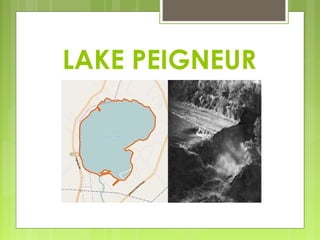
ļ‚› Lake PeigneurĀ is located in theĀ USĀ state
ofĀ Louisiana, 1.2 miles (1.9Ā km) north
ofĀ DelcambreĀ and 9.1 miles (14.6Ā km) west
ofĀ New Iberia, near the northernmost tip
ofĀ Vermilion Bay.
ļ‚› It was a 10-foot (3m) deepĀ freshwaterĀ body
popular with sportsmen, until an unusual
man-made disaster on November 20, 1980
changed its structure and the surrounding
land.
LAKE PEIGNEUR
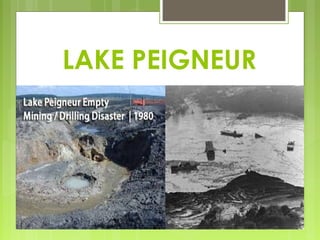
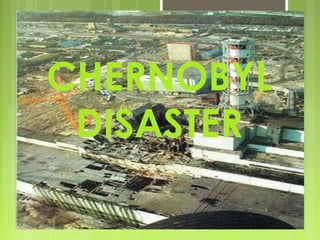
ļ‚› On November 20, 1980, anĀ oil rigĀ contracted
byĀ TexacoĀ accidentally drilled into theĀ Diamond
Crystal Salt CompanyĀ salt mineĀ under the lake.
ļ‚› Because of an incorrect or misinterpretedĀ coordinate
reference system the rig was positioned as if the
coordinates were in theĀ Universal Transverse Mercator
coordinate systemĀ when, in actuality, they were
inĀ transverse Mercator projection the 14-inch (36Ā cm)
drill bit entered the mine, starting a chain of events
which turned the lake from freshwater to salt water,
with a deep hole.
LAKE PEIGNEUR
ļ‚› It is difficult to determine what occurred, as much
evidence was destroyed or washed away in the
ensuingĀ maelstrom.
ļ‚› One explanation is that a miscalculation by Texaco
about their location resulted in the drill puncturing the
roof of the third level of the mine. This created an
opening in the bottom of the lake.
ļ‚› The lake then drained into the hole, expanding the size
of that hole as the soil and salt were washed into the
mine by the rushing water, filling the enormous
caverns that had been left by the removal of salt over
the years.
LAKE PEIGNEUR
ļ‚› Although there were no injuries and no human lives
lost, three dogs were reported killed. All 55 employees
in the mine at the time of the accident were able to
escape thanks to well-planned and rehearsed
evacuation drills.
ļ‚› While the crew of the drilling rig fled the platform
before it was sucked down into the new depths of the
lake, and Leonce Viator, Jr., a fisherman who was on
the lake at the time, was able to drive his small boat to
the shore and escape.
ļ‚› Days after the disaster, once the water pressure
equalized, nine of the eleven sunkenĀ barges popped
out of the whirlpool and refloated on the lake's surface.
LAKE PEIGNEUR
LAKE PEIGNEUR
CHERNOBYL
DISASTER
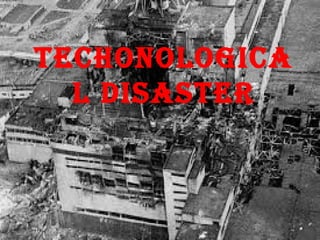
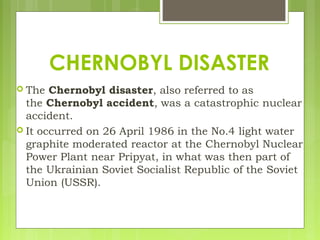
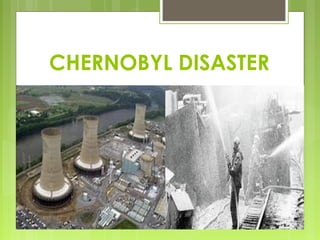
ļ‚› TheĀ Chernobyl disaster, also referred to as
theĀ Chernobyl accident, was aĀ catastrophicĀ nuclear
accident.
ļ‚› It occurred on 26 April 1986 in the No.4Ā light water
graphite moderated reactorĀ at theĀ Chernobyl Nuclear
Power PlantĀ nearĀ Pripyat, in what was then part of
theĀ Ukrainian Soviet Socialist RepublicĀ of theĀ Soviet
UnionĀ (USSR).
CHERNOBYL DISASTER
ļ‚› The event occurred during a late-night safety test
which simulated aĀ station blackoutĀ power-failure
and in whichĀ safety systemsĀ were deliberately
turned off.
ļ‚› A combination of inherentĀ reactor design
flawsĀ and the reactor operatorsĀ arranging the
coreĀ in a manner contrary to theĀ checklistĀ for the
test, eventually resulted inĀ uncontrolled reaction
conditions. Water flashed into steam generating
a destructiveĀ steam explosionĀ and a subsequent
open-airĀ graphiteĀ fire.
CHERNOBYL DISASTER
ļ‚› This fire produced considerableĀ updraftsĀ for about
nine days. These loftedĀ plumesĀ ofĀ fission
productsĀ into the atmosphere.
ļ‚› The estimated radioactive inventory that was
released during this very hot fire phase
approximately equalled in magnitude the airborne
fission products released in the initial destructive
explosion.Ā 
ļ‚› Practically all of this radioactive material would
then go on toĀ fall-out/precipitate onto much of the
surface of the western USSR and Europe.
CHERNOBYL DISASTER
ļ‚› During the accident, blast effects causedĀ 2
deathsĀ within the facility, later 134 were hospitalized
with acute radiation symptoms, of whichĀ 28 firemen
and employees diedĀ in the days-to-months afterward
from the effects ofĀ acute radiation syndrome, in
addition, approximately 14 cancer deaths amongst this
group of initially hospitalized survivors was to follow
within the next ten years(1996).
ļ‚› Whilst among the wider population, an excess of 15
childhoodĀ thyroid cancerĀ deaths had been documented
as of 2011.It will take further time and investigative
funding to definitively determine the elevatedĀ relative
riskĀ of cancer amongst both the surviving employees
and the population at large.
CHERNOBYL DISASTER
CHERNOBYL DISASTER
Thank
You……..

Technological disaster

  • 1.
  • 2.
    LE(ME) ACTIVITY WORK MADE BY:KRISHNARAJ MISHRA(ME038) MANOJ CHAUHAN(ME037) HARSH MISTRY(ME029) RAHUL PAL
  • 3.
    WHAT IS TECHNOLOGICAL DISASTER? ļ‚›AĀ technological disasterĀ is an event caused by a malfunction of aĀ technological structure and/or some human error in controlling or handling the technology. The effects of aĀ disasterĀ on families and individuals may be long lasting and can endure for years.
  • 4.
    ļ‚› Disasters causedby technology involve the failure or breakdown of systems, equipment and engineering standards that harms people and the environment. ļ‚› The term itself includes a wide range of modern issues and consequences of technology mismanagement and engineering mistakes. ļ‚› Technology disasters include structural collapses, such as bridges, mines and buildings, but also industrial accidents, such as chemical or nuclear explosions.
  • 5.
  • 6.
    ļ‚› Lake PeigneurĀ islocated in theĀ USĀ state ofĀ Louisiana, 1.2 miles (1.9Ā km) north ofĀ DelcambreĀ and 9.1 miles (14.6Ā km) west ofĀ New Iberia, near the northernmost tip ofĀ Vermilion Bay. ļ‚› It was a 10-foot (3m) deepĀ freshwaterĀ body popular with sportsmen, until an unusual man-made disaster on November 20, 1980 changed its structure and the surrounding land. LAKE PEIGNEUR
  • 7.
    ļ‚› On November20, 1980, anĀ oil rigĀ contracted byĀ TexacoĀ accidentally drilled into theĀ Diamond Crystal Salt CompanyĀ salt mineĀ under the lake. ļ‚› Because of an incorrect or misinterpretedĀ coordinate reference system the rig was positioned as if the coordinates were in theĀ Universal Transverse Mercator coordinate systemĀ when, in actuality, they were inĀ transverse Mercator projection the 14-inch (36Ā cm) drill bit entered the mine, starting a chain of events which turned the lake from freshwater to salt water, with a deep hole. LAKE PEIGNEUR
  • 8.
    ļ‚› It isdifficult to determine what occurred, as much evidence was destroyed or washed away in the ensuingĀ maelstrom. ļ‚› One explanation is that a miscalculation by Texaco about their location resulted in the drill puncturing the roof of the third level of the mine. This created an opening in the bottom of the lake. ļ‚› The lake then drained into the hole, expanding the size of that hole as the soil and salt were washed into the mine by the rushing water, filling the enormous caverns that had been left by the removal of salt over the years. LAKE PEIGNEUR
  • 9.
    ļ‚› Although therewere no injuries and no human lives lost, three dogs were reported killed. All 55 employees in the mine at the time of the accident were able to escape thanks to well-planned and rehearsed evacuation drills. ļ‚› While the crew of the drilling rig fled the platform before it was sucked down into the new depths of the lake, and Leonce Viator, Jr., a fisherman who was on the lake at the time, was able to drive his small boat to the shore and escape. ļ‚› Days after the disaster, once the water pressure equalized, nine of the eleven sunkenĀ barges popped out of the whirlpool and refloated on the lake's surface. LAKE PEIGNEUR
  • 10.
  • 11.
  • 12.
    ļ‚› TheĀ Chernobyl disaster,also referred to as theĀ Chernobyl accident, was aĀ catastrophicĀ nuclear accident. ļ‚› It occurred on 26 April 1986 in the No.4Ā light water graphite moderated reactorĀ at theĀ Chernobyl Nuclear Power PlantĀ nearĀ Pripyat, in what was then part of theĀ Ukrainian Soviet Socialist RepublicĀ of theĀ Soviet UnionĀ (USSR). CHERNOBYL DISASTER
  • 13.
    ļ‚› The eventoccurred during a late-night safety test which simulated aĀ station blackoutĀ power-failure and in whichĀ safety systemsĀ were deliberately turned off. ļ‚› A combination of inherentĀ reactor design flawsĀ and the reactor operatorsĀ arranging the coreĀ in a manner contrary to theĀ checklistĀ for the test, eventually resulted inĀ uncontrolled reaction conditions. Water flashed into steam generating a destructiveĀ steam explosionĀ and a subsequent open-airĀ graphiteĀ fire. CHERNOBYL DISASTER
  • 14.
    ļ‚› This fireproduced considerableĀ updraftsĀ for about nine days. These loftedĀ plumesĀ ofĀ fission productsĀ into the atmosphere. ļ‚› The estimated radioactive inventory that was released during this very hot fire phase approximately equalled in magnitude the airborne fission products released in the initial destructive explosion.Ā  ļ‚› Practically all of this radioactive material would then go on toĀ fall-out/precipitate onto much of the surface of the western USSR and Europe. CHERNOBYL DISASTER
  • 15.
    ļ‚› During theaccident, blast effects causedĀ 2 deathsĀ within the facility, later 134 were hospitalized with acute radiation symptoms, of whichĀ 28 firemen and employees diedĀ in the days-to-months afterward from the effects ofĀ acute radiation syndrome, in addition, approximately 14 cancer deaths amongst this group of initially hospitalized survivors was to follow within the next ten years(1996). ļ‚› Whilst among the wider population, an excess of 15 childhoodĀ thyroid cancerĀ deaths had been documented as of 2011.It will take further time and investigative funding to definitively determine the elevatedĀ relative riskĀ of cancer amongst both the surviving employees and the population at large. CHERNOBYL DISASTER
  • 16.
  • 17.