Communication for Change

  A SHORT GUIDE TO SOCIAL AND BEHAVIOR
    CHANGE (SBCC) THEORY AND MODELS
More harm than good?
                           2

 When we set out to improve life for others without a
 fundamental understanding of their point of view
 and quality of experience, we do more harm than
 good. (Lauren Reichelt, Tikkun, Winter 2011)
3


Why use
                           Answers to key questions
theories and
                             What problems exists
models?
                             Why a problem exists

Theory can guide the         Whom to select
design, implementation
                             What to know before taking action
of evidence-
based programs, and          How to reach people with impact
evaluations. Adequately
addressing an issue          What strategies likely to cause change
may require more than
one theory, and that no
one theory is suitable
for all cases
(Glanz, Rimer, and
Sharyn 2005).
Evolution of Key Concepts
            4
Communication concepts a generation ago…
                      5

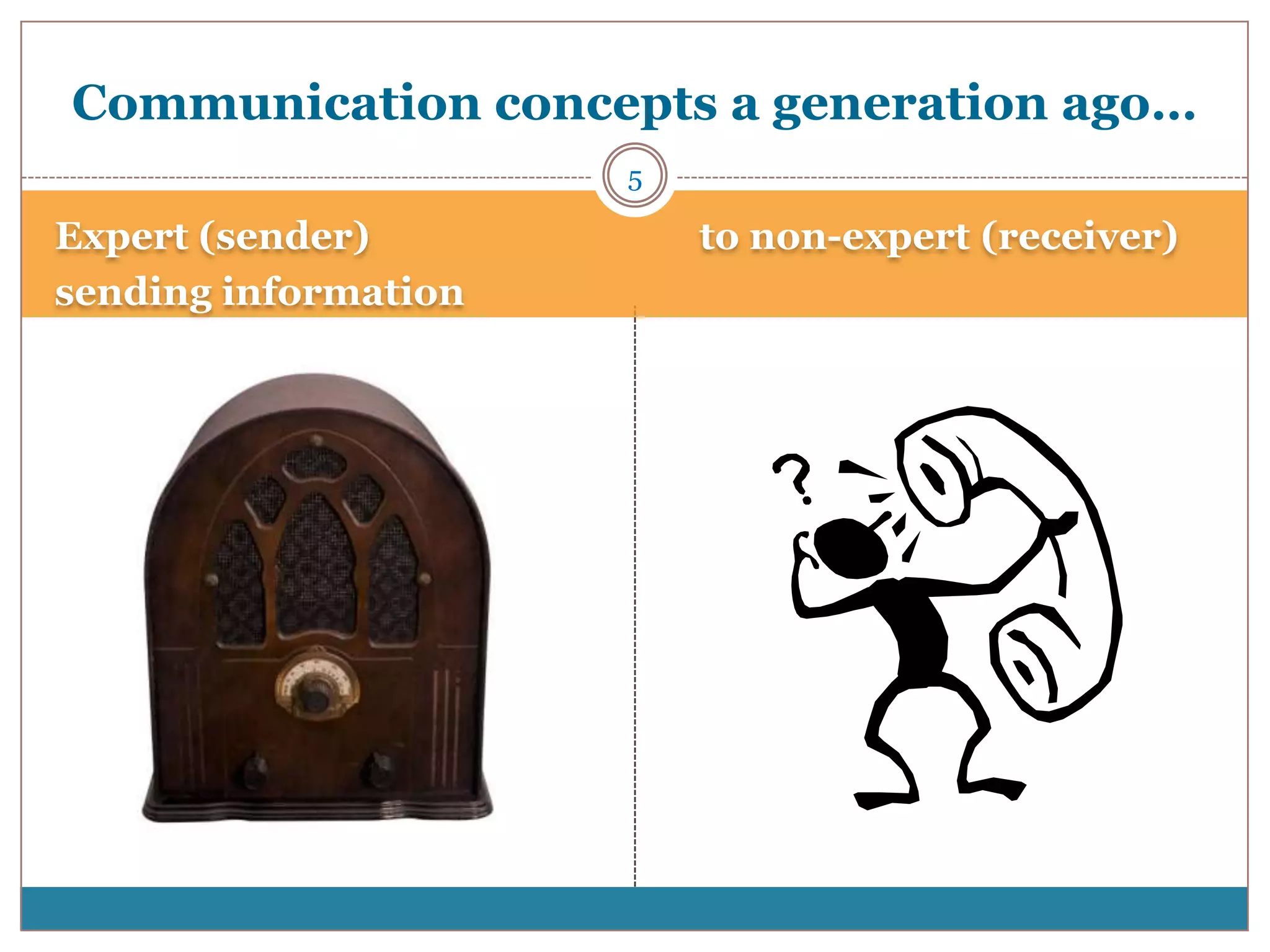
Expert (sender)           to non-expert (receiver)
sending information
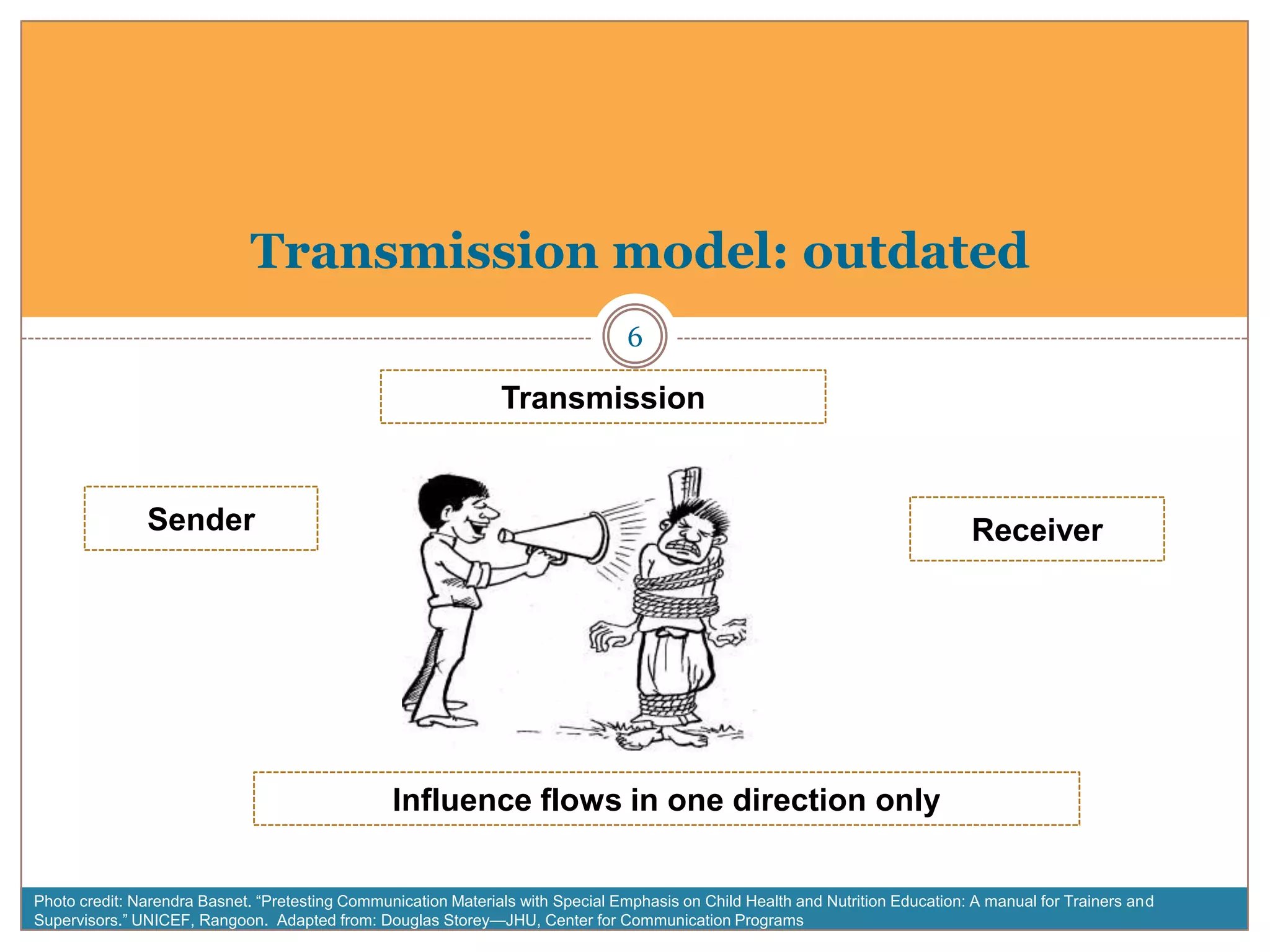
Transmission model: outdated
                                                                                  6

                                                                Transmission


               Sender                                                                                                            Receiver


                                                 Influence flows in one direction only


Photo credit: Narendra Basnet. “Pretesting Communication Materials with Special Emphasis on Child Health and Nutrition Education: A manual for Trainers and
Supervisors.” UNICEF, Rangoon. Adapted from: Douglas Storey—JHU, Center for Communication Programs
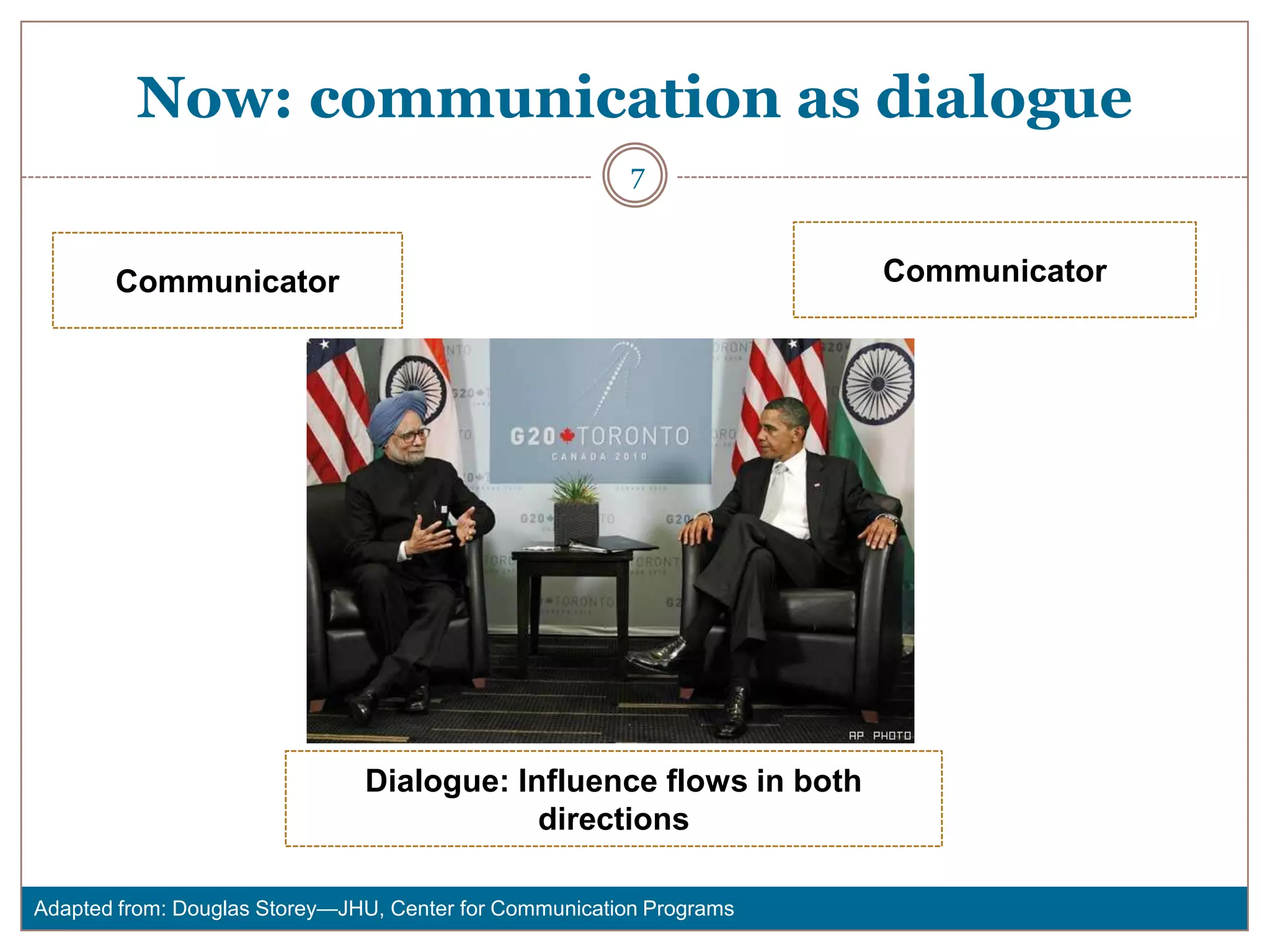
Now: communication as dialogue
                                                         7


       Communicator                                                   Communicator


                               Dialogue: Influence flows in both
                                           directions

Adapted from: Douglas Storey—JHU, Center for Communication Programs
Evolution of key concepts
                                                        8

  Older approaches tried to persuade individuals to
   change their health behaviors
  Newer approaches try to create an enabling
   environment to encourage healthy behaviors
  New approaches look for tipping points of change
   that need to address social change as much as
   individual behavior change


Adapted from: Douglas Storey—JHU, Center for Communication Programs
Core Theories
             9

THAT HAVE FUELED THE CURRENT
          THINKING
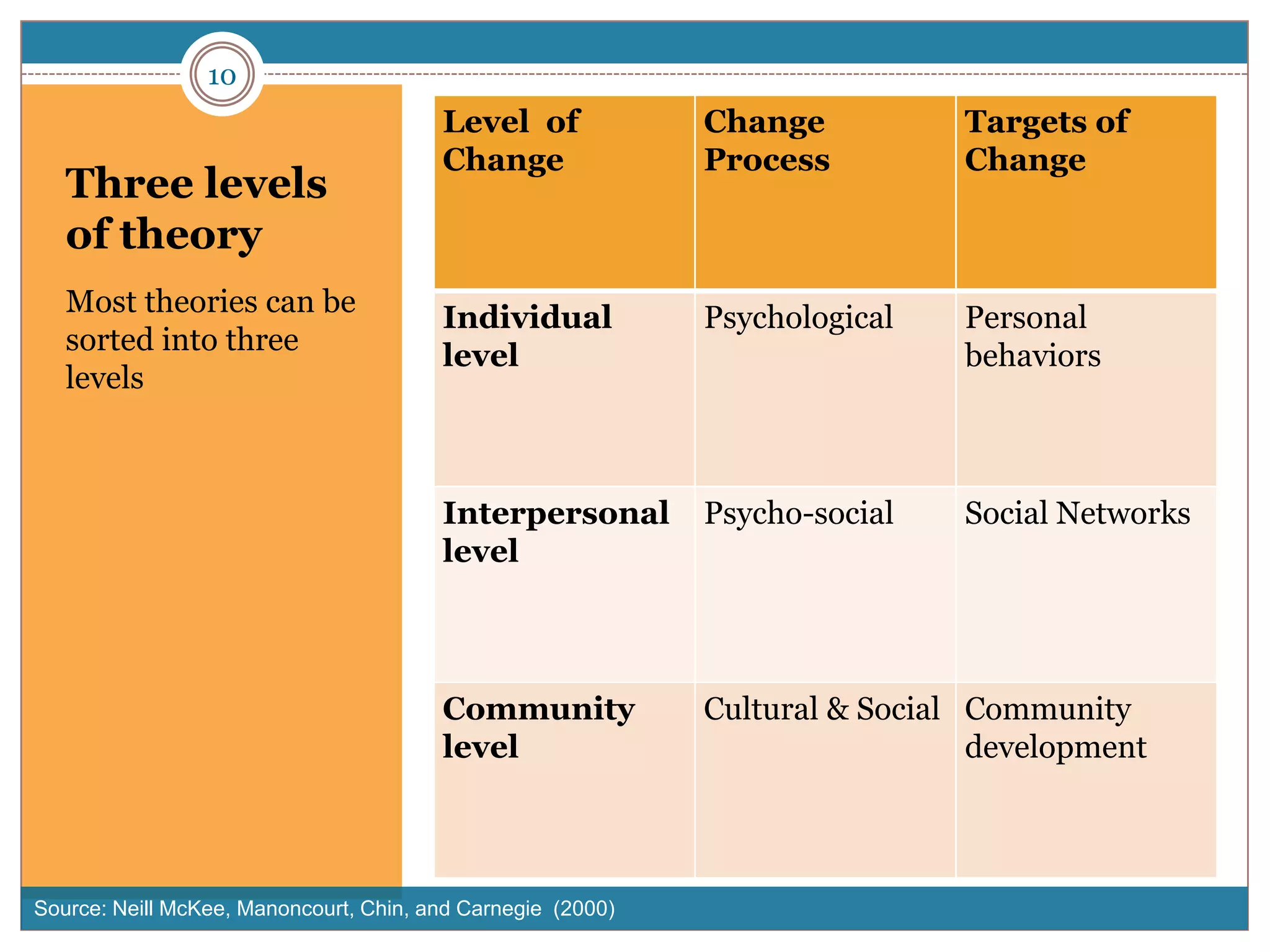
10
                                        Level of             Change           Targets of
                                        Change               Process          Change
   Three levels
   of theory
   Most theories can be
                                        Individual           Psychological    Personal
   sorted into three                    level                                 behaviors
   levels


                                        Interpersonal        Psycho-social    Social Networks
                                        level


                                        Community            Cultural & Social Community
                                        level                                  development


Source: Neill McKee, Manoncourt, Chin, and Carnegie (2000)
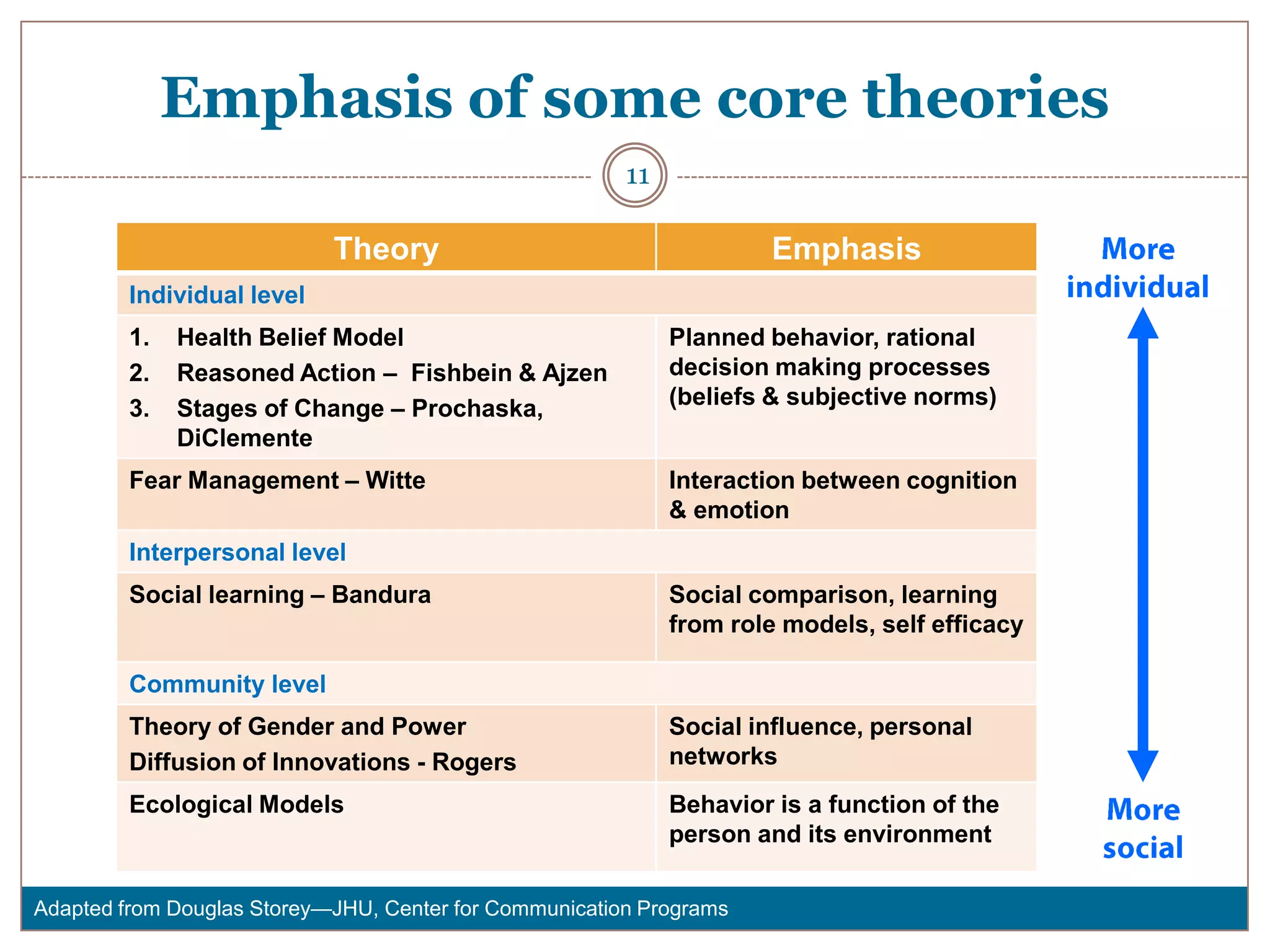
Emphasis of some core theories
                                                        11

                            Theory                                    Emphasis
         Individual level
         1.   Health Belief Model                            Planned behavior, rational
         2.   Reasoned Action – Fishbein & Ajzen             decision making processes
         3.   Stages of Change – Prochaska,                  (beliefs & subjective norms)
              DiClemente
         Fear Management – Witte                             Interaction between cognition
                                                             & emotion
         Interpersonal level
         Social learning – Bandura                           Social comparison, learning
                                                             from role models, self efficacy

         Community level
         Theory of Gender and Power                          Social influence, personal
         Diffusion of Innovations - Rogers                   networks
         Ecological Models                                   Behavior is a function of the
                                                             person and its environment

Adapted from Douglas Storey—JHU, Center for Communication Programs
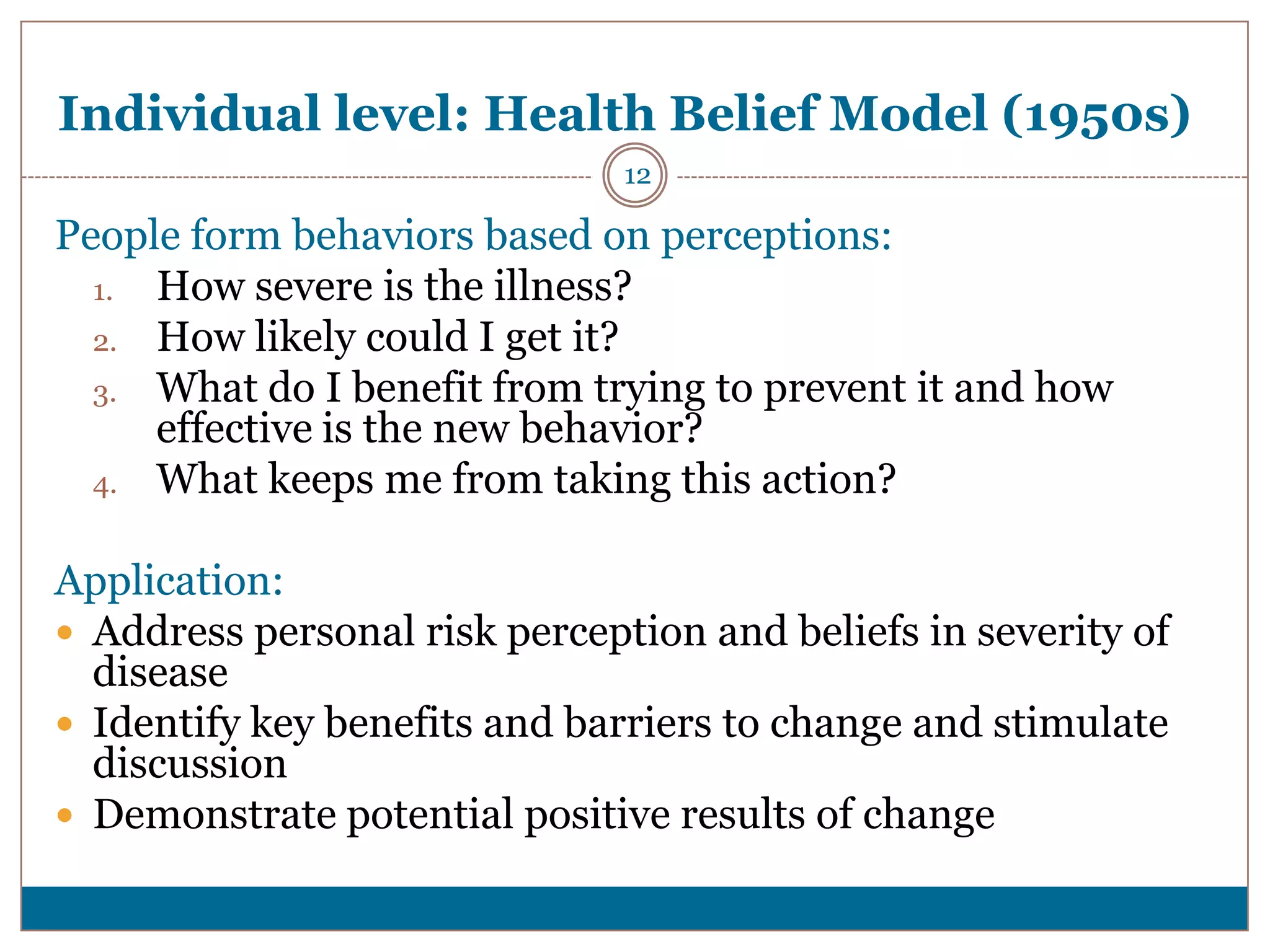
Individual level: Health Belief Model (1950s)
                               12

People form behaviors based on perceptions:
  1. How severe is the illness?
  2. How likely could I get it?
  3. What do I benefit from trying to prevent it and how
     effective is the new behavior?
  4. What keeps me from taking this action?


Application:
 Address personal risk perception and beliefs in severity of
  disease
 Identify key benefits and barriers to change and stimulate
  discussion
 Demonstrate potential positive results of change
Individual level : Reasoned Action (1960s)
                                    13

People make decisions by:
 Weighing the advantages and disadvantages of behaviors before
  deciding to practice it
 People base their intentions to act on two things:
   their attitudes (whether performing the behavior is a good thing or a
    bad thing)
   their subjective norms (whether other people around you are
    performing it and think that you should do that too)

Application:
 Identify motivators and benefits for action
 Create messages that can affect attitudes
 Identify audiences that influence the group your are trying to reach
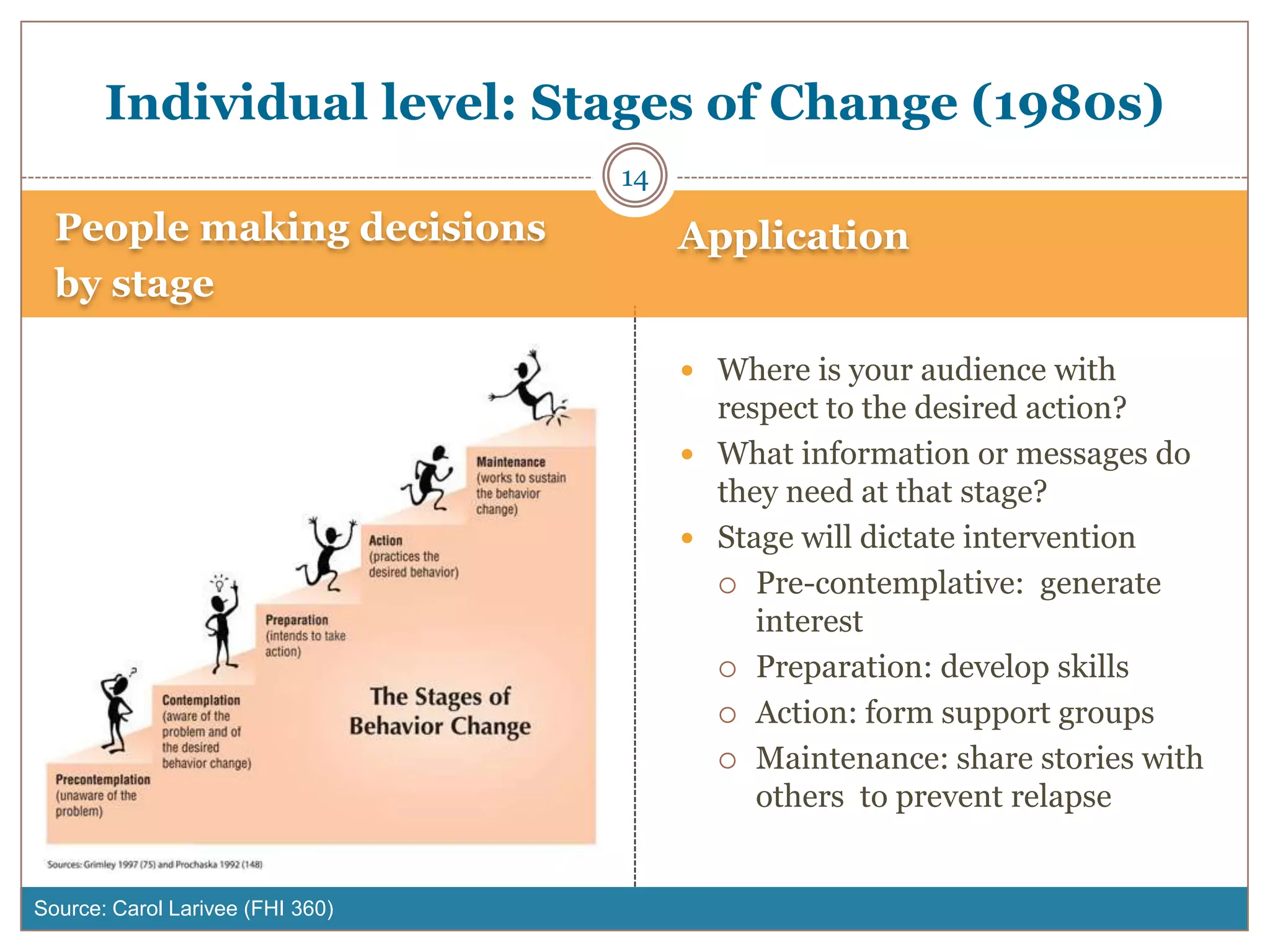
Individual level: Stages of Change (1980s)
                                  14
  People making decisions              Application
  by stage

                                        Where is your audience with
                                         respect to the desired action?
                                        What information or messages do
                                         they need at that stage?
                                        Stage will dictate intervention
                                          Pre-contemplative: generate
                                            interest
                                          Preparation: develop skills

                                          Action: form support groups

                                          Maintenance: share stories with
                                            others to prevent relapse


Source: Carol Larivee (FHI 360)
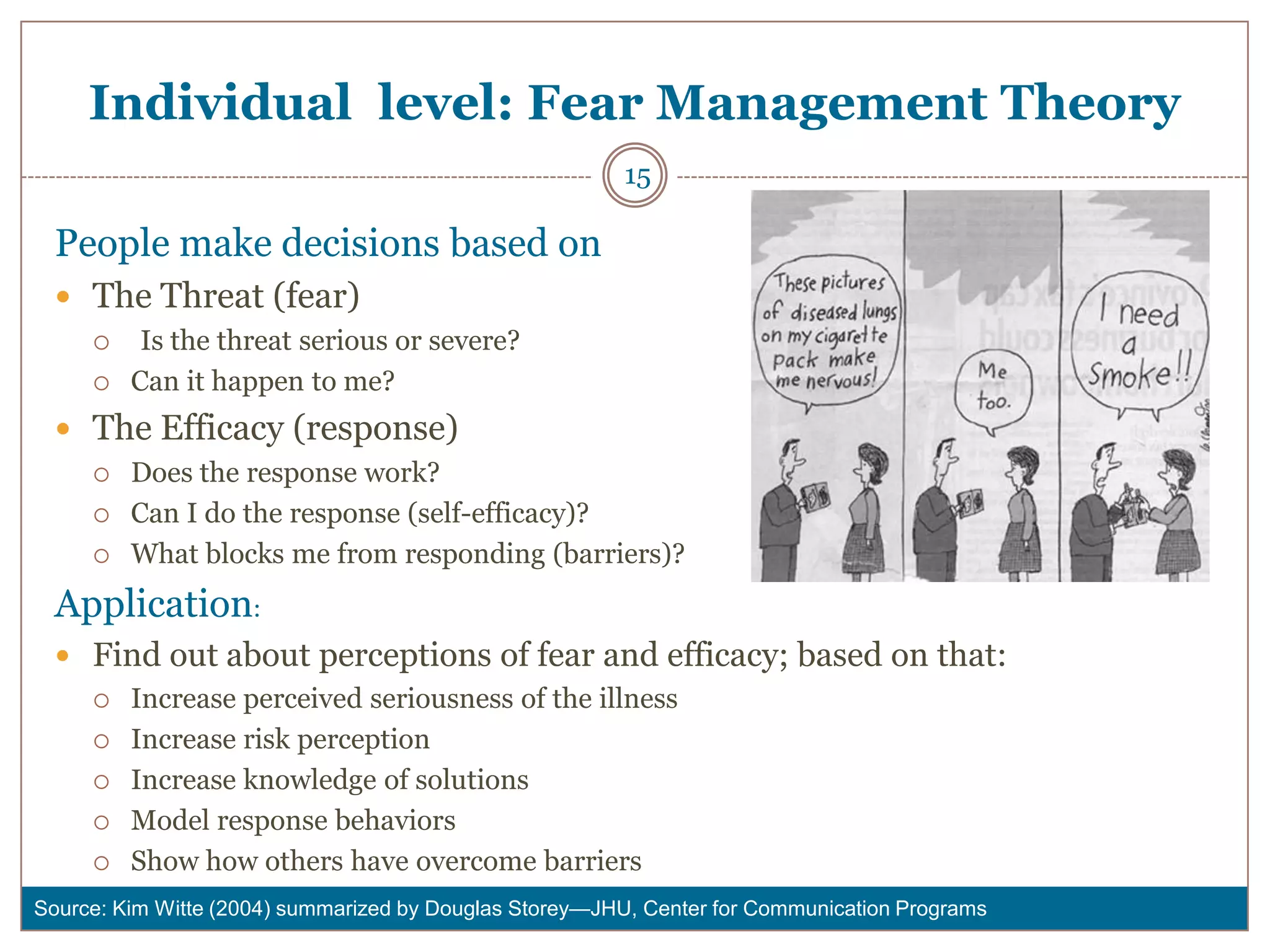
Individual level: Fear Management Theory
                                                        15

  People make decisions based on
   The Threat (fear)
         Is the threat serious or severe?
        Can it happen to me?
   The Efficacy (response)
        Does the response work?
        Can I do the response (self-efficacy)?
        What blocks me from responding (barriers)?
  Application:
   Find out about perceptions of fear and efficacy; based on that:
     Increase perceived seriousness of the illness

     Increase risk perception

     Increase knowledge of solutions

     Model response behaviors

     Show how others have overcome barriers

Source: Kim Witte (2004) summarized by Douglas Storey—JHU, Center for Communication Programs
Interpersonal level: Principles of Social Learning (1970s)
                                    16

People learn and decide how to act by:
   Observing the actions of others
   Observing the apparent consequences of those actions
   Checking those consequences for their own lives
   Trying out those actions themselves

Application:
   Identify key role models in the community
   Provide opportunities for them to model or talk about their behaviors
   Showcase role models and their actions through radio dramas,
    personal testimonials, community discussions
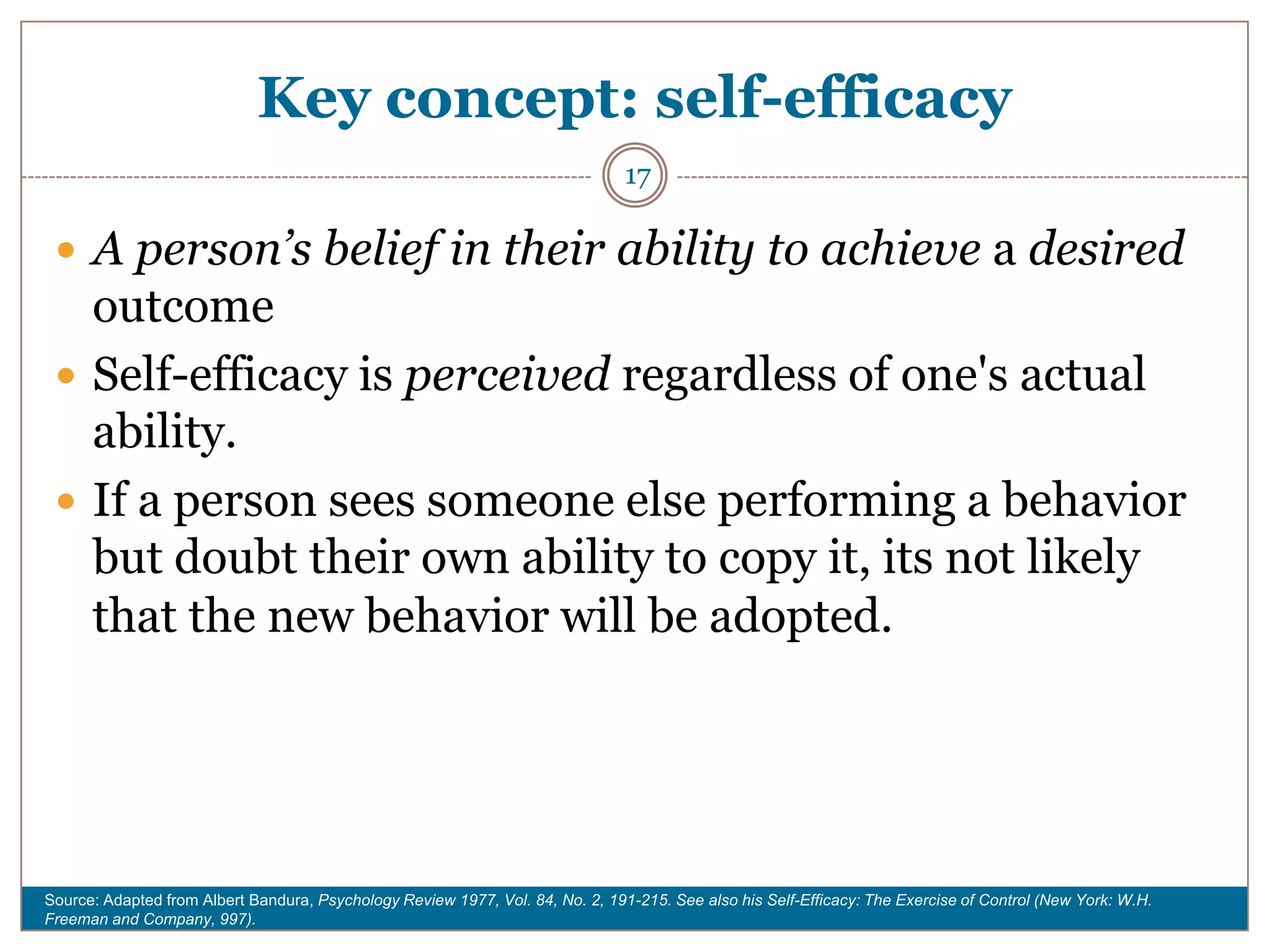
Key concept: self-efficacy
                                                                                17

  A person’s belief in their ability to achieve a desired
   outcome
  Self-efficacy is perceived regardless of one's actual
   ability.
  If a person sees someone else performing a behavior
   but doubt their own ability to copy it, its not likely
   that the new behavior will be adopted.


Source: Adapted from Albert Bandura, Psychology Review 1977, Vol. 84, No. 2, 191-215. See also his Self-Efficacy: The Exercise of Control (New York: W.H.
Freeman and Company, 997).
Summary of individual BCC theories
                                                              18

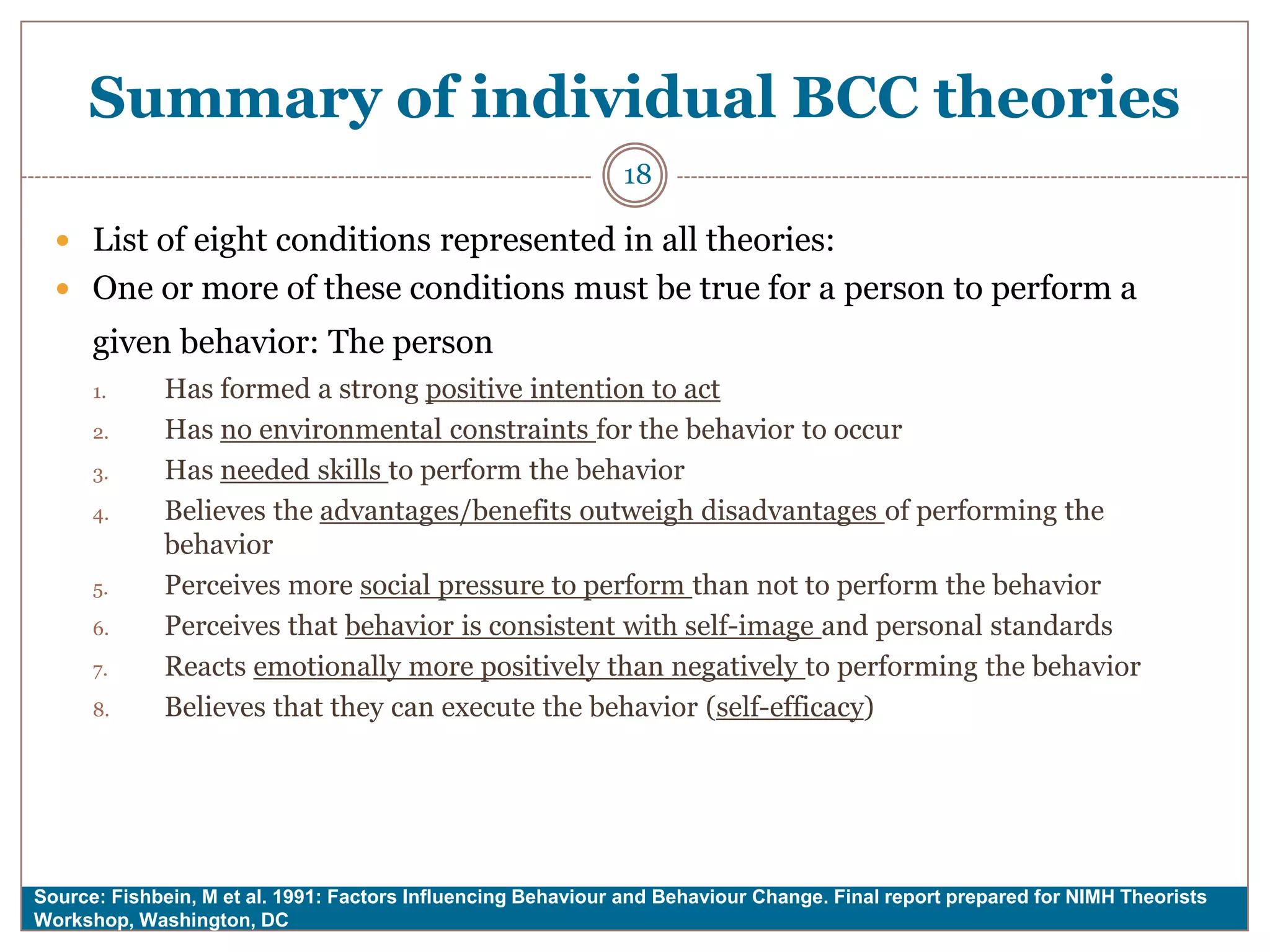
   List of eight conditions represented in all theories:
   One or more of these conditions must be true for a person to perform a
      given behavior: The person
      1.     Has formed a strong positive intention to act
      2.     Has no environmental constraints for the behavior to occur
      3.     Has needed skills to perform the behavior
      4.     Believes the advantages/benefits outweigh disadvantages of performing the
             behavior
      5.     Perceives more social pressure to perform than not to perform the behavior
      6.     Perceives that behavior is consistent with self-image and personal standards
      7.     Reacts emotionally more positively than negatively to performing the behavior
      8.     Believes that they can execute the behavior (self-efficacy)


Source: Fishbein, M et al. 1991: Factors Influencing Behaviour and Behaviour Change. Final report prepared for NIMH Theorists
Workshop, Washington, DC
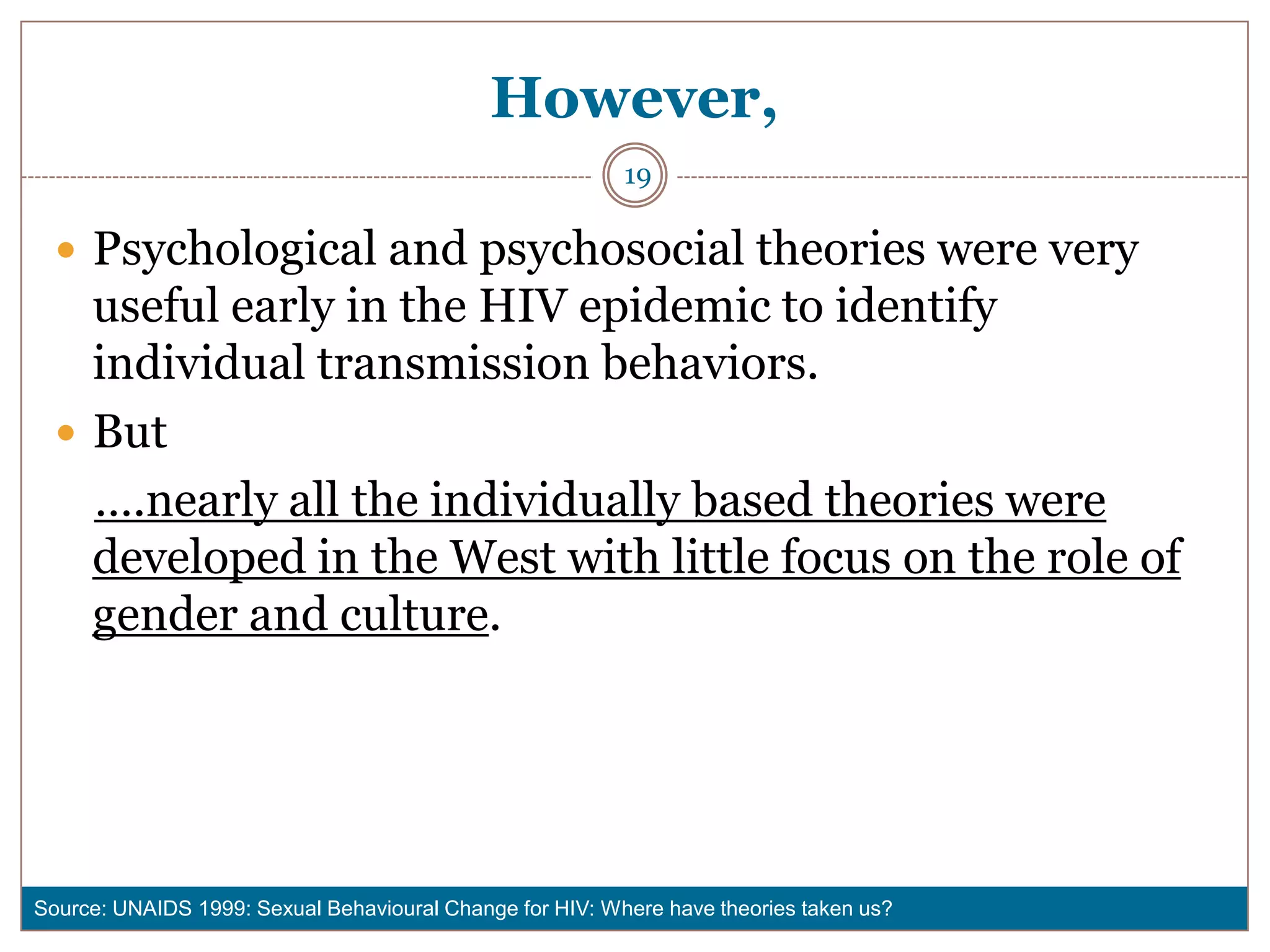
However,
                                                          19

   Psychological and psychosocial theories were very
    useful early in the HIV epidemic to identify
    individual transmission behaviors.
   But
    ….nearly all the individually based theories were
    developed in the West with little focus on the role of
    gender and culture.


Source: UNAIDS 1999: Sexual Behavioural Change for HIV: Where have theories taken us?
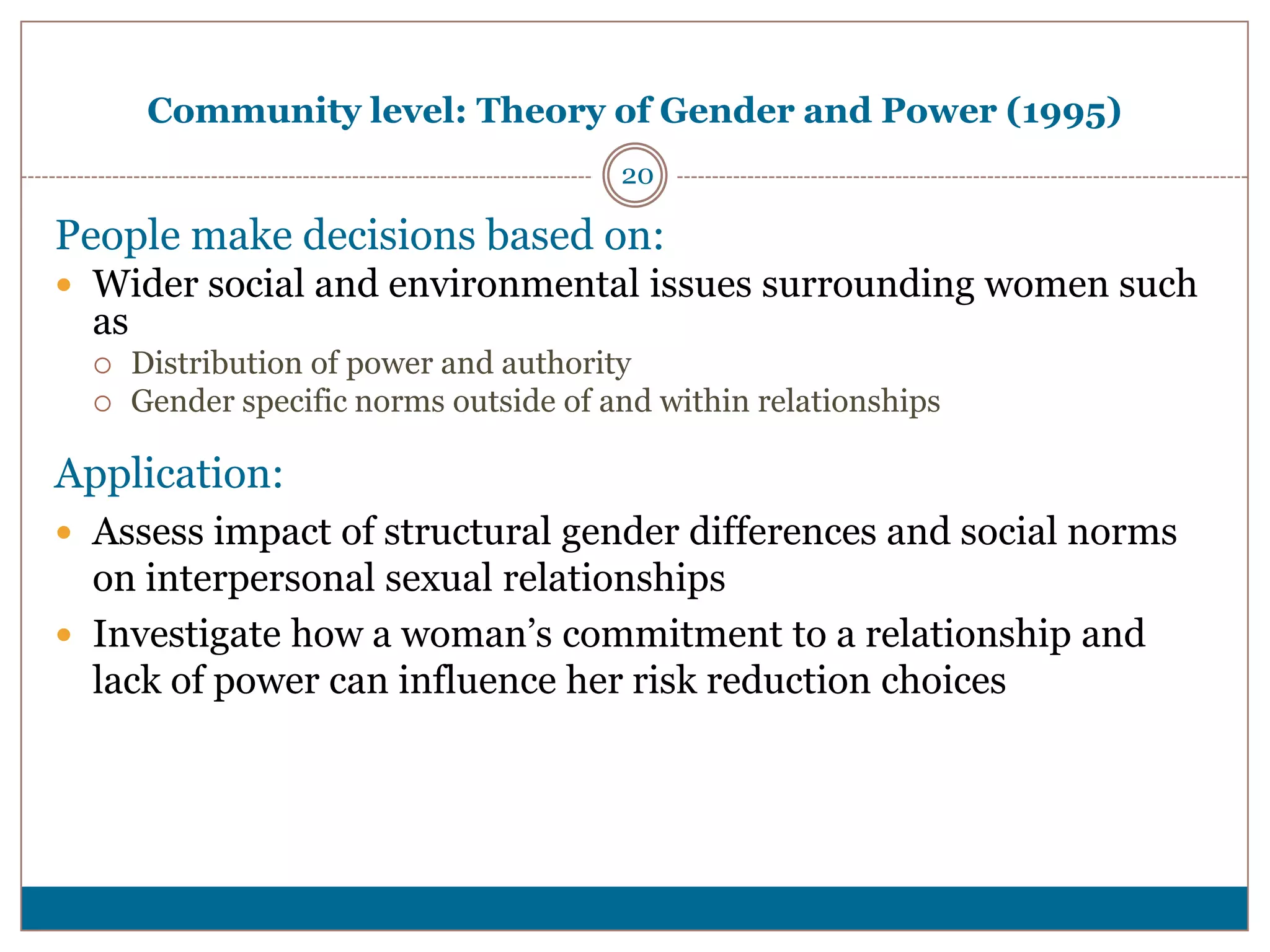
Community level: Theory of Gender and Power (1995)
                                         20

People make decisions based on:
 Wider social and environmental issues surrounding women such
  as
      Distribution of power and authority
      Gender specific norms outside of and within relationships

Application:
 Assess impact of structural gender differences and social norms
  on interpersonal sexual relationships
 Investigate how a woman’s commitment to a relationship and
  lack of power can influence her risk reduction choices
Community level: Diffusion of Innovations (1960s)
                                      21

Innovations are spread through:
 Social networks over time
 The speed at which an innovation spreads depends on
       What people think about the innovations and the people using it
       How well the social network works


Application:
 Identify how audience thinks of the innovation
 Identify opinion leader in the network
 Identify messages that address concerns about the innovation
 Demonstrate what happens to others when they try the
 innovation
A shift in thinking
            22

SOCIAL AND BEHAVIOR CHANGE
      COMMUNICATION
Shift in thinking
                                   23
 Over the years, there has
  been a shift in thinking
  about behavior change
  communication:
     Simply giving correct
      information – while
      important – does not
      change behavior by itself
     Only addressing individual
      behaviors is often not
      enough either
Key facts about human behavior
                          24

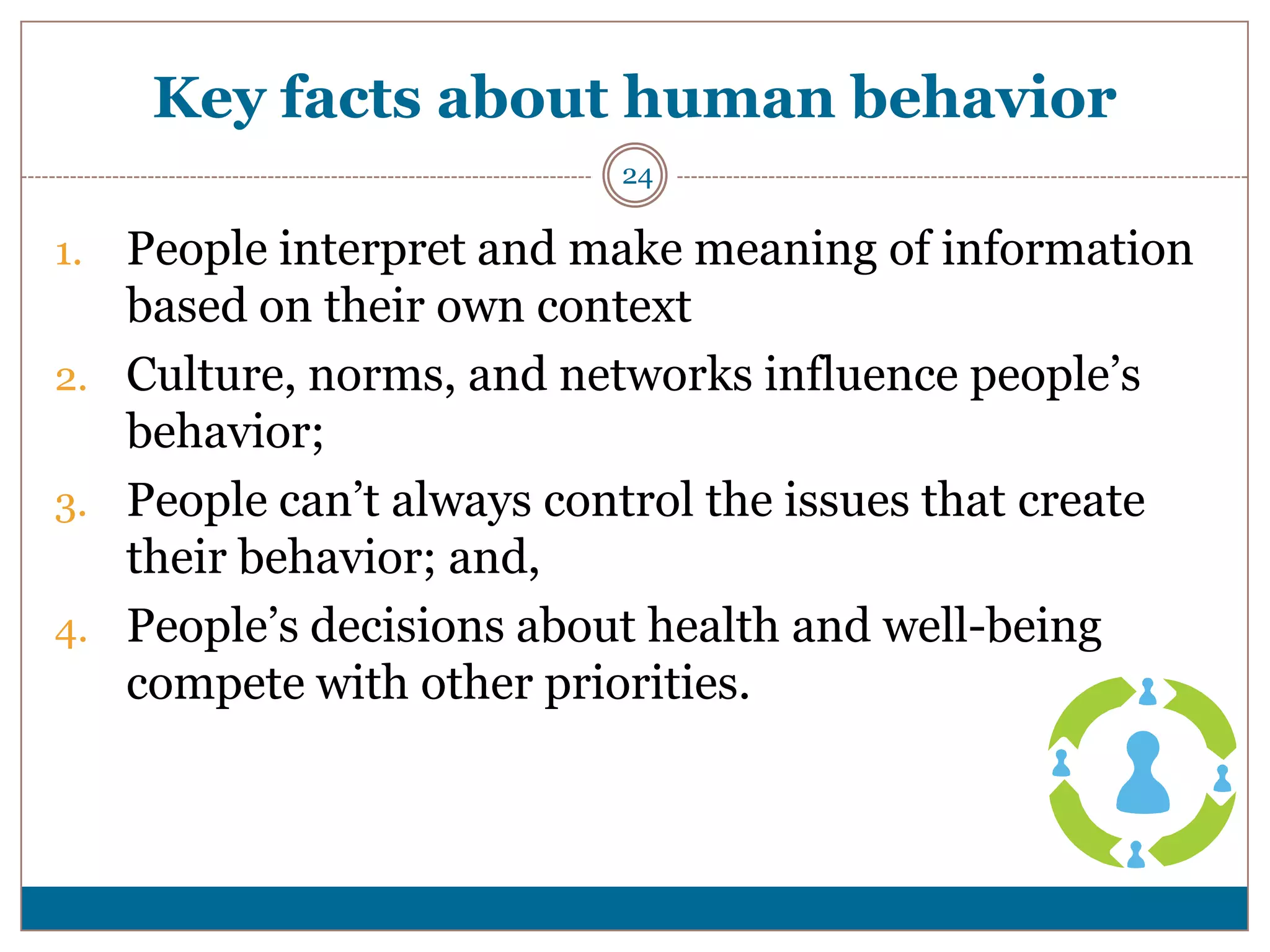
1. People interpret and make meaning of information
   based on their own context
2. Culture, norms, and networks influence people’s
   behavior;
3. People can’t always control the issues that create
   their behavior; and,
4. People’s decisions about health and well-being
   compete with other priorities.
What is SBCC?
                                       25

 SBCC is the systematic application of interactive, theory
  based, and research-driven communication processes and
  strategies to address “tipping points” for change at the
  individual, community, and social levels.
 A tipping point refers to the dynamics of social change
  where trends rapidly evolve into permanent changes.
     A tipping point can be driven by a naturally occurring event or a strong
      determinant for change, such as political will, that provides the final
      push to “tip over” barriers to change.
     Tipping points describe how momentum builds up to a point where
      change gains strength and becomes unstoppable.
SBCC has 3 characteristics:
                                  26

1. SBCC is an interactive, researched and planned
   process
2. SBCC requires a socio-ecological model for analysis
   to find the tipping point for change
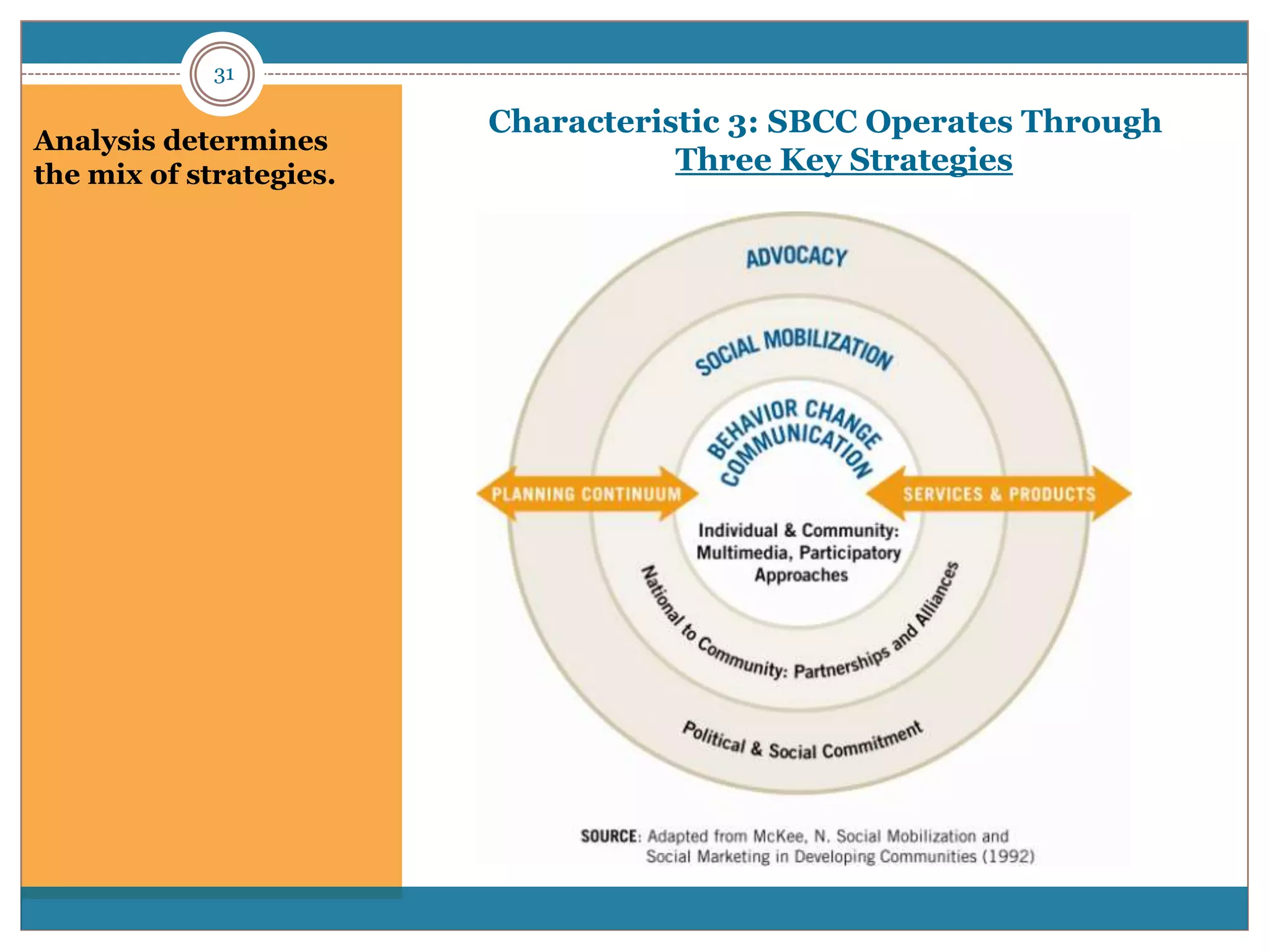
3. SBCC operates through three main
   strategies, namely
     a)   advocacy,
     b)   social mobilization, and
     c)   behavior change communication
27
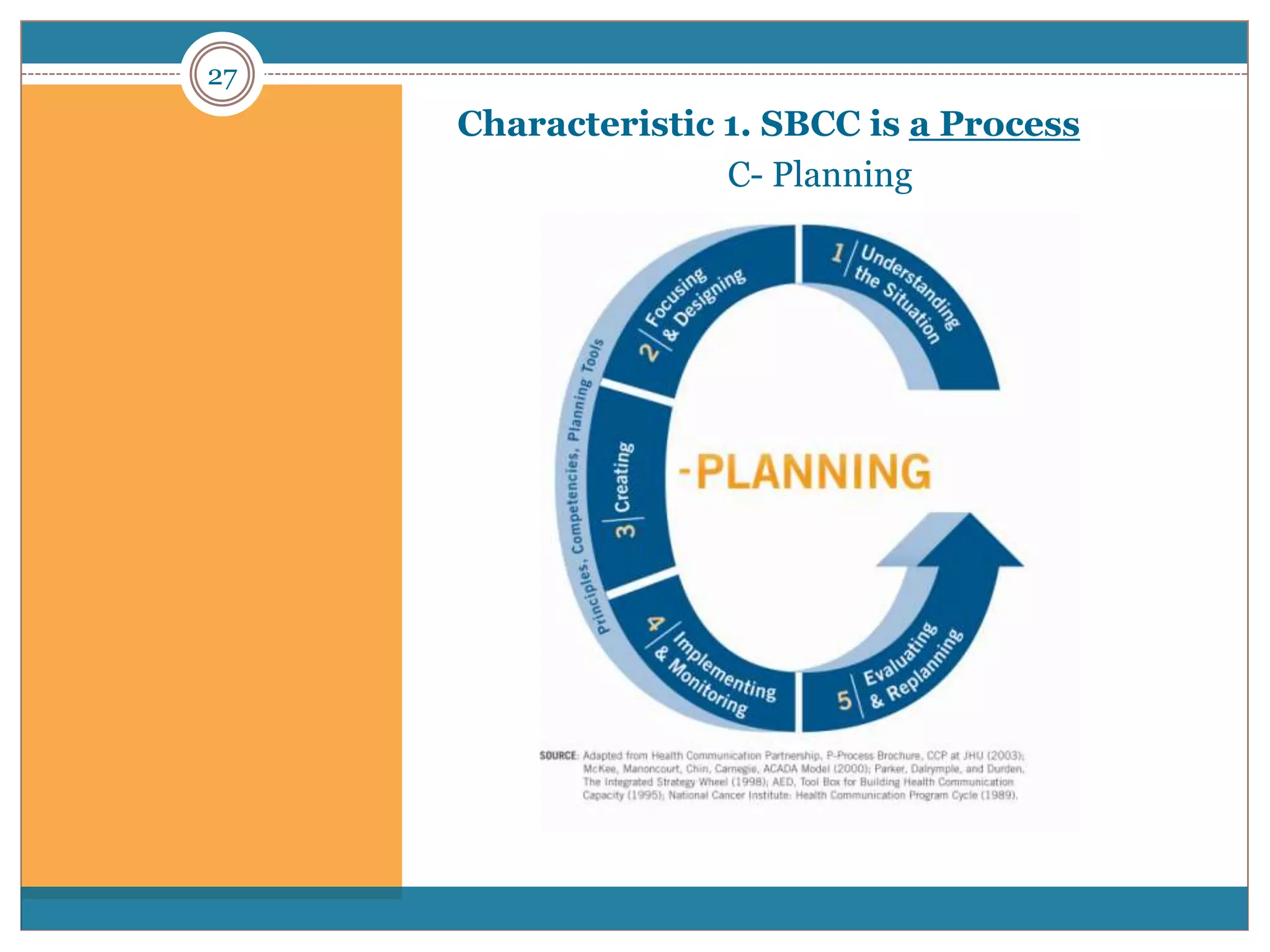
     Characteristic 1. SBCC is a Process
                    C- Planning
28
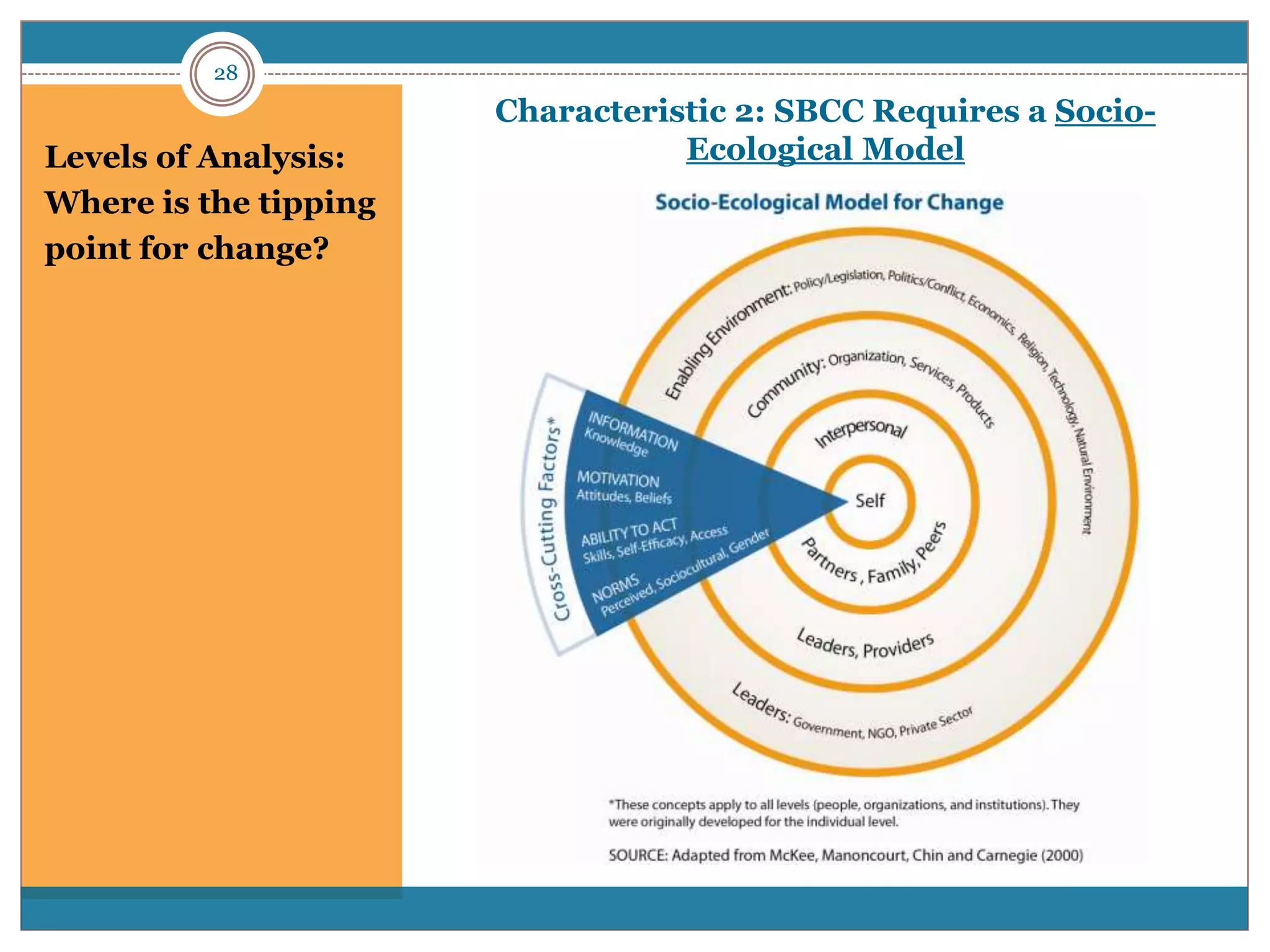
                       Characteristic 2: SBCC Requires a Socio-
Levels of Analysis:               Ecological Model
Where is the tipping
point for change?
29


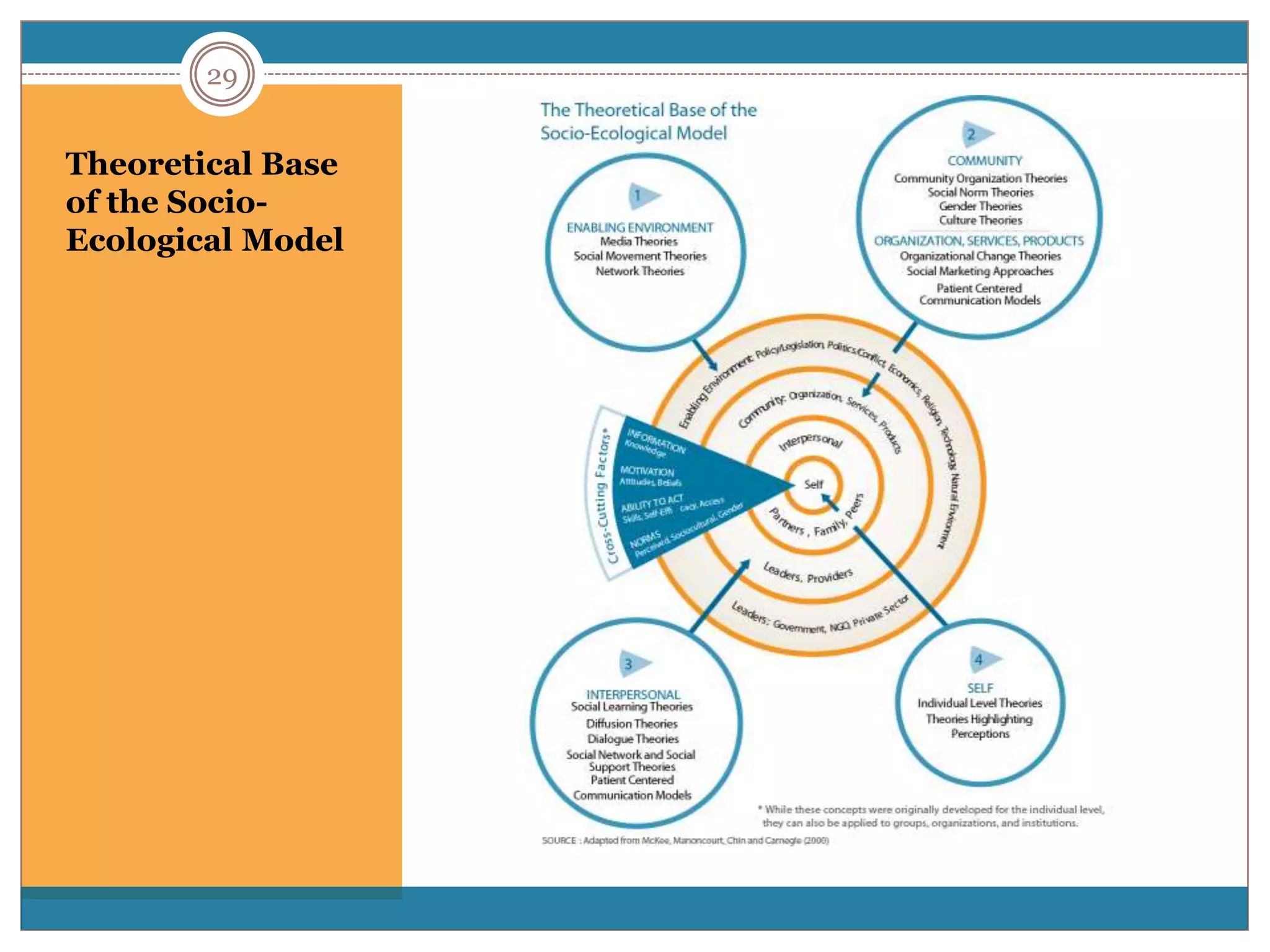
Theoretical Base
of the Socio-
Ecological Model
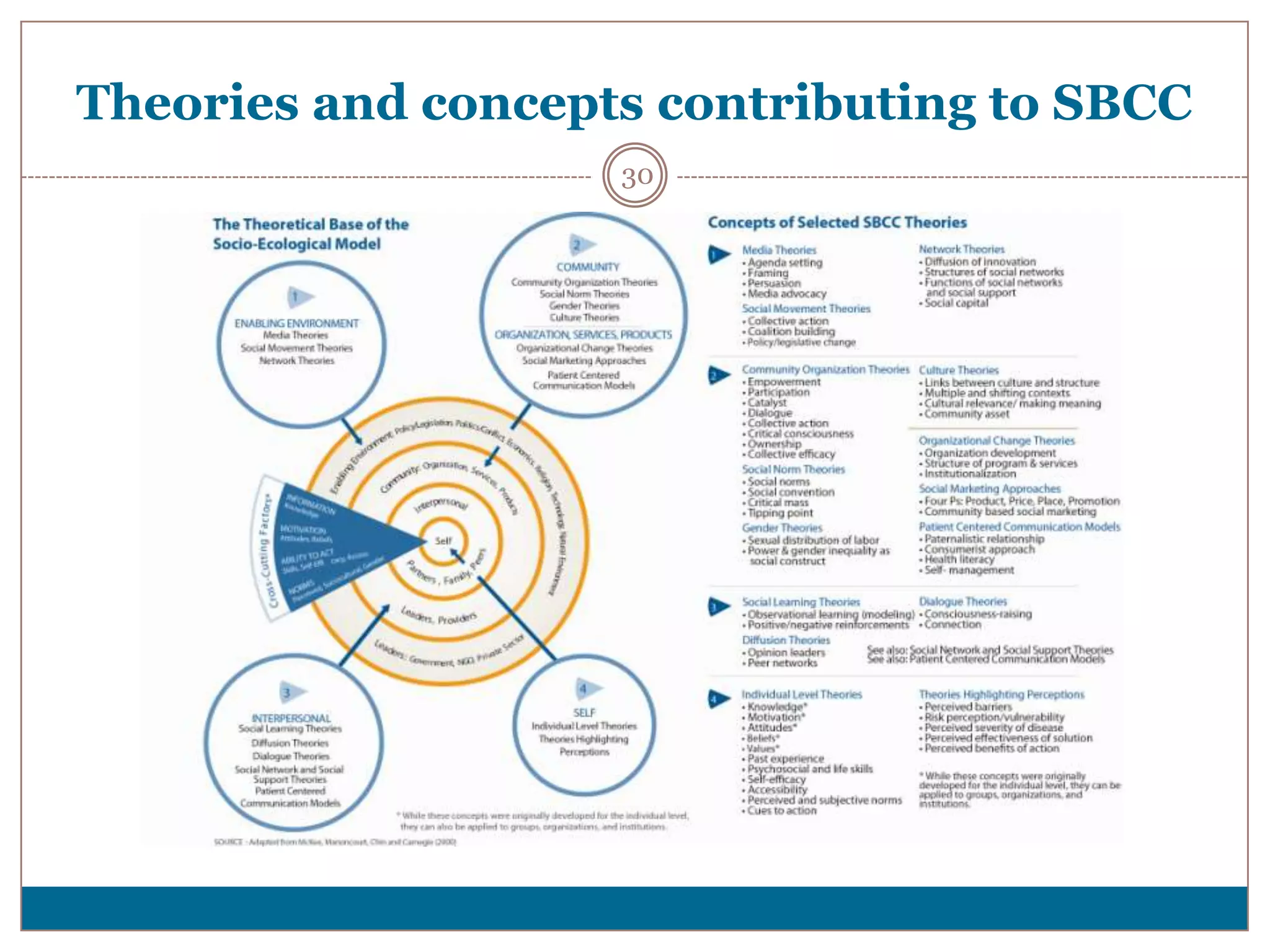
Theories and concepts contributing to SBCC
                    30
31

                         Characteristic 3: SBCC Operates Through
Analysis determines
the mix of strategies.              Three Key Strategies
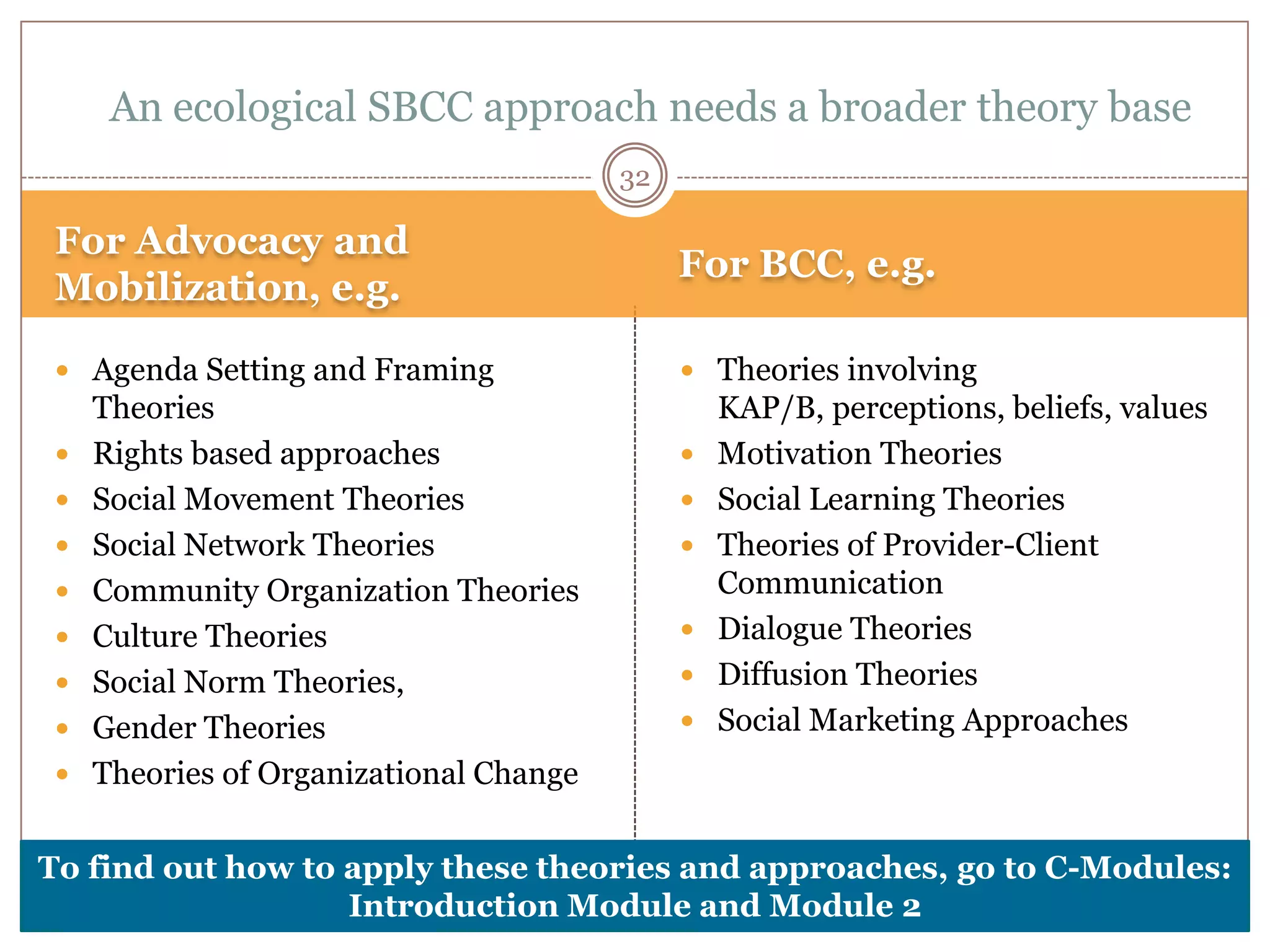
An ecological SBCC approach needs a broader theory base
                                         32

 For Advocacy and
                                              For BCC, e.g.
 Mobilization, e.g.

  Agenda Setting and Framing                  Theories involving
     Theories                                     KAP/B, perceptions, beliefs, values
    Rights based approaches                     Motivation Theories
    Social Movement Theories                    Social Learning Theories
    Social Network Theories                     Theories of Provider-Client
    Community Organization Theories              Communication
    Culture Theories                            Dialogue Theories
    Social Norm Theories,                       Diffusion Theories
    Gender Theories                             Social Marketing Approaches
    Theories of Organizational Change

To find out how to apply these theories and approaches, go to C-Modules:
                   Introduction Module and Module 2
Effectiveness of
Communication
       33
34

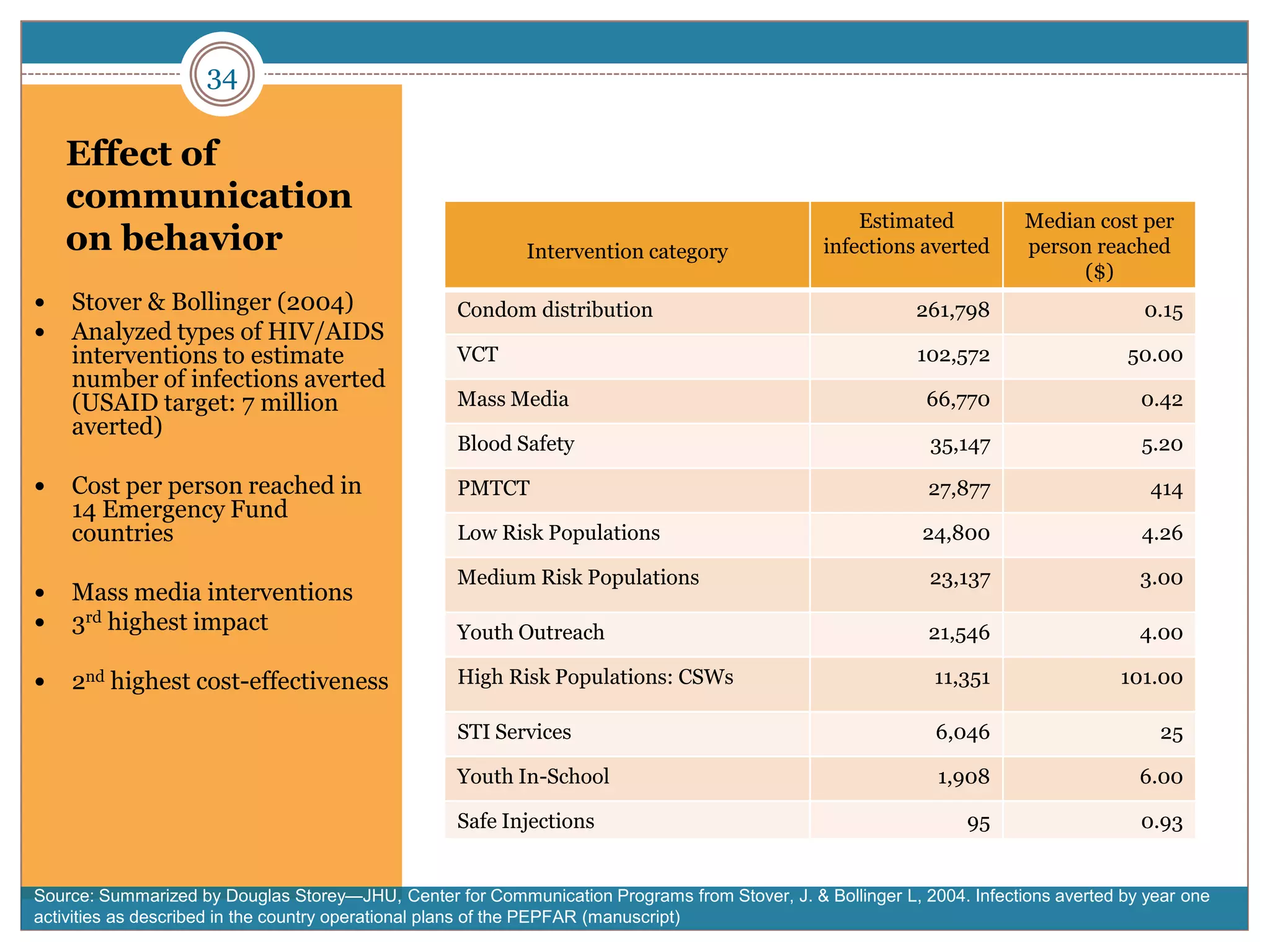
    Effect of
    communication
                                                                                                   Estimated            Median cost per
    on behavior                                            Intervention category               infections averted       person reached
                                                                                                                             ($)
   Stover & Bollinger (2004)                      Condom distribution                                     261,798                     0.15
   Analyzed types of HIV/AIDS
    interventions to estimate                      VCT                                                     102,572                  50.00
    number of infections averted
    (USAID target: 7 million                       Mass Media                                               66,770                    0.42
    averted)
                                                   Blood Safety                                             35,147                    5.20

   Cost per person reached in                     PMTCT                                                    27,877                     414
    14 Emergency Fund
    countries                                      Low Risk Populations                                     24,800                    4.26

                                                   Medium Risk Populations                                  23,137                    3.00
   Mass media interventions
   3rd highest impact                             Youth Outreach                                           21,546                    4.00

   2nd highest cost-effectiveness                 High Risk Populations: CSWs                               11,351                 101.00

                                                   STI Services                                              6,046                      25

                                                   Youth In-School                                           1,908                    6.00

                                                   Safe Injections                                               95                   0.93


Source: Summarized by Douglas Storey—JHU, Center for Communication Programs from Stover, J. & Bollinger L, 2004. Infections averted by year one
activities as described in the country operational plans of the PEPFAR (manuscript)
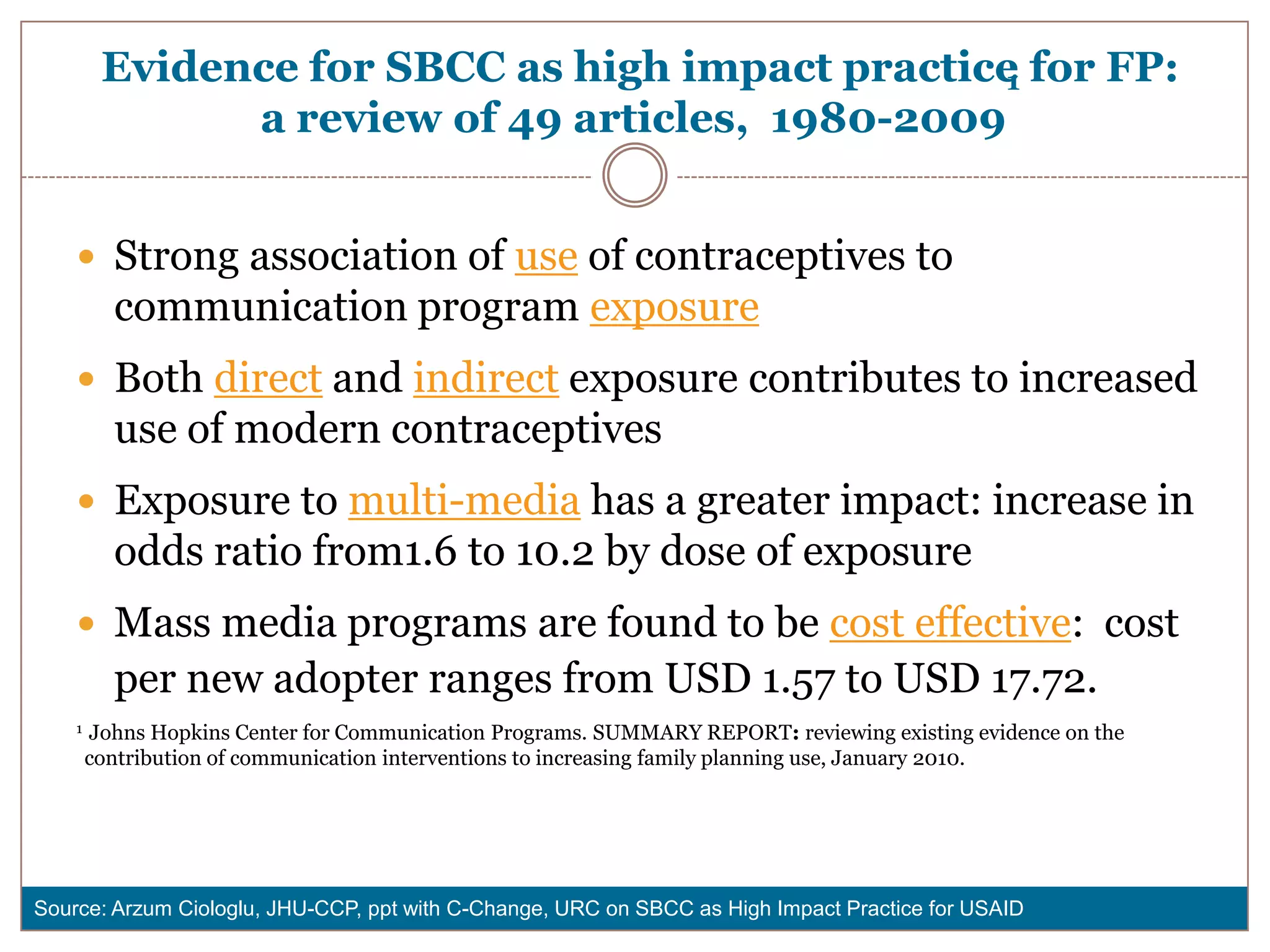
Evidence for SBCC as high impact practice for FP:
                                                  1
               a review of 49 articles, 1980-2009


     Strong association of use of contraceptives to
          communication program exposure
     Both direct and indirect exposure contributes to increased
          use of modern contraceptives
     Exposure to multi-media has a greater impact: increase in
          odds ratio from1.6 to 10.2 by dose of exposure
     Mass media programs are found to be cost effective: cost
          per new adopter ranges from USD 1.57 to USD 17.72.
    1   Johns Hopkins Center for Communication Programs. SUMMARY REPORT: reviewing existing evidence on the
        contribution of communication interventions to increasing family planning use, January 2010.


Source: Arzum Ciologlu, JHU-CCP, ppt with C-Change, URC on SBCC as High Impact Practice for USAID
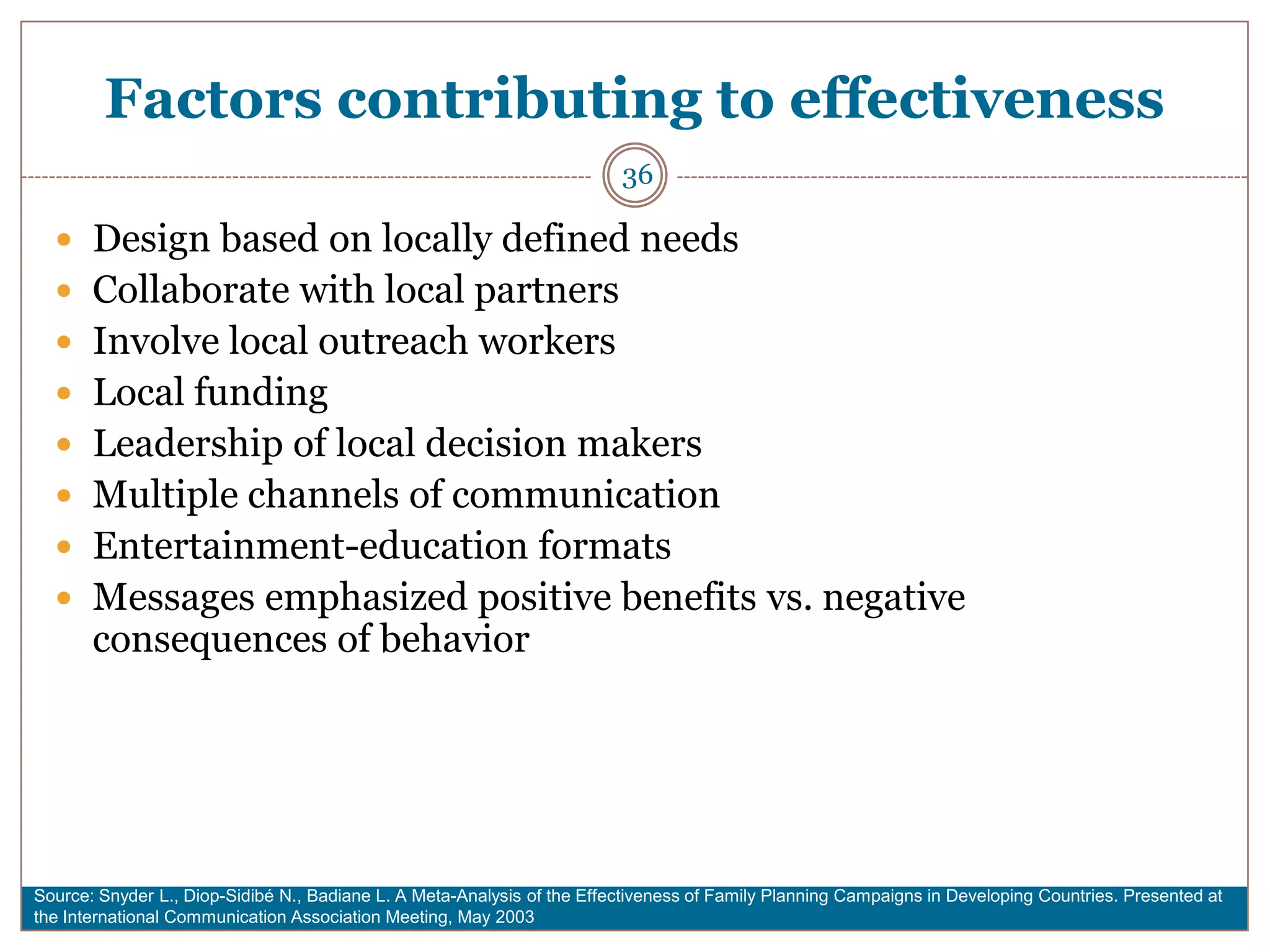
Factors contributing to effectiveness
                                                                         36

   Design based on locally defined needs
   Collaborate with local partners
   Involve local outreach workers
   Local funding
   Leadership of local decision makers
   Multiple channels of communication
   Entertainment-education formats
   Messages emphasized positive benefits vs. negative
       consequences of behavior


Source: Snyder L., Diop-Sidibé N., Badiane L. A Meta-Analysis of the Effectiveness of Family Planning Campaigns in Developing Countries. Presented at
the International Communication Association Meeting, May 2003
Conclusion
                               37

1. Theories are tools for creative thinking, not absolute truth
   or formulas for success
2. Use theories to check your assumptions
3. No one theory will explain every behavioral setting
4. The ecological SBCC model combines various theories
5. Creative and tailored use of models and theories increases
   the success of interventions

SBCC Framework

  • 1.
    Communication for Change A SHORT GUIDE TO SOCIAL AND BEHAVIOR CHANGE (SBCC) THEORY AND MODELS
  • 2.
    More harm thangood? 2  When we set out to improve life for others without a fundamental understanding of their point of view and quality of experience, we do more harm than good. (Lauren Reichelt, Tikkun, Winter 2011)
  • 3.
    3 Why use  Answers to key questions theories and  What problems exists models?  Why a problem exists Theory can guide the  Whom to select design, implementation  What to know before taking action of evidence- based programs, and  How to reach people with impact evaluations. Adequately addressing an issue  What strategies likely to cause change may require more than one theory, and that no one theory is suitable for all cases (Glanz, Rimer, and Sharyn 2005).
  • 4.
    Evolution of KeyConcepts 4
  • 5.
    Communication concepts ageneration ago… 5 Expert (sender) to non-expert (receiver) sending information
  • 6.
    Transmission model: outdated 6 Transmission Sender Receiver Influence flows in one direction only Photo credit: Narendra Basnet. “Pretesting Communication Materials with Special Emphasis on Child Health and Nutrition Education: A manual for Trainers and Supervisors.” UNICEF, Rangoon. Adapted from: Douglas Storey—JHU, Center for Communication Programs
  • 7.
    Now: communication asdialogue 7 Communicator Communicator Dialogue: Influence flows in both directions Adapted from: Douglas Storey—JHU, Center for Communication Programs
  • 8.
    Evolution of keyconcepts 8  Older approaches tried to persuade individuals to change their health behaviors  Newer approaches try to create an enabling environment to encourage healthy behaviors  New approaches look for tipping points of change that need to address social change as much as individual behavior change Adapted from: Douglas Storey—JHU, Center for Communication Programs
  • 9.
    Core Theories 9 THAT HAVE FUELED THE CURRENT THINKING
  • 10.
    10 Level of Change Targets of Change Process Change Three levels of theory Most theories can be Individual Psychological Personal sorted into three level behaviors levels Interpersonal Psycho-social Social Networks level Community Cultural & Social Community level development Source: Neill McKee, Manoncourt, Chin, and Carnegie (2000)
  • 11.
    Emphasis of somecore theories 11 Theory Emphasis Individual level 1. Health Belief Model Planned behavior, rational 2. Reasoned Action – Fishbein & Ajzen decision making processes 3. Stages of Change – Prochaska, (beliefs & subjective norms) DiClemente Fear Management – Witte Interaction between cognition & emotion Interpersonal level Social learning – Bandura Social comparison, learning from role models, self efficacy Community level Theory of Gender and Power Social influence, personal Diffusion of Innovations - Rogers networks Ecological Models Behavior is a function of the person and its environment Adapted from Douglas Storey—JHU, Center for Communication Programs
  • 12.
    Individual level: HealthBelief Model (1950s) 12 People form behaviors based on perceptions: 1. How severe is the illness? 2. How likely could I get it? 3. What do I benefit from trying to prevent it and how effective is the new behavior? 4. What keeps me from taking this action? Application:  Address personal risk perception and beliefs in severity of disease  Identify key benefits and barriers to change and stimulate discussion  Demonstrate potential positive results of change
  • 13.
    Individual level :Reasoned Action (1960s) 13 People make decisions by:  Weighing the advantages and disadvantages of behaviors before deciding to practice it  People base their intentions to act on two things:  their attitudes (whether performing the behavior is a good thing or a bad thing)  their subjective norms (whether other people around you are performing it and think that you should do that too) Application:  Identify motivators and benefits for action  Create messages that can affect attitudes  Identify audiences that influence the group your are trying to reach
  • 14.
    Individual level: Stagesof Change (1980s) 14 People making decisions Application by stage  Where is your audience with respect to the desired action?  What information or messages do they need at that stage?  Stage will dictate intervention  Pre-contemplative: generate interest  Preparation: develop skills  Action: form support groups  Maintenance: share stories with others to prevent relapse Source: Carol Larivee (FHI 360)
  • 15.
    Individual level: FearManagement Theory 15 People make decisions based on  The Threat (fear)  Is the threat serious or severe?  Can it happen to me?  The Efficacy (response)  Does the response work?  Can I do the response (self-efficacy)?  What blocks me from responding (barriers)? Application:  Find out about perceptions of fear and efficacy; based on that:  Increase perceived seriousness of the illness  Increase risk perception  Increase knowledge of solutions  Model response behaviors  Show how others have overcome barriers Source: Kim Witte (2004) summarized by Douglas Storey—JHU, Center for Communication Programs
  • 16.
    Interpersonal level: Principlesof Social Learning (1970s) 16 People learn and decide how to act by:  Observing the actions of others  Observing the apparent consequences of those actions  Checking those consequences for their own lives  Trying out those actions themselves Application:  Identify key role models in the community  Provide opportunities for them to model or talk about their behaviors  Showcase role models and their actions through radio dramas, personal testimonials, community discussions
  • 17.
    Key concept: self-efficacy 17  A person’s belief in their ability to achieve a desired outcome  Self-efficacy is perceived regardless of one's actual ability.  If a person sees someone else performing a behavior but doubt their own ability to copy it, its not likely that the new behavior will be adopted. Source: Adapted from Albert Bandura, Psychology Review 1977, Vol. 84, No. 2, 191-215. See also his Self-Efficacy: The Exercise of Control (New York: W.H. Freeman and Company, 997).
  • 18.
    Summary of individualBCC theories 18  List of eight conditions represented in all theories:  One or more of these conditions must be true for a person to perform a given behavior: The person 1. Has formed a strong positive intention to act 2. Has no environmental constraints for the behavior to occur 3. Has needed skills to perform the behavior 4. Believes the advantages/benefits outweigh disadvantages of performing the behavior 5. Perceives more social pressure to perform than not to perform the behavior 6. Perceives that behavior is consistent with self-image and personal standards 7. Reacts emotionally more positively than negatively to performing the behavior 8. Believes that they can execute the behavior (self-efficacy) Source: Fishbein, M et al. 1991: Factors Influencing Behaviour and Behaviour Change. Final report prepared for NIMH Theorists Workshop, Washington, DC
  • 19.
    However, 19  Psychological and psychosocial theories were very useful early in the HIV epidemic to identify individual transmission behaviors.  But ….nearly all the individually based theories were developed in the West with little focus on the role of gender and culture. Source: UNAIDS 1999: Sexual Behavioural Change for HIV: Where have theories taken us?
  • 20.
    Community level: Theoryof Gender and Power (1995) 20 People make decisions based on:  Wider social and environmental issues surrounding women such as  Distribution of power and authority  Gender specific norms outside of and within relationships Application:  Assess impact of structural gender differences and social norms on interpersonal sexual relationships  Investigate how a woman’s commitment to a relationship and lack of power can influence her risk reduction choices
  • 21.
    Community level: Diffusionof Innovations (1960s) 21 Innovations are spread through:  Social networks over time  The speed at which an innovation spreads depends on  What people think about the innovations and the people using it  How well the social network works Application:  Identify how audience thinks of the innovation  Identify opinion leader in the network  Identify messages that address concerns about the innovation  Demonstrate what happens to others when they try the innovation
  • 22.
    A shift inthinking 22 SOCIAL AND BEHAVIOR CHANGE COMMUNICATION
  • 23.
    Shift in thinking 23  Over the years, there has been a shift in thinking about behavior change communication:  Simply giving correct information – while important – does not change behavior by itself  Only addressing individual behaviors is often not enough either
  • 24.
    Key facts abouthuman behavior 24 1. People interpret and make meaning of information based on their own context 2. Culture, norms, and networks influence people’s behavior; 3. People can’t always control the issues that create their behavior; and, 4. People’s decisions about health and well-being compete with other priorities.
  • 25.
    What is SBCC? 25  SBCC is the systematic application of interactive, theory based, and research-driven communication processes and strategies to address “tipping points” for change at the individual, community, and social levels.  A tipping point refers to the dynamics of social change where trends rapidly evolve into permanent changes.  A tipping point can be driven by a naturally occurring event or a strong determinant for change, such as political will, that provides the final push to “tip over” barriers to change.  Tipping points describe how momentum builds up to a point where change gains strength and becomes unstoppable.
  • 26.
    SBCC has 3characteristics: 26 1. SBCC is an interactive, researched and planned process 2. SBCC requires a socio-ecological model for analysis to find the tipping point for change 3. SBCC operates through three main strategies, namely a) advocacy, b) social mobilization, and c) behavior change communication
  • 27.
    27 Characteristic 1. SBCC is a Process C- Planning
  • 28.
    28 Characteristic 2: SBCC Requires a Socio- Levels of Analysis: Ecological Model Where is the tipping point for change?
  • 29.
    29 Theoretical Base of theSocio- Ecological Model
  • 30.
    Theories and conceptscontributing to SBCC 30
  • 31.
    31 Characteristic 3: SBCC Operates Through Analysis determines the mix of strategies. Three Key Strategies
  • 32.
    An ecological SBCCapproach needs a broader theory base 32 For Advocacy and For BCC, e.g. Mobilization, e.g.  Agenda Setting and Framing  Theories involving Theories KAP/B, perceptions, beliefs, values  Rights based approaches  Motivation Theories  Social Movement Theories  Social Learning Theories  Social Network Theories  Theories of Provider-Client  Community Organization Theories Communication  Culture Theories  Dialogue Theories  Social Norm Theories,  Diffusion Theories  Gender Theories  Social Marketing Approaches  Theories of Organizational Change To find out how to apply these theories and approaches, go to C-Modules: Introduction Module and Module 2
  • 33.
  • 34.
    34 Effect of communication Estimated Median cost per on behavior Intervention category infections averted person reached ($)  Stover & Bollinger (2004) Condom distribution 261,798 0.15  Analyzed types of HIV/AIDS interventions to estimate VCT 102,572 50.00 number of infections averted (USAID target: 7 million Mass Media 66,770 0.42 averted) Blood Safety 35,147 5.20  Cost per person reached in PMTCT 27,877 414 14 Emergency Fund countries Low Risk Populations 24,800 4.26 Medium Risk Populations 23,137 3.00  Mass media interventions  3rd highest impact Youth Outreach 21,546 4.00  2nd highest cost-effectiveness High Risk Populations: CSWs 11,351 101.00 STI Services 6,046 25 Youth In-School 1,908 6.00 Safe Injections 95 0.93 Source: Summarized by Douglas Storey—JHU, Center for Communication Programs from Stover, J. & Bollinger L, 2004. Infections averted by year one activities as described in the country operational plans of the PEPFAR (manuscript)
  • 35.
    Evidence for SBCCas high impact practice for FP: 1 a review of 49 articles, 1980-2009  Strong association of use of contraceptives to communication program exposure  Both direct and indirect exposure contributes to increased use of modern contraceptives  Exposure to multi-media has a greater impact: increase in odds ratio from1.6 to 10.2 by dose of exposure  Mass media programs are found to be cost effective: cost per new adopter ranges from USD 1.57 to USD 17.72. 1 Johns Hopkins Center for Communication Programs. SUMMARY REPORT: reviewing existing evidence on the contribution of communication interventions to increasing family planning use, January 2010. Source: Arzum Ciologlu, JHU-CCP, ppt with C-Change, URC on SBCC as High Impact Practice for USAID
  • 36.
    Factors contributing toeffectiveness 36  Design based on locally defined needs  Collaborate with local partners  Involve local outreach workers  Local funding  Leadership of local decision makers  Multiple channels of communication  Entertainment-education formats  Messages emphasized positive benefits vs. negative consequences of behavior Source: Snyder L., Diop-Sidibé N., Badiane L. A Meta-Analysis of the Effectiveness of Family Planning Campaigns in Developing Countries. Presented at the International Communication Association Meeting, May 2003
  • 37.
    Conclusion 37 1. Theories are tools for creative thinking, not absolute truth or formulas for success 2. Use theories to check your assumptions 3. No one theory will explain every behavioral setting 4. The ecological SBCC model combines various theories 5. Creative and tailored use of models and theories increases the success of interventions

Editor's Notes

  • #7 Add source
  • #29 Ecological means how people relate to their environment, shown by the ringsSelf: Who is directly affected? Partners, Family, Peers: Who is directly influencing “self”?Local Community, Services, Products & Leaders and Providers: Who or what is directly influencing “self” at the local level?National Enabling Environment & Leaders: Who or what is indirectly affecting “self” at the national level?Crosscutting Factors:Information, Motivation, Ability to Act, and Norms: How are these factors addressed across all levels?
  • #30 The socio-ecological model is based on existing theories, models, and approaches from several disciplines, including political science, sociology, psychology, and communication. Through a synthesis of the concepts in the theories and approaches, the socio-ecological model proposes several influences to find effective tipping points for change.
  • #32 Advocacy to raise resources & political/ social leadership commitment for change goals Social Mobilization for wider participation, collective action and ownership, including community mobilization Behavior Change Communication for changes in knowledge, attitudes and practices of specific audiences
  • #36 Includes sbcc and bcc