Information Education and
Communication (IEC):
Basic Principles
Dr Khem R Sharma
Assistant Professor,
SPH & CM
Contents
โ€ข Health Education/Information/Communication
โ€ข IEC / essentials
โ€ข Communication Process
โ€ข Types of Communication
โ€ข Principles of health education
โ€ข The basic principles of communication
A state of complete physical, mental & social wellbeing
& not merely an absence of disease or infirmity that
enables an individual to lead a socially & economically
productive life.
(WHO Definition of Health)
โ€ข Health Education: concern establishing changes in
personal and group attitudes and behavior that
promote healthier living.
- the foundation of a preventive health care system.
- Correct information is the basic part of health
education.
Health Information
โ€ข Facts about situation, persons, and
events in relation to health.
โ€ข Uses of health information:
1) To measure the health status of the
people and to quantify their health
problems and Medical/health care
needs.
2) For local, national and international
comparison of health status
3) For planning, administration and
management of health services and
programs
4) For assessing whether health services
are accomplishing their objectives in
terms of their effectiveness and
efficiency
Health Information
(5) For assessing the attitude and degree
of satisfaction of the beneficiary with the
health system
(6) For research into particular problems
of health and disease
Health Information
โ€œHealth education is a process that informs, motivates
and helps people to adopt and maintain healthy practices
and lifestyles, advocates environmental changes as
needed to facilitate this goal and conducts, professional
training and research to the same endโ€
๏ถThe dynamic definition of Health Education was
given by Alma Ata Declaration 1978.
โ€œA process aimed at encouraging people to be
healthy, to know how to stay healthy, to do what
they can do individually and collectively to
maintain health and seek help when neededโ€.
Objectives of Health Education
o Informing people: The first directive of health
education is to inform people or disseminate scientific
knowledge about prevention of disease and
promotion of health.
o Motivating People: Simply informing people about
health is not enough. They must be motivated to
change their habits and ways of living, since many
present day problems of community health require
alteration of human behavior or changes in the health
practices which are detrimental to health.
โ€ข Guiding into action: Health education can
and should be conducted by a variety of
health, education and communication
personnel, in a variety of settings.
โ€ข People need to be encouraged to use
judiciously and wisely the health services
available.
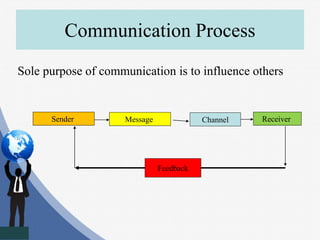
Communication Process
Sole purpose of communication is to influence others
Message Channel Receiver
Feedback
Sender
Communication Process
1. Sender (source) - communicator
2. Receiver: (audience)-Single person or group of
people (Homogenous audience is better)
3. Message (content)- Meaningful, based on felt
needs, clear and understandable, specific and
adequate, interesting, culturally and socially
appropriate.
4. Channels (medium):
โ€ข Interpersonal communication
โ€ข Mass Media
โ€ข Traditional or folk media
5. Feedback (effect)- Reaction of the audience to the
message
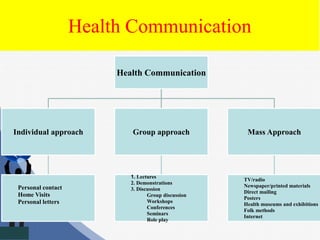
Health Communication
Individual approach
Personal contact
Home Visits
Personal letters
Group approach
1. Lectures
2. Demonstrations
3. Discussion
Group discussion
Workshops
Conferences
Seminars
Role play
Mass Approach
TV/radio
Newspaper/printed materials
Direct mailing
Posters
Health museums and exhibitions
Folk methods
Internet
Basic Ideaโ€ฆ
โ€ข Information: Inform the target groups about the
cause of disease its transmission and how to prevent
the disease. (Collection of known facts)
โ€ข Education: Educate the target groups about
techniques of disease prevention and mode of
transmission. (formal training by specialists)
โ€ข Communication: A process that informs, motivates
and helps people to adopt and maintain healthy
practices by using techniques to spread the
knowledge on the disease prevention and health
promotion. (two way process of exchanging or
shaping ideas, feelings, and information)
IEC
โ€ข A broad term comprising a range of approaches,
activities and outputs
โ€ข The most visible component of IEC is frequently the
materials, producer and user (such as posters hanging
on clinic walls)
โ€ข Materials are only one component.
โ€ข Effective IEC makes use of a full range of approaches
and activities
IECโ€ฆ
โ€ข Approaches: use of mass media to inform
โ€ข Activities: include designing and providing training
in communication skills , carrying out research on
audiences (what information is needed, effective way)
โ€ข Objective:
1. To raise the health awareness of the people
2. To enable them to identify health issues, develop
positive attitude towards health care &
increase access to new information and technology of
health and health programs for the people
IECโ€ฆ
โ€ข Goal:
To raise health awareness of issues, which
influence peoples agendas, help them clarify their
values and to acquire knowledge, skills by means
of changing attitudes, beliefs, values, behaviour or
norms within individual or groups of individuals.
โ€ข The goals may be achieved at different levels
1. Cognitive level in terms of increase in knowledge
2. Affective: in terms of changing existing patterns of
behaviour and attitudes.
3. Psychomotor: In terms of acquiring new skills.
The essentials of IEC
โ€ข IEC combines strategies, approaches and methods
that enable individuals, families, groups,
organisations and communities to play active roles in
achieving, protecting and sustaining their own health
โ€ข Embodied in IEC is the process of learning that
empowers people to make decisions, modify
behaviours and change social conditions.
โ€ฆโ€ฆ.The essentials of IEC
โ€ข Activities are developed based upon needs
assessments, sound educational principles, and
periodic evaluation using a clear set of goals and
objectives
โ€ข The influence of underlying social, cultural,
economic and environmental conditions on health
are also taken into consideration in the IEC
processes.
โ€ฆโ€ฆ.The essentials of IEC
โ€ข Identifying and promoting specific behaviours that
are desirable are usually the objectives of IEC
efforts....
โ€ข Channels might include interpersonal
communication (such as individual discussions,
counselling sessions or group discussions and
community meetings and events)
OR
mass media communication (such as radio,
television and other forms of one-way
communication, such as brochures, leaflets and
posters, visual and audio visual presentations and
some forms of electronic communication).
Types of Communication
โ€ข One way communication - flow of
communication in one way from the communicator
to the audience. e.g. lecture methods in class
rooms.
โ€ข Two way communication - in which both the
communicator and the audience take part.
โ€ข Verbal communication - Direct verbal
communication by word of mouth (spoken word)
โ€ข Non-verbal communication - Communication
without words
Bodily movements, facial expressions, gestures,
symbolic representation
Other communications
โ€ข Formal communication : follows lines of
authority
โ€ข Informal communication : Gossips, chatting
โ€ข Visual communication: Charts and graphs,
pictograms, tables, maps, patterns.
โ€ข Telecommunication and internet: Radio, TV, and
internet.
Barriers in Communication
1) Physiological- Difficulties in hearing or expression.
2) Psychological- Language, Emotional disturbances,
Neurosis and Comprehension difficulties.
3) Environmental- Noise, Invisibility and Congestion.
4) Cultural- Illiteracy, Level of Knowledge and
Understandings, Religion, Social class differences,
Language variations, Cultural differences between
foreigners and nationals.
Principles of health education
Health education brings together the art & science of
medicine, and the principles and practice of general
education.
โ€ข Credibility : The degree to which message to be
communicated is perceived as trustworthy by the
receiver (based on facts- must be compatible with
scientific knowledge & with the local culture,..)
โ€ข Interest : People are unlikely to listen things which
are not to their interest. ( relate to the interest of the
people; to find out the needs the people feel about
themselves).
โ€ฆโ€ฆ..Principles of health education
โ€ข Participation : active learning ; encouraging people
to work actively with health workers and others in
identifying their own health problems and in
developing solutions and plans to work them out
โ€ข Motivation : Awakening the desire to learn; need
for incentives is a first step in learning to change.
โ€ข Comprehension : Know the level of understanding,
education & literacy of people to whom the teaching
is directed. (teaching should be within the mental
capacity of the audience)
โ€ฆโ€ฆ..Principles of health education
โ€ข Reinforcement : Repetition at intervals is necessary to
prevent the individual going back to the pre-awareness
stage.
โ€ข Learning by doing : Learning is an action- process
โ€ข Known to unknown: work must proceed from a
simple to more complicated, easy to more difficult,โ€ฆ.;
start with what they understand and then proceed to
new knowledge
โ€ฆโ€ฆ..Principles of health education
โ€ข Setting an example : set a good example of things
that is teaching
โ€ข Good human relations : Sharing of information
happen easily
โ€ข Feedback : for effective communication
โ€ข Leaders : learn best from people whom we respect
and regard ; penetrate the community through the
local leaders โ€“ the village headman, the school
teacher or the political worker
The basic principles of communication
(small/large groups, private, social or political)
a - Close, wholehearted listening to the other
- and speaking out oneโ€™s own truth,
b - with self respect and respect of the other
c - Envisioning the other as naturally good
at the core of being. Presupposing the
communication partner as being an
approachable human and good willed within.
(Assuming it, will tend to evoke it.
Recognizing well the pitfalls and addressing
false manoeuvres.)
Thank You

Iec basic principles

  • 1.
    Information Education and Communication(IEC): Basic Principles Dr Khem R Sharma Assistant Professor, SPH & CM
  • 2.
    Contents โ€ข Health Education/Information/Communication โ€ขIEC / essentials โ€ข Communication Process โ€ข Types of Communication โ€ข Principles of health education โ€ข The basic principles of communication
  • 3.
    A state ofcomplete physical, mental & social wellbeing & not merely an absence of disease or infirmity that enables an individual to lead a socially & economically productive life. (WHO Definition of Health) โ€ข Health Education: concern establishing changes in personal and group attitudes and behavior that promote healthier living. - the foundation of a preventive health care system. - Correct information is the basic part of health education.
  • 4.
    Health Information โ€ข Factsabout situation, persons, and events in relation to health. โ€ข Uses of health information: 1) To measure the health status of the people and to quantify their health problems and Medical/health care needs.
  • 5.
    2) For local,national and international comparison of health status 3) For planning, administration and management of health services and programs 4) For assessing whether health services are accomplishing their objectives in terms of their effectiveness and efficiency Health Information
  • 6.
    (5) For assessingthe attitude and degree of satisfaction of the beneficiary with the health system (6) For research into particular problems of health and disease Health Information
  • 7.
    โ€œHealth education isa process that informs, motivates and helps people to adopt and maintain healthy practices and lifestyles, advocates environmental changes as needed to facilitate this goal and conducts, professional training and research to the same endโ€ ๏ถThe dynamic definition of Health Education was given by Alma Ata Declaration 1978. โ€œA process aimed at encouraging people to be healthy, to know how to stay healthy, to do what they can do individually and collectively to maintain health and seek help when neededโ€.
  • 8.
    Objectives of HealthEducation o Informing people: The first directive of health education is to inform people or disseminate scientific knowledge about prevention of disease and promotion of health. o Motivating People: Simply informing people about health is not enough. They must be motivated to change their habits and ways of living, since many present day problems of community health require alteration of human behavior or changes in the health practices which are detrimental to health.
  • 9.
    โ€ข Guiding intoaction: Health education can and should be conducted by a variety of health, education and communication personnel, in a variety of settings. โ€ข People need to be encouraged to use judiciously and wisely the health services available.
  • 10.
    Communication Process Sole purposeof communication is to influence others Message Channel Receiver Feedback Sender
  • 11.
    Communication Process 1. Sender(source) - communicator 2. Receiver: (audience)-Single person or group of people (Homogenous audience is better) 3. Message (content)- Meaningful, based on felt needs, clear and understandable, specific and adequate, interesting, culturally and socially appropriate. 4. Channels (medium): โ€ข Interpersonal communication โ€ข Mass Media โ€ข Traditional or folk media 5. Feedback (effect)- Reaction of the audience to the message
  • 12.
    Health Communication Health Communication Individualapproach Personal contact Home Visits Personal letters Group approach 1. Lectures 2. Demonstrations 3. Discussion Group discussion Workshops Conferences Seminars Role play Mass Approach TV/radio Newspaper/printed materials Direct mailing Posters Health museums and exhibitions Folk methods Internet
  • 13.
    Basic Ideaโ€ฆ โ€ข Information:Inform the target groups about the cause of disease its transmission and how to prevent the disease. (Collection of known facts) โ€ข Education: Educate the target groups about techniques of disease prevention and mode of transmission. (formal training by specialists) โ€ข Communication: A process that informs, motivates and helps people to adopt and maintain healthy practices by using techniques to spread the knowledge on the disease prevention and health promotion. (two way process of exchanging or shaping ideas, feelings, and information)
  • 14.
    IEC โ€ข A broadterm comprising a range of approaches, activities and outputs โ€ข The most visible component of IEC is frequently the materials, producer and user (such as posters hanging on clinic walls) โ€ข Materials are only one component. โ€ข Effective IEC makes use of a full range of approaches and activities
  • 15.
    IECโ€ฆ โ€ข Approaches: useof mass media to inform โ€ข Activities: include designing and providing training in communication skills , carrying out research on audiences (what information is needed, effective way) โ€ข Objective: 1. To raise the health awareness of the people 2. To enable them to identify health issues, develop positive attitude towards health care & increase access to new information and technology of health and health programs for the people
  • 16.
    IECโ€ฆ โ€ข Goal: To raisehealth awareness of issues, which influence peoples agendas, help them clarify their values and to acquire knowledge, skills by means of changing attitudes, beliefs, values, behaviour or norms within individual or groups of individuals. โ€ข The goals may be achieved at different levels 1. Cognitive level in terms of increase in knowledge 2. Affective: in terms of changing existing patterns of behaviour and attitudes. 3. Psychomotor: In terms of acquiring new skills.
  • 17.
    The essentials ofIEC โ€ข IEC combines strategies, approaches and methods that enable individuals, families, groups, organisations and communities to play active roles in achieving, protecting and sustaining their own health โ€ข Embodied in IEC is the process of learning that empowers people to make decisions, modify behaviours and change social conditions.
  • 18.
    โ€ฆโ€ฆ.The essentials ofIEC โ€ข Activities are developed based upon needs assessments, sound educational principles, and periodic evaluation using a clear set of goals and objectives โ€ข The influence of underlying social, cultural, economic and environmental conditions on health are also taken into consideration in the IEC processes.
  • 19.
    โ€ฆโ€ฆ.The essentials ofIEC โ€ข Identifying and promoting specific behaviours that are desirable are usually the objectives of IEC efforts.... โ€ข Channels might include interpersonal communication (such as individual discussions, counselling sessions or group discussions and community meetings and events) OR mass media communication (such as radio, television and other forms of one-way communication, such as brochures, leaflets and posters, visual and audio visual presentations and some forms of electronic communication).
  • 20.
    Types of Communication โ€ขOne way communication - flow of communication in one way from the communicator to the audience. e.g. lecture methods in class rooms. โ€ข Two way communication - in which both the communicator and the audience take part. โ€ข Verbal communication - Direct verbal communication by word of mouth (spoken word) โ€ข Non-verbal communication - Communication without words Bodily movements, facial expressions, gestures, symbolic representation
  • 21.
    Other communications โ€ข Formalcommunication : follows lines of authority โ€ข Informal communication : Gossips, chatting โ€ข Visual communication: Charts and graphs, pictograms, tables, maps, patterns. โ€ข Telecommunication and internet: Radio, TV, and internet.
  • 22.
    Barriers in Communication 1)Physiological- Difficulties in hearing or expression. 2) Psychological- Language, Emotional disturbances, Neurosis and Comprehension difficulties. 3) Environmental- Noise, Invisibility and Congestion. 4) Cultural- Illiteracy, Level of Knowledge and Understandings, Religion, Social class differences, Language variations, Cultural differences between foreigners and nationals.
  • 23.
    Principles of healtheducation Health education brings together the art & science of medicine, and the principles and practice of general education. โ€ข Credibility : The degree to which message to be communicated is perceived as trustworthy by the receiver (based on facts- must be compatible with scientific knowledge & with the local culture,..) โ€ข Interest : People are unlikely to listen things which are not to their interest. ( relate to the interest of the people; to find out the needs the people feel about themselves).
  • 24.
    โ€ฆโ€ฆ..Principles of healtheducation โ€ข Participation : active learning ; encouraging people to work actively with health workers and others in identifying their own health problems and in developing solutions and plans to work them out โ€ข Motivation : Awakening the desire to learn; need for incentives is a first step in learning to change. โ€ข Comprehension : Know the level of understanding, education & literacy of people to whom the teaching is directed. (teaching should be within the mental capacity of the audience)
  • 25.
    โ€ฆโ€ฆ..Principles of healtheducation โ€ข Reinforcement : Repetition at intervals is necessary to prevent the individual going back to the pre-awareness stage. โ€ข Learning by doing : Learning is an action- process โ€ข Known to unknown: work must proceed from a simple to more complicated, easy to more difficult,โ€ฆ.; start with what they understand and then proceed to new knowledge
  • 26.
    โ€ฆโ€ฆ..Principles of healtheducation โ€ข Setting an example : set a good example of things that is teaching โ€ข Good human relations : Sharing of information happen easily โ€ข Feedback : for effective communication โ€ข Leaders : learn best from people whom we respect and regard ; penetrate the community through the local leaders โ€“ the village headman, the school teacher or the political worker
  • 27.
    The basic principlesof communication (small/large groups, private, social or political) a - Close, wholehearted listening to the other - and speaking out oneโ€™s own truth, b - with self respect and respect of the other c - Envisioning the other as naturally good at the core of being. Presupposing the communication partner as being an approachable human and good willed within. (Assuming it, will tend to evoke it. Recognizing well the pitfalls and addressing false manoeuvres.)
  • 28.