YITBAREK WASIHUN (BSc, MPH)
5/30/2020
1
By:- Yitbarek W.(BSC, MPH)
Learning objectives
At the end of this chapter the students are expected to:
v Define communication & health communication
v Explain objective & roles of health communication
v Discuss communication model & component &process
of communication
v Explain forms & types of communication
v Barriers to effective communication
5/30/2020 Wollo univerisity, Dessie
2
 Is communication mere talking???????????
 When does talking become communication??????????
Only when it is understood!!!!!!!!!!
5/30/2020
Health Education
4
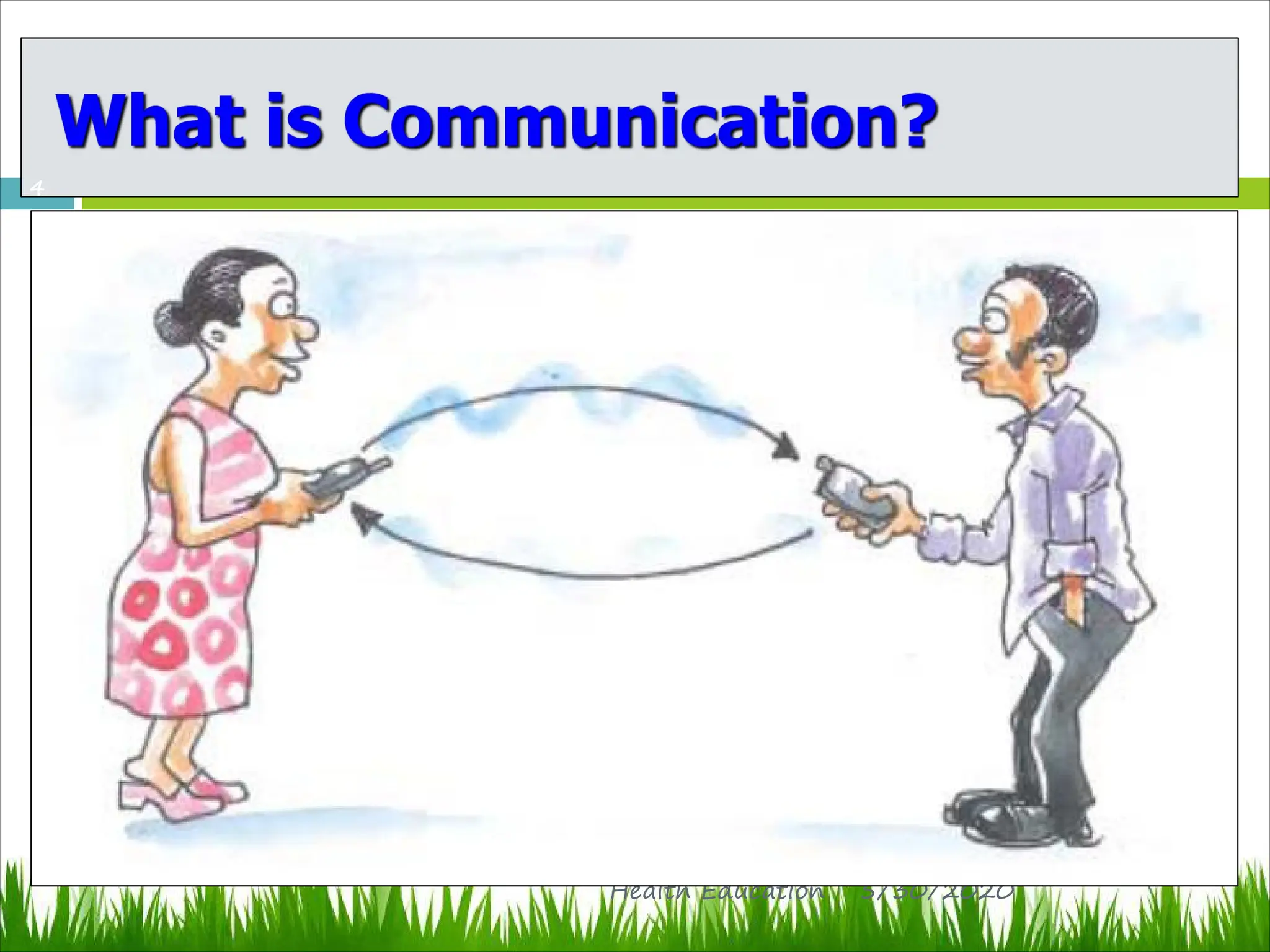
What is communication?
v Communication; is the process by which two or more people
exchange ideas, facts, feelings or impressions in ways that each
gains a common or mutual understanding of the meaning and
the use of the message.
v so communication uses/helps to share information, give instruction,
give feed back and express feeling
5/30/2020
5
By:- Yitbarek W.(BSC, MPH)
v Health communication is the art and technique of informing,
influencing, and motivating individuals, institutions, and large
public audiences about important of health issues based on
sound scientific and ethical consideration.
v That means health communication can take place at a number
of different levels : The individual , Social networks (family) ,
The organization , Communities and Society level
5/30/2020
6
By:- Yitbarek W.(BSC, MPH)
v We always have four general objectives:
ü To be received (heard or read)
ü To be understood
ü To be accepted
ü To get action (change of behavior)
5/30/2020
7
By:- Yitbarek W.(BSC, MPH)
Principles of communication
A)Perception
v For communication to be effective the perception of the sender should be
as close as possible to the perception of the receiver.
B) Sensory involvement
v The more sensory organs involved in a communication the more is its
effectiveness from their cumulative effect.
C) Face to face
v The more communication takes place face-to-face the more its
effectiveness.
D) Feedback
v Any communication without two-way process is less effective because of
lack of opportunity for concurrent, timely & appropriate feedback.
§ Increase knowledge and awareness of a health issue,
problem, or solution
§ Influence perceptions, beliefs, attitudes, and social
norms
§ Prompt action
§ Demonstrate or illustrate skills
§ Show the benefit of behavior change
§ Increase demand for health services
§ Reinforce knowledge, attitudes, and behavior
§ Refute myths and misconceptions
§ Help coalesce organizational relationships
§ Advocate for a health issue or a population group
5/30/2020
9
By:- Yitbarek W.(BSC, MPH)
Communication model
A) Linear (one –way) model
Ø The flow of information from the sender (source) to the
receiver is one-way or unidirectional
Ø The communication is dominated by the “sender’s
knowledge”. “Information is poured out”
Ø This model does not consider feedback and interaction with
the sender
Ø A familiar example is the lecture method in class rooms
5/30/2020
10
By:- Yitbarek W.(BSC, MPH)
lecturenote_476595681CHAPTER 4; Health Communication.pdf

  • 1.
    YITBAREK WASIHUN (BSc,MPH) 5/30/2020 1 By:- Yitbarek W.(BSC, MPH)
  • 2.
    Learning objectives At theend of this chapter the students are expected to: v Define communication & health communication v Explain objective & roles of health communication v Discuss communication model & component &process of communication v Explain forms & types of communication v Barriers to effective communication 5/30/2020 Wollo univerisity, Dessie 2
  • 3.
     Is communicationmere talking???????????  When does talking become communication?????????? Only when it is understood!!!!!!!!!!
  • 4.
  • 5.
    What is communication? vCommunication; is the process by which two or more people exchange ideas, facts, feelings or impressions in ways that each gains a common or mutual understanding of the meaning and the use of the message. v so communication uses/helps to share information, give instruction, give feed back and express feeling 5/30/2020 5 By:- Yitbarek W.(BSC, MPH)
  • 6.
    v Health communicationis the art and technique of informing, influencing, and motivating individuals, institutions, and large public audiences about important of health issues based on sound scientific and ethical consideration. v That means health communication can take place at a number of different levels : The individual , Social networks (family) , The organization , Communities and Society level 5/30/2020 6 By:- Yitbarek W.(BSC, MPH)
  • 7.
    v We alwayshave four general objectives: ü To be received (heard or read) ü To be understood ü To be accepted ü To get action (change of behavior) 5/30/2020 7 By:- Yitbarek W.(BSC, MPH)
  • 8.
    Principles of communication A)Perception vFor communication to be effective the perception of the sender should be as close as possible to the perception of the receiver. B) Sensory involvement v The more sensory organs involved in a communication the more is its effectiveness from their cumulative effect. C) Face to face v The more communication takes place face-to-face the more its effectiveness. D) Feedback v Any communication without two-way process is less effective because of lack of opportunity for concurrent, timely & appropriate feedback.
  • 9.
    § Increase knowledgeand awareness of a health issue, problem, or solution § Influence perceptions, beliefs, attitudes, and social norms § Prompt action § Demonstrate or illustrate skills § Show the benefit of behavior change § Increase demand for health services § Reinforce knowledge, attitudes, and behavior § Refute myths and misconceptions § Help coalesce organizational relationships § Advocate for a health issue or a population group 5/30/2020 9 By:- Yitbarek W.(BSC, MPH)
  • 10.
    Communication model A) Linear(one –way) model Ø The flow of information from the sender (source) to the receiver is one-way or unidirectional Ø The communication is dominated by the “sender’s knowledge”. “Information is poured out” Ø This model does not consider feedback and interaction with the sender Ø A familiar example is the lecture method in class rooms 5/30/2020 10 By:- Yitbarek W.(BSC, MPH)