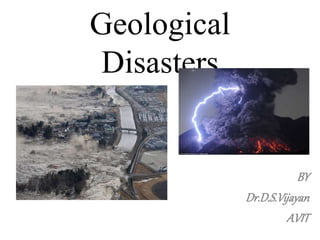
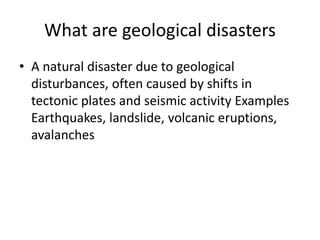
Geological
Disasters
BY
Dr.D.S.Vijayan
AVIT
What are geological disasters
• A natural disaster due to geological
disturbances, often caused by shifts in
tectonic plates and seismic activity Examples
Earthquakes, landslide, volcanic eruptions,
avalanches
Contents
• Avalanches
• Landslides
• Earthquakes
• Volcanic eruptions
Avalanches
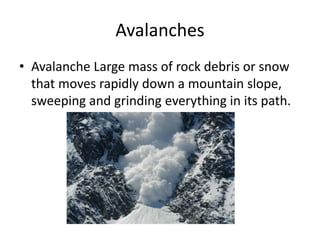
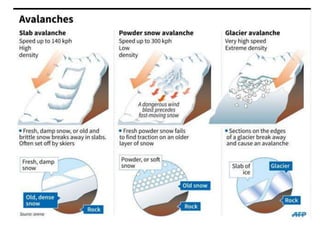
• Avalanche Large mass of rock debris or snow
that moves rapidly down a mountain slope,
sweeping and grinding everything in its path.
How they are created
• An avalanche begins when a mass of material
overcomes frictional resistance of the sloping
surface, often after its foundation is loosened by
spring rains or is rapidly melted by warm, dry
wind. Vibrations caused by loud noises, such as
artillery, thunder, or blasting can create an
avalanche.
• Avalanches usually occur in February, March, and
January. They can also occur in April when
everything thaws.
Areas in the world where Avalanches
Occur
• Avalanches can occur anywhere in the
world.
• They occur where ever there is a high snow
covered mountain.
• Avalanches can also occur near plate
boundaries.
• Usually at convergent plate boundaries.
Damage Due to Avalanches
• Avalanches don’t do a lot of damage to cities or
towns because they are up in the high mountains
but anything up there better watch out.
• Avalanches burry mountain side homes and
destroy forests. They also take down radio towers
and lodges that are in its path.
• Avalanches also take away people’s lives,
especially skiers who are taking a trip down the
mountain.
Tips on Avalanches
• If you are in an area that is highly at risk for
avalanches be sure not to ski or use any
snowmobiles on the mountain.
• Try not to use any explosives around an
avalanche zone.
• If there was a heavy snow fall the night before
make sure not to go on the mountain because
you might trigger an avalanche.
• Don’t ever go alone on a mountain that has been
known to have avalanches.
Future Research
• They are doing research to find out about the
mechanisms that govern the build-up of snow
- wind and precipitation - instability within the
snow cover, and the flow of avalanches.
• The main objective of this research is to
improve zoning and make defenses more
effective and more reliable.
Landslide
A landslide is an catastrophic event where
a block of earthen mass slides downhill. Cause
significant loss of life and billions of dollars
each year
Landslides Prediction
• Although a basic understanding of the
landslides is available, system that predict the
occurrence of a landslide do NOT exist. Why?
• The lack of field measurements over large
temporal and spatial scales.
How they occur Natural causes of
Landslides
• Earthquakes
• Heavy Rainfall
• Human causes of Landslides
– Clear Cutting
– Mining
Earthquakes
• Seismic activities have always been a main
cause of landslides throughout the world. Any
time plate tectonics move the soil that covers
them moves with it. When earthquakes occur
on areas with steep slopes, many times the
soil slips causing landslides.
Heavy Rainfall
• When sloped areas become completely
saturated by heavy rainfall many times
landslides can occur. Without the aid of
mechanical root support the soil simply runs
off when it contains too much water.
Human causes of Landslides
Clear Cutting:
Method of timber harvesting which
completely removes all old growth timber from
the area. This method is hazardous because it
destroys the existing mechanical root structure in
the area.
Mining:
Mining operations that use blasting
techniques often cause other areas that are at
the risk of sliding to slide due to vibrations under
the soil.
Before the occurrence of landslide
• In terms of economic aspects, the government
needs to upgrade more on the knowledge on
natural phenomenon to the public through media
such as internet, seminar and others. By stating
more information regarding the landslide, the
locals would know few things about landslide and
the way to deal with landslide if it occurs. Not
only that, the government should provide more
expertise to prevent this matter before it
happens. In addition, with expertise help, the
government should held campaign for the locals
to participate. Therefore, the locals can gain
knowledge on this matter.
Before the occurrence of landslide
• In term of social aspects, the locals need to
understand and apply their knowledge about the
occurrence of landslide. The locals must aware
about their areas especially the area that are
near steep slopes, lose to mountain edges, near
drainage ways or natural erosion valleys. As
mentioned earlier that the government should
provide knowledge about landslide, the locals
should take precautious about their property,
such as the locals should contact the expertise
and as for information their property that
whether their area are prone to landslide or not.
After the occurrence of landslide
• In terms of economical aspects, house owners
should choose housing insurance companies that
can cover damages caused by landslide if they
feel that their houses are prone to landslide. This
would ease the burden of the victims in financial
terms.
• In terms of infrastructure aspect, retaining walls
should be checked for damages quite often to
ensure that it is properly functioning. The
surrounding areas of the retaining walls should
also be included in this maintenance process. For
instance checking whether the wall retentions'
holes are blocked or not.
Planning action
we were asked to plan some actions
regarding our projects. The actions will be
executed individually and these are the action
plan that will be executed
– Insurance coverage
– Creating a blog
– Plantation of trees
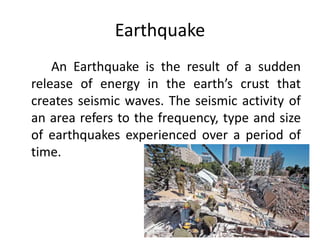
Earthquake
An Earthquake is the result of a sudden
release of energy in the earth’s crust that
creates seismic waves. The seismic activity of
an area refers to the frequency, type and size
of earthquakes experienced over a period of
time.
Causes Of Earthquake
The primary cause of an earthquake is
faults on the crust of the earth. “A Fault is a
break or fracture b/w two blocks of rocks in
response to stress.” This movement may occur
rapidly, in the form of an earthquake or may
occur slowly, in the form of creep. Earth
scientists use the angle of the fault with
respect to the surface and the direction of slip
along the fault to classify faults.
Earthquake Prediction
• Unusual animal behaviour
• Water level in wells
• Large scale of fluctuation of oil flow from oil wells
• Foreshocks or minor shocks before major
earthquake
• Temperature change
• Uplifting of earth surface
• Change in seismic wave velocity
Effect Of Earthquake
• Loss of life and property
• Damage to transport system i.e. roads, railways,
highways, airports, marine
• Damage to infrastructure.
• Chances of Floods – Develop cracks in Dams
• Chances of fire short-circuit.
• Communications such as telephone wires are
damaged.
• Water pipes, sewers are disrupted
• Economic activities like agriculture, industry, trade and
transport are severely affected.
Earthquake Safety Rules
• Don’t use lift for getting down from building.
• Be prepared to move with your family. If you
are in shop, school or office
• Don’t run for an exit.
• Take cover under a desk/table.
• Move away from window glass.
• Do not go near electric point and cable. Keep
away from weak portion of the building .
After An Earthquake
• Keep calm, switch on the transistor radio and
obey instructions.
• Keep away from beaches and low banks of river.
A huge wave may sweep in
• Do not re enter badly damaged buildings and do
not go near damage structures.
• Turn off the water, gas and electricity.
• Do not smoke, light match or use a cigarette
lighter
• Do not turn on switches there may be gas leak or
short circuit
• If there is any fire, try to put it out or call fire
brigade.
Local response
• The response within India was immediate. The
national and state governments quickly
provided assistance in many forms including
cash, medical supplies, communications
teams, shelters, food, clothing, transport and
relief workers.
Volcanic eruption
A volcano is a rupture on the crust of a
planetary-mass object, such as Earth, that
allows hot lava, volcanic ash, and gases to
escape from a magma chamber below the
surface.
Cause of eruption
As rock inside the earth melts, its mass
remains the same while its volume increases--
producing a melt that is less dense than the
surrounding rock. This lighter magma then
rises toward the surface by virtue of its
buoyancy. If the density of the magma
between the zone of its generation and the
surface is less than that of the surrounding
and overlying rocks, the magma reaches the
surface and erupts.
Safety Tips
• Stay away from active volcanoes.
• If you live near an active volcano, keep goggles
and a mask in an emergency kit, along with a
flashlight and a working, battery-operated
radio.
• Know your evacuation route. Keep gas in your
car.
If a Volcano Erupts in Your Area
• • Evacuate only as recommended by
authorities to stay clear of lava, mud flows,
and flying rocks and debris.
• Avoid river areas and low-lying regions.
• Before you leave the house, change into long-
sleeved shirts and long pants and use goggles
or eyeglasses, not contacts. Wear an
emergency mask or hold a damp cloth over
your face.
If a Volcano Erupts in Your Area
• If you are not evacuating, close windows and
doors and block chimneys and other vents, to
prevent ash from coming into the house.
• Be aware that ash may put excess weight on
your roof and need to be swept away. Wear
protection during cleanups.
• Ash can damage engines and metal parts, so
avoid driving. If you must drive, stay below 35
miles (56 kilometers) an hour.
THANK U

geological disasters.pptx

  • 1.
  • 2.
    What are geologicaldisasters • A natural disaster due to geological disturbances, often caused by shifts in tectonic plates and seismic activity Examples Earthquakes, landslide, volcanic eruptions, avalanches
  • 3.
    Contents • Avalanches • Landslides •Earthquakes • Volcanic eruptions
  • 4.
    Avalanches • Avalanche Largemass of rock debris or snow that moves rapidly down a mountain slope, sweeping and grinding everything in its path.
  • 5.
    How they arecreated • An avalanche begins when a mass of material overcomes frictional resistance of the sloping surface, often after its foundation is loosened by spring rains or is rapidly melted by warm, dry wind. Vibrations caused by loud noises, such as artillery, thunder, or blasting can create an avalanche. • Avalanches usually occur in February, March, and January. They can also occur in April when everything thaws.
  • 6.
    Areas in theworld where Avalanches Occur • Avalanches can occur anywhere in the world. • They occur where ever there is a high snow covered mountain. • Avalanches can also occur near plate boundaries. • Usually at convergent plate boundaries.
  • 7.
    Damage Due toAvalanches • Avalanches don’t do a lot of damage to cities or towns because they are up in the high mountains but anything up there better watch out. • Avalanches burry mountain side homes and destroy forests. They also take down radio towers and lodges that are in its path. • Avalanches also take away people’s lives, especially skiers who are taking a trip down the mountain.
  • 8.
    Tips on Avalanches •If you are in an area that is highly at risk for avalanches be sure not to ski or use any snowmobiles on the mountain. • Try not to use any explosives around an avalanche zone. • If there was a heavy snow fall the night before make sure not to go on the mountain because you might trigger an avalanche. • Don’t ever go alone on a mountain that has been known to have avalanches.
  • 9.
    Future Research • Theyare doing research to find out about the mechanisms that govern the build-up of snow - wind and precipitation - instability within the snow cover, and the flow of avalanches. • The main objective of this research is to improve zoning and make defenses more effective and more reliable.
  • 11.
    Landslide A landslide isan catastrophic event where a block of earthen mass slides downhill. Cause significant loss of life and billions of dollars each year
  • 12.
    Landslides Prediction • Althougha basic understanding of the landslides is available, system that predict the occurrence of a landslide do NOT exist. Why? • The lack of field measurements over large temporal and spatial scales.
  • 13.
    How they occurNatural causes of Landslides • Earthquakes • Heavy Rainfall • Human causes of Landslides – Clear Cutting – Mining
  • 14.
    Earthquakes • Seismic activitieshave always been a main cause of landslides throughout the world. Any time plate tectonics move the soil that covers them moves with it. When earthquakes occur on areas with steep slopes, many times the soil slips causing landslides.
  • 15.
    Heavy Rainfall • Whensloped areas become completely saturated by heavy rainfall many times landslides can occur. Without the aid of mechanical root support the soil simply runs off when it contains too much water.
  • 16.
    Human causes ofLandslides Clear Cutting: Method of timber harvesting which completely removes all old growth timber from the area. This method is hazardous because it destroys the existing mechanical root structure in the area. Mining: Mining operations that use blasting techniques often cause other areas that are at the risk of sliding to slide due to vibrations under the soil.
  • 17.
    Before the occurrenceof landslide • In terms of economic aspects, the government needs to upgrade more on the knowledge on natural phenomenon to the public through media such as internet, seminar and others. By stating more information regarding the landslide, the locals would know few things about landslide and the way to deal with landslide if it occurs. Not only that, the government should provide more expertise to prevent this matter before it happens. In addition, with expertise help, the government should held campaign for the locals to participate. Therefore, the locals can gain knowledge on this matter.
  • 18.
    Before the occurrenceof landslide • In term of social aspects, the locals need to understand and apply their knowledge about the occurrence of landslide. The locals must aware about their areas especially the area that are near steep slopes, lose to mountain edges, near drainage ways or natural erosion valleys. As mentioned earlier that the government should provide knowledge about landslide, the locals should take precautious about their property, such as the locals should contact the expertise and as for information their property that whether their area are prone to landslide or not.
  • 19.
    After the occurrenceof landslide • In terms of economical aspects, house owners should choose housing insurance companies that can cover damages caused by landslide if they feel that their houses are prone to landslide. This would ease the burden of the victims in financial terms. • In terms of infrastructure aspect, retaining walls should be checked for damages quite often to ensure that it is properly functioning. The surrounding areas of the retaining walls should also be included in this maintenance process. For instance checking whether the wall retentions' holes are blocked or not.
  • 20.
    Planning action we wereasked to plan some actions regarding our projects. The actions will be executed individually and these are the action plan that will be executed – Insurance coverage – Creating a blog – Plantation of trees
  • 21.
    Earthquake An Earthquake isthe result of a sudden release of energy in the earth’s crust that creates seismic waves. The seismic activity of an area refers to the frequency, type and size of earthquakes experienced over a period of time.
  • 22.
    Causes Of Earthquake Theprimary cause of an earthquake is faults on the crust of the earth. “A Fault is a break or fracture b/w two blocks of rocks in response to stress.” This movement may occur rapidly, in the form of an earthquake or may occur slowly, in the form of creep. Earth scientists use the angle of the fault with respect to the surface and the direction of slip along the fault to classify faults.
  • 23.
    Earthquake Prediction • Unusualanimal behaviour • Water level in wells • Large scale of fluctuation of oil flow from oil wells • Foreshocks or minor shocks before major earthquake • Temperature change • Uplifting of earth surface • Change in seismic wave velocity
  • 24.
    Effect Of Earthquake •Loss of life and property • Damage to transport system i.e. roads, railways, highways, airports, marine • Damage to infrastructure. • Chances of Floods – Develop cracks in Dams • Chances of fire short-circuit. • Communications such as telephone wires are damaged. • Water pipes, sewers are disrupted • Economic activities like agriculture, industry, trade and transport are severely affected.
  • 25.
    Earthquake Safety Rules •Don’t use lift for getting down from building. • Be prepared to move with your family. If you are in shop, school or office • Don’t run for an exit. • Take cover under a desk/table. • Move away from window glass. • Do not go near electric point and cable. Keep away from weak portion of the building .
  • 26.
    After An Earthquake •Keep calm, switch on the transistor radio and obey instructions. • Keep away from beaches and low banks of river. A huge wave may sweep in • Do not re enter badly damaged buildings and do not go near damage structures. • Turn off the water, gas and electricity. • Do not smoke, light match or use a cigarette lighter • Do not turn on switches there may be gas leak or short circuit • If there is any fire, try to put it out or call fire brigade.
  • 27.
    Local response • Theresponse within India was immediate. The national and state governments quickly provided assistance in many forms including cash, medical supplies, communications teams, shelters, food, clothing, transport and relief workers.
  • 28.
    Volcanic eruption A volcanois a rupture on the crust of a planetary-mass object, such as Earth, that allows hot lava, volcanic ash, and gases to escape from a magma chamber below the surface.
  • 29.
    Cause of eruption Asrock inside the earth melts, its mass remains the same while its volume increases-- producing a melt that is less dense than the surrounding rock. This lighter magma then rises toward the surface by virtue of its buoyancy. If the density of the magma between the zone of its generation and the surface is less than that of the surrounding and overlying rocks, the magma reaches the surface and erupts.
  • 30.
    Safety Tips • Stayaway from active volcanoes. • If you live near an active volcano, keep goggles and a mask in an emergency kit, along with a flashlight and a working, battery-operated radio. • Know your evacuation route. Keep gas in your car.
  • 31.
    If a VolcanoErupts in Your Area • • Evacuate only as recommended by authorities to stay clear of lava, mud flows, and flying rocks and debris. • Avoid river areas and low-lying regions. • Before you leave the house, change into long- sleeved shirts and long pants and use goggles or eyeglasses, not contacts. Wear an emergency mask or hold a damp cloth over your face.
  • 32.
    If a VolcanoErupts in Your Area • If you are not evacuating, close windows and doors and block chimneys and other vents, to prevent ash from coming into the house. • Be aware that ash may put excess weight on your roof and need to be swept away. Wear protection during cleanups. • Ash can damage engines and metal parts, so avoid driving. If you must drive, stay below 35 miles (56 kilometers) an hour.
  • 34.