1
Overview
• Health communication
• Strategy
• Components Health communication
• Methods of health communication
• Approaches of Health communication
• WHO Strategic communication Framework
– Six Principles
• National Health Communication Policy, 2012
2
Stories
• Suppose at the 10 pm we are all sleeping in
this room and it’s raining outside…..
• Prophet Mohammad and a child…….
• Bat and a ball cost Rs 1100/-……..
• Flute with six holes……….
3
4
Health Communication
• is the art and technique of informing, persuading and
motivating individuals or larger audiences about
important health issues based on scientific and
ethical considerations.
• the study and use of communication strategies to
inform and persuade individual and community
knowledge, attitudes and practices (KAP) with regard
to health and behavior change.
5
Strategy
• A strategy is an approach to a set of competitive
moves that are designed to generate a successful
outcome
• A strategy is management’s game plan for
– Strengthening the organization’s competitive
position
– Satisfying customers
– Achieving performance targets
• Four big questions involved in a strategy
– Where are we now? Where do we want to go?
– How will we get there?
– How do we know if we got there?
6
Components of Health Communication
• Sender
Credibility can come from:
– A person’s natural position in the family or community — for example,
head, village chief or elder.
– Through their personal qualities
– Respect for their qualifications and training.
– The extent to which the source of communication shares
characteristics such as age, sex, education, religion or experiences
with the receiver
• Receiver/audience
7
• Message: is a piece of information that
contains a combination of ideas, facts,
opinions, feelings or attitudes. The content of
the message could be organized in different
ways so that it is more likely to persuade or
convince people. These are called
appeals.(fear-arousal, humor, logical/factual
appeals, emotional appeals)
8
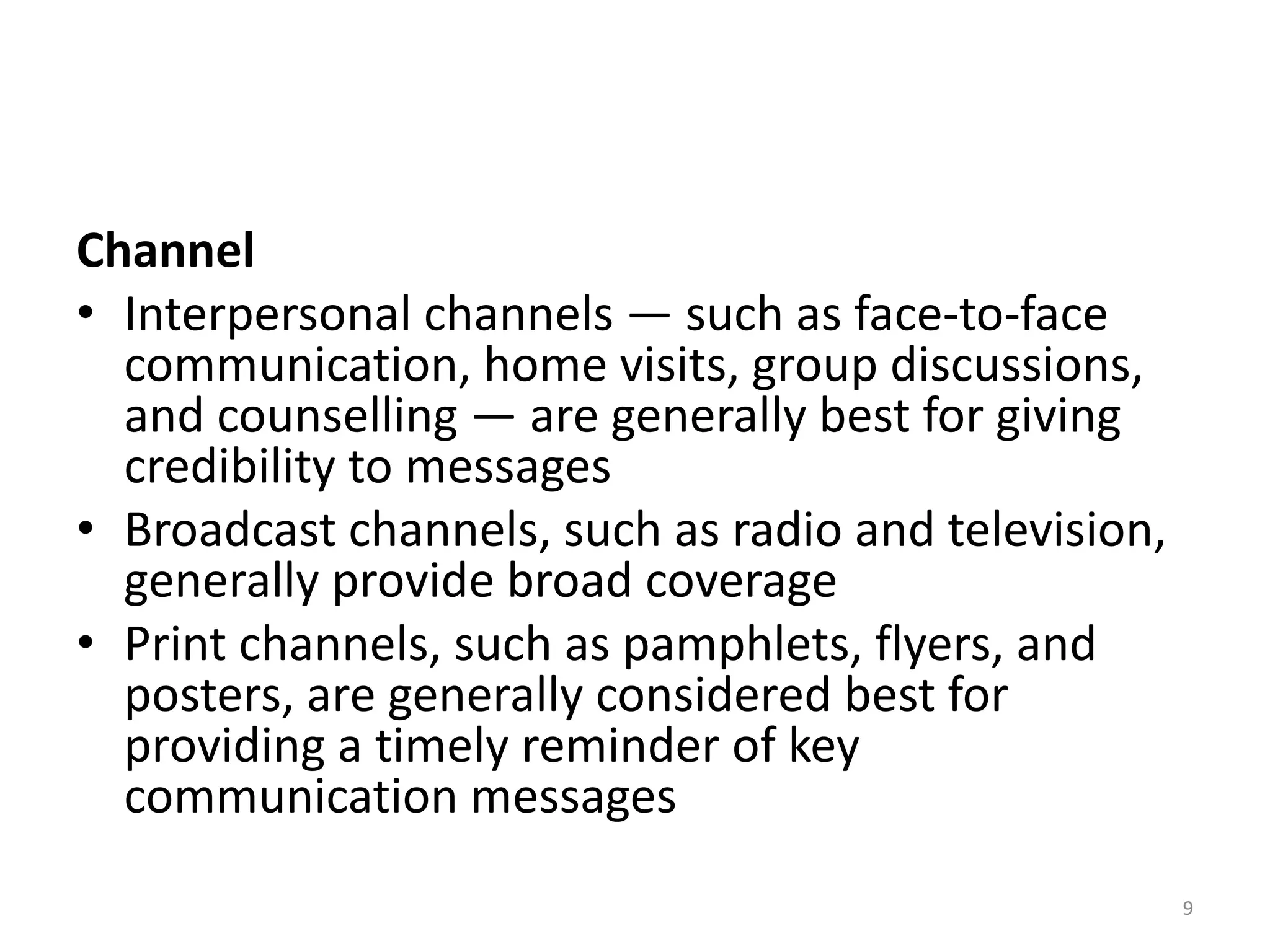
Channel
• Interpersonal channels — such as face-to-face
communication, home visits, group discussions,
and counselling — are generally best for giving
credibility to messages
• Broadcast channels, such as radio and television,
generally provide broad coverage
• Print channels, such as pamphlets, flyers, and
posters, are generally considered best for
providing a timely reminder of key
communication messages
9
• Feedback is the mechanism of assessing what
has happened to the receivers after the
communication has occurred. A
communication is said to have feedback when
the receiver of the message gives his or her
responses back to the sender of the message.
10
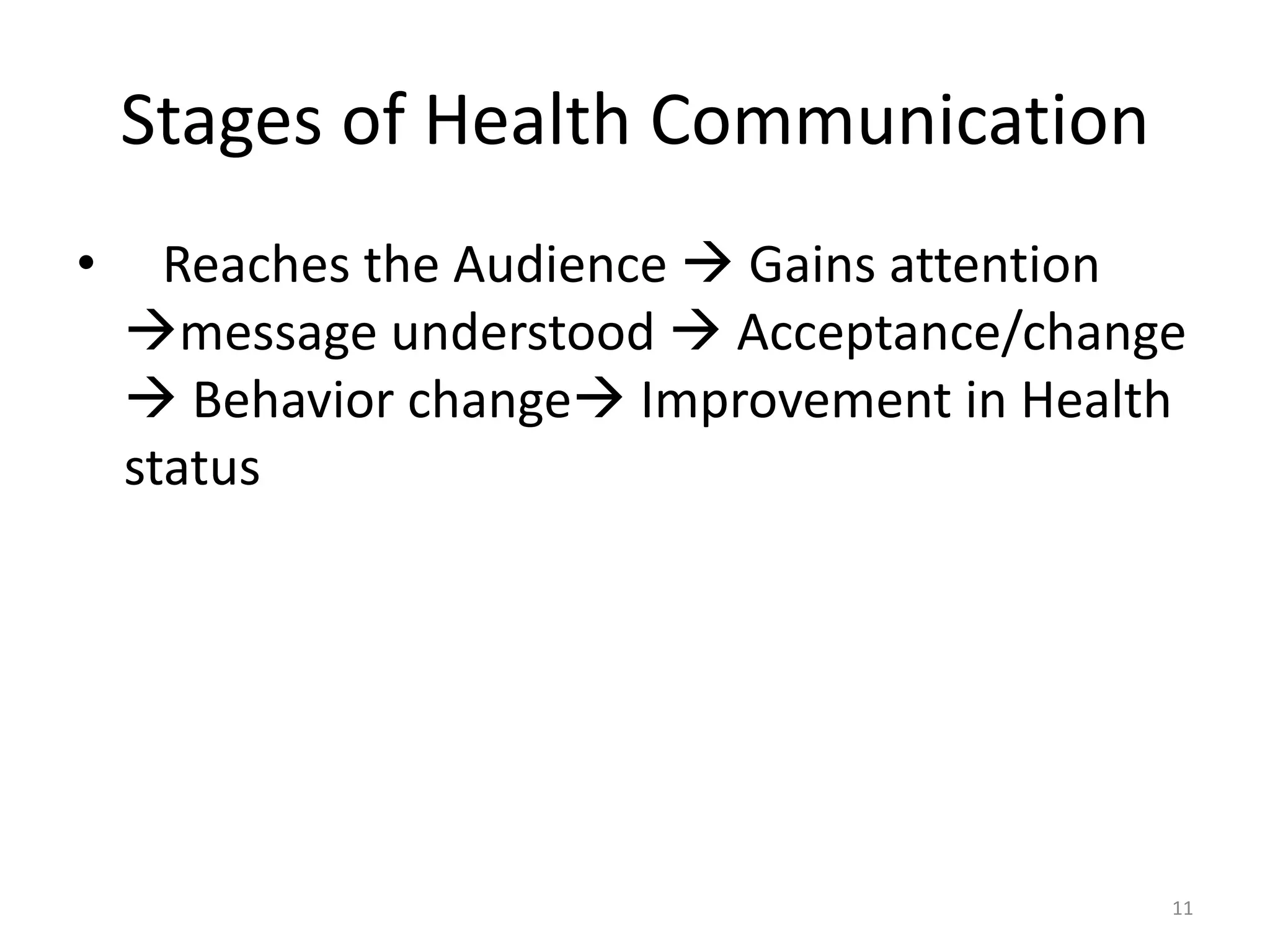
Stages of Health Communication
• Reaches the Audience à Gains attention
àmessage understood à Acceptance/change
à Behavior changeà Improvement in Health
status
11
Methods of communication
• Intrapersonal communication
• Interpersonal communication
• Mass communication
– (transmitting messages to a large segment of a
population. Electronic and print media are
commonly used for this.)
12
Forms of communication
• Oral / verbal
• Written
• Non-verbal
– (gestures, body language or posture, facial
expressions, and eye contact )
13
Approaches to health communication
• people respond to messages differently and that what
might persuade one person may not appeal to another.
• Generally there are four approaches to health
communication.
– Informative communication provides information about a
new idea and makes it familiar to people. Mass media of
this type is mostly used for wide coverage and reaching a
large audience
– prompting communication messages are designed so that
they are not easily ignored or forgotten they can be used
to remind the audience about something that reinforces
earlier messages (posters, song)
14
• Educative communication is where a new idea on
health behavior is explained, including its
strengths and weaknesses. This approach is used
when people are already aware of an issue, but
need more information or clarification.
• persuasive communication is usually in the form
of a message that promotes a positive change in
behavior and attitudes, and which encourages
that audience to accept the new idea
15
16
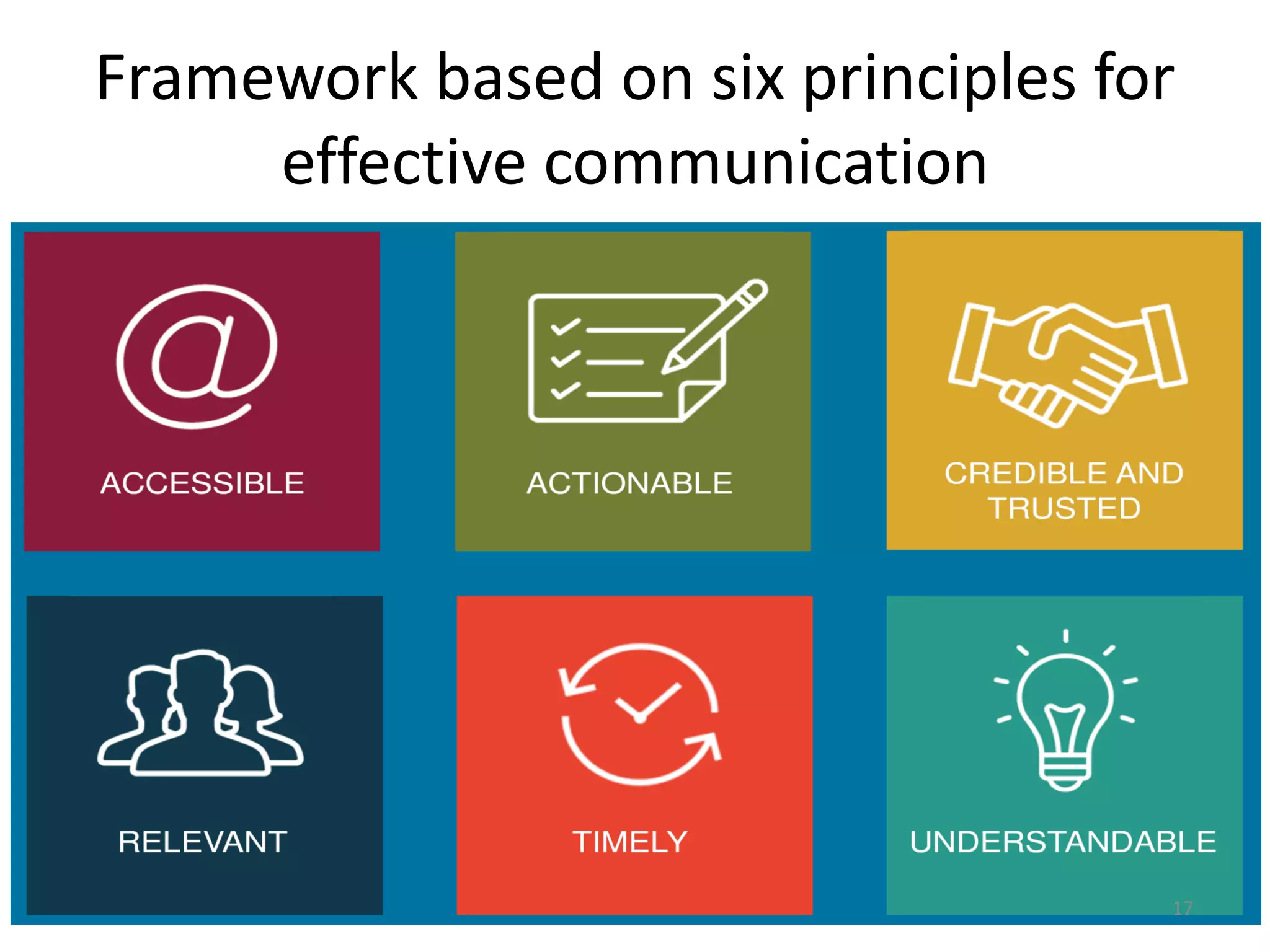
Framework based on six principles for
effective communication
17
WHO’S COMMUNICATIONS GOAL
To provide information, advice, and guidance to
key audiences to prompt action that will
protect the health of individuals, families,
communities and nations.
Purpose: effective, integrated and coordinated
communication is integral to carrying out
WHO’s goal to build a better, healthier future
for people all over the world.
18
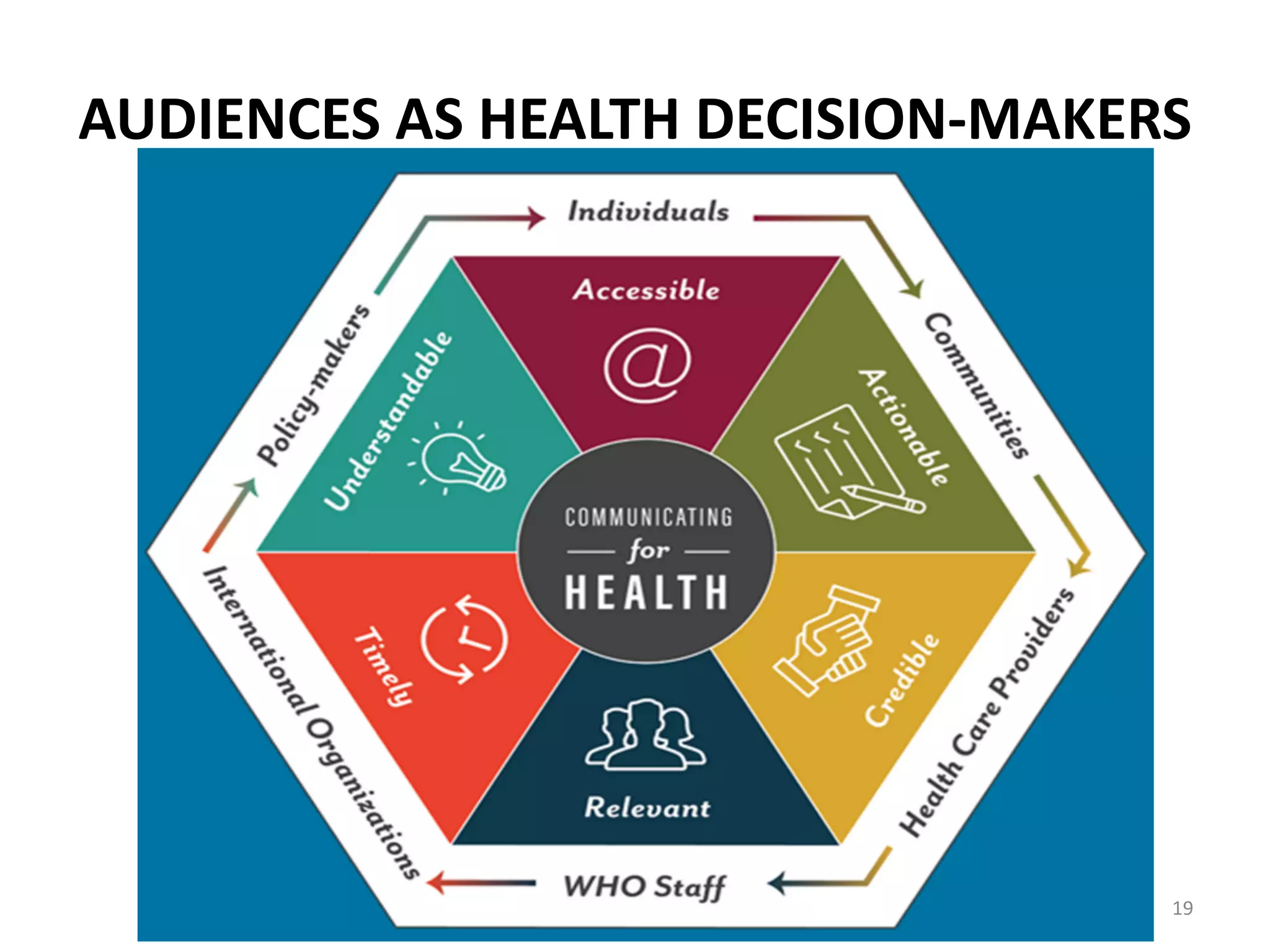
AUDIENCES AS HEALTH DECISION-MAKERS
19
• What channels do audiences have access to?
preference for receiving health information?
• What channels encourage two-way engagement with
audiences?
• Which set of channels best supports the
communication objectives identified for the project?
For example:
— if building awareness is the objective, what channels offer
the greatest opportunities for exposure and for ensuring
sufficient message frequency (repetition); or
— if behavior change is the objective, what channels provide
opportunities for the audience to see a role models? AA 20
• Mass media: broad reach (television,…websites)
may incur a cost if placement on certain platforms or
at specific times is important.
• Organization and community-based media, such as
local radio talk shows, organization newsletters;
community-based activities, such as health fairs
• Interpersonal. People seeking advice or sharing
information about health risks often turn to family,
friends, health care practitioners.
often the most trusted channels for health information.
21
How to make accessible
Make information, advice and guidance accessible
by:
• identifying the best channels for message
dissemination to achieve the communication
objective (for example moving decision-makers
from awareness to action);
• ensuring there are appropriate platforms to
support those who are seeking information about
the health issue; and
• considering the communication needs of those
with disabilities.
22
• What is the behavior or action we want
audiences to take to protect themselves or
those they care about? -- behavior or action
that needs to be discouraged?
• Do the target audiences understand the
situation, the health risks and recommended
behaviors and policies?
• Do target audiences perceive the health issue
as relevant to them; do they feel personally
engaged with the issue? 23
This principle comprises several components
helping communicators develop messages and
campaigns focused on behavior change by
understanding the audiences:
• level of awareness of the health risks and
protection;
• feelings of personal relevance to the health
risk;
24
• knowledge of appropriate health behaviors or
policies to mitigate risks and promote health;
• confidence that they can take the
recommended actions;
• sense that the recommended actions are
endorsed by their community; and
• belief that the benefits of implementing
actions outweigh the costs.
25
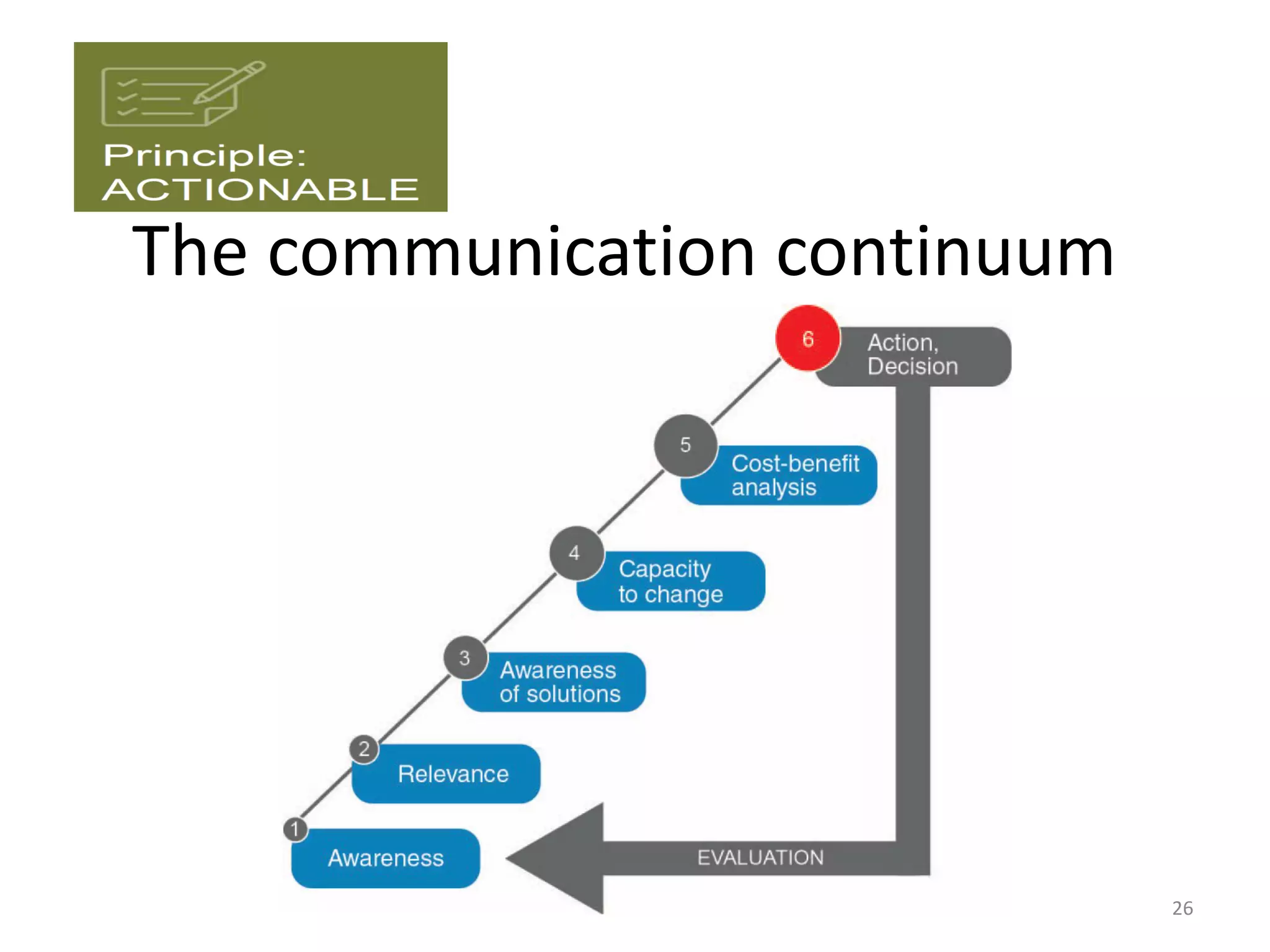
The communication continuum
26
INCREASE AWARENESS
Communicators first need to build awareness of
existing or emerging health threats or benefits.
- can build awareness using a variety of methods.
• Increase the level of understanding of health risks
and promote the steps that protect people’s
health.
• Widely disseminate messages that are simple,
easy to recall, repeated and attention-getting.
• Use mass media and social media channels.
27
SUPPORT AN APPROPRIATE
UNDERSTANDING OF THE RISK
Decision-makers need to believe that a health risk is
real and that they are vulnerable.
Communicators can use the following approaches
to increase personal relevance of the issue.
• Create a connection to the health issue at a
personal or community level.
• Show the health problem’s effect on people who
are like the target audience.
• Create a sense of urgency to prompt decisions
and action.
28
PROMOTE KNOWLEDGE OF
SOLUTIONS
People who feel susceptible to a health threat are more
likely to look for ways to protect themselves. In these
cases, communicators need strategies to match the
perception of susceptibility to the real magnitude of
the health risk.& to ensure the target audience knows
what behaviors and policies reduce risk and
susceptibility.
• Support decision-makers’ implementation of protective
measures by using messages that describe the desired
action and explain where to find information and
resources that support implementation.
29
INSTIL THE CONFIDENCE TO ACT
- various ways communicators can ensure individuals and
organizations believe they can perform recommended
behaviors or implement policies to promote health.
• Use WHO stories of individuals or organizations that model
the desired behavior or policy-making action.
• Use well-known strategies to influence audiences’
confidence. For example, promoting the ability to try a new
behavior without risk, observing someone else who is
respected practicing the health behavior.
• Have a clear call to action that breaks the accomplishment
of the desired health outcome into simple steps. Ensure
that each step in the call to action is attainable for that
target audience.
30
INSTIL THE CONFIDENCE TO ACT
• Teach skills, if necessary. Begin with behaviors that have
minimal skill requirements and continue working on
others that require more complex effort. For policy-
makers, begin with steps that require minimal initial
investment, but reap visible rewards, to motivate
towards the next step.
• Create opportunities for individuals and policy makers
to practice skills or develop plans with someone who
has already mastered them. Policy-makers should be
encouraged to learn from the successful policy
implementation of decision-makers who have already
acted on WHO guidance.
31
INFLUENCE SOCIAL NORMS
Social norms (rules, beliefs, expectations and behaviors )
can make it easier or harder for audiences to adopt
recommended health actions and policies. They can
come from peer attitudes, social or community beliefs,
and work contexts.
Communicators can use the following approaches to align
recommendations and benefits with relevant social
and cultural norms.
• Encourage trusted influencers and messengers who are
close to the audience to act as models and champions
for the desired behaviors and policies.
32
REINFORCE BENEFITS TO OVERCOME
BARRIERS
Communicators can help the target audience see the
benefits of protective health actions and lower the
barriers for their uptake in the following ways.
• Increase confidence in institutional support for
recommended behaviors and policies and lower the
barriers to their adoption.
• Design communications materials and activities at
individual and community levels to address barriers (
include lack of time, problems with logistics, costs, lack
of urgency and lack of awareness.)
33
REINFORCE BENEFITS TO OVERCOME
BARRIERS
• Reduce the time between when the target audience
adopts a recommended behavior and the reward. Any
significant time gap can disrupt this connection.
• Focus communications on midpoint milestones and
rewards to close the time gap between adopting the
behavior and the reward.
• Promote all the benefits that result from the
recommended behavior, not just the health benefit.
For example, getting a flu vaccine may help keep you
healthy and reduce the potential need to take
unscheduled time off work.
34
Communicators should consider these planning
questions to help decide how to communicate
with the aim of building and maintaining
credibility.
• What does WHO know about the health issue
and what questions still need to be answered?
35
• How aware are at-risk populations and other
decision-makers of WHO’s status as a credible
resource on the specific health issue?
• What other organizations are perceived by the
audiences as trusted on this health issue? How
can WHO align with them?
• Who is the best WHO spokesperson for this issue?
36
ENSURE TECHNICAL ACCURACY
• ensure that all communications products are
accurate and deliver a consistent message.
37
BE TRANSPARENT
To build trust, communicators must be transparent
about how WHO analyses data and how it makes
recommendations and policies. Messages also
need to acknowledge uncertainty and quickly
address any misconceptions or errors.
Transparency of all communications is essential to
ensure the credibility and trust of WHO
information, advice and guidance.
38
COORDINATE WITH PARTNERS
• If WHO and its partners coordinate to present
messages with consistent information, people
are more likely to trust the information and
follow the advice.
39
COORDINATE WITH PARTNERS
To reach more audiences, communicators can collaborate
with partners to:
• access more channels to disseminate important health
messages;
• gain new audiences by cross-linking web materials
between WHO and its partners;
• publish joint publications, drawing attention to the
document among both WHO and partners’
constituents; and
• issue joint press releases with partners.
40
• What socio-demographic characteristics of the
audience (such as age, education, geographic
location, etc.) can inform message design and
dissemination plans?
• Do individuals perceive they are at risk? Does that
perception correspond to the actual degree of
the risk?.
For example, this can occur when common health
threats that pose a higher actual risk are more familiar
and more accepted by the population than the new
threat about which WHO communicates in that
instant.
41
• Does the audience have previous experiences
with this, or similar health risks or topics, that can
be referenced to develop messages and materials
about the current issue that are more relevant?
• Does the audience feel there are steps they can
take to reduce the risks to their health?
• What is the audience hearing about the health
issue from other sources that may affect their
understanding of how WHO’s information,
advice, and guidance applies to them?
42
-how to create relevant messages by following these
points.
• Understand the characteristics of the target audience
to design effective messages and strategies.
• Create messages and materials that include examples
from or references to the target audience’s
community, organizations.
• Listen to the audience and to stakeholders that work
with that audience, in order to identify how to address
the audience’s concerns.
• Tailor content and messages to meet the needs of the
audience.
43
Know the Audience
UNDERSTAND SOCIO-DEMOGRAPHIC AND CULTURAL
CHARACTERISTICS
Age, gender, educational background, income, geographic
location, cultural beliefs and civic structure all influence how
people receive messages. To develop relevant messaging,
communicators must learn how these characteristics
influence a target audience.
DETERMINE COMMUNICATION PREFERENCES
• how the target audience prefers to receive messages;
• what communications channels the target audience uses;
• what messengers the target audience trusts; and
• any preferences the target audience has for product format
and design.
44
LISTEN TO THE AUDIENCE
LEARN BY LISTENING
Communicators can listen in a variety of ways to gain insight into
whether people find the health topic relevant. Listening can
identify:
• their level of interest in the issue;
• their perceptions and attitudes about the topic or risk and the
promoted action (behavior change, policy adoption, etc.);
• their current position or behaviors responding to health issue;
• the concerns about the health issue of at-risk audiences and
the organizations that support them;
• how the media portrays the issue;
45
LISTEN TO THE AUDIENCE
LISTEN TO ENQUIRIES
To learn about target audience questions and concerns, WHO
communicators can check sources that process enquiries by
people seeking information. This can help provide information
about levels of concern among at-risk populations and also
among those who are not at risk.
• Regional and country offices may have partner organizations
with hotlines or consumer enquiry phone lines. The questions
that people ask help WHO identify the gaps in existing
information, which can be filled through WHO communication
materials.
46
TAILOR THE MESSAGE
• Customizing communications ensures the relevance of
WHO information for target audiences.
• Message design can influence the effectiveness of a
message.
For example,
– if a target audience has health beliefs and values already
consistent with those presented in a message, using
statistics can be persuasive.
– If audience beliefs are counter to WHO recommendations,
emotional stories may be more effective.
47
MOTIVATE THE AUDIENCE
• Effective message design moves target
audiences along a communications continuum
from awareness to action.
• WHO communicators should identify where
audiences are on the continuum and design
messages to engage them at that stage.
48
-communicators should consider these questions
when designing communications actions and
products that are timely.
• When health threats are urgent, what are the best
methods to engage priority audiences quickly?
• When are the audiences likely to be faced with a
health-related decision for themselves or others
on the health topic?
• How can messages be delivered so that audiences
have enough time to understand and act on the
message?
49
• How can WHO best engage with the press to
get messages to the public quickly?
• How can WHO support partners so there is
timely and consistent dissemination of
information and advice?
50
The component sections of this principle discuss
how communicators can support timely
dissemination of WHO information, advice and
guidance by:
• making sure WHO’s information is available to
decision-makers as quickly as possible;
• timing communications to when decision-makers
need to know and take action; and
• sequencing messages to build the conversation
over time.
51
COMMUNICATE WHAT WHO KNOWS
EARLY
USE SOCIAL MEDIA
Twitter and other platforms can help WHO messages quickly reach millions of
people.
• A Twitter-first approach speeds dissemination of critical information that is
verified, while more detailed information is developed and cleared.
• WHO Twitter alerts can be sent from the WHO account as SMS messages
that can rapidly inform people about urgent health risks. SMS is especially
useful to reach target audiences who are in areas where internet
connections are unstable.
ENGAGE THE MEDIA
WHO communicators regularly reach out to local, national and international
print, television and radio outlets. There are various approaches for
communicators to engage with the media.
• Hold in-person and virtual press conferences.
— PC reach many journalists with the same message.
52
COMMUNICATE AT THE RIGHT TIME
ENHANCE EMERGENCY COMMUNICATIONS
Health emergencies demand rapid dissemination of
information and guidance. If announcements are
delayed, people may:
• overreact to the health risk;
• fill the information void with rumors and
misperceptions;
• conclude that WHO is unaware of the situation or
hiding information, causing audiences to lose trust in
the Organization; and
• look elsewhere for information that may be inaccurate
or incomplete.
53
To help ensure messages are understandable,
communicators should consider
• How familiar is your audience with the topic? Does the
audience have prior experience with the specific health
threat or does your communications need to provide
basic information to create awareness?
• What is your most important message, that is, what do
you want your audience to do? How can you highlight
it?
• Does your message clearly state the action you want
the audience to take?
54
USE PLAIN LANGUAGE
People are more likely to trust and act on
information they understand. To ensure the
target audience understands WHO
information, advice and guidance,
communicators must:
• be clear about the desired outcome
• get to the point quickly
• know what the audience wants and needs.
55
TELL REAL STORIES
Descriptive storytelling makes health information more
understandable and compelling. WHO communicators
can use narratives to:
• bring a human face to suffering;
• inspire audiences with success stories that would
motivate them to take action;
• tell WHO’s story, about specific teams and activities,
showing how WHO protects health and saves lives;
• showcase decision-makers who implemented WHO
policies and experienced positive outcomes; and
56
MAKE IT VISUAL
• Communicators increasingly share health information
through visual means, such as YouTube videos,
photographs, infographics, charts and illustrations.
• easier to understand and can reach people of all
literacy and education levels. Communicators can
increase understandability of WHO’s messages by:
• presenting technical information with illustrations and
images so it is easier to understand;
• clarifying sequences, timelines and relationships with
drawings to show the steps in a process.
57
USE FAMILIAR LANGUAGES
• To ensure target audiences understand WHO
information, advice and guidance,
communicators should create messages in
multiple languages and provide translation
support.
• DISTRIBUTE MESSAGES IN RELEVANT
LANGUAGES
58
“National Health Communication Policy, 2012”
Goal:
to sustain healthy lifestyle of mass citizens
• by promoting health services, programs and
healthy behavior;
• by preventing and controlling disease and
• by increasing accessibility and utilization of
health services.
59
Objectives
• Mobilize and use modern and traditional
communication multimedia and methods in an
extensive and proportionate manner to raise health
awareness, knowledge and promote healthy behavior of
mass citizens.
• Strengthen, expand and implement health
communication programs at central, region, district and
community level through clear and strengthened
cooperation, coordination and collaboration among
individual, community, relevant organizations and
communication media. 60
Objectives
• Generate, collect and mobilize sufficient resources
for the effective implementation of health
communication programs at central, region, district
and community level.
• Prevent unauthorized dissemination and duplication
of health related messages or information and
materials of different issues by maintaining quality,
correctness, authorized, uniformity and
appropriateness,
61
62

Health communication an overview of various strategies

  • 1.
  • 2.
    Overview • Health communication •Strategy • Components Health communication • Methods of health communication • Approaches of Health communication • WHO Strategic communication Framework – Six Principles • National Health Communication Policy, 2012 2
  • 3.
    Stories • Suppose atthe 10 pm we are all sleeping in this room and it’s raining outside….. • Prophet Mohammad and a child……. • Bat and a ball cost Rs 1100/-…….. • Flute with six holes………. 3
  • 4.
  • 5.
    Health Communication • isthe art and technique of informing, persuading and motivating individuals or larger audiences about important health issues based on scientific and ethical considerations. • the study and use of communication strategies to inform and persuade individual and community knowledge, attitudes and practices (KAP) with regard to health and behavior change. 5
  • 6.
    Strategy • A strategyis an approach to a set of competitive moves that are designed to generate a successful outcome • A strategy is management’s game plan for – Strengthening the organization’s competitive position – Satisfying customers – Achieving performance targets • Four big questions involved in a strategy – Where are we now? Where do we want to go? – How will we get there? – How do we know if we got there? 6
  • 7.
    Components of HealthCommunication • Sender Credibility can come from: – A person’s natural position in the family or community — for example, head, village chief or elder. – Through their personal qualities – Respect for their qualifications and training. – The extent to which the source of communication shares characteristics such as age, sex, education, religion or experiences with the receiver • Receiver/audience 7
  • 8.
    • Message: isa piece of information that contains a combination of ideas, facts, opinions, feelings or attitudes. The content of the message could be organized in different ways so that it is more likely to persuade or convince people. These are called appeals.(fear-arousal, humor, logical/factual appeals, emotional appeals) 8
  • 9.
    Channel • Interpersonal channels— such as face-to-face communication, home visits, group discussions, and counselling — are generally best for giving credibility to messages • Broadcast channels, such as radio and television, generally provide broad coverage • Print channels, such as pamphlets, flyers, and posters, are generally considered best for providing a timely reminder of key communication messages 9
  • 10.
    • Feedback isthe mechanism of assessing what has happened to the receivers after the communication has occurred. A communication is said to have feedback when the receiver of the message gives his or her responses back to the sender of the message. 10
  • 11.
    Stages of HealthCommunication • Reaches the Audience à Gains attention àmessage understood à Acceptance/change à Behavior changeà Improvement in Health status 11
  • 12.
    Methods of communication •Intrapersonal communication • Interpersonal communication • Mass communication – (transmitting messages to a large segment of a population. Electronic and print media are commonly used for this.) 12
  • 13.
    Forms of communication •Oral / verbal • Written • Non-verbal – (gestures, body language or posture, facial expressions, and eye contact ) 13
  • 14.
    Approaches to healthcommunication • people respond to messages differently and that what might persuade one person may not appeal to another. • Generally there are four approaches to health communication. – Informative communication provides information about a new idea and makes it familiar to people. Mass media of this type is mostly used for wide coverage and reaching a large audience – prompting communication messages are designed so that they are not easily ignored or forgotten they can be used to remind the audience about something that reinforces earlier messages (posters, song) 14
  • 15.
    • Educative communicationis where a new idea on health behavior is explained, including its strengths and weaknesses. This approach is used when people are already aware of an issue, but need more information or clarification. • persuasive communication is usually in the form of a message that promotes a positive change in behavior and attitudes, and which encourages that audience to accept the new idea 15
  • 16.
  • 17.
    Framework based onsix principles for effective communication 17
  • 18.
    WHO’S COMMUNICATIONS GOAL Toprovide information, advice, and guidance to key audiences to prompt action that will protect the health of individuals, families, communities and nations. Purpose: effective, integrated and coordinated communication is integral to carrying out WHO’s goal to build a better, healthier future for people all over the world. 18
  • 19.
    AUDIENCES AS HEALTHDECISION-MAKERS 19
  • 20.
    • What channelsdo audiences have access to? preference for receiving health information? • What channels encourage two-way engagement with audiences? • Which set of channels best supports the communication objectives identified for the project? For example: — if building awareness is the objective, what channels offer the greatest opportunities for exposure and for ensuring sufficient message frequency (repetition); or — if behavior change is the objective, what channels provide opportunities for the audience to see a role models? AA 20
  • 21.
    • Mass media:broad reach (television,…websites) may incur a cost if placement on certain platforms or at specific times is important. • Organization and community-based media, such as local radio talk shows, organization newsletters; community-based activities, such as health fairs • Interpersonal. People seeking advice or sharing information about health risks often turn to family, friends, health care practitioners. often the most trusted channels for health information. 21
  • 22.
    How to makeaccessible Make information, advice and guidance accessible by: • identifying the best channels for message dissemination to achieve the communication objective (for example moving decision-makers from awareness to action); • ensuring there are appropriate platforms to support those who are seeking information about the health issue; and • considering the communication needs of those with disabilities. 22
  • 23.
    • What isthe behavior or action we want audiences to take to protect themselves or those they care about? -- behavior or action that needs to be discouraged? • Do the target audiences understand the situation, the health risks and recommended behaviors and policies? • Do target audiences perceive the health issue as relevant to them; do they feel personally engaged with the issue? 23
  • 24.
    This principle comprisesseveral components helping communicators develop messages and campaigns focused on behavior change by understanding the audiences: • level of awareness of the health risks and protection; • feelings of personal relevance to the health risk; 24
  • 25.
    • knowledge ofappropriate health behaviors or policies to mitigate risks and promote health; • confidence that they can take the recommended actions; • sense that the recommended actions are endorsed by their community; and • belief that the benefits of implementing actions outweigh the costs. 25
  • 26.
  • 27.
    INCREASE AWARENESS Communicators firstneed to build awareness of existing or emerging health threats or benefits. - can build awareness using a variety of methods. • Increase the level of understanding of health risks and promote the steps that protect people’s health. • Widely disseminate messages that are simple, easy to recall, repeated and attention-getting. • Use mass media and social media channels. 27
  • 28.
    SUPPORT AN APPROPRIATE UNDERSTANDINGOF THE RISK Decision-makers need to believe that a health risk is real and that they are vulnerable. Communicators can use the following approaches to increase personal relevance of the issue. • Create a connection to the health issue at a personal or community level. • Show the health problem’s effect on people who are like the target audience. • Create a sense of urgency to prompt decisions and action. 28
  • 29.
    PROMOTE KNOWLEDGE OF SOLUTIONS Peoplewho feel susceptible to a health threat are more likely to look for ways to protect themselves. In these cases, communicators need strategies to match the perception of susceptibility to the real magnitude of the health risk.& to ensure the target audience knows what behaviors and policies reduce risk and susceptibility. • Support decision-makers’ implementation of protective measures by using messages that describe the desired action and explain where to find information and resources that support implementation. 29
  • 30.
    INSTIL THE CONFIDENCETO ACT - various ways communicators can ensure individuals and organizations believe they can perform recommended behaviors or implement policies to promote health. • Use WHO stories of individuals or organizations that model the desired behavior or policy-making action. • Use well-known strategies to influence audiences’ confidence. For example, promoting the ability to try a new behavior without risk, observing someone else who is respected practicing the health behavior. • Have a clear call to action that breaks the accomplishment of the desired health outcome into simple steps. Ensure that each step in the call to action is attainable for that target audience. 30
  • 31.
    INSTIL THE CONFIDENCETO ACT • Teach skills, if necessary. Begin with behaviors that have minimal skill requirements and continue working on others that require more complex effort. For policy- makers, begin with steps that require minimal initial investment, but reap visible rewards, to motivate towards the next step. • Create opportunities for individuals and policy makers to practice skills or develop plans with someone who has already mastered them. Policy-makers should be encouraged to learn from the successful policy implementation of decision-makers who have already acted on WHO guidance. 31
  • 32.
    INFLUENCE SOCIAL NORMS Socialnorms (rules, beliefs, expectations and behaviors ) can make it easier or harder for audiences to adopt recommended health actions and policies. They can come from peer attitudes, social or community beliefs, and work contexts. Communicators can use the following approaches to align recommendations and benefits with relevant social and cultural norms. • Encourage trusted influencers and messengers who are close to the audience to act as models and champions for the desired behaviors and policies. 32
  • 33.
    REINFORCE BENEFITS TOOVERCOME BARRIERS Communicators can help the target audience see the benefits of protective health actions and lower the barriers for their uptake in the following ways. • Increase confidence in institutional support for recommended behaviors and policies and lower the barriers to their adoption. • Design communications materials and activities at individual and community levels to address barriers ( include lack of time, problems with logistics, costs, lack of urgency and lack of awareness.) 33
  • 34.
    REINFORCE BENEFITS TOOVERCOME BARRIERS • Reduce the time between when the target audience adopts a recommended behavior and the reward. Any significant time gap can disrupt this connection. • Focus communications on midpoint milestones and rewards to close the time gap between adopting the behavior and the reward. • Promote all the benefits that result from the recommended behavior, not just the health benefit. For example, getting a flu vaccine may help keep you healthy and reduce the potential need to take unscheduled time off work. 34
  • 35.
    Communicators should considerthese planning questions to help decide how to communicate with the aim of building and maintaining credibility. • What does WHO know about the health issue and what questions still need to be answered? 35
  • 36.
    • How awareare at-risk populations and other decision-makers of WHO’s status as a credible resource on the specific health issue? • What other organizations are perceived by the audiences as trusted on this health issue? How can WHO align with them? • Who is the best WHO spokesperson for this issue? 36
  • 37.
    ENSURE TECHNICAL ACCURACY •ensure that all communications products are accurate and deliver a consistent message. 37
  • 38.
    BE TRANSPARENT To buildtrust, communicators must be transparent about how WHO analyses data and how it makes recommendations and policies. Messages also need to acknowledge uncertainty and quickly address any misconceptions or errors. Transparency of all communications is essential to ensure the credibility and trust of WHO information, advice and guidance. 38
  • 39.
    COORDINATE WITH PARTNERS •If WHO and its partners coordinate to present messages with consistent information, people are more likely to trust the information and follow the advice. 39
  • 40.
    COORDINATE WITH PARTNERS Toreach more audiences, communicators can collaborate with partners to: • access more channels to disseminate important health messages; • gain new audiences by cross-linking web materials between WHO and its partners; • publish joint publications, drawing attention to the document among both WHO and partners’ constituents; and • issue joint press releases with partners. 40
  • 41.
    • What socio-demographiccharacteristics of the audience (such as age, education, geographic location, etc.) can inform message design and dissemination plans? • Do individuals perceive they are at risk? Does that perception correspond to the actual degree of the risk?. For example, this can occur when common health threats that pose a higher actual risk are more familiar and more accepted by the population than the new threat about which WHO communicates in that instant. 41
  • 42.
    • Does theaudience have previous experiences with this, or similar health risks or topics, that can be referenced to develop messages and materials about the current issue that are more relevant? • Does the audience feel there are steps they can take to reduce the risks to their health? • What is the audience hearing about the health issue from other sources that may affect their understanding of how WHO’s information, advice, and guidance applies to them? 42
  • 43.
    -how to createrelevant messages by following these points. • Understand the characteristics of the target audience to design effective messages and strategies. • Create messages and materials that include examples from or references to the target audience’s community, organizations. • Listen to the audience and to stakeholders that work with that audience, in order to identify how to address the audience’s concerns. • Tailor content and messages to meet the needs of the audience. 43
  • 44.
    Know the Audience UNDERSTANDSOCIO-DEMOGRAPHIC AND CULTURAL CHARACTERISTICS Age, gender, educational background, income, geographic location, cultural beliefs and civic structure all influence how people receive messages. To develop relevant messaging, communicators must learn how these characteristics influence a target audience. DETERMINE COMMUNICATION PREFERENCES • how the target audience prefers to receive messages; • what communications channels the target audience uses; • what messengers the target audience trusts; and • any preferences the target audience has for product format and design. 44
  • 45.
    LISTEN TO THEAUDIENCE LEARN BY LISTENING Communicators can listen in a variety of ways to gain insight into whether people find the health topic relevant. Listening can identify: • their level of interest in the issue; • their perceptions and attitudes about the topic or risk and the promoted action (behavior change, policy adoption, etc.); • their current position or behaviors responding to health issue; • the concerns about the health issue of at-risk audiences and the organizations that support them; • how the media portrays the issue; 45
  • 46.
    LISTEN TO THEAUDIENCE LISTEN TO ENQUIRIES To learn about target audience questions and concerns, WHO communicators can check sources that process enquiries by people seeking information. This can help provide information about levels of concern among at-risk populations and also among those who are not at risk. • Regional and country offices may have partner organizations with hotlines or consumer enquiry phone lines. The questions that people ask help WHO identify the gaps in existing information, which can be filled through WHO communication materials. 46
  • 47.
    TAILOR THE MESSAGE •Customizing communications ensures the relevance of WHO information for target audiences. • Message design can influence the effectiveness of a message. For example, – if a target audience has health beliefs and values already consistent with those presented in a message, using statistics can be persuasive. – If audience beliefs are counter to WHO recommendations, emotional stories may be more effective. 47
  • 48.
    MOTIVATE THE AUDIENCE •Effective message design moves target audiences along a communications continuum from awareness to action. • WHO communicators should identify where audiences are on the continuum and design messages to engage them at that stage. 48
  • 49.
    -communicators should considerthese questions when designing communications actions and products that are timely. • When health threats are urgent, what are the best methods to engage priority audiences quickly? • When are the audiences likely to be faced with a health-related decision for themselves or others on the health topic? • How can messages be delivered so that audiences have enough time to understand and act on the message? 49
  • 50.
    • How canWHO best engage with the press to get messages to the public quickly? • How can WHO support partners so there is timely and consistent dissemination of information and advice? 50
  • 51.
    The component sectionsof this principle discuss how communicators can support timely dissemination of WHO information, advice and guidance by: • making sure WHO’s information is available to decision-makers as quickly as possible; • timing communications to when decision-makers need to know and take action; and • sequencing messages to build the conversation over time. 51
  • 52.
    COMMUNICATE WHAT WHOKNOWS EARLY USE SOCIAL MEDIA Twitter and other platforms can help WHO messages quickly reach millions of people. • A Twitter-first approach speeds dissemination of critical information that is verified, while more detailed information is developed and cleared. • WHO Twitter alerts can be sent from the WHO account as SMS messages that can rapidly inform people about urgent health risks. SMS is especially useful to reach target audiences who are in areas where internet connections are unstable. ENGAGE THE MEDIA WHO communicators regularly reach out to local, national and international print, television and radio outlets. There are various approaches for communicators to engage with the media. • Hold in-person and virtual press conferences. — PC reach many journalists with the same message. 52
  • 53.
    COMMUNICATE AT THERIGHT TIME ENHANCE EMERGENCY COMMUNICATIONS Health emergencies demand rapid dissemination of information and guidance. If announcements are delayed, people may: • overreact to the health risk; • fill the information void with rumors and misperceptions; • conclude that WHO is unaware of the situation or hiding information, causing audiences to lose trust in the Organization; and • look elsewhere for information that may be inaccurate or incomplete. 53
  • 54.
    To help ensuremessages are understandable, communicators should consider • How familiar is your audience with the topic? Does the audience have prior experience with the specific health threat or does your communications need to provide basic information to create awareness? • What is your most important message, that is, what do you want your audience to do? How can you highlight it? • Does your message clearly state the action you want the audience to take? 54
  • 55.
    USE PLAIN LANGUAGE Peopleare more likely to trust and act on information they understand. To ensure the target audience understands WHO information, advice and guidance, communicators must: • be clear about the desired outcome • get to the point quickly • know what the audience wants and needs. 55
  • 56.
    TELL REAL STORIES Descriptivestorytelling makes health information more understandable and compelling. WHO communicators can use narratives to: • bring a human face to suffering; • inspire audiences with success stories that would motivate them to take action; • tell WHO’s story, about specific teams and activities, showing how WHO protects health and saves lives; • showcase decision-makers who implemented WHO policies and experienced positive outcomes; and 56
  • 57.
    MAKE IT VISUAL •Communicators increasingly share health information through visual means, such as YouTube videos, photographs, infographics, charts and illustrations. • easier to understand and can reach people of all literacy and education levels. Communicators can increase understandability of WHO’s messages by: • presenting technical information with illustrations and images so it is easier to understand; • clarifying sequences, timelines and relationships with drawings to show the steps in a process. 57
  • 58.
    USE FAMILIAR LANGUAGES •To ensure target audiences understand WHO information, advice and guidance, communicators should create messages in multiple languages and provide translation support. • DISTRIBUTE MESSAGES IN RELEVANT LANGUAGES 58
  • 59.
    “National Health CommunicationPolicy, 2012” Goal: to sustain healthy lifestyle of mass citizens • by promoting health services, programs and healthy behavior; • by preventing and controlling disease and • by increasing accessibility and utilization of health services. 59
  • 60.
    Objectives • Mobilize anduse modern and traditional communication multimedia and methods in an extensive and proportionate manner to raise health awareness, knowledge and promote healthy behavior of mass citizens. • Strengthen, expand and implement health communication programs at central, region, district and community level through clear and strengthened cooperation, coordination and collaboration among individual, community, relevant organizations and communication media. 60
  • 61.
    Objectives • Generate, collectand mobilize sufficient resources for the effective implementation of health communication programs at central, region, district and community level. • Prevent unauthorized dissemination and duplication of health related messages or information and materials of different issues by maintaining quality, correctness, authorized, uniformity and appropriateness, 61
  • 62.