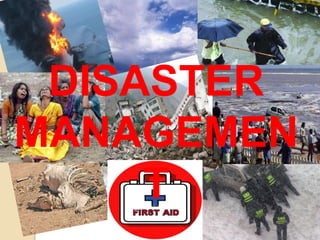
DISASTER
MANAGEMEN
T
DEFINITIONS OF DISASTER
 “A disaster can be defined as any occurrence that cause
damage, ecological disruption, loss of human
life, deterioration of health and health services on a
scale, sufficient to warrant an extraordinary response
from outside the affected community or area”.
(W.H.O.)
 “A disaster can be defined as an occurrence either
nature or manmade that causes human suffering and
creates human needs that victims cannot alleviate
without assistance”.
American Red Cross (ARC)
DISASTER NURSING
 It can be defined as the adaptation of
professional nursing skills in recognizing and
meeting the nursing, physical and emotional
needs resulting from a disaster.
TYPES OF DISASTER
Natural
Disasters
Meteorological
Topographical
Environmental
Man-made
Disasters
Technological
Industrial
accidents
Security
related
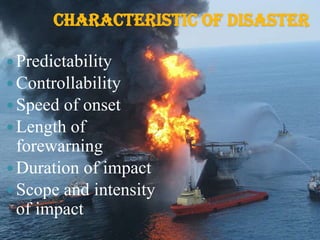
CHARACTERISTIC OF DISASTER
Predictability
Controllability
Speed of onset
Length of
forewarning
Duration of impact
Scope and intensity
of impact
PHASES OF DISASTER
Pre-impact
phase
Impact
phase
Post-impact
phase
What is Disaster Management
 Disaster management, which is also known as
emergency management, can be defined as
dealing with and avoiding both natural and
man made disasters. Disaster management
involves preparedness before
disaster, rebuilding and supporting society
after natural disasters such
as, earthquakes, drought, tsunami etc. In
India, there are many areas, which are often
affected with natural calamity or man made
disasters. They have become top priority for
the Ministry of Human Resource
Development, Government of India.
PRINCIPLES OF DISASTER
MANAGEMENT
 Disaster management is the
responsibility of all spheres of
government
 Disaster management should use
resources that exist for a day-to-day
purpose.
 Organizations should function as an
extension of their core business
 Individuals are responsible for their own
safety.
 Disaster management planning should
focus on large-scale events.
Contd….
 Disaster management planning should recognize the difference
between incidents and disasters.
 Disaster management operational arrangements are additional
to and do not replace incident management operational
arrangements
 Disaster management planning must take account of the type of
physical environment and the structure of the population.
 Disaster management arrangements must recognise the
involvement and potential role of non- government agencies.
PHASES OF DISASTER
MANAGEMENT
Disaster Preparedness
Disaster impact
Disaster Response
Rehabilitation
Disaster Mitigation
Disaster preparedness
Preparedness should be in the form of money, manpower
and materials
 Evaluation from past experiences about risk
 Location of disaster prone areas
 Organization of communication, information and
warning system
 Ensuring co-ordination and response mechanisms
 Development of public education programme
 Co-ordination with media
 National & international relations
 Keeping stock of foods, drug and other essential
commodities.
E.g.: Indian Meteorological department (IMD) plays a key role in
forewarning the disaster of cyclone-storms by detection tracing. It
has 5 centres in Kolkata, Bhubaneswar, Vishakapatanam, Chennai
& Mumbai. In addition there are 31 special observation posts setup
a long the east coast of India.
The International Agencies which provides humanitarian assistance
to the disaster strike areas are United Nation agencies.
 Office for the co-ordination of Humanitarian Affair (OCHA)
 World Health Organization (WHO)
 UNICEF
 World Food Programme (WFP)
 Food & Agricultural Organisation (FAD)
E.g.: Non Governmental Organizations
 Co-Operative American Relief Every where (CARE)
 International committee of Red cross
Disaster impact
Triage
 Golden hour
 Immediate or high priority:
 Delayed or medium priority:
 Minor or minimal or ambulatory patients:
 Expectant or least priority:
 Colour code:
Disaster response
 Epidemiologic surveillance and disease
control
 Vaccination
 Nutrition
Rehabilitation phase
 Water supply
 Food safety
 Basic sanitation
and personal
hygiene
 Housing
Disaster mitigation
 This involves lessening the likely effects of
emergencies. These include depending upon the
disaster, protection of vulnerable population and
structure.
 For examples, improving structural qualities of
schools, houses and such other buildings so that
medical causalities can be minimized. Similarly
ensuring the safety of health facilities and public
health services including water supply and sewerage
system to reduce the cost of rehabilitation and
reconstruction. This mitigation compliments the
disaster preparedness and disaster response activities.
DISASTER MANAGEMENT
CYCLE
DISASTER-EFFECTS
 Deaths
 Disability
 Increase in communicable disease
 Psychological problems
 Food shortage
 Socioeconomic losses
 Shortage of drugs and medical supplies.
 Environmental disruption
DISASTER DRILL
A disaster drill is an exercise in which people
simulate the circumstances of a disaster so that
they have an opportunity to practice their
responses.
ROLE OF NURSE IN DISASTER
MANAGEMENT
DISASTER PREPAREDNESS
 To facilitate preparation with community
 To provide updated record of vulnerable
populations within community
 Nurse leads a preparedness effort
 Nurse play multiroles in community
 Nurse should have understanding of community
resources
 Disaster Nurse must be involved in community
organization
DISASTER RESPONSE
 Nurse must involve in community assessment
 Once rescue workers begin to arrive at the
scene, immediate plans for triage should begin
 Nurse work a member of assessment team
 To be involved in ongoing surveillance
DISASTER RECOVERY
 Successful Recovery
Preparation
 Be vigilant in Health teaching
 Psychological support
 Referrals to hospital as needed
 Remain alert for environmental
health
 Nurse must be attentive to the
danger
JOURNAL REFERENCE
THANK
YOU
Presented By
Pankaj Kr.Singh
Ravi Prakash Yadav

Disaster management

  • 1.
  • 2.
    DEFINITIONS OF DISASTER “A disaster can be defined as any occurrence that cause damage, ecological disruption, loss of human life, deterioration of health and health services on a scale, sufficient to warrant an extraordinary response from outside the affected community or area”. (W.H.O.)  “A disaster can be defined as an occurrence either nature or manmade that causes human suffering and creates human needs that victims cannot alleviate without assistance”. American Red Cross (ARC)
  • 3.
    DISASTER NURSING  Itcan be defined as the adaptation of professional nursing skills in recognizing and meeting the nursing, physical and emotional needs resulting from a disaster.
  • 4.
  • 5.
    CHARACTERISTIC OF DISASTER Predictability Controllability Speedof onset Length of forewarning Duration of impact Scope and intensity of impact
  • 6.
  • 8.
    What is DisasterManagement  Disaster management, which is also known as emergency management, can be defined as dealing with and avoiding both natural and man made disasters. Disaster management involves preparedness before disaster, rebuilding and supporting society after natural disasters such as, earthquakes, drought, tsunami etc. In India, there are many areas, which are often affected with natural calamity or man made disasters. They have become top priority for the Ministry of Human Resource Development, Government of India.
  • 9.
    PRINCIPLES OF DISASTER MANAGEMENT Disaster management is the responsibility of all spheres of government  Disaster management should use resources that exist for a day-to-day purpose.  Organizations should function as an extension of their core business  Individuals are responsible for their own safety.  Disaster management planning should focus on large-scale events.
  • 10.
    Contd….  Disaster managementplanning should recognize the difference between incidents and disasters.  Disaster management operational arrangements are additional to and do not replace incident management operational arrangements  Disaster management planning must take account of the type of physical environment and the structure of the population.  Disaster management arrangements must recognise the involvement and potential role of non- government agencies.
  • 11.
    PHASES OF DISASTER MANAGEMENT DisasterPreparedness Disaster impact Disaster Response Rehabilitation Disaster Mitigation
  • 12.
    Disaster preparedness Preparedness shouldbe in the form of money, manpower and materials  Evaluation from past experiences about risk  Location of disaster prone areas  Organization of communication, information and warning system  Ensuring co-ordination and response mechanisms  Development of public education programme  Co-ordination with media  National & international relations  Keeping stock of foods, drug and other essential commodities.
  • 13.
    E.g.: Indian Meteorologicaldepartment (IMD) plays a key role in forewarning the disaster of cyclone-storms by detection tracing. It has 5 centres in Kolkata, Bhubaneswar, Vishakapatanam, Chennai & Mumbai. In addition there are 31 special observation posts setup a long the east coast of India. The International Agencies which provides humanitarian assistance to the disaster strike areas are United Nation agencies.  Office for the co-ordination of Humanitarian Affair (OCHA)  World Health Organization (WHO)  UNICEF  World Food Programme (WFP)  Food & Agricultural Organisation (FAD) E.g.: Non Governmental Organizations  Co-Operative American Relief Every where (CARE)  International committee of Red cross  International committee of Red cross
  • 14.
  • 15.
    Triage  Golden hour Immediate or high priority:  Delayed or medium priority:  Minor or minimal or ambulatory patients:  Expectant or least priority:  Colour code:
  • 16.
    Disaster response  Epidemiologicsurveillance and disease control  Vaccination  Nutrition
  • 17.
    Rehabilitation phase  Watersupply  Food safety  Basic sanitation and personal hygiene  Housing
  • 18.
    Disaster mitigation  Thisinvolves lessening the likely effects of emergencies. These include depending upon the disaster, protection of vulnerable population and structure.  For examples, improving structural qualities of schools, houses and such other buildings so that medical causalities can be minimized. Similarly ensuring the safety of health facilities and public health services including water supply and sewerage system to reduce the cost of rehabilitation and reconstruction. This mitigation compliments the disaster preparedness and disaster response activities.
  • 19.
  • 20.
    DISASTER-EFFECTS  Deaths  Disability Increase in communicable disease  Psychological problems  Food shortage  Socioeconomic losses  Shortage of drugs and medical supplies.  Environmental disruption
  • 21.
    DISASTER DRILL A disasterdrill is an exercise in which people simulate the circumstances of a disaster so that they have an opportunity to practice their responses.
  • 22.
    ROLE OF NURSEIN DISASTER MANAGEMENT DISASTER PREPAREDNESS  To facilitate preparation with community  To provide updated record of vulnerable populations within community  Nurse leads a preparedness effort  Nurse play multiroles in community  Nurse should have understanding of community resources  Disaster Nurse must be involved in community organization
  • 23.
    DISASTER RESPONSE  Nursemust involve in community assessment  Once rescue workers begin to arrive at the scene, immediate plans for triage should begin  Nurse work a member of assessment team  To be involved in ongoing surveillance
  • 24.
    DISASTER RECOVERY  SuccessfulRecovery Preparation  Be vigilant in Health teaching  Psychological support  Referrals to hospital as needed  Remain alert for environmental health  Nurse must be attentive to the danger
  • 25.
  • 26.