INTRODUCTION
 One of the serious problems India is facing today
is ‘Population Explosion’.
 It has become one of the most serious problems
our country is facing.
 The current population India is 127 million
reported on may 15,2015
 China is on top and is on 2nd position with respect
to the population.
 Over population has adverse effect on the
economy and the environment.
 POPULATION :- It is defined as a group of
people or animals of a particular kind that live
in a space.
 EXPLOSION :- A Sudden and very fast increase.
 POPULATION EXPLOSION :- the rapid growth of
world’s population over the past one hundred
years result from a difference between the rate
of birth and the rate of death. The human
population will increase by 1 billion people in
the next decade.
 Decrease death rates was the major reason.
 improvement in public health.
 High birth rate.
 Lack of education.
 Migration
 Medical technology, along with gains in education
and standards of living with in many developing
nations.
 Early marriage and universal marriage.
 In the 20th century, human population has
grown much faster than before.
 Between 1950-1990 population crossed 5
billion mark i.e. 92 million every year.
 In the year 2000 the the word population was
6.1 billion it is predict to grow 4 times in
next 100 year.
 On 11th may 2000, India had 1 billion
(100crores) people; i.e. 16% of the world’s
population on 2.4%of the globe’s land area.
 If current trends continue, India may overtake
china by 2045, to become the most populous
country in the world.
 Global population:- increase 3 folds during
this century (from 2 to 6 billion)
 Over use of natural resources e.g. water, land,
soil, natural forests.
 increase in food demand.
 increase in waste generation.
 increase demand of medical facilities.
 shortage of education facilities.
 Other effect like:-
 unemployment
 increase in crime rate
 poverty
 energy crisis
 Over crowding of cities
 child abuse
1) MALTHUSIAN THEORY(1798):-
 Human population tend to grow at an exponential
rate where as food production tend to very slow
growth.
 For stabilizing the population growth we need
“positive checks”: famines, disease outbreak and
violence.
 “preventive checks” birth control systems
 Population growth- a symptom rather than cause
of poverty, resource depletion population and
other problems.
 Social explanation and oppression of the less
privileged people leads to poverty, employment,
environment degradation and in turn cause
population.
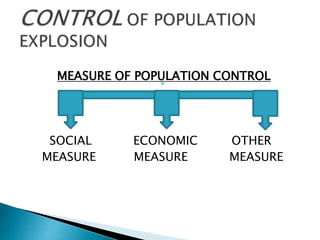
MEASURE OF POPULATION CONTROL
SOCIAL ECONOMIC OTHER
MEASURE MEASURE MEASURE
A. SOCIAL MEASURE :-
1. Minimum age of marriage
2. Raising the status of women
3. Spread of education
4. Adoption
5.Social security
1. More employment opportunities
2. Development of agriculture and
industry
3. Standard of living
4. Urbanization
C. OTHER MEASURCES
1. Late marriage
2. Self control
3. Self planning
4. Recreational facilities
5. publicity
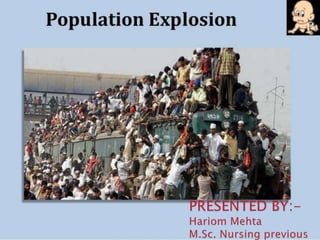
Population explosion

Population explosion

  • 2.
    INTRODUCTION  One ofthe serious problems India is facing today is ‘Population Explosion’.  It has become one of the most serious problems our country is facing.  The current population India is 127 million reported on may 15,2015  China is on top and is on 2nd position with respect to the population.  Over population has adverse effect on the economy and the environment.
  • 3.
     POPULATION :-It is defined as a group of people or animals of a particular kind that live in a space.  EXPLOSION :- A Sudden and very fast increase.  POPULATION EXPLOSION :- the rapid growth of world’s population over the past one hundred years result from a difference between the rate of birth and the rate of death. The human population will increase by 1 billion people in the next decade.
  • 4.
     Decrease deathrates was the major reason.  improvement in public health.  High birth rate.  Lack of education.  Migration  Medical technology, along with gains in education and standards of living with in many developing nations.  Early marriage and universal marriage.
  • 5.
     In the20th century, human population has grown much faster than before.  Between 1950-1990 population crossed 5 billion mark i.e. 92 million every year.  In the year 2000 the the word population was 6.1 billion it is predict to grow 4 times in next 100 year.
  • 6.
     On 11thmay 2000, India had 1 billion (100crores) people; i.e. 16% of the world’s population on 2.4%of the globe’s land area.  If current trends continue, India may overtake china by 2045, to become the most populous country in the world.  Global population:- increase 3 folds during this century (from 2 to 6 billion)
  • 7.
     Over useof natural resources e.g. water, land, soil, natural forests.  increase in food demand.  increase in waste generation.  increase demand of medical facilities.  shortage of education facilities.  Other effect like:-  unemployment  increase in crime rate
  • 8.
     poverty  energycrisis  Over crowding of cities  child abuse
  • 9.
    1) MALTHUSIAN THEORY(1798):- Human population tend to grow at an exponential rate where as food production tend to very slow growth.  For stabilizing the population growth we need “positive checks”: famines, disease outbreak and violence.  “preventive checks” birth control systems
  • 10.
     Population growth-a symptom rather than cause of poverty, resource depletion population and other problems.  Social explanation and oppression of the less privileged people leads to poverty, employment, environment degradation and in turn cause population.
  • 12.
    MEASURE OF POPULATIONCONTROL SOCIAL ECONOMIC OTHER MEASURE MEASURE MEASURE
  • 13.
    A. SOCIAL MEASURE:- 1. Minimum age of marriage 2. Raising the status of women 3. Spread of education 4. Adoption 5.Social security
  • 14.
    1. More employmentopportunities 2. Development of agriculture and industry 3. Standard of living 4. Urbanization
  • 15.
    C. OTHER MEASURCES 1.Late marriage 2. Self control 3. Self planning 4. Recreational facilities 5. publicity