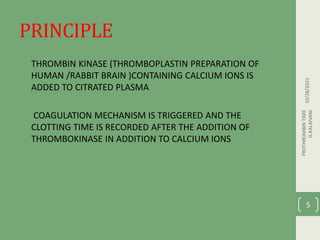
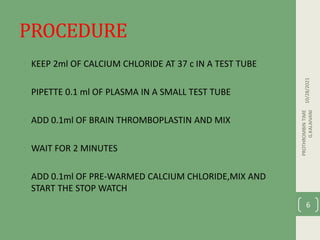
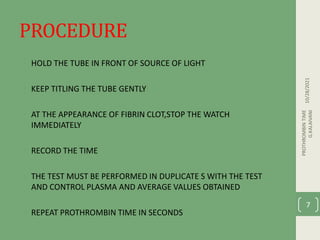
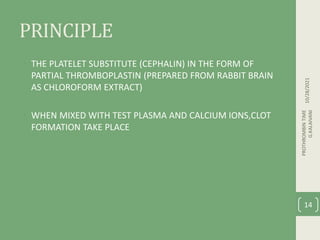
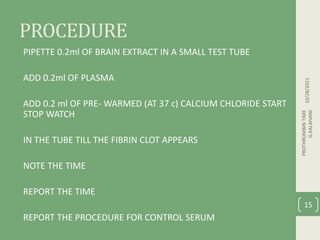
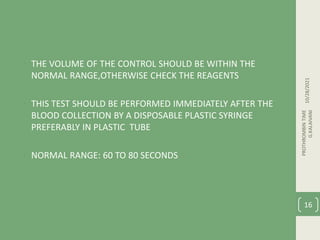
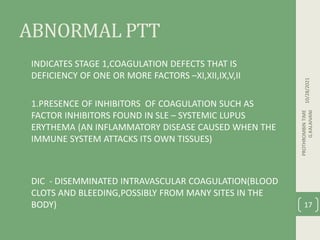
The document discusses prothrombin time (PT) and activated partial thromboplastin time (APTT) tests. PT measures the extrinsic and common coagulation pathway, while APTT measures the intrinsic and common pathways. Both tests are used to detect bleeding disorders and monitor anticoagulant therapy. The document describes the principles, materials, procedures, normal values and causes of abnormal PT and APTT results. Prolonged PT can indicate liver disease or a fibrinogen abnormality. Prolonged APTT suggests a coagulation factor deficiency and can be seen in lupus or disseminated intravascular coagulation.




![Cells and Organs of immune system [Autosaved].pptx](https://cdn.slidesharecdn.com/ss_thumbnails/cellsandorgansofimmunesystemautosaved-260123152717-ea0cb261-thumbnail.jpg?width=640&height=640&fit=bounds)


![Hypothalamus short notes on location, function and disorders by Dr. Neha [PT]...](https://cdn.slidesharecdn.com/ss_thumbnails/hypothalamusbydr-260124142231-2b48143d-thumbnail.jpg?width=640&height=640&fit=bounds)


