BLEEDING TIME
AND
CLOTTING TIME
SUNIL KUMAR.P
Dept. of Haematology
SJMCH, Bangalore
1SUNIL KUMAR.P
BLEEDING TIME
First functional platelet evaluation test
Introduced by duke in 1900
Used to detect defects in primary hemostasis
Used as a screening test for vascular disorders
as well as platelet function test.
2SUNIL KUMAR.P
PRINCIPLE
• A standardised incision is made on the volar
surface of the forearm
• The time the incision bleeds is measured
• Cessation of bleeding indicate the formation
of haemostatic plug
• Depends on the adequate no: of platelets and
on the ability of the platelets to adhere to the
subendothelium.
3SUNIL KUMAR.P
4SUNIL KUMAR.P
METHODS
• Standard template method
• Dukes method
• Ivy’s method
• Copley and lalitch method
5SUNIL KUMAR.P
IVY’S METHOD
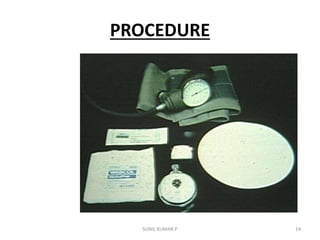
REQUIREMENTS:
BP cuff
Disposable lancet
Stop watch
Filter paper
Spirit/alcohol
6SUNIL KUMAR.P
PROCEDURE
• Clean the inner aspect of the fore arm
• Place a BP cuff on the upper arm , inflate to 40
mm of mercury.
• Select an area on the volar surface which is
devoid of veins
• Should be performed at room temperature.
• A disposable lancet with a point of about
3mm /No.11 bard parker surgical blade is
taken.
7SUNIL KUMAR.P
• Three skin punctures 1mm deep and 3 mm long
are made.
• Stopwatch is started as soon as the bleeding
starts in each wound.
• Using the edge of a filter paper (whattman No:1) ,
blot the blood accumalated over the wound
• The time from which incision was made to the
time at which the bleeding stops to stain the filter
paper is taken.
8SUNIL KUMAR.P
• The average of the 3 bleeding time is taken .
• The BP cuff is removed.
• The puncture wounds are cleaned
• Sterile bandage applied
• The longer of the duplicate bleeding time will
be the most accurate one.
• Longer bleeding time-puncture of superficial
veins
9SUNIL KUMAR.P
• If bleeding continues more than 15 min-
apply pressure Repeat the bleeding time on
other arm.
• Report-greater than 15 min.
• Reports correlated with platelet count and
finger prick smear.
• Reference range-2-7’
10SUNIL KUMAR.P
ADVANTAGE
• Standardised method
• Bleeding time more accurate
• Normal BT-3-8’.
11SUNIL KUMAR.P
LIMITATIONS
• Not a very reliable test.
• The puncture wound may close before the
cessation of bleeding.
12SUNIL KUMAR.P
STANDARD TEMPLATE METHOD
• More standardised method
• Uses a glass or plastic template
• Allows the lancet to make a cut-11 mm long
and 1mm deep.
13SUNIL KUMAR.P
PROCEDURE
14SUNIL KUMAR.P
15SUNIL KUMAR.P
16SUNIL KUMAR.P
17SUNIL KUMAR.P
18SUNIL KUMAR.P
ADVANTAGES
• Test is very sensitive and reproducible
• Detects even minor alterations in platelet
function.
19SUNIL KUMAR.P
DUKE’S METHOD
• Easy to perform
• Requires minimal equipment
• Requirements-alcohol,sterile
lancet,stopwatch,filter paper
20SUNIL KUMAR.P
PROCEDURE
• Clean the ear lobe with alcohol sponge
• Infants-heel of foot
• Hold a glass slide behind the ear lobe
• Make a deep puncture with sterile lancet.
• Start the stop watch
• Discard the glass slide
• Using filter paper blot the drop of blood
coming out from incision.
21SUNIL KUMAR.P
• When bleeding ceases stop the stop watch.
• Count the number of drop on the filterpaper
• Multiply by 30 sec
• Report the closest minute
• If the cut bleeds more than 10 ‘,discontinue
the test
22SUNIL KUMAR.P
ADVANTAGES
• The ear lobule contain abundant
subcutaneous tissue and is vascular.
• Flow of the blood is quite good
• Normal bleeding time-3-5’
• DISADVANTAGE
• Difficult to get a standardised wound
23SUNIL KUMAR.P
COPLEY AND LALITCH METHOD
• Clean the finger
• Make a puncture wound 6mm deep
• Immerse the wound in sterile physiological
saline warmed to 37o
• Laeve it until there is no free flow of blood
• The BT measured from the moment of the
wound to the cessation of bleeding.
24SUNIL KUMAR.P
VARIABLES AFFECTING BT
• Anemia prolongs the bleeding time.
• Patients with thrombocytopenia(<100×109 /L)
Will have increased BT.
• Aspirin,pencillin,cephalothin prolongs BT
• Pediatric pts and neonates –smaller incisions
are required.pressure -20 mm of Hg.
25SUNIL KUMAR.P
CLINICAL SIGNIFICANCE
• Prolonged BT in
Thromboctytopenia
Disorders in platelet fn-thrombasthenia,storage
pool disease,Bernard –Soulier syndrome
Afibrinogenemia
Severe hypofibrinogenemia
Vascular disorders
Aspirin
26SUNIL KUMAR.P
Aplastic anaemia
A/c leukkemia
Liver diseases
Von Willibrand disease
DIC
Vascular abnormalities -Ehlers danlos
syndrome
Severe deficiency of factor V or XI
27SUNIL KUMAR.P
WHOLE BLOOD CLOTTING TIME
• The time it takes for whole blood , drawn from
a vein and immediately placed in a container
to clot.
• It measures all stages of intrinsic coagulation
• It is not a very sensitive method
• Avoid contamination with tissue fluid.
28SUNIL KUMAR.P
METHODS
• Venepuncture method-Modified lee and white
method
• Capillary method
• Heparin retarded blood coagulation time
29SUNIL KUMAR.P
VENEPUNCTURE METHOD
• Sample collection
• 2 SYRINGE TECHNIQUE-avoid interference
from tissue fluid
• Draw 1 ml of blood into first syringe
• Without disturbing the position of the needle
2 nd syringe attached.
• 5ml of blood drawn
30SUNIL KUMAR.P
EQUIPMENTS
• Cotton wool,surgical gauze soaked in
alcohol,plastic syringe
• Test tube-acid washed(10ml)
• Water bath -370 c.
• Stop watch
31SUNIL KUMAR.P
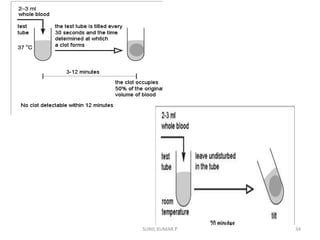
PROCEDURE
• 2ml of venous blood collected quickly
• Start the stop watch as soon as the blood enters
the syringe
• Fill each of the tube to 1 ml mark.
• Plug the tube and place them in water bath at 370
c.
• After 5’ tilt the first tube at an angle 450 c.(room
temp-10’)
• If not clotted return to water bath
32SUNIL KUMAR.P
• Examine at an interval of 30 sec
• When the blood is clotted it can be tilted at an
angle of 900 c without spilling the contents.
• As soon as blood is clotted,immediately
examine the second tube.
• Stop the stop watch and note the time.
• Coagulation time is the clotting time of the
second tube.
33SUNIL KUMAR.P
34SUNIL KUMAR.P
• ADVANTAGE
• More accurate and standard method
• Test can be run with control
• DISADVANTAGE
• Only a rough method
• There can be contamination of syringe /tubes
35SUNIL KUMAR.P
NORMAL VALUE
• DEPENDS ON THE METHOD USED
• Normal value-8-15’
• If 10 min inc done-20 -22 min
• Value<8min-contamination with tissue fluid
/hypercoagulability.
36SUNIL KUMAR.P
SOURCES OF ERRORS
• Faulty technique
• Inappropriate volume of blood
• Faulty venepuncture
• Air bubble entering the syringe
• Diameter of the glass tube should be uniform
• Always use clean glass wares and plastic
syringe
• Vigorous agitation should be avoided.
37SUNIL KUMAR.P
CAPILLARY METHOD
• PRINCIPLE-puncture the skin,blood is taken to
a plain capillary tube and stop watch started.
• Formation of fibrin strings is noted by
breaking the capillary tube at regular intervals.
• The time taken for the first appearance of the
fibrin string is noted.
38SUNIL KUMAR.P
EQUIPMENT
• Disposable lancet
• Capillary tubing10-15 cm length and 1.5 mm
diameter without anticoagulant
39SUNIL KUMAR.P
PROCEDURE
• Warm up the finger for skin puncture
• Make an incision with a sterile disposable
lancet to depth of 3mm.
• As soon as blood is visible- start the stop
watch.
• Wipe off the first drop of blood
• Allow 2nd drop of blood to flow to capillary
tube .
40SUNIL KUMAR.P
• After 2’ break off the capillary tubing,1-2 cm
from the end.
• When a thin string of fibrin can be seen in
between the broken end of the capillary
tube,stop the watch and note the time
• Report the time
41SUNIL KUMAR.P
• DISADVANTAGE
• This method is insensitive
• This method is unreliable
• Capillary blood always contaminated with tissue
fluid
• ADVANTAGE
• Can be performed when venous blood cannot be
obtained
• NORMAL CT-1-5 min.
42SUNIL KUMAR.P
43SUNIL KUMAR.P
HEPARIN RETARDED BLOOD
COAGULATION TIME
• REQUIREMENTS
• .004 mg per ml of isotonic saline.
• Venous blood freshly drawn in to syringe
• TECHNIQUE
• Add 1ml of heparin solution in a clean dry test tube in
waterbath at 370 c
• Add 1ml of blood to this test tube and invert twice.
• A t the end of 12 min,tilt the tube gently at I min
interval.
• Look for clot formation
• Normal range-20-35 min
44SUNIL KUMAR.P
SIGNIFICANCE
• It appears to be the most valuable single test
of coagulation.
• Test used to detect hypercoagulable and
hypocoagulable states.
• Prolonged clotting time seen in deficiency
states involving AHG,Plasma thromoblastin
component, plasma thromboplastin activator.
• Also prolonged in pt with bone marrow
depression and thrombocytopenia.
45SUNIL KUMAR.P
ACTIVATED CLOTTING TIME
• Used to access heparin effects during cardiac
surgery
• Negatively charged clotting cascade activators are
used-celite,kaolin.
• Look for clot formation-either
optical/electromagnetic method
• Normal value-celite -100-170 sec
• Kaolin-90-150 sec
• ACT MONITORS-HEMOCHRON ACT,HEMOTECH
AUTOMATED ANTICOAGULATION TIMER.
46SUNIL KUMAR.P
CLINICAL SIGNIFICANCE
• Only severe clotting factor deficiency can be
recognised
• Prolonged CT more than 10’-pt subjected to
more detailed test.
• Used to monitor heparin therapy.
• Can be due to the deficiency of plasma factors
such as Antihemophiliac globulin,plasma
thromboplastin,fibrinogen,prothrombin.
• Circulating anticoagulants
47SUNIL KUMAR.P

Bleeding time and clotting time

  • 1.
    BLEEDING TIME AND CLOTTING TIME SUNILKUMAR.P Dept. of Haematology SJMCH, Bangalore 1SUNIL KUMAR.P
  • 2.
    BLEEDING TIME First functionalplatelet evaluation test Introduced by duke in 1900 Used to detect defects in primary hemostasis Used as a screening test for vascular disorders as well as platelet function test. 2SUNIL KUMAR.P
  • 3.
    PRINCIPLE • A standardisedincision is made on the volar surface of the forearm • The time the incision bleeds is measured • Cessation of bleeding indicate the formation of haemostatic plug • Depends on the adequate no: of platelets and on the ability of the platelets to adhere to the subendothelium. 3SUNIL KUMAR.P
  • 4.
  • 5.
    METHODS • Standard templatemethod • Dukes method • Ivy’s method • Copley and lalitch method 5SUNIL KUMAR.P
  • 6.
    IVY’S METHOD REQUIREMENTS: BP cuff Disposablelancet Stop watch Filter paper Spirit/alcohol 6SUNIL KUMAR.P
  • 7.
    PROCEDURE • Clean theinner aspect of the fore arm • Place a BP cuff on the upper arm , inflate to 40 mm of mercury. • Select an area on the volar surface which is devoid of veins • Should be performed at room temperature. • A disposable lancet with a point of about 3mm /No.11 bard parker surgical blade is taken. 7SUNIL KUMAR.P
  • 8.
    • Three skinpunctures 1mm deep and 3 mm long are made. • Stopwatch is started as soon as the bleeding starts in each wound. • Using the edge of a filter paper (whattman No:1) , blot the blood accumalated over the wound • The time from which incision was made to the time at which the bleeding stops to stain the filter paper is taken. 8SUNIL KUMAR.P
  • 9.
    • The averageof the 3 bleeding time is taken . • The BP cuff is removed. • The puncture wounds are cleaned • Sterile bandage applied • The longer of the duplicate bleeding time will be the most accurate one. • Longer bleeding time-puncture of superficial veins 9SUNIL KUMAR.P
  • 10.
    • If bleedingcontinues more than 15 min- apply pressure Repeat the bleeding time on other arm. • Report-greater than 15 min. • Reports correlated with platelet count and finger prick smear. • Reference range-2-7’ 10SUNIL KUMAR.P
  • 11.
    ADVANTAGE • Standardised method •Bleeding time more accurate • Normal BT-3-8’. 11SUNIL KUMAR.P
  • 12.
    LIMITATIONS • Not avery reliable test. • The puncture wound may close before the cessation of bleeding. 12SUNIL KUMAR.P
  • 13.
    STANDARD TEMPLATE METHOD •More standardised method • Uses a glass or plastic template • Allows the lancet to make a cut-11 mm long and 1mm deep. 13SUNIL KUMAR.P
  • 14.
  • 15.
  • 16.
  • 17.
  • 18.
  • 19.
    ADVANTAGES • Test isvery sensitive and reproducible • Detects even minor alterations in platelet function. 19SUNIL KUMAR.P
  • 20.
    DUKE’S METHOD • Easyto perform • Requires minimal equipment • Requirements-alcohol,sterile lancet,stopwatch,filter paper 20SUNIL KUMAR.P
  • 21.
    PROCEDURE • Clean theear lobe with alcohol sponge • Infants-heel of foot • Hold a glass slide behind the ear lobe • Make a deep puncture with sterile lancet. • Start the stop watch • Discard the glass slide • Using filter paper blot the drop of blood coming out from incision. 21SUNIL KUMAR.P
  • 22.
    • When bleedingceases stop the stop watch. • Count the number of drop on the filterpaper • Multiply by 30 sec • Report the closest minute • If the cut bleeds more than 10 ‘,discontinue the test 22SUNIL KUMAR.P
  • 23.
    ADVANTAGES • The earlobule contain abundant subcutaneous tissue and is vascular. • Flow of the blood is quite good • Normal bleeding time-3-5’ • DISADVANTAGE • Difficult to get a standardised wound 23SUNIL KUMAR.P
  • 24.
    COPLEY AND LALITCHMETHOD • Clean the finger • Make a puncture wound 6mm deep • Immerse the wound in sterile physiological saline warmed to 37o • Laeve it until there is no free flow of blood • The BT measured from the moment of the wound to the cessation of bleeding. 24SUNIL KUMAR.P
  • 25.
    VARIABLES AFFECTING BT •Anemia prolongs the bleeding time. • Patients with thrombocytopenia(<100×109 /L) Will have increased BT. • Aspirin,pencillin,cephalothin prolongs BT • Pediatric pts and neonates –smaller incisions are required.pressure -20 mm of Hg. 25SUNIL KUMAR.P
  • 26.
    CLINICAL SIGNIFICANCE • ProlongedBT in Thromboctytopenia Disorders in platelet fn-thrombasthenia,storage pool disease,Bernard –Soulier syndrome Afibrinogenemia Severe hypofibrinogenemia Vascular disorders Aspirin 26SUNIL KUMAR.P
  • 27.
    Aplastic anaemia A/c leukkemia Liverdiseases Von Willibrand disease DIC Vascular abnormalities -Ehlers danlos syndrome Severe deficiency of factor V or XI 27SUNIL KUMAR.P
  • 28.
    WHOLE BLOOD CLOTTINGTIME • The time it takes for whole blood , drawn from a vein and immediately placed in a container to clot. • It measures all stages of intrinsic coagulation • It is not a very sensitive method • Avoid contamination with tissue fluid. 28SUNIL KUMAR.P
  • 29.
    METHODS • Venepuncture method-Modifiedlee and white method • Capillary method • Heparin retarded blood coagulation time 29SUNIL KUMAR.P
  • 30.
    VENEPUNCTURE METHOD • Samplecollection • 2 SYRINGE TECHNIQUE-avoid interference from tissue fluid • Draw 1 ml of blood into first syringe • Without disturbing the position of the needle 2 nd syringe attached. • 5ml of blood drawn 30SUNIL KUMAR.P
  • 31.
    EQUIPMENTS • Cotton wool,surgicalgauze soaked in alcohol,plastic syringe • Test tube-acid washed(10ml) • Water bath -370 c. • Stop watch 31SUNIL KUMAR.P
  • 32.
    PROCEDURE • 2ml ofvenous blood collected quickly • Start the stop watch as soon as the blood enters the syringe • Fill each of the tube to 1 ml mark. • Plug the tube and place them in water bath at 370 c. • After 5’ tilt the first tube at an angle 450 c.(room temp-10’) • If not clotted return to water bath 32SUNIL KUMAR.P
  • 33.
    • Examine atan interval of 30 sec • When the blood is clotted it can be tilted at an angle of 900 c without spilling the contents. • As soon as blood is clotted,immediately examine the second tube. • Stop the stop watch and note the time. • Coagulation time is the clotting time of the second tube. 33SUNIL KUMAR.P
  • 34.
  • 35.
    • ADVANTAGE • Moreaccurate and standard method • Test can be run with control • DISADVANTAGE • Only a rough method • There can be contamination of syringe /tubes 35SUNIL KUMAR.P
  • 36.
    NORMAL VALUE • DEPENDSON THE METHOD USED • Normal value-8-15’ • If 10 min inc done-20 -22 min • Value<8min-contamination with tissue fluid /hypercoagulability. 36SUNIL KUMAR.P
  • 37.
    SOURCES OF ERRORS •Faulty technique • Inappropriate volume of blood • Faulty venepuncture • Air bubble entering the syringe • Diameter of the glass tube should be uniform • Always use clean glass wares and plastic syringe • Vigorous agitation should be avoided. 37SUNIL KUMAR.P
  • 38.
    CAPILLARY METHOD • PRINCIPLE-puncturethe skin,blood is taken to a plain capillary tube and stop watch started. • Formation of fibrin strings is noted by breaking the capillary tube at regular intervals. • The time taken for the first appearance of the fibrin string is noted. 38SUNIL KUMAR.P
  • 39.
    EQUIPMENT • Disposable lancet •Capillary tubing10-15 cm length and 1.5 mm diameter without anticoagulant 39SUNIL KUMAR.P
  • 40.
    PROCEDURE • Warm upthe finger for skin puncture • Make an incision with a sterile disposable lancet to depth of 3mm. • As soon as blood is visible- start the stop watch. • Wipe off the first drop of blood • Allow 2nd drop of blood to flow to capillary tube . 40SUNIL KUMAR.P
  • 41.
    • After 2’break off the capillary tubing,1-2 cm from the end. • When a thin string of fibrin can be seen in between the broken end of the capillary tube,stop the watch and note the time • Report the time 41SUNIL KUMAR.P
  • 42.
    • DISADVANTAGE • Thismethod is insensitive • This method is unreliable • Capillary blood always contaminated with tissue fluid • ADVANTAGE • Can be performed when venous blood cannot be obtained • NORMAL CT-1-5 min. 42SUNIL KUMAR.P
  • 43.
  • 44.
    HEPARIN RETARDED BLOOD COAGULATIONTIME • REQUIREMENTS • .004 mg per ml of isotonic saline. • Venous blood freshly drawn in to syringe • TECHNIQUE • Add 1ml of heparin solution in a clean dry test tube in waterbath at 370 c • Add 1ml of blood to this test tube and invert twice. • A t the end of 12 min,tilt the tube gently at I min interval. • Look for clot formation • Normal range-20-35 min 44SUNIL KUMAR.P
  • 45.
    SIGNIFICANCE • It appearsto be the most valuable single test of coagulation. • Test used to detect hypercoagulable and hypocoagulable states. • Prolonged clotting time seen in deficiency states involving AHG,Plasma thromoblastin component, plasma thromboplastin activator. • Also prolonged in pt with bone marrow depression and thrombocytopenia. 45SUNIL KUMAR.P
  • 46.
    ACTIVATED CLOTTING TIME •Used to access heparin effects during cardiac surgery • Negatively charged clotting cascade activators are used-celite,kaolin. • Look for clot formation-either optical/electromagnetic method • Normal value-celite -100-170 sec • Kaolin-90-150 sec • ACT MONITORS-HEMOCHRON ACT,HEMOTECH AUTOMATED ANTICOAGULATION TIMER. 46SUNIL KUMAR.P
  • 47.
    CLINICAL SIGNIFICANCE • Onlysevere clotting factor deficiency can be recognised • Prolonged CT more than 10’-pt subjected to more detailed test. • Used to monitor heparin therapy. • Can be due to the deficiency of plasma factors such as Antihemophiliac globulin,plasma thromboplastin,fibrinogen,prothrombin. • Circulating anticoagulants 47SUNIL KUMAR.P

Editor's Notes

  • #8 Arm should be supine on a firm support ,preferably closee to the level of heart.,site-lateral 1/3rd of the forearm 2-3 cm below the anticubital crease.A locatioin on the median aspect of the calf abt 6-8 cm below the knee can also be taken.
  • #9 Either parallel or perpendicular to the anticubital crease. Care should be taken not to touch the developing platelet plug.Rounded to the nearest 30 sec is taken as the BT.
  • #10 Than taking theb average of the 2 .
  • #11 Stop the bleeding.Criitical values which needs urgent clinical notification are values above 15’.
  • #14 It is a standardised spring loaded razor device that produces a deftinite incision.eg 1mm deep 3mm long incision.
  • #22 Do not rub.allow to dry completely.
  • #23 Apply pressure on the bleeding spot.
  • #26 /
  • #29 b/c of the ease of doing.Not affected by the deficiecy of plts since not very many plts are required to get a normal result in this test.Small amt of thrombin isb required so mild to modereate defiency of plasma factor will be missed.
  • #31 Which rinse out the tissue fliud as it has passed thru the needle.
  • #33 Remove the needle.room temp-cold prolongs-hot weather hastens
  • #34 Tilting can promote clotting .so too much tilting is avioded.hwnce difficult to detect hypercoagulable states.The purpose of first tube is when to start look at the 2nd tube.
  • #36 Syringe-tissue fliud.tube-ca
  • #38 Vol less than 1ml –give shorter time.CT accelarated by narrow tube
  • #42 Mention capillary method is used.
  • #47 Diatomateous earth