COAGULATION PROFILE
DR SHIVAPRASAD SHARMA THANUGULA
FINAL YEAR PGSCHOLAR
DEP OF KAYACHIKITSA
KAHER’S SHRI BMK AYURVEDA MAHAVIDYALAYA
BELAGAVI
HAEMOSTASIS
• Arrest or stoppage of bleeding
STAGES OF HAEMOSTASIS
1. Vasoconstriction
2. Platelet plug formation
3. Coagulation of blood
COAGULATION OF BLOOD
• Defined as the process in which blood loses its
fluidity and becomes a jelly like mass few
minutes after it is shed
FACTORS IN COAGULATION
• I Fibrinogen
• II Prothrombin
• III Tissue factor or thromboplastin
• IV Calcium
• V Proaccelerin (Labile factor)
• VII Proconvertin (Stable factor)
• VIII Antihaemophilic factor A,
Antihaemophilic globulin
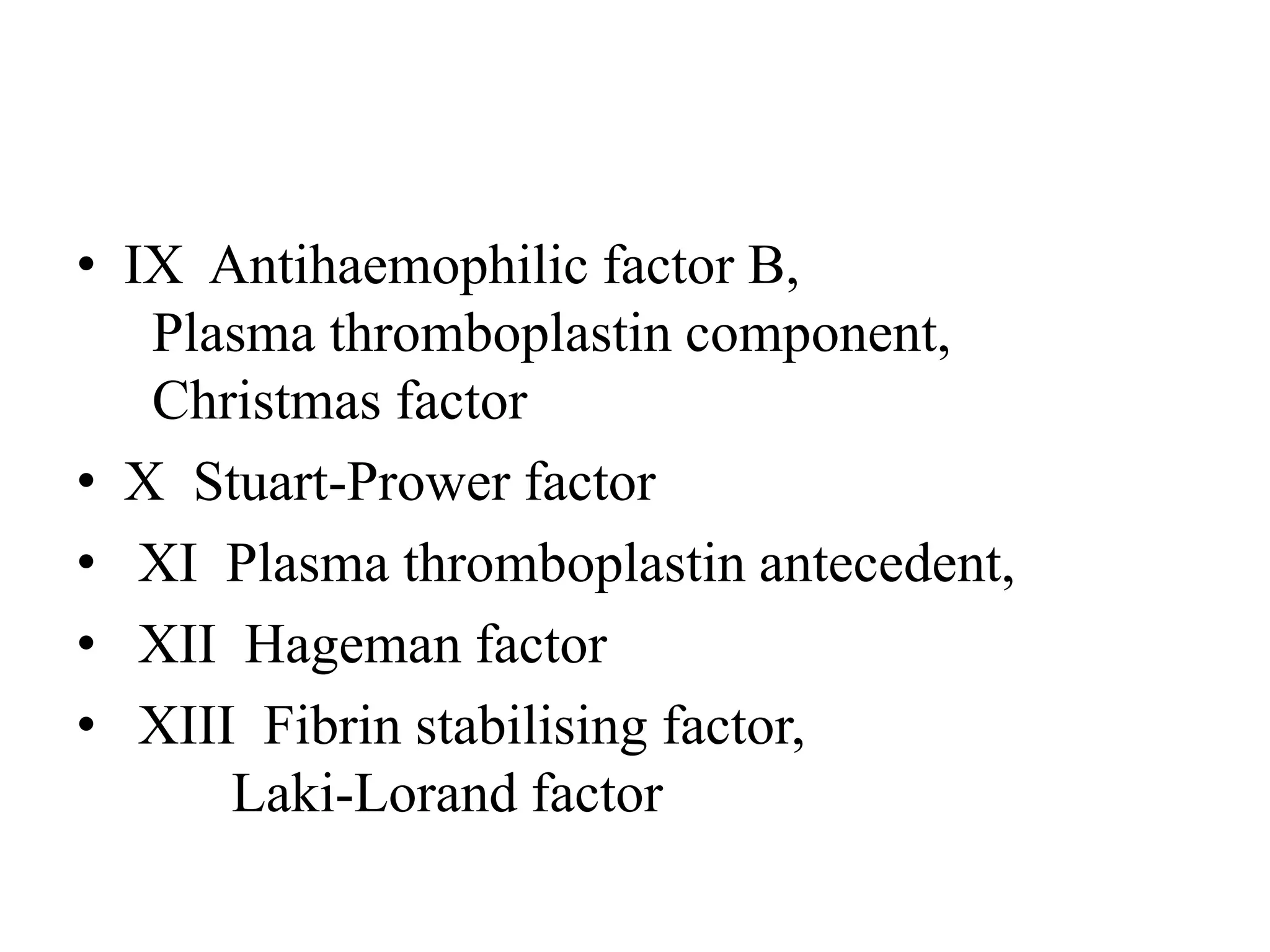
• IX Antihaemophilic factor B,
Plasma thromboplastin component,
Christmas factor
• X Stuart-Prower factor
• XI Plasma thromboplastin antecedent,
• XII Hageman factor
• XIII Fibrin stabilising factor,
Laki-Lorand factor
STAGES OF BLOOD CLOTTING
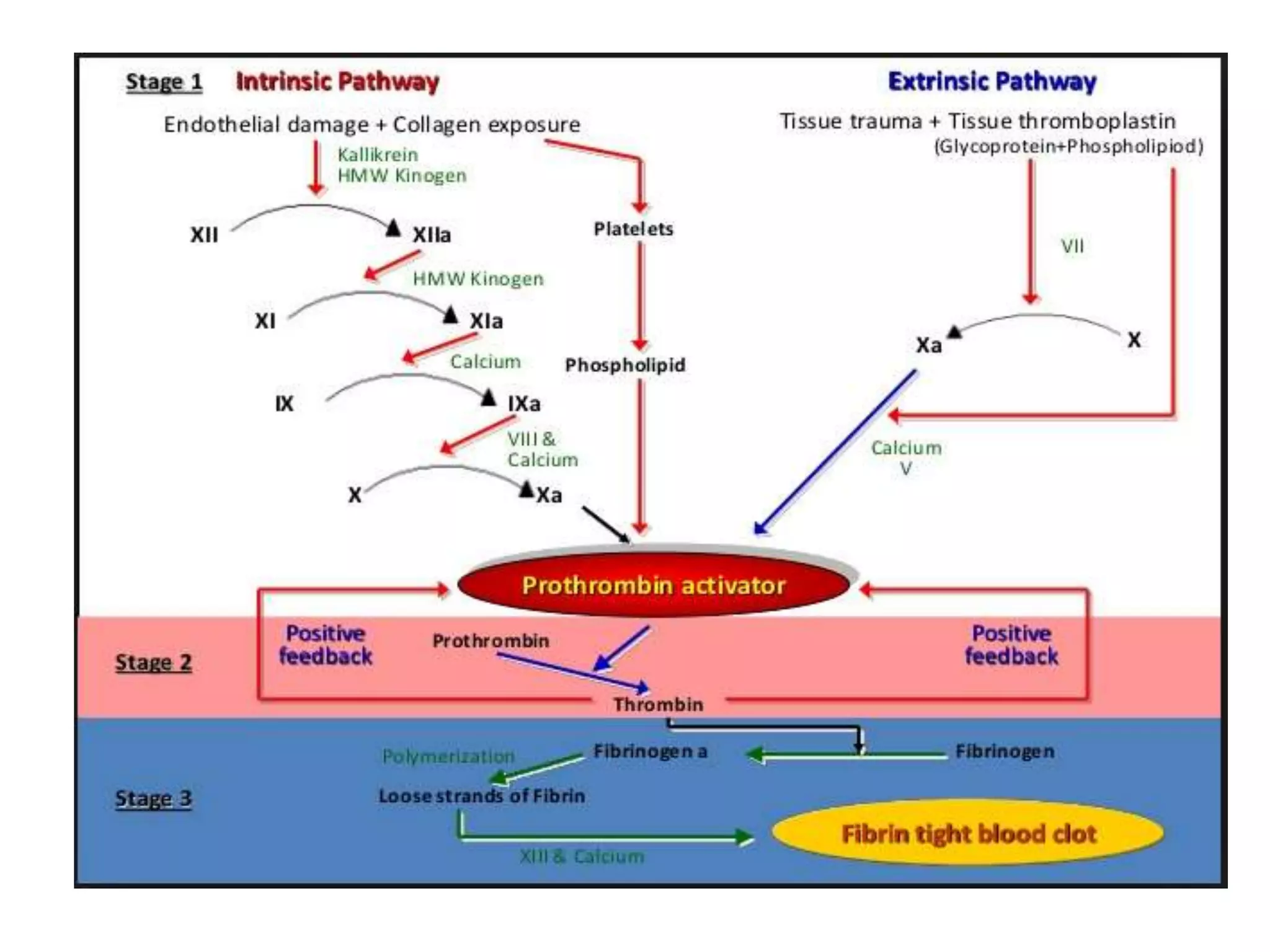
• STAGE 1.
Formation of prothrombin activator
1. Intrinsic pathway
2. Extrinsic pathway
• SATGE 2
Conversion of prothrombin to thrombin
STAGE 3
Conversion of fibrinogen to fibrin
INVESTIGATION OF
HAEMOSTATIC FUNCTION
TESTS FOR
1. Disordered vascular haemostasis
2. Platelet and their functions
3. Blood coagulation
4. Fibrinolysis
5. Coagulation inhibitors
BLEEDING TIME
• Based on the principle of formation of
haemostatic plug.
• Factors affecting the test are capillary function,
platelet number and the ability to form
aggregates.
• It involves cutting the underside of the subject's
forearm, in an area where there is no hair or
visible veins. The cut is of a standardized width
and depth, and is done quickly by an automatic
device.
• NORMAL RANGE 3-8 minutes.
Diseases that cause prolonged bleeding time
include
• thrombocytopenia
• disseminated intravascular coagulation (DIC)
• Bernard-Soulier disease
• Glanzmann's thrombasthenia
• von Willebrand’s disease
However bleeding time is normal in Haemophilia
Drugs that affect BT are Aspirin and COX
inhibitors.
PLATELET COUNT
• Screening test for assessing platelet function
• Methods
1. Peripheral blood platelet count using anayser.
2. Skin bleeding time
3. Examination of fresh blood film to see
morphologic abnormalities of platelets in a
Leishman stained peripheral bood smear.
Normal 1.5 – 4.5 lakh
CLOTTING TIME
• Clotting time is the time required for a sample
of blood to coagulate in vitro under standard
conditions
• There are various methods for determining
the clotting time, the most common being
the capillary tube method.
• NORMAL RANGE - 4-9 minutes at 37 C
• It is affected by heparin and warfarin
• It is delayed in clotting disorders like
Haemophilias
PROTHROMBIN TIME
• PT measures the factors involved in the extrinsic pathway
and in the common pathway. i.e I, II, V, VII, X.
• In this test, tissue thromboplastin (brain extract) and
calcium is added to determine PT.
• NORMAL RANGE- 10-14 seconds
• Causes of prolonged PT are
1. Oral anticoagulants
2. Liver disease
3. Vit K deficiency
4. DIC
5. lack of intestinal colonization by bacteria (such as
in newborns
ACTIVATED PARTIAL
THROMBOPLASTIN TIME
• kaolin-cephalin clotting time.
• This test is used to measure the intrinsic system factors
and factors common to both intrinsic and extrinsic
pathways. i.e. VIII, IX, XI, XII, X, V, prothrombin and
fibrinogen.
• NORMAL RANGE 30-40 seconds.
• It consists of addition of calcium, phospholipid and
kaolin.
• Apart from detecting abnormalities in blood
clotting, partial thromboplastin time is also used to
monitor the treatment effects with heparin, a widely
prescribed drug that reduces blood's tendency to clot.
• It is prolonged in
1. Parenteral administration of heparin
2. DIC
3. Liver disease
4. Circulating anticoagulants
5. Hemophilia
MEASUREMENT OF FIBRINOGEN
• The screening test for the measurement of
fibrinogen deficiency are
1. Thrombin time- (normal is under 20 seconds)
2. Fibrinogen titre in plasma dilution upto 32 is
considered normal.
• Higher values of both the tests are seen in
1. DIC
2. Raised concentration of FDP
3. Presence of heparin
SPECIAL TESTS
1. COAGULATION FACTOR ASSAYS
• Based on the results of PT and APTT
• They employ the use of substrate plasma that contain
all other coagulation factors except the one to be
measured.
• The unknown level of factor activity is compared with
standard control plasma with a known level of activity.
2. QUANTITATIVE ASSAYS
• Coagulation factors can be quantitatively assessed by
immunological and other chemical methods.
• The degree of correction of the clotting
time when plasma is added to clotting
system specifically deficient in the clotting
factor to be measured allows the level of
that clotting factor to be determined. E.g .
A factor VIII deficient plasma is used to
assay the level of factor VIII.
APPROACH TO A PATIENT WITH
ABNORMAL BLEEDING
TENDENCY• Full history
• Age, sex
• Present episodes of bleeding
• Frequency and duration
• Apparent cause
• Coexisting known bleeding disease
• Other diseases
• Drugs- aspirin, cox inhibitors, warfarin,
phenedione, salicylates
• Occupation
• Diet with ascorbic acid
• Past history– recurrent boleeding, age at
first episode of bleeding
• Haemorrhagic incidents--- ecchymosis,
petechiae, epistaxis, wound bleed
• Melaena, haematemesis, haematuria,
haemoptysis.
• Menstrual and post partum history
• Bleeding after trauma and surgery
• Therapeutic measures and response
• Family history
EXAMINATION
• General appearance
• Skin
• Mouth
• Wounds
• Abdomen
• Pelvis
• CNS
• Joints
• Urine
• ESSENTIAL INVSTIGATIONS IN A CASES
1. Full bood examination
2. Hb
3. Red cell morphology
4. WBC count
5. Patelet count
6. Peripheral smear
7. Skin bleeding time
FURTHER INVESTIGATIONS
1. Screening tests for blood coagulation- PT, aPTT,
factor assays
2. Test for platelet function for adhesion, aggregation
SUMMARY
THANK YOU……
Disorders of hemostasis
• Thromboembolic –undesirable clot formation
• Bleeding diseases –abnormalities that prevent
nornal clot formation
• Disseminated intravascular coagulation –
involves both type
Factors preventing undesirable
clotting
• Smooth endothelium of blood vessels prevents
platelets from clinging.
• Antithrombic substances nitric oxide and
prostacyclin secreted by endothelial cell.
• Vitamin E quinone acts as a potent
anticoagulant

Coagulaton profile

  • 1.
    COAGULATION PROFILE DR SHIVAPRASADSHARMA THANUGULA FINAL YEAR PGSCHOLAR DEP OF KAYACHIKITSA KAHER’S SHRI BMK AYURVEDA MAHAVIDYALAYA BELAGAVI
  • 2.
    HAEMOSTASIS • Arrest orstoppage of bleeding STAGES OF HAEMOSTASIS 1. Vasoconstriction 2. Platelet plug formation 3. Coagulation of blood
  • 3.
    COAGULATION OF BLOOD •Defined as the process in which blood loses its fluidity and becomes a jelly like mass few minutes after it is shed
  • 4.
    FACTORS IN COAGULATION •I Fibrinogen • II Prothrombin • III Tissue factor or thromboplastin • IV Calcium • V Proaccelerin (Labile factor) • VII Proconvertin (Stable factor) • VIII Antihaemophilic factor A, Antihaemophilic globulin
  • 5.
    • IX Antihaemophilicfactor B, Plasma thromboplastin component, Christmas factor • X Stuart-Prower factor • XI Plasma thromboplastin antecedent, • XII Hageman factor • XIII Fibrin stabilising factor, Laki-Lorand factor
  • 6.
    STAGES OF BLOODCLOTTING • STAGE 1. Formation of prothrombin activator 1. Intrinsic pathway 2. Extrinsic pathway
  • 8.
    • SATGE 2 Conversionof prothrombin to thrombin STAGE 3 Conversion of fibrinogen to fibrin
  • 9.
    INVESTIGATION OF HAEMOSTATIC FUNCTION TESTSFOR 1. Disordered vascular haemostasis 2. Platelet and their functions 3. Blood coagulation 4. Fibrinolysis 5. Coagulation inhibitors
  • 10.
    BLEEDING TIME • Basedon the principle of formation of haemostatic plug. • Factors affecting the test are capillary function, platelet number and the ability to form aggregates. • It involves cutting the underside of the subject's forearm, in an area where there is no hair or visible veins. The cut is of a standardized width and depth, and is done quickly by an automatic device. • NORMAL RANGE 3-8 minutes.
  • 11.
    Diseases that causeprolonged bleeding time include • thrombocytopenia • disseminated intravascular coagulation (DIC) • Bernard-Soulier disease • Glanzmann's thrombasthenia • von Willebrand’s disease However bleeding time is normal in Haemophilia Drugs that affect BT are Aspirin and COX inhibitors.
  • 12.
    PLATELET COUNT • Screeningtest for assessing platelet function • Methods 1. Peripheral blood platelet count using anayser. 2. Skin bleeding time 3. Examination of fresh blood film to see morphologic abnormalities of platelets in a Leishman stained peripheral bood smear. Normal 1.5 – 4.5 lakh
  • 13.
    CLOTTING TIME • Clottingtime is the time required for a sample of blood to coagulate in vitro under standard conditions • There are various methods for determining the clotting time, the most common being the capillary tube method. • NORMAL RANGE - 4-9 minutes at 37 C • It is affected by heparin and warfarin • It is delayed in clotting disorders like Haemophilias
  • 14.
    PROTHROMBIN TIME • PTmeasures the factors involved in the extrinsic pathway and in the common pathway. i.e I, II, V, VII, X. • In this test, tissue thromboplastin (brain extract) and calcium is added to determine PT. • NORMAL RANGE- 10-14 seconds • Causes of prolonged PT are 1. Oral anticoagulants 2. Liver disease 3. Vit K deficiency 4. DIC 5. lack of intestinal colonization by bacteria (such as in newborns
  • 15.
    ACTIVATED PARTIAL THROMBOPLASTIN TIME •kaolin-cephalin clotting time. • This test is used to measure the intrinsic system factors and factors common to both intrinsic and extrinsic pathways. i.e. VIII, IX, XI, XII, X, V, prothrombin and fibrinogen. • NORMAL RANGE 30-40 seconds. • It consists of addition of calcium, phospholipid and kaolin. • Apart from detecting abnormalities in blood clotting, partial thromboplastin time is also used to monitor the treatment effects with heparin, a widely prescribed drug that reduces blood's tendency to clot.
  • 16.
    • It isprolonged in 1. Parenteral administration of heparin 2. DIC 3. Liver disease 4. Circulating anticoagulants 5. Hemophilia
  • 17.
    MEASUREMENT OF FIBRINOGEN •The screening test for the measurement of fibrinogen deficiency are 1. Thrombin time- (normal is under 20 seconds) 2. Fibrinogen titre in plasma dilution upto 32 is considered normal. • Higher values of both the tests are seen in 1. DIC 2. Raised concentration of FDP 3. Presence of heparin
  • 18.
    SPECIAL TESTS 1. COAGULATIONFACTOR ASSAYS • Based on the results of PT and APTT • They employ the use of substrate plasma that contain all other coagulation factors except the one to be measured. • The unknown level of factor activity is compared with standard control plasma with a known level of activity. 2. QUANTITATIVE ASSAYS • Coagulation factors can be quantitatively assessed by immunological and other chemical methods.
  • 19.
    • The degreeof correction of the clotting time when plasma is added to clotting system specifically deficient in the clotting factor to be measured allows the level of that clotting factor to be determined. E.g . A factor VIII deficient plasma is used to assay the level of factor VIII.
  • 20.
    APPROACH TO APATIENT WITH ABNORMAL BLEEDING TENDENCY• Full history • Age, sex • Present episodes of bleeding • Frequency and duration • Apparent cause • Coexisting known bleeding disease • Other diseases • Drugs- aspirin, cox inhibitors, warfarin, phenedione, salicylates • Occupation • Diet with ascorbic acid
  • 21.
    • Past history–recurrent boleeding, age at first episode of bleeding • Haemorrhagic incidents--- ecchymosis, petechiae, epistaxis, wound bleed • Melaena, haematemesis, haematuria, haemoptysis. • Menstrual and post partum history • Bleeding after trauma and surgery • Therapeutic measures and response • Family history
  • 22.
    EXAMINATION • General appearance •Skin • Mouth • Wounds • Abdomen • Pelvis • CNS • Joints • Urine
  • 23.
    • ESSENTIAL INVSTIGATIONSIN A CASES 1. Full bood examination 2. Hb 3. Red cell morphology 4. WBC count 5. Patelet count 6. Peripheral smear 7. Skin bleeding time FURTHER INVESTIGATIONS 1. Screening tests for blood coagulation- PT, aPTT, factor assays 2. Test for platelet function for adhesion, aggregation
  • 24.
  • 25.
  • 26.
    Disorders of hemostasis •Thromboembolic –undesirable clot formation • Bleeding diseases –abnormalities that prevent nornal clot formation • Disseminated intravascular coagulation – involves both type
  • 27.
    Factors preventing undesirable clotting •Smooth endothelium of blood vessels prevents platelets from clinging. • Antithrombic substances nitric oxide and prostacyclin secreted by endothelial cell. • Vitamin E quinone acts as a potent anticoagulant