25-Apr-20
kalaivani.g24@gmail.com 9620500523
Thrombosis
1
DEFINITION
• Process of formation of solid mass in circulation from the constituents of
flowing blood the mass itself is called a thrombus.
Characterised by
• activation of platelets
• the process of clotting involves only conversion of soluble fibrinogen to
insoluble polymerised fibrin
• Harmful effects:
1. Ischaemic injury
2. Thromboembolism
25-Apr-20
kalaivani.g24@gmail.com 9620500523
Thrombosis
2
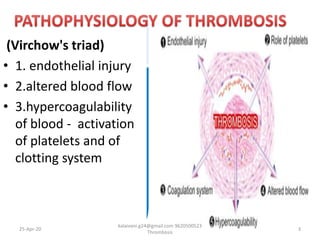
(Virchow's triad)
• 1. endothelial injury
• 2.altered blood flow
• 3.hypercoagulability
of blood - activation
of platelets and of
clotting system
25-Apr-20
kalaivani.g24@gmail.com 9620500523
Thrombosis
3
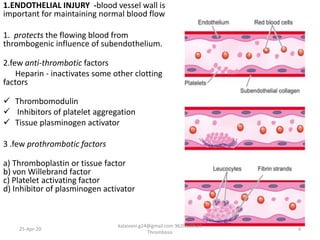
1.ENDOTHELIAL INJURY -blood vessel wall is
important for maintaining normal blood flow
1. protects the flowing blood from
thrombogenic influence of subendothelium.
2.few anti-thrombotic factors
Heparin - inactivates some other clotting
factors
 Thrombomodulin
 Inhibitors of platelet aggregation
 Tissue plasminogen activator
3 .few prothrombotic factors
a) Thromboplastin or tissue factor
b) von Willebrand factor
c) Platelet activating factor
d) Inhibitor of plasminogen activator
25-Apr-20
kalaivani.g24@gmail.com 9620500523
Thrombosis
4
• Vascular injury exposes the subendothelial
extracellular
matrix or ECM
• (e.g. collagen, elastin, fibronectin, laminin and
glycosaminoglycans) which is thrombogenic
• important role in initiating haemostasis as well as
thrombosis
• Injury to vessel wall also causes vasoconstriction of
small blood vessels to reduce the blood loss
• Endothelial injury is of major significance in the
formation of arterial thrombi
• thrombi of the heart, especially of the left ventricle
25-Apr-20
kalaivani.g24@gmail.com 9620500523
Thrombosis
5
• A number of factors and conditions may cause
vascular injury
• predispose to the formation of thrombi
1. Endocardial injury - cardiac surgery
2.Ulcerated plaques - advanced atherosclerosis.
3.Haemodynamic stress - hypertension.
4. Arterial diseases.
5. Diabetes mellitus.
6. Endogenous - hypercholesterolaemia,
7. Exogenous - cigarette smoke
25-Apr-20
kalaivani.g24@gmail.com 9620500523
Thrombosis
6
3. ROLE OF PLATELETS - Following
endothelial cell injury, platelets come to
play a central role in normal
haemostasis as well as in thrombosis
1. Platelet adhesion - Glycoprotein Ib
(GpIb) receptor (Primary
aggregation)
2. Platelet release reaction - platelet
granules are released to the
exterior.
• Two main types of platelet granules
are released:
1. Dense bodies
2. Alpha granules
3. Platelet aggregation- release of ADP,
a potent platelet aggregating agent
(secondary aggregation)
4. ROLE OF COAGULATION SYSTEM
25-Apr-20
kalaivani.g24@gmail.com 9620500523
Thrombosis
7
4. ALTERATION OF
BLOOD FLOW
Turbulence(irregular ) and
stasis occur in thrombosis
in which the normal axial
flow of blood is
disturbed
25-Apr-20
kalaivani.g24@gmail.com 9620500523
Thrombosis
8
5.HYPERCOAGULABLE STATES
(THROMBOPHILIA) -Increased
risk develop venous thrombosis.
• Conditions may be hereditary
or acquired causes
• Hereditary factors
1. Deficiency of antithrombin III
2. Deficiency of protein C and S60
3. Mutation in factor V Leiden
4. Defects in fibrinolysis
5. Increased levels of
coagulations factors (II and VIII).
25-Apr-20
kalaivani.g24@gmail.com 9620500523
Thrombosis
9
25-Apr-20
kalaivani.g24@gmail.com 9620500523
Thrombosis
10
25-Apr-20
kalaivani.g24@gmail.com 9620500523
Thrombosis
11
continuation
25-Apr-20
kalaivani.g24@gmail.com 9620500523
Thrombosis
12
Morphologic Features
Grossly - various shapes, sizes and composition
• Arterial thrombi - white and mural
• venous thrombi - red and occlusive.
• Mixed white and red layers called lines of Zahn
• Red thrombi - are soft, red and gelatinous
• white thrombi - firm and pale.
Microscopically - . Red (venous) thrombi have more
abundant red cells
• leucocytes
• platelets entrapped in fibrin meshwork.
25-Apr-20
kalaivani.g24@gmail.com 9620500523
Thrombosis
13
FATE OF THROMBUS
25-Apr-20
kalaivani.g24@gmail.com 9620500523
Thrombosis
14
2. ORGANISATION
• thrombus is not removed
• starts getting organised
• Phagocytic cells (neutrophils
and macrophages) appear
and begin to phagocytose
fibrin and cell debris
3. PROPAGATION
• thrombus enlarge in size
• due to more deposition
from the particular of
flowing blood
• ultimately cause
obstruction of some
important vessel.
25-Apr-20
kalaivani.g24@gmail.com 9620500523
Thrombosis
15
ORIGIN OF THROMBI AT DIFFERENT SITES
CARDIAC THROMBI
• Thrombi formed in chambers
of the heart & valve cusps
• more common in right atrium
,mitral and aortic valves
ARTERIAL THROMBI
Examples are
1. Aorta: aneurysms
2. Coronary arteries:
atherosclerosis
3.Renal artery: atherosclerosis
4. Cerebral artery: atherosclerosis
25-Apr-20
kalaivani.g24@gmail.com 9620500523
Thrombosis
16
25-Apr-20
kalaivani.g24@gmail.com 9620500523
Thrombosis
17

THROMBI .pdf

  • 1.
  • 2.
    DEFINITION • Process offormation of solid mass in circulation from the constituents of flowing blood the mass itself is called a thrombus. Characterised by • activation of platelets • the process of clotting involves only conversion of soluble fibrinogen to insoluble polymerised fibrin • Harmful effects: 1. Ischaemic injury 2. Thromboembolism 25-Apr-20 kalaivani.g24@gmail.com 9620500523 Thrombosis 2
  • 3.
    (Virchow's triad) • 1.endothelial injury • 2.altered blood flow • 3.hypercoagulability of blood - activation of platelets and of clotting system 25-Apr-20 kalaivani.g24@gmail.com 9620500523 Thrombosis 3
  • 4.
    1.ENDOTHELIAL INJURY -bloodvessel wall is important for maintaining normal blood flow 1. protects the flowing blood from thrombogenic influence of subendothelium. 2.few anti-thrombotic factors Heparin - inactivates some other clotting factors  Thrombomodulin  Inhibitors of platelet aggregation  Tissue plasminogen activator 3 .few prothrombotic factors a) Thromboplastin or tissue factor b) von Willebrand factor c) Platelet activating factor d) Inhibitor of plasminogen activator 25-Apr-20 kalaivani.g24@gmail.com 9620500523 Thrombosis 4
  • 5.
    • Vascular injuryexposes the subendothelial extracellular matrix or ECM • (e.g. collagen, elastin, fibronectin, laminin and glycosaminoglycans) which is thrombogenic • important role in initiating haemostasis as well as thrombosis • Injury to vessel wall also causes vasoconstriction of small blood vessels to reduce the blood loss • Endothelial injury is of major significance in the formation of arterial thrombi • thrombi of the heart, especially of the left ventricle 25-Apr-20 kalaivani.g24@gmail.com 9620500523 Thrombosis 5
  • 6.
    • A numberof factors and conditions may cause vascular injury • predispose to the formation of thrombi 1. Endocardial injury - cardiac surgery 2.Ulcerated plaques - advanced atherosclerosis. 3.Haemodynamic stress - hypertension. 4. Arterial diseases. 5. Diabetes mellitus. 6. Endogenous - hypercholesterolaemia, 7. Exogenous - cigarette smoke 25-Apr-20 kalaivani.g24@gmail.com 9620500523 Thrombosis 6
  • 7.
    3. ROLE OFPLATELETS - Following endothelial cell injury, platelets come to play a central role in normal haemostasis as well as in thrombosis 1. Platelet adhesion - Glycoprotein Ib (GpIb) receptor (Primary aggregation) 2. Platelet release reaction - platelet granules are released to the exterior. • Two main types of platelet granules are released: 1. Dense bodies 2. Alpha granules 3. Platelet aggregation- release of ADP, a potent platelet aggregating agent (secondary aggregation) 4. ROLE OF COAGULATION SYSTEM 25-Apr-20 kalaivani.g24@gmail.com 9620500523 Thrombosis 7
  • 8.
    4. ALTERATION OF BLOODFLOW Turbulence(irregular ) and stasis occur in thrombosis in which the normal axial flow of blood is disturbed 25-Apr-20 kalaivani.g24@gmail.com 9620500523 Thrombosis 8
  • 9.
    5.HYPERCOAGULABLE STATES (THROMBOPHILIA) -Increased riskdevelop venous thrombosis. • Conditions may be hereditary or acquired causes • Hereditary factors 1. Deficiency of antithrombin III 2. Deficiency of protein C and S60 3. Mutation in factor V Leiden 4. Defects in fibrinolysis 5. Increased levels of coagulations factors (II and VIII). 25-Apr-20 kalaivani.g24@gmail.com 9620500523 Thrombosis 9
  • 10.
  • 11.
  • 12.
  • 13.
    Morphologic Features Grossly -various shapes, sizes and composition • Arterial thrombi - white and mural • venous thrombi - red and occlusive. • Mixed white and red layers called lines of Zahn • Red thrombi - are soft, red and gelatinous • white thrombi - firm and pale. Microscopically - . Red (venous) thrombi have more abundant red cells • leucocytes • platelets entrapped in fibrin meshwork. 25-Apr-20 kalaivani.g24@gmail.com 9620500523 Thrombosis 13
  • 14.
  • 15.
    2. ORGANISATION • thrombusis not removed • starts getting organised • Phagocytic cells (neutrophils and macrophages) appear and begin to phagocytose fibrin and cell debris 3. PROPAGATION • thrombus enlarge in size • due to more deposition from the particular of flowing blood • ultimately cause obstruction of some important vessel. 25-Apr-20 kalaivani.g24@gmail.com 9620500523 Thrombosis 15
  • 16.
    ORIGIN OF THROMBIAT DIFFERENT SITES CARDIAC THROMBI • Thrombi formed in chambers of the heart & valve cusps • more common in right atrium ,mitral and aortic valves ARTERIAL THROMBI Examples are 1. Aorta: aneurysms 2. Coronary arteries: atherosclerosis 3.Renal artery: atherosclerosis 4. Cerebral artery: atherosclerosis 25-Apr-20 kalaivani.g24@gmail.com 9620500523 Thrombosis 16
  • 17.