Blood component preparation
Dr. Akshay Agarwal
MD Pathology Resident
drakshay90@gmail.com
Index
• Need for separation
• Types of blood components
• Equipments
• Precautions
• Preparation of
– Packed red cells
– Platelet rich plasma
– Fresh frozen plasma
Need for separation
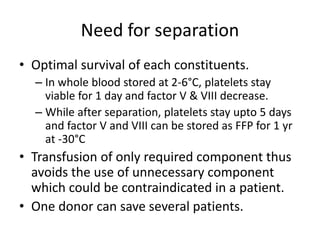
• Optimal survival of each constituents.
– In whole blood stored at 2-6°C, platelets stay
viable for 1 day and factor V & VIII decrease.
– While after separation, platelets stay upto 5 days
and factor V and VIII can be stored as FFP for 1 yr
at -30°C
• Transfusion of only required component thus
avoids the use of unnecessary component
which could be contraindicated in a patient.
• One donor can save several patients.
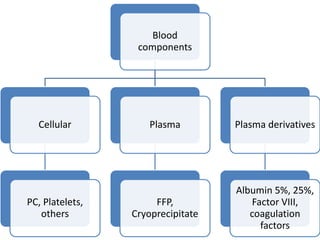
Blood
components
Cellular
PC, Platelets,
others
Plasma
FFP,
Cryoprecipitate
Plasma derivatives
Albumin 5%, 25%,
Factor VIII,
coagulation
factors
Equipments
• Freezer: – 40°C and -70°C
• Blood bank Refrigerator 2-6°C
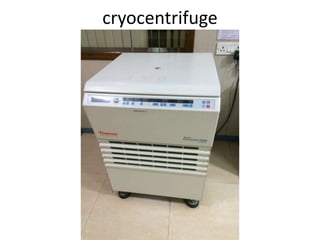
• Refrigerated centrifuge with swing out head and oval
cups
• Laminar flow
• Weighing scale
• Dielectric sealer or aluminium clips & sealer
• Stripper
• Water bath 37°C or plasma defroster (Microwave)
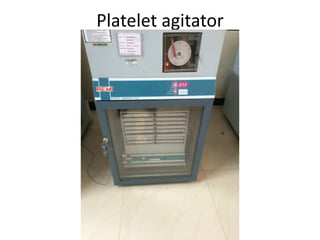
• Platelet agitator
• Sterile docking device
Precautions
A. In collection of blood:
1. Proper selection of donor
2. Clean aseptic site of venipuncture
3. Uninterrupted flow of blood
4. Collect correct amount of blood
5. Automatic mixing of blood during collection
6. Separate platelets within 6-8 hours
7. triple pack and quad pack system
Precautions
B. In centrifugation
1. Balancing & use of rubber discs
2. Broad side of the bag faces the outside wall of
the cup
3. Correct speed and time to be maintained
4. Look for any abnormal vibration
Whole Blood
• 450 ml +/- 45 ml or350 ml +/- 35 ml of donor
blood and anticoagulant solution
• Minimum 70% of transfused red cells should
survive in the recipient’s circulation 24 hours
after transfusion.
• No functional platelets and no labile
coagulation factors V and VIII
A unit of blood collected from a single donor in a
sterile container with an appropriate
anticoagulant.(CPD-A1)
• •Shelf life; 35 days at 2–6 C°
• •Volume ; 450ml +- 10%
• •One unit whole blood contain ~ 200ml RBC
• •Indications ;
• –Massive transfusion
• –Exchange transfusion
• •Must be ABO identical , cross match compatible
Preparation of Packed Red Cells
• Red cells have a higher specific gravity than
plasma, thus settle in the lower portion of the
bag.
• Types of preparation:
– Sediment red cells: PCV- 60-70%; 30% plasma and
all original leukocytes and platelets.
– Centrigued red cells: PCV- 70-80%; 15%
– Red cells with additive (Adsol or SAG-M): PCV -50-
60%; minimum plasma and all leukocytes and
platelets.
A unit of RBC prepared after removing 2/3 of plasma
• •Volume; 250 - 300 ml
• •Shelf life; 35 days (CPDA1)
• •Storage temperature; 2–6 C°
• •Indications ;
• oSymptomatic anaemia
• oBleeding during surgery
• oSevere haemorrhage for patients with surgical, complications
• otrauma
• ocancer
• • Must be ABO compatible and cross match compatible
• •1 Unit raises ~ 1.5 g/dL of Hb in an adult
Steps in separation
1st
• Store the bag at 2-6°C till processed
2nd
• Place bag in buckets of refrigerated centrifuge and balance
the opposite bags
• Centrifuge at 5000 x g for 5 mins at 2-6°C
3rd
• Express approx 3/4th of the plasma in the satellite bag
• Keep red cell at 2-6°C and plasma at -30°C
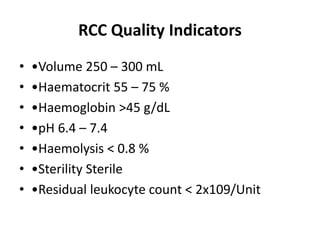
RCC Quality Indicators
• •Volume 250 – 300 mL
• •Haematocrit 55 – 75 %
• •Haemoglobin >45 g/dL
• •pH 6.4 – 7.4
• •Haemolysis < 0.8 %
• •Sterility Sterile
• •Residual leukocyte count < 2x10⁹/Unit
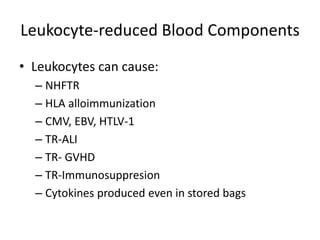
Leukocyte-reduced Blood Components
• Leukocytes can cause:
– NHFTR
– HLA alloimmunization
– CMV, EBV, HTLV-1
– TR-ALI
– TR- GVHD
– TR-Immunosuppresion
– Cytokines produced even in stored bags
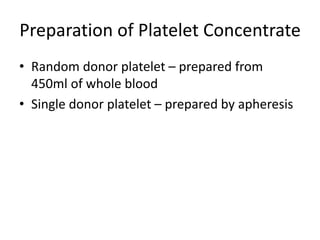
Preparation of Platelet Concentrate
• Random donor platelet – prepared from
450ml of whole blood
• Single donor platelet – prepared by apheresis
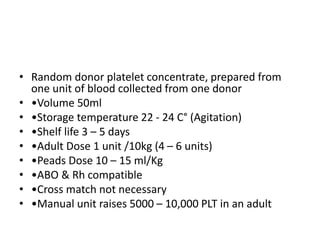
• Random donor platelet concentrate, prepared from
one unit of blood collected from one donor
• •Volume 50ml
• •Storage temperature 22 - 24 C° (Agitation)
• •Shelf life 3 – 5 days
• •Adult Dose 1 unit /10kg (4 – 6 units)
• •Peads Dose 10 – 15 ml/Kg
• •ABO & Rh compatible
• •Cross match not necessary
• •Manual unit raises 5000 – 10,000 PLT in an adult
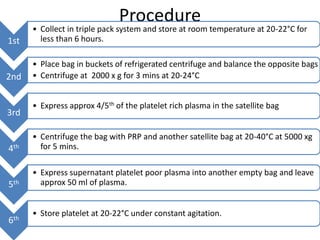
Procedure
1st
• Collect in triple pack system and store at room temperature at 20-22°C for
less than 6 hours.
2nd
• Place bag in buckets of refrigerated centrifuge and balance the opposite bags
• Centrifuge at 2000 x g for 3 mins at 20-24°C
3rd
• Express approx 4/5th of the platelet rich plasma in the satellite bag
4th
• Centrifuge the bag with PRP and another satellite bag at 20-40°C at 5000 xg
for 5 mins.
5th
• Express supernatant platelet poor plasma into another empty bag and leave
approx 50 ml of plasma.
6th
• Store platelet at 20-22°C under constant agitation.
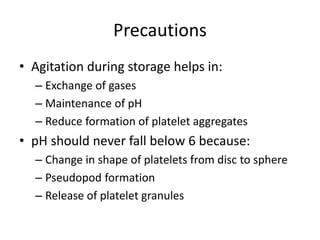
Precautions
• Agitation during storage helps in:
– Exchange of gases
– Maintenance of pH
– Reduce formation of platelet aggregates
• pH should never fall below 6 because:
– Change in shape of platelets from disc to sphere
– Pseudopod formation
– Release of platelet granules
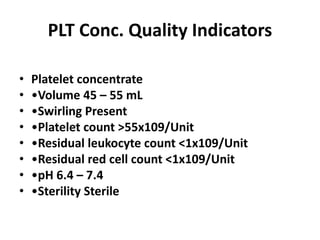
PLT Conc. Quality Indicators
• Platelet concentrate
• •Volume 45 – 55 mL
• •Swirling Present
• •Platelet count >55x109/Unit
• •Residual leukocyte count <1x10⁹/Unit
• •Residual red cell count <1x10⁹/Unit
• •pH 6.4 – 7.4
• •Sterility Sterile
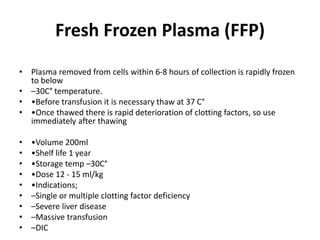
Fresh Frozen Plasma (FFP)
• Plasma removed from cells within 6-8 hours of collection is rapidly frozen
to below
• –30C° temperature.
• •Before transfusion it is necessary thaw at 37 C°
• •Once thawed there is rapid deterioration of clotting factors, so use
immediately after thawing
• •Volume 200ml
• •Shelf life 1 year
• •Storage temp –30C°
• •Dose 12 - 15 ml/kg
• •Indications;
• –Single or multiple clotting factor deficiency
• –Severe liver disease
• –Massive transfusion
• –DIC
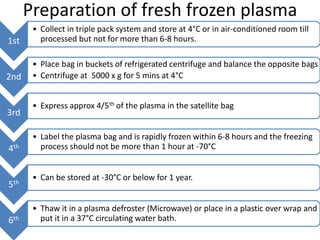
Preparation of fresh frozen plasma
1st
• Collect in triple pack system and store at 4°C or in air-conditioned room till
processed but not for more than 6-8 hours.
2nd
• Place bag in buckets of refrigerated centrifuge and balance the opposite bags
• Centrifuge at 5000 x g for 5 mins at 4°C
3rd
• Express approx 4/5th of the plasma in the satellite bag
4th
• Label the plasma bag and is rapidly frozen within 6-8 hours and the freezing
process should not be more than 1 hour at -70°C
5th
• Can be stored at -30°C or below for 1 year.
6th
• Thaw it in a plasma defroster (Microwave) or place in a plastic over wrap and
put it in a 37°C circulating water bath.
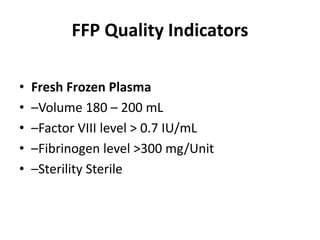
FFP Quality Indicators
• Fresh Frozen Plasma
• –Volume 180 – 200 mL
• –Factor VIII level > 0.7 IU/mL
• –Fibrinogen level >300 mg/Unit
• –Sterility Sterile
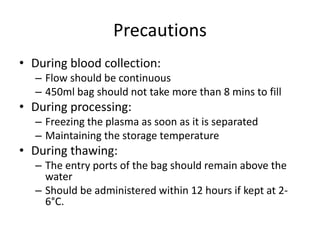
Precautions
• During blood collection:
– Flow should be continuous
– 450ml bag should not take more than 8 mins to fill
• During processing:
– Freezing the plasma as soon as it is separated
– Maintaining the storage temperature
• During thawing:
– The entry ports of the bag should remain above the
water
– Should be administered within 12 hours if kept at 2-
6°C.
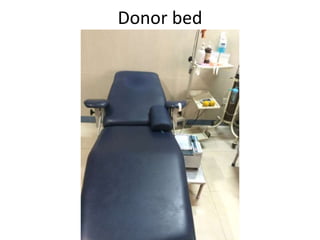
Donor bed
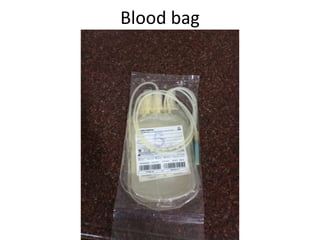
Blood bag
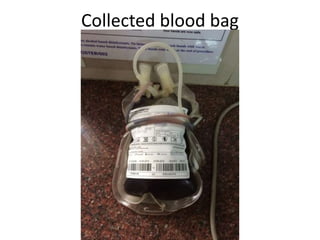
Collected blood bag
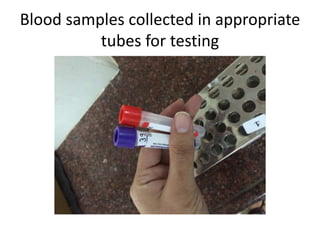
Blood samples collected in appropriate
tubes for testing
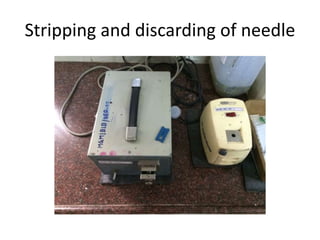
Stripping and discarding of needle
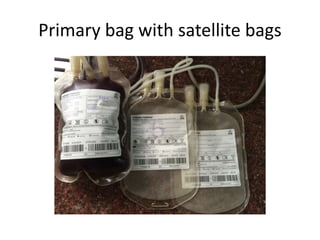
Primary bag with satellite bags
cryocentrifuge
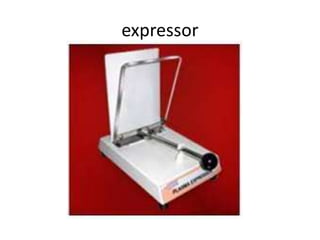
expressor
Platelet agitator
Blood component preparation blood banking

Blood component preparation blood banking

  • 1.
    Blood component preparation Dr.Akshay Agarwal MD Pathology Resident drakshay90@gmail.com
  • 2.
    Index • Need forseparation • Types of blood components • Equipments • Precautions • Preparation of – Packed red cells – Platelet rich plasma – Fresh frozen plasma
  • 3.
    Need for separation •Optimal survival of each constituents. – In whole blood stored at 2-6°C, platelets stay viable for 1 day and factor V & VIII decrease. – While after separation, platelets stay upto 5 days and factor V and VIII can be stored as FFP for 1 yr at -30°C • Transfusion of only required component thus avoids the use of unnecessary component which could be contraindicated in a patient. • One donor can save several patients.
  • 4.
  • 5.
    Equipments • Freezer: –40°C and -70°C • Blood bank Refrigerator 2-6°C • Refrigerated centrifuge with swing out head and oval cups • Laminar flow • Weighing scale • Dielectric sealer or aluminium clips & sealer • Stripper • Water bath 37°C or plasma defroster (Microwave) • Platelet agitator • Sterile docking device
  • 6.
    Precautions A. In collectionof blood: 1. Proper selection of donor 2. Clean aseptic site of venipuncture 3. Uninterrupted flow of blood 4. Collect correct amount of blood 5. Automatic mixing of blood during collection 6. Separate platelets within 6-8 hours 7. triple pack and quad pack system
  • 7.
    Precautions B. In centrifugation 1.Balancing & use of rubber discs 2. Broad side of the bag faces the outside wall of the cup 3. Correct speed and time to be maintained 4. Look for any abnormal vibration
  • 8.
    Whole Blood • 450ml +/- 45 ml or350 ml +/- 35 ml of donor blood and anticoagulant solution • Minimum 70% of transfused red cells should survive in the recipient’s circulation 24 hours after transfusion. • No functional platelets and no labile coagulation factors V and VIII
  • 9.
    A unit ofblood collected from a single donor in a sterile container with an appropriate anticoagulant.(CPD-A1) • •Shelf life; 35 days at 2–6 C° • •Volume ; 450ml +- 10% • •One unit whole blood contain ~ 200ml RBC • •Indications ; • –Massive transfusion • –Exchange transfusion • •Must be ABO identical , cross match compatible
  • 10.
    Preparation of PackedRed Cells • Red cells have a higher specific gravity than plasma, thus settle in the lower portion of the bag. • Types of preparation: – Sediment red cells: PCV- 60-70%; 30% plasma and all original leukocytes and platelets. – Centrigued red cells: PCV- 70-80%; 15% – Red cells with additive (Adsol or SAG-M): PCV -50- 60%; minimum plasma and all leukocytes and platelets.
  • 11.
    A unit ofRBC prepared after removing 2/3 of plasma • •Volume; 250 - 300 ml • •Shelf life; 35 days (CPDA1) • •Storage temperature; 2–6 C° • •Indications ; • oSymptomatic anaemia • oBleeding during surgery • oSevere haemorrhage for patients with surgical, complications • otrauma • ocancer • • Must be ABO compatible and cross match compatible • •1 Unit raises ~ 1.5 g/dL of Hb in an adult
  • 12.
    Steps in separation 1st •Store the bag at 2-6°C till processed 2nd • Place bag in buckets of refrigerated centrifuge and balance the opposite bags • Centrifuge at 5000 x g for 5 mins at 2-6°C 3rd • Express approx 3/4th of the plasma in the satellite bag • Keep red cell at 2-6°C and plasma at -30°C
  • 13.
    RCC Quality Indicators ••Volume 250 – 300 mL • •Haematocrit 55 – 75 % • •Haemoglobin >45 g/dL • •pH 6.4 – 7.4 • •Haemolysis < 0.8 % • •Sterility Sterile • •Residual leukocyte count < 2x10⁹/Unit
  • 14.
    Leukocyte-reduced Blood Components •Leukocytes can cause: – NHFTR – HLA alloimmunization – CMV, EBV, HTLV-1 – TR-ALI – TR- GVHD – TR-Immunosuppresion – Cytokines produced even in stored bags
  • 15.
    Preparation of PlateletConcentrate • Random donor platelet – prepared from 450ml of whole blood • Single donor platelet – prepared by apheresis
  • 16.
    • Random donorplatelet concentrate, prepared from one unit of blood collected from one donor • •Volume 50ml • •Storage temperature 22 - 24 C° (Agitation) • •Shelf life 3 – 5 days • •Adult Dose 1 unit /10kg (4 – 6 units) • •Peads Dose 10 – 15 ml/Kg • •ABO & Rh compatible • •Cross match not necessary • •Manual unit raises 5000 – 10,000 PLT in an adult
  • 17.
    Procedure 1st • Collect intriple pack system and store at room temperature at 20-22°C for less than 6 hours. 2nd • Place bag in buckets of refrigerated centrifuge and balance the opposite bags • Centrifuge at 2000 x g for 3 mins at 20-24°C 3rd • Express approx 4/5th of the platelet rich plasma in the satellite bag 4th • Centrifuge the bag with PRP and another satellite bag at 20-40°C at 5000 xg for 5 mins. 5th • Express supernatant platelet poor plasma into another empty bag and leave approx 50 ml of plasma. 6th • Store platelet at 20-22°C under constant agitation.
  • 18.
    Precautions • Agitation duringstorage helps in: – Exchange of gases – Maintenance of pH – Reduce formation of platelet aggregates • pH should never fall below 6 because: – Change in shape of platelets from disc to sphere – Pseudopod formation – Release of platelet granules
  • 19.
    PLT Conc. QualityIndicators • Platelet concentrate • •Volume 45 – 55 mL • •Swirling Present • •Platelet count >55x109/Unit • •Residual leukocyte count <1x10⁹/Unit • •Residual red cell count <1x10⁹/Unit • •pH 6.4 – 7.4 • •Sterility Sterile
  • 20.
    Fresh Frozen Plasma(FFP) • Plasma removed from cells within 6-8 hours of collection is rapidly frozen to below • –30C° temperature. • •Before transfusion it is necessary thaw at 37 C° • •Once thawed there is rapid deterioration of clotting factors, so use immediately after thawing • •Volume 200ml • •Shelf life 1 year • •Storage temp –30C° • •Dose 12 - 15 ml/kg • •Indications; • –Single or multiple clotting factor deficiency • –Severe liver disease • –Massive transfusion • –DIC
  • 21.
    Preparation of freshfrozen plasma 1st • Collect in triple pack system and store at 4°C or in air-conditioned room till processed but not for more than 6-8 hours. 2nd • Place bag in buckets of refrigerated centrifuge and balance the opposite bags • Centrifuge at 5000 x g for 5 mins at 4°C 3rd • Express approx 4/5th of the plasma in the satellite bag 4th • Label the plasma bag and is rapidly frozen within 6-8 hours and the freezing process should not be more than 1 hour at -70°C 5th • Can be stored at -30°C or below for 1 year. 6th • Thaw it in a plasma defroster (Microwave) or place in a plastic over wrap and put it in a 37°C circulating water bath.
  • 22.
    FFP Quality Indicators •Fresh Frozen Plasma • –Volume 180 – 200 mL • –Factor VIII level > 0.7 IU/mL • –Fibrinogen level >300 mg/Unit • –Sterility Sterile
  • 23.
    Precautions • During bloodcollection: – Flow should be continuous – 450ml bag should not take more than 8 mins to fill • During processing: – Freezing the plasma as soon as it is separated – Maintaining the storage temperature • During thawing: – The entry ports of the bag should remain above the water – Should be administered within 12 hours if kept at 2- 6°C.
  • 24.
  • 25.
  • 26.
  • 27.
    Blood samples collectedin appropriate tubes for testing
  • 28.
  • 29.
    Primary bag withsatellite bags
  • 30.
  • 31.
  • 32.