Dr VIKASH 
Junior Resident 1,Pathology 
IMS,BHU
Hemostasis 
Normal physiological mechanism for 
keeping the blood in fluid state in vascular 
system and for prevention of hemorrhage by 
complex interaction of blood vessels wall , 
platelets and plasma proteins. 
 Primary type- Platelets plugs(b/w blood 
vessels and platelets) 
 Secondary type-(Activation of coagulation 
factors by a series of enzymatic activity to 
form fibrin clot)
Hemostasis 
Purpose 
 Ensure that coagulation mechanisms are 
 activated when there is injury 
 not unnecessarily activated 
Restore tissue blood flow after repair of injury 
(fibrinolysis)
Hemostatic Process 
3 main steps 
 Primary hemostasis: local vasoconstriction & 
platelet plug formation 
Coagulation cascade 
 Fibrinolysis
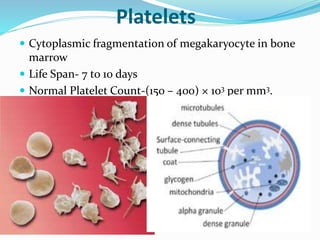
Platelets 
 Cytoplasmic fragmentation of megakaryocyte in bone 
marrow 
 Life Span- 7 to 10 days 
 Normal Platelet Count-(150 – 400) × 103 per mm3.
Hemostatic Process 
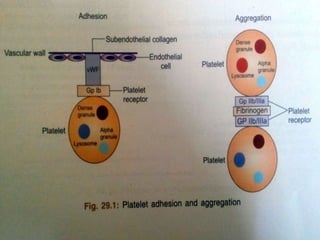
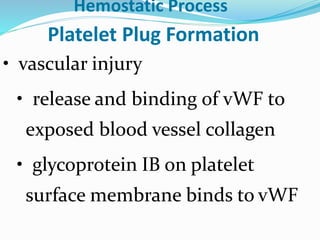
Platelet Plug Formation 
• vascular injury 
• release and binding of vWF to 
exposed blood vessel collagen 
• glycoprotein IB on platelet 
surface membrane binds to vWF
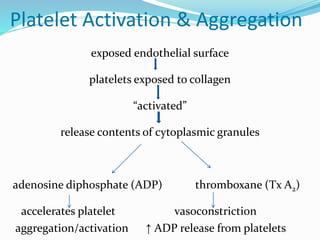
Platelet Activation & Aggregation 
exposed endothelial surface 
platelets exposed to collagen 
“activated” 
release contents of cytoplasmic granules 
adenosine diphosphate (ADP) thromboxane (Tx A2) 
accelerates platelet vasoconstriction 
aggregation/activation ↑ ADP release from platelets
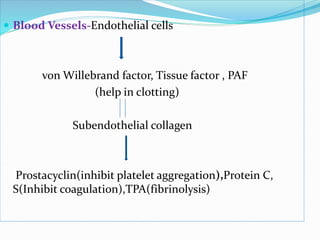
 Blood Vessels-Endothelial cells 
von Willebrand factor, Tissue factor , PAF 
(help in clotting) 
Subendothelial collagen 
Prostacyclin(inhibit platelet aggregation),Protein C, 
S(Inhibit coagulation),TPA(fibrinolysis)
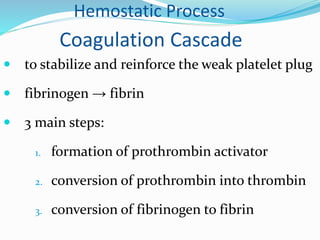
Hemostatic Process 
Coagulation Cascade 
 to stabilize and reinforce the weak platelet plug 
 fibrinogen → fibrin 
 3 main steps: 
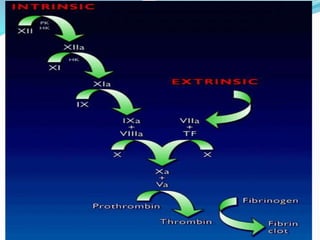
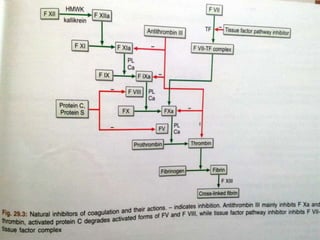
1. formation of prothrombin activator 
2. conversion of prothrombin into thrombin 
3. conversion of fibrinogen to fibrin
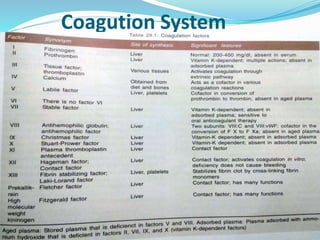
Coagution System
Coagulation Mechanism 
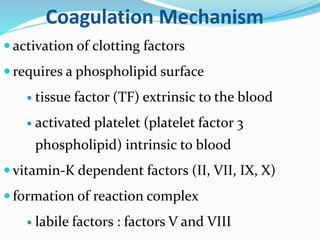
 activation of clotting factors 
 requires a phospholipid surface 
 tissue factor (TF) extrinsic to the blood 
 activated platelet (platelet factor 3 
phospholipid) intrinsic to blood 
 vitamin-K dependent factors (II, VII, IX, X) 
 formation of reaction complex 
 labile factors : factors V and VIII
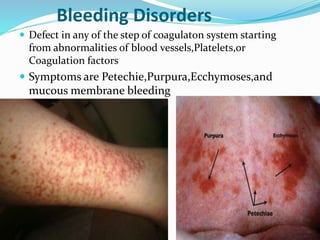
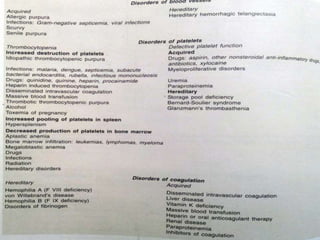
Bleeding Disorders 
 Defect in any of the step of coagulaton system starting 
from abnormalities of blood vessels,Platelets,or 
Coagulation factors 
 Symptoms are Petechie,Purpura,Ecchymoses,and 
mucous membrane bleeding
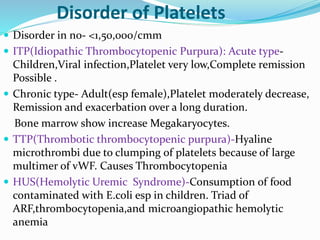
Disorder of Platelets 
 Disorder in no- <1,50,000/cmm 
 ITP(Idiopathic Thrombocytopenic Purpura): Acute type- 
Children,Viral infection,Platelet very low,Complete remission 
Possible . 
 Chronic type- Adult(esp female),Platelet moderately decrease, 
Remission and exacerbation over a long duration. 
Bone marrow show increase Megakaryocytes. 
 TTP(Thrombotic thrombocytopenic purpura)-Hyaline 
microthrombi due to clumping of platelets because of large 
multimer of vWF. Causes Thrombocytopenia 
 HUS(Hemolytic Uremic Syndrome)-Consumption of food 
contaminated with E.coli esp in children. Triad of 
ARF,thrombocytopenia,and microangiopathic hemolytic 
anemia
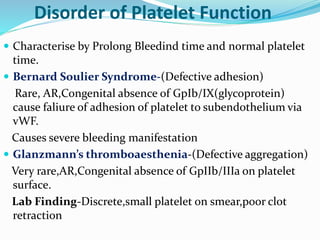
Disorder of Platelet Function 
 Characterise by Prolong Bleedind time and normal platelet 
time. 
 Bernard Soulier Syndrome-(Defective adhesion) 
Rare, AR,Congenital absence of GpIb/IX(glycoprotein) 
cause faliure of adhesion of platelet to subendothelium via 
vWF. 
Causes severe bleeding manifestation 
 Glanzmann’s thromboaesthenia-(Defective aggregation) 
Very rare,AR,Congenital absence of GpIIb/IIIa on platelet 
surface. 
Lab Finding-Discrete,small platelet 0n smear,poor clot 
retraction
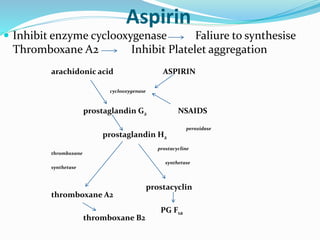
Aspirin 
 Inhibit enzyme cyclooxygenase Faliure to synthesise 
Thromboxane A2 Inhibit Platelet aggregation 
arachidonic acid ASPIRIN 
cyclooxygenase 
prostaglandin G2 NSAIDS 
peroxidase 
prostaglandin H2 
prostacycline 
thromboxane 
synthetase 
synthetase 
prostacyclin 
thromboxane A2 
PG F1a 
thromboxane B2
Inherited disorder of coagulation 
 Hemophilia A(factor VIII deficiency) 
 Hemophilia B(factor IX deficiency) 
 von willebrand Disease(VWD)
Laboratory Monitoring 
Prothrombin Time (PT) 
 test of extrinsic pathway activity 
 measures vitamin K - dependent factors activity (factors 
II, VII, IX, X) 
 thromboplastin + Ca+2 to plasma = clotting time 
 normal values: 12-14 seconds 
 International Normalized Ratio (INR) 
▪ standardizes PT reporting 
 normal values: 0.8 -1.2 seconds
Laboratory Monitoring 
Prothrombin Time (PT) 
monitors coumadin therapy 
most sensitive to alteration in F VII levels 
 prolonged: 55 % ↓ of normal F VII activity 
 antithrombotic activity: reduction of factor II and 
factor X activity (after several days)
Laboratory Monitoring 
Activated Partial Prothrombin Time (aPTT) 
 test for intrinsic and common pathways 
 dependent on activity of all coagulation factors, 
except VII and XIII 
 normal values: 25 -35 seconds 
monitors heparin tx & screen for hemophilia
Laboratory Monitoring 
Activated Partial Prothrombin Time (aPTT) 
 prolonged: heparin, thrombin inhibitors, 
fibrin degradation products (FDP) 
 citrated plasma + surface activators + 
phospholipid 
 prolonged only if coagulation factors reduced to < 
30 % of normal
Laboratory Monitoring 
Activated Clotting Time (ACT) 
monitors heparin anticoagulation in 
the OR (cardiac and vascular surgeries) 
normal values: 90 - 120 seconds
Laboratory Monitoring 
Thrombin Clotting Time (TCT) 
 reflects abnormalities in fibrinogen → fibrin 
 plasma + excessive amount of thrombin 
 prolonged: heparin, thrombin inhibitors, 
low fibrinogen, dysfibrinogenemia 
 monitors hirudin, bivalirudin, LMWH tx 
 INR & PT may be normal or ↑ 
 TCT prolonged with adequate therapeutic levels
Laboratory Monitoring 
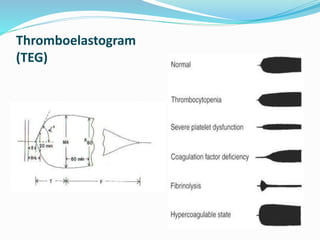
Thromboelastography (TEG) 
 continuous profiles during all phases of 
clot formation 
 provides more accurate picture of in vivo coagulation process 
 to evaluate: 
• hypo / hypercoagulable state 
• hemophilia 
• dilutional coagulopathy 
• rare coagulation disorders anticoagulation tx 
• coagulation problems with liver transplantation
Thromboelastogram 
(TEG)
Bleeding time 
monitors platelet function 
 not specific indicator of platelet function 
 not very reliable 
 very operator - dependent 
 variable from each institution
Laboratory Monitoring 
Platelet Function Analyzer (PFA) - 100 
 relatively new global test of platelet adhesion and aggregation 
 advantages 
 noninvasive, simple, easy to perform 
 very sensitive in detecting platelet defects 
associated with vWD 
 sensitive to dx of acquired platelet defects (ASA, NSAID, 
dietary factors: excessive cocoa intake) 
 monitors pro-hemostatic treatment 
 DDAVP & platelet transfusions
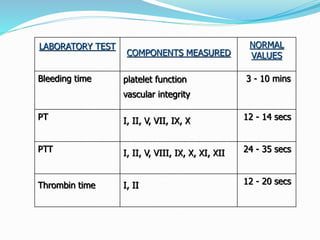
LABORATORY TEST 
COMPONENTS MEASURED 
NORMAL 
VALUES 
Bleeding time platelet function 
vascular integrity 
3 - 10 mins 
PT I, II, V, VII, IX, X 12 - 14 secs 
PTT I, II, V, VIII, IX, X, XI, XII 24 - 35 secs 
Thrombin time I, II 12 - 20 secs
Coagulation profile

Coagulation profile

  • 1.
    Dr VIKASH JuniorResident 1,Pathology IMS,BHU
  • 2.
    Hemostasis Normal physiologicalmechanism for keeping the blood in fluid state in vascular system and for prevention of hemorrhage by complex interaction of blood vessels wall , platelets and plasma proteins.  Primary type- Platelets plugs(b/w blood vessels and platelets)  Secondary type-(Activation of coagulation factors by a series of enzymatic activity to form fibrin clot)
  • 3.
    Hemostasis Purpose Ensure that coagulation mechanisms are  activated when there is injury  not unnecessarily activated Restore tissue blood flow after repair of injury (fibrinolysis)
  • 4.
    Hemostatic Process 3main steps  Primary hemostasis: local vasoconstriction & platelet plug formation Coagulation cascade  Fibrinolysis
  • 5.
    Platelets  Cytoplasmicfragmentation of megakaryocyte in bone marrow  Life Span- 7 to 10 days  Normal Platelet Count-(150 – 400) × 103 per mm3.
  • 7.
    Hemostatic Process PlateletPlug Formation • vascular injury • release and binding of vWF to exposed blood vessel collagen • glycoprotein IB on platelet surface membrane binds to vWF
  • 8.
    Platelet Activation &Aggregation exposed endothelial surface platelets exposed to collagen “activated” release contents of cytoplasmic granules adenosine diphosphate (ADP) thromboxane (Tx A2) accelerates platelet vasoconstriction aggregation/activation ↑ ADP release from platelets
  • 9.
     Blood Vessels-Endothelialcells von Willebrand factor, Tissue factor , PAF (help in clotting) Subendothelial collagen Prostacyclin(inhibit platelet aggregation),Protein C, S(Inhibit coagulation),TPA(fibrinolysis)
  • 10.
    Hemostatic Process CoagulationCascade  to stabilize and reinforce the weak platelet plug  fibrinogen → fibrin  3 main steps: 1. formation of prothrombin activator 2. conversion of prothrombin into thrombin 3. conversion of fibrinogen to fibrin
  • 11.
  • 14.
    Coagulation Mechanism activation of clotting factors  requires a phospholipid surface  tissue factor (TF) extrinsic to the blood  activated platelet (platelet factor 3 phospholipid) intrinsic to blood  vitamin-K dependent factors (II, VII, IX, X)  formation of reaction complex  labile factors : factors V and VIII
  • 15.
    Bleeding Disorders Defect in any of the step of coagulaton system starting from abnormalities of blood vessels,Platelets,or Coagulation factors  Symptoms are Petechie,Purpura,Ecchymoses,and mucous membrane bleeding
  • 17.
    Disorder of Platelets  Disorder in no- <1,50,000/cmm  ITP(Idiopathic Thrombocytopenic Purpura): Acute type- Children,Viral infection,Platelet very low,Complete remission Possible .  Chronic type- Adult(esp female),Platelet moderately decrease, Remission and exacerbation over a long duration. Bone marrow show increase Megakaryocytes.  TTP(Thrombotic thrombocytopenic purpura)-Hyaline microthrombi due to clumping of platelets because of large multimer of vWF. Causes Thrombocytopenia  HUS(Hemolytic Uremic Syndrome)-Consumption of food contaminated with E.coli esp in children. Triad of ARF,thrombocytopenia,and microangiopathic hemolytic anemia
  • 18.
    Disorder of PlateletFunction  Characterise by Prolong Bleedind time and normal platelet time.  Bernard Soulier Syndrome-(Defective adhesion) Rare, AR,Congenital absence of GpIb/IX(glycoprotein) cause faliure of adhesion of platelet to subendothelium via vWF. Causes severe bleeding manifestation  Glanzmann’s thromboaesthenia-(Defective aggregation) Very rare,AR,Congenital absence of GpIIb/IIIa on platelet surface. Lab Finding-Discrete,small platelet 0n smear,poor clot retraction
  • 19.
    Aspirin  Inhibitenzyme cyclooxygenase Faliure to synthesise Thromboxane A2 Inhibit Platelet aggregation arachidonic acid ASPIRIN cyclooxygenase prostaglandin G2 NSAIDS peroxidase prostaglandin H2 prostacycline thromboxane synthetase synthetase prostacyclin thromboxane A2 PG F1a thromboxane B2
  • 20.
    Inherited disorder ofcoagulation  Hemophilia A(factor VIII deficiency)  Hemophilia B(factor IX deficiency)  von willebrand Disease(VWD)
  • 21.
    Laboratory Monitoring ProthrombinTime (PT)  test of extrinsic pathway activity  measures vitamin K - dependent factors activity (factors II, VII, IX, X)  thromboplastin + Ca+2 to plasma = clotting time  normal values: 12-14 seconds  International Normalized Ratio (INR) ▪ standardizes PT reporting  normal values: 0.8 -1.2 seconds
  • 22.
    Laboratory Monitoring ProthrombinTime (PT) monitors coumadin therapy most sensitive to alteration in F VII levels  prolonged: 55 % ↓ of normal F VII activity  antithrombotic activity: reduction of factor II and factor X activity (after several days)
  • 23.
    Laboratory Monitoring ActivatedPartial Prothrombin Time (aPTT)  test for intrinsic and common pathways  dependent on activity of all coagulation factors, except VII and XIII  normal values: 25 -35 seconds monitors heparin tx & screen for hemophilia
  • 24.
    Laboratory Monitoring ActivatedPartial Prothrombin Time (aPTT)  prolonged: heparin, thrombin inhibitors, fibrin degradation products (FDP)  citrated plasma + surface activators + phospholipid  prolonged only if coagulation factors reduced to < 30 % of normal
  • 25.
    Laboratory Monitoring ActivatedClotting Time (ACT) monitors heparin anticoagulation in the OR (cardiac and vascular surgeries) normal values: 90 - 120 seconds
  • 26.
    Laboratory Monitoring ThrombinClotting Time (TCT)  reflects abnormalities in fibrinogen → fibrin  plasma + excessive amount of thrombin  prolonged: heparin, thrombin inhibitors, low fibrinogen, dysfibrinogenemia  monitors hirudin, bivalirudin, LMWH tx  INR & PT may be normal or ↑  TCT prolonged with adequate therapeutic levels
  • 27.
    Laboratory Monitoring Thromboelastography(TEG)  continuous profiles during all phases of clot formation  provides more accurate picture of in vivo coagulation process  to evaluate: • hypo / hypercoagulable state • hemophilia • dilutional coagulopathy • rare coagulation disorders anticoagulation tx • coagulation problems with liver transplantation
  • 28.
  • 29.
    Bleeding time monitorsplatelet function  not specific indicator of platelet function  not very reliable  very operator - dependent  variable from each institution
  • 30.
    Laboratory Monitoring PlateletFunction Analyzer (PFA) - 100  relatively new global test of platelet adhesion and aggregation  advantages  noninvasive, simple, easy to perform  very sensitive in detecting platelet defects associated with vWD  sensitive to dx of acquired platelet defects (ASA, NSAID, dietary factors: excessive cocoa intake)  monitors pro-hemostatic treatment  DDAVP & platelet transfusions
  • 31.
    LABORATORY TEST COMPONENTSMEASURED NORMAL VALUES Bleeding time platelet function vascular integrity 3 - 10 mins PT I, II, V, VII, IX, X 12 - 14 secs PTT I, II, V, VIII, IX, X, XI, XII 24 - 35 secs Thrombin time I, II 12 - 20 secs