BLOOD COMPONENTS
INDICATIONS,PREPARATION OF
BLOOD COMPONENTS
SUNIL KUMAR.P
Department of Haematology
St.John’s Medical College Hospital
Bangalore 1SUNIL KUMAR.P
INTRODUCTION
• These days effective blood transfusion
depends upon the availability of different
blood components.
• These components are used in separately or in
combinations, can meet most patients
transfusions need and keeping the risk of
transfusion to a minimum.
2SUNIL KUMAR.P
WHY THERE IS NEED FOR
COMPONENT SEPARATION
• 1. Separation of blood in to components allows
optimal survival of each constituents.
• 2. component preparation allows transfusing only
specific blood component that the patient requires.
• 3. Transfusion of only specific constituent of blood
needed avoids the use of unnecessary component,
which could be contraindicated in a patient
3SUNIL KUMAR.P
• 4.By using blood components, several patients
can be treated with the blood from one donor,
giving the optimal use of every unit of
donated blood.
• 5. use of blood components, supplements
blood supply- adds to the blood inventory
4SUNIL KUMAR.P
BLOOD COMPONENTS
Cellular components :
• Red cell concentrate
• Leucocytes-Reduced Red cells
• Platelet Concentrate
• Leukocytes-Reduced Platelet Concentrate
• Platelet Apheresis
• Granulocytes Apheresis
5SUNIL KUMAR.P
Plasma components
• Fresh frozen plasma
• Single donor plasma
• Cryoprecipitate
• Cryo-poor plasma
• Plasma derivatives
Albumin 5% & 25%
6SUNIL KUMAR.P
Plasma Protein Fractions
• Factor VIII concentrate Immunoglobulins
• Fibrinogen Other coagulation factors
7SUNIL KUMAR.P
PREPARATION OF BLOOD
COMPONENTS
• Equipment:
• Freezer - 40°C and - 70°C
• Blood bank refrigerator 2-6°C
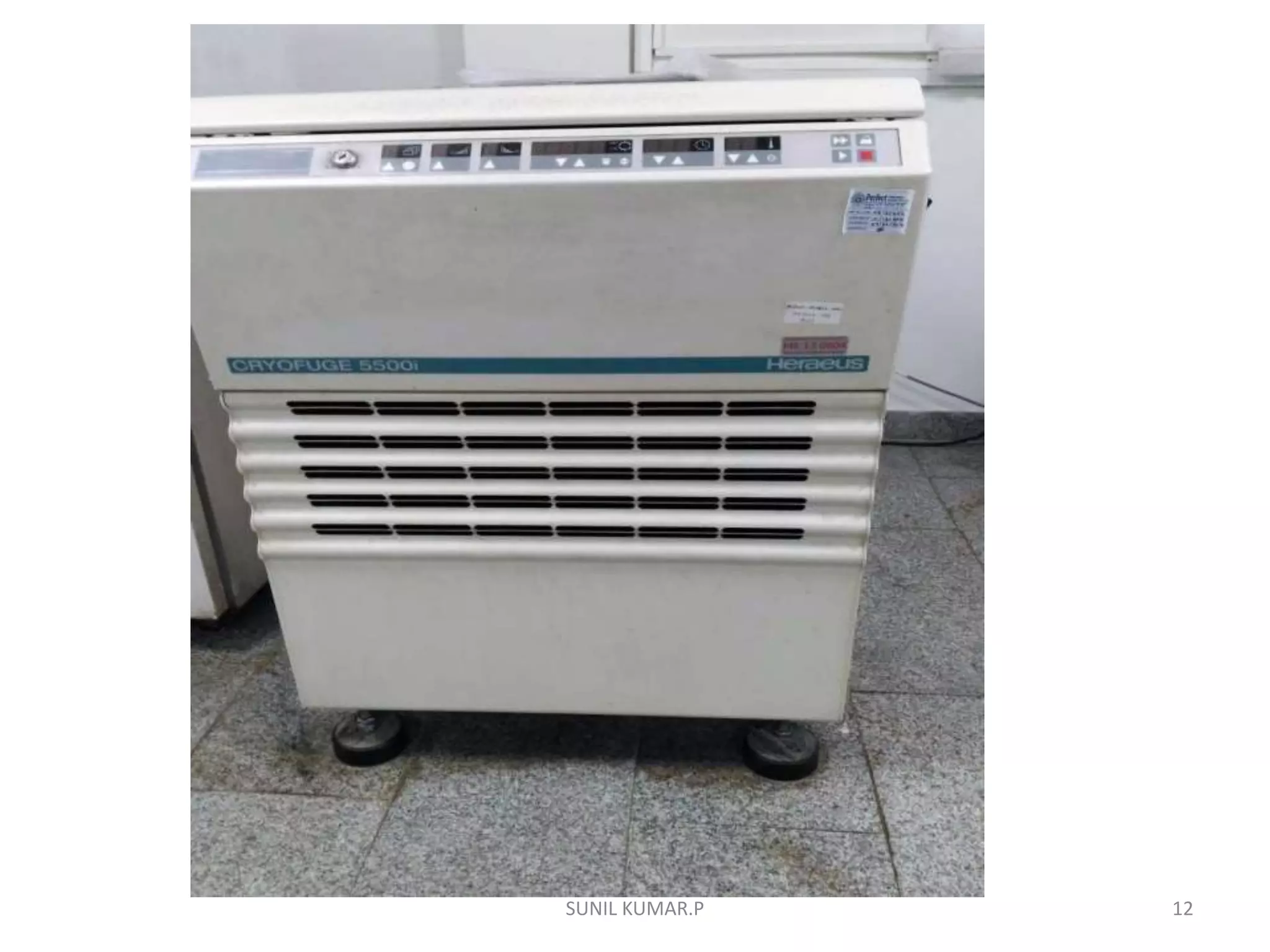
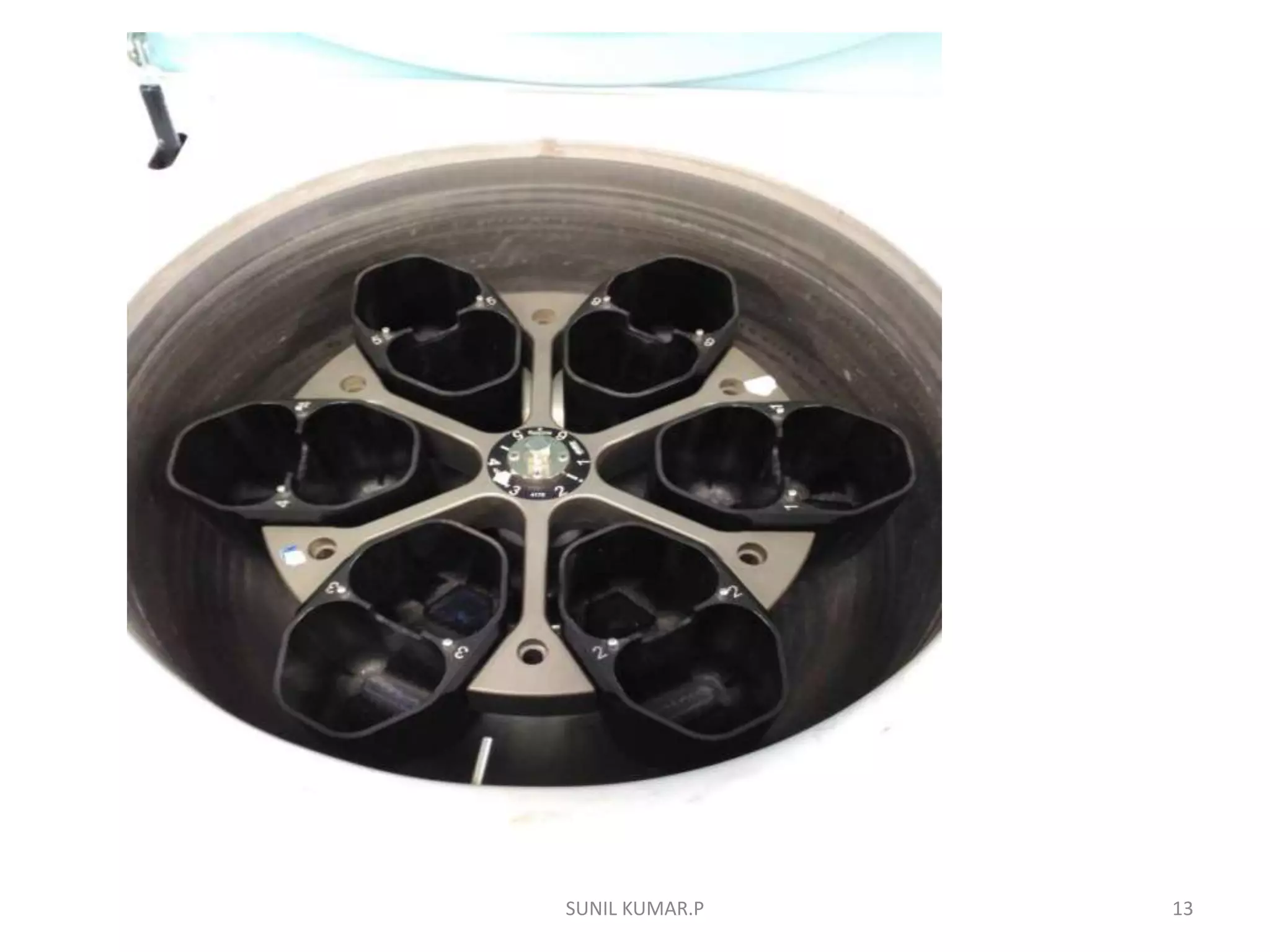
• Refrigerated centrifuge with swing out head and oval
cups
• Laminar flow
• Weighing scale
• Dielectric sealer or aluminium clips & sealer
• Stripper
• Water bath 37°C or Plasma Defroster (MicroWave)
8SUNIL KUMAR.P
• Platelet reciprocator (platelet incubator with
agitator)
• Cryoprecipitate bath 4°C
9SUNIL KUMAR.P
10SUNIL KUMAR.P
11SUNIL KUMAR.P
12SUNIL KUMAR.P
13SUNIL KUMAR.P
14SUNIL KUMAR.P
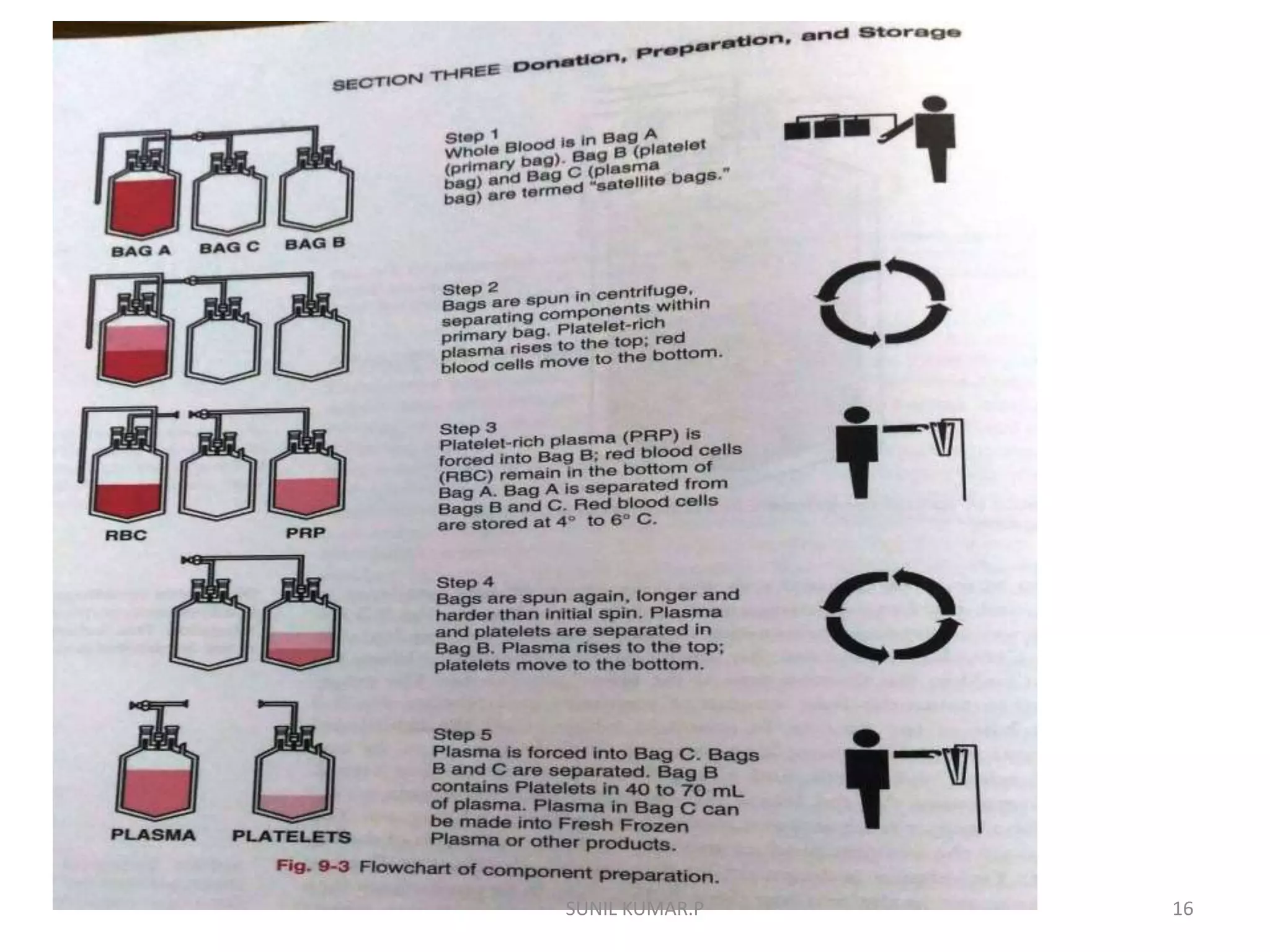
Preparation of blood components is possible due
to :
• Multiple Plastic packs system
• Refrigerated centrifuge
• Different specific gravity of cellular components
• Red cells specific gravity 1.08 - 1.09
• Platelet specific gravity 1.03 - 1.04
• Plasma specific gravity 1.02 - 1.03
15SUNIL KUMAR.P
16SUNIL KUMAR.P
Methods of preparation
• There are various methods to separate these
components and the yield and quality of
component depends upon the methods
applied.
Various methods used are:
• a)Gravity separation
• b)Low and high speed centrifugation
• c)Apheresis by cell separator
17SUNIL KUMAR.P
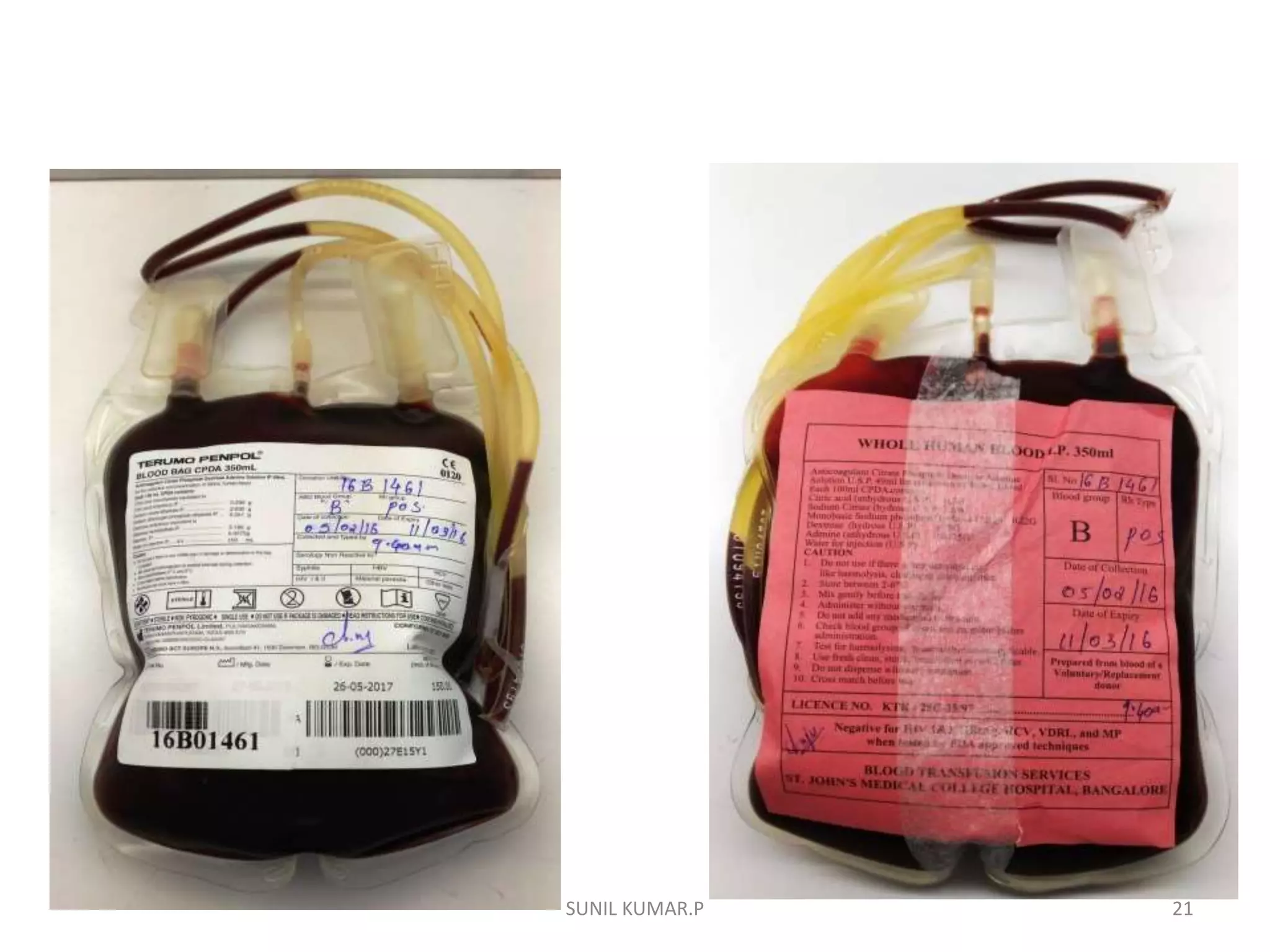
WHOLE BLOOD
• 350-450 ml of blood
• 49-63ml of anticoagulant solution
• Hct- 36-44%
• No components removed
• Stored at 1- 6 degree celsius
• Shelf life :
• Citrate –phosphate –Dextrose(CPD)- 21days
• CPDA (adenine) – 35 days
• AS-1, AS-3, AS-5 – 42 days
18SUNIL KUMAR.P
• Increase Hb by 1 g/dl
• Rate of Blood Transfusion -3ml/kg/hr
19SUNIL KUMAR.P
WHOLE BLOOD Indications
• Acute active blood loss with hypovolemia
• Exchange transfusion Contradictions
Risk of volume overload
• chronic anemia
• Incipent cardiac failure
20SUNIL KUMAR.P
21SUNIL KUMAR.P
WHOLE BLOOD Drawbacks
• After storage for 24 hours platelets and wbc
are non functional
• Factor V and Viii decrease with storage
• Fluid overload
22SUNIL KUMAR.P
Preparation of Packed RBCs Principle
• RBCs are obtained by removal of supernatant plasma
from centrifuged whole blood
Preparation
• 1. Collect appropriate volume of donor blood in CPDA
double or triple bag.
• 2. Store at 2-6C till processed.
• 3. Place bags in the buckets of refrigerated centrifuge
and balance the opposite bags accurately.
• 4. Centrifuge at heavy spin (5000 x g) for 5 minutes at
2-6C.
23SUNIL KUMAR.P
• 5. Express approximately 3/4 of the plasma
into the satellite bag.
• 6. Double seal the tube between primary and
satellite bags with plasma Separate the
satellite bag with plasma and keep at -30°C or
below.
• 7. Keep the red cells at 2-6°C.
24SUNIL KUMAR.P
Indications
• Patient need urgent operation and has Hb < 10g/dl
• Anticipated surgical blood loss > 1000 ml
• Other acute Loss of blood
• Replacement Fluid blood loss < 20% of blood vol.
• Anemia associated with incipient/established cardiac
failure
• Hb value < 6 g/dl
• Patients approaching delivery and has Hb value < 7g/dl
• In hereditary hemolytic anemias and betathalassaemia
major.
25SUNIL KUMAR.P
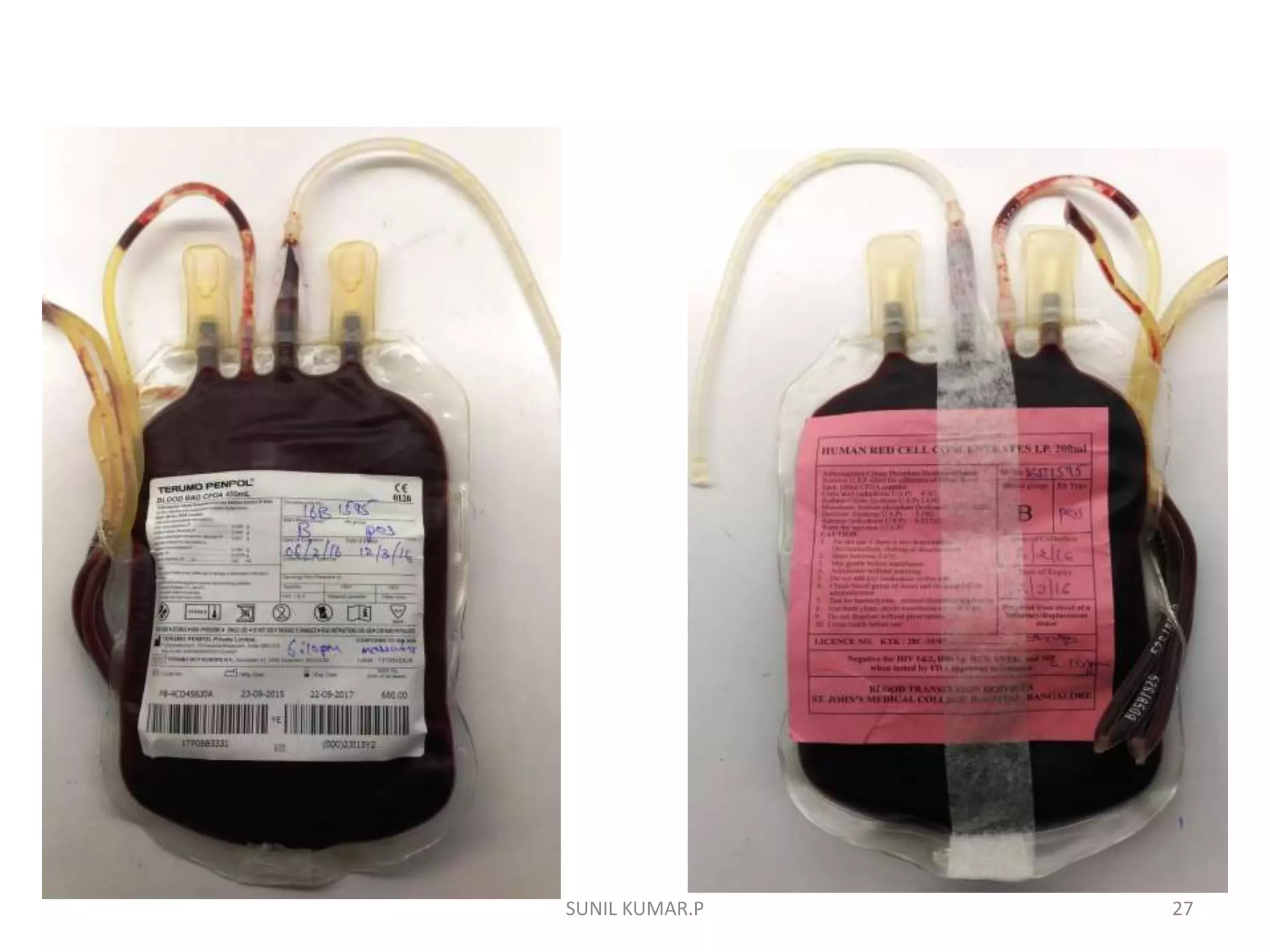
Packed RBCs
• Shelf life – 35 days
• Storage temp- 2 – 6 Degree celsius
• QC Requirements: PCV 80% (Range 65-80%)
• Volume- 250- 300 ml
Contents :
• red cells- 65-80%,
• Plasma 20- 35%,
• Some platelets,
• white blood cell and anticoagulant preservative
solutions Effect – 1 unit RBC raise Hct by 3% and hb by
1g/dl
26SUNIL KUMAR.P
27SUNIL KUMAR.P
Guidelines for Paediatric red cell
transfusions
Anaemia
Infants within first 4 months of life
• Hb< 13.0 g/dL and severe pulmonary disease
• Hb < 10.0 g/dL and moderate pulmonary disease
• Hb< 13.0 g/dL and severe cardiac disease
• Hb<10.0 g/dL and major surgery
• Hb < 8.0 g/dL and symptomatic anemia
• Acute blood loss >10% of total blood volume.
28SUNIL KUMAR.P
Guidelines for Paediatric red cell
transfusions
Infants >4 months & children
• Acute loss > 25% circulating blood volume
• Hb < 8.0 g/dL in perioperative period
• Hb < 13.0 g/dL and severe cardiopulmonary
disease
• Hb < 8.0 g/dL and marrow failure
• Hb < 8.0 g/dL and symptomatic chronic
anemia
29SUNIL KUMAR.P
IRRADIATED RED BLOOD CELLS
• Gamma radiated to kill the lymphocytes
• The lack of T cells prevents graft versus host
reaction
Indications:
• Severely imunocompromised patients
• Lymphoma patients
• Stem cell/marrow transplants
• Intrauterine transfusion
• Neonates undergoing exchange transfusion
• Hodgkin Disease
30SUNIL KUMAR.P
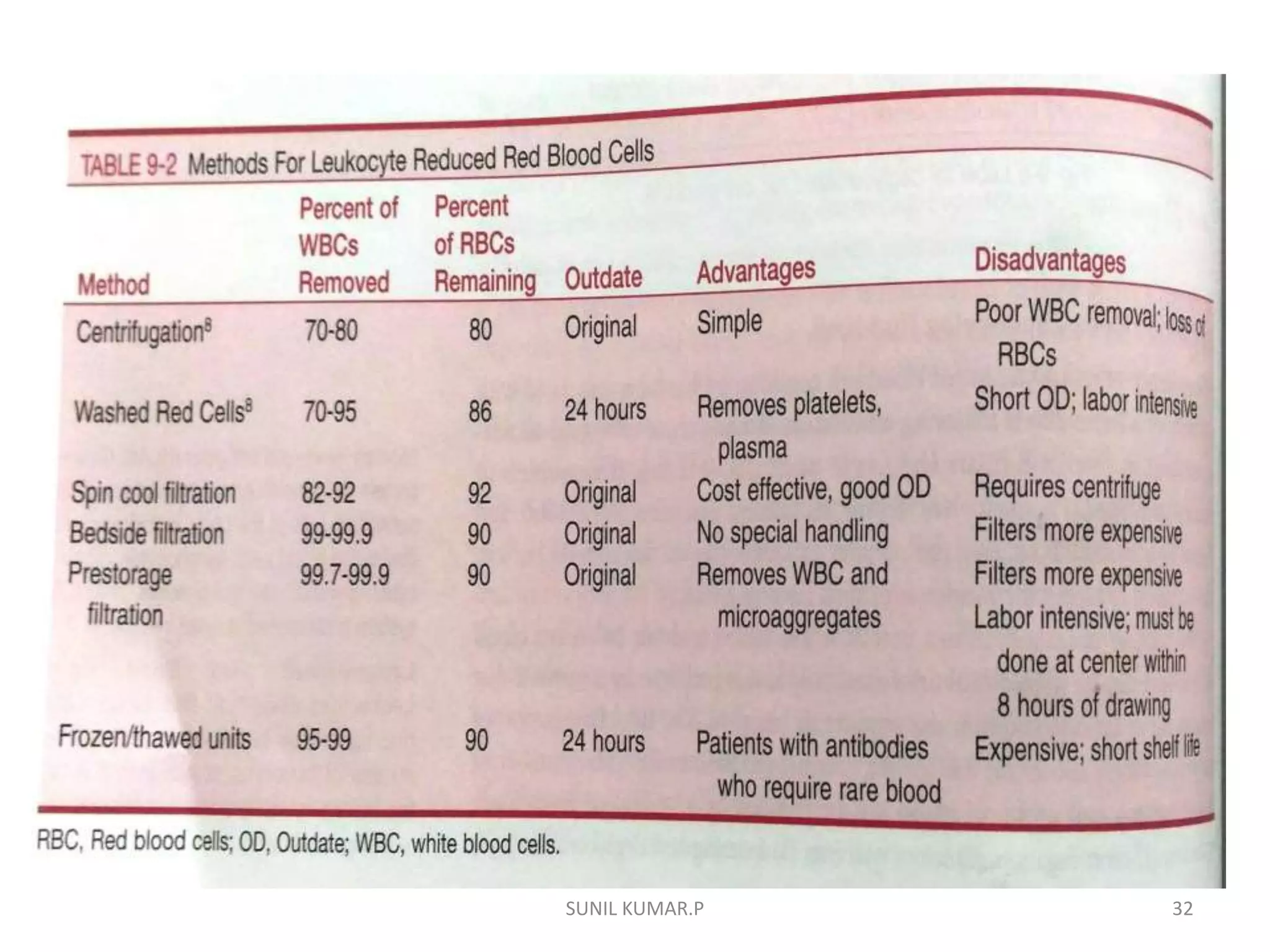
LEUCOCYTE REDUCED RBCS
Methods of the preparation of Leucocyte-
Reduced Red cells
• Centrifugation and removing of buffy coat
• Filtration
• Washing of red cells with saline
• Freezing and thawing of red cells
31SUNIL KUMAR.P
32SUNIL KUMAR.P
LEUCOCYTE REDUCED RBCS
INDICATIONS
• Multi transfused patients like thalasemia
• Leukemia
• Aplastic anemia
• Immunosupressed
• Immunodeficient
• Prevention of recurrent FNHTRs
• Prevention or delay of primary alloimmunization
to HLA antigen
• Prevention of CMV transmission in at risk
individual
33SUNIL KUMAR.P
FROZEN/DEGLYCEROLIZED RED CELLS
Indications
• The provision of rare blood lacking common
antigens for patients with corresponding
antibodies.
• Autologous units of patients with multiple red
cells alloantibodies stored for future surgery.
• IgA deficient patient with antibodies to IgA
• It can be used to prevent Febrile non
hemolytic transfusion reactions( FNHTRs )
34SUNIL KUMAR.P
GRANULOCYTE CONCENTRATE
• Obtained by apheresis from family members
for administration in cancer patients
• Contains 109granulocyte
• Pretreatment with recombinant G-CSF and
dexamethasone can yield 4-8x 10⁸granulocyte
• Stored at 24 degree celsius
• Infuse within 24 hours of collection
35SUNIL KUMAR.P
GRANULOCYTE CONCENTRATE
• Granulocyte concentrate can be prepared by
• 1. Single donor unit
• 2. Leukapheresis by blood cells separator
36SUNIL KUMAR.P
INDICATIONS
The role of granulocytes transfusion has
decreased with
• The availability of new and better antibiotics
• The advent of recombinant granulopoeitic
growth factors e.g. granulocyte stimulating
factor .
37SUNIL KUMAR.P
Adverse effects of granulocytes
transfusion
•However the granulocytes transfusion are still
used at times with success in the following
conditions:
• Septicemia not responding to antibiotics..
• Neutrophil count less than 0.50 x 10⁹/L
(500 / mm3), having gram-negative infection
which fail to respond with antibiotics
38SUNIL KUMAR.P
• Temporary bone marrow depression for 1 - 2
weeks
• Infections in patients undergoing chemo /
radio therapy for neoplastic diseases
39SUNIL KUMAR.P
PLATELET RICH PLASMA (PRP)
Procedure:
• 1. Collect 450 ml blood by a clean, single venipunctuer
into 450 ml CPDA or Adsol / SAGM triple bags system.
• 2. Keep the blood bag at room temperature (20-22°C)
before preparing platelets, for not more than 6 hours.
Do not chill at any time before or during platelet
separation.
• 3. Centrifuge the blood bags at 20-24°C at light spin for
appropriate time (2000 x g for 3 minutes).
• 4. Separate 4/5 of the platelet rich plasma (PRP) into
one satellite bag
40SUNIL KUMAR.P
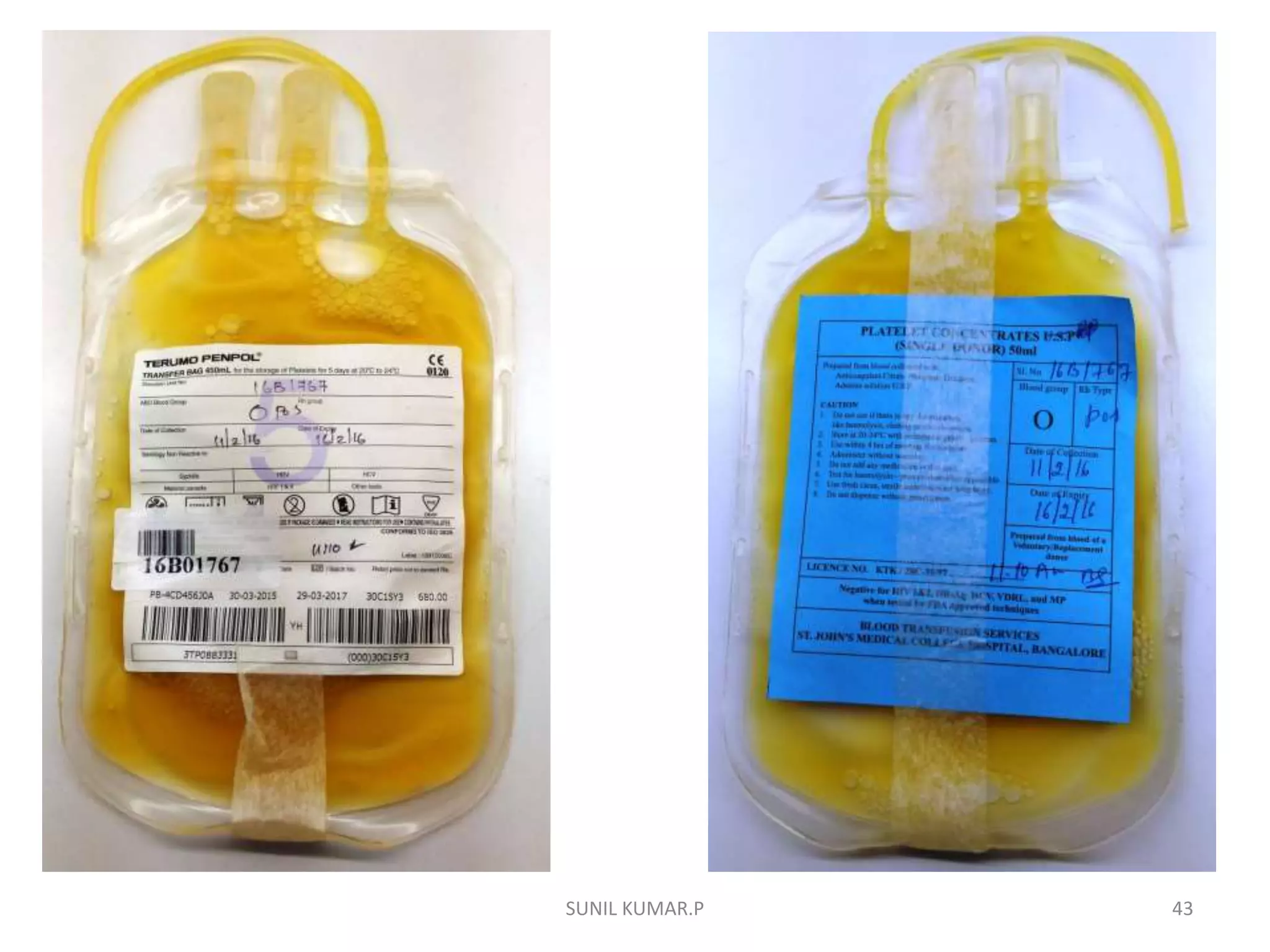
PLATELET CONCENTRATE
• Shelf life:
1 day if no storage cabinet
5 days in platelet incubator and agitator
• Storage temp :20-24 degree celsius
• Q.C Requirements: to be prepared within 6hr
of collection and ph should be >6.2
• volume: 30 to 50 ml
• Contents: 5.5x10¹⁰ unit/bag
41SUNIL KUMAR.P
Indications
 Platelet count is < 5000 / µl regardless of
clinical condition
 Effect: increases platelet count by 10000/ µl
per unit
42SUNIL KUMAR.P
43SUNIL KUMAR.P
PROCEDURE
1. Centrifuge the bag with PRP and another
satellite bag at 20-40°C at ‘heavy spin’ for
appropriate time e.g. 5000xg for 5 minutes.
2. Express supernatant platelet - poor plasma
into another empty satellite bag.
44SUNIL KUMAR.P
SINGLE DONOR PLATELETS
• Obtained by plasmapheresis technique
• 6 to 8 times more platelets as in random
donor unit
• Larger volumes and HLA compatibility results
in increase of 30 to 60 k
• Leucoreduced because of apheresis technique
• ABO Matched platelets preferred
45SUNIL KUMAR.P
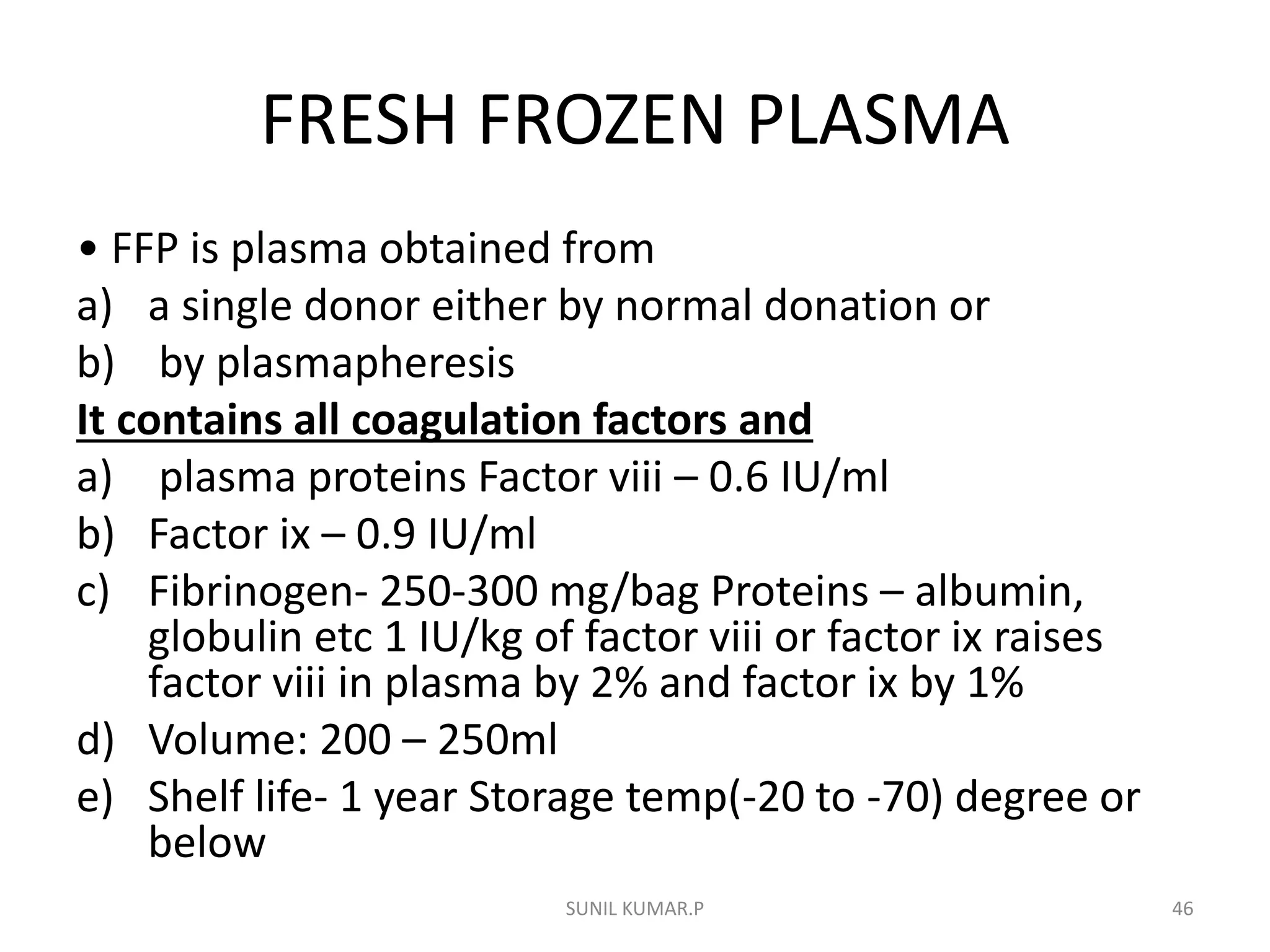
FRESH FROZEN PLASMA
• FFP is plasma obtained from
a) a single donor either by normal donation or
b) by plasmapheresis
It contains all coagulation factors and
a) plasma proteins Factor viii – 0.6 IU/ml
b) Factor ix – 0.9 IU/ml
c) Fibrinogen- 250-300 mg/bag Proteins – albumin,
globulin etc 1 IU/kg of factor viii or factor ix raises
factor viii in plasma by 2% and factor ix by 1%
d) Volume: 200 – 250ml
e) Shelf life- 1 year Storage temp(-20 to -70) degree or
below
46SUNIL KUMAR.P
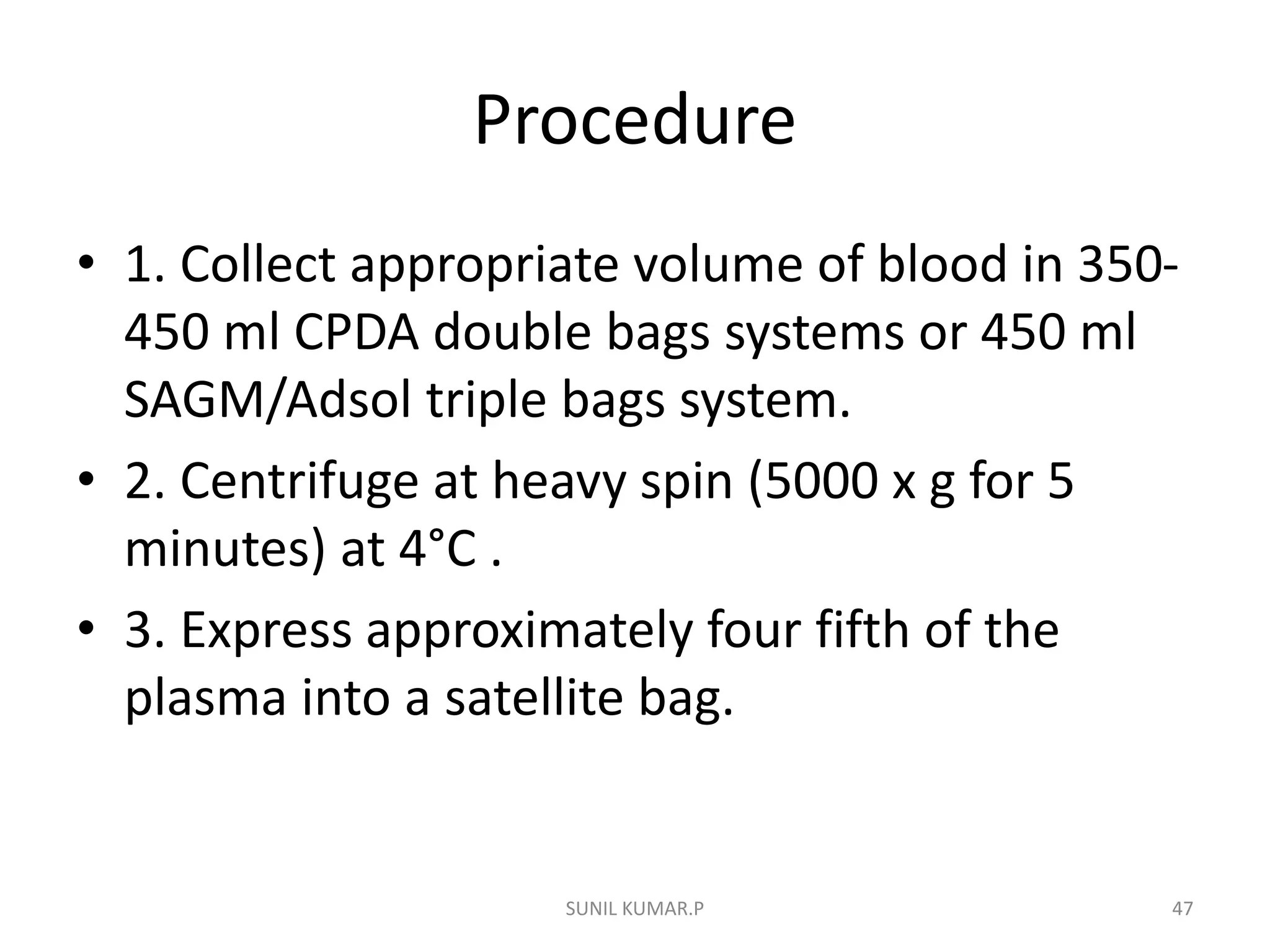
Procedure
• 1. Collect appropriate volume of blood in 350-
450 ml CPDA double bags systems or 450 ml
SAGM/Adsol triple bags system.
• 2. Centrifuge at heavy spin (5000 x g for 5
minutes) at 4°C .
• 3. Express approximately four fifth of the
plasma into a satellite bag.
47SUNIL KUMAR.P
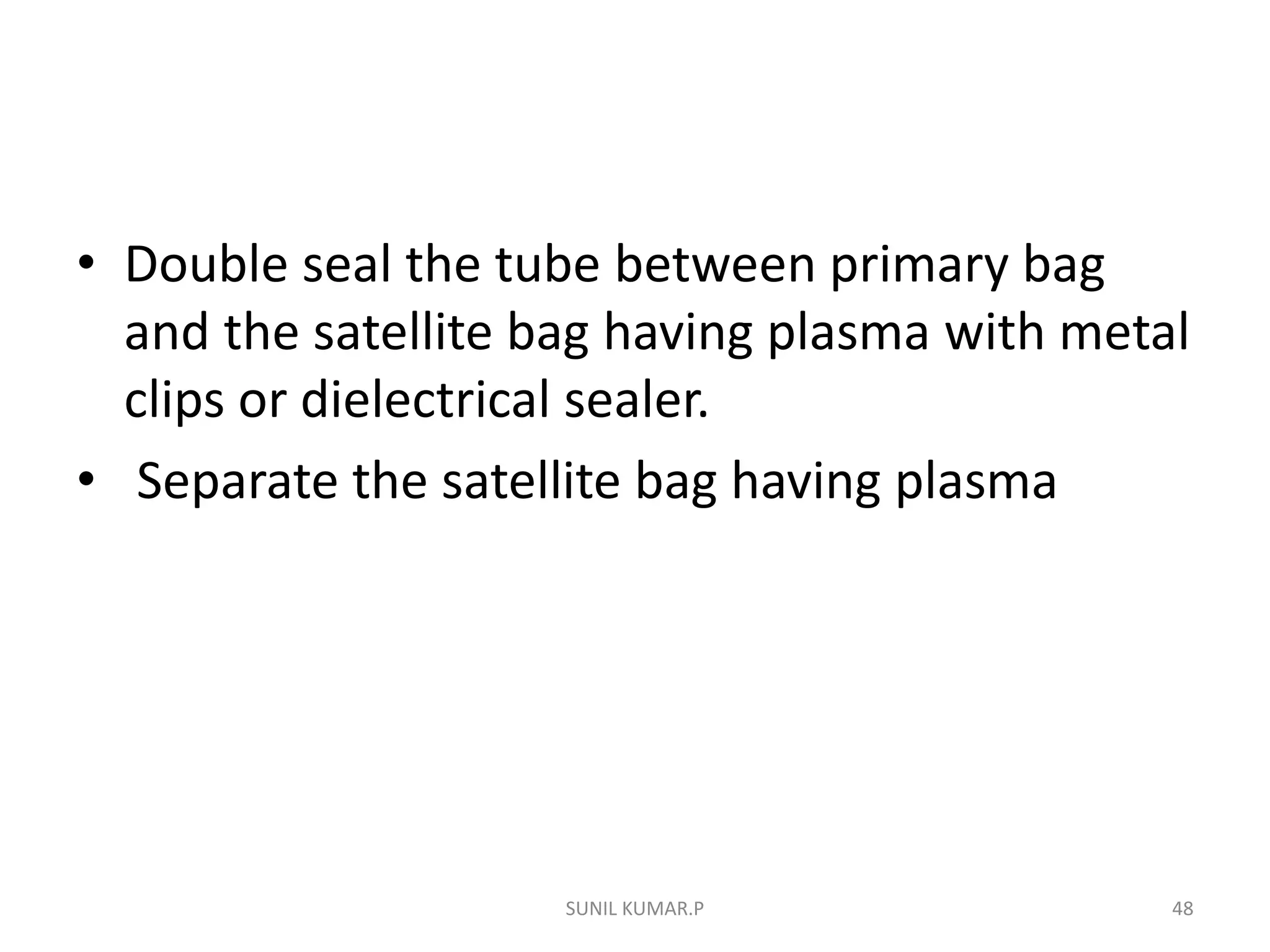
• Double seal the tube between primary bag
and the satellite bag having plasma with metal
clips or dielectrical sealer.
• Separate the satellite bag having plasma
48SUNIL KUMAR.P
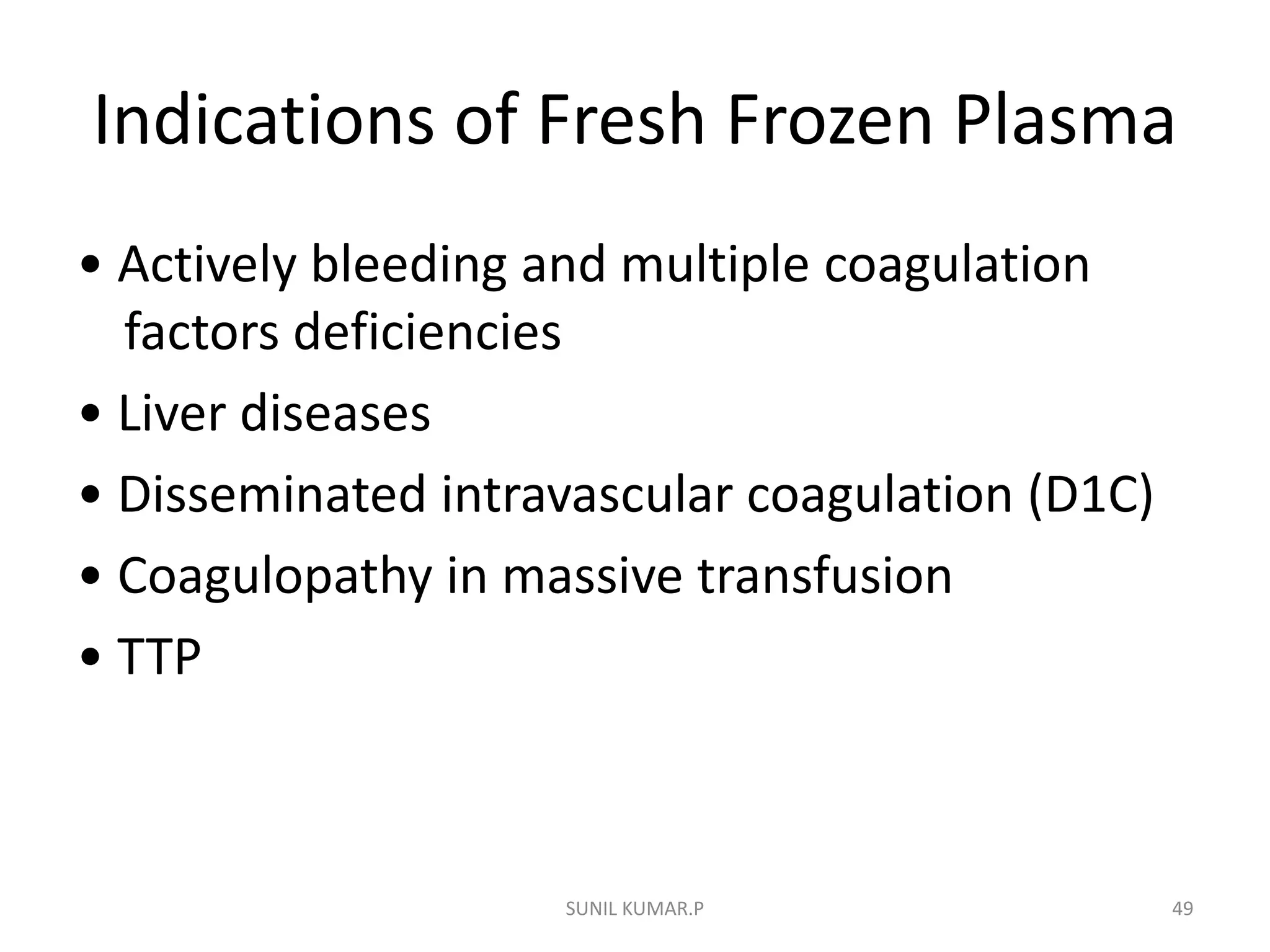
Indications of Fresh Frozen Plasma
• Actively bleeding and multiple coagulation
factors deficiencies
• Liver diseases
• Disseminated intravascular coagulation (D1C)
• Coagulopathy in massive transfusion
• TTP
49SUNIL KUMAR.P
• Antithrombin III deficiency
• Congenital or acquired coagulation factor
deficiency
• Use of FFP in conjunction with red cells has
largely replaced the transfusion of fresh
blood.
• Deficiency of Factors II, VII, IX,, and X
50SUNIL KUMAR.P
51SUNIL KUMAR.P
SINGLE DONOR PLASMA
• Prepared from stored blood
• Poor in coagulation factors
• Cannot be used in correction of coagulation
factor deficiencies
• Effective as a volume expander
52SUNIL KUMAR.P
CRYOPRECIPITATE
• Shelf life: frozen – 1 year
• Thawed : 6 hours
• Storage temp : frozen -20 degree or less
• thawed : 37 degree
• Volume- 10 to 20 ml
53SUNIL KUMAR.P
• Contents –
Factor viii- 80 to 150 units/bag
Fibrinogen- 150 to 250 mg/ bag
Factor xiii- 20 to 30 % of whole blood
Von wilebrand factor- 40 to 70 % of whole blood
• Transfusion criteria :
ABO compatibility not required
Must be infused within 6 hours of thawing
54SUNIL KUMAR.P
INDICATIONS
• Quantitative and qualitative fibrinogen
deficiency : DIC
• Correction of factor viii deficiency
Haemophilia A
• Von wilebrand disease
• Factor XIII deficiency
• Uremic coagulopathy
55SUNIL KUMAR.P
CRYOPRECIPITATE-POOR-PLASMA
• It is a by-product of cryoprecipitate
preparation.
• It lacks labile clotting factors V and Viii and
fibrinogen.
• It contains adequate levels of the stable
clotting factors II, VII, IX and X.
• It is frozen and stored at -20°C or lower
temperature for 5 years Indications
• Burn
56SUNIL KUMAR.P
57SUNIL KUMAR.P
ALBUMIN
• Prepared from a large pool of blood
reconstituted in isotonic electrolyte solution
• 96% albumin and 4% globulin and other
proteins Available as a 5% or 25% solutions
• Half life : 6 hours
• Used for hypovolemia or hypoproteinemia
• Can be given without ABO Compatibility Test
58SUNIL KUMAR.P
59SUNIL KUMAR.P
60SUNIL KUMAR.P
THANK YOU
61SUNIL KUMAR.P

Blood component preparation

  • 1.
    BLOOD COMPONENTS INDICATIONS,PREPARATION OF BLOODCOMPONENTS SUNIL KUMAR.P Department of Haematology St.John’s Medical College Hospital Bangalore 1SUNIL KUMAR.P
  • 2.
    INTRODUCTION • These dayseffective blood transfusion depends upon the availability of different blood components. • These components are used in separately or in combinations, can meet most patients transfusions need and keeping the risk of transfusion to a minimum. 2SUNIL KUMAR.P
  • 3.
    WHY THERE ISNEED FOR COMPONENT SEPARATION • 1. Separation of blood in to components allows optimal survival of each constituents. • 2. component preparation allows transfusing only specific blood component that the patient requires. • 3. Transfusion of only specific constituent of blood needed avoids the use of unnecessary component, which could be contraindicated in a patient 3SUNIL KUMAR.P
  • 4.
    • 4.By usingblood components, several patients can be treated with the blood from one donor, giving the optimal use of every unit of donated blood. • 5. use of blood components, supplements blood supply- adds to the blood inventory 4SUNIL KUMAR.P
  • 5.
    BLOOD COMPONENTS Cellular components: • Red cell concentrate • Leucocytes-Reduced Red cells • Platelet Concentrate • Leukocytes-Reduced Platelet Concentrate • Platelet Apheresis • Granulocytes Apheresis 5SUNIL KUMAR.P
  • 6.
    Plasma components • Freshfrozen plasma • Single donor plasma • Cryoprecipitate • Cryo-poor plasma • Plasma derivatives Albumin 5% & 25% 6SUNIL KUMAR.P
  • 7.
    Plasma Protein Fractions •Factor VIII concentrate Immunoglobulins • Fibrinogen Other coagulation factors 7SUNIL KUMAR.P
  • 8.
    PREPARATION OF BLOOD COMPONENTS •Equipment: • Freezer - 40°C and - 70°C • Blood bank refrigerator 2-6°C • Refrigerated centrifuge with swing out head and oval cups • Laminar flow • Weighing scale • Dielectric sealer or aluminium clips & sealer • Stripper • Water bath 37°C or Plasma Defroster (MicroWave) 8SUNIL KUMAR.P
  • 9.
    • Platelet reciprocator(platelet incubator with agitator) • Cryoprecipitate bath 4°C 9SUNIL KUMAR.P
  • 10.
  • 11.
  • 12.
  • 13.
  • 14.
  • 15.
    Preparation of bloodcomponents is possible due to : • Multiple Plastic packs system • Refrigerated centrifuge • Different specific gravity of cellular components • Red cells specific gravity 1.08 - 1.09 • Platelet specific gravity 1.03 - 1.04 • Plasma specific gravity 1.02 - 1.03 15SUNIL KUMAR.P
  • 16.
  • 17.
    Methods of preparation •There are various methods to separate these components and the yield and quality of component depends upon the methods applied. Various methods used are: • a)Gravity separation • b)Low and high speed centrifugation • c)Apheresis by cell separator 17SUNIL KUMAR.P
  • 18.
    WHOLE BLOOD • 350-450ml of blood • 49-63ml of anticoagulant solution • Hct- 36-44% • No components removed • Stored at 1- 6 degree celsius • Shelf life : • Citrate –phosphate –Dextrose(CPD)- 21days • CPDA (adenine) – 35 days • AS-1, AS-3, AS-5 – 42 days 18SUNIL KUMAR.P
  • 19.
    • Increase Hbby 1 g/dl • Rate of Blood Transfusion -3ml/kg/hr 19SUNIL KUMAR.P
  • 20.
    WHOLE BLOOD Indications •Acute active blood loss with hypovolemia • Exchange transfusion Contradictions Risk of volume overload • chronic anemia • Incipent cardiac failure 20SUNIL KUMAR.P
  • 21.
  • 22.
    WHOLE BLOOD Drawbacks •After storage for 24 hours platelets and wbc are non functional • Factor V and Viii decrease with storage • Fluid overload 22SUNIL KUMAR.P
  • 23.
    Preparation of PackedRBCs Principle • RBCs are obtained by removal of supernatant plasma from centrifuged whole blood Preparation • 1. Collect appropriate volume of donor blood in CPDA double or triple bag. • 2. Store at 2-6C till processed. • 3. Place bags in the buckets of refrigerated centrifuge and balance the opposite bags accurately. • 4. Centrifuge at heavy spin (5000 x g) for 5 minutes at 2-6C. 23SUNIL KUMAR.P
  • 24.
    • 5. Expressapproximately 3/4 of the plasma into the satellite bag. • 6. Double seal the tube between primary and satellite bags with plasma Separate the satellite bag with plasma and keep at -30°C or below. • 7. Keep the red cells at 2-6°C. 24SUNIL KUMAR.P
  • 25.
    Indications • Patient needurgent operation and has Hb < 10g/dl • Anticipated surgical blood loss > 1000 ml • Other acute Loss of blood • Replacement Fluid blood loss < 20% of blood vol. • Anemia associated with incipient/established cardiac failure • Hb value < 6 g/dl • Patients approaching delivery and has Hb value < 7g/dl • In hereditary hemolytic anemias and betathalassaemia major. 25SUNIL KUMAR.P
  • 26.
    Packed RBCs • Shelflife – 35 days • Storage temp- 2 – 6 Degree celsius • QC Requirements: PCV 80% (Range 65-80%) • Volume- 250- 300 ml Contents : • red cells- 65-80%, • Plasma 20- 35%, • Some platelets, • white blood cell and anticoagulant preservative solutions Effect – 1 unit RBC raise Hct by 3% and hb by 1g/dl 26SUNIL KUMAR.P
  • 27.
  • 28.
    Guidelines for Paediatricred cell transfusions Anaemia Infants within first 4 months of life • Hb< 13.0 g/dL and severe pulmonary disease • Hb < 10.0 g/dL and moderate pulmonary disease • Hb< 13.0 g/dL and severe cardiac disease • Hb<10.0 g/dL and major surgery • Hb < 8.0 g/dL and symptomatic anemia • Acute blood loss >10% of total blood volume. 28SUNIL KUMAR.P
  • 29.
    Guidelines for Paediatricred cell transfusions Infants >4 months & children • Acute loss > 25% circulating blood volume • Hb < 8.0 g/dL in perioperative period • Hb < 13.0 g/dL and severe cardiopulmonary disease • Hb < 8.0 g/dL and marrow failure • Hb < 8.0 g/dL and symptomatic chronic anemia 29SUNIL KUMAR.P
  • 30.
    IRRADIATED RED BLOODCELLS • Gamma radiated to kill the lymphocytes • The lack of T cells prevents graft versus host reaction Indications: • Severely imunocompromised patients • Lymphoma patients • Stem cell/marrow transplants • Intrauterine transfusion • Neonates undergoing exchange transfusion • Hodgkin Disease 30SUNIL KUMAR.P
  • 31.
    LEUCOCYTE REDUCED RBCS Methodsof the preparation of Leucocyte- Reduced Red cells • Centrifugation and removing of buffy coat • Filtration • Washing of red cells with saline • Freezing and thawing of red cells 31SUNIL KUMAR.P
  • 32.
  • 33.
    LEUCOCYTE REDUCED RBCS INDICATIONS •Multi transfused patients like thalasemia • Leukemia • Aplastic anemia • Immunosupressed • Immunodeficient • Prevention of recurrent FNHTRs • Prevention or delay of primary alloimmunization to HLA antigen • Prevention of CMV transmission in at risk individual 33SUNIL KUMAR.P
  • 34.
    FROZEN/DEGLYCEROLIZED RED CELLS Indications •The provision of rare blood lacking common antigens for patients with corresponding antibodies. • Autologous units of patients with multiple red cells alloantibodies stored for future surgery. • IgA deficient patient with antibodies to IgA • It can be used to prevent Febrile non hemolytic transfusion reactions( FNHTRs ) 34SUNIL KUMAR.P
  • 35.
    GRANULOCYTE CONCENTRATE • Obtainedby apheresis from family members for administration in cancer patients • Contains 109granulocyte • Pretreatment with recombinant G-CSF and dexamethasone can yield 4-8x 10⁸granulocyte • Stored at 24 degree celsius • Infuse within 24 hours of collection 35SUNIL KUMAR.P
  • 36.
    GRANULOCYTE CONCENTRATE • Granulocyteconcentrate can be prepared by • 1. Single donor unit • 2. Leukapheresis by blood cells separator 36SUNIL KUMAR.P
  • 37.
    INDICATIONS The role ofgranulocytes transfusion has decreased with • The availability of new and better antibiotics • The advent of recombinant granulopoeitic growth factors e.g. granulocyte stimulating factor . 37SUNIL KUMAR.P
  • 38.
    Adverse effects ofgranulocytes transfusion •However the granulocytes transfusion are still used at times with success in the following conditions: • Septicemia not responding to antibiotics.. • Neutrophil count less than 0.50 x 10⁹/L (500 / mm3), having gram-negative infection which fail to respond with antibiotics 38SUNIL KUMAR.P
  • 39.
    • Temporary bonemarrow depression for 1 - 2 weeks • Infections in patients undergoing chemo / radio therapy for neoplastic diseases 39SUNIL KUMAR.P
  • 40.
    PLATELET RICH PLASMA(PRP) Procedure: • 1. Collect 450 ml blood by a clean, single venipunctuer into 450 ml CPDA or Adsol / SAGM triple bags system. • 2. Keep the blood bag at room temperature (20-22°C) before preparing platelets, for not more than 6 hours. Do not chill at any time before or during platelet separation. • 3. Centrifuge the blood bags at 20-24°C at light spin for appropriate time (2000 x g for 3 minutes). • 4. Separate 4/5 of the platelet rich plasma (PRP) into one satellite bag 40SUNIL KUMAR.P
  • 41.
    PLATELET CONCENTRATE • Shelflife: 1 day if no storage cabinet 5 days in platelet incubator and agitator • Storage temp :20-24 degree celsius • Q.C Requirements: to be prepared within 6hr of collection and ph should be >6.2 • volume: 30 to 50 ml • Contents: 5.5x10¹⁰ unit/bag 41SUNIL KUMAR.P
  • 42.
    Indications  Platelet countis < 5000 / µl regardless of clinical condition  Effect: increases platelet count by 10000/ µl per unit 42SUNIL KUMAR.P
  • 43.
  • 44.
    PROCEDURE 1. Centrifuge thebag with PRP and another satellite bag at 20-40°C at ‘heavy spin’ for appropriate time e.g. 5000xg for 5 minutes. 2. Express supernatant platelet - poor plasma into another empty satellite bag. 44SUNIL KUMAR.P
  • 45.
    SINGLE DONOR PLATELETS •Obtained by plasmapheresis technique • 6 to 8 times more platelets as in random donor unit • Larger volumes and HLA compatibility results in increase of 30 to 60 k • Leucoreduced because of apheresis technique • ABO Matched platelets preferred 45SUNIL KUMAR.P
  • 46.
    FRESH FROZEN PLASMA •FFP is plasma obtained from a) a single donor either by normal donation or b) by plasmapheresis It contains all coagulation factors and a) plasma proteins Factor viii – 0.6 IU/ml b) Factor ix – 0.9 IU/ml c) Fibrinogen- 250-300 mg/bag Proteins – albumin, globulin etc 1 IU/kg of factor viii or factor ix raises factor viii in plasma by 2% and factor ix by 1% d) Volume: 200 – 250ml e) Shelf life- 1 year Storage temp(-20 to -70) degree or below 46SUNIL KUMAR.P
  • 47.
    Procedure • 1. Collectappropriate volume of blood in 350- 450 ml CPDA double bags systems or 450 ml SAGM/Adsol triple bags system. • 2. Centrifuge at heavy spin (5000 x g for 5 minutes) at 4°C . • 3. Express approximately four fifth of the plasma into a satellite bag. 47SUNIL KUMAR.P
  • 48.
    • Double sealthe tube between primary bag and the satellite bag having plasma with metal clips or dielectrical sealer. • Separate the satellite bag having plasma 48SUNIL KUMAR.P
  • 49.
    Indications of FreshFrozen Plasma • Actively bleeding and multiple coagulation factors deficiencies • Liver diseases • Disseminated intravascular coagulation (D1C) • Coagulopathy in massive transfusion • TTP 49SUNIL KUMAR.P
  • 50.
    • Antithrombin IIIdeficiency • Congenital or acquired coagulation factor deficiency • Use of FFP in conjunction with red cells has largely replaced the transfusion of fresh blood. • Deficiency of Factors II, VII, IX,, and X 50SUNIL KUMAR.P
  • 51.
  • 52.
    SINGLE DONOR PLASMA •Prepared from stored blood • Poor in coagulation factors • Cannot be used in correction of coagulation factor deficiencies • Effective as a volume expander 52SUNIL KUMAR.P
  • 53.
    CRYOPRECIPITATE • Shelf life:frozen – 1 year • Thawed : 6 hours • Storage temp : frozen -20 degree or less • thawed : 37 degree • Volume- 10 to 20 ml 53SUNIL KUMAR.P
  • 54.
    • Contents – Factorviii- 80 to 150 units/bag Fibrinogen- 150 to 250 mg/ bag Factor xiii- 20 to 30 % of whole blood Von wilebrand factor- 40 to 70 % of whole blood • Transfusion criteria : ABO compatibility not required Must be infused within 6 hours of thawing 54SUNIL KUMAR.P
  • 55.
    INDICATIONS • Quantitative andqualitative fibrinogen deficiency : DIC • Correction of factor viii deficiency Haemophilia A • Von wilebrand disease • Factor XIII deficiency • Uremic coagulopathy 55SUNIL KUMAR.P
  • 56.
    CRYOPRECIPITATE-POOR-PLASMA • It isa by-product of cryoprecipitate preparation. • It lacks labile clotting factors V and Viii and fibrinogen. • It contains adequate levels of the stable clotting factors II, VII, IX and X. • It is frozen and stored at -20°C or lower temperature for 5 years Indications • Burn 56SUNIL KUMAR.P
  • 57.
  • 58.
    ALBUMIN • Prepared froma large pool of blood reconstituted in isotonic electrolyte solution • 96% albumin and 4% globulin and other proteins Available as a 5% or 25% solutions • Half life : 6 hours • Used for hypovolemia or hypoproteinemia • Can be given without ABO Compatibility Test 58SUNIL KUMAR.P
  • 59.
  • 60.
  • 61.