copyright cmassengale 1
 DNA contains genes,
sequences of nucleotide
bases
 These Genes code for
polypeptides (proteins)
 Proteins are used to build
cells and do much of the
work inside cells
copyright cmassengale 2
 Proteins are made of
amino acids linked
together by peptide
bonds
 20 different amino acids
exist
copyright cmassengale 3
copyright cmassengale 4
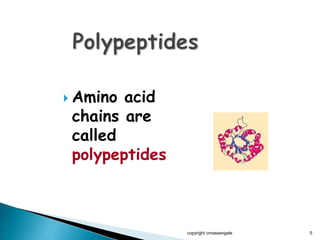
 Amino acid
chains are
called
polypeptides
copyright cmassengale 5
 DNA is found inside the nucleus
 Proteins, however, are made in the
cytoplasm of cells by organelles called
ribosomes
 Ribosomes may be free in the cytosol or
attached to the surface of rough ER
copyright cmassengale 6
 DNA ‘s code must be copied
and taken to the cytosol
 In the cytoplasm, this code
must be read so amino acids
can be assembled to make
polypeptides (proteins)
 This process is called
PROTEIN SYNTHESIS
copyright cmassengale 7
 DNA is the MASTER
PLAN
 RNA is the
BLUEPRINT of the
Master Plan
copyright cmassengale 8
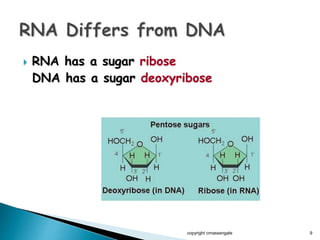
 RNA has a sugar ribose
DNA has a sugar deoxyribose
copyright cmassengale 9
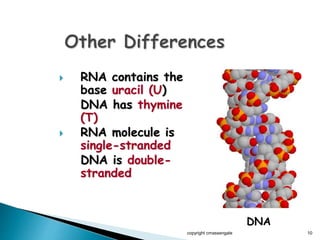
 RNA contains the
base uracil (U)
DNA has thymine
(T)
 RNA molecule is
single-stranded
DNA is double-
stranded
copyright cmassengale 10
DNA
copyright cmassengale 11
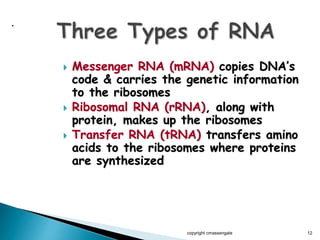
 Messenger RNA (mRNA) copies DNA’s
code & carries the genetic information
to the ribosomes
 Ribosomal RNA (rRNA), along with
protein, makes up the ribosomes
 Transfer RNA (tRNA) transfers amino
acids to the ribosomes where proteins
are synthesized
copyright cmassengale 12
.
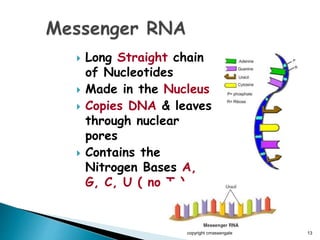
 Long Straight chain
of Nucleotides
 Made in the Nucleus
 Copies DNA & leaves
through nuclear
pores
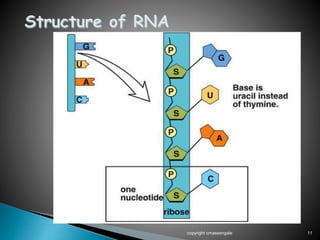
 Contains the
Nitrogen Bases A,
G, C, U ( no T )
copyright cmassengale 13
 Carries the information for a
specific protein
 Made up of 500 to 1000 nucleotides
long
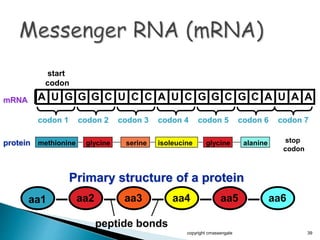
 Sequence of 3 bases called codon
 AUG – methionine or start codon
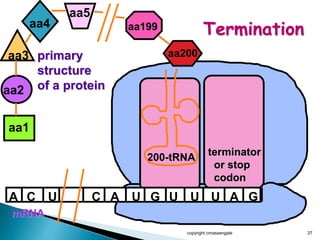
 UAA, UAG, or UGA – stop codons
copyright cmassengale 14
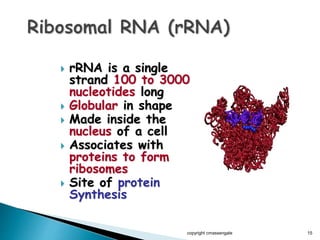
 rRNA is a single
strand 100 to 3000
nucleotides long
 Globular in shape
 Made inside the
nucleus of a cell
 Associates with
proteins to form
ribosomes
 Site of protein
Synthesis
copyright cmassengale 15
 A codon designates an amino acid
 An amino acid may have more than one codon
 There are 20 amino acids, but 64 possible
codons
 Some codons tell the ribosome to stop
translating
copyright cmassengale 16
copyright cmassengale 17
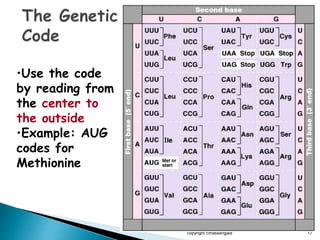
•Use the code
by reading from
the center to
the outside
•Example: AUG
codes for
Methionine
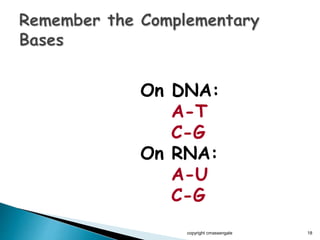
On DNA:
A-T
C-G
On RNA:
A-U
C-G
copyright cmassengale 18
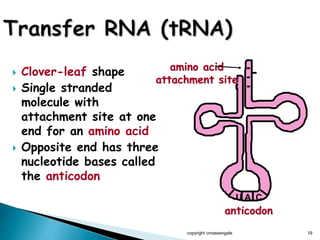
 Clover-leaf shape
 Single stranded
molecule with
attachment site at one
end for an amino acid
 Opposite end has three
nucleotide bases called
the anticodon
copyright cmassengale 19
amino acid
attachment site
U A C
anticodon
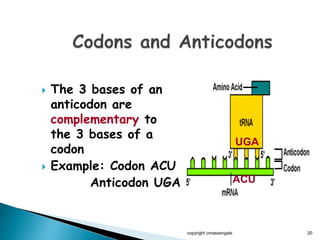
 The 3 bases of an
anticodon are
complementary to
the 3 bases of a
codon
 Example: Codon ACU
Anticodon UGA
copyright cmassengale 20
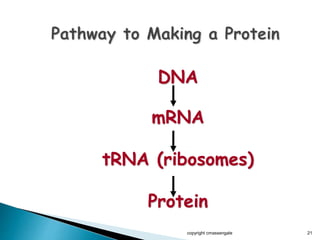
UGA
ACU
DNA
mRNA
tRNA (ribosomes)
Protein
copyright cmassengale 21
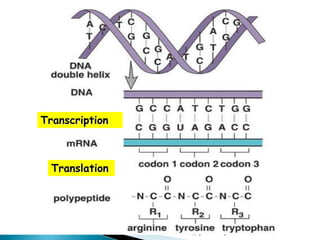
 The production or synthesis of
polypeptide chains (proteins)
 Two phases:
Transcription & Translation
 mRNA must be processed
before it leaves the nucleus of
eukaryotic cells
copyright cmassengale 22
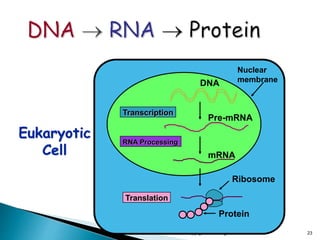
copyright cmassengale 23
Nuclear
membrane
Transcription
RNA Processing
Translation
DNA
Pre-mRNA
mRNA
Ribosome
Protein
Eukaryotic
Cell
 Translation is the process of
decoding the mRNA into a
polypeptide chain
 Ribosomes read mRNA three
bases or 1 codon at a time and
construct the proteins
copyright cmassengale 24
copyright cmassengale 25
Transcription
Translation
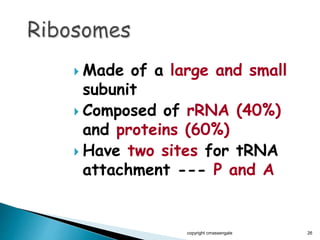
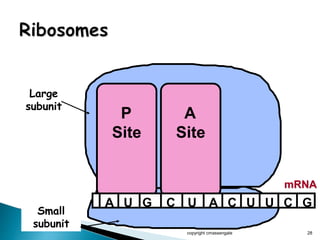
 Made of a large and small
subunit
 Composed of rRNA (40%)
and proteins (60%)
 Have two sites for tRNA
attachment --- P and A
copyright cmassengale 26
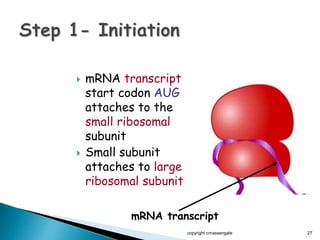
 mRNA transcript
start codon AUG
attaches to the
small ribosomal
subunit
 Small subunit
attaches to large
ribosomal subunit
copyright cmassengale 27
mRNA transcript
copyright cmassengale 28
P
Site
A
Site
Large
subunit
Small
subunit
mRNA
A U G C U A C U U C G
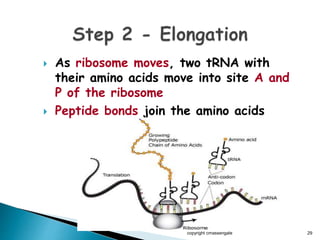
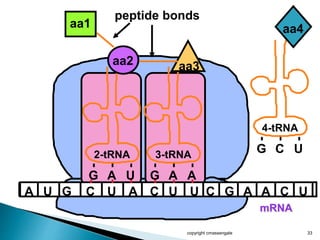
 As ribosome moves, two tRNA with
their amino acids move into site A and
P of the ribosome
 Peptide bonds join the amino acids
copyright cmassengale 29
copyright cmassengale 30
mRNA
A U G C U A C U U C G
2-tRNA
G
aa2
A U
A
1-tRNA
U A C
aa1
anticodon
hydrogen
bonds codon
copyright cmassengale 31
mRNA
A U G C U A C U U C G
1-tRNA 2-tRNA
U A C G
aa1 aa2
A U
A
anticodon
hydrogen
bonds codon
peptide bond
3-tRNA
G A A
aa3
Elongation
copyright cmassengale 32
mRNA
A U G C U A C U U C G
1-tRNA
2-tRNA
U A C
G
aa1
aa2
A U
A
peptide bond
3-tRNA
G A A
aa3
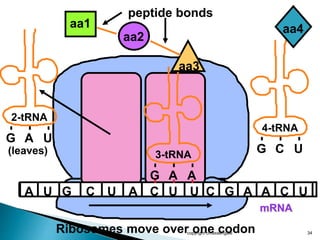
Ribosomes move over one codon
(leaves)
copyright cmassengale 33
mRNA
A U G C U A C U U C G
2-tRNA
G
aa1
aa2
A U
A
peptide bonds
3-tRNA
G A A
aa3
4-tRNA
G C U
aa4
A C U
copyright cmassengale 34
mRNA
A U G C U A C U U C G
2-tRNA
G
aa1
aa2
A U
A
peptide bonds
3-tRNA
G A A
aa3
4-tRNA
G C U
aa4
A C U
(leaves)
Ribosomes move over one codon
copyright cmassengale 35
mRNA
G C U A C U U C G
aa1
aa2
A
peptide bonds
3-tRNA
G A A
aa3
4-tRNA
G C U
aa4
A C U
U G A
5-tRNA
aa5
copyright cmassengale 36
mRNA
G C U A C U U C G
aa1
aa2
A
peptide bonds
3-tRNA
G A A
aa3
4-tRNA
G C U
aa4
A C U
U G A
5-tRNA
aa5
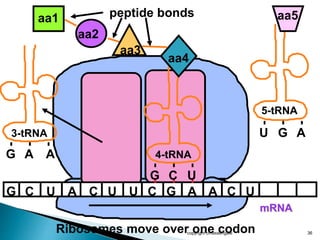
Ribosomes move over one codon
copyright cmassengale 37
mRNA
A C A U G U
aa1
aa2
U
primary
structure
of a protein
aa3
200-tRNA
aa4
U A G
aa5
C U
aa200
aa199
terminator
or stop
codon
Termination
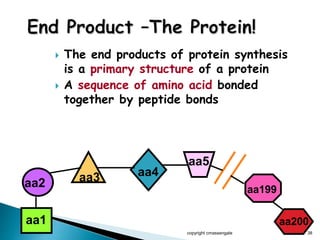
 The end products of protein synthesis
is a primary structure of a protein
 A sequence of amino acid bonded
together by peptide bonds
copyright cmassengale 38
aa1
aa2 aa3 aa4
aa5
aa200
aa199
copyright cmassengale 39
methionine glycine serine isoleucine glycine alanine stop
codon
protein
A U G G G C U C C A U C G G C G C A U A AmRNA
start
codon
Primary structure of a protein
aa1 aa2 aa3 aa4 aa5 aa6
peptide bonds
codon 2 codon 3 codon 4 codon 5 codon 6 codon 7codon 1

Protein synthesis

  • 1.
  • 2.
     DNA containsgenes, sequences of nucleotide bases  These Genes code for polypeptides (proteins)  Proteins are used to build cells and do much of the work inside cells copyright cmassengale 2
  • 3.
     Proteins aremade of amino acids linked together by peptide bonds  20 different amino acids exist copyright cmassengale 3
  • 4.
  • 5.
     Amino acid chainsare called polypeptides copyright cmassengale 5
  • 6.
     DNA isfound inside the nucleus  Proteins, however, are made in the cytoplasm of cells by organelles called ribosomes  Ribosomes may be free in the cytosol or attached to the surface of rough ER copyright cmassengale 6
  • 7.
     DNA ‘scode must be copied and taken to the cytosol  In the cytoplasm, this code must be read so amino acids can be assembled to make polypeptides (proteins)  This process is called PROTEIN SYNTHESIS copyright cmassengale 7
  • 8.
     DNA isthe MASTER PLAN  RNA is the BLUEPRINT of the Master Plan copyright cmassengale 8
  • 9.
     RNA hasa sugar ribose DNA has a sugar deoxyribose copyright cmassengale 9
  • 10.
     RNA containsthe base uracil (U) DNA has thymine (T)  RNA molecule is single-stranded DNA is double- stranded copyright cmassengale 10 DNA
  • 11.
  • 12.
     Messenger RNA(mRNA) copies DNA’s code & carries the genetic information to the ribosomes  Ribosomal RNA (rRNA), along with protein, makes up the ribosomes  Transfer RNA (tRNA) transfers amino acids to the ribosomes where proteins are synthesized copyright cmassengale 12 .
  • 13.
     Long Straightchain of Nucleotides  Made in the Nucleus  Copies DNA & leaves through nuclear pores  Contains the Nitrogen Bases A, G, C, U ( no T ) copyright cmassengale 13
  • 14.
     Carries theinformation for a specific protein  Made up of 500 to 1000 nucleotides long  Sequence of 3 bases called codon  AUG – methionine or start codon  UAA, UAG, or UGA – stop codons copyright cmassengale 14
  • 15.
     rRNA isa single strand 100 to 3000 nucleotides long  Globular in shape  Made inside the nucleus of a cell  Associates with proteins to form ribosomes  Site of protein Synthesis copyright cmassengale 15
  • 16.
     A codondesignates an amino acid  An amino acid may have more than one codon  There are 20 amino acids, but 64 possible codons  Some codons tell the ribosome to stop translating copyright cmassengale 16
  • 17.
    copyright cmassengale 17 •Usethe code by reading from the center to the outside •Example: AUG codes for Methionine
  • 18.
  • 19.
     Clover-leaf shape Single stranded molecule with attachment site at one end for an amino acid  Opposite end has three nucleotide bases called the anticodon copyright cmassengale 19 amino acid attachment site U A C anticodon
  • 20.
     The 3bases of an anticodon are complementary to the 3 bases of a codon  Example: Codon ACU Anticodon UGA copyright cmassengale 20 UGA ACU
  • 21.
  • 22.
     The productionor synthesis of polypeptide chains (proteins)  Two phases: Transcription & Translation  mRNA must be processed before it leaves the nucleus of eukaryotic cells copyright cmassengale 22
  • 23.
    copyright cmassengale 23 Nuclear membrane Transcription RNAProcessing Translation DNA Pre-mRNA mRNA Ribosome Protein Eukaryotic Cell
  • 24.
     Translation isthe process of decoding the mRNA into a polypeptide chain  Ribosomes read mRNA three bases or 1 codon at a time and construct the proteins copyright cmassengale 24
  • 25.
  • 26.
     Made ofa large and small subunit  Composed of rRNA (40%) and proteins (60%)  Have two sites for tRNA attachment --- P and A copyright cmassengale 26
  • 27.
     mRNA transcript startcodon AUG attaches to the small ribosomal subunit  Small subunit attaches to large ribosomal subunit copyright cmassengale 27 mRNA transcript
  • 28.
  • 29.
     As ribosomemoves, two tRNA with their amino acids move into site A and P of the ribosome  Peptide bonds join the amino acids copyright cmassengale 29
  • 30.
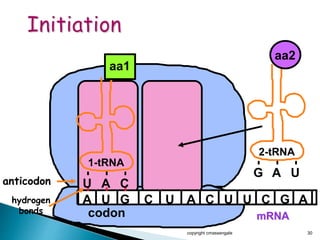
    copyright cmassengale 30 mRNA AU G C U A C U U C G 2-tRNA G aa2 A U A 1-tRNA U A C aa1 anticodon hydrogen bonds codon
  • 31.
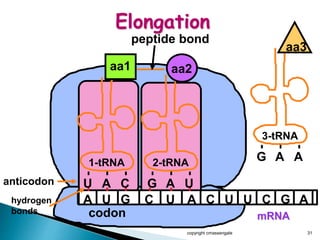
    copyright cmassengale 31 mRNA AU G C U A C U U C G 1-tRNA 2-tRNA U A C G aa1 aa2 A U A anticodon hydrogen bonds codon peptide bond 3-tRNA G A A aa3 Elongation
  • 32.
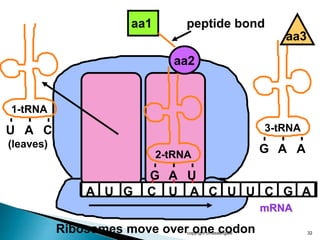
    copyright cmassengale 32 mRNA AU G C U A C U U C G 1-tRNA 2-tRNA U A C G aa1 aa2 A U A peptide bond 3-tRNA G A A aa3 Ribosomes move over one codon (leaves)
  • 33.
    copyright cmassengale 33 mRNA AU G C U A C U U C G 2-tRNA G aa1 aa2 A U A peptide bonds 3-tRNA G A A aa3 4-tRNA G C U aa4 A C U
  • 34.
    copyright cmassengale 34 mRNA AU G C U A C U U C G 2-tRNA G aa1 aa2 A U A peptide bonds 3-tRNA G A A aa3 4-tRNA G C U aa4 A C U (leaves) Ribosomes move over one codon
  • 35.
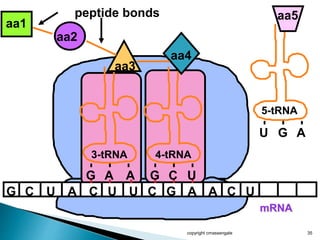
    copyright cmassengale 35 mRNA GC U A C U U C G aa1 aa2 A peptide bonds 3-tRNA G A A aa3 4-tRNA G C U aa4 A C U U G A 5-tRNA aa5
  • 36.
    copyright cmassengale 36 mRNA GC U A C U U C G aa1 aa2 A peptide bonds 3-tRNA G A A aa3 4-tRNA G C U aa4 A C U U G A 5-tRNA aa5 Ribosomes move over one codon
  • 37.
    copyright cmassengale 37 mRNA AC A U G U aa1 aa2 U primary structure of a protein aa3 200-tRNA aa4 U A G aa5 C U aa200 aa199 terminator or stop codon Termination
  • 38.
     The endproducts of protein synthesis is a primary structure of a protein  A sequence of amino acid bonded together by peptide bonds copyright cmassengale 38 aa1 aa2 aa3 aa4 aa5 aa200 aa199
  • 39.
    copyright cmassengale 39 methionineglycine serine isoleucine glycine alanine stop codon protein A U G G G C U C C A U C G G C G C A U A AmRNA start codon Primary structure of a protein aa1 aa2 aa3 aa4 aa5 aa6 peptide bonds codon 2 codon 3 codon 4 codon 5 codon 6 codon 7codon 1