
Protein Synthesis
By Souvik Biswas
M.Pharm (Pharmacology), 1st Year, 2nd Sem
INTRODUCTION OF PROTEIN SYNTHESIS
• The information content of DNA is in the form of
specific sequences of nucleotides along the DNA
strands.
• The DNA inherited by an organism leads to
specific traits by dictating the synthesis of
proteins.
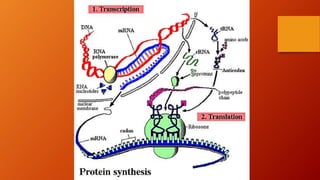
• The process by which DNA directs protein
synthesis, gene expression includes two stages,
called transcription and translation.
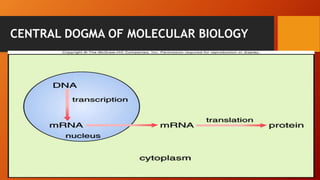
CENTRAL DOGMA OF MOLECULAR BIOLOGY
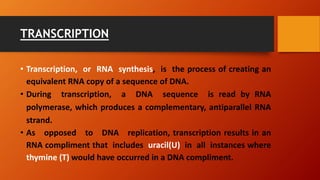
TRANSCRIPTION
• Transcription, or RNA synthesis, is the process of creating an
equivalent RNA copy of a sequence of DNA.
• During transcription, a DNA sequence is read by RNA
polymerase, which produces a complementary, antiparallel RNA
strand.
• As opposed to DNA replication, transcription results in an
RNA compliment that includes uracil(U) in all instances where
thymine (T) would have occurred in a DNA compliment.
CONTD…
• Transcription is the first step leading to gene expression.
• The stretch of DNA transcribed into an RNA molecule is
called a transcription unit and encodes at least one gene.
• If the gene transcribed encodes for a protein, the result of
transcription is messenger RNA (mRNA), which will then
be used to create that protein via the process of
translation.
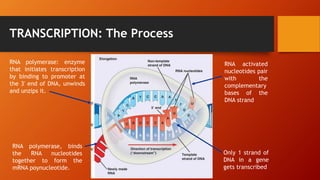
TRANSCRIPTION: The Process
RNA polymerase: enzyme
that initiates transcription
by binding to promoter at
the 3' end of DNA, unwinds
and unzips it.
RNA polymerase, binds
the RNA nucleotides
together to form the
mRNA poynucleotide.
RNA activated
nucleotides pair
with the
complementary
bases of the
DNA strand
Only 1 strand of
DNA in a gene
gets transcribed
TYPES OF TRANSCRIPTION
• Transcription is divided into 3 stages:
1. Initiation
2. Elongation
3. Termination
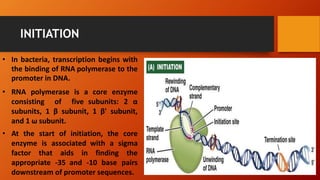
INITIATION
• In bacteria, transcription begins with
the binding of RNA polymerase to the
promoter in DNA.
• RNA polymerase is a core enzyme
consisting of five subunits: 2 α
subunits, 1 β subunit, 1 β' subunit,
and 1 ω subunit.
• At the start of initiation, the core
enzyme is associated with a sigma
factor that aids in finding the
appropriate -35 and -10 base pairs
downstream of promoter sequences.
ELONGATION
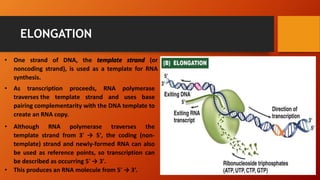
• One strand of DNA, the template strand (or
noncoding strand), is used as a template for RNA
synthesis.
• As transcription proceeds, RNA polymerase
traverses the template strand and uses base
pairing complementarity with the DNA template to
create an RNA copy.
• Although RNA polymerase traverses the
template strand from 3' → 5', the coding (non-
template) strand and newly-formed RNA can also
be used as reference points, so transcription can
be described as occurring 5' → 3'.
• This produces an RNA molecule from 5' → 3‘.
TERMINATION
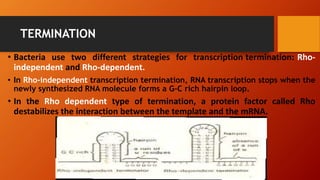
• Bacteria use two different strategies for transcription termination: Rho-
independent and Rho-dependent.
• In Rho-independent transcription termination, RNA transcription stops when the
newly synthesized RNA molecule forms a G-C rich hairpin loop.
• In the Rho dependent type of termination, a protein factor called Rho
destabilizes the interaction between the template and the mRNA.
TRANSLATION
• Translation is the first stage of protein
biosynthesis (part of the overall process of
gene expression).
• Translation is the production of proteins by
decoding mRNA produced in transcription.
• It occurs in the cytoplasm where the
ribosomes are located.
• Ribosomes are made of a small and large
subunit which surrounds them RNA.
CONTD…
• In translation, messenger RNA (mRNA) is
decoded to produce a specific polypeptide
according to the rules specified by the genetic
code.
• This uses an mRNA sequence as a template to
guide the synthesis of a chain of amino acid
that form a protein.
CONTD…
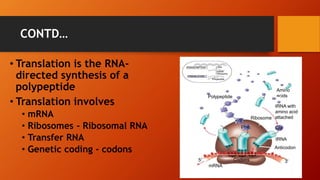
• Translation is the RNA-
directed synthesis of a
polypeptide
• Translation involves
• mRNA
• Ribosomes - Ribosomal RNA
• Transfer RNA
• Genetic coding - codons
TRANSCRIPTION
TRANSLATION
DNA
mRNA
Ribosome
Polypeptide
Polypeptide
Amino
acids
tRNA with
amino acid
attachedRibosome
tRNA
Anticodon
mRNA
Gly
A A A
U G G U U U G G C
Codons5 3
CONTD…
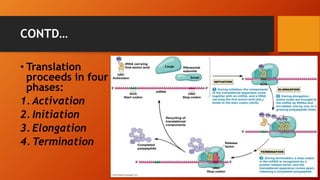
• Translation
proceeds in four
phases:
1. Activation
2. Initiation
3. Elongation
4. Termination
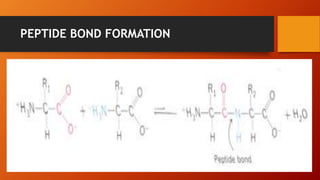
PEPTIDE BOND FORMATION
REFERENCES
• http://www.proteinsynthesis.org/what-is-protein-
synthesis/
• http://www.austincc.edu/rfofi/BIO1308/BIO1308ppt/130
8ProteinSynthesis.ppt
• http://www.dpcdsb.org/NR/rdonlyres/7524E2B1-62BE-
4AC5-BF57-23BE0A91F922/136699/Proteinssynthesis3.ppt
• https://msu.edu/~hostete1/Translation%20(Protein%20Sy
nthesis)ls.ppt
Protein Synthesis

Protein Synthesis

  • 1.
    Protein Synthesis By SouvikBiswas M.Pharm (Pharmacology), 1st Year, 2nd Sem
  • 2.
    INTRODUCTION OF PROTEINSYNTHESIS • The information content of DNA is in the form of specific sequences of nucleotides along the DNA strands. • The DNA inherited by an organism leads to specific traits by dictating the synthesis of proteins. • The process by which DNA directs protein synthesis, gene expression includes two stages, called transcription and translation.
  • 3.
    CENTRAL DOGMA OFMOLECULAR BIOLOGY
  • 4.
    TRANSCRIPTION • Transcription, orRNA synthesis, is the process of creating an equivalent RNA copy of a sequence of DNA. • During transcription, a DNA sequence is read by RNA polymerase, which produces a complementary, antiparallel RNA strand. • As opposed to DNA replication, transcription results in an RNA compliment that includes uracil(U) in all instances where thymine (T) would have occurred in a DNA compliment.
  • 5.
    CONTD… • Transcription isthe first step leading to gene expression. • The stretch of DNA transcribed into an RNA molecule is called a transcription unit and encodes at least one gene. • If the gene transcribed encodes for a protein, the result of transcription is messenger RNA (mRNA), which will then be used to create that protein via the process of translation.
  • 6.
    TRANSCRIPTION: The Process RNApolymerase: enzyme that initiates transcription by binding to promoter at the 3' end of DNA, unwinds and unzips it. RNA polymerase, binds the RNA nucleotides together to form the mRNA poynucleotide. RNA activated nucleotides pair with the complementary bases of the DNA strand Only 1 strand of DNA in a gene gets transcribed
  • 7.
    TYPES OF TRANSCRIPTION •Transcription is divided into 3 stages: 1. Initiation 2. Elongation 3. Termination
  • 8.
    INITIATION • In bacteria,transcription begins with the binding of RNA polymerase to the promoter in DNA. • RNA polymerase is a core enzyme consisting of five subunits: 2 α subunits, 1 β subunit, 1 β' subunit, and 1 ω subunit. • At the start of initiation, the core enzyme is associated with a sigma factor that aids in finding the appropriate -35 and -10 base pairs downstream of promoter sequences.
  • 9.
    ELONGATION • One strandof DNA, the template strand (or noncoding strand), is used as a template for RNA synthesis. • As transcription proceeds, RNA polymerase traverses the template strand and uses base pairing complementarity with the DNA template to create an RNA copy. • Although RNA polymerase traverses the template strand from 3' → 5', the coding (non- template) strand and newly-formed RNA can also be used as reference points, so transcription can be described as occurring 5' → 3'. • This produces an RNA molecule from 5' → 3‘.
  • 10.
    TERMINATION • Bacteria usetwo different strategies for transcription termination: Rho- independent and Rho-dependent. • In Rho-independent transcription termination, RNA transcription stops when the newly synthesized RNA molecule forms a G-C rich hairpin loop. • In the Rho dependent type of termination, a protein factor called Rho destabilizes the interaction between the template and the mRNA.
  • 11.
    TRANSLATION • Translation isthe first stage of protein biosynthesis (part of the overall process of gene expression). • Translation is the production of proteins by decoding mRNA produced in transcription. • It occurs in the cytoplasm where the ribosomes are located. • Ribosomes are made of a small and large subunit which surrounds them RNA.
  • 12.
    CONTD… • In translation,messenger RNA (mRNA) is decoded to produce a specific polypeptide according to the rules specified by the genetic code. • This uses an mRNA sequence as a template to guide the synthesis of a chain of amino acid that form a protein.
  • 13.
    CONTD… • Translation isthe RNA- directed synthesis of a polypeptide • Translation involves • mRNA • Ribosomes - Ribosomal RNA • Transfer RNA • Genetic coding - codons TRANSCRIPTION TRANSLATION DNA mRNA Ribosome Polypeptide Polypeptide Amino acids tRNA with amino acid attachedRibosome tRNA Anticodon mRNA Gly A A A U G G U U U G G C Codons5 3
  • 14.
    CONTD… • Translation proceeds infour phases: 1. Activation 2. Initiation 3. Elongation 4. Termination
  • 15.
  • 17.
    REFERENCES • http://www.proteinsynthesis.org/what-is-protein- synthesis/ • http://www.austincc.edu/rfofi/BIO1308/BIO1308ppt/130 8ProteinSynthesis.ppt •http://www.dpcdsb.org/NR/rdonlyres/7524E2B1-62BE- 4AC5-BF57-23BE0A91F922/136699/Proteinssynthesis3.ppt • https://msu.edu/~hostete1/Translation%20(Protein%20Sy nthesis)ls.ppt