PROTEIN SYNTHESIS
TOPICS : Nucleic Acids DNA  Replication RNA Making a Protein
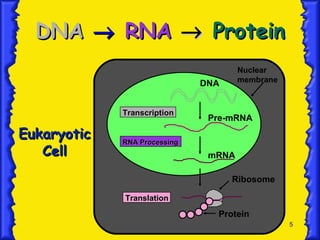
Protein Synthesis The production (synthesis) of polypeptide chains  (proteins) Two phases:   Transcription  &  Translation mRNA must be  processed before it leaves the nucleus  of eukaryotic cells
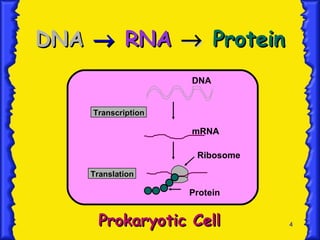
DNA     RNA     Protein Prokaryotic Cell Transcription Translation DNA mRNA Ribosome Protein
DNA     RNA     Protein Eukaryotic Cell Nuclear membrane Transcription RNA Processing Translation DNA Pre-mRNA mRNA Ribosome Protein
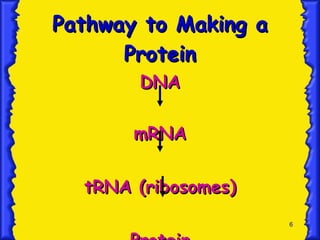
Pathway to Making a Protein DNA mRNA tRNA (ribosomes) Protein
Nucleic Acids
DNA or Protein? Walter Sutton discovered  chromosomes  were made of  DNA and Protein However, scientists were  NOT  sure which one (protein or DNA) was  the actual genetic material of the cell
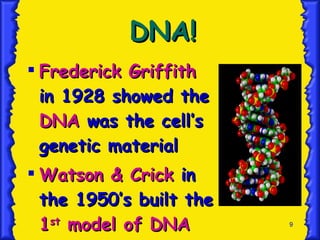
DNA! Frederick Griffith  in 1928 showed the  DNA  was the cell’s genetic material Watson & Crick  in the 1950’s built the  1 st  model of DNA
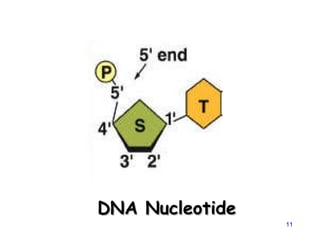
Structure of DNA DNA is made of subunits called  nucleotides DNA nucleotides are composed of a  phosphate ,  deoxyribose  sugar, and  a nitrogen-containing base The 4 bases in DNA are:  adenine (A),  thymine (T),   guanine (G),  and cytosine (C)
DNA Nucleotide
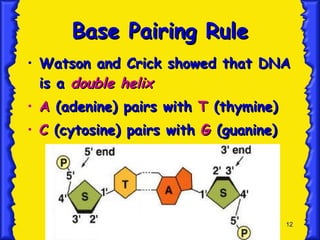
Base Pairing Rule Watson and Crick showed that DNA is a  double helix A  (adenine) pairs with  T  (thymine) C  (cytosine) pairs with  G  (guanine)
Nitrogen Rings Purines  have  single  rings of carbon-nitrogen (G, A) Pyrimidines  have  double  carbon-nitrogen rings (C, T) This is called  complementary base pairing  because a  purine  is always paired with a  pyrimidine
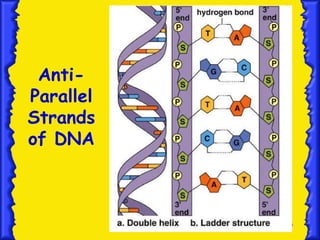
5’ to 3’ Sugars When the DNA  double helix  unwinds, it  resembles a ladder The  sides  of the ladder are the  sugar-phosphate backbones The  rungs  of the ladder are the  complementary paired bases The two DNA strands are  anti-parallel  (they run in opposite directions) .
Anti-Parallel Strands of DNA
DNA  Replication
Steps in DNA Replication Occurs when  chromosomes duplicate  (make copies) An  exact copy  of the DNA is produced with the aid of the enzyme  DNA polymerase Hydrogen bonds  between bases  break  and enzymes “unzip” the molecule Each  old strand  of nucleotides serves as a  template  for each new strand New nucleotides  move into complementary positions are joined by DNA polymerase
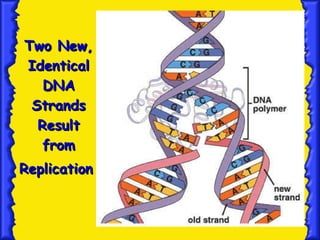
Two New, Identical DNA Strands Result from Replication
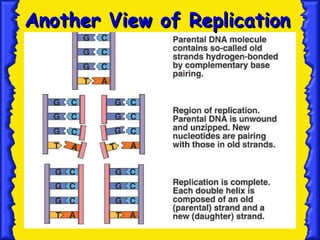
Another View of Replication
RNA
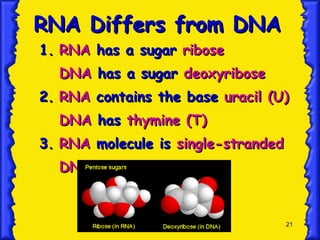
RNA Differs from DNA 1. RNA  has a sugar  ribose DNA  has a sugar  deoxyribose 2. RNA  contains the base  uracil (U) DNA  has  thymine (T) 3. RNA  molecule is  single-stranded DNA  is  double-stranded
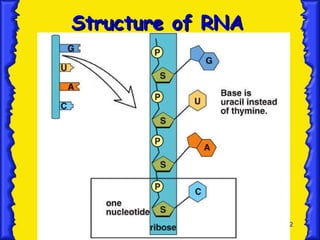
Structure of RNA
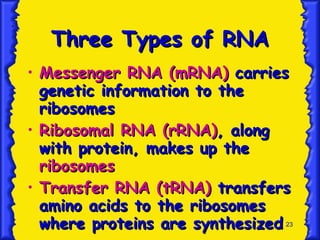
Three Types of RNA Messenger RNA (mRNA)   carries genetic information to the ribosomes Ribosomal RNA (rRNA) ,   along with protein, makes up the  ribosomes Transfer RNA (tRNA)   transfers amino acids to the ribosomes where proteins are synthesized .
Making a Protein
Genes & Proteins Proteins  are made of  amino acids  linked together by  peptide bonds 20  different amino acids  exist Amino acids chains are called  polypeptides Segment of DNA that codes for the amino acid sequence in a protein are called  genes
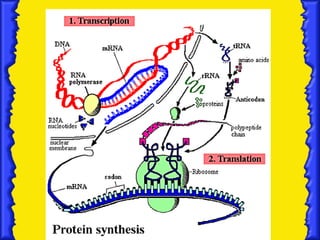
Two Parts of Protein Synthesis Transcription  makes an RNA molecule complementary to a portion of DNA Translation   occurs when the sequence of bases of mRNA  DIRECTS  the  sequence of amino acids  in a polypeptide
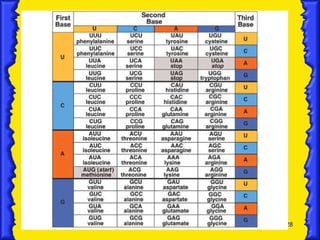
Genetic Code DNA contains a  triplet code Every three bases on DNA stands for  ONE amino acid Each three-letter unit on  mRNA  is called a  codon Most amino acids have more than one codon! There are  20 amino acids  with a possible 64 different triplets The code is nearly  universal  among living organisms
Transcription Translation
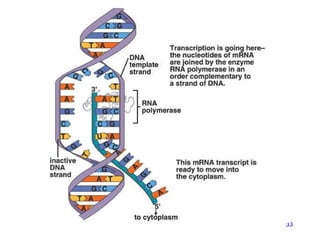
Overview of Transcription During  transcription  in the nucleus, a segment of DNA unwinds and unzips, and the  DNA  serves as a  template for mRNA formation RNA polymerase  joins the RNA nucleotides so that the  codons in mRNA are complementary  to the triplet code in DNA
Steps in Transcription The transfer of information in the  nucleus  from a  DNA  molecule to an  RNA  molecule Only 1  DNA  strand serves as the  template Starts at promoter  DNA  (TATA box) Ends at terminator  DNA  (stop) When complete,  pre-RNA  molecule is released
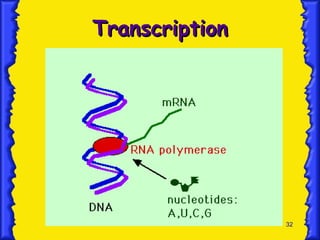
Transcription
What is the  enzyme  responsible for the production of the mRNA molecule?
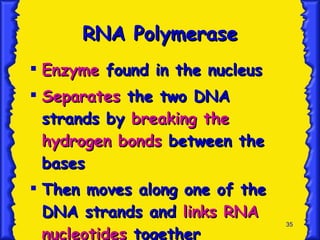
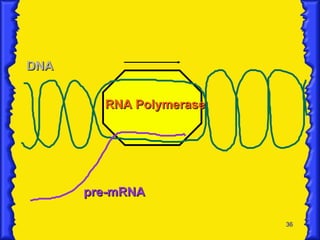
RNA Polymerase Enzyme  found in the nucleus Separates  the two DNA strands by  breaking the hydrogen bonds  between the bases Then moves along one of the DNA strands and  links RNA nucleotides  together
DNA pre-mRNA RNA Polymerase
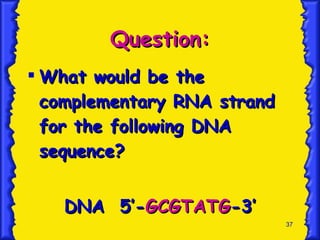
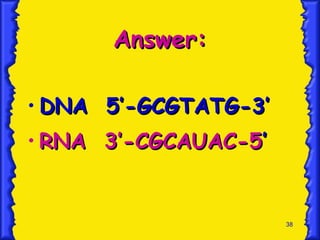
Question: What would be the complementary RNA strand for the following DNA sequence? DNA  5’- GCGTATG -3’
Answer: DNA  5’-GCGTATG-3’ RNA  3’-CGCAUAC-5 ’
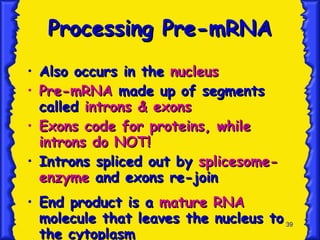
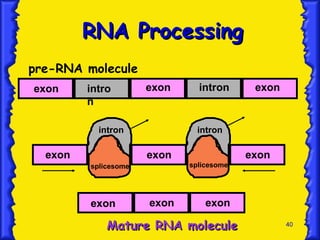
Processing Pre-mRNA Also occurs in the  nucleus Pre-mRNA  made up of segments called  introns & exons Exons code for proteins, while introns do NOT! Introns spliced out by  splicesome-enzyme  and exons re-join End product is a  mature RNA  molecule that leaves the nucleus to the cytoplasm
RNA Processing pre-RNA molecule intron intron exon exon exon exon exon exon Mature RNA molecule exon exon exon intron intron splicesome splicesome
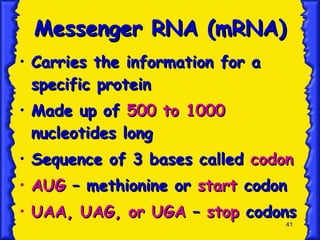
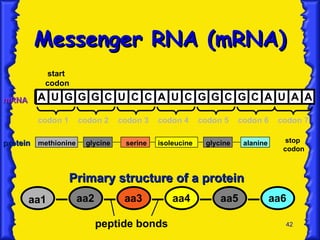
Messenger RNA (mRNA) Carries the information for a specific protein Made up of  500 to 1000  nucleotides long Sequence of 3 bases called  codon AUG  – methionine or  start  codon UAA, UAG, or UGA  –  stop  codons
Messenger RNA (mRNA) methionine glycine serine isoleucine glycine alanine stop codon protein A U G G G C U C C A U C G G C G C A U A A mRNA start codon Primary structure of a protein aa1 aa2 aa3 aa4 aa5 aa6 peptide bonds codon 2 codon 3 codon 4 codon 5 codon 6 codon 7 codon 1
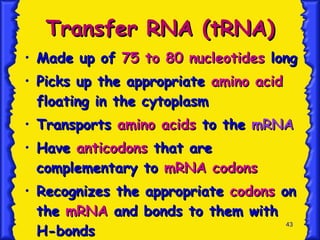
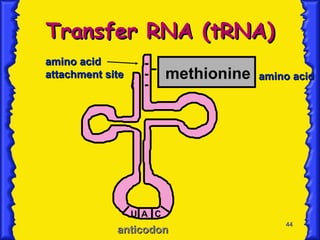
Transfer RNA (tRNA) Made up of  75 to 80 nucleotides  long Picks up the appropriate  amino acid   floating in the cytoplasm  Transports  amino acids   to the  mRNA Have  anticodons  that are complementary to  mRNA codons Recognizes the appropriate  codons  on the  mRNA  and bonds to them with H-bonds
Transfer RNA (tRNA) amino acid attachment site U A C anticodon methionine amino acid
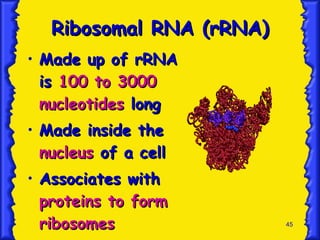
Ribosomal RNA (rRNA) Made up of rRNA is  100 to 3000 nucleotides  long Made inside the  nucleus  of a cell Associates with  proteins to form ribosomes
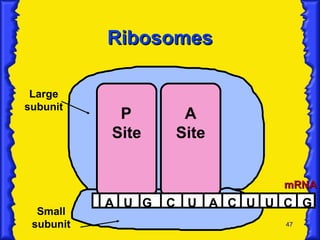
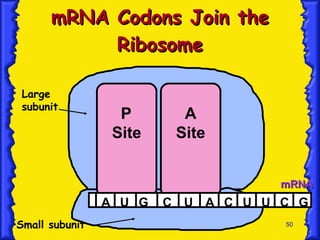
Ribosomes Made of a  large and small  subunit Composed of  rRNA (40%)  and  proteins (60%) Have  two sites  for tRNA attachment ---  P and A
Ribosomes P Site A Site Large subunit Small subunit mRNA A U G C U A C U U C G
Translation Synthesis of proteins  in the cytoplasm Involves the following: 1. mRNA  (codons) 2. tRNA (anticodons) 3. ribosomes 4. amino acids
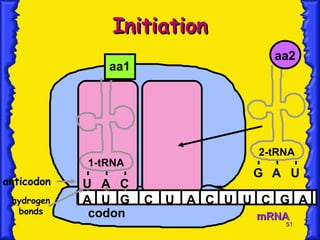
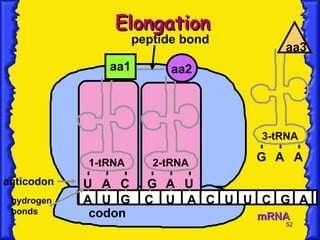
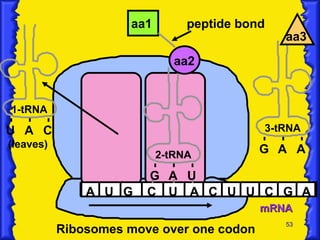
Translation Three steps: 1. initiation : start codon (AUG) 2. elongation : amino acids linked 3. termination :  stop codon (UAG, UAA, or UGA). Let’s Make a Protein !
mRNA Codons Join the Ribosome P Site A Site Large subunit Small subunit mRNA A U G C U A C U U C G
Initiation mRNA A U G C U A C U U C G A anticodon hydrogen bonds codon 2-tRNA G aa2 A U 1-tRNA U A C aa1
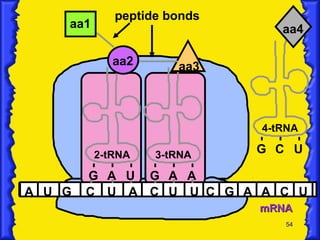
mRNA A U G C U A C U U C G 1-tRNA 2-tRNA U A C G aa1 aa2 A U A anticodon hydrogen bonds codon peptide bond Elongation 3-tRNA G A A aa3
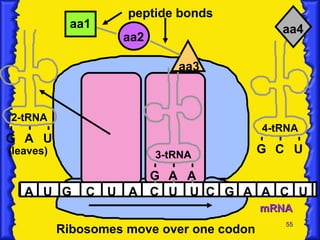
mRNA A U G C U A C U U C G 1-tRNA 2-tRNA U A C G aa1 aa2 A U A peptide bond Ribosomes move over one codon (leaves) 3-tRNA G A A aa3
mRNA A U G C U A C U U C G 2-tRNA G aa1 aa2 A U A peptide bonds 3-tRNA G A A aa3 A C U 4-tRNA G C U aa4
mRNA A U G C U A C U U C G 2-tRNA G aa1 aa2 A U A peptide bonds 3-tRNA G A A aa3 A C U (leaves) Ribosomes move over one codon 4-tRNA G C U aa4
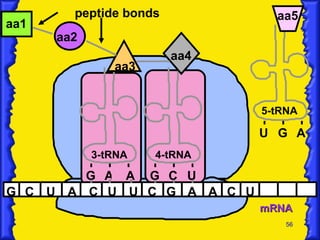
mRNA G C U A C U U C G aa1 aa2 A peptide bonds 3-tRNA G A A aa3 4-tRNA G C U aa4 A C U U G A 5-tRNA aa5
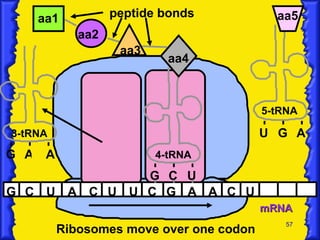
mRNA G C U A C U U C G aa1 aa2 A peptide bonds 3-tRNA G A A aa3 4-tRNA G C U aa4 A C U Ribosomes move over one codon U G A 5-tRNA aa5
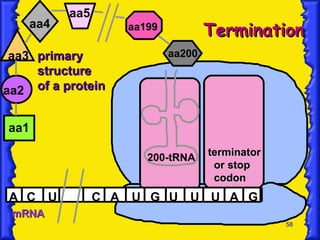
mRNA A C A U G U aa1 aa2 U primary structure of a protein aa3 200-tRNA aa4 U A G aa5 C U aa200 aa199 terminator or stop codon Termination
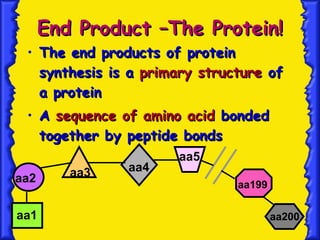
End Product –The Protein! The end products of protein synthesis is a  primary structure  of a protein A  sequence of amino acid  bonded together by peptide bonds aa1 aa2 aa3 aa4 aa5 aa200 aa199
Translation - animation
 
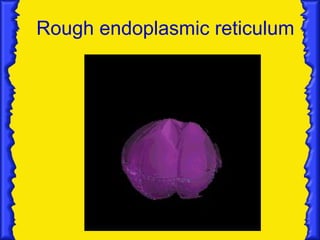
Rough endoplasmic reticulum
 
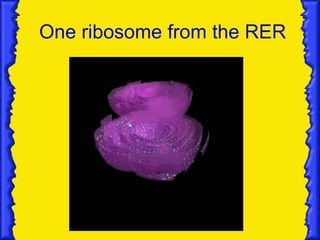
One ribosome from the RER
 
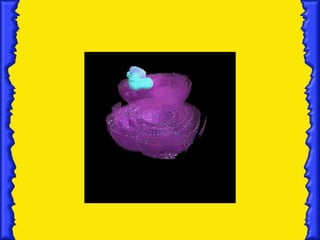
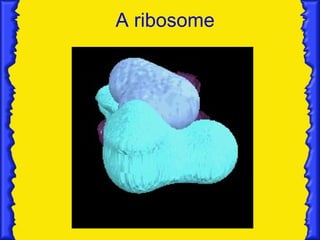
A ribosome

Biology lecture 5

  • 1.
  • 2.
    TOPICS : NucleicAcids DNA Replication RNA Making a Protein
  • 3.
    Protein Synthesis Theproduction (synthesis) of polypeptide chains (proteins) Two phases: Transcription & Translation mRNA must be processed before it leaves the nucleus of eukaryotic cells
  • 4.
    DNA  RNA  Protein Prokaryotic Cell Transcription Translation DNA mRNA Ribosome Protein
  • 5.
    DNA  RNA  Protein Eukaryotic Cell Nuclear membrane Transcription RNA Processing Translation DNA Pre-mRNA mRNA Ribosome Protein
  • 6.
    Pathway to Makinga Protein DNA mRNA tRNA (ribosomes) Protein
  • 7.
  • 8.
    DNA or Protein?Walter Sutton discovered chromosomes were made of DNA and Protein However, scientists were NOT sure which one (protein or DNA) was the actual genetic material of the cell
  • 9.
    DNA! Frederick Griffith in 1928 showed the DNA was the cell’s genetic material Watson & Crick in the 1950’s built the 1 st model of DNA
  • 10.
    Structure of DNADNA is made of subunits called nucleotides DNA nucleotides are composed of a phosphate , deoxyribose sugar, and a nitrogen-containing base The 4 bases in DNA are: adenine (A), thymine (T), guanine (G), and cytosine (C)
  • 11.
  • 12.
    Base Pairing RuleWatson and Crick showed that DNA is a double helix A (adenine) pairs with T (thymine) C (cytosine) pairs with G (guanine)
  • 13.
    Nitrogen Rings Purines have single rings of carbon-nitrogen (G, A) Pyrimidines have double carbon-nitrogen rings (C, T) This is called complementary base pairing because a purine is always paired with a pyrimidine
  • 14.
    5’ to 3’Sugars When the DNA double helix unwinds, it resembles a ladder The sides of the ladder are the sugar-phosphate backbones The rungs of the ladder are the complementary paired bases The two DNA strands are anti-parallel (they run in opposite directions) .
  • 15.
  • 16.
  • 17.
    Steps in DNAReplication Occurs when chromosomes duplicate (make copies) An exact copy of the DNA is produced with the aid of the enzyme DNA polymerase Hydrogen bonds between bases break and enzymes “unzip” the molecule Each old strand of nucleotides serves as a template for each new strand New nucleotides move into complementary positions are joined by DNA polymerase
  • 18.
    Two New, IdenticalDNA Strands Result from Replication
  • 19.
    Another View ofReplication
  • 20.
  • 21.
    RNA Differs fromDNA 1. RNA has a sugar ribose DNA has a sugar deoxyribose 2. RNA contains the base uracil (U) DNA has thymine (T) 3. RNA molecule is single-stranded DNA is double-stranded
  • 22.
  • 23.
    Three Types ofRNA Messenger RNA (mRNA) carries genetic information to the ribosomes Ribosomal RNA (rRNA) , along with protein, makes up the ribosomes Transfer RNA (tRNA) transfers amino acids to the ribosomes where proteins are synthesized .
  • 24.
  • 25.
    Genes & ProteinsProteins are made of amino acids linked together by peptide bonds 20 different amino acids exist Amino acids chains are called polypeptides Segment of DNA that codes for the amino acid sequence in a protein are called genes
  • 26.
    Two Parts ofProtein Synthesis Transcription makes an RNA molecule complementary to a portion of DNA Translation occurs when the sequence of bases of mRNA DIRECTS the sequence of amino acids in a polypeptide
  • 27.
    Genetic Code DNAcontains a triplet code Every three bases on DNA stands for ONE amino acid Each three-letter unit on mRNA is called a codon Most amino acids have more than one codon! There are 20 amino acids with a possible 64 different triplets The code is nearly universal among living organisms
  • 29.
  • 30.
    Overview of TranscriptionDuring transcription in the nucleus, a segment of DNA unwinds and unzips, and the DNA serves as a template for mRNA formation RNA polymerase joins the RNA nucleotides so that the codons in mRNA are complementary to the triplet code in DNA
  • 31.
    Steps in TranscriptionThe transfer of information in the nucleus from a DNA molecule to an RNA molecule Only 1 DNA strand serves as the template Starts at promoter DNA (TATA box) Ends at terminator DNA (stop) When complete, pre-RNA molecule is released
  • 32.
  • 34.
    What is the enzyme responsible for the production of the mRNA molecule?
  • 35.
    RNA Polymerase Enzyme found in the nucleus Separates the two DNA strands by breaking the hydrogen bonds between the bases Then moves along one of the DNA strands and links RNA nucleotides together
  • 36.
    DNA pre-mRNA RNAPolymerase
  • 37.
    Question: What wouldbe the complementary RNA strand for the following DNA sequence? DNA 5’- GCGTATG -3’
  • 38.
    Answer: DNA 5’-GCGTATG-3’ RNA 3’-CGCAUAC-5 ’
  • 39.
    Processing Pre-mRNA Alsooccurs in the nucleus Pre-mRNA made up of segments called introns & exons Exons code for proteins, while introns do NOT! Introns spliced out by splicesome-enzyme and exons re-join End product is a mature RNA molecule that leaves the nucleus to the cytoplasm
  • 40.
    RNA Processing pre-RNAmolecule intron intron exon exon exon exon exon exon Mature RNA molecule exon exon exon intron intron splicesome splicesome
  • 41.
    Messenger RNA (mRNA)Carries the information for a specific protein Made up of 500 to 1000 nucleotides long Sequence of 3 bases called codon AUG – methionine or start codon UAA, UAG, or UGA – stop codons
  • 42.
    Messenger RNA (mRNA)methionine glycine serine isoleucine glycine alanine stop codon protein A U G G G C U C C A U C G G C G C A U A A mRNA start codon Primary structure of a protein aa1 aa2 aa3 aa4 aa5 aa6 peptide bonds codon 2 codon 3 codon 4 codon 5 codon 6 codon 7 codon 1
  • 43.
    Transfer RNA (tRNA)Made up of 75 to 80 nucleotides long Picks up the appropriate amino acid floating in the cytoplasm Transports amino acids to the mRNA Have anticodons that are complementary to mRNA codons Recognizes the appropriate codons on the mRNA and bonds to them with H-bonds
  • 44.
    Transfer RNA (tRNA)amino acid attachment site U A C anticodon methionine amino acid
  • 45.
    Ribosomal RNA (rRNA)Made up of rRNA is 100 to 3000 nucleotides long Made inside the nucleus of a cell Associates with proteins to form ribosomes
  • 46.
    Ribosomes Made ofa large and small subunit Composed of rRNA (40%) and proteins (60%) Have two sites for tRNA attachment --- P and A
  • 47.
    Ribosomes P SiteA Site Large subunit Small subunit mRNA A U G C U A C U U C G
  • 48.
    Translation Synthesis ofproteins in the cytoplasm Involves the following: 1. mRNA (codons) 2. tRNA (anticodons) 3. ribosomes 4. amino acids
  • 49.
    Translation Three steps:1. initiation : start codon (AUG) 2. elongation : amino acids linked 3. termination : stop codon (UAG, UAA, or UGA). Let’s Make a Protein !
  • 50.
    mRNA Codons Jointhe Ribosome P Site A Site Large subunit Small subunit mRNA A U G C U A C U U C G
  • 51.
    Initiation mRNA AU G C U A C U U C G A anticodon hydrogen bonds codon 2-tRNA G aa2 A U 1-tRNA U A C aa1
  • 52.
    mRNA A UG C U A C U U C G 1-tRNA 2-tRNA U A C G aa1 aa2 A U A anticodon hydrogen bonds codon peptide bond Elongation 3-tRNA G A A aa3
  • 53.
    mRNA A UG C U A C U U C G 1-tRNA 2-tRNA U A C G aa1 aa2 A U A peptide bond Ribosomes move over one codon (leaves) 3-tRNA G A A aa3
  • 54.
    mRNA A UG C U A C U U C G 2-tRNA G aa1 aa2 A U A peptide bonds 3-tRNA G A A aa3 A C U 4-tRNA G C U aa4
  • 55.
    mRNA A UG C U A C U U C G 2-tRNA G aa1 aa2 A U A peptide bonds 3-tRNA G A A aa3 A C U (leaves) Ribosomes move over one codon 4-tRNA G C U aa4
  • 56.
    mRNA G CU A C U U C G aa1 aa2 A peptide bonds 3-tRNA G A A aa3 4-tRNA G C U aa4 A C U U G A 5-tRNA aa5
  • 57.
    mRNA G CU A C U U C G aa1 aa2 A peptide bonds 3-tRNA G A A aa3 4-tRNA G C U aa4 A C U Ribosomes move over one codon U G A 5-tRNA aa5
  • 58.
    mRNA A CA U G U aa1 aa2 U primary structure of a protein aa3 200-tRNA aa4 U A G aa5 C U aa200 aa199 terminator or stop codon Termination
  • 59.
    End Product –TheProtein! The end products of protein synthesis is a primary structure of a protein A sequence of amino acid bonded together by peptide bonds aa1 aa2 aa3 aa4 aa5 aa200 aa199
  • 60.
  • 61.
  • 62.
  • 63.
  • 64.
  • 65.
  • 66.

Editor's Notes

  • #12 Notice that the 3’ and 5’ refer to a numbering system for the carbon atoms that make up the sugar.
  • #16 On the left is the DNA double helix. When the helix is unwound, a ladder configuration shows that the uprights are composed of sugar and phosphate molecules and the rungs are complementary bases. Notice that the bases in DNA pair in such a way that the phosphate-sugar groups are oriented in different directions. This means that the strands of DNA end up running antiparallel to one another, with the 3’ end of one strand opposite the 5’ end of the other strand.
  • #18 DNA polymerase is an enzyme.
  • #19 Replication is called semiconservative because each new double helix is composed of an old (parental) strand and a new (daughter) strand.
  • #20 Use of the ladder configuration better illustrates how complementary nucleotides available in the cell pair with those of each old strand before they are joined together to form a daughter strand.
  • #23 Like DNA, RNA is a polymer of nucleotides. In an RNA nucleotide, the sugar ribose is attached to a phosphate molecule and to a base, either G, U, A, or C. Notice that in RNA, the base uracil replaces thymine as one of the pyrimidine bases. RNA is single-stranded, whereas DNA is double-stranded.
  • #28 The fact that the genetic code is about universal in living things suggests that the code dates back to the first organisms on earth and that all living things are related.
  • #29 Notice that in this chart, each of the codons (white rectangles) is composed of three letters representing the first base, second base, and third base. For example, find the rectangle where C for the first base and A for the second base intersect. You will see that U, C, A, or G can be the third base. CAU and CAC are codons for histidine; CAA and CAG are codons for glutamine.
  • #30 Transcription occurs when DNA acts as a template for mRNA synthesis. Translation occurs when the sequence of the mRNA codons determines the sequence of amino acids in a protein.
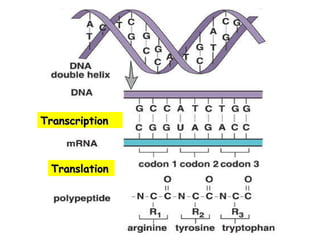
  • #34 During transcription, complementary RNA is made from a DNA template. A portion of DNA unwinds and unzips at the point of attachment of RNA polymerase. A strand of mRNA is produced when complementary bases join in the order dictated by the sequence of bases in DNA. Transcription occurs in the nucleus, and the mRNA passes out of the nucleus to enter the cytoplasm.