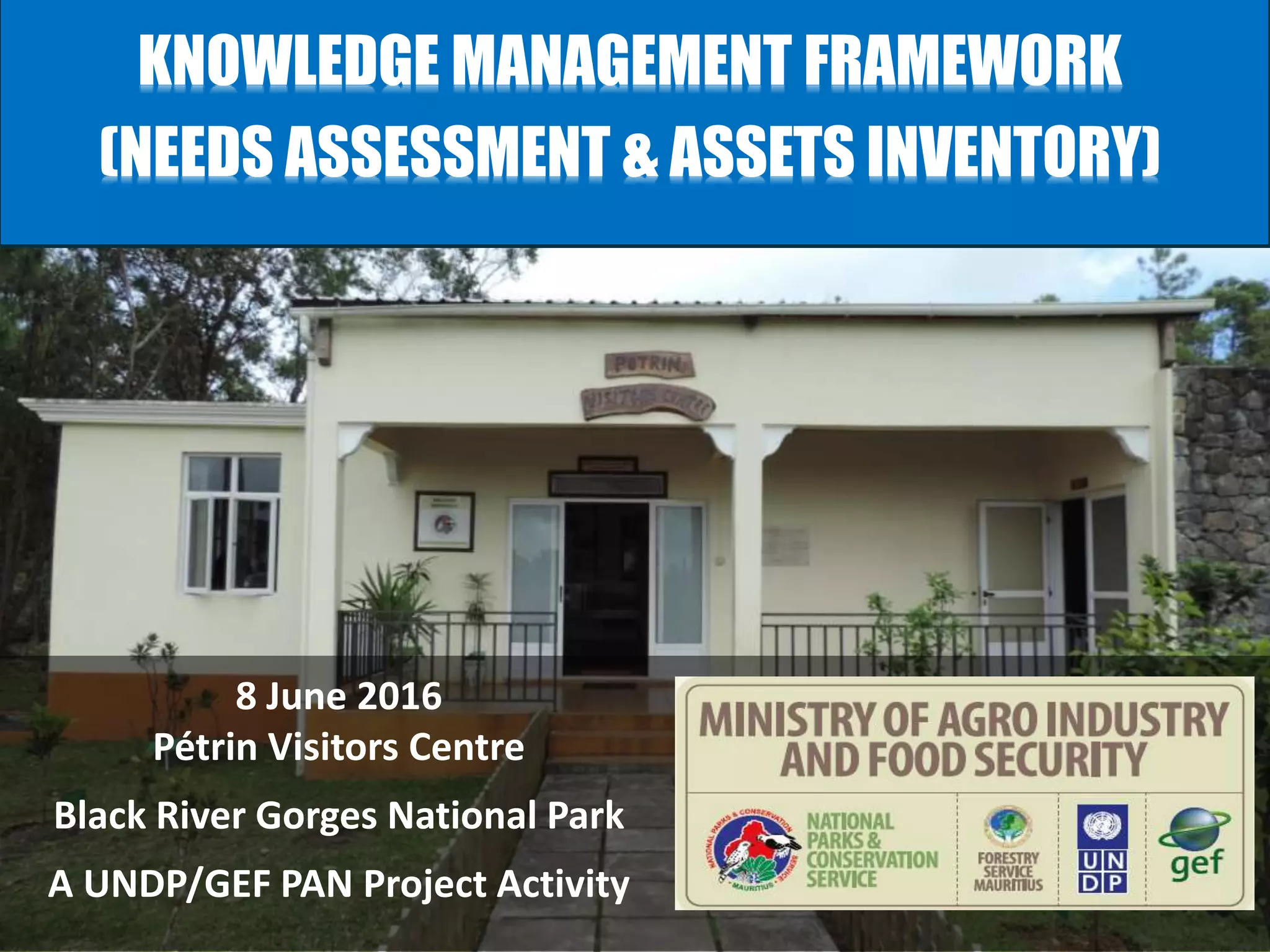





8 June 2016
Pétrin Visitors Centre
Black River Gorges National Park
A UNDP/GEF PAN Project Activity
KNOWLEDGE MANAGEMENT FRAMEWORK
(NEEDS ASSESSMENT & ASSETS INVENTORY)
Ground Rules
• Everybody’s input is equally valued
• Respectfully listen & be patient – things may feel slow
for some but challenging for others
• Participate but don’t dominate
• Talk one at a time in plenary
• Avoid side-conversations
• Mobile phones on silent
• Feel free to ask questions during plenary but be aware
of time constraints
• The workshop is an information gathering exercise and
not a decision-making forum.
KMF Assets Inventory & Needs
Assessment Workshop
OBJECTIVE
“To collect and consolidate information on current
knowledge management practices and needs in
Mauritius as input a Knowledge Management Framework
to ensure lessons learnt, reports, publications and
experiences acquired are shared through newsletters, on
the job training and development sessions, academic
papers and other ICT medias to community groups and
stakeholders.”
What is Knowledge Management?
A means of systematically and
transparently inputting, accessing
and adding value to information so
that it contributes to the
effectiveness and efficiency with
which an individual, organisation or
network executes their mandate.
5
A knowledge Management Framework is:
A means of systematically and transparently inputting,
accessing and adding value to information so that it
contributes to the effectiveness and efficiency with which
an individual, organisation or network can execute their
mandate.
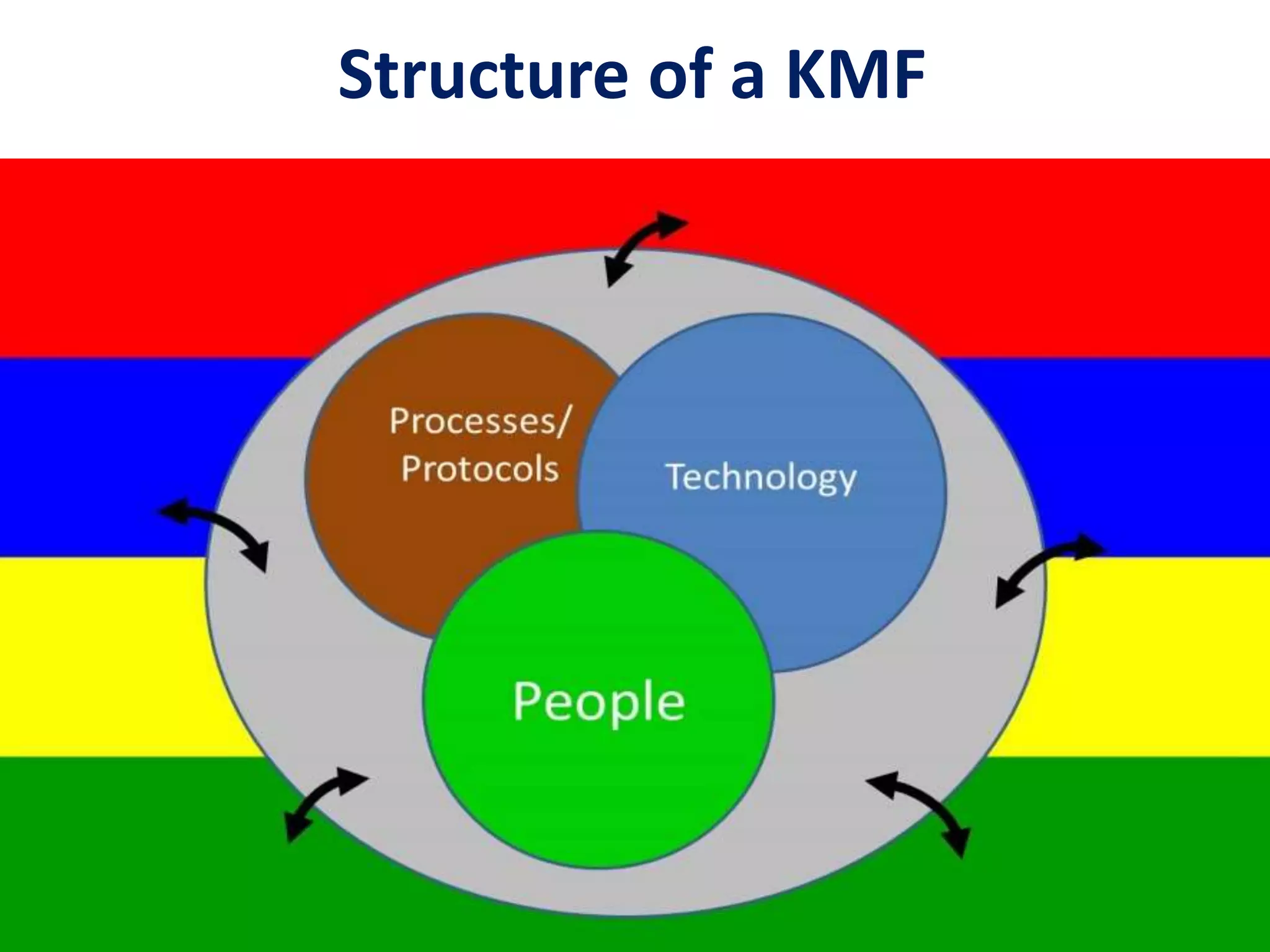
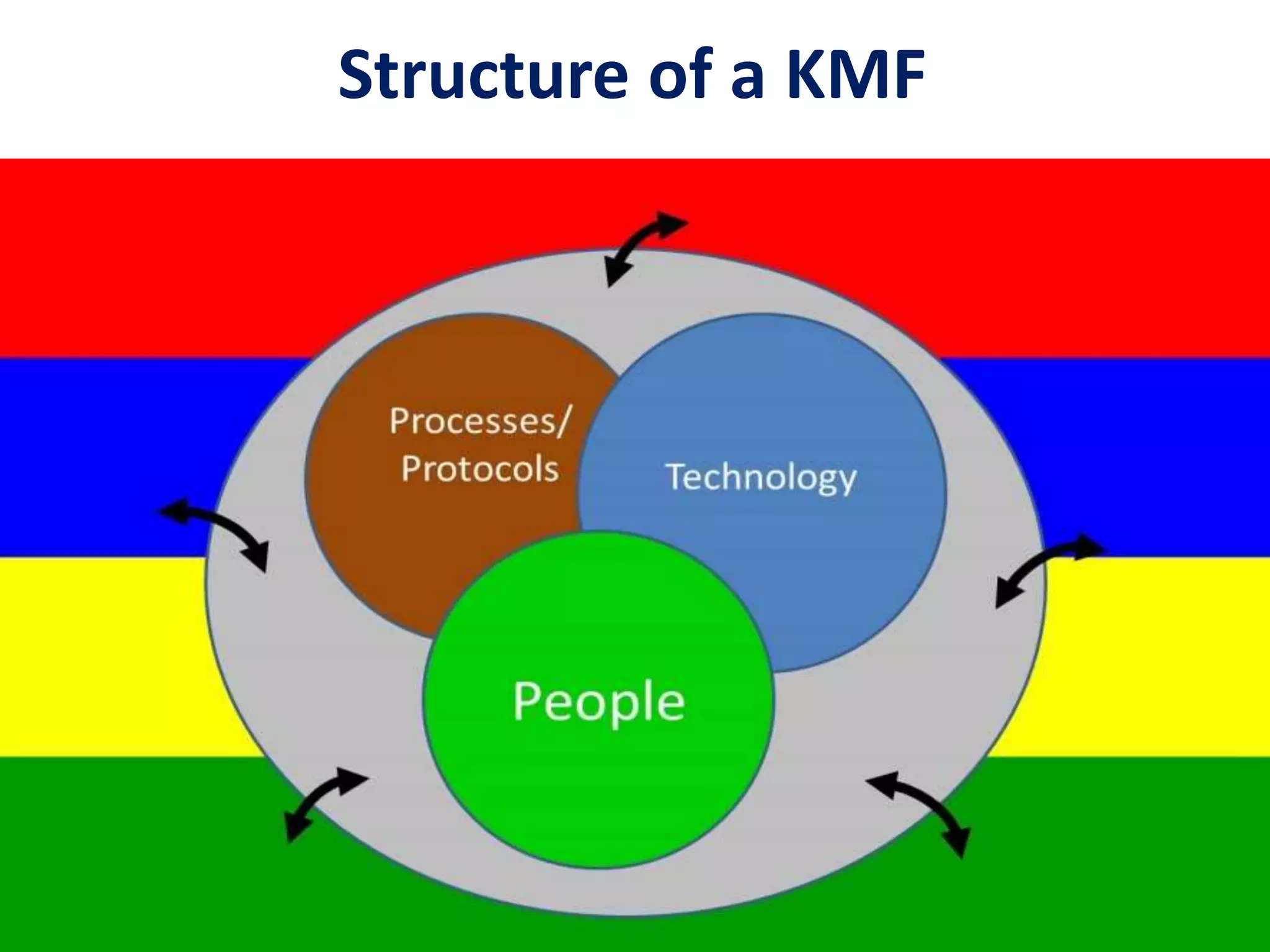
Structure of a KMF
6
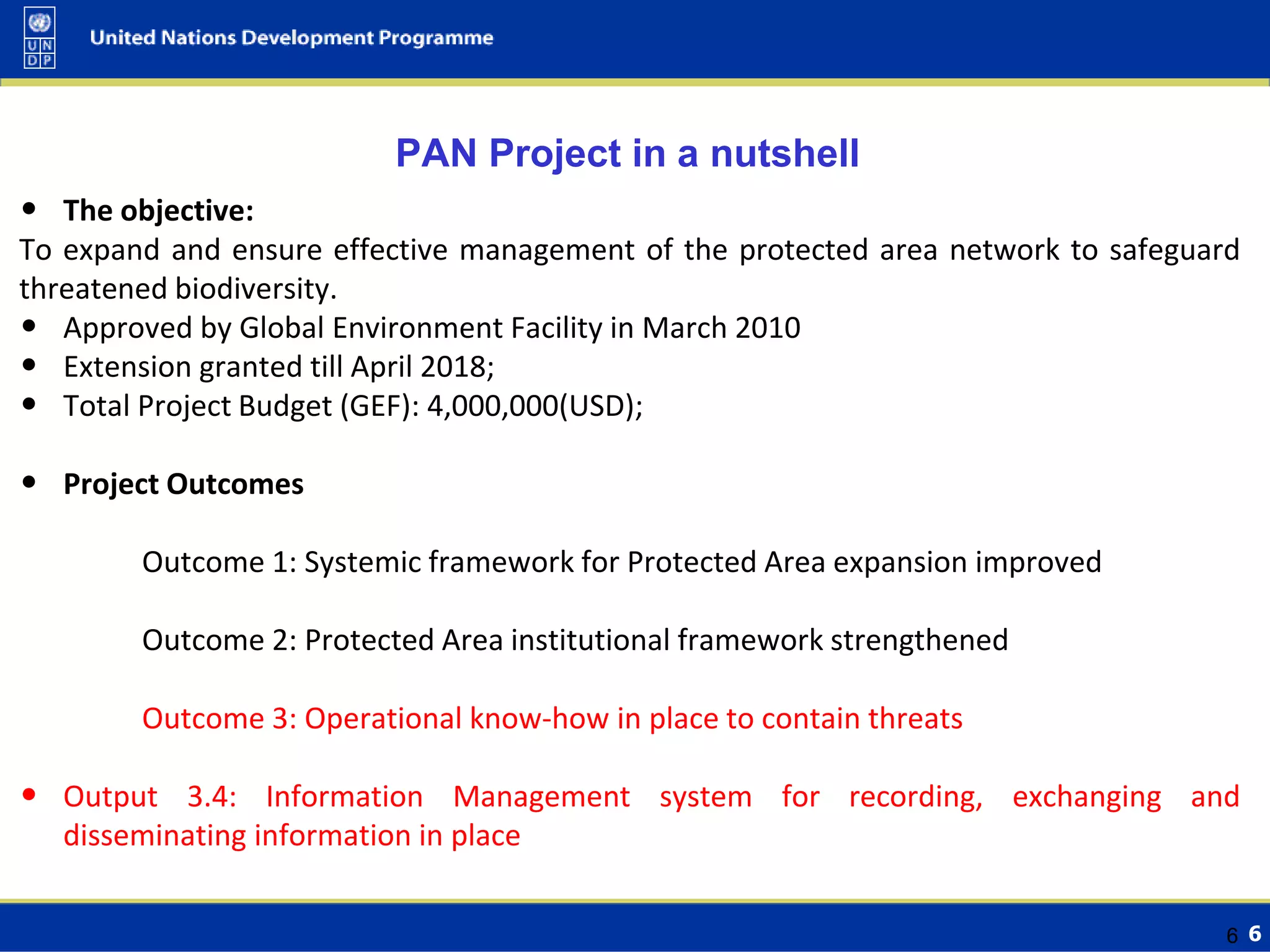
• The objective:
To expand and ensure effective management of the protected area network to safeguard
threatened biodiversity.
• Approved by Global Environment Facility in March 2010
• Extension granted till April 2018;
• Total Project Budget (GEF): 4,000,000(USD);
• Project Outcomes
Outcome 1: Systemic framework for Protected Area expansion improved
Outcome 2: Protected Area institutional framework strengthened
Outcome 3: Operational know-how in place to contain threats
• Output 3.4: Information Management system for recording, exchanging and
disseminating information in place
6
PAN Project in a nutshell
7
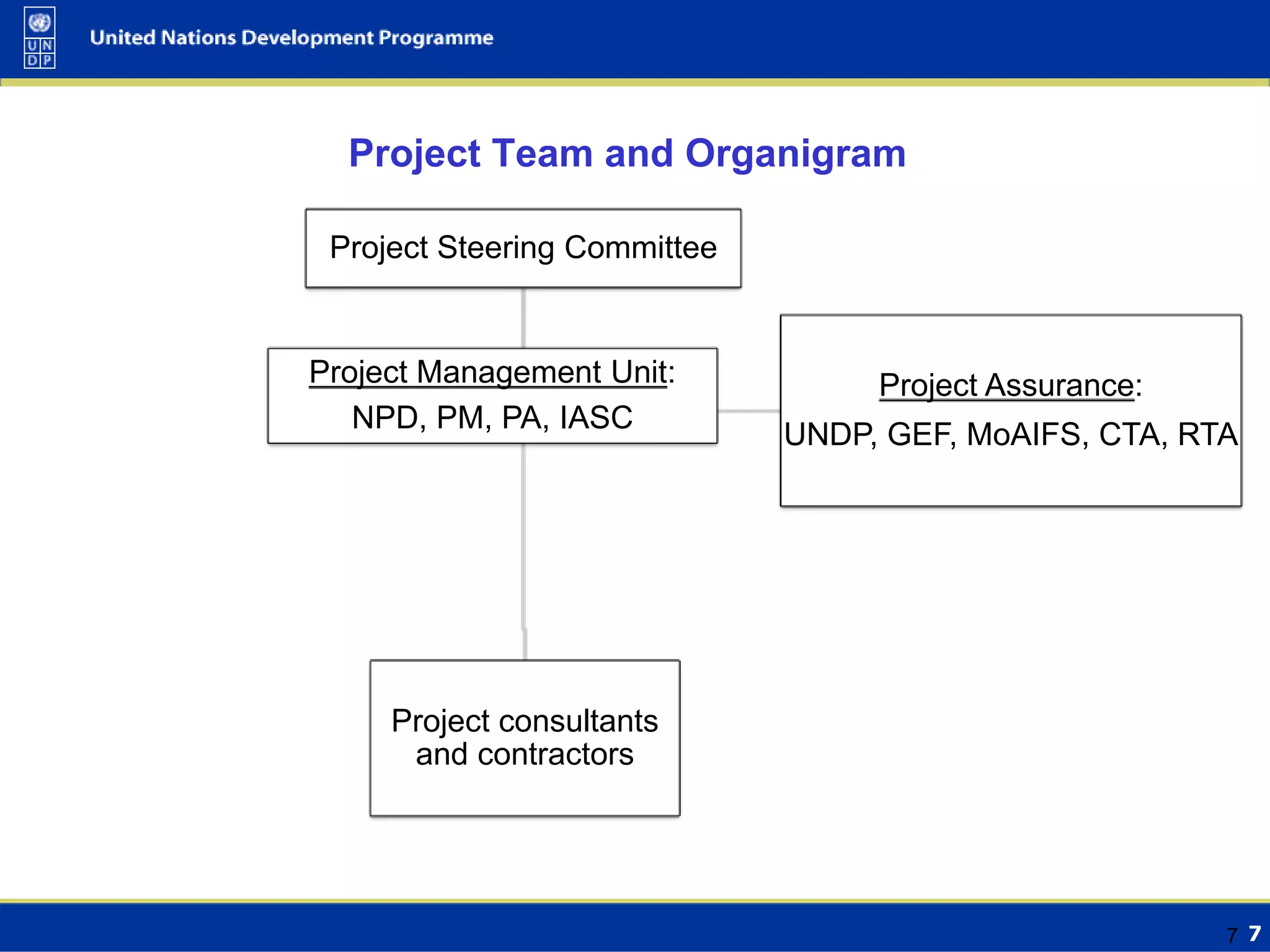
Project Team and Organigram
Project Steering Committee
Project consultants
and contractors
Project Assurance:
UNDP, GEF, MoAIFS, CTA, RTA
Project Management Unit:
NPD, PM, PA, IASC
7
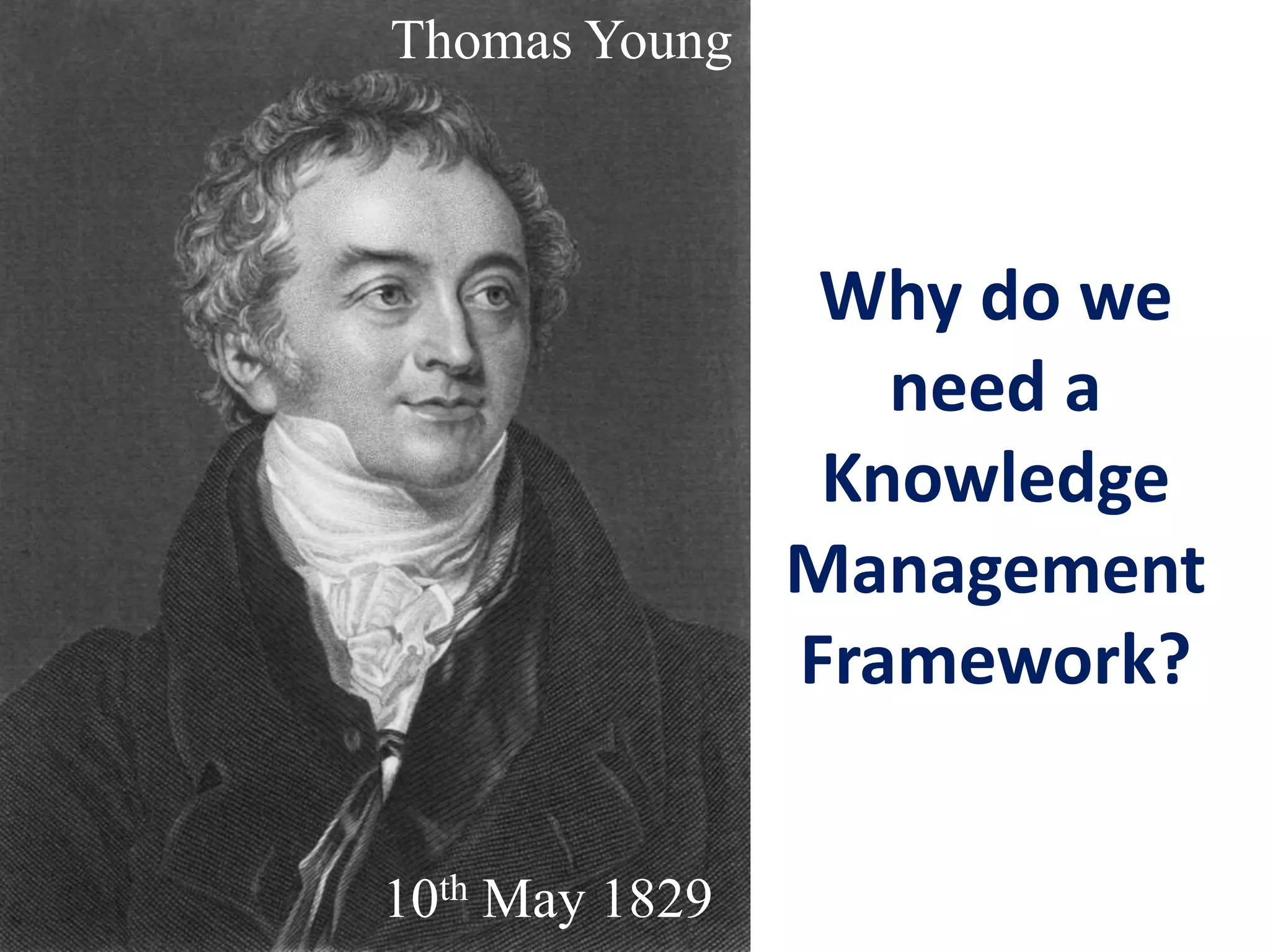
10th May 1829
10th May 1829
Why do we
need a
Knowledge
Management
Framework?
Thomas Young
Why do we
need a
Knowledge
Management
Framework?
Why do we need a knowledge management
framework?
75
15
7
Eduard Marmet: CC BY-SA 3.0
Secretlondon at English Wikipedia: CC BY-SA 3.0
Theoretical Knowledge Management
Hierarchy
Theoretical Knowledge Management
Hierarchy
Alfred P. Sloan long
serving CEO of General
Motors
Knowledge Management Network
18
A knowledge Management Framework is:
A means of systematically and transparently inputting,
accessing and adding value to information so that it
contributes to the effectiveness and efficiency with which
an individual, organisation or network can execute their
mandate.
Structure of a KMF
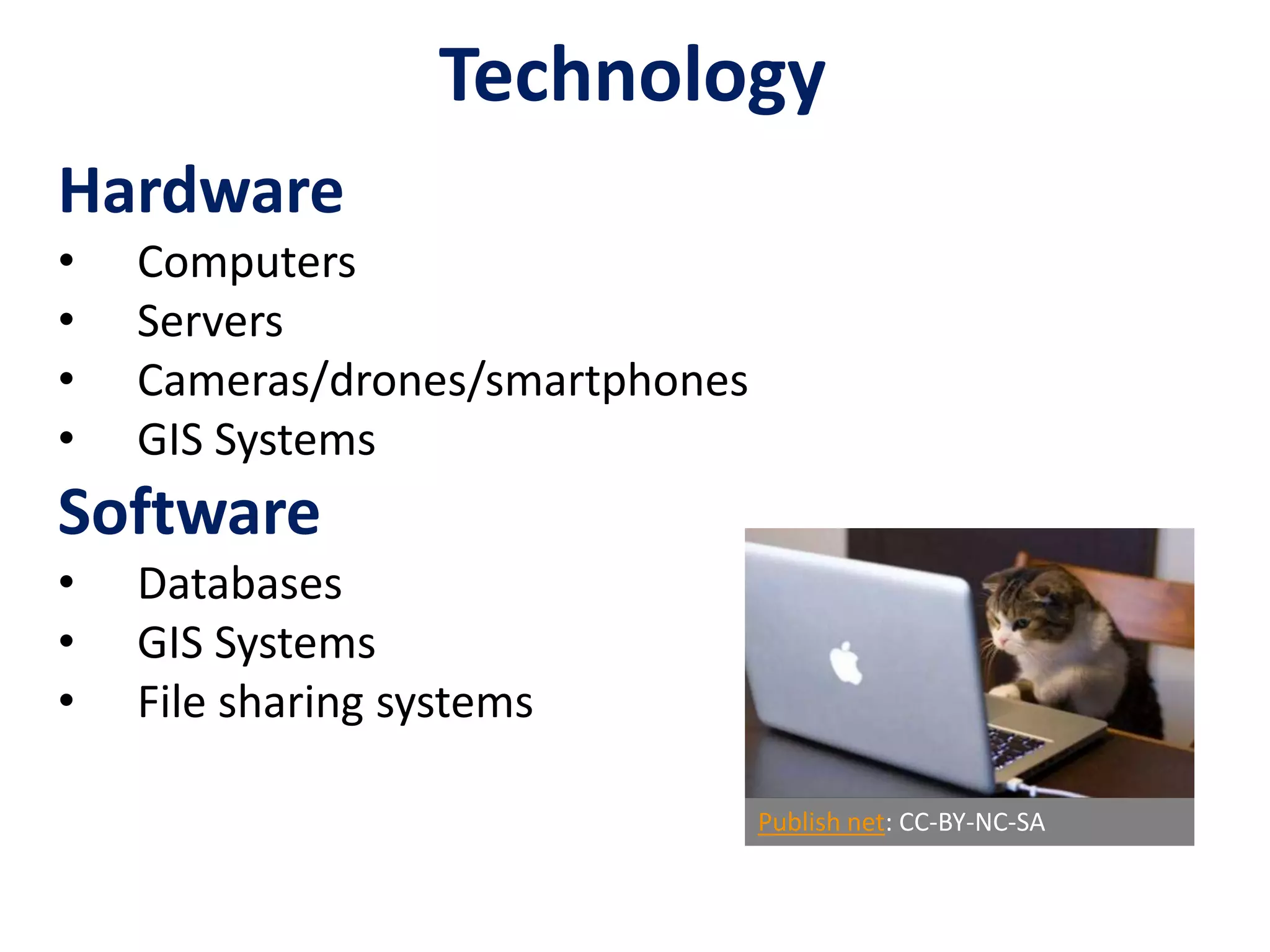
Technology
Hardware
• Computers
• Servers
• Cameras/drones/smartphones
• GIS Systems
Software
• Databases
• GIS Systems
• File sharing systems
Publish net: CC-BY-NC-SA
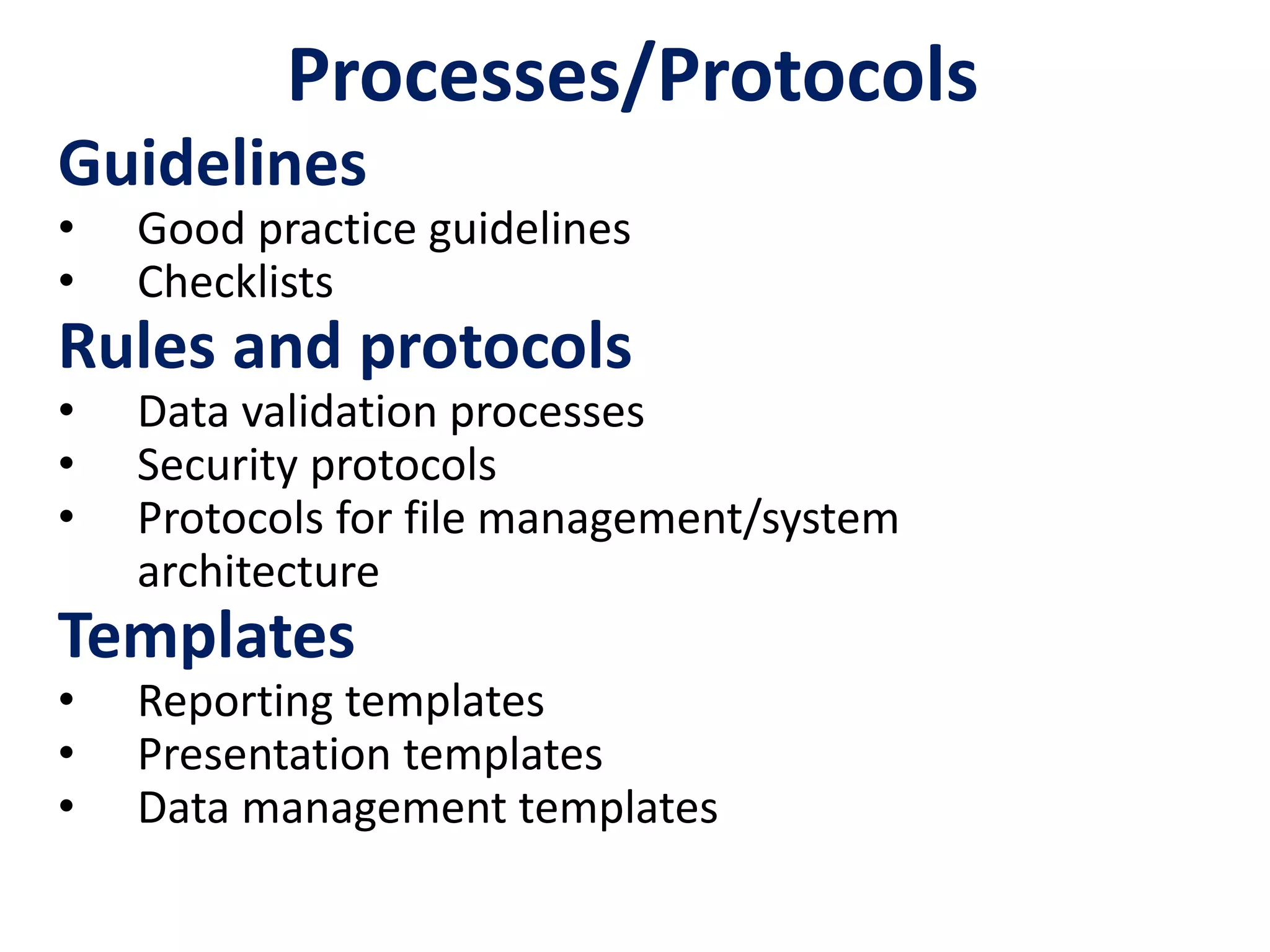
Processes/Protocols
Guidelines
• Good practice guidelines
• Checklists
Rules and protocols
• Data validation processes
• Security protocols
• Protocols for file management/system
architecture
Templates
• Reporting templates
• Presentation templates
• Data management templates
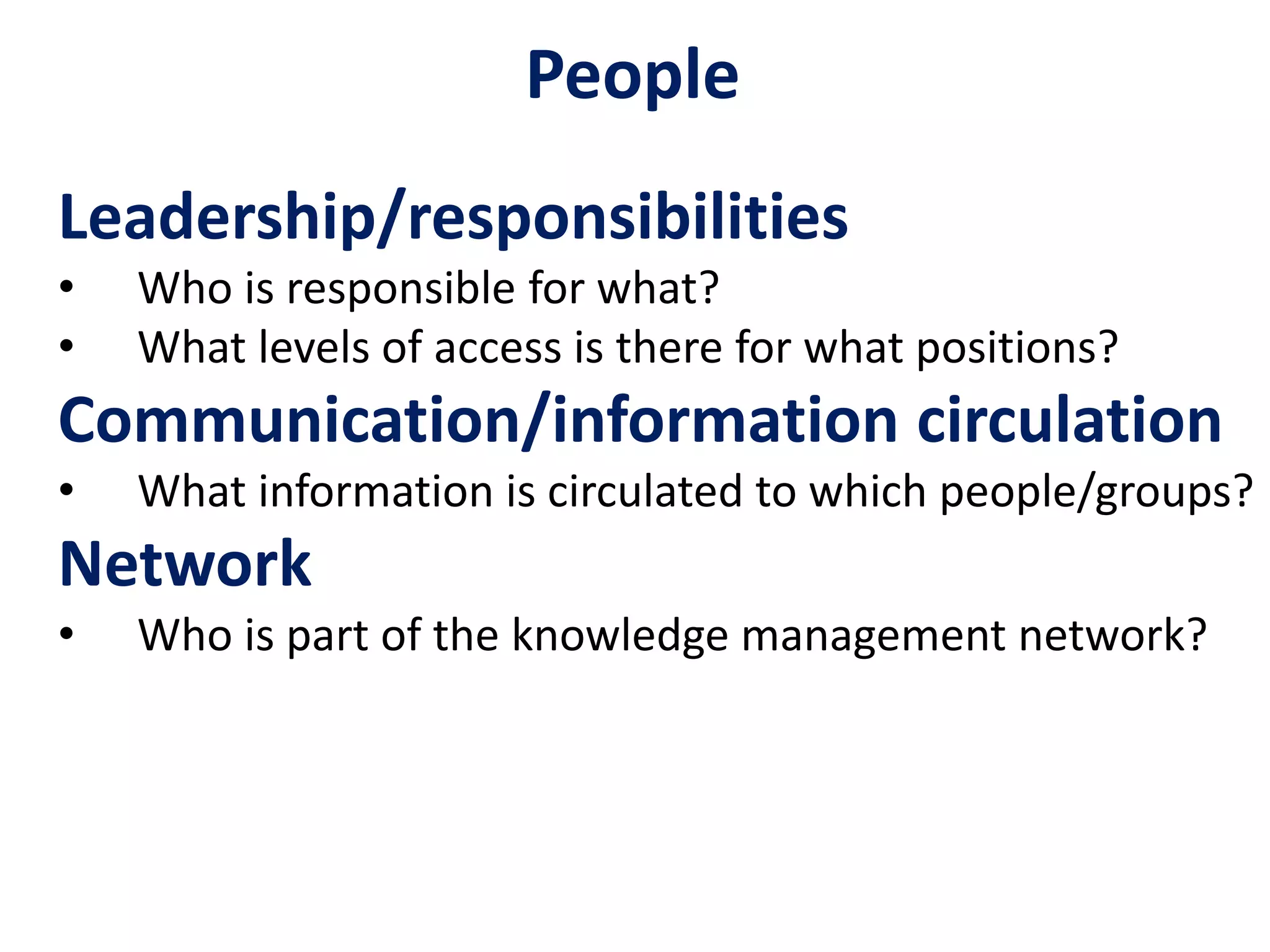
People
Leadership/responsibilities
• Who is responsible for what?
• What levels of access is there for what positions?
Communication/information circulation
• What information is circulated to which people/groups?
Network
• Who is part of the knowledge management network?
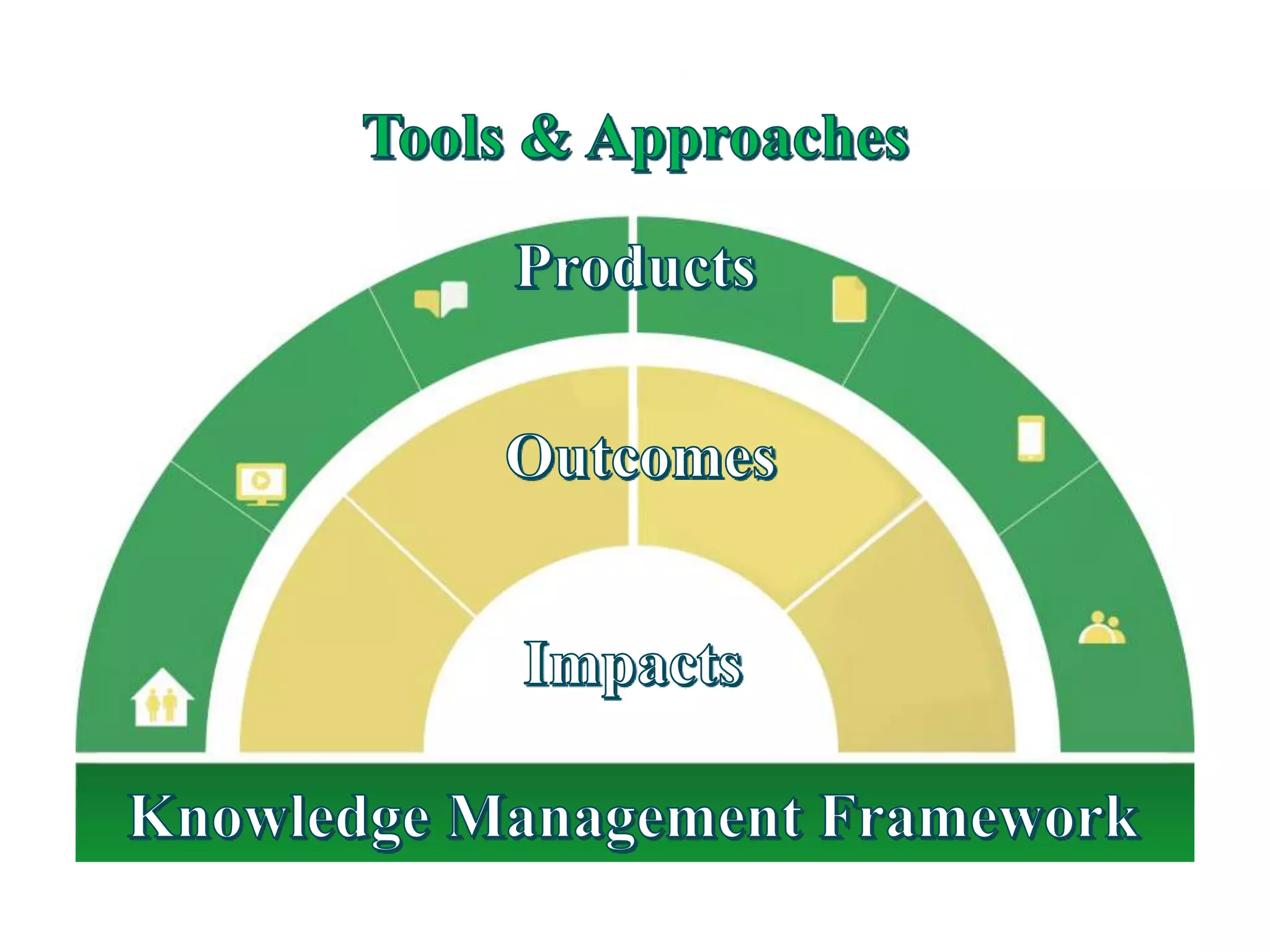
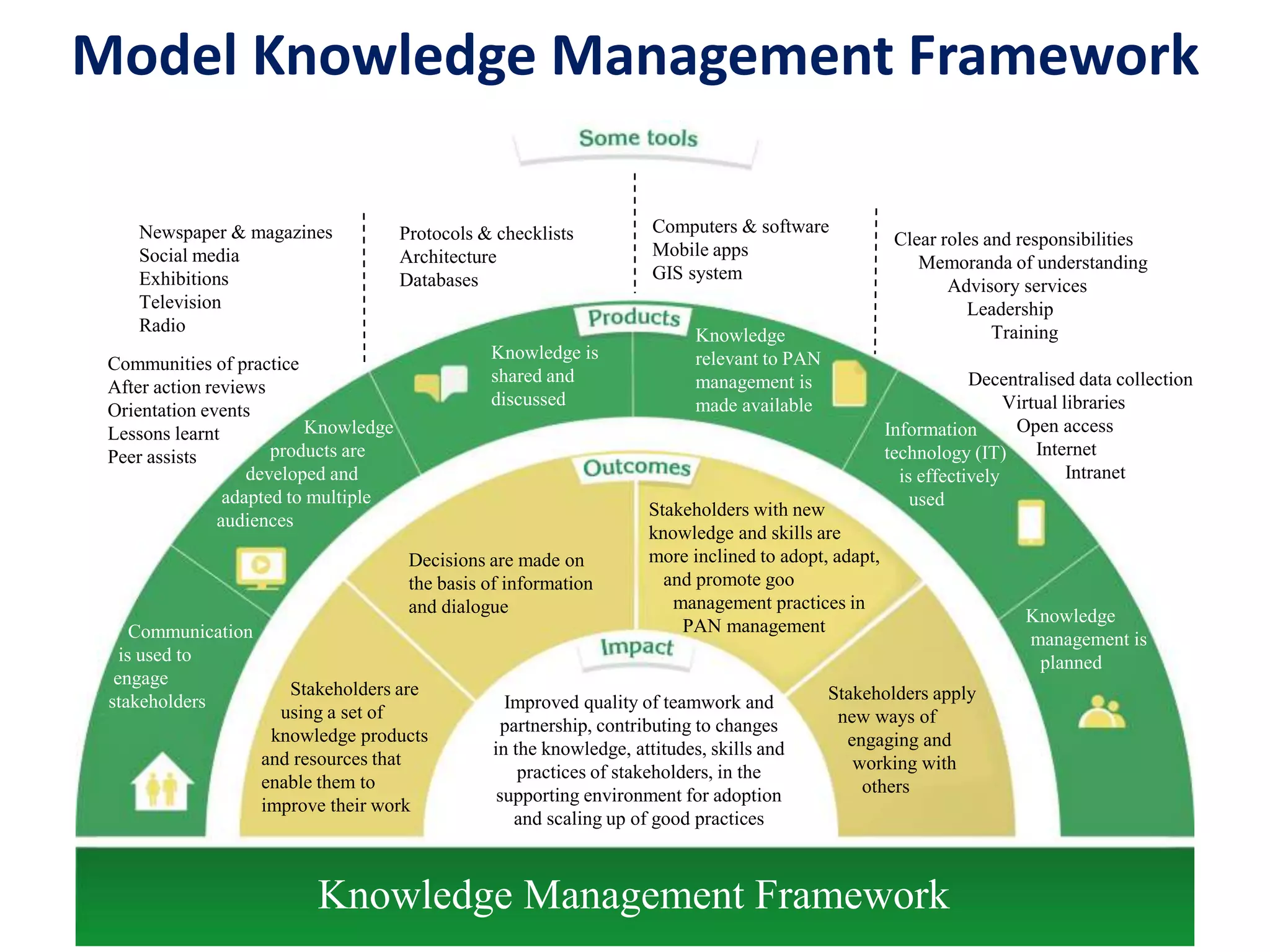
A Model Knowledge Management Framework
Knowledge Management Framework
Communities of practice
After action reviews
Orientation events
Lessons learnt
Peer assists
Newspaper & magazines
Social media
Exhibitions
Television
Radio
Protocols & checklists
Architecture
Databases
Computers & software
Mobile apps
GIS system
Decentralised data collection
Virtual libraries
Open access
Internet
Intranet
Clear roles and responsibilities
Memoranda of understanding
Advisory services
Leadership
Training
Communication
is used to
engage
stakeholders
Knowledge
products are
developed and
adapted to multiple
audiences
Knowledge is
shared and
discussed
Knowledge
relevant to PAN
management is
made available
Information
technology (IT)
is effectively
used
Knowledge
management is
planned
Knowledge Management Framework
Stakeholders are
using a set of
knowledge products
and resources that
enable them to
improve their work
Decisions are made on
the basis of information
and dialogue
Stakeholders with new
knowledge and skills are
more inclined to adopt, adapt,
and promote goo
management practices in
PAN management
Stakeholders apply
new ways of
engaging and
working with
others
Improved quality of teamwork and
partnership, contributing to changes
in the knowledge, attitudes, skills and
practices of stakeholders, in the
supporting environment for adoption
and scaling up of good practices
Model Knowledge Management Framework
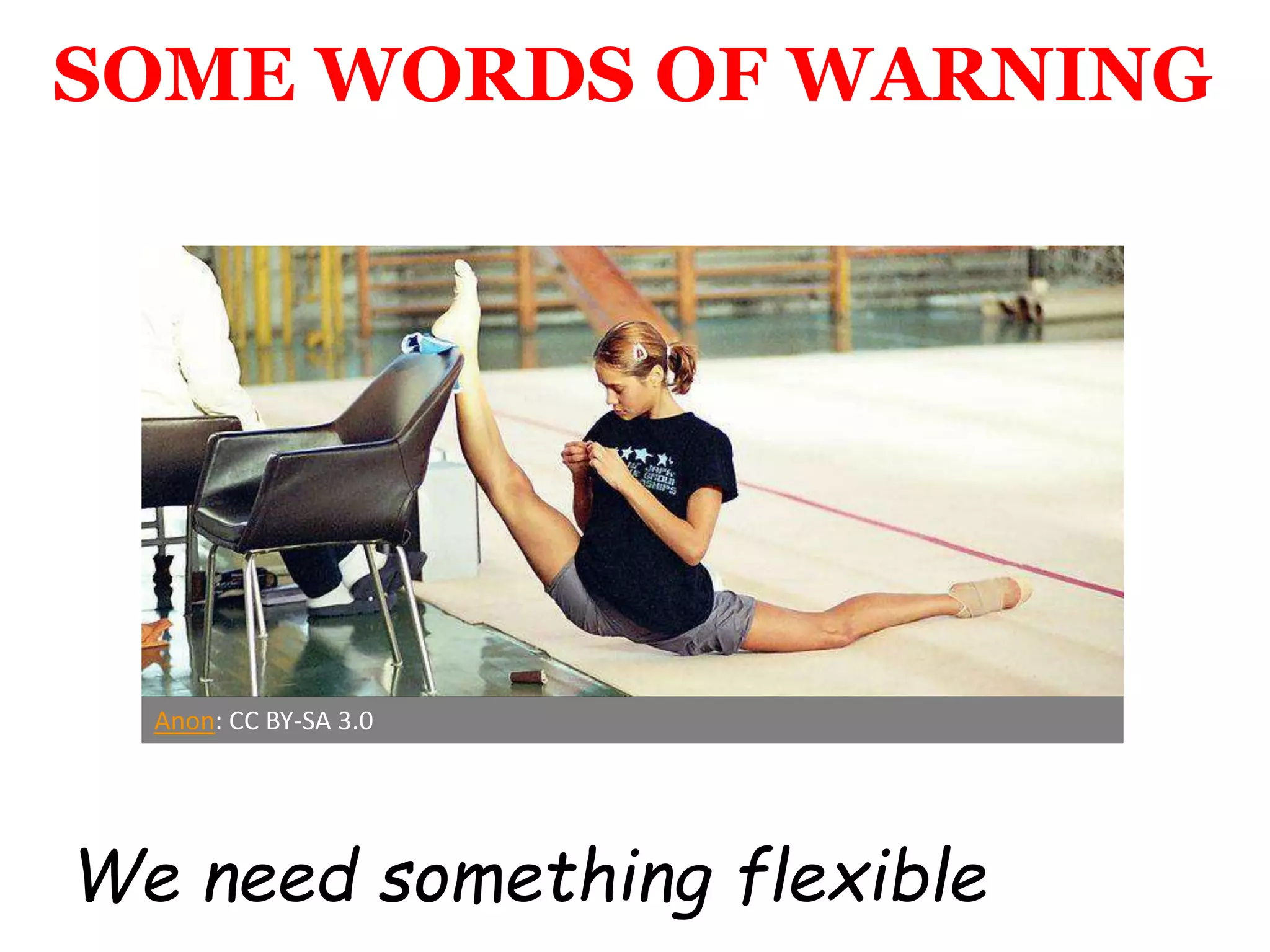
SOME WORDS OF WARNING
We need something flexible
Anon: CC BY-SA 3.0
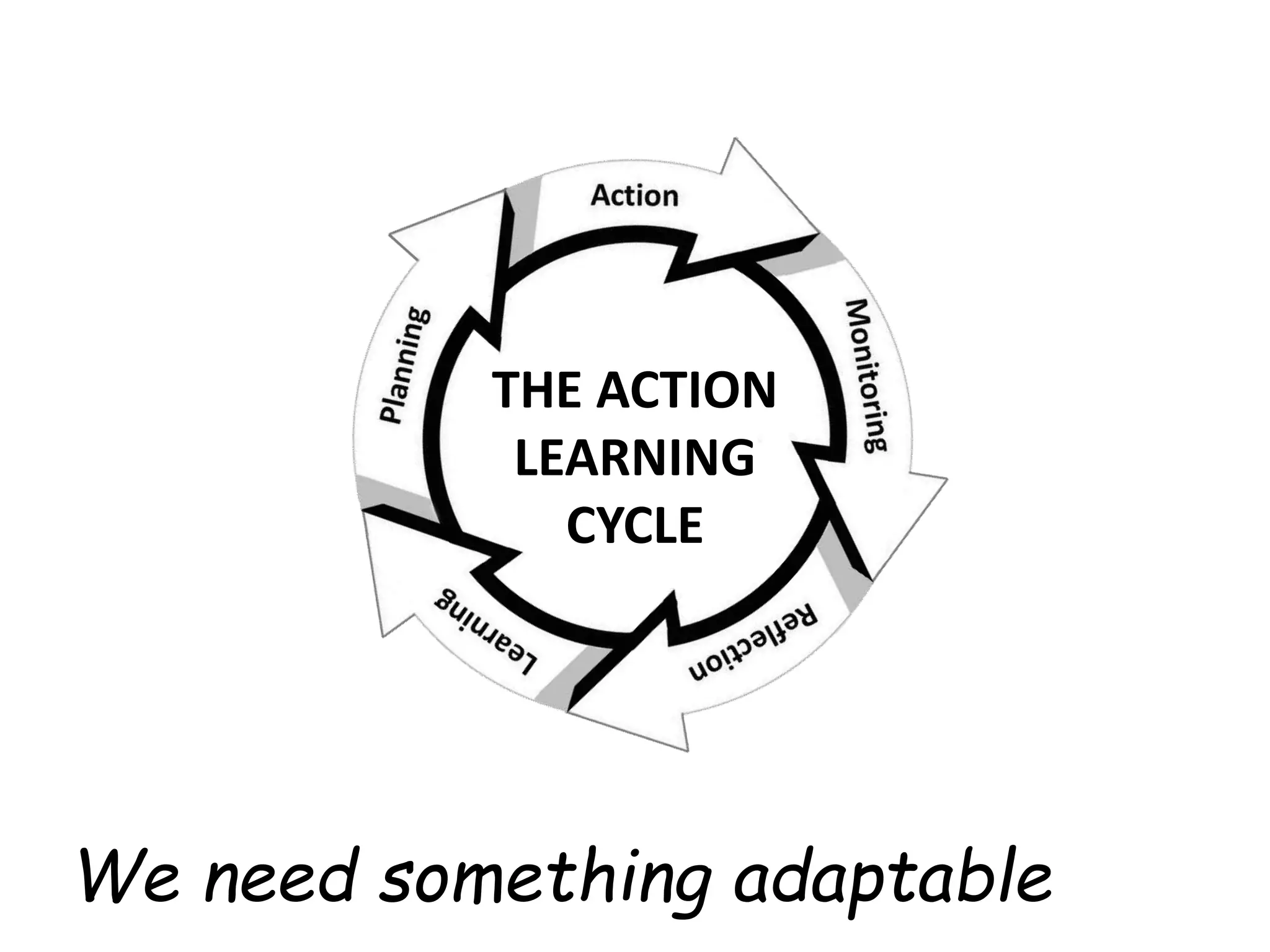
We need something adaptable
THE ACTION
LEARNING
CYCLE
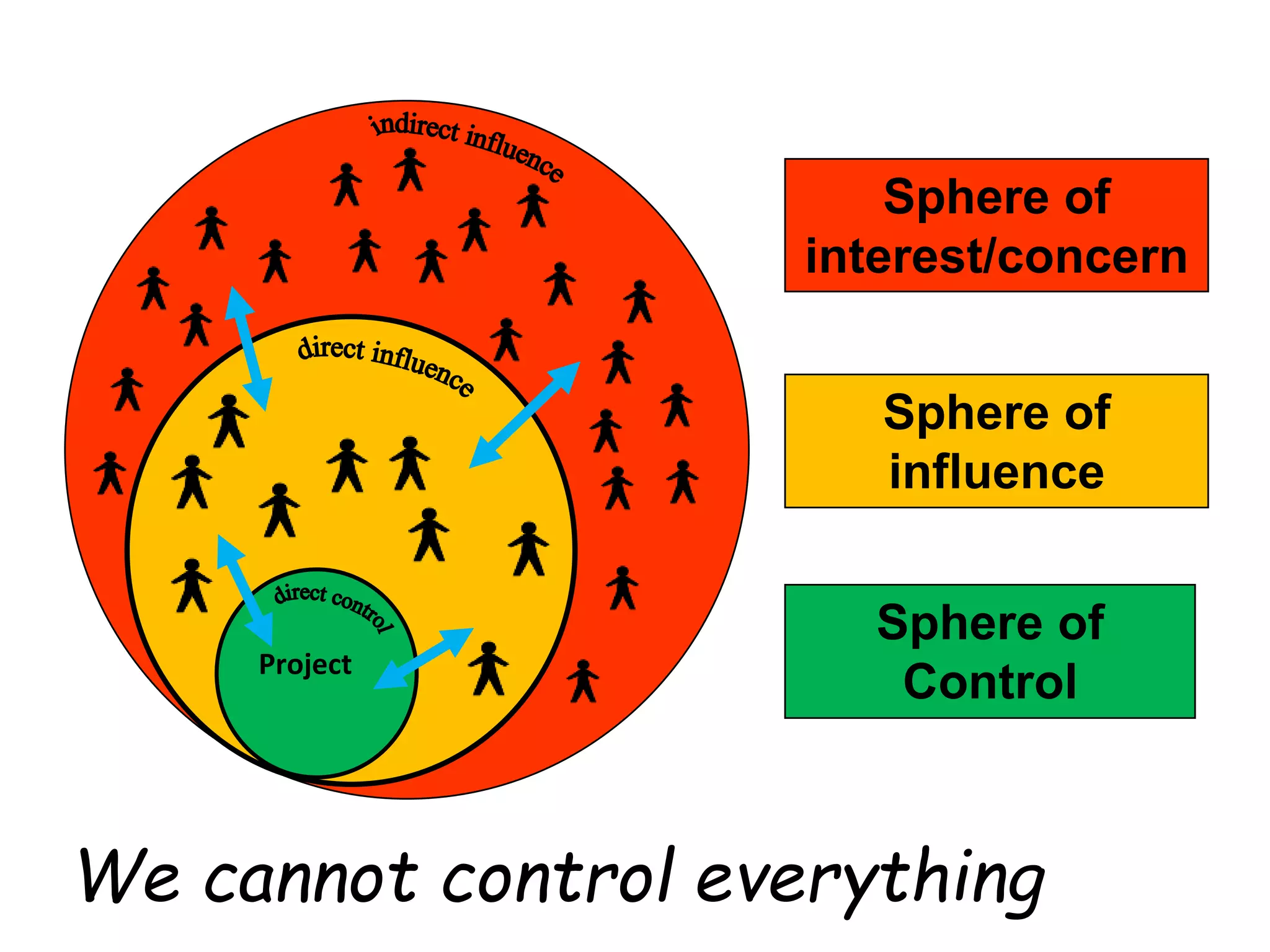
Sphere of
interest/concern
Sphere of
influence
Project
Sphere of
Control
We cannot control everything
2828
Knowledge Products under PAN
29
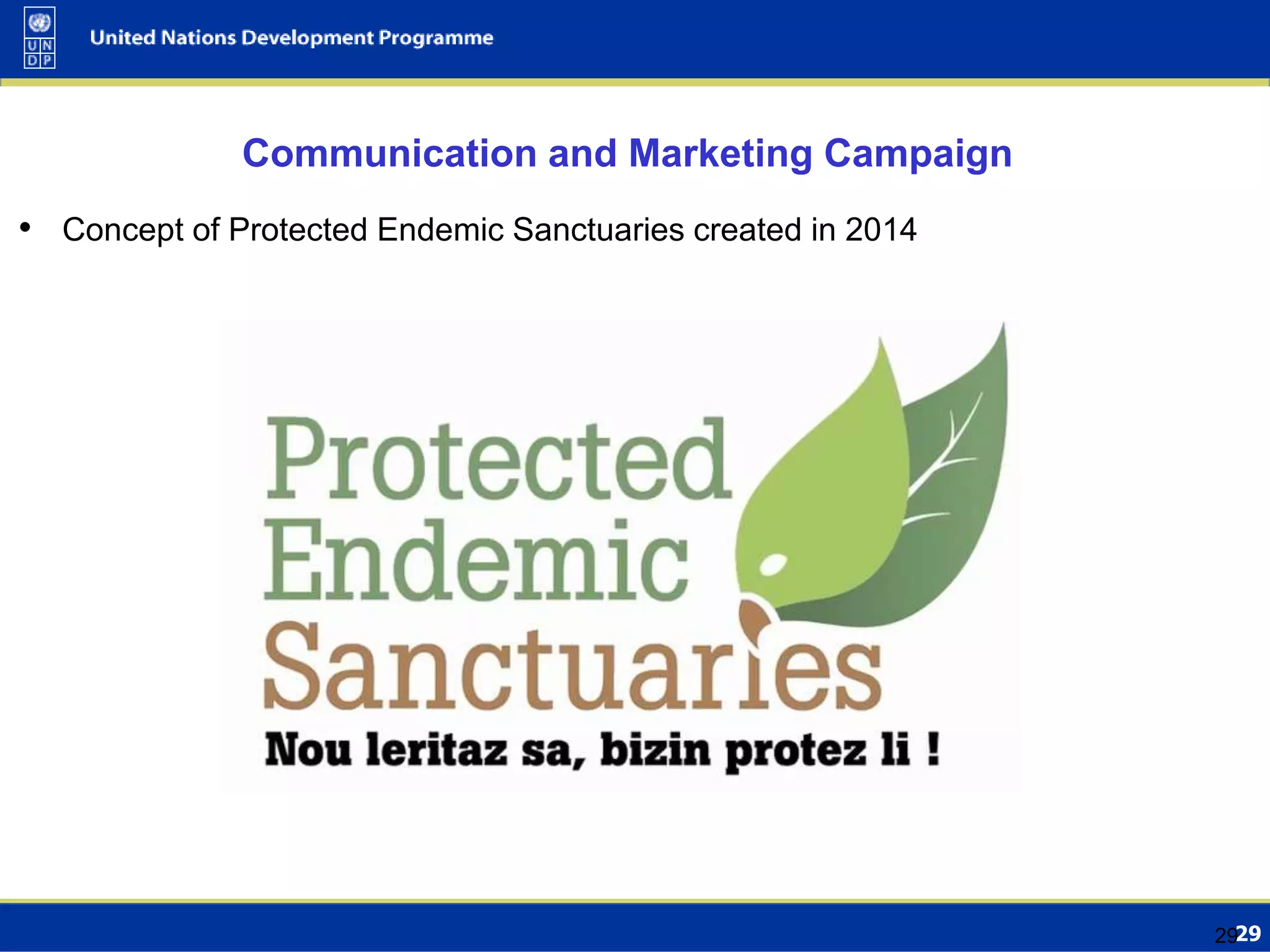
Communication and Marketing Campaign
• Concept of Protected Endemic Sanctuaries created in 2014
29
30
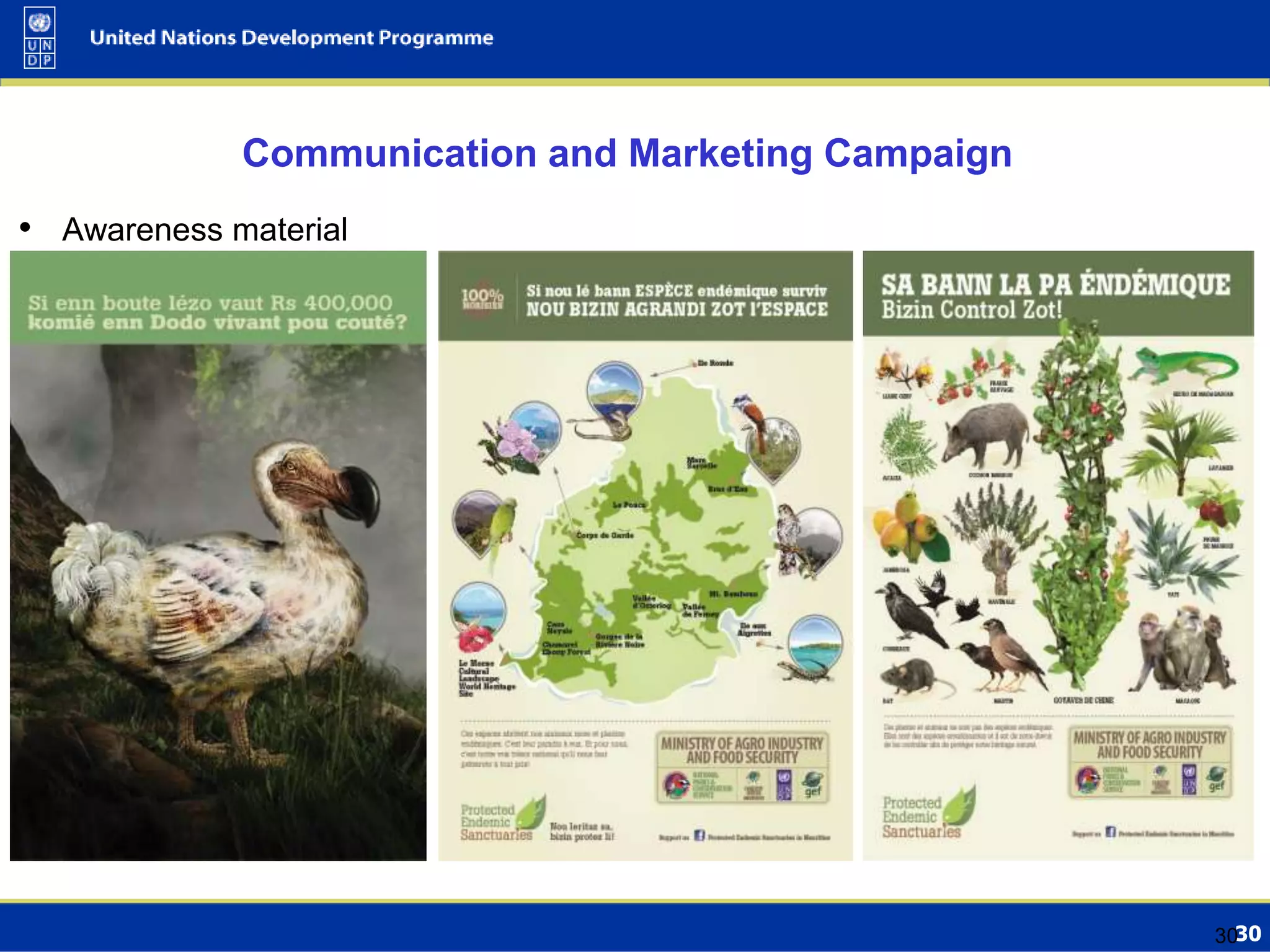
Communication and Marketing Campaign
• Awareness material
30
31
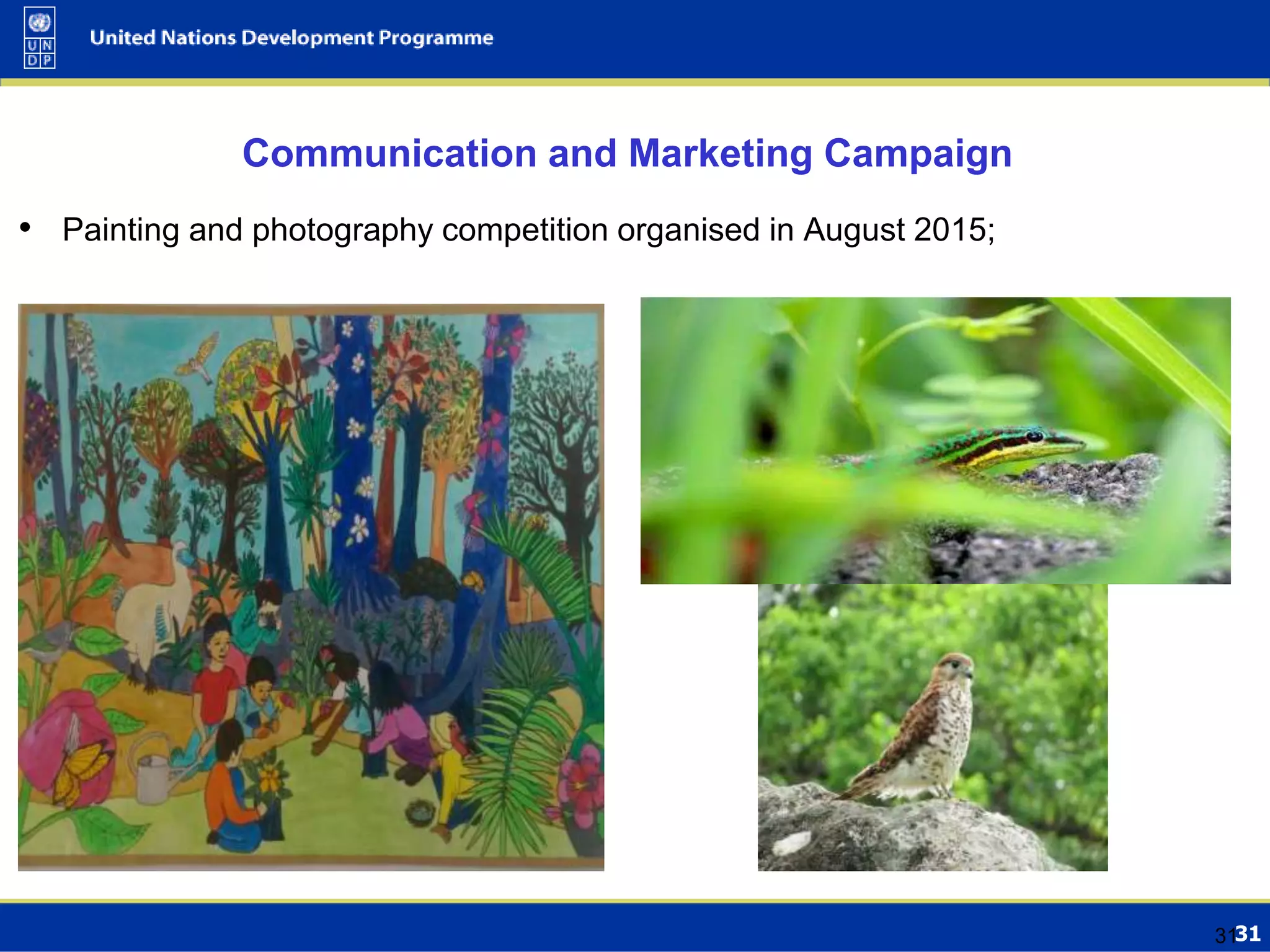
Communication and Marketing Campaign
• Painting and photography competition organised in August 2015;
31
32
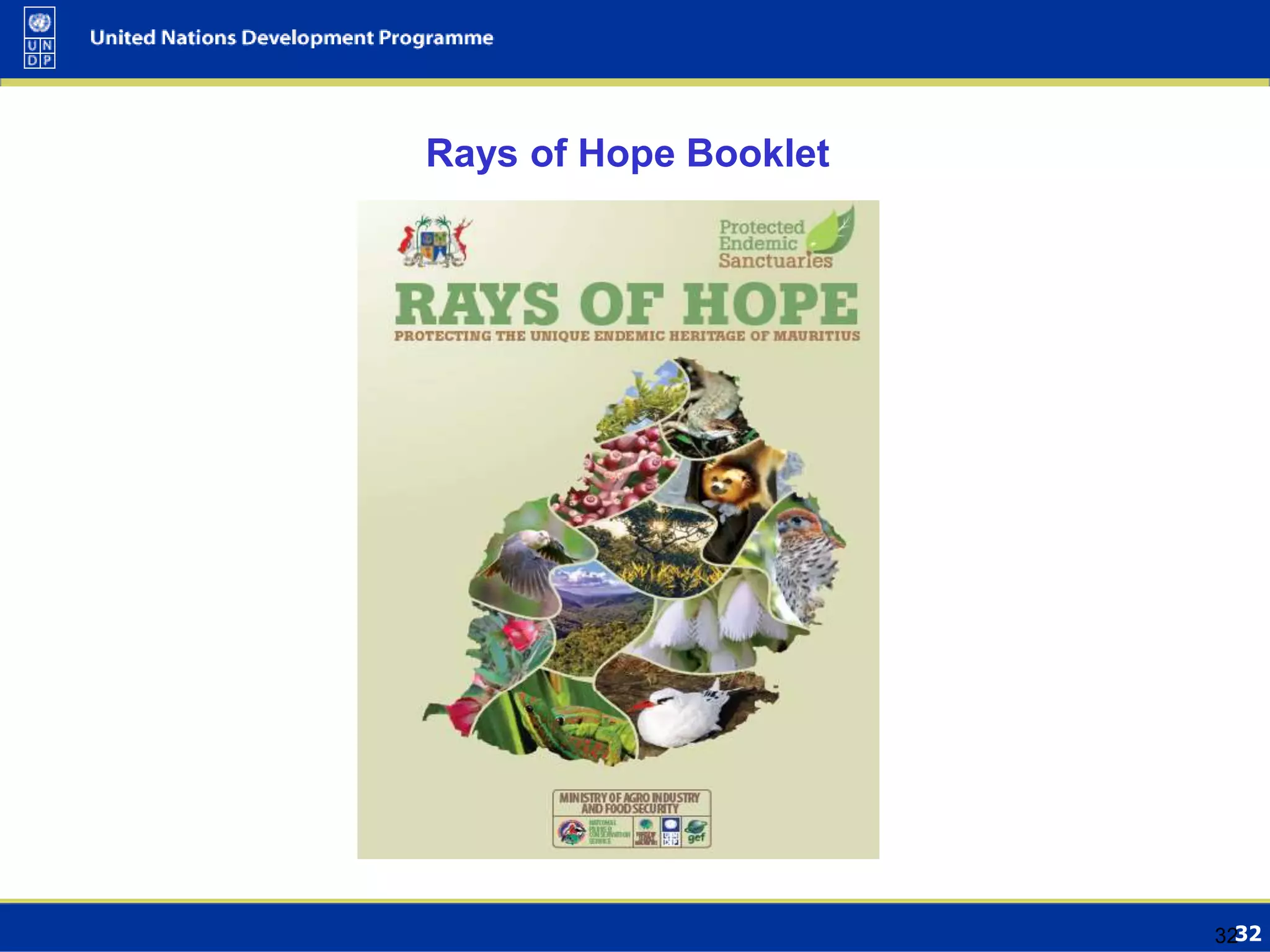
Rays of Hope Booklet
32
33
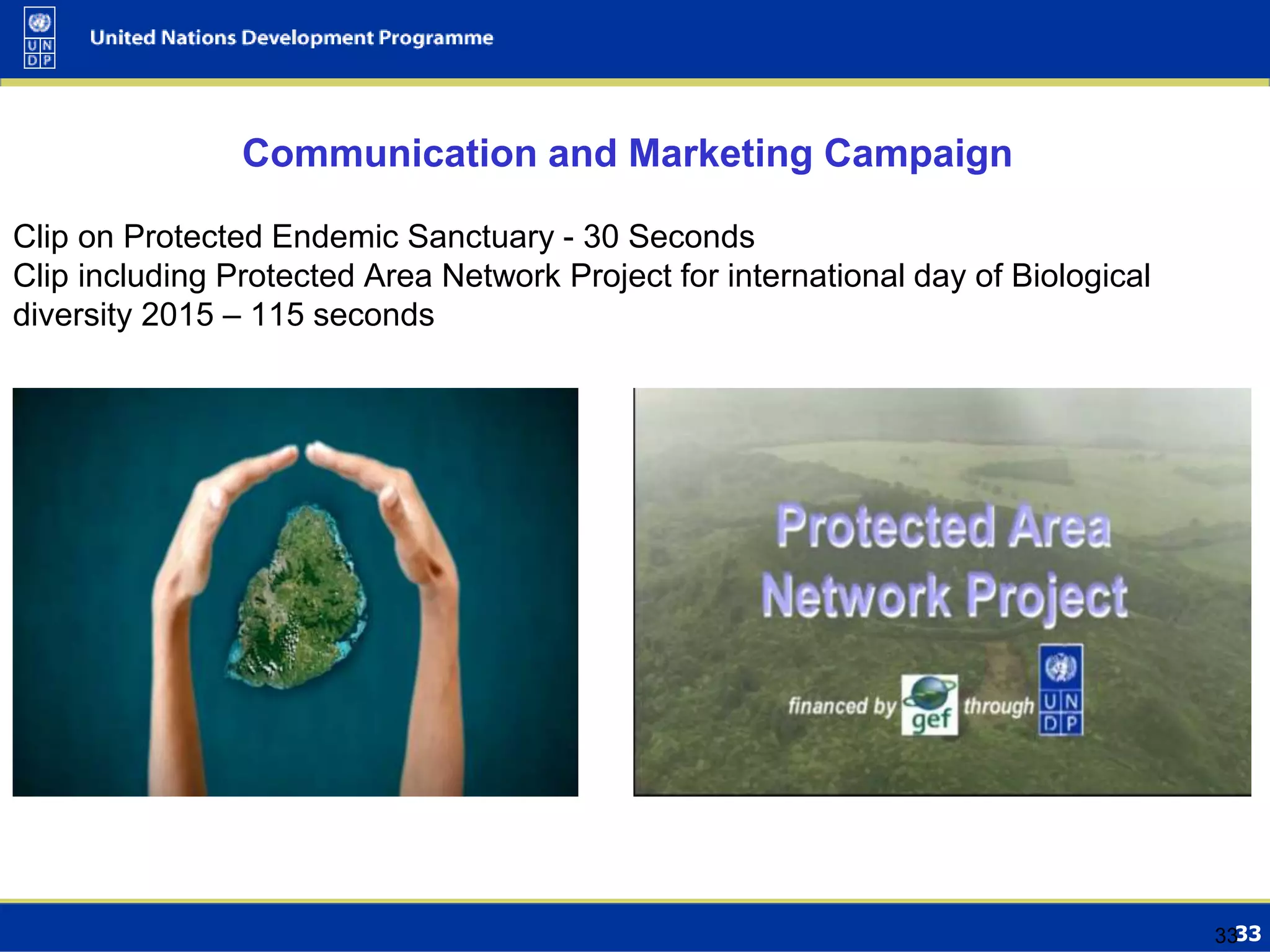
Communication and Marketing Campaign
Clip on Protected Endemic Sanctuary - 30 Seconds
Clip including Protected Area Network Project for international day of Biological
diversity 2015 – 115 seconds
33
34
Communication and Marketing Campaign
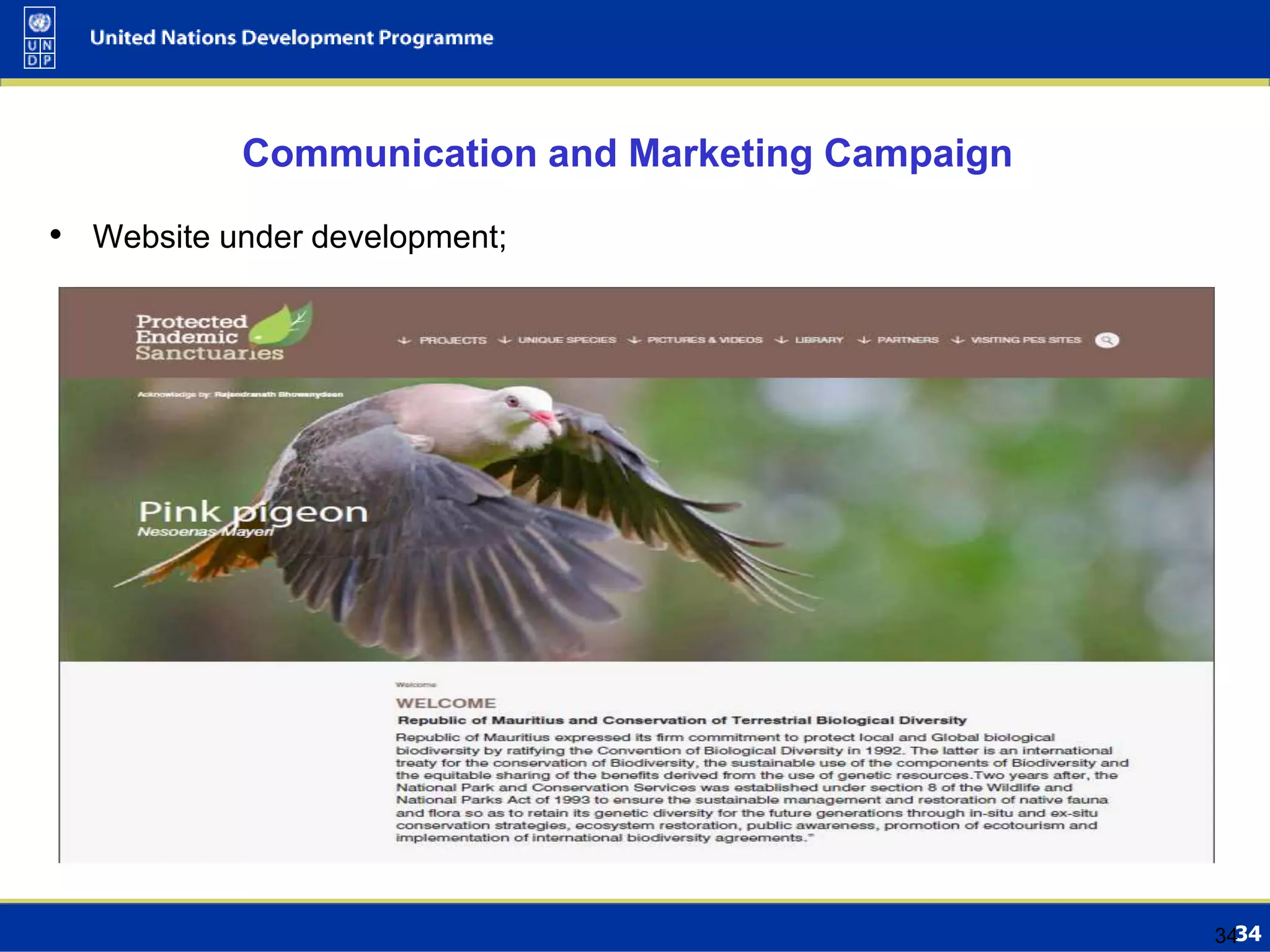
• Website under development;
34
35
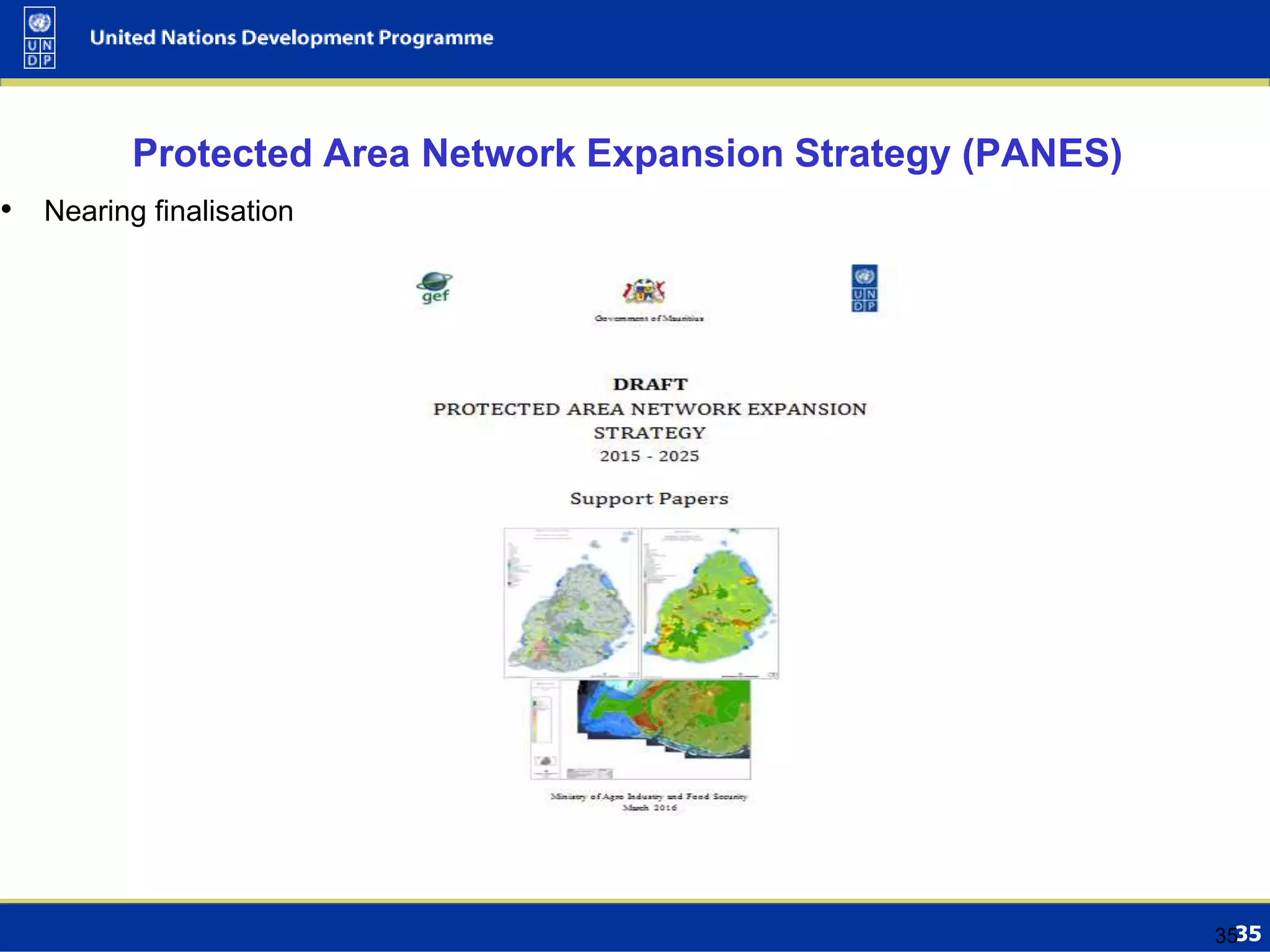
• Nearing finalisation
35
Protected Area Network Expansion Strategy (PANES)
36
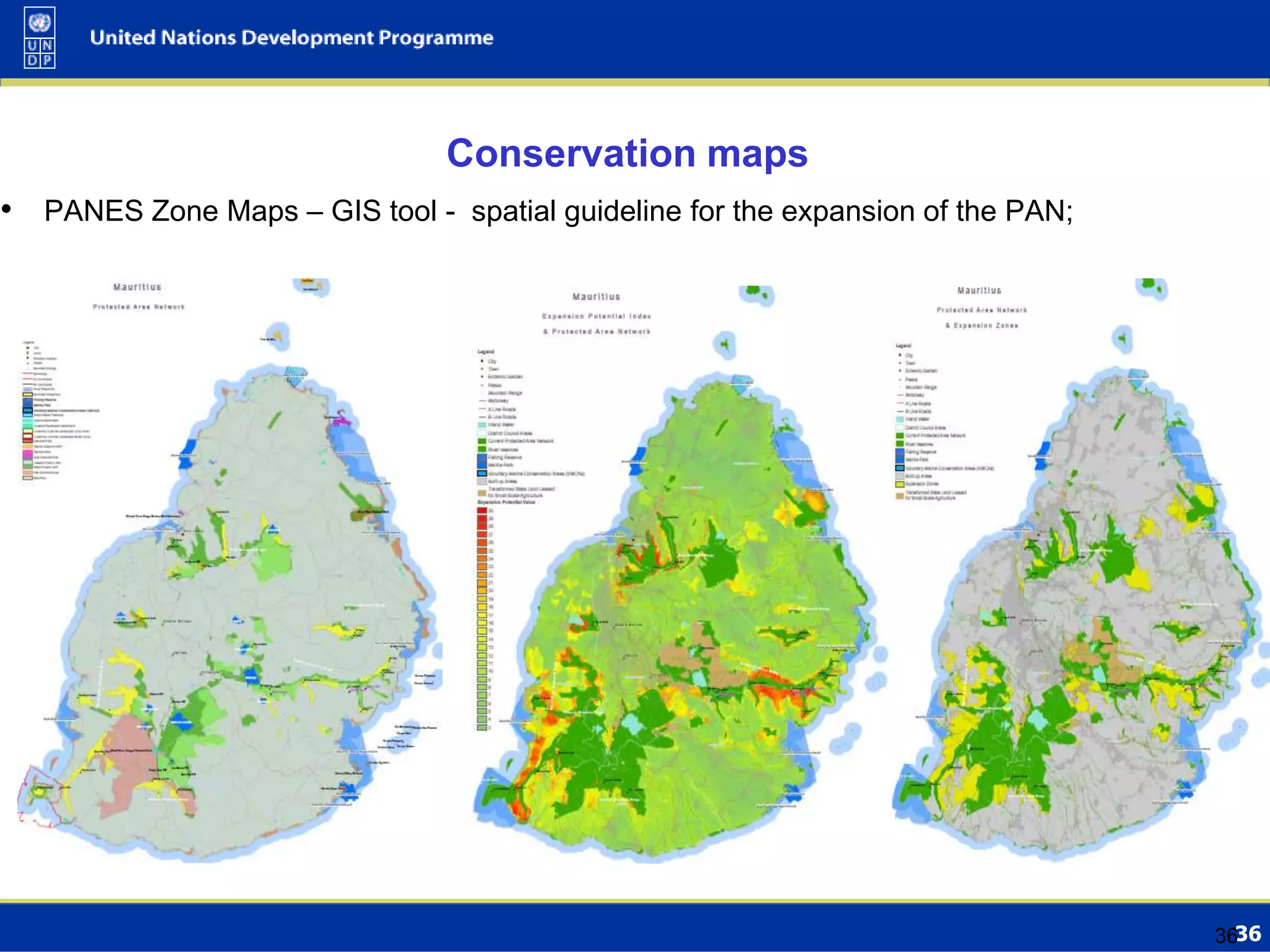
• PANES Zone Maps – GIS tool - spatial guideline for the expansion of the PAN;
36
Conservation maps
3737
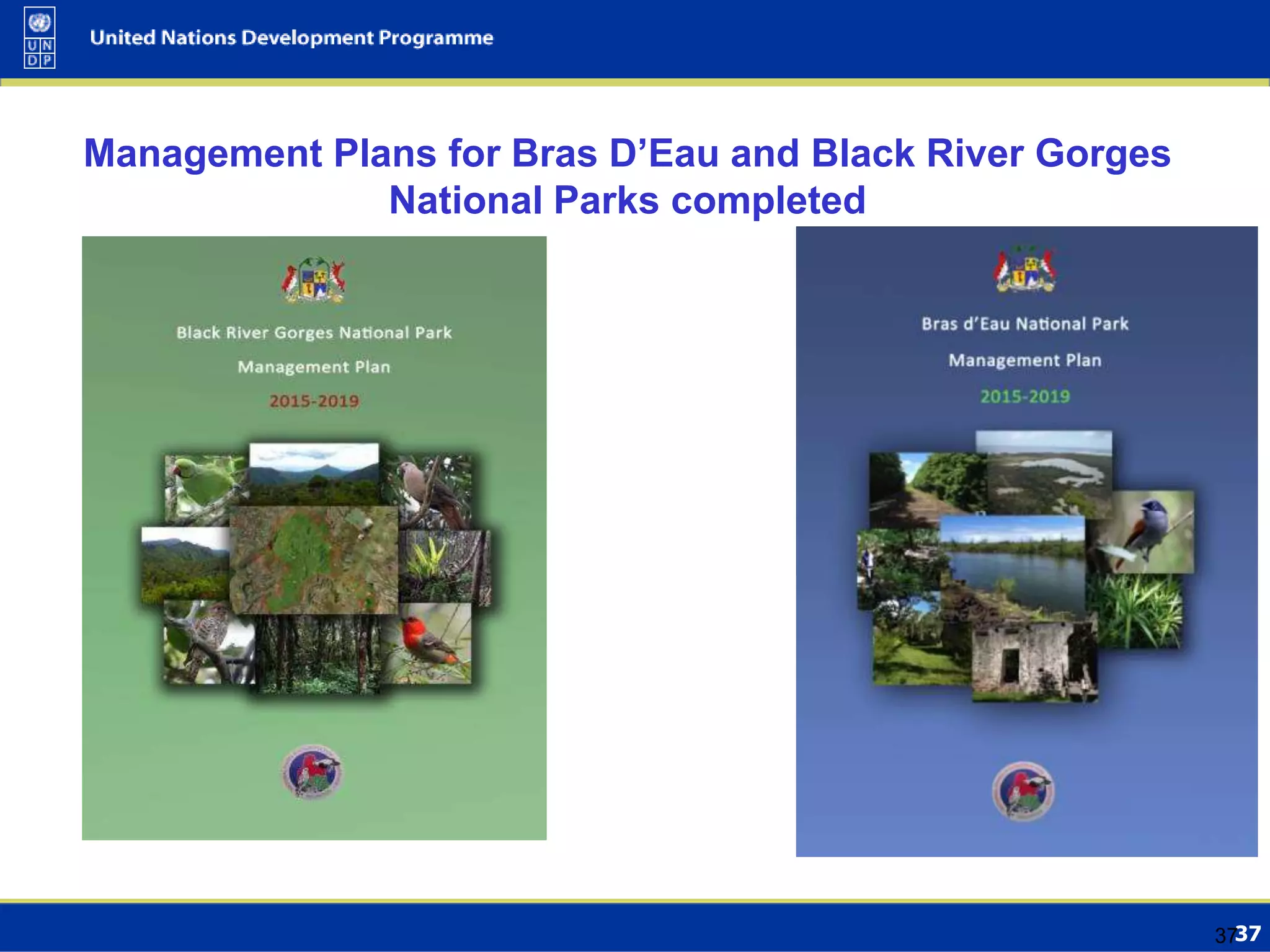
Management Plans for Bras D’Eau and Black River Gorges
National Parks completed
3838
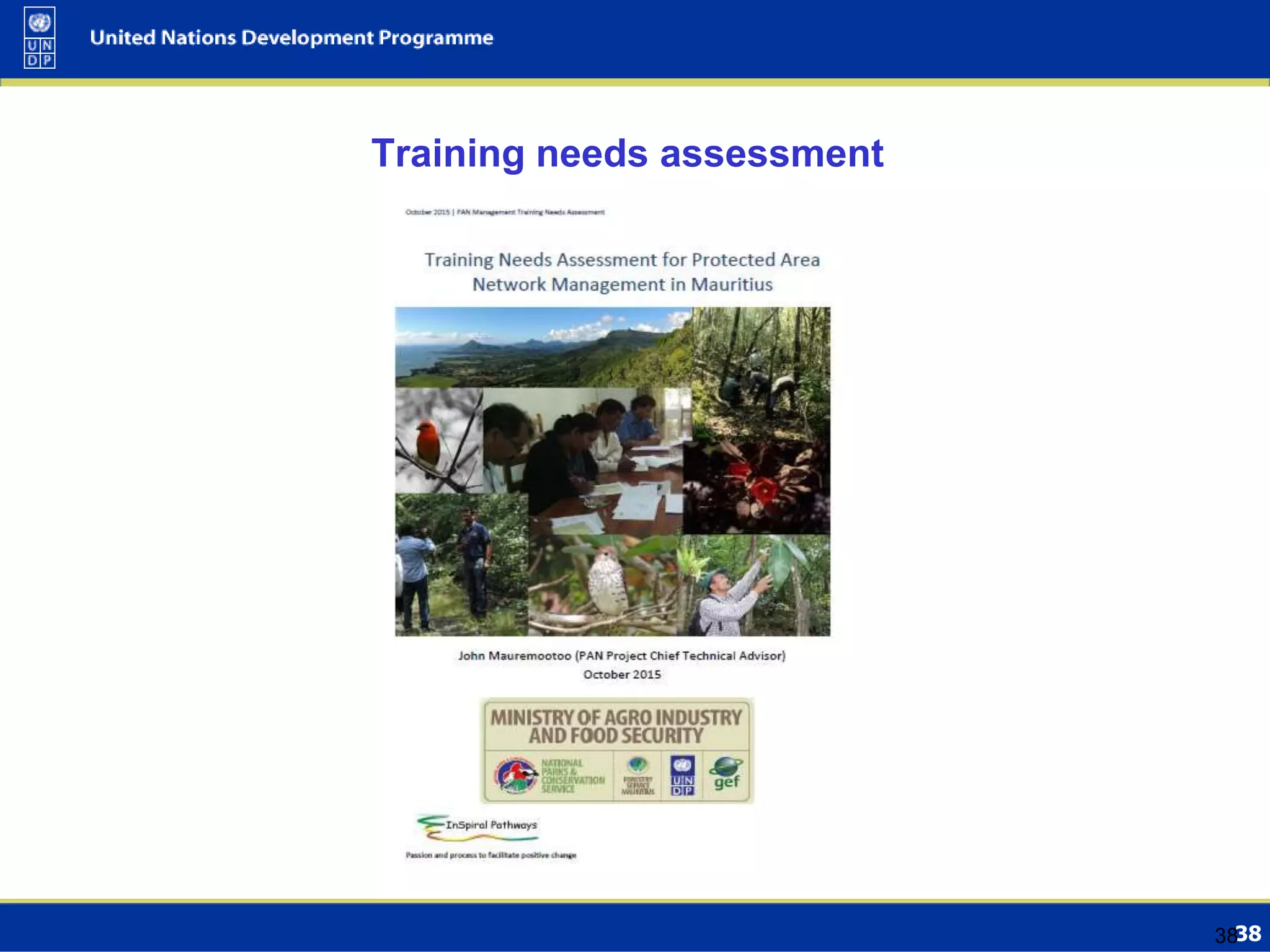
Training needs assessment
3939
Other forms of Knowledge products
• Progress reports;
• Financial reports;
• Notes of Meeting;
• Mission reports;
• Project briefs;
• Relevant reporting to UNDP, GEF and MoAIFS
4040
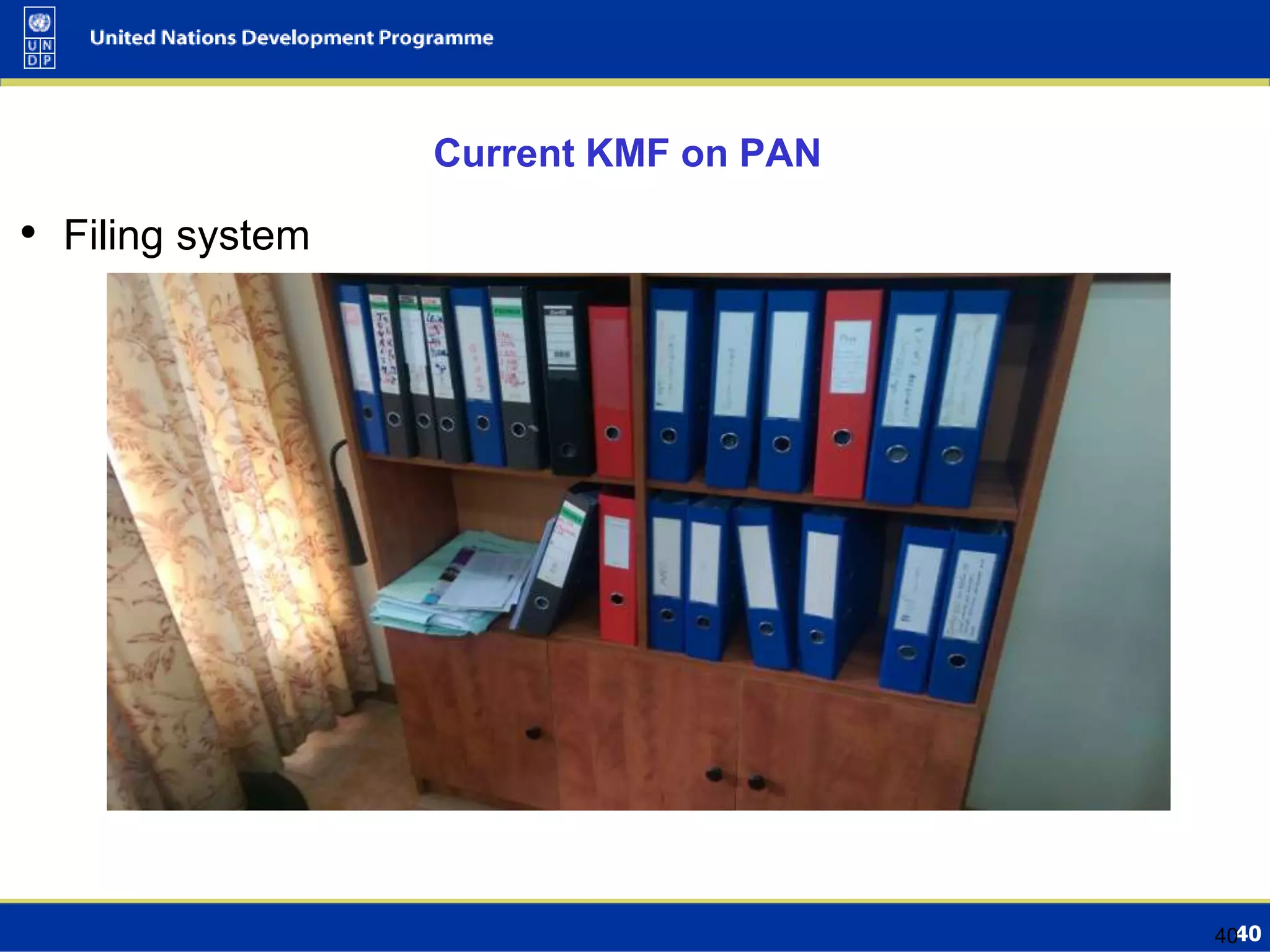
Current KMF on PAN
• Filing system
4141
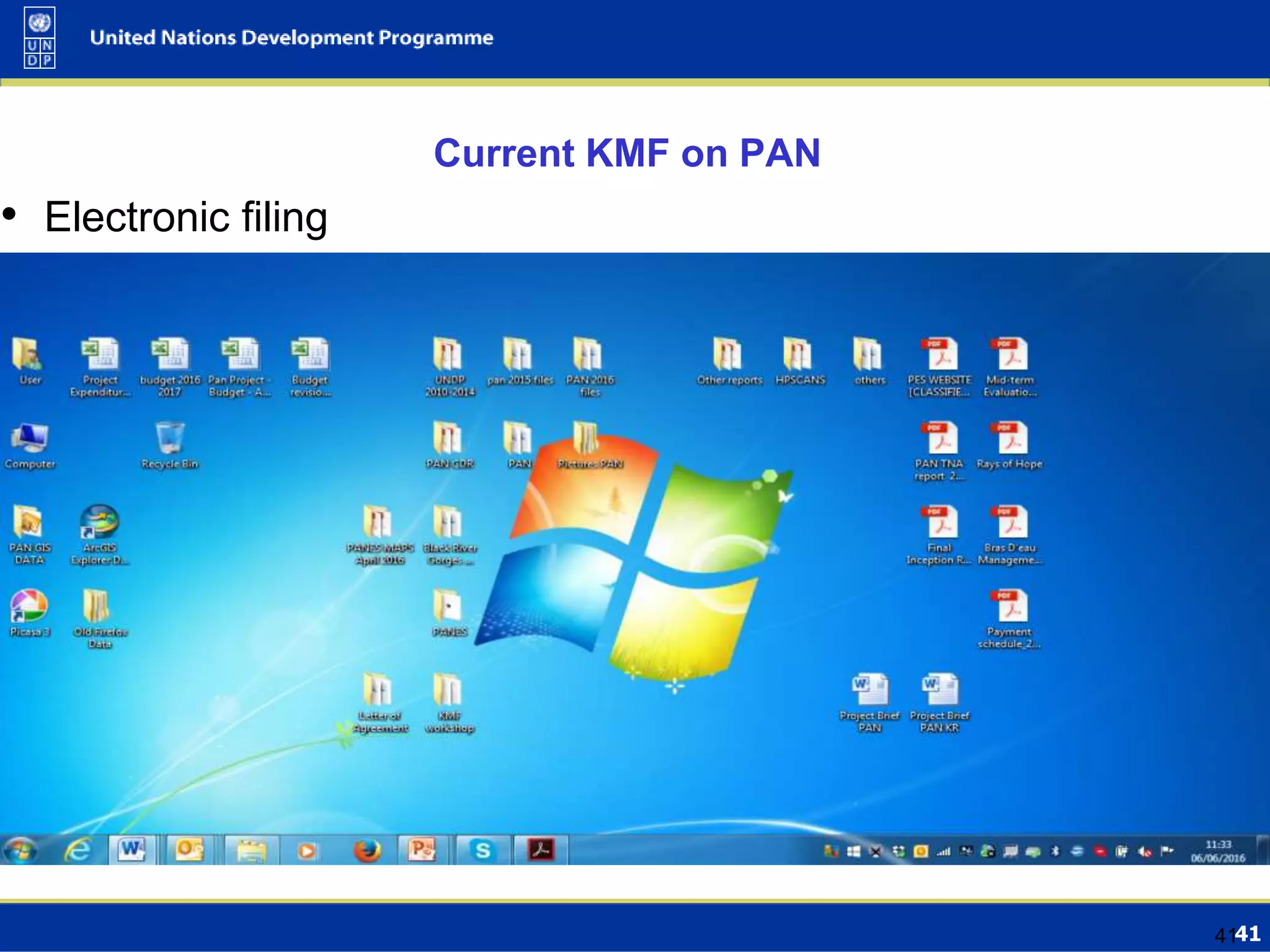
Current KMF on PAN
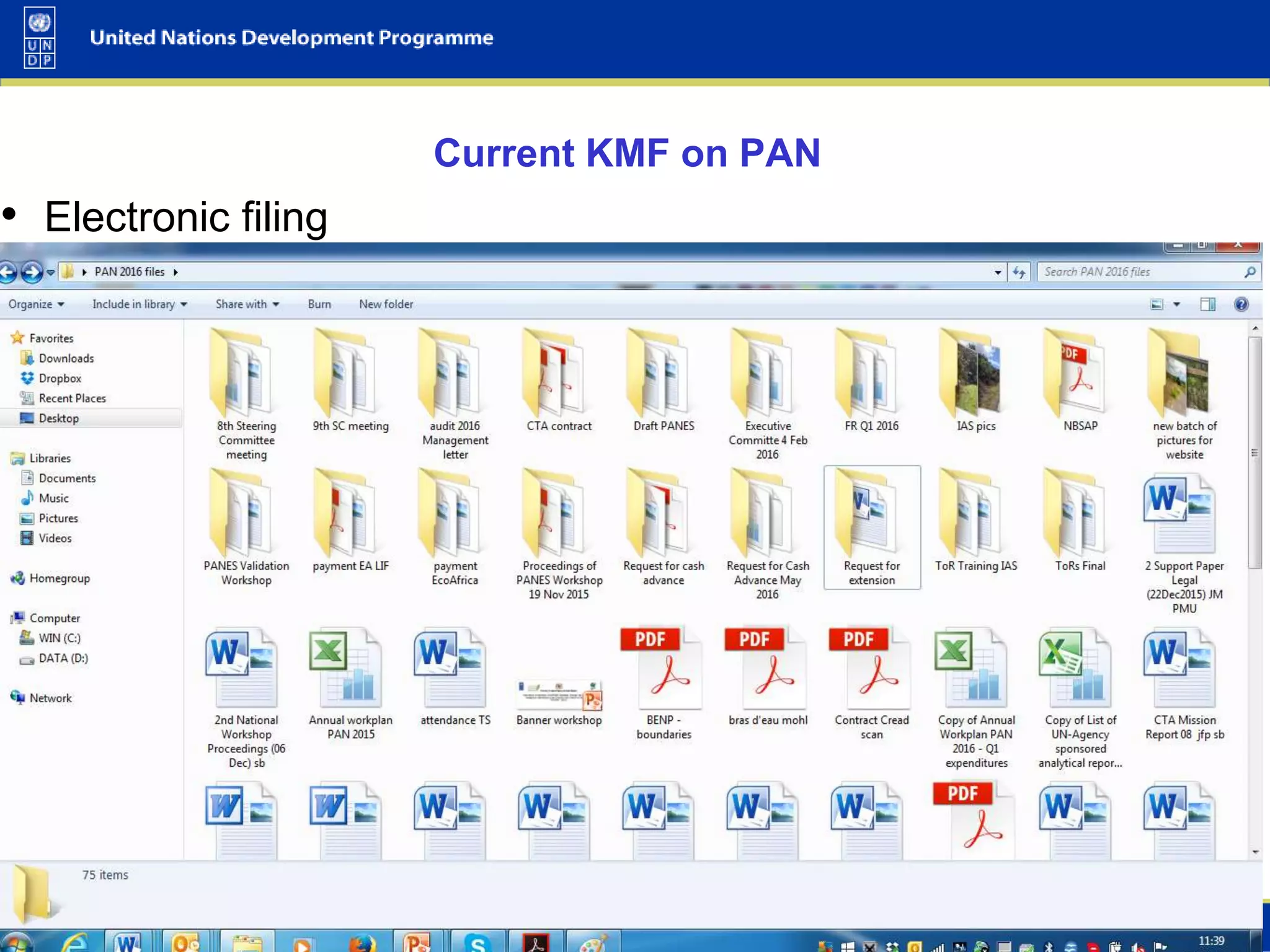
• Electronic filing
4242
Current KMF on PAN
• Electronic filing
4343
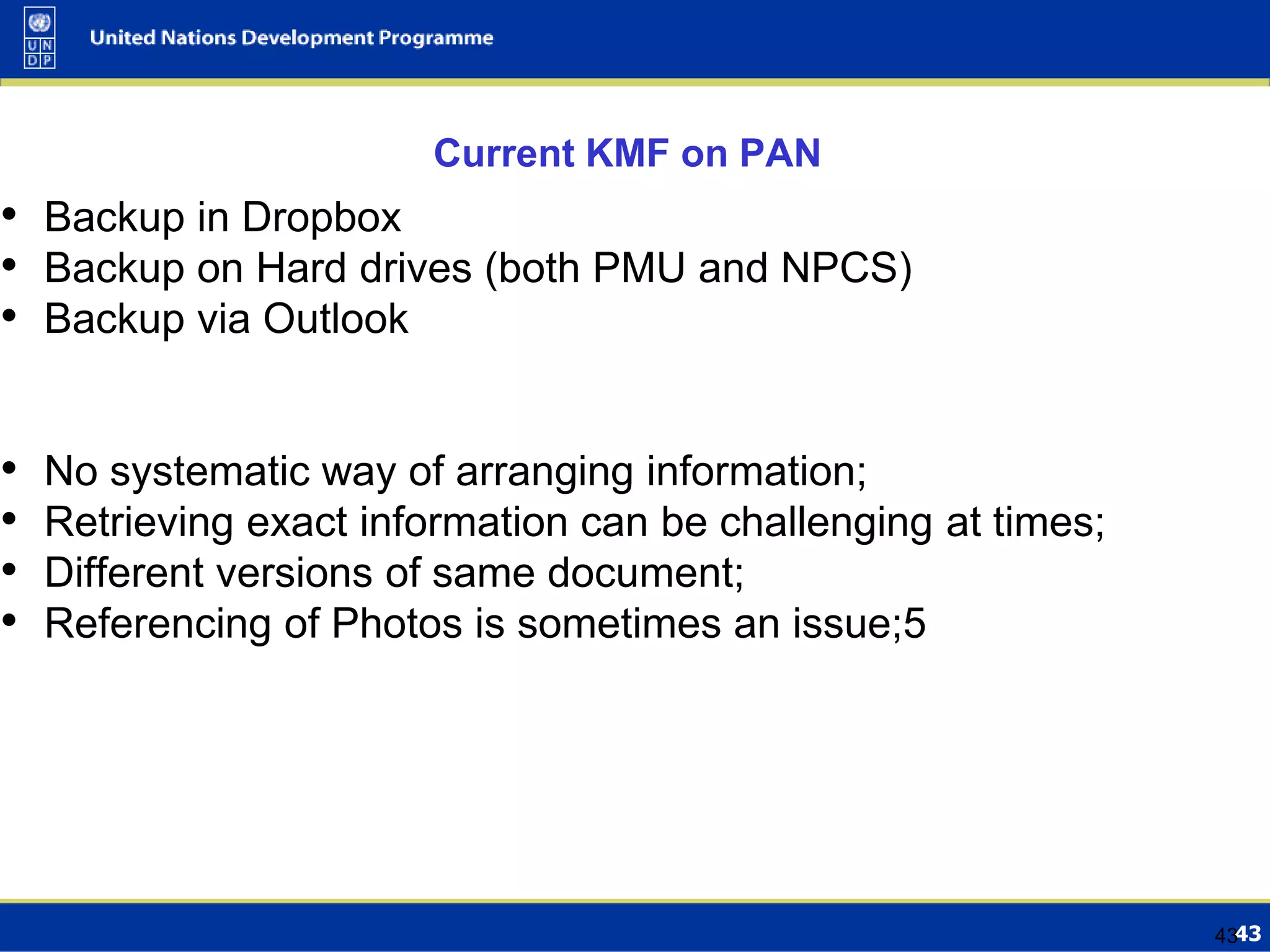
Current KMF on PAN
• Backup in Dropbox
• Backup on Hard drives (both PMU and NPCS)
• Backup via Outlook
• No systematic way of arranging information;
• Retrieving exact information can be challenging at times;
• Different versions of same document;
• Referencing of Photos is sometimes an issue;5
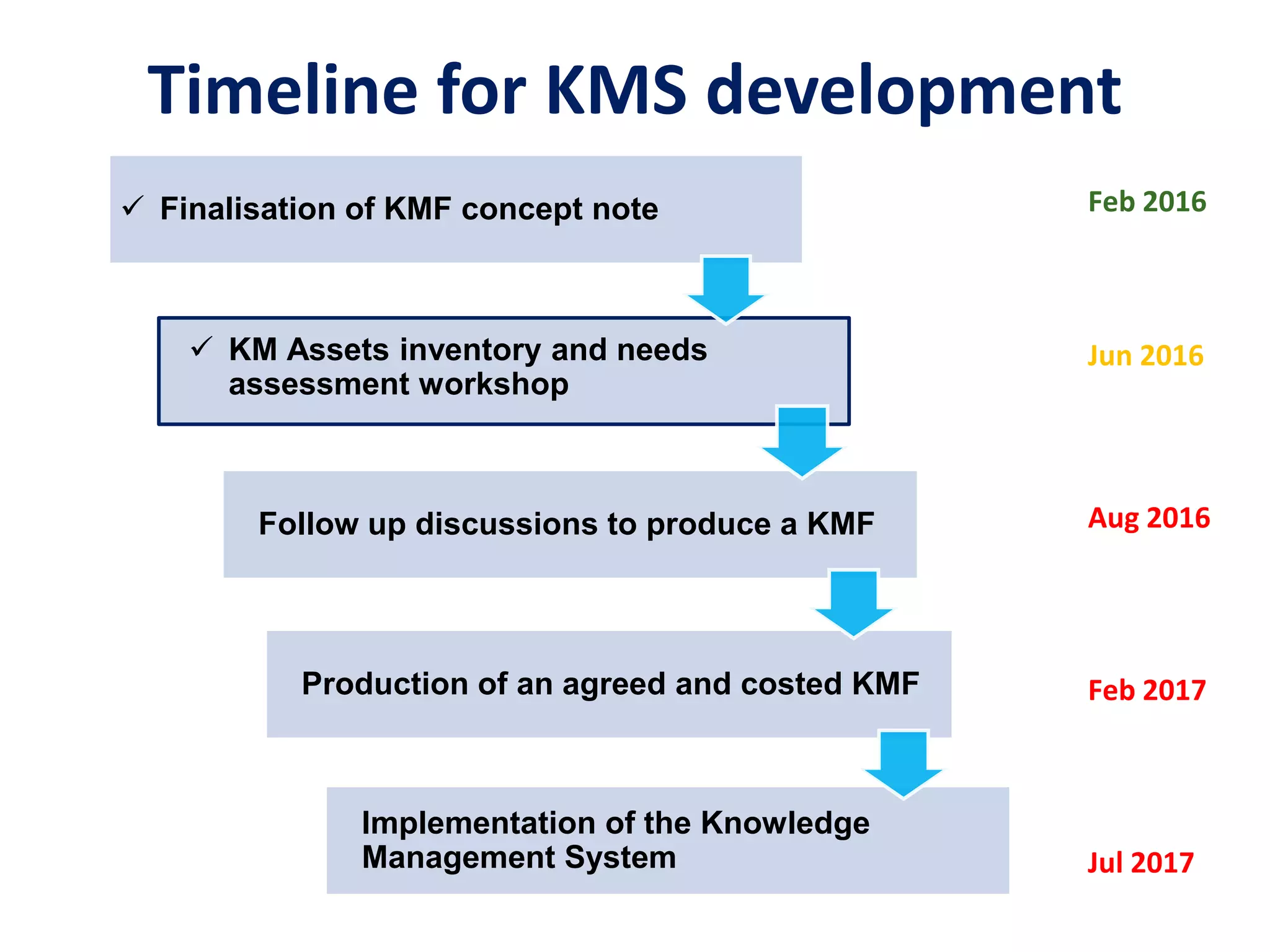
Timeline for KMS development
 Finalisation of KMF concept note
Follow up discussions to produce a KMF
Production of an agreed and costed KMF
Implementation of the Knowledge
Management System
Feb 2016
Jul 2017
Jun 2016
Aug 2016
 KM Assets inventory and needs
assessment workshop
Feb 2017
Assets Inventory & Needs Assessment
Workshop
Process
Appreciative Inquiry
and
Mental Contrasting
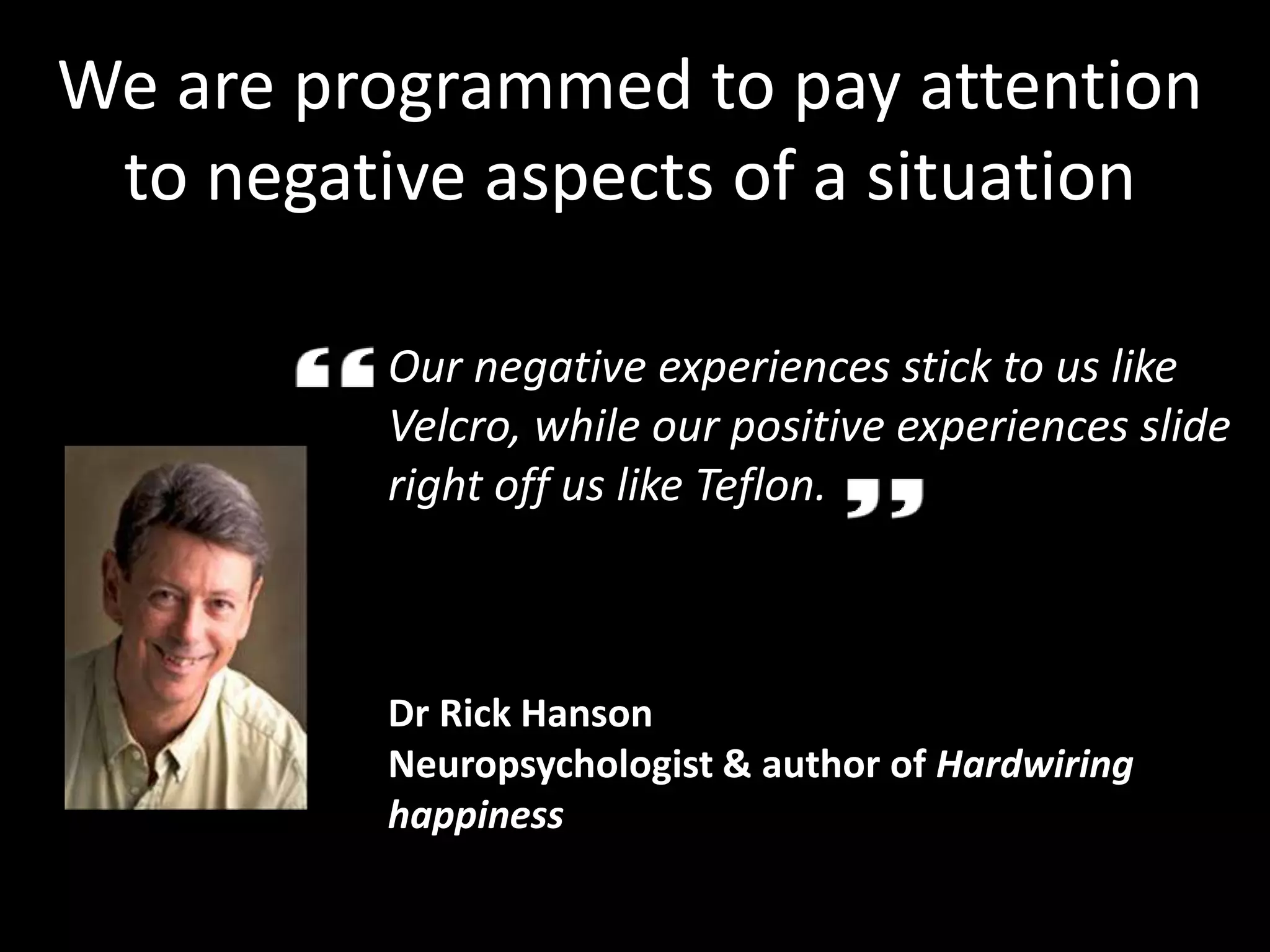
Our negative experiences stick to us like
Velcro, while our positive experiences slide
right off us like Teflon.
Dr Rick Hanson
Neuropsychologist & author of Hardwiring
happiness
We are programmed to pay attention
to negative aspects of a situation
We are programmed to pay attention
to negative aspects of a situation
We are programmed to pay attention
to negative aspects of a situation
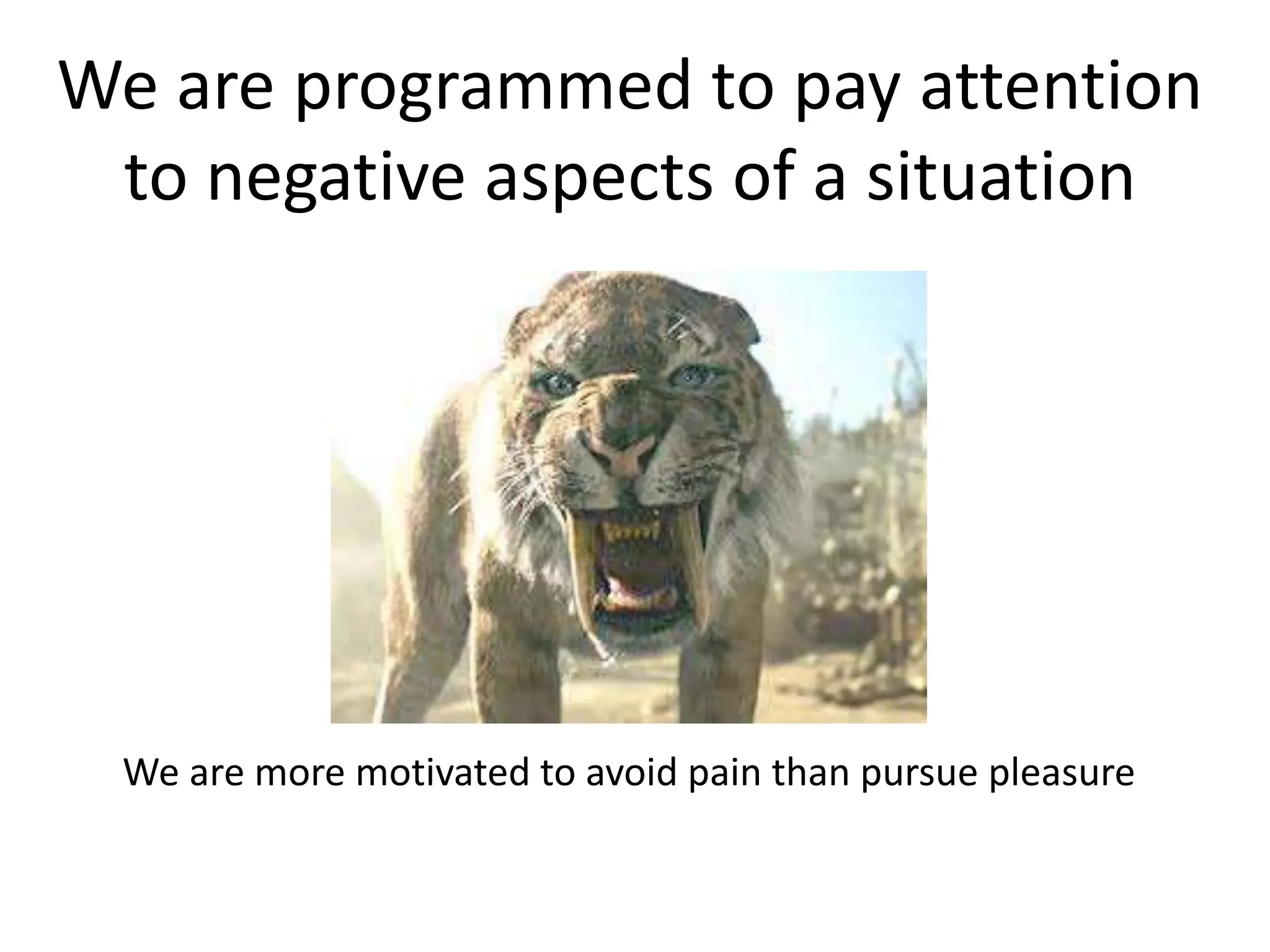
We are more motivated to avoid pain than pursue pleasure
We are programmed to pay attention
to negative aspects of a situation
• The “problem statement” or “Barriers” approach to change
• Let’s fix what’s wrong and let the strengths take care of themselves
Appreciative Inquiry focuses on an
issue from the solution side
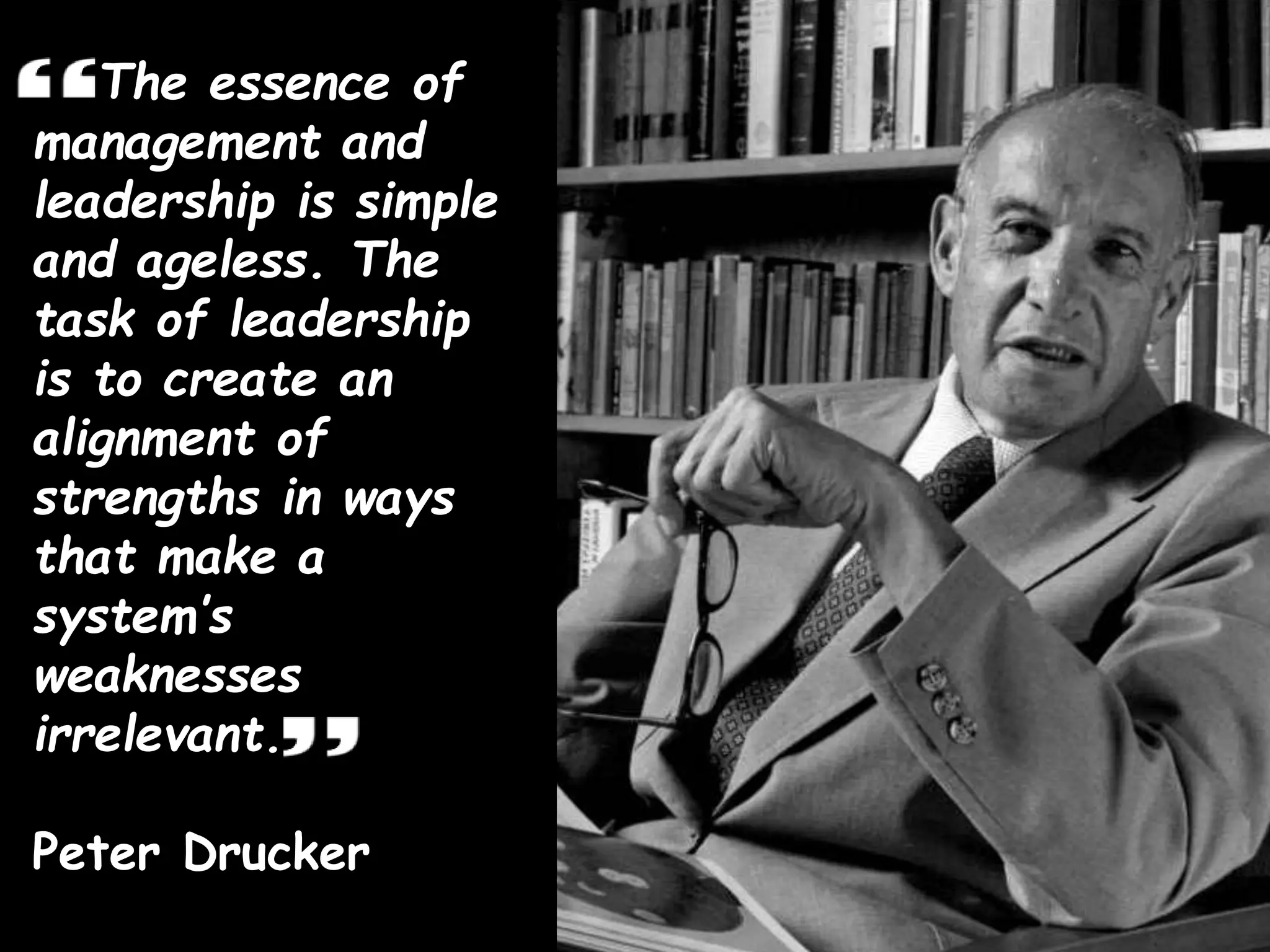
The essence of
management and
leadership is simple
and ageless. The
task of leadership
is to create an
alignment of
strengths in ways
that make a
system’s
weaknesses
irrelevant.
Peter Drucker
BUT
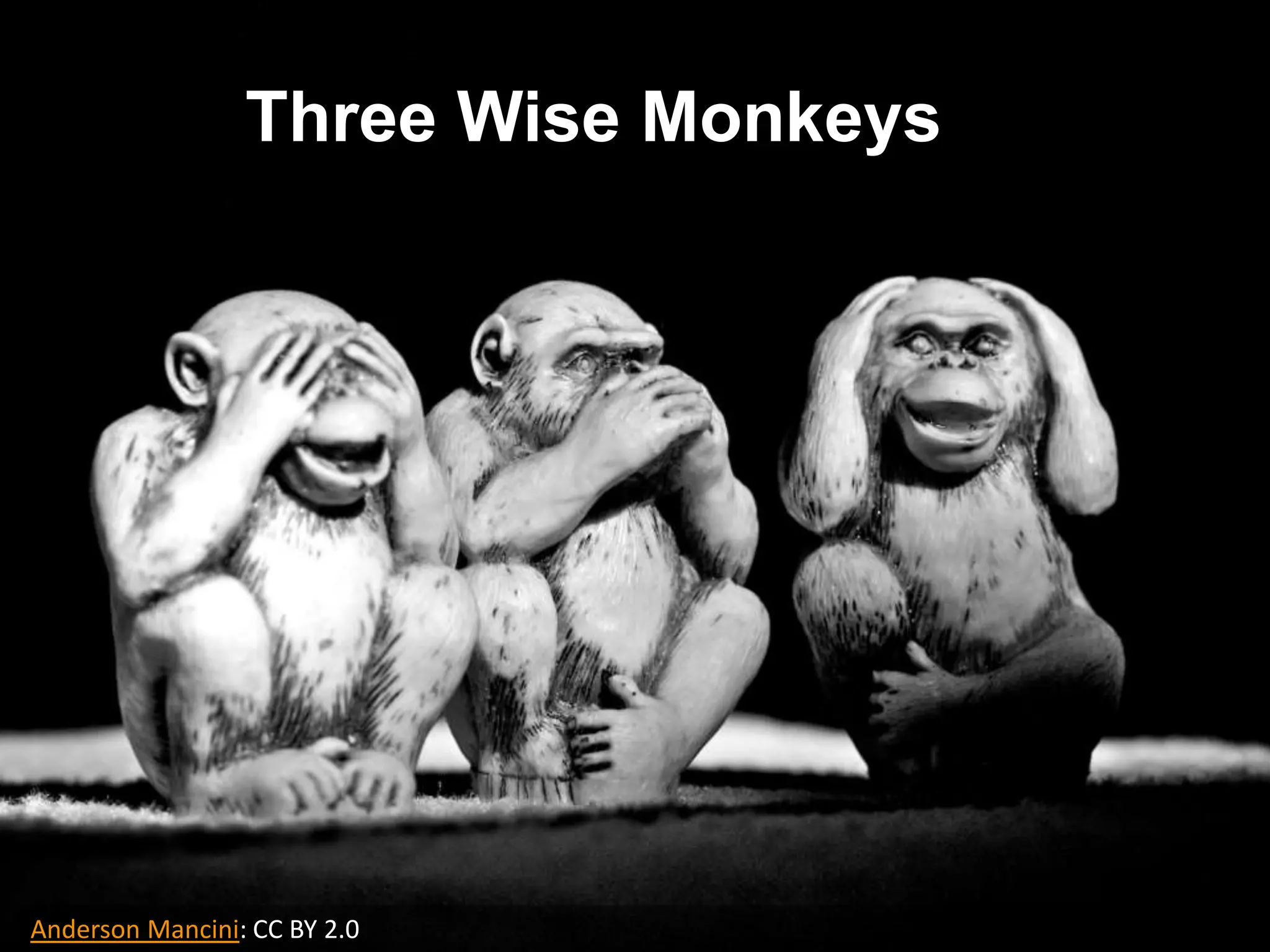
Three Wise Monkeys
Anderson Mancini: CC BY 2.0
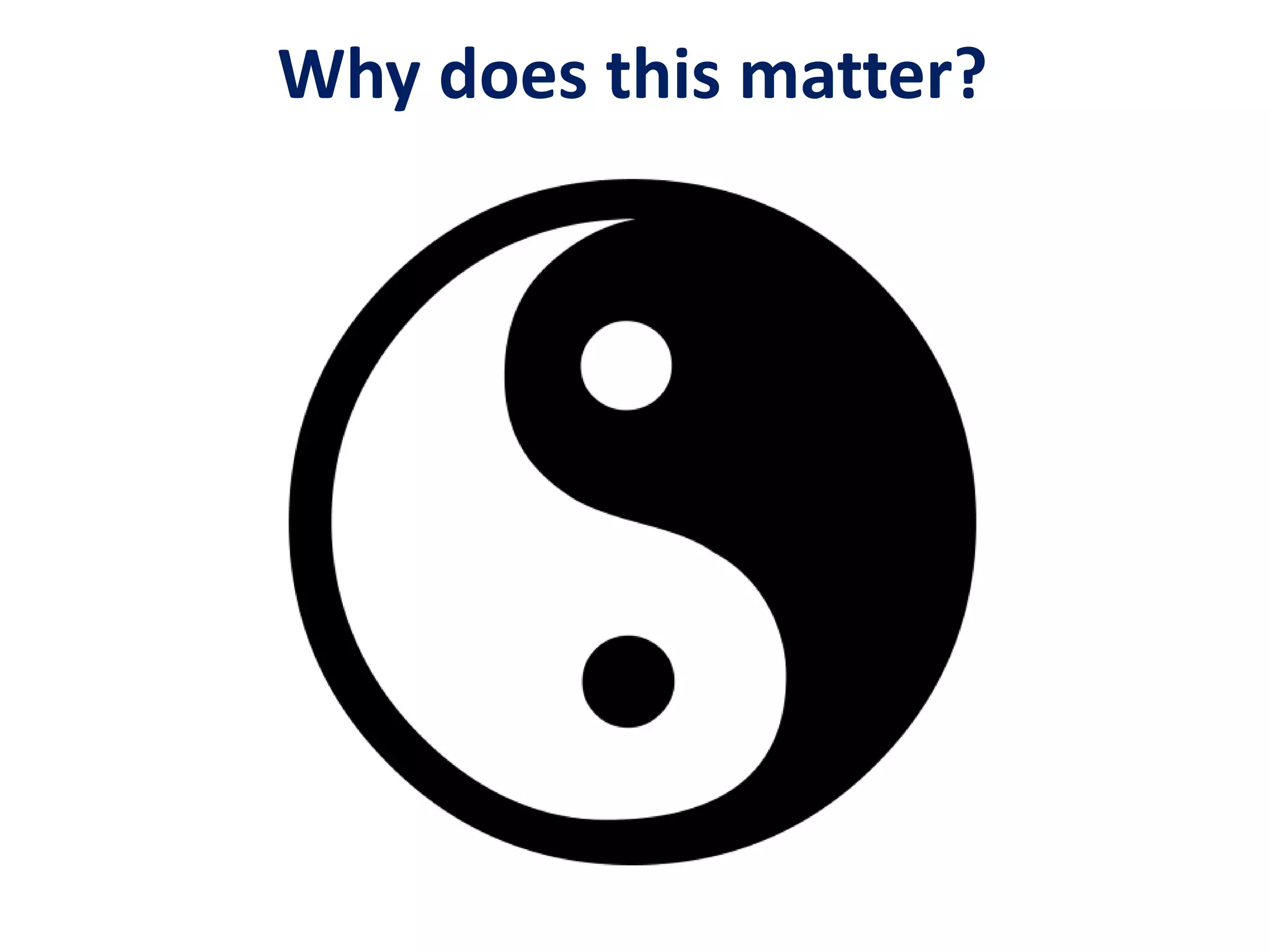
Why does this matter?
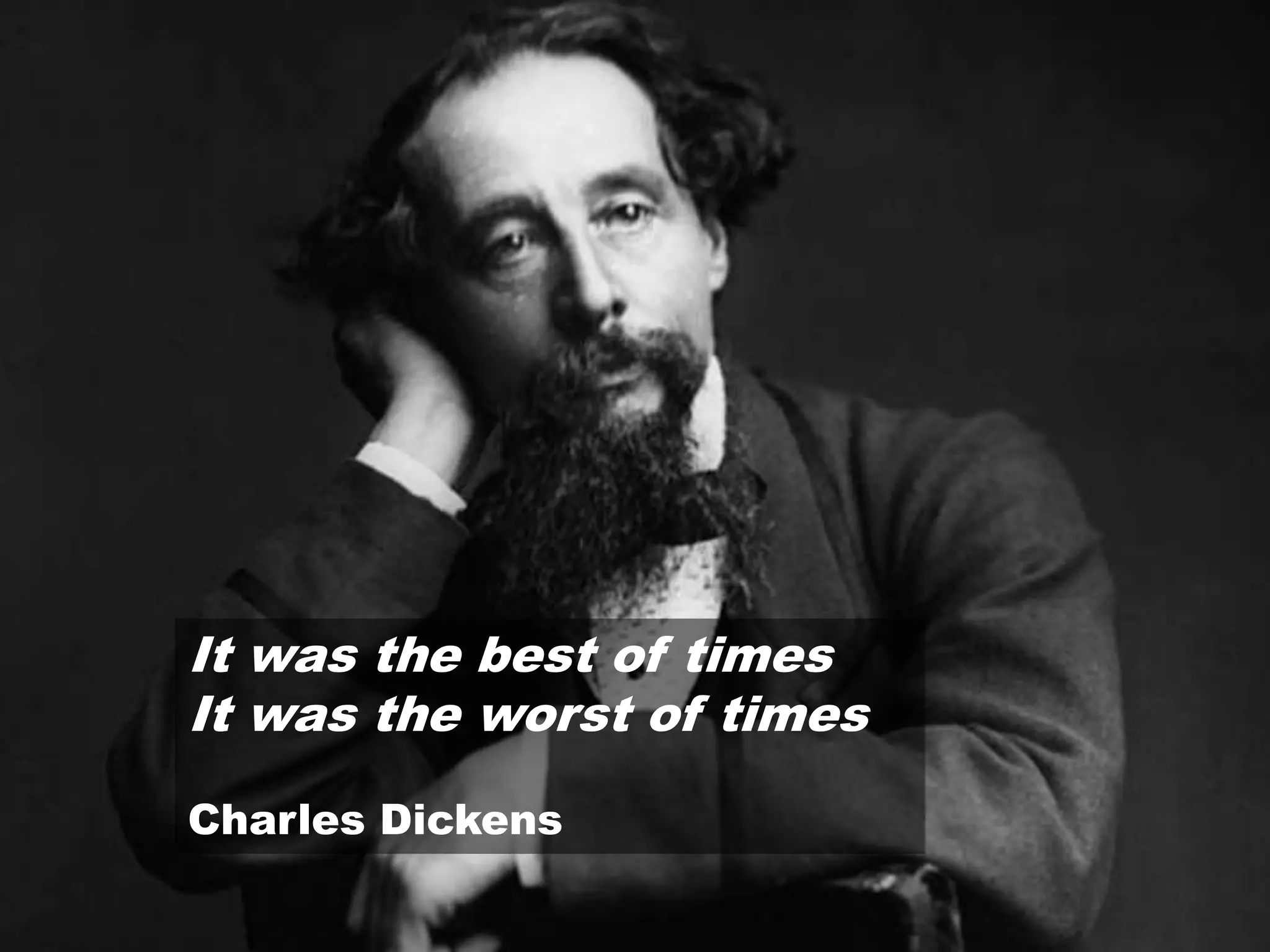
It was the best of times
It was the worst of times
Charles Dickens
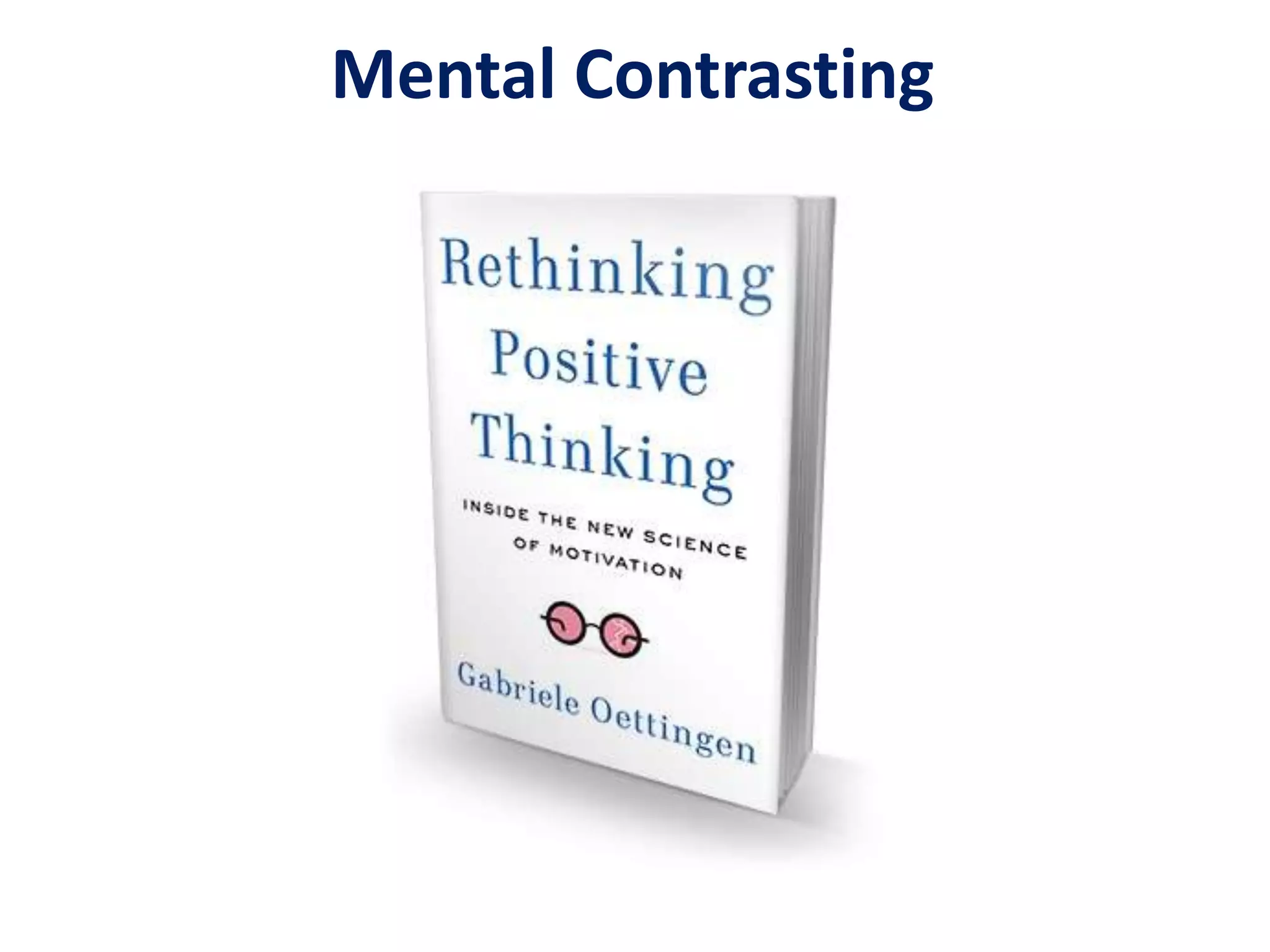
Mental Contrasting
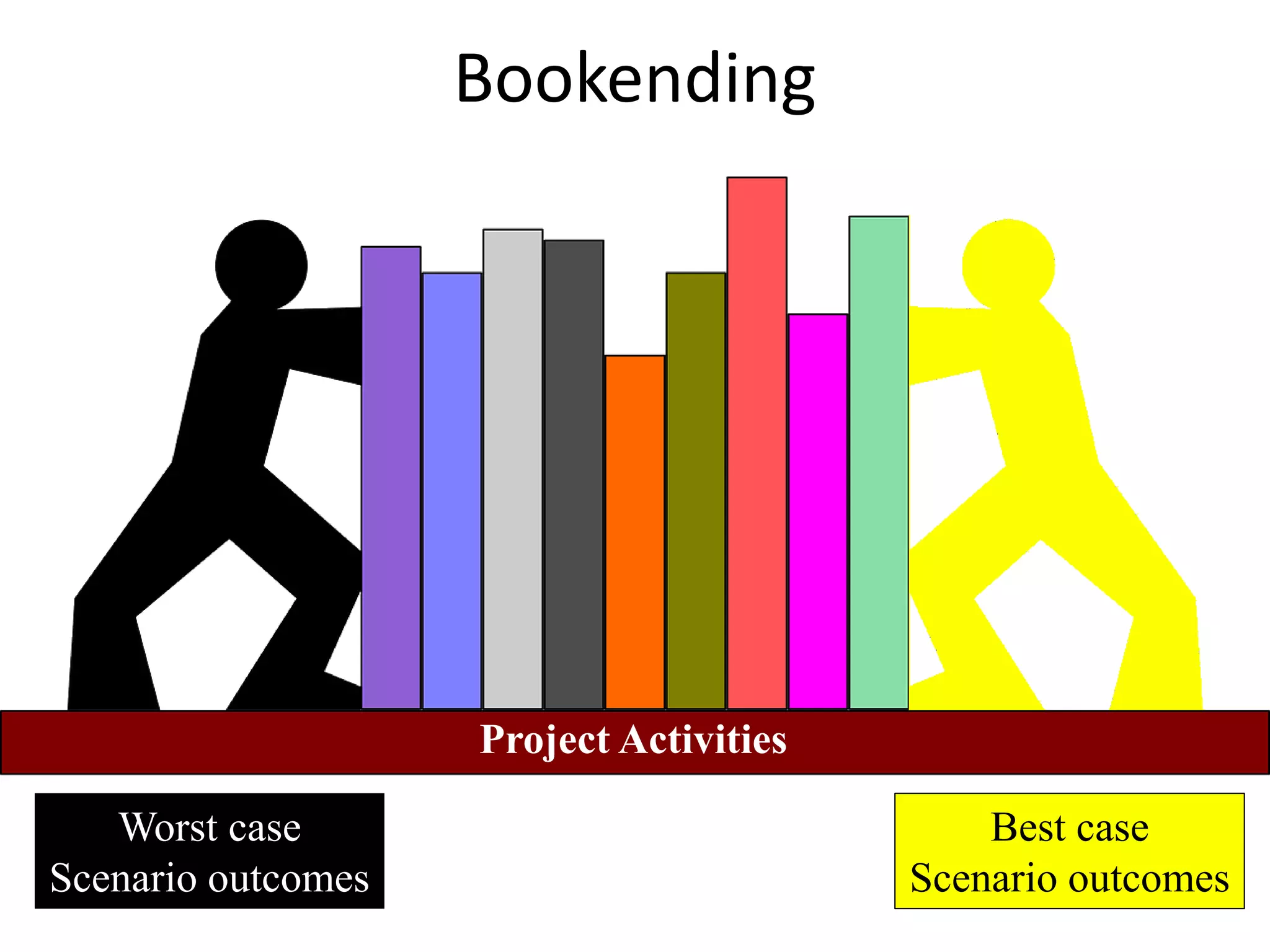
Looking at “best and worst case scenarios” and
actions to maximise positive outcomes
Bookending
Worst case
Scenario outcomes
Best case
Scenario outcomes
Project Activities
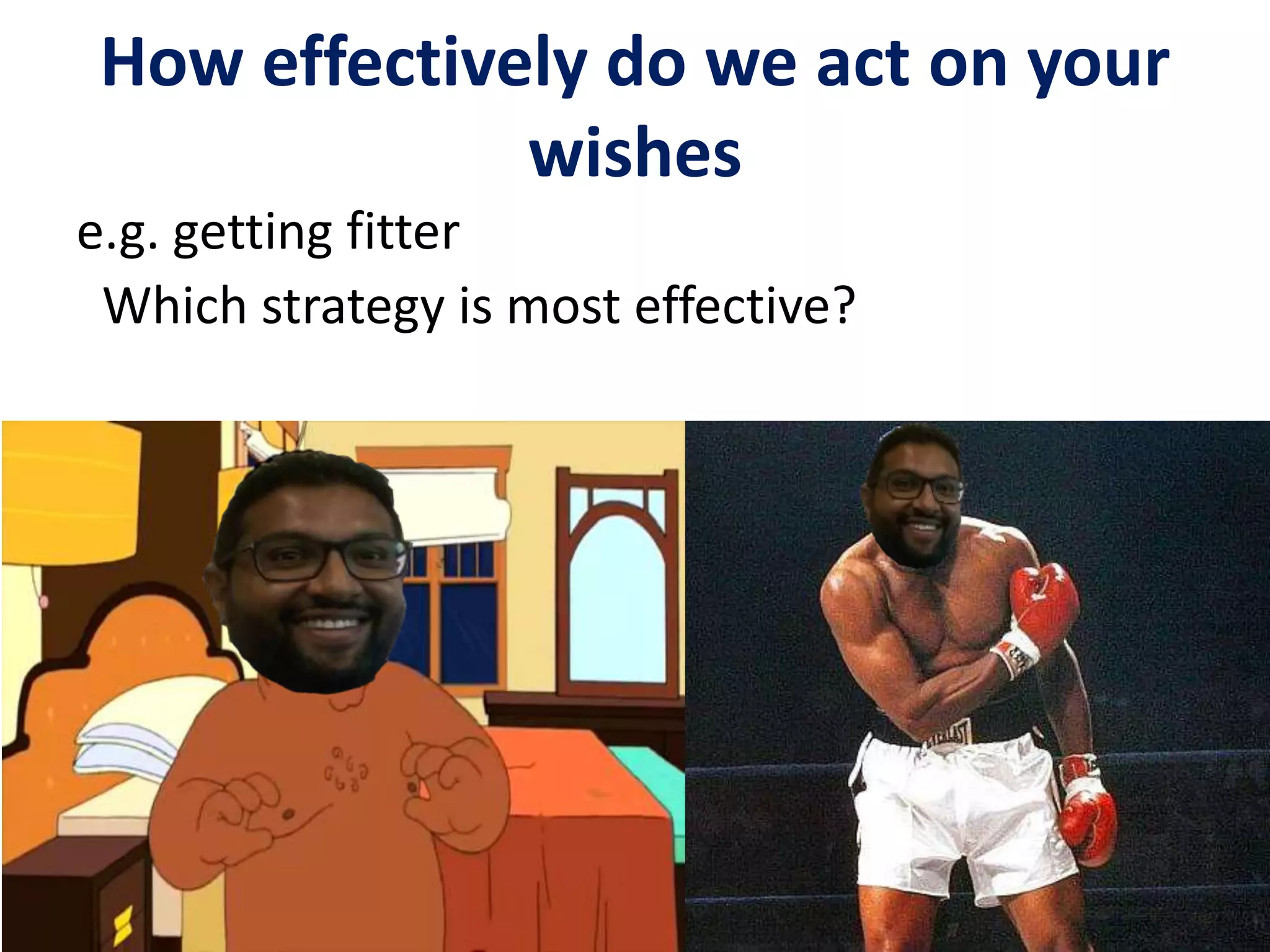
How effectively do we act on your
wishes
e.g. getting fitter
Which strategy is most effective?
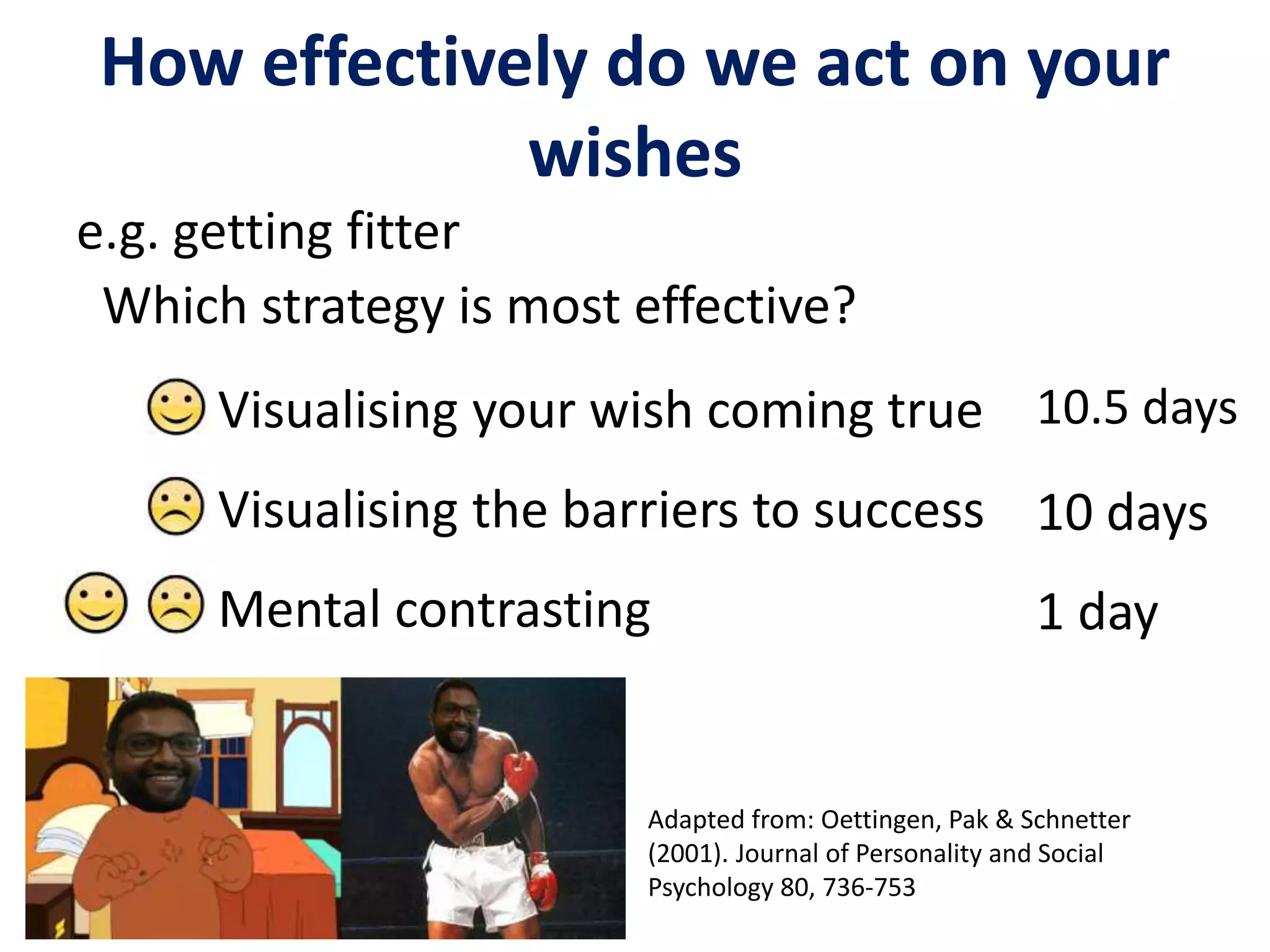
How effectively do we act on your
wishes
Adapted from: Oettingen, Pak & Schnetter
(2001). Journal of Personality and Social
Psychology 80, 736-753
e.g. getting fitter
Which strategy is most effective?
Mental contrasting
Visualising the barriers to success
Visualising your wish coming true 10.5 days
10 days
1 day
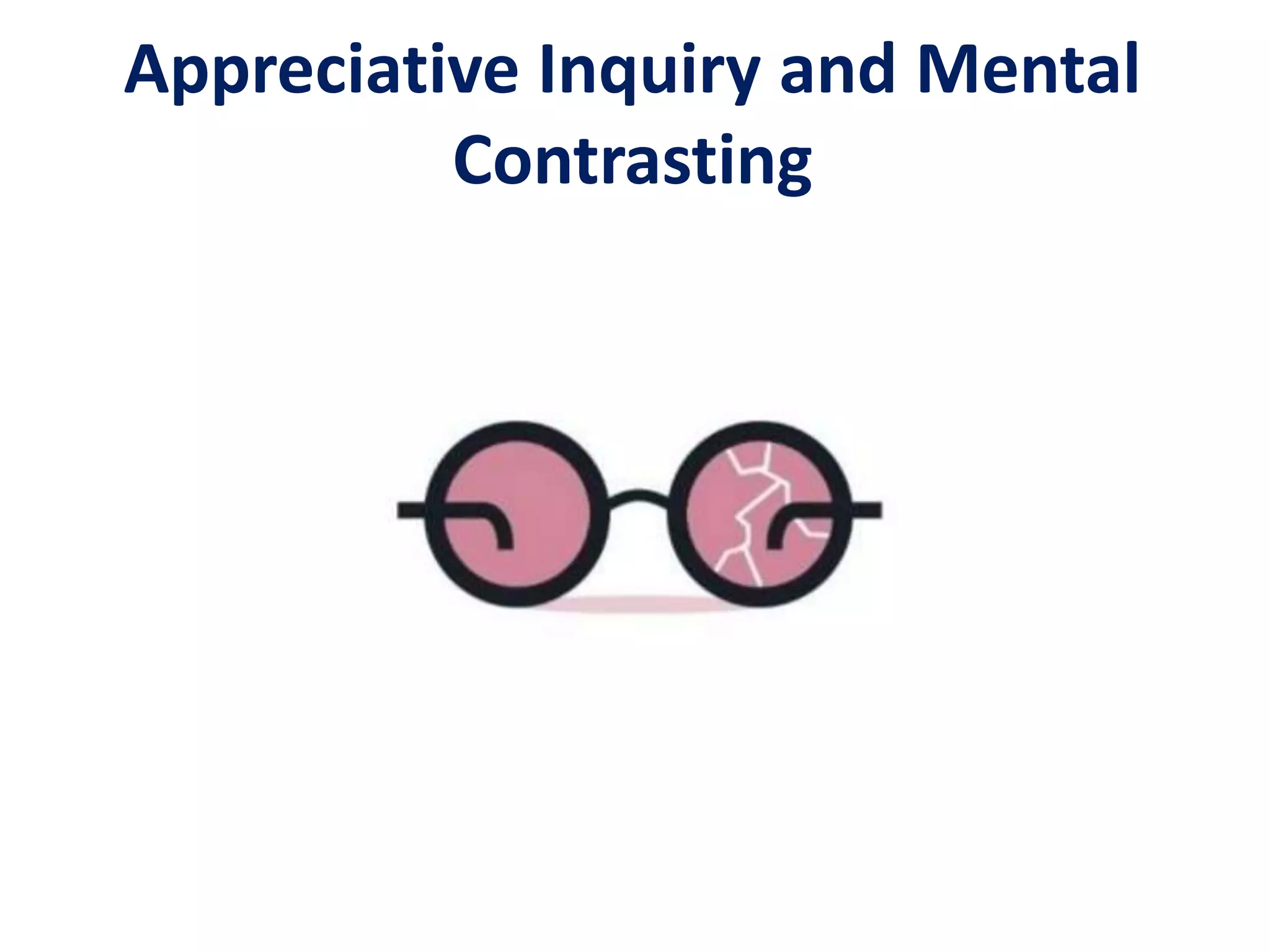
Appreciative Inquiry and Mental
Contrasting
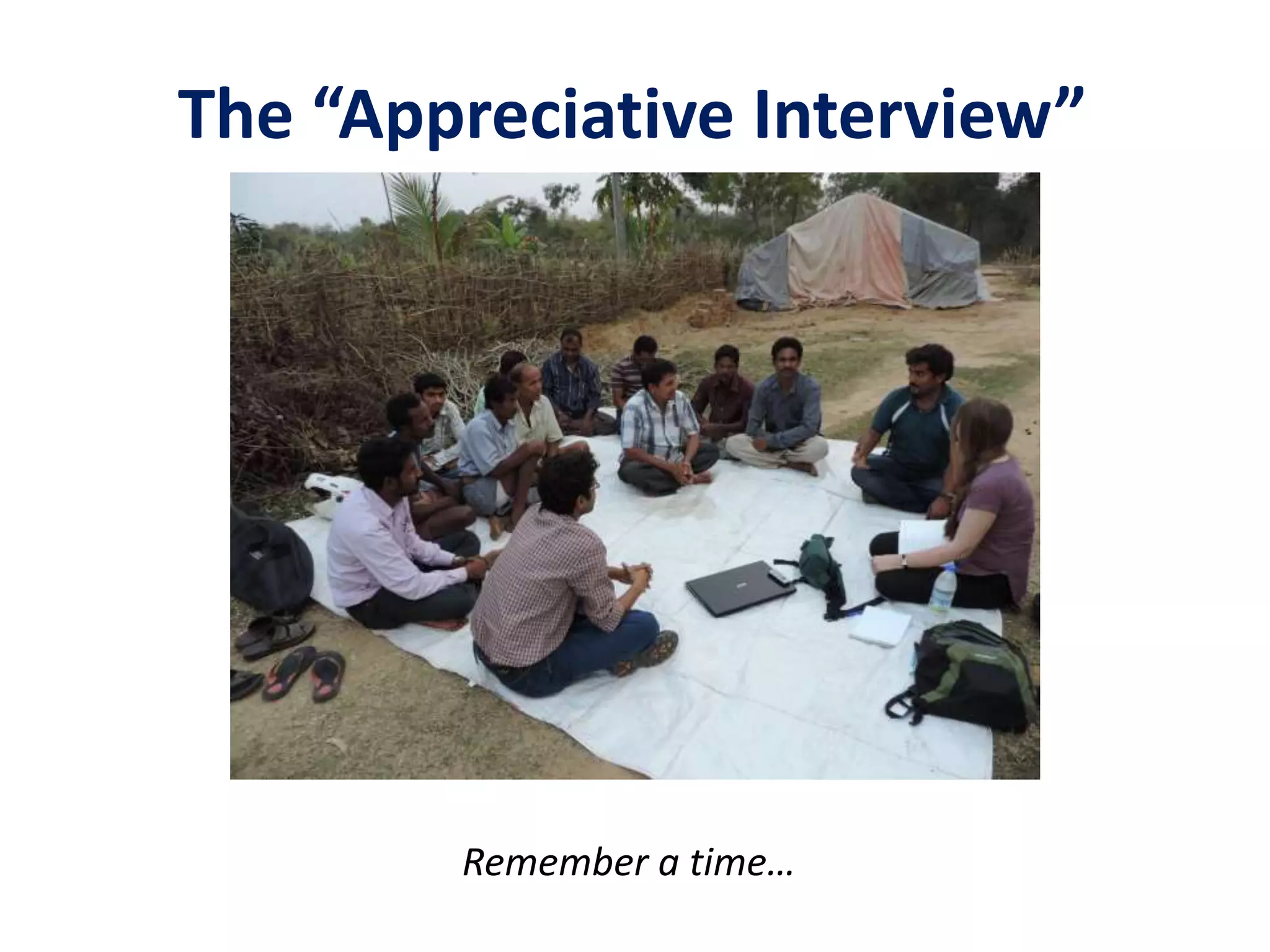
The “Appreciative Interview”
Remember a time…
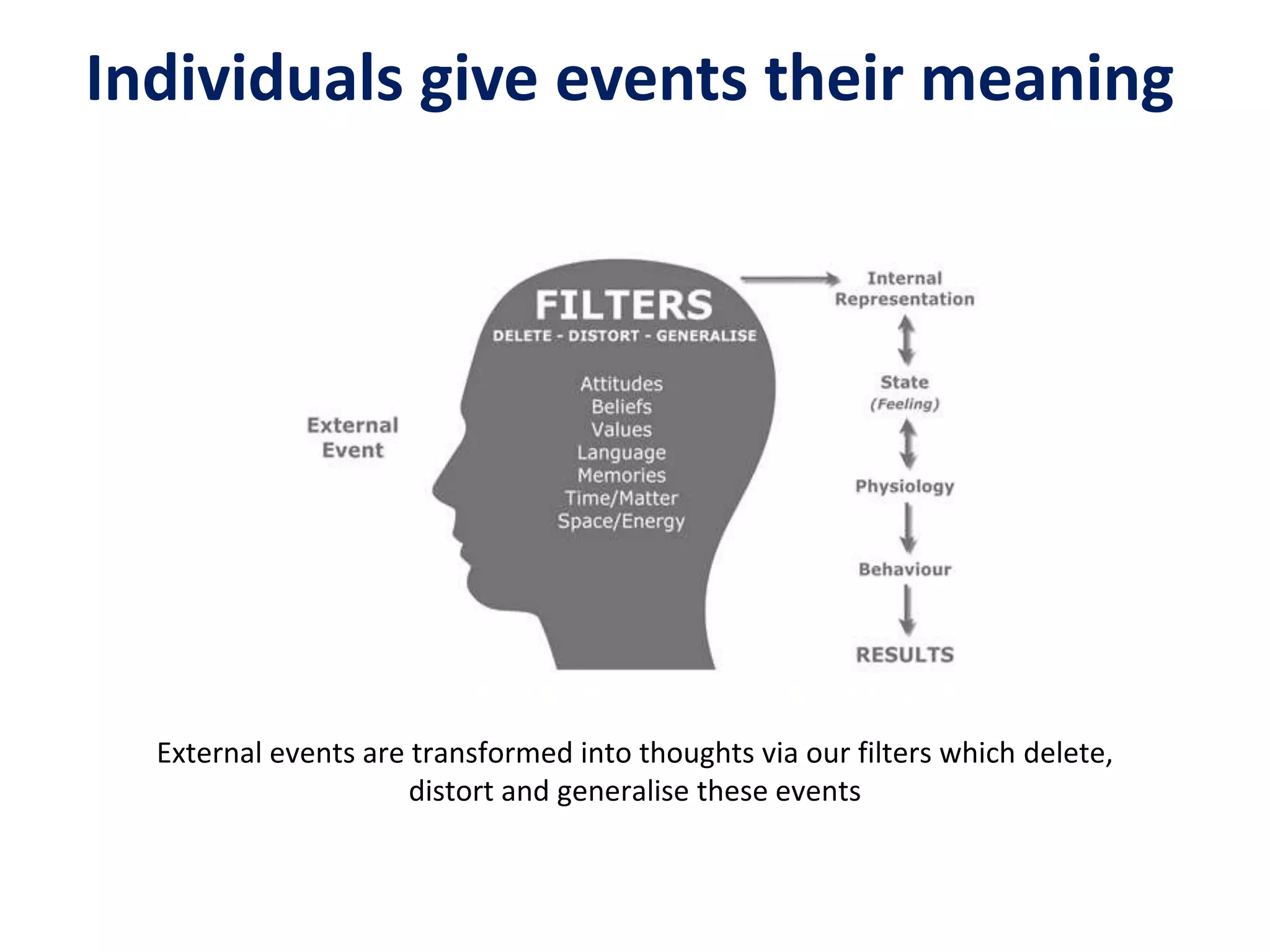
External events are transformed into thoughts via our filters which delete,
distort and generalise these events
Individuals give events their meaning
Knowledge Management assets
inventory and needs assessment
Exercises
Appreciative Interviews
(Knowledge Assets)
• Spend the first 10 minutes individually thinking
about your answers – make notes as necessary.
• Form pairs as instructed
• Take turns in interviewing one another using our
demo and the interview questions as a guide
• Interviewer takes notes – one experience per
page
• Interviewees classify the experience as: people,
processes, technology, cross-cutting or other
Individual Exercise
PAN KMF Needs
• Complete the interview questions as given on
the Individual Written Responses section of
the interview sheet.
• The responses are anonymous but write your
name, organisation and job title if you are
happy to do so and if you think that this
information will be helpful.
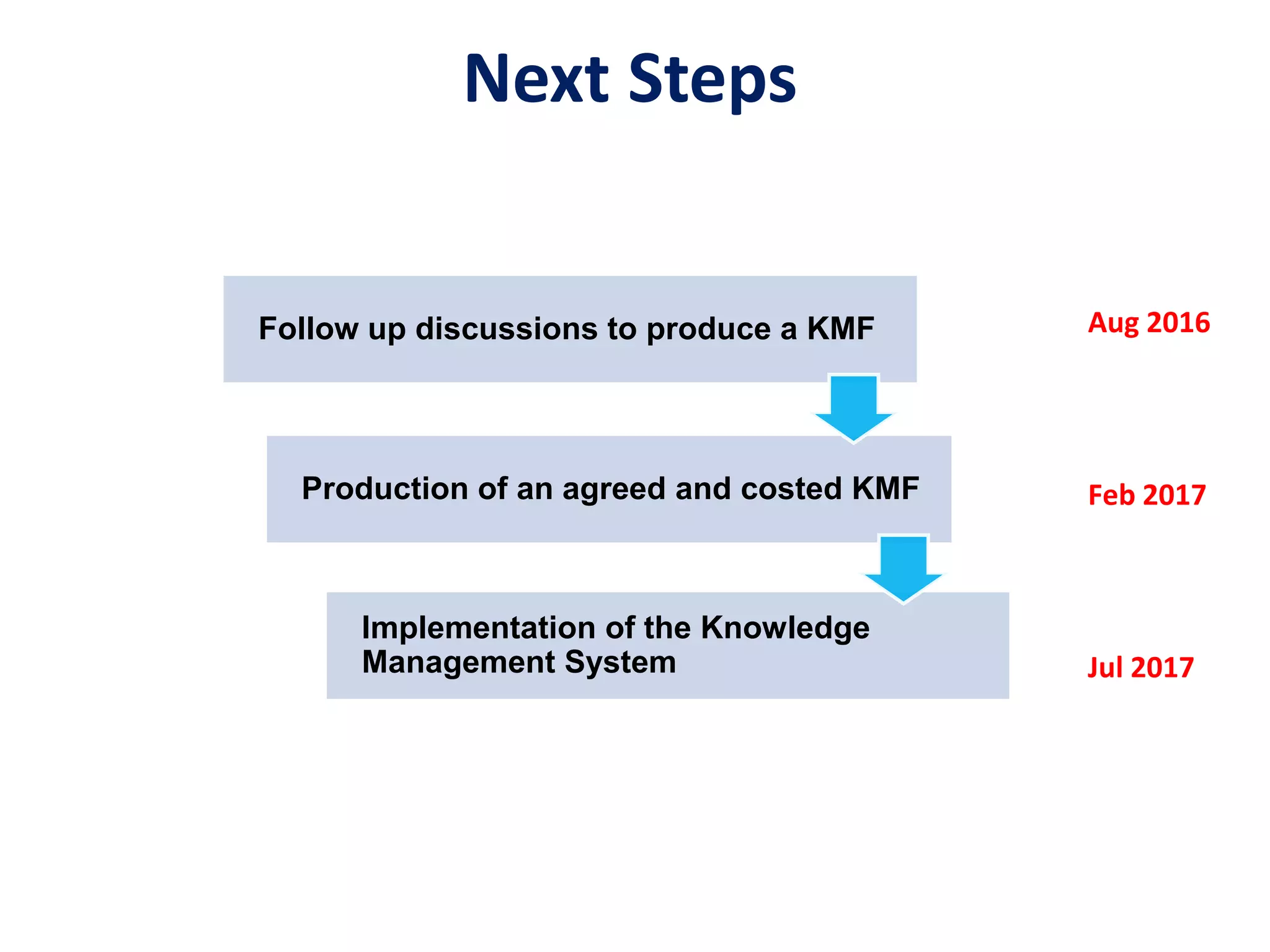
Next Steps
Follow up discussions to produce a KMF
Production of an agreed and costed KMF
Implementation of the Knowledge
Management System Jul 2017
Aug 2016
Feb 2017
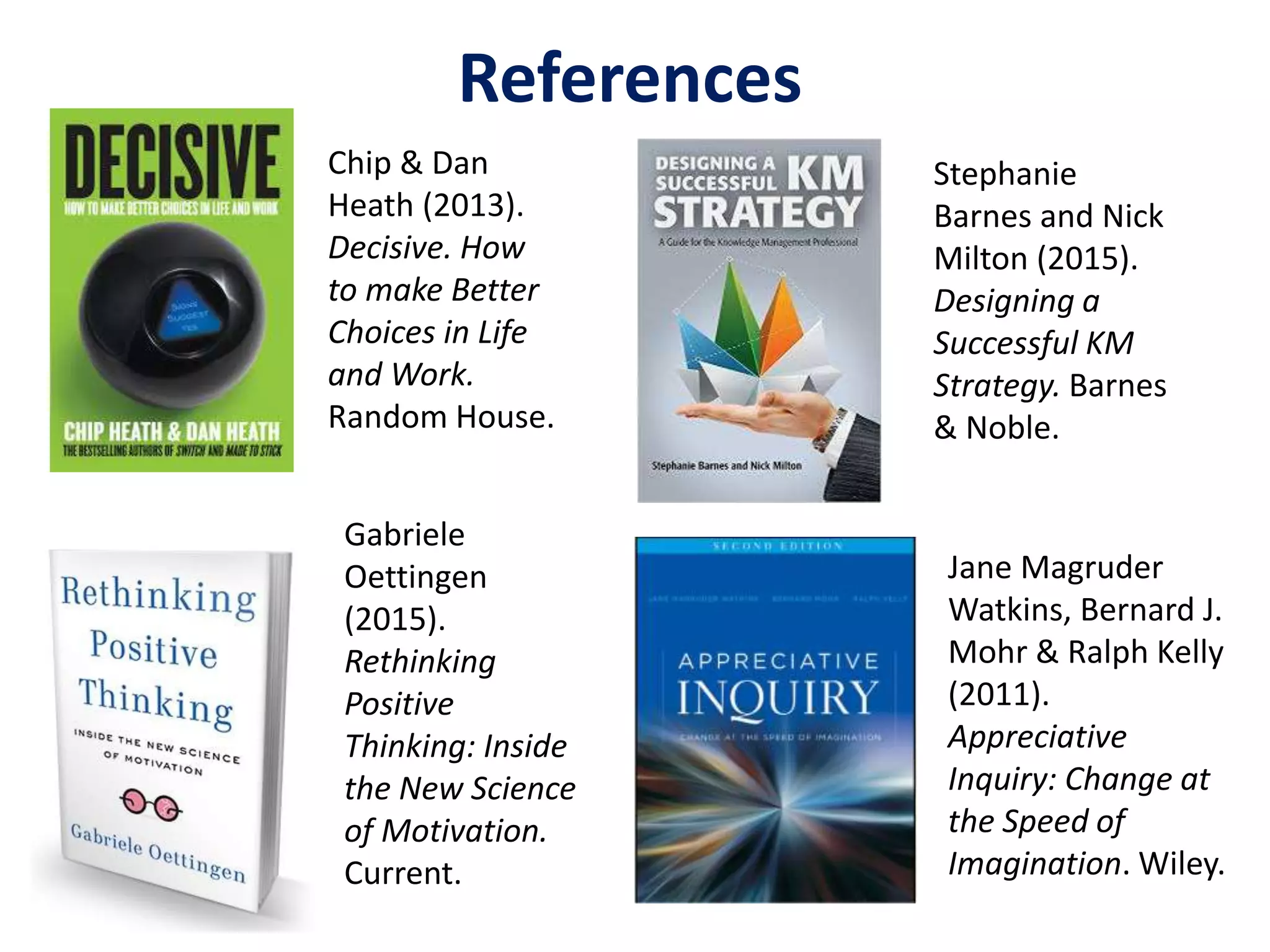
Chip & Dan
Heath (2013).
Decisive. How
to make Better
Choices in Life
and Work.
Random House.
Jane Magruder
Watkins, Bernard J.
Mohr & Ralph Kelly
(2011).
Appreciative
Inquiry: Change at
the Speed of
Imagination. Wiley.
References
Gabriele
Oettingen
(2015).
Rethinking
Positive
Thinking: Inside
the New Science
of Motivation.
Current.
Stephanie
Barnes and Nick
Milton (2015).
Designing a
Successful KM
Strategy. Barnes
& Noble.

Protected Area Network Knowledge Management Framework (Needs Assessment and Assets Inventory)

  • 1.
    8 June 2016 PétrinVisitors Centre Black River Gorges National Park A UNDP/GEF PAN Project Activity KNOWLEDGE MANAGEMENT FRAMEWORK (NEEDS ASSESSMENT & ASSETS INVENTORY)
  • 2.
    Ground Rules • Everybody’sinput is equally valued • Respectfully listen & be patient – things may feel slow for some but challenging for others • Participate but don’t dominate • Talk one at a time in plenary • Avoid side-conversations • Mobile phones on silent • Feel free to ask questions during plenary but be aware of time constraints • The workshop is an information gathering exercise and not a decision-making forum.
  • 3.
    KMF Assets Inventory& Needs Assessment Workshop OBJECTIVE “To collect and consolidate information on current knowledge management practices and needs in Mauritius as input a Knowledge Management Framework to ensure lessons learnt, reports, publications and experiences acquired are shared through newsletters, on the job training and development sessions, academic papers and other ICT medias to community groups and stakeholders.”
  • 4.
    What is KnowledgeManagement? A means of systematically and transparently inputting, accessing and adding value to information so that it contributes to the effectiveness and efficiency with which an individual, organisation or network executes their mandate.
  • 5.
    5 A knowledge ManagementFramework is: A means of systematically and transparently inputting, accessing and adding value to information so that it contributes to the effectiveness and efficiency with which an individual, organisation or network can execute their mandate. Structure of a KMF
  • 6.
    6 • The objective: Toexpand and ensure effective management of the protected area network to safeguard threatened biodiversity. • Approved by Global Environment Facility in March 2010 • Extension granted till April 2018; • Total Project Budget (GEF): 4,000,000(USD); • Project Outcomes Outcome 1: Systemic framework for Protected Area expansion improved Outcome 2: Protected Area institutional framework strengthened Outcome 3: Operational know-how in place to contain threats • Output 3.4: Information Management system for recording, exchanging and disseminating information in place 6 PAN Project in a nutshell
  • 7.
    7 Project Team andOrganigram Project Steering Committee Project consultants and contractors Project Assurance: UNDP, GEF, MoAIFS, CTA, RTA Project Management Unit: NPD, PM, PA, IASC 7
  • 8.
    10th May 1829 10thMay 1829 Why do we need a Knowledge Management Framework? Thomas Young
  • 9.
    Why do we needa Knowledge Management Framework?
  • 11.
    Why do weneed a knowledge management framework? 75 15 7
  • 13.
  • 14.
    Secretlondon at EnglishWikipedia: CC BY-SA 3.0
  • 15.
  • 16.
    Theoretical Knowledge Management Hierarchy AlfredP. Sloan long serving CEO of General Motors
  • 17.
  • 18.
    18 A knowledge ManagementFramework is: A means of systematically and transparently inputting, accessing and adding value to information so that it contributes to the effectiveness and efficiency with which an individual, organisation or network can execute their mandate. Structure of a KMF
  • 19.
    Technology Hardware • Computers • Servers •Cameras/drones/smartphones • GIS Systems Software • Databases • GIS Systems • File sharing systems Publish net: CC-BY-NC-SA
  • 20.
    Processes/Protocols Guidelines • Good practiceguidelines • Checklists Rules and protocols • Data validation processes • Security protocols • Protocols for file management/system architecture Templates • Reporting templates • Presentation templates • Data management templates
  • 21.
    People Leadership/responsibilities • Who isresponsible for what? • What levels of access is there for what positions? Communication/information circulation • What information is circulated to which people/groups? Network • Who is part of the knowledge management network?
  • 22.
    A Model KnowledgeManagement Framework
  • 24.
    Knowledge Management Framework Communitiesof practice After action reviews Orientation events Lessons learnt Peer assists Newspaper & magazines Social media Exhibitions Television Radio Protocols & checklists Architecture Databases Computers & software Mobile apps GIS system Decentralised data collection Virtual libraries Open access Internet Intranet Clear roles and responsibilities Memoranda of understanding Advisory services Leadership Training Communication is used to engage stakeholders Knowledge products are developed and adapted to multiple audiences Knowledge is shared and discussed Knowledge relevant to PAN management is made available Information technology (IT) is effectively used Knowledge management is planned Knowledge Management Framework Stakeholders are using a set of knowledge products and resources that enable them to improve their work Decisions are made on the basis of information and dialogue Stakeholders with new knowledge and skills are more inclined to adopt, adapt, and promote goo management practices in PAN management Stakeholders apply new ways of engaging and working with others Improved quality of teamwork and partnership, contributing to changes in the knowledge, attitudes, skills and practices of stakeholders, in the supporting environment for adoption and scaling up of good practices Model Knowledge Management Framework
  • 25.
    SOME WORDS OFWARNING We need something flexible Anon: CC BY-SA 3.0
  • 26.
    We need somethingadaptable THE ACTION LEARNING CYCLE
  • 27.
  • 28.
  • 29.
    29 Communication and MarketingCampaign • Concept of Protected Endemic Sanctuaries created in 2014 29
  • 30.
    30 Communication and MarketingCampaign • Awareness material 30
  • 31.
    31 Communication and MarketingCampaign • Painting and photography competition organised in August 2015; 31
  • 32.
    32 Rays of HopeBooklet 32
  • 33.
    33 Communication and MarketingCampaign Clip on Protected Endemic Sanctuary - 30 Seconds Clip including Protected Area Network Project for international day of Biological diversity 2015 – 115 seconds 33
  • 34.
    34 Communication and MarketingCampaign • Website under development; 34
  • 35.
    35 • Nearing finalisation 35 ProtectedArea Network Expansion Strategy (PANES)
  • 36.
    36 • PANES ZoneMaps – GIS tool - spatial guideline for the expansion of the PAN; 36 Conservation maps
  • 37.
    3737 Management Plans forBras D’Eau and Black River Gorges National Parks completed
  • 38.
  • 39.
    3939 Other forms ofKnowledge products • Progress reports; • Financial reports; • Notes of Meeting; • Mission reports; • Project briefs; • Relevant reporting to UNDP, GEF and MoAIFS
  • 40.
    4040 Current KMF onPAN • Filing system
  • 41.
    4141 Current KMF onPAN • Electronic filing
  • 42.
    4242 Current KMF onPAN • Electronic filing
  • 43.
    4343 Current KMF onPAN • Backup in Dropbox • Backup on Hard drives (both PMU and NPCS) • Backup via Outlook • No systematic way of arranging information; • Retrieving exact information can be challenging at times; • Different versions of same document; • Referencing of Photos is sometimes an issue;5
  • 44.
    Timeline for KMSdevelopment  Finalisation of KMF concept note Follow up discussions to produce a KMF Production of an agreed and costed KMF Implementation of the Knowledge Management System Feb 2016 Jul 2017 Jun 2016 Aug 2016  KM Assets inventory and needs assessment workshop Feb 2017
  • 45.
    Assets Inventory &Needs Assessment Workshop Process Appreciative Inquiry and Mental Contrasting
  • 46.
    Our negative experiencesstick to us like Velcro, while our positive experiences slide right off us like Teflon. Dr Rick Hanson Neuropsychologist & author of Hardwiring happiness We are programmed to pay attention to negative aspects of a situation
  • 47.
    We are programmedto pay attention to negative aspects of a situation
  • 48.
    We are programmedto pay attention to negative aspects of a situation We are more motivated to avoid pain than pursue pleasure
  • 49.
    We are programmedto pay attention to negative aspects of a situation • The “problem statement” or “Barriers” approach to change • Let’s fix what’s wrong and let the strengths take care of themselves
  • 51.
    Appreciative Inquiry focuseson an issue from the solution side
  • 52.
    The essence of managementand leadership is simple and ageless. The task of leadership is to create an alignment of strengths in ways that make a system’s weaknesses irrelevant. Peter Drucker
  • 53.
  • 56.
    Three Wise Monkeys AndersonMancini: CC BY 2.0
  • 57.
  • 58.
    It was thebest of times It was the worst of times Charles Dickens
  • 59.
  • 60.
    Looking at “bestand worst case scenarios” and actions to maximise positive outcomes
  • 61.
    Bookending Worst case Scenario outcomes Bestcase Scenario outcomes Project Activities
  • 62.
    How effectively dowe act on your wishes e.g. getting fitter Which strategy is most effective?
  • 63.
    How effectively dowe act on your wishes Adapted from: Oettingen, Pak & Schnetter (2001). Journal of Personality and Social Psychology 80, 736-753 e.g. getting fitter Which strategy is most effective? Mental contrasting Visualising the barriers to success Visualising your wish coming true 10.5 days 10 days 1 day
  • 64.
    Appreciative Inquiry andMental Contrasting
  • 65.
  • 66.
    External events aretransformed into thoughts via our filters which delete, distort and generalise these events Individuals give events their meaning
  • 67.
  • 68.
  • 69.
    Knowledge Management assets inventoryand needs assessment Exercises
  • 70.
    Appreciative Interviews (Knowledge Assets) •Spend the first 10 minutes individually thinking about your answers – make notes as necessary. • Form pairs as instructed • Take turns in interviewing one another using our demo and the interview questions as a guide • Interviewer takes notes – one experience per page • Interviewees classify the experience as: people, processes, technology, cross-cutting or other
  • 71.
    Individual Exercise PAN KMFNeeds • Complete the interview questions as given on the Individual Written Responses section of the interview sheet. • The responses are anonymous but write your name, organisation and job title if you are happy to do so and if you think that this information will be helpful.
  • 72.
    Next Steps Follow updiscussions to produce a KMF Production of an agreed and costed KMF Implementation of the Knowledge Management System Jul 2017 Aug 2016 Feb 2017
  • 73.
    Chip & Dan Heath(2013). Decisive. How to make Better Choices in Life and Work. Random House. Jane Magruder Watkins, Bernard J. Mohr & Ralph Kelly (2011). Appreciative Inquiry: Change at the Speed of Imagination. Wiley. References Gabriele Oettingen (2015). Rethinking Positive Thinking: Inside the New Science of Motivation. Current. Stephanie Barnes and Nick Milton (2015). Designing a Successful KM Strategy. Barnes & Noble.

Editor's Notes

  • #3 Put emphasis on the final rule
  • #7 Summary of the UNDP/GEF PAN (Protected Area Network) Project: Expanding coverage and strengthening management effectiveness of the protected area network on the island of Mauritius
  • #9 Medic, physicist, mathematician, linguist, musician, horseman and much more. Invited to contribute to a new edition of the Encyclopaedia Britannica, Young offered the following subjects: Alphabet, Annuities, Attraction, Capillary Action, Cohesion, Colour, Dew, Egypt, Eye, Focus, Friction, Halo, Hieroglyphic, Hydraulics, Motion, Resistance, Ship, Sound, Strength, Tides, Waves, and “anything of a medical nature.” He asked that all his contributions be kept anonymous. Thomas Young has been characterised as “The Last Man Who Knew Everything” in the book by Andrew Robinson. Nobody can claim that epithet today and this illustrates the need to store and share knowledge.
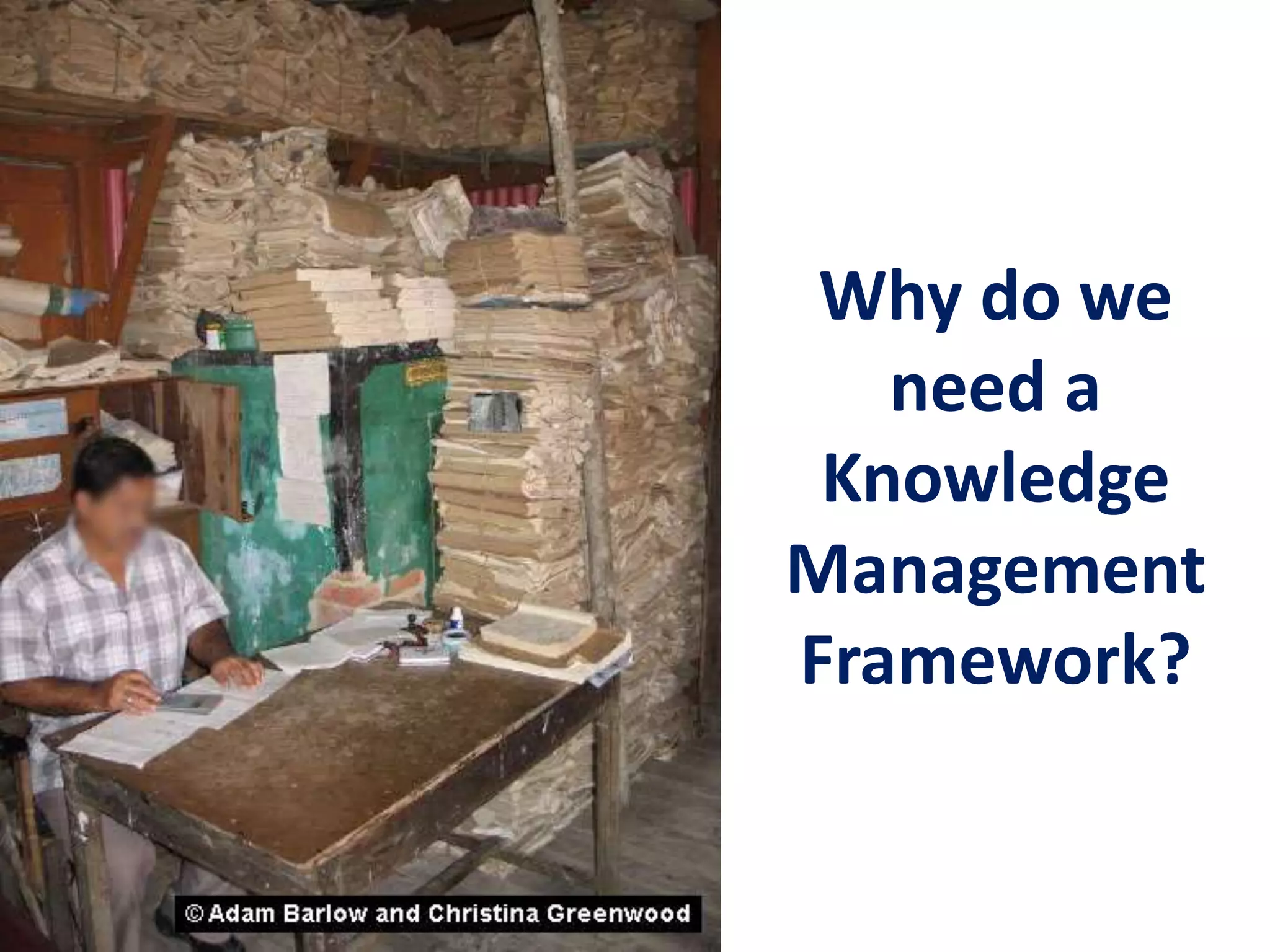
  • #10 This is an example of poor knowledge management: The information contained in these documents is very difficult to access and is more fire hazard than document management system
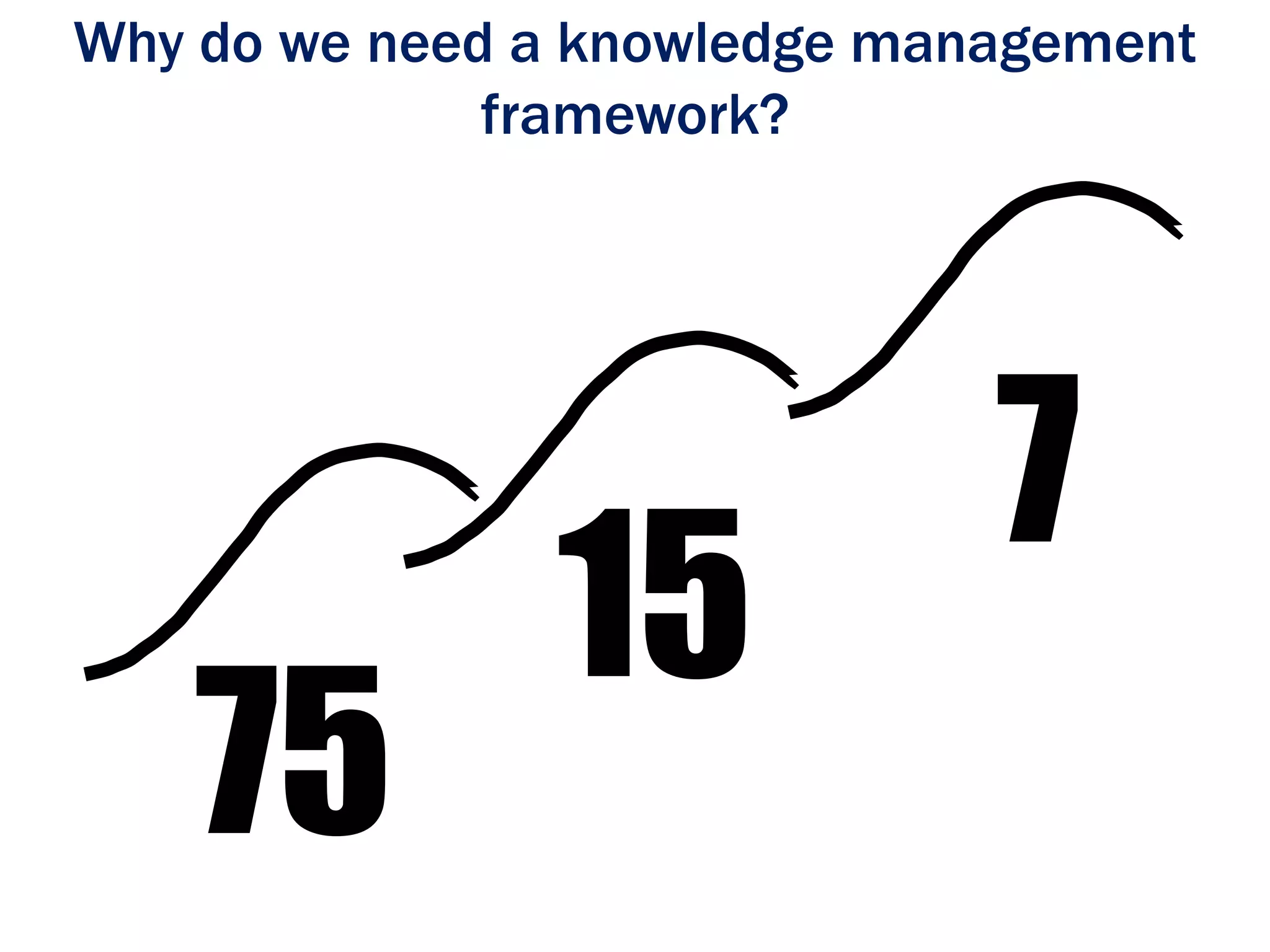
  • #11 One of the compelling reasons to manage knowledge is the accelerating pace of change
  • #12 An illustration of the accelerating pace of change. A Chart of company growth cycles . In the 20th century the average cycle took 75 years which meant that you could start and end your career in the same company and never live through any major reinvention, by 2000 that cycle had shrunk to 15 years, and today it is an average of 7 years which means that we have to start reinventing our company every 3.5 years. The secret to success is starting a new growth cycle before the old cycle expires (Nadya Zhexembayeva Tedx https://www.youtube.com/watch?v=f4kySpcdvFg)
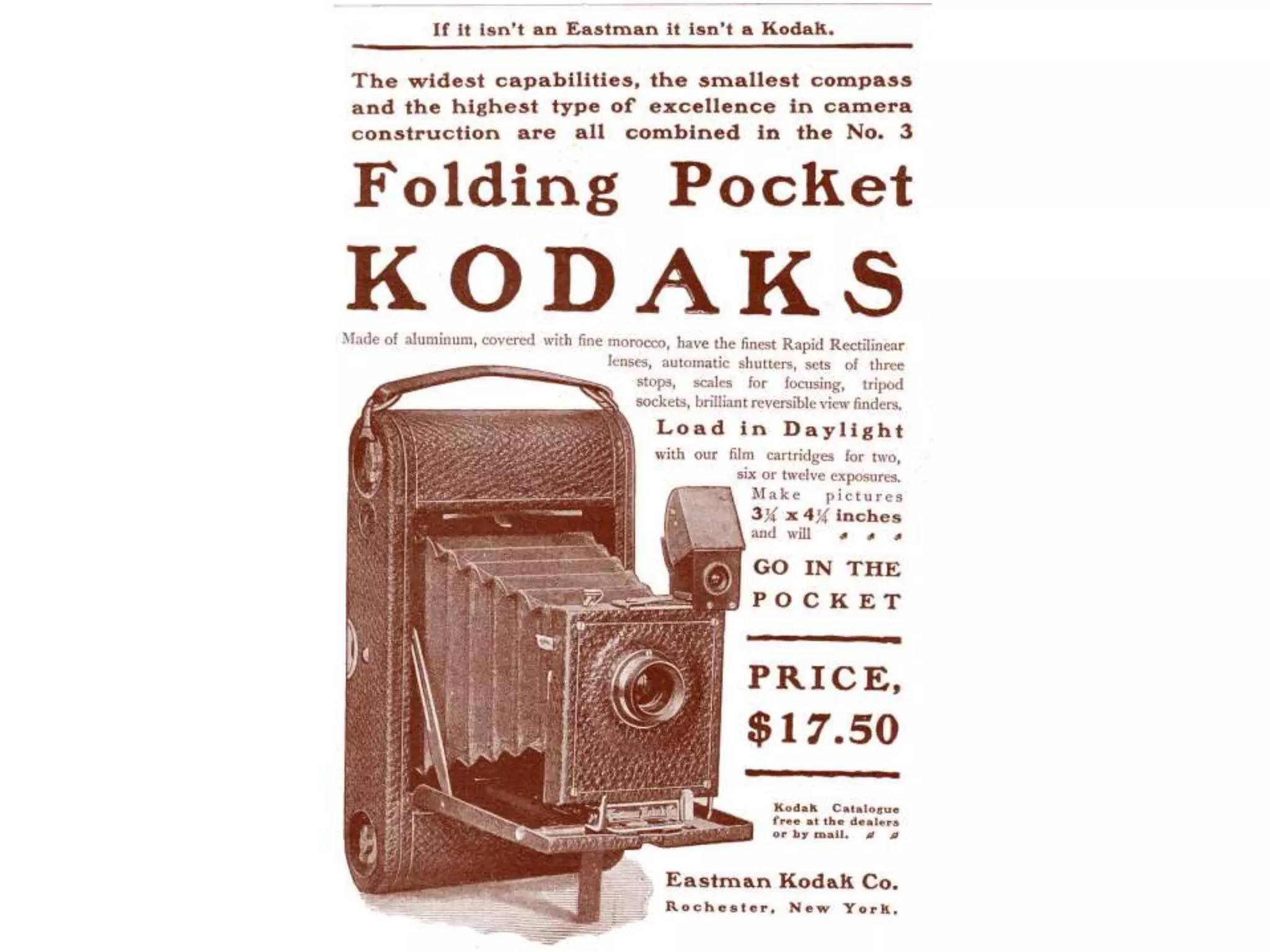
  • #13 The effect on change illustrated – No. 1: Kodak Kodak was a dominant force in photography for more than a century through its manufacture of film but it failed to adapt to digital photography despite the fact that Steve Sasson, a Kodak engineer, invented the first digital camera in 1975.
  • #14 The effect on change illustrated – No. 2: PAN AM Pan American World Airways, commonly known as PAN AM was the world’s largest airline from 1927 until its collapse in 1991. There were a number of reasons for its demise including some high profile crashes and terrorist incidents notably the bombing of PAN AM Flight 103 above Lockerbie, Scotland in 1988.
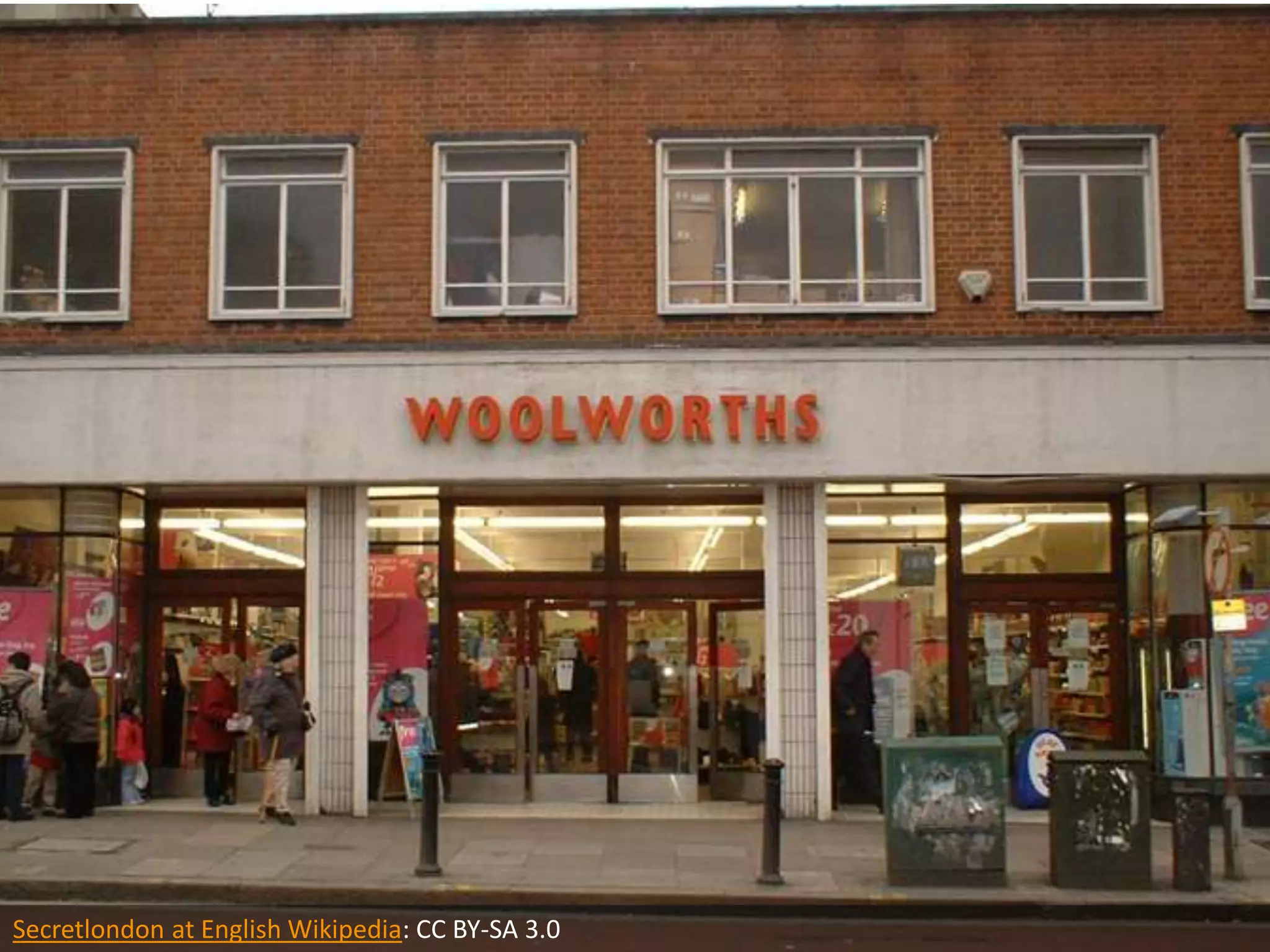
  • #15 The effect on change illustrated – No. 3: Woolworths Woolworths stores were found in most high streets in British towns in the Twentieth Century but the company went bankrupt in 2008 closing 800 stores and threatening 30,000 jobs. Woolworths failed to adapt to the growth of large supermarkets who diversified into non-food items and the rise of high street rivals.
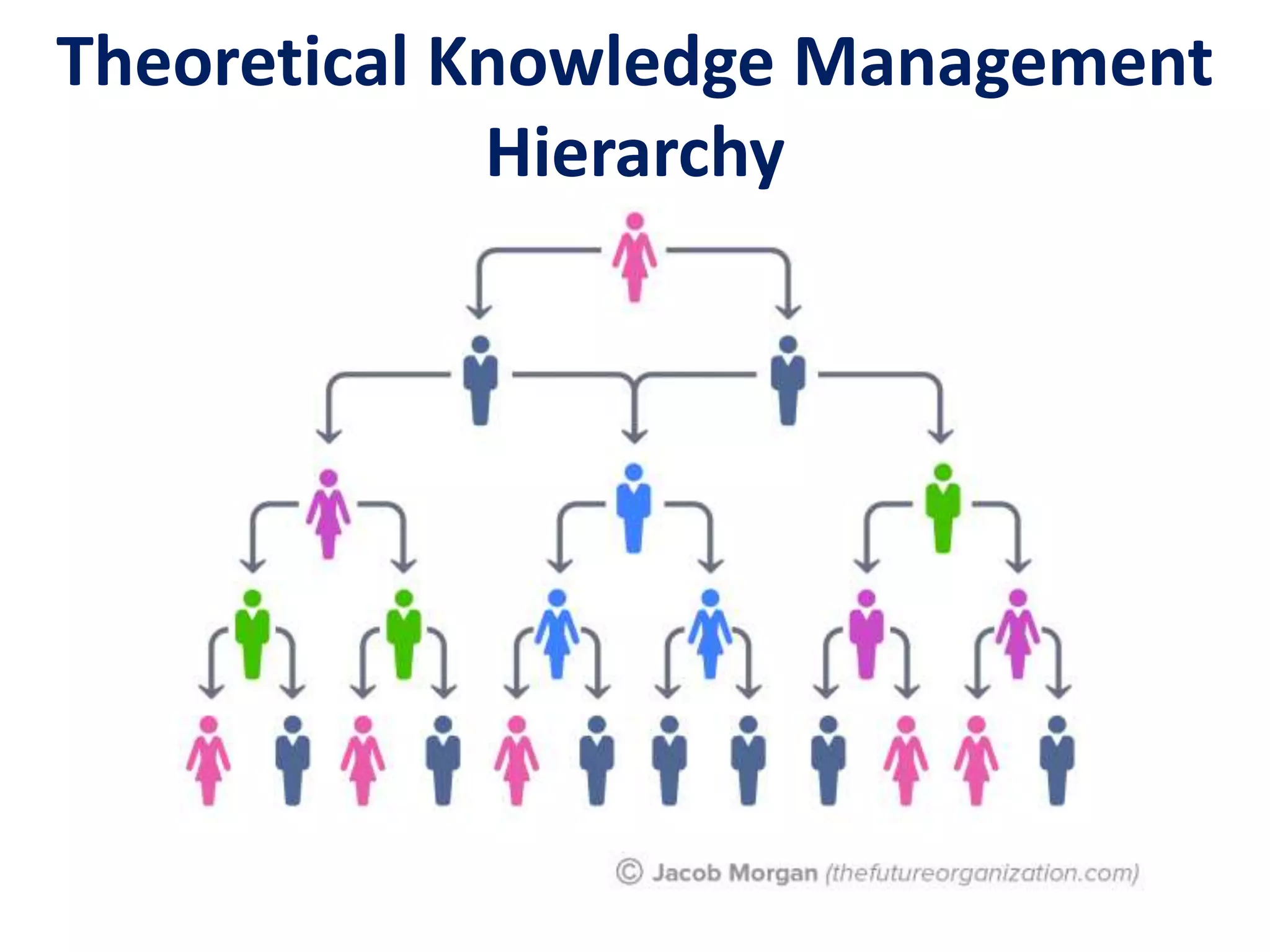
  • #16 This chart illustrates a very traditional hierarchy with all knowledge being transmitted from “upon high.”
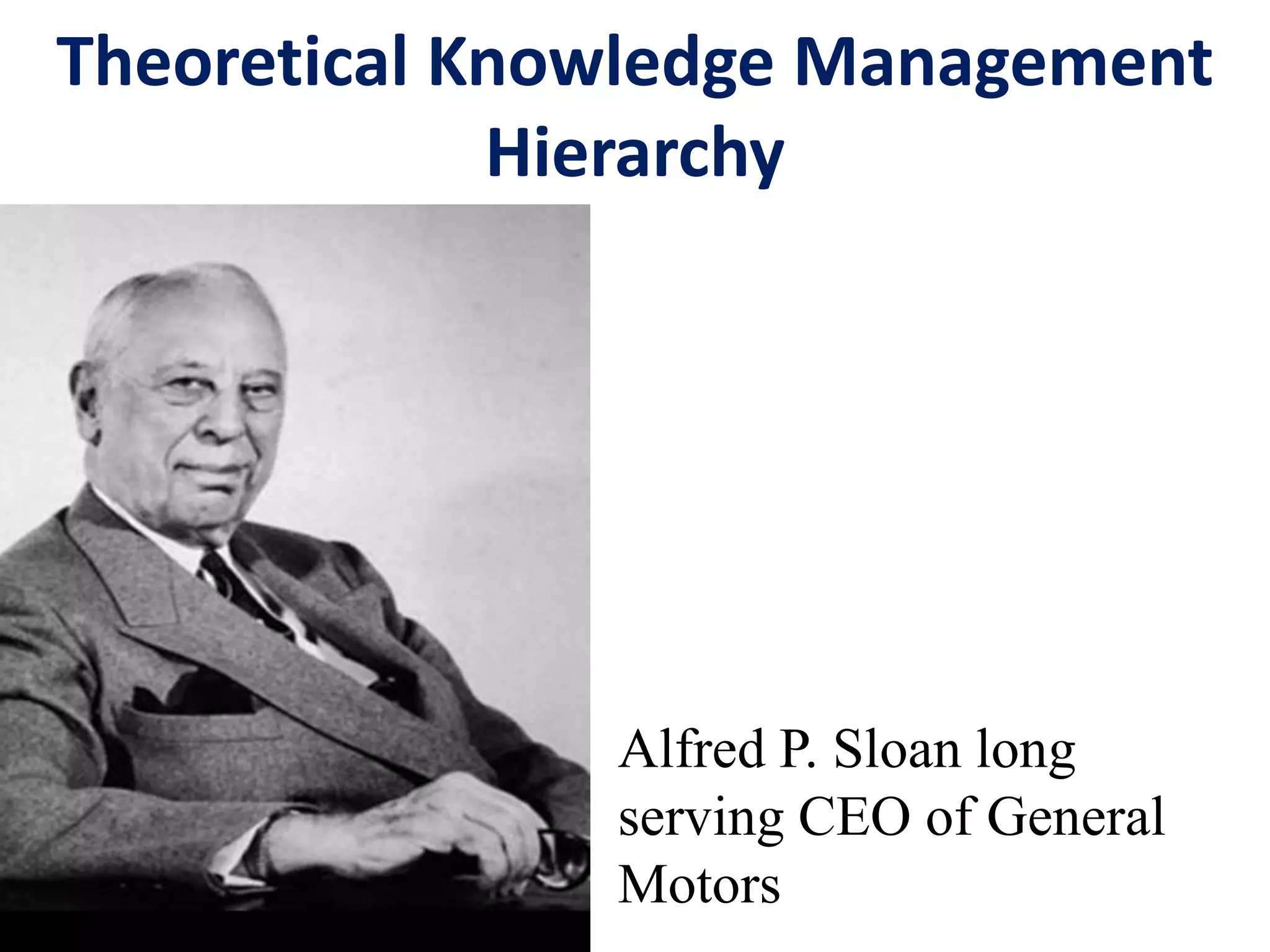
  • #17 People tend to be deferential towards hierarchy. An example of this relates to Alfred Sloan, long-time CEO and Chairman of General Motors who once interrupted a committee meeting to ask the question: “Gentlemen, I take it we are all in complete agreement on the decision here?” All the committee members nodded. In response, Sloan said “Then, I propose we postpone further discussion on this matter until our next meeting to give ourselves time to develop disagreement and perhaps understand what this decision is about.”
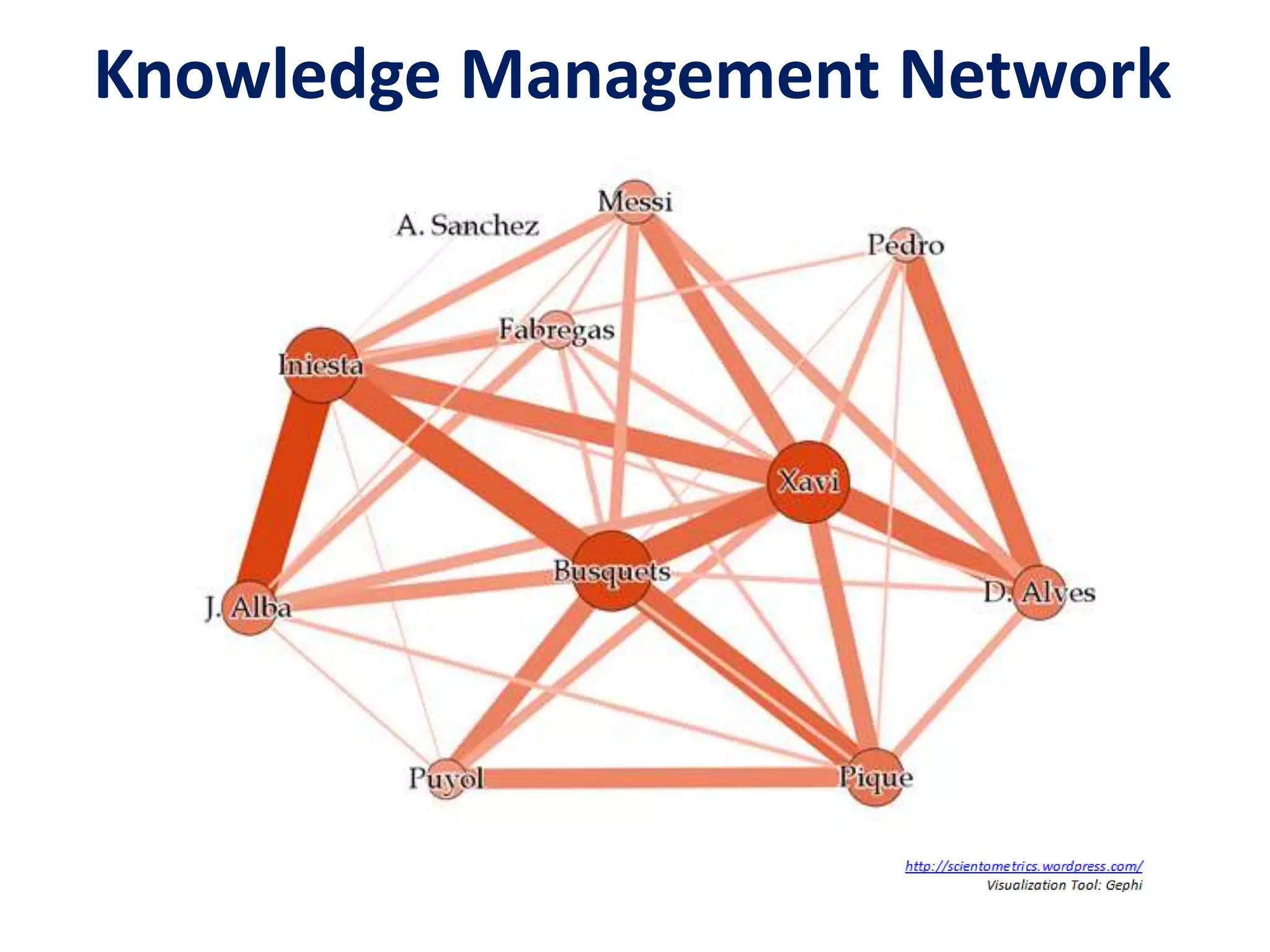
  • #18 Knowledge Management can be visualised as connections as illustrated by this map of the connections (passes) between the Barcelona football team
  • #19 The knowledge management framework comprises of people, processes/protocols and technology (as well as governance – not illustrated here) interacting with the internal and external environment.
  • #23 A succinct summary of why knowledge management matters.
  • #24 A model KMF
  • #25 A model KMF with examples
  • #26 Don’t fall into the rigidity trap e.g. Palace of Nations built to house the League of Nations, whose design included everything “ingenuity could devise” except it was only completed in 1937, 17 years after the organisation was founded and when it had “practically ceased to exist”. When institutions are truly busy, they have no time to fret over perfection, whether of plans or physical plants (see Parkinson’s Law by C. Northcote Parkinson, 1957).
  • #27 The Action Learning Cycle exemplifies this flexible, adaptable approach to planning, execution, monitoring and evaluation
  • #28 Let’s put our effort into our spheres of control and influence while being mindful of our sphere of interest/concern or worry Reminds me of the famous Serenity Prayer: Grant me the serenity to accept the things I cannot change, The courage to change the things I can, And the wisdom to know the difference.
  • #29 A summary of knowledge products produced under the PAN Project to date
  • #41 A work in progress!
  • #42 A work in progress!
  • #43 Learning needs identified!
  • #46 An outline of the process adopted to document KM successes to date (KM assets) and stakeholder’s KM Needs.
  • #47 “Yet it’s easy to take things for granted. How much time during the day do you actually focus on gratitude, compared to the time you spend thinking about the problems in your life? We act as if gratitude and appreciation are our good china and our fancy tablecloth and bring them out only on really special occasions.” – Marci Shimoff.
  • #48 Study after study shows that the desire to avoid pain (fear) is usually the more powerful of the two forces. An illustrative study was carried out by Professor Baba Shiv of Stamford University (<<URL>>). Shiv gave participants $20. They had the choice of whether to bet or not bet $1 on 20 coin tosses. Each losing bet would cost $1 while each winning bet would make $1.50. Logically you should bet every time but that is not what actually happened. The participants refused to bet on many occasions and this reluctance grew with each coin toss. On average the participants ended up with only $22.80 compared to the predicted average of $25 if they had bet on every coin toss.
  • #49 People are adapted to fight, flight or freeze in the event of a sabre-tooth tiger threat but this same response is engendered by the various “paper tigers” we encounter in our daily lives… notably our bosses!
  • #50 People do more to avoid pain than gain pleasure – that’s why negative political campaigning works so well. Proverbs: Better the devil you know and a bird in the hand is worth two in the bush
  • #51 The fact that we tend to pay attention to what is missing is exemplified by our focus on things like “gap analysis”, “problem trees” and “needs” without a commensurate emphasis on assets –those aspects of a situation that are currently working.
  • #52 Represented here by the rose-tinted specs
  • #53 One of the classic quotes used by advocates of appreciative inquiry
  • #55 There is a potential flipside of Appreciative Inquiry
  • #56 There is a potential flipside of Appreciative Inquiry
  • #57 By focusing exclusively on the “light side of the continuum” we may fall into the “tree wise monkey trap” of failing to address the problematic.
  • #58 Light and dark combine to provide the whole picture as illustrated by the concept of Ying and Yang
  • #59 Dicken’s famous opening line from his “Tale of Two Cities” was as true in 1859 as it is today and will be tomorrow.
  • #60 Mental contrasting, pioneered by Gabriele Oettingen provides a more balanced approach at looking at the positive and challenging aspects of every situation.
  • #62 Related to mental contrasting, bookending is an approach that involves estimating two contrasting situations: the worst case and best case scenarios which helps us to see opportunities and pitfalls (see Chip and Dan Heath’s (2013) book Decisive: How to make Better Choices in Life and Work for more details).
  • #63 Project Manager Mr Shakil Beedassy kindly posing as our before and after model
  • #65 Represented here be rose-tinted specs with one lens cracked
  • #66 The appreciative interview begins with the selection of an affirmative topic. In this case we asked participants to remember a successful instance of knowledge management from there work or personal life.
  • #67 An idea, central to Appreciative Inquiry and Neuro-Linguistic Programming is that we experience the world through filters of perception (our senses and our interpretation of sensory inputs) through which we give events their meaning. In the appreciative interview we focus on the affirming aspects of a felt experience.
  • #68 This idea can be dramatically illustrated by the contrasting experiences of two fans of opposing football teams as a result of the same event; in this case a late equalising goal by Tottenham Hotspur against Arsenal.
  • #69 Take it away… Jamie Gascoigne!
  • #71 Exercise to harvest positive knowledge management experience as a basis for an assets inventory
  • #72 Exercise to harvest positive PAN knowledge management needs