KNOWLEDGE MANAGEMENT
A PRACTICAL MODEL WORKING
(Based on Gilbert J. B. Probst’s work)
Goal of Knowledge Management
Capabilities
Improve organizational capabilities through better use
of the organization’s individual and collective knowledge
Resources.
Resources
These resources include skills, capabilities,
experience, routines, and norms, as well as technologies.
Consensus
Create a consensus within the organization of the importance of
knowledge or intellectual capital to company’s success.
PRACTICAL EFFORTS
AKNOWLEDGEMENT
STRATEGIC RESOURCE
Consider knowledge a strategic resource and a central tool for
Protecting competitiveness of the business.
Many knowledge problems occur because organizations neglect one or
more of the knowledge management building blocks and thus interrupt the
knowledge cycle.
Knowledge management must integrate human beings, and human beings
do not externalize their knowledge in computer systems, but need
personal contacts and discussions. To enable these talks between
knowledge suppliers and knowledge demanders, the knowledge
management system must include opportunities for personal contact
KNOWLEDGE IS A STRATEGIC RESOURCE
Standards for knowledge management
COMPATIBILITY
Knowledge Management (KM) requires both a shared language
and a good fit with concepts that already exist in the organization,
such as Total Quality Management (TQM), Business Process
Reengineering (BPR), Business Analysis (BA), and Business
Intelligence (BI).
PROBLEM ORIENTATION
Knowledge management has to make a contribution to the
solution of concrete problems; it must not be allowed to remain
theoretical. The ultimate test of ideas is their usefulness in
practice.
.
PRACTICAL MODEL FOR KM
Standards for knowledge management
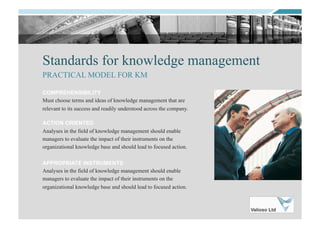
COMPREHENSIBILITY
Must choose terms and ideas of knowledge management that are
relevant to its success and readily understood across the company.
ACTION ORIENTED
Analyses in the field of knowledge management should enable
managers to evaluate the impact of their instruments on the
organizational knowledge base and should lead to focused action.
APPROPRIATE INSTRUMENTS
Analyses in the field of knowledge management should enable
managers to evaluate the impact of their instruments on the
organizational knowledge base and should lead to focused action.
PRACTICAL MODEL FOR KM
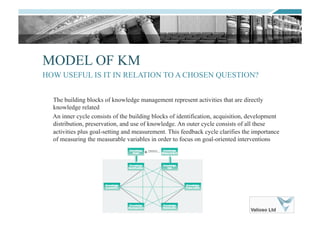
The building blocks of knowledge management represent activities that are directly
knowledge related
An inner cycle consists of the building blocks of identification, acquisition, development
distribution, preservation, and use of knowledge. An outer cycle consists of all these
activities plus goal-setting and measurement. This feedback cycle clarifies the importance
of measuring the measurable variables in order to focus on goal-oriented interventions
MODEL OF KM
HOW USEFUL IS IT IN RELATION TO A CHOSEN QUESTION?
KM BLOCKS
IMPLEMENTABLE OR NOT?
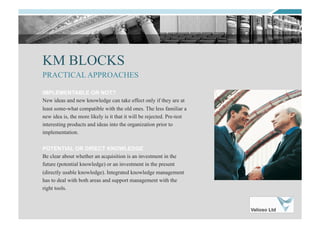
New ideas and new knowledge can take effect only if they are at
least some-what compatible with the old ones. The less familiar a
new idea is, the more likely is it that it will be rejected. Pre-test
interesting products and ideas into the organization prior to
implementation.
POTENTIAL OR DIRECT KNOWLEDGE
Be clear about whether an acquisition is an investment in the
future (potential knowledge) or an investment in the present
(directly usable knowledge). Integrated knowledge management
has to deal with both areas and support management with the
right tools.
PRACTICAL APPROACHES
KM BLOCKS
ARENAS
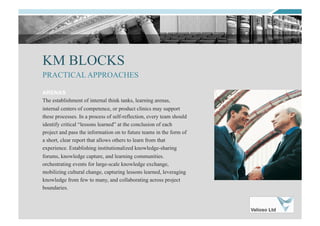
The establishment of internal think tanks, learning arenas,
internal centers of competence, or product clinics may support
these processes. In a process of self-reflection, every team should
identify critical “lessons learned” at the conclusion of each
project and pass the information on to future teams in the form of
a short, clear report that allows others to learn from that
experience. Establishing institutionalized knowledge-sharing
forums, knowledge capture, and learning communities.
orchestrating events for large-scale knowledge exchange,
mobilizing cultural change, capturing lessons learned, leveraging
knowledge from few to many, and collaborating across project
boundaries.
PRACTICAL APPROACHES
KM BLOCKS
DISTRIBUTE KNOWLEDGE
Technical knowledge distribution infrastructures can support
efficient knowledge exchange within organizations and connect
formerly separated experts through IT network.
SATISFACTION
Efficient knowledge distribution can gene
rate not only time and quality advantages, but a direct rise in
worker satisfaction.
CULTURAL BARRIERS
Do not share knowledge because unwritten rules drive people’s
behavior in another direction, like; “it works, so do not disrupt
it”, “we are paid to do the work, not think”, “we can not share, its
secret”, or “management does not know what it wants”.
PRACTICAL APPROACHES
KM BLOCKS
ADOPT KNOWLEDGE
The potential user of knowledge has to see a real advantage in
order to change his or her behavior and “adopt” the knowledge..
KNOWLEDGE MARKETPLACE
Enhance use of knowledge through knowledge fairs, advisory
boards, champions communities, internal media channels, and IT
platforms on intranet.
Establish profiles of internal experts (The Yellow Pages), profiles
of external experts (The Blue Pages), and bulletin boards and
virtual meetings (The FairShare)
PRACTICAL APPROACHES
KM BLOCKS
CORPORATE MEMORY OR AMNESIA?
Establish a knowledge map to be the roadmap to shape the
processes of selecting valuable knowledge for preservation,
ensuring its suitable storage, and regularly incorporating it into
the knowledge base.
KNOWLEDGE MAPS
Define key customer questions and requirements and store
experience and lessons learned. Define key organizational
questions and requirements and store experience and lessons
learned. The guiding rule should be to preserve only information
that will be usable for a third party in the future. Less is more.
PRACTICAL APPROACHES
KM BLOCKS
STORAGE PROCESSES
Include individual, collective, and electronic versions all of
which are subject to “unlearning.” On the individual level,
experts with key know-how should be bound to the company by
material or nonmaterial incentive systems. On the collective
level, an organization can try to make explicit the capabilities
stored in the procedural memory of the company and try to build
a conscious picture of the company’s past. Electronic storage, in
which more and more expert systems play the role of intelligent
protectors of organizational experience, ensures future access to
central knowledge documents in a systematic way. A word of
caution: preservation is a continual process. Outdated or out of
date storage systems are dead storage systems.
PRACTICAL APPROACHES
KM BLOCKS
MEASURE KM PROGRESS/ EFFECT
There are no one way of measure how well KM is doing, but
there are ways you can approach this in a cautionary way.
Examples of ways could include knowledge-oriented cultural
analysis, capability balance sheets, or the intensification of
training evaluations. Only by simplifying the measurement of
central indicators within the knowledge management process can
knowledge managers win solid acceptance of their activities and
useful feedback.
Knowledge management is highly political and needs top -
management commitment. Many actions in the field of
knowledge management can be successful only if the undertaking
has full top-management commitment.
AVOID “TURF” BATTLES
PRACTICAL APPROACHES
KNOWLEDGE MANAGEMENT
DECISIONS TO MAKE
to use the company’s knowledge resources more effectively must
shape long-term organizational Structures and corporate culture.
Knowledge goals must be integrated into corporate strategy and
project planning.
Employees must get infrastructural support in order to handle the
information overload.
It is important to create and establish a practical reference frame
and tool kit to design and utilize best-practice analysis related to
knowledge management
AND THEN WHAT?
BI OR KM?
DIFFERENCES - SIMILARITIES
BI has many parallels to KM, and at the end of the day it's all
about being able to filter out the noise, identify all the variables in
the equation, and make the right decisions based on what you
know and assume to be true -- be it structured or unstructured.
BI maybe more into figuring out ways to collect, organize,
structure, and mine data to help businesses make better decisions
and not so much on how to share what is learned, and that is
maybe where KM goes further.
KM is also about the way we create, collect, manage, consume,
share, and leverage the unstructured information combined with
the structured data my colleague was so familiar with. It's about
learning, learning curves, and reuse - be it structured or social or
organizational. And KM can be also be about talent, innovation,
revenue and costs as well.
WHAT IS WHAT?

KM

  • 1.
    KNOWLEDGE MANAGEMENT A PRACTICALMODEL WORKING (Based on Gilbert J. B. Probst’s work)
  • 2.
    Goal of KnowledgeManagement Capabilities Improve organizational capabilities through better use of the organization’s individual and collective knowledge Resources. Resources These resources include skills, capabilities, experience, routines, and norms, as well as technologies. Consensus Create a consensus within the organization of the importance of knowledge or intellectual capital to company’s success. PRACTICAL EFFORTS
  • 3.
    AKNOWLEDGEMENT STRATEGIC RESOURCE Consider knowledgea strategic resource and a central tool for Protecting competitiveness of the business. Many knowledge problems occur because organizations neglect one or more of the knowledge management building blocks and thus interrupt the knowledge cycle. Knowledge management must integrate human beings, and human beings do not externalize their knowledge in computer systems, but need personal contacts and discussions. To enable these talks between knowledge suppliers and knowledge demanders, the knowledge management system must include opportunities for personal contact KNOWLEDGE IS A STRATEGIC RESOURCE
  • 4.
    Standards for knowledgemanagement COMPATIBILITY Knowledge Management (KM) requires both a shared language and a good fit with concepts that already exist in the organization, such as Total Quality Management (TQM), Business Process Reengineering (BPR), Business Analysis (BA), and Business Intelligence (BI). PROBLEM ORIENTATION Knowledge management has to make a contribution to the solution of concrete problems; it must not be allowed to remain theoretical. The ultimate test of ideas is their usefulness in practice. . PRACTICAL MODEL FOR KM
  • 5.
    Standards for knowledgemanagement COMPREHENSIBILITY Must choose terms and ideas of knowledge management that are relevant to its success and readily understood across the company. ACTION ORIENTED Analyses in the field of knowledge management should enable managers to evaluate the impact of their instruments on the organizational knowledge base and should lead to focused action. APPROPRIATE INSTRUMENTS Analyses in the field of knowledge management should enable managers to evaluate the impact of their instruments on the organizational knowledge base and should lead to focused action. PRACTICAL MODEL FOR KM
  • 6.
    The building blocksof knowledge management represent activities that are directly knowledge related An inner cycle consists of the building blocks of identification, acquisition, development distribution, preservation, and use of knowledge. An outer cycle consists of all these activities plus goal-setting and measurement. This feedback cycle clarifies the importance of measuring the measurable variables in order to focus on goal-oriented interventions MODEL OF KM HOW USEFUL IS IT IN RELATION TO A CHOSEN QUESTION?
  • 7.
    KM BLOCKS IMPLEMENTABLE ORNOT? New ideas and new knowledge can take effect only if they are at least some-what compatible with the old ones. The less familiar a new idea is, the more likely is it that it will be rejected. Pre-test interesting products and ideas into the organization prior to implementation. POTENTIAL OR DIRECT KNOWLEDGE Be clear about whether an acquisition is an investment in the future (potential knowledge) or an investment in the present (directly usable knowledge). Integrated knowledge management has to deal with both areas and support management with the right tools. PRACTICAL APPROACHES
  • 8.
    KM BLOCKS ARENAS The establishmentof internal think tanks, learning arenas, internal centers of competence, or product clinics may support these processes. In a process of self-reflection, every team should identify critical “lessons learned” at the conclusion of each project and pass the information on to future teams in the form of a short, clear report that allows others to learn from that experience. Establishing institutionalized knowledge-sharing forums, knowledge capture, and learning communities. orchestrating events for large-scale knowledge exchange, mobilizing cultural change, capturing lessons learned, leveraging knowledge from few to many, and collaborating across project boundaries. PRACTICAL APPROACHES
  • 9.
    KM BLOCKS DISTRIBUTE KNOWLEDGE Technicalknowledge distribution infrastructures can support efficient knowledge exchange within organizations and connect formerly separated experts through IT network. SATISFACTION Efficient knowledge distribution can gene rate not only time and quality advantages, but a direct rise in worker satisfaction. CULTURAL BARRIERS Do not share knowledge because unwritten rules drive people’s behavior in another direction, like; “it works, so do not disrupt it”, “we are paid to do the work, not think”, “we can not share, its secret”, or “management does not know what it wants”. PRACTICAL APPROACHES
  • 10.
    KM BLOCKS ADOPT KNOWLEDGE Thepotential user of knowledge has to see a real advantage in order to change his or her behavior and “adopt” the knowledge.. KNOWLEDGE MARKETPLACE Enhance use of knowledge through knowledge fairs, advisory boards, champions communities, internal media channels, and IT platforms on intranet. Establish profiles of internal experts (The Yellow Pages), profiles of external experts (The Blue Pages), and bulletin boards and virtual meetings (The FairShare) PRACTICAL APPROACHES
  • 11.
    KM BLOCKS CORPORATE MEMORYOR AMNESIA? Establish a knowledge map to be the roadmap to shape the processes of selecting valuable knowledge for preservation, ensuring its suitable storage, and regularly incorporating it into the knowledge base. KNOWLEDGE MAPS Define key customer questions and requirements and store experience and lessons learned. Define key organizational questions and requirements and store experience and lessons learned. The guiding rule should be to preserve only information that will be usable for a third party in the future. Less is more. PRACTICAL APPROACHES
  • 12.
    KM BLOCKS STORAGE PROCESSES Includeindividual, collective, and electronic versions all of which are subject to “unlearning.” On the individual level, experts with key know-how should be bound to the company by material or nonmaterial incentive systems. On the collective level, an organization can try to make explicit the capabilities stored in the procedural memory of the company and try to build a conscious picture of the company’s past. Electronic storage, in which more and more expert systems play the role of intelligent protectors of organizational experience, ensures future access to central knowledge documents in a systematic way. A word of caution: preservation is a continual process. Outdated or out of date storage systems are dead storage systems. PRACTICAL APPROACHES
  • 13.
    KM BLOCKS MEASURE KMPROGRESS/ EFFECT There are no one way of measure how well KM is doing, but there are ways you can approach this in a cautionary way. Examples of ways could include knowledge-oriented cultural analysis, capability balance sheets, or the intensification of training evaluations. Only by simplifying the measurement of central indicators within the knowledge management process can knowledge managers win solid acceptance of their activities and useful feedback. Knowledge management is highly political and needs top - management commitment. Many actions in the field of knowledge management can be successful only if the undertaking has full top-management commitment. AVOID “TURF” BATTLES PRACTICAL APPROACHES
  • 14.
    KNOWLEDGE MANAGEMENT DECISIONS TOMAKE to use the company’s knowledge resources more effectively must shape long-term organizational Structures and corporate culture. Knowledge goals must be integrated into corporate strategy and project planning. Employees must get infrastructural support in order to handle the information overload. It is important to create and establish a practical reference frame and tool kit to design and utilize best-practice analysis related to knowledge management AND THEN WHAT?
  • 15.
    BI OR KM? DIFFERENCES- SIMILARITIES BI has many parallels to KM, and at the end of the day it's all about being able to filter out the noise, identify all the variables in the equation, and make the right decisions based on what you know and assume to be true -- be it structured or unstructured. BI maybe more into figuring out ways to collect, organize, structure, and mine data to help businesses make better decisions and not so much on how to share what is learned, and that is maybe where KM goes further. KM is also about the way we create, collect, manage, consume, share, and leverage the unstructured information combined with the structured data my colleague was so familiar with. It's about learning, learning curves, and reuse - be it structured or social or organizational. And KM can be also be about talent, innovation, revenue and costs as well. WHAT IS WHAT?