KNOWLEDGE MANAGEMENT Zakaria Deraman [email_address]
Contents  Definition of Knowledge Definition of Knowledge Management (KM) Road Map to KM Implementation  Key Benefits of KMS
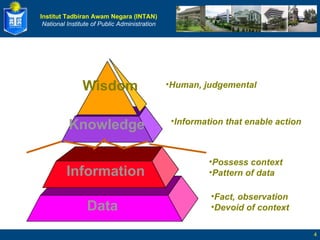
How Knowledge is Derived? Data   facts, numbers or individual entities without context Information   comprises the basic facts with context and perspective Information= data + interpretation Knowledge   the information which provides guidance for action. Knowledge= information + use Wisdom   the understanding which knowledge to use for what purpose.
Data Information Knowledge Wisdom Possess context Pattern of data Information that enable action Fact, observation Devoid of context Human, judgemental
Definition of Knowledge   Ideas/best practices  from organisation which can be utilized to achieve the organization’s goals  This knowledge is  specific  according to organization role/function Knowledge may be recorded in  an individual brain  or stored in  organizational processes, products, facilities, systems and documents.
When Information become knowledge Comparison Consequences Connections Conversation and etc
Types of Knowledge Tacit Knowledge “ highly personal and hard to formalize. Subjective insights, intuitions and hunches fall into this category of knowledge.” E.g. Experience, Creativity, Skills, Innovation, etc. Explicit   Knowledge :  “ can be expressed in words and numbers and can be easily communicated and shared in the form of hard data, scientific formulae, codified procedures or universal principles” E.g. Pattern, R&D Materials, Best Practices, etc.
Knowledge conversion – Tacit to Explicit Internalization [i&g&o] training mentoring tacit Socialization  [i&i] brainstorming meeting Combination [g&o] repositories CoP tacit tacit tacit explicit explicit explicit explicit Externalization [ i&g] videotaping knowledge map
The Importance of Knowledge Resources of an organization must be protected, cultivated and shared among organization members  to sustain continuity. To compete  more effectively in the future an organization need to have the following elements such as Individual skills/competencies Thoughts Innovations and ideas
Problems Relating to Knowledge Usually exists in the minds of individuals Leaves the organization with the employee Hidden in some forgotten report People are not comfortable sharing their knowledge. a human problem, not a technology problem.  WHY?
People are not sharing what they know due to personal reason organizational inhibitors. This is becoming an extremely expensive reality.  Problems Relating to Knowledge (cont’d)
Inefficiencies that result from intellectual work. Substandard performance  The inability to find knowledge resources A better idea goes unused is a lost opportunity Problems Relating to Knowledge (cont’d)
Definition of KM KM is a  systematic  management of  vital knowledge  and its associated  processes  of creating, gathering, organizing, diffusion, use and exploitation, in pursuit of organizational objectives
Definition of KM (cont’d) A systematic process of information in a way that  improves an employee’s comprehension  in a specific area of interest. It helps an organization  gain lesson learnt  and understanding from its own experience
Definition of KM (cont’d) Specific KM activities help focus the organization on  acquiring ,  storing  and  utilizing  knowledge for  problem solving, e-learning, strategic planning & decision making. It  protects intellectual assets  from  decay , add to  organization intelligence  and provides  increased flexibility
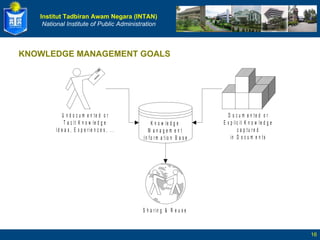
KNOWLEDGE MANAGEMENT GOALS
KM Involves: CoP (Communities of Practice) KMO (Knowledge Management Office) SME Identification and Use. Knowledge Brokering Lessons Learned/Best Practices Taxonomy, Ontology and Mapping Data Warehousing/Data Mining
Elements of KM People The  culture  of the organization support ongoing learning & knowledge sharing The people should be  motivated and rewarded  for creating, sharing & using knowledge Inspire  the people to innovate & learn from mistakes. Do not allow  “blame and shame” culture Also relate to mindset, trust, insight, hunches
Reasons People Don’t Share Knowledge: People believe that  knowledge is power   People are  insecure  about the value of their knowledge  People  don't trust  each other  Employees are  afraid of negative consequences   People work for other people who don't tell what they know  Elements of KM (cont’d)
Elements of KM (cont’d) Process In order to implement and sustain knowledge management, organizations need to make changes to the way their internal processes are structured. Identify which processes constitute either barriers to, or enablers of, knowledge management.  How  these processes can be adapted, or  what  new processes can be introduced, to support people in  creating, sharing and using  knowledge? activity such as research, recruitment, cataloging, indexing, verification.
Elements of KM (cont’d) Technology a crucial enabler  of knowledge management it can help connect people with information, and people with each other, but it  is not  the solution . KM portal, discovery tools, applications, etc.
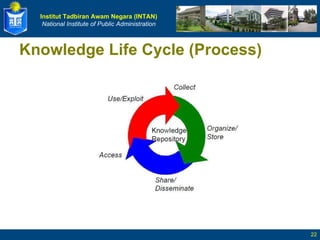
Knowledge Life Cycle (Process)
Collect Existing knowledge is gathered either on a routine basis or as needed.  Identifying various knowledge domains  Accessing information from existing databases, on-line sources, homepages, application systems. Organize The knowledge is classified and stored, often using an organization or industry specific thesaurus or classification schema. This makes subsequent retrieval easier.  An  AI system and and Digitized Knowledge  will be used to automatically carry out the above functions. DSS  and  Data Mining  will be used to transfor.  Share Information may be sent routinely to those people who are known to be interested in it (Information ‘push’) Meetings and events act as vehicles to share tacit knowledge. Access Information is made easily accessible from a database, for example over an intranet.  Users access it as they need it  (information ‘pull’). A main portal (central) and knowledge portals (various knowledge domains) are used as the front end of the KMS Exploit The knowledge is used as part of a work process.  It is refined and developed. Through use, additional knowledge is created and the cycle repeats itself. Knowledge Life Cycle (cont’d)
Technology (Enabler)  Knowledge Repositories Expert Systems Data Mining tools  Contact software Collaborative tools Intranets/Extranets
Knowledge Repositories Tool used to store information Also known as  Data Warehouse Examples: Business Intelligence EIS, DSS
Expert Systems Attempts to provide an answer to a problem with the consultation aid of human expert. Example: Case based reasoning Characteristics of a problem are entered into a system, classified based on different cases, and provides a potential solution.  This case and it’s solution is then added to the database. Help Desk From experience of maintenance activity, the system can produce result to the user and what action should be taken.
Data Mining Attempt by the system to translate huge amounts of data into knowledge Analyzes patterns Some examples….. Based on information gathered from  current and historical data  , it can help forecast market trends, business patterns, profiling practices using algorithms. Examples of DM product: Scenario (Cognos), Intelligent Miner (IBM)
Contact Software/Collaborative Tools Facilitates interaction among individuals to encourage sharing Email Intranet chat rooms Whiteboards Blogs Virtual conferencing/meeting Online Community
Intranets Usually the first stage of KM implementation for most organizations HR forms, online resources, work product status… Plan with the user in mind: access, flexibility and navigation
Extranets Centralized electronic repository of information Accessed by clients Advertising, newsletters, client specific information, status of orders…. Interactive tools for collaboration
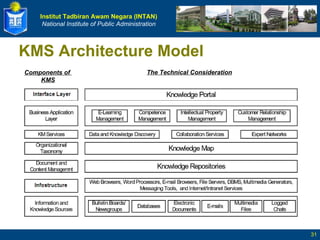
KMS Architecture Model Components of  KMS The Technical Consideration
ROAD MAP TO  KM IMPLEMENTATION
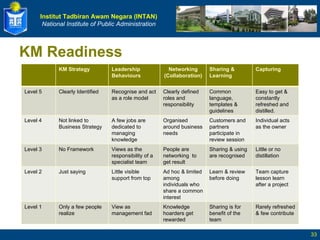
KM Readiness KM Strategy Leadership Behaviours Networking (Collaboration) Sharing & Learning Capturing Level 5 Clearly Identified Recognise and act as a role model Clearly defined roles and responsibility Common language, templates & guidelines Easy to get & constantly refreshed and distilled. Level 4 Not linked to Business Strategy A few jobs are dedicated to managing knowledge Organised around business needs Customers and partners participate in review session Individual acts as the owner Level 3 No Framework Views as the responsibility of a specialist team People are networking  to get result Sharing & using are recognised Little or no distillation Level 2 Just saying Little visible support from top Ad hoc & limited among individuals who share a common interest Learn & review before doing Team capture lesson learn after a project Level 1 Only a few people realize View as management fad Knowledge hoarders get rewarded Sharing is for benefit of the team Rarely refreshed & few contribute
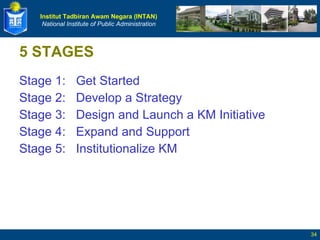
5 STAGES Stage 1:  Get Started  Stage 2:  Develop a Strategy  Stage 3:  Design and Launch a KM Initiative Stage 4:  Expand and Support Stage 5:  Institutionalize KM
STAGE 1:  Get Started  Knowledge management has emerged  as a topic of interest  in the organization  At least  a few employees have explored  the benefits of KM for the organization Someone  has had a personal stake  in developing interest in KM  Some members of the organization  have learned about KM  through participation in consortia or conferences  The organization  has created  a high-level rationale or  vision for pursuing KM
STAGE 2:  Develop Strategy  Establish a KM exploratory group or  steering committee  for KM Need support  from an executive sponsor for further exploration of KM Look for  internal grassroots  efforts already under way  IT organization  is interested in actively supporting KM initiatives Stories of how knowledge sharing has helped in the past (lesson learnt) identify  proof-of-concept (POC)  that allows to demonstrate how KM will benefit our organization  Secured ownership, funding, and  buy-in for pilots
STAGE 3:  Design & Launch KM Initiatives  Design a pilot  and  implementation strategies Launch  communities of practice (CoP),  an interactive KM Intranet site, or some other pilot initiative  Enlist and train pilot  facilitators  and  leaders  Establish pilot measures  and indicators and developed a system for tracking and reporting results Create strategies for learning from our KM initiatives Map out strategies for  expanding  our pilot initiatives across the organization
STAGE 4:  Expand & Support  Other departments in the organization are expressing a demand for KM, based on pilot results Begin to  market KM  throughout the organization  Make the  entire organization  aware of KM Expand strategy  in place for KM initiatives  Identify the resources necessary for expanding KM efforts
STAGE 5:  Institutionalize Knowledge Management  KM is directly  linked to business model KM initiatives are  widely deployed  throughout the organization  All staffs are trained to use KM technologies Assess  KM strategy, identify gaps, and outline methods to close the gaps Have a formal support structure in place to maintain KM.  Have  rewards programs  in alignment with our KM strategy Sharing knowledge is now the norm in organization
KEY BENEFITS OF KM SYSTEM
The Need for a KM System Increases the  capture, sharing and transfer   of knowledge across the organization Captures  tacit  and  explicit  knowledge Enables  indexing  and  categorization  to facilitate searching and mining
The Need for a KM System (cont’d) Single point of access  to knowledge contained in isolated information systems  Monitors and  alerts  user when new knowledge is captured Linking individuals to knowledge to encourage  reuse and sharing Encourage  collaboration  by linking individuals to individuals
The Need for a KM System (cont’d) Provide  paper-less  integration with workflow applications to automatically capture knowledge generated Provide  secured access  to organizational knowledge
TERIMA KASIH

Km ver 1.0 student

  • 1.
    KNOWLEDGE MANAGEMENT ZakariaDeraman [email_address]
  • 2.
    Contents Definitionof Knowledge Definition of Knowledge Management (KM) Road Map to KM Implementation Key Benefits of KMS
  • 3.
    How Knowledge isDerived? Data facts, numbers or individual entities without context Information comprises the basic facts with context and perspective Information= data + interpretation Knowledge the information which provides guidance for action. Knowledge= information + use Wisdom the understanding which knowledge to use for what purpose.
  • 4.
    Data Information KnowledgeWisdom Possess context Pattern of data Information that enable action Fact, observation Devoid of context Human, judgemental
  • 5.
    Definition of Knowledge Ideas/best practices from organisation which can be utilized to achieve the organization’s goals This knowledge is specific according to organization role/function Knowledge may be recorded in an individual brain or stored in organizational processes, products, facilities, systems and documents.
  • 6.
    When Information becomeknowledge Comparison Consequences Connections Conversation and etc
  • 7.
    Types of KnowledgeTacit Knowledge “ highly personal and hard to formalize. Subjective insights, intuitions and hunches fall into this category of knowledge.” E.g. Experience, Creativity, Skills, Innovation, etc. Explicit Knowledge : “ can be expressed in words and numbers and can be easily communicated and shared in the form of hard data, scientific formulae, codified procedures or universal principles” E.g. Pattern, R&D Materials, Best Practices, etc.
  • 8.
    Knowledge conversion –Tacit to Explicit Internalization [i&g&o] training mentoring tacit Socialization [i&i] brainstorming meeting Combination [g&o] repositories CoP tacit tacit tacit explicit explicit explicit explicit Externalization [ i&g] videotaping knowledge map
  • 9.
    The Importance ofKnowledge Resources of an organization must be protected, cultivated and shared among organization members to sustain continuity. To compete more effectively in the future an organization need to have the following elements such as Individual skills/competencies Thoughts Innovations and ideas
  • 10.
    Problems Relating toKnowledge Usually exists in the minds of individuals Leaves the organization with the employee Hidden in some forgotten report People are not comfortable sharing their knowledge. a human problem, not a technology problem. WHY?
  • 11.
    People are notsharing what they know due to personal reason organizational inhibitors. This is becoming an extremely expensive reality. Problems Relating to Knowledge (cont’d)
  • 12.
    Inefficiencies that resultfrom intellectual work. Substandard performance The inability to find knowledge resources A better idea goes unused is a lost opportunity Problems Relating to Knowledge (cont’d)
  • 13.
    Definition of KMKM is a systematic management of vital knowledge and its associated processes of creating, gathering, organizing, diffusion, use and exploitation, in pursuit of organizational objectives
  • 14.
    Definition of KM(cont’d) A systematic process of information in a way that improves an employee’s comprehension in a specific area of interest. It helps an organization gain lesson learnt and understanding from its own experience
  • 15.
    Definition of KM(cont’d) Specific KM activities help focus the organization on acquiring , storing and utilizing knowledge for problem solving, e-learning, strategic planning & decision making. It protects intellectual assets from decay , add to organization intelligence and provides increased flexibility
  • 16.
  • 17.
    KM Involves: CoP(Communities of Practice) KMO (Knowledge Management Office) SME Identification and Use. Knowledge Brokering Lessons Learned/Best Practices Taxonomy, Ontology and Mapping Data Warehousing/Data Mining
  • 18.
    Elements of KMPeople The culture of the organization support ongoing learning & knowledge sharing The people should be motivated and rewarded for creating, sharing & using knowledge Inspire the people to innovate & learn from mistakes. Do not allow “blame and shame” culture Also relate to mindset, trust, insight, hunches
  • 19.
    Reasons People Don’tShare Knowledge: People believe that knowledge is power People are insecure about the value of their knowledge People don't trust each other Employees are afraid of negative consequences People work for other people who don't tell what they know Elements of KM (cont’d)
  • 20.
    Elements of KM(cont’d) Process In order to implement and sustain knowledge management, organizations need to make changes to the way their internal processes are structured. Identify which processes constitute either barriers to, or enablers of, knowledge management. How these processes can be adapted, or what new processes can be introduced, to support people in creating, sharing and using knowledge? activity such as research, recruitment, cataloging, indexing, verification.
  • 21.
    Elements of KM(cont’d) Technology a crucial enabler of knowledge management it can help connect people with information, and people with each other, but it is not the solution . KM portal, discovery tools, applications, etc.
  • 22.
  • 23.
    Collect Existing knowledgeis gathered either on a routine basis or as needed. Identifying various knowledge domains Accessing information from existing databases, on-line sources, homepages, application systems. Organize The knowledge is classified and stored, often using an organization or industry specific thesaurus or classification schema. This makes subsequent retrieval easier. An AI system and and Digitized Knowledge will be used to automatically carry out the above functions. DSS and Data Mining will be used to transfor. Share Information may be sent routinely to those people who are known to be interested in it (Information ‘push’) Meetings and events act as vehicles to share tacit knowledge. Access Information is made easily accessible from a database, for example over an intranet. Users access it as they need it (information ‘pull’). A main portal (central) and knowledge portals (various knowledge domains) are used as the front end of the KMS Exploit The knowledge is used as part of a work process. It is refined and developed. Through use, additional knowledge is created and the cycle repeats itself. Knowledge Life Cycle (cont’d)
  • 24.
    Technology (Enabler) Knowledge Repositories Expert Systems Data Mining tools Contact software Collaborative tools Intranets/Extranets
  • 25.
    Knowledge Repositories Toolused to store information Also known as Data Warehouse Examples: Business Intelligence EIS, DSS
  • 26.
    Expert Systems Attemptsto provide an answer to a problem with the consultation aid of human expert. Example: Case based reasoning Characteristics of a problem are entered into a system, classified based on different cases, and provides a potential solution. This case and it’s solution is then added to the database. Help Desk From experience of maintenance activity, the system can produce result to the user and what action should be taken.
  • 27.
    Data Mining Attemptby the system to translate huge amounts of data into knowledge Analyzes patterns Some examples….. Based on information gathered from current and historical data , it can help forecast market trends, business patterns, profiling practices using algorithms. Examples of DM product: Scenario (Cognos), Intelligent Miner (IBM)
  • 28.
    Contact Software/Collaborative ToolsFacilitates interaction among individuals to encourage sharing Email Intranet chat rooms Whiteboards Blogs Virtual conferencing/meeting Online Community
  • 29.
    Intranets Usually thefirst stage of KM implementation for most organizations HR forms, online resources, work product status… Plan with the user in mind: access, flexibility and navigation
  • 30.
    Extranets Centralized electronicrepository of information Accessed by clients Advertising, newsletters, client specific information, status of orders…. Interactive tools for collaboration
  • 31.
    KMS Architecture ModelComponents of KMS The Technical Consideration
  • 32.
    ROAD MAP TO KM IMPLEMENTATION
  • 33.
    KM Readiness KMStrategy Leadership Behaviours Networking (Collaboration) Sharing & Learning Capturing Level 5 Clearly Identified Recognise and act as a role model Clearly defined roles and responsibility Common language, templates & guidelines Easy to get & constantly refreshed and distilled. Level 4 Not linked to Business Strategy A few jobs are dedicated to managing knowledge Organised around business needs Customers and partners participate in review session Individual acts as the owner Level 3 No Framework Views as the responsibility of a specialist team People are networking to get result Sharing & using are recognised Little or no distillation Level 2 Just saying Little visible support from top Ad hoc & limited among individuals who share a common interest Learn & review before doing Team capture lesson learn after a project Level 1 Only a few people realize View as management fad Knowledge hoarders get rewarded Sharing is for benefit of the team Rarely refreshed & few contribute
  • 34.
    5 STAGES Stage1: Get Started Stage 2: Develop a Strategy Stage 3: Design and Launch a KM Initiative Stage 4: Expand and Support Stage 5: Institutionalize KM
  • 35.
    STAGE 1: Get Started Knowledge management has emerged as a topic of interest in the organization At least a few employees have explored the benefits of KM for the organization Someone has had a personal stake in developing interest in KM Some members of the organization have learned about KM through participation in consortia or conferences The organization has created a high-level rationale or vision for pursuing KM
  • 36.
    STAGE 2: Develop Strategy Establish a KM exploratory group or steering committee for KM Need support from an executive sponsor for further exploration of KM Look for internal grassroots efforts already under way IT organization is interested in actively supporting KM initiatives Stories of how knowledge sharing has helped in the past (lesson learnt) identify proof-of-concept (POC) that allows to demonstrate how KM will benefit our organization Secured ownership, funding, and buy-in for pilots
  • 37.
    STAGE 3: Design & Launch KM Initiatives Design a pilot and implementation strategies Launch communities of practice (CoP), an interactive KM Intranet site, or some other pilot initiative Enlist and train pilot facilitators and leaders Establish pilot measures and indicators and developed a system for tracking and reporting results Create strategies for learning from our KM initiatives Map out strategies for expanding our pilot initiatives across the organization
  • 38.
    STAGE 4: Expand & Support Other departments in the organization are expressing a demand for KM, based on pilot results Begin to market KM throughout the organization Make the entire organization aware of KM Expand strategy in place for KM initiatives Identify the resources necessary for expanding KM efforts
  • 39.
    STAGE 5: Institutionalize Knowledge Management KM is directly linked to business model KM initiatives are widely deployed throughout the organization All staffs are trained to use KM technologies Assess KM strategy, identify gaps, and outline methods to close the gaps Have a formal support structure in place to maintain KM. Have rewards programs in alignment with our KM strategy Sharing knowledge is now the norm in organization
  • 40.
    KEY BENEFITS OFKM SYSTEM
  • 41.
    The Need fora KM System Increases the capture, sharing and transfer of knowledge across the organization Captures tacit and explicit knowledge Enables indexing and categorization to facilitate searching and mining
  • 42.
    The Need fora KM System (cont’d) Single point of access to knowledge contained in isolated information systems Monitors and alerts user when new knowledge is captured Linking individuals to knowledge to encourage reuse and sharing Encourage collaboration by linking individuals to individuals
  • 43.
    The Need fora KM System (cont’d) Provide paper-less integration with workflow applications to automatically capture knowledge generated Provide secured access to organizational knowledge
  • 44.

Editor's Notes

  • #40 Loophole = ada kekurangan; so identify gap