Overview of an efficient knowledge management model Hamidreza Mokhtari Behrooz Arastoo  Omid Jahanshahi  ITVHE – Iran
Overview Introduction Theoretical bases Present situation and problems Suggested Model SWOT Analysis Future research opportunity
Introduction Sir Arthur Keith believes that the plateau of Iran has been among the first parts of the world whose people started to practice farming and animal husbandry (Iranshahr, 1963)
Introduction In the peaks of their civilization, Iranians introduced so many great ideas and inventions to the world like networks of irrigation canals and Ghanats. In this respect Henri Cgoblot, a French hydrologist and historian claimed that “… the first Ghanat were developed in the cultural borders of Iran”.
Theoretical bases Giere (1984) using cognitive psychology defines knowledge as justified true belief (JTB)
Theoretical bases “ information is converted to knowledge when we develop a justified belief in its truth value”.
Theoretical bases Natarajan (2000) states that knowledge that is in the context of the human mind is called  tacit  knowledge and when it is expressed in any form is called  explicit  knowledge
There are many facts that have been examined by our ancestors in the laboratory of nature during time and reached to us that is called  indigenous knowledge   Despite the indigenous knowledge,  science-based knowledge  is a product of scientific thinking and analogy
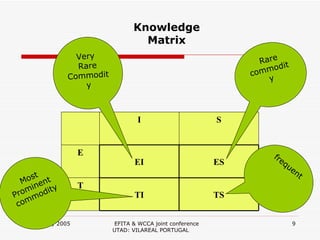
Very  Rare Commodity Rare  commodity frequent Most Prominent  commodity Knowledge Matrix TS TI T ES EI E S I
Present situation and problems Four sectors responsible for agriculture education State Universities Azad Universities T&V Schools Agriculture Highschools
Present situation and problems 45% illiterate farmers and on the other hand there are so many students graduating from higher education centres that are either unemployed or employed in non agriculture sector
Present situation and problems It seems that there have to be a straight relationship between the low rate of literacy and the productivity of agriculture being as low as about 50%.  The agricultural organizations in Iran are not designed to be components of a dynamic agriculture system. Thus each of them plays its role without considering the others’
Present situation and problems “ at the present, there are masses of documents such as annual reports, laws and regulations, financial and credential documents etc. in the form of reports or loose leaf and plenty of file cabinets all over the Institute” that are organized properly.
Present situation and problems the end user of the agriculture system of Iran has been lost in the middle of the  bureaucracy  of large and heavy bodies of government organizations  different and sometimes incompatible standards in their software, hardware and networks development
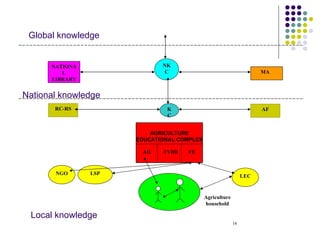
Suggested Model USAID: knowledge is an increasingly significant factor of productions, all actors in the agricultural sector are part of an evolving agricultural knowledge system (AKS) ICTs accelerate agricultural development by facilitating knowledge management for AKS members, ICTs are essential coordinating mechanisms in global trade.
Global   knowledge NGO LSP LEC AF RC-RS KC MA NATIONAL LIBRARY NKC National knowledge Local knowledge Agriculture household AGRICULTURE EDUCATIONAL COMPLEX FE TVHE AH
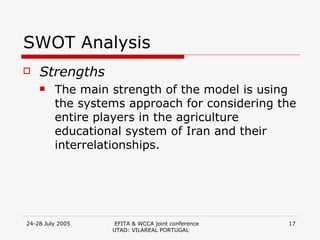
SWOT Analysis Strengths The main strength of the model is using the systems approach for considering the entire players in the agriculture educational system of Iran and their interrelationships.
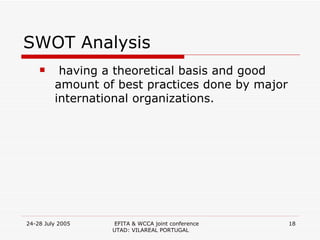
SWOT Analysis having a theoretical basis and good amount of best practices done by major international organizations.
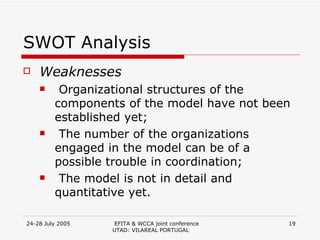
SWOT Analysis Weaknesses Organizational structures of the components of the model have not been established yet; The number of the organizations engaged in the model can be of a possible trouble in coordination; The model is not in detail and quantitative yet.
SWOT Analysis Opportunities TAKFA, which stands for “the Plan for Development and Application of Communication and Information Technology in Iran”, started in late 2001. It has been one of the most radical plans of president Khatami’s cabinet in ICT domain. A large amount of budget is dedicated to the plan, which consists of subdivisions like Electronic Government or Content Creation (TAKFA, 2001). Furthermore, the new priority of TAKFA will be on creating contents and knowledge.
SWOT Analysis During last years much works have been done in equipping the libraries and information services of ITVHE with computers, software, networks, internet, websites and many other technologies providing a backbone for the model.
SWOT Analysis Some activities have been done in the Center for Rural Research on indigenous knowledge which can potentially act as the scientific and managerial support for the model Recently a rise in the salary of the faculty members in Higher Education Sector by the decree of the Leader has put an extra weight on the importance of knowledge workers
SWOT Analysis Threats: Every now and then the managerial teams change suddenly without prior notification and thus the previous plans will be in danger of failure The bureaucracy of administrative phases of accreditation, research and implementation of the model The role of knowledge in the development process is not conceived by the managers completely;
Future research opportunity How can farmers children  be as an intermediate to transform and transfer the tacit knowledge of their parents to national and global knowledge and vice versa?  What are the roles of ICTs as enabler and accelerator?
THANK YOU FOR YOUR ATTENTION

Overview of an Efficient Knowledge Management Model

  • 1.
    Overview of anefficient knowledge management model Hamidreza Mokhtari Behrooz Arastoo Omid Jahanshahi ITVHE – Iran
  • 2.
    Overview Introduction Theoreticalbases Present situation and problems Suggested Model SWOT Analysis Future research opportunity
  • 3.
    Introduction Sir ArthurKeith believes that the plateau of Iran has been among the first parts of the world whose people started to practice farming and animal husbandry (Iranshahr, 1963)
  • 4.
    Introduction In thepeaks of their civilization, Iranians introduced so many great ideas and inventions to the world like networks of irrigation canals and Ghanats. In this respect Henri Cgoblot, a French hydrologist and historian claimed that “… the first Ghanat were developed in the cultural borders of Iran”.
  • 5.
    Theoretical bases Giere(1984) using cognitive psychology defines knowledge as justified true belief (JTB)
  • 6.
    Theoretical bases “information is converted to knowledge when we develop a justified belief in its truth value”.
  • 7.
    Theoretical bases Natarajan(2000) states that knowledge that is in the context of the human mind is called tacit knowledge and when it is expressed in any form is called explicit knowledge
  • 8.
    There are manyfacts that have been examined by our ancestors in the laboratory of nature during time and reached to us that is called indigenous knowledge Despite the indigenous knowledge, science-based knowledge is a product of scientific thinking and analogy
  • 9.
    Very RareCommodity Rare commodity frequent Most Prominent commodity Knowledge Matrix TS TI T ES EI E S I
  • 10.
    Present situation andproblems Four sectors responsible for agriculture education State Universities Azad Universities T&V Schools Agriculture Highschools
  • 11.
    Present situation andproblems 45% illiterate farmers and on the other hand there are so many students graduating from higher education centres that are either unemployed or employed in non agriculture sector
  • 12.
    Present situation andproblems It seems that there have to be a straight relationship between the low rate of literacy and the productivity of agriculture being as low as about 50%. The agricultural organizations in Iran are not designed to be components of a dynamic agriculture system. Thus each of them plays its role without considering the others’
  • 13.
    Present situation andproblems “ at the present, there are masses of documents such as annual reports, laws and regulations, financial and credential documents etc. in the form of reports or loose leaf and plenty of file cabinets all over the Institute” that are organized properly.
  • 14.
    Present situation andproblems the end user of the agriculture system of Iran has been lost in the middle of the bureaucracy of large and heavy bodies of government organizations different and sometimes incompatible standards in their software, hardware and networks development
  • 15.
    Suggested Model USAID:knowledge is an increasingly significant factor of productions, all actors in the agricultural sector are part of an evolving agricultural knowledge system (AKS) ICTs accelerate agricultural development by facilitating knowledge management for AKS members, ICTs are essential coordinating mechanisms in global trade.
  • 16.
    Global knowledge NGO LSP LEC AF RC-RS KC MA NATIONAL LIBRARY NKC National knowledge Local knowledge Agriculture household AGRICULTURE EDUCATIONAL COMPLEX FE TVHE AH
  • 17.
    SWOT Analysis StrengthsThe main strength of the model is using the systems approach for considering the entire players in the agriculture educational system of Iran and their interrelationships.
  • 18.
    SWOT Analysis havinga theoretical basis and good amount of best practices done by major international organizations.
  • 19.
    SWOT Analysis WeaknessesOrganizational structures of the components of the model have not been established yet; The number of the organizations engaged in the model can be of a possible trouble in coordination; The model is not in detail and quantitative yet.
  • 20.
    SWOT Analysis OpportunitiesTAKFA, which stands for “the Plan for Development and Application of Communication and Information Technology in Iran”, started in late 2001. It has been one of the most radical plans of president Khatami’s cabinet in ICT domain. A large amount of budget is dedicated to the plan, which consists of subdivisions like Electronic Government or Content Creation (TAKFA, 2001). Furthermore, the new priority of TAKFA will be on creating contents and knowledge.
  • 21.
    SWOT Analysis Duringlast years much works have been done in equipping the libraries and information services of ITVHE with computers, software, networks, internet, websites and many other technologies providing a backbone for the model.
  • 22.
    SWOT Analysis Someactivities have been done in the Center for Rural Research on indigenous knowledge which can potentially act as the scientific and managerial support for the model Recently a rise in the salary of the faculty members in Higher Education Sector by the decree of the Leader has put an extra weight on the importance of knowledge workers
  • 23.
    SWOT Analysis Threats:Every now and then the managerial teams change suddenly without prior notification and thus the previous plans will be in danger of failure The bureaucracy of administrative phases of accreditation, research and implementation of the model The role of knowledge in the development process is not conceived by the managers completely;
  • 24.
    Future research opportunityHow can farmers children be as an intermediate to transform and transfer the tacit knowledge of their parents to national and global knowledge and vice versa? What are the roles of ICTs as enabler and accelerator?
  • 25.
    THANK YOU FORYOUR ATTENTION