presents
CAPTURING TACIT
KNOWLEDGE
INTO KNOWLEDGE
MANAGEMENT SYSTEMS
By: Sajad Nosrati
We know much more than we can tell
…BY ALBERT EINSTEIN
… BY POLANYI
tacit knowledge resides in the minds of individuals.
Information is not knowledge…..
The only source of knowledge is experience….
inspiration
insights
intuitions
BASICS
Tacit Knowledge Forms
1
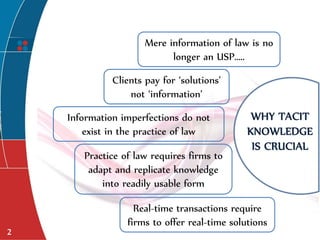
WHY TACIT
KNOWLEDGE
IS CRUCIAL
Mere information of law is no
longer an USP…..
Clients pay for ‘solutions’
not ‘information’
Information imperfections do not
exist in the practice of law
Real-time transactions require
firms to offer real-time solutions
Practice of law requires firms to
adapt and replicate knowledge
into readily usable form
2
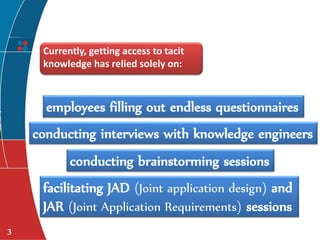
employees filling out endless questionnaires
conducting interviews with knowledge engineers
conducting brainstorming sessions
facilitating JAD (Joint application design) and
JAR (Joint Application Requirements) sessions
Currently, getting access to tacit
knowledge has relied solely on:
3
An environment that people can organize their learning
around the social communities in which they belong.
The knowledge of the community is integrated in the life
of communities that share values, beliefs, languages, and
ways of doing things.
Knowledge repositories are:
collections of factual, procedural knowledge that
include manuals, best practices, discussion threads,
corporate directories, and SME directories
Capturing tacit knowledge has led to
the following:
Creation of knowledge repositories
Communities of practice
Enterprise knowledge portalsThe enterprise knowledge portal is a single
infrastructure solution that supports the
distributed KM objectives of the organization
4
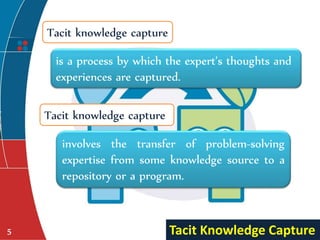
Tacit Knowledge Capture
is a process by which the expert’s thoughts and
experiences are captured.
Tacit knowledge capture
involves the transfer of problem-solving
expertise from some knowledge source to a
repository or a program.
Tacit knowledge capture
5
Tacit Knowledge Capture
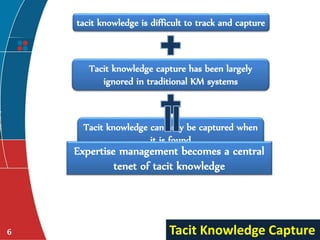
tacit knowledge is difficult to track and capture
Tacit knowledge capture has been largely
ignored in traditional KM systems
Tacit knowledge can only be captured when
it is found
Expertise management becomes a central
tenet of tacit knowledge
6
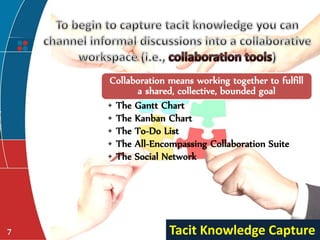
Collaboration means working together to fulfill
a shared, collective, bounded goal
• The Gantt Chart
• The Kanban Chart
• The To-Do List
• The All-Encompassing Collaboration Suite
• The Social Network
Tacit Knowledge Capture7
Tacit Knowledge Capture
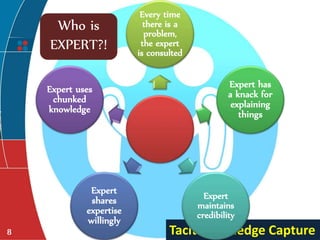
Every time
there is a
problem,
the expert
is consulted
Expert has
a knack for
explaining
things
Expert
maintains
credibility
Expert
shares
expertise
willingly
Expert uses
chunked
knowledge
Who is
EXPERT?!
8
Tacit Knowledge Capture
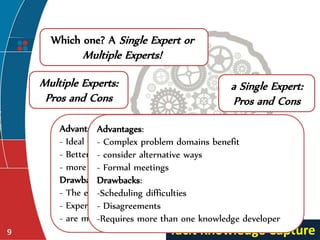
Advantages:
- Ideal when building a simple KM system
- Better facilitation
- more confidentiality
Drawbacks:
- The expert’s knowledge is not easy to capture
- Expert knowledge is sometimes dispersed
- are more likely to change scheduled meetings
Which one? A Single Expert or
Multiple Experts!
a Single Expert:
Pros and Cons
Multiple Experts:
Pros and Cons
Advantages:
- Complex problem domains benefit
- consider alternative ways
- Formal meetings
Drawbacks:
-Scheduling difficulties
- Disagreements
-Requires more than one knowledge developer
9
Tacit Knowledge Capture
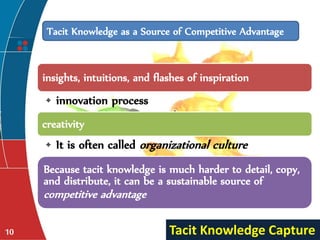
Tacit Knowledge as a Source of Competitive Advantage
insights, intuitions, and flashes of inspiration
• innovation process
creativity
• It is often called organizational culture
Because tacit knowledge is much harder to detail, copy,
and distribute, it can be a sustainable source of
competitive advantage
10
Tacit Knowledge Capture
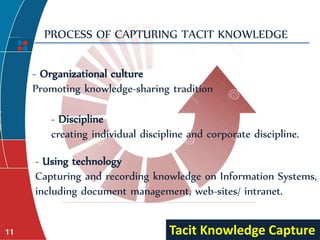
PROCESS OF CAPTURING TACIT KNOWLEDGE
- Organizational culture
Promoting knowledge-sharing tradition
- Discipline
creating individual discipline and corporate discipline.
- Using technology
Capturing and recording knowledge on Information Systems,
including document management, web-sites/ intranet.
11
Tacit Knowledge Capture
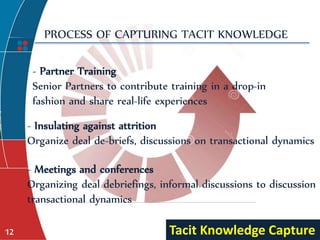
PROCESS OF CAPTURING TACIT KNOWLEDGE
- Partner Training
Senior Partners to contribute training in a drop-in
fashion and share real-life experiences
- Insulating against attrition
Organize deal de-briefs, discussions on transactional dynamics
- Meetings and conferences
Organizing deal debriefings, informal discussions to discussion
transactional dynamics
12
Tacit Knowledge Capture
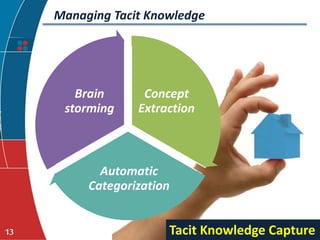
Managing Tacit Knowledge
Concept
Extraction
Automatic
Categorization
Brain
storming
13
Tacit Knowledge Capture14
- Polanyi, M. (1958), Personal Knowledge: Toward a Post-
critical Philosophy, University of Chicago Press, Chicago, IL.
-Polanyi, M. (1966), The Tacit Dimension, Doubleday, Garden
City, NY.
- Reber, A.S. (1993), Implicit Learning and Tacit Knowledge:
An Essay on the Cognitive Unconscious, Oxford University
Press, New York, NY.
- Smith, E.A. (2001), “The role of tacit and explicit knowledge
in the workplace”, Journal of Knowledge Management, Vol. 5
No. 4, pp. 311-21.
Thank
You

Capture Tacit Knowledge

  • 1.
  • 2.
    We know muchmore than we can tell …BY ALBERT EINSTEIN … BY POLANYI tacit knowledge resides in the minds of individuals. Information is not knowledge….. The only source of knowledge is experience…. inspiration insights intuitions BASICS Tacit Knowledge Forms 1
  • 3.
    WHY TACIT KNOWLEDGE IS CRUCIAL Mereinformation of law is no longer an USP….. Clients pay for ‘solutions’ not ‘information’ Information imperfections do not exist in the practice of law Real-time transactions require firms to offer real-time solutions Practice of law requires firms to adapt and replicate knowledge into readily usable form 2
  • 4.
    employees filling outendless questionnaires conducting interviews with knowledge engineers conducting brainstorming sessions facilitating JAD (Joint application design) and JAR (Joint Application Requirements) sessions Currently, getting access to tacit knowledge has relied solely on: 3
  • 5.
    An environment thatpeople can organize their learning around the social communities in which they belong. The knowledge of the community is integrated in the life of communities that share values, beliefs, languages, and ways of doing things. Knowledge repositories are: collections of factual, procedural knowledge that include manuals, best practices, discussion threads, corporate directories, and SME directories Capturing tacit knowledge has led to the following: Creation of knowledge repositories Communities of practice Enterprise knowledge portalsThe enterprise knowledge portal is a single infrastructure solution that supports the distributed KM objectives of the organization 4
  • 6.
    Tacit Knowledge Capture isa process by which the expert’s thoughts and experiences are captured. Tacit knowledge capture involves the transfer of problem-solving expertise from some knowledge source to a repository or a program. Tacit knowledge capture 5
  • 7.
    Tacit Knowledge Capture tacitknowledge is difficult to track and capture Tacit knowledge capture has been largely ignored in traditional KM systems Tacit knowledge can only be captured when it is found Expertise management becomes a central tenet of tacit knowledge 6
  • 8.
    Collaboration means workingtogether to fulfill a shared, collective, bounded goal • The Gantt Chart • The Kanban Chart • The To-Do List • The All-Encompassing Collaboration Suite • The Social Network Tacit Knowledge Capture7
  • 9.
    Tacit Knowledge Capture Everytime there is a problem, the expert is consulted Expert has a knack for explaining things Expert maintains credibility Expert shares expertise willingly Expert uses chunked knowledge Who is EXPERT?! 8
  • 10.
    Tacit Knowledge Capture Advantages: -Ideal when building a simple KM system - Better facilitation - more confidentiality Drawbacks: - The expert’s knowledge is not easy to capture - Expert knowledge is sometimes dispersed - are more likely to change scheduled meetings Which one? A Single Expert or Multiple Experts! a Single Expert: Pros and Cons Multiple Experts: Pros and Cons Advantages: - Complex problem domains benefit - consider alternative ways - Formal meetings Drawbacks: -Scheduling difficulties - Disagreements -Requires more than one knowledge developer 9
  • 11.
    Tacit Knowledge Capture TacitKnowledge as a Source of Competitive Advantage insights, intuitions, and flashes of inspiration • innovation process creativity • It is often called organizational culture Because tacit knowledge is much harder to detail, copy, and distribute, it can be a sustainable source of competitive advantage 10
  • 12.
    Tacit Knowledge Capture PROCESSOF CAPTURING TACIT KNOWLEDGE - Organizational culture Promoting knowledge-sharing tradition - Discipline creating individual discipline and corporate discipline. - Using technology Capturing and recording knowledge on Information Systems, including document management, web-sites/ intranet. 11
  • 13.
    Tacit Knowledge Capture PROCESSOF CAPTURING TACIT KNOWLEDGE - Partner Training Senior Partners to contribute training in a drop-in fashion and share real-life experiences - Insulating against attrition Organize deal de-briefs, discussions on transactional dynamics - Meetings and conferences Organizing deal debriefings, informal discussions to discussion transactional dynamics 12
  • 14.
    Tacit Knowledge Capture ManagingTacit Knowledge Concept Extraction Automatic Categorization Brain storming 13
  • 15.
    Tacit Knowledge Capture14 -Polanyi, M. (1958), Personal Knowledge: Toward a Post- critical Philosophy, University of Chicago Press, Chicago, IL. -Polanyi, M. (1966), The Tacit Dimension, Doubleday, Garden City, NY. - Reber, A.S. (1993), Implicit Learning and Tacit Knowledge: An Essay on the Cognitive Unconscious, Oxford University Press, New York, NY. - Smith, E.A. (2001), “The role of tacit and explicit knowledge in the workplace”, Journal of Knowledge Management, Vol. 5 No. 4, pp. 311-21.
  • 16.