Knowledge ManagementKnowledge Management
BY
C S R PRABHUC S R PRABHU
Deputy Director General
Ministry of Communications and Information Technology
NATIONAL INFORMATICS CENTRENATIONAL INFORMATICS CENTRE
HYDERABAD
Knowledge Management
Knowledge management is the process
of discovery, acquisition, creation,
dissemination and utilization of
knowledge for the organization.
Definition
Knowledge Management
Knowledge has been recognized as an
important productivity factor for the
organization
Working Definition
Knowledge Management is a discipline that
seeks to improve the performance of
individuals and organisations by maintaining
and leveraging the present and future value of
knowledge assets.
Knowledge Management
The three basic means of human knowledge acquisition are :
to discover
- One can discover something all by oneself
to study and to communicate
- One can obtain knowledge from others by
studying information that has previously
been recorded or by communicating
directly with them.
Knowledge Management
Knowledge management is in practice in many organisations
for the purpose of achieving,
• Improvement in operating efficiency of business
processes which benefit from having access to superior
information at the point of need e.g customer-facing and
marketing processes, product development etc
• A knowledge-empowered organisation
• A way of addressing concerns over the loss of corporate
memory arising from the increasing mobility of labour
Knowledge Management
 Knowledge Management is a discipline
 Knowledge is shareable in the organisation
 Cultural change is not automatic
 Create a change management plan
 Stay strategic
 Pick a topic, go in-depth, keep it current
 Don’t get hung up on the limitations
 Set expectations or risk extinction
 Integrate KM into existing systems
 Educate your self-service users
Principles of Knowledge Management
Knowledge Management
Significance of Knowledge Management
Track, measure, share and make use of
intangible assets in an Organisation
Paying attention to ensure that they are
capturing, sharing and using productive
knowledge within their organisations to
enhance learning and improve performance.
Knowledge Management
Critical success factors can be categorized as follows
 Leadership
 Culture
 Structure, roles, and responsibilities
 Information technology infrastructure
 Measurement.
Data, Information, Knowledge
• Data – raw facts; numbers
• Information – data in context; readily
captured in documents and databases
• Knowledge – information plus experience
to act upon
Knowledge Management
Knowledge and Learning
Knowledge Management
Knowledge involves a higher degree of certainty or
validity than information
BASICS to Knowledge :
• Information
• Values
• Beliefs
• Experiences
• Rules and Procedures
Knowledge Management
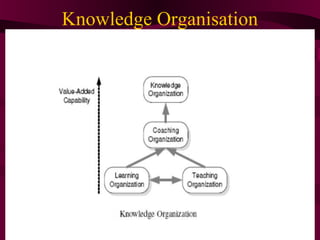
Learning Organisation
It facilitates the learning of its members and
continuously transforms itself.
In a learning organisation everyone, and the
organization as well, are engaged in a
continuous learning process.
Knowledge and Learning
Knowledge Management
Teaching Organisation
In a teaching organisation everyone is a
teacher, everyone is a learner and reciprocal
teaching and learning are embodied into
everyday activities.
Teachers belong to the organisation and the
teaching process is completely developed
with organisational resources.
Knowledge Management
Coaching Organisation
Creates an environment where the behaviors and
practices involved in continuous learning
exchange both explicit and tacit knowledge;
reciprocal coaching and self-leadership
development are actively encouraged and
facilitated
Coaching relationship with his/her training
involves mutual commitment, trust and respect.
Knowledge Organisation
Successful organizations are often described
as Knowledge Organizations composed of
knowledge workers who continually perform
knowledge intensive tasks using and creating
new knowledge.
Successful organisations create new
knowledge, share and spread this knowledge
through the entire organization and quickly
embody it in new products and technologies.
Knowledge Management
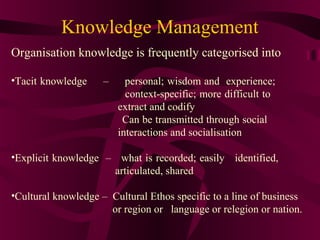
Organisation knowledge is frequently categorised into
•Tacit knowledge – personal; wisdom and experience;
context-specific; more difficult to
extract and codify
Can be transmitted through social
interactions and socialisation
•Explicit knowledge – what is recorded; easily identified,
articulated, shared
•Cultural knowledge – Cultural Ethos specific to a line of business
or region or language or relegion or nation.
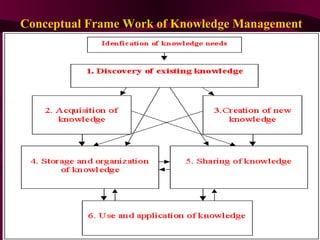
Conceptual Frame Work of Knowledge Management
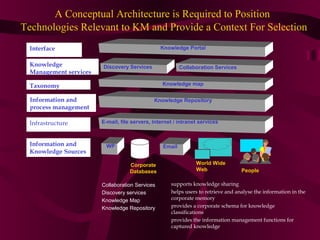
A Conceptual Architecture is Required to Position
Technologies Relevant to KM and Provide a Context For Selection
Knowledge Portal
Discovery Services Collaboration Services
Knowledge map
Knowledge Repository
E-mail, file servers, Internet / intranet services
WP
Interface
Knowledge
Management services
Taxonomy
Information and
process management
Infrastructure
Information and
Knowledge Sources
Email
World Wide
Web People
Corporate
Databases
Collaboration Services
Discovery services
Knowledge Map
Knowledge Repository
supports knowledge sharing
helps users to retrieve and analyse the information in the
corporate memory
provides a corporate schema for knowledge
classifications
provides the information management functions for
captured knowledge
Knowledge Management
Characteristics of KM Implementation Trends
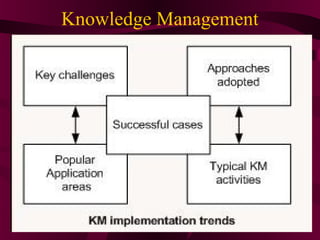
Key Problems knowledge enterprises face today are :
 Poor utilisation of knowledge
 Information and knowledge islands
 Knowledge loss
 High cost of sharing knowledge
 Reinvention / Repetitions
 Lack of responsiveness
Knowledge Management
Characteristics of KM Implementation Trends
Popular Application Areas :
Most oragnisations have an interest to manage and
increase their knowledge in the following areas :
 Customer Needs / Preferences
 Performance Trends / Variations
 Competitor Plans, Products, Market Perceptions
Knowledge Management
Characteristics of KM Implementation Trends
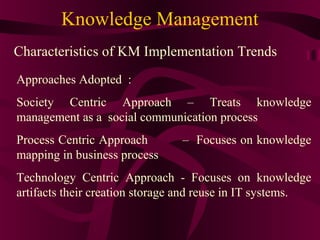
Approaches Adopted :
Society Centric Approach – Treats knowledge
management as a social communication process
Process Centric Approach – Focuses on knowledge
mapping in business process
Technology Centric Approach - Focuses on knowledge
artifacts their creation storage and reuse in IT systems.
Knowledge Management
Characteristics of KM Implementation Trends
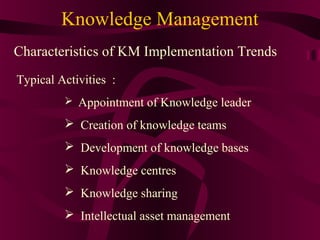
Typical Activities :
 Appointment of Knowledge leader
 Creation of knowledge teams
 Development of knowledge bases
 Knowledge centres
 Knowledge sharing
 Intellectual asset management
Knowledge Management
knowledge management

knowledge management

  • 1.
    Knowledge ManagementKnowledge Management BY CS R PRABHUC S R PRABHU Deputy Director General Ministry of Communications and Information Technology NATIONAL INFORMATICS CENTRENATIONAL INFORMATICS CENTRE HYDERABAD
  • 2.
    Knowledge Management Knowledge managementis the process of discovery, acquisition, creation, dissemination and utilization of knowledge for the organization. Definition
  • 3.
    Knowledge Management Knowledge hasbeen recognized as an important productivity factor for the organization
  • 4.
    Working Definition Knowledge Managementis a discipline that seeks to improve the performance of individuals and organisations by maintaining and leveraging the present and future value of knowledge assets. Knowledge Management
  • 5.
    Knowledge Management The threebasic means of human knowledge acquisition are : to discover - One can discover something all by oneself to study and to communicate - One can obtain knowledge from others by studying information that has previously been recorded or by communicating directly with them.
  • 6.
    Knowledge Management Knowledge managementis in practice in many organisations for the purpose of achieving, • Improvement in operating efficiency of business processes which benefit from having access to superior information at the point of need e.g customer-facing and marketing processes, product development etc • A knowledge-empowered organisation • A way of addressing concerns over the loss of corporate memory arising from the increasing mobility of labour
  • 7.
    Knowledge Management  KnowledgeManagement is a discipline  Knowledge is shareable in the organisation  Cultural change is not automatic  Create a change management plan  Stay strategic  Pick a topic, go in-depth, keep it current  Don’t get hung up on the limitations  Set expectations or risk extinction  Integrate KM into existing systems  Educate your self-service users Principles of Knowledge Management
  • 8.
    Knowledge Management Significance ofKnowledge Management Track, measure, share and make use of intangible assets in an Organisation Paying attention to ensure that they are capturing, sharing and using productive knowledge within their organisations to enhance learning and improve performance.
  • 9.
    Knowledge Management Critical successfactors can be categorized as follows  Leadership  Culture  Structure, roles, and responsibilities  Information technology infrastructure  Measurement.
  • 10.
    Data, Information, Knowledge •Data – raw facts; numbers • Information – data in context; readily captured in documents and databases • Knowledge – information plus experience to act upon Knowledge Management Knowledge and Learning
  • 11.
    Knowledge Management Knowledge involvesa higher degree of certainty or validity than information BASICS to Knowledge : • Information • Values • Beliefs • Experiences • Rules and Procedures
  • 12.
    Knowledge Management Learning Organisation Itfacilitates the learning of its members and continuously transforms itself. In a learning organisation everyone, and the organization as well, are engaged in a continuous learning process. Knowledge and Learning
  • 13.
    Knowledge Management Teaching Organisation Ina teaching organisation everyone is a teacher, everyone is a learner and reciprocal teaching and learning are embodied into everyday activities. Teachers belong to the organisation and the teaching process is completely developed with organisational resources.
  • 14.
    Knowledge Management Coaching Organisation Createsan environment where the behaviors and practices involved in continuous learning exchange both explicit and tacit knowledge; reciprocal coaching and self-leadership development are actively encouraged and facilitated Coaching relationship with his/her training involves mutual commitment, trust and respect.
  • 15.
  • 16.
    Successful organizations areoften described as Knowledge Organizations composed of knowledge workers who continually perform knowledge intensive tasks using and creating new knowledge. Successful organisations create new knowledge, share and spread this knowledge through the entire organization and quickly embody it in new products and technologies. Knowledge Management
  • 17.
    Knowledge Management Organisation knowledgeis frequently categorised into •Tacit knowledge – personal; wisdom and experience; context-specific; more difficult to extract and codify Can be transmitted through social interactions and socialisation •Explicit knowledge – what is recorded; easily identified, articulated, shared •Cultural knowledge – Cultural Ethos specific to a line of business or region or language or relegion or nation.
  • 18.
    Conceptual Frame Workof Knowledge Management
  • 19.
    A Conceptual Architectureis Required to Position Technologies Relevant to KM and Provide a Context For Selection Knowledge Portal Discovery Services Collaboration Services Knowledge map Knowledge Repository E-mail, file servers, Internet / intranet services WP Interface Knowledge Management services Taxonomy Information and process management Infrastructure Information and Knowledge Sources Email World Wide Web People Corporate Databases Collaboration Services Discovery services Knowledge Map Knowledge Repository supports knowledge sharing helps users to retrieve and analyse the information in the corporate memory provides a corporate schema for knowledge classifications provides the information management functions for captured knowledge
  • 20.
    Knowledge Management Characteristics ofKM Implementation Trends Key Problems knowledge enterprises face today are :  Poor utilisation of knowledge  Information and knowledge islands  Knowledge loss  High cost of sharing knowledge  Reinvention / Repetitions  Lack of responsiveness
  • 21.
    Knowledge Management Characteristics ofKM Implementation Trends Popular Application Areas : Most oragnisations have an interest to manage and increase their knowledge in the following areas :  Customer Needs / Preferences  Performance Trends / Variations  Competitor Plans, Products, Market Perceptions
  • 22.
    Knowledge Management Characteristics ofKM Implementation Trends Approaches Adopted : Society Centric Approach – Treats knowledge management as a social communication process Process Centric Approach – Focuses on knowledge mapping in business process Technology Centric Approach - Focuses on knowledge artifacts their creation storage and reuse in IT systems.
  • 23.
    Knowledge Management Characteristics ofKM Implementation Trends Typical Activities :  Appointment of Knowledge leader  Creation of knowledge teams  Development of knowledge bases  Knowledge centres  Knowledge sharing  Intellectual asset management
  • 24.

Editor's Notes

  • #5 Definitions are many and varied. Four main elements - explicit: knowledge is explicitly recognised (language, documents etc.) - systematic: it is too important to be left to chance - selective: there’s lots of knowledge; focus on that which is important - content and process perspective (nouns and verbs) By adopting a systematic vs. an ad-hoc approach, management consultancies believe they can offer better global solutions, and reduced competitive price pressures (e.g. see Booz Hamilton Allen)
  • #6 Definitions are many and varied. Four main elements - explicit: knowledge is explicitly recognised (language, documents etc.) - systematic: it is too important to be left to chance - selective: there’s lots of knowledge; focus on that which is important - content and process perspective (nouns and verbs) By adopting a systematic vs. an ad-hoc approach, management consultancies believe they can offer better global solutions, and reduced competitive price pressures (e.g. see Booz Hamilton Allen)