KM IMPLEMENTATION ANDKM IMPLEMENTATION AND
FRAMEWORKFRAMEWORK
KNOW WHAT YOU KNOW
Alwi Mohd Yunus
Faculty of Information Studies UiTM
May 2001
Brief Look: What is KM?Brief Look: What is KM?
 KM as the art of creating value from an
organization’s intangible assets
- Karl E. Sveiby-
 Knowledge Management is the process
by which the organization generates
wealth from its intellectual or
knowledge-based assets.
Bukowitz,Wendi R. and Williams,Ruth L.
The Knowledge Management Fieldbook
Why Now?Why Now?
 Knowledge commands a premium price
in the market
 Avoidance of costly mistake
 Sharing of best practices
 Successful innovation
 Customer relationship management
[CRM]
 Downsizing - a great lost
 Mobile workforce-special requirements
 Global business
 Rapid changes
Corporate CapabilityCorporate Capability
 the skills and expertise of the staff;
 their ability to learn and to build knowledge;
 the processes which enable their skills and
knowledge to be applied and shared;
 the culture and values which encourage
knowledge building and sharing;
 the infrastructure (IT and physical), which
supports knowledge building, flow and
sharing; and
 the intellectual assets which the organization
builds, maintains, organizes and exploits.
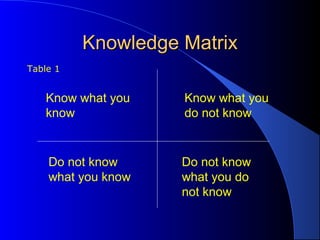
Knowledge MatrixKnowledge Matrix
Table 1
Know what you
know
Do not know
what you know
Know what you
do not know
Do not know
what you do
not know
The unlearnsThe unlearns
 You repeat mistakes
 Work gets duplicated - reinventing the
wheel
 Customers relations are strained
 Good ideas don’t get shared
 You’re dependent on key individuals
 You’re slow to launch new
programs/services
 You don’t know the value of your
service
KM in Special LibrariesKM in Special Libraries
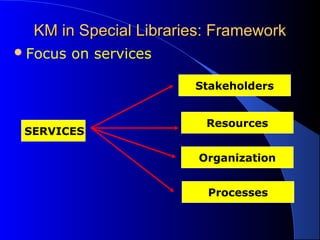
 Focus on services
 Customer oriented
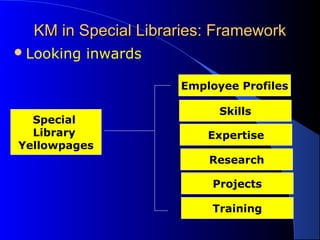
 Looking inwards-creating knowledge
databases
 Manage changes-cultural and
technological
 Create sharing culture
 Teamwork
KM in Special Libraries: FrameworkKM in Special Libraries: Framework
Focus on services
SERVICES
Stakeholders
Resources
Organization
Processes
KM in Special Libraries: FrameworkKM in Special Libraries: Framework
Looking inwards
Employee Profiles
Skills
Expertise
Research
Special
Library
Yellowpages
Projects
Training
Steps of implementationSteps of implementation
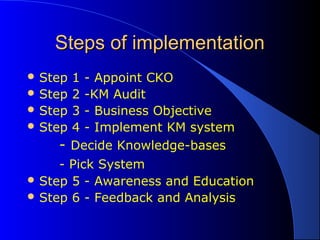
 Step 1 - Appoint CKO
 Step 2 -KM Audit
 Step 3 - Business Objective
 Step 4 - Implement KM system
- Decide Knowledge-bases
- Pick System
 Step 5 - Awareness and Education
 Step 6 - Feedback and Analysis
FrameworkFramework
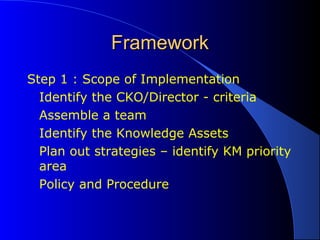
Step 1 : Scope of Implementation
Identify the CKO/Director - criteria
Assemble a team
Identify the Knowledge Assets
Plan out strategies – identify KM priority
area
Policy and Procedure
FrameworkFramework
Step 2 : KM Audit
Identify the team
Define the audit methodology
Identify the knowledge assets
Evaluate the assets, how they are being
used and how they can add value
Identify the flow of information
Identify IT systems in place
Identify the processes
Identify the culture and how do people
do their work - critical
FrameworkFramework
Step 3 : Business Objectives
Always tie-up the KM initiatives with
your business objectives
Study the objectives
1990 AA - Global Best Practices
failed due to information overload
Get clarification on the objectives
FrameworkFramework
Step 4 : KM System
Study the current available system. Can
it be used or do you buy a dedicated
one.
System design
System implementation
Training
Feedback
FrameworkFramework
Step 5 : Awareness and Education
The first buy-in
Training strategy
Benefit of the system
Training schedule
Policy and Procedure
Step 6 : Feedback and analysis
Feedback system
Analysis team
Analysis methodology
Intellectual CapitalIntellectual Capital
• Competence – The Abilities
 Knowledge (Theoretical)
 Skills (Practical)
• Attitude – The Behavior
 Motivation (Richard Branson)
 Behavior/Conduct
• Intellectual Agility – The Wits
 Innovation/Imitation
 Adaptation
 Packaging
Managing Human CapitalManaging Human Capital
 KPMG Study in UK - 44% of
organizations employees skills
information is kept either in employee’s
heads or on paper and only 9% of
organizations allow electronic access
 Objective – To Decrease Dependence on
Experts
 Recruiting in a Competitive Personnel
Market
Managing Human CapitalManaging Human Capital
Expert Database- possible
solutions
- HR Packages
- Resume Oriented Systems
- Build Your Own - create a profile
- Real Time Analysis System
Managing Human CapitalManaging Human Capital
The HP Way (Bill Hewlett & Dave
Packard)
- Friendship
- Commitment to Innovation
- Listening to Customers
- Trust in People
- Responsibility to society
Managing Human CapitalManaging Human Capital
 Corporate Yellow-pages
 Handbook
 Manuals
 Process and Procedure
 Training - face-to-face communication
 On the job training - experience
 Cross Functional Team
 Community of Practice
 External experts
Welcome to KM world..Welcome to KM world..
Remember…it is just the
beginning not the end….
Thank you for joining me in
this KM journey….
See you again…

KM Implementation Framework for Special Library

  • 1.
    KM IMPLEMENTATION ANDKMIMPLEMENTATION AND FRAMEWORKFRAMEWORK KNOW WHAT YOU KNOW Alwi Mohd Yunus Faculty of Information Studies UiTM May 2001
  • 2.
    Brief Look: Whatis KM?Brief Look: What is KM?  KM as the art of creating value from an organization’s intangible assets - Karl E. Sveiby-  Knowledge Management is the process by which the organization generates wealth from its intellectual or knowledge-based assets. Bukowitz,Wendi R. and Williams,Ruth L. The Knowledge Management Fieldbook
  • 3.
    Why Now?Why Now? Knowledge commands a premium price in the market  Avoidance of costly mistake  Sharing of best practices  Successful innovation  Customer relationship management [CRM]  Downsizing - a great lost  Mobile workforce-special requirements  Global business  Rapid changes
  • 4.
    Corporate CapabilityCorporate Capability the skills and expertise of the staff;  their ability to learn and to build knowledge;  the processes which enable their skills and knowledge to be applied and shared;  the culture and values which encourage knowledge building and sharing;  the infrastructure (IT and physical), which supports knowledge building, flow and sharing; and  the intellectual assets which the organization builds, maintains, organizes and exploits.
  • 5.
    Knowledge MatrixKnowledge Matrix Table1 Know what you know Do not know what you know Know what you do not know Do not know what you do not know
  • 6.
    The unlearnsThe unlearns You repeat mistakes  Work gets duplicated - reinventing the wheel  Customers relations are strained  Good ideas don’t get shared  You’re dependent on key individuals  You’re slow to launch new programs/services  You don’t know the value of your service
  • 7.
    KM in SpecialLibrariesKM in Special Libraries  Focus on services  Customer oriented  Looking inwards-creating knowledge databases  Manage changes-cultural and technological  Create sharing culture  Teamwork
  • 8.
    KM in SpecialLibraries: FrameworkKM in Special Libraries: Framework Focus on services SERVICES Stakeholders Resources Organization Processes
  • 9.
    KM in SpecialLibraries: FrameworkKM in Special Libraries: Framework Looking inwards Employee Profiles Skills Expertise Research Special Library Yellowpages Projects Training
  • 10.
    Steps of implementationStepsof implementation  Step 1 - Appoint CKO  Step 2 -KM Audit  Step 3 - Business Objective  Step 4 - Implement KM system - Decide Knowledge-bases - Pick System  Step 5 - Awareness and Education  Step 6 - Feedback and Analysis
  • 11.
    FrameworkFramework Step 1 :Scope of Implementation Identify the CKO/Director - criteria Assemble a team Identify the Knowledge Assets Plan out strategies – identify KM priority area Policy and Procedure
  • 12.
    FrameworkFramework Step 2 :KM Audit Identify the team Define the audit methodology Identify the knowledge assets Evaluate the assets, how they are being used and how they can add value Identify the flow of information Identify IT systems in place Identify the processes Identify the culture and how do people do their work - critical
  • 13.
    FrameworkFramework Step 3 :Business Objectives Always tie-up the KM initiatives with your business objectives Study the objectives 1990 AA - Global Best Practices failed due to information overload Get clarification on the objectives
  • 14.
    FrameworkFramework Step 4 :KM System Study the current available system. Can it be used or do you buy a dedicated one. System design System implementation Training Feedback
  • 15.
    FrameworkFramework Step 5 :Awareness and Education The first buy-in Training strategy Benefit of the system Training schedule Policy and Procedure Step 6 : Feedback and analysis Feedback system Analysis team Analysis methodology
  • 16.
    Intellectual CapitalIntellectual Capital •Competence – The Abilities  Knowledge (Theoretical)  Skills (Practical) • Attitude – The Behavior  Motivation (Richard Branson)  Behavior/Conduct • Intellectual Agility – The Wits  Innovation/Imitation  Adaptation  Packaging
  • 17.
    Managing Human CapitalManagingHuman Capital  KPMG Study in UK - 44% of organizations employees skills information is kept either in employee’s heads or on paper and only 9% of organizations allow electronic access  Objective – To Decrease Dependence on Experts  Recruiting in a Competitive Personnel Market
  • 18.
    Managing Human CapitalManagingHuman Capital Expert Database- possible solutions - HR Packages - Resume Oriented Systems - Build Your Own - create a profile - Real Time Analysis System
  • 19.
    Managing Human CapitalManagingHuman Capital The HP Way (Bill Hewlett & Dave Packard) - Friendship - Commitment to Innovation - Listening to Customers - Trust in People - Responsibility to society
  • 20.
    Managing Human CapitalManagingHuman Capital  Corporate Yellow-pages  Handbook  Manuals  Process and Procedure  Training - face-to-face communication  On the job training - experience  Cross Functional Team  Community of Practice  External experts
  • 21.
    Welcome to KMworld..Welcome to KM world.. Remember…it is just the beginning not the end…. Thank you for joining me in this KM journey…. See you again…