KNOWLEDGE MANAGEMENT:
PROCESSES AND SYSTEMS
2nd Annual Conference of Nigerian Library Association
Ebonyi State Chapter
Theme: Leveraging ICTs and Knowledge Management for
Sustainable Development in Nigeria.
30th Nov-3rd Dec, 2016
Magnus O. Igbinovia (CLN)
University of Ibadan,
Nigeria
infor.migbinovia@gmail.com
Ikenwe, Iguehi Joy (CLN)
Ambrose Alli University, Ekpoma
Nigeria
Ikenweiguehi@yahoo.com
AUTHORS
 Introduction
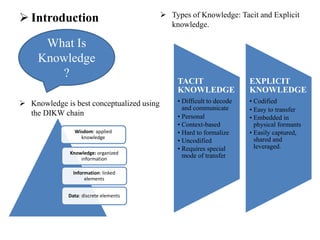
 Knowledge is best conceptualized using
the DIKW chain
 Types of Knowledge: Tacit and Explicit
knowledge.
What Is
Knowledge
?
Wisdom: applied
knowledge
Knowledge: organized
information
Information: linked
elements
Data: discrete elements
TACIT
KNOWLEDGE
• Difficult to decode
and communicate
• Personal
• Context-based
• Hard to formalize
• Uncodified
• Requires special
mode of transfer
EXPLICIT
KNOWLEDGE
• Codified
• Easy to transfer
• Embedded in
physical formants
• Easily captured,
shared and
leveraged.
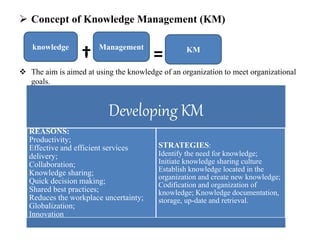
 Concept of Knowledge Management (KM)
† =
 The aim is aimed at using the knowledge of an organization to meet organizational
goals.
knowledge Management KM
Developing KM
REASONS:
Productivity;
Effective and efficient services
delivery;
Collaboration;
Knowledge sharing;
Quick decision making;
Shared best practices;
Reduces the workplace uncertainty;
Globalization;
Innovation
STRATEGIES:
Identify the need for knowledge;
Initiate knowledge sharing culture
Establish knowledge located in the
organization and create new knowledge;
Codification and organization of
knowledge; Knowledge documentation,
storage, up-date and retrieval.
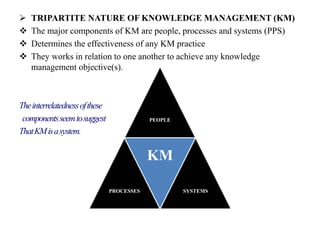
 TRIPARTITE NATURE OF KNOWLEDGE MANAGEMENT (KM)
 The major components of KM are people, processes and systems (PPS)
 Determines the effectiveness of any KM practice
 They works in relation to one another to achieve any knowledge
management objective(s).
Theinterrelatednessofthese
componentsseemtosuggest
ThatKMisasystem.
PEOPLE
PROCESSES
KM
SYSTEMS
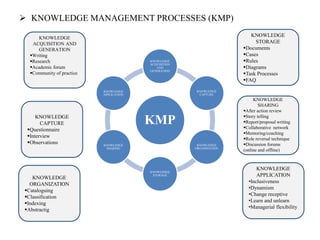
 KNOWLEDGE MANAGEMENT PROCESSES (KMP)
KMP
KNOWLEDGE
ACQUISITION
AND
GENERATION
KNOWLEDGE
CAPTURE
KNOWLEDGE
ORGANIZATION
KNOWLEDGE
STORAGE
KNOWLEDGE
SHARING
KNOWLEDGE
APPLICATION
KNOWLEDGE
ACQUISITION AND
GENERATION
Writing
Research
Academic forum
Community of practice
KNOWLEDGE
SHARING
After action review
Story telling
Report/proposal writing
Collaborative network
Mentoring/coaching
Role reversal technique
Discussion forums
(online and offline)
KNOWLEDGE
STORAGE
Documents
Cases
Rules
Diagrams
Task Processes
FAQ
KNOWLEDGE
APPLICATION
•Inclusiveness
•Dynamism
•Change receptive
•Learn and unlearn
•Managerial flexibility
KNOWLEDGE
CAPTURE
Questionnaire
Interview
Observations
KNOWLEDGE
ORGANIZATION
Cataloguing
Classification
Indexing
Abstractig
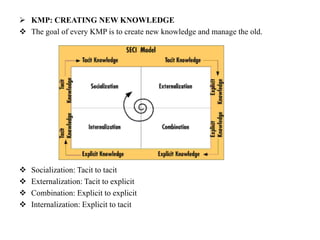
 KMP: CREATING NEW KNOWLEDGE
 The goal of every KMP is to create new knowledge and manage the old.
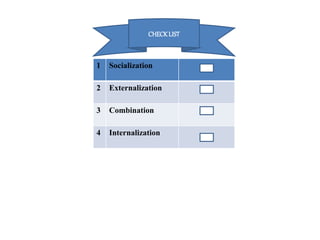
 Socialization: Tacit to tacit
 Externalization: Tacit to explicit
 Combination: Explicit to explicit
 Internalization: Explicit to tacit
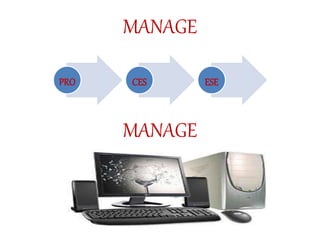
CAN you now MANAGE THE PROCESSES?
 KNOWLEDGE MANAGEMENT SYSTEM (KMS)
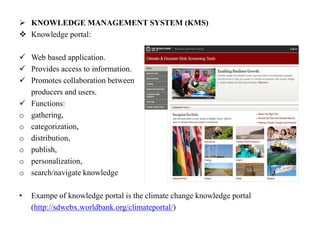
 Knowledge portal:
 Web based application.
 Provides access to information.
 Promotes collaboration between
producers and users.
 Functions:
o gathering,
o categorization,
o distribution,
o publish,
o personalization,
o search/navigate knowledge
• Exampe of knowledge portal is the climate change knowledge portal
(http://sdwebx.worldbank.org/climateportal/)
 Database Management System (DBMS)
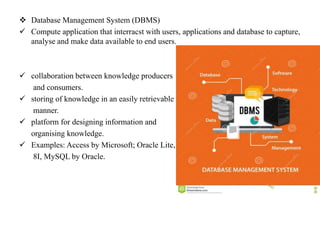
 Compute application that interracst with users, applications and database to capture,
analyse and make data available to end users.
 collaboration between knowledge producers
and consumers.
 storing of knowledge in an easily retrievable
manner.
 platform for designing information and
organising knowledge.
 Examples: Access by Microsoft; Oracle Lite,
8I, MySQL by Oracle.
 Electronic Mail
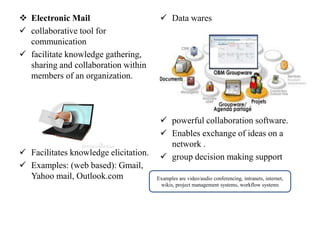
 collaborative tool for
communication
 facilitate knowledge gathering,
sharing and collaboration within
members of an organization.
 Facilitates knowledge elicitation.
 Examples: (web based): Gmail,
Yahoo mail, Outlook.com
 Data wares
 powerful collaboration software.
 Enables exchange of ideas on a
network .
 group decision making support
Examples are video/audio conferencing, intranets, internet,
wikis, project management systems, workflow systems
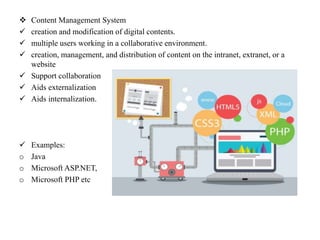
 Content Management System
 creation and modification of digital contents.
 multiple users working in a collaborative environment.
 creation, management, and distribution of content on the intranet, extranet, or a
website
 Support collaboration
 Aids externalization
 Aids internalization.
 Examples:
o Java
o Microsoft ASP.NET,
o Microsoft PHP etc
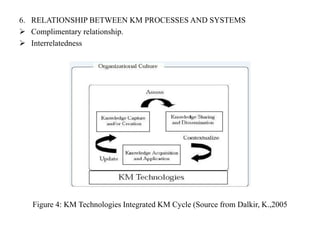
6. RELATIONSHIP BETWEEN KM PROCESSES AND SYSTEMS
 Complimentary relationship.
 Interrelatedness
Figure 4: KM Technologies Integrated KM Cycle (Source from Dalkir, K.,2005
DO you know the KMS?
 Knowledge management is a fundamental practice for any organization
to survive in the 21st century and key to organization's success
 The major components are people, processes and systems and they are
interconnected, functioning together to achieve a common goal.
 Processes are all activities required to create new knowledge and manage
the already existing one.
 Systems are technologies and tools that support process and people in
knowledge management practice.
CONCLUSION
 Carryout knowledge auditing as a preliminary step towards KM practice
and this should be done at regularly as KM is in a continuum.
 Spur knowledge sharing culture within your organization.
 Integrate all organizational members into KM processes with utmost
fairness and equality
 Build up/ develop systems, tools or technologies that supports people and
processes in KM practice
1 Socialization
2 Externalization
3 Combination
4 Internalization
CHECKLIST
MANAGE
MANAGE
PRO CES ESE
THANK YOU FOR
LISTENING
Magnus and Joy

Knowledge Management: Processes and Systems

  • 1.
    KNOWLEDGE MANAGEMENT: PROCESSES ANDSYSTEMS 2nd Annual Conference of Nigerian Library Association Ebonyi State Chapter Theme: Leveraging ICTs and Knowledge Management for Sustainable Development in Nigeria. 30th Nov-3rd Dec, 2016
  • 2.
    Magnus O. Igbinovia(CLN) University of Ibadan, Nigeria infor.migbinovia@gmail.com Ikenwe, Iguehi Joy (CLN) Ambrose Alli University, Ekpoma Nigeria Ikenweiguehi@yahoo.com AUTHORS
  • 3.
     Introduction  Knowledgeis best conceptualized using the DIKW chain  Types of Knowledge: Tacit and Explicit knowledge. What Is Knowledge ? Wisdom: applied knowledge Knowledge: organized information Information: linked elements Data: discrete elements TACIT KNOWLEDGE • Difficult to decode and communicate • Personal • Context-based • Hard to formalize • Uncodified • Requires special mode of transfer EXPLICIT KNOWLEDGE • Codified • Easy to transfer • Embedded in physical formants • Easily captured, shared and leveraged.
  • 4.
     Concept ofKnowledge Management (KM) † =  The aim is aimed at using the knowledge of an organization to meet organizational goals. knowledge Management KM Developing KM REASONS: Productivity; Effective and efficient services delivery; Collaboration; Knowledge sharing; Quick decision making; Shared best practices; Reduces the workplace uncertainty; Globalization; Innovation STRATEGIES: Identify the need for knowledge; Initiate knowledge sharing culture Establish knowledge located in the organization and create new knowledge; Codification and organization of knowledge; Knowledge documentation, storage, up-date and retrieval.
  • 5.
     TRIPARTITE NATUREOF KNOWLEDGE MANAGEMENT (KM)  The major components of KM are people, processes and systems (PPS)  Determines the effectiveness of any KM practice  They works in relation to one another to achieve any knowledge management objective(s). Theinterrelatednessofthese componentsseemtosuggest ThatKMisasystem. PEOPLE PROCESSES KM SYSTEMS
  • 6.
     KNOWLEDGE MANAGEMENTPROCESSES (KMP) KMP KNOWLEDGE ACQUISITION AND GENERATION KNOWLEDGE CAPTURE KNOWLEDGE ORGANIZATION KNOWLEDGE STORAGE KNOWLEDGE SHARING KNOWLEDGE APPLICATION KNOWLEDGE ACQUISITION AND GENERATION Writing Research Academic forum Community of practice KNOWLEDGE SHARING After action review Story telling Report/proposal writing Collaborative network Mentoring/coaching Role reversal technique Discussion forums (online and offline) KNOWLEDGE STORAGE Documents Cases Rules Diagrams Task Processes FAQ KNOWLEDGE APPLICATION •Inclusiveness •Dynamism •Change receptive •Learn and unlearn •Managerial flexibility KNOWLEDGE CAPTURE Questionnaire Interview Observations KNOWLEDGE ORGANIZATION Cataloguing Classification Indexing Abstractig
  • 7.
     KMP: CREATINGNEW KNOWLEDGE  The goal of every KMP is to create new knowledge and manage the old.  Socialization: Tacit to tacit  Externalization: Tacit to explicit  Combination: Explicit to explicit  Internalization: Explicit to tacit
  • 8.
    CAN you nowMANAGE THE PROCESSES?
  • 9.
     KNOWLEDGE MANAGEMENTSYSTEM (KMS)  Knowledge portal:  Web based application.  Provides access to information.  Promotes collaboration between producers and users.  Functions: o gathering, o categorization, o distribution, o publish, o personalization, o search/navigate knowledge • Exampe of knowledge portal is the climate change knowledge portal (http://sdwebx.worldbank.org/climateportal/)
  • 10.
     Database ManagementSystem (DBMS)  Compute application that interracst with users, applications and database to capture, analyse and make data available to end users.  collaboration between knowledge producers and consumers.  storing of knowledge in an easily retrievable manner.  platform for designing information and organising knowledge.  Examples: Access by Microsoft; Oracle Lite, 8I, MySQL by Oracle.
  • 11.
     Electronic Mail collaborative tool for communication  facilitate knowledge gathering, sharing and collaboration within members of an organization.  Facilitates knowledge elicitation.  Examples: (web based): Gmail, Yahoo mail, Outlook.com  Data wares  powerful collaboration software.  Enables exchange of ideas on a network .  group decision making support Examples are video/audio conferencing, intranets, internet, wikis, project management systems, workflow systems
  • 12.
     Content ManagementSystem  creation and modification of digital contents.  multiple users working in a collaborative environment.  creation, management, and distribution of content on the intranet, extranet, or a website  Support collaboration  Aids externalization  Aids internalization.  Examples: o Java o Microsoft ASP.NET, o Microsoft PHP etc
  • 13.
    6. RELATIONSHIP BETWEENKM PROCESSES AND SYSTEMS  Complimentary relationship.  Interrelatedness Figure 4: KM Technologies Integrated KM Cycle (Source from Dalkir, K.,2005
  • 14.
    DO you knowthe KMS?
  • 15.
     Knowledge managementis a fundamental practice for any organization to survive in the 21st century and key to organization's success  The major components are people, processes and systems and they are interconnected, functioning together to achieve a common goal.  Processes are all activities required to create new knowledge and manage the already existing one.  Systems are technologies and tools that support process and people in knowledge management practice. CONCLUSION
  • 16.
     Carryout knowledgeauditing as a preliminary step towards KM practice and this should be done at regularly as KM is in a continuum.  Spur knowledge sharing culture within your organization.  Integrate all organizational members into KM processes with utmost fairness and equality  Build up/ develop systems, tools or technologies that supports people and processes in KM practice
  • 17.
    1 Socialization 2 Externalization 3Combination 4 Internalization CHECKLIST
  • 18.
  • 19.