This covers Understand the knowledge management
Understand the decision making styles
Understanding escalation of commitment
Outlining stages of creative process
Understand the group decision making
2 LEARNING OBJECTIVES
a)Understand the knowledge management
b) Understand the decision making styles
c) Understanding escalation of commitment
d)Outlining stages of creative process
e) Understand the group decision making
3.
IMPROVING DECISION MAKINGTHROUGH
EFFECTIVE KNOWLEDGE MANAGEMENT
• It is a process that helps organizations identify, select, organize, disseminate and transfer
important information and expertise that are part of the organizational memory that
typically resides within the organization in an unstructured manner
• This enables effective and efficient problem solving, dynamic learning, strategic planning
and decision making
• It thus focuses on identifying knowledge, explicating it in a way so that it can be shared in
a formal manner and thus reusing it
4.
IMPORTANCE OF MANAGINGKNOWLEDGE
• Intellectual capital is a firm’s only appreciable asset. Most assets depreciate with time.
• Knowledge work is increasing
• Employees with the most intellectual capital have become volunteers
• Many managers ignore intellectual capital and lose out on the benefits of its capture and
use
• Employees with the most intellectual capital are often the least appreciated
• Many current investment in intellectual capital are misfocussed
5.
FEATURES OF KNOWLEDGEMANAGEMENT
SYSTEM
• Creating a knowledge culture
• Capturing knowledge
• Knowledge generation
• Knowledge explication(and digitization)
• Knowledge sharing and reuse
• Knowledge renewal
6.
KNOWLEDGE MANAGEMENT SYSTEMPROCESSES ARE DESIGNEDTO
MANAGE
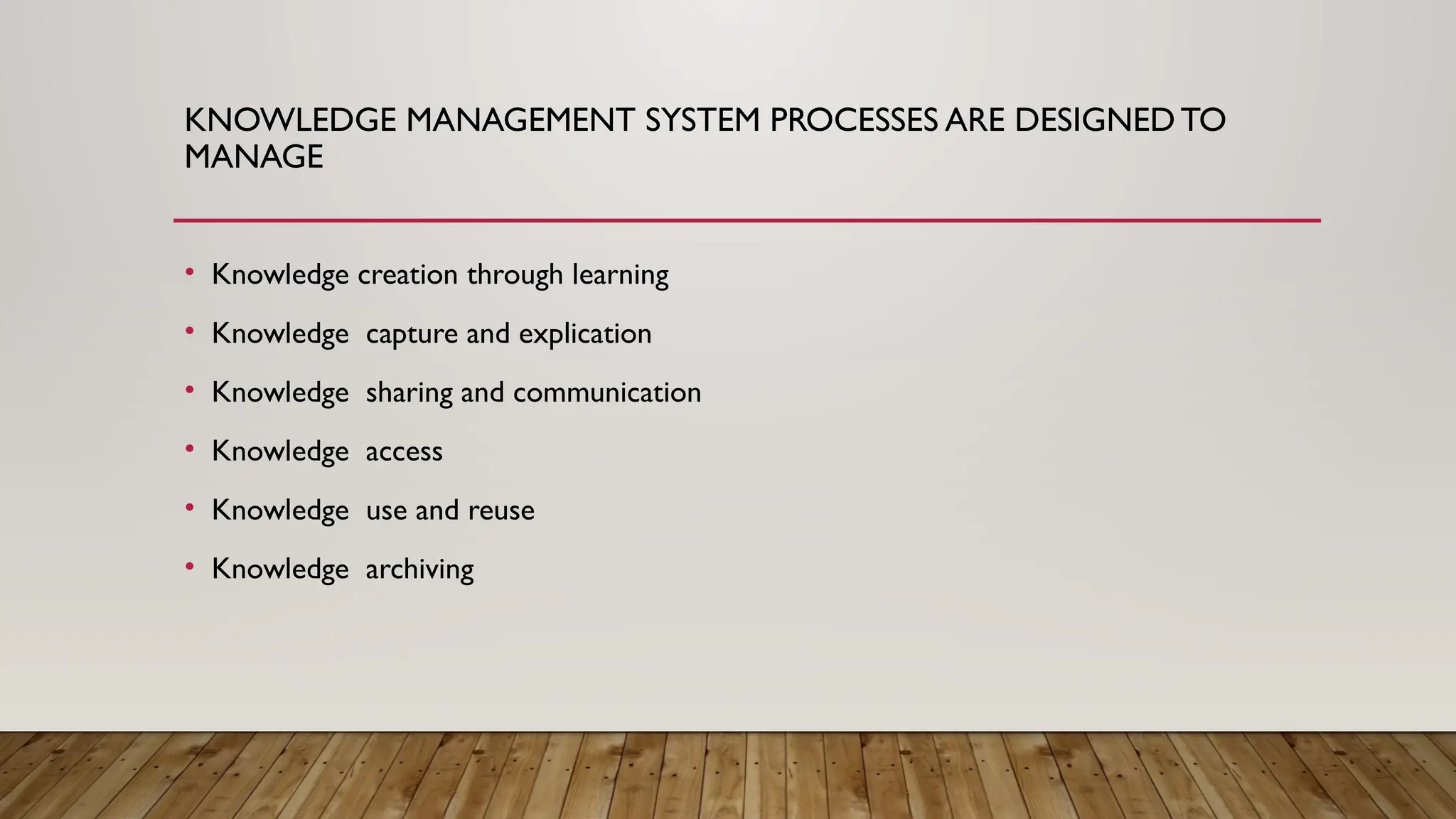
• Knowledge creation through learning
• Knowledge capture and explication
• Knowledge sharing and communication
• Knowledge access
• Knowledge use and reuse
• Knowledge archiving
7.
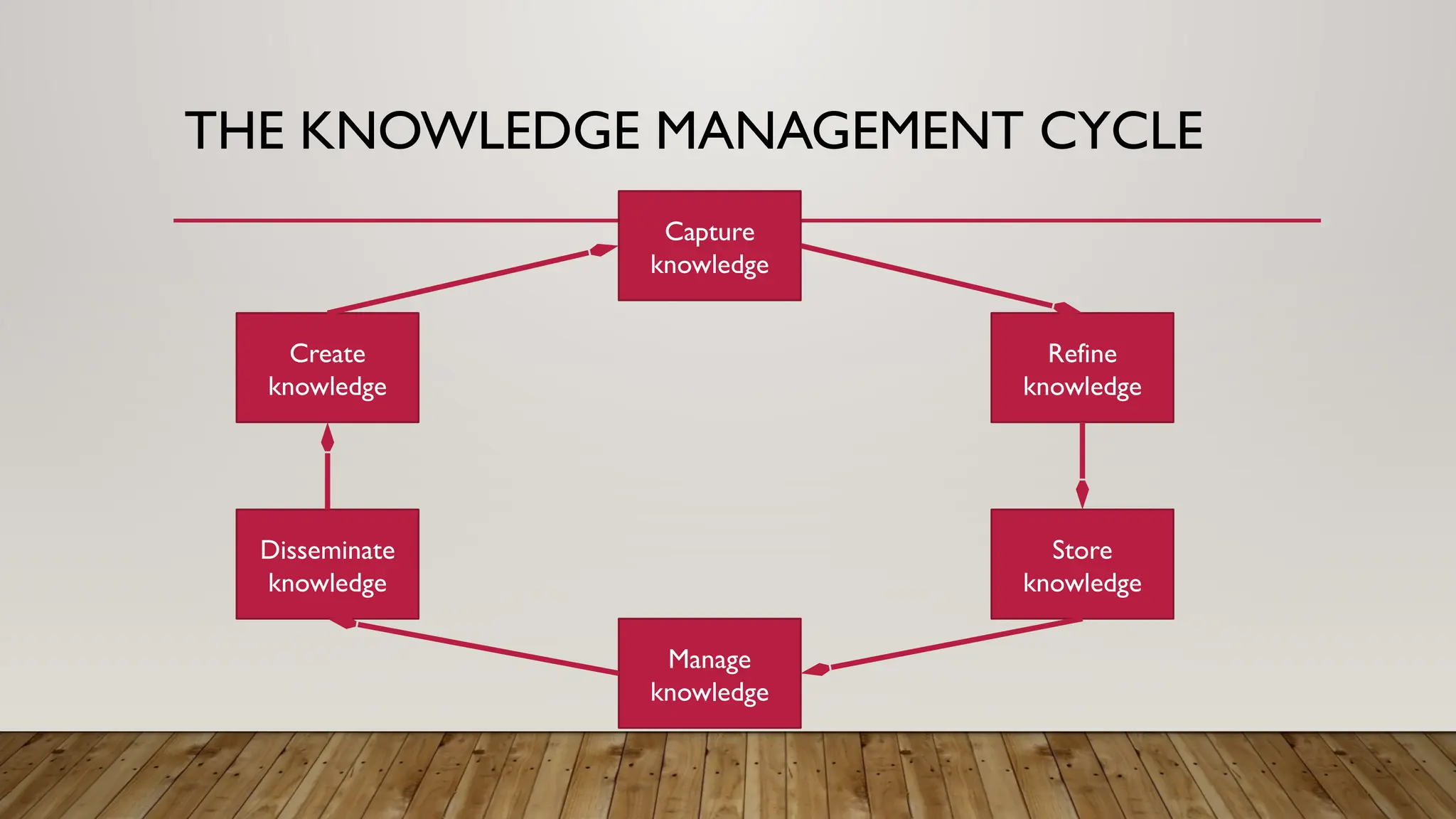
THE KNOWLEDGE MANAGEMENTCYCLE
Create
knowledge
Capture
knowledge
Refine
knowledge
Store
knowledge
Manage
knowledge
Disseminate
knowledge
8.
IMPLEMENTING KNOWLEDGE MANAGEMENT
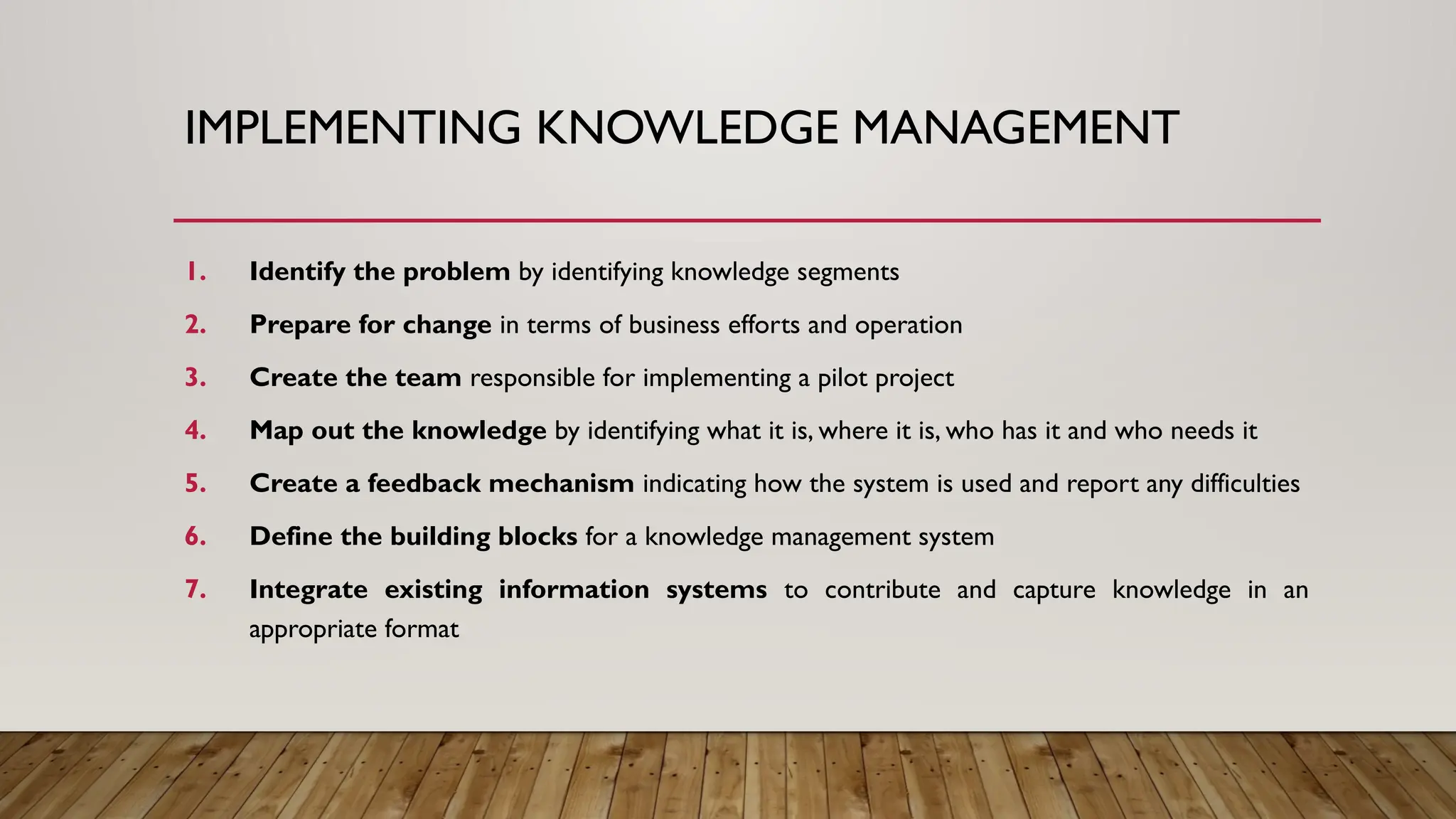
1.Identify the problem by identifying knowledge segments
2. Prepare for change in terms of business efforts and operation
3. Create the team responsible for implementing a pilot project
4. Map out the knowledge by identifying what it is, where it is, who has it and who needs it
5. Create a feedback mechanism indicating how the system is used and report any difficulties
6. Define the building blocks for a knowledge management system
7. Integrate existing information systems to contribute and capture knowledge in an
appropriate format
9.
DATA, INFORMATION ANDKNOWLEDGE
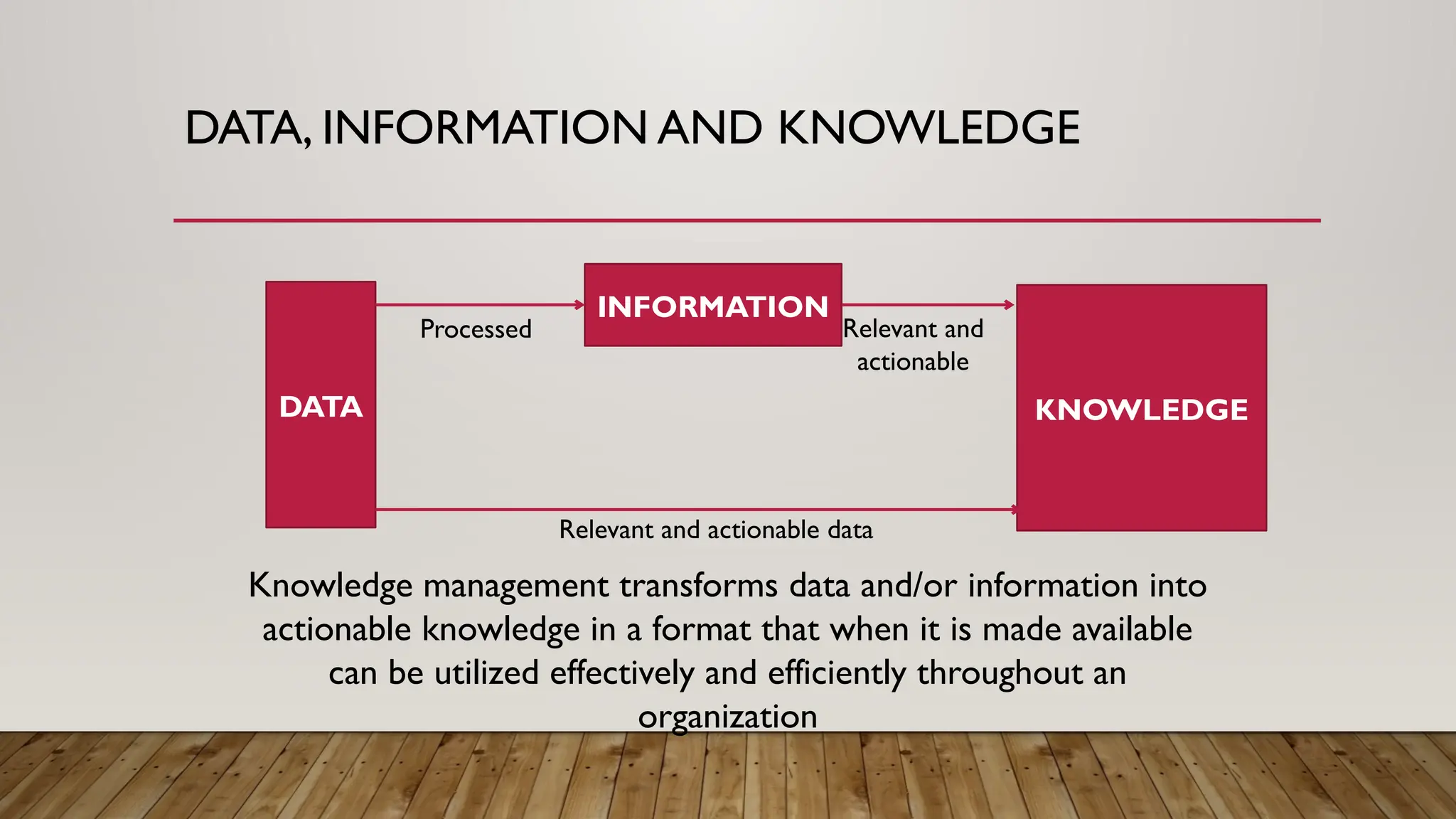
DATA
INFORMATION
KNOWLEDGE
Processed Relevant and
actionable
Relevant and actionable data
Knowledge management transforms data and/or information into
actionable knowledge in a format that when it is made available
can be utilized effectively and efficiently throughout an
organization
10.
IMPROVING DECISION MAKINGTHROUGH
EFFECTIVE KNOWLEDGE MANAGEMENT
• Systems and practices that increase the sharing of knowledge
and information
• Types of knowledge
• Tacit knowledge – intuition, experience, natural abilities
• Explicit knowledge
• Explicit knowledge requires access to large amounts of
information; tacit knowledge is obtained through observation,
mentoring, collaboration, etc.
11.
TACIT AND EXPLICITKNOWLEDGE
• Tacit knowledge is in the domain of subjective, cognitive and
experiential learning
• Explicit knowledge deals more with objective, rational and technical
knowledge(data, policies, procedures, software, documents)
• Knowledge management transfers the tacit knowledge in individuals to
value processes that lead to innovation, knowledge creation and
replenishment of the organization’
12.
12 EXPLICIT ANDTACIT KNOWLEDGE
• Explicit knowledge – what is recorded; easily identified, articulated, shared and employed
• Tacit knowledge – personal; wisdom and experience; context-specific; more difficult to
extract and codify
13.
13 ORGANIZATIONAL KNOWLEDGE
•Both explicit and tacit
• Explicit knowledge can be formalized and codified, embodied in standard process, documented and
taught
• Tacit knowledge is unconscious and cannot easily be transmitted by formal description-requires
interaction and modeling to be transmitted
• Both individual and collective
• Embodied in individual expertise
• Embodied in communities of practice
• Embodied in collectives ofexpertisesthat work collaboratively
14.
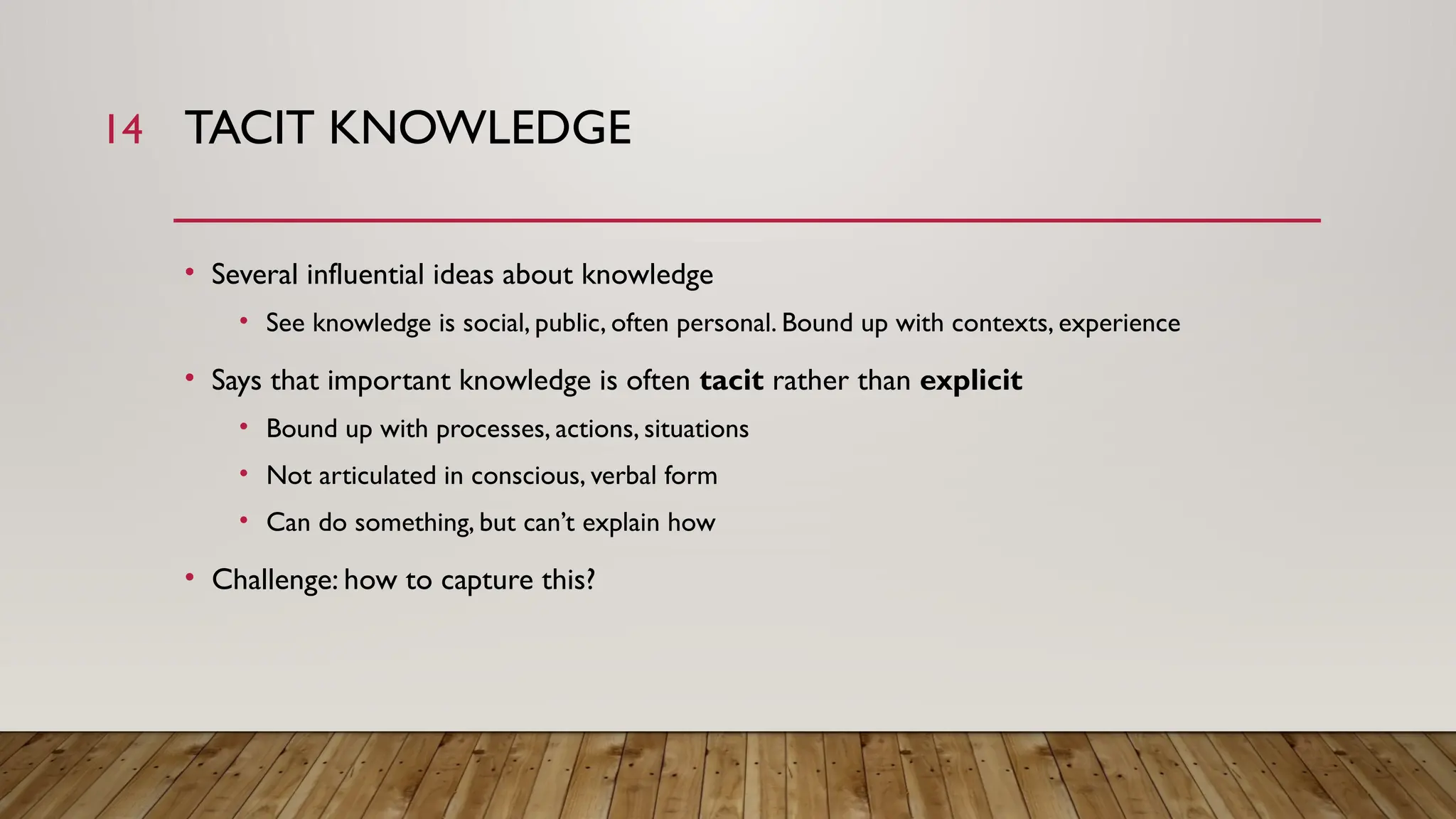
14 TACIT KNOWLEDGE
•Several influential ideas about knowledge
• See knowledge is social, public, often personal. Bound up with contexts, experience
• Says that important knowledge is often tacit rather than explicit
• Bound up with processes, actions, situations
• Not articulated in conscious, verbal form
• Can do something, but can’t explain how
• Challenge: how to capture this?
15.
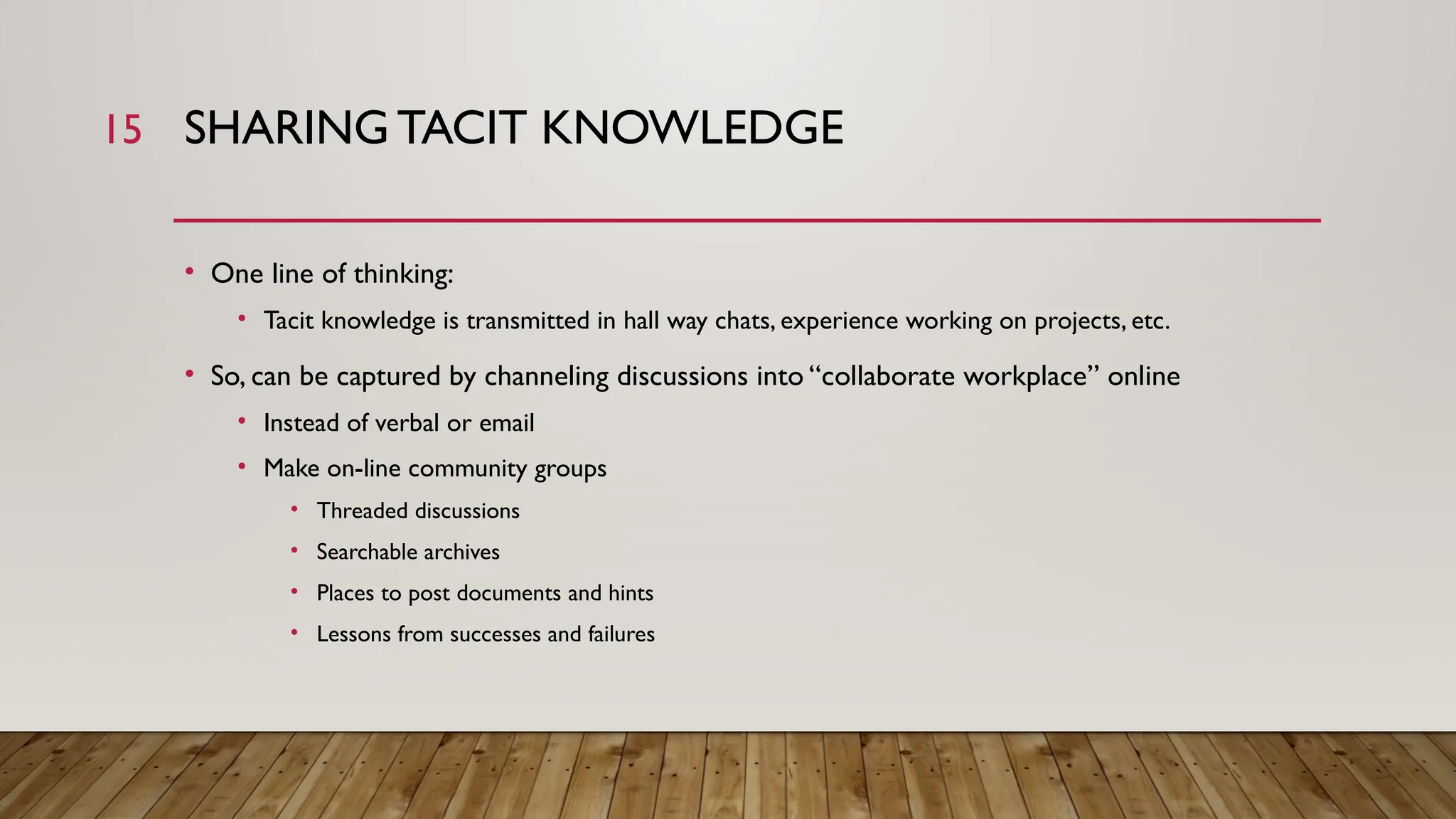
15 SHARING TACITKNOWLEDGE
• One line of thinking:
• Tacit knowledge is transmitted in hall way chats, experience working on projects, etc.
• So, can be captured by channeling discussions into “collaborate workplace” online
• Instead of verbal or email
• Make on-line community groups
• Threaded discussions
• Searchable archives
• Places to post documents and hints
• Lessons from successes and failures
16.
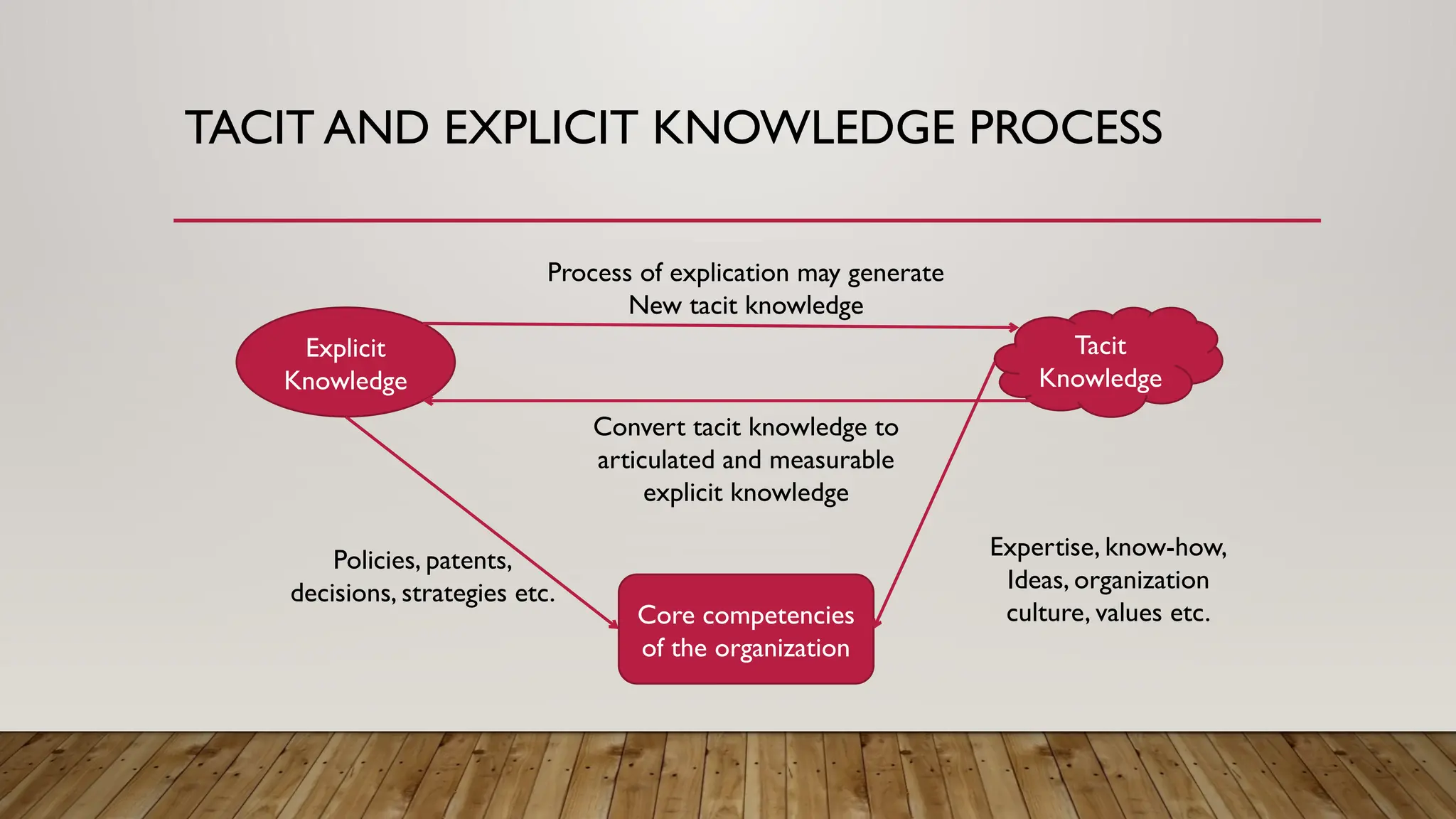
TACIT AND EXPLICITKNOWLEDGE PROCESS
Explicit
Knowledge
Tacit
Knowledge
Core competencies
of the organization
Process of explication may generate
New tacit knowledge
Convert tacit knowledge to
articulated and measurable
explicit knowledge
Policies, patents,
decisions, strategies etc.
Expertise, know-how,
Ideas, organization
culture, values etc.
17.
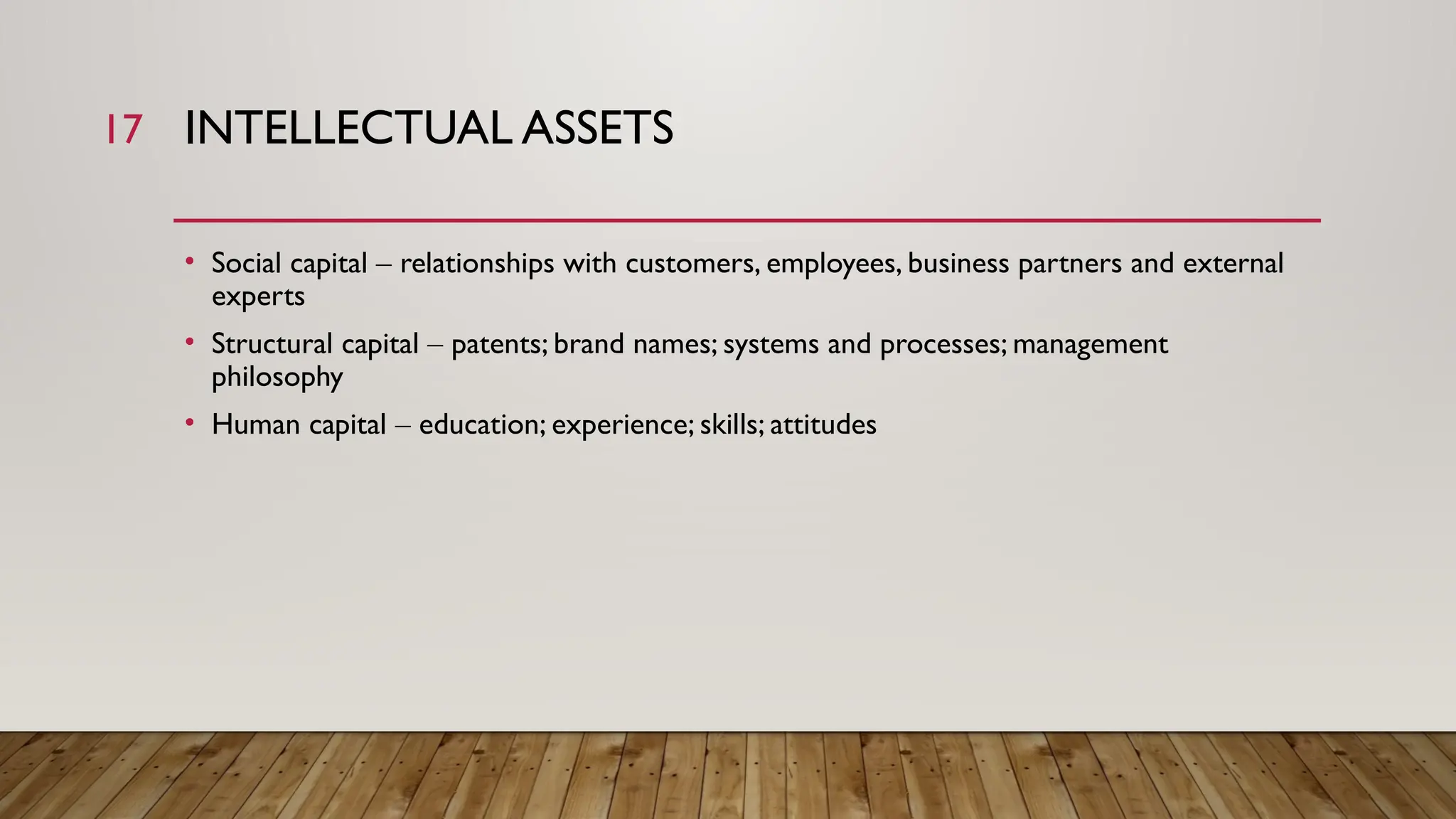
17 INTELLECTUAL ASSETS
•Social capital – relationships with customers, employees, business partners and external
experts
• Structural capital – patents; brand names; systems and processes; management
philosophy
• Human capital – education; experience; skills; attitudes
18.
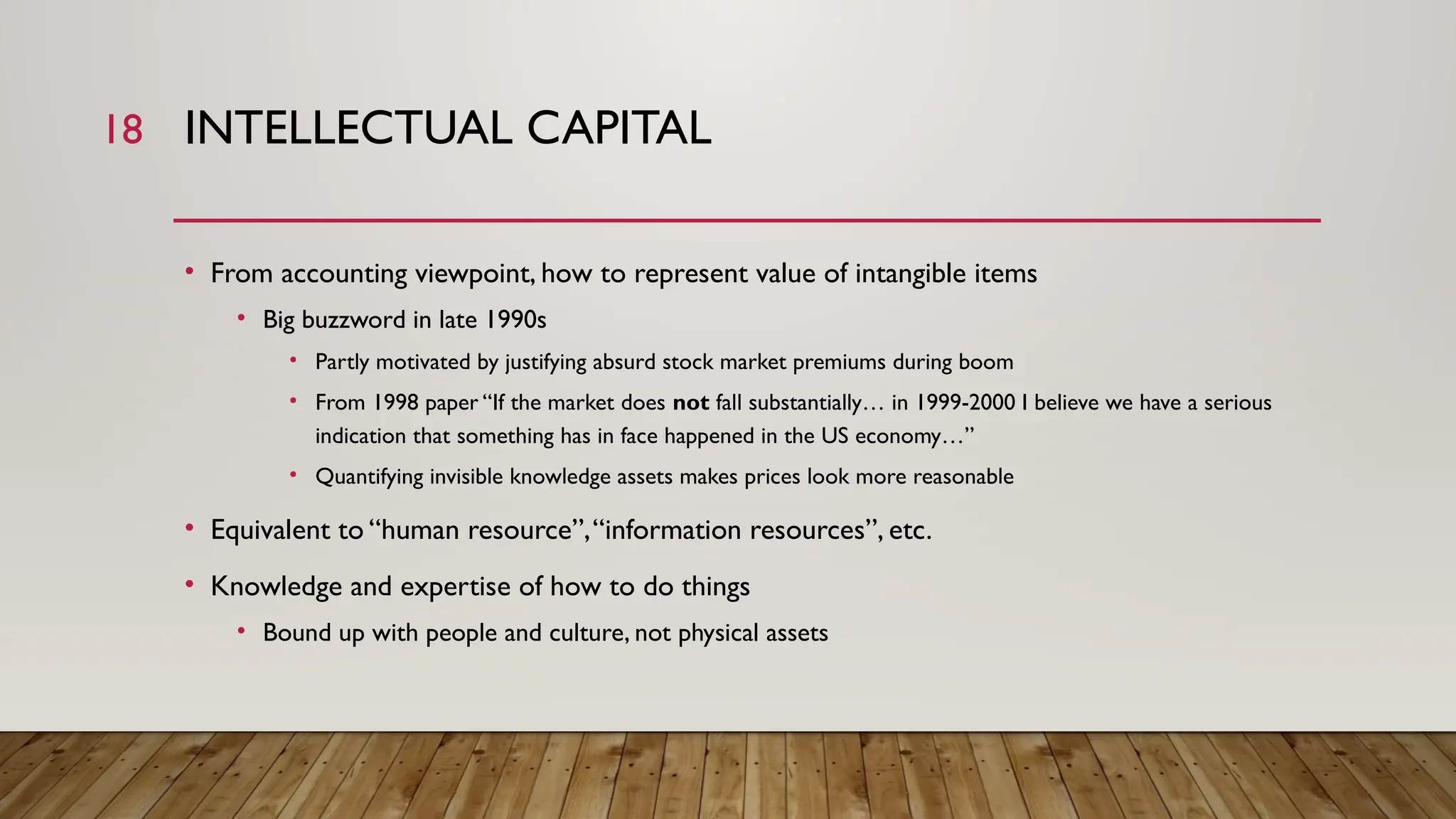
18 INTELLECTUAL CAPITAL
•From accounting viewpoint, how to represent value of intangible items
• Big buzzword in late 1990s
• Partly motivated by justifying absurd stock market premiums during boom
• From 1998 paper “If the market does not fall substantially… in 1999-2000 I believe we have a serious
indication that something has in face happened in the US economy…”
• Quantifying invisible knowledge assets makes prices look more reasonable
• Equivalent to “human resource”,“information resources”, etc.
• Knowledge and expertise of how to do things
• Bound up with people and culture, not physical assets
19.
19 ORGANIZATIONALVS INDIVIDUALKNOWLEDGE
• Two issues:
• Corporate knowledge owned by individuals
• Knowledge resides in silos
20.
20 COMPONENTS OFKNOWLEDGE MANAGEMENT
PROGRAMS
• People – communities and networks
• Processes – knowledge-enabled
• Technology – collaboration, knowledge leverage tools
• Content – best practices, internal and external intelligence
22 KNOWLEDGE MANAGEMENTAPPROACHES
1) Self-service – intranet portals; yellow pages; people finder
2) Networks and Community of Practice – knowledge sharing; learning communities
3) Facilitated transfer – internal consultants; dedicated facilitators; known experts
23.
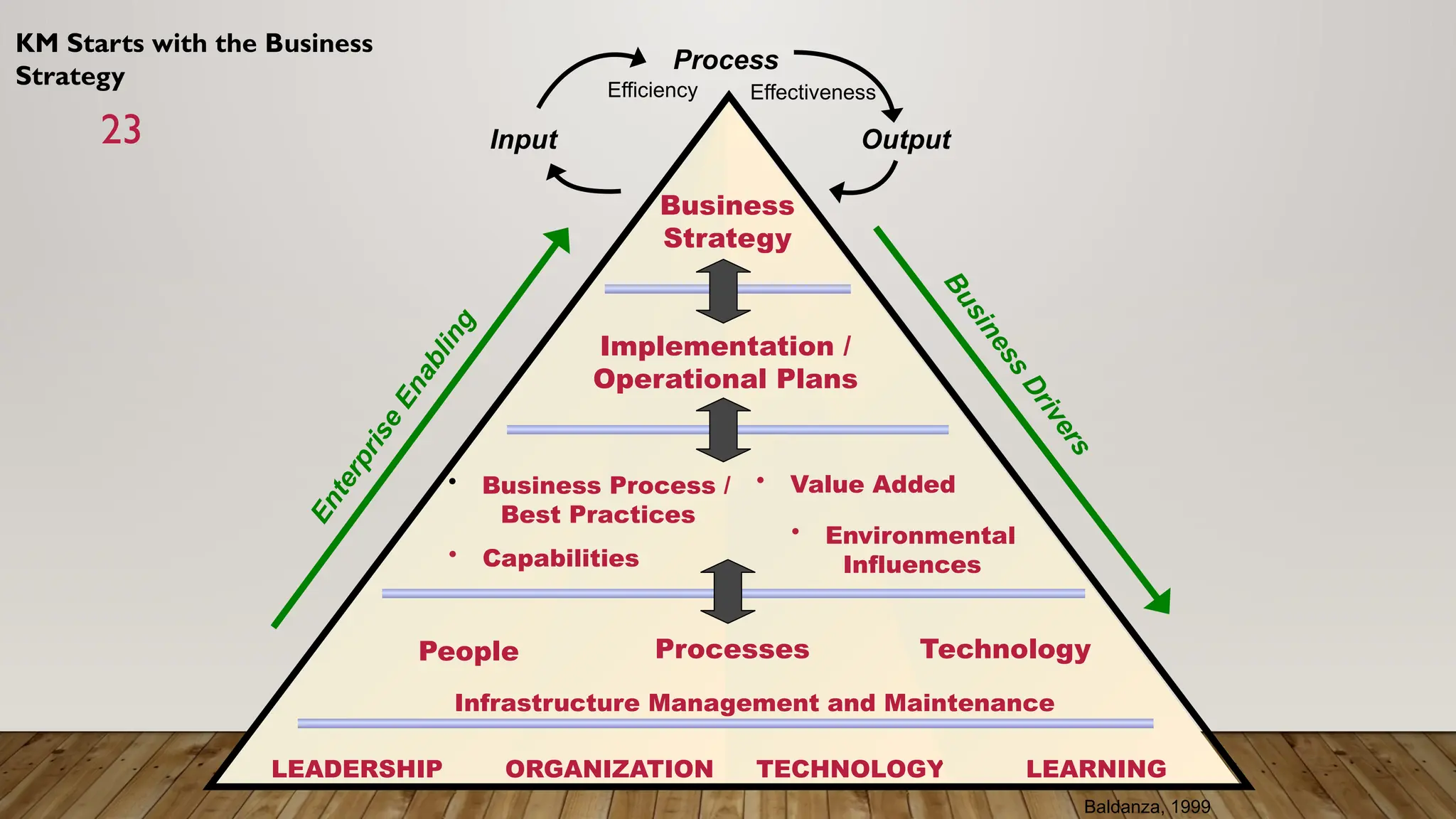
23
LEADERSHIP ORGANIZATION TECHNOLOGYLEARNING
People Processes Technology
Infrastructure Management and Maintenance
Business
Strategy
Implementation /
Operational Plans
• Business Process /
Best Practices
• Capabilities
• Environmental
Influences
• Value Added
E
n
t
e
r
p
r
i
s
e
E
n
a
b
l
i
n
g
B
u
s
i
n
e
s
s
D
r
i
v
e
r
s
Baldanza, 1999
Input
Process
Output
Efficiency Effectiveness
KM Starts with the Business
Strategy
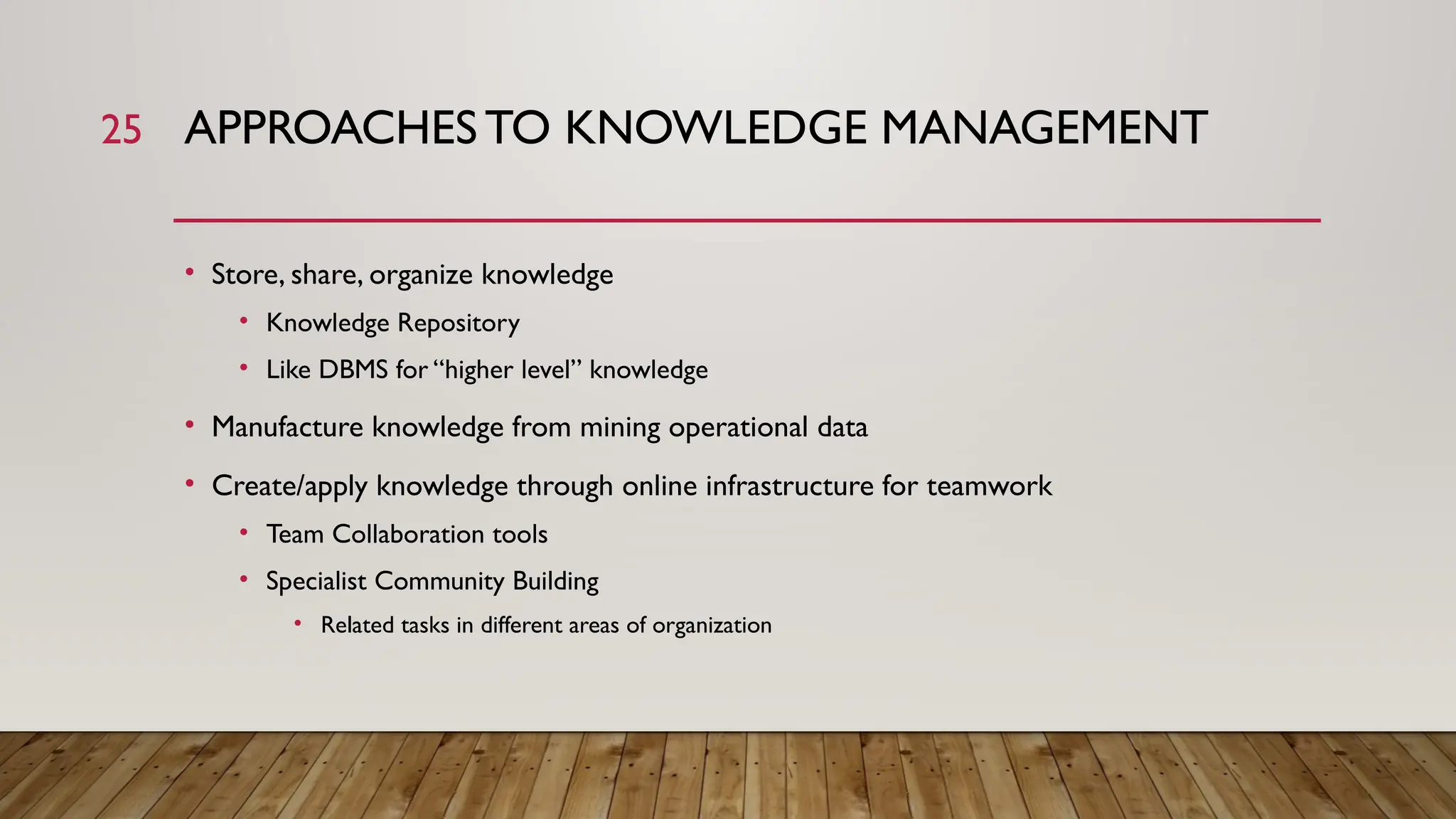
25 APPROACHESTO KNOWLEDGEMANAGEMENT
• Store, share, organize knowledge
• Knowledge Repository
• Like DBMS for “higher level” knowledge
• Manufacture knowledge from mining operational data
• Create/apply knowledge through online infrastructure for teamwork
• Team Collaboration tools
• Specialist Community Building
• Related tasks in different areas of organization
26.
26 GETTING STARTED
Identify what your most valuable knowledge is
Identify where that knowledge is
Create a knowledge map (skills, expertise, experience)
Build an intranet, use groupware
27.
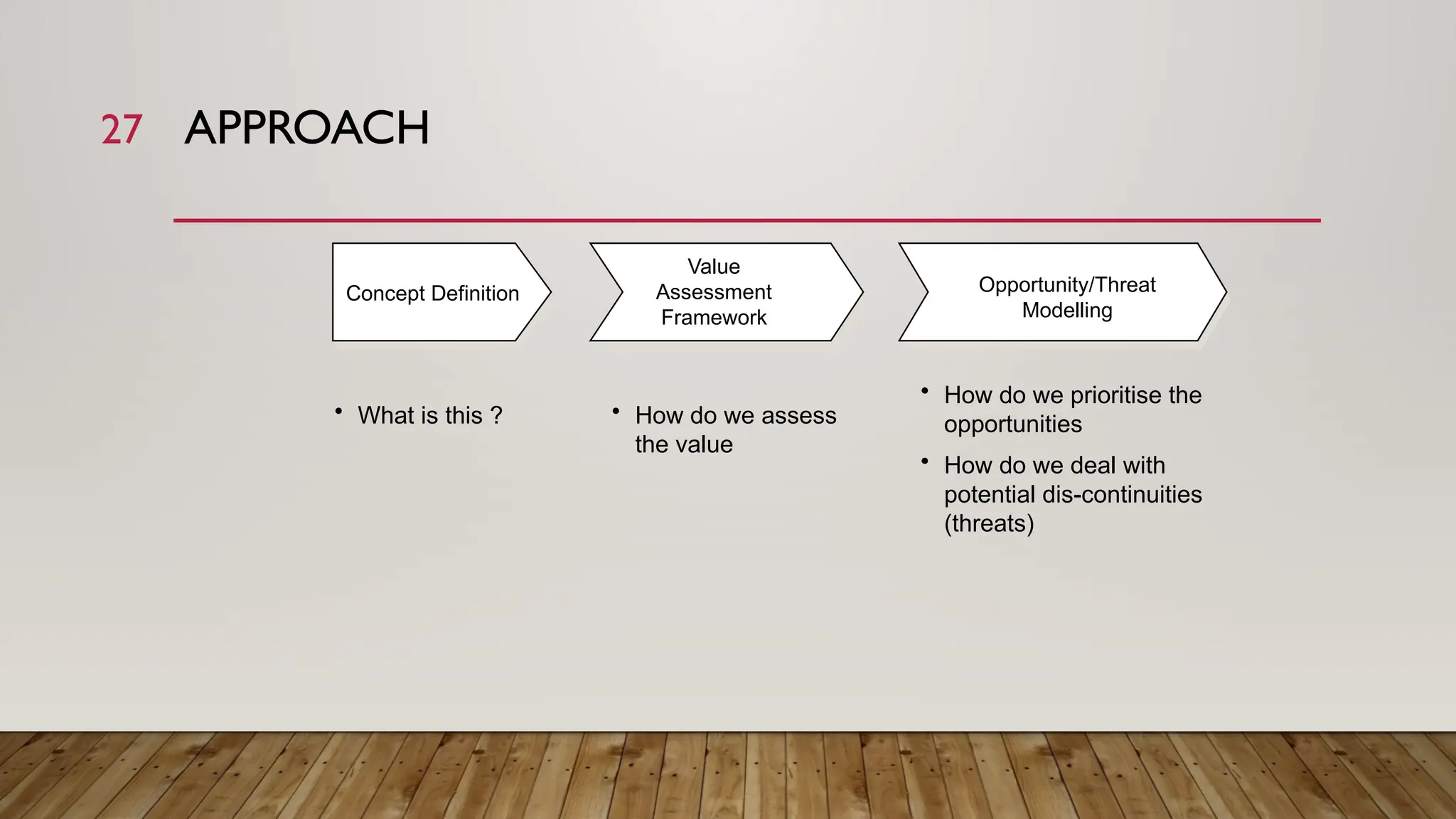
27 APPROACH
Concept DefinitionOpportunity/Threat
Modelling
Value
Assessment
Framework
• What is this ?
• How do we prioritise the
opportunities
• How do we deal with
potential dis-continuities
(threats)
• How do we assess
the value
28.
28
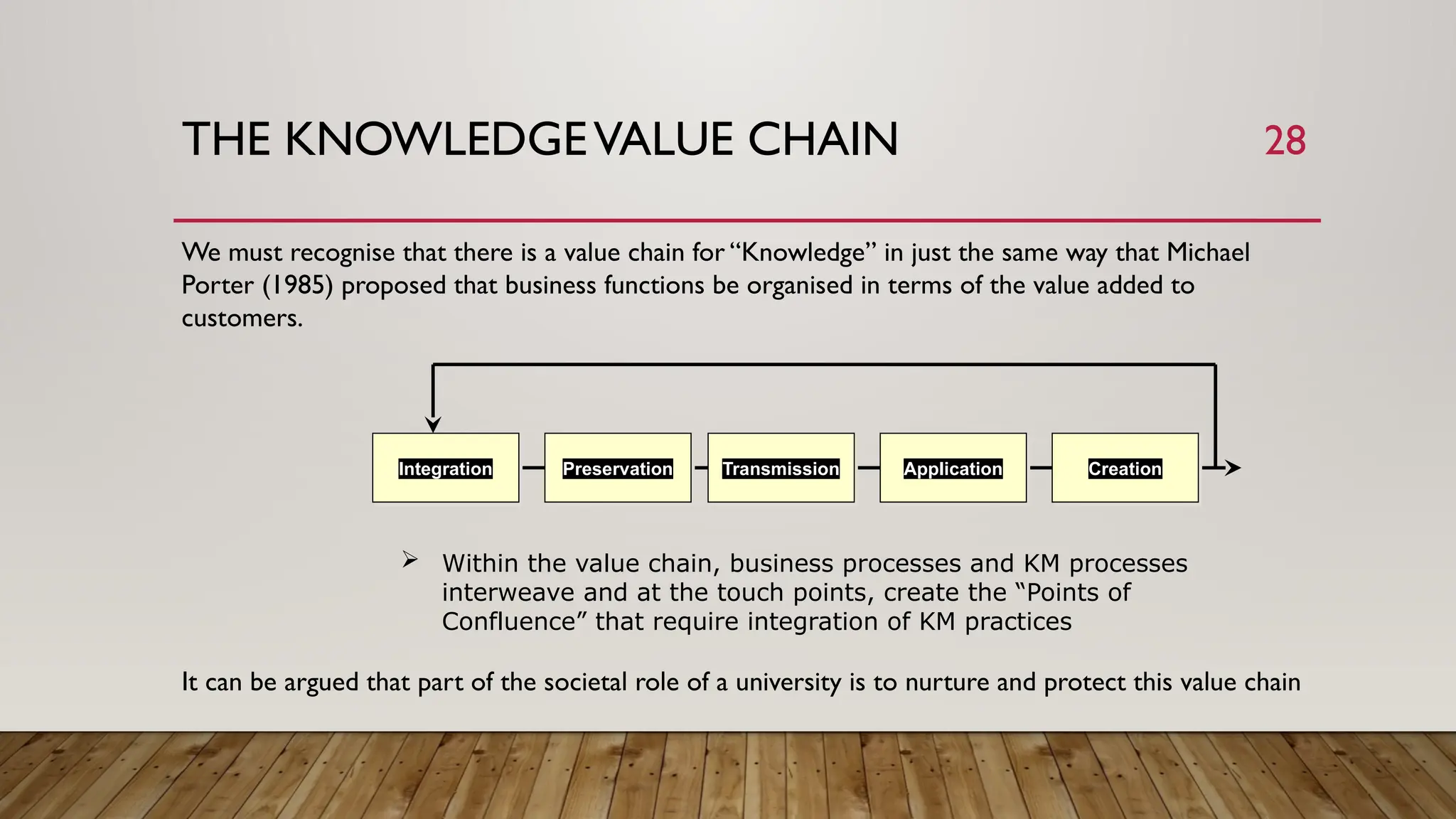
THE KNOWLEDGEVALUE CHAIN
Wemust recognise that there is a value chain for “Knowledge” in just the same way that Michael
Porter (1985) proposed that business functions be organised in terms of the value added to
customers.
Creation
Preservation
Integration Transmission Application
Within the value chain, business processes and KM processes
interweave and at the touch points, create the “Points of
Confluence” that require integration of KM practices
It can be argued that part of the societal role of a university is to nurture and protect this value chain
29.
29
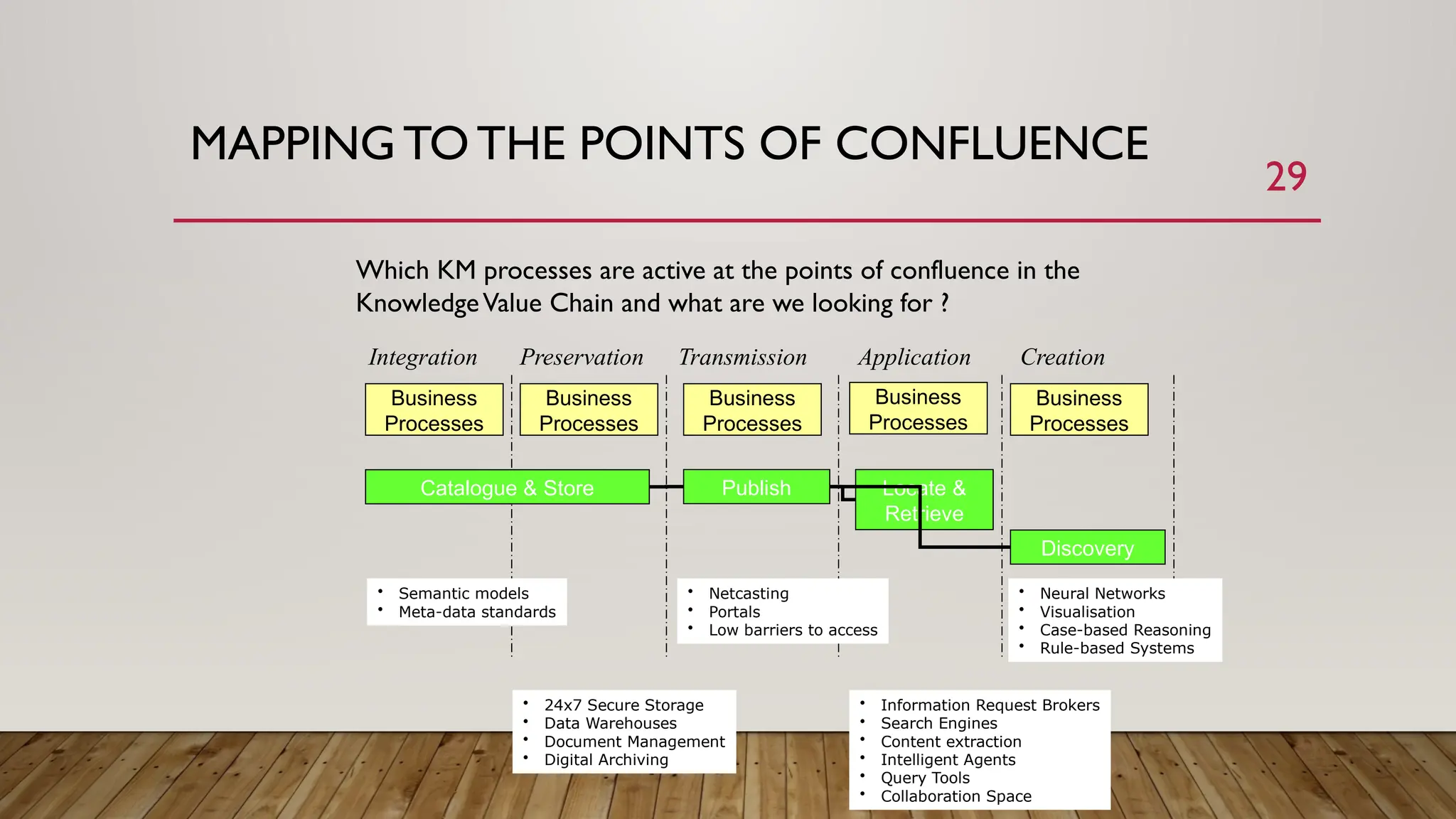
MAPPINGTOTHE POINTS OFCONFLUENCE
Which KM processes are active at the points of confluence in the
KnowledgeValue Chain and what are we looking for ?
Preservation
Integration Transmission Application Creation
Catalogue & Store Publish
Discovery
Locate &
Retrieve
• 24x7 Secure Storage
• Data Warehouses
• Document Management
• Digital Archiving
• Netcasting
• Portals
• Low barriers to access
• Information Request Brokers
• Search Engines
• Content extraction
• Intelligent Agents
• Query Tools
• Collaboration Space
• Neural Networks
• Visualisation
• Case-based Reasoning
• Rule-based Systems
• Semantic models
• Meta-data standards
Business
Processes
Business
Processes
Business
Processes
Business
Processes
Business
Processes
30.
30
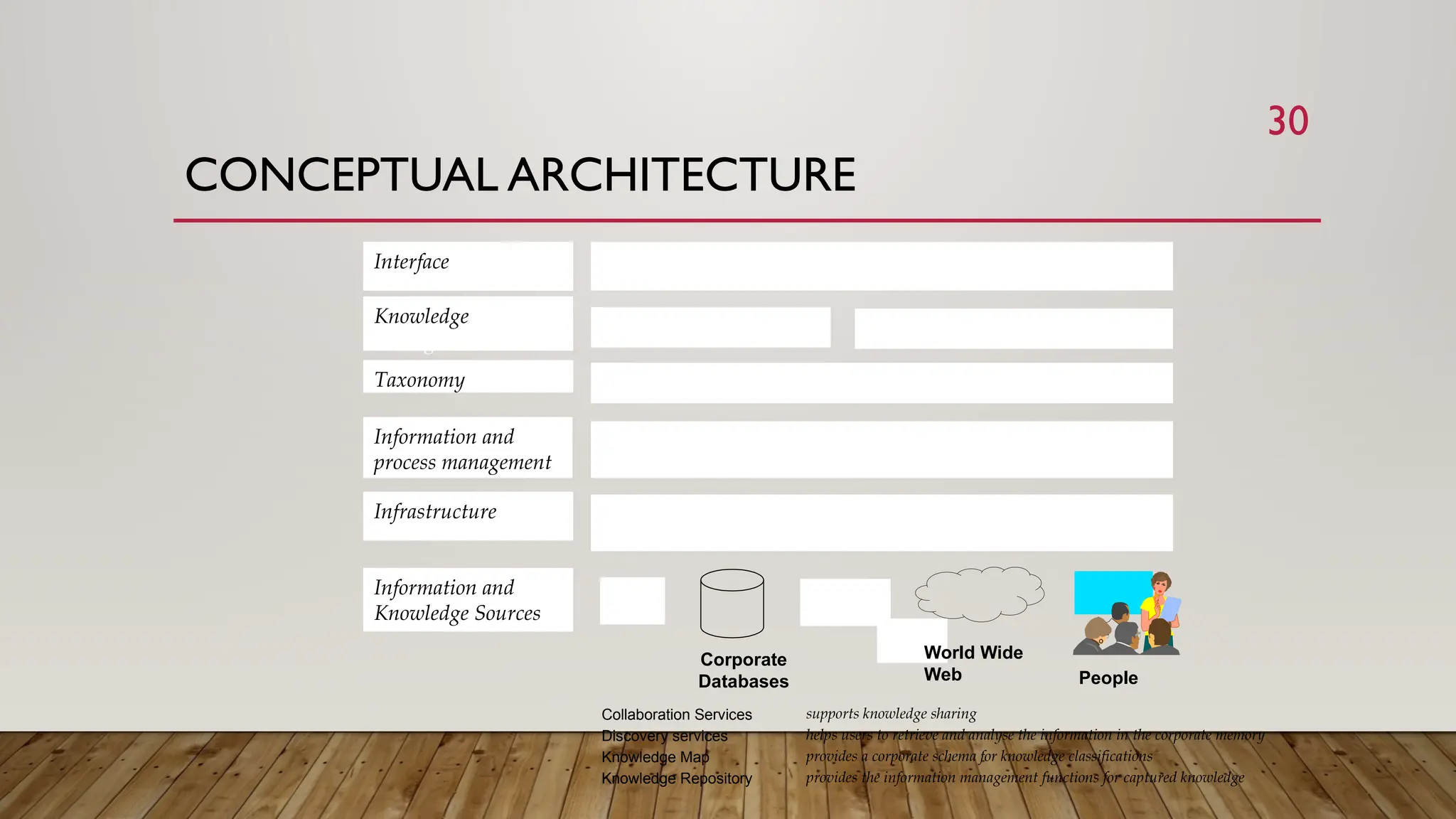
CONCEPTUAL ARCHITECTURE
Knowledge Portal
DiscoveryServices Collaboration Services
Knowledge map
Knowledge Repository
E-mail, file servers, Internet / intranet services
WP
Interface
Knowledge
Management services
Taxonomy
Information and
process management
Infrastructure
Information and
Knowledge Sources
Email
World Wide
Web People
Corporate
Databases
Collaboration Services
Discovery services
Knowledge Map
Knowledge Repository
supports knowledge sharing
helps users to retrieve and analyse the information in the corporate memory
provides a corporate schema for knowledge classifications
provides the information management functions for captured knowledge
31.
31 COMMERCIAL ORGANIZATIONSAND KM
1. Improvement in operating efficiency of business
processes which benefit from having access to superior
information at the point of need e.g customer-facing and
marketing processes, product development etc
2. A knowledge-empowered organization
3. A way of addressing concerns over the loss of corporate
memory arising from the increasing mobility of labor
“If we only knew half of what we know, we would be twice as profitable”
- Carla Fiorini, CEO Hewlett Packard Corp
32.
32
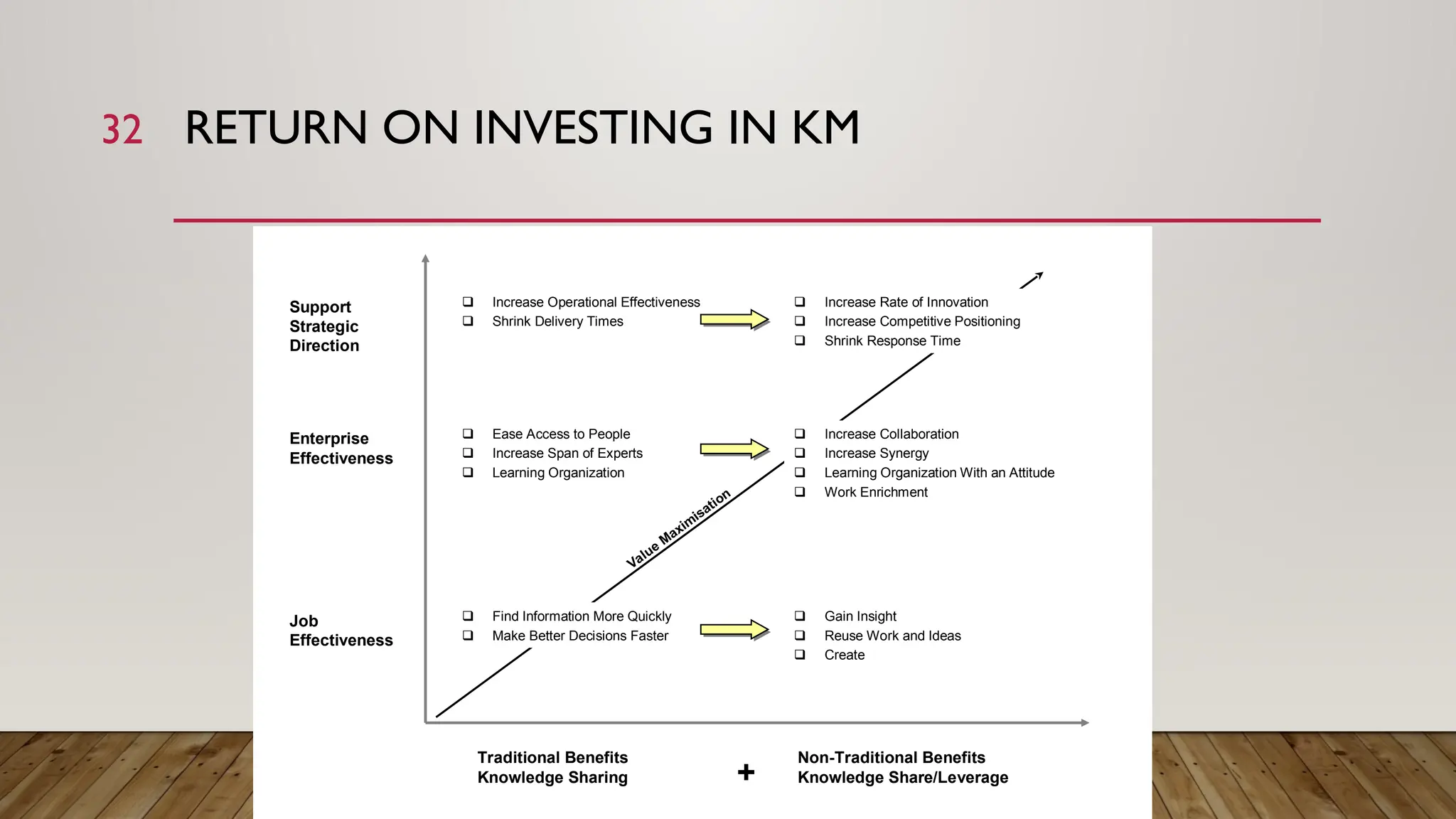
Find InformationMore Quickly
Make Better Decisions Faster
Gain Insight
Reuse Work and Ideas
Create
Ease Access to People
Increase Span of Experts
Learning Organization
Increase Collaboration
Increase Synergy
Learning Organization With an Attitude
Work Enrichment
Increase Operational Effectiveness
Shrink Delivery Times
Increase Rate of Innovation
Increase Competitive Positioning
Shrink Response Time
Support
Strategic
Direction
Job
Effectiveness
Enterprise
Effectiveness
Non-Traditional Benefits
Knowledge Share/Leverage
Traditional Benefits
Knowledge Sharing +
Value Maxim
isation
RETURN ON INVESTING IN KM
33.
33
MULTI PLE DISCI PLI NES
K
N
O
W
L
E
D
G
EM
A
N
A
G
E
M
E
N
T
T
h
eA
rc
h
ite
c
tu
reo
f E
n
te
rp
ris
eE
n
g
in
e
e
rin
g
S
y
s
te
m
sE
n
g
in
e
e
rin
g O
rg
a
n
iz
a
tio
nD
e
v
e
lo
p
m
e
n
t O
rg
a
n
iz
a
tio
nB
e
h
a
v
io
r
S
y
s
te
m
sM
a
n
a
g
e
m
e
n
t
E
-m
a
il
O
L
A
P
D
a
taW
are
h
o
u
s
in
g
S
e
a
rc
hE
n
g
in
e
s
D
e
c
is
io
nS
u
p
p
o
rt
P
ro
c
e
s
sM
o
d
e
lin
g
M
a
n
a
g
e
m
e
n
t T
oo
ls
C
o
m
m
u
n
ic
a
tio
n
s
T
E
C
H
N
O
L
O
G
Y
T
E
C
H
N
O
L
O
G
Y
B
P
R
-P
ro
c
e
s
s
e
s
-P
ro
c
e
d
u
re
s
M
e
tric
s
M
B
O
T
Q
M
/L
W
o
rk
flo
w
C
o
m
m
u
n
ic
a
tio
n
s
O
R
G
A
N
IZ
A
T
IO
N
O
R
G
A
N
IZ
A
T
IO
N
B
u
s
in
e
s
sC
u
ltu
re
S
tra
te
g
icP
la
n
n
in
g
-V
is
io
na
n
dG
o
a
ls
C
lim
a
te
G
ro
w
th
S
e
g
m
e
n
ta
tio
n
C
o
m
m
u
n
ic
a
tio
n
s
L
E
A
D
E
R
S
H
IP
L
E
A
D
E
R
S
H
IP
In
tu
itio
n
In
n
o
v
a
tio
nv
s
.
In
v
e
n
tio
n
L
e
a
rn
in
g
C
o
m
m
u
n
ity
V
irtu
a
l T
ea
m
s
S
h
a
re
dR
e
s
u
lts
E
x
c
h
a
n
g
eF
o
ru
m
s
C
o
m
m
u
n
ic
a
tio
n
s
L
E
A
R
N
IN
G
L
E
A
R
N
IN
G
E
n
v
iro
n
m
e
n
ta
l In
flu
e
n
c
e
s
S
o
c
ia
l
P
o
litica
l
G
o
v
e
rn
m
e
n
ta
l
E
c
o
n
o
m
ic
L
E
A
D
E
R
S
H
IP
T
E
C
H
N
O
L
O
G
Y
L
E
A
R
N
IN
G O
R
G
A
N
IZ
A
T
IO
N
MULTI PLE DI SCI PLI NES
K
N
O
W
L
E
D
G
EM
A
N
A
G
E
M
E
N
T
T
h
eA
rc
h
ite
c
tu
reo
f E
n
te
rp
ris
eE
n
g
in
e
e
rin
g
S
y
s
te
m
sE
n
g
in
e
e
rin
g O
rg
a
n
iz
a
tio
nD
e
v
e
lo
p
m
e
n
t O
rg
a
n
iz
a
tio
nB
e
h
a
v
io
r
S
y
s
te
m
sM
a
n
a
g
e
m
e
n
t
E
-m
a
il
O
L
A
P
D
a
taW
are
h
o
u
s
in
g
S
e
a
rc
hE
n
g
in
e
s
D
e
c
is
io
nS
u
p
p
o
rt
P
ro
c
e
s
sM
o
d
e
lin
g
M
a
n
a
g
e
m
e
n
t T
oo
ls
C
o
m
m
u
n
ic
a
tio
n
s
T
E
C
H
N
O
L
O
G
Y
T
E
C
H
N
O
L
O
G
Y
B
P
R
-P
ro
c
e
s
s
e
s
-P
ro
c
e
d
u
re
s
M
e
tric
s
M
B
O
T
Q
M
/L
W
o
rk
flo
w
C
o
m
m
u
n
ic
a
tio
n
s
O
R
G
A
N
IZ
A
T
IO
N
O
R
G
A
N
IZ
A
T
IO
N
B
u
s
in
e
s
sC
u
ltu
re
S
tra
te
g
icP
la
n
n
in
g
-V
is
io
na
n
dG
o
a
ls
C
lim
a
te
G
ro
w
th
S
e
g
m
e
n
ta
tio
n
C
o
m
m
u
n
ic
a
tio
n
s
L
E
A
D
E
R
S
H
IP
L
E
A
D
E
R
S
H
IP
In
tu
itio
n
In
n
o
v
a
tio
nv
s
.
In
v
e
n
tio
n
L
e
a
rn
in
g
C
o
m
m
u
n
ity
V
irtu
a
l T
ea
m
s
S
h
a
re
dR
e
s
u
lts
E
x
c
h
a
n
g
eF
o
ru
m
s
C
o
m
m
u
n
ic
a
tio
n
s
L
E
A
R
N
IN
G
L
E
A
R
N
IN
G
E
n
v
iro
n
m
e
n
ta
l In
flu
e
n
c
e
s
S
o
c
ia
l
P
o
litica
l
G
o
v
e
rn
m
e
n
ta
l
E
c
o
n
o
m
ic
L
E
A
D
E
R
S
H
IP
T
E
C
H
N
O
L
O
G
Y
L
E
A
R
N
IN
G O
R
G
A
N
IZ
A
T
IO
N
L
E
A
D
E
R
S
H
IP
T
E
C
H
N
O
L
O
G
Y
L
E
A
R
N
IN
G O
R
G
A
N
IZ
A
T
IO
N
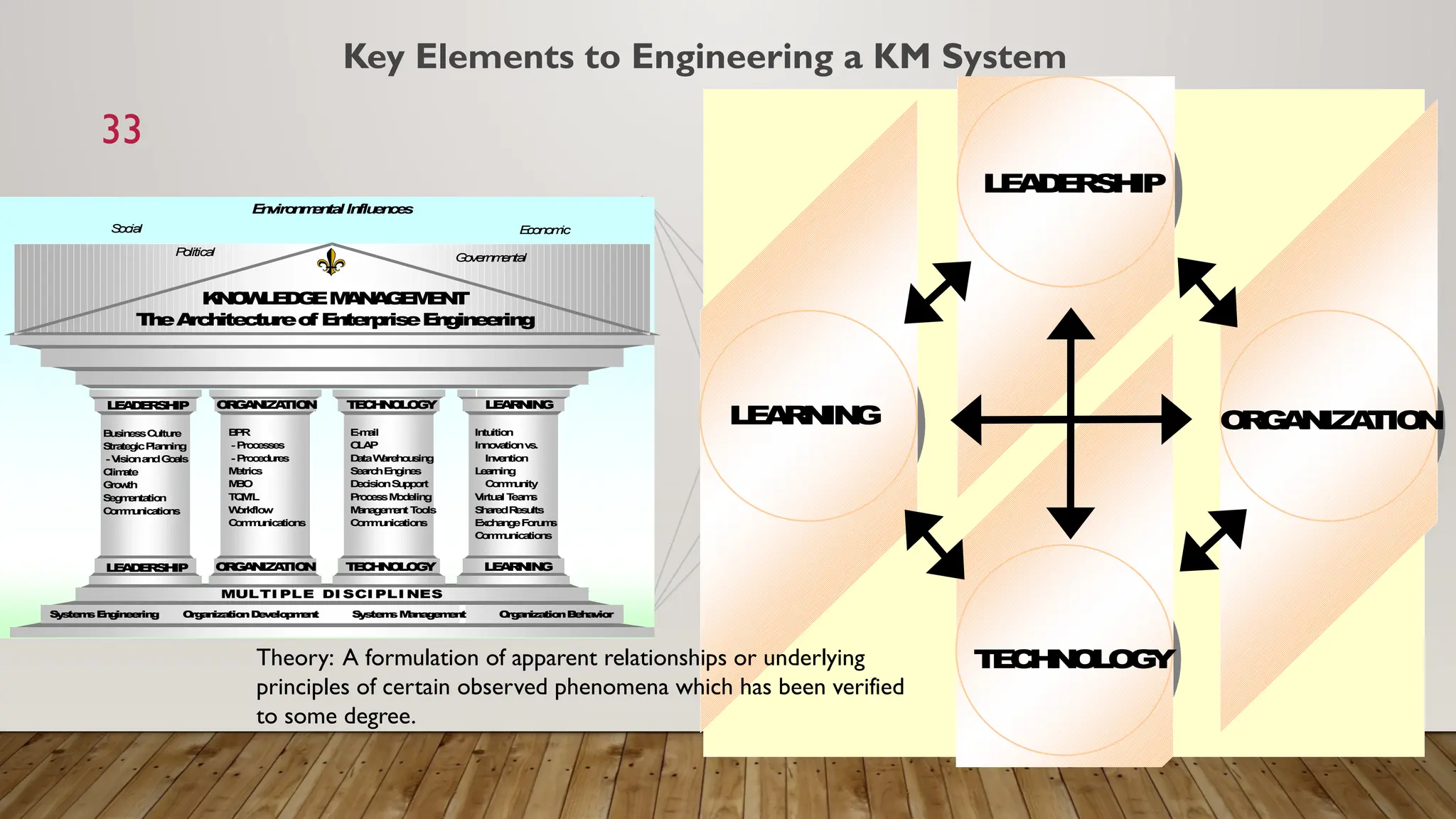
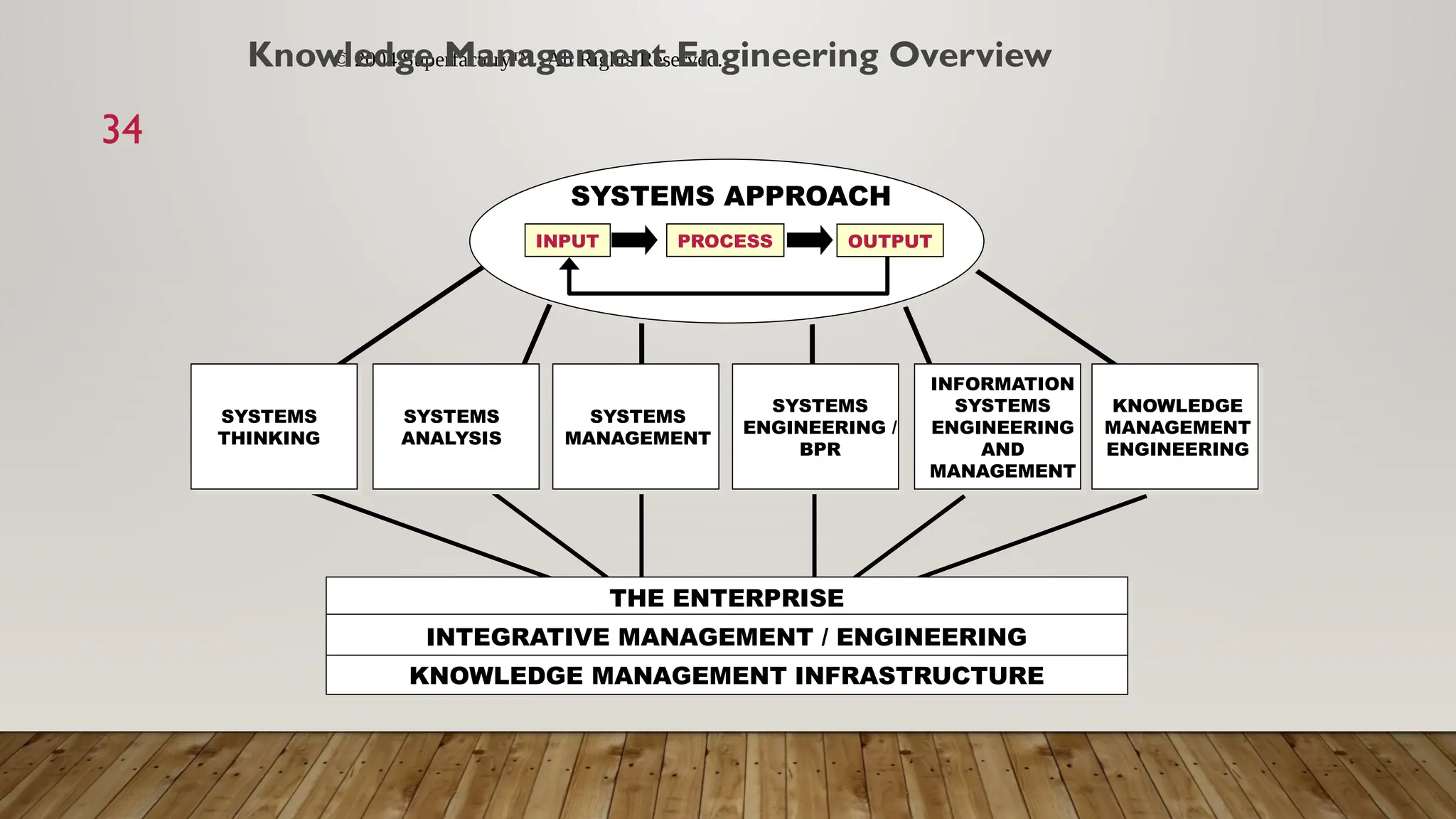
Key Elements to Engineering a KM System
Theory: A formulation of apparent relationships or underlying
principles of certain observed phenomena which has been verified
to some degree.
35
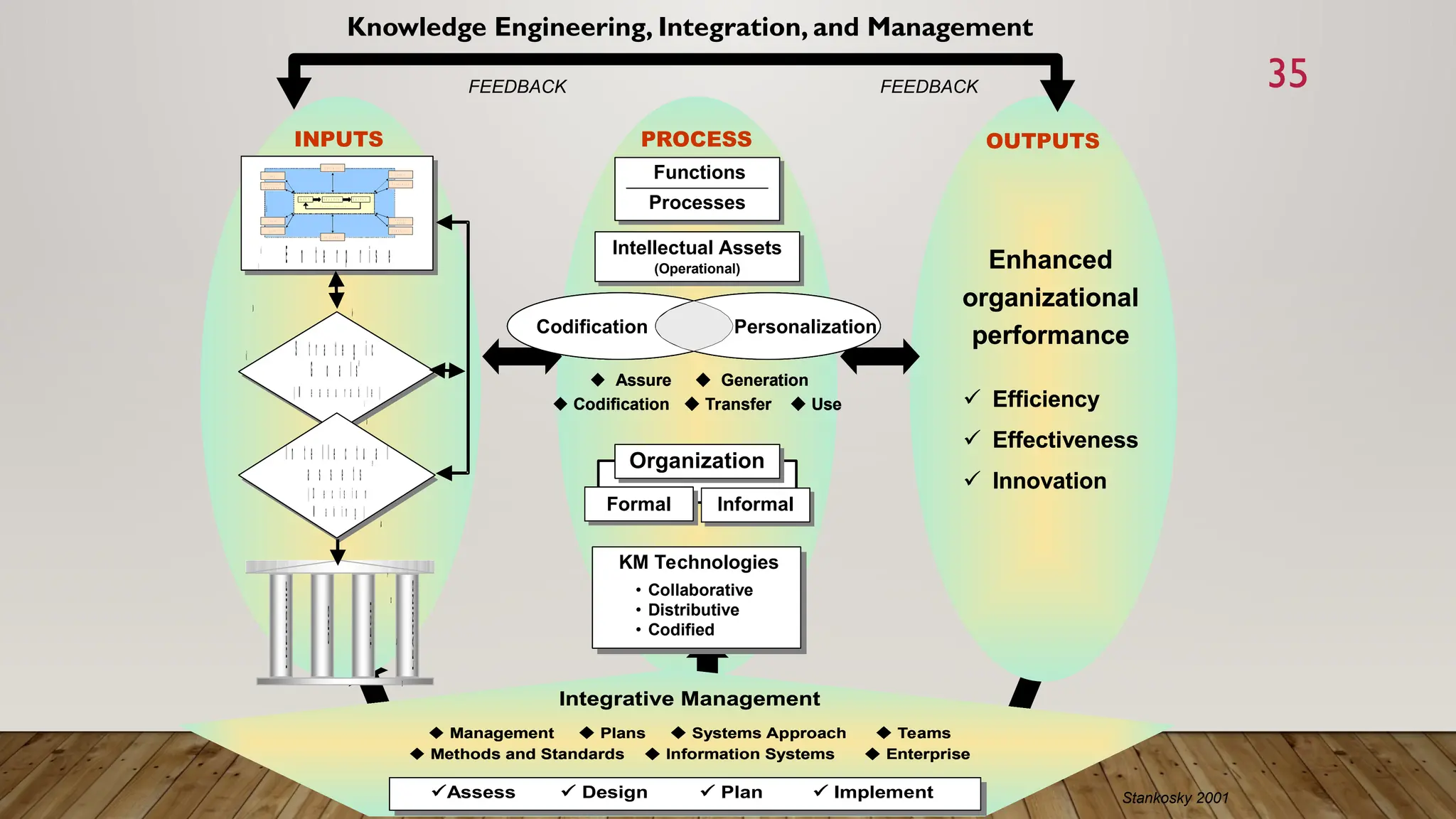
INPUTS PROCESS OUTPUTS
FEEDBACK
Stankosky2001
FEEDBACK
Knowledge Engineering, Integration, and Management
Enhanced
organizational
performance
Efficiency
Effectiveness
Innovation
Enhanced
organizational
performance
Efficiency
Effectiveness
Innovation
Integrative Management
Management Plans Systems Approach Teams
Methods and Standards Information Systems Enterprise
Assess Design Plan Implement
Integrative Management
Management Plans Systems Approach Teams
Methods and Standards Information Systems Enterprise
Assess Design Plan Implement
Assess Design Plan Implement
E n t e r p r i s e
M a t e r i a l a n d
E q u i p m e n t
I N P U T P R O C E S S O U T P U T
I N P U T P R O C E S S O U T P U T
L a b o r
G e n e r a l
P u b l i c
C a p i t a l
L a n d
C u s t o m e r s
E c o l o g y
G o v e r n m e n t
C o m p e t i t o r s
T e c h n o l o g y
F e e d b a c k C o n t r o l s
T h e O r g a n i z a t i o n
M a t e r i a l a n d
E q u i p m e n t
M a t e r i a l a n d
E q u i p m e n t
I N P U T P R O C E S S O U T P U T
I N P U T P R O C E S S O U T P U T
I N P U T P R O C E S S O U T P U T
I N P U T P R O C E S S O U T P U T
L a b o r
L a b o r
G e n e r a l
P u b l i c
G e n e r a l
P u b l i c
C a p i t a l
C a p i t a l
L a n d
L a n d
C u s t o m e r s
C u s t o m e r s
E c o l o g y
E c o l o g y
G o v e r n m e n t
G o v e r n m e n t
C o m p e t i t o r s
C o m p e t i t o r s
T e c h n o l o g y
T e c h n o l o g y
F e e d b a c k C o n t r o l s
T h e O r g a n i z a t i o n
S t r a t e g i c
G o a l s
( M e a s u r a b l e )
I n t e l l e c t u a l
a s s e t s
( D e c i s i o n
M a k i n g )
LDE
RS
HI
P
O
RG
TECH
LE
A
RNING
E n t e r p r i s e
M a t e r i a l a n d
E q u i p m e n t
I N P U T P R O C E S S O U T P U T
I N P U T P R O C E S S O U T P U T
L a b o r
G e n e r a l
P u b l i c
C a p i t a l
L a n d
C u s t o m e r s
E c o l o g y
G o v e r n m e n t
C o m p e t i t o r s
T e c h n o l o g y
F e e d b a c k C o n t r o l s
T h e O r g a n i z a t i o n
M a t e r i a l a n d
E q u i p m e n t
M a t e r i a l a n d
E q u i p m e n t
I N P U T P R O C E S S O U T P U T
I N P U T P R O C E S S O U T P U T
I N P U T P R O C E S S O U T P U T
I N P U T P R O C E S S O U T P U T
L a b o r
L a b o r
G e n e r a l
P u b l i c
G e n e r a l
P u b l i c
C a p i t a l
C a p i t a l
L a n d
L a n d
C u s t o m e r s
C u s t o m e r s
E c o l o g y
E c o l o g y
G o v e r n m e n t
G o v e r n m e n t
C o m p e t i t o r s
C o m p e t i t o r s
T e c h n o l o g y
T e c h n o l o g y
F e e d b a c k C o n t r o l s
T h e O r g a n i z a t i o n
E n t e r p r i s e
M a t e r i a l a n d
E q u i p m e n t
I N P U T P R O C E S S O U T P U T
I N P U T P R O C E S S O U T P U T
L a b o r
G e n e r a l
P u b l i c
C a p i t a l
L a n d
C u s t o m e r s
E c o l o g y
G o v e r n m e n t
C o m p e t i t o r s
T e c h n o l o g y
F e e d b a c k C o n t r o l s
T h e O r g a n i z a t i o n
M a t e r i a l a n d
E q u i p m e n t
M a t e r i a l a n d
E q u i p m e n t
I N P U T P R O C E S S O U T P U T
I N P U T P R O C E S S O U T P U T
I N P U T P R O C E S S O U T P U T
I N P U T P R O C E S S O U T P U T
L a b o r
L a b o r
G e n e r a l
P u b l i c
G e n e r a l
P u b l i c
C a p i t a l
C a p i t a l
L a n d
L a n d
C u s t o m e r s
C u s t o m e r s
E c o l o g y
E c o l o g y
G o v e r n m e n t
G o v e r n m e n t
C o m p e t i t o r s
C o m p e t i t o r s
T e c h n o l o g y
T e c h n o l o g y
F e e d b a c k C o n t r o l s
T h e O r g a n i z a t i o n
S t r a t e g i c
G o a l s
( M e a s u r a b l e )
I n t e l l e c t u a l
a s s e t s
( D e c i s i o n
M a k i n g )
LDE
RS
HI
P
O
RG
TECH
LE
A
RNING
LDE
RS
HI
P
O
RG
TECH
LE
A
RNING
LDE
RS
HI
P
O
RG
TECH
LE
A
RNING
Assure Generation
Codification Transfer Use
Codification Personalization
KM Technologies
• Collaborative
• Distributive
• Codified
Organization
Formal Informal
Functions
Processes
Intellectual Assets
(Operational)
Assure Generation
Codification Transfer Use
Codification Personalization
Codification Personalization
KM Technologies
• Collaborative
• Distributive
• Codified
Organization
Formal Informal
KM Technologies
• Collaborative
• Distributive
• Codified
KM Technologies
• Collaborative
• Distributive
• Codified
Organization
Formal Informal
Organization
Organization
Formal Informal
Formal
Formal Informal
Informal
Functions
Processes
Functions
Processes
Intellectual Assets
(Operational)
Intellectual Assets
(Operational)
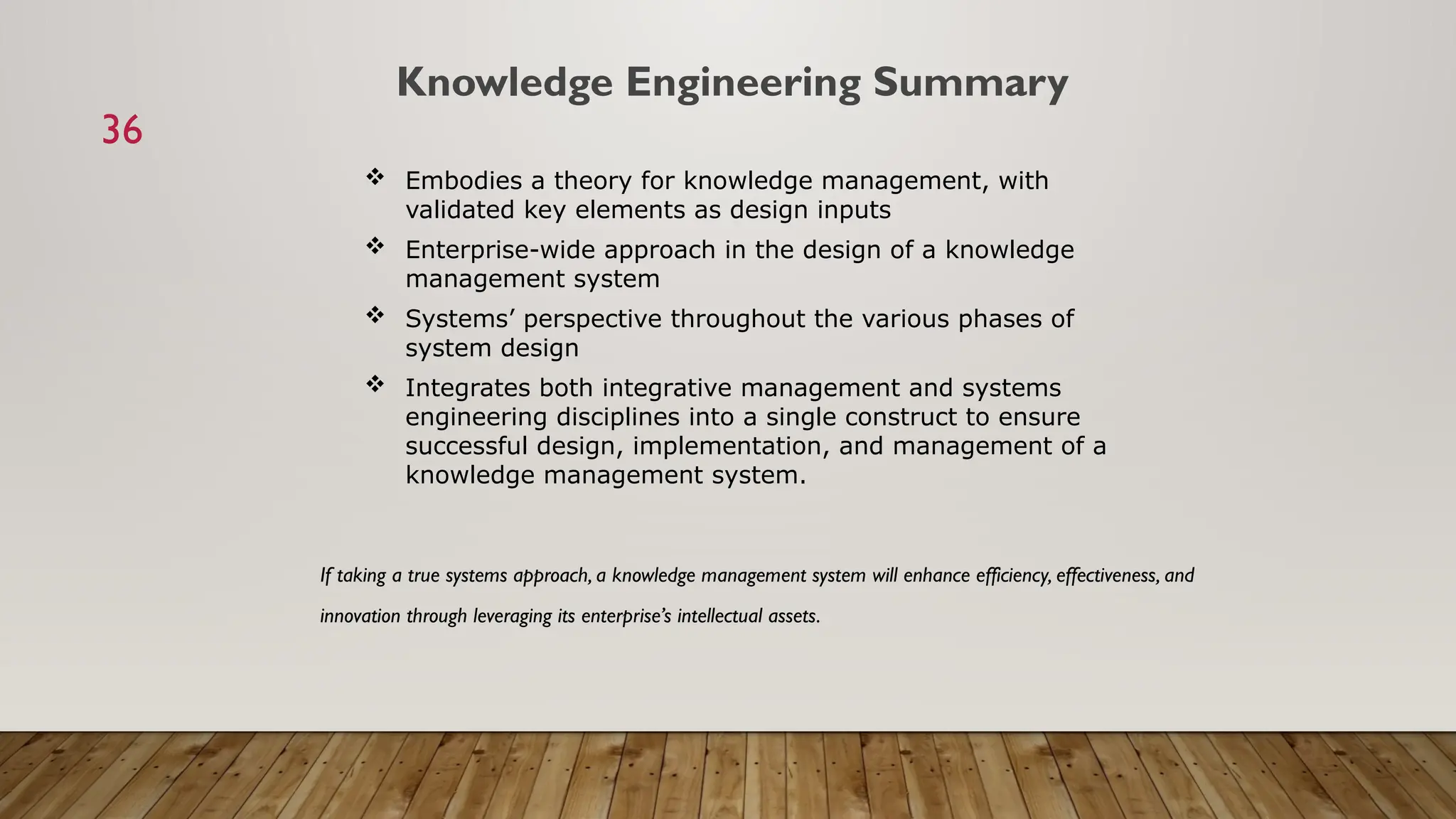
36.
36
Embodies atheory for knowledge management, with
validated key elements as design inputs
Enterprise-wide approach in the design of a knowledge
management system
Systems’ perspective throughout the various phases of
system design
Integrates both integrative management and systems
engineering disciplines into a single construct to ensure
successful design, implementation, and management of a
knowledge management system.
Knowledge Engineering Summary
If taking a true systems approach, a knowledge management system will enhance efficiency, effectiveness, and
innovation through leveraging its enterprise’s intellectual assets.
37.
GENERAL DECISION MAKINGSTYLES
• Everyone brings their own unique personalities and experiences to the decisions they make.
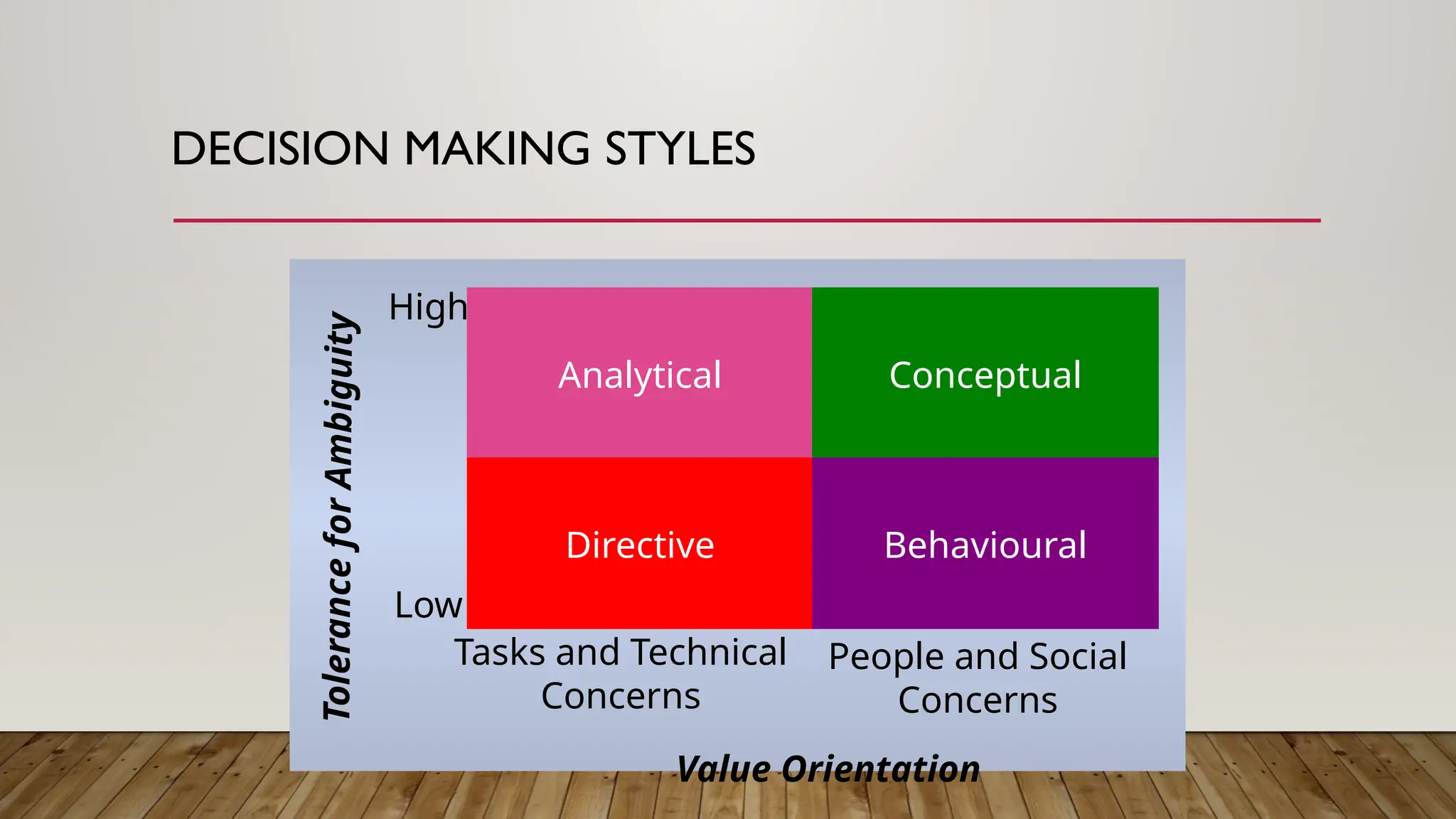
• The decision-style model assumes that people differ along two dimensions:
1) Their way of thinking orValue orientation – task and technical concerns or people and social
concerns and how they process information
2) Tolerance for Ambiguity - How clear does everything have to be or need of structure or
control.
• Based on these two main dimensions, there are four decision making styles: Directive,
analytical, conceptual and behavioural
38.
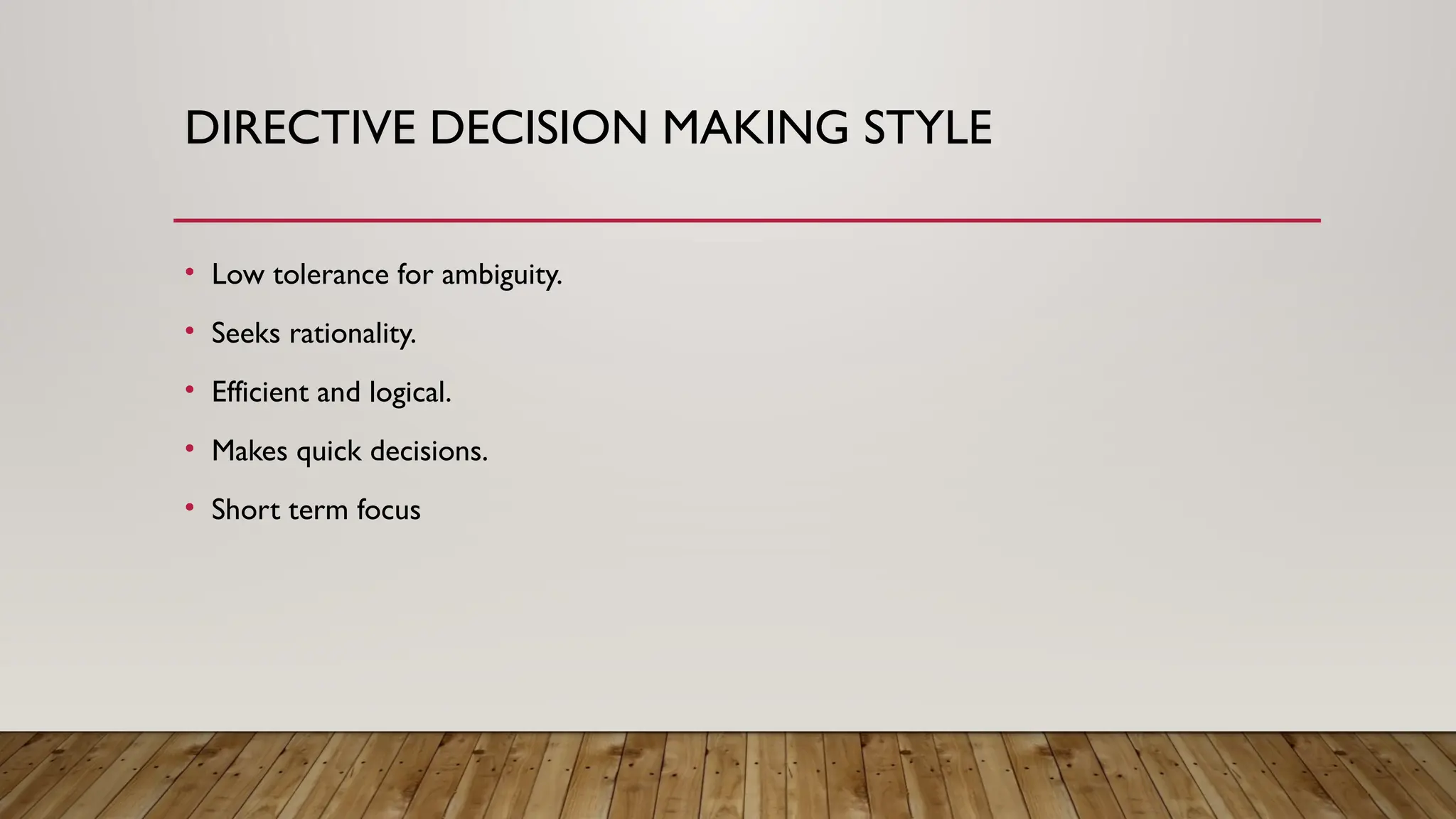
DIRECTIVE DECISION MAKINGSTYLE
• Low tolerance for ambiguity.
• Seeks rationality.
• Efficient and logical.
• Makes quick decisions.
• Short term focus
39.
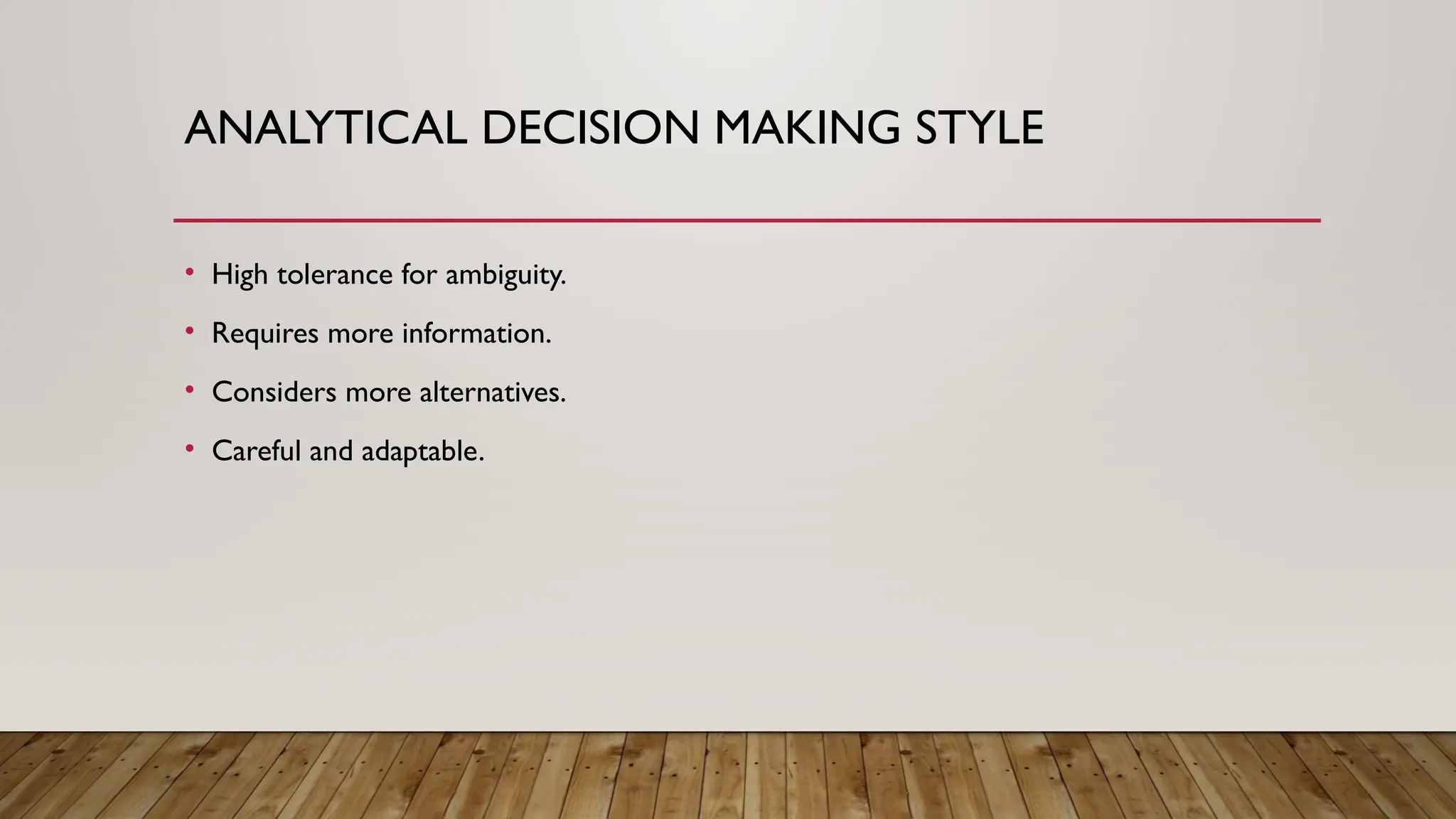
ANALYTICAL DECISION MAKINGSTYLE
• High tolerance for ambiguity.
• Requires more information.
• Considers more alternatives.
• Careful and adaptable.
40.
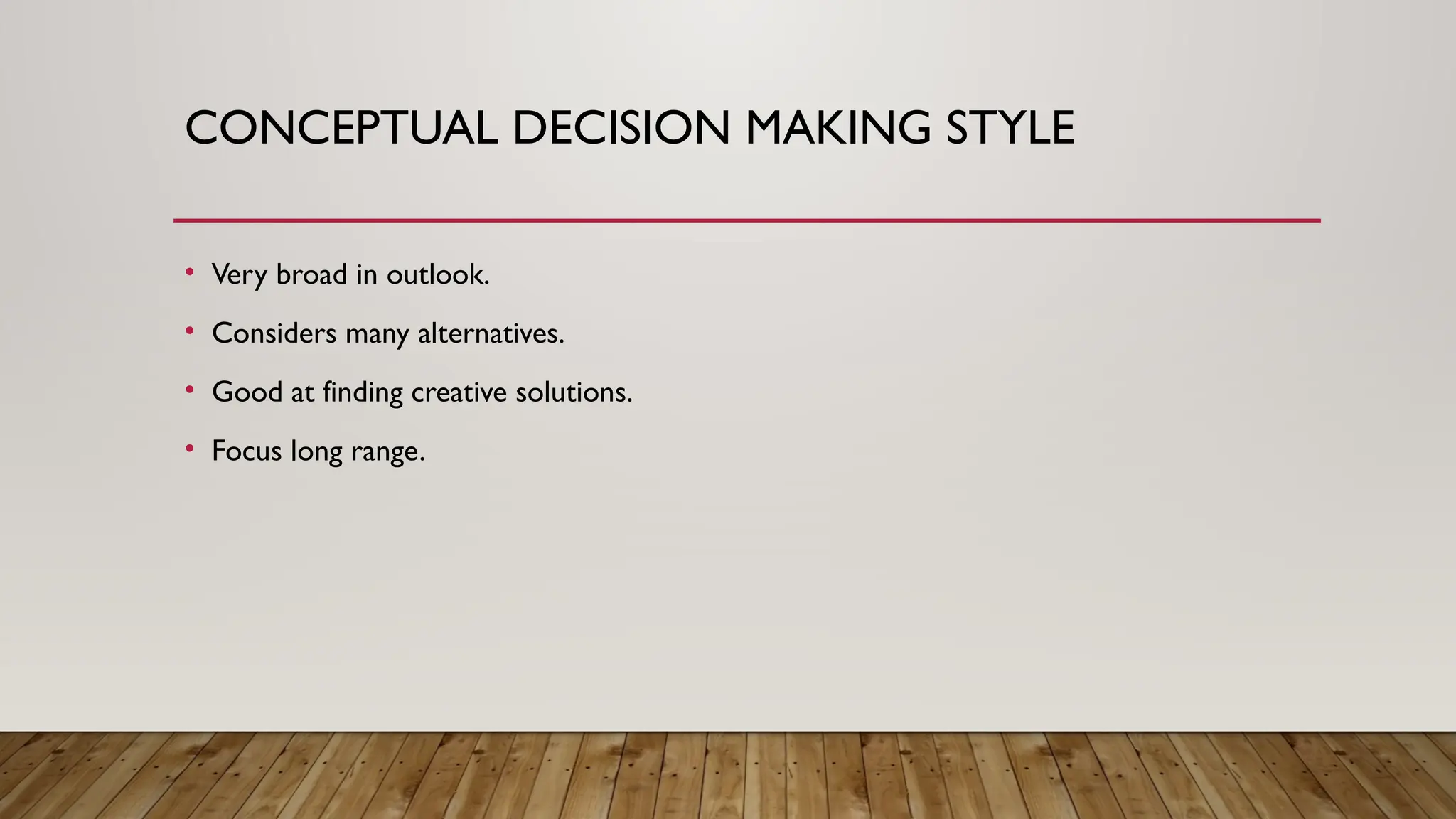
CONCEPTUAL DECISION MAKINGSTYLE
• Very broad in outlook.
• Considers many alternatives.
• Good at finding creative solutions.
• Focus long range.
41.
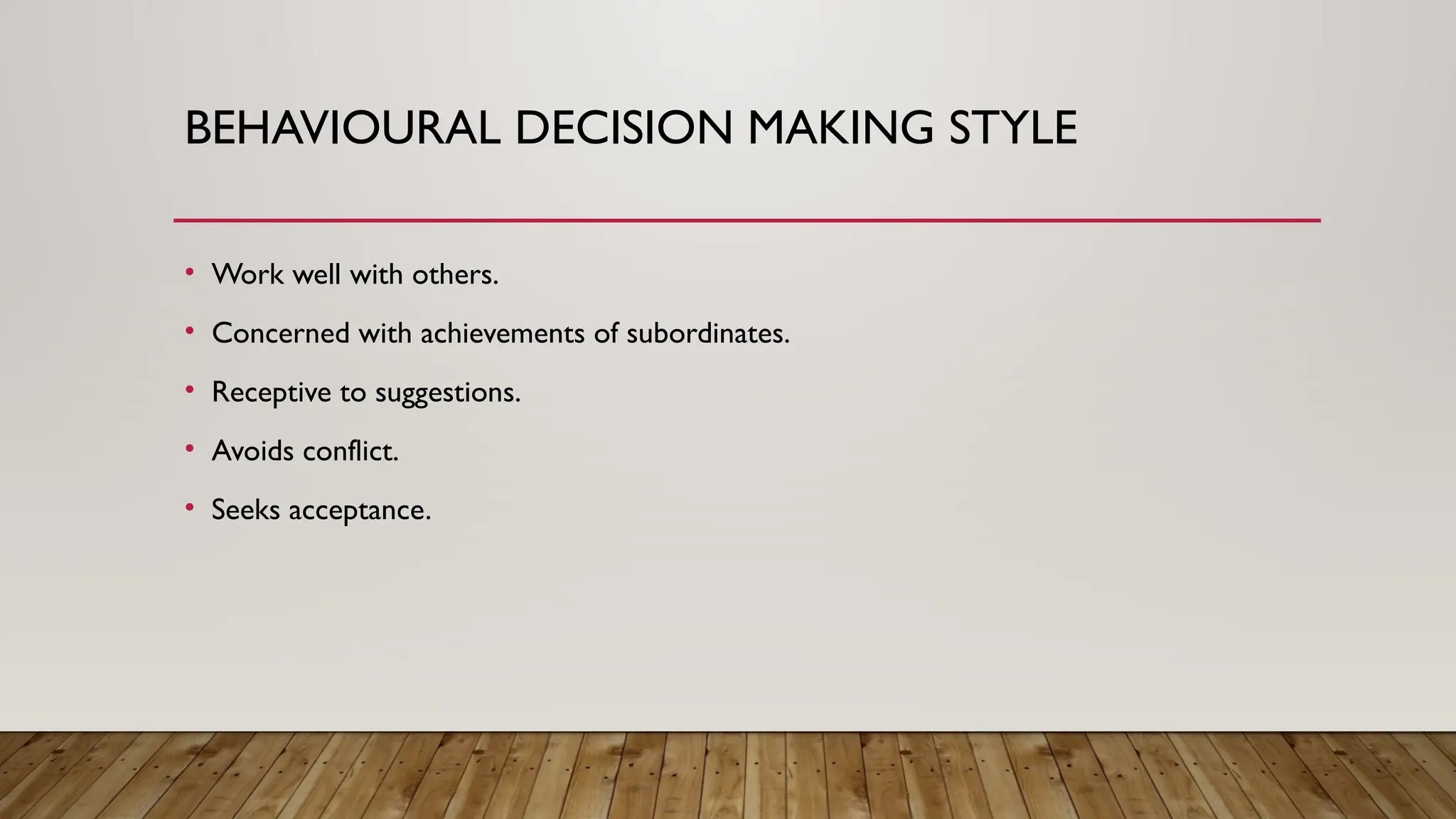
BEHAVIOURAL DECISION MAKINGSTYLE
• Work well with others.
• Concerned with achievements of subordinates.
• Receptive to suggestions.
• Avoids conflict.
• Seeks acceptance.
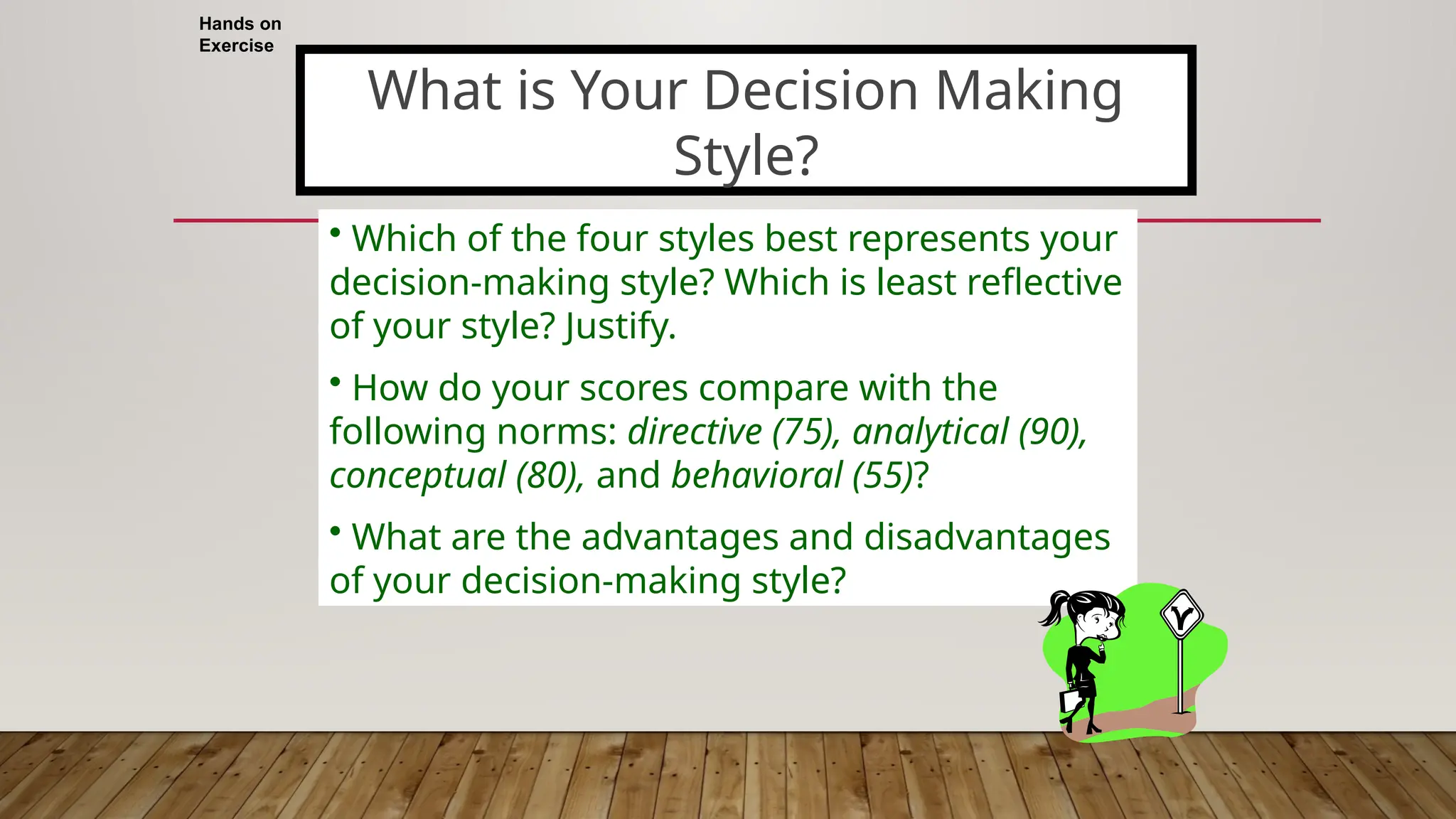
Hands on
Exercise
• Whichof the four styles best represents your
decision-making style? Which is least reflective
of your style? Justify.
• How do your scores compare with the
following norms: directive (75), analytical (90),
conceptual (80), and behavioral (55)?
• What are the advantages and disadvantages
of your decision-making style?
What is Your Decision Making
Style?
44.
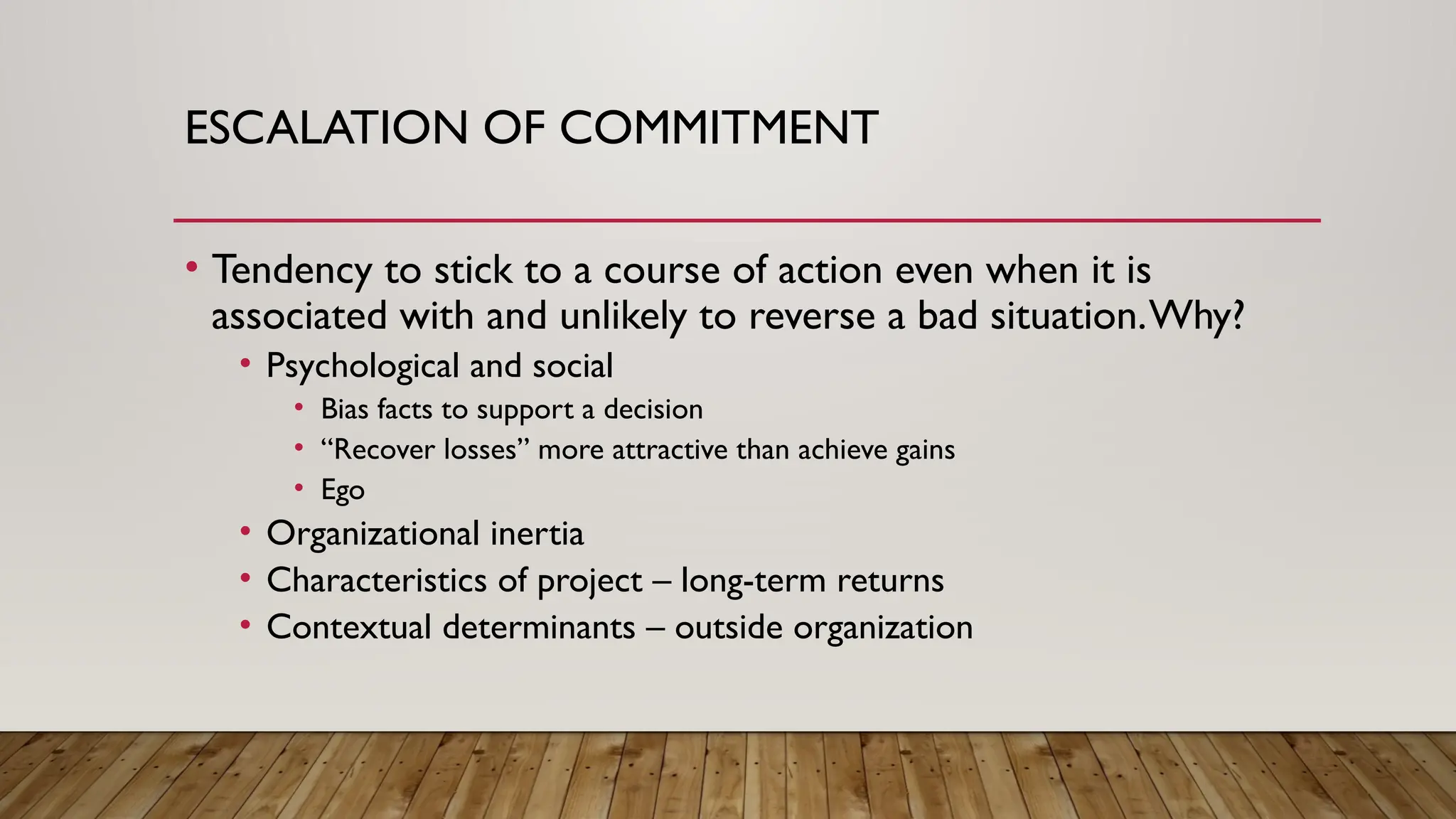
ESCALATION OF COMMITMENT
•Tendency to stick to a course of action even when it is
associated with and unlikely to reverse a bad situation.Why?
• Psychological and social
• Bias facts to support a decision
• “Recover losses” more attractive than achieve gains
• Ego
• Organizational inertia
• Characteristics of project – long-term returns
• Contextual determinants – outside organization
45.
1. Set minimumtargets for performance, and have decision
makers compare their performance with these targets.
2. Have different individuals make the initial and subsequent
decisions about a project.
3. Encourage decision makers to become less ego-involved with a
project.
4. Provide more frequent feedback about project completion and
costs.
5. Reduce the risk of penalties of failure.
6. Make decision makers aware of the costs of persistence.
SKILLS AND BEST PRACTICES: RECOMMENDATIONS
TO REDUCE ESCALATION OF COMMITMENT
46.
1. Preparation: Reflectsthe notion that creativity starts from a
base of knowledge.
2. Concentration: Where an individual concentrates on the
problem at hand.
3. Incubation: Done unconsciously. During this stage, people
engage in daily activities while their minds simultaneously mull
over information and make remote associations.
4. Illumination: Remote associations from the incubation stage
are ultimately generated.
5. Verification: Entails going through the entire process to verify,
modify, or try out the new idea.
STAGES UNDERLYING THE CREATIVE PROCESS
47.
GROUP DECISION-MAKING
• Datasuggests that innovative groups possessed high levels of
both minority dissent and participation in decision making
• Note four requirements of effective decision making in a group:
• Focus on process
• Understand requirements for an effective choice
• Assess positive qualities of alternative solutions
• Assess negative qualities of alternative solutions
• Suggests openness, acceptance of dissent?
48.
CHARACTERISTICS OF GROUPWORK
•A group performs a task, sometimes decision making, sometimes not
• Group members may be located in different places
• Group members may work at different times
• Group members may work for the same or for different organizations
• The group can be permanent or temporary
• The group can be at any managerial level or span levels
49.
CHARACTERISTICS OF GROUPWORK…
•There can be synergy or conflict in group work
• There can be gains/losses in productivity from group work
• The task might have to be accomplished very quickly
• It may be impossible for all members to meet in one place
• Some of the data needed may be located in sources external to the organization
• The expertise of non-team members may be needed
50.
COMMUNICATION SUPPORT
• Communicationis a vital element for decision support
• Without communication there is no collaboration
• Groups of decision makers must communicate, collaborate and negotiate in their work
• Effective e-commerce is possible only via modern communication technologies
• Modern information technologies provide inexpensive, fast, capable and reliable means of
supporting communication
• Collaborative technologies like EMS(electronic meeting systems) and electronic
conferencing systems and services helps in connecting decision makers
51.
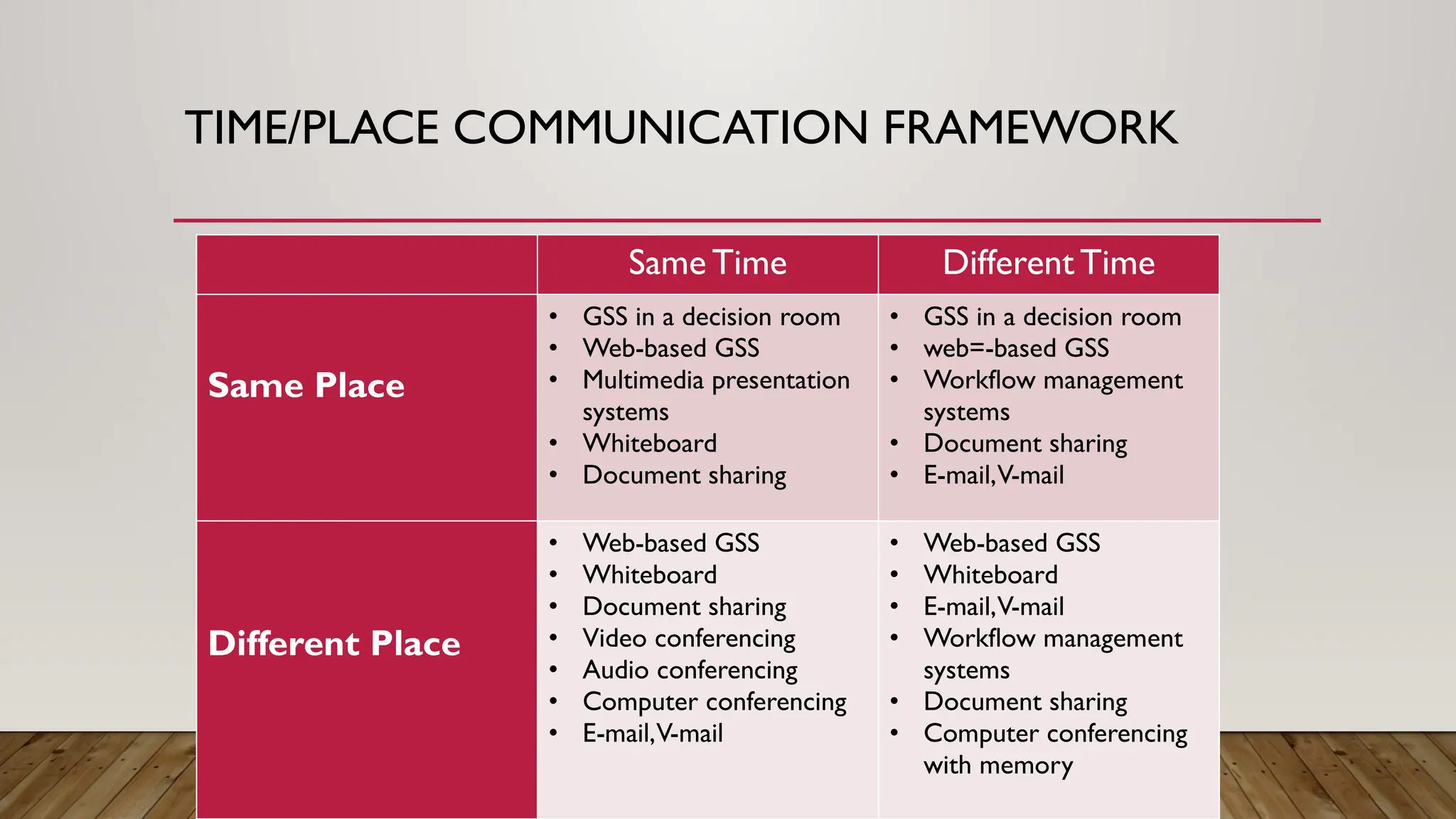
TIME/PLACE COMMUNICATION FRAMEWORK
SameTime Different Time
Same Place
• GSS in a decision room
• Web-based GSS
• Multimedia presentation
systems
• Whiteboard
• Document sharing
• GSS in a decision room
• web=-based GSS
• Workflow management
systems
• Document sharing
• E-mail,V-mail
Different Place
• Web-based GSS
• Whiteboard
• Document sharing
• Video conferencing
• Audio conferencing
• Computer conferencing
• E-mail,V-mail
• Web-based GSS
• Whiteboard
• E-mail,V-mail
• Workflow management
systems
• Document sharing
• Computer conferencing
with memory
52.
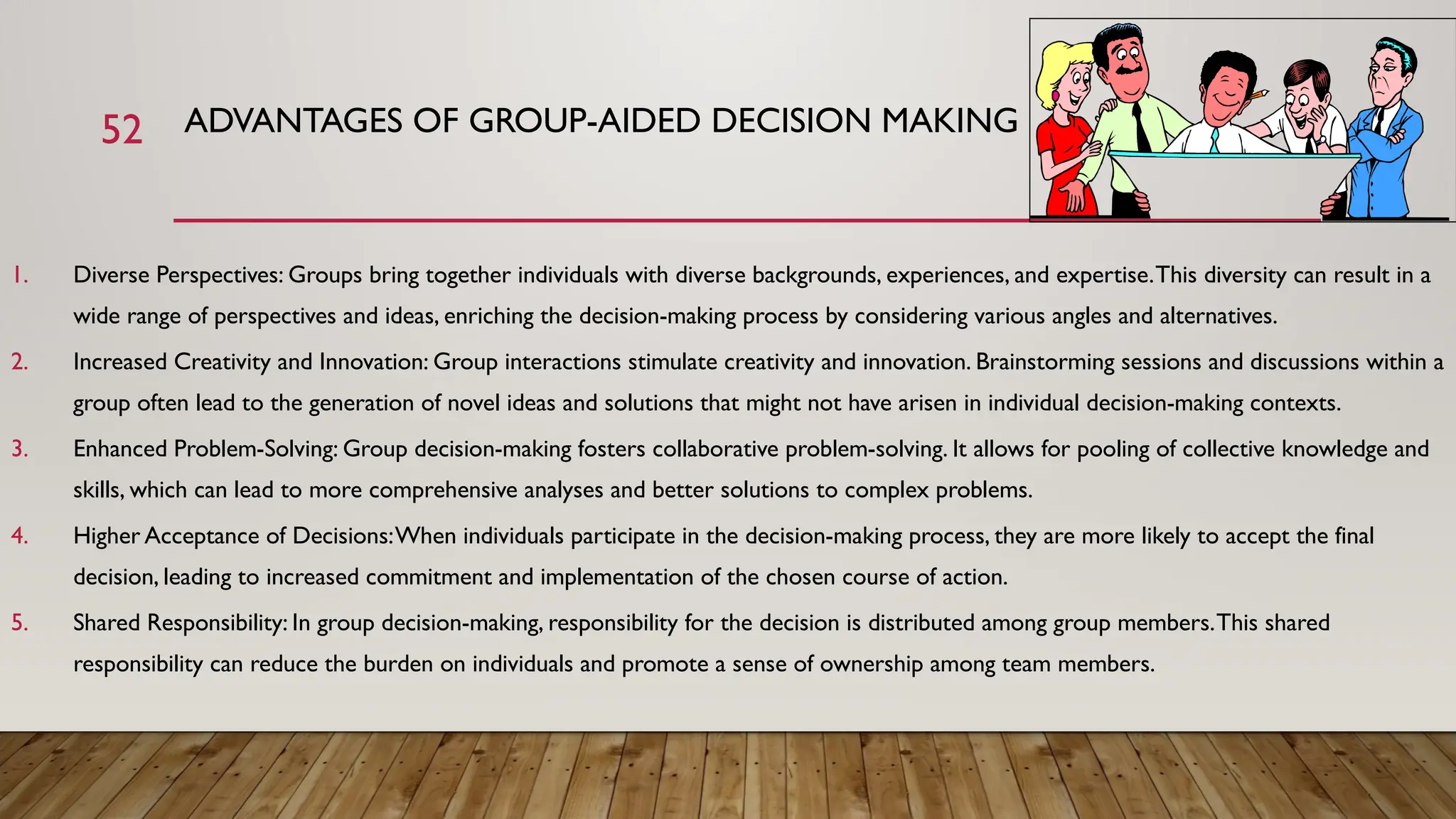
52 ADVANTAGES OFGROUP-AIDED DECISION MAKING
1. Diverse Perspectives: Groups bring together individuals with diverse backgrounds, experiences, and expertise.This diversity can result in a
wide range of perspectives and ideas, enriching the decision-making process by considering various angles and alternatives.
2. Increased Creativity and Innovation: Group interactions stimulate creativity and innovation. Brainstorming sessions and discussions within a
group often lead to the generation of novel ideas and solutions that might not have arisen in individual decision-making contexts.
3. Enhanced Problem-Solving: Group decision-making fosters collaborative problem-solving. It allows for pooling of collective knowledge and
skills, which can lead to more comprehensive analyses and better solutions to complex problems.
4. Higher Acceptance of Decisions:When individuals participate in the decision-making process, they are more likely to accept the final
decision, leading to increased commitment and implementation of the chosen course of action.
5. Shared Responsibility: In group decision-making, responsibility for the decision is distributed among group members.This shared
responsibility can reduce the burden on individuals and promote a sense of ownership among team members.
53.
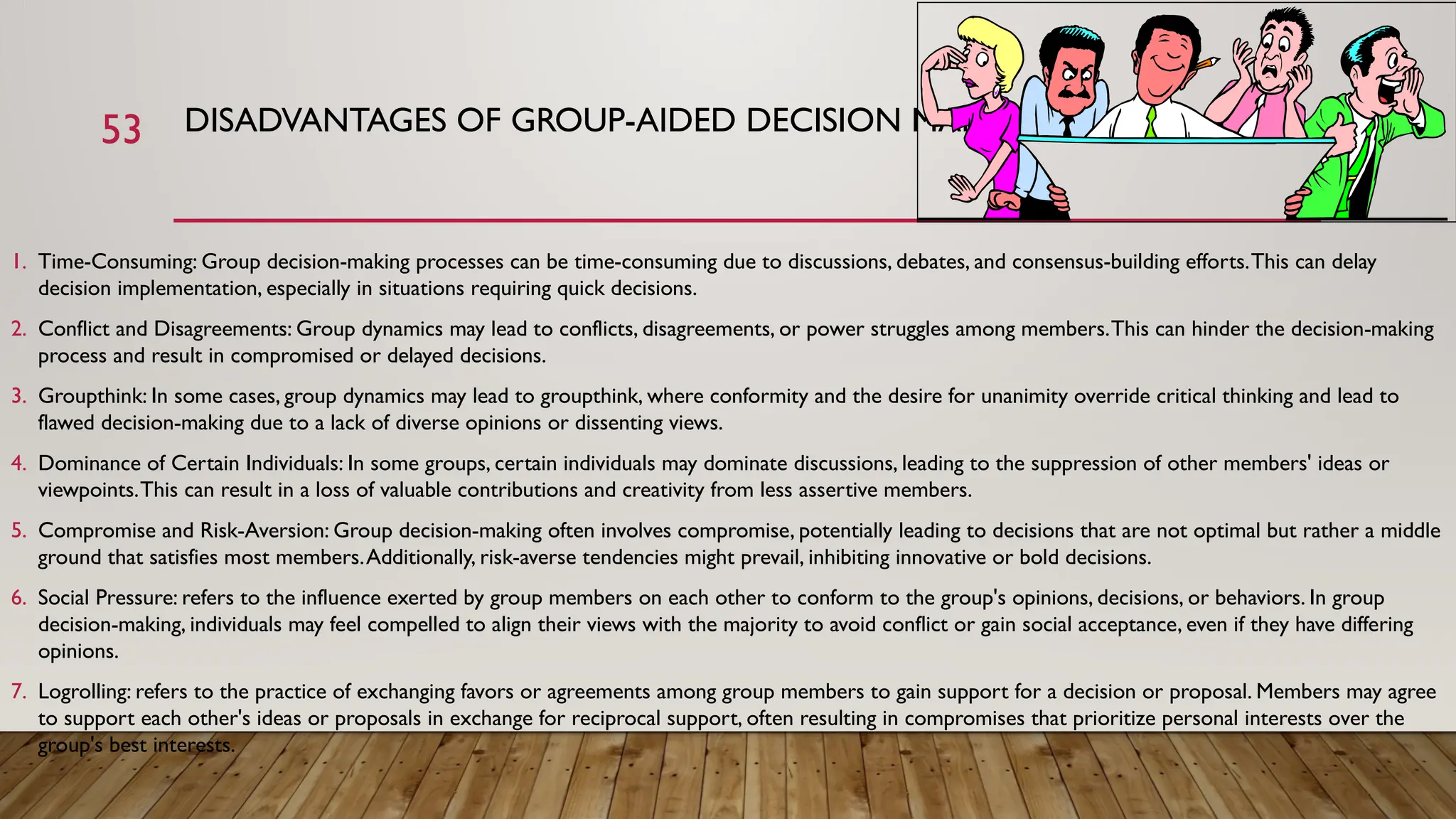
53 DISADVANTAGES OFGROUP-AIDED DECISION MAKING
1. Time-Consuming: Group decision-making processes can be time-consuming due to discussions, debates, and consensus-building efforts.This can delay
decision implementation, especially in situations requiring quick decisions.
2. Conflict and Disagreements: Group dynamics may lead to conflicts, disagreements, or power struggles among members.This can hinder the decision-making
process and result in compromised or delayed decisions.
3. Groupthink: In some cases, group dynamics may lead to groupthink, where conformity and the desire for unanimity override critical thinking and lead to
flawed decision-making due to a lack of diverse opinions or dissenting views.
4. Dominance of Certain Individuals: In some groups, certain individuals may dominate discussions, leading to the suppression of other members' ideas or
viewpoints.This can result in a loss of valuable contributions and creativity from less assertive members.
5. Compromise and Risk-Aversion: Group decision-making often involves compromise, potentially leading to decisions that are not optimal but rather a middle
ground that satisfies most members.Additionally, risk-averse tendencies might prevail, inhibiting innovative or bold decisions.
6. Social Pressure: refers to the influence exerted by group members on each other to conform to the group's opinions, decisions, or behaviors. In group
decision-making, individuals may feel compelled to align their views with the majority to avoid conflict or gain social acceptance, even if they have differing
opinions.
7. Logrolling: refers to the practice of exchanging favors or agreements among group members to gain support for a decision or proposal. Members may agree
to support each other's ideas or proposals in exchange for reciprocal support, often resulting in compromises that prioritize personal interests over the
group's best interests.
54.
GROUP PROBLEM SOLVINGTECHNIQUES
• Definition of consensus – . . . reached when all members can say they either agree . . . Or
have had their “day in court” and were unable to convince the others of their viewpoint.
In the final analysis, everyone agrees to support the outcome
55.
GROUP PROBLEM SOLVINGTECHNIQUES
• Other approaches to a group decision
• Unanimity
• A minority or one decides
56.
GROUP PROBLEM SOLVINGTECHNIQUES-
UNANIMITY
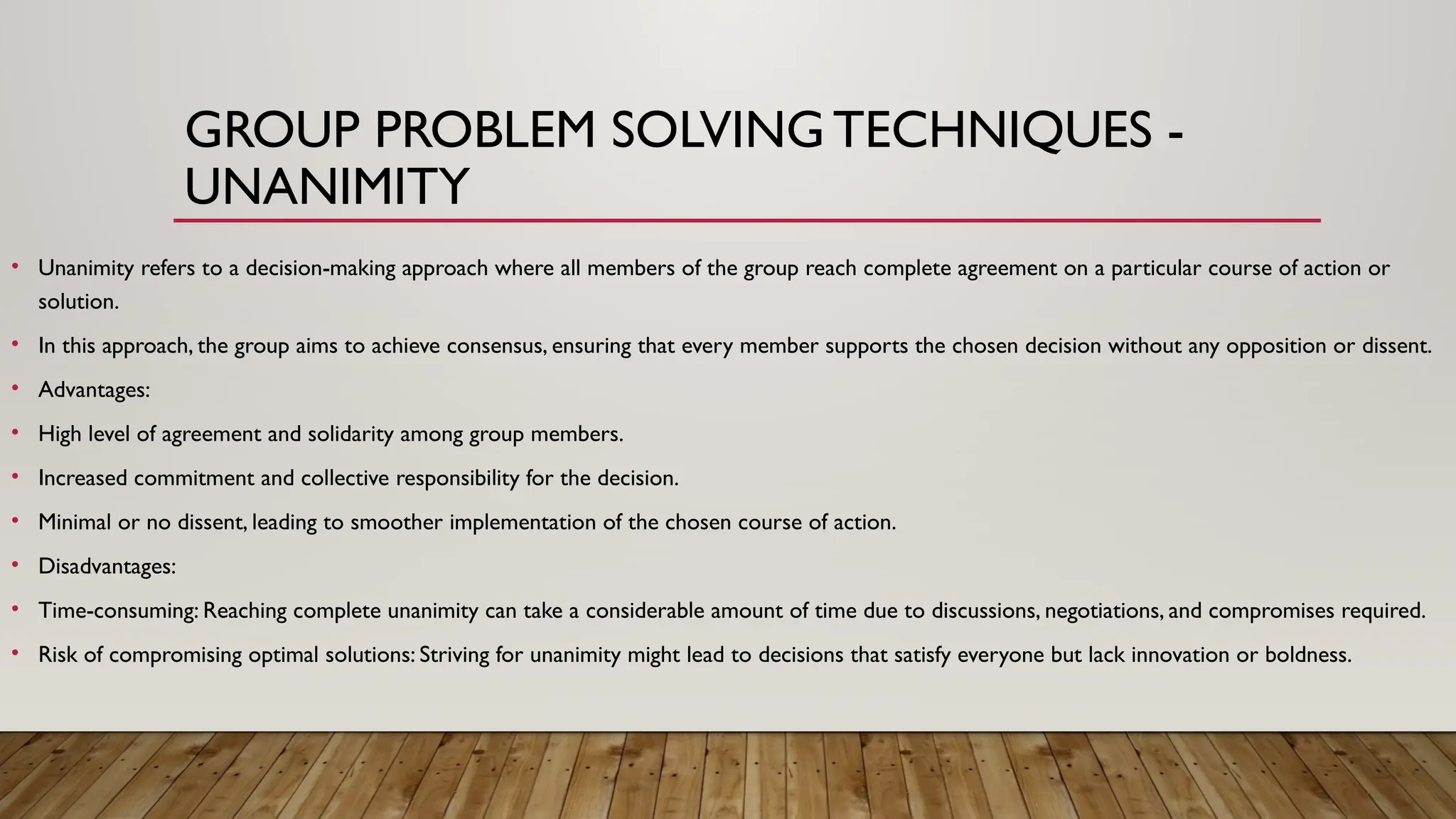
• Unanimity refers to a decision-making approach where all members of the group reach complete agreement on a particular course of action or
solution.
• In this approach, the group aims to achieve consensus, ensuring that every member supports the chosen decision without any opposition or dissent.
• Advantages:
• High level of agreement and solidarity among group members.
• Increased commitment and collective responsibility for the decision.
• Minimal or no dissent, leading to smoother implementation of the chosen course of action.
• Disadvantages:
• Time-consuming: Reaching complete unanimity can take a considerable amount of time due to discussions, negotiations, and compromises required.
• Risk of compromising optimal solutions: Striving for unanimity might lead to decisions that satisfy everyone but lack innovation or boldness.
57.
GROUP PROBLEM SOLVINGTECHNIQUES
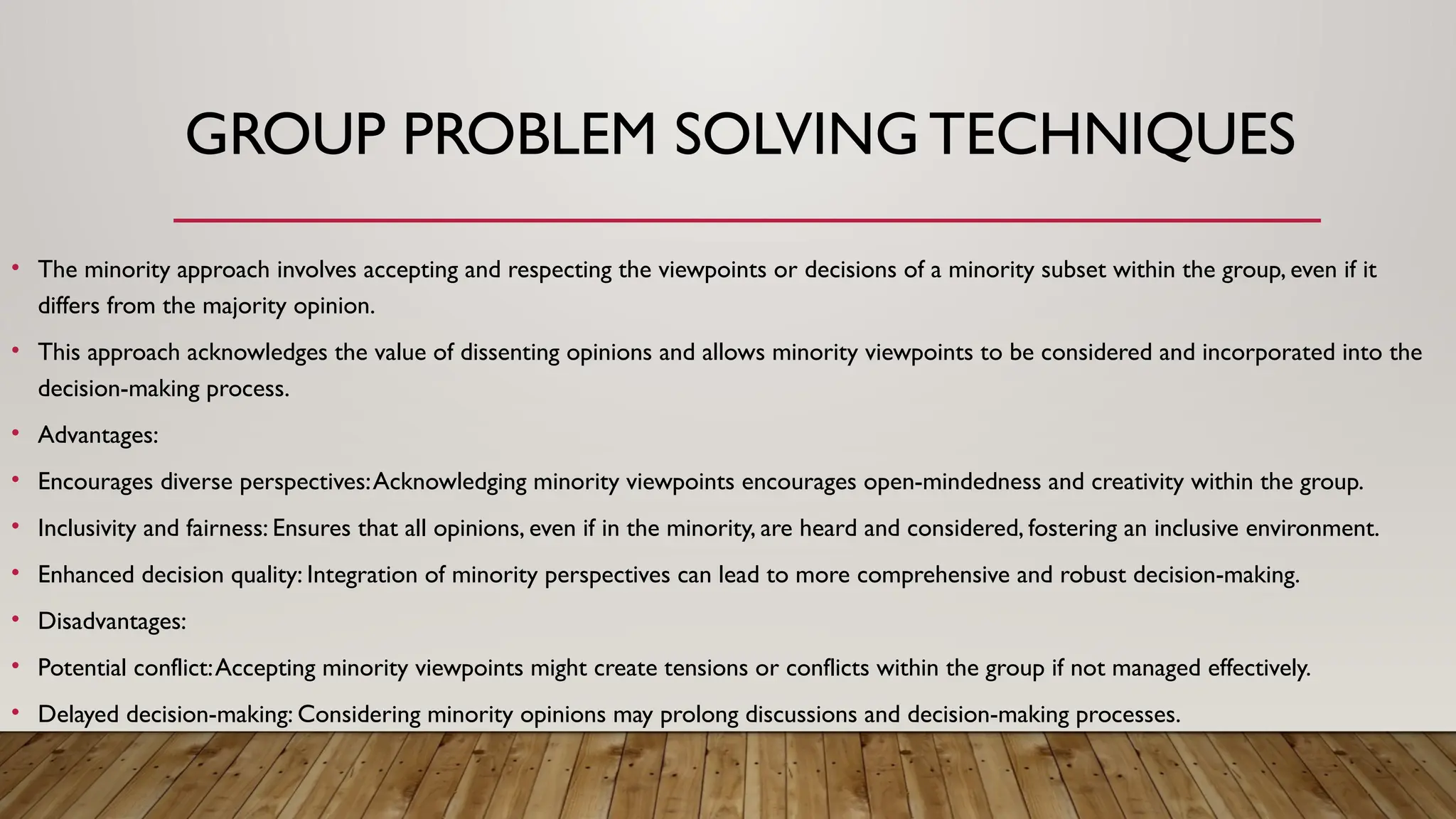
• The minority approach involves accepting and respecting the viewpoints or decisions of a minority subset within the group, even if it
differs from the majority opinion.
• This approach acknowledges the value of dissenting opinions and allows minority viewpoints to be considered and incorporated into the
decision-making process.
• Advantages:
• Encourages diverse perspectives:Acknowledging minority viewpoints encourages open-mindedness and creativity within the group.
• Inclusivity and fairness: Ensures that all opinions, even if in the minority, are heard and considered, fostering an inclusive environment.
• Enhanced decision quality: Integration of minority perspectives can lead to more comprehensive and robust decision-making.
• Disadvantages:
• Potential conflict:Accepting minority viewpoints might create tensions or conflicts within the group if not managed effectively.
• Delayed decision-making: Considering minority opinions may prolong discussions and decision-making processes.
58.
MORE FORMAL GROUPPROBLEM SOLVING
TECHNIQUES
• Brainstorming - disciplined process
• Silent idea (optional)
• Ideas/opinions solicited and written on a board, disallowing criticisms,
allowing piggy-backing on ideas, clarification
• Delphi technique is another, more formal form of
brainstorming. Involves several rounds of questionnaire,
feedback, etc. Useful in cases where participants are not in the
same place.
59.
MORE FORMAL GROUPPROBLEM SOLVING
TECHNIQUES
• Nominal Group Technique – used to narrow down options through voting
• Computer-aided Decision Making
• Uses computers to manage brainstorming or delphi questioning
Editor's Notes
#53 Social pressure can lead to a suppression of dissenting viewpoints, hindering the exploration of alternative ideas and resulting in decisions that do not consider diverse perspectives.
Logrolling can lead to suboptimal decisions or trade-offs that benefit specific individuals within the group rather than serving the overall objectives.