Presented by:
Apoorva Rashmi R
Chapter 2
Strategic Knowledge
Management
Strategic Knowledge
Management
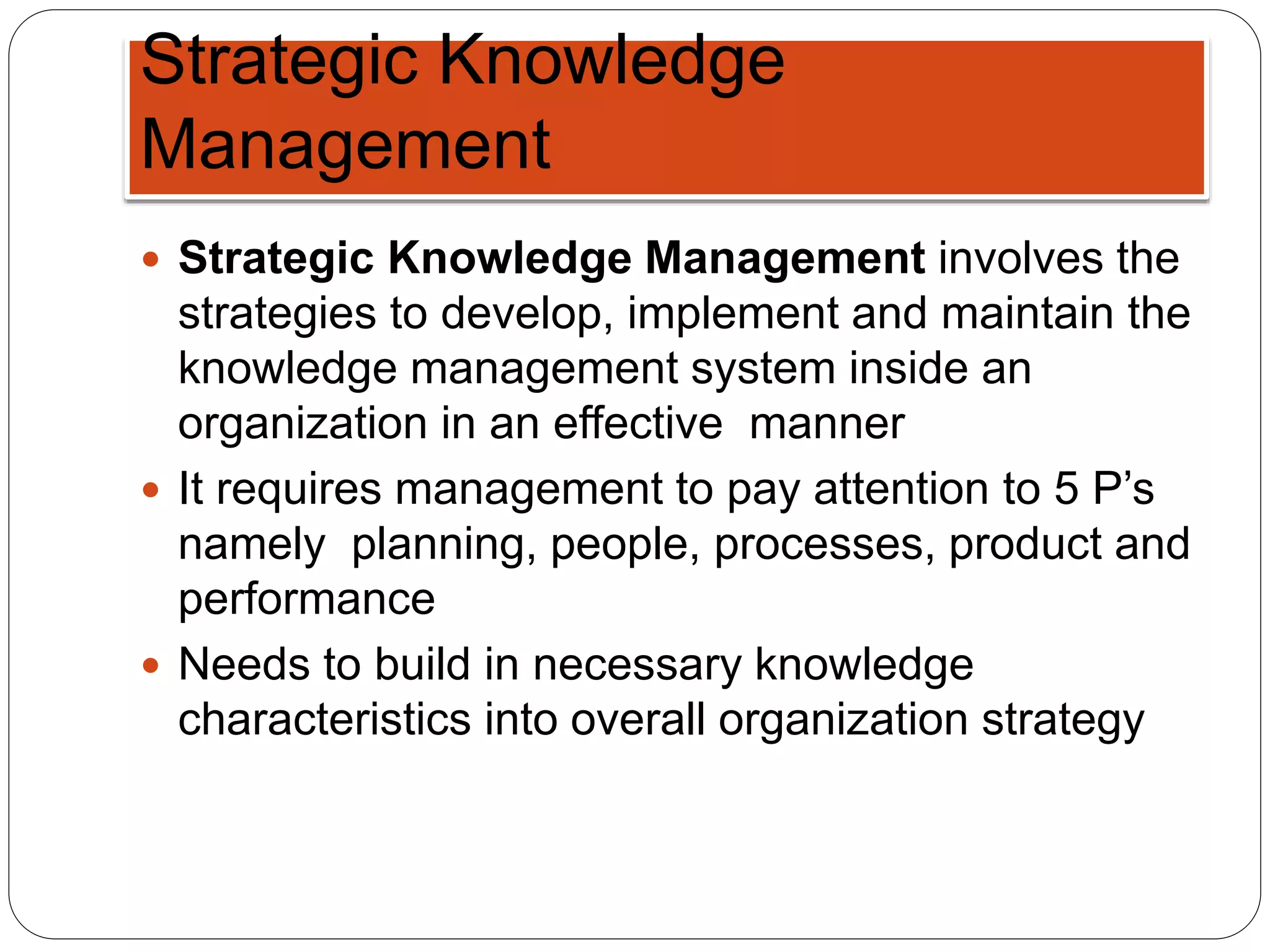
 Strategic Knowledge Management involves the
strategies to develop, implement and maintain the
knowledge management system inside an
organization in an effective manner
 It requires management to pay attention to 5 P’s
namely planning, people, processes, product and
performance
 Needs to build in necessary knowledge
characteristics into overall organization strategy
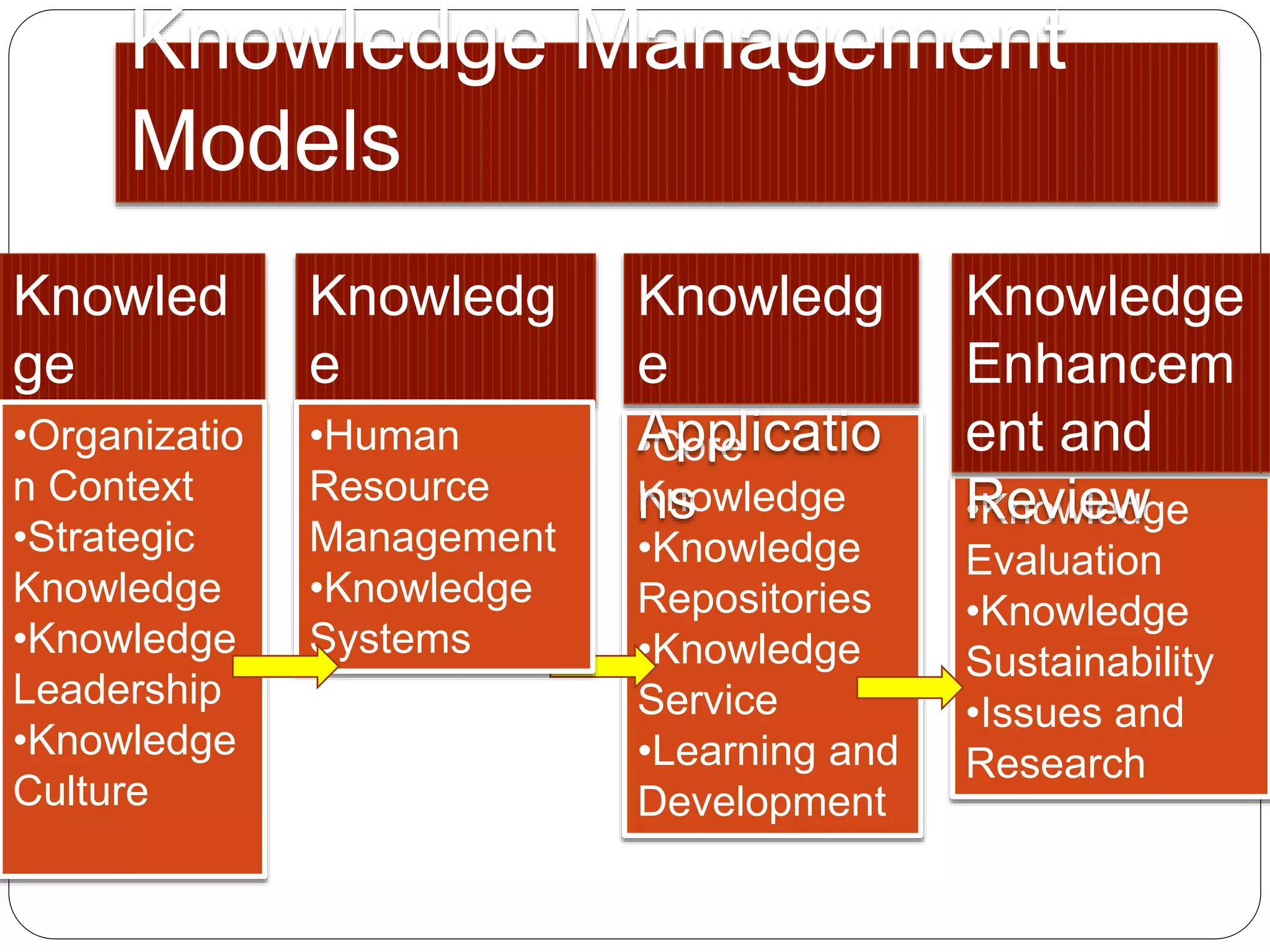
•Knowledge
Evaluation
•Knowledge
Sustainability
•Issues and
Research
•Core
Knowledge
•Knowledge
Repositories
•Knowledge
Service
•Learning and
Development
Knowledge Management
Models
Knowled
ge
Influence
s
Knowledg
e
Foundatio
ns
Knowledg
e
Applicatio
ns
Knowledge
Enhancem
ent and
Review
•Organizatio
n Context
•Strategic
Knowledge
•Knowledge
Leadership
•Knowledge
Culture
•Human
Resource
Management
•Knowledge
Systems
Knowledge Workers
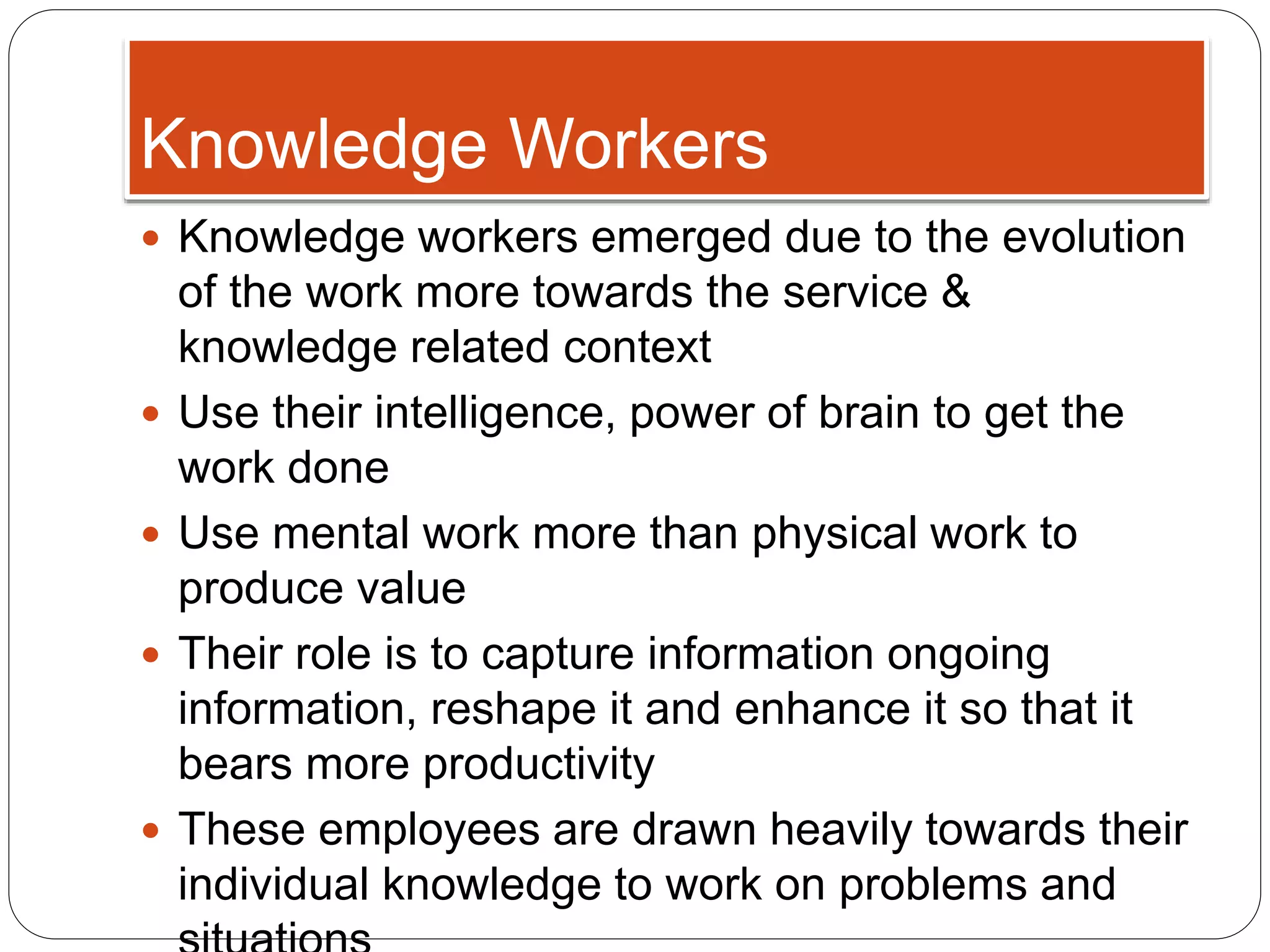
 Knowledge workers emerged due to the evolution
of the work more towards the service &
knowledge related context
 Use their intelligence, power of brain to get the
work done
 Use mental work more than physical work to
produce value
 Their role is to capture information ongoing
information, reshape it and enhance it so that it
bears more productivity
 These employees are drawn heavily towards their
individual knowledge to work on problems and
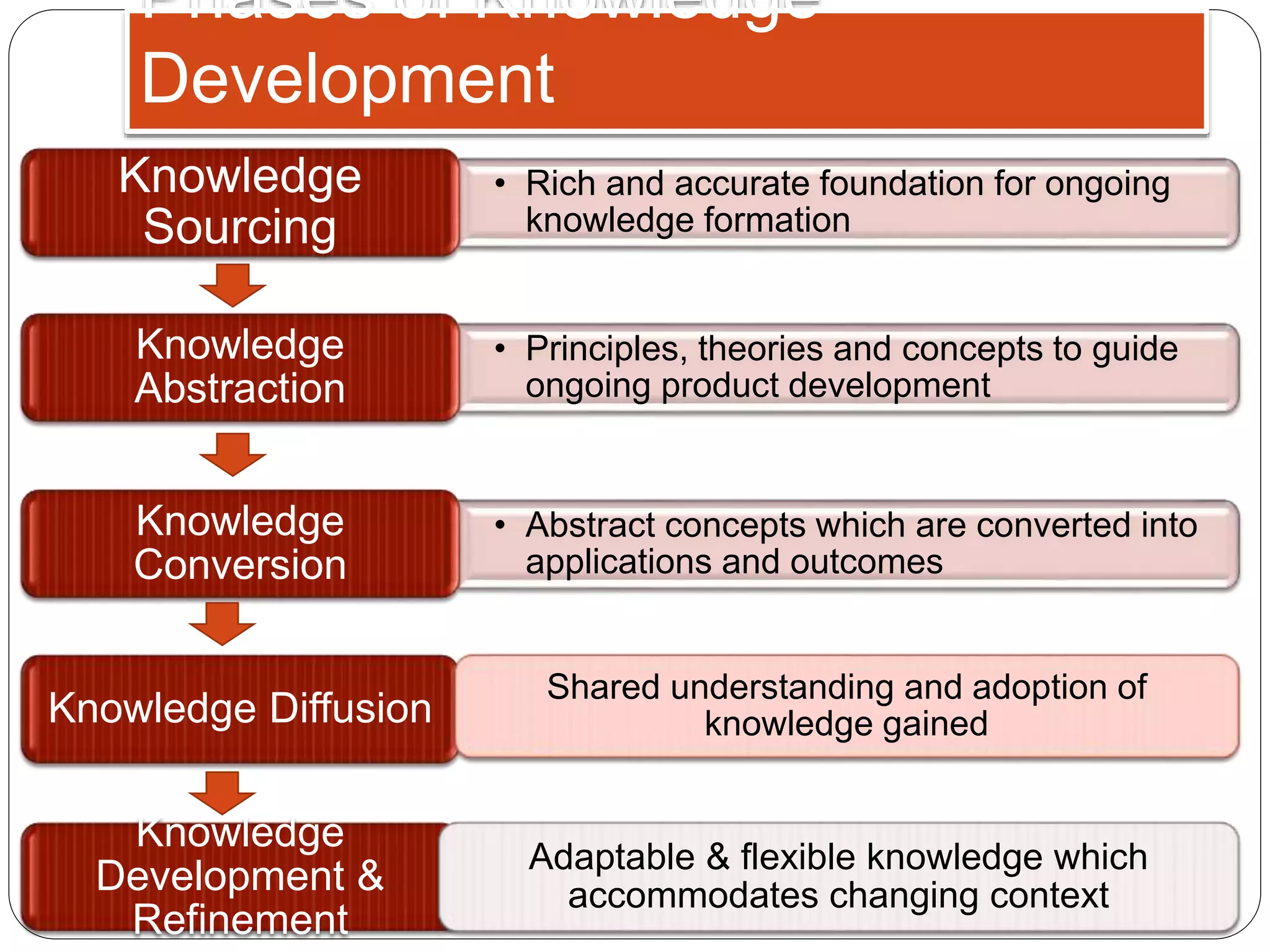
Phases of Knowledge
Development
• Rich and accurate foundation for ongoing
knowledge formation
Knowledge
Sourcing
• Principles, theories and concepts to guide
ongoing product development
Knowledge
Abstraction
• Abstract concepts which are converted into
applications and outcomes
Knowledge
Conversion
Knowledge Diffusion
Knowledge
Development &
Refinement
Adaptable & flexible knowledge which
accommodates changing context
Shared understanding and adoption of
knowledge gained
Explanation of the Phases
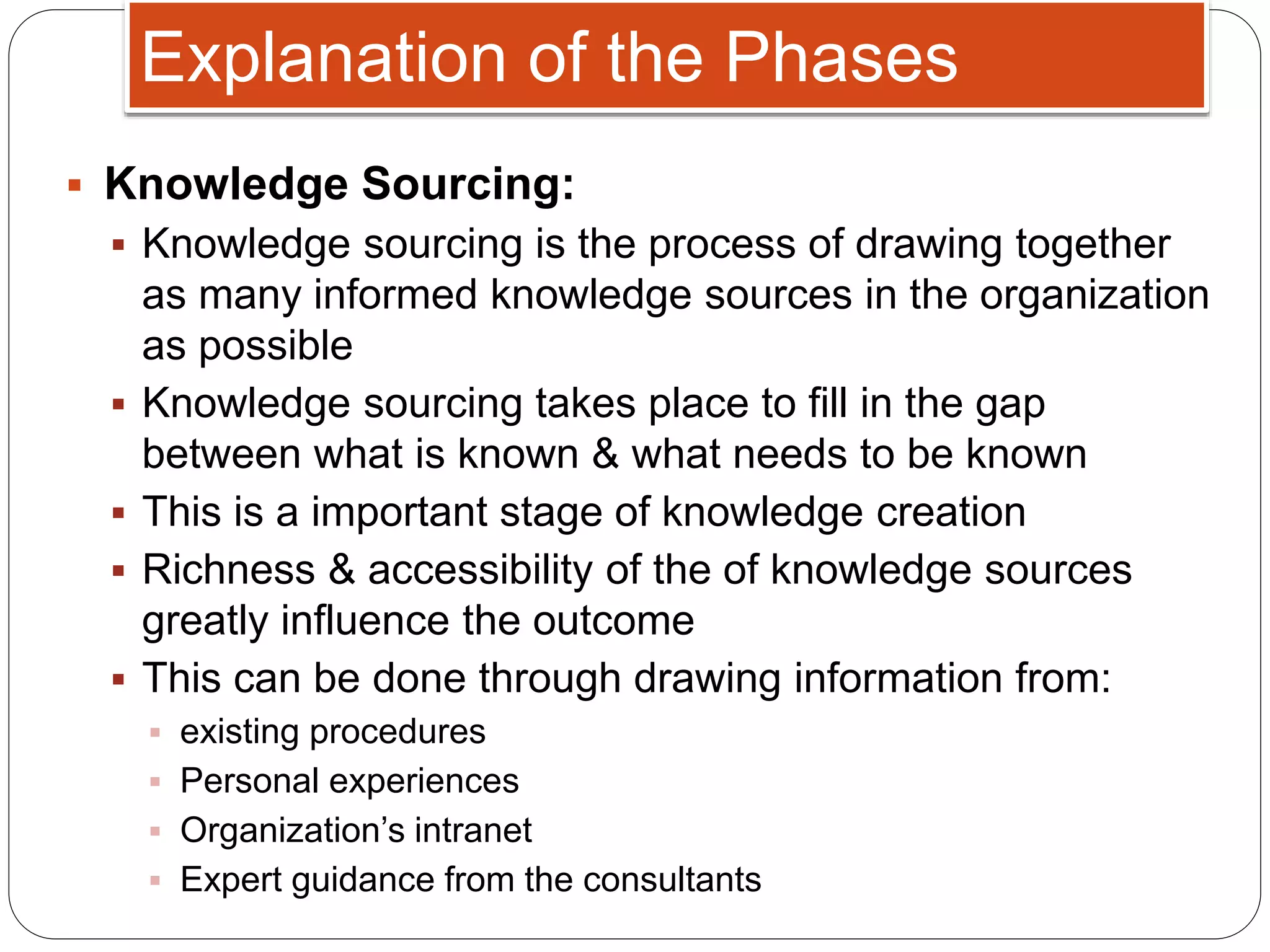
 Knowledge Sourcing:
 Knowledge sourcing is the process of drawing together
as many informed knowledge sources in the organization
as possible
 Knowledge sourcing takes place to fill in the gap
between what is known & what needs to be known
 This is a important stage of knowledge creation
 Richness & accessibility of the of knowledge sources
greatly influence the outcome
 This can be done through drawing information from:
 existing procedures
 Personal experiences
 Organization’s intranet
 Expert guidance from the consultants
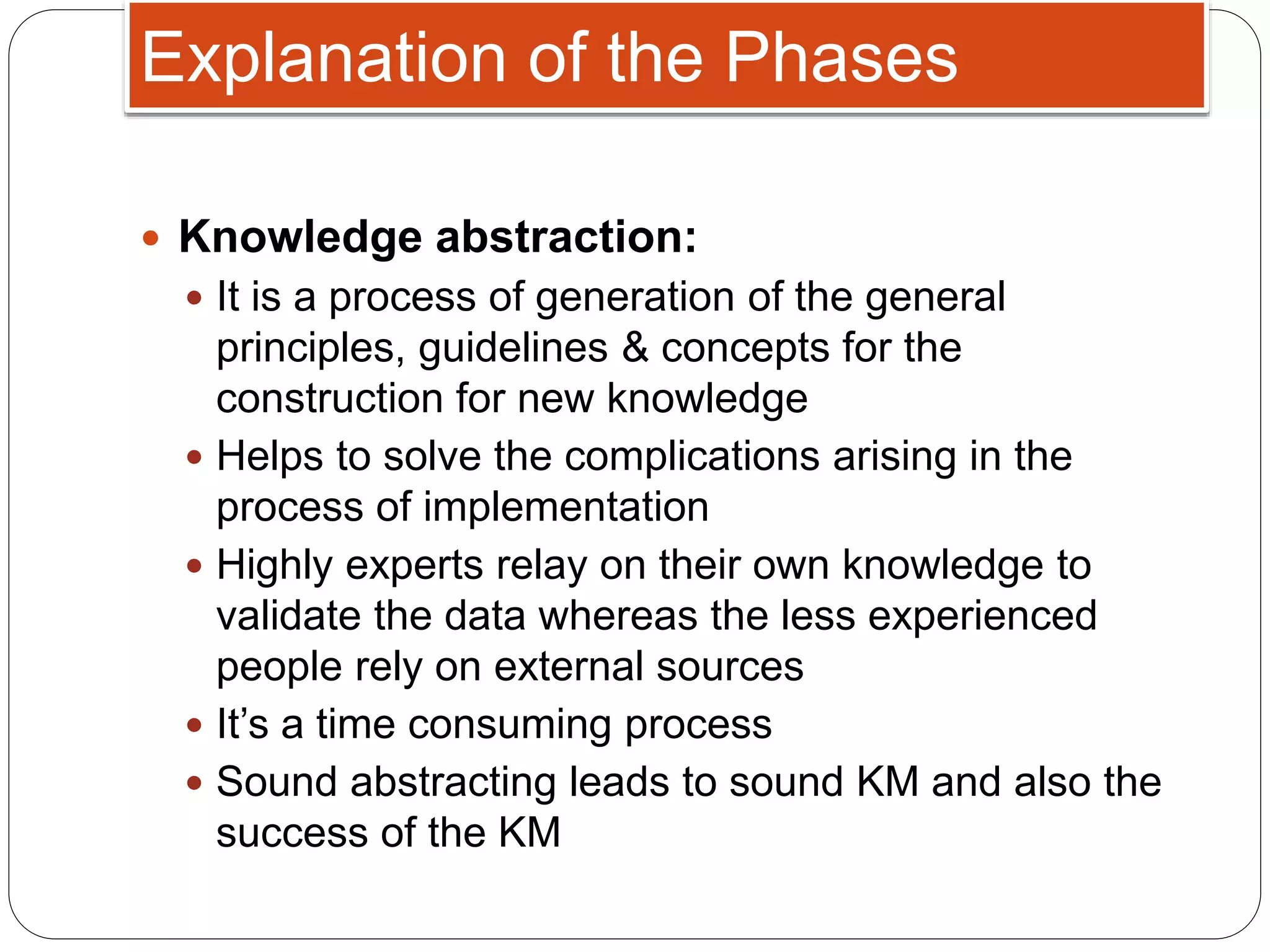
 Knowledge abstraction:
 It is a process of generation of the general
principles, guidelines & concepts for the
construction for new knowledge
 Helps to solve the complications arising in the
process of implementation
 Highly experts relay on their own knowledge to
validate the data whereas the less experienced
people rely on external sources
 It’s a time consuming process
 Sound abstracting leads to sound KM and also the
success of the KM
Explanation of the Phases
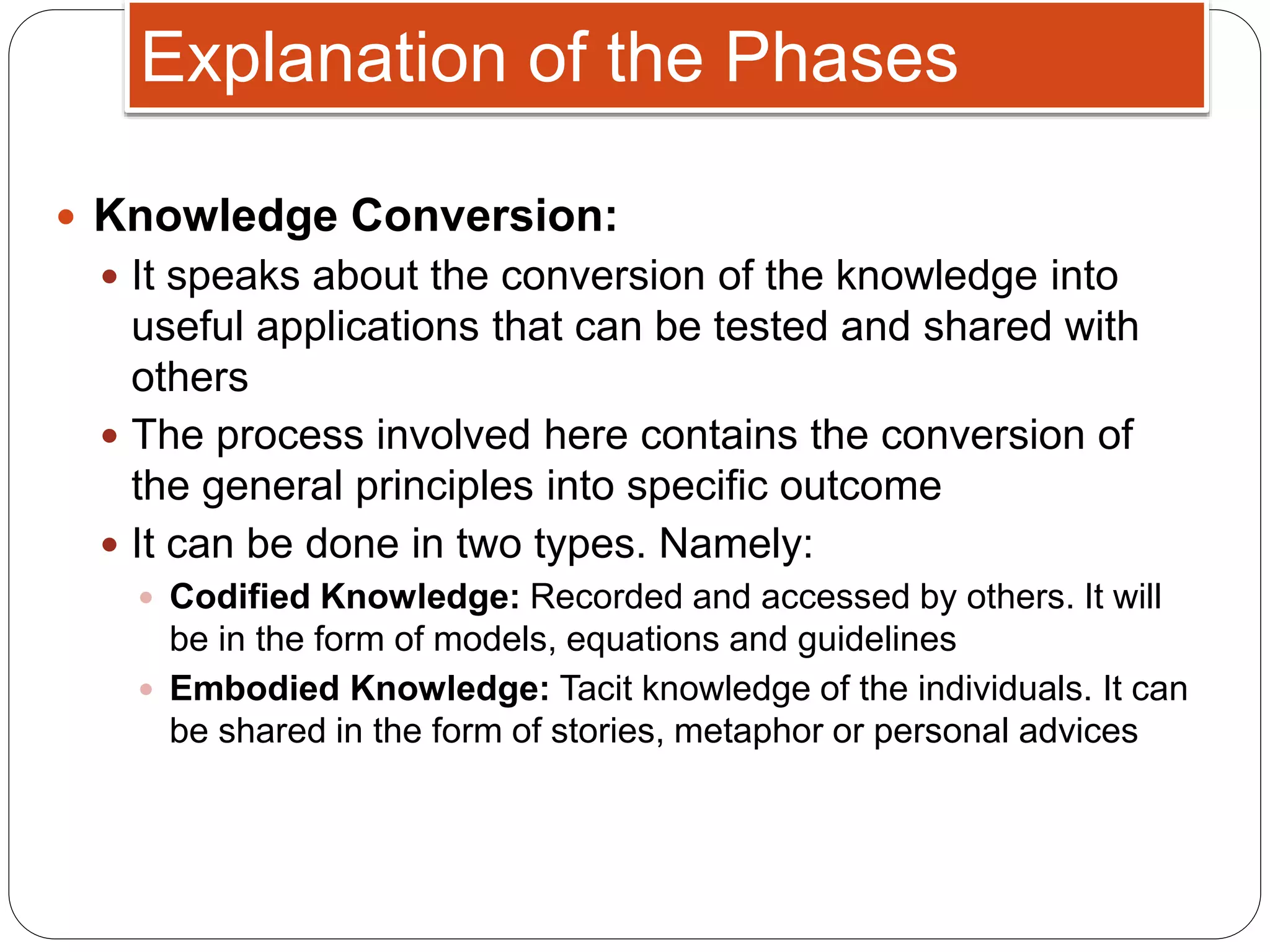
 Knowledge Conversion:
 It speaks about the conversion of the knowledge into
useful applications that can be tested and shared with
others
 The process involved here contains the conversion of
the general principles into specific outcome
 It can be done in two types. Namely:
 Codified Knowledge: Recorded and accessed by others. It will
be in the form of models, equations and guidelines
 Embodied Knowledge: Tacit knowledge of the individuals. It can
be shared in the form of stories, metaphor or personal advices
Explanation of the Phases
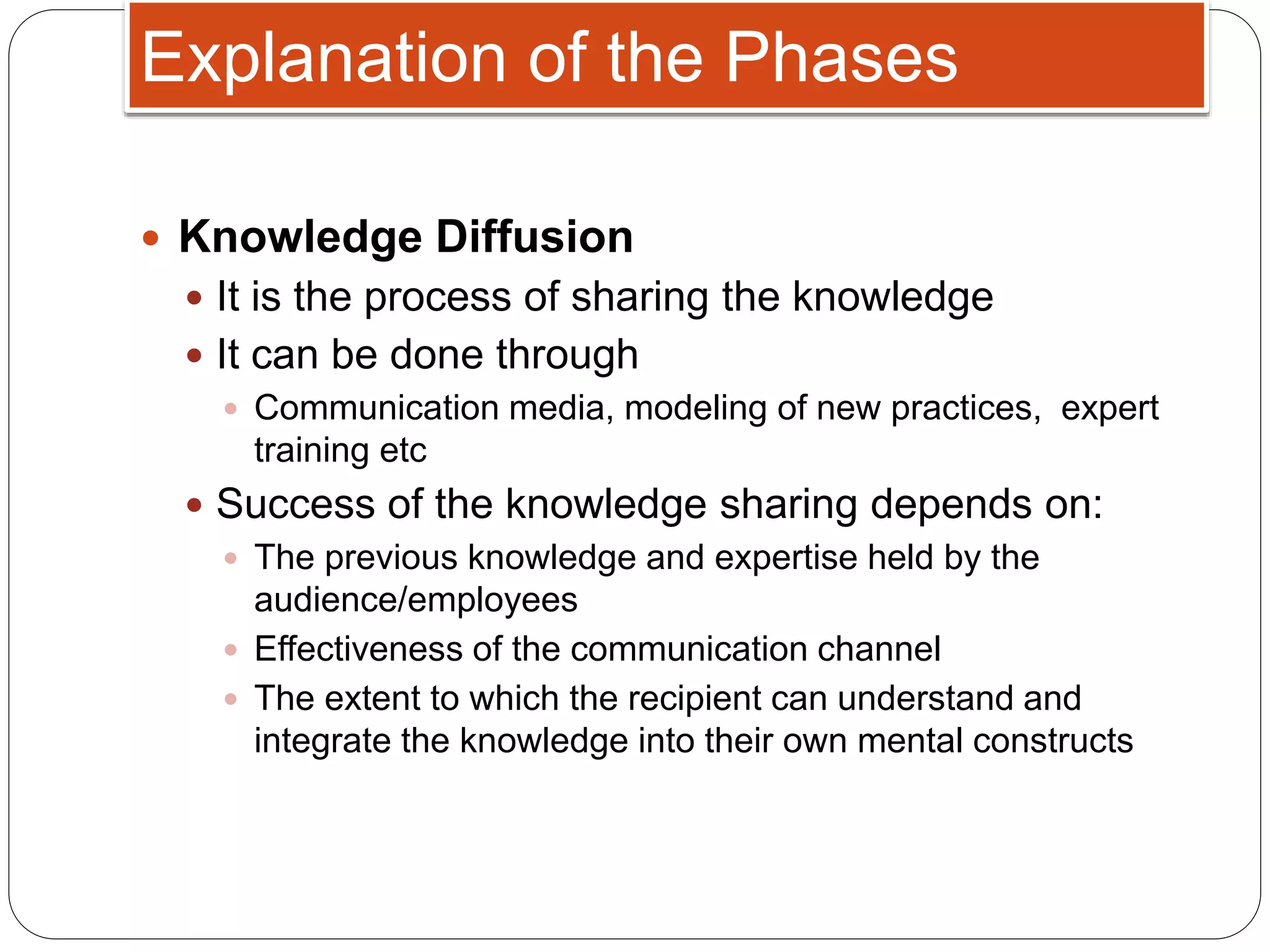
 Knowledge Diffusion
 It is the process of sharing the knowledge
 It can be done through
 Communication media, modeling of new practices, expert
training etc
 Success of the knowledge sharing depends on:
 The previous knowledge and expertise held by the
audience/employees
 Effectiveness of the communication channel
 The extent to which the recipient can understand and
integrate the knowledge into their own mental constructs
Explanation of the Phases
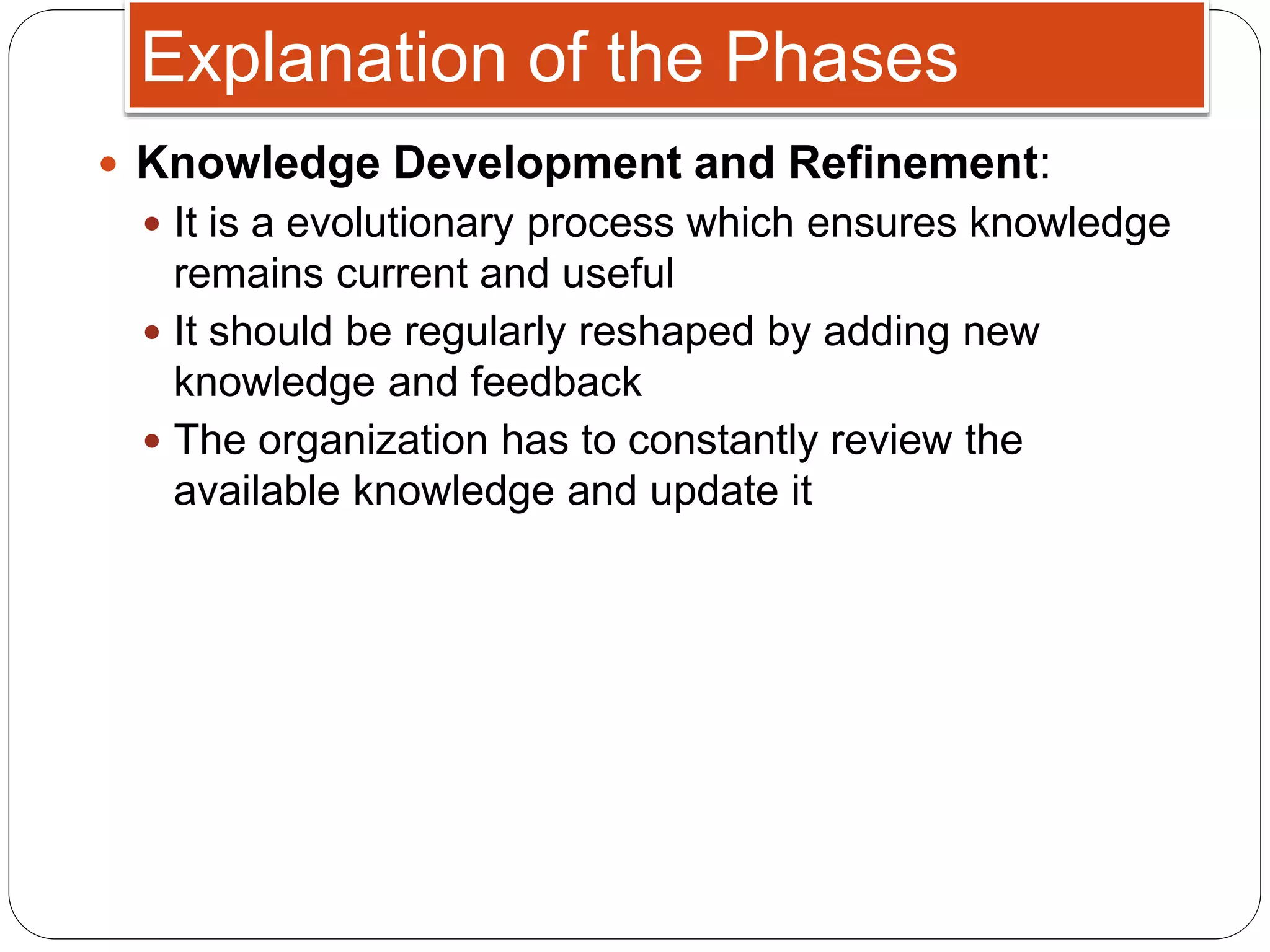
 Knowledge Development and Refinement:
 It is a evolutionary process which ensures knowledge
remains current and useful
 It should be regularly reshaped by adding new
knowledge and feedback
 The organization has to constantly review the
available knowledge and update it
Explanation of the Phases
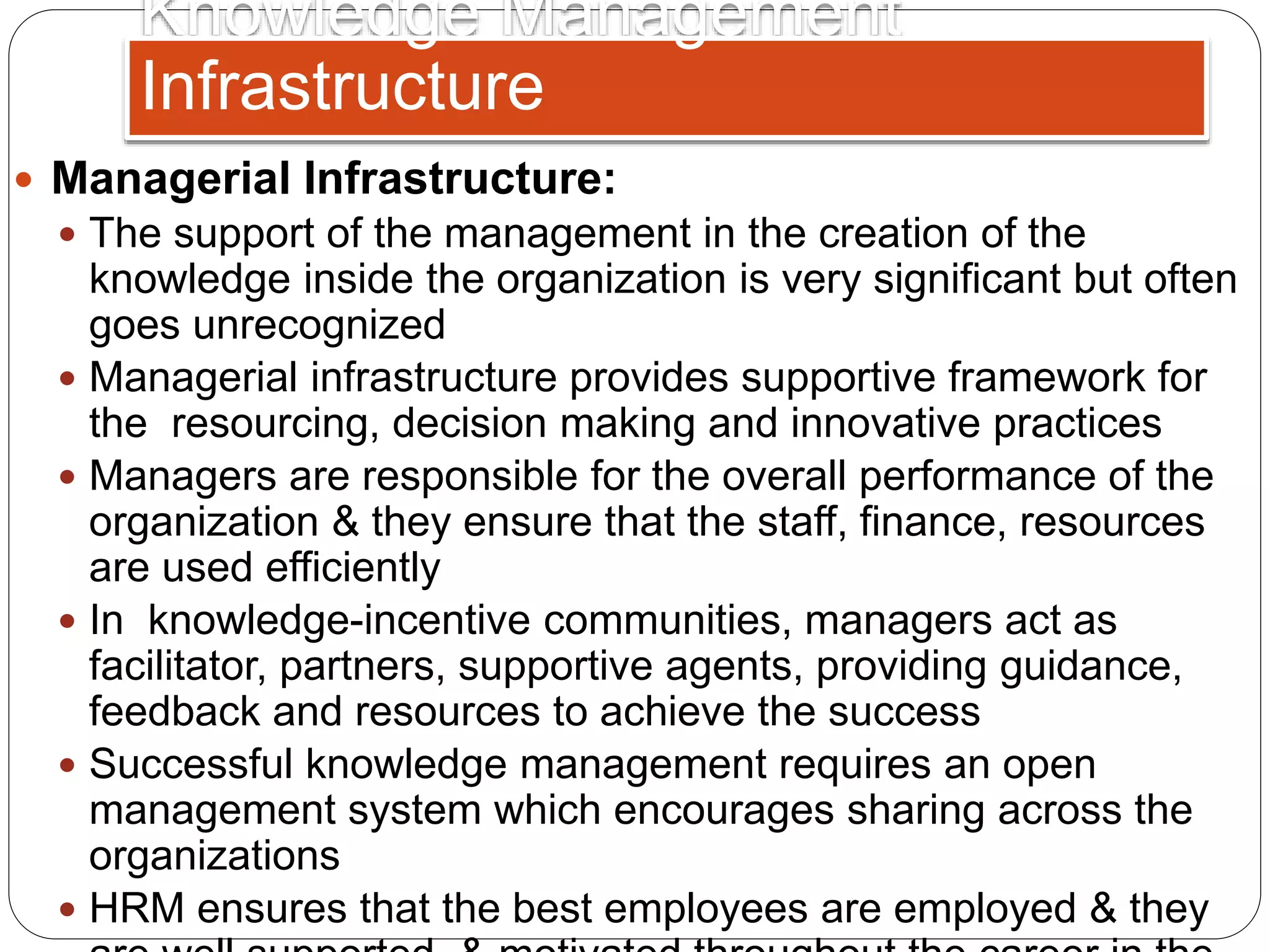
 Managerial Infrastructure:
 The support of the management in the creation of the
knowledge inside the organization is very significant but often
goes unrecognized
 Managerial infrastructure provides supportive framework for
the resourcing, decision making and innovative practices
 Managers are responsible for the overall performance of the
organization & they ensure that the staff, finance, resources
are used efficiently
 In knowledge-incentive communities, managers act as
facilitator, partners, supportive agents, providing guidance,
feedback and resources to achieve the success
 Successful knowledge management requires an open
management system which encourages sharing across the
organizations
 HRM ensures that the best employees are employed & they
Knowledge Management
Infrastructure
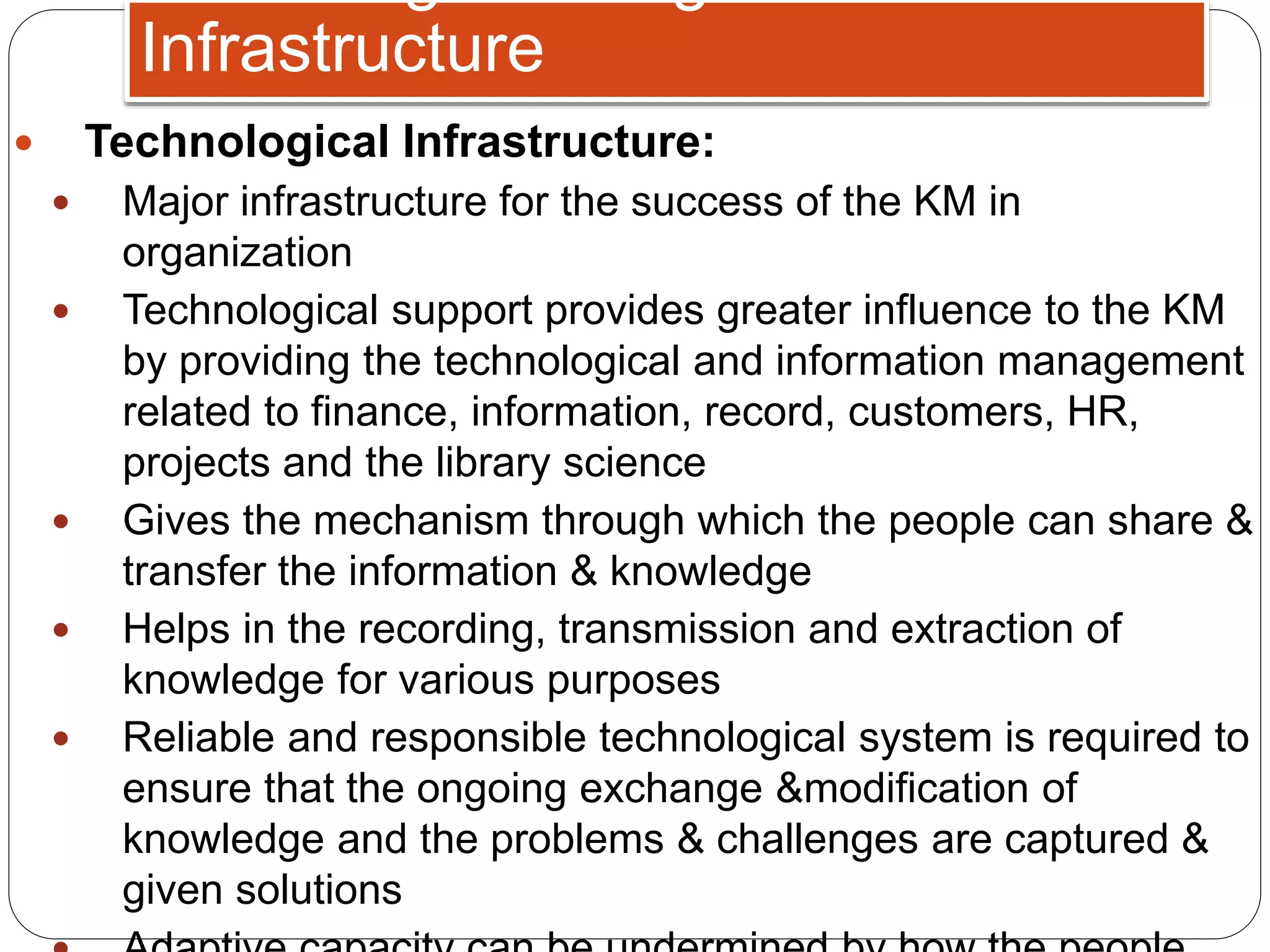
 Technological Infrastructure:
 Major infrastructure for the success of the KM in
organization
 Technological support provides greater influence to the KM
by providing the technological and information management
related to finance, information, record, customers, HR,
projects and the library science
 Gives the mechanism through which the people can share &
transfer the information & knowledge
 Helps in the recording, transmission and extraction of
knowledge for various purposes
 Reliable and responsible technological system is required to
ensure that the ongoing exchange &modification of
knowledge and the problems & challenges are captured &
given solutions
Infrastructure
 Library and Information Services:
 Library & information services are the key ingredients for
the success of KM strategy in organization
 These services focus on the individual support to the users,
enabling ready access to resources that support the
knowledge creation & abstraction
 Responsive of the service may be from the centralized
database or the system of the users
 Effective library services should be connected with their
users, monitoring their changing needs, profiles and work
priorities
 They can be centralized, decentralized or both the
approaches
 They try to disseminate the information through as many
avenues as possible
 These provide access to the information regardless of time
Infrastructure
 Records Management:
 The day to day operations generate enormous records
 These records need to be processed in order to identify the
core organizational data, store them and retrieve them when
required
 In the small organizations, the storing of the data can be done
by keeping the records in the boxes
 In the large organizations, there will be clear guidelines,
policies & procedures which clearly state that how the
important records should be maintained
 These records act as a means to learn the ongoing changes
and practices inside an organization & also becomes
elements to create the future knowledge concepts
Infrastructure
 Social Infrastructure:
 It helps to build the efficient knowledge management
system within the organization by enhancing the better
social & professional interactions within an organization
 The interactions may take place between the colleagues,
clients and other stakeholders
 It gives the insight on the values & priorities on which the
people of an organization operate
 Organization builds effective KM system if it focuses more
on building the
 Effective collaborations & cooperation,
 Relationship building,
 Long-term outcomes and
 Organization good will
Infrastructure
 Many forms of knowledge exists inside the organization ranging from codified
knowledge to expert knowledge of people
 Helps in development of the corporate intellectual capital
 Two major issues to focus on:
 Knowing what is known
 Facilitating capturing and sharing
 Knowledge core the accumulated mass of strategic knowledge which is
identified, publically valued, captured and disseminated by the organization
 It helps share the knowledge across the corporate boundaries
 Focuses on development of competency needs of the organization
 Facilitates better transition of the tacit knowledge into actual practices
 The focus of the strategic knowledge core needs to integrate short terms
and long term priorities
 Aware of current and ongoing growth in skills, knowledge and capabilities of
its employees
 Regular audits on staff potential and capabilities should be done to
maximize the staff contribution
Knowledge
Enabling Knowledge Transference
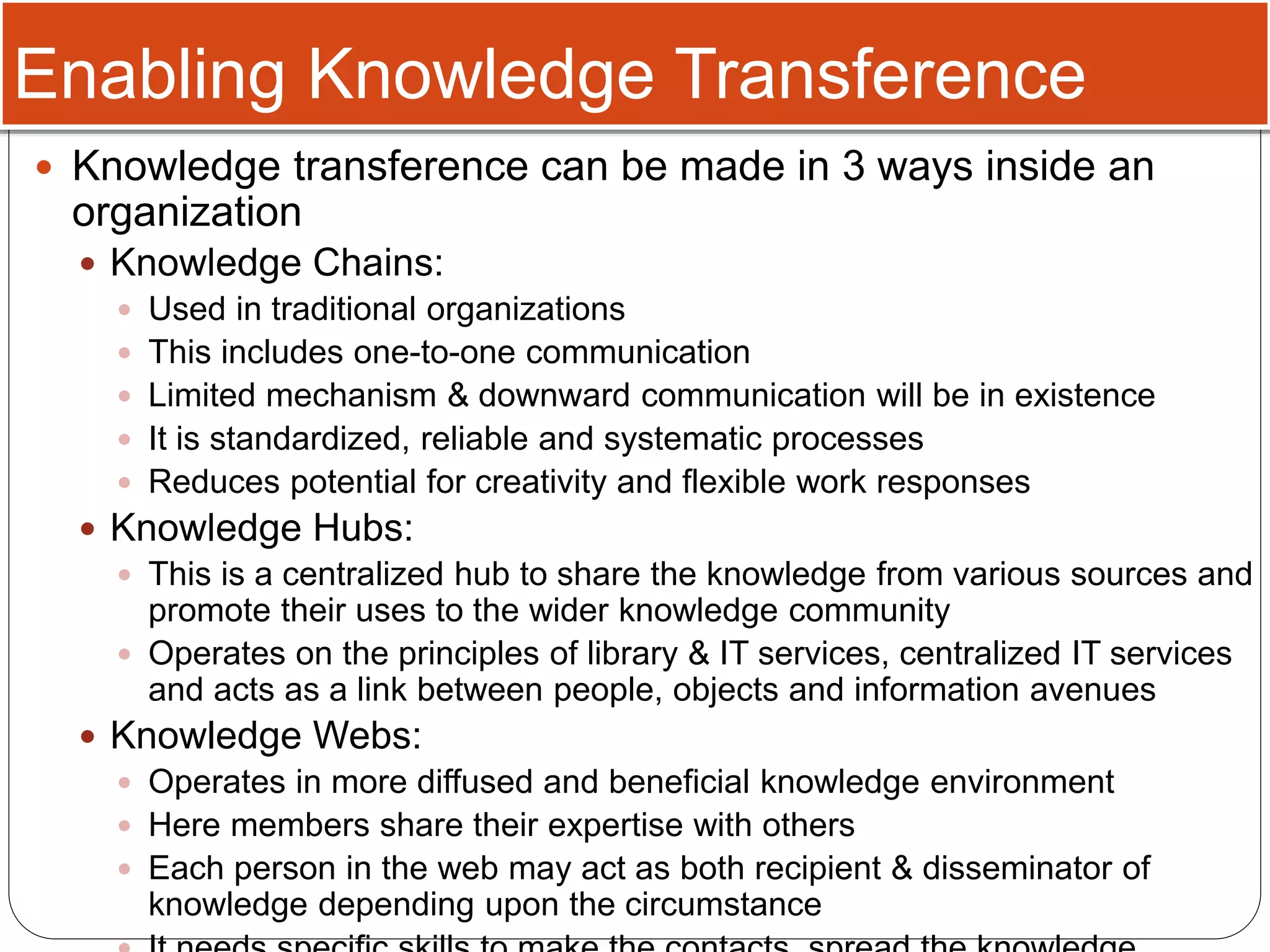
 Knowledge transference can be made in 3 ways inside an
organization
 Knowledge Chains:
 Used in traditional organizations
 This includes one-to-one communication
 Limited mechanism & downward communication will be in existence
 It is standardized, reliable and systematic processes
 Reduces potential for creativity and flexible work responses
 Knowledge Hubs:
 This is a centralized hub to share the knowledge from various sources and
promote their uses to the wider knowledge community
 Operates on the principles of library & IT services, centralized IT services
and acts as a link between people, objects and information avenues
 Knowledge Webs:
 Operates in more diffused and beneficial knowledge environment
 Here members share their expertise with others
 Each person in the web may act as both recipient & disseminator of
knowledge depending upon the circumstance
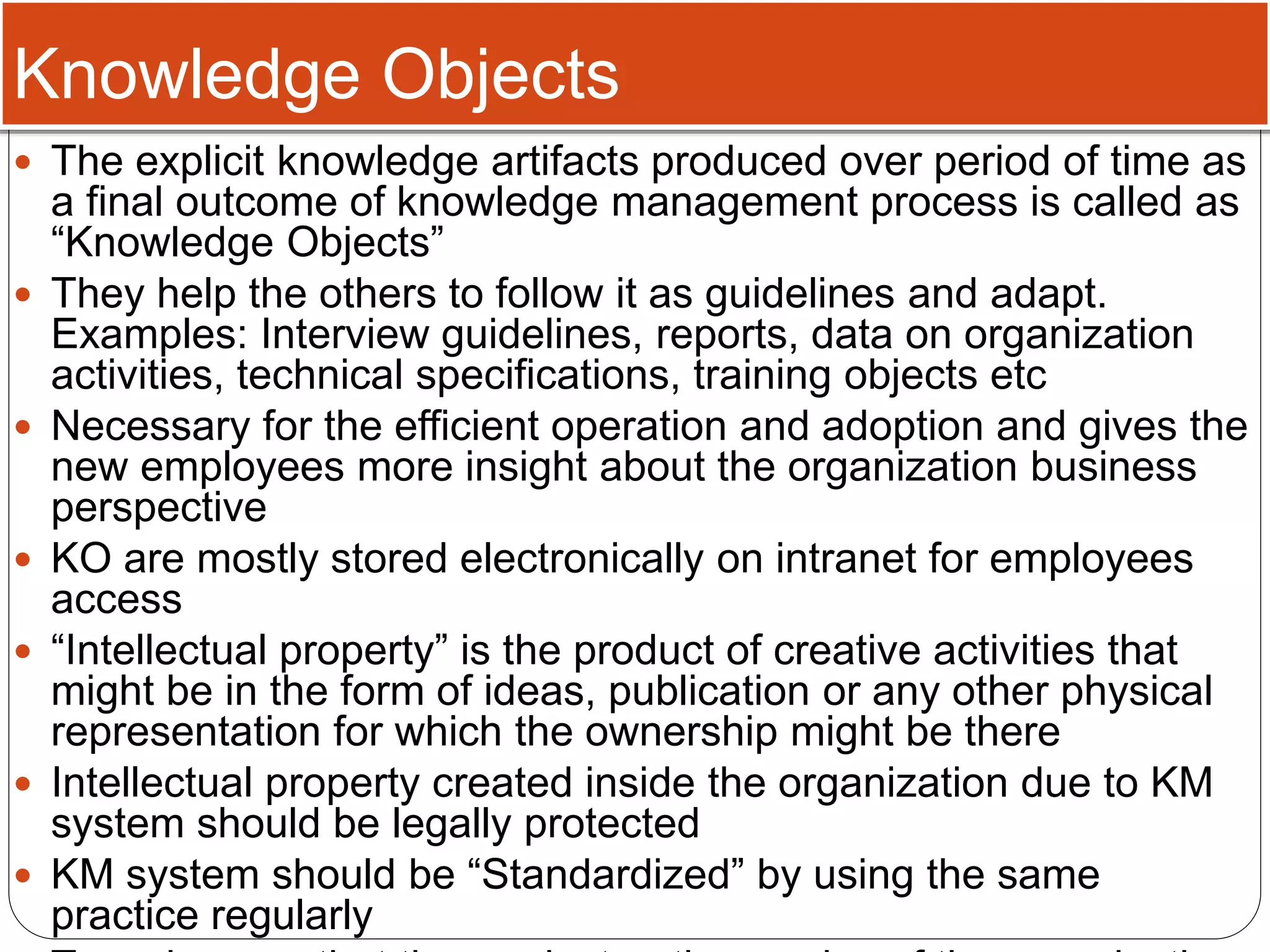
Knowledge Objects
 The explicit knowledge artifacts produced over period of time as
a final outcome of knowledge management process is called as
“Knowledge Objects”
 They help the others to follow it as guidelines and adapt.
Examples: Interview guidelines, reports, data on organization
activities, technical specifications, training objects etc
 Necessary for the efficient operation and adoption and gives the
new employees more insight about the organization business
perspective
 KO are mostly stored electronically on intranet for employees
access
 “Intellectual property” is the product of creative activities that
might be in the form of ideas, publication or any other physical
representation for which the ownership might be there
 Intellectual property created inside the organization due to KM
system should be legally protected
 KM system should be “Standardized” by using the same
practice regularly
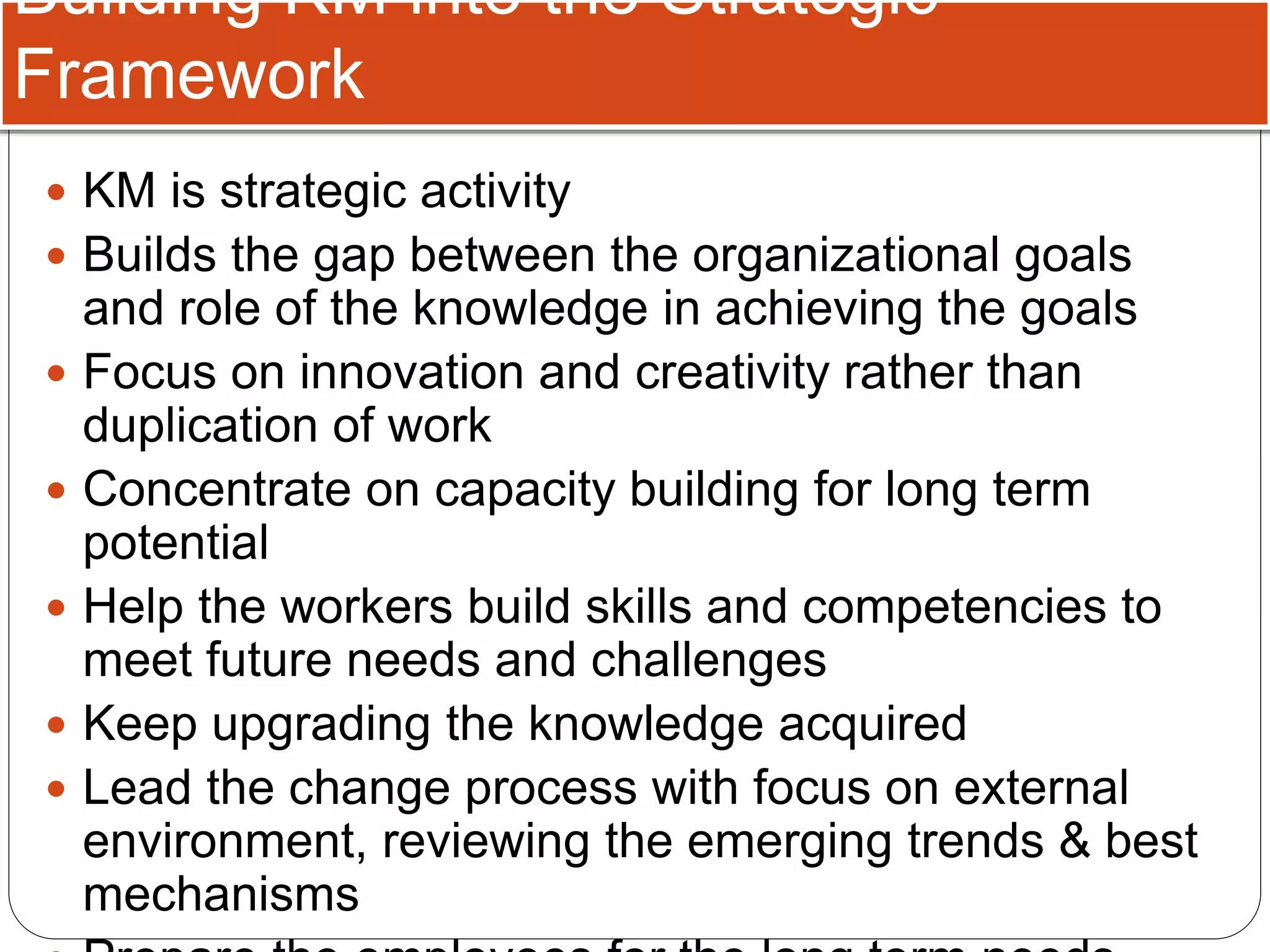
Building KM into the Strategic
Framework
 KM is strategic activity
 Builds the gap between the organizational goals
and role of the knowledge in achieving the goals
 Focus on innovation and creativity rather than
duplication of work
 Concentrate on capacity building for long term
potential
 Help the workers build skills and competencies to
meet future needs and challenges
 Keep upgrading the knowledge acquired
 Lead the change process with focus on external
environment, reviewing the emerging trends & best
mechanisms
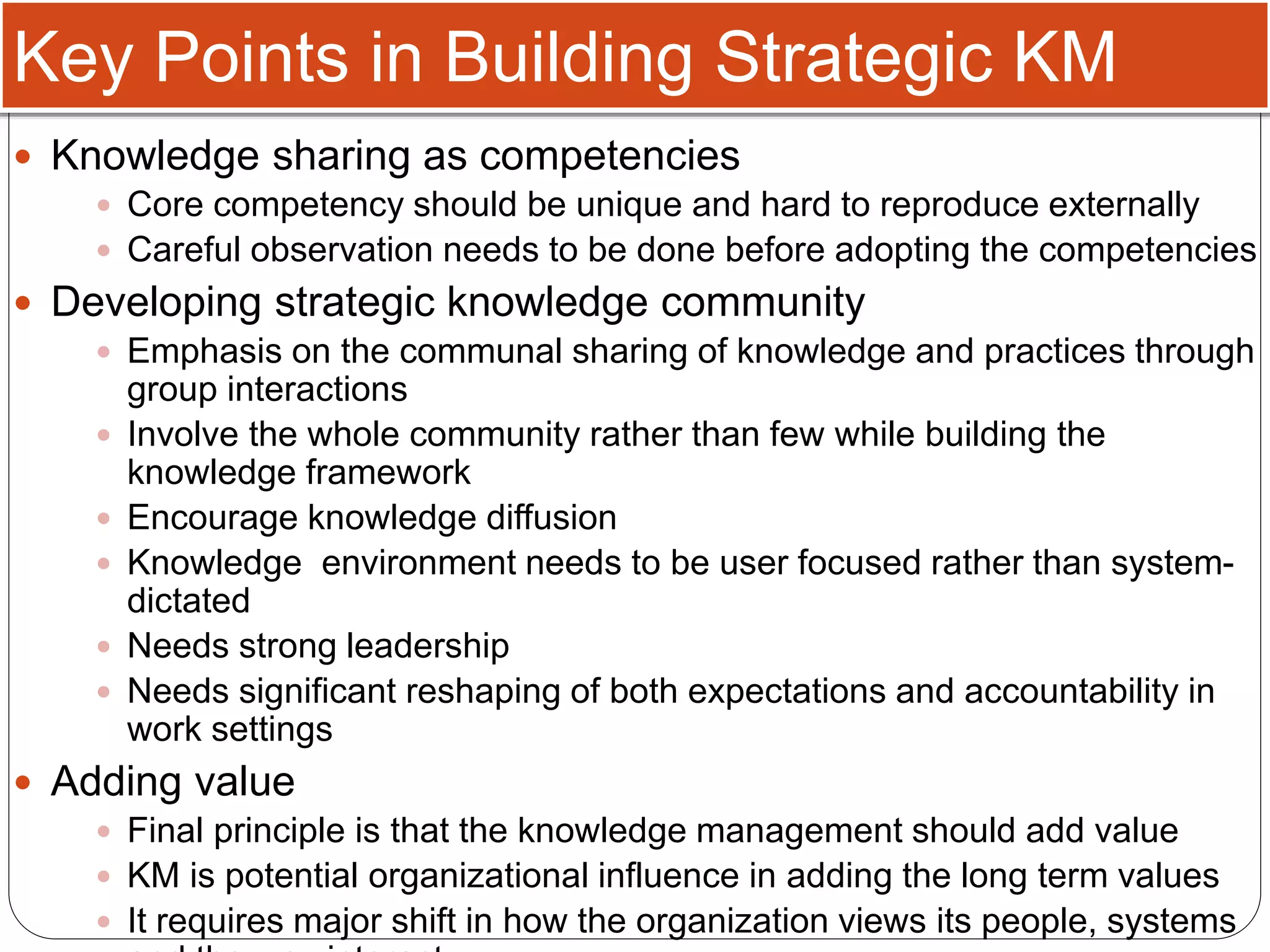
Key Points in Building Strategic KM
 Knowledge sharing as competencies
 Core competency should be unique and hard to reproduce externally
 Careful observation needs to be done before adopting the competencies
 Developing strategic knowledge community
 Emphasis on the communal sharing of knowledge and practices through
group interactions
 Involve the whole community rather than few while building the
knowledge framework
 Encourage knowledge diffusion
 Knowledge environment needs to be user focused rather than system-
dictated
 Needs strong leadership
 Needs significant reshaping of both expectations and accountability in
work settings
 Adding value
 Final principle is that the knowledge management should add value
 KM is potential organizational influence in adding the long term values
 It requires major shift in how the organization views its people, systems
Strategic Knowledge Management

Strategic Knowledge Management

  • 1.
    Presented by: Apoorva RashmiR Chapter 2 Strategic Knowledge Management
  • 2.
    Strategic Knowledge Management  StrategicKnowledge Management involves the strategies to develop, implement and maintain the knowledge management system inside an organization in an effective manner  It requires management to pay attention to 5 P’s namely planning, people, processes, product and performance  Needs to build in necessary knowledge characteristics into overall organization strategy
  • 3.
    •Knowledge Evaluation •Knowledge Sustainability •Issues and Research •Core Knowledge •Knowledge Repositories •Knowledge Service •Learning and Development KnowledgeManagement Models Knowled ge Influence s Knowledg e Foundatio ns Knowledg e Applicatio ns Knowledge Enhancem ent and Review •Organizatio n Context •Strategic Knowledge •Knowledge Leadership •Knowledge Culture •Human Resource Management •Knowledge Systems
  • 4.
    Knowledge Workers  Knowledgeworkers emerged due to the evolution of the work more towards the service & knowledge related context  Use their intelligence, power of brain to get the work done  Use mental work more than physical work to produce value  Their role is to capture information ongoing information, reshape it and enhance it so that it bears more productivity  These employees are drawn heavily towards their individual knowledge to work on problems and
  • 5.
    Phases of Knowledge Development •Rich and accurate foundation for ongoing knowledge formation Knowledge Sourcing • Principles, theories and concepts to guide ongoing product development Knowledge Abstraction • Abstract concepts which are converted into applications and outcomes Knowledge Conversion Knowledge Diffusion Knowledge Development & Refinement Adaptable & flexible knowledge which accommodates changing context Shared understanding and adoption of knowledge gained
  • 6.
    Explanation of thePhases  Knowledge Sourcing:  Knowledge sourcing is the process of drawing together as many informed knowledge sources in the organization as possible  Knowledge sourcing takes place to fill in the gap between what is known & what needs to be known  This is a important stage of knowledge creation  Richness & accessibility of the of knowledge sources greatly influence the outcome  This can be done through drawing information from:  existing procedures  Personal experiences  Organization’s intranet  Expert guidance from the consultants
  • 7.
     Knowledge abstraction: It is a process of generation of the general principles, guidelines & concepts for the construction for new knowledge  Helps to solve the complications arising in the process of implementation  Highly experts relay on their own knowledge to validate the data whereas the less experienced people rely on external sources  It’s a time consuming process  Sound abstracting leads to sound KM and also the success of the KM Explanation of the Phases
  • 8.
     Knowledge Conversion: It speaks about the conversion of the knowledge into useful applications that can be tested and shared with others  The process involved here contains the conversion of the general principles into specific outcome  It can be done in two types. Namely:  Codified Knowledge: Recorded and accessed by others. It will be in the form of models, equations and guidelines  Embodied Knowledge: Tacit knowledge of the individuals. It can be shared in the form of stories, metaphor or personal advices Explanation of the Phases
  • 9.
     Knowledge Diffusion It is the process of sharing the knowledge  It can be done through  Communication media, modeling of new practices, expert training etc  Success of the knowledge sharing depends on:  The previous knowledge and expertise held by the audience/employees  Effectiveness of the communication channel  The extent to which the recipient can understand and integrate the knowledge into their own mental constructs Explanation of the Phases
  • 10.
     Knowledge Developmentand Refinement:  It is a evolutionary process which ensures knowledge remains current and useful  It should be regularly reshaped by adding new knowledge and feedback  The organization has to constantly review the available knowledge and update it Explanation of the Phases
  • 11.
     Managerial Infrastructure: The support of the management in the creation of the knowledge inside the organization is very significant but often goes unrecognized  Managerial infrastructure provides supportive framework for the resourcing, decision making and innovative practices  Managers are responsible for the overall performance of the organization & they ensure that the staff, finance, resources are used efficiently  In knowledge-incentive communities, managers act as facilitator, partners, supportive agents, providing guidance, feedback and resources to achieve the success  Successful knowledge management requires an open management system which encourages sharing across the organizations  HRM ensures that the best employees are employed & they Knowledge Management Infrastructure
  • 12.
     Technological Infrastructure: Major infrastructure for the success of the KM in organization  Technological support provides greater influence to the KM by providing the technological and information management related to finance, information, record, customers, HR, projects and the library science  Gives the mechanism through which the people can share & transfer the information & knowledge  Helps in the recording, transmission and extraction of knowledge for various purposes  Reliable and responsible technological system is required to ensure that the ongoing exchange &modification of knowledge and the problems & challenges are captured & given solutions Infrastructure
  • 13.
     Library andInformation Services:  Library & information services are the key ingredients for the success of KM strategy in organization  These services focus on the individual support to the users, enabling ready access to resources that support the knowledge creation & abstraction  Responsive of the service may be from the centralized database or the system of the users  Effective library services should be connected with their users, monitoring their changing needs, profiles and work priorities  They can be centralized, decentralized or both the approaches  They try to disseminate the information through as many avenues as possible  These provide access to the information regardless of time Infrastructure
  • 14.
     Records Management: The day to day operations generate enormous records  These records need to be processed in order to identify the core organizational data, store them and retrieve them when required  In the small organizations, the storing of the data can be done by keeping the records in the boxes  In the large organizations, there will be clear guidelines, policies & procedures which clearly state that how the important records should be maintained  These records act as a means to learn the ongoing changes and practices inside an organization & also becomes elements to create the future knowledge concepts Infrastructure
  • 15.
     Social Infrastructure: It helps to build the efficient knowledge management system within the organization by enhancing the better social & professional interactions within an organization  The interactions may take place between the colleagues, clients and other stakeholders  It gives the insight on the values & priorities on which the people of an organization operate  Organization builds effective KM system if it focuses more on building the  Effective collaborations & cooperation,  Relationship building,  Long-term outcomes and  Organization good will Infrastructure
  • 16.
     Many formsof knowledge exists inside the organization ranging from codified knowledge to expert knowledge of people  Helps in development of the corporate intellectual capital  Two major issues to focus on:  Knowing what is known  Facilitating capturing and sharing  Knowledge core the accumulated mass of strategic knowledge which is identified, publically valued, captured and disseminated by the organization  It helps share the knowledge across the corporate boundaries  Focuses on development of competency needs of the organization  Facilitates better transition of the tacit knowledge into actual practices  The focus of the strategic knowledge core needs to integrate short terms and long term priorities  Aware of current and ongoing growth in skills, knowledge and capabilities of its employees  Regular audits on staff potential and capabilities should be done to maximize the staff contribution Knowledge
  • 17.
    Enabling Knowledge Transference Knowledge transference can be made in 3 ways inside an organization  Knowledge Chains:  Used in traditional organizations  This includes one-to-one communication  Limited mechanism & downward communication will be in existence  It is standardized, reliable and systematic processes  Reduces potential for creativity and flexible work responses  Knowledge Hubs:  This is a centralized hub to share the knowledge from various sources and promote their uses to the wider knowledge community  Operates on the principles of library & IT services, centralized IT services and acts as a link between people, objects and information avenues  Knowledge Webs:  Operates in more diffused and beneficial knowledge environment  Here members share their expertise with others  Each person in the web may act as both recipient & disseminator of knowledge depending upon the circumstance
  • 18.
    Knowledge Objects  Theexplicit knowledge artifacts produced over period of time as a final outcome of knowledge management process is called as “Knowledge Objects”  They help the others to follow it as guidelines and adapt. Examples: Interview guidelines, reports, data on organization activities, technical specifications, training objects etc  Necessary for the efficient operation and adoption and gives the new employees more insight about the organization business perspective  KO are mostly stored electronically on intranet for employees access  “Intellectual property” is the product of creative activities that might be in the form of ideas, publication or any other physical representation for which the ownership might be there  Intellectual property created inside the organization due to KM system should be legally protected  KM system should be “Standardized” by using the same practice regularly
  • 19.
    Building KM intothe Strategic Framework  KM is strategic activity  Builds the gap between the organizational goals and role of the knowledge in achieving the goals  Focus on innovation and creativity rather than duplication of work  Concentrate on capacity building for long term potential  Help the workers build skills and competencies to meet future needs and challenges  Keep upgrading the knowledge acquired  Lead the change process with focus on external environment, reviewing the emerging trends & best mechanisms
  • 20.
    Key Points inBuilding Strategic KM  Knowledge sharing as competencies  Core competency should be unique and hard to reproduce externally  Careful observation needs to be done before adopting the competencies  Developing strategic knowledge community  Emphasis on the communal sharing of knowledge and practices through group interactions  Involve the whole community rather than few while building the knowledge framework  Encourage knowledge diffusion  Knowledge environment needs to be user focused rather than system- dictated  Needs strong leadership  Needs significant reshaping of both expectations and accountability in work settings  Adding value  Final principle is that the knowledge management should add value  KM is potential organizational influence in adding the long term values  It requires major shift in how the organization views its people, systems