Concepts and Application of KM

                      MEC 7432


Teaching Lecturer : Azmawati Binti Mohd Lazim


 •: azmawati.mohd.lazim@gmail.com   : Azmawati Mohd Lazim
 21A4FE60      : wawacrv     : wawacrv
INTRODUCTION TO
   KNOWLEDGE
  MANAGEMENT


       •Handout by Mdm Nazirah Mat Sin
What is ‘KM’ @ ‘Knowledge Management’ ?
Definition of Knowledge Management
 •   No single authoritative definition
 •   The word emerged in Europe around 1992 to 1994
 •   KM experts:
Problems

• Loss of knowledge
• Unable to acquire information
• A decision making process has
to be postponed
• “Sorry, I’m not sure what projects
my colleagues are involved in
 now”
• All documents labelled with
‘Private and Confidential’, and no
  one is supposed to open it
Problems (cont.)
• Collecting the necessary information - becomes a project
in itself
• No record of the methodology used to solve the problem
• Outdated information
• Best practices are not being captured and shared
Symptoms


Cause & Effect : Messy management took place
INFORMATION OVERLOAD!!!


        VIDEO
KM in Action
• Sharing Best Practices

• Sourcing Expertise Efficiently

• Exploitation of Existing Commercial Know-how

• Learning about Customers

• Creating Knowledge from Data

• Dissemination of Right Knowledge, Right Time, Right Place

• Sharing Knowledge for Cooperative Solving
Become a best seller cloud system analyst?

                    ViDeO:
              Service cloud demo
KM in Action 1
• Sharing Best Practices

Problem
   The performance across sales divisions was not comparable

Action
  The company analysed and codified the practices of the best-performing
   sales divisions and made these available to all divisions

Benefit
   Improved performance in those divisions that implemented best
   practices.
KM in Action 2
• Sourcing Expertise Efficiently

Problem
   A commercial bank needed to be able to put together its expertise from around the
    world

Action
    Developed and published a sophisticated directory identifying experts and their
    subjects

Benefit
  The directory would contribute more than ten times return on a modest
   investment.
KM in Action 3
•   Exploitation of Existing Commercial Know-how

Problem
   A chemical company had thousands of patents

Action
   It created a new function tasked with getting more value from these
   assets

Benefit
   Those patents with commercial potential were licensed, and those
   without were discontinued
KM in Action 4
• Learning about Customers

Problem
   A credit card organisation was unable to identify which customers
   represented the most profitable business

Action
   Using a data warehouse to identify the unprofitable customers

Benefit
   The organisation was able to target its efforts on that part of the
   customer
KM in Action 5
• Creating Knowledge from Data

Problem
   A Telecommunications company wanted to identify those customer it
   risked losing

Action
   Using data warehousing and data mining in analysing customer behaviour

Benefit
   The company was able to identify those customers take immediate
   marketing action to retain them

Video of Mr Mike Walsh
KM in Action
• Dissemination of Right Knowledge, Right Time, Right Place 6

Problem
   A multinational lost a major order to a competitor because the market
   intelligence

Action
   The company responded by linking staff around the world and providing
   them with competitor analysis

Benefit
   The company is able to pass on intelligence to the right place in a timely
   manner
KM in Action 7
•   Sharing Knowledge for
    Cooperative Solving
Problem
   An oil rig was faced with
   shutdown when a key
   part and its first
   replacement both failed,
   leaving only one
   remaining spare
Action
    Using technologies
    summoned up technical
    skills from engineers, the
    supplier, the
    manufacturer’s research
    laboratory and designers
Benefit
   Their combined advice
   ensured the last
   remaining spare was
   fitted
   safely and the rig
   continued to operate
KM Scenario
•   Access to everything published within an organization

•   A solution to information overload

•   Virtual Work Environments for collaborative working

•   Communication of corporate news in a relevant and timely
    manner

•   Real-time virtual communities to share opinions and insights

•   Sharing with customers, suppliers and partners
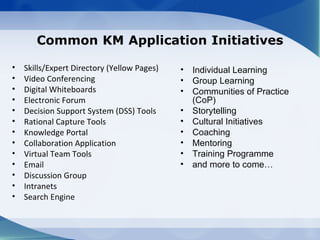
Common KM Application Initiatives

•   Skills/Expert Directory (Yellow Pages)   •   Individual Learning
•   Video Conferencing                       •   Group Learning
•   Digital Whiteboards                      •   Communities of Practice
•   Electronic Forum                             (CoP)
•   Decision Support System (DSS) Tools      •   Storytelling
•   Rational Capture Tools                   •   Cultural Initiatives
•   Knowledge Portal                         •   Coaching
•   Collaboration Application                •   Mentoring
•   Virtual Team Tools                       •   Training Programme
•   Email                                    •   and more to come…
•   Discussion Group
•   Intranets
•   Search Engine
MOVIE TIME!
          a
‘The Future Revolves’
Perspectives on KM Application
    Information-based          Technology-based         Culture-based

• Categorization of data   • Data mining          • Collective learning
• Corporate yellow pages   • Data warehousing     • Continuous learning
• Filtered information     • Expert systems       • Learning organization
• Information archiving    • Intelligent agents
                           • Intranet
                           • Multimedia
                           • Search engines
Potential Benefits of KM
Process Outcomes                 Organizational Outcomes
Communication                    Financial
• Enhanced communication         • Increased sales
• Faster communication           • Decreased cost
• More visible opinions          • Higher profitability
• Increased participation
                                 Marketing
Efficiency                       • Better service
• Reduced problem-solving time   • Customer focus
• Shortening proposal times      • Targeted marketing
• Faster results                 • Proactive marketing
• Faster delivery to market
• Greater overall efficiency     General
                                 • Improved project management
                                 • Personnel reduction
Where Should KM Be?

                      Administration?
     IT Department?
                                Research
                                & Development (R&D)?


Customer
Service?                           Human Resource
                                   Department?


      Sales and              Accounts and
      Marketing              Finance Department?
      Department?
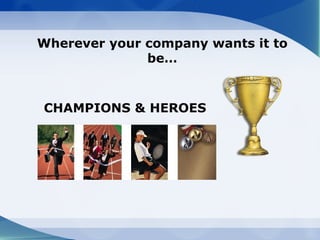
Wherever your company wants it to
              be…


CHAMPIONS & HEROES
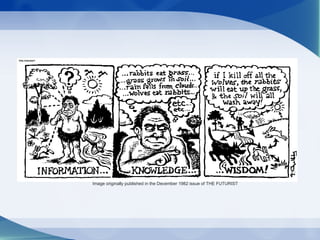
Image originally published in the December 1982 issue of THE FUTURIST
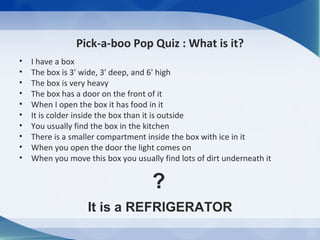
Pick-a-boo Pop Quiz : What is it?
•   I have a box
•   The box is 3' wide, 3' deep, and 6' high
•   The box is very heavy
•   The box has a door on the front of it
•   When I open the box it has food in it
•   It is colder inside the box than it is outside
•   You usually find the box in the kitchen
•   There is a smaller compartment inside the box with ice in it
•   When you open the door the light comes on
•   When you move this box you usually find lots of dirt underneath it


                                     ?
                   It is a REFRIGERATOR
‘Knowledge Management’
                           Why Now?
•   Growing awareness of the importance of knowledge to organizational
    success

•   Technology has made the sharing of knowledge more feasible
Why KM is Important
•   a growing emphasis on creating customer value

•   an increasingly competitive marketplace

•   reduced cycle times and shortened product development
    times

•   a need for organizational adaptation

•   a requirement to operate with a shrinking number of
    assets

•   a reduction in the amount of time employees changes in
    strategic directions
The Benefits of KM
•   Facilitates better, more informed decisions

•   Contributes to the intellectual capital

•   Encourages the free flow of ideas

•   Eliminates redundant processes

•   Improves customer service and efficiency

•   Leads to greater productivity
Let’s meet Owen

    ViDeO
KM and its Challenges

• Getting Employees on Board

• Allowing Technology to Dictate KM

• Not Having a Specific Business Goal

• KM is Not Static

• Not All Information is Knowledge
3 Major Myths
•   ‘Build It and They Will Come’

•   ‘Technology can Replace Face-to-Face’

•   ‘First, Create a Learning Culture’
‘Build It and They Will Come’
- Mental image of ‘warehouse’
- Build a central electronic database and spent a considerable
  amount of money
- But very little happens; neither contributions nor retrievals
  occur with much enthusiasm
- ‘Fix’ through an incentive system
                                                            k
                                                                  k
                                                       k
 * To alter the image of ‘warehouse’                                  k
                                                   k
    - from collecting & storing to reusing it
‘Technology can Replace Face-to-Face’

- ‘Talking’ – Training Programme, Conferences
- But getting people together is costly (travel and time away
  from job)
- Through technology – allow people to share knowledge
  without having to be in the same place


 * Technology has to be married with face-to-face
 interaction to create the most effective systems
‘First, Create a Learning Culture’

- Competitive Culture – no one is going to tell anyone else
  something that might help the other person get ahead
- Knowledge sharing only happens in organizations with a
  noncompetitive or a collaborative culture
- So, change the culture


* If people begin sharing ideas about issues they see as really
important, the sharing itself creates a learning culture.
Drivers of KM
:: Knowledge-centric Drivers
  • Knowledge recognition failure

  • Need for Smart knowledge distribution

  • Tacit knowledge walkouts

  • Knowledge hoarding

  • Learn to Unlearn


   WEEK 3 PRESENTATION : Question for group 1
Drivers of KM
:: Technology Drivers

  • Technology provides temporary advantage

  • Compressed product & process lifecycle

  • Link between knowledge, relationship capital, market strategy
    and information technology


   WEEK 3 PRESENTATION : Question for group 2
Drivers of KM
:: Organizational Structure-based Drivers


   • Functional convergence

   • Convergence of products and services

   • New organizational structures

   • Deregulation & globalization


  WEEK 3 PRESENTATION : Question for group 3
Drivers of KM
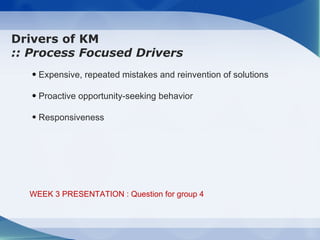
:: Process Focused Drivers
   • Expensive, repeated mistakes and reinvention of solutions

   • Proactive opportunity-seeking behavior

   • Responsiveness


  WEEK 3 PRESENTATION : Question for group 4
Drivers of KM
:: Economic Drivers

   • Increasing returns

   • Differentiation


  WEEK 3 PRESENTATION : Question for group 5
Is Your Company Ready for KM?
1.   Scanning imperative
     i. Does your company truly understand the environment in which it
     function?
     ii. Does it gather information about practices and conditions outside
     the organization?
     iii. Is there awareness about how your company’s internal operations
     compare with those of your competitors?

6.   Shared perception of performance gaps
     i. Is there a shared and relatively well agreed upon perception of how
     things are in your company and of how they actually need to be?

9.   Metrics
     i. How things are measured. Is everything measured solely on the basis
     of financial outcomes?
Is Your Company Ready for KM?
•    Corporate culture – ‘technology can lead the horse to the water but
     cannot make him drink it’
     i. Is your corporate culture accept debate and conflict as ways of
     solving problems?

•    Knowledge champions – need for Knowledge Champions from
     different functional areas

6.   Strategic alignment – knowledge strategy needs to be closely tied to
     the company’s business strategy

7.   Begin with what you know – accept your current data and information
     assets and begin by leveraging those first
To transfer the knowledge (message) starts with
            how you manage it first!

                    ViDeO

               Dr Randy Paush

Concept and Application of KM_Week Two

  • 1.
    Concepts and Applicationof KM MEC 7432 Teaching Lecturer : Azmawati Binti Mohd Lazim •: azmawati.mohd.lazim@gmail.com : Azmawati Mohd Lazim 21A4FE60 : wawacrv : wawacrv
  • 2.
    INTRODUCTION TO KNOWLEDGE MANAGEMENT •Handout by Mdm Nazirah Mat Sin
  • 3.
    What is ‘KM’@ ‘Knowledge Management’ ?
  • 4.
    Definition of KnowledgeManagement • No single authoritative definition • The word emerged in Europe around 1992 to 1994 • KM experts:
  • 5.
    Problems • Loss ofknowledge • Unable to acquire information • A decision making process has to be postponed • “Sorry, I’m not sure what projects my colleagues are involved in now” • All documents labelled with ‘Private and Confidential’, and no one is supposed to open it
  • 6.
    Problems (cont.) • Collectingthe necessary information - becomes a project in itself • No record of the methodology used to solve the problem • Outdated information • Best practices are not being captured and shared
  • 7.
    Symptoms Cause & Effect: Messy management took place
  • 8.
  • 9.
    KM in Action •Sharing Best Practices • Sourcing Expertise Efficiently • Exploitation of Existing Commercial Know-how • Learning about Customers • Creating Knowledge from Data • Dissemination of Right Knowledge, Right Time, Right Place • Sharing Knowledge for Cooperative Solving
  • 10.
    Become a bestseller cloud system analyst? ViDeO: Service cloud demo
  • 11.
    KM in Action1 • Sharing Best Practices Problem The performance across sales divisions was not comparable Action The company analysed and codified the practices of the best-performing sales divisions and made these available to all divisions Benefit Improved performance in those divisions that implemented best practices.
  • 12.
    KM in Action2 • Sourcing Expertise Efficiently Problem A commercial bank needed to be able to put together its expertise from around the world Action Developed and published a sophisticated directory identifying experts and their subjects Benefit The directory would contribute more than ten times return on a modest investment.
  • 13.
    KM in Action3 • Exploitation of Existing Commercial Know-how Problem A chemical company had thousands of patents Action It created a new function tasked with getting more value from these assets Benefit Those patents with commercial potential were licensed, and those without were discontinued
  • 14.
    KM in Action4 • Learning about Customers Problem A credit card organisation was unable to identify which customers represented the most profitable business Action Using a data warehouse to identify the unprofitable customers Benefit The organisation was able to target its efforts on that part of the customer
  • 15.
    KM in Action5 • Creating Knowledge from Data Problem A Telecommunications company wanted to identify those customer it risked losing Action Using data warehousing and data mining in analysing customer behaviour Benefit The company was able to identify those customers take immediate marketing action to retain them Video of Mr Mike Walsh
  • 16.
    KM in Action •Dissemination of Right Knowledge, Right Time, Right Place 6 Problem A multinational lost a major order to a competitor because the market intelligence Action The company responded by linking staff around the world and providing them with competitor analysis Benefit The company is able to pass on intelligence to the right place in a timely manner
  • 17.
    KM in Action7 • Sharing Knowledge for Cooperative Solving Problem An oil rig was faced with shutdown when a key part and its first replacement both failed, leaving only one remaining spare Action Using technologies summoned up technical skills from engineers, the supplier, the manufacturer’s research laboratory and designers Benefit Their combined advice ensured the last remaining spare was fitted safely and the rig continued to operate
  • 18.
    KM Scenario • Access to everything published within an organization • A solution to information overload • Virtual Work Environments for collaborative working • Communication of corporate news in a relevant and timely manner • Real-time virtual communities to share opinions and insights • Sharing with customers, suppliers and partners
  • 19.
    Common KM ApplicationInitiatives • Skills/Expert Directory (Yellow Pages) • Individual Learning • Video Conferencing • Group Learning • Digital Whiteboards • Communities of Practice • Electronic Forum (CoP) • Decision Support System (DSS) Tools • Storytelling • Rational Capture Tools • Cultural Initiatives • Knowledge Portal • Coaching • Collaboration Application • Mentoring • Virtual Team Tools • Training Programme • Email • and more to come… • Discussion Group • Intranets • Search Engine
  • 20.
    MOVIE TIME! a ‘The Future Revolves’
  • 21.
    Perspectives on KMApplication Information-based Technology-based Culture-based • Categorization of data • Data mining • Collective learning • Corporate yellow pages • Data warehousing • Continuous learning • Filtered information • Expert systems • Learning organization • Information archiving • Intelligent agents • Intranet • Multimedia • Search engines
  • 22.
    Potential Benefits ofKM Process Outcomes Organizational Outcomes Communication Financial • Enhanced communication • Increased sales • Faster communication • Decreased cost • More visible opinions • Higher profitability • Increased participation Marketing Efficiency • Better service • Reduced problem-solving time • Customer focus • Shortening proposal times • Targeted marketing • Faster results • Proactive marketing • Faster delivery to market • Greater overall efficiency General • Improved project management • Personnel reduction
  • 23.
    Where Should KMBe? Administration? IT Department? Research & Development (R&D)? Customer Service? Human Resource Department? Sales and Accounts and Marketing Finance Department? Department?
  • 24.
    Wherever your companywants it to be… CHAMPIONS & HEROES
  • 25.
    Image originally publishedin the December 1982 issue of THE FUTURIST
  • 26.
    Pick-a-boo Pop Quiz: What is it? • I have a box • The box is 3' wide, 3' deep, and 6' high • The box is very heavy • The box has a door on the front of it • When I open the box it has food in it • It is colder inside the box than it is outside • You usually find the box in the kitchen • There is a smaller compartment inside the box with ice in it • When you open the door the light comes on • When you move this box you usually find lots of dirt underneath it ? It is a REFRIGERATOR
  • 27.
    ‘Knowledge Management’ Why Now? • Growing awareness of the importance of knowledge to organizational success • Technology has made the sharing of knowledge more feasible
  • 28.
    Why KM isImportant • a growing emphasis on creating customer value • an increasingly competitive marketplace • reduced cycle times and shortened product development times • a need for organizational adaptation • a requirement to operate with a shrinking number of assets • a reduction in the amount of time employees changes in strategic directions
  • 29.
    The Benefits ofKM • Facilitates better, more informed decisions • Contributes to the intellectual capital • Encourages the free flow of ideas • Eliminates redundant processes • Improves customer service and efficiency • Leads to greater productivity
  • 30.
  • 31.
    KM and itsChallenges • Getting Employees on Board • Allowing Technology to Dictate KM • Not Having a Specific Business Goal • KM is Not Static • Not All Information is Knowledge
  • 32.
    3 Major Myths • ‘Build It and They Will Come’ • ‘Technology can Replace Face-to-Face’ • ‘First, Create a Learning Culture’
  • 33.
    ‘Build It andThey Will Come’ - Mental image of ‘warehouse’ - Build a central electronic database and spent a considerable amount of money - But very little happens; neither contributions nor retrievals occur with much enthusiasm - ‘Fix’ through an incentive system k k k * To alter the image of ‘warehouse’ k k - from collecting & storing to reusing it
  • 34.
    ‘Technology can ReplaceFace-to-Face’ - ‘Talking’ – Training Programme, Conferences - But getting people together is costly (travel and time away from job) - Through technology – allow people to share knowledge without having to be in the same place * Technology has to be married with face-to-face interaction to create the most effective systems
  • 35.
    ‘First, Create aLearning Culture’ - Competitive Culture – no one is going to tell anyone else something that might help the other person get ahead - Knowledge sharing only happens in organizations with a noncompetitive or a collaborative culture - So, change the culture * If people begin sharing ideas about issues they see as really important, the sharing itself creates a learning culture.
  • 36.
    Drivers of KM ::Knowledge-centric Drivers • Knowledge recognition failure • Need for Smart knowledge distribution • Tacit knowledge walkouts • Knowledge hoarding • Learn to Unlearn WEEK 3 PRESENTATION : Question for group 1
  • 37.
    Drivers of KM ::Technology Drivers • Technology provides temporary advantage • Compressed product & process lifecycle • Link between knowledge, relationship capital, market strategy and information technology WEEK 3 PRESENTATION : Question for group 2
  • 38.
    Drivers of KM ::Organizational Structure-based Drivers • Functional convergence • Convergence of products and services • New organizational structures • Deregulation & globalization WEEK 3 PRESENTATION : Question for group 3
  • 39.
    Drivers of KM ::Process Focused Drivers • Expensive, repeated mistakes and reinvention of solutions • Proactive opportunity-seeking behavior • Responsiveness WEEK 3 PRESENTATION : Question for group 4
  • 40.
    Drivers of KM ::Economic Drivers • Increasing returns • Differentiation WEEK 3 PRESENTATION : Question for group 5
  • 41.
    Is Your CompanyReady for KM? 1. Scanning imperative i. Does your company truly understand the environment in which it function? ii. Does it gather information about practices and conditions outside the organization? iii. Is there awareness about how your company’s internal operations compare with those of your competitors? 6. Shared perception of performance gaps i. Is there a shared and relatively well agreed upon perception of how things are in your company and of how they actually need to be? 9. Metrics i. How things are measured. Is everything measured solely on the basis of financial outcomes?
  • 42.
    Is Your CompanyReady for KM? • Corporate culture – ‘technology can lead the horse to the water but cannot make him drink it’ i. Is your corporate culture accept debate and conflict as ways of solving problems? • Knowledge champions – need for Knowledge Champions from different functional areas 6. Strategic alignment – knowledge strategy needs to be closely tied to the company’s business strategy 7. Begin with what you know – accept your current data and information assets and begin by leveraging those first
  • 43.
    To transfer theknowledge (message) starts with how you manage it first! ViDeO Dr Randy Paush

Editor's Notes

  • #6 Knowledge resides with just one or two key employees, and when the particular persons were transferred, the knowledge was loss Unable to acquire information because the person in charge or the data involved is not available at the time and place when it was needed A decision making process has to be postponed due to unavailability of the persons who are responsible “ Sorry, I’m not sure what projects my colleagues are involved in now” All documents labelled with ‘ Private and Confidential ’, and no one is supposed to open it
  • #7 When asked to tender for a major project, collecting the necessary information - becomes a project in itself. As a result, the tender document is not as good as it could been When faced with a serious, but unusual failure in the plant, somebody remembers that the same situation occur a couple of years before, but there is no record of the methodology used to solve the problem the previous time, nor of who was involved The internal telephone directory is out of date the moment it is printed. It tells names and formal titles, but very little about the people or what they can do. In no sense does it provide an effective tool for finding people with specific expertise or experience when needed There is a large discrepancies between the performances of different divisions carrying out essentially the same task. Best practices are not being captured and shared
  • #8 Taking too long for new skills to be applied throughout the organisation, giving away the edge to competitors who learn faster. The same skill may have to be developed in different parts of the organisation because it has not been shared. The mistakes made cause high after-sales and rework costs Decision-making performance may be impacted because the best know-how is not available to those who need it, when and where they need it.
  • #12 Problem A multinational noticed that performance across its sales divisions in different markets was not comparable, even taking local conditions into account. The company analysed and codified the practices of the best-performing sales divisions and made these available to all divisions. Benefit Subsequent measurement showed gains running to hundreds of millions of dollars in the medium term through improved performance in those divisions that implemented best practices.
  • #13 Problem A commercial bank needed to be able to put together its expertise from around the world on different industries, territories and financial instruments, quickly and efficiently in order to compete successfully for corporate finance business. They developed and published a sophisticated directory identifying experts and their subjects. Benefit They conservatively estimated that by only increasing the deal success rate by 1% the directory would contribute more than ten times return on a modest investment.
  • #14 Problem A chemical company had thousands of patents with annual registration fees running into millions of dollars. It created a new function tasked with getting more value from these assets. Benefit Those patents with commercial potential were licensed, and those without were discontinued. The company gained a five-fold increase in licensing income and saved millions of dollars in registration fees.
  • #15 Problem A credit card organisation knew that its customer profile was affecting profitability but was unable to identify which customers represented the most profitable business. Using a data warehouse it was able to apply its knowledge to identify which customers were unprofitable and should be terminated, and which customer retention programmes were effective. Benefit The organisation was able to target its efforts on that part of the customer base likely to offer the best margins.
  • #16 Problem A Telecommunications company was suffering from above-average customer turnover and wanted to identify those customer it risked losing. Using data warehousing and data mining it analysed customer behaviour and noted a characteristic three-month pattern in customers who left. Benefit The company was able to identify those customers at risk and take immediate marketing action to retain them.
  • #17 Problem A multinational lost a major order to a competitor because the market intelligence passed on by one of its salesman in another part of the world had failed to reach headquarters in time, owing to organisational boundaries and different time zones. The company responded by linking hundreds of sales staff and major account managers around the world and providing them with sources of customer and competitor analysis. Benefit The company is able to pass on intelligence to the right place in a timely manner in a highly competitive and rapidly changing environment.
  • #18 Problem An oil rig was faced with shutdown when a key part and its first replacement both failed, leaving only one remaining spare. The owner, using technologies ranging from databases to video-conferencing, summoned up technical skills from its worldwide engineers, the supplier of the equipment, the manufacturer’s research laboratory and one of the designers. Benefit Their combined advice ensured the last remaining spare was fitted safely and the rig continued to operate, so avoiding the loss of hundreds of thousands of dollars.
  • #20 Definition of ‘APPLICATION’ Oxford Advanced Learner’s Dictionary = Act of putting a theory, discovery, etc. to practical use ‘ application software’ in computing= subclass of computer software that employs the capabilities of a computer directly to a task that the user wishes to perform
  • #29 a growing emphasis on creating customer value and improving customer service an increasingly competitive marketplace with a rising rate of innovation reduced cycle times and shortened product development times a need for organizational adaptation because of changing business rules and assumptions a requirement to operate with a shrinking number of assets (people, inventory, and facilities) a reduction in the amount of time employees are given to acquire new knowledge changes in strategic directions and workforce mobility that lead to knowledge loss
  • #30 Facilitates better, more informed decisions Contributes to the intellectual capital of an organization Encourages the free flow of ideas which leads to insight and innovation Eliminates redundant processes, streamlines operations, and enhances employee retention rates Improves customer service and efficiency Leads to greater productivity
  • #35 * Technology has to be married with face-to-face interaction to create the most effective systems * One does not replace the other, although clearly one can greatly enhance the other
  • #37 Knowledge recognition failure - companies don’t know what they already know - reinventing old wheels 2. Need for Smart knowledge distribution - employees can’t find critical existing knowledge in time - lessons are learned but not shared - no knowledge gained from failures-it is soon forgotten - expertise is not shared 3. Tacit knowledge walkouts - critical tacit knowledge is close held by a few key individuals-capabilities are movable to competitors - employee departure causes loss of key clients, suppliers, best practices, and even revenue 4. Knowledge hoarding - individual employees closely guard knowledge and insights-fear of job security exists - collaboration is only namesake 5. Learn to Unlearn - assumptions, rules of thumb, and processes are unreliable or outdated - old practices, methods, and processes continue to be inappropriately applied
  • #38 6. Technology provides temporary advantage - technological innovation and adoption fails to sustain competitive advantage - only provides temporary advantage – no longer a competitive differentiator 7. Compressed product & process lifecycle - market information, service, and physical product lifecycles have significantly shortened - frequent changes in the software, hardware etc. 8. Link between knowledge, relationship capital, market strategy and information technology - business and IT strategy are not aligned - need for perfect link between knowledge, business strategy, and information
  • #39 9. Functional convergence - complex dependencies among and between different functional areas - team members lack understanding of the critical process factors for areas other than their own - need for conversation and discussion that precede collaboration and effective sharing of knowledge 10. Convergence of products and services - products & services are increasingly bundled - blurred boundaries between products/services 11. New organizational structures - ad hoc project-centered team structures bringing together the best of their talent and expertise - skills developed during the collaboration process lost 12. Deregulation & globalization - virtual collaboration and global remote teaming occurs among highly distributed teams and partnering firms - challenges brought about by deregulation and inability to keep up due to globalization
  • #40 13. Expensive, repeated mistakes and reinvention of solutions - business incur unnecessary expense to relearn the same lessons - knowledge is neither being effectively retained nor shared 14. Proactive opportunity-seeking behavior - inability to integrate external knowledge with internal expertise - by integrating company’s collective knowledge, can turn business turbulence into opportunity 15. Responsiveness - using the right application of knowledge within the structures and processes to response to customer needs - ability to proactively anticipate and respond to market trend
  • #41 16. Increasing returns - high start-up cost can be spread out - multiple users can simultaneously benefit from knowledge assets and increase its value as they add to, adapt, enhance, enrich, and validate it 17. Differentiation - traditional capital assets no longer suffices as a competitive differentiator - building and deploying knowledge capital provide a sustainable source of competitive differentiation
  • #42 Scanning imperative Questions may help in determining such scanning imperative exists in your company: i. Does your company truly understand the environment in which it function? ii. Does it gather information about practices and conditions outside the organization? iii. Is there awareness about how your company’s internal operations compare with those of your competitors? Shared perception of performance gaps i. Is there a shared and relatively well agreed upon perception of how things are in your company and of how they actually need to be? Metrics i. How things are measured. Is everything measured solely on the basis of financial outcomes?