Global Knowledge Management

           An Introduction


 Jan M. Pawlowski, Markus Bick, Franz Lehner
                Spring 2012
Licensing: Creative Commons
You are free:
   to Share — to copy, distribute and transmit        Collaborative Course Development!
      the work
                                                      Thanks to my colleagues Prof. Dr.
   to Remix — to adapt the work                       Markus Bick and Prof. Dr. Franz
                                                      Lehner who have developed parts of
                                                      the Knowledge Management Course
Under the following conditions:                       which we taught together during the
                                                      Jyväskylä Summer School Course
     Attribution. You must attribute the work in      2011.
         the manner specified by the author or
         licensor (but not in any way that suggests
                                                      Prof. Dr. Markus Bick (Introduction,
         that they endorse you or your use of the     CEN Framework)
         work).                                       ESCP Europe Campus Berlin
                                                      Web: http://www.escpeurope.de/wi
     Noncommercial. You may not use this
         work for commercial purposes.                Prof. Dr. Franz Lehner (Assessment,
                                                      Process Integration)
     Share Alike. If you alter, transform, or build   University of Passau
         upon this work, you may distribute the       Web: http:// www.wi.uni-passau.de/
         resulting work only under the same or
         similar license to this one.
http://creativecommons.org/licenses/by-nc-
    sa/3.0/
The License in plain words…
All slides in this set can be used for non-commercial
purposes (academic, general)
If you like to use my slides, just inform one of the
authors by sending a mail (eg to jan.pawlowski@jyu.fi)
If you modify the slides, please send usyour version
If you use the slide for a commercial course, contact
us and we agree how to arrange this
…Jyväskylä, Finland…


Source: [http://www.jyu.fi/, http://www.jyvaskyla.fi/]
…Jyväskylä, Finland…


Source: [http://commons.wikimedia.org/, http://www.jyvaskyla.fi/,
                   http://www.laajavuori.com/]
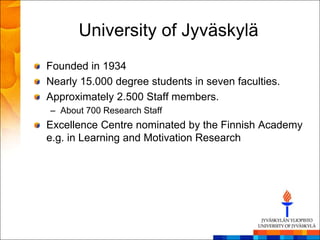
University of Jyväskylä
Founded in 1934
Nearly 15.000 degree students in seven faculties.
Approximately 2.500 Staff members.
– About 700 Research Staff
Excellence Centre nominated by the Finnish Academy
e.g. in Learning and Motivation Research
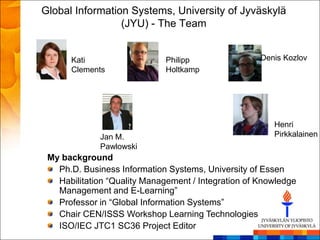
Global Information Systems, University of Jyväskylä
                 (JYU) - The Team


      Kati                    Philipp                Denis Kozlov
      Clements                Holtkamp


                                                        Henri
             Jan M.                                     Pirkkalainen
             Pawlowski
 My background
   Ph.D. Business Information Systems, University of Essen
   Habilitation ―Quality Management / Integration of Knowledge
   Management and E-Learning‖
   Professor in ―Global Information Systems‖
   Chair CEN/ISSS Workshop Learning Technologies
   ISO/IEC JTC1 SC36 Project Editor
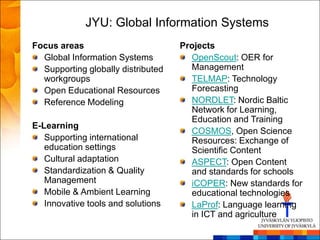
JYU: Global Information Systems
Focus areas                         Projects
  Global Information Systems          OpenScout: OER for
  Supporting globally distributed     Management
  workgroups                          TELMAP: Technology
  Open Educational Resources          Forecasting
  Reference Modeling                  NORDLET: Nordic Baltic
                                      Network for Learning,
                                      Education and Training
E-Learning
                                      COSMOS, Open Science
   Supporting international           Resources: Exchange of
   education settings                 Scientific Content
   Cultural adaptation                ASPECT: Open Content
   Standardization & Quality          and standards for schools
   Management                         iCOPER: New standards for
   Mobile & Ambient Learning          educational technologies
   Innovative tools and solutions     LaProf: Language learning
                                      in ICT and agriculture
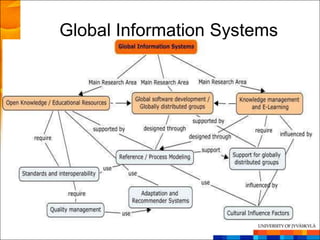
Global Information Systems
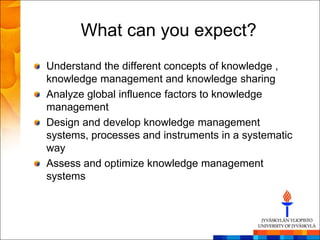
What can you expect?
Understand the different concepts of knowledge ,
knowledge management and knowledge sharing
Analyze global influence factors to knowledge
management
Design and develop knowledge management
systems, processes and instruments in a systematic
way
Assess and optimize knowledge management
systems
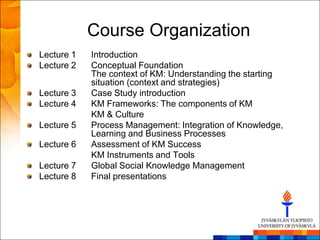
Course Organization
Lecture 1   Introduction
Lecture 2   Conceptual Foundation
            The context of KM: Understanding the starting
            situation (context and strategies)
Lecture 3   Case Study introduction
Lecture 4   KM Frameworks: The components of KM
            KM & Culture
Lecture 5   Process Management: Integration of Knowledge,
            Learning and Business Processes
Lecture 6   Assessment of KM Success
            KM Instruments and Tools
Lecture 7   Global Social Knowledge Management
Lecture 8   Final presentations
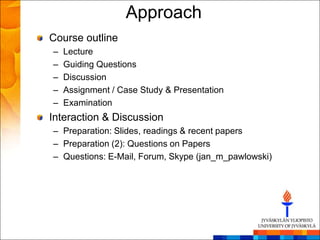
Approach
Course outline
–   Lecture
–   Guiding Questions
–   Discussion
–   Assignment / Case Study & Presentation
–   Examination
Interaction & Discussion
– Preparation: Slides, readings & recent papers
– Preparation (2): Questions on Papers
– Questions: E-Mail, Forum, Skype (jan_m_pawlowski)
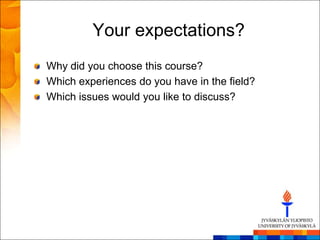
Your expectations?
Why did you choose this course?
Which experiences do you have in the field?
Which issues would you like to discuss?
A first question


What is common
  knowledge?
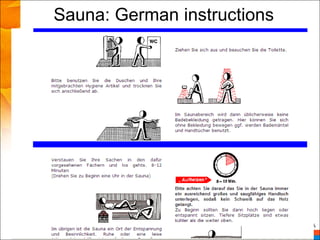
Sauna: German instructions
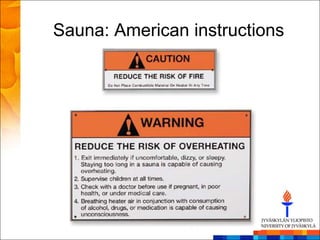
Sauna: American instructions
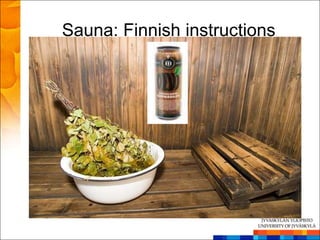
Sauna: Finnish instructions
A first questions


Why is Knowledge a
  Global Success
      Factor?
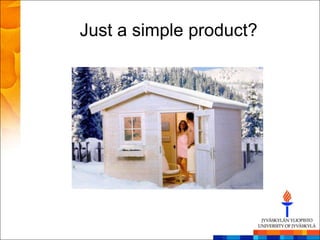
Just a simple product?
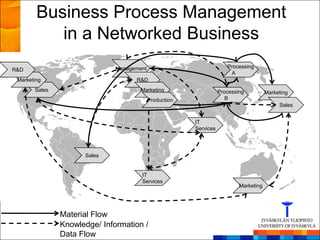
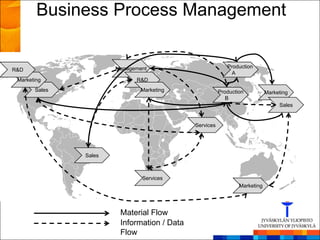
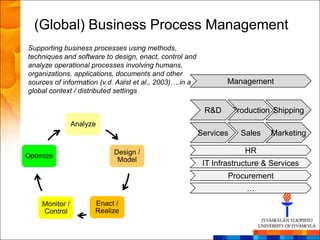
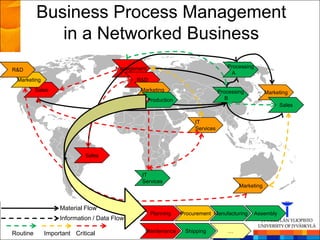
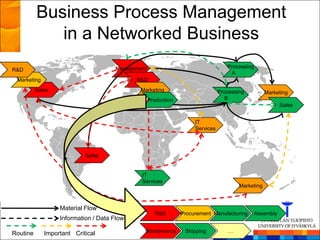
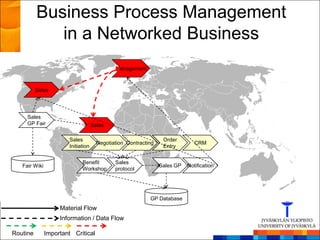
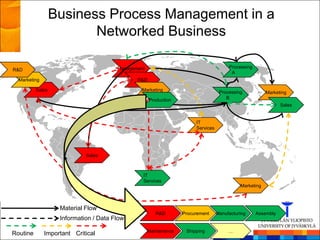
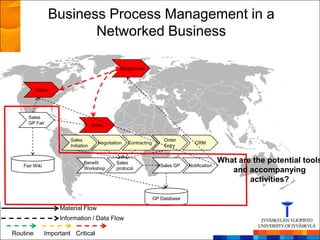
Business Process Management
           in a Networked Business
                              Management                              Processing
R&D
                                                                       A
 Marketing                          R&D
       Sales                          Marketing                    Processing          Marketing
                                           Production                 B
                                                                                            Sales


                                                        IT
                                                        Services


                     Sales


                                      IT
                                      Services
                                                                           Marketing


               Material Flow
               Knowledge/ Information /
               Data Flow
Some random questions…
Decision questions
– Where to produce?
– How to build partnerships (joint ventures, contractors, …)
– Which systems to exchange knowledge?
Operational questions
– How to process wood?
– When will the next shipment arrive?
– How to market the product in Japan?
– How to explain the concept and advantages of Finnish
  saunas?
– How to find the main problems of customers?
– Which are import and safety regulations?
This means…
Knowledge is a key to global success

Global KM managers need to understand the value
chain and knowledge requirements
Global KM managers need to understand
knowledge processes and culture
Global KM managers are the main hubs for smooth
operations in production and service enterprises
Contents
Introduction
Knowledge Management Foundations
– Conceptual foundation
– Theoretical Frameworks
– Practical Frameworks
Global KM
– Influence factors
– Cultural Barriers
Solutions
– Strategies
– Processes
– Tools
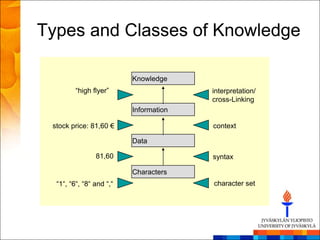
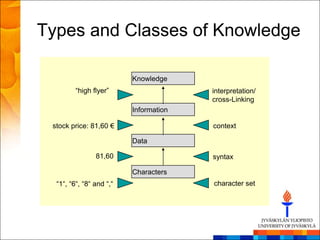
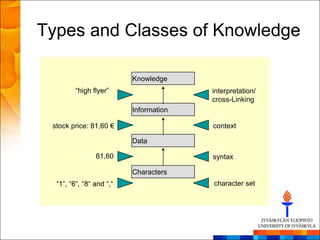
Types and Classes of Knowledge

                          Knowledge
         ―high flyer‖                   interpretation/
                                        cross-Linking
                          Information

 stock price: 81,60 €                   context

                          Data

                81,60                   syntax

                          Characters
  ―1―, ―6―, ―8― and ―,―                 character set
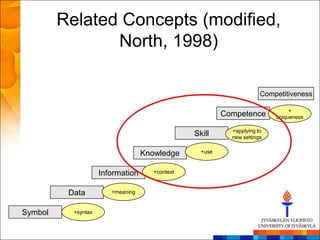
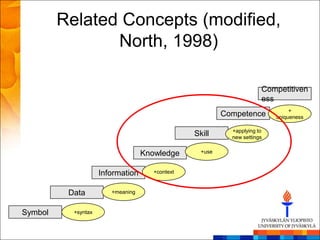
Related Concepts (modified,
                North, 1998)

                                                                       Competitiveness

                                                                                +
                                                          Competence       uniqueness

                                                            +applying to
                                                 Skill      new settings


                                   Knowledge       +use


                     Information      +context


          Data          +meaning


Symbol     +syntax
Myths of Knowledge
              Management
Myth 1:
KM technologies can deliver the right information to the right
person at the right time

Myth 2:
KM technologies can „store― human knowledge, intelligence or
experience

Myth 3:
KM technologies can distribute or multiply human intelligence

Myth 4:
Organizations are not able to learn, only individuals learn
Video

Ford Learning Network


   Slide 27
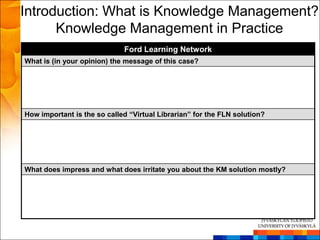
Introduction: What is Knowledge Management?
      Knowledge Management in Practice
                             Ford Learning Network
What is (in your opinion) the message of this case?


How important is the so called “Virtual Librarian” for the FLN solution?


What does impress and what does irritate you about the KM solution mostly?
Some issues…
How do you organize the development process?
How to find components which need to be changed, how to
develop different versions?
How qualified are the development partners? How good are their
language and communication skills? Will they understand your
codes?
How to keep track of the changes and versioning?
How to change the development environment (e.g. new release)
in a coordinated way?
How to find out country-/market-specific needs?
How to coordinate prototype validations?
What are communication standards?
How are problems communicated?
How is the development process and specific aspects
documented?
Introduction – What is Knowledge
    Management? Main Drivers
  Co-evolution of society, organization, products, services, work and
  workers
  Globalization of business
  Distribution of organizations
  Fragmentation of knowledge
  Need for speed and cycle-time reduction
  Need for organizational growth
  Complex organizational interlacings
  Increasing pace of organisational redesign and increasing employee
  mobility
  Business process reengineering and lean management
  New information and communication technologies
Introduction – Global Knowledge
          Management
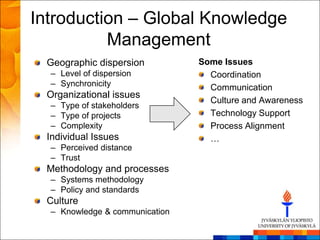
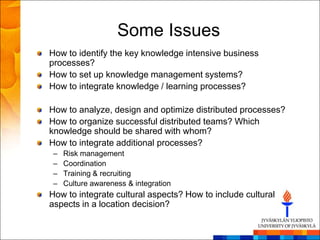
 Geographic dispersion          Some Issues
  – Level of dispersion           Coordination
  – Synchronicity                 Communication
 Organizational issues
                                  Culture and Awareness
  – Type of stakeholders
  – Type of projects              Technology Support
  – Complexity                    Process Alignment
 Individual Issues                …
  – Perceived distance
  – Trust
 Methodology and processes
  – Systems methodology
  – Policy and standards
 Culture
  – Knowledge & communication
So, what is the problem…?
What is common and crucial knowledge in different
communities?
How can we organize knowledge sharing across
borders?
Which technologies can we use?
Which problems might occur?

Potential solutions
– Theories and frameworks
– Practical methods and instruments
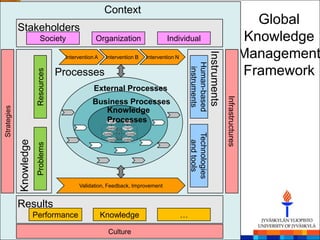
Context                            Stakeholders

                create
                                                       Society                     Organization                  Individual


                                                                                                                                                             Instruments
                                                             influences                 runs
                                                                                                                  perform

                                                           Intervention A     Intervention B    Intervention N


                                                                                                                                 Human-based
                                                                                                                                  instruments
                                   Resources
                                                                          embedded in                              influences

                                                         Processes              External Processes


                                                                                                                                                                                    Infrastructures
              enable
                                                                               Business Processes
 Strategies


                                                change
                                                                                                                       Support
                                                                                 Knowledge
                                               guide                             Processes


                                                                                                                                    Technologies and tools
                                                                                                                                                                           enable
                                   Problems


                                                use
                       Knowledge


                                                                                                                 Measured
                                                       influences                                                by
                                                                                         Improved by


                                                                     Validation, Feedback, Improvement
                                   Measured
                                   by                                                      measures
                   influences              Results

                                                       Performance                      Knowledge                       …


                                                                                         Culture
Culture
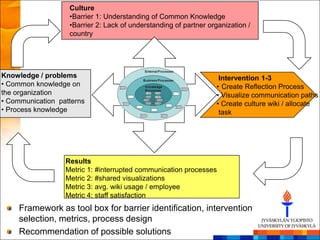
                   •Barrier 1: Understanding of Common Knowledge
                   •Barrier 2: Lack of understanding of partner organization /
                   country


Knowledge / problems                                               Intervention 1-3
• Common knowledge on                                             • Create Reflection Process
the organization                                                  • Visualize communication paths
• Communication patterns                                          • Create culture wiki / allocate
• Process knowledge                                                task


                  Results
                  Metric 1: #interrupted communication processes
                  Metric 2: #shared visualizations
                  Metric 3: avg. wiki usage / employee
                  Metric 4: staff satisfaction
     Framework as tool box for barrier identification, intervention
     selection, metrics, process design
     Recommendation of possible solutions
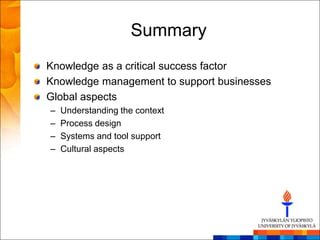
Summary
Knowledge as a critical success factor
Knowledge management to support businesses
Global aspects
–   Understanding the context
–   Process design
–   Systems and tool support
–   Cultural aspects
References (required readings)
Conceptual Foundations: Baskerville R and Dulipovici A (2006) The theoretical
foundations of knowledge management. Knowledge Management Research and
Practice 4, 83–105.
Frameworks: Pawlowski, J. & Bick, M. (2012). The Global Knowledge Management
Framework: Towards a Theory for Knowledge Management in Globally Distributed
Settings. Electronic Journal of Knowledge Management, 2012
Context/Barriers and Culture: Leidner D, Alavi M, Kayworth T. 2006.The role of
culture in knowledge management: a case study of two global firms. International
Journal of e-Collaboration 2: 17–40.
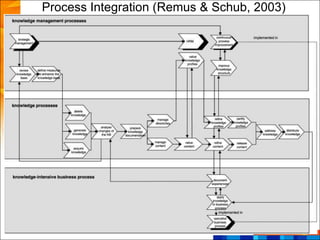
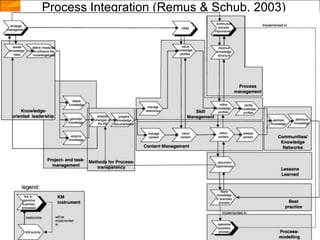
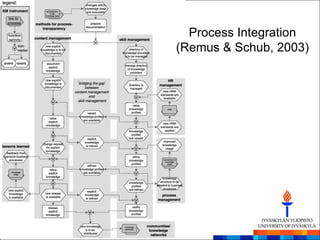
Processes: Remus, U.; Schub, S. A Blueprint for the Implementation of Process-
oriented Knowledge Management. In: Journal of Process- and Knowledge
Management. 10 No. 4, (2003)
Knowledge and Knowledge Representation: A. Abecker and L. van Elst, Ontologies
for Knowledge Management, in Handbook on Ontologies second edition, International
handbooks on information systems, Heidelberg: Springer, 2009, pp. 713-734.
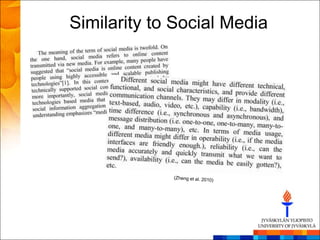
Tools and Social Software: ZHENG Y, LI L and ZHENG F (2010) Social Media
Support for Knowledge Management. In Proceedings of the International Conference
on Management and Service Science. pp 1-4, IEEE, Wuhan, China
Assessment of KM: Lehner, F.: Measuring KM Success and KM Service Quality with
KnowMetrix–First Experiences from a Case Study in a Software Company. Knowledge
Science, Engineering and Management, 2009 - Springer.
Bose, R. (2004), "Knowledge management metrics", Industrial Management & Data
Systems, Vol. 104 No.6, pp.457-68.
References (practical issues,
        good practices)
APQC (1996): Knowledge Management, a Consortium Benchmarking Study Final
Report.
CEN/ISSS (2004): European Guide to Good Practice in Knowledge Management,
Bruxelles 2004.
http://www.cenorm.be/cenorm/businessdomains/businessdomains/isss/about_iss
s/km.asp
Eppler, M. J. (2002): Knowledge Management Light. In O. Sukowski, and M. J.
Eppler (Eds): Knowledge Management Case Studies. Project Experiences,
Implementation Insights, Key Questions. NetAcademy Press, St. Gallen.
Maier, R. (2002): Knowledge Management Systems. Springer, Stuttgart.
References (theory and
               background)
Bick, M. (2004): Knowledge Management Support System. University
Duisburg-Essen, 2004. http://miless.uni-duisburg-
essen.de/servlets/DocumentServlet?id=11663 (in German)
Kalkan, V.D. (2008): An overall view of knowledge management
challenges for global business, Business Process Management Journal,
14 (3), pp.390 – 400
Desouza, K.C., Awazu, Y., Baloh, P. (2006): Managing Knowledge in
Global Software Development Efforts: Issues and Practices, IEEE
Software, 23 (5), pp. 30-37
McDermott, R., O‘Dell, C. (2001): Overcoming cultural barriers to sharing
knowledge, Journal of Knowledge Management, 5 (1), pp.76 – 85
Bhagat, R.S., Kedia, B.L., Harveston, P.D., Triandis, H.C. (2002):
Cultural Variations in the Cross-Border Transfer of Organizational
Knowledge: An Integrative Framework, The Academy of Management
Review, 27 (2), pp. 204-221
Holden, NJ. (2002): Cross-cultural Management: A Knowledge
Management Perspective. London: Financial Times/ Prentice Hall.
References (theory and
               background)
Desouza, K., Evaristo, R. (2003): Global Knowledge Management Strategies,
European Management Journal, 21 (1), pp. 62-67
Richter, T., Pawlowski, J.M. (2007): Adaptation of E-Learning Environments:
Determining National Differences through Context Metadata. TRANS - Internet
Journal for Cultural Studies, 17.
De Long, D. W., Fahey, L. (2000): Diagnosing cultural barriers to knowledge
management. Academy of Management Executive, 14(4), pp.113-128.
Pauleen, D. (Ed.) (2006). Cross-cultural perspectives on knowledge management,
Westport, Conn.: Libraries Unlimited.
Vaidyanathan, G. (2007). Networked Knowledge Management Dimensions in
Distributed Projects, In: Tan, F.: Global Information Technologies: Concepts,
Methodologies, Tools and Applications, Idea Group, 2007.
Dawes, S.S., Gharawi, M., Burke, B. (2011). Knowledge and
Information Sharing in Transnational Knowledge Networks: A
Contextual Perspective, Proceedings of the 44th Hawaii International
Conference on System Sciences, 2011.

More references given on request and during the lecture
Global Knowledge Management

              Case Study


 Jan M. Pawlowski, Markus Bick, Franz Lehner
                28.10.2011
Evaluation / Credits
(Final) Evaluation
   – 50 % Final examination
   – 25% case study presentation
      • ―active‖ presentation (in case related sessions)
   – 25% final assignment
      • -10 pages (Times New Roman 12pt, single spacing, ―common
        margin‖)
      • finally revised presentations
      • ppt/pdf + doc/pdf
      • provide the full names and email of all group members
Global Knowledge Management
>> Case – Part I <<
Case – Part I
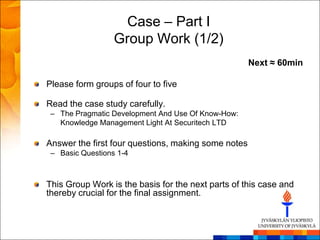
                  Group Work (1/2)
                                                     Next ≈ 60min

Please form groups of four to five

Read the case study carefully.
 – The Pragmatic Development And Use Of Know-How:
   Knowledge Management Light At Securitech LTD

Answer the first four questions, making some notes
 – Basic Questions 1-4


This Group Work is the basis for the next parts of this case and
thereby crucial for the final assignment.
Case – Part I
                             Group Work (2/2)
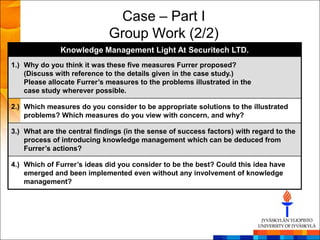
              Knowledge Management Light At Securitech LTD.
1.) Why do you think it was these five measures Furrer proposed?
    (Discuss with reference to the details given in the case study.)
    Please allocate Furrer’s measures to the problems illustrated in the
    case study wherever possible.

2.) Which measures do you consider to be appropriate solutions to the illustrated
    problems? Which measures do you view with concern, and why?

3.) What are the central findings (in the sense of success factors) with regard to the
    process of introducing knowledge management which can be deduced from
    Furrer’s actions?

4.) Which of Furrer’s ideas did you consider to be the best? Could this idea have
    emerged and been implemented even without any involvement of knowledge
    management?
Integrated Knowledge Management
>> Case – Part II <<
Case – Part II
                   Group Work (1/2)
                                                         Next ≈ 60min

Please stick to your group

Re-Read the case study carefully.
 – The Pragmatic Development And Use Of Know-How:
   Knowledge Management Light At Securitech LTD

Answer the following questions, preparing a presentation (.ppt, etc.)
 – See questions next slide


This Group Work is the basis for Part III of this case
Case – Part II
                             Group Work (2/2)
               Knowledge Management Light At Securitech LTD.
5.) Which next steps would you propose to Mr. Furrer for the coming six months?
    How can he ensure the continued success of the undertaken measures, and
    achieve the continuation of knowledge management in the approaching business
    management meeting?

6.) With regard to this mornings session, what do you think about the knowledge
    cockpit? What about the criteria / indicators? Are these sufficient and tailored to
    the companies needs?

7.) Discuss the difficulties of measuring Knowledge Management success or
    impacts in general and more specifically concerning Knowledge Management
    Light At Securitech LTD.

8.) Which aspects of the given context should Furrer pay more attention to in his
    next steps? Which factors has he given too little consideration until now?
Case – Part III
                  Group Work
                                        Next ≈ 4 weeks

Please stick to your group

Discuss the extension of the case study – which
changes to the previous situation can you identify
Answer the questions of the case extension, we
support the case work
Prepare a presentation of the overall solution until
13.12.2011
Contact Information

Prof. Dr. Jan M. Pawlowski
 jan.pawlowski@jyu.fi
 Skype: jan_m_pawlowski

 Office: Room 514.2
 Telephone +358 14 260 2596
 http://users.jyu.fi/~japawlow
Global Knowledge Management

      Conceptual foundation


 Jan M. Pawlowski, Markus Bick, Franz Lehner
                28.10.2011
Licensing: Creative Commons
You are free:
   to Share — to copy, distribute and transmit        Collaborative Course Development!
      the work
                                                      Thanks to my colleagues Prof. Dr.
   to Remix — to adapt the work                       Markus Bick and Prof. Dr. Franz
                                                      Lehner who have developed parts of
                                                      the Knowledge Management Course
Under the following conditions:                       which we taught together during the
                                                      Jyväskylä Summer School Course
     Attribution. You must attribute the work in      2011.
         the manner specified by the author or
         licensor (but not in any way that suggests
                                                      Prof. Dr. Markus Bick (Introduction,
         that they endorse you or your use of the     CEN Framework)
         work).                                       ESCP Europe Campus Berlin
                                                      Web: http://www.escpeurope.de/wi
     Noncommercial. You may not use this
         work for commercial purposes.                Prof. Dr. Franz Lehner (Assessment,
                                                      Process Integration)
     Share Alike. If you alter, transform, or build   University of Passau
         upon this work, you may distribute the       Web: http:// www.wi.uni-passau.de/
         resulting work only under the same or
         similar license to this one.
http://creativecommons.org/licenses/by-nc-
    sa/3.0/
Types and Classes of Knowledge

                          Knowledge
         ―high flyer‖                   interpretation/
                                        cross-Linking
                          Information

 stock price: 81,60 €                   context

                          Data

                81,60                   syntax

                          Characters
  ―1―, ―6―, ―8― and ―,―                 character set
Related Concepts (modified,
                North, 1998)

                                                                       Competitiven
                                                                       ess
                                                                                +
                                                          Competence       uniqueness

                                                            +applying to
                                                 Skill      new settings


                                   Knowledge       +use


                     Information      +context


          Data          +meaning


Symbol     +syntax
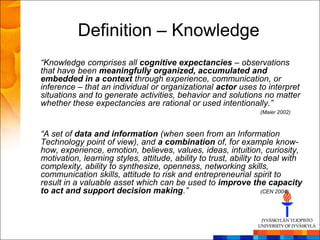
Definition – Knowledge
“Knowledge comprises all cognitive expectancies – observations
that have been meaningfully organized, accumulated and
embedded in a context through experience, communication, or
inference – that an individual or organizational actor uses to interpret
situations and to generate activities, behavior and solutions no matter
whether these expectancies are rational or used intentionally.”
                                                                (Maier 2002)


“A set of data and information (when seen from an Information
Technology point of view), and a combination of, for example know-
how, experience, emotion, believes, values, ideas, intuition, curiosity,
motivation, learning styles, attitude, ability to trust, ability to deal with
complexity, ability to synthesize, openness, networking skills,
communication skills, attitude to risk and entrepreneurial spirit to
result in a valuable asset which can be used to improve the capacity
to act and support decision making.”                               (CEN 2004)
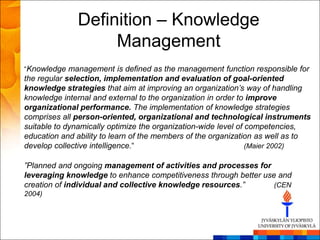
Definition – Knowledge
                   Management
―Knowledge management is defined as the management function responsible for
the regular selection, implementation and evaluation of goal-oriented
knowledge strategies that aim at improving an organization’s way of handling
knowledge internal and external to the organization in order to improve
organizational performance. The implementation of knowledge strategies
comprises all person-oriented, organizational and technological instruments
suitable to dynamically optimize the organization-wide level of competencies,
education and ability to learn of the members of the organization as well as to
develop collective intelligence.―                               (Maier 2002)

”Planned and ongoing management of activities and processes for
leveraging knowledge to enhance competitiveness through better use and
creation of individual and collective knowledge resources.”       (CEN
2004)
Types and Classes of Knowledge
Declarative Knowledge:                     Procedural Knowledge:
• knowing that                             • knowing how


                                                            [Source:
                                                            http://kartta.jkl.fi]

                           My
                         position


                                    How to get
                                       to the
                                     lecture…
      Position, room                         Navigation
      Lecture time                           Lecture behavior
      Traffic rules                          Traffic behavior
Types and Classes of Knowledge

Organizational Knowledge:
                                     Individual Knowledge:
• consists of the critical intel-
                                     • knowledge of each person
  lectual assets within an
                                       (employee)
  organization


   Building cars….                  Steering / using
                                    production facilities
[Picture Source:
http://commons.wikimedia.org]
Types and Classes of Knowledge

                                                             Implicit / Tacit Knowledge:
Explicit Knowledge:
                                                             • knowledge that people carry in
• codified knowledge that can be
                                                              their minds and is, therefore,
 easily shared and understood
                                                              difficult to access


    Traffic rules                                               Traffic customs
    Driving instructions                                        Interpretations
    …                                                           …


                                   Global / cultural
                                   differences


                                           [Picture Source:
                                           http://commons.wikimedia.org]
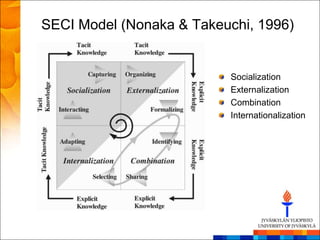
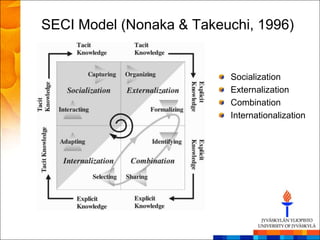
SECI Model (Nonaka & Takeuchi, 1996)


                          Socialization
                          Externalization
                          Combination
                          Internationalization
SECI Processes
Socialization: Transfer tacit knowledge from one
person to another person
Externalization: Translate tacit knowledge into
explicit knowledge in a repository
Combination: Combine different bodies of
explicit knowledge to create new explicit
knowledge
Internalization: Extract the explicit knowledge
from a repository that is relevant to a particular
person‘s need and deliver it to that person where
it is translated into tacit knowledge
Cognition: Apply tacit knowledge to a business
problem
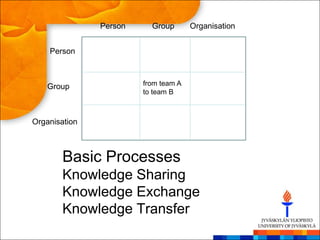
Person     Group       Organisation


    Person


    Group               from team A
                        to team B


Organisation


        Basic Processes
        Knowledge Sharing
        Knowledge Exchange
        Knowledge Transfer
Selected Knowledge Exchange
Models
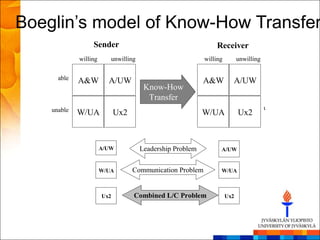
• Know-How transfer model (after Boeglin)
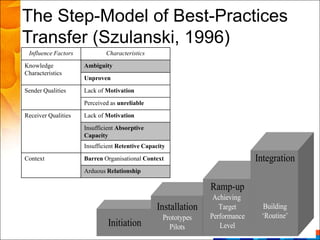
• Szulanski‘s stepwise model of Best Practices
Transfer
• Internal Knowledge Transfer model (Krogh)
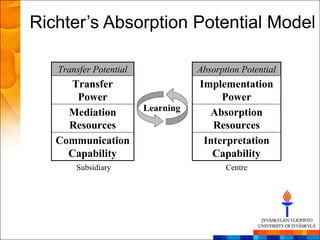
• Richter‘s Transfer Potential Absorption model
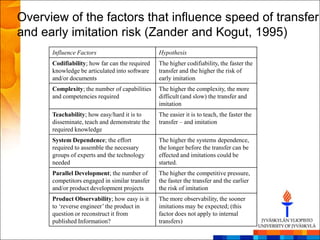
• Zander & Kogut‘s Transfer and Imitation model
Boeglin‘s model of Know-How Transfer
                  Sender                                       Receiver
             willing      unwilling                        willing         unwilling


      able   A&W         A/UW                              A&W         A/UW            able
                                       Know-How
                                        Transfer
    unable                                                                             unable
             W/UA            Ux2                           W/UA            Ux2


                       A/UW           Leadership Problem         A/UW


                       W/UA        Communication Problem         W/UA


                       Ux2         Combined L/C Problem              Ux2
The Step-Model of Best-Practices
Transfer (Szulanski, 1996)
 Influence Factors           Characteristics
Knowledge            Ambiguity
Characteristics
                     Unproven
Sender Qualities     Lack of Motivation
                     Perceived as unreliable
Receiver Qualities   Lack of Motivation
                     Insufficient Absorptive
                     Capacity
                     Insufficient Retentive Capacity
Context              Barren Organisational Context                            Integration
                     Arduous Relationship

                                                                Ramp-up
                                                                 Achieving
                                                Installation       Target      Building
                                                   Prototypes   Performance    ‘Routine’
                              Initiation             Pilots        Level
Richter‘s Absorption Potential Model

   Transfer Potential              Absorption Potential
     Transfer                      Implementation
      Power                             Power
     Mediation          Learning     Absorption
     Resources                        Resources
   Communication                    Interpretation
     Capability                       Capability
       Subsidiary                         Centre
Overview of the factors that influence speed of transfer
and early imitation risk (Zander and Kogut, 1995)
      Influence Factors                         Hypothesis
      Codifiability; how far can the required   The higher codifiability, the faster the
      knowledge be articulated into software    transfer and the higher the risk of
      and/or documents                          early imitation
      Complexity; the number of capabilities    The higher the complexity, the more
      and competencies required                 difficult (and slow) the transfer and
                                                imitation
      Teachability; how easy/hard it is to      The easier it is to teach, the faster the
      disseminate, teach and demonstrate the    transfer – and imitation
      required knowledge
      System Dependence; the effort             The higher the systems dependence,
      required to assemble the necessary        the longer before the transfer can be
      groups of experts and the technology      effected and imitations could be
      needed                                    started.
      Parallel Development; the number of       The higher the competitive pressure,
      competitors engaged in similar transfer   the faster the transfer and the earlier
      and/or product development projects       the risk of imitation
      Product Observability; how easy is it     The more observability, the sooner
      to ‘reverse engineer’ the product in      imitations may be expected; (this
      question or reconstruct it from           factor does not apply to internal
      published Information?                    transfers)
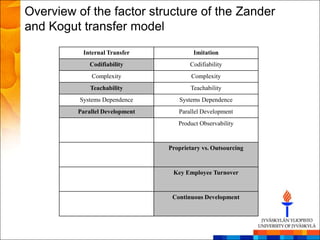
Overview of the factor structure of the Zander
and Kogut transfer model
           Internal Transfer             Imitation
             Codifiability             Codifiability
              Complexity                Complexity
             Teachability              Teachability
          Systems Dependence       Systems Dependence
         Parallel Development      Parallel Development
                                   Product Observability


                                Proprietary vs. Outsourcing


                                 Key Employee Turnover


                                 Continuous Development
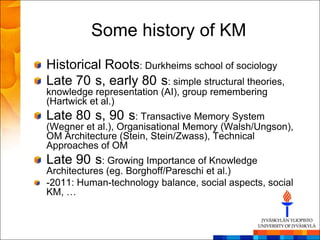
Some history of KM
Historical Roots: Durkheims school of sociology
Late 70 s, early 80 s: simple structural theories,
knowledge representation (AI), group remembering
(Hartwick et al.)
Late 80 s, 90 s: Transactive Memory System
(Wegner et al.), Organisational Memory (Walsh/Ungson),
OM Architecture (Stein, Stein/Zwass), Technical
Approaches of OM
Late 90 s: Growing Importance of Knowledge
Architectures (eg. Borghoff/Pareschi et al.)
-2011: Human-technology balance, social aspects, social
KM, …
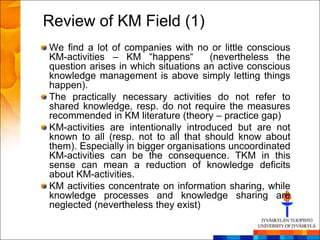
Review of KM Field (1)
We find a lot of companies with no or little conscious
KM-activities – KM ―happens―          (nevertheless the
question arises in which situations an active conscious
knowledge management is above simply letting things
happen).
The practically necessary activities do not refer to
shared knowledge, resp. do not require the measures
recommended in KM literature (theory – practice gap)
KM-activities are intentionally introduced but are not
known to all (resp. not to all that should know about
them). Especially in bigger organisations uncoordinated
KM-activities can be the consequence. TKM in this
sense can mean a reduction of knowledge deficits
about KM-activities.
KM activities concentrate on information sharing, while
knowledge processes and knowledge sharing are
neglected (nevertheless they exist)
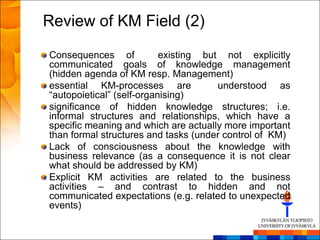
Review of KM Field (2)
Consequences of            existing but not explicitly
communicated goals of knowledge management
(hidden agenda of KM resp. Management)
essential KM-processes are             understood as
―autopoietical‖ (self-organising)
significance of hidden knowledge structures; i.e.
informal structures and relationships, which have a
specific meaning and which are actually more important
than formal structures and tasks (under control of KM)
Lack of consciousness about the knowledge with
business relevance (as a consequence it is not clear
what should be addressed by KM)
Explicit KM activities are related to the business
activities – and contrast to hidden and not
communicated expectations (e.g. related to unexpected
events)
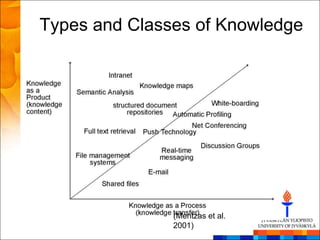
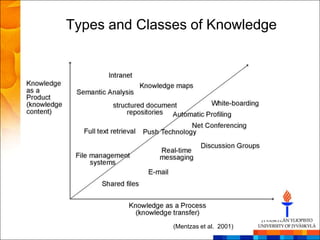
Types and Classes of Knowledge


               (Mentzas et al.
               2001)
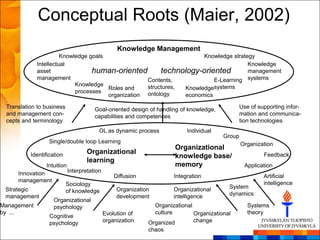
Conceptual Roots (Maier, 2002)
                                                  Knowledge Management
                       Knowledge goals                                Knowledge strategy
             Intellectual                                                             Knowledge
             asset                human-oriented         technology-oriented          management
             management                             Contents,             E-Learning systems
                            Knowledge               structures,
                                       Roles and                Knowledgesystems
                            processes               ontology
                                       organization             economics

 Translation to business               Goal-oriented design of handling of knowledge,          Use of supporting infor-
 and management con-                   capabilities and competences                            mation and communica-
 cepts and terminology                                                                         tion technologies
                                         OL as dynamic process             Individual
                                                                                         Group
                 Single/double loop Learning                                                     Organization
                                                                       Organizational
          Identification            Organizational                                                       Feedback
                                                                       knowledge base/
                                    learning
                Intuition                                              memory                     Application
     Innovation             Interpretation
                                                 Diffusion            Integration                        Artificial
     management                                                                                          intelligence
                           Sociology                                                       System
 Strategic                 of knowledge           Organization        Organizational
 management                                       development         intelligence         dynamics
                    Organizational
Management          psychology                                 Organizational                      Systems
by ...                                       Evolution of      culture        Organizational       theory
                  Cognitive
                  psychology                 organization    Organized        change
                                                             chaos
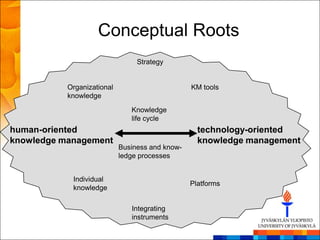
Conceptual Roots
                                 Strategy


           Organizational                        KM tools
           knowledge
                               Knowledge
                               life cycle
human-oriented                                     technology-oriented
knowledge management                               knowledge management
                            Business and know-
                            ledge processes


            Individual
                                                 Platforms
            knowledge

                               Integrating
                               instruments
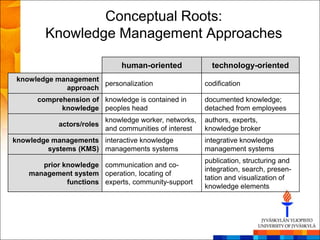
Conceptual Roots:
        Knowledge Management Approaches

                               human-oriented              technology-oriented
 knowledge management
                      personalization                    codification
             approach
      comprehension of knowledge is contained in         documented knowledge;
            knowledge peoples head                       detached from employees
                           knowledge worker, networks,   authors, experts,
            actors/roles
                           and communities of interest   knowledge broker
knowledge managements interactive knowledge              integrative knowledge
         systems (KMS) managements systems               management systems
                                                         publication, structuring and
       prior knowledge communication and co-
                                                         integration, search, presen-
    management system operation, locating of
                                                         tation and visualization of
              functions experts, community-support
                                                         knowledge elements
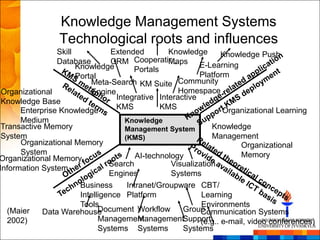
Knowledge Management Systems
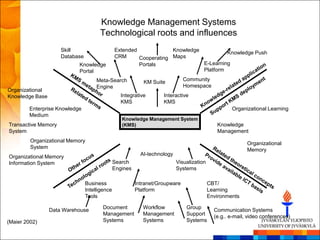
                 Technological roots and influences
                Skill            Extended         Knowledge        Knowledge Push
                Database         CRM Cooperating  Maps E-Learning
                      Knowledge         Portals
                      Portal                               Platform
                          Meta-Search KM Suite Community
 Organizational           Engine                     Homespace
                                  Integrative Interactive
 Knowledge Base
      Enterprise Knowledge        KMS           KMS                Organizational Learning
      Medium                         Knowledge
 Transactive Memory                  Management System         Knowledge
 System                              (KMS)                     Management
      Organizational Memory                                             Organizational
      System                             AI-technology                  Memory
Organizational Memory
                                Search             Visualization
Information System
                                Engines            Systems
                       Business       Intranet/Groupware CBT/
                       Intelligence Platform                Learning
                       Tools                                Environments
   (Maier   Data Warehouse   Document Workflow        Group Communication Systems
   2002)                     Management   ManagementSupport e-mail, video conferences)
                                                            (e.g..
                             Systems Systems          Systems
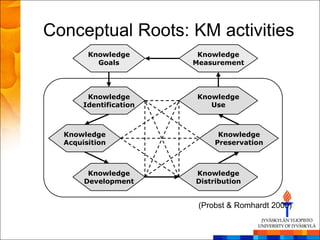
Conceptual Roots: KM activities
        Knowledge        Knowledge
          Goals         Measurement


        Knowledge       Knowledge
       Identification      Use


  Knowledge                   Knowledge
  Acquisition                Preservation


        Knowledge       Knowledge
       Development      Distribution


                         (Probst & Romhardt 2000)
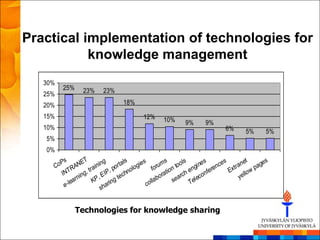
Practical implementation of technologies for
           knowledge management
   30%
         25%    23%      23%
   25%
   20%                           18%

   15%                                    12%     10%      9%      9%
   10%                                                                      6%      5%       5%
   5%
   0%
        Ps         ET        g           ls   s          s     ls     es nces          et   es
     Co        AN rainin porta logie forum n too ngi n                          t r an    ag
              R
        INT ing,
                      t       IP,         hno           atio rch e confe
                                                                         re   Ex llow p
                         P,
                            E          ec             or                            ye
              ar n      K           gt            lab       sea Tel e
         e- l
             e
                             ha
                                rin            col
                           s


               Technologies for knowledge sharing
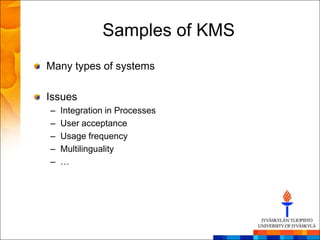
Samples of KMS
Many types of systems

Issues
–   Integration in Processes
–   User acceptance
–   Usage frequency
–   Multilinguality
–   …
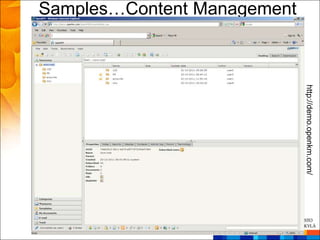
Samples…Content Management


                             http://demo.openkm.com/
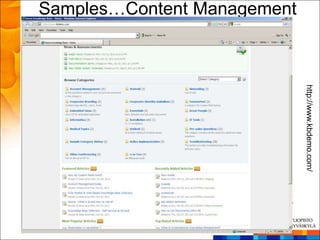
Samples…Content Management


                             http://www.kbdemo.com/
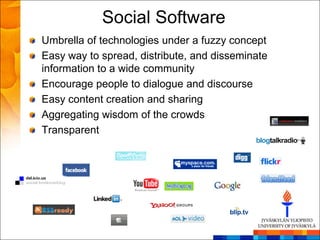
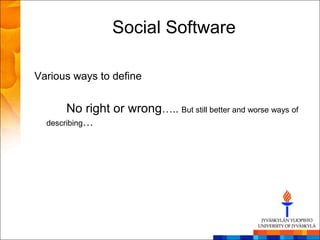
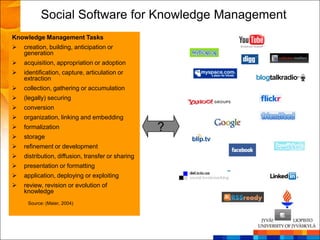
Social Software
Umbrella of technologies under a fuzzy concept
Easy way to spread, distribute, and disseminate
information to a wide community
Encourage people to dialogue and discourse
Easy content creation and sharing
Aggregating wisdom of the crowds
Transparent
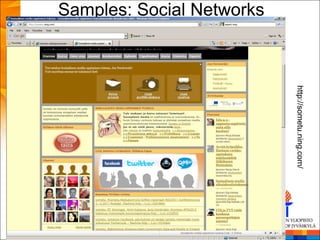
Samples: Social Networks


                           http://sometu.ning.com/
Ready for Use?
Is there management support in all parts of an
enterprise?
Does a system fit the users‘ work behavior?
Does a system fit the purpose? What kind of
knowledge needs to be shared?
Are there incentives for knowledge sharing?
Are there communication options fitting the users
needs?
…
Ready for Global Use?
Is the process clear, within and outside the
organization?
Are there clear procedures for inter-organizational
knowledge exchange (who shares with whom?)
Is the system multilingual?
– Multilingual ontologies
– Tag / Query translations
– …
Are there communication options support multi-
lingual communication (e.g. translation support,
facilitation)?
…
Global aspects to KM
Coordination: In international team work several
problems such as time differences have to be taken
into consideration and managed.
Communication: Common ways of communication
including language need to be agreed on.
Collaboration: Team work has to be facilitated by
providing suitable mechanisms and support.
Knowledge Management including knowledge
sharing and transfer is crucial to establish a common
knowledge base of all team members
– KM as a horizontal aspect!
Global aspects to KM (2)
Challenges
–   Lack of Trust
–   Different vocabularies, frames of reference
–   Status and rewards of knowledge owners
–   Behavior towards mistakes…
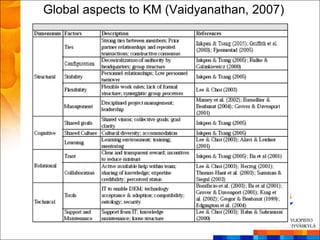
Global aspects to KM (Vaidyanathan, 2007)
Preliminary Summary
Broad field with
–   …a variety of conceptual foundations
–   …interdisciplinary approaches
–   …different viewpoints
–   …possibilities of interventions
–   …uncertain success probabilities
–   …unknowns!
Need for frameworks and comparable models!
Guiding questions
What is the different between knowledge and
competence?
Give an example for explicit and implicit knowledge.
Find an example where explicit knowledge in one
culture is implicit in another.
Do you know international communities on the web
where knowledge on a certain topic is shared – is this
human- or technology oriented? Give an example.
In a development process for mobile applications,
which knowledge is organizational, which is personal?
Global Knowledge Management

  Frameworks and Strategies


 Jan M. Pawlowski, Markus Bick, Franz Lehner
                28.10.2011
Licensing: Creative Commons
You are free:
   to Share — to copy, distribute and transmit        Collaborative Course Development!
      the work
                                                      Thanks to my colleagues Prof. Dr.
   to Remix — to adapt the work                       Markus Bick and Prof. Dr. Franz
                                                      Lehner who have developed parts of
                                                      the Knowledge Management Course
Under the following conditions:                       which we taught together during the
                                                      Jyväskylä Summer School Course
     Attribution. You must attribute the work in      2011.
         the manner specified by the author or
         licensor (but not in any way that suggests
                                                      Prof. Dr. Markus Bick (Introduction,
         that they endorse you or your use of the     CEN Framework)
         work).                                       ESCP Europe Campus Berlin
                                                      Web: http://www.escpeurope.de/wi
     Noncommercial. You may not use this
         work for commercial purposes.                Prof. Dr. Franz Lehner (Assessment,
                                                      Process Integration)
     Share Alike. If you alter, transform, or build   University of Passau
         upon this work, you may distribute the       Web: http:// www.wi.uni-passau.de/
         resulting work only under the same or
         similar license to this one.
http://creativecommons.org/licenses/by-nc-
    sa/3.0/
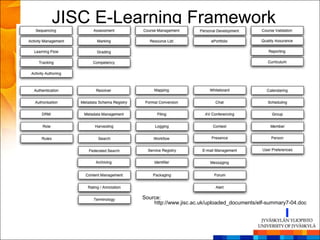
Knowledge Management Frameworks
Framework
– Conceptual models describing and relating potential
  influencing aspects, such as systems, processes or
  instruments
– Understanding the inter-relations in global settings
– Learning how to apply in in practice…
Utilization:
– Guideline which aspects should be taken into account
– Research tool
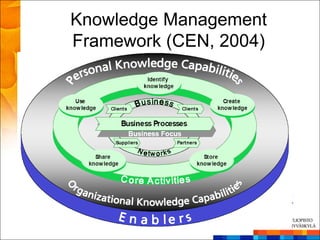
Knowledge Management
Framework (CEN, 2004)
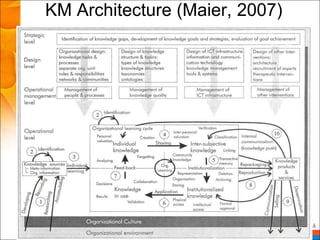
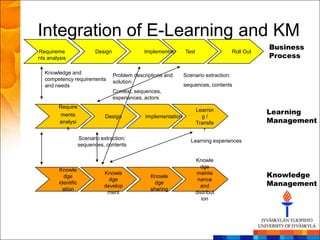
KM Architecture (Maier, 2007)
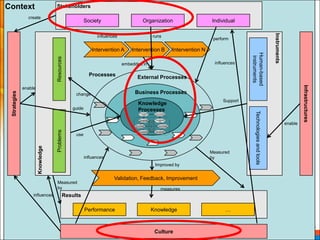
Context
             Stakeholders
                                                                                                                                                 Global
                            Society                 Organization                  Individual                                                   Knowledge
                                                                                                                                              Management


                                                                                                              Instruments
                                       Intervention A    Intervention B   Intervention N


                                                                                               Human-based
                                                                                                                                              Framework


                                                                                                instruments
                          Resources


                                      Processes
                                                   External Processes


                                                                                                                            Infrastructures
                                                  Business Processes
Strategies


                                                     Knowledge
                                                     Processes


                                                                                               Technologies
             Knowledge


                                                                                                 and tools
                          Problems


                                            Validation, Feedback, Improvement


             Results
                         Performance                    Knowledge                          …

                                                          Culture
Knowledge…
   Category              Description                       Sample Values / Attributes
                                                Subject area
                    Description of knowledge    Type (procedural, factual, …)
Knowledge element
                     areas of an organization   Representation / codification
                                                Culture specifics (common, contextualized, …)
                                                Knowing that / knowing how
                                                Tacit / implicit / explicit
   Knowledge type    What kind of knowledge
                                                Knowledge as object / knowledge as process
                                                …
                                                Problem description
                                                Context
                          Problems to which
         Problem                                Related knowledge
                        knowledge is applied
                                                Related competences
                                                Related actors
Global Knowledge                                     Context

 Management Framework
Context
– Society: (National, regional) culture, legal aspects,
  infrastructure, …
– Organization: Culture, Strategies, Structure, Processes, …
– Individuals: Characteristics, preferences, knowledge / skills /
  competences, barriers
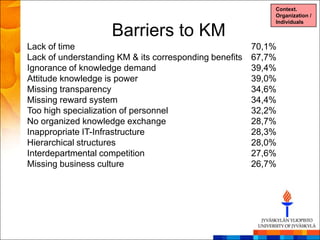
Context.
                                                            Organization /
                                                            Individuals

                    Barriers to KM
Lack of time                                            70,1%
Lack of understanding KM & its corresponding benefits   67,7%
Ignorance of knowledge demand                           39,4%
Attitude knowledge is power                             39,0%
Missing transparency                                    34,6%
Missing reward system                                   34,4%
Too high specialization of personnel                    32,2%
No organized knowledge exchange                         28,7%
Inappropriate IT-Infrastructure                         28,3%
Hierarchical structures                                 28,0%
Interdepartmental competition                           27,6%
Missing business culture                                26,7%
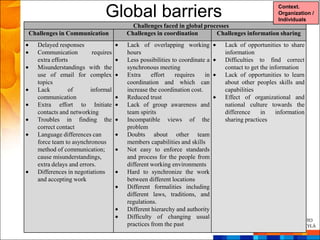
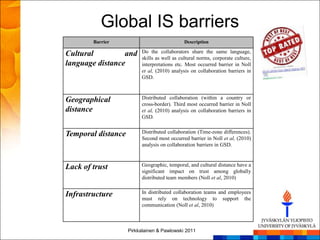
Global barriers                                                 Context.
                                                                                              Organization /
                                                                                              Individuals
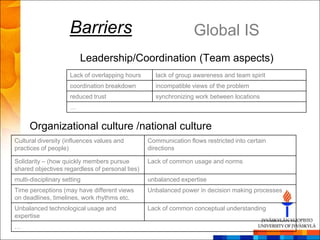
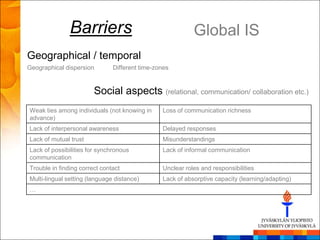
                                      Challenges faced in global processes
Challenges in Communication         Challenges in coordination       Challenges information sharing
   Delayed responses                Lack of overlapping working          Lack of opportunities to share
   Communication         requires   hours                                information
   extra efforts                    Less possibilities to coordinate a   Difficulties to find correct
   Misunderstandings with the       synchronous meeting                  contact to get the information
   use of email for complex         Extra     effort    requires    in   Lack of opportunities to learn
   topics                           coordination and which can           about other peoples skills and
   Lack         of      informal    increase the coordination cost.      capabilities
   communication                    Reduced trust                        Effect of organizational and
   Extra effort to Initiate         Lack of group awareness and          national culture towards the
   contacts and networking          team spirits                         difference     in    information
   Troubles in finding the          Incompatible views of the            sharing practices
   correct contact                  problem
   Language differences can         Doubts about other team
   force team to asynchronous       members capabilities and skills
   method of communication;         Not easy to enforce standards
   cause misunderstandings,         and process for the people from
   extra delays and errors.         different working environments
   Differences in negotiations      Hard to synchronize the work
   and accepting work               between different locations
                                    Different formalities including
                                    different laws, traditions, and
                                    regulations.
                                    Different hierarchy and authority
                                    Difficulty of changing usual
                                    practices from the past
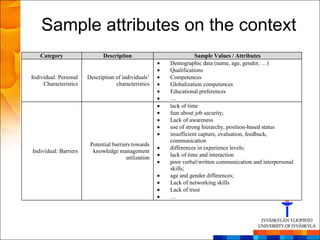
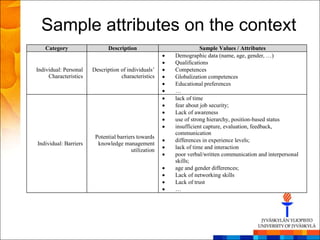
Sample attributes on the context
   Category                  Description                         Sample Values / Attributes
                                                      Demographic data (name, age, gender, …)
                                                      Qualifications
Individual: Personal   Description of individuals’    Competences
     Characteristics               characteristics    Globalization competences
                                                      Educational preferences
                                                      …
                                                      lack of time
                                                      fear about job security;
                                                      Lack of awareness
                                                      use of strong hierarchy, position-based status
                                                      insufficient capture, evaluation, feedback,
                                                      communication
                        Potential barriers towards
                                                      differences in experience levels;
Individual: Barriers     knowledge management
                                        utilization   lack of time and interaction
                                                      poor verbal/written communication and interpersonal
                                                      skills;
                                                      age and gender differences;
                                                      Lack of networking skills
                                                      Lack of trust
                                                      …
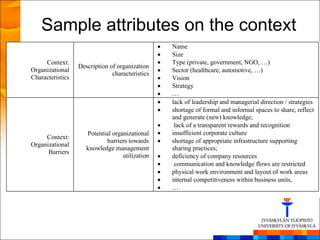
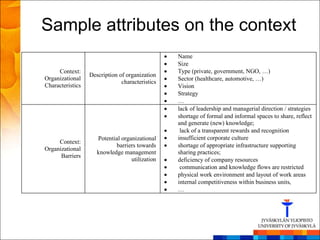
Sample attributes on the context
                                                 Name
                                                 Size
     Context:                                    Type (private, government, NGO, …)
                  Description of organization
Organizational                                   Sector (healthcare, automotive, …)
                               characteristics
Characteristics                                  Vision
                                                 Strategy
                                                 …
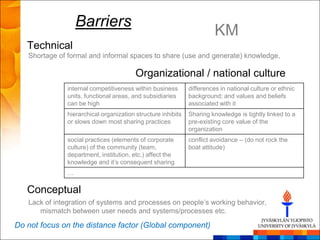
                                                 lack of leadership and managerial direction / strategies
                                                 shortage of formal and informal spaces to share, reflect
                                                 and generate (new) knowledge;
                                                  lack of a transparent rewards and recognition
                     Potential organizational    insufficient corporate culture
     Context:
                            barriers towards     shortage of appropriate infrastructure supporting
Organizational
                     knowledge management        sharing practices;
      Barriers
                                   utilization   deficiency of company resources
                                                  communication and knowledge flows are restricted
                                                 physical work environment and layout of work areas
                                                 internal competitiveness within business units,
                                                 …
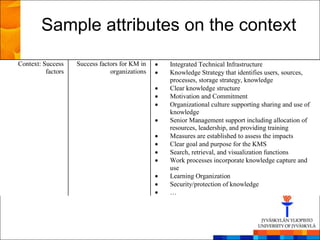
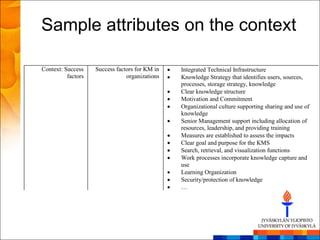
Sample attributes on the context
Context: Success    Success factors for KM in   Integrated Technical Infrastructure
          factors               organizations   Knowledge Strategy that identifies users, sources,
                                                processes, storage strategy, knowledge
                                                Clear knowledge structure
                                                Motivation and Commitment
                                                Organizational culture supporting sharing and use of
                                                knowledge
                                                Senior Management support including allocation of
                                                resources, leadership, and providing training
                                                Measures are established to assess the impacts
                                                Clear goal and purpose for the KMS
                                                Search, retrieval, and visualization functions
                                                Work processes incorporate knowledge capture and
                                                use
                                                Learning Organization
                                                Security/protection of knowledge
                                                …
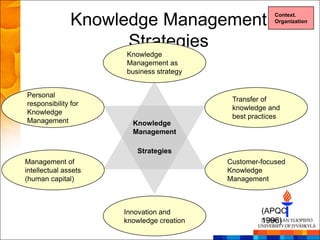
Knowledge Management                     Context.
                                                        Organization


                     Strategies
                      Knowledge
                      Management as
                      business strategy


Personal
                                            Transfer of
responsibility for
                                            knowledge and
Knowledge
                                            best practices
Management              Knowledge
                        Management

                         Strategies
Management of                              Customer-focused
intellectual assets                        Knowledge
(human capital)                            Management


                      Innovation and                (APQC
                      knowledge creation            1996)
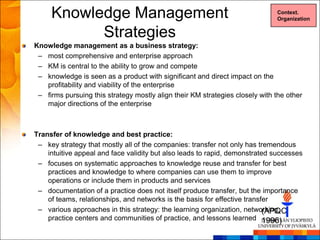
Knowledge Management                                                     Context.
                                                                              Organization


           Strategies
Knowledge management as a business strategy:
 – most comprehensive and enterprise approach
 – KM is central to the ability to grow and compete
 – knowledge is seen as a product with significant and direct impact on the
   profitability and viability of the enterprise
 – firms pursuing this strategy mostly align their KM strategies closely with the other
   major directions of the enterprise


Transfer of knowledge and best practice:
 – key strategy that mostly all of the companies: transfer not only has tremendous
    intuitive appeal and face validity but also leads to rapid, demonstrated successes
 – focuses on systematic approaches to knowledge reuse and transfer for best
    practices and knowledge to where companies can use them to improve
    operations or include them in products and services
 – documentation of a practice does not itself produce transfer, but the importance
    of teams, relationships, and networks is the basis for effective transfer
 – various approaches in this strategy: the learning organization, networking,
                                                                           (APQC
    practice centers and communities of practice, and lessons learned 1996)
Knowledge Management                                             Context.
                                                                       Organization


            Strategies
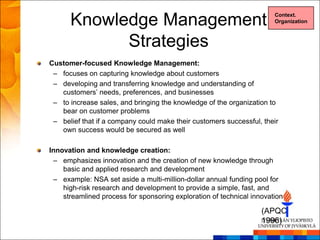
Customer-focused Knowledge Management:
 – focuses on capturing knowledge about customers
 – developing and transferring knowledge and understanding of
   customers‘ needs, preferences, and businesses
 – to increase sales, and bringing the knowledge of the organization to
   bear on customer problems
 – belief that if a company could make their customers successful, their
   own success would be secured as well

Innovation and knowledge creation:
 – emphasizes innovation and the creation of new knowledge through
    basic and applied research and development
 – example: NSA set aside a multi-million-dollar annual funding pool for
    high-risk research and development to provide a simple, fast, and
    streamlined process for sponsoring exploration of technical innovation

                                                                   (APQC
                                                                   1996)
Knowledge Management
             Strategies
Management of intellectual assets (human capital):
 – emphasizes enterprise-level management of specific intellectual assets such
   as patents, technologies, operational and management practices, customer
   relations, organizational arrangement, and other structural knowledge assets
 – management focus may center on renewing, organizing, evaluating,
   marketing, and increasing the availability of these assets

Personal responsibility for Knowledge Management:
 – people are the engine of knowledge and should be supported as such,
 – individuals are personally responsible for identifying, maintaining, and
    expanding their own knowledge as well as understanding, renewing, and
    sharing their knowledge assets
 – reasons for this strategy: perception of the value of having employees who
    are broadly knowledgeable and able to perform competent work, and the
    understanding that successful development of knowledge in individuals
    cannot be micromanaged and must be done by the individual
 – strategy is in line with the emerging paradigm that employees are the
    ultimate source of new knowledge in a firm and that they are responsible for
    their own knowledge development
                                                                      (APQC
                                                                    1996)
Knowledge Management
             Strategies
Global Aspects of Strategies
 – Which partners are strategic & trusted in terms of knowledge exchange?
 – How to align strategies for knowledge in all parts of the globe?
 – Which knowledge makes competitive advantages?


Guidance
 – Develop national / regional strategies
 – Provide strategies in local languages
 – Let partners participate in strategy development
 – Define procedures for strategy implementation


                                                                 (APQC
                                                                 1996)
Knowledge Management Framework                                    Context
                                                                  Processes
   Business Focus (CEN, 2004)

  The business focus should be in the centre of any KM
  initiative and represents the value-adding processes of an
  organization, which may typically include
   – strategy development
   – product/service innovation and
   – development, manufacturing and service delivery, sales and
     customer support.
  Processes represent the organizational context, creating
  critical knowledge on
   –   products and services
   –   Customers
   –   technology
   –   …
  Processes are inter-organizational in distributed networks
                                            (CEN
                                               2004)
Knowledge Management Framework                                                             Processes

          Business Focus
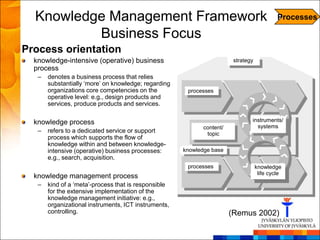
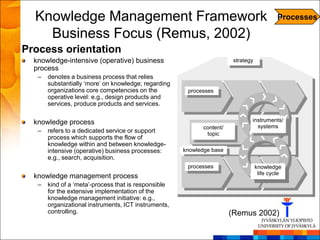
Process orientation
  knowledge-intensive (operative) business                               strategy
  process
   –   denotes a business process that relies
       substantially ‗more‘ on knowledge; regarding
       organizations core competencies on the          processes
       operative level: e.g., design products and
       services, produce products and services.

  knowledge process                                                             instruments/
                                                             content/             systems
   –   refers to a dedicated service or support               topic
       process which supports the flow of
       knowledge within and between knowledge-
       intensive (operative) business processes:      knowledge base
       e.g., search, acquisition.
                                                       processes                    knowledge
                                                                                     life cycle
  knowledge management process
   –   kind of a ‗meta‘-process that is responsible
       for the extensive implementation of the
       knowledge management initiative: e.g.,
       organizational instruments, ICT instruments,
       controlling.                                                     (Remus 2002)
Knowledge Management Framework                            Processes

Core Knowledge Activities (CEN, 2004)


 Five core knowledge activities:
  – identify, create, store, share and use.
  – Supported by the right KM methods and tools
 Requirements have to be fulfilled to achieve
 improvements
  – Integration / alignment of core activities with
    organizational processes and daily tasks.
  – Carefully balanced in accordance with the
    specificities of each business process and
    organization. A KM solution should not focus only on
    one or two activities in isolation.
Knowledge Management Framework                                                      Processes

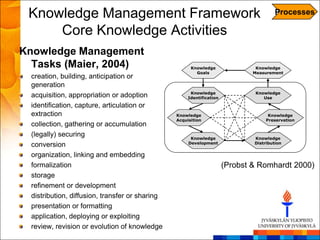
     Core Knowledge Activities
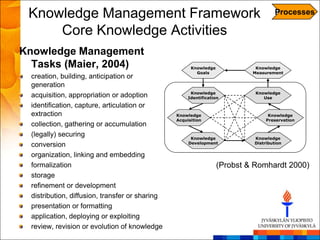
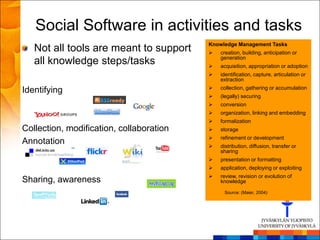
Knowledge Management
  Tasks (Maier, 2004)                                  Knowledge             Knowledge
                                                         Goals              Measurement
  creation, building, anticipation or
  generation
                                                       Knowledge             Knowledge
  acquisition, appropriation or adoption              Identification            Use

  identification, capture, articulation or
  extraction                                     Knowledge                        Knowledge
                                                 Acquisition                     Preservation
  collection, gathering or accumulation
  (legally) securing                                   Knowledge            Knowledge
                                                      Development           Distribution
  conversion
  organization, linking and embedding
  formalization                                                    (Probst & Romhardt 2000)
  storage
  refinement or development
  distribution, diffusion, transfer or sharing
  presentation or formatting
  application, deploying or exploiting
  review, revision or evolution of knowledge
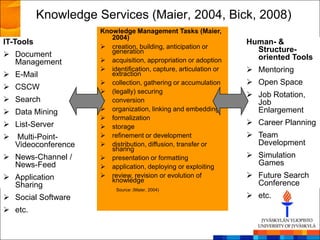
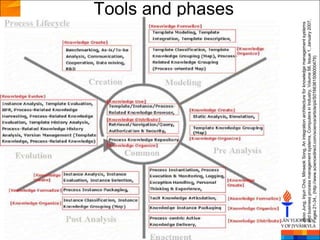
Knowledge Management Framework:                                                    Instruments

            Enabler
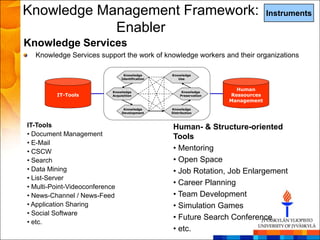
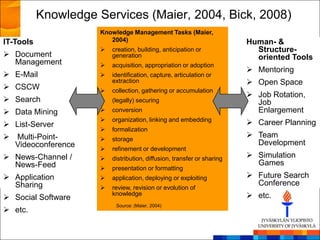
Knowledge Services
  Knowledge Services support the work of knowledge workers and their organizations

                                  Knowledge       Knowledge
                                 Identification      Use


                            Knowledge                   Knowledge
                                                                        Human
         IT-Tools           Acquisition                Preservation   Ressources
                                                                      Management
                                  Knowledge       Knowledge
                                 Development      Distribution


IT-Tools                                           Human- & Structure-oriented
• Document Management                              Tools
• E-Mail
• CSCW                                             • Mentoring
• Search                                           • Open Space
• Data Mining                                      • Job Rotation, Job Enlargement
• List-Server
• Multi-Point-Videoconference
                                                   • Career Planning
• News-Channel / News-Feed                         • Team Development
• Application Sharing                              • Simulation Games
• Social Software
                                                   • Future Search Conference
• etc.
                                                   • etc.
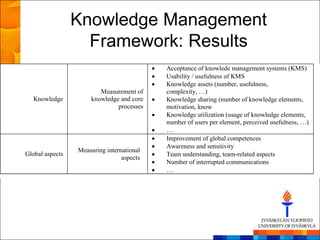
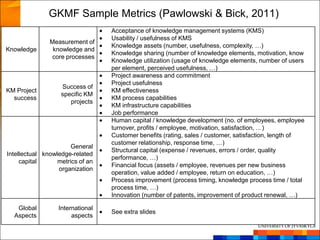
Knowledge Management
                   Framework: Results
                                           Acceptance of knowlede management systems (KMS)
                                           Usability / usefulness of KMS
                                           Knowledge assets (number, usefulness,
                        Measurement of     complexity, …)
   Knowledge         knowledge and core    Knowledge sharing (number of knowledge elements,
                              processes    motivation, know
                                           Knowledge utilization (usage of knowledge elements,
                                           number of users per element, perceived usefulness, …)
                                           …
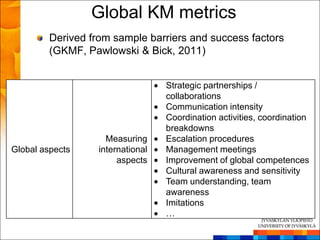
                                           Improvement of global competences
                                           Awareness and sensitivity
                 Measuring international
Global aspects                             Team understanding, team-related aspects
                                 aspects
                                           Number of interrupted communications
                                           …
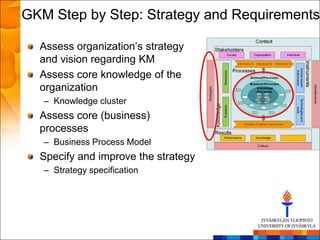
GKM Step by Step: Strategy and Requirements

  Assess organization‘s strategy
  and vision regarding KM
  Assess core knowledge of the
  organization
   – Knowledge cluster
  Assess core (business)
  processes
   – Business Process Model
  Specify and improve the strategy
   – Strategy specification
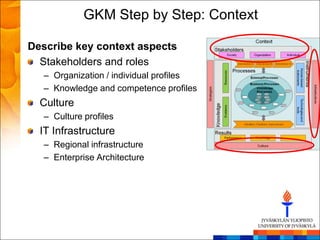
GKM Step by Step: Context

Describe key context aspects
  Stakeholders and roles
   – Organization / individual profiles
   – Knowledge and competence profiles
  Culture
   – Culture profiles
  IT Infrastructure
   – Regional infrastructure
   – Enterprise Architecture
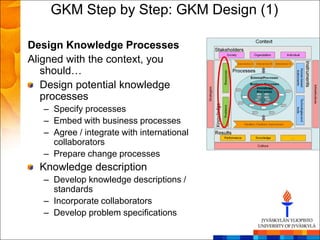
GKM Step by Step: GKM Design (1)

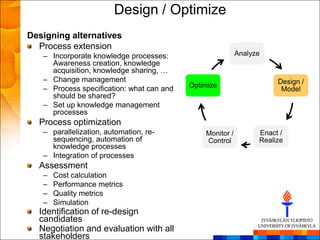
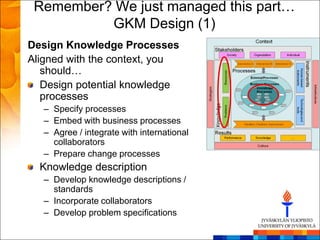
Design Knowledge Processes
Aligned with the context, you
   should…
   Design potential knowledge
   processes
   – Specify processes
   – Embed with business processes
   – Agree / integrate with international
     collaborators
   – Prepare change processes
  Knowledge description
   – Develop knowledge descriptions /
     standards
   – Incorporate collaborators
   – Develop problem specifications
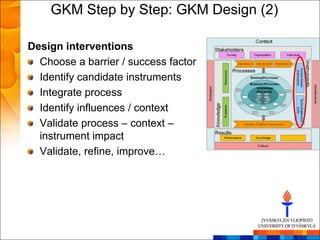
GKM Step by Step: GKM Design (2)

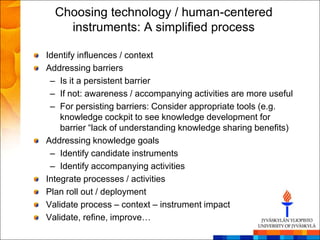
Design interventions
  Choose a barrier / success factor
  Identify candidate instruments
  Integrate process
  Identify influences / context
  Validate process – context –
  instrument impact
  Validate, refine, improve…
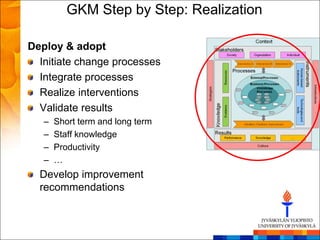
GKM Step by Step: Realization

Deploy & adopt
  Initiate change processes
  Integrate processes
  Realize interventions
  Validate results
   –   Short term and long term
   –   Staff knowledge
   –   Productivity
   –   …
  Develop improvement
  recommendations
Summary
Successful Global KM is still a creative, explorative
design activity
Factors are identified but their interdependencies
and context-correlations are unclear
Step by step, participatory approaches with
validations and continuous improvement
More research to be done…
Guiding questions
How to embed knowledge management in a strategy?
How could knowledge processes be integrated in work
processes?
What are promising tools?
How can knowledge sharing be embedded in a
collaborative environment?
Contact Information

Prof. Dr. Jan M. Pawlowski
 jan.pawlowski@jyu.fi
 Skype: jan_m_pawlowski

 Office: Room 514.2
 Telephone +358 14 260 2596
 http://users.jyu.fi/~japawlow
Global Knowledge Management

            Context and Barriers


Jan M. Pawlowski, Henri Pirkkalainen, Markus Bick, Franz
                        Lehner
                     15.11.2011
Licensing: Creative Commons
  You are free:                                           Collaborative Course Development!
       to Share — to copy, distribute and transmit
           the work                                       Thanks to my colleagues Prof. Dr.
                                                          Markus Bick and Prof. Dr. Franz Lehner
       to Remix — to adapt the work
                                                          who have developed parts of the
                                                          Knowledge Management Course which
  Under the following conditions:                         we taught together during the Jyväskylä
         Attribution. You must attribute the work in      Summer School Course 2011.
             the manner specified by the author or
             licensor (but not in any way that
             suggests that they endorse you or your       Prof. Dr. Markus Bick (Introduction,
             use of the work).                            CEN Framework)
         Noncommercial. You may not use this              ESCP Europe Campus Berlin
             work for commercial purposes.                Web: http://www.escpeurope.de/wi
         Share Alike. If you alter, transform, or build
                                                          Prof. Dr. Franz Lehner (Assessment,
             upon this work, you may distribute the
                                                          Process Integration)
             resulting work only under the same or
                                                          University of Passau
             similar license to this one.
                                                          Web: http:// www.wi.uni-passau.de/
  http://creativecommons.org/licenses/by-nc-sa/3.0/
Contents
Context
– What is it?
– Context Models
Cultural context
– Culture Models
– Organizational culture analysis
Barriers and Success Factors
– KM Barriers
– Global Barriers
– Social Software Barriers
Context


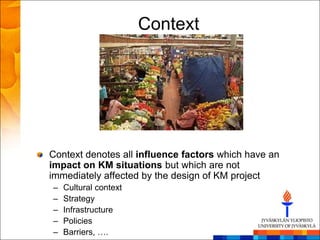
Context denotes all influence factors which have an
impact on KM situations but which are not
immediately affected by the design of KM project
–   Cultural context
–   Strategy
–   Infrastructure
–   Policies
–   Barriers, ….
Context
Purpose
– Understanding the situation of KM and its potentials
– Adapting interventions and tools to this situation
Challenges
– What are the aspects that matter (most)?
– What are models to be used?
– How to distinguish the important and irrelevant aspects?
Global KM Context
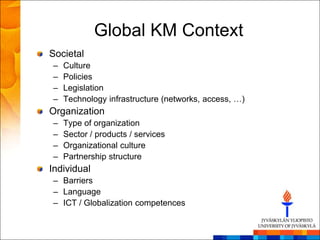
Societal
–   Culture
–   Policies
–   Legislation
–   Technology infrastructure (networks, access, …)
Organization
–   Type of organization
–   Sector / products / services
–   Organizational culture
–   Partnership structure
Individual
– Barriers
– Language
– ICT / Globalization competences
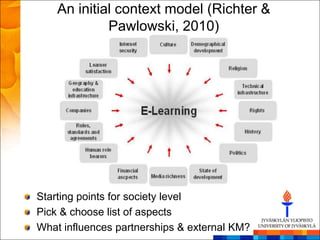
An initial context model (Richter &
             Pawlowski, 2010)


Starting points for society level
Pick & choose list of aspects
What influences partnerships & external KM?
Samples of Context Influences
Human-oriented instruments
 – How are KM interventions perceived (culture)
 – How is concrete knowledge shared (e.g. legislation:
   critical technologies), how is privacy / IPR perceived?
Technology-oriented instruments
 – Which technologies can be used (infrastructure)
 – Which technologies are well adopted (e.g. mobile video
   streaming, google vs baidu, …)
Process design
 – Culture & organizational practices influence business
   processes
 – Roles and responsibilities (culture, who is responsible for
   KM, who owns KM)
 – External processes: trust aspects
Definitions of Culture
―Culture is the collective programming of the mind
which distinguishes the members of one category of
people from another.‖ (Hofstede, 1984)
―Most social scientists today view culture as
consisting primarily of the symbolic, ideational, and
intangible aspects of human societies. The essence of
a culture is not its artifacts, tools, or other tangible
cultural elements but how the members of the group
interpret, use, and perceive them. It is the values,
symbols, interpretations, and perspectives that
distinguish one people from another in modernized
societies; it is not material objects and other tangible
aspects of human societies. People within a culture
usually interpret the meaning of symbols, artifacts,
and behaviors in the same or in similar ways‖ (Banks
et al. 1989)
Definitions of Culture
Culture is defined as the ―[…] definitive, dynamic
purposes and tools (values, ethics, rules, knowledge
systems) that are developed to attain group goals‖
(Mabawonku, 2003)
Culture includes ―[..]every aspect of life: know-how,
technical knowledge, customs of food and dress,
religion, mentality, values, language, symbols, socio-
political and economic behavior, indigenous methods
of taking decisions and exercising power, methods of
production and economic relations, and so on."
(Verhelst, 1990)
The system of shared beliefs, values, customs,
behaviours, and artifacts that the members of society
use to cope with their world and with one another, and
that are transmitted from generation to generation
through learning (Bates, Plog, 1990)
How does culture influence KM?

Impact on
–   Working style
–   Group behavior
–   Communication
–   Design
–   …
How to represent culture / which aspects should be
analyzed?
How do these aspects influence KM processes?
More perspectives on ―culture‖
Organizational or corporate culture: Management
style, rewards, working atmosphere
Professional culture: Formal education within a group
of professionals
Functional culture: functional roles within the
organization
Team culture: common work experiences
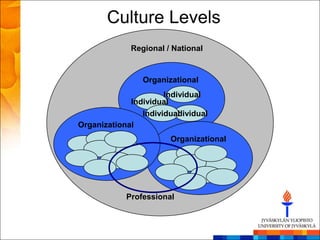
Culture Levels
             Regional / National


                Organizational
                      Individual
             Individual
                Individual
                        Individual
Organizational
                        Organizational


            Professional
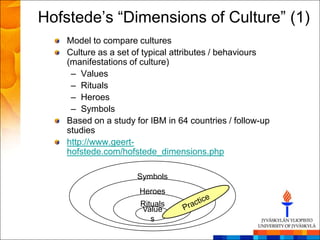
Hofstede‘s ―Dimensions of Culture‖ (1)
    Model to compare cultures
    Culture as a set of typical attributes / behaviours
    (manifestations of culture)
     – Values
     – Rituals
     – Heroes
     – Symbols
    Based on a study for IBM in 64 countries / follow-up
    studies
    http://www.geert-
    hofstede.com/hofstede_dimensions.php

                      Symbols
                      Heroes
                      Rituals
                      Value
                         s
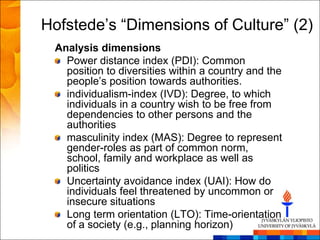
Hofstede‘s ―Dimensions of Culture‖ (2)
 Analysis dimensions
   Power distance index (PDI): Common
   position to diversities within a country and the
   people‘s position towards authorities.
   individualism-index (IVD): Degree, to which
   individuals in a country wish to be free from
   dependencies to other persons and the
   authorities
   masculinity index (MAS): Degree to represent
   gender-roles as part of common norm,
   school, family and workplace as well as
   politics
   Uncertainty avoidance index (UAI): How do
   individuals feel threatened by uncommon or
   insecure situations
   Long term orientation (LTO): Time-orientation
   of a society (e.g., planning horizon)
Hofstede‘s ―Dimensions of Culture‖
Country/Region
  Germany
                Score Rank
                 26    70     Germany   (3) 18 Country/Region Score
                           Country/Region Score Rank
                                           67        Germany   66
                                                                                                                Rank
                                                                                                                11-13
  Austria                11      74            Austria           55      27            Austria           79       4
  France                 68     27-29          France            71     13-14          France            43     47-50
  Spain                  57     45-46          Spain             51      30            Spain             42     51-53
  Portugal               63     37-38          Portugal          27     49-51          Portugal          31      65
  South Korea            60     41-42          South Korea       18      63            South Korea       39      59
  Brazil                 69      26            Brazil            38     39-40          Brazil            49      37
  Guatemala              95      3-4           Guatemala         6       74            Guatemala         37     61-62

Values for Power Distance Index (PDI)      Values for Individualism Index (IDV)     Values for Masculinity Index (MAS)
              Country/Region Score Rank                        Country/Region Score Rank
                 Germany       65   43                            Germany      31   25-27
                 Austria       70  35-38                          Austria      31   25-27
                 France        86  17-22                          France       39    19
                 Spain         86  17-22                          Spain        19   35-36
                 Portugal     104    2                            Portugal     30   28-30
                 South Korea   85  23-25                          South Korea   75    6
                 Brazil        76  31-32                          Brazil       65     7
                 Guatemala    101    3                            Guatemala    n.a.  n.a.

          Values for Uncertainly Avoidance Index (UAI)
                                                          Values for Long-Term Orientation Index (LTO)

           [Source: http://www.geert-hofstede.com/hofstede_dimensions.php]
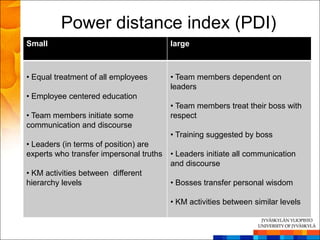
Power distance index (PDI)
Small                                    large


• Equal treatment of all employees       • Team members dependent on
                                         leaders
• Employee centered education
                                         • Team members treat their boss with
• Team members initiate some             respect
communication and discourse
                                         • Training suggested by boss
• Leaders (in terms of position) are
experts who transfer impersonal truths   • Leaders initiate all communication
                                         and discourse
• KM activities between different
hierarchy levels                         • Bosses transfer personal wisdom

                                         • KM activities between similar levels
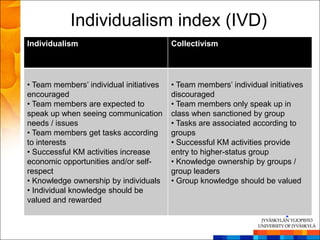
Individualism index (IVD)
Individualism                            Collectivism


• Team members‘ individual initiatives   • Team members‘ individual initiatives
encouraged                               discouraged
• Team members are expected to           • Team members only speak up in
speak up when seeing communication       class when sanctioned by group
needs / issues                           • Tasks are associated according to
• Team members get tasks according       groups
to interests                             • Successful KM activities provide
• Successful KM activities increase      entry to higher-status group
economic opportunities and/or self-      • Knowledge ownership by groups /
respect                                  group leaders
• Knowledge ownership by individuals     • Group knowledge should be valued
• Individual knowledge should be
valued and rewarded
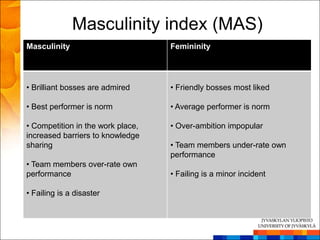
Masculinity index (MAS)
Masculinity                        Femininity


• Brilliant bosses are admired     • Friendly bosses most liked

• Best performer is norm           • Average performer is norm

• Competition in the work place,   • Over-ambition impopular
increased barriers to knowledge
sharing                            • Team members under-rate own
                                   performance
• Team members over-rate own
performance                        • Failing is a minor incident

• Failing is a disaster
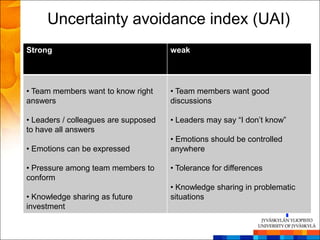
Uncertainty avoidance index (UAI)
Strong                                weak


• Team members want to know right     • Team members want good
answers                               discussions

• Leaders / colleagues are supposed   • Leaders may say ―I don‘t know‖
to have all answers
                                      • Emotions should be controlled
• Emotions can be expressed           anywhere

• Pressure among team members to      • Tolerance for differences
conform
                                      • Knowledge sharing in problematic
• Knowledge sharing as future         situations
investment
Long term orientation (LTO)
Long team orientation                     Short term orientation


• Team members attribute success to       • Team members attribute both
effort and failure to lack of effort      success and failure to luck and fate

• Working hard is norm                    • Enjoyment is norm

• Talent for applied, concrete sciences   • Talent for theoretical, abstract
                                          sciences
• Children learn to save
                                          • Children learn to spend
Some issues based on Hofstede…

PDI: How is knowledge shared between hierarchy
levels?
IVD: Who ―owns‖ knowledge, is it a common good in
an organization?
MAS: Are there different ways of sharing knowledge?
UAI/LTO: Is knowledge management seen as help for
future problems?
Critical Analysis
Empirical study in a corporate culture
Results were evaluated in hundreds of settings
Relative values seem to be stabile (while absolute values
are changing)
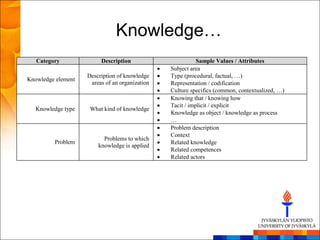
Not applicable to all contexts
Interpretations for KM and specific components (e.g.,
communication) are questionable (see previous slides )
KM should take those categories as guidelines for
discourse
KM should be designed based on more detailed cultural
aspects (e.g. media / software use, communication
behavior, roles and responsibilities, …)
Analyzing culture: Characteristics   Context.
                                     Society / Culture

   (De Long & Fahey, 2000)
Context.
KM Success Factors and Guidance (De Long                   Organization /
                                                           Individuals
            & Fahey, 2000)                                  Instruments

 Cultural assumptions
  – Which knowledge is common & useful?
  – Analyze cultural influences on priorities (e.g. knowledge
    sharing vs project management)
  – Identify critical knowledge tasks (e.g., customer knowledge)
  – Identify current practices
 Understanding and defining knowledge
  – How do different groups define (important, common, priority)
    knowledge
  – Identify skills / motivation for different instruments (e.g.
    knowledge repositories)
 Importance of individual knowledge
 Enable cross-function knowledge sharing
Context.
                                                       Organization /
KM Success Factors and Guidance                        Individuals

    (De Long & Fahey, 2000)                             Instruments


Enable cross-function knowledge sharing
 – Changes of ownership of knowledge?
 – Which new behavior patterns are needed by leaders
 – Provide examples of practices
Culture as context for social interaction
 –   Vertical interactions
 –   Approachability
 –   Horizontal interactions
 –   Interactivity
 –   Sharing and teaching
 –   Dealing with mistakes
Analyzing culture: Distance   Context.
                              Society / Culture

   (Dawes et al., 2011)
Summary
Culture models are abstract, focusing (in most
cases) on national culture
Take the models as an orientation
– General orientation: Abstract models such as Hofstede
– Detailed design decisions based on organizational and
  detailed cultural characteristics
Use the models as a discussion issue: observe,
reflect, ask, discuss and share!
GKMF provides selected attributes for societal,
organizational and individual influence factors
– Base for adaptation
– Templates and representation of attributes
Consequences KM practice
How to relate cultural influence factors and knowledge
intensive processes?
Culture as main driver for
–   Identifying common knowledge
–   Understanding knowledge sharing processes
–   Defining and analyzing roles and relations
–   Creating trust and awareness
–   Motivation and attitudes
Building culture profiles and culture competences
Identify cultural barriers
Relate culture to key processes and interventions
Sample attributes on the context
   Category                  Description                         Sample Values / Attributes
                                                      Demographic data (name, age, gender, …)
                                                      Qualifications
Individual: Personal   Description of individuals’    Competences
     Characteristics               characteristics    Globalization competences
                                                      Educational preferences
                                                      …
                                                      lack of time
                                                      fear about job security;
                                                      Lack of awareness
                                                      use of strong hierarchy, position-based status
                                                      insufficient capture, evaluation, feedback,
                                                      communication
                        Potential barriers towards
                                                      differences in experience levels;
Individual: Barriers     knowledge management
                                        utilization   lack of time and interaction
                                                      poor verbal/written communication and interpersonal
                                                      skills;
                                                      age and gender differences;
                                                      Lack of networking skills
                                                      Lack of trust
                                                      …
Sample attributes on the context
                                                 Name
                                                 Size
     Context:                                    Type (private, government, NGO, …)
                  Description of organization
Organizational                                   Sector (healthcare, automotive, …)
                               characteristics
Characteristics                                  Vision
                                                 Strategy
                                                 …
                                                 lack of leadership and managerial direction / strategies
                                                 shortage of formal and informal spaces to share, reflect
                                                 and generate (new) knowledge;
                                                  lack of a transparent rewards and recognition
                     Potential organizational    insufficient corporate culture
     Context:
                            barriers towards     shortage of appropriate infrastructure supporting
Organizational
                     knowledge management        sharing practices;
      Barriers
                                   utilization   deficiency of company resources
                                                  communication and knowledge flows are restricted
                                                 physical work environment and layout of work areas
                                                 internal competitiveness within business units,
                                                 …
Sample attributes on the context

Context: Success    Success factors for KM in   Integrated Technical Infrastructure
          factors               organizations   Knowledge Strategy that identifies users, sources,
                                                processes, storage strategy, knowledge
                                                Clear knowledge structure
                                                Motivation and Commitment
                                                Organizational culture supporting sharing and use of
                                                knowledge
                                                Senior Management support including allocation of
                                                resources, leadership, and providing training
                                                Measures are established to assess the impacts
                                                Clear goal and purpose for the KMS
                                                Search, retrieval, and visualization functions
                                                Work processes incorporate knowledge capture and
                                                use
                                                Learning Organization
                                                Security/protection of knowledge
                                                …
Summary
Models to represent culture…
– Have been developed for different purposes and context
– Vary in their level of abstraction
– Can be used as a guideline to identify influence factors
No model is validated to cover all influence factors
for a design and development process
Besides: Other requirements have to be taken into
account!
Henri Pirkkalainen

  Project Researcher
  (2009-)
  M.Sc (Econ) (2010)
  Projects: OpenScout,
  TEL-Map

Ph.D topics:
                              GSM: +358 400247684
Social Software, Global       Mail: henri.j.pirkkalainen@jyu.fi
Knowledge Sharing, Open
Educational Resources
Context.
                                                   Organization /
                                                   Individuals
Barriers and Success Factors
              – Knowledge management project fail often


 Which are the main barriers to successful Knowledge
 Management activities?
 Which are success factors?
 How do those barriers and success factors differ in
 global settings?
Barriers?
Discussed from the viewpoint of an individual or group of people

Can relate to social interaction and as an example to factors that
hinder or challenge knowledge exchange

Might relate to challenges and risks when adopting or using a
specific technology

Challenges set by diverse workers, hierarchies and cultural
influences within an organization

In many cases tied to a specific context

Can be presented as a wider concept ―cultural distance‖
         …or as a question that is formed from the problem,
―How to reward contribution?‖…
Barriers

                +                        +

Organizational   Dependent on business       Location, time, culture
and hierarchical process and project         and language


         =


                “Knowledge Islands”
Success factors - barriers
                                          Critical Success Factors (CSF)

The relation between a barrier and success factor not always clear

             …not always counter balanced in a way that overcoming a
             barrier means a success

…not all success factors can be derived from barriers


 Barriers are a starting point to understand success factors within a
                            specific context

        Geographical dispersion of individuals
                         CSF
  ―set meeting schedules and rules of engagement‖
       ―conduct periodic face-to-face meetings‖
Context.
                                                                                 Organization /

                     Success Factors                                             Individuals
                                                                                   Instruments

Holistic, integrated and standardized approach
 –   KM integrated within culture, coordination, and leadership
 –   Consider relationships and interdependencies
 –   Avoid isolated solutions, e. g., different, incompatible communication systems, no
     standards, different knowledge processes,
 –   Knowledge processes and ICT platforms for KM should be standardized
     throughout the organization and integrated with the existing business processes.
Knowledge-oriented culture
 –   Supportive organizational culture
 –   Open and communicative atmosphere
 –   Supporting a knowledge-oriented culture through e. g., communication of success
     stories and best practices, through the acceptance of errors a s well as promoting
     individual responsibility
Management support
 –   Top management to strategic knowledge goals, allocate sufficient budgets to the
     KM initiative
 –   Providing good example for the change of behavior
 –   A knowledge champion can act as a coordinator for management support as well
     as key speaker and motivator for the initiative.
The challenge
Analyzing the cultural, organizational, and individual
context
Identifying barriers and potential success factors
Choosing and creating solutions (=interventions /
methods)
–   Aligned with strategies and processes
–   Addressing barriers
–   Involving all stakeholders
–   Not overloading people
–   Choosing and creating solutions (=interventions / methods)
Utilizing barrier-knowledge in KM processes
KM Barriers


(Pirkkalainen & Pawlowski 2011)
KM barriers
The bottleneck usually knowledge sharing


         Common ways of categorization (if categorized at all)

Individual, organizational, technological (Riege 2005)

            Individual, social (Disterer 2001)
(Individual: Loss of Power, Revelation, Uncertainty, Motivation
Social: Language, Conflict avoidance, bureucracy and Hierarchy, Incoherent
paradigms)


Individual, social (Bures 2003)
Knowledge sharing barriers
          Barrier                                     Description

Lack of interpersonal Level of trust in a company, between its sub-units, and its
trust                 employees seems to have a direct influence on the
                             communication flow and thus the amount of knowledge
                             sharing (Riege, 2005)


Lack of opportunities Appropriate infrastructure and resources to facilitate sharing
for sharing (resources, practices within and between functional areas is the basis of a
time,           networks, successful KM (Schlegelmilch and Chini, 2003)
infrastructures)

How       to   reward Managers many have to force people to transform their
contribution      and organisation into knowledge-embracing cultures. No matter
encourage information which reward and recognition system is chosen (Riege, 2005)
sharing

Lack of motivation to Sharing only if it’s important to their work, if they feel
share                 encouraged to share and learn, or if they wish to support a
                             certain colleague (Wheatley, 2000)


Fear of harming his or Fear that sharing may reduce or jeopardise people’s job’s
her image if sharing   security or even employee’s corporate position


“Knowledge is power” - By providing knowledge to the colleague, the exclusivity of
Loss of Power through influence is reduced (Bures, 2003)
Sharing
                             Pirkkalainen & Pawlowski 2011
Barriers                                            KM
Financial
Resources for providing adequate sharing opportunities


Management/Coordination/support
How to reward contribution          Integration of KM strategy into company‘s
                                    goals
Lack of transparent recognition     Unrealistic expectations of employees
and reward systems
Lack of leadership and managerial   Lack of training, lack of technical support etc.
direction
…


Skills
Poor verbal/written communication and interpersonal skills
Barriers                                           KM
                       Social aspects
Lack of trust                        Unwilligness to receive:
Knowledge is difficult to transfer
                                     Preferring own ideas
Lack of motivation to share,         Doubt validity and reliability of received
unwilligness to share                knowledge
Knowledge is the power (loss of      Have strong group affiliations
power through sharing)               Too proud to accept knowledge
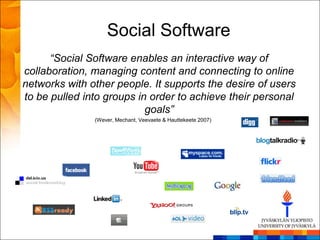
Knowledge parasites
Group thinking (―why change a        apprehension of fear that sharing may reduce
winner group‖)                       or jeopardize people‘s job security
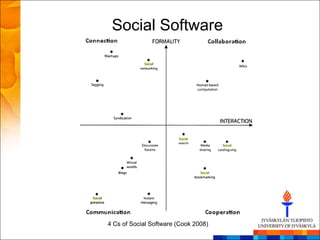
Difference in experience levels      Age differences
…
Barriers
                                                                        KM
   Technical
   Shortage of formal and informal spaces to share (use and generate) knowledge,

                                         Organizational / national culture
               internal competitiveness within business       differences in national culture or ethnic
               units, functional areas, and subsidiaries      background; and values and beliefs
               can be high                                    associated with it
               hierarchical organization structure inhibits   Sharing knowledge is tightly linked to a
               or slows down most sharing practices           pre-existing core value of the
                                                              organization
               social practices (elements of corporate        conflict avoidance – (do not rock the
               culture) of the community (team,               boat attitude)
               department, institution, etc.) affect the
               knowledge and it‘s consequent sharing
               …

   Conceptual
   Lack of integration of systems and processes on people‘s working behavior,
      mismatch between user needs and systems/processes etc.

Do not focus on the distance factor (Global component)
Relation of concepts


    Pirkkalainen & Pawlowski 2011
Global barriers


   …long traditions!
Global IS barriers
        Barrier                              Description

Cultural         and     Do the collaborators share the same language,
                         skills as well as cultural norms, corporate culture,
language distance        interpretations etc. Most occurred barrier in Noll
                         et al, (2010) analysis on collaboration barriers in
                         GSD.


Geographical             Distributed collaboration (within a country or
                         cross-border). Third most occurred barrier in Noll
distance                 et al, (2010) analysis on collaboration barriers in
                         GSD.


Temporal distance        Distributed collaboration (Time-zone differences).
                         Second most occurred barrier in Noll et al, (2010)
                         analysis on collaboration barriers in GSD.


Lack of trust            Geographic, temporal, and cultural distance have a
                         significant impact on trust among globally
                         distributed team members (Noll et al, 2010)


Infrastructure           In distributed collaboration teams and employees
                         must rely on technology to support the
                         communication (Noll et al, 2010)


                    Pirkkalainen & Pawlowski 2011
Barriers                                    Global IS
                         Leadership/Coordination (Team aspects)
                     Lack of overlapping hours     lack of group awareness and team spirit
                     coordination breakdown        incompatible views of the problem
                     reduced trust                 synchronizing work between locations
                     …


     Organizational culture /national culture
Cultural diversity (influences values and        Communication flows restricted into certain
practices of people)                             directions

Solidarity – (how quickly members pursue         Lack of common usage and norms
shared objectives regardless of personal ties)
multi-disciplinary setting                       unbalanced expertise
Time perceptions (may have different views       Unbalanced power in decision making processes
on deadlines, timelines, work rhythms etc.
    ,,,
Unbalanced technological usage and               Lack of common conceptual understanding
expertise
…
Barriers                                    Global IS
Geographical / temporal
Geographical dispersion        Different time-zones


                        Social aspects (relational, communication/ collaboration etc.)
Weak ties among individuals (not knowing in     Loss of communication richness
advance)
Lack of interpersonal awareness                 Delayed responses
Lack of mutual trust                            Misunderstandings
Lack of possibilities for synchronous           Lack of informal communication
communication
Trouble in finding correct contact              Unclear roles and responsibilities
Multi-lingual setting (language distance)       Lack of absorptive capacity (learning/adapting)
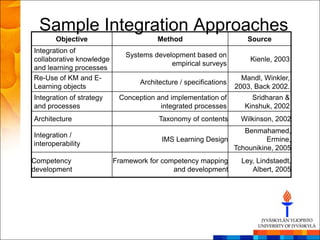
…
Social Software

Various ways to define


      No right or wrong….. But still better and worse ways of
  describing…
Similarity to Social Media
Social Software
      “Social Software enables an interactive way of
collaboration, managing content and connecting to online
networks with other people. It supports the desire of users
to be pulled into groups in order to achieve their personal
                           goals”
               (Wever, Mechant, Veevaete & Hauttekeete 2007)
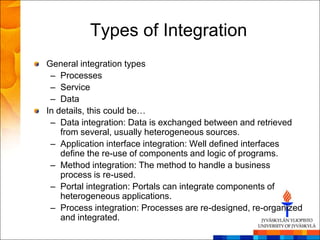
Social Software


4 Cs of Social Software (Cook 2008)
Barriers                            Social Software


                    (Pirkkalainen & Pawlowski 2011)


… 119 barriers from the literature
Barriers                     Social Software

Very much discussed at the moment

  Same barriers discussed under different terminology
                          (Social Software, Social Media etc.)

Related to knowledge sharing, group collaboration etc.


                 Higher Education, Business and IT, B2B…

At the moment trying to recognize relevant barriers. No
   clear context-aware understanding of the biggest
   problems
Barriers                             Social Software

Financial (resources, time)
                                     Management/Coordination/support
 Technology fit
                                        Organizational culture
  Social
Relational, knowledge sharing, skills, cognitive, background, preferences


 Technical
Availability, Interoperability, Functionality, Usability, conceptual, privacy/security, misuse


  Quality                                    Legal (IPR, copyright)
Identifying and Utilizing the
                             barriers
            Crucial in requirements analysis to execution


Knowledge phases carried out according to project life cycle (Beiryaei and Vaghefi 2010)
Thank You
Contact Information
Prof. Dr. Jan M. Pawlowski
jan.pawlowski@jyu.fi
Skype: jan_m_pawlowski
Office: Room 514.2
Telephone +358 14 260 2596
http://users.jyu.fi/~japawlow

Henri Pirkkalainen
henri.j.pirkkalainen@jyu.fi
Office: Room 511.1
Telephone +358 400247684
Global Knowledge Management

  Knowledge Representation


 Jan M. Pawlowski, Markus Bick, Franz Lehner
                22.11.2011
Licensing: Creative Commons
You are free:
   to Share — to copy, distribute and transmit        Collaborative Course Development!
      the work
                                                      Thanks to my colleagues Prof. Dr.
   to Remix — to adapt the work                       Markus Bick and Prof. Dr. Franz
                                                      Lehner who have developed parts of
                                                      the Knowledge Management Course
Under the following conditions:                       which we taught together during the
                                                      Jyväskylä Summer School Course
     Attribution. You must attribute the work in      2011.
         the manner specified by the author or
         licensor (but not in any way that suggests
                                                      Prof. Dr. Markus Bick (Introduction,
         that they endorse you or your use of the     CEN Framework)
         work).                                       ESCP Europe Campus Berlin
                                                      Web: http://www.escpeurope.de/wi
     Noncommercial. You may not use this
         work for commercial purposes.                Prof. Dr. Franz Lehner (Assessment,
                                                      Process Integration)
     Share Alike. If you alter, transform, or build   University of Passau
         upon this work, you may distribute the       Web: http:// www.wi.uni-passau.de/
         resulting work only under the same or
         similar license to this one.
http://creativecommons.org/licenses/by-nc-
    sa/3.0/
The challenges
How to codify knowledge?
How to find, retrieve and utilize knowledge?
How to represent knowledge?
How to deal with differences regarding common
knowledge?
How to deal with cultural aspects of knowledge
processes?
How to make knowledge accessible?
And many more…
Remember?
          Definition – Knowledge
“Knowledge comprises all cognitive expectancies – observations
that have been meaningfully organized, accumulated and
embedded in a context through experience, communication, or
inference – that an individual or organizational actor uses to interpret
situations and to generate activities, behavior and solutions no matter
whether these expectancies are rational or used intentionally.”
                                                                (Maier 2002)


“A set of data and information (when seen from an Information
Technology point of view), and a combination of, for example know-
how, experience, emotion, believes, values, ideas, intuition, curiosity,
motivation, learning styles, attitude, ability to trust, ability to deal with
complexity, ability to synthesize, openness, networking skills,
communication skills, attitude to risk and entrepreneurial spirit to
result in a valuable asset which can be used to improve the capacity
to act and support decision making.”                               (CEN 2004)
Types and Classes of Knowledge

                          Knowledge
         ―high flyer‖                   interpretation/
                                        cross-Linking
                          Information

 stock price: 81,60 €                   context

                          Data

                81,60                   syntax

                          Characters
  ―1―, ―6―, ―8― and ―,―                 character set
Types and Classes of Knowledge
Declarative Knowledge:                     Procedural Knowledge:
• knowing that                             • knowing how


                                                            [Source:
                                                            http://kartta.jkl.fi]

                           My
                         position


                                    How to get
                                       to the
                                     lecture…
      Position, room                         Navigation
      Lecture time                           Lecture behavior
      Traffic rules                          Traffic behavior
Types and Classes of Knowledge

Organizational Knowledge:
                                     Individual Knowledge:
• consists of the critical intel-
                                     • knowledge of each person
  lectual assets within an
                                       (employee)
  organization


   Building cars….                  Steering / using
                                    production facilities
[Picture Source:
http://commons.wikimedia.org]
Types and Classes of Knowledge

                                                             Implicit / Tacit Knowledge:
Explicit Knowledge:
                                                             • knowledge that people carry in
• codified knowledge that can be
                                                              their minds and is, therefore,
 easily shared and understood
                                                              difficult to access


    Traffic rules                                               Traffic customs
    Driving instructions                                        Interpretations
    …                                                           …


                                   Global / cultural
                                   differences


                                           [Picture Source:
                                           http://commons.wikimedia.org]
SECI Model (Nonaka & Takeuchi, 1996)


                          Socialization
                          Externalization
                          Combination
                          Internationalization
Key questions
Which knowledge does an organization have?
– Outcome (e.g. how to build a car)
– Process (e.g. which steps are necessary to build a car)
– Competences (e.g. how to design an engine fulfilling certain
  constraints)
Which knowledge is critical (e.g. how to combine fuel
technologies)?
Which knowledge needs to be shared?
– Between people, groups, departments, organizations
How to represent this knowledge?
– Making knowledge and relations explicit
– Providing opportunities for knowledge identification and creation
  (searching, inference mechanisms / data mining)
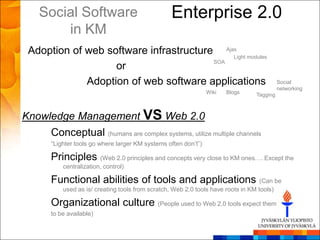
Knowledge Entities
                        Context
                                                      How to organize
                                                      knowledge
                       Occur in                       – By topic, by
                                                        process, by
                                                        problem etc
Topic / Subject /                      Competence /   Represented
                        Process
   Concept                               Problem      through
                                                      – Individuals and
                                                        competences
                      Represented
                                                      – Documents of any
                                                        format
         Individual                 Document          Defining relations
                                                      and
                                                      interdependencies
Knowledge Types (Holsapple & Joshi,
             2007)
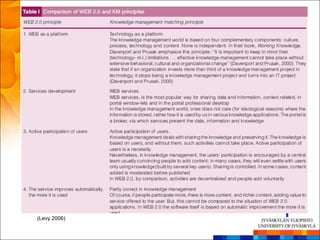
                    Additional attributes
                      Nature (Dixon, 2000)
                       – Frequent vs non-
                         frequent
                       – Routine vs non-routine
                      Complexity
                       – Expert … common
                      Importance
                       – Critical
                       – Important
                       – Routine
Some solutions
Conceptual approaches
–   Natural language
–   Formal representation such as predicate logic
–   Data model
–   Semantic networks
–   (Concept) Graphs
–   Ontologies, taxonomies, folksonomies
–   Data models
–   Social tagging
–   …
Representation formats
–   XML
–   RDF
–   OWL
–   But also: doc, html, avi, gif, …
Remember the goals: identifying knowledge, creating
new knowledge, relating (multi-lingual, multi-
perspective) knowledge
Basic concepts
Ontology (an IS perspective): An ontology        Ontology
defines the terms used to describe and
represent an area of knowledge (W3C).
Ontologies include computer-usable                    +
definitions of basic concepts in the domain           relations
and the relationships among them
                                                 Taxonomy
– Specialization: Folksonomy as an aggregation
  of concepts created by stakeholders
Taxonomy: A hierarchical organizational
                                                      +
structure for the classification of concepts          hierarchy
Vocabulary: Set of concepts and terms to
describe a domain                                Vocabulary
Basic concepts in the global
Ontology
             context
– Relating multiple languages
– Relating concepts
– Creating multiple meaning of concepts (e.g. what does the
  concept ―sauna‖ mean)
Taxonomy
– Limited for multi-perspective representations and complex
  relations
– Easier to handle in multiple languages / cultures /
  organizations
Vocabulary
– Controlled vocabularies to create shared understanding of
  a domain
– Rather simple to translate
Concept Maps


http://commons.wikimedia.org
Topic Maps


http://commons.wikimedia.org
Example: Protege


                                 http://protege.stanford.edu/
  http://protege.stanford.edu/
Ontology Example: Visual Representation


                                          http://protege.stanford.edu/
Ontology Example: Visual Representation


             http://www.ecolleg.org/
Ontology Example: RDF


http://pellet.owldl.com/owlsight/
Ontology Use
Creating models for domains
Knowledge Management
–   Processes
–   Problems
–   Topics / Subjects
–   People
Usage
–   Describe / relate
–   Query
–   Tag
–   Publish
–   Share
–   Create
–   …
Assessment
– Usage analysis
– Updating frequency
– …
Global Aspects
Multilingual aspects
–   Translated ontology
–   Metamodel
–   Mappings (e.g. synonyms)
–   Conceptual differences
Cultural aspects
– Process and procedure mappings and comparisons
– Conceptual differences
Maintenance
– How updates ontologies?
– Who incorporates changes?
Time
– How long are concepts valid?
– How to model those?
Multilingual Models (Montiel-Pensoda, 2008):
            Combined Meta-Model
Multilingual Models (Montiel-Pensoda, 2008):
       Mapping / Mulitlingual Vocabulary
Multilingual Models (Montiel-Pensoda, 2008):
       Mapping / Mulitlingual Vocabulary
Knowledge Search: Ontology Browsing
Summary
Key steps
– Knowledge identification
– Knowledge representation
   • Multilingual, multi-perspective
   • Consider collaborative practices
– Knowledge priorization and characterizing
– Knowledge organization
Match knowledge with business processes and KM
activities
Next step (and lecture): Tool support
Contact Information

Prof. Dr. Jan M. Pawlowski
 jan.pawlowski@jyu.fi
 Skype: jan_m_pawlowski

 Office: Room 514.2
 Telephone +358 14 260 2596
 http://users.jyu.fi/~japawlow
Global Knowledge Management

      Process Management


 Jan M. Pawlowski, Markus Bick, Franz Lehner
                28.10.2011
Licensing: Creative Commons
You are free:
   to Share — to copy, distribute and transmit        Collaborative Course Development!
      the work
                                                      Thanks to my colleagues Prof. Dr.
   to Remix — to adapt the work                       Markus Bick and Prof. Dr. Franz
                                                      Lehner who have developed parts of
                                                      the Knowledge Management Course
Under the following conditions:                       which we taught together during the
                                                      Jyväskylä Summer School Course
     Attribution. You must attribute the work in      2011.
         the manner specified by the author or
         licensor (but not in any way that suggests
                                                      Prof. Dr. Markus Bick (Introduction,
         that they endorse you or your use of the     CEN Framework)
         work).                                       ESCP Europe Campus Berlin
                                                      Web: http://www.escpeurope.de/wi
     Noncommercial. You may not use this
         work for commercial purposes.                Prof. Dr. Franz Lehner (Assessment,
                                                      Process Integration)
     Share Alike. If you alter, transform, or build   University of Passau
         upon this work, you may distribute the       Web: http:// www.wi.uni-passau.de/
         resulting work only under the same or
         similar license to this one.
http://creativecommons.org/licenses/by-nc-
    sa/3.0/
Business Process Management


                       Management                          Production
R&D
                                                             A
 Marketing                   R&D
       Sales                   Marketing                Production          Marketing
                                                           B
                                                                                 Sales


                                             Services


               Sales


                               Services
                                                                Marketing


                        Material Flow
                        Information / Data
                        Flow
The Challenge: Key process classes
  Managing knowledge-intensive business
  processes
   – Which business processes require specialized
     knowledge?
   – How to capture process-related knowledge?
  Managing knowledge management processes
   – How to support business processes?
   – How to improve knowledge activities?
  Implementing knowledge management projects
   – How to plan and implement KM processes?
   – How to integrate business and knowledge processes?
Knowledge Management Framework                                                             Processes

    Business Focus (Remus, 2002)
Process orientation
  knowledge-intensive (operative) business                               strategy
  process
   –   denotes a business process that relies
       substantially ‗more‘ on knowledge; regarding
       organizations core competencies on the          processes
       operative level: e.g., design products and
       services, produce products and services.

  knowledge process                                                             instruments/
                                                             content/             systems
   –   refers to a dedicated service or support               topic
       process which supports the flow of
       knowledge within and between knowledge-
       intensive (operative) business processes:      knowledge base
       e.g., search, acquisition.
                                                       processes                    knowledge
                                                                                     life cycle
  knowledge management process
   –   kind of a ‗meta‘-process that is responsible
       for the extensive implementation of the
       knowledge management initiative: e.g.,
       organizational instruments, ICT instruments,
       controlling.                                                     (Remus 2002)
Business Process Management
Business Process
– a collection of activities that takes one or more kinds of
  input and creates an output that is of value to the customer.
  A business process has a goal and is affected by events
  occurring in the external world or in other processes
  (Hammer & Champy, 1993)
Types
– Core BP: Creating value (e.g. manufacturing, service
  provision)
– Management BP: planning, organizing, steering, monitoring
  […] operations
– Support BP: no direct value creation but essential to
  achieve business goal
(Global) Business Process Management
Supporting business processes using methods,
techniques and software to design, enact, control and
analyze operational processes involving humans,
organizations, applications, documents and other
sources of information (v.d. Aalst et al., 2003)….in a           Management
global context / distributed settings

                                                          R&D       Production Shipping
                Analyze
                                                         Services     Sales   Marketing

                           Design /                                    HR
Optimize
                            Model
                                                          IT Infrastructure & Services
                                                                 Procurement
                                                                       …
    Monitor /         Enact /
    Control           Realize
Some Issues
How to identify the key knowledge intensive business
processes?
How to set up knowledge management systems?
How to integrate knowledge / learning processes?

How to analyze, design and optimize distributed processes?
How to organize successful distributed teams? Which
knowledge should be shared with whom?
How to integrate additional processes?
 –   Risk management
 –   Coordination
 –   Training & recruiting
 –   Culture awareness & integration
How to integrate cultural aspects? How to include cultural
aspects in a location decision?
Agile
                             The challenge…
                                                                                          Enterprise 2.0
     Manufacturing                           Business Process
                                             Modeling
                                                                      Business Process
                     Business Process                                 Optimization
                     Management
Quality                                                                                  Business Process
                                                                                         Reengineering
Management


Change                                                                                       Supply Chain
Management                                                                                   Management


Performance                                                                                  Value Chain
Management                                                                                   Management
                Intercultural
                Management
                                                           International
                                                                                             ERP Systems
                                                           Management
Global IT               Global
Management              Distribution                                           Project
                        Model                       Global Software
                                                    Development                Management
         Business
         Networks
                                       Offshoring                      Outsourcing
The concepts, simplified…

                                                            Business Process
                                             Analysis       Modeling
                          Business Process
                          Management
                                             Improvement    Business Process
                                                            Optimization /
                                                            Reengineering
    Support                Logistic Focus
                                                                                 Support
                                                 Realization /                        Change
                                                 Operations                           Management
Global IT       Support    Supply Chain
Management                 Management
                                                            Project
                                                            Management
                            Value Focus
     Support
                                                                     Support

                           Value Chain                           Intercultural
                           Management                            Management
Levels of value chain management from a
             KM perspective
 Strategic
  – Location decision (guidance, partners, market knowledge)
  – Strategic partnerships and alliances (and knowledge exchange)
  – Governance
 Tactical
  –   Process design and optimization!
  –   Production decisions and analysis (identification of core knowledge)
  –   Transportation decisions (knowledge on providers)
  –   Process planning and optimization (knowledge process integration)
  –   Staffing (knowledge acquisition, knowledge sharing)
  –   …
 Operation
  –   Realization: Production (and knowledge exchange)
  –   Learning and training
  –   Experience capturing and sharing
  –   …
Analyze / Model
Describing the current situation                         Analyze
– Process modeling
– Identification of knowledge-
  intensive processes                    Optimize
                                                                    Design /
– Identification of critical processes                               Model

Modeling (own organization and
main partnerships)
–   Process description
–   Knowledge flows                          Monitor /         Enact /
                                             Control           Realize
–   Knowledge description
–   Knowledge levels (what can be
    shared)
Value knowledge
– Most critical processes
– Most critical knowledge areas
– Most critical roles
Process description
ID   Category   Process      Description
     HRM /      Course
                             Individual course planning and course acquisition
     Training   Planning
                   Competency assessment
Sub-processes      Manager consultation
       /           Content selection
Sub-aspects        Selection: Inhouse or external training / face-to-face or E-Learning
                   Provider negotiation
                   To find, perform and evaluate adequate courses to develop the competencies of
                   staff members
                   To select cost-efficient training providers
                   To continuously monitor staffs‘ performance
Objective          Knowledge: To share knowledge on didactic success scenarios (important)
                   Knowledge: Choosing culture-aware didactic scenarios (critical)
                   Barrier: Lack of communication
                   Barrier: Lack of data integration / willingness to share data
                   Barrier: Culture related didactic differences
                   Competency gap analysis
Method             Agreement / negotiation talks with managers and staff
                   Human oriented instrument: Knowledge fair on didactics
                   HR Management System (competency profiles and learner data)
Systems            Gap Analysis tool (excel)
                   Tech-oriented instrument: Course catalogue with discussion and rating options
                   Manager, staff member, HRCS team member, training providers, internal
Actors
                   trainers
Business Process Management
             in a Networked Business
                                     Management                                   Processing
R&D
                                                                                   A
 Marketing                                  R&D
          Sales                              Marketing                         Processing          Marketing
                                                  Production                      B
                                                                                                          Sales


                                                                    IT
                                                                    Services


                           Sales


                                             IT
                                             Services
                                                                                       Marketing


                  Material Flow
                                                   Planning    Procurement Manufacturing       Assembly
                  Information / Data Flow

Routine      Important Critical               Maintenance       Shipping          …
Design / Optimize
Designing alternatives
  Process extension
   – Incorporate knowledge processes:                      Analyze
     Awareness creation, knowledge
     acquisition, knowledge sharing, …
   – Change management                                                Design /
   – Process specification: what can and   Optimize
                                                                       Model
     should be shared?
   – Set up knowledge management
     processes
  Process optimization
   – parallelization, automation, re-          Monitor /         Enact /
     sequencing, automation of                 Control           Realize
     knowledge processes
   – Integration of processes
  Assessment
   –   Cost calculation
   –   Performance metrics
   –   Quality metrics
   –   Simulation
  Identification of re-design
  candidates
  Negotiation and evaluation with all
  stakeholders
Knowledge Management Framework                            Processes

Core Knowledge Activities (CEN, 2004)


 Five core knowledge activities:
  – identify, create, store, share and use.
  – Supported by the right KM methods and tools
 Requirements have to be fulfilled to achieve
 improvements
  – Integration / alignment of core activities with
    organizational processes and daily tasks.
  – Carefully balanced in accordance with the
    specificities of each business process and
    organization. A KM solution should not focus only on
    one or two activities in isolation.
Knowledge Management Framework                                                         Processes

     Core Knowledge Activities
Knowledge Management
  Tasks (Maier, 2004)                                  Knowledge                Knowledge
                                                         Goals                 Measurement
  creation, building, anticipation or
  generation
                                                       Knowledge               Knowledge
  acquisition, appropriation or adoption              Identification              Use

  identification, capture, articulation or
  extraction                                     Knowledge                           Knowledge
                                                 Acquisition                        Preservation
  collection, gathering or accumulation
  (legally) securing                                   Knowledge               Knowledge
                                                      Development              Distribution
  conversion
  organization, linking and embedding
  formalization                                                        (Probst & Romhardt 2000)
  storage
  refinement or development
  distribution, diffusion, transfer or sharing
  presentation or formatting
  application, deploying or exploiting
  review, revision or evolution of knowledge
Design / Optimize
Designing alternatives
  Identify relevant processes
  Identify knowledge management   process type: identify,
  create, store, share and use (or more detailed one,
  e.g. Maier‘s tasks)
  Create extension knowledge management process
   –   Mark context influences and barriers
   –   Define responsibilities
   –   Define sequencing
   –   Re-write process model and job description
  Change Management
   – Assess potential barriers
   – Provide awareness instrument
   – Provide training
  Assess and validate
   – Execution / realization?
   – Performance
   – Further metrics / analysis
Process: Knowledge Acquisition
ID   Category Process       Description
     KM       Knowledge
                            Acquiring knowledge from external source
     Process  Acquisition
                 Knowledge requirement specification
                 Bidding
Sub-processes
                 Bid selection
       /
                 Negotiation
Sub-aspects
                 Contracting
                 Training
                 To acquire critical knowledge from external experts
                 To acquire knowledge on Japanese customer preferences until 2013
Objective
                    Knowledge: To acquire knowledge
                    Context: No internal experience on target market
                    Context: Cultural influence on market approach
Constraints
                    Barrier: Lack of communication
                    Barrier: Culture related differences
                    Call for bids
Method              Competence assessment
                    Kick Off workshop
                    Call for bids in business network
Systems             Competence specification and assessment tool
                    Tech-oriented instrument: Culture specification
                    Manager, staff member, HRCS team member, training providers, internal
Actors
                    trainers
Process: Knowledge Sharing
ID   Category   Process      Description
     KM         Knowledge
                             Sharing knowledge between Far East Sales Representatives
     Process    Sharing
                   Sales protocol
Sub-processes      Sales good practice (GP) reporting
       /           GP database entry
Sub-aspects        Notification
                   Related process: Sales / Order Processing (parallel)
                   To share knowledge on sales processes in Japan, Korea, China
                   To create a network of sales representatives in the Far East region
Objective
                   Knowledge: Sales initiation, presentation, negotiation, contracting, key account
                   relation building

                   Context: Partial lack of knowledge on target market
                   Context: Sales representatives from sales agency (Japan, China)
Constraints
                   Barrier: Cultural differences: Communication, negotiation, trust
                   Barrier: Fear of power loss, lack of time
                   GP reporting (part of sales process)
Method             GP fair
                   Sales incentive trip
                   GP database
Systems            Sales network
                   Sales Blog
Actors             Manager, sales managers, sales representatives, external sales partners
Business Process Management
             in a Networked Business
                                     Management                                   Processing
R&D
                                                                                   A
 Marketing                                  R&D
          Sales                              Marketing                         Processing          Marketing
                                                  Production                      B
                                                                                                          Sales


                                                                    IT
                                                                    Services


                           Sales


                                             IT
                                             Services
                                                                                       Marketing


                  Material Flow
                                                    R&D        Procurement Manufacturing       Assembly
                  Information / Data Flow

Routine      Important Critical               Maintenance       Shipping          …
Business Process Management
             in a Networked Business
                                             Management


          Sales


     Sales
     GP Fair                        Sales

                       Sales                                     Order
                                      Negotiation Contracting                 CRM
                       Initiation                                Entry


                             Benefit         Sales
   Fair Wiki                                                    Sales GP   Notification
                             Workshop        protocol


                                                           GP Database
                    Material Flow
                    Information / Data Flow

Routine        Important Critical
Process Integration (Remus & Schub, 2003)
Process Integration
(Remus & Schub, 2003)
Further aspects
Modeling across cultures and organizations,
multilingual modeling

Collaborative Modeling

Participative Modeling


http://www.signavio.com/en/academic.html
Summary and Outlook
Networked businesses and globally distributed
processes require new analysis instruments
Knowledge management, change management
and culture management play a key role
Challenges across borders
– Additional processes (risk, coordination, culture)
– New barriers (in particular cultural barriers)
– Understanding tool, instruments, interventions based on
  the context and barriers
Key role for Knowledge Managers
– Understanding processes
– Analyzing and validating knowledge needs and
  requirements
– Designing and integrating interventions
– Designing change processes
– Validating solution
Remember? We just managed this part…
          GKM Design (1)
Design Knowledge Processes
Aligned with the context, you
   should…
   Design potential knowledge
   processes
   – Specify processes
   – Embed with business processes
   – Agree / integrate with international
     collaborators
   – Prepare change processes
  Knowledge description
   – Develop knowledge descriptions /
     standards
   – Incorporate collaborators
   – Develop problem specifications
Contact Information

Prof. Dr. Jan M. Pawlowski
 jan.pawlowski@jyu.fi
 Skype: jan_m_pawlowski

 Office: Room 514.2
 Telephone +358 14 260 2596
 http://users.jyu.fi/~japawlow
Global Knowledge Management

  Process Integration of Business,
Learning, and Knowledge Processes


   Jan M. Pawlowski, Markus Bick, Franz Lehner
                  28.10.2011
The Challenge
Going one step further: Re-Design of Knowledge,
Learning and Business Processes -> fostering
synergies
Understanding inter-departmental and inter-
organizational processes and interdependencies
Optimizing processes, utilizing synergies
– process, service or data integration
Bridging the gap between KM and e-learning

                 Organizational development

          Knowledge                       Educational
         Management                       Management


      • CKO, Knowledge                                   • CLO
         worker                           • Personnel/HR Unit
      • Internal Consulting-Group   • Personnel Development
      • Business Unit                   • Corporate University
        Knowledge Manager                       • Training Unit
The role of technology
       KM-focus vs. e-learning focus
    people-to-people                          teaching / training
–      Problem solving by building               Independent of time and
       learning communities                       location
–      Supporting communication                  Testing, examinations
       (synchronous and asynchronous             Re-training
–      Finding experts
                                              Content and learning objects
    OL + meta-learning                        Supporting individual
    people-to-documents                        learning
–      Supports through                       institutionalized, intentional
       documents, archives
                                              Blended learning concepts
–      Classification, searching,
       extraction                             Virtual classroom


    happens in a work                          usually separation from work
    environment…                               environment…
Possible convergence targets
• Shift the focus of KM initiatives from knowledge sharing to support
  actual learning from others and actual applying experiences of those
  other people

• Change working environments to encourage knowledge sharing and
  workplace learning and to provide time, space and instruments to do
  so

• Use of existing communities of practice instead of forming a
  community around a learning event. Promotion of learning
  communities after a course
Strategy Integration
The relationship between the business strategy & eLearning and the
business strategy & Knowledge Management ?


                 Learning               Knowledge


            loose coupling with      close coupling with
               the business             the business
                 strategy                 strategy


                                                               Back 2004
Place, time, and way of acquiring
                  knowledge
Where is new knowledge acquired? How is this organized regarding work-time
management and regarding individual needs?


                   Learning                 Knowledge
                                          • at the workplace
              • in seminars and          • in short units with
             conferences, at home       interruptions through
               • in larger blocks            regular work
              • with rather weak               • trend to
                personalization             personalization


                                                                    Back 2004
Cultural Aspects
How about attitudes and behavior of the target groups of eL und KM measures
                when learning or acquiring new knowledge ?


                Learning                Knowledge
                                • open towards technology
       • skeptical towards techn.
                                      • cooperation in
            • competition and
                                    communities, peer-
            ―one-man-shows‖
                                          learning
        • comparatively intensive
                                  • highly self-responsible
          guidance and tutoring
                                       • pull-principle
             • push-principle


                                                                    Back 2004
Measurement of sucess


      Learning               Knowledge

                       • rather weekly structured;
   • institutionalized       often as part of
through assessments,        regular employee
        exams,                 assessment
       certificates


                                                     Back 2004
Step 1: documentation of the business processes
                                                              Preperatory activities
                                                              Comparing knowledge
                                                              demand / knowledge
                                                              supply

               Step 2: Implementation of a reference model
               Integration into a knowledge life cycle
                                                              Wissen
                                                              generieren


                                     Wissen
                                                                                       Wissen-
                                     weiterent-
                                                                                       bewerten
         Step 3: Implementation of   wickeln


         supporting IT systems
                                     Wissen                                            Wissen-
                                     anwenden                                          aufbereiten


                                                  Wissen                   Wissen
                                                  verteilen                speichern


Step 4: Continuous process improvement
Integration: Questions
Which processes and systems can be integrated?
Which and how processes should be redesigned?
Which information / data should be shared?
Which actors should be involved in cooperative
processes?
Integration of E-Learning and KM
                                                                                                     Business
Requireme                   Design               Implementation Test                      Roll Out
nts analysis                                                                                         Process

  Knowledge and                      Problem descriptions and      Scenario extraction:
  competency requirements            solution:
  and needs                                                        sequences, contents
                                     Context, sequences,
                                     experiences, actors
        Require
         ments
                                                                        Learnin                      Learning
                                Design            Implementation          g/
        analysi                                                         Transfe                      Management
           s                                                               r
                     Scenario extraction:                             Learning experiences
                     sequences, contents

                                                                        Knowle
                                                                          dge
         Knowle
           dge
                               Knowle
                                                    Knowle
                                                                        mainte                       Knowledge
                                 dge                                     nance
         identific
                               develop
                                                      dge
                                                                          and                        Management
           ation                                    sharing
                                ment                                    distribut
                                                                           ion
Conceptual Integration
 Criterion          KM            E-Learning           Source
                                                          Reinmann-
Target Group     Organizational        Individual    Rothmeier, 2000
                                                      (Munich Model)
                 Knowledge as     Learning as the
Complexity       contextualized        process of        North, 1998
                    information      assimilation
                                                     Kraemer, Milius,
   Time             On demand           On stock
                                                               2000
                                                      Mandl, Winkler,
 Objective     Problem-oriented     Not specified
                                                               2003
                   Non-formal /                     Watkins, Marsick,
 Formality                                Formal
                      informal                                 1992
Sample Integration Approaches
       Objective                      Method                         Source
Integration of
                             Systems development based on
collaborative knowledge                                              Kienle, 2003
                                          empirical surveys
and learning processes
Re-Use of KM and E-                                                Mandl, Winkler,
                                 Architecture / specifications
Learning objects                                                 2003, Back 2002.
Integration of strategy    Conception and implementation of           Sridharan &
and processes                          integrated processes         Kinshuk, 2002
Architecture                           Taxonomy of contents       Wilkinson, 2002
                                                               Benmahamed,
Integration /
                                        IMS Learning Design           Ermine,
interoperability
                                                            Tchounikine, 2005
Competency                Framework for competency mapping         Ley, Lindstaedt,
development                                and development            Albert, 2005
Types of Integration
General integration types
 – Processes
 – Service
 – Data
In details, this could be…
 – Data integration: Data is exchanged between and retrieved
    from several, usually heterogeneous sources.
 – Application interface integration: Well defined interfaces
    define the re-use of components and logic of programs.
 – Method integration: The method to handle a business
    process is re-used.
 – Portal integration: Portals can integrate components of
    heterogeneous applications.
 – Process integration: Processes are re-designed, re-organized
    and integrated.
Integration levels (1)
Process Overlaps
– Identifying processes with similar objectives, tasks and
  outcomes
– Combining processes towards a connected, inter-related
  process
– Example: Experience sharing as part of all business
  processes

Shared Services and Systems
– Identifying common services and systems
– Example: ―staff administration‖ is a service which is used by
  different departments or systems
Integration levels (2)
Information / Data Integration
– Identifying overlaps in information / data models of an
  organization
– Example: Actor data is used by different departments /
  systems
Cooperation process
– Identifying interdependencies between actors and
  organizational units
– Defining modes of cooperation in
    • the integration processes
    • daily operations
Integration support
Use reference models and standards
Develop services and information
Integrate knowledge processes…
Step by step integration
1. Awareness building and context setting
2. Process analysis and redesign
3. Shared services‘ and systems‘ design
4. Information and data integration
5. Evaluation and validation
Awareness Building and Context
           Setting
Integration is a major organizational change
Barriers
 –   Fear of change
 –   Loss of responsibilities / power
 –   Time
 –   …
Preparing actors for change processes
Ensuring involvement and participation
Developing a common vision
Process analysis and redesign
Objectives
– Identifying relevant processes for consideration
– Forecasting synergy effects
– Understanding the organization
Phases
– Process Modeling
– Process Analysis
– Process Redesign
Outcomes
– Process Models
– Process Re-Design
– Implementation Plan
Process analysis and redesign
Process Identification and Modeling
– Processes in the relevant departments are modeled
– Including actors involved and systems used
– Use of reference models should be considered


Tools
– ISO/IEC 19796-1 for Learning Processes
– Knowledge Management Processes
– ebXML for Business Processes
Analysis Grid


                                Manufacturing


                                                Resources
                                                Human


                                                              Customer service


                                                                                 …


                                                                                     Identification
                                                                                     Knowledge

                                                                                                      Sharing
                                                                                                      Knowledge


                                                                                                                  …


                                                                                                                      Authoring
                                                                                                                      Learning:


                                                                                                                                   Learning Process
Manufacturing                                                                        PO1              SS              ID2         SS
Human Resources                                                                      ID3              SS              PO          SS
Customer Service                                                                     PO               PO              PO          PO
…
Knowledge Identification         SS             SS          PO                                                        PO          SS
Knowledge Sharing                PO             ID          PO                                                        PO          SS
…
Learning: Authoring                             PO4         SS5                      SS               SS
Learning Process                 ID             PO          PO                       SS6              PO
…
PO Process Overlap (includes SS and ID)
SS Shared Service (includes ID)
                                                        [Source: Pawlowski, Bick, 2008]
ID Information / Data Integration
          not subject to this analysis
Process Integration
                                                                                                     Business
Requireme                   Design               Implementation Test                      Roll Out
nts analysis                                                                                         Process

  Knowledge and                      Problem descriptions and      Scenario extraction:
  competency requirements            solution:
  and needs                                                        sequences, contents
                                     Context, sequences,
                                     experiences, actors
        Require
         ments
                                                                        Learnin                      Learning
                                Design            Implementation          g/
        analysi                                                         Transfe                      Management
           s                                                               r
                     Scenario extraction:                                           Sample Integration Processes:
                                                                      Learning experiences
                     sequences, contents                                            •Knowledge gap analysis
                                                                                    •Staff development planning
                                                                        Knowle      •Experience sharing
                                                                          dge
         Knowle
           dge
                               Knowle
                                                    Knowle
                                                                        mainte                       Knowledge
                                 dge                                     nance
         identific
                               develop
                                                      dge
                                                                          and                        Management
           ation                                    sharing
                                ment                                    distribut
                                                                           ion
Reference Framework for the Description of
         Quality Approaches: ISO/IEC 19796-1

                                   CD
                                Conception/
        FA                        Design                    DP
     Framework                                          Development/
      Analysis                                           Production


     NA                                                         IM
Needs Analysis                                            Implementation

                                              LP
                     EO
                                           Learning
                 Evaluation/
                                           Process /
                 Optimization
                                          Realization
Process Integration: Knowledge Processes
              (Maier, 2004)


              [Source: Maier,2004]
Process Integration: ebXML
      Category                      Sample Processes / Components
Procurement         Bid Submission
                    Contract Negotiation
                    Purchase Order Preparation
                    Receiving
Human resources     Hiring
                    Training
                    Payroll Management
                    Personnel Deployment
Transportation      Loading
                    Shipping
                    Packaging
Manufacturing       Product Development
                    Product Design
                    Assembly
                    Quality control
Marketing & sales   Advertising Use & Campaigning
                    Marketing Management
                    Sales Calling
                    Customer Credit Management
Customer service    After Sales Service
                    Warranty Construction
Financing           Loan Management
                    Stock Subscriptions and Sales
                    Dividend Policy
Administration      Accounting
                    Financial Reporting
                    Executive Management
Process description
ID   Category   Process      Description
     Career     Course
                             Individual course planning and course acquisition
     Planning   Planning
                   Competency assessment
Sub-processes      Manager consultation
       /           Content selection
Sub-aspects        Selection: Inhouse or external training / face-to-face or E-Learning
                   Provider negotiation

                   To find, perform and evaluate adequate courses to develop the competencies of
                   staff members
                   To select cost-efficient training providers
                   To continuously monitor staffs‘ performance
Objective
                   Knowledge: To share knowledge on didactic success scenarios
                   Barrier: Lack of communication
                   Barrier: Lack of data integration / willingness to share data
                   Barrier: Culture related didactic differences
                   Competency gap analysis
Method             Agreement / negotiation talks with managers and staff
                   Human oriented instrument: Knowledge fair on didactics
                   HR Management System (competency profiles and learner data)
Systems            Gap Analysis tool (excel)
                   Tech-oriented instrument: Course catalogue with discussion and rating options
                   Manager, staff member, HRCS team member, training providers, internal
Actors
                   trainers
Process analysis and redesign
Process Analysis
– Analyzing processes for integration potentials
– Forecasting effects: Cost of integration, improved data
  handling, improved communication, …
– Identification of re-design candidates
– Negotiation and evaluation with all stakeholders
Process Redesign and Implementation
– Design of changed processes
– Updated process and data models
– Change Specifications: Specifying changes for actors and
  systems involved
– Cooperation process to ensure participation
Shared services‘ and systems‘
           design
Systems and service identification
– Identification of integration candidates
– Defining a new systems‘ architecture
– Potential levels: Systems or services
– Defining integration type (service / data / user interface /
  portal, …)
– Implementation plan
Tools
– JISC Services
– Knowledge Services
Process Integration
                                                                                                     Business
Requireme                   Design               Implementation Test                      Roll Out
nts analysis                                                                                         Process

  Knowledge and                      Problem descriptions and      Scenario extraction:
  competency requirements            solution:
  and needs                                                        sequences, contents
                                     Context, sequences,
                                     experiences, actors
        Require
         ments
                                                                        Learnin                  Learning
                                Design            Implementation          g/
        analysi                                                         Transfe                  Management
           s                                                               r     Sample Integration Services:
                     Scenario extraction:                                        •Enrollment
                                                                      Learning experiences
                     sequences, contents
                                                                                 •Learner profile update
                                                                        Knowle
                                                                                 •Posting experiences
                                                                         dge     •Generating test data
         Knowle
           dge
                               Knowle
                                                    Knowle
                                                                        mainte                   Knowledge
                                 dge                                    nance
         identific
                               develop
                                                      dge
                                                                         and                     Management
           ation                                    sharing
                                ment                                    distribut
                                                                           ion
JISC E-Learning Framework


          Source:
              http://www.jisc.ac.uk/uploaded_documents/elf-summary7-04.doc
Knowledge Services (Maier, 2004, Bick, 2008)
                      Knowledge Management Tasks (Maier,
                         2004)
IT-Tools                                                           Human- &
                       creation, building, anticipation or          Structure-
 Document               generation
                       acquisition, appropriation or adoption       oriented Tools
  Management
                       identification, capture, articulation or    Mentoring
 E-Mail                 extraction
                       collection, gathering or accumulation       Open Space
 CSCW
                       (legally) securing
                                                                    Job Rotation,
 Search               conversion                                   Job
 Data Mining          organization, linking and embedding          Enlargement
                       formalization
 List-Server          storage
                                                                    Career Planning
 Multi-Point-         refinement or development                   Team
  Videoconference      distribution, diffusion, transfer or         Development
                         sharing
 News-Channel /       presentation or formatting                  Simulation
  News-Feed            application, deploying or exploiting
                                                                     Games
 Application          review, revision or evolution of            Future Search
                         knowledge                                   Conference
  Sharing                  Source: (Maier, 2004)
 Social Software                                                   etc.
 etc.
Information and data integration
Identification of integration potentials
 –   Loose coupling vs. integration
Data definition
 –   Defining common data classes
 –   Determining necessary extensions
Choice of specifications
 –   Choosing / considering standards or existing specifications as a basis
Data mapping
 –   Heterogeneous data descriptions
 –   Mapping to define relations between the different entities
Data synchronization
 –   Data should be stored consistent and without redundancies
 –   Examples: Single repository, data warehouse
 –   For distributed environments: Defining synchronization mechanisms
Tools
 –   Learning Technology Standard Specifications
Process Integration
                                                                                                     Business
Requireme                   Design               Implementation Test                      Roll Out
nts analysis                                                                                         Process

  Knowledge and                      Problem descriptions and      Scenario extraction:
  competency requirements            solution:
  and needs                                                        sequences, contents
                                     Context, sequences,
                                     experiences, actors
        Require
         ments
                                                                        Learnin                      Learning
                                Design            Implementation          g/
        analysi                                                         Transfe                      Management
           s                                                               r
                     Scenario extraction:                                           Sample Integration Data:
                                                                      Learning experiences
                     sequences, contents                                            •Actor Profiles
                                                                                    •Activity descriptions
                                                                        Knowle      •Experience profile
                                                                          dge
         Knowle
           dge
                               Knowle
                                                    Knowle
                                                                        mainte                       Knowledge
                                 dge                                     nance
         identific
                               develop
                                                      dge
                                                                          and                        Management
           ation                                    sharing
                                ment                                    distribut
                                                                           ion
Data Integration
  Aspect         Specification                             Explanation


                                    Both specifications can be recommended to describe
                                         scenarios as a basis for knowledge identification and
                DIN Didactical
                                         learning environments. They cover aspects such as
                  Object Model /
 Scenarios                               activities, context, and services which are used in
                  IMS Learning
                                         many contexts: software development, problem or
                     Design
                                         situation descriptions, learning scenarios.

                                    Learning Object Metadata cover a variety of aspects of
Contents /     Learning Object           contents (such as documents, learning modules,
  documents          Metadata            knowledge bits). Each can be described and related to
                                         each other.
                                    This specification describes a variety of aspects on user
              Learner Information         data. It covers all necessary basic data as well as
  Users
                       Package            specific data for the fields of knowledge management
                                          and learning.
                                    Experiences can be used in a variety of contexts, such as
                DIN Didactical           knowledge management. DIN DOM provides a format
Experiences
                   Object Model          for structured description of experiences.


                         [Source: Pawlowski, Bick, 2008]
Evaluation and validation
Cost-benefit analysis
Validation of integration potentials
–   Improved communication
–   Process duration
–   Staff motivation
–   Staff involvement
Analyzing strength and weaknesses
Maturity analysis
Planning the next integration cycle…
Evaluation and validation: KM Success Factors
                  (North, 2008)
Success at Business Level
       Cost                  Quality                 Time               increasing
       reduction             improvements            saving             revenues

                                 Quality of internal
                                KM support processes

                                       Training

   ?                              Information quality                         ?
                                     System use

                                    System quality

Success at KM Level
     Knowledge-           Documentation of        Reuse of Knowledge      Internal
      transfer            „best-practices“                             Transparency

   Internal communication           User Satisfaction            Enterprise culture

   Optimizing knowledge            Developing competences /            establishing
    intensive processes               Knowledge capital                Communities
Summary
Holistic planning of business, knowledge and
learning processes
– Focus: KM and E-Learning
– Identifying similarities and common objectives
Integration
– Focus on reference models and standards to ease
  adaptation process
– Process, service, data integration
– Cooperation and participation
– Tools for analysis and re-design
Change and cooperation processes
So, how to integrate this into the overall KM design
process?
Outlook
New challenges and potentials

Web 2.0 applications

Internationalization of processes

Open Source and Open Content
References and further readings

Gereffi, G., Humphrey, J., Sturgeon, T. (2005): The
governance of global value chains, Review of
International Political Economy, 12:1, 78-104
Faber, E., P. Ballon, H. Bouwman, T. Haaker, O.
Rietkerk & M. Steen (2003) Designing business
models for mobile ICT services. Proc of the workshop
on concepts, metrics & visualization, 6th Bled
Electronic Commerce Conference eTransformation,
Bled, Slovenia, June 9 -11, 2003.
Contact Information

Prof. Dr. Jan M. Pawlowski
 jan.pawlowski@jyu.fi
 Skype: jan_m_pawlowski

 Office: Room 514.2
 Telephone +358 14 260 2596
 http://users.jyu.fi/~japawlow
Global Knowledge Management

Instruments, Tools, Social Software


Henri Pirkkalainen, Jan M. Pawlowski, Markus Bick, Franz
                         Lehner
                       15.11.2011
Licensing: Creative Commons
  You are free:                                           Collaborative Course Development!
       to Share — to copy, distribute and transmit
           the work                                       Thanks to my colleagues Prof. Dr.
                                                          Markus Bick and Prof. Dr. Franz Lehner
       to Remix — to adapt the work
                                                          who have developed parts of the
                                                          Knowledge Management Course which
  Under the following conditions:                         we taught together during the Jyväskylä
         Attribution. You must attribute the work in      Summer School Course 2011.
             the manner specified by the author or
             licensor (but not in any way that
             suggests that they endorse you or your       Prof. Dr. Markus Bick (Introduction,
             use of the work).                            CEN Framework)
         Noncommercial. You may not use this              ESCP Europe Campus Berlin
             work for commercial purposes.                Web: http://www.escpeurope.de/wi
         Share Alike. If you alter, transform, or build
                                                          Prof. Dr. Franz Lehner (Assessment,
             upon this work, you may distribute the
                                                          Process Integration)
             resulting work only under the same or
                                                          University of Passau
             similar license to this one.
                                                          Web: http:// www.wi.uni-passau.de/
  http://creativecommons.org/licenses/by-nc-sa/3.0/
Starting points
We have analyzed and understood the context,
business processes and critical knowledge
Main task
– Selecting tools for knowledge management activities
  according to the purpose
– Creating accompanying activities (e.g. awareness, tool
  training, early adopter groups)
– Balancing human- and technology-orientation
Specialization: Social Software
Intended Outcome
– A selection of tools and activities
– Implementation plan
– Validation ideas (following lecture)
Business Process Management in a
                         Networked Business

                                       Management                                      Processing
R&D
                                                                                        A
  Marketing                                   R&D

          Sales                                 Marketing                          Processing           Marketing
                                                    Production                        B
                                                                                                               Sales


                                                                       IT
                                                                       Services


                            Sales


                                                IT
                                                Services
                                                                                            Marketing


                   Material Flow
                                                       R&D        Procurement     Manufacturing     Assembly
                   Information / Data Flow
                                                    Maintenance    Shipping            …
Routine       Important Critical
Business Process Management in a
                         Networked Business

                                                Management


          Sales


     Sales
     GP Fair                         Sales


                        Sales                                          Order
                                       Negotiation   Contracting                    CRM
                        Initiation                                     Entry


                               Benefit         Sales                                            What are the potential tools
   Fair Wiki                                                          Sales GP   Notification
                               Workshop        protocol
                                                                                                   and accompanying
                                                                                                        activities?

                                                                   GP Database

                    Material Flow
                    Information / Data Flow

Routine        Important Critical
Knowledge Management Systems
                                      Technological roots and influences
                     Skill                     Extended             Knowledge          Knowledge Push
                     Database                  CRM      Cooperating Maps
                           Knowledge                    Portals               E-Learning
                           Portal                                             Platform
                                     Meta-Search                              Community
                                                            KM Suite
                                     Engine                                   Homespace
Organizational
Knowledge Base                                    Integrative       Interactive
                                                  KMS               KMS
        Enterprise Knowledge                                                                        Organizational Learning
        Medium
                                                  Knowledge Management System
Transactive Memory                                (KMS)                                       Knowledge
System                                                                                        Management
         Organizational Memory                                                                             Organizational
         System                                                                                            Memory
                                                           AI-technology
Organizational Memory
Information System                             Search                      Visualization
                                               Engines                     Systems

                                Business                 Intranet/Groupware                CBT/
                                Intelligence             Platform                          Learning
                                Tools                                                      Environments

                                        Document            Workflow           Group
                 Data Warehouse                                                              Communication Systems
                                        Management          Management         Support       (e.g.. e-mail, video conferences)
(Maier 2002)                            Systems             Systems            Systems
Types and Classes of Knowledge


               (Mentzas et al. 2001)
From Ontologies to Tools and Knowledge
  Activities (Abecker & van Elst, 2009)
From Ontologies to Tools (Abecker & van
              Elst, 2009)


                          Intelligent Search and
                          Retrieval in Intranet and
                          Internet
                          Information Gathering,
                          Information Extraction and
                          Information Integration with
                          ontologies as target data
                          structure
                          Semantic Community Web
                          Portals
                          Expert Systems and Intelligent
                          Advisor Systems
Tools and phases


Jisoo Jung, Injun Choi, Minseok Song, An integration architecture for knowledge management systems
and business process management systems, Computers in Industry, Volume 58, Issue 1, January 2007,
Pages 21-34,, (http://www.sciencedirect.com/science/article/pii/S0166361506000479)
Knowledge Services (Maier, 2004, Bick, 2008)
                      Knowledge Management Tasks (Maier,
IT-Tools                 2004)                                           Human- &
                         creation, building, anticipation or              Structure-
 Document                generation                                       oriented Tools
  Management             acquisition, appropriation or adoption
                                                                          Mentoring
 E-Mail                 identification, capture, articulation or
                          extraction                                      Open Space
 CSCW                   collection, gathering or accumulation
                                                                          Job Rotation,
 Search                 (legally) securing                               Job
 Data Mining            conversion                                       Enlargement
                         organization, linking and embedding
 List-Server                                                             Career Planning
                         formalization
 Multi-Point-           storage
                                                                          Team
  Videoconference                                                          Development
                         refinement or development
 News-Channel /         distribution, diffusion, transfer or sharing    Simulation
  News-Feed                                                                Games
                         presentation or formatting
 Application            application, deploying or exploiting            Future Search
  Sharing                                                                  Conference
                         review, revision or evolution of
 Social Software
                          knowledge                                       etc.
                           Source: (Maier, 2004)
 etc.
Choosing technology / human-centered
    instruments: A simplified process

Identify influences / context
Addressing barriers
 – Is it a persistent barrier
 – If not: awareness / accompanying activities are more useful
 – For persisting barriers: Consider appropriate tools (e.g.
    knowledge cockpit to see knowledge development for
    barrier ―lack of understanding knowledge sharing benefits)
Addressing knowledge goals
 – Identify candidate instruments
 – Identify accompanying activities
Integrate processes / activities
Plan roll out / deployment
Validate process – context – instrument impact
Validate, refine, improve…
Social Software for Knowledge Management
Knowledge Management Tasks
   creation, building, anticipation or
    generation
   acquisition, appropriation or adoption
   identification, capture, articulation or
    extraction
   collection, gathering or accumulation
   (legally) securing
   conversion
   organization, linking and embedding
   formalization                                  ?
   storage
   refinement or development
   distribution, diffusion, transfer or sharing
   presentation or formatting
   application, deploying or exploiting
   review, revision or evolution of
    knowledge
     Source: (Maier, 2004)
Social Software for KM: Contents


     Social Software – possibilities and limitations


              Knowledge Management – where are we now?


                       Impressions and strategies


                                 Social Software in KM
Social Software
      “Social Software enables an interactive way of
collaboration, managing content and connecting to online
networks with other people. It supports the desire of users
to be pulled into groups in order to achieve their personal
                           goals”
               (Wever, Mechant, Veevaete & Hauttekeete 2007)
Social Software


4 Cs of Social Software (Cook 2008)
Barriers                            Social Software


                    (Pirkkalainen & Pawlowski 2011)


… 119 barriers from the literature
Barriers                     Social Software

Very much discussed at the moment

  Same barriers discussed under different terminology
                          (Social Software, Social Media etc.)

Related to knowledge sharing, group collaboration etc.


                 Higher Education, Business and IT, B2B…

At the moment trying to recognize relevant barriers. No
   clear context-aware understanding of the biggest
   problems
Barriers                             Social Software

Financial (resources, time)
                                     Management/Coordination/support
 Technology fit
                                        Organizational culture
  Social
Relational, knowledge sharing, skills, cognitive, background, preferences


 Technical
Availability, Interoperability, Functionality, Usability, conceptual, privacy/security, misuse


  Quality                                    Legal (IPR, copyright)
Social Software in
Knowledge Management
   Individuals, process/culture, technology
   In many cases generalizing the purpose of Social
   Software/media unnecessarily
 E.g. ―social media is essentially a social networking site, with subscribing‖


   Support of Social Software for different levels of KM:
   Knowledge evolution, knowledge use/reuse, knowledge          sharing/transfer


Not to replace but to support?

         Are we discussing a specific service
         or about the web in general?
Social Software in
Knowledge Management


          http://radar.oreilly.com/2011/03/knowledge-management-social-media.html
Social Software in
 Knowledge Management

Social networking as awareness support for Knowledge Management                (Groth 2002)


 http://www.jeffhester.net/2011/02/22/social-media-and-knowledge-management/
Social
       Software                           Web 2.0
        in KM


―Web as a platform‖
―basis for social media‖

               Linked to Enterprise 2.0
Web 2.0??
Social Software in internal collaboration

                                               Open/closed
             Different modes:
                                    internal
                                                  Between units
                     Between organizations                    …

             Reasons for selection: Easiness to use, availability,
             effortless
             Strategies differ
                                                  Develop from scratch
                                                    Use what we know from before
                                                         Selection process/evaluation?
                                                Role   to support
                                                 to replace


Onyechi & Abeisinghe (2009)
Social
  Software                       Web 2.0
   in KM
―Enterprise Social Software‖

-Business / Commercial usage

Should allow (McAfee 2006)
  search (users, content)
  links (groups, semantic content)
  authoring (blogs, wikis etc.)
  extensions (personalized recommendations
  signals (subscribing to changes, RSS etc.)
Social
Software               Enterprise 2.0
 in KM
Collaboration
Awareness
Documentation
Customer engagement
Interaction with stakeholders
…
Social Software in activities and tasks
                                          Knowledge Management Tasks
   Not all tools are meant to support        creation, building, anticipation or
                                              generation
   all knowledge steps/tasks                 acquisition, appropriation or adoption
                                             identification, capture, articulation or
                                              extraction
                                             collection, gathering or accumulation
Identifying
                                             (legally) securing
                                             conversion
                                             organization, linking and embedding
                                             formalization
Collection, modification, collaboration      storage
                                             refinement or development
Annotation                                   distribution, diffusion, transfer or
                                              sharing
                                             presentation or formatting
                                             application, deploying or exploiting
                                             review, revision or evolution of
Sharing, awareness                            knowledge

                                               Source: (Maier, 2004)
Social Software   Supporting processes
Process: Push Knowledge
ID       Category     Process                      Description

         KM process   Push Knowledge               Pushing knowledge to relevant
                                                   audiences (within the organization)
Sub-processes         • Training of Social networking use
/ aspects             • Benefit workshop
                      • Good practice reporting
                      • Wiki entry
                      • Notification
Objective             • To activate knowledge flow by sharing relevant information
                      • Identifying necessary channels to ensure awareness
Constraints           • Informal / formal networks and communities
                      • Barrier: Lack of conceptual understanding
                      • Barrier: Technology fitness to task
                      • Barrier: Unwilligness to share
Method                • Awareness building activities / training
                      •Relation of content and skill management
                      • GP reporting
Systems               • Social networking service (internal)
                      • Wiki (closed)
Actors                • Employee / staff member / knowledge carrier, IT support, manager
Social Software                               Enterprise 2.0
      in KM
Adoption of web software infrastructure Ajax modules
                                           Light
                                       SOA
                  or
            Adoption of web software applications                                        Social
                                                                                         networking
                                                               Wiki   Blogs    Tagging


Knowledge Management VS Web 2.0
     Conceptual (humans are complex systems, utilize multiple channels
     ―Lighter tools go where larger KM systems often don‘t‖)

     Principles (Web 2.0 principles and concepts very close to KM ones…. Except the
         centralization, control)

     Functional abilities of tools and applications                               (Can be
         used as is/ creating tools from scratch, Web 2.0 tools have roots in KM tools)

     Organizational culture (People used to Web 2.0 tools expect them
     to be available)
(Levy 2006)
(Levy 2006)
(Levy 2006)
From barriers to decisions
Utilizing barrier-knowledge for different purposes
     KM projects
     KM activities in general
     Choosing/evaluating technologies for KM
     Designing and developing technologies

Barrier-knowledge available for KM in general, for
communication/collaboration, Global aspects,
technology, content/information etc.
Who takes actions on these? Roles and
responsibilities?
Identifying and utilizing barrier-knowledge
                    (technology, global KM)
              Crucial in KM projects (in requirements analysis to
              execution)                               Knowledge phases


                                                                                           Project life cycle


Knowledge phases carried out according to project life cycle (Beiryaei and Vaghefi 2010)
KM activities &
            Barrier-knowledge    instruments


(Maier and Remus 2003)
Barrier-knowledge   Processes
Barrier-knowledge           Knowledge
                         management starter
Potential case for recognizing and analyzing barriers
Initiation of KM in an organization, potentiality,
awareness, barriers and knowledge gaps
Support in selection of
            technologies
Recognizing the barriers crucial for decision process
– Differences in usage of Social Software (networking,
  collaborative work etc.)
Criteria to evaluate against must be clear (needs)
– How do you identify
– Preferences, interoperability, security etc.
Reacting vs. proacting
– Changing traditions and tools after the damage is done?
– Clear conceptual understanding before technologies are
  introduced to the organization?
Evaluating technologies
Different tools, different criteria
Context-dependent
Approaches vary from formal to informal
     Applied by an expert, consultant
     Applied by IT department, manager,
                 assigned person/ group
Evaluation framework 1/2


         Pirkkalainen (2010)
Evaluation framework 2/2


Evaluation (step 2) - fitness of the functionality to the processes
– the functionality of tool is compared to the processes


                   Awareness     Awareness    Communi-   Collabora-   Collabora-   Sharing
                   of contents    of people     cation      tion         tors

       Processes


             The criteria for the reasoning consists of four options (tool is
             necessary for the process (++), tool is recommended but not
             crucial (+), tool is not relevant but possible (-) or tool is not
             usable in the certain process (--)) that show the possibility to
             use the tool in that setting.
Process improvement
ID       Category   Process                   Description

         KM         Continuous process        Selection of Social Software for KM
         process    improvement               support
Sub-processes       • Evaluation of technologies
/ aspects           • Needs analysis
                    • State of the art analysis
Objective           • complement or replace existing ICT support for KM with Social
                    Software tools
Constraints         • Organizational culture, existing practices
                    • Barriers: Conceptual understanding, Preferences, fitness to
                    task, privacy/ security
Method              • Requirements gathering
                    • External consulting support
Systems             • Decision support systems
                    • Social Software
Actors              • managers, employees, consultants, IT support (infrastructure,
                    interoperability)
Creating technologies
What are the needs? Could existing tools be utilized?
Any software packages (open source) available? How
to integrate to existing systems…
How to ensure that users are part of the design
process?
Key users, preferences, cultural distance

 Wide variety of aspects /influences to be taken in to account.
        Recognizing barriers crucial for the analysis
Development as a part of planning


 Kucza (2001)
Process: Designing technology
ID   Category            Process                  Description

     KM process          Design and               Developing Social Software for KM
     /Determination of   development              support
     infrastructure
Sub-processes            • Needs /requirements analysis
/ aspects                • Implementation
                         • Testing
                         • Evaluation
Objective                • Developing Social Software for KM support
Constraints              • Which designing method to use
                         • How to ensure organizational take up
                         • Barriers: Conceptual, fitness to task, cultural distance,
                         information flows…
Method                   • Planning sessions
                         • Negotiation talks with staff / managers
Systems                  • Workflow, task management systems
                         • Social Software
Actors                   • project leader, manager, employees, IT support
Thank You
Global Knowledge Management

             Assessment


 Jan M. Pawlowski, Markus Bick, Franz Lehner
                28.10.2011
Licensing: Creative Commons
You are free:
   to Share — to copy, distribute and transmit        Collaborative Course Development!
      the work
                                                      Thanks to my colleagues Prof. Dr.
   to Remix — to adapt the work                       Markus Bick and Prof. Dr. Franz
                                                      Lehner who have developed parts of
                                                      the Knowledge Management Course
Under the following conditions:                       which we taught together during the
                                                      Jyväskylä Summer School Course
     Attribution. You must attribute the work in      2011.
         the manner specified by the author or
         licensor (but not in any way that suggests
                                                      Prof. Dr. Markus Bick (Introduction,
         that they endorse you or your use of the     CEN Framework)
         work).                                       ESCP Europe Campus Berlin
                                                      Web: http://www.escpeurope.de/wi
     Noncommercial. You may not use this
         work for commercial purposes.                Prof. Dr. Franz Lehner (Assessment,
                                                      Process Integration)
     Share Alike. If you alter, transform, or build   University of Passau
         upon this work, you may distribute the       Web: http:// www.wi.uni-passau.de/
         resulting work only under the same or
         similar license to this one.
http://creativecommons.org/licenses/by-nc-
    sa/3.0/
What is success?


                                 ... reaching a self defined goal!
  http://commons.wikimedia.org
The Challenge
How to measure KM success
– Business Perspective (Quality, Performance, Customers, …)
– Knowledge Perspective (Organizational, Individual)
Which are entities to measure
–   Intellectual capital
–   KM resources
–   Career development
–   User / customer satisfaction
–   Project success
–   And many more…
Success in Knowledge Management (North, 2008)
Success at Business Level
       Cost                     Quality                  Time               increasing
       reduction                improvements             saving             revenues

                                      Quality of internal
                                    KM support processes

                                           Training

   ?                                  Information quality                          ?
                                         System use

                                        System quality

Success at KM Level
      Knowledge-             Documentation of         Reuse of Knowledge       Internal
       transfer               „best-practices―                              Transparency

    Internal communication               User Satisfaction            Enterprise culture

    Optimizing knowledge                Develoing competences /             establishing
     intensive processes                   Knowledge capital                Communities
Some studies as a starting point

Starting points
– Barriers
– Success factors
– Assessment of those: Are success factors measurable? Were
  they measured in the corresponding research work
Studies on KM Success Factors

 Definition of Success:
 ―KM success is a multidimensional concept. It is defined by
      • capturing the right knowledge,
      • getting the right knowledge to
      • the right user,
      • and using this knowledge to improve organizational and/or
      individual performance.
 KM success is measured using the dimensions of impact on business
 processes, strategy, leadership, efficiency and effectiveness of KM
 processes, efficiency and effectiveness of the KM system, organizational
 culture, and knowledge content.‖ (Jennex et al. 2007)

Critics:        no validated understanding of KM success
                inferences on business performance are not measureable
Studies on KM Success Factors
  Dimension                             Core barrier/success factor
  A.    Individual                      1.    Top management support
                                        2.    Communications
                                        3.    Personal development
                                        4.    Personality
  B.    Organisation                    5.    Target system
                                        7.    Architecture of the KM processes
                                        8.    KM processes
                                        9.    Delegation and participation
                                        9.    Employee motivation
                                        10.   Social networks and relationships
  C.    Technology                      11.   Information and communications technology
                                        12.   Systems quality
                                        13.   Content of KM systems
  D.    Culture                         14.   Enterprise culture conducive to fostering knowledge
  E.    Environment of the enterprise   15.   External conditions
  F.    Institutionalised KM            16.   Knowledge base and knowledge collection
                                        17.   Application of knowledge
Merged list of indicators
A Assessment of KM as an enterprise internal             B Assessment of the individual working context
     service and interdisciplinary support function          with regard to the availability of required
1.   Institutionalised KM                                    knowledge and information
2.   History of support for KM                           13. Free time to engage in KM activities
3.   Sufficient funding for KM activities                14. Access to new knowledge, exchange of
4.   Communication of KM strategies and targets              know-ledge in the network is sufficiently
5.   Linkage/relationships of KM targets to the              possible
     strategic targets of the enterprise                 15. Sufficient qualifications for interaction with
6.   Clarity of accountability for KM at all levels of       technology of KM activities
     the organisation                                    16. Sufficient qualifications for interaction with
7.   Standardised, systemic knowledge                        knowledge sharing activities
     processes are defined                               17. Awareness/understanding of the utility of
8.   Employees are engaged in knowledge                      KM
     processes and participate in decisions              18. Adequate empowerment for employees to
9.   Suitable and user-friendly KM information               undertake KM activities
     technology is present                               19. Integration of knowledge activities into
10. Employees are motivated towards                          essential work processes
     knowledge transfer                                  20. Shared vision with the enterprise
11. Knowledge quality is assured through good            21. Motivation for knowledge sharing, e.g.
     quality management processes                            through quickly visible success, suggestion
12. KM activities are regularly benchmarked                  schemes
     internally and externally                           22. Direct communication and knowledge
                                                             exchange for collaborative problem solving
                                                         23. Lack of acknowledgement of knowledge
                                                             emanating from lower organisational ranks
                                                         24. Tolerance for learning from mistakes
                                                         25. Culture of mutual trust and knowledge
                                                             sharing
How to assess success?
Main goals
– Measuring the success of KM
– Understanding the relation of KM and Business Success
– Understanding and assessing the organization‘s KM
  situation
Methods
–   Intellectual capital statement
–   Benchmarking
–   Metrics and Indicators
–   Balanced Score Card approaches
–   Quality Assessment
–   Self assessment
–   …
Intellectual Capital (Bukh, Larsen &
          Mouritsen, 2001)
Knowledge and knowing capability of an
organisation, intellectual community, or
professional practice
Intellectual Capital (Bukh, Larsen &
          Mouritsen, 2001)
Different aspects, mainly intangible assets
Human vs structural capital
Again: how to measure it…
– Some metrics following…
Intellectual Capital Metrics: ICM Group Study (Bose, 2004)
Intellectual Capital Metrics: Roos‘ Study (Bose, 2004)
Metrics: Universal Intellectual Capital Report (Bose, 2004)
Intellectual Capital: Summary
A variety of knowledge related aspects discussed
Not all aspects are related to KM
Selection and decision process
– How to choose appropriate metrics?
– How to embed metrics in a decision process (e.g. balanced
  score card)?
– How to relate a KM activity with metrics?
Many approaches cannot be applied for KM project
success
No understanding / relation of business and KM
success
Lack of global / inter-organizational components
However: Useful tool for developing individual
assessment schemes (project- / context-dependent)
Measuring KM Success – The KnowMetrix
              Approach (Lehner, 2009)
Success Factors in KM-Projects
  •   Knowledge-oriented culture
  •   Support by top management
  •   Economic benefit or cost influence
  •   Clear vision and terminology
  •   Motivational measures
  •   Technical and organizational infrastructure
  •   Low rate of change concerning the knowledge structure
  •   Multiple or redundant channels of information and
      knowledge exchange
  Approach
   – Assessment of success factors
   – Priorization: Importance & performance
   – Usage to understand status (a priori) and KM success (ex-
     post)
Measuring KM Success – The KnowMetrix Approach


    Difficulties in measuring KM success or impacts
1.Availability of valid and reliable measurement instruments
2.Interpretation problems – what do numbers, figures really
mean?
3.Time-lag between interventions and impacts
4.Causal chains not analysed so far
5. What is intended at all? (operationalising success)
KnowMetrix Factors
Top Management Support
Communication
HR Development
Personality
Target System
Organizational Structure
Delegation / participation
Motivation
Social networks
ICT systems
KMS Contents
Organizational culture
External factors
Knowledge identification
Knowledge usage
Measuring KM Success – The KnowMetrix Approach

 For each indicator
           Priority / Importance
           irelevant                           very important

           1           2    3      4   5   6           7


           Performance
           Not sufficient                        excellent


           1           2    3      4   5   6          7


 For KM in total
           Overall success
           Not sufficient                                    excellent


           1           2    3      4   5   6          7
Measuring KM Success – The KnowMetrix Approach


                          Procedure

• presentation of the method as well as time schedules
• adaption of the list of indicators to the specific situation
• preparing the questionnaire
• selecting employees
• data collection
• analysing results
• presentation results and measures
Measuring KM Success – The KnowMetrix Approach

                     Analysing Results
 • General / overall assessment of KM performance and
 employee satisfaction
 • Assessment of performance indicators
 • Importance of the single factors (coherent view between
 groups?)
 • Comparison of performance and significance
 • Comparison of differences between performance and
 significance
 • Calculated success based upon formulas
Measuring KM Success – The KnowMetrix Approach

     Example: application of KnowMetrix in a software
                        company
The company was founded in 1997 and develops software-solutions for the management
of product information (PIM) as well as the output channels online, print and stationary
point of sale (POS). The software company employs altogether about 90 staff members,
about 60 of these in Munich. Apart from the head quarters, the company has further
branches in the United Kingdom, the Netherlands, Switzerland, Austria, Sweden, Poland
and the USA.
              9,52%


      9,52%                          28,57%


                                              Research and Development
                                              Professional Services
                                              Presales
                                              Product management


              52,38%
Measuring KM Success – The KnowMetrix Approach


                                 12

                                        11


                          9


                   5


            3

                                               2


      0

      1     2      3      4      5      6      7


           Overall satisfaction with KM services
Measuring KM Success – The KnowMetrix Approach


     7,00


     6,00
               5,25
                                                                    5,00
     5,00
                                   4,50

     4,00                                           3,75


     3,00


     2,00


     1,00
            Research and   Professional Services   Presales   Product management
            Development

              Overall satisfaction with KM services
Measuring KM Success – The KnowMetrix Approach


Comparing importance and performance values of the indicators
Contrasting importance and performance values in a matrix
Measuring KM Success – The KnowMetrix Approach


  Contrasting importance and performance values in a matrix
Measuring KM Success – The KnowMetrix Approach


            Characteristics of the CSF method
• Holistic view of success
• Based on a pre-defined list of indicators
• flexible, easy to understand (visualisation of results and
findings)
• Low effort
• Easy to repeat
• Focused on the specific situation of an organisation
Summary
Feasible approach for reliable and quick assessment
Different usage scenarios (KM status, project success)
Lack of global aspects
Open questions
 – Which factor acts as a success factor and which as a barrier factor?
 – Which factors known until now, really influence knowledge management
   on a personnel level?
 – Testing validity and reliability of KnowMetrix
 – Development of a standardised catalogue of indicators and influence
   factors (resp. success factors)
 – Software tool for automated analysis
Addressing global aspects

No pre-defined criteria catalogues
Aspects
– Project success (e.g. communication breakdowns, interrupted
  projects)
– Social capital, interorganizational knowledge exchange
Methods
– Metric selection depending on barriers and success factors
  (e.g. extending Lehner‘s KnowMetrix)
– Mixed approaches of external / internal assessment
Social capital across organizations
     (Inkpen & Tsang, 2005)
GKMF Sample Metrics (Pawlowski & Bick, 2011)
                                  Acceptance of knowledge management systems (KMS)
                                  Usability / usefulness of KMS
               Measurement of
                                  Knowledge assets (number, usefulness, complexity, …)
Knowledge       knowledge and
                                  Knowledge sharing (number of knowledge elements, motivation, know
               core processes
                                  Knowledge utilization (usage of knowledge elements, number of users
                                  per element, perceived usefulness, …)
                                  Project awareness and commitment
                                  Project usefulness
                   Success of
KM Project                        KM effectiveness
                   specific KM
  success                         KM process capabilities
                      projects
                                  KM infrastructure capabilities
                                  Job performance
                                  Human capital / knowledge development (no. of employees, employee
                                  turnover, profits / employee, motivation, satisfaction, …)
                                  Customer benefits (rating, sales / customer, satisfaction, length of
                                  customer relationship, response time, …)
                       General
                                  Structural capital (expense / revenues, errors / order, quality
Intellectual knowledge-related
                                  performance, …)
     capital      metrics of an
                                  Financial focus (assets / employee, revenues per new business
                  organization
                                  operation, value added / employee, return on education, …)
                                  Process improvement (process timing, knowledge process time / total
                                  process time, …)
                                  Innovation (number of patents, improvement of product renewal, …)

   Global         International
                                  See extra slides
  Aspects              aspects
Global KM metrics
         Derived from sample barriers and success factors
         (GKMF, Pawlowski & Bick, 2011)


                                   Strategic partnerships /
                                   collaborations
                                   Communication intensity
                                   Coordination activities, coordination
                                   breakdowns
                     Measuring     Escalation procedures
Global aspects     international   Management meetings
                        aspects    Improvement of global competences
                                   Cultural awareness and sensitivity
                                   Team understanding, team
                                   awareness
                                   Imitations
                                   …
Assessment Step by Step
Starting point: Assessing barriers & success factors
(e.g. using KnowMetrics)
Develop assessment scheme
– Focus on important aspects (critical processes / knowledge /
  barriers)!
– Method (e.g. BSC, survey, self-assessment)
– Aspects (Barriers, knowledge, project success, intellectual /
  social capital, global aspects)
– If applicable: choose & design metrics
– Develop instrument (e.g. questionnaires, tools, …)
– For analyzing relations and in-depth understanding of those:
  qualitative methods, e.g. expert interviews
– Embed instrument as / with interventions
– Define schedule
Perform continuous analysis
Share results on different aggregation level (e.g. KPI
for management, qualitative analysis for managers)
Evaluate assessment (did we measure what we
intended to measure)
Summary
Variety of methods, measures, metrics
Levels of assessment, in particular
– Overall performance
– Project success
– Knowledge development
Focus on important aspects
– Critical processes
– Critical knowledge
– Main barriers
Careful instrument selection
– What is the intended use of an instrument?
– Combine quantitative (e.g. metrics) and qualitative (e.g.,
  interviews) methods
No one-fits-all instrument, especially for global aspects
Reflect on the usefulness and efforts of the instruments
Contact Information

Prof. Dr. Jan M. Pawlowski
 jan.pawlowski@jyu.fi
 Skype: jan_m_pawlowski

 Office: Room 514.2
 Telephone +358 14 260 2596
 http://users.jyu.fi/~japawlow

Global knowledge management_pawlowski_2012

  • 1.
    Global Knowledge Management An Introduction Jan M. Pawlowski, Markus Bick, Franz Lehner Spring 2012
  • 2.
    Licensing: Creative Commons Youare free: to Share — to copy, distribute and transmit Collaborative Course Development! the work Thanks to my colleagues Prof. Dr. to Remix — to adapt the work Markus Bick and Prof. Dr. Franz Lehner who have developed parts of the Knowledge Management Course Under the following conditions: which we taught together during the Jyväskylä Summer School Course Attribution. You must attribute the work in 2011. the manner specified by the author or licensor (but not in any way that suggests Prof. Dr. Markus Bick (Introduction, that they endorse you or your use of the CEN Framework) work). ESCP Europe Campus Berlin Web: http://www.escpeurope.de/wi Noncommercial. You may not use this work for commercial purposes. Prof. Dr. Franz Lehner (Assessment, Process Integration) Share Alike. If you alter, transform, or build University of Passau upon this work, you may distribute the Web: http:// www.wi.uni-passau.de/ resulting work only under the same or similar license to this one. http://creativecommons.org/licenses/by-nc- sa/3.0/
  • 3.
    The License inplain words… All slides in this set can be used for non-commercial purposes (academic, general) If you like to use my slides, just inform one of the authors by sending a mail (eg to jan.pawlowski@jyu.fi) If you modify the slides, please send usyour version If you use the slide for a commercial course, contact us and we agree how to arrange this
  • 4.
  • 5.
    …Jyväskylä, Finland… Source: [http://commons.wikimedia.org/,http://www.jyvaskyla.fi/, http://www.laajavuori.com/]
  • 6.
    University of Jyväskylä Foundedin 1934 Nearly 15.000 degree students in seven faculties. Approximately 2.500 Staff members. – About 700 Research Staff Excellence Centre nominated by the Finnish Academy e.g. in Learning and Motivation Research
  • 7.
    Global Information Systems,University of Jyväskylä (JYU) - The Team Kati Philipp Denis Kozlov Clements Holtkamp Henri Jan M. Pirkkalainen Pawlowski My background Ph.D. Business Information Systems, University of Essen Habilitation ―Quality Management / Integration of Knowledge Management and E-Learning‖ Professor in ―Global Information Systems‖ Chair CEN/ISSS Workshop Learning Technologies ISO/IEC JTC1 SC36 Project Editor
  • 8.
    JYU: Global InformationSystems Focus areas Projects Global Information Systems OpenScout: OER for Supporting globally distributed Management workgroups TELMAP: Technology Open Educational Resources Forecasting Reference Modeling NORDLET: Nordic Baltic Network for Learning, Education and Training E-Learning COSMOS, Open Science Supporting international Resources: Exchange of education settings Scientific Content Cultural adaptation ASPECT: Open Content Standardization & Quality and standards for schools Management iCOPER: New standards for Mobile & Ambient Learning educational technologies Innovative tools and solutions LaProf: Language learning in ICT and agriculture
  • 9.
  • 10.
    What can youexpect? Understand the different concepts of knowledge , knowledge management and knowledge sharing Analyze global influence factors to knowledge management Design and develop knowledge management systems, processes and instruments in a systematic way Assess and optimize knowledge management systems
  • 11.
    Course Organization Lecture 1 Introduction Lecture 2 Conceptual Foundation The context of KM: Understanding the starting situation (context and strategies) Lecture 3 Case Study introduction Lecture 4 KM Frameworks: The components of KM KM & Culture Lecture 5 Process Management: Integration of Knowledge, Learning and Business Processes Lecture 6 Assessment of KM Success KM Instruments and Tools Lecture 7 Global Social Knowledge Management Lecture 8 Final presentations
  • 12.
    Approach Course outline – Lecture – Guiding Questions – Discussion – Assignment / Case Study & Presentation – Examination Interaction & Discussion – Preparation: Slides, readings & recent papers – Preparation (2): Questions on Papers – Questions: E-Mail, Forum, Skype (jan_m_pawlowski)
  • 13.
    Your expectations? Why didyou choose this course? Which experiences do you have in the field? Which issues would you like to discuss?
  • 14.
    A first question Whatis common knowledge?
  • 15.
  • 16.
  • 17.
  • 18.
    A first questions Whyis Knowledge a Global Success Factor?
  • 19.
    Just a simpleproduct?
  • 20.
    Business Process Management in a Networked Business Management Processing R&D A Marketing R&D Sales Marketing Processing Marketing Production B Sales IT Services Sales IT Services Marketing Material Flow Knowledge/ Information / Data Flow
  • 21.
    Some random questions… Decisionquestions – Where to produce? – How to build partnerships (joint ventures, contractors, …) – Which systems to exchange knowledge? Operational questions – How to process wood? – When will the next shipment arrive? – How to market the product in Japan? – How to explain the concept and advantages of Finnish saunas? – How to find the main problems of customers? – Which are import and safety regulations?
  • 22.
    This means… Knowledge isa key to global success Global KM managers need to understand the value chain and knowledge requirements Global KM managers need to understand knowledge processes and culture Global KM managers are the main hubs for smooth operations in production and service enterprises
  • 23.
    Contents Introduction Knowledge Management Foundations –Conceptual foundation – Theoretical Frameworks – Practical Frameworks Global KM – Influence factors – Cultural Barriers Solutions – Strategies – Processes – Tools
  • 24.
    Types and Classesof Knowledge Knowledge ―high flyer‖ interpretation/ cross-Linking Information stock price: 81,60 € context Data 81,60 syntax Characters ―1―, ―6―, ―8― and ―,― character set
  • 25.
    Related Concepts (modified, North, 1998) Competitiveness + Competence uniqueness +applying to Skill new settings Knowledge +use Information +context Data +meaning Symbol +syntax
  • 26.
    Myths of Knowledge Management Myth 1: KM technologies can deliver the right information to the right person at the right time Myth 2: KM technologies can „store― human knowledge, intelligence or experience Myth 3: KM technologies can distribute or multiply human intelligence Myth 4: Organizations are not able to learn, only individuals learn
  • 27.
  • 28.
    Introduction: What isKnowledge Management? Knowledge Management in Practice Ford Learning Network What is (in your opinion) the message of this case? How important is the so called “Virtual Librarian” for the FLN solution? What does impress and what does irritate you about the KM solution mostly?
  • 29.
    Some issues… How doyou organize the development process? How to find components which need to be changed, how to develop different versions? How qualified are the development partners? How good are their language and communication skills? Will they understand your codes? How to keep track of the changes and versioning? How to change the development environment (e.g. new release) in a coordinated way? How to find out country-/market-specific needs? How to coordinate prototype validations? What are communication standards? How are problems communicated? How is the development process and specific aspects documented?
  • 30.
    Introduction – Whatis Knowledge Management? Main Drivers Co-evolution of society, organization, products, services, work and workers Globalization of business Distribution of organizations Fragmentation of knowledge Need for speed and cycle-time reduction Need for organizational growth Complex organizational interlacings Increasing pace of organisational redesign and increasing employee mobility Business process reengineering and lean management New information and communication technologies
  • 31.
    Introduction – GlobalKnowledge Management Geographic dispersion Some Issues – Level of dispersion Coordination – Synchronicity Communication Organizational issues Culture and Awareness – Type of stakeholders – Type of projects Technology Support – Complexity Process Alignment Individual Issues … – Perceived distance – Trust Methodology and processes – Systems methodology – Policy and standards Culture – Knowledge & communication
  • 32.
    So, what isthe problem…? What is common and crucial knowledge in different communities? How can we organize knowledge sharing across borders? Which technologies can we use? Which problems might occur? Potential solutions – Theories and frameworks – Practical methods and instruments
  • 33.
    Context Stakeholders create Society Organization Individual Instruments influences runs perform Intervention A Intervention B Intervention N Human-based instruments Resources embedded in influences Processes External Processes Infrastructures enable Business Processes Strategies change Support Knowledge guide Processes Technologies and tools enable Problems use Knowledge Measured influences by Improved by Validation, Feedback, Improvement Measured by measures influences Results Performance Knowledge … Culture
  • 34.
    Culture •Barrier 1: Understanding of Common Knowledge •Barrier 2: Lack of understanding of partner organization / country Knowledge / problems Intervention 1-3 • Common knowledge on • Create Reflection Process the organization • Visualize communication paths • Communication patterns • Create culture wiki / allocate • Process knowledge task Results Metric 1: #interrupted communication processes Metric 2: #shared visualizations Metric 3: avg. wiki usage / employee Metric 4: staff satisfaction Framework as tool box for barrier identification, intervention selection, metrics, process design Recommendation of possible solutions
  • 35.
    Summary Knowledge as acritical success factor Knowledge management to support businesses Global aspects – Understanding the context – Process design – Systems and tool support – Cultural aspects
  • 36.
    References (required readings) ConceptualFoundations: Baskerville R and Dulipovici A (2006) The theoretical foundations of knowledge management. Knowledge Management Research and Practice 4, 83–105. Frameworks: Pawlowski, J. & Bick, M. (2012). The Global Knowledge Management Framework: Towards a Theory for Knowledge Management in Globally Distributed Settings. Electronic Journal of Knowledge Management, 2012 Context/Barriers and Culture: Leidner D, Alavi M, Kayworth T. 2006.The role of culture in knowledge management: a case study of two global firms. International Journal of e-Collaboration 2: 17–40. Processes: Remus, U.; Schub, S. A Blueprint for the Implementation of Process- oriented Knowledge Management. In: Journal of Process- and Knowledge Management. 10 No. 4, (2003) Knowledge and Knowledge Representation: A. Abecker and L. van Elst, Ontologies for Knowledge Management, in Handbook on Ontologies second edition, International handbooks on information systems, Heidelberg: Springer, 2009, pp. 713-734. Tools and Social Software: ZHENG Y, LI L and ZHENG F (2010) Social Media Support for Knowledge Management. In Proceedings of the International Conference on Management and Service Science. pp 1-4, IEEE, Wuhan, China Assessment of KM: Lehner, F.: Measuring KM Success and KM Service Quality with KnowMetrix–First Experiences from a Case Study in a Software Company. Knowledge Science, Engineering and Management, 2009 - Springer. Bose, R. (2004), "Knowledge management metrics", Industrial Management & Data Systems, Vol. 104 No.6, pp.457-68.
  • 37.
    References (practical issues, good practices) APQC (1996): Knowledge Management, a Consortium Benchmarking Study Final Report. CEN/ISSS (2004): European Guide to Good Practice in Knowledge Management, Bruxelles 2004. http://www.cenorm.be/cenorm/businessdomains/businessdomains/isss/about_iss s/km.asp Eppler, M. J. (2002): Knowledge Management Light. In O. Sukowski, and M. J. Eppler (Eds): Knowledge Management Case Studies. Project Experiences, Implementation Insights, Key Questions. NetAcademy Press, St. Gallen. Maier, R. (2002): Knowledge Management Systems. Springer, Stuttgart.
  • 38.
    References (theory and background) Bick, M. (2004): Knowledge Management Support System. University Duisburg-Essen, 2004. http://miless.uni-duisburg- essen.de/servlets/DocumentServlet?id=11663 (in German) Kalkan, V.D. (2008): An overall view of knowledge management challenges for global business, Business Process Management Journal, 14 (3), pp.390 – 400 Desouza, K.C., Awazu, Y., Baloh, P. (2006): Managing Knowledge in Global Software Development Efforts: Issues and Practices, IEEE Software, 23 (5), pp. 30-37 McDermott, R., O‘Dell, C. (2001): Overcoming cultural barriers to sharing knowledge, Journal of Knowledge Management, 5 (1), pp.76 – 85 Bhagat, R.S., Kedia, B.L., Harveston, P.D., Triandis, H.C. (2002): Cultural Variations in the Cross-Border Transfer of Organizational Knowledge: An Integrative Framework, The Academy of Management Review, 27 (2), pp. 204-221 Holden, NJ. (2002): Cross-cultural Management: A Knowledge Management Perspective. London: Financial Times/ Prentice Hall.
  • 39.
    References (theory and background) Desouza, K., Evaristo, R. (2003): Global Knowledge Management Strategies, European Management Journal, 21 (1), pp. 62-67 Richter, T., Pawlowski, J.M. (2007): Adaptation of E-Learning Environments: Determining National Differences through Context Metadata. TRANS - Internet Journal for Cultural Studies, 17. De Long, D. W., Fahey, L. (2000): Diagnosing cultural barriers to knowledge management. Academy of Management Executive, 14(4), pp.113-128. Pauleen, D. (Ed.) (2006). Cross-cultural perspectives on knowledge management, Westport, Conn.: Libraries Unlimited. Vaidyanathan, G. (2007). Networked Knowledge Management Dimensions in Distributed Projects, In: Tan, F.: Global Information Technologies: Concepts, Methodologies, Tools and Applications, Idea Group, 2007. Dawes, S.S., Gharawi, M., Burke, B. (2011). Knowledge and Information Sharing in Transnational Knowledge Networks: A Contextual Perspective, Proceedings of the 44th Hawaii International Conference on System Sciences, 2011. More references given on request and during the lecture
  • 40.
    Global Knowledge Management Case Study Jan M. Pawlowski, Markus Bick, Franz Lehner 28.10.2011
  • 41.
    Evaluation / Credits (Final)Evaluation – 50 % Final examination – 25% case study presentation • ―active‖ presentation (in case related sessions) – 25% final assignment • -10 pages (Times New Roman 12pt, single spacing, ―common margin‖) • finally revised presentations • ppt/pdf + doc/pdf • provide the full names and email of all group members
  • 42.
  • 43.
    Case – PartI Group Work (1/2) Next ≈ 60min Please form groups of four to five Read the case study carefully. – The Pragmatic Development And Use Of Know-How: Knowledge Management Light At Securitech LTD Answer the first four questions, making some notes – Basic Questions 1-4 This Group Work is the basis for the next parts of this case and thereby crucial for the final assignment.
  • 44.
    Case – PartI Group Work (2/2) Knowledge Management Light At Securitech LTD. 1.) Why do you think it was these five measures Furrer proposed? (Discuss with reference to the details given in the case study.) Please allocate Furrer’s measures to the problems illustrated in the case study wherever possible. 2.) Which measures do you consider to be appropriate solutions to the illustrated problems? Which measures do you view with concern, and why? 3.) What are the central findings (in the sense of success factors) with regard to the process of introducing knowledge management which can be deduced from Furrer’s actions? 4.) Which of Furrer’s ideas did you consider to be the best? Could this idea have emerged and been implemented even without any involvement of knowledge management?
  • 45.
  • 46.
    Case – PartII Group Work (1/2) Next ≈ 60min Please stick to your group Re-Read the case study carefully. – The Pragmatic Development And Use Of Know-How: Knowledge Management Light At Securitech LTD Answer the following questions, preparing a presentation (.ppt, etc.) – See questions next slide This Group Work is the basis for Part III of this case
  • 47.
    Case – PartII Group Work (2/2) Knowledge Management Light At Securitech LTD. 5.) Which next steps would you propose to Mr. Furrer for the coming six months? How can he ensure the continued success of the undertaken measures, and achieve the continuation of knowledge management in the approaching business management meeting? 6.) With regard to this mornings session, what do you think about the knowledge cockpit? What about the criteria / indicators? Are these sufficient and tailored to the companies needs? 7.) Discuss the difficulties of measuring Knowledge Management success or impacts in general and more specifically concerning Knowledge Management Light At Securitech LTD. 8.) Which aspects of the given context should Furrer pay more attention to in his next steps? Which factors has he given too little consideration until now?
  • 48.
    Case – PartIII Group Work Next ≈ 4 weeks Please stick to your group Discuss the extension of the case study – which changes to the previous situation can you identify Answer the questions of the case extension, we support the case work Prepare a presentation of the overall solution until 13.12.2011
  • 49.
    Contact Information Prof. Dr.Jan M. Pawlowski jan.pawlowski@jyu.fi Skype: jan_m_pawlowski Office: Room 514.2 Telephone +358 14 260 2596 http://users.jyu.fi/~japawlow
  • 50.
    Global Knowledge Management Conceptual foundation Jan M. Pawlowski, Markus Bick, Franz Lehner 28.10.2011
  • 51.
    Licensing: Creative Commons Youare free: to Share — to copy, distribute and transmit Collaborative Course Development! the work Thanks to my colleagues Prof. Dr. to Remix — to adapt the work Markus Bick and Prof. Dr. Franz Lehner who have developed parts of the Knowledge Management Course Under the following conditions: which we taught together during the Jyväskylä Summer School Course Attribution. You must attribute the work in 2011. the manner specified by the author or licensor (but not in any way that suggests Prof. Dr. Markus Bick (Introduction, that they endorse you or your use of the CEN Framework) work). ESCP Europe Campus Berlin Web: http://www.escpeurope.de/wi Noncommercial. You may not use this work for commercial purposes. Prof. Dr. Franz Lehner (Assessment, Process Integration) Share Alike. If you alter, transform, or build University of Passau upon this work, you may distribute the Web: http:// www.wi.uni-passau.de/ resulting work only under the same or similar license to this one. http://creativecommons.org/licenses/by-nc- sa/3.0/
  • 52.
    Types and Classesof Knowledge Knowledge ―high flyer‖ interpretation/ cross-Linking Information stock price: 81,60 € context Data 81,60 syntax Characters ―1―, ―6―, ―8― and ―,― character set
  • 53.
    Related Concepts (modified, North, 1998) Competitiven ess + Competence uniqueness +applying to Skill new settings Knowledge +use Information +context Data +meaning Symbol +syntax
  • 54.
    Definition – Knowledge “Knowledgecomprises all cognitive expectancies – observations that have been meaningfully organized, accumulated and embedded in a context through experience, communication, or inference – that an individual or organizational actor uses to interpret situations and to generate activities, behavior and solutions no matter whether these expectancies are rational or used intentionally.” (Maier 2002) “A set of data and information (when seen from an Information Technology point of view), and a combination of, for example know- how, experience, emotion, believes, values, ideas, intuition, curiosity, motivation, learning styles, attitude, ability to trust, ability to deal with complexity, ability to synthesize, openness, networking skills, communication skills, attitude to risk and entrepreneurial spirit to result in a valuable asset which can be used to improve the capacity to act and support decision making.” (CEN 2004)
  • 55.
    Definition – Knowledge Management ―Knowledge management is defined as the management function responsible for the regular selection, implementation and evaluation of goal-oriented knowledge strategies that aim at improving an organization’s way of handling knowledge internal and external to the organization in order to improve organizational performance. The implementation of knowledge strategies comprises all person-oriented, organizational and technological instruments suitable to dynamically optimize the organization-wide level of competencies, education and ability to learn of the members of the organization as well as to develop collective intelligence.― (Maier 2002) ”Planned and ongoing management of activities and processes for leveraging knowledge to enhance competitiveness through better use and creation of individual and collective knowledge resources.” (CEN 2004)
  • 56.
    Types and Classesof Knowledge Declarative Knowledge: Procedural Knowledge: • knowing that • knowing how [Source: http://kartta.jkl.fi] My position How to get to the lecture… Position, room Navigation Lecture time Lecture behavior Traffic rules Traffic behavior
  • 57.
    Types and Classesof Knowledge Organizational Knowledge: Individual Knowledge: • consists of the critical intel- • knowledge of each person lectual assets within an (employee) organization Building cars…. Steering / using production facilities [Picture Source: http://commons.wikimedia.org]
  • 58.
    Types and Classesof Knowledge Implicit / Tacit Knowledge: Explicit Knowledge: • knowledge that people carry in • codified knowledge that can be their minds and is, therefore, easily shared and understood difficult to access Traffic rules Traffic customs Driving instructions Interpretations … … Global / cultural differences [Picture Source: http://commons.wikimedia.org]
  • 59.
    SECI Model (Nonaka& Takeuchi, 1996) Socialization Externalization Combination Internationalization
  • 60.
    SECI Processes Socialization: Transfertacit knowledge from one person to another person Externalization: Translate tacit knowledge into explicit knowledge in a repository Combination: Combine different bodies of explicit knowledge to create new explicit knowledge Internalization: Extract the explicit knowledge from a repository that is relevant to a particular person‘s need and deliver it to that person where it is translated into tacit knowledge Cognition: Apply tacit knowledge to a business problem
  • 61.
    Person Group Organisation Person Group from team A to team B Organisation Basic Processes Knowledge Sharing Knowledge Exchange Knowledge Transfer
  • 62.
    Selected Knowledge Exchange Models •Know-How transfer model (after Boeglin) • Szulanski‘s stepwise model of Best Practices Transfer • Internal Knowledge Transfer model (Krogh) • Richter‘s Transfer Potential Absorption model • Zander & Kogut‘s Transfer and Imitation model
  • 63.
    Boeglin‘s model ofKnow-How Transfer Sender Receiver willing unwilling willing unwilling able A&W A/UW A&W A/UW able Know-How Transfer unable unable W/UA Ux2 W/UA Ux2 A/UW Leadership Problem A/UW W/UA Communication Problem W/UA Ux2 Combined L/C Problem Ux2
  • 64.
    The Step-Model ofBest-Practices Transfer (Szulanski, 1996) Influence Factors Characteristics Knowledge Ambiguity Characteristics Unproven Sender Qualities Lack of Motivation Perceived as unreliable Receiver Qualities Lack of Motivation Insufficient Absorptive Capacity Insufficient Retentive Capacity Context Barren Organisational Context Integration Arduous Relationship Ramp-up Achieving Installation Target Building Prototypes Performance ‘Routine’ Initiation Pilots Level
  • 65.
    Richter‘s Absorption PotentialModel Transfer Potential Absorption Potential Transfer Implementation Power Power Mediation Learning Absorption Resources Resources Communication Interpretation Capability Capability Subsidiary Centre
  • 66.
    Overview of thefactors that influence speed of transfer and early imitation risk (Zander and Kogut, 1995) Influence Factors Hypothesis Codifiability; how far can the required The higher codifiability, the faster the knowledge be articulated into software transfer and the higher the risk of and/or documents early imitation Complexity; the number of capabilities The higher the complexity, the more and competencies required difficult (and slow) the transfer and imitation Teachability; how easy/hard it is to The easier it is to teach, the faster the disseminate, teach and demonstrate the transfer – and imitation required knowledge System Dependence; the effort The higher the systems dependence, required to assemble the necessary the longer before the transfer can be groups of experts and the technology effected and imitations could be needed started. Parallel Development; the number of The higher the competitive pressure, competitors engaged in similar transfer the faster the transfer and the earlier and/or product development projects the risk of imitation Product Observability; how easy is it The more observability, the sooner to ‘reverse engineer’ the product in imitations may be expected; (this question or reconstruct it from factor does not apply to internal published Information? transfers)
  • 67.
    Overview of thefactor structure of the Zander and Kogut transfer model Internal Transfer Imitation Codifiability Codifiability Complexity Complexity Teachability Teachability Systems Dependence Systems Dependence Parallel Development Parallel Development Product Observability Proprietary vs. Outsourcing Key Employee Turnover Continuous Development
  • 68.
    Some history ofKM Historical Roots: Durkheims school of sociology Late 70 s, early 80 s: simple structural theories, knowledge representation (AI), group remembering (Hartwick et al.) Late 80 s, 90 s: Transactive Memory System (Wegner et al.), Organisational Memory (Walsh/Ungson), OM Architecture (Stein, Stein/Zwass), Technical Approaches of OM Late 90 s: Growing Importance of Knowledge Architectures (eg. Borghoff/Pareschi et al.) -2011: Human-technology balance, social aspects, social KM, …
  • 69.
    Review of KMField (1) We find a lot of companies with no or little conscious KM-activities – KM ―happens― (nevertheless the question arises in which situations an active conscious knowledge management is above simply letting things happen). The practically necessary activities do not refer to shared knowledge, resp. do not require the measures recommended in KM literature (theory – practice gap) KM-activities are intentionally introduced but are not known to all (resp. not to all that should know about them). Especially in bigger organisations uncoordinated KM-activities can be the consequence. TKM in this sense can mean a reduction of knowledge deficits about KM-activities. KM activities concentrate on information sharing, while knowledge processes and knowledge sharing are neglected (nevertheless they exist)
  • 70.
    Review of KMField (2) Consequences of existing but not explicitly communicated goals of knowledge management (hidden agenda of KM resp. Management) essential KM-processes are understood as ―autopoietical‖ (self-organising) significance of hidden knowledge structures; i.e. informal structures and relationships, which have a specific meaning and which are actually more important than formal structures and tasks (under control of KM) Lack of consciousness about the knowledge with business relevance (as a consequence it is not clear what should be addressed by KM) Explicit KM activities are related to the business activities – and contrast to hidden and not communicated expectations (e.g. related to unexpected events)
  • 71.
    Types and Classesof Knowledge (Mentzas et al. 2001)
  • 72.
    Conceptual Roots (Maier,2002) Knowledge Management Knowledge goals Knowledge strategy Intellectual Knowledge asset human-oriented technology-oriented management management Contents, E-Learning systems Knowledge structures, Roles and Knowledgesystems processes ontology organization economics Translation to business Goal-oriented design of handling of knowledge, Use of supporting infor- and management con- capabilities and competences mation and communica- cepts and terminology tion technologies OL as dynamic process Individual Group Single/double loop Learning Organization Organizational Identification Organizational Feedback knowledge base/ learning Intuition memory Application Innovation Interpretation Diffusion Integration Artificial management intelligence Sociology System Strategic of knowledge Organization Organizational management development intelligence dynamics Organizational Management psychology Organizational Systems by ... Evolution of culture Organizational theory Cognitive psychology organization Organized change chaos
  • 73.
    Conceptual Roots Strategy Organizational KM tools knowledge Knowledge life cycle human-oriented technology-oriented knowledge management knowledge management Business and know- ledge processes Individual Platforms knowledge Integrating instruments
  • 74.
    Conceptual Roots: Knowledge Management Approaches human-oriented technology-oriented knowledge management personalization codification approach comprehension of knowledge is contained in documented knowledge; knowledge peoples head detached from employees knowledge worker, networks, authors, experts, actors/roles and communities of interest knowledge broker knowledge managements interactive knowledge integrative knowledge systems (KMS) managements systems management systems publication, structuring and prior knowledge communication and co- integration, search, presen- management system operation, locating of tation and visualization of functions experts, community-support knowledge elements
  • 75.
    Knowledge Management Systems Technological roots and influences Skill Extended Knowledge Knowledge Push Database CRM Cooperating Maps E-Learning Knowledge Portals Portal Platform Meta-Search KM Suite Community Organizational Engine Homespace Integrative Interactive Knowledge Base Enterprise Knowledge KMS KMS Organizational Learning Medium Knowledge Transactive Memory Management System Knowledge System (KMS) Management Organizational Memory Organizational System AI-technology Memory Organizational Memory Search Visualization Information System Engines Systems Business Intranet/Groupware CBT/ Intelligence Platform Learning Tools Environments (Maier Data Warehouse Document Workflow Group Communication Systems 2002) Management ManagementSupport e-mail, video conferences) (e.g.. Systems Systems Systems
  • 76.
    Conceptual Roots: KMactivities Knowledge Knowledge Goals Measurement Knowledge Knowledge Identification Use Knowledge Knowledge Acquisition Preservation Knowledge Knowledge Development Distribution (Probst & Romhardt 2000)
  • 77.
    Practical implementation oftechnologies for knowledge management 30% 25% 23% 23% 25% 20% 18% 15% 12% 10% 9% 9% 10% 6% 5% 5% 5% 0% Ps ET g ls s s ls es nces et es Co AN rainin porta logie forum n too ngi n t r an ag R INT ing, t IP, hno atio rch e confe re Ex llow p P, E ec or ye ar n K gt lab sea Tel e e- l e ha rin col s Technologies for knowledge sharing
  • 78.
    Samples of KMS Manytypes of systems Issues – Integration in Processes – User acceptance – Usage frequency – Multilinguality – …
  • 79.
    Samples…Content Management http://demo.openkm.com/
  • 80.
    Samples…Content Management http://www.kbdemo.com/
  • 81.
    Social Software Umbrella oftechnologies under a fuzzy concept Easy way to spread, distribute, and disseminate information to a wide community Encourage people to dialogue and discourse Easy content creation and sharing Aggregating wisdom of the crowds Transparent
  • 82.
    Samples: Social Networks http://sometu.ning.com/
  • 83.
    Ready for Use? Isthere management support in all parts of an enterprise? Does a system fit the users‘ work behavior? Does a system fit the purpose? What kind of knowledge needs to be shared? Are there incentives for knowledge sharing? Are there communication options fitting the users needs? …
  • 84.
    Ready for GlobalUse? Is the process clear, within and outside the organization? Are there clear procedures for inter-organizational knowledge exchange (who shares with whom?) Is the system multilingual? – Multilingual ontologies – Tag / Query translations – … Are there communication options support multi- lingual communication (e.g. translation support, facilitation)? …
  • 85.
    Global aspects toKM Coordination: In international team work several problems such as time differences have to be taken into consideration and managed. Communication: Common ways of communication including language need to be agreed on. Collaboration: Team work has to be facilitated by providing suitable mechanisms and support. Knowledge Management including knowledge sharing and transfer is crucial to establish a common knowledge base of all team members – KM as a horizontal aspect!
  • 86.
    Global aspects toKM (2) Challenges – Lack of Trust – Different vocabularies, frames of reference – Status and rewards of knowledge owners – Behavior towards mistakes…
  • 87.
    Global aspects toKM (Vaidyanathan, 2007)
  • 88.
    Preliminary Summary Broad fieldwith – …a variety of conceptual foundations – …interdisciplinary approaches – …different viewpoints – …possibilities of interventions – …uncertain success probabilities – …unknowns! Need for frameworks and comparable models!
  • 89.
    Guiding questions What isthe different between knowledge and competence? Give an example for explicit and implicit knowledge. Find an example where explicit knowledge in one culture is implicit in another. Do you know international communities on the web where knowledge on a certain topic is shared – is this human- or technology oriented? Give an example. In a development process for mobile applications, which knowledge is organizational, which is personal?
  • 90.
    Global Knowledge Management Frameworks and Strategies Jan M. Pawlowski, Markus Bick, Franz Lehner 28.10.2011
  • 91.
    Licensing: Creative Commons Youare free: to Share — to copy, distribute and transmit Collaborative Course Development! the work Thanks to my colleagues Prof. Dr. to Remix — to adapt the work Markus Bick and Prof. Dr. Franz Lehner who have developed parts of the Knowledge Management Course Under the following conditions: which we taught together during the Jyväskylä Summer School Course Attribution. You must attribute the work in 2011. the manner specified by the author or licensor (but not in any way that suggests Prof. Dr. Markus Bick (Introduction, that they endorse you or your use of the CEN Framework) work). ESCP Europe Campus Berlin Web: http://www.escpeurope.de/wi Noncommercial. You may not use this work for commercial purposes. Prof. Dr. Franz Lehner (Assessment, Process Integration) Share Alike. If you alter, transform, or build University of Passau upon this work, you may distribute the Web: http:// www.wi.uni-passau.de/ resulting work only under the same or similar license to this one. http://creativecommons.org/licenses/by-nc- sa/3.0/
  • 92.
    Knowledge Management Frameworks Framework –Conceptual models describing and relating potential influencing aspects, such as systems, processes or instruments – Understanding the inter-relations in global settings – Learning how to apply in in practice… Utilization: – Guideline which aspects should be taken into account – Research tool
  • 93.
  • 94.
  • 95.
    Context Stakeholders Global Society Organization Individual Knowledge Management Instruments Intervention A Intervention B Intervention N Human-based Framework instruments Resources Processes External Processes Infrastructures Business Processes Strategies Knowledge Processes Technologies Knowledge and tools Problems Validation, Feedback, Improvement Results Performance Knowledge … Culture
  • 96.
    Knowledge… Category Description Sample Values / Attributes Subject area Description of knowledge Type (procedural, factual, …) Knowledge element areas of an organization Representation / codification Culture specifics (common, contextualized, …) Knowing that / knowing how Tacit / implicit / explicit Knowledge type What kind of knowledge Knowledge as object / knowledge as process … Problem description Context Problems to which Problem Related knowledge knowledge is applied Related competences Related actors
  • 97.
    Global Knowledge Context Management Framework Context – Society: (National, regional) culture, legal aspects, infrastructure, … – Organization: Culture, Strategies, Structure, Processes, … – Individuals: Characteristics, preferences, knowledge / skills / competences, barriers
  • 98.
    Context. Organization / Individuals Barriers to KM Lack of time 70,1% Lack of understanding KM & its corresponding benefits 67,7% Ignorance of knowledge demand 39,4% Attitude knowledge is power 39,0% Missing transparency 34,6% Missing reward system 34,4% Too high specialization of personnel 32,2% No organized knowledge exchange 28,7% Inappropriate IT-Infrastructure 28,3% Hierarchical structures 28,0% Interdepartmental competition 27,6% Missing business culture 26,7%
  • 99.
    Global barriers Context. Organization / Individuals Challenges faced in global processes Challenges in Communication Challenges in coordination Challenges information sharing Delayed responses Lack of overlapping working Lack of opportunities to share Communication requires hours information extra efforts Less possibilities to coordinate a Difficulties to find correct Misunderstandings with the synchronous meeting contact to get the information use of email for complex Extra effort requires in Lack of opportunities to learn topics coordination and which can about other peoples skills and Lack of informal increase the coordination cost. capabilities communication Reduced trust Effect of organizational and Extra effort to Initiate Lack of group awareness and national culture towards the contacts and networking team spirits difference in information Troubles in finding the Incompatible views of the sharing practices correct contact problem Language differences can Doubts about other team force team to asynchronous members capabilities and skills method of communication; Not easy to enforce standards cause misunderstandings, and process for the people from extra delays and errors. different working environments Differences in negotiations Hard to synchronize the work and accepting work between different locations Different formalities including different laws, traditions, and regulations. Different hierarchy and authority Difficulty of changing usual practices from the past
  • 100.
    Sample attributes onthe context Category Description Sample Values / Attributes Demographic data (name, age, gender, …) Qualifications Individual: Personal Description of individuals’ Competences Characteristics characteristics Globalization competences Educational preferences … lack of time fear about job security; Lack of awareness use of strong hierarchy, position-based status insufficient capture, evaluation, feedback, communication Potential barriers towards differences in experience levels; Individual: Barriers knowledge management utilization lack of time and interaction poor verbal/written communication and interpersonal skills; age and gender differences; Lack of networking skills Lack of trust …
  • 101.
    Sample attributes onthe context Name Size Context: Type (private, government, NGO, …) Description of organization Organizational Sector (healthcare, automotive, …) characteristics Characteristics Vision Strategy … lack of leadership and managerial direction / strategies shortage of formal and informal spaces to share, reflect and generate (new) knowledge; lack of a transparent rewards and recognition Potential organizational insufficient corporate culture Context: barriers towards shortage of appropriate infrastructure supporting Organizational knowledge management sharing practices; Barriers utilization deficiency of company resources communication and knowledge flows are restricted physical work environment and layout of work areas internal competitiveness within business units, …
  • 102.
    Sample attributes onthe context Context: Success Success factors for KM in Integrated Technical Infrastructure factors organizations Knowledge Strategy that identifies users, sources, processes, storage strategy, knowledge Clear knowledge structure Motivation and Commitment Organizational culture supporting sharing and use of knowledge Senior Management support including allocation of resources, leadership, and providing training Measures are established to assess the impacts Clear goal and purpose for the KMS Search, retrieval, and visualization functions Work processes incorporate knowledge capture and use Learning Organization Security/protection of knowledge …
  • 103.
    Knowledge Management Context. Organization Strategies Knowledge Management as business strategy Personal Transfer of responsibility for knowledge and Knowledge best practices Management Knowledge Management Strategies Management of Customer-focused intellectual assets Knowledge (human capital) Management Innovation and (APQC knowledge creation 1996)
  • 104.
    Knowledge Management Context. Organization Strategies Knowledge management as a business strategy: – most comprehensive and enterprise approach – KM is central to the ability to grow and compete – knowledge is seen as a product with significant and direct impact on the profitability and viability of the enterprise – firms pursuing this strategy mostly align their KM strategies closely with the other major directions of the enterprise Transfer of knowledge and best practice: – key strategy that mostly all of the companies: transfer not only has tremendous intuitive appeal and face validity but also leads to rapid, demonstrated successes – focuses on systematic approaches to knowledge reuse and transfer for best practices and knowledge to where companies can use them to improve operations or include them in products and services – documentation of a practice does not itself produce transfer, but the importance of teams, relationships, and networks is the basis for effective transfer – various approaches in this strategy: the learning organization, networking, (APQC practice centers and communities of practice, and lessons learned 1996)
  • 105.
    Knowledge Management Context. Organization Strategies Customer-focused Knowledge Management: – focuses on capturing knowledge about customers – developing and transferring knowledge and understanding of customers‘ needs, preferences, and businesses – to increase sales, and bringing the knowledge of the organization to bear on customer problems – belief that if a company could make their customers successful, their own success would be secured as well Innovation and knowledge creation: – emphasizes innovation and the creation of new knowledge through basic and applied research and development – example: NSA set aside a multi-million-dollar annual funding pool for high-risk research and development to provide a simple, fast, and streamlined process for sponsoring exploration of technical innovation (APQC 1996)
  • 106.
    Knowledge Management Strategies Management of intellectual assets (human capital): – emphasizes enterprise-level management of specific intellectual assets such as patents, technologies, operational and management practices, customer relations, organizational arrangement, and other structural knowledge assets – management focus may center on renewing, organizing, evaluating, marketing, and increasing the availability of these assets Personal responsibility for Knowledge Management: – people are the engine of knowledge and should be supported as such, – individuals are personally responsible for identifying, maintaining, and expanding their own knowledge as well as understanding, renewing, and sharing their knowledge assets – reasons for this strategy: perception of the value of having employees who are broadly knowledgeable and able to perform competent work, and the understanding that successful development of knowledge in individuals cannot be micromanaged and must be done by the individual – strategy is in line with the emerging paradigm that employees are the ultimate source of new knowledge in a firm and that they are responsible for their own knowledge development (APQC 1996)
  • 107.
    Knowledge Management Strategies Global Aspects of Strategies – Which partners are strategic & trusted in terms of knowledge exchange? – How to align strategies for knowledge in all parts of the globe? – Which knowledge makes competitive advantages? Guidance – Develop national / regional strategies – Provide strategies in local languages – Let partners participate in strategy development – Define procedures for strategy implementation (APQC 1996)
  • 108.
    Knowledge Management Framework Context Processes Business Focus (CEN, 2004) The business focus should be in the centre of any KM initiative and represents the value-adding processes of an organization, which may typically include – strategy development – product/service innovation and – development, manufacturing and service delivery, sales and customer support. Processes represent the organizational context, creating critical knowledge on – products and services – Customers – technology – … Processes are inter-organizational in distributed networks (CEN 2004)
  • 109.
    Knowledge Management Framework Processes Business Focus Process orientation knowledge-intensive (operative) business strategy process – denotes a business process that relies substantially ‗more‘ on knowledge; regarding organizations core competencies on the processes operative level: e.g., design products and services, produce products and services. knowledge process instruments/ content/ systems – refers to a dedicated service or support topic process which supports the flow of knowledge within and between knowledge- intensive (operative) business processes: knowledge base e.g., search, acquisition. processes knowledge life cycle knowledge management process – kind of a ‗meta‘-process that is responsible for the extensive implementation of the knowledge management initiative: e.g., organizational instruments, ICT instruments, controlling. (Remus 2002)
  • 110.
    Knowledge Management Framework Processes Core Knowledge Activities (CEN, 2004) Five core knowledge activities: – identify, create, store, share and use. – Supported by the right KM methods and tools Requirements have to be fulfilled to achieve improvements – Integration / alignment of core activities with organizational processes and daily tasks. – Carefully balanced in accordance with the specificities of each business process and organization. A KM solution should not focus only on one or two activities in isolation.
  • 111.
    Knowledge Management Framework Processes Core Knowledge Activities Knowledge Management Tasks (Maier, 2004) Knowledge Knowledge Goals Measurement creation, building, anticipation or generation Knowledge Knowledge acquisition, appropriation or adoption Identification Use identification, capture, articulation or extraction Knowledge Knowledge Acquisition Preservation collection, gathering or accumulation (legally) securing Knowledge Knowledge Development Distribution conversion organization, linking and embedding formalization (Probst & Romhardt 2000) storage refinement or development distribution, diffusion, transfer or sharing presentation or formatting application, deploying or exploiting review, revision or evolution of knowledge
  • 112.
    Knowledge Management Framework: Instruments Enabler Knowledge Services Knowledge Services support the work of knowledge workers and their organizations Knowledge Knowledge Identification Use Knowledge Knowledge Human IT-Tools Acquisition Preservation Ressources Management Knowledge Knowledge Development Distribution IT-Tools Human- & Structure-oriented • Document Management Tools • E-Mail • CSCW • Mentoring • Search • Open Space • Data Mining • Job Rotation, Job Enlargement • List-Server • Multi-Point-Videoconference • Career Planning • News-Channel / News-Feed • Team Development • Application Sharing • Simulation Games • Social Software • Future Search Conference • etc. • etc.
  • 113.
    Knowledge Management Framework: Results Acceptance of knowlede management systems (KMS) Usability / usefulness of KMS Knowledge assets (number, usefulness, Measurement of complexity, …) Knowledge knowledge and core Knowledge sharing (number of knowledge elements, processes motivation, know Knowledge utilization (usage of knowledge elements, number of users per element, perceived usefulness, …) … Improvement of global competences Awareness and sensitivity Measuring international Global aspects Team understanding, team-related aspects aspects Number of interrupted communications …
  • 114.
    GKM Step byStep: Strategy and Requirements Assess organization‘s strategy and vision regarding KM Assess core knowledge of the organization – Knowledge cluster Assess core (business) processes – Business Process Model Specify and improve the strategy – Strategy specification
  • 115.
    GKM Step byStep: Context Describe key context aspects Stakeholders and roles – Organization / individual profiles – Knowledge and competence profiles Culture – Culture profiles IT Infrastructure – Regional infrastructure – Enterprise Architecture
  • 116.
    GKM Step byStep: GKM Design (1) Design Knowledge Processes Aligned with the context, you should… Design potential knowledge processes – Specify processes – Embed with business processes – Agree / integrate with international collaborators – Prepare change processes Knowledge description – Develop knowledge descriptions / standards – Incorporate collaborators – Develop problem specifications
  • 117.
    GKM Step byStep: GKM Design (2) Design interventions Choose a barrier / success factor Identify candidate instruments Integrate process Identify influences / context Validate process – context – instrument impact Validate, refine, improve…
  • 118.
    GKM Step byStep: Realization Deploy & adopt Initiate change processes Integrate processes Realize interventions Validate results – Short term and long term – Staff knowledge – Productivity – … Develop improvement recommendations
  • 119.
    Summary Successful Global KMis still a creative, explorative design activity Factors are identified but their interdependencies and context-correlations are unclear Step by step, participatory approaches with validations and continuous improvement More research to be done…
  • 120.
    Guiding questions How toembed knowledge management in a strategy? How could knowledge processes be integrated in work processes? What are promising tools? How can knowledge sharing be embedded in a collaborative environment?
  • 121.
    Contact Information Prof. Dr.Jan M. Pawlowski jan.pawlowski@jyu.fi Skype: jan_m_pawlowski Office: Room 514.2 Telephone +358 14 260 2596 http://users.jyu.fi/~japawlow
  • 122.
    Global Knowledge Management Context and Barriers Jan M. Pawlowski, Henri Pirkkalainen, Markus Bick, Franz Lehner 15.11.2011
  • 123.
    Licensing: Creative Commons You are free: Collaborative Course Development! to Share — to copy, distribute and transmit the work Thanks to my colleagues Prof. Dr. Markus Bick and Prof. Dr. Franz Lehner to Remix — to adapt the work who have developed parts of the Knowledge Management Course which Under the following conditions: we taught together during the Jyväskylä Attribution. You must attribute the work in Summer School Course 2011. the manner specified by the author or licensor (but not in any way that suggests that they endorse you or your Prof. Dr. Markus Bick (Introduction, use of the work). CEN Framework) Noncommercial. You may not use this ESCP Europe Campus Berlin work for commercial purposes. Web: http://www.escpeurope.de/wi Share Alike. If you alter, transform, or build Prof. Dr. Franz Lehner (Assessment, upon this work, you may distribute the Process Integration) resulting work only under the same or University of Passau similar license to this one. Web: http:// www.wi.uni-passau.de/ http://creativecommons.org/licenses/by-nc-sa/3.0/
  • 124.
    Contents Context – What isit? – Context Models Cultural context – Culture Models – Organizational culture analysis Barriers and Success Factors – KM Barriers – Global Barriers – Social Software Barriers
  • 125.
    Context Context denotes allinfluence factors which have an impact on KM situations but which are not immediately affected by the design of KM project – Cultural context – Strategy – Infrastructure – Policies – Barriers, ….
  • 126.
    Context Purpose – Understanding thesituation of KM and its potentials – Adapting interventions and tools to this situation Challenges – What are the aspects that matter (most)? – What are models to be used? – How to distinguish the important and irrelevant aspects?
  • 127.
    Global KM Context Societal – Culture – Policies – Legislation – Technology infrastructure (networks, access, …) Organization – Type of organization – Sector / products / services – Organizational culture – Partnership structure Individual – Barriers – Language – ICT / Globalization competences
  • 128.
    An initial contextmodel (Richter & Pawlowski, 2010) Starting points for society level Pick & choose list of aspects What influences partnerships & external KM?
  • 129.
    Samples of ContextInfluences Human-oriented instruments – How are KM interventions perceived (culture) – How is concrete knowledge shared (e.g. legislation: critical technologies), how is privacy / IPR perceived? Technology-oriented instruments – Which technologies can be used (infrastructure) – Which technologies are well adopted (e.g. mobile video streaming, google vs baidu, …) Process design – Culture & organizational practices influence business processes – Roles and responsibilities (culture, who is responsible for KM, who owns KM) – External processes: trust aspects
  • 130.
    Definitions of Culture ―Cultureis the collective programming of the mind which distinguishes the members of one category of people from another.‖ (Hofstede, 1984) ―Most social scientists today view culture as consisting primarily of the symbolic, ideational, and intangible aspects of human societies. The essence of a culture is not its artifacts, tools, or other tangible cultural elements but how the members of the group interpret, use, and perceive them. It is the values, symbols, interpretations, and perspectives that distinguish one people from another in modernized societies; it is not material objects and other tangible aspects of human societies. People within a culture usually interpret the meaning of symbols, artifacts, and behaviors in the same or in similar ways‖ (Banks et al. 1989)
  • 131.
    Definitions of Culture Cultureis defined as the ―[…] definitive, dynamic purposes and tools (values, ethics, rules, knowledge systems) that are developed to attain group goals‖ (Mabawonku, 2003) Culture includes ―[..]every aspect of life: know-how, technical knowledge, customs of food and dress, religion, mentality, values, language, symbols, socio- political and economic behavior, indigenous methods of taking decisions and exercising power, methods of production and economic relations, and so on." (Verhelst, 1990) The system of shared beliefs, values, customs, behaviours, and artifacts that the members of society use to cope with their world and with one another, and that are transmitted from generation to generation through learning (Bates, Plog, 1990)
  • 132.
    How does cultureinfluence KM? Impact on – Working style – Group behavior – Communication – Design – … How to represent culture / which aspects should be analyzed? How do these aspects influence KM processes?
  • 133.
    More perspectives on―culture‖ Organizational or corporate culture: Management style, rewards, working atmosphere Professional culture: Formal education within a group of professionals Functional culture: functional roles within the organization Team culture: common work experiences
  • 134.
    Culture Levels Regional / National Organizational Individual Individual Individual Individual Organizational Organizational Professional
  • 135.
    Hofstede‘s ―Dimensions ofCulture‖ (1) Model to compare cultures Culture as a set of typical attributes / behaviours (manifestations of culture) – Values – Rituals – Heroes – Symbols Based on a study for IBM in 64 countries / follow-up studies http://www.geert- hofstede.com/hofstede_dimensions.php Symbols Heroes Rituals Value s
  • 136.
    Hofstede‘s ―Dimensions ofCulture‖ (2) Analysis dimensions Power distance index (PDI): Common position to diversities within a country and the people‘s position towards authorities. individualism-index (IVD): Degree, to which individuals in a country wish to be free from dependencies to other persons and the authorities masculinity index (MAS): Degree to represent gender-roles as part of common norm, school, family and workplace as well as politics Uncertainty avoidance index (UAI): How do individuals feel threatened by uncommon or insecure situations Long term orientation (LTO): Time-orientation of a society (e.g., planning horizon)
  • 137.
    Hofstede‘s ―Dimensions ofCulture‖ Country/Region Germany Score Rank 26 70 Germany (3) 18 Country/Region Score Country/Region Score Rank 67 Germany 66 Rank 11-13 Austria 11 74 Austria 55 27 Austria 79 4 France 68 27-29 France 71 13-14 France 43 47-50 Spain 57 45-46 Spain 51 30 Spain 42 51-53 Portugal 63 37-38 Portugal 27 49-51 Portugal 31 65 South Korea 60 41-42 South Korea 18 63 South Korea 39 59 Brazil 69 26 Brazil 38 39-40 Brazil 49 37 Guatemala 95 3-4 Guatemala 6 74 Guatemala 37 61-62 Values for Power Distance Index (PDI) Values for Individualism Index (IDV) Values for Masculinity Index (MAS) Country/Region Score Rank Country/Region Score Rank Germany 65 43 Germany 31 25-27 Austria 70 35-38 Austria 31 25-27 France 86 17-22 France 39 19 Spain 86 17-22 Spain 19 35-36 Portugal 104 2 Portugal 30 28-30 South Korea 85 23-25 South Korea 75 6 Brazil 76 31-32 Brazil 65 7 Guatemala 101 3 Guatemala n.a. n.a. Values for Uncertainly Avoidance Index (UAI) Values for Long-Term Orientation Index (LTO) [Source: http://www.geert-hofstede.com/hofstede_dimensions.php]
  • 138.
    Power distance index(PDI) Small large • Equal treatment of all employees • Team members dependent on leaders • Employee centered education • Team members treat their boss with • Team members initiate some respect communication and discourse • Training suggested by boss • Leaders (in terms of position) are experts who transfer impersonal truths • Leaders initiate all communication and discourse • KM activities between different hierarchy levels • Bosses transfer personal wisdom • KM activities between similar levels
  • 139.
    Individualism index (IVD) Individualism Collectivism • Team members‘ individual initiatives • Team members‘ individual initiatives encouraged discouraged • Team members are expected to • Team members only speak up in speak up when seeing communication class when sanctioned by group needs / issues • Tasks are associated according to • Team members get tasks according groups to interests • Successful KM activities provide • Successful KM activities increase entry to higher-status group economic opportunities and/or self- • Knowledge ownership by groups / respect group leaders • Knowledge ownership by individuals • Group knowledge should be valued • Individual knowledge should be valued and rewarded
  • 140.
    Masculinity index (MAS) Masculinity Femininity • Brilliant bosses are admired • Friendly bosses most liked • Best performer is norm • Average performer is norm • Competition in the work place, • Over-ambition impopular increased barriers to knowledge sharing • Team members under-rate own performance • Team members over-rate own performance • Failing is a minor incident • Failing is a disaster
  • 141.
    Uncertainty avoidance index(UAI) Strong weak • Team members want to know right • Team members want good answers discussions • Leaders / colleagues are supposed • Leaders may say ―I don‘t know‖ to have all answers • Emotions should be controlled • Emotions can be expressed anywhere • Pressure among team members to • Tolerance for differences conform • Knowledge sharing in problematic • Knowledge sharing as future situations investment
  • 142.
    Long term orientation(LTO) Long team orientation Short term orientation • Team members attribute success to • Team members attribute both effort and failure to lack of effort success and failure to luck and fate • Working hard is norm • Enjoyment is norm • Talent for applied, concrete sciences • Talent for theoretical, abstract sciences • Children learn to save • Children learn to spend
  • 143.
    Some issues basedon Hofstede… PDI: How is knowledge shared between hierarchy levels? IVD: Who ―owns‖ knowledge, is it a common good in an organization? MAS: Are there different ways of sharing knowledge? UAI/LTO: Is knowledge management seen as help for future problems?
  • 144.
    Critical Analysis Empirical studyin a corporate culture Results were evaluated in hundreds of settings Relative values seem to be stabile (while absolute values are changing) Not applicable to all contexts Interpretations for KM and specific components (e.g., communication) are questionable (see previous slides ) KM should take those categories as guidelines for discourse KM should be designed based on more detailed cultural aspects (e.g. media / software use, communication behavior, roles and responsibilities, …)
  • 145.
    Analyzing culture: Characteristics Context. Society / Culture (De Long & Fahey, 2000)
  • 146.
    Context. KM Success Factorsand Guidance (De Long Organization / Individuals & Fahey, 2000) Instruments Cultural assumptions – Which knowledge is common & useful? – Analyze cultural influences on priorities (e.g. knowledge sharing vs project management) – Identify critical knowledge tasks (e.g., customer knowledge) – Identify current practices Understanding and defining knowledge – How do different groups define (important, common, priority) knowledge – Identify skills / motivation for different instruments (e.g. knowledge repositories) Importance of individual knowledge Enable cross-function knowledge sharing
  • 147.
    Context. Organization / KM Success Factors and Guidance Individuals (De Long & Fahey, 2000) Instruments Enable cross-function knowledge sharing – Changes of ownership of knowledge? – Which new behavior patterns are needed by leaders – Provide examples of practices Culture as context for social interaction – Vertical interactions – Approachability – Horizontal interactions – Interactivity – Sharing and teaching – Dealing with mistakes
  • 148.
    Analyzing culture: Distance Context. Society / Culture (Dawes et al., 2011)
  • 149.
    Summary Culture models areabstract, focusing (in most cases) on national culture Take the models as an orientation – General orientation: Abstract models such as Hofstede – Detailed design decisions based on organizational and detailed cultural characteristics Use the models as a discussion issue: observe, reflect, ask, discuss and share! GKMF provides selected attributes for societal, organizational and individual influence factors – Base for adaptation – Templates and representation of attributes
  • 150.
    Consequences KM practice Howto relate cultural influence factors and knowledge intensive processes? Culture as main driver for – Identifying common knowledge – Understanding knowledge sharing processes – Defining and analyzing roles and relations – Creating trust and awareness – Motivation and attitudes Building culture profiles and culture competences Identify cultural barriers Relate culture to key processes and interventions
  • 151.
    Sample attributes onthe context Category Description Sample Values / Attributes Demographic data (name, age, gender, …) Qualifications Individual: Personal Description of individuals’ Competences Characteristics characteristics Globalization competences Educational preferences … lack of time fear about job security; Lack of awareness use of strong hierarchy, position-based status insufficient capture, evaluation, feedback, communication Potential barriers towards differences in experience levels; Individual: Barriers knowledge management utilization lack of time and interaction poor verbal/written communication and interpersonal skills; age and gender differences; Lack of networking skills Lack of trust …
  • 152.
    Sample attributes onthe context Name Size Context: Type (private, government, NGO, …) Description of organization Organizational Sector (healthcare, automotive, …) characteristics Characteristics Vision Strategy … lack of leadership and managerial direction / strategies shortage of formal and informal spaces to share, reflect and generate (new) knowledge; lack of a transparent rewards and recognition Potential organizational insufficient corporate culture Context: barriers towards shortage of appropriate infrastructure supporting Organizational knowledge management sharing practices; Barriers utilization deficiency of company resources communication and knowledge flows are restricted physical work environment and layout of work areas internal competitiveness within business units, …
  • 153.
    Sample attributes onthe context Context: Success Success factors for KM in Integrated Technical Infrastructure factors organizations Knowledge Strategy that identifies users, sources, processes, storage strategy, knowledge Clear knowledge structure Motivation and Commitment Organizational culture supporting sharing and use of knowledge Senior Management support including allocation of resources, leadership, and providing training Measures are established to assess the impacts Clear goal and purpose for the KMS Search, retrieval, and visualization functions Work processes incorporate knowledge capture and use Learning Organization Security/protection of knowledge …
  • 154.
    Summary Models to representculture… – Have been developed for different purposes and context – Vary in their level of abstraction – Can be used as a guideline to identify influence factors No model is validated to cover all influence factors for a design and development process Besides: Other requirements have to be taken into account!
  • 155.
    Henri Pirkkalainen Project Researcher (2009-) M.Sc (Econ) (2010) Projects: OpenScout, TEL-Map Ph.D topics: GSM: +358 400247684 Social Software, Global Mail: henri.j.pirkkalainen@jyu.fi Knowledge Sharing, Open Educational Resources
  • 156.
    Context. Organization / Individuals Barriers and Success Factors – Knowledge management project fail often Which are the main barriers to successful Knowledge Management activities? Which are success factors? How do those barriers and success factors differ in global settings?
  • 157.
    Barriers? Discussed from theviewpoint of an individual or group of people Can relate to social interaction and as an example to factors that hinder or challenge knowledge exchange Might relate to challenges and risks when adopting or using a specific technology Challenges set by diverse workers, hierarchies and cultural influences within an organization In many cases tied to a specific context Can be presented as a wider concept ―cultural distance‖ …or as a question that is formed from the problem, ―How to reward contribution?‖…
  • 158.
    Barriers + + Organizational Dependent on business Location, time, culture and hierarchical process and project and language = “Knowledge Islands”
  • 159.
    Success factors -barriers Critical Success Factors (CSF) The relation between a barrier and success factor not always clear …not always counter balanced in a way that overcoming a barrier means a success …not all success factors can be derived from barriers Barriers are a starting point to understand success factors within a specific context Geographical dispersion of individuals CSF ―set meeting schedules and rules of engagement‖ ―conduct periodic face-to-face meetings‖
  • 160.
    Context. Organization / Success Factors Individuals Instruments Holistic, integrated and standardized approach – KM integrated within culture, coordination, and leadership – Consider relationships and interdependencies – Avoid isolated solutions, e. g., different, incompatible communication systems, no standards, different knowledge processes, – Knowledge processes and ICT platforms for KM should be standardized throughout the organization and integrated with the existing business processes. Knowledge-oriented culture – Supportive organizational culture – Open and communicative atmosphere – Supporting a knowledge-oriented culture through e. g., communication of success stories and best practices, through the acceptance of errors a s well as promoting individual responsibility Management support – Top management to strategic knowledge goals, allocate sufficient budgets to the KM initiative – Providing good example for the change of behavior – A knowledge champion can act as a coordinator for management support as well as key speaker and motivator for the initiative.
  • 161.
    The challenge Analyzing thecultural, organizational, and individual context Identifying barriers and potential success factors Choosing and creating solutions (=interventions / methods) – Aligned with strategies and processes – Addressing barriers – Involving all stakeholders – Not overloading people – Choosing and creating solutions (=interventions / methods) Utilizing barrier-knowledge in KM processes
  • 162.
  • 163.
    KM barriers The bottleneckusually knowledge sharing Common ways of categorization (if categorized at all) Individual, organizational, technological (Riege 2005) Individual, social (Disterer 2001) (Individual: Loss of Power, Revelation, Uncertainty, Motivation Social: Language, Conflict avoidance, bureucracy and Hierarchy, Incoherent paradigms) Individual, social (Bures 2003)
  • 164.
    Knowledge sharing barriers Barrier Description Lack of interpersonal Level of trust in a company, between its sub-units, and its trust employees seems to have a direct influence on the communication flow and thus the amount of knowledge sharing (Riege, 2005) Lack of opportunities Appropriate infrastructure and resources to facilitate sharing for sharing (resources, practices within and between functional areas is the basis of a time, networks, successful KM (Schlegelmilch and Chini, 2003) infrastructures) How to reward Managers many have to force people to transform their contribution and organisation into knowledge-embracing cultures. No matter encourage information which reward and recognition system is chosen (Riege, 2005) sharing Lack of motivation to Sharing only if it’s important to their work, if they feel share encouraged to share and learn, or if they wish to support a certain colleague (Wheatley, 2000) Fear of harming his or Fear that sharing may reduce or jeopardise people’s job’s her image if sharing security or even employee’s corporate position “Knowledge is power” - By providing knowledge to the colleague, the exclusivity of Loss of Power through influence is reduced (Bures, 2003) Sharing Pirkkalainen & Pawlowski 2011
  • 165.
    Barriers KM Financial Resources for providing adequate sharing opportunities Management/Coordination/support How to reward contribution Integration of KM strategy into company‘s goals Lack of transparent recognition Unrealistic expectations of employees and reward systems Lack of leadership and managerial Lack of training, lack of technical support etc. direction … Skills Poor verbal/written communication and interpersonal skills
  • 166.
    Barriers KM Social aspects Lack of trust Unwilligness to receive: Knowledge is difficult to transfer Preferring own ideas Lack of motivation to share, Doubt validity and reliability of received unwilligness to share knowledge Knowledge is the power (loss of Have strong group affiliations power through sharing) Too proud to accept knowledge Knowledge parasites Group thinking (―why change a apprehension of fear that sharing may reduce winner group‖) or jeopardize people‘s job security Difference in experience levels Age differences …
  • 167.
    Barriers KM Technical Shortage of formal and informal spaces to share (use and generate) knowledge, Organizational / national culture internal competitiveness within business differences in national culture or ethnic units, functional areas, and subsidiaries background; and values and beliefs can be high associated with it hierarchical organization structure inhibits Sharing knowledge is tightly linked to a or slows down most sharing practices pre-existing core value of the organization social practices (elements of corporate conflict avoidance – (do not rock the culture) of the community (team, boat attitude) department, institution, etc.) affect the knowledge and it‘s consequent sharing … Conceptual Lack of integration of systems and processes on people‘s working behavior, mismatch between user needs and systems/processes etc. Do not focus on the distance factor (Global component)
  • 168.
    Relation of concepts Pirkkalainen & Pawlowski 2011
  • 169.
    Global barriers …long traditions!
  • 170.
    Global IS barriers Barrier Description Cultural and Do the collaborators share the same language, skills as well as cultural norms, corporate culture, language distance interpretations etc. Most occurred barrier in Noll et al, (2010) analysis on collaboration barriers in GSD. Geographical Distributed collaboration (within a country or cross-border). Third most occurred barrier in Noll distance et al, (2010) analysis on collaboration barriers in GSD. Temporal distance Distributed collaboration (Time-zone differences). Second most occurred barrier in Noll et al, (2010) analysis on collaboration barriers in GSD. Lack of trust Geographic, temporal, and cultural distance have a significant impact on trust among globally distributed team members (Noll et al, 2010) Infrastructure In distributed collaboration teams and employees must rely on technology to support the communication (Noll et al, 2010) Pirkkalainen & Pawlowski 2011
  • 171.
    Barriers Global IS Leadership/Coordination (Team aspects) Lack of overlapping hours lack of group awareness and team spirit coordination breakdown incompatible views of the problem reduced trust synchronizing work between locations … Organizational culture /national culture Cultural diversity (influences values and Communication flows restricted into certain practices of people) directions Solidarity – (how quickly members pursue Lack of common usage and norms shared objectives regardless of personal ties) multi-disciplinary setting unbalanced expertise Time perceptions (may have different views Unbalanced power in decision making processes on deadlines, timelines, work rhythms etc. ,,, Unbalanced technological usage and Lack of common conceptual understanding expertise …
  • 172.
    Barriers Global IS Geographical / temporal Geographical dispersion Different time-zones Social aspects (relational, communication/ collaboration etc.) Weak ties among individuals (not knowing in Loss of communication richness advance) Lack of interpersonal awareness Delayed responses Lack of mutual trust Misunderstandings Lack of possibilities for synchronous Lack of informal communication communication Trouble in finding correct contact Unclear roles and responsibilities Multi-lingual setting (language distance) Lack of absorptive capacity (learning/adapting) …
  • 173.
    Social Software Various waysto define No right or wrong….. But still better and worse ways of describing…
  • 174.
  • 175.
    Social Software “Social Software enables an interactive way of collaboration, managing content and connecting to online networks with other people. It supports the desire of users to be pulled into groups in order to achieve their personal goals” (Wever, Mechant, Veevaete & Hauttekeete 2007)
  • 176.
    Social Software 4 Csof Social Software (Cook 2008)
  • 177.
    Barriers Social Software (Pirkkalainen & Pawlowski 2011) … 119 barriers from the literature
  • 178.
    Barriers Social Software Very much discussed at the moment Same barriers discussed under different terminology (Social Software, Social Media etc.) Related to knowledge sharing, group collaboration etc. Higher Education, Business and IT, B2B… At the moment trying to recognize relevant barriers. No clear context-aware understanding of the biggest problems
  • 179.
    Barriers Social Software Financial (resources, time) Management/Coordination/support Technology fit Organizational culture Social Relational, knowledge sharing, skills, cognitive, background, preferences Technical Availability, Interoperability, Functionality, Usability, conceptual, privacy/security, misuse Quality Legal (IPR, copyright)
  • 180.
    Identifying and Utilizingthe barriers Crucial in requirements analysis to execution Knowledge phases carried out according to project life cycle (Beiryaei and Vaghefi 2010)
  • 181.
  • 182.
    Contact Information Prof. Dr.Jan M. Pawlowski jan.pawlowski@jyu.fi Skype: jan_m_pawlowski Office: Room 514.2 Telephone +358 14 260 2596 http://users.jyu.fi/~japawlow Henri Pirkkalainen henri.j.pirkkalainen@jyu.fi Office: Room 511.1 Telephone +358 400247684
  • 183.
    Global Knowledge Management Knowledge Representation Jan M. Pawlowski, Markus Bick, Franz Lehner 22.11.2011
  • 184.
    Licensing: Creative Commons Youare free: to Share — to copy, distribute and transmit Collaborative Course Development! the work Thanks to my colleagues Prof. Dr. to Remix — to adapt the work Markus Bick and Prof. Dr. Franz Lehner who have developed parts of the Knowledge Management Course Under the following conditions: which we taught together during the Jyväskylä Summer School Course Attribution. You must attribute the work in 2011. the manner specified by the author or licensor (but not in any way that suggests Prof. Dr. Markus Bick (Introduction, that they endorse you or your use of the CEN Framework) work). ESCP Europe Campus Berlin Web: http://www.escpeurope.de/wi Noncommercial. You may not use this work for commercial purposes. Prof. Dr. Franz Lehner (Assessment, Process Integration) Share Alike. If you alter, transform, or build University of Passau upon this work, you may distribute the Web: http:// www.wi.uni-passau.de/ resulting work only under the same or similar license to this one. http://creativecommons.org/licenses/by-nc- sa/3.0/
  • 185.
    The challenges How tocodify knowledge? How to find, retrieve and utilize knowledge? How to represent knowledge? How to deal with differences regarding common knowledge? How to deal with cultural aspects of knowledge processes? How to make knowledge accessible? And many more…
  • 186.
    Remember? Definition – Knowledge “Knowledge comprises all cognitive expectancies – observations that have been meaningfully organized, accumulated and embedded in a context through experience, communication, or inference – that an individual or organizational actor uses to interpret situations and to generate activities, behavior and solutions no matter whether these expectancies are rational or used intentionally.” (Maier 2002) “A set of data and information (when seen from an Information Technology point of view), and a combination of, for example know- how, experience, emotion, believes, values, ideas, intuition, curiosity, motivation, learning styles, attitude, ability to trust, ability to deal with complexity, ability to synthesize, openness, networking skills, communication skills, attitude to risk and entrepreneurial spirit to result in a valuable asset which can be used to improve the capacity to act and support decision making.” (CEN 2004)
  • 187.
    Types and Classesof Knowledge Knowledge ―high flyer‖ interpretation/ cross-Linking Information stock price: 81,60 € context Data 81,60 syntax Characters ―1―, ―6―, ―8― and ―,― character set
  • 188.
    Types and Classesof Knowledge Declarative Knowledge: Procedural Knowledge: • knowing that • knowing how [Source: http://kartta.jkl.fi] My position How to get to the lecture… Position, room Navigation Lecture time Lecture behavior Traffic rules Traffic behavior
  • 189.
    Types and Classesof Knowledge Organizational Knowledge: Individual Knowledge: • consists of the critical intel- • knowledge of each person lectual assets within an (employee) organization Building cars…. Steering / using production facilities [Picture Source: http://commons.wikimedia.org]
  • 190.
    Types and Classesof Knowledge Implicit / Tacit Knowledge: Explicit Knowledge: • knowledge that people carry in • codified knowledge that can be their minds and is, therefore, easily shared and understood difficult to access Traffic rules Traffic customs Driving instructions Interpretations … … Global / cultural differences [Picture Source: http://commons.wikimedia.org]
  • 191.
    SECI Model (Nonaka& Takeuchi, 1996) Socialization Externalization Combination Internationalization
  • 192.
    Key questions Which knowledgedoes an organization have? – Outcome (e.g. how to build a car) – Process (e.g. which steps are necessary to build a car) – Competences (e.g. how to design an engine fulfilling certain constraints) Which knowledge is critical (e.g. how to combine fuel technologies)? Which knowledge needs to be shared? – Between people, groups, departments, organizations How to represent this knowledge? – Making knowledge and relations explicit – Providing opportunities for knowledge identification and creation (searching, inference mechanisms / data mining)
  • 193.
    Knowledge Entities Context How to organize knowledge Occur in – By topic, by process, by problem etc Topic / Subject / Competence / Represented Process Concept Problem through – Individuals and competences Represented – Documents of any format Individual Document Defining relations and interdependencies
  • 194.
    Knowledge Types (Holsapple& Joshi, 2007) Additional attributes Nature (Dixon, 2000) – Frequent vs non- frequent – Routine vs non-routine Complexity – Expert … common Importance – Critical – Important – Routine
  • 195.
    Some solutions Conceptual approaches – Natural language – Formal representation such as predicate logic – Data model – Semantic networks – (Concept) Graphs – Ontologies, taxonomies, folksonomies – Data models – Social tagging – … Representation formats – XML – RDF – OWL – But also: doc, html, avi, gif, … Remember the goals: identifying knowledge, creating new knowledge, relating (multi-lingual, multi- perspective) knowledge
  • 196.
    Basic concepts Ontology (anIS perspective): An ontology Ontology defines the terms used to describe and represent an area of knowledge (W3C). Ontologies include computer-usable + definitions of basic concepts in the domain relations and the relationships among them Taxonomy – Specialization: Folksonomy as an aggregation of concepts created by stakeholders Taxonomy: A hierarchical organizational + structure for the classification of concepts hierarchy Vocabulary: Set of concepts and terms to describe a domain Vocabulary
  • 197.
    Basic concepts inthe global Ontology context – Relating multiple languages – Relating concepts – Creating multiple meaning of concepts (e.g. what does the concept ―sauna‖ mean) Taxonomy – Limited for multi-perspective representations and complex relations – Easier to handle in multiple languages / cultures / organizations Vocabulary – Controlled vocabularies to create shared understanding of a domain – Rather simple to translate
  • 198.
  • 199.
  • 200.
    Example: Protege http://protege.stanford.edu/ http://protege.stanford.edu/
  • 201.
    Ontology Example: VisualRepresentation http://protege.stanford.edu/
  • 202.
    Ontology Example: VisualRepresentation http://www.ecolleg.org/
  • 203.
  • 204.
  • 205.
    Ontology Use Creating modelsfor domains Knowledge Management – Processes – Problems – Topics / Subjects – People Usage – Describe / relate – Query – Tag – Publish – Share – Create – … Assessment – Usage analysis – Updating frequency – …
  • 206.
    Global Aspects Multilingual aspects – Translated ontology – Metamodel – Mappings (e.g. synonyms) – Conceptual differences Cultural aspects – Process and procedure mappings and comparisons – Conceptual differences Maintenance – How updates ontologies? – Who incorporates changes? Time – How long are concepts valid? – How to model those?
  • 207.
    Multilingual Models (Montiel-Pensoda,2008): Combined Meta-Model
  • 208.
    Multilingual Models (Montiel-Pensoda,2008): Mapping / Mulitlingual Vocabulary
  • 209.
    Multilingual Models (Montiel-Pensoda,2008): Mapping / Mulitlingual Vocabulary
  • 210.
  • 211.
    Summary Key steps – Knowledgeidentification – Knowledge representation • Multilingual, multi-perspective • Consider collaborative practices – Knowledge priorization and characterizing – Knowledge organization Match knowledge with business processes and KM activities Next step (and lecture): Tool support
  • 212.
    Contact Information Prof. Dr.Jan M. Pawlowski jan.pawlowski@jyu.fi Skype: jan_m_pawlowski Office: Room 514.2 Telephone +358 14 260 2596 http://users.jyu.fi/~japawlow
  • 213.
    Global Knowledge Management Process Management Jan M. Pawlowski, Markus Bick, Franz Lehner 28.10.2011
  • 214.
    Licensing: Creative Commons Youare free: to Share — to copy, distribute and transmit Collaborative Course Development! the work Thanks to my colleagues Prof. Dr. to Remix — to adapt the work Markus Bick and Prof. Dr. Franz Lehner who have developed parts of the Knowledge Management Course Under the following conditions: which we taught together during the Jyväskylä Summer School Course Attribution. You must attribute the work in 2011. the manner specified by the author or licensor (but not in any way that suggests Prof. Dr. Markus Bick (Introduction, that they endorse you or your use of the CEN Framework) work). ESCP Europe Campus Berlin Web: http://www.escpeurope.de/wi Noncommercial. You may not use this work for commercial purposes. Prof. Dr. Franz Lehner (Assessment, Process Integration) Share Alike. If you alter, transform, or build University of Passau upon this work, you may distribute the Web: http:// www.wi.uni-passau.de/ resulting work only under the same or similar license to this one. http://creativecommons.org/licenses/by-nc- sa/3.0/
  • 215.
    Business Process Management Management Production R&D A Marketing R&D Sales Marketing Production Marketing B Sales Services Sales Services Marketing Material Flow Information / Data Flow
  • 216.
    The Challenge: Keyprocess classes Managing knowledge-intensive business processes – Which business processes require specialized knowledge? – How to capture process-related knowledge? Managing knowledge management processes – How to support business processes? – How to improve knowledge activities? Implementing knowledge management projects – How to plan and implement KM processes? – How to integrate business and knowledge processes?
  • 217.
    Knowledge Management Framework Processes Business Focus (Remus, 2002) Process orientation knowledge-intensive (operative) business strategy process – denotes a business process that relies substantially ‗more‘ on knowledge; regarding organizations core competencies on the processes operative level: e.g., design products and services, produce products and services. knowledge process instruments/ content/ systems – refers to a dedicated service or support topic process which supports the flow of knowledge within and between knowledge- intensive (operative) business processes: knowledge base e.g., search, acquisition. processes knowledge life cycle knowledge management process – kind of a ‗meta‘-process that is responsible for the extensive implementation of the knowledge management initiative: e.g., organizational instruments, ICT instruments, controlling. (Remus 2002)
  • 218.
    Business Process Management BusinessProcess – a collection of activities that takes one or more kinds of input and creates an output that is of value to the customer. A business process has a goal and is affected by events occurring in the external world or in other processes (Hammer & Champy, 1993) Types – Core BP: Creating value (e.g. manufacturing, service provision) – Management BP: planning, organizing, steering, monitoring […] operations – Support BP: no direct value creation but essential to achieve business goal
  • 219.
    (Global) Business ProcessManagement Supporting business processes using methods, techniques and software to design, enact, control and analyze operational processes involving humans, organizations, applications, documents and other sources of information (v.d. Aalst et al., 2003)….in a Management global context / distributed settings R&D Production Shipping Analyze Services Sales Marketing Design / HR Optimize Model IT Infrastructure & Services Procurement … Monitor / Enact / Control Realize
  • 220.
    Some Issues How toidentify the key knowledge intensive business processes? How to set up knowledge management systems? How to integrate knowledge / learning processes? How to analyze, design and optimize distributed processes? How to organize successful distributed teams? Which knowledge should be shared with whom? How to integrate additional processes? – Risk management – Coordination – Training & recruiting – Culture awareness & integration How to integrate cultural aspects? How to include cultural aspects in a location decision?
  • 221.
    Agile The challenge… Enterprise 2.0 Manufacturing Business Process Modeling Business Process Business Process Optimization Management Quality Business Process Reengineering Management Change Supply Chain Management Management Performance Value Chain Management Management Intercultural Management International ERP Systems Management Global IT Global Management Distribution Project Model Global Software Development Management Business Networks Offshoring Outsourcing
  • 222.
    The concepts, simplified… Business Process Analysis Modeling Business Process Management Improvement Business Process Optimization / Reengineering Support Logistic Focus Support Realization / Change Operations Management Global IT Support Supply Chain Management Management Project Management Value Focus Support Support Value Chain Intercultural Management Management
  • 223.
    Levels of valuechain management from a KM perspective Strategic – Location decision (guidance, partners, market knowledge) – Strategic partnerships and alliances (and knowledge exchange) – Governance Tactical – Process design and optimization! – Production decisions and analysis (identification of core knowledge) – Transportation decisions (knowledge on providers) – Process planning and optimization (knowledge process integration) – Staffing (knowledge acquisition, knowledge sharing) – … Operation – Realization: Production (and knowledge exchange) – Learning and training – Experience capturing and sharing – …
  • 224.
    Analyze / Model Describingthe current situation Analyze – Process modeling – Identification of knowledge- intensive processes Optimize Design / – Identification of critical processes Model Modeling (own organization and main partnerships) – Process description – Knowledge flows Monitor / Enact / Control Realize – Knowledge description – Knowledge levels (what can be shared) Value knowledge – Most critical processes – Most critical knowledge areas – Most critical roles
  • 225.
    Process description ID Category Process Description HRM / Course Individual course planning and course acquisition Training Planning Competency assessment Sub-processes Manager consultation / Content selection Sub-aspects Selection: Inhouse or external training / face-to-face or E-Learning Provider negotiation To find, perform and evaluate adequate courses to develop the competencies of staff members To select cost-efficient training providers To continuously monitor staffs‘ performance Objective Knowledge: To share knowledge on didactic success scenarios (important) Knowledge: Choosing culture-aware didactic scenarios (critical) Barrier: Lack of communication Barrier: Lack of data integration / willingness to share data Barrier: Culture related didactic differences Competency gap analysis Method Agreement / negotiation talks with managers and staff Human oriented instrument: Knowledge fair on didactics HR Management System (competency profiles and learner data) Systems Gap Analysis tool (excel) Tech-oriented instrument: Course catalogue with discussion and rating options Manager, staff member, HRCS team member, training providers, internal Actors trainers
  • 226.
    Business Process Management in a Networked Business Management Processing R&D A Marketing R&D Sales Marketing Processing Marketing Production B Sales IT Services Sales IT Services Marketing Material Flow Planning Procurement Manufacturing Assembly Information / Data Flow Routine Important Critical Maintenance Shipping …
  • 227.
    Design / Optimize Designingalternatives Process extension – Incorporate knowledge processes: Analyze Awareness creation, knowledge acquisition, knowledge sharing, … – Change management Design / – Process specification: what can and Optimize Model should be shared? – Set up knowledge management processes Process optimization – parallelization, automation, re- Monitor / Enact / sequencing, automation of Control Realize knowledge processes – Integration of processes Assessment – Cost calculation – Performance metrics – Quality metrics – Simulation Identification of re-design candidates Negotiation and evaluation with all stakeholders
  • 228.
    Knowledge Management Framework Processes Core Knowledge Activities (CEN, 2004) Five core knowledge activities: – identify, create, store, share and use. – Supported by the right KM methods and tools Requirements have to be fulfilled to achieve improvements – Integration / alignment of core activities with organizational processes and daily tasks. – Carefully balanced in accordance with the specificities of each business process and organization. A KM solution should not focus only on one or two activities in isolation.
  • 229.
    Knowledge Management Framework Processes Core Knowledge Activities Knowledge Management Tasks (Maier, 2004) Knowledge Knowledge Goals Measurement creation, building, anticipation or generation Knowledge Knowledge acquisition, appropriation or adoption Identification Use identification, capture, articulation or extraction Knowledge Knowledge Acquisition Preservation collection, gathering or accumulation (legally) securing Knowledge Knowledge Development Distribution conversion organization, linking and embedding formalization (Probst & Romhardt 2000) storage refinement or development distribution, diffusion, transfer or sharing presentation or formatting application, deploying or exploiting review, revision or evolution of knowledge
  • 230.
    Design / Optimize Designingalternatives Identify relevant processes Identify knowledge management process type: identify, create, store, share and use (or more detailed one, e.g. Maier‘s tasks) Create extension knowledge management process – Mark context influences and barriers – Define responsibilities – Define sequencing – Re-write process model and job description Change Management – Assess potential barriers – Provide awareness instrument – Provide training Assess and validate – Execution / realization? – Performance – Further metrics / analysis
  • 231.
    Process: Knowledge Acquisition ID Category Process Description KM Knowledge Acquiring knowledge from external source Process Acquisition Knowledge requirement specification Bidding Sub-processes Bid selection / Negotiation Sub-aspects Contracting Training To acquire critical knowledge from external experts To acquire knowledge on Japanese customer preferences until 2013 Objective Knowledge: To acquire knowledge Context: No internal experience on target market Context: Cultural influence on market approach Constraints Barrier: Lack of communication Barrier: Culture related differences Call for bids Method Competence assessment Kick Off workshop Call for bids in business network Systems Competence specification and assessment tool Tech-oriented instrument: Culture specification Manager, staff member, HRCS team member, training providers, internal Actors trainers
  • 232.
    Process: Knowledge Sharing ID Category Process Description KM Knowledge Sharing knowledge between Far East Sales Representatives Process Sharing Sales protocol Sub-processes Sales good practice (GP) reporting / GP database entry Sub-aspects Notification Related process: Sales / Order Processing (parallel) To share knowledge on sales processes in Japan, Korea, China To create a network of sales representatives in the Far East region Objective Knowledge: Sales initiation, presentation, negotiation, contracting, key account relation building Context: Partial lack of knowledge on target market Context: Sales representatives from sales agency (Japan, China) Constraints Barrier: Cultural differences: Communication, negotiation, trust Barrier: Fear of power loss, lack of time GP reporting (part of sales process) Method GP fair Sales incentive trip GP database Systems Sales network Sales Blog Actors Manager, sales managers, sales representatives, external sales partners
  • 233.
    Business Process Management in a Networked Business Management Processing R&D A Marketing R&D Sales Marketing Processing Marketing Production B Sales IT Services Sales IT Services Marketing Material Flow R&D Procurement Manufacturing Assembly Information / Data Flow Routine Important Critical Maintenance Shipping …
  • 234.
    Business Process Management in a Networked Business Management Sales Sales GP Fair Sales Sales Order Negotiation Contracting CRM Initiation Entry Benefit Sales Fair Wiki Sales GP Notification Workshop protocol GP Database Material Flow Information / Data Flow Routine Important Critical
  • 235.
  • 236.
  • 237.
  • 238.
    Further aspects Modeling acrosscultures and organizations, multilingual modeling Collaborative Modeling Participative Modeling
  • 239.
  • 240.
    Summary and Outlook Networkedbusinesses and globally distributed processes require new analysis instruments Knowledge management, change management and culture management play a key role Challenges across borders – Additional processes (risk, coordination, culture) – New barriers (in particular cultural barriers) – Understanding tool, instruments, interventions based on the context and barriers Key role for Knowledge Managers – Understanding processes – Analyzing and validating knowledge needs and requirements – Designing and integrating interventions – Designing change processes – Validating solution
  • 241.
    Remember? We justmanaged this part… GKM Design (1) Design Knowledge Processes Aligned with the context, you should… Design potential knowledge processes – Specify processes – Embed with business processes – Agree / integrate with international collaborators – Prepare change processes Knowledge description – Develop knowledge descriptions / standards – Incorporate collaborators – Develop problem specifications
  • 242.
    Contact Information Prof. Dr.Jan M. Pawlowski jan.pawlowski@jyu.fi Skype: jan_m_pawlowski Office: Room 514.2 Telephone +358 14 260 2596 http://users.jyu.fi/~japawlow
  • 243.
    Global Knowledge Management Process Integration of Business, Learning, and Knowledge Processes Jan M. Pawlowski, Markus Bick, Franz Lehner 28.10.2011
  • 244.
    The Challenge Going onestep further: Re-Design of Knowledge, Learning and Business Processes -> fostering synergies Understanding inter-departmental and inter- organizational processes and interdependencies Optimizing processes, utilizing synergies – process, service or data integration
  • 245.
    Bridging the gapbetween KM and e-learning Organizational development Knowledge Educational Management Management • CKO, Knowledge • CLO worker • Personnel/HR Unit • Internal Consulting-Group • Personnel Development • Business Unit • Corporate University Knowledge Manager • Training Unit
  • 246.
    The role oftechnology KM-focus vs. e-learning focus people-to-people  teaching / training – Problem solving by building  Independent of time and learning communities location – Supporting communication  Testing, examinations (synchronous and asynchronous  Re-training – Finding experts  Content and learning objects OL + meta-learning  Supporting individual people-to-documents learning – Supports through  institutionalized, intentional documents, archives  Blended learning concepts – Classification, searching, extraction  Virtual classroom happens in a work usually separation from work environment… environment…
  • 247.
    Possible convergence targets •Shift the focus of KM initiatives from knowledge sharing to support actual learning from others and actual applying experiences of those other people • Change working environments to encourage knowledge sharing and workplace learning and to provide time, space and instruments to do so • Use of existing communities of practice instead of forming a community around a learning event. Promotion of learning communities after a course
  • 248.
    Strategy Integration The relationshipbetween the business strategy & eLearning and the business strategy & Knowledge Management ? Learning Knowledge loose coupling with close coupling with the business the business strategy strategy Back 2004
  • 249.
    Place, time, andway of acquiring knowledge Where is new knowledge acquired? How is this organized regarding work-time management and regarding individual needs? Learning Knowledge • at the workplace • in seminars and • in short units with conferences, at home interruptions through • in larger blocks regular work • with rather weak • trend to personalization personalization Back 2004
  • 250.
    Cultural Aspects How aboutattitudes and behavior of the target groups of eL und KM measures when learning or acquiring new knowledge ? Learning Knowledge • open towards technology • skeptical towards techn. • cooperation in • competition and communities, peer- ―one-man-shows‖ learning • comparatively intensive • highly self-responsible guidance and tutoring • pull-principle • push-principle Back 2004
  • 251.
    Measurement of sucess Learning Knowledge • rather weekly structured; • institutionalized often as part of through assessments, regular employee exams, assessment certificates Back 2004
  • 252.
    Step 1: documentationof the business processes Preperatory activities Comparing knowledge demand / knowledge supply Step 2: Implementation of a reference model Integration into a knowledge life cycle Wissen generieren Wissen Wissen- weiterent- bewerten Step 3: Implementation of wickeln supporting IT systems Wissen Wissen- anwenden aufbereiten Wissen Wissen verteilen speichern Step 4: Continuous process improvement
  • 253.
    Integration: Questions Which processesand systems can be integrated? Which and how processes should be redesigned? Which information / data should be shared? Which actors should be involved in cooperative processes?
  • 254.
    Integration of E-Learningand KM Business Requireme Design Implementation Test Roll Out nts analysis Process Knowledge and Problem descriptions and Scenario extraction: competency requirements solution: and needs sequences, contents Context, sequences, experiences, actors Require ments Learnin Learning Design Implementation g/ analysi Transfe Management s r Scenario extraction: Learning experiences sequences, contents Knowle dge Knowle dge Knowle Knowle mainte Knowledge dge nance identific develop dge and Management ation sharing ment distribut ion
  • 255.
    Conceptual Integration Criterion KM E-Learning Source Reinmann- Target Group Organizational Individual Rothmeier, 2000 (Munich Model) Knowledge as Learning as the Complexity contextualized process of North, 1998 information assimilation Kraemer, Milius, Time On demand On stock 2000 Mandl, Winkler, Objective Problem-oriented Not specified 2003 Non-formal / Watkins, Marsick, Formality Formal informal 1992
  • 256.
    Sample Integration Approaches Objective Method Source Integration of Systems development based on collaborative knowledge Kienle, 2003 empirical surveys and learning processes Re-Use of KM and E- Mandl, Winkler, Architecture / specifications Learning objects 2003, Back 2002. Integration of strategy Conception and implementation of Sridharan & and processes integrated processes Kinshuk, 2002 Architecture Taxonomy of contents Wilkinson, 2002 Benmahamed, Integration / IMS Learning Design Ermine, interoperability Tchounikine, 2005 Competency Framework for competency mapping Ley, Lindstaedt, development and development Albert, 2005
  • 257.
    Types of Integration Generalintegration types – Processes – Service – Data In details, this could be… – Data integration: Data is exchanged between and retrieved from several, usually heterogeneous sources. – Application interface integration: Well defined interfaces define the re-use of components and logic of programs. – Method integration: The method to handle a business process is re-used. – Portal integration: Portals can integrate components of heterogeneous applications. – Process integration: Processes are re-designed, re-organized and integrated.
  • 258.
    Integration levels (1) ProcessOverlaps – Identifying processes with similar objectives, tasks and outcomes – Combining processes towards a connected, inter-related process – Example: Experience sharing as part of all business processes Shared Services and Systems – Identifying common services and systems – Example: ―staff administration‖ is a service which is used by different departments or systems
  • 259.
    Integration levels (2) Information/ Data Integration – Identifying overlaps in information / data models of an organization – Example: Actor data is used by different departments / systems Cooperation process – Identifying interdependencies between actors and organizational units – Defining modes of cooperation in • the integration processes • daily operations
  • 260.
    Integration support Use referencemodels and standards Develop services and information Integrate knowledge processes…
  • 261.
    Step by stepintegration 1. Awareness building and context setting 2. Process analysis and redesign 3. Shared services‘ and systems‘ design 4. Information and data integration 5. Evaluation and validation
  • 262.
    Awareness Building andContext Setting Integration is a major organizational change Barriers – Fear of change – Loss of responsibilities / power – Time – … Preparing actors for change processes Ensuring involvement and participation Developing a common vision
  • 263.
    Process analysis andredesign Objectives – Identifying relevant processes for consideration – Forecasting synergy effects – Understanding the organization Phases – Process Modeling – Process Analysis – Process Redesign Outcomes – Process Models – Process Re-Design – Implementation Plan
  • 264.
    Process analysis andredesign Process Identification and Modeling – Processes in the relevant departments are modeled – Including actors involved and systems used – Use of reference models should be considered Tools – ISO/IEC 19796-1 for Learning Processes – Knowledge Management Processes – ebXML for Business Processes
  • 265.
    Analysis Grid Manufacturing Resources Human Customer service … Identification Knowledge Sharing Knowledge … Authoring Learning: Learning Process Manufacturing PO1 SS ID2 SS Human Resources ID3 SS PO SS Customer Service PO PO PO PO … Knowledge Identification SS SS PO PO SS Knowledge Sharing PO ID PO PO SS … Learning: Authoring PO4 SS5 SS SS Learning Process ID PO PO SS6 PO … PO Process Overlap (includes SS and ID) SS Shared Service (includes ID) [Source: Pawlowski, Bick, 2008] ID Information / Data Integration not subject to this analysis
  • 266.
    Process Integration Business Requireme Design Implementation Test Roll Out nts analysis Process Knowledge and Problem descriptions and Scenario extraction: competency requirements solution: and needs sequences, contents Context, sequences, experiences, actors Require ments Learnin Learning Design Implementation g/ analysi Transfe Management s r Scenario extraction: Sample Integration Processes: Learning experiences sequences, contents •Knowledge gap analysis •Staff development planning Knowle •Experience sharing dge Knowle dge Knowle Knowle mainte Knowledge dge nance identific develop dge and Management ation sharing ment distribut ion
  • 267.
    Reference Framework forthe Description of Quality Approaches: ISO/IEC 19796-1 CD Conception/ FA Design DP Framework Development/ Analysis Production NA IM Needs Analysis Implementation LP EO Learning Evaluation/ Process / Optimization Realization
  • 268.
    Process Integration: KnowledgeProcesses (Maier, 2004) [Source: Maier,2004]
  • 269.
    Process Integration: ebXML Category Sample Processes / Components Procurement Bid Submission Contract Negotiation Purchase Order Preparation Receiving Human resources Hiring Training Payroll Management Personnel Deployment Transportation Loading Shipping Packaging Manufacturing Product Development Product Design Assembly Quality control Marketing & sales Advertising Use & Campaigning Marketing Management Sales Calling Customer Credit Management Customer service After Sales Service Warranty Construction Financing Loan Management Stock Subscriptions and Sales Dividend Policy Administration Accounting Financial Reporting Executive Management
  • 270.
    Process description ID Category Process Description Career Course Individual course planning and course acquisition Planning Planning Competency assessment Sub-processes Manager consultation / Content selection Sub-aspects Selection: Inhouse or external training / face-to-face or E-Learning Provider negotiation To find, perform and evaluate adequate courses to develop the competencies of staff members To select cost-efficient training providers To continuously monitor staffs‘ performance Objective Knowledge: To share knowledge on didactic success scenarios Barrier: Lack of communication Barrier: Lack of data integration / willingness to share data Barrier: Culture related didactic differences Competency gap analysis Method Agreement / negotiation talks with managers and staff Human oriented instrument: Knowledge fair on didactics HR Management System (competency profiles and learner data) Systems Gap Analysis tool (excel) Tech-oriented instrument: Course catalogue with discussion and rating options Manager, staff member, HRCS team member, training providers, internal Actors trainers
  • 271.
    Process analysis andredesign Process Analysis – Analyzing processes for integration potentials – Forecasting effects: Cost of integration, improved data handling, improved communication, … – Identification of re-design candidates – Negotiation and evaluation with all stakeholders Process Redesign and Implementation – Design of changed processes – Updated process and data models – Change Specifications: Specifying changes for actors and systems involved – Cooperation process to ensure participation
  • 272.
    Shared services‘ andsystems‘ design Systems and service identification – Identification of integration candidates – Defining a new systems‘ architecture – Potential levels: Systems or services – Defining integration type (service / data / user interface / portal, …) – Implementation plan Tools – JISC Services – Knowledge Services
  • 273.
    Process Integration Business Requireme Design Implementation Test Roll Out nts analysis Process Knowledge and Problem descriptions and Scenario extraction: competency requirements solution: and needs sequences, contents Context, sequences, experiences, actors Require ments Learnin Learning Design Implementation g/ analysi Transfe Management s r Sample Integration Services: Scenario extraction: •Enrollment Learning experiences sequences, contents •Learner profile update Knowle •Posting experiences dge •Generating test data Knowle dge Knowle Knowle mainte Knowledge dge nance identific develop dge and Management ation sharing ment distribut ion
  • 274.
    JISC E-Learning Framework Source: http://www.jisc.ac.uk/uploaded_documents/elf-summary7-04.doc
  • 275.
    Knowledge Services (Maier,2004, Bick, 2008) Knowledge Management Tasks (Maier, 2004) IT-Tools Human- &  creation, building, anticipation or Structure-  Document generation  acquisition, appropriation or adoption oriented Tools Management  identification, capture, articulation or  Mentoring  E-Mail extraction  collection, gathering or accumulation  Open Space  CSCW  (legally) securing  Job Rotation,  Search  conversion Job  Data Mining  organization, linking and embedding Enlargement  formalization  List-Server  storage  Career Planning  Multi-Point-  refinement or development  Team Videoconference  distribution, diffusion, transfer or Development sharing  News-Channel /  presentation or formatting  Simulation News-Feed  application, deploying or exploiting Games  Application  review, revision or evolution of  Future Search knowledge Conference Sharing Source: (Maier, 2004)  Social Software  etc.  etc.
  • 276.
    Information and dataintegration Identification of integration potentials – Loose coupling vs. integration Data definition – Defining common data classes – Determining necessary extensions Choice of specifications – Choosing / considering standards or existing specifications as a basis Data mapping – Heterogeneous data descriptions – Mapping to define relations between the different entities Data synchronization – Data should be stored consistent and without redundancies – Examples: Single repository, data warehouse – For distributed environments: Defining synchronization mechanisms Tools – Learning Technology Standard Specifications
  • 277.
    Process Integration Business Requireme Design Implementation Test Roll Out nts analysis Process Knowledge and Problem descriptions and Scenario extraction: competency requirements solution: and needs sequences, contents Context, sequences, experiences, actors Require ments Learnin Learning Design Implementation g/ analysi Transfe Management s r Scenario extraction: Sample Integration Data: Learning experiences sequences, contents •Actor Profiles •Activity descriptions Knowle •Experience profile dge Knowle dge Knowle Knowle mainte Knowledge dge nance identific develop dge and Management ation sharing ment distribut ion
  • 278.
    Data Integration Aspect Specification Explanation Both specifications can be recommended to describe scenarios as a basis for knowledge identification and DIN Didactical learning environments. They cover aspects such as Object Model / Scenarios activities, context, and services which are used in IMS Learning many contexts: software development, problem or Design situation descriptions, learning scenarios. Learning Object Metadata cover a variety of aspects of Contents / Learning Object contents (such as documents, learning modules, documents Metadata knowledge bits). Each can be described and related to each other. This specification describes a variety of aspects on user Learner Information data. It covers all necessary basic data as well as Users Package specific data for the fields of knowledge management and learning. Experiences can be used in a variety of contexts, such as DIN Didactical knowledge management. DIN DOM provides a format Experiences Object Model for structured description of experiences. [Source: Pawlowski, Bick, 2008]
  • 279.
    Evaluation and validation Cost-benefitanalysis Validation of integration potentials – Improved communication – Process duration – Staff motivation – Staff involvement Analyzing strength and weaknesses Maturity analysis Planning the next integration cycle…
  • 280.
    Evaluation and validation:KM Success Factors (North, 2008) Success at Business Level Cost Quality Time increasing reduction improvements saving revenues Quality of internal KM support processes Training ? Information quality ? System use System quality Success at KM Level Knowledge- Documentation of Reuse of Knowledge Internal transfer „best-practices“ Transparency Internal communication User Satisfaction Enterprise culture Optimizing knowledge Developing competences / establishing intensive processes Knowledge capital Communities
  • 281.
    Summary Holistic planning ofbusiness, knowledge and learning processes – Focus: KM and E-Learning – Identifying similarities and common objectives Integration – Focus on reference models and standards to ease adaptation process – Process, service, data integration – Cooperation and participation – Tools for analysis and re-design Change and cooperation processes
  • 282.
    So, how tointegrate this into the overall KM design process?
  • 283.
    Outlook New challenges andpotentials Web 2.0 applications Internationalization of processes Open Source and Open Content
  • 284.
    References and furtherreadings Gereffi, G., Humphrey, J., Sturgeon, T. (2005): The governance of global value chains, Review of International Political Economy, 12:1, 78-104 Faber, E., P. Ballon, H. Bouwman, T. Haaker, O. Rietkerk & M. Steen (2003) Designing business models for mobile ICT services. Proc of the workshop on concepts, metrics & visualization, 6th Bled Electronic Commerce Conference eTransformation, Bled, Slovenia, June 9 -11, 2003.
  • 285.
    Contact Information Prof. Dr.Jan M. Pawlowski jan.pawlowski@jyu.fi Skype: jan_m_pawlowski Office: Room 514.2 Telephone +358 14 260 2596 http://users.jyu.fi/~japawlow
  • 286.
    Global Knowledge Management Instruments,Tools, Social Software Henri Pirkkalainen, Jan M. Pawlowski, Markus Bick, Franz Lehner 15.11.2011
  • 287.
    Licensing: Creative Commons You are free: Collaborative Course Development! to Share — to copy, distribute and transmit the work Thanks to my colleagues Prof. Dr. Markus Bick and Prof. Dr. Franz Lehner to Remix — to adapt the work who have developed parts of the Knowledge Management Course which Under the following conditions: we taught together during the Jyväskylä Attribution. You must attribute the work in Summer School Course 2011. the manner specified by the author or licensor (but not in any way that suggests that they endorse you or your Prof. Dr. Markus Bick (Introduction, use of the work). CEN Framework) Noncommercial. You may not use this ESCP Europe Campus Berlin work for commercial purposes. Web: http://www.escpeurope.de/wi Share Alike. If you alter, transform, or build Prof. Dr. Franz Lehner (Assessment, upon this work, you may distribute the Process Integration) resulting work only under the same or University of Passau similar license to this one. Web: http:// www.wi.uni-passau.de/ http://creativecommons.org/licenses/by-nc-sa/3.0/
  • 288.
    Starting points We haveanalyzed and understood the context, business processes and critical knowledge Main task – Selecting tools for knowledge management activities according to the purpose – Creating accompanying activities (e.g. awareness, tool training, early adopter groups) – Balancing human- and technology-orientation Specialization: Social Software Intended Outcome – A selection of tools and activities – Implementation plan – Validation ideas (following lecture)
  • 289.
    Business Process Managementin a Networked Business Management Processing R&D A Marketing R&D Sales Marketing Processing Marketing Production B Sales IT Services Sales IT Services Marketing Material Flow R&D Procurement Manufacturing Assembly Information / Data Flow Maintenance Shipping … Routine Important Critical
  • 290.
    Business Process Managementin a Networked Business Management Sales Sales GP Fair Sales Sales Order Negotiation Contracting CRM Initiation Entry Benefit Sales What are the potential tools Fair Wiki Sales GP Notification Workshop protocol and accompanying activities? GP Database Material Flow Information / Data Flow Routine Important Critical
  • 291.
    Knowledge Management Systems Technological roots and influences Skill Extended Knowledge Knowledge Push Database CRM Cooperating Maps Knowledge Portals E-Learning Portal Platform Meta-Search Community KM Suite Engine Homespace Organizational Knowledge Base Integrative Interactive KMS KMS Enterprise Knowledge Organizational Learning Medium Knowledge Management System Transactive Memory (KMS) Knowledge System Management Organizational Memory Organizational System Memory AI-technology Organizational Memory Information System Search Visualization Engines Systems Business Intranet/Groupware CBT/ Intelligence Platform Learning Tools Environments Document Workflow Group Data Warehouse Communication Systems Management Management Support (e.g.. e-mail, video conferences) (Maier 2002) Systems Systems Systems
  • 292.
    Types and Classesof Knowledge (Mentzas et al. 2001)
  • 293.
    From Ontologies toTools and Knowledge Activities (Abecker & van Elst, 2009)
  • 294.
    From Ontologies toTools (Abecker & van Elst, 2009) Intelligent Search and Retrieval in Intranet and Internet Information Gathering, Information Extraction and Information Integration with ontologies as target data structure Semantic Community Web Portals Expert Systems and Intelligent Advisor Systems
  • 295.
    Tools and phases JisooJung, Injun Choi, Minseok Song, An integration architecture for knowledge management systems and business process management systems, Computers in Industry, Volume 58, Issue 1, January 2007, Pages 21-34,, (http://www.sciencedirect.com/science/article/pii/S0166361506000479)
  • 296.
    Knowledge Services (Maier,2004, Bick, 2008) Knowledge Management Tasks (Maier, IT-Tools 2004) Human- &  creation, building, anticipation or Structure-  Document generation oriented Tools Management  acquisition, appropriation or adoption  Mentoring  E-Mail  identification, capture, articulation or extraction  Open Space  CSCW  collection, gathering or accumulation  Job Rotation,  Search  (legally) securing Job  Data Mining  conversion Enlargement  organization, linking and embedding  List-Server  Career Planning  formalization  Multi-Point-  storage  Team Videoconference Development  refinement or development  News-Channel /  distribution, diffusion, transfer or sharing  Simulation News-Feed Games  presentation or formatting  Application  application, deploying or exploiting  Future Search Sharing Conference  review, revision or evolution of  Social Software knowledge  etc. Source: (Maier, 2004)  etc.
  • 297.
    Choosing technology /human-centered instruments: A simplified process Identify influences / context Addressing barriers – Is it a persistent barrier – If not: awareness / accompanying activities are more useful – For persisting barriers: Consider appropriate tools (e.g. knowledge cockpit to see knowledge development for barrier ―lack of understanding knowledge sharing benefits) Addressing knowledge goals – Identify candidate instruments – Identify accompanying activities Integrate processes / activities Plan roll out / deployment Validate process – context – instrument impact Validate, refine, improve…
  • 298.
    Social Software forKnowledge Management Knowledge Management Tasks  creation, building, anticipation or generation  acquisition, appropriation or adoption  identification, capture, articulation or extraction  collection, gathering or accumulation  (legally) securing  conversion  organization, linking and embedding  formalization ?  storage  refinement or development  distribution, diffusion, transfer or sharing  presentation or formatting  application, deploying or exploiting  review, revision or evolution of knowledge Source: (Maier, 2004)
  • 299.
    Social Software forKM: Contents Social Software – possibilities and limitations Knowledge Management – where are we now? Impressions and strategies Social Software in KM
  • 300.
    Social Software “Social Software enables an interactive way of collaboration, managing content and connecting to online networks with other people. It supports the desire of users to be pulled into groups in order to achieve their personal goals” (Wever, Mechant, Veevaete & Hauttekeete 2007)
  • 301.
    Social Software 4 Csof Social Software (Cook 2008)
  • 302.
    Barriers Social Software (Pirkkalainen & Pawlowski 2011) … 119 barriers from the literature
  • 303.
    Barriers Social Software Very much discussed at the moment Same barriers discussed under different terminology (Social Software, Social Media etc.) Related to knowledge sharing, group collaboration etc. Higher Education, Business and IT, B2B… At the moment trying to recognize relevant barriers. No clear context-aware understanding of the biggest problems
  • 304.
    Barriers Social Software Financial (resources, time) Management/Coordination/support Technology fit Organizational culture Social Relational, knowledge sharing, skills, cognitive, background, preferences Technical Availability, Interoperability, Functionality, Usability, conceptual, privacy/security, misuse Quality Legal (IPR, copyright)
  • 305.
    Social Software in KnowledgeManagement Individuals, process/culture, technology In many cases generalizing the purpose of Social Software/media unnecessarily E.g. ―social media is essentially a social networking site, with subscribing‖ Support of Social Software for different levels of KM: Knowledge evolution, knowledge use/reuse, knowledge sharing/transfer Not to replace but to support? Are we discussing a specific service or about the web in general?
  • 306.
    Social Software in KnowledgeManagement http://radar.oreilly.com/2011/03/knowledge-management-social-media.html
  • 307.
    Social Software in Knowledge Management Social networking as awareness support for Knowledge Management (Groth 2002) http://www.jeffhester.net/2011/02/22/social-media-and-knowledge-management/
  • 308.
    Social Software Web 2.0 in KM ―Web as a platform‖ ―basis for social media‖ Linked to Enterprise 2.0
  • 309.
  • 310.
    Social Software ininternal collaboration Open/closed Different modes: internal Between units Between organizations … Reasons for selection: Easiness to use, availability, effortless Strategies differ Develop from scratch Use what we know from before Selection process/evaluation? Role to support to replace Onyechi & Abeisinghe (2009)
  • 311.
    Social Software Web 2.0 in KM ―Enterprise Social Software‖ -Business / Commercial usage Should allow (McAfee 2006) search (users, content) links (groups, semantic content) authoring (blogs, wikis etc.) extensions (personalized recommendations signals (subscribing to changes, RSS etc.)
  • 312.
    Social Software Enterprise 2.0 in KM Collaboration Awareness Documentation Customer engagement Interaction with stakeholders …
  • 313.
    Social Software inactivities and tasks Knowledge Management Tasks Not all tools are meant to support  creation, building, anticipation or generation all knowledge steps/tasks  acquisition, appropriation or adoption  identification, capture, articulation or extraction  collection, gathering or accumulation Identifying  (legally) securing  conversion  organization, linking and embedding  formalization Collection, modification, collaboration  storage  refinement or development Annotation  distribution, diffusion, transfer or sharing  presentation or formatting  application, deploying or exploiting  review, revision or evolution of Sharing, awareness knowledge Source: (Maier, 2004)
  • 314.
    Social Software Supporting processes
  • 315.
    Process: Push Knowledge ID Category Process Description KM process Push Knowledge Pushing knowledge to relevant audiences (within the organization) Sub-processes • Training of Social networking use / aspects • Benefit workshop • Good practice reporting • Wiki entry • Notification Objective • To activate knowledge flow by sharing relevant information • Identifying necessary channels to ensure awareness Constraints • Informal / formal networks and communities • Barrier: Lack of conceptual understanding • Barrier: Technology fitness to task • Barrier: Unwilligness to share Method • Awareness building activities / training •Relation of content and skill management • GP reporting Systems • Social networking service (internal) • Wiki (closed) Actors • Employee / staff member / knowledge carrier, IT support, manager
  • 316.
    Social Software Enterprise 2.0 in KM Adoption of web software infrastructure Ajax modules Light SOA or Adoption of web software applications Social networking Wiki Blogs Tagging Knowledge Management VS Web 2.0 Conceptual (humans are complex systems, utilize multiple channels ―Lighter tools go where larger KM systems often don‘t‖) Principles (Web 2.0 principles and concepts very close to KM ones…. Except the centralization, control) Functional abilities of tools and applications (Can be used as is/ creating tools from scratch, Web 2.0 tools have roots in KM tools) Organizational culture (People used to Web 2.0 tools expect them to be available)
  • 317.
  • 318.
  • 319.
  • 320.
    From barriers todecisions Utilizing barrier-knowledge for different purposes KM projects KM activities in general Choosing/evaluating technologies for KM Designing and developing technologies Barrier-knowledge available for KM in general, for communication/collaboration, Global aspects, technology, content/information etc. Who takes actions on these? Roles and responsibilities?
  • 321.
    Identifying and utilizingbarrier-knowledge (technology, global KM) Crucial in KM projects (in requirements analysis to execution) Knowledge phases Project life cycle Knowledge phases carried out according to project life cycle (Beiryaei and Vaghefi 2010)
  • 322.
    KM activities & Barrier-knowledge instruments (Maier and Remus 2003)
  • 323.
  • 324.
    Barrier-knowledge Knowledge management starter Potential case for recognizing and analyzing barriers Initiation of KM in an organization, potentiality, awareness, barriers and knowledge gaps
  • 325.
    Support in selectionof technologies Recognizing the barriers crucial for decision process – Differences in usage of Social Software (networking, collaborative work etc.) Criteria to evaluate against must be clear (needs) – How do you identify – Preferences, interoperability, security etc. Reacting vs. proacting – Changing traditions and tools after the damage is done? – Clear conceptual understanding before technologies are introduced to the organization?
  • 326.
    Evaluating technologies Different tools,different criteria Context-dependent Approaches vary from formal to informal Applied by an expert, consultant Applied by IT department, manager, assigned person/ group
  • 327.
    Evaluation framework 1/2 Pirkkalainen (2010)
  • 328.
    Evaluation framework 2/2 Evaluation(step 2) - fitness of the functionality to the processes – the functionality of tool is compared to the processes Awareness Awareness Communi- Collabora- Collabora- Sharing of contents of people cation tion tors Processes The criteria for the reasoning consists of four options (tool is necessary for the process (++), tool is recommended but not crucial (+), tool is not relevant but possible (-) or tool is not usable in the certain process (--)) that show the possibility to use the tool in that setting.
  • 329.
    Process improvement ID Category Process Description KM Continuous process Selection of Social Software for KM process improvement support Sub-processes • Evaluation of technologies / aspects • Needs analysis • State of the art analysis Objective • complement or replace existing ICT support for KM with Social Software tools Constraints • Organizational culture, existing practices • Barriers: Conceptual understanding, Preferences, fitness to task, privacy/ security Method • Requirements gathering • External consulting support Systems • Decision support systems • Social Software Actors • managers, employees, consultants, IT support (infrastructure, interoperability)
  • 330.
    Creating technologies What arethe needs? Could existing tools be utilized? Any software packages (open source) available? How to integrate to existing systems… How to ensure that users are part of the design process? Key users, preferences, cultural distance Wide variety of aspects /influences to be taken in to account. Recognizing barriers crucial for the analysis
  • 331.
    Development as apart of planning Kucza (2001)
  • 332.
    Process: Designing technology ID Category Process Description KM process Design and Developing Social Software for KM /Determination of development support infrastructure Sub-processes • Needs /requirements analysis / aspects • Implementation • Testing • Evaluation Objective • Developing Social Software for KM support Constraints • Which designing method to use • How to ensure organizational take up • Barriers: Conceptual, fitness to task, cultural distance, information flows… Method • Planning sessions • Negotiation talks with staff / managers Systems • Workflow, task management systems • Social Software Actors • project leader, manager, employees, IT support
  • 333.
  • 334.
    Global Knowledge Management Assessment Jan M. Pawlowski, Markus Bick, Franz Lehner 28.10.2011
  • 335.
    Licensing: Creative Commons Youare free: to Share — to copy, distribute and transmit Collaborative Course Development! the work Thanks to my colleagues Prof. Dr. to Remix — to adapt the work Markus Bick and Prof. Dr. Franz Lehner who have developed parts of the Knowledge Management Course Under the following conditions: which we taught together during the Jyväskylä Summer School Course Attribution. You must attribute the work in 2011. the manner specified by the author or licensor (but not in any way that suggests Prof. Dr. Markus Bick (Introduction, that they endorse you or your use of the CEN Framework) work). ESCP Europe Campus Berlin Web: http://www.escpeurope.de/wi Noncommercial. You may not use this work for commercial purposes. Prof. Dr. Franz Lehner (Assessment, Process Integration) Share Alike. If you alter, transform, or build University of Passau upon this work, you may distribute the Web: http:// www.wi.uni-passau.de/ resulting work only under the same or similar license to this one. http://creativecommons.org/licenses/by-nc- sa/3.0/
  • 336.
    What is success? ... reaching a self defined goal! http://commons.wikimedia.org
  • 337.
    The Challenge How tomeasure KM success – Business Perspective (Quality, Performance, Customers, …) – Knowledge Perspective (Organizational, Individual) Which are entities to measure – Intellectual capital – KM resources – Career development – User / customer satisfaction – Project success – And many more…
  • 338.
    Success in KnowledgeManagement (North, 2008) Success at Business Level Cost Quality Time increasing reduction improvements saving revenues Quality of internal KM support processes Training ? Information quality ? System use System quality Success at KM Level Knowledge- Documentation of Reuse of Knowledge Internal transfer „best-practices― Transparency Internal communication User Satisfaction Enterprise culture Optimizing knowledge Develoing competences / establishing intensive processes Knowledge capital Communities
  • 339.
    Some studies asa starting point Starting points – Barriers – Success factors – Assessment of those: Are success factors measurable? Were they measured in the corresponding research work
  • 340.
    Studies on KMSuccess Factors Definition of Success: ―KM success is a multidimensional concept. It is defined by • capturing the right knowledge, • getting the right knowledge to • the right user, • and using this knowledge to improve organizational and/or individual performance. KM success is measured using the dimensions of impact on business processes, strategy, leadership, efficiency and effectiveness of KM processes, efficiency and effectiveness of the KM system, organizational culture, and knowledge content.‖ (Jennex et al. 2007) Critics: no validated understanding of KM success inferences on business performance are not measureable
  • 341.
    Studies on KMSuccess Factors Dimension Core barrier/success factor A. Individual 1. Top management support 2. Communications 3. Personal development 4. Personality B. Organisation 5. Target system 7. Architecture of the KM processes 8. KM processes 9. Delegation and participation 9. Employee motivation 10. Social networks and relationships C. Technology 11. Information and communications technology 12. Systems quality 13. Content of KM systems D. Culture 14. Enterprise culture conducive to fostering knowledge E. Environment of the enterprise 15. External conditions F. Institutionalised KM 16. Knowledge base and knowledge collection 17. Application of knowledge
  • 342.
    Merged list ofindicators A Assessment of KM as an enterprise internal B Assessment of the individual working context service and interdisciplinary support function with regard to the availability of required 1. Institutionalised KM knowledge and information 2. History of support for KM 13. Free time to engage in KM activities 3. Sufficient funding for KM activities 14. Access to new knowledge, exchange of 4. Communication of KM strategies and targets know-ledge in the network is sufficiently 5. Linkage/relationships of KM targets to the possible strategic targets of the enterprise 15. Sufficient qualifications for interaction with 6. Clarity of accountability for KM at all levels of technology of KM activities the organisation 16. Sufficient qualifications for interaction with 7. Standardised, systemic knowledge knowledge sharing activities processes are defined 17. Awareness/understanding of the utility of 8. Employees are engaged in knowledge KM processes and participate in decisions 18. Adequate empowerment for employees to 9. Suitable and user-friendly KM information undertake KM activities technology is present 19. Integration of knowledge activities into 10. Employees are motivated towards essential work processes knowledge transfer 20. Shared vision with the enterprise 11. Knowledge quality is assured through good 21. Motivation for knowledge sharing, e.g. quality management processes through quickly visible success, suggestion 12. KM activities are regularly benchmarked schemes internally and externally 22. Direct communication and knowledge exchange for collaborative problem solving 23. Lack of acknowledgement of knowledge emanating from lower organisational ranks 24. Tolerance for learning from mistakes 25. Culture of mutual trust and knowledge sharing
  • 343.
    How to assesssuccess? Main goals – Measuring the success of KM – Understanding the relation of KM and Business Success – Understanding and assessing the organization‘s KM situation Methods – Intellectual capital statement – Benchmarking – Metrics and Indicators – Balanced Score Card approaches – Quality Assessment – Self assessment – …
  • 344.
    Intellectual Capital (Bukh,Larsen & Mouritsen, 2001) Knowledge and knowing capability of an organisation, intellectual community, or professional practice
  • 345.
    Intellectual Capital (Bukh,Larsen & Mouritsen, 2001) Different aspects, mainly intangible assets Human vs structural capital Again: how to measure it… – Some metrics following…
  • 346.
    Intellectual Capital Metrics:ICM Group Study (Bose, 2004)
  • 347.
    Intellectual Capital Metrics:Roos‘ Study (Bose, 2004)
  • 348.
    Metrics: Universal IntellectualCapital Report (Bose, 2004)
  • 349.
    Metrics: Universal IntellectualCapital Report (Bose, 2004)
  • 350.
    Intellectual Capital: Summary Avariety of knowledge related aspects discussed Not all aspects are related to KM Selection and decision process – How to choose appropriate metrics? – How to embed metrics in a decision process (e.g. balanced score card)? – How to relate a KM activity with metrics? Many approaches cannot be applied for KM project success No understanding / relation of business and KM success Lack of global / inter-organizational components However: Useful tool for developing individual assessment schemes (project- / context-dependent)
  • 351.
    Measuring KM Success– The KnowMetrix Approach (Lehner, 2009) Success Factors in KM-Projects • Knowledge-oriented culture • Support by top management • Economic benefit or cost influence • Clear vision and terminology • Motivational measures • Technical and organizational infrastructure • Low rate of change concerning the knowledge structure • Multiple or redundant channels of information and knowledge exchange Approach – Assessment of success factors – Priorization: Importance & performance – Usage to understand status (a priori) and KM success (ex- post)
  • 352.
    Measuring KM Success– The KnowMetrix Approach Difficulties in measuring KM success or impacts 1.Availability of valid and reliable measurement instruments 2.Interpretation problems – what do numbers, figures really mean? 3.Time-lag between interventions and impacts 4.Causal chains not analysed so far 5. What is intended at all? (operationalising success)
  • 353.
    KnowMetrix Factors Top ManagementSupport Communication HR Development Personality Target System Organizational Structure Delegation / participation Motivation Social networks ICT systems KMS Contents Organizational culture External factors Knowledge identification Knowledge usage
  • 354.
    Measuring KM Success– The KnowMetrix Approach For each indicator Priority / Importance irelevant very important 1 2 3 4 5 6 7 Performance Not sufficient excellent 1 2 3 4 5 6 7 For KM in total Overall success Not sufficient excellent 1 2 3 4 5 6 7
  • 355.
    Measuring KM Success– The KnowMetrix Approach Procedure • presentation of the method as well as time schedules • adaption of the list of indicators to the specific situation • preparing the questionnaire • selecting employees • data collection • analysing results • presentation results and measures
  • 356.
    Measuring KM Success– The KnowMetrix Approach Analysing Results • General / overall assessment of KM performance and employee satisfaction • Assessment of performance indicators • Importance of the single factors (coherent view between groups?) • Comparison of performance and significance • Comparison of differences between performance and significance • Calculated success based upon formulas
  • 357.
    Measuring KM Success– The KnowMetrix Approach Example: application of KnowMetrix in a software company The company was founded in 1997 and develops software-solutions for the management of product information (PIM) as well as the output channels online, print and stationary point of sale (POS). The software company employs altogether about 90 staff members, about 60 of these in Munich. Apart from the head quarters, the company has further branches in the United Kingdom, the Netherlands, Switzerland, Austria, Sweden, Poland and the USA. 9,52% 9,52% 28,57% Research and Development Professional Services Presales Product management 52,38%
  • 358.
    Measuring KM Success– The KnowMetrix Approach 12 11 9 5 3 2 0 1 2 3 4 5 6 7 Overall satisfaction with KM services
  • 359.
    Measuring KM Success– The KnowMetrix Approach 7,00 6,00 5,25 5,00 5,00 4,50 4,00 3,75 3,00 2,00 1,00 Research and Professional Services Presales Product management Development Overall satisfaction with KM services
  • 360.
    Measuring KM Success– The KnowMetrix Approach Comparing importance and performance values of the indicators Contrasting importance and performance values in a matrix
  • 361.
    Measuring KM Success– The KnowMetrix Approach Contrasting importance and performance values in a matrix
  • 362.
    Measuring KM Success– The KnowMetrix Approach Characteristics of the CSF method • Holistic view of success • Based on a pre-defined list of indicators • flexible, easy to understand (visualisation of results and findings) • Low effort • Easy to repeat • Focused on the specific situation of an organisation
  • 363.
    Summary Feasible approach forreliable and quick assessment Different usage scenarios (KM status, project success) Lack of global aspects Open questions – Which factor acts as a success factor and which as a barrier factor? – Which factors known until now, really influence knowledge management on a personnel level? – Testing validity and reliability of KnowMetrix – Development of a standardised catalogue of indicators and influence factors (resp. success factors) – Software tool for automated analysis
  • 364.
    Addressing global aspects Nopre-defined criteria catalogues Aspects – Project success (e.g. communication breakdowns, interrupted projects) – Social capital, interorganizational knowledge exchange Methods – Metric selection depending on barriers and success factors (e.g. extending Lehner‘s KnowMetrix) – Mixed approaches of external / internal assessment
  • 365.
    Social capital acrossorganizations (Inkpen & Tsang, 2005)
  • 366.
    GKMF Sample Metrics(Pawlowski & Bick, 2011) Acceptance of knowledge management systems (KMS) Usability / usefulness of KMS Measurement of Knowledge assets (number, usefulness, complexity, …) Knowledge knowledge and Knowledge sharing (number of knowledge elements, motivation, know core processes Knowledge utilization (usage of knowledge elements, number of users per element, perceived usefulness, …) Project awareness and commitment Project usefulness Success of KM Project KM effectiveness specific KM success KM process capabilities projects KM infrastructure capabilities Job performance Human capital / knowledge development (no. of employees, employee turnover, profits / employee, motivation, satisfaction, …) Customer benefits (rating, sales / customer, satisfaction, length of customer relationship, response time, …) General Structural capital (expense / revenues, errors / order, quality Intellectual knowledge-related performance, …) capital metrics of an Financial focus (assets / employee, revenues per new business organization operation, value added / employee, return on education, …) Process improvement (process timing, knowledge process time / total process time, …) Innovation (number of patents, improvement of product renewal, …) Global International See extra slides Aspects aspects
  • 367.
    Global KM metrics Derived from sample barriers and success factors (GKMF, Pawlowski & Bick, 2011) Strategic partnerships / collaborations Communication intensity Coordination activities, coordination breakdowns Measuring Escalation procedures Global aspects international Management meetings aspects Improvement of global competences Cultural awareness and sensitivity Team understanding, team awareness Imitations …
  • 368.
    Assessment Step byStep Starting point: Assessing barriers & success factors (e.g. using KnowMetrics) Develop assessment scheme – Focus on important aspects (critical processes / knowledge / barriers)! – Method (e.g. BSC, survey, self-assessment) – Aspects (Barriers, knowledge, project success, intellectual / social capital, global aspects) – If applicable: choose & design metrics – Develop instrument (e.g. questionnaires, tools, …) – For analyzing relations and in-depth understanding of those: qualitative methods, e.g. expert interviews – Embed instrument as / with interventions – Define schedule Perform continuous analysis Share results on different aggregation level (e.g. KPI for management, qualitative analysis for managers) Evaluate assessment (did we measure what we intended to measure)
  • 369.
    Summary Variety of methods,measures, metrics Levels of assessment, in particular – Overall performance – Project success – Knowledge development Focus on important aspects – Critical processes – Critical knowledge – Main barriers Careful instrument selection – What is the intended use of an instrument? – Combine quantitative (e.g. metrics) and qualitative (e.g., interviews) methods No one-fits-all instrument, especially for global aspects Reflect on the usefulness and efforts of the instruments
  • 370.
    Contact Information Prof. Dr.Jan M. Pawlowski jan.pawlowski@jyu.fi Skype: jan_m_pawlowski Office: Room 514.2 Telephone +358 14 260 2596 http://users.jyu.fi/~japawlow

Editor's Notes

  • #160 Relation from the paper + one maybe from Jan’s slides
  • #178 Don’t go too deeply on the first lecture.
  • #303 Don’t go too deeply on the first lecture.
  • #315 Can support various stagesRelated to barrier knowledge explained later.
  • #316 Informal networks are getting more visible. If communities are bundled to knowledge networks, the advantages of peripherally orga- nized communities can be combined with the advantages of centrally organized approaches, such as content management (Bach, 2000, p. 81). By defining roles and responsibilities within knowledge networks, communities can be closely linked to business processes. Directory and skill management. Skill management is based on expert directories that are maintained by the process ‘knowledge documentation,’ how- ever, not only the storing of information about pro- fessionals is of interest. In addition, knowledge profiles should be managed and assessed in such a way that a skill management is able to contribute to the planning of measures.
  • #321 Different models and approaches where can be utilized-KM &amp; PM (different phases)-Designing systems for KM-selecting systems for KM (show evaluation strategies (thesis, WS papers etc))
  • #323 Multiple entry points depending on what do you want to focus on (improving the process, application of technologies, communication channels, communication flow etc.)
  • #327 Here from thesis and other evaluation frameworks