The views expressed in this presentation are the views of the author/s and do not necessarily reflect the views or policies of the Asian
Development Bank, or its Board of Governors, or the governments they represent. ADB does not guarantee the accuracy of the data included
in this presentation and accepts no responsibility for any consequence of their use. The countries listed in this presentation do not imply any
view on ADB's part as to sovereignty or independent status or necessarily conform to ADB's terminology.
Eliciting Tacit Knowledge
for Learning
Olivier Serrat
2013
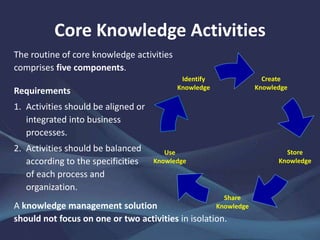
Core Knowledge Activities
Create
Knowledge
Store
Knowledge
Identify
Knowledge
Share
Knowledge
Use
Knowledge
The routine of core knowledge activities
comprises five components.
Requirements
1. Activities should be aligned or
integrated into business
processes.
2. Activities should be balanced
according to the specificities
of each process and
organization.
A knowledge management solution
should not focus on one or two activities in isolation.
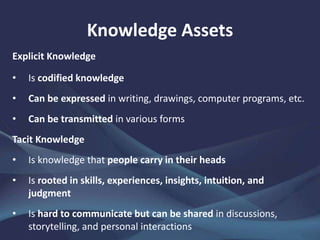
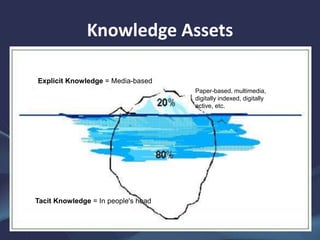
Knowledge Assets
Explicit Knowledge
• Is codified knowledge
• Can be expressed in writing, drawings, computer programs, etc.
• Can be transmitted in various forms
Tacit Knowledge
• Is knowledge that people carry in their heads
• Is rooted in skills, experiences, insights, intuition, and
judgment
• Is hard to communicate but can be shared in discussions,
storytelling, and personal interactions
Knowledge Assets
Explicit Knowledge = Media-based
Tacit Knowledge = In people's head
Paper-based, multimedia,
digitally indexed, digitally
active, etc.
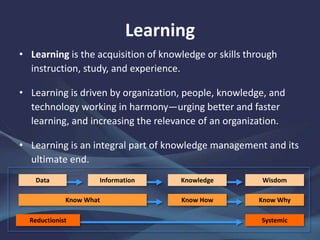
• Learning is the acquisition of knowledge or skills through
instruction, study, and experience.
• Learning is driven by organization, people, knowledge, and
technology working in harmony—urging better and faster
learning, and increasing the relevance of an organization.
• Learning is an integral part of knowledge management and its
ultimate end.
Data WisdomInformation Knowledge
Know WhyKnow HowKnow What
Reductionist Systemic
Learning
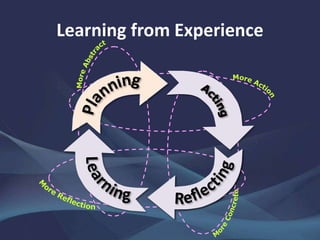
Learning from Experience
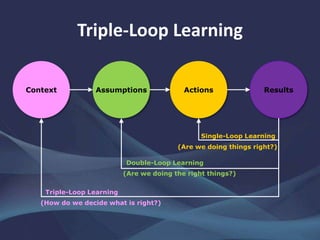
ResultsActionsAssumptionsContext
Single-Loop Learning
Double-Loop Learning
Triple-Loop Learning
(Are we doing things right?)
(Are we doing the right things?)
(How do we decide what is right?)
Triple-Loop Learning
Organizational Learning
• Learning is the key to success—some would even say survival—
in today's organizations.
• Organizational learning is the activity and the process by which
organizations reach the ideal of a learning organization.
• Organizational learning is the ability of an organization to gain
insight and understanding from experience through
experimentation, observation, and analysis, and a willingness
to examine successes and failures.
• Organizational learning promotes organizational health and
consequently increases organizational performance.
Organizational Learning
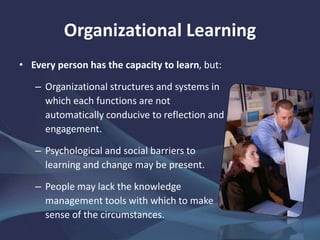
• Every person has the capacity to learn, but:
– Organizational structures and systems in
which each functions are not
automatically conducive to reflection and
engagement.
– Psychological and social barriers to
learning and change may be present.
– People may lack the knowledge
management tools with which to make
sense of the circumstances.
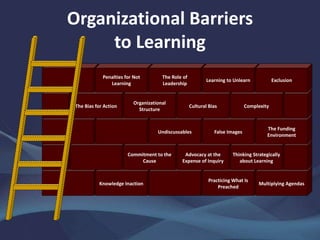
Organizational Barriers
to Learning
Knowledge Inaction
Practicing What Is
Preached
Multiplying Agendas
Commitment to the
Cause
Advocacy at the
Expense of Inquiry
Thinking Strategically
about Learning
Undiscussables False Images
The Funding
Environment
The Bias for Action
Organizational
Structure
Cultural Bias Complexity
Penalties for Not
Learning
The Role of
Leadership
Learning to Unlearn Exclusion
A Learning Organization
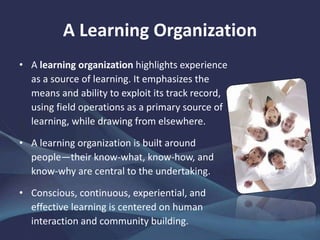
• A learning organization highlights experience
as a source of learning. It emphasizes the
means and ability to exploit its track record,
using field operations as a primary source of
learning, while drawing from elsewhere.
• A learning organization is built around
people—their know-what, know-how, and
know-why are central to the undertaking.
• Conscious, continuous, experiential, and
effective learning is centered on human
interaction and community building.
Dimensions of the
Learning Organization
• A learning organization evidences five,
sometimes overlapping, levels: individual
learning; team learning; cross-functional
learning; operational learning; and strategic
planning.
• Individual and collective learning is not
only about finding out what others already
know, even if that is a useful first stage—it
is about solving problems by doing,
reflecting, connecting, and testing until a
solution forms part of organizational life.
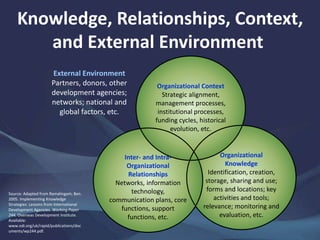
Knowledge, Relationships, Context,
and External Environment
Organizational Context
Strategic alignment,
management processes,
institutional processes,
funding cycles, historical
evolution, etc.
Inter- and Intra-
Organizational
Relationships
Networks, information
technology,
communication plans, core
functions, support
functions, etc.
Organizational
Knowledge
Identification, creation,
storage, sharing and use;
forms and locations; key
activities and tools;
relevance; monitoring and
evaluation, etc.
External Environment
Partners, donors, other
development agencies;
networks; national and
global factors, etc.
Source: Adapted from Ramalingam, Ben.
2005. Implementing Knowledge
Strategies: Lessons from International
Development Agencies. Working Paper
244. Overseas Development Institute.
Available:
www.odi.org/uk/rapid/publications/doc
uments/wp244.pdf.
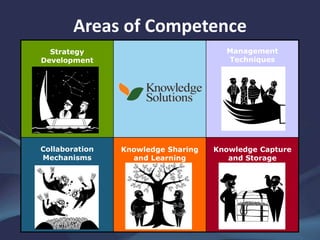
Strategy
Development
Management
Techniques
Collaboration
Mechanisms
Knowledge Sharing
and Learning
Knowledge Capture
and Storage
Areas of Competence
Competencies for Knowledge
Management and Learning
• A strategy is a long-term plan of action to achieve a particular
goal. (Strategy Development)
• Leadership is the process of working out the right things to do.
Management is the process of doing things right.
Management Techniques)
• When working with others, efforts sometimes turn out to be
less than the sum of the parts. Too often, not enough attention
is paid to facilitating effective collaborative practices.
(Collaboration Mechanisms)
• Two-way communication that take place simply and effectively
build knowledge. (Knowledge Sharing and Learning)
Eliciting
Tacit Knowledge
Building Communities of Practice
• Communities of practice are groups
of like-minded, interacting people
who filter, amplify, invest, and
provide, convene, build, and learn
and facilitate to ensure more
creation and sharing of knowledge
in their domain.
Eliciting
Tacit Knowledge
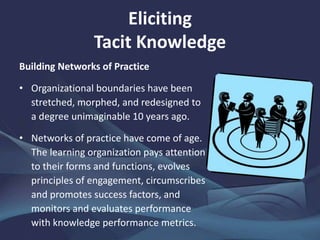
Building Networks of Practice
• Organizational boundaries have been
stretched, morphed, and redesigned to
a degree unimaginable 10 years ago.
• Networks of practice have come of age.
The learning organization pays attention
to their forms and functions, evolves
principles of engagement, circumscribes
and promotes success factors, and
monitors and evaluates performance
with knowledge performance metrics.
Eliciting
Tacit Knowledge
Collaborating with Wikis
• Wikis are websites that
invite voluntary
contributions to organize
information. They harness
the power of collaborative
minds to innovate faster,
cocreate, and cut costs. They
are now serious business.
Eliciting
Tacit Knowledge
Conducting Exit Interviews
• Exit interviews provide feedback on why
employees leave, what they liked about their job,
and where the organization needs improvement.
It is a tool to capture knowledge from leavers.
• Exit interviews are most effective when data is
compiled and tracked over time.
• Exit interviews can be a win-win situation: the
organization retains a portion of the leaver's
knowledge and shares it; the departing employee
articulates unique contributions and leaves a
mark.
Eliciting
Tacit Knowledge
The Critical Incident Technique
• The technique gives organizations a
starting point and a process for
advancing organizational
development through learning
experiences.
• The technique helps them study
"what people do" in various
situations.
Eliciting
Tacit Knowledge
Harvesting Knowledge
• If 80% of knowledge is unwritten
and largely unspoken, we first need
to elicit that before we can
articulate, share, and make wider
use of it.
• Knowledge harvesting is one way to
draw out and package tacit
knowledge to help others adapt,
personalize, and apply it; build
organizational capacity; and
preserve institutional memory
Eliciting
Tacit Knowledge
Identifying and Sharing Good
Practices
• Good practice is a process or
methodology that has been
shown to be effective in one
part of the organization and
might be effective in another
too.
Eliciting
Tacit Knowledge
Learning Histories
• How can we gauge the successes
and failures of collective learning?
• How can the rest of the
organization benefit from the
experience?
• Learning histories surface the
thinking, experiments, and
arguments of actors who engaged
in organizational change.
Eliciting
Tacit Knowledge
Monthly Progress Notes
• Feedback is the dynamic process of
presenting and disseminating
information to improve performance.
• Feedback mechanisms are increasingly
being recognized as key elements of
learning before, during, and after.
• Monthly progress notes on project
administration, which document
accomplishments as well as bottlenecks,
are prominent among these.
Eliciting
Tacit Knowledge
Showcasing Knowledge
• Information has become ubiquitous
because producing, manipulating,
and disseminating it is now cheap
and easy.
• But perceptions of information
overload have less to do with
quantity than with the qualities by
which knowledge is presented.
Eliciting
Tacit Knowledge
Social Media
• Social media is revolutionizing the way we
live, learn, work, and play.
Staff Profile Pages
• Staff profile pages are dynamic, adaptive,
electronic directories that store
information about the knowledge, skills,
experience, and interests of people.
• They are a cornerstone of successful
knowledge management and learning
initiatives.
Eliciting
Tacit Knowledge
Storytelling
• Storytelling is the use of stories
or narratives as a
communication tool to value,
share, and capitalize on the
knowledge of individuals.
Eliciting
Tacit Knowledge
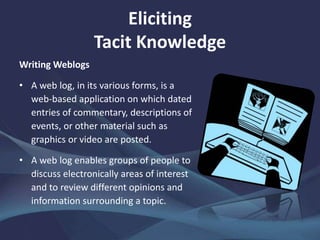
Writing Weblogs
• A web log, in its various forms, is a
web-based application on which dated
entries of commentary, descriptions of
events, or other material such as
graphics or video are posted.
• A web log enables groups of people to
discuss electronically areas of interest
and to review different opinions and
information surrounding a topic.
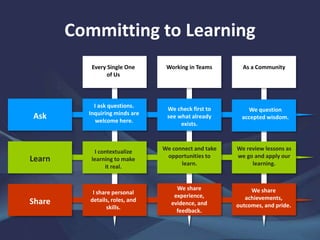
Committing to Learning
Working in Teams As a Community
Ask
I ask questions.
Inquiring minds are
welcome here.
We check first to
see what already
exists.
We question
accepted wisdom.
Every Single One
of Us
We share
experience,
evidence, and
feedback.
We share
achievements,
outcomes, and pride.
Learn
I contextualize
learning to make
it real.
We connect and take
opportunities to
learn.
We review lessons as
we go and apply our
learning.
Share
I share personal
details, roles, and
skills.
• ADB. 2008 Notions of Knowledge Management.
www.adb.org/publications/notions-knowledge-management
• ——. 2009. Building a Learning Organization.
www.adb.org/publications/building-learning-organization
• ——. 2010. Compendium of Knowledge Solutions.
www.adb.org/publications/compendium-knowledge-solutions
• ——. 2010. Seeding Knowledge Solutions Before, During, and After.
www.adb.org/publications/seeding-knowledge-solutions-during-and-
after
• ——. 2010. Learning in Development.
www.adb.org/publications/learning-development
• ——. 2010. Learning for Change. www.adb.org/publications/learning-
change-adb
Further Reading
Quick Response Codes
@ADB
@ADB Sustainable
Development Timeline
@Academia.edu
@LinkedIn
@ResearchGate
@Scholar
@SlideShare
@Twitter

Eliciting Tacit Knowledge for Learning

  • 1.
    The views expressedin this presentation are the views of the author/s and do not necessarily reflect the views or policies of the Asian Development Bank, or its Board of Governors, or the governments they represent. ADB does not guarantee the accuracy of the data included in this presentation and accepts no responsibility for any consequence of their use. The countries listed in this presentation do not imply any view on ADB's part as to sovereignty or independent status or necessarily conform to ADB's terminology. Eliciting Tacit Knowledge for Learning Olivier Serrat 2013
  • 2.
    Core Knowledge Activities Create Knowledge Store Knowledge Identify Knowledge Share Knowledge Use Knowledge Theroutine of core knowledge activities comprises five components. Requirements 1. Activities should be aligned or integrated into business processes. 2. Activities should be balanced according to the specificities of each process and organization. A knowledge management solution should not focus on one or two activities in isolation.
  • 3.
    Knowledge Assets Explicit Knowledge •Is codified knowledge • Can be expressed in writing, drawings, computer programs, etc. • Can be transmitted in various forms Tacit Knowledge • Is knowledge that people carry in their heads • Is rooted in skills, experiences, insights, intuition, and judgment • Is hard to communicate but can be shared in discussions, storytelling, and personal interactions
  • 4.
    Knowledge Assets Explicit Knowledge= Media-based Tacit Knowledge = In people's head Paper-based, multimedia, digitally indexed, digitally active, etc.
  • 5.
    • Learning isthe acquisition of knowledge or skills through instruction, study, and experience. • Learning is driven by organization, people, knowledge, and technology working in harmony—urging better and faster learning, and increasing the relevance of an organization. • Learning is an integral part of knowledge management and its ultimate end. Data WisdomInformation Knowledge Know WhyKnow HowKnow What Reductionist Systemic Learning
  • 6.
  • 7.
    ResultsActionsAssumptionsContext Single-Loop Learning Double-Loop Learning Triple-LoopLearning (Are we doing things right?) (Are we doing the right things?) (How do we decide what is right?) Triple-Loop Learning
  • 8.
    Organizational Learning • Learningis the key to success—some would even say survival— in today's organizations. • Organizational learning is the activity and the process by which organizations reach the ideal of a learning organization. • Organizational learning is the ability of an organization to gain insight and understanding from experience through experimentation, observation, and analysis, and a willingness to examine successes and failures. • Organizational learning promotes organizational health and consequently increases organizational performance.
  • 9.
    Organizational Learning • Everyperson has the capacity to learn, but: – Organizational structures and systems in which each functions are not automatically conducive to reflection and engagement. – Psychological and social barriers to learning and change may be present. – People may lack the knowledge management tools with which to make sense of the circumstances.
  • 10.
    Organizational Barriers to Learning KnowledgeInaction Practicing What Is Preached Multiplying Agendas Commitment to the Cause Advocacy at the Expense of Inquiry Thinking Strategically about Learning Undiscussables False Images The Funding Environment The Bias for Action Organizational Structure Cultural Bias Complexity Penalties for Not Learning The Role of Leadership Learning to Unlearn Exclusion
  • 11.
    A Learning Organization •A learning organization highlights experience as a source of learning. It emphasizes the means and ability to exploit its track record, using field operations as a primary source of learning, while drawing from elsewhere. • A learning organization is built around people—their know-what, know-how, and know-why are central to the undertaking. • Conscious, continuous, experiential, and effective learning is centered on human interaction and community building.
  • 12.
    Dimensions of the LearningOrganization • A learning organization evidences five, sometimes overlapping, levels: individual learning; team learning; cross-functional learning; operational learning; and strategic planning. • Individual and collective learning is not only about finding out what others already know, even if that is a useful first stage—it is about solving problems by doing, reflecting, connecting, and testing until a solution forms part of organizational life.
  • 13.
    Knowledge, Relationships, Context, andExternal Environment Organizational Context Strategic alignment, management processes, institutional processes, funding cycles, historical evolution, etc. Inter- and Intra- Organizational Relationships Networks, information technology, communication plans, core functions, support functions, etc. Organizational Knowledge Identification, creation, storage, sharing and use; forms and locations; key activities and tools; relevance; monitoring and evaluation, etc. External Environment Partners, donors, other development agencies; networks; national and global factors, etc. Source: Adapted from Ramalingam, Ben. 2005. Implementing Knowledge Strategies: Lessons from International Development Agencies. Working Paper 244. Overseas Development Institute. Available: www.odi.org/uk/rapid/publications/doc uments/wp244.pdf.
  • 14.
  • 15.
    Competencies for Knowledge Managementand Learning • A strategy is a long-term plan of action to achieve a particular goal. (Strategy Development) • Leadership is the process of working out the right things to do. Management is the process of doing things right. Management Techniques) • When working with others, efforts sometimes turn out to be less than the sum of the parts. Too often, not enough attention is paid to facilitating effective collaborative practices. (Collaboration Mechanisms) • Two-way communication that take place simply and effectively build knowledge. (Knowledge Sharing and Learning)
  • 16.
    Eliciting Tacit Knowledge Building Communitiesof Practice • Communities of practice are groups of like-minded, interacting people who filter, amplify, invest, and provide, convene, build, and learn and facilitate to ensure more creation and sharing of knowledge in their domain.
  • 17.
    Eliciting Tacit Knowledge Building Networksof Practice • Organizational boundaries have been stretched, morphed, and redesigned to a degree unimaginable 10 years ago. • Networks of practice have come of age. The learning organization pays attention to their forms and functions, evolves principles of engagement, circumscribes and promotes success factors, and monitors and evaluates performance with knowledge performance metrics.
  • 18.
    Eliciting Tacit Knowledge Collaborating withWikis • Wikis are websites that invite voluntary contributions to organize information. They harness the power of collaborative minds to innovate faster, cocreate, and cut costs. They are now serious business.
  • 19.
    Eliciting Tacit Knowledge Conducting ExitInterviews • Exit interviews provide feedback on why employees leave, what they liked about their job, and where the organization needs improvement. It is a tool to capture knowledge from leavers. • Exit interviews are most effective when data is compiled and tracked over time. • Exit interviews can be a win-win situation: the organization retains a portion of the leaver's knowledge and shares it; the departing employee articulates unique contributions and leaves a mark.
  • 20.
    Eliciting Tacit Knowledge The CriticalIncident Technique • The technique gives organizations a starting point and a process for advancing organizational development through learning experiences. • The technique helps them study "what people do" in various situations.
  • 21.
    Eliciting Tacit Knowledge Harvesting Knowledge •If 80% of knowledge is unwritten and largely unspoken, we first need to elicit that before we can articulate, share, and make wider use of it. • Knowledge harvesting is one way to draw out and package tacit knowledge to help others adapt, personalize, and apply it; build organizational capacity; and preserve institutional memory
  • 22.
    Eliciting Tacit Knowledge Identifying andSharing Good Practices • Good practice is a process or methodology that has been shown to be effective in one part of the organization and might be effective in another too.
  • 23.
    Eliciting Tacit Knowledge Learning Histories •How can we gauge the successes and failures of collective learning? • How can the rest of the organization benefit from the experience? • Learning histories surface the thinking, experiments, and arguments of actors who engaged in organizational change.
  • 24.
    Eliciting Tacit Knowledge Monthly ProgressNotes • Feedback is the dynamic process of presenting and disseminating information to improve performance. • Feedback mechanisms are increasingly being recognized as key elements of learning before, during, and after. • Monthly progress notes on project administration, which document accomplishments as well as bottlenecks, are prominent among these.
  • 25.
    Eliciting Tacit Knowledge Showcasing Knowledge •Information has become ubiquitous because producing, manipulating, and disseminating it is now cheap and easy. • But perceptions of information overload have less to do with quantity than with the qualities by which knowledge is presented.
  • 26.
    Eliciting Tacit Knowledge Social Media •Social media is revolutionizing the way we live, learn, work, and play. Staff Profile Pages • Staff profile pages are dynamic, adaptive, electronic directories that store information about the knowledge, skills, experience, and interests of people. • They are a cornerstone of successful knowledge management and learning initiatives.
  • 27.
    Eliciting Tacit Knowledge Storytelling • Storytellingis the use of stories or narratives as a communication tool to value, share, and capitalize on the knowledge of individuals.
  • 28.
    Eliciting Tacit Knowledge Writing Weblogs •A web log, in its various forms, is a web-based application on which dated entries of commentary, descriptions of events, or other material such as graphics or video are posted. • A web log enables groups of people to discuss electronically areas of interest and to review different opinions and information surrounding a topic.
  • 29.
    Committing to Learning Workingin Teams As a Community Ask I ask questions. Inquiring minds are welcome here. We check first to see what already exists. We question accepted wisdom. Every Single One of Us We share experience, evidence, and feedback. We share achievements, outcomes, and pride. Learn I contextualize learning to make it real. We connect and take opportunities to learn. We review lessons as we go and apply our learning. Share I share personal details, roles, and skills.
  • 30.
    • ADB. 2008Notions of Knowledge Management. www.adb.org/publications/notions-knowledge-management • ——. 2009. Building a Learning Organization. www.adb.org/publications/building-learning-organization • ——. 2010. Compendium of Knowledge Solutions. www.adb.org/publications/compendium-knowledge-solutions • ——. 2010. Seeding Knowledge Solutions Before, During, and After. www.adb.org/publications/seeding-knowledge-solutions-during-and- after • ——. 2010. Learning in Development. www.adb.org/publications/learning-development • ——. 2010. Learning for Change. www.adb.org/publications/learning- change-adb Further Reading
  • 31.
    Quick Response Codes @ADB @ADBSustainable Development Timeline @Academia.edu @LinkedIn @ResearchGate @Scholar @SlideShare @Twitter