KNOWLEDGE MANAGEMENT  & KNOWLEDGE MANAGEMENT  3.0 Yağmur BÜYÜKEMRE Can ÇAKIR Mehmet SUBAŞI
OUTLINE Definition of Data, Information, Knowledge and Wisdom What is Knowledge Management (KM)? Why is KM Necessary? A General Framework for an Effective KM Structure How to Measure the Effectiveness of a KM Structure Evolution and Development of KM Definition and Distinguishing Aspects of KM  3.0 Best Practice Examples
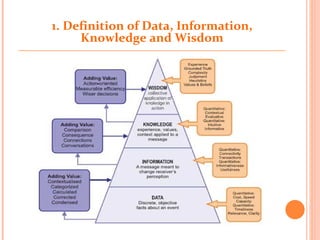
1. Defin ition of Data, Information, Knowledge and Wisdom
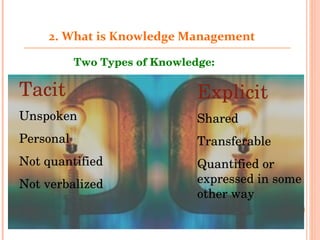
Two Types of Knowledge: Tacit Unspoken Personal Not quantified Not verbalized Explicit Shared Transferable Quantified or expressed in some other way 2. What is Knowledge Management
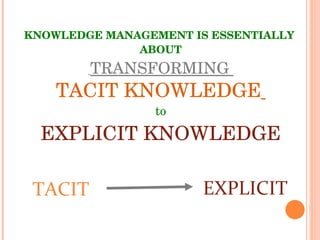
KNOWLEDGE MANAGEMENT IS ESSENTIALLY  ABOUT TRANSFORMING  TACIT KNOWLEDGE   to EXPLICIT KNOWLEDGE TACIT EXPLICIT
3.  Why Knowledge Management is Necessary To make  existing knowledge  more widely  available  within organization so that learning curve duration goes down and people in different branches of the organization won’t have to discover the same things over and  over again Innovation;  to make it possible to cr eate new  valuable knowledge Adaptability; agility ; better mark et  intelligence from more sources
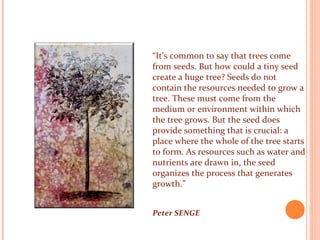
“ It’s common to say that trees come from seeds. But how could a tiny seed create a huge tree? Seeds do not contain the resources needed to grow a tree. These must come from the medium or environment within which the tree grows. But the seed does provide something that is crucial: a place where the whole of the tree starts to form. As resources such as water and nutrients are drawn in, the seed organizes the process that generates growth.”  Peter SENGE
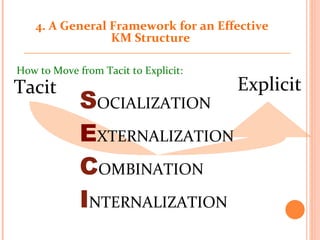
How to Move from Tacit to Explicit : Tacit Explicit S OCIALIZATION E XTERNALIZATION C OMBINATION I NTERNALIZATION 4. A General Framework for an Effective KM Structure
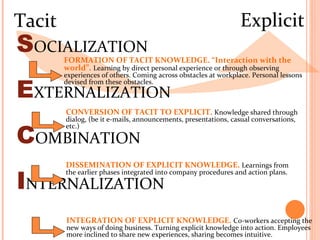
Tacit Explicit S OCIALIZATION E XTERNALIZATION C OMBINATION I NTERNALIZATION FORMATION OF TACIT KNOWLEDGE. “Interaction with the world”.   Learning by direct personal experience or through observing experiences of others. Coming across obstacles at workplace. Personal lessons devised from these obstacles. CONVERSION OF TACIT TO EXPLICIT.  Knowledge shared through dialog, (be it e-mails, announcements, presentations, casual conversations, etc.) DISSEMINATION OF EXPLICIT KNOWLEDGE.  Learnings from the earlier phases integrated into company procedures and action plans.  INTEGRATION OF EXPLICIT KNOWLEDGE.  Co-workers accepting the new ways of doing business. Turning explicit knowledge into action. Employees more inclined to share new experiences, sharing becomes intuitive.
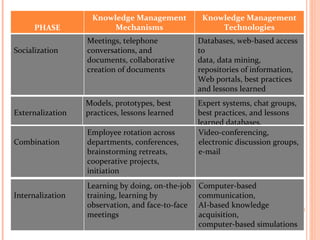
PHASE Knowledge Management Mechanisms Knowledge Management Technologies Socialization Meetings, telephone conversations, and documents, collaborative creation of documents Databases, web-based access to data, data mining, repositories of information, Web portals, best practices and lessons learned Externalization Models, prototypes, best practices, lessons learned Expert systems, chat groups, best practices, and lessons learned databases. Combination Employee rotation across departments, conferences, brainstorming retreats, cooperative projects, initiation Video-conferencing, electronic discussion groups, e-mail Internalization Learning by doing, on-the-job training, learning by observation, and face-to-face meetings Computer-based communication, AI-based knowledge acquisition, computer-based simulations
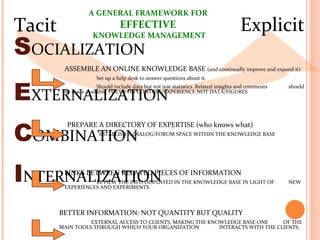
Tacit Explicit S OCIALIZATION E XTERNALIZATION C OMBINATION I NTERNALIZATION ASSEMBLE AN ONLINE KNOWLEDGE BASE  (and continually improve and expand it) Set up a help desk to answer questions about it. Should include data but not just statistics. Related insights and comments  should be made available. FOCUS ON CONTEXT/EXPERIENCE NOT DATA/FIGURES A GENERAL FRAMEWORK FOR  EFFECTIVE  KNOWLEDGE MANAGEMENT PREPARE A DIRECTORY OF EXPERTISE (who knows what) ESTABLISH A DIALOG/FORUM SPACE WITHIN THE KNOWLEDGE BASE LINKS BETWEEN RELATED PIECES OF INFORMATION REVIEW THE INFO DISPLAYED IN THE KNOWLEDGE BASE IN LIGHT OF  NEW  EXPERIENCES AND EXPERIMENTS. BETTER INFORMATION: NOT QUANTITY BUT QUALITY EXTERNAL ACCESS TO CLIENTS, MAKING THE KNOWLEDGE BASE ONE  OF THE MAIN TOOLS THROUGH WHICH YOUR ORGANIZATION  INTERACTS WITH THE CLIENTS.
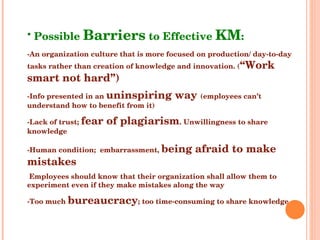
Possible  Barriers  to Effective  KM : -An organization culture that is more focused on production/ day-to-day tasks rather than creation of knowledge and innovation. ( “Work smart not hard”) -Info presented in an  uninspiring way  (employees can’t understand how to benefit from it) -Lack of trust;  fear of plagiarism . Unwillingness to share knowledge -Human condition;  embarrassment,  being afraid to make mistakes  Employees should know that their organization shall allow them to experiment even if they make mistakes along the way -Too much  bureaucracy ; too time-consuming to share knowledge
5.  How to Measure the Effectiveness of an Organization’s KM Structure: KNOWLEDGE MANAGEMENT   METRICS  AIM:  To assess whether employees   Want to contribute CRITERIA: To the knowledge base.   Visits per employee Suggestions per employee (overall participation) Proportion of implemented suggestions Time taken to achieve a certain improvement  Availability of information
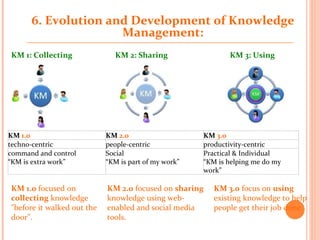
6 .  Evolution and Development of Knowledge Management: KM 1: Collecting KM 2: Sharing KM 3: Using KM 2.0  focused on  sharing  knowledge using web-enabled and social media tools. KM 1.0  focused on  collecting  knowledge "before it walked out the door". KM 3.0  focus on  using  existing knowledge to help people get their job done. KM  1.0 KM  2.0 KM  3.0 techno-centric people-centric productivity-centric command and control “ KM is extra work” Social “ KM is part of my work” Practical & Individual “ KM is helping me do my work”
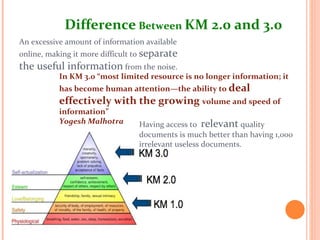
In KM 3.0 “most limited resource is no longer information; it has become human attention—the ability to  deal effectively with the growing  volume and speed of information” Yogesh Malhotra An excessive amount of information available online, making it more difficult to  separate the useful information  from the noise. Difference  Between  KM 2.0 and 3.0 Having access to  relevant  quality documents is much better than having 1,000 irrelevant useless documents.
What is  Knowledge Management 3.0 ? Collecting and sharing with others is still important, but what you share with your project team is not necessary the same as you share with your department,  division or your organization . There is no point collecting common knowledge if it isn't shared. - There is no point sharing knowledge  if it isn't used . Collecting  everything  will lead to  information overloa d  and make it more difficult to search for and find what you need, and may actually  decrease  the overall value of the captured k nowledge.  If 30% of your knowledge database is useful to 2% of your employees, then the other 98% of your people will have to  filter  through a lot of irrelevant information unnecessary. INFORMATION TECHNOLOGY’s MAIN ROLE IN KM 3.0 IS  TAXONOMY :  Tools to filter out relevant info.
7 .  Best Practice Examples: Making KM a natural part of the workflow Call center example: 2 agent levels:  -Level 1 agents for initial client interactions, less sophisticated problems,  -Level 2 agents for problems that the 1 st  level agents can’t solve. A customer calls about a software problem.  As Level 1 agent prepares to find a solution, he/she gathers problem description along with info on product model and computer operating environment.  If Level 1 agent can find an existing solution in the knowledgebase, he/she shares with the caller. If not, puts the caller through to a higher level agent. Expert agent then solves the problem, and makes an entry into the knowledgebase about the nature and solution of the problem. Next time, level 1 agents will have access to the solution of this particular problem.
Interoperability: Consulting company example: A knowledgebase, which covers the company’s success measurement criteria and tips and hints on fixing several different types of management issues, is available within the consulting company’s database.  Instead of functioning in a vacuum, the knowledgebase, thanks to the foresight of the IT department, is able to pull valuable information from a wide selection of existing sources (drawing on the expertise of different departments within the company) in a wide variety of file formats, such as Word, Excel, Powerpoint, Adobe Acrobat and web pages in HTML.
Open organization culture: “ [Knowledge management] is not just a tool-set it’s a cultural revolution. The major implementation hurdle in a knowledge-sharing system is not the technology. It is getting people used to it. Sharing ideas freely is one thing when you are at a physical meeting and can see reaction. It is another when you are working electronically.” —  Gig Griffith, Manager of Business Operations for Technical Services, Novell In many companies, a knowledge-based support organization requires a cultural shift, a migration to an organization whose people are open and willing to share what they know with others in a more systematic way than what they may be used to. Continuously creating motivation for sharing: Ongoing recognition of improvements,  Periodic feedback on efficiency gains,  Rewards on personal contribution  (e.g. Reward per 10 entry), View as a marketing strategy to reflect expertise
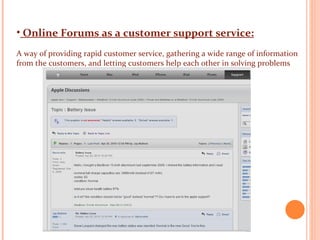
Online Forums as a customer support service: A way of providing rapid customer service, gathering a wide range of information from the customers, and letting customers help each other in solving problems
PROJECT RELATED DOCUMENTS Photos: http://www.flickr.com/photos/50008418@N03/?saved=1 Videos: http://vimeo.com/user3781333 Links: http://delicious.com/KM3.0 Blog Entries: https://docs.google.com/Doc?id=dg4c9n74_36kxs3sf2 Kick Off Presentation : https://docs.google.com/present/edit?id=0AYE8CS6210idZGc0YzluNzRfMjdmNXNnMzhjNQ&hl=en http://www.slideshare.net/KM03 Project Documents: https://docs.google.com/Doc?docid=0AYE8CS6210idZGc0YzluNzRfMTZkY3Z6aGJ0cg&hl=en Presentation: http://www.slideshare.net/KM03
REFERENCES: ARTICLES; Murray, J.E. (2007)  Knowledge Management in Modern Organization.  Hershey: Idea Group.   Schwartz, D.G. (2006)  Encyclopedia of Knowledge Management.  Hershey: Idea Group.   King, W.R. (2009)  Knowledge Management and Organizational Learning (Volume 4).  New York: Springer.   Dalkir, Kimiz. (2005)  Knowledge Management in Theory and Practice.  Burlington: Elsevier.   Figallo C., Rhine N. (2002)  Building the Knowledge Management Networks.  New York: Wiley Technology Publishing.   Senge P., Scharmer C.O., Jaworski J., Flowers B.S. (2004)  Presence . New York: Doubleday .
LINKS; http://www.ppcsoft.com/blog/km-3.asp http://fredzimny.wordpress.com/2010/02/28/recommended-knowledge-management-3-0-part-iii-the-km-process/ www.aplici.org/wp-content/uploads/2009/11/Lester_KM_slides.pdf http://mature-ip.eu/knowledge-management-3.0-learntec-2010 http://www.activecampaign.com/blog/knowledgebuilder-30-beta-coming-soon/ http://zyxo.wordpress.com/2008/12/28/km-10-km-20-km-30/ http://www.metacafe.com/results/knowledge_management/ http://www.slideshare.net/TSystemsMMS/enterprise-20-knowledge-management-getting-started http://en.wikipedia.org/wiki/Knowledge_management http://blog.jackvinson.com/archives/2009/11/22/is_there_a_next_stage_to_km_10_20.html http://www.thinkhdi.com/library/deliverfile.aspx?filecontentid=130 http://www.providersedge.com/docs/km_articles/Best_Practices_in_Business_and_Competitive_Intelligence_Volume_I.pdf http://www.dkms.com/papers/kmfamrev1.pdf http://www.practicallaw.com/4-225-4012 http://www.aplici.org/wp-content/uploads/2009/11/Lester_KM_slides.pdf
THANK YOU! QUESTIONS?? Yağmur BÜYÜKEMRE Can ÇAKIR Mehmet SUBAŞI

Knowledge Management 3.0 Final Presentation

  • 1.
    KNOWLEDGE MANAGEMENT & KNOWLEDGE MANAGEMENT 3.0 Yağmur BÜYÜKEMRE Can ÇAKIR Mehmet SUBAŞI
  • 2.
    OUTLINE Definition ofData, Information, Knowledge and Wisdom What is Knowledge Management (KM)? Why is KM Necessary? A General Framework for an Effective KM Structure How to Measure the Effectiveness of a KM Structure Evolution and Development of KM Definition and Distinguishing Aspects of KM 3.0 Best Practice Examples
  • 3.
    1. Defin itionof Data, Information, Knowledge and Wisdom
  • 4.
    Two Types ofKnowledge: Tacit Unspoken Personal Not quantified Not verbalized Explicit Shared Transferable Quantified or expressed in some other way 2. What is Knowledge Management
  • 5.
    KNOWLEDGE MANAGEMENT ISESSENTIALLY ABOUT TRANSFORMING TACIT KNOWLEDGE to EXPLICIT KNOWLEDGE TACIT EXPLICIT
  • 6.
    3. WhyKnowledge Management is Necessary To make existing knowledge more widely available within organization so that learning curve duration goes down and people in different branches of the organization won’t have to discover the same things over and over again Innovation; to make it possible to cr eate new valuable knowledge Adaptability; agility ; better mark et intelligence from more sources
  • 7.
    “ It’s commonto say that trees come from seeds. But how could a tiny seed create a huge tree? Seeds do not contain the resources needed to grow a tree. These must come from the medium or environment within which the tree grows. But the seed does provide something that is crucial: a place where the whole of the tree starts to form. As resources such as water and nutrients are drawn in, the seed organizes the process that generates growth.” Peter SENGE
  • 8.
    How to Movefrom Tacit to Explicit : Tacit Explicit S OCIALIZATION E XTERNALIZATION C OMBINATION I NTERNALIZATION 4. A General Framework for an Effective KM Structure
  • 9.
    Tacit Explicit SOCIALIZATION E XTERNALIZATION C OMBINATION I NTERNALIZATION FORMATION OF TACIT KNOWLEDGE. “Interaction with the world”. Learning by direct personal experience or through observing experiences of others. Coming across obstacles at workplace. Personal lessons devised from these obstacles. CONVERSION OF TACIT TO EXPLICIT. Knowledge shared through dialog, (be it e-mails, announcements, presentations, casual conversations, etc.) DISSEMINATION OF EXPLICIT KNOWLEDGE. Learnings from the earlier phases integrated into company procedures and action plans. INTEGRATION OF EXPLICIT KNOWLEDGE. Co-workers accepting the new ways of doing business. Turning explicit knowledge into action. Employees more inclined to share new experiences, sharing becomes intuitive.
  • 10.
    PHASE Knowledge ManagementMechanisms Knowledge Management Technologies Socialization Meetings, telephone conversations, and documents, collaborative creation of documents Databases, web-based access to data, data mining, repositories of information, Web portals, best practices and lessons learned Externalization Models, prototypes, best practices, lessons learned Expert systems, chat groups, best practices, and lessons learned databases. Combination Employee rotation across departments, conferences, brainstorming retreats, cooperative projects, initiation Video-conferencing, electronic discussion groups, e-mail Internalization Learning by doing, on-the-job training, learning by observation, and face-to-face meetings Computer-based communication, AI-based knowledge acquisition, computer-based simulations
  • 11.
    Tacit Explicit SOCIALIZATION E XTERNALIZATION C OMBINATION I NTERNALIZATION ASSEMBLE AN ONLINE KNOWLEDGE BASE (and continually improve and expand it) Set up a help desk to answer questions about it. Should include data but not just statistics. Related insights and comments should be made available. FOCUS ON CONTEXT/EXPERIENCE NOT DATA/FIGURES A GENERAL FRAMEWORK FOR EFFECTIVE KNOWLEDGE MANAGEMENT PREPARE A DIRECTORY OF EXPERTISE (who knows what) ESTABLISH A DIALOG/FORUM SPACE WITHIN THE KNOWLEDGE BASE LINKS BETWEEN RELATED PIECES OF INFORMATION REVIEW THE INFO DISPLAYED IN THE KNOWLEDGE BASE IN LIGHT OF NEW EXPERIENCES AND EXPERIMENTS. BETTER INFORMATION: NOT QUANTITY BUT QUALITY EXTERNAL ACCESS TO CLIENTS, MAKING THE KNOWLEDGE BASE ONE OF THE MAIN TOOLS THROUGH WHICH YOUR ORGANIZATION INTERACTS WITH THE CLIENTS.
  • 12.
    Possible Barriers to Effective KM : -An organization culture that is more focused on production/ day-to-day tasks rather than creation of knowledge and innovation. ( “Work smart not hard”) -Info presented in an uninspiring way (employees can’t understand how to benefit from it) -Lack of trust; fear of plagiarism . Unwillingness to share knowledge -Human condition; embarrassment, being afraid to make mistakes Employees should know that their organization shall allow them to experiment even if they make mistakes along the way -Too much bureaucracy ; too time-consuming to share knowledge
  • 13.
    5. Howto Measure the Effectiveness of an Organization’s KM Structure: KNOWLEDGE MANAGEMENT METRICS AIM: To assess whether employees Want to contribute CRITERIA: To the knowledge base. Visits per employee Suggestions per employee (overall participation) Proportion of implemented suggestions Time taken to achieve a certain improvement Availability of information
  • 14.
    6 . Evolution and Development of Knowledge Management: KM 1: Collecting KM 2: Sharing KM 3: Using KM 2.0 focused on sharing knowledge using web-enabled and social media tools. KM 1.0 focused on collecting knowledge "before it walked out the door". KM 3.0 focus on using existing knowledge to help people get their job done. KM 1.0 KM 2.0 KM 3.0 techno-centric people-centric productivity-centric command and control “ KM is extra work” Social “ KM is part of my work” Practical & Individual “ KM is helping me do my work”
  • 15.
    In KM 3.0“most limited resource is no longer information; it has become human attention—the ability to deal effectively with the growing volume and speed of information” Yogesh Malhotra An excessive amount of information available online, making it more difficult to separate the useful information from the noise. Difference Between KM 2.0 and 3.0 Having access to relevant quality documents is much better than having 1,000 irrelevant useless documents.
  • 16.
    What is Knowledge Management 3.0 ? Collecting and sharing with others is still important, but what you share with your project team is not necessary the same as you share with your department, division or your organization . There is no point collecting common knowledge if it isn't shared. - There is no point sharing knowledge if it isn't used . Collecting everything will lead to information overloa d and make it more difficult to search for and find what you need, and may actually decrease the overall value of the captured k nowledge. If 30% of your knowledge database is useful to 2% of your employees, then the other 98% of your people will have to filter through a lot of irrelevant information unnecessary. INFORMATION TECHNOLOGY’s MAIN ROLE IN KM 3.0 IS TAXONOMY : Tools to filter out relevant info.
  • 17.
    7 . Best Practice Examples: Making KM a natural part of the workflow Call center example: 2 agent levels: -Level 1 agents for initial client interactions, less sophisticated problems, -Level 2 agents for problems that the 1 st level agents can’t solve. A customer calls about a software problem. As Level 1 agent prepares to find a solution, he/she gathers problem description along with info on product model and computer operating environment. If Level 1 agent can find an existing solution in the knowledgebase, he/she shares with the caller. If not, puts the caller through to a higher level agent. Expert agent then solves the problem, and makes an entry into the knowledgebase about the nature and solution of the problem. Next time, level 1 agents will have access to the solution of this particular problem.
  • 18.
    Interoperability: Consulting companyexample: A knowledgebase, which covers the company’s success measurement criteria and tips and hints on fixing several different types of management issues, is available within the consulting company’s database. Instead of functioning in a vacuum, the knowledgebase, thanks to the foresight of the IT department, is able to pull valuable information from a wide selection of existing sources (drawing on the expertise of different departments within the company) in a wide variety of file formats, such as Word, Excel, Powerpoint, Adobe Acrobat and web pages in HTML.
  • 19.
    Open organization culture:“ [Knowledge management] is not just a tool-set it’s a cultural revolution. The major implementation hurdle in a knowledge-sharing system is not the technology. It is getting people used to it. Sharing ideas freely is one thing when you are at a physical meeting and can see reaction. It is another when you are working electronically.” — Gig Griffith, Manager of Business Operations for Technical Services, Novell In many companies, a knowledge-based support organization requires a cultural shift, a migration to an organization whose people are open and willing to share what they know with others in a more systematic way than what they may be used to. Continuously creating motivation for sharing: Ongoing recognition of improvements, Periodic feedback on efficiency gains, Rewards on personal contribution (e.g. Reward per 10 entry), View as a marketing strategy to reflect expertise
  • 20.
    Online Forums asa customer support service: A way of providing rapid customer service, gathering a wide range of information from the customers, and letting customers help each other in solving problems
  • 21.
    PROJECT RELATED DOCUMENTSPhotos: http://www.flickr.com/photos/50008418@N03/?saved=1 Videos: http://vimeo.com/user3781333 Links: http://delicious.com/KM3.0 Blog Entries: https://docs.google.com/Doc?id=dg4c9n74_36kxs3sf2 Kick Off Presentation : https://docs.google.com/present/edit?id=0AYE8CS6210idZGc0YzluNzRfMjdmNXNnMzhjNQ&hl=en http://www.slideshare.net/KM03 Project Documents: https://docs.google.com/Doc?docid=0AYE8CS6210idZGc0YzluNzRfMTZkY3Z6aGJ0cg&hl=en Presentation: http://www.slideshare.net/KM03
  • 22.
    REFERENCES: ARTICLES; Murray,J.E. (2007) Knowledge Management in Modern Organization. Hershey: Idea Group.   Schwartz, D.G. (2006) Encyclopedia of Knowledge Management. Hershey: Idea Group.   King, W.R. (2009) Knowledge Management and Organizational Learning (Volume 4). New York: Springer.   Dalkir, Kimiz. (2005) Knowledge Management in Theory and Practice. Burlington: Elsevier.   Figallo C., Rhine N. (2002) Building the Knowledge Management Networks. New York: Wiley Technology Publishing.   Senge P., Scharmer C.O., Jaworski J., Flowers B.S. (2004) Presence . New York: Doubleday .
  • 23.
    LINKS; http://www.ppcsoft.com/blog/km-3.asp http://fredzimny.wordpress.com/2010/02/28/recommended-knowledge-management-3-0-part-iii-the-km-process/www.aplici.org/wp-content/uploads/2009/11/Lester_KM_slides.pdf http://mature-ip.eu/knowledge-management-3.0-learntec-2010 http://www.activecampaign.com/blog/knowledgebuilder-30-beta-coming-soon/ http://zyxo.wordpress.com/2008/12/28/km-10-km-20-km-30/ http://www.metacafe.com/results/knowledge_management/ http://www.slideshare.net/TSystemsMMS/enterprise-20-knowledge-management-getting-started http://en.wikipedia.org/wiki/Knowledge_management http://blog.jackvinson.com/archives/2009/11/22/is_there_a_next_stage_to_km_10_20.html http://www.thinkhdi.com/library/deliverfile.aspx?filecontentid=130 http://www.providersedge.com/docs/km_articles/Best_Practices_in_Business_and_Competitive_Intelligence_Volume_I.pdf http://www.dkms.com/papers/kmfamrev1.pdf http://www.practicallaw.com/4-225-4012 http://www.aplici.org/wp-content/uploads/2009/11/Lester_KM_slides.pdf
  • 24.
    THANK YOU! QUESTIONS??Yağmur BÜYÜKEMRE Can ÇAKIR Mehmet SUBAŞI