Ocean  Currents  
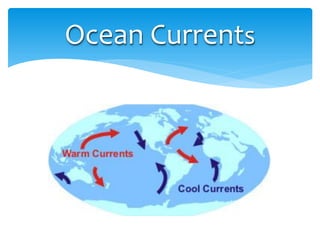
Ocean  Currents  


      Warm  currents  flow  away  from  the  
     equator.  


          Cold  currents  flow  toward  the  equator.  
  
Factors  Influencing  Currents  


Sun  
Wind  
Coriolis  
Gravity  
  
Sun  


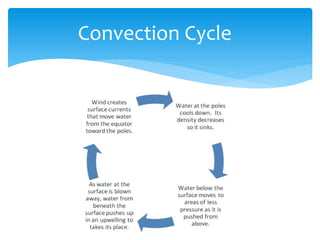
     Energy  from  the  Sun  heats  the  water.  
     Warm  water  is  less  dense  that  cold  
     water.  
     Warm  water  rises,  and  cold  water  sinks.  
     As  warm  water  rises,  cold  water  moves  it  
     to  replace  it.  
  
Convection  Cycle  
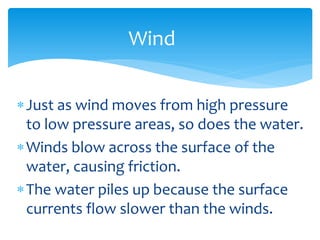
Wind  


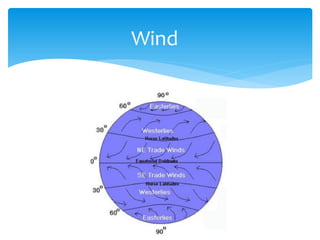
     Just  as  wind  moves  from  high  pressure  
     to  low  pressure  areas,  so  does  the  water.  
     Winds  blow  across  the  surface  of  the  
     water,  causing  friction.  
     The  water  piles  up  because  the  surface  
     currents  flow  slower  than  the  winds.  
  
Wind  
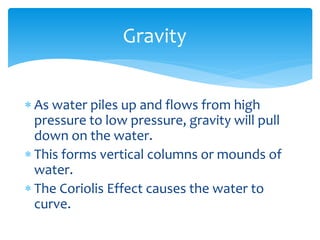
Gravity  


As  water  piles  up  and  flows  from  high  
pressure  to  low  pressure,  gravity  will  pull  
down  on  the  water.  
This  forms  vertical  columns  or  mounds  of  
water.  
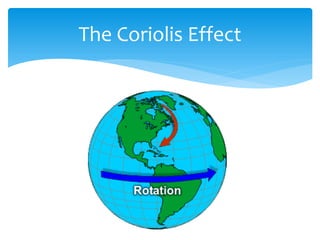
The  Coriolis  Effect  causes  the  water  to  
curve.  
The  Coriolis  Effect  


Causes  water  to  move  to  the  right  in  
the  Northern  Hemisphere  


Causes  water  to  move  to  the  left  in  
the  Southern  Hemisphere  
The  Coriolis  Effect  
Surface  Currents  


M                                  
Up  to  maximum  depth  of  400  m  
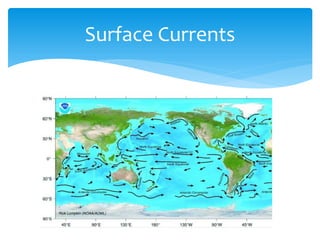
Surface  ocean  currents  are  caused  by  
the  surface  wind  patterns.  
  
Surface  Currents  
Gyres  

Vertical  columns    or  mounds  of  water  at  the  surface  
and  flow  around  them  
Produce  enormous  circular  currents    
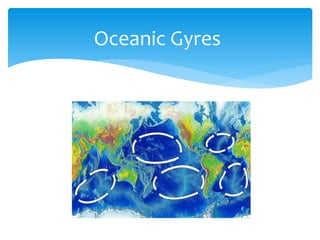
Five  major  locations:  
  North  Pacific  -­‐  clockwise  
  South  Pacific  -­‐  counterclockwise  
  Indian  Ocean  -­‐  counterclockwise  
  South  Atlantic  -­‐  counterclockwise  
  North  Atlantic  -­‐  clockwise  
Oceanic  Gyres  
Gulf  Stream  


A  strong  surface  current  
Begins  at  the  tip  of  Florida  
Flows  up  the  eastern  coastline  of  the  U.S.    
Crosses  the  Atlantic  Ocean  
Causes  warmer  climate  in  NW  Europe  
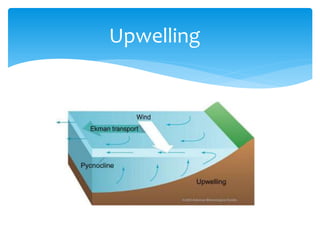
Upwelling  


Surface  waters  blow  to  the  right  of  
the  wind.  


As  less  dense,  surface  water  moves  
off  shore,  cold,  deep,  denser  waters  
come  to  the  surface  to  replace  them.  
  
Upwelling  
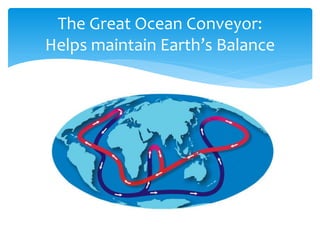
The  Great  Ocean  Conveyor:  
                                   
Deep  Water  Currents  

                                               
Differences  in  density  cause  them  to  move.  
Differences  in  density  are  related  to  temperature  
and  salinity.  
At  high  latitudes,  they  sink  deep  into  the  ocean  
basins.  
Temperatures  are  so  cold,  they  cause  the  density  to  
increase.  
Reflective  Question  


     How  are  ocean  currents  produced?  
  
El  Nino  


      Abnormally  high  surface  ocean  
     temperatures  off  the  coast  of  South  
     America  
            
        Causes  unusual  weather  patterns  across  
        the  globe  


El  Nino  


Starts  because  the  easterly  trade  winds  
weaken  and  allow  the  warm  waters  in  the  
Western  Pacific  to  move  east  toward  South  
America  
This  changes  where  the  convection  current  
occurs.  
Causing  rain  where  it  usually  doesn't  occur  
and  drought  where  it  usually  rains  
  
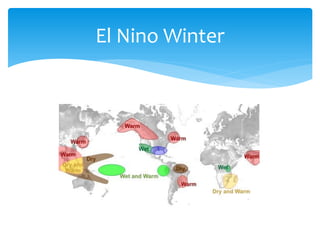
El  Nino  Winter  
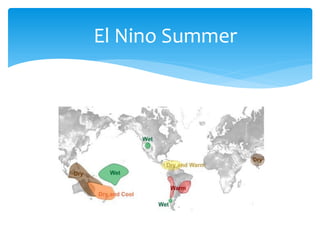
El  Nino  Summer  
La  Nina  


        Abnormally  low  surface  ocean  temperatures  
      off  the  coast  of  South  America  
          
        Causes  unusual  weather  patterns  across  
        the  globe  


     Ocean  currents  move  more  slowly  than  winds.  
     Oceans  hold  more  heat  than  the  atmosphere  and  
     land.  
     Cold  currents  will  cause  nearby  coastlines  to  be  
     cooler.  
     Warm  currents  will  cause  nearby  coastlines  to  be  
     warmer.  
  
Where  do  the  cold  currents  come  from?  The  
warm  currents?  
       
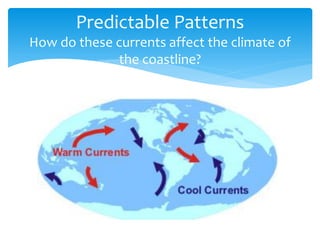
Predictable  Patterns    
How  do  these  currents  affect  the  climate  of  
                the  coastline?  
Reflection  Questions  


     How  do  our  oceans  impact  climate?  

Ocean currents ppt cscope

  • 1.
  • 2.
    Ocean  Currents   Warm  currents  flow  away  from  the   equator.       Cold  currents  flow  toward  the  equator.    
  • 3.
    Factors  Influencing  Currents  Sun   Wind   Coriolis   Gravity    
  • 4.
    Sun   Energy  from  the  Sun  heats  the  water.   Warm  water  is  less  dense  that  cold   water.   Warm  water  rises,  and  cold  water  sinks.   As  warm  water  rises,  cold  water  moves  it   to  replace  it.    
  • 5.
  • 6.
    Wind   Just  as  wind  moves  from  high  pressure   to  low  pressure  areas,  so  does  the  water.   Winds  blow  across  the  surface  of  the   water,  causing  friction.   The  water  piles  up  because  the  surface   currents  flow  slower  than  the  winds.    
  • 7.
  • 8.
    Gravity   As  water piles  up  and  flows  from  high   pressure  to  low  pressure,  gravity  will  pull   down  on  the  water.   This  forms  vertical  columns  or  mounds  of   water.   The  Coriolis  Effect  causes  the  water  to   curve.  
  • 9.
    The  Coriolis  Effect  Causes  water  to  move  to  the  right  in   the  Northern  Hemisphere     Causes  water  to  move  to  the  left  in   the  Southern  Hemisphere  
  • 10.
  • 11.
    Surface  Currents   M   Up  to  maximum  depth  of  400  m   Surface  ocean  currents  are  caused  by   the  surface  wind  patterns.    
  • 12.
  • 13.
    Gyres   Vertical  columns   or  mounds  of  water  at  the  surface   and  flow  around  them   Produce  enormous  circular  currents     Five  major  locations:   North  Pacific  -­‐  clockwise   South  Pacific  -­‐  counterclockwise   Indian  Ocean  -­‐  counterclockwise   South  Atlantic  -­‐  counterclockwise   North  Atlantic  -­‐  clockwise  
  • 14.
  • 15.
    Gulf  Stream   A strong  surface  current   Begins  at  the  tip  of  Florida   Flows  up  the  eastern  coastline  of  the  U.S.     Crosses  the  Atlantic  Ocean   Causes  warmer  climate  in  NW  Europe  
  • 16.
    Upwelling   Surface  waters blow  to  the  right  of   the  wind.     As  less  dense,  surface  water  moves   off  shore,  cold,  deep,  denser  waters   come  to  the  surface  to  replace  them.    
  • 17.
  • 18.
    The  Great  Ocean Conveyor:    
  • 19.
    Deep  Water  Currents    Differences  in  density  cause  them  to  move.   Differences  in  density  are  related  to  temperature   and  salinity.   At  high  latitudes,  they  sink  deep  into  the  ocean   basins.   Temperatures  are  so  cold,  they  cause  the  density  to   increase.  
  • 20.
    Reflective  Question   How  are  ocean  currents  produced?    
  • 21.
    El  Nino   Abnormally  high  surface  ocean   temperatures  off  the  coast  of  South   America     Causes  unusual  weather  patterns  across          the  globe      
  • 22.
    El  Nino   Starts because  the  easterly  trade  winds   weaken  and  allow  the  warm  waters  in  the   Western  Pacific  to  move  east  toward  South   America   This  changes  where  the  convection  current   occurs.   Causing  rain  where  it  usually  doesn't  occur   and  drought  where  it  usually  rains    
  • 23.
  • 24.
  • 25.
    La  Nina   Abnormally  low  surface  ocean  temperatures   off  the  coast  of  South  America     Causes  unusual  weather  patterns  across          the  globe    
  • 26.
      Ocean  currents  move  more  slowly  than  winds.   Oceans  hold  more  heat  than  the  atmosphere  and   land.   Cold  currents  will  cause  nearby  coastlines  to  be   cooler.   Warm  currents  will  cause  nearby  coastlines  to  be   warmer.     Where  do  the  cold  currents  come  from?  The   warm  currents?    
  • 27.
    Predictable  Patterns    How  do  these  currents  affect  the  climate  of   the  coastline?  
  • 28.
    Reflection  Questions     How  do  our  oceans  impact  climate?