Biology –
the study
of life
Water and it’s life giving properties
 How many drops of water can you fit on a penny?
 How does water do to ink?
 What does a drop of water look like?
 Can you float a paperclip on water?
Observations
 What observations did you make about water?
 What do you already know?
The Chemical
Properties of Water
Your Objective
Be able to state at least 2
properties of water that help
support life
AND
Be able to explain how the
chemical nature of water gives
rise to that property
Water
and Life
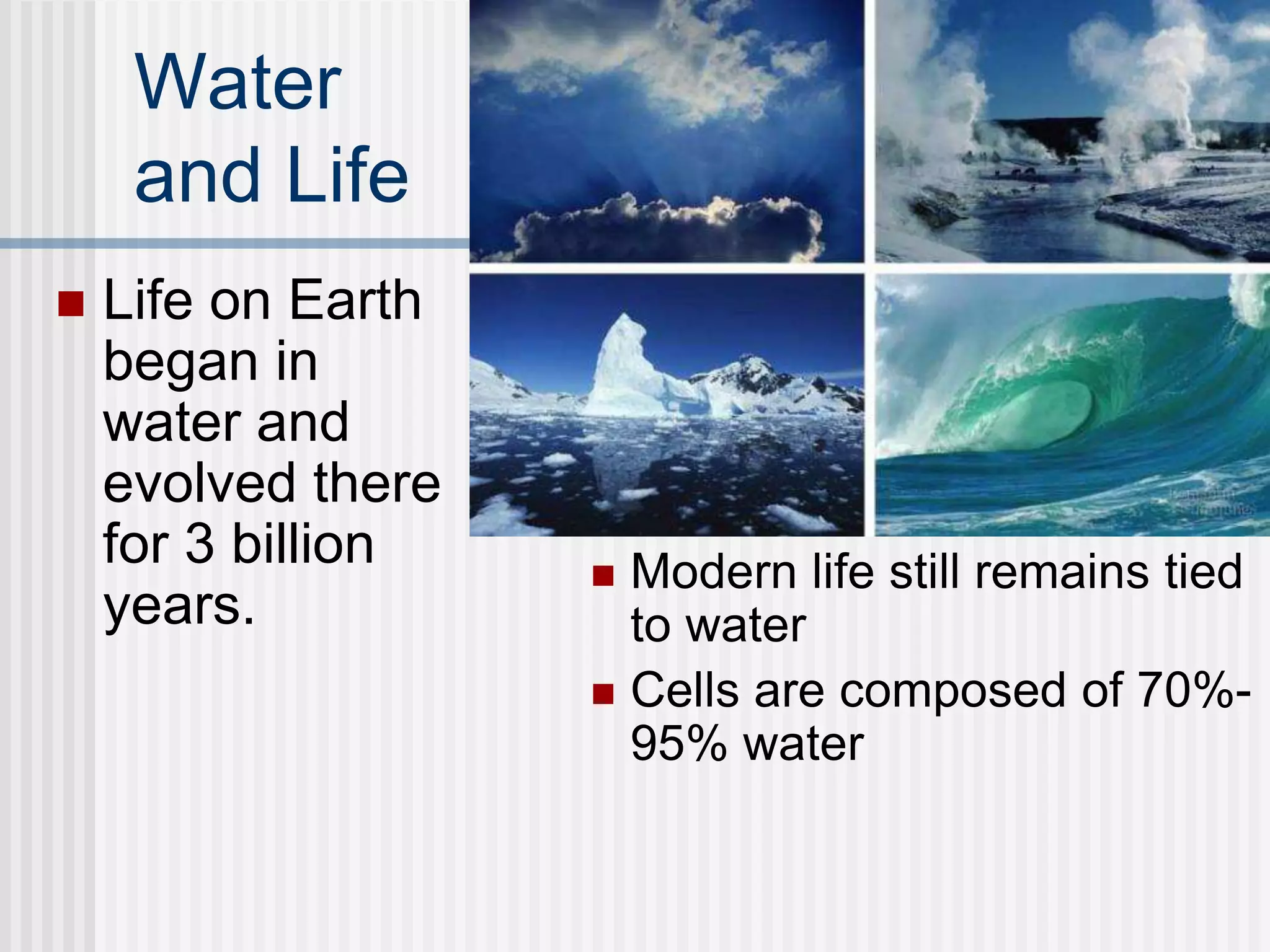
 Life on Earth
began in
water and
evolved there
for 3 billion
years.
 Modern life still remains tied
to water
 Cells are composed of 70%-
95% water
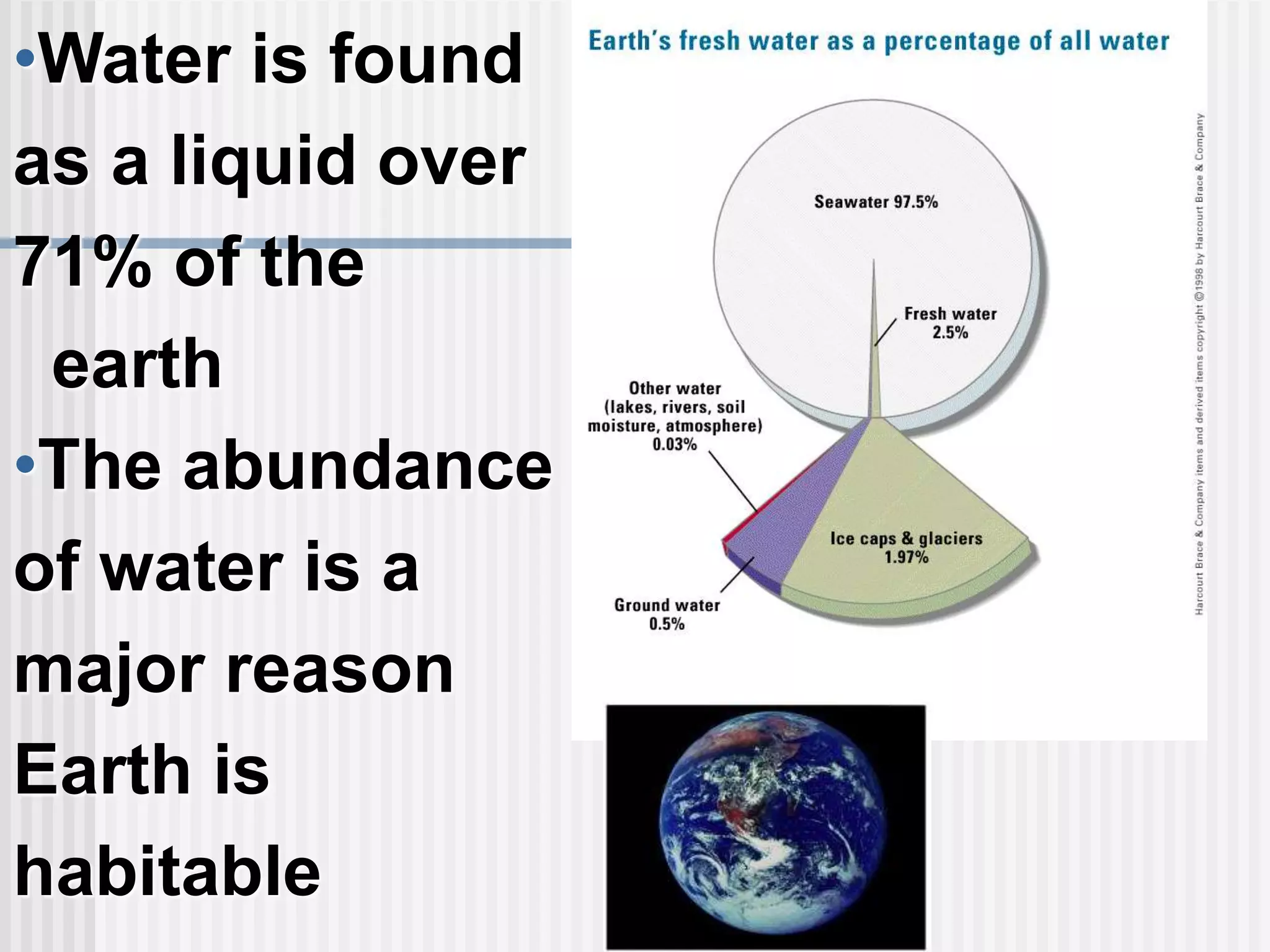
•Water is found
as a liquid over
71% of the
earth
•The abundance
of water is a
major reason
Earth is
habitable
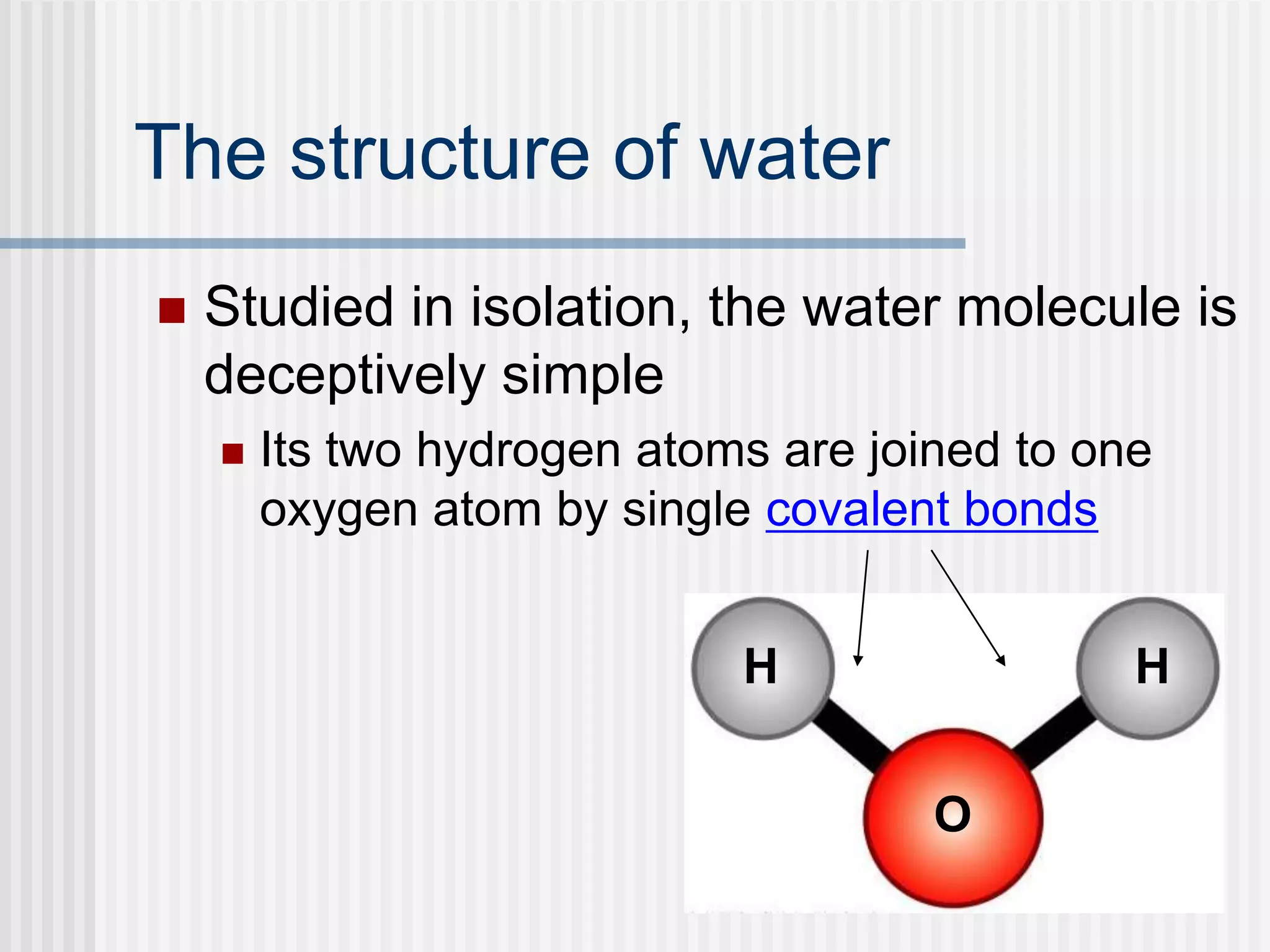
 Studied in isolation, the water molecule is
deceptively simple
 Its two hydrogen atoms are joined to one
oxygen atom by single covalent bonds
The structure of water
H
O
H
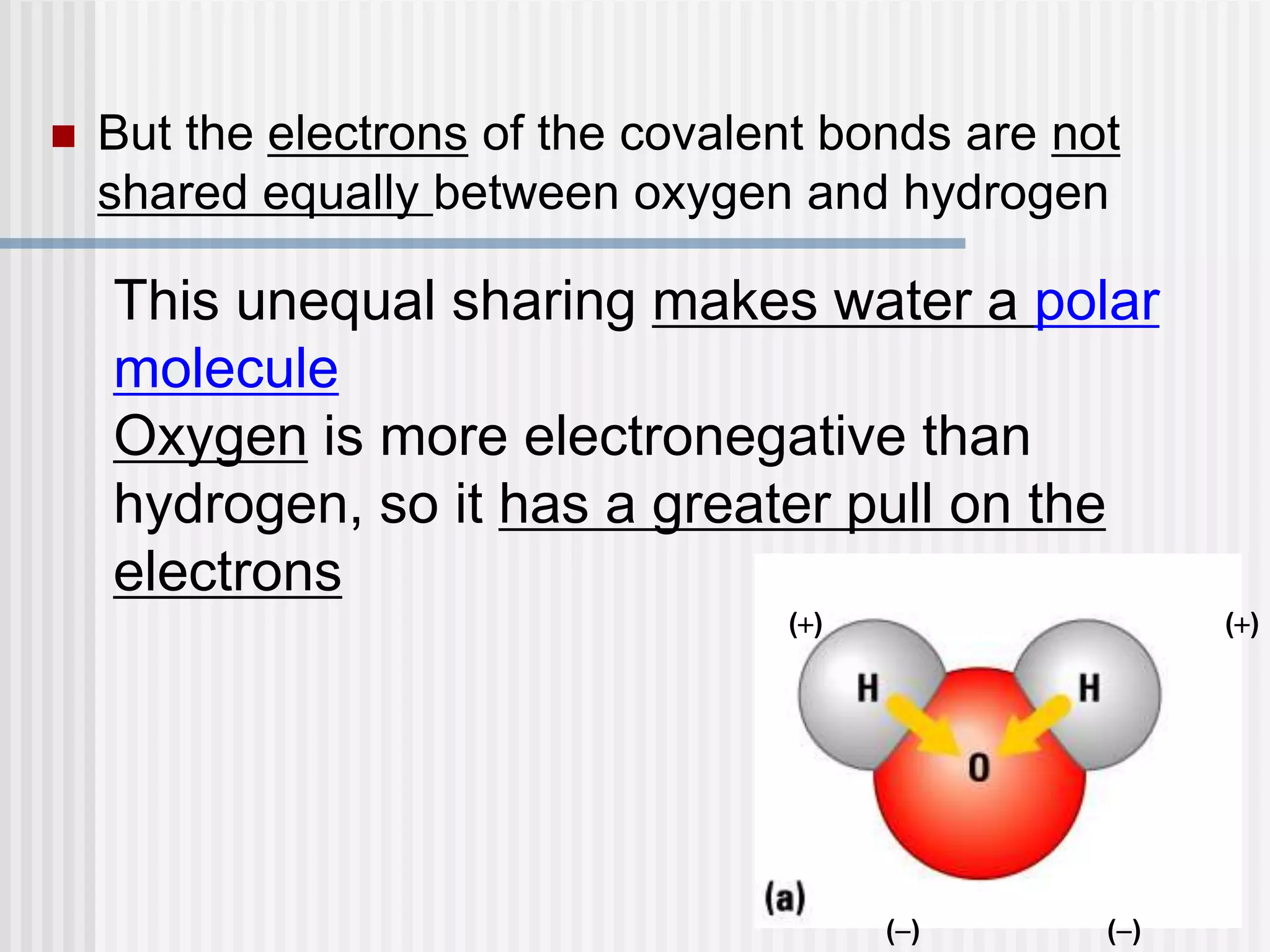
 But the electrons of the covalent bonds are not
shared equally between oxygen and hydrogen
This unequal sharing makes water a polar
molecule
Oxygen is more electronegative than
hydrogen, so it has a greater pull on the
electrons
() ()
() ()
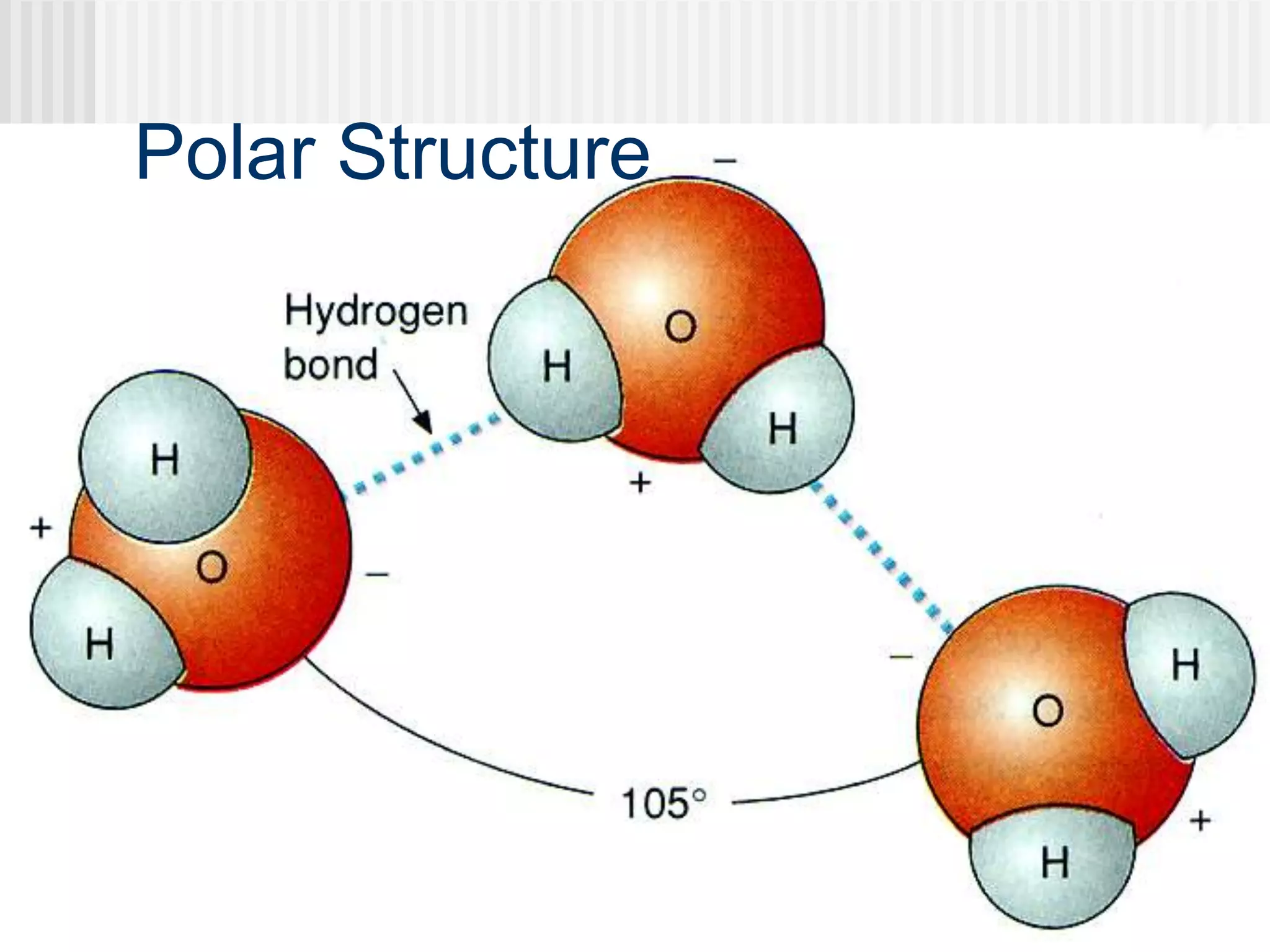
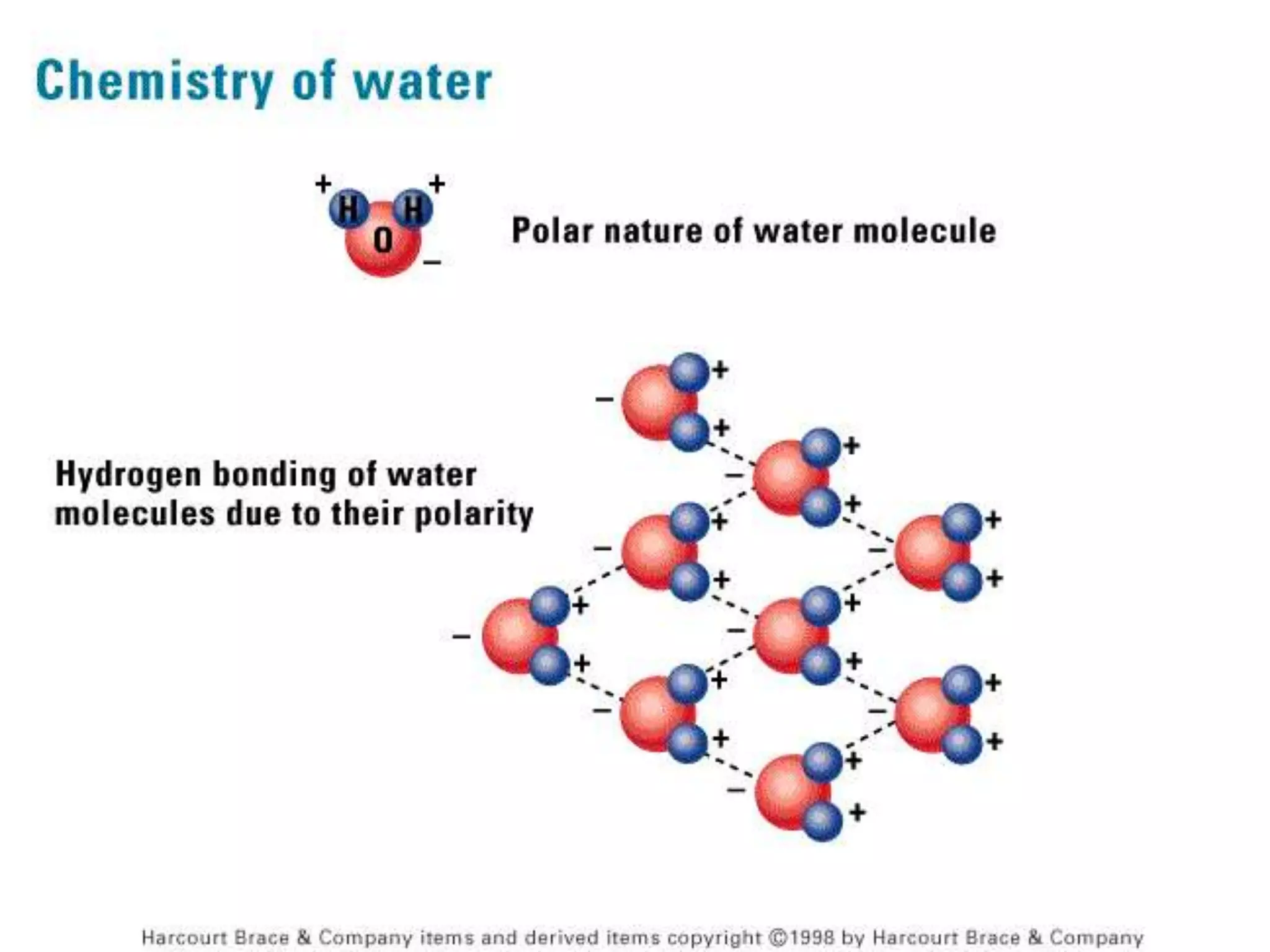
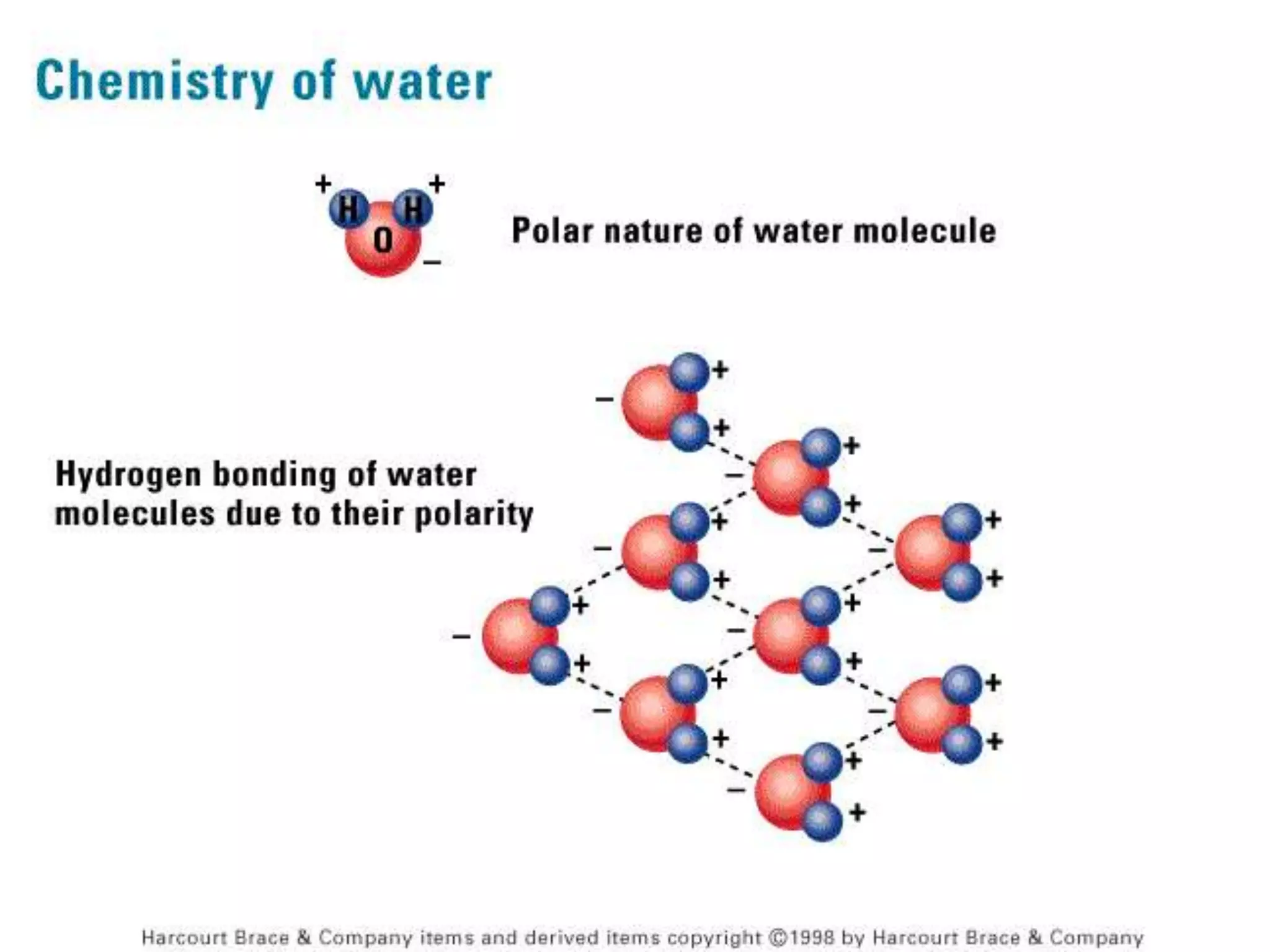
 The polarity of
water results in
weak electrical
attractions
between
neighboring water
molecules
These
interactions
are called
hydrogen
bonds
(b)
()
Hydrogen bond
()
()
()
()
()
()
()
Polar Structure
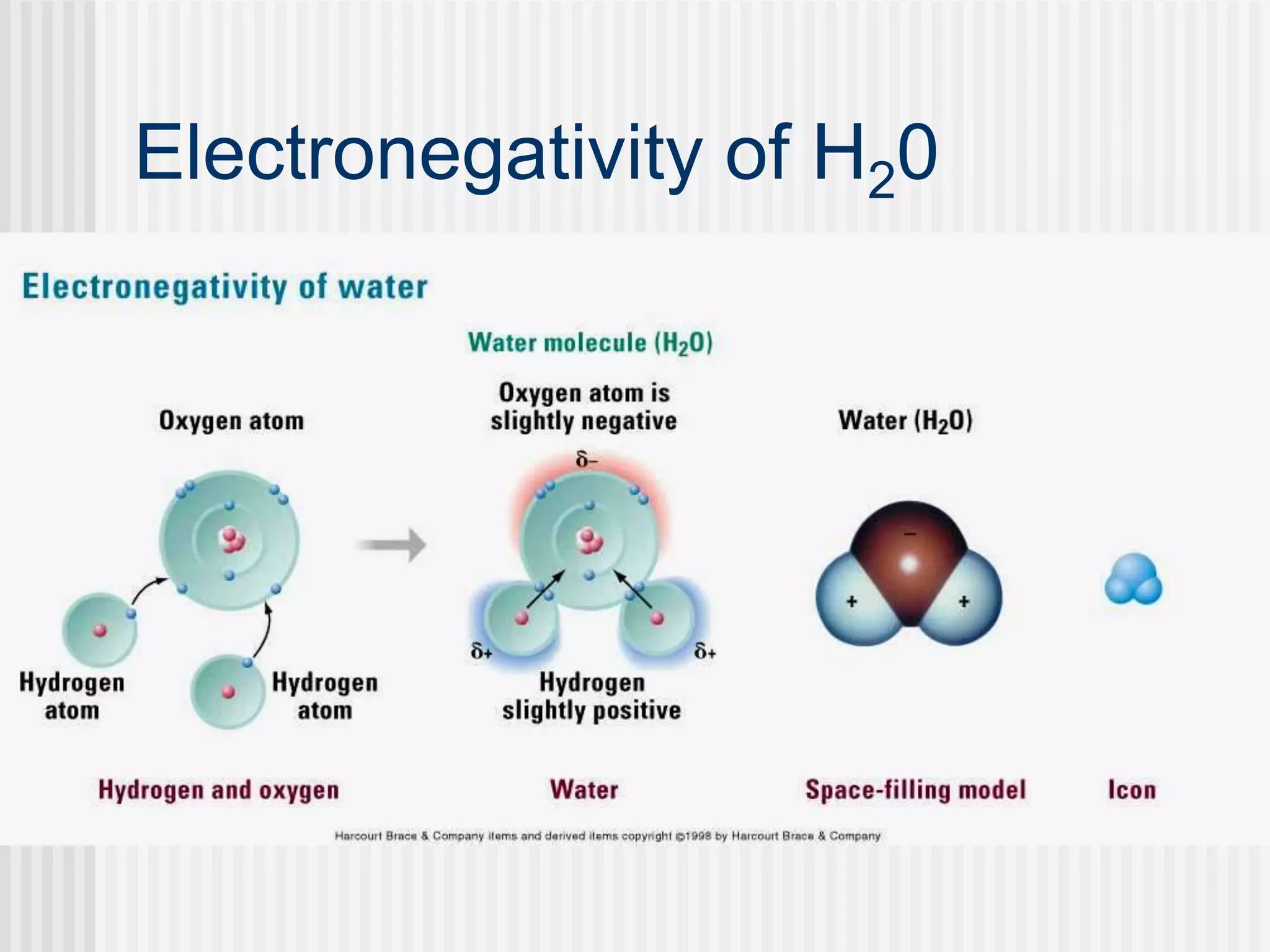
Electronegativity of H20
Quick Think
 Why is a molecule
of water said to
have polar covalent
bonds?
 What kind of bonds
hold individual
water molecules
together?
Water’s Life Supporting
Properties
 The polarity of water molecules and the
hydrogen bonding that results explain most
of water’s life-supporting properties
 Water’s cohesive nature
 Water’s ability to moderate temperature
 Floating ice
 Versatility of water as a solvent
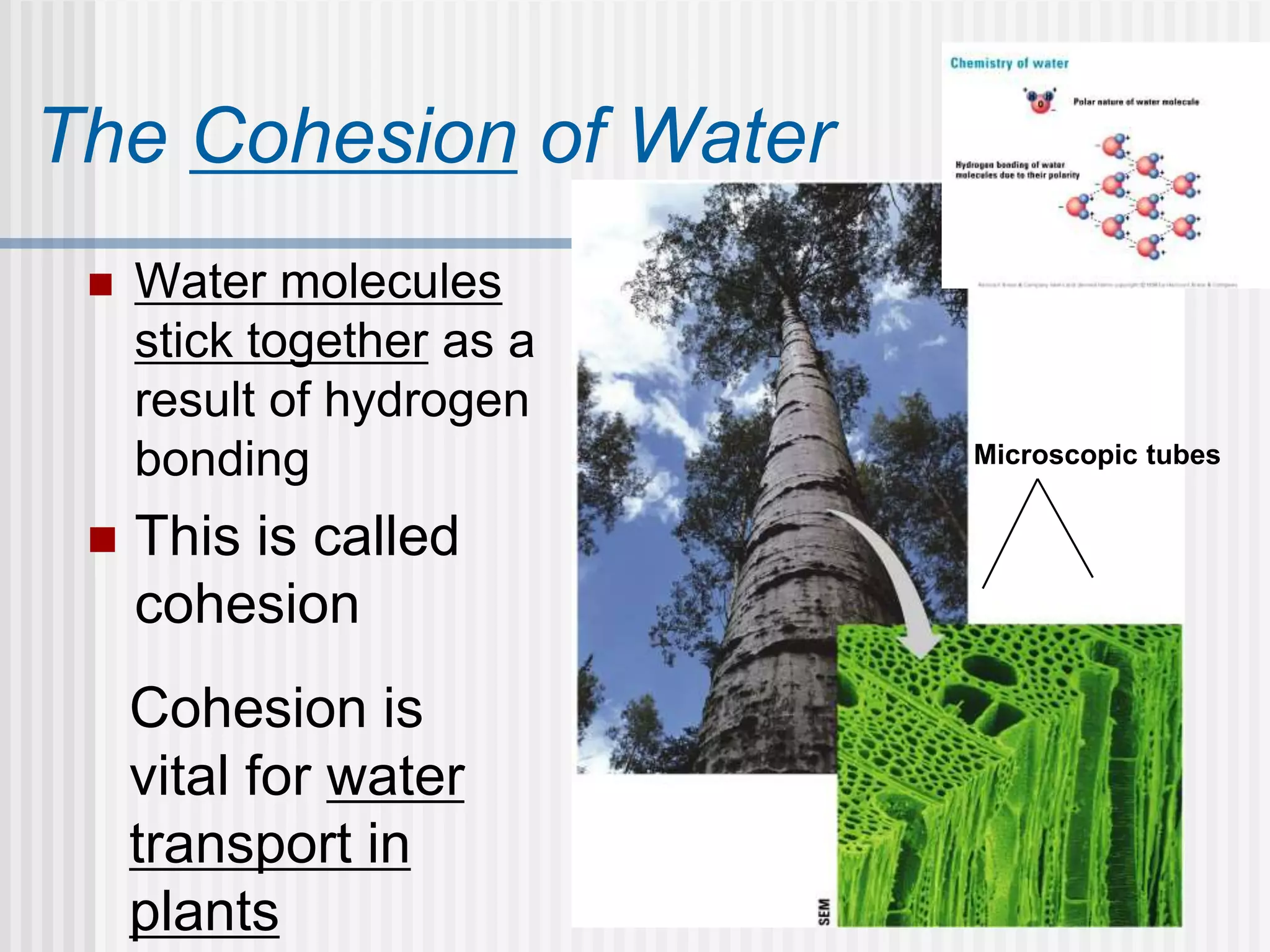
 Water molecules
stick together as a
result of hydrogen
bonding
 This is called
cohesion
The Cohesion of Water
Cohesion is
vital for water
transport in
plants
Microscopic tubes
 Which of our mini-lab demos seems to
illustrate cohesion?
Surface tension is the measure of how difficult
it is to stretch or break the surface of a liquid
Hydrogen bonds
give water an
unusually high
surface tension
Cohesion
between water
molecules form a
skin-like surface Can support animals like “water
striders” in ponds
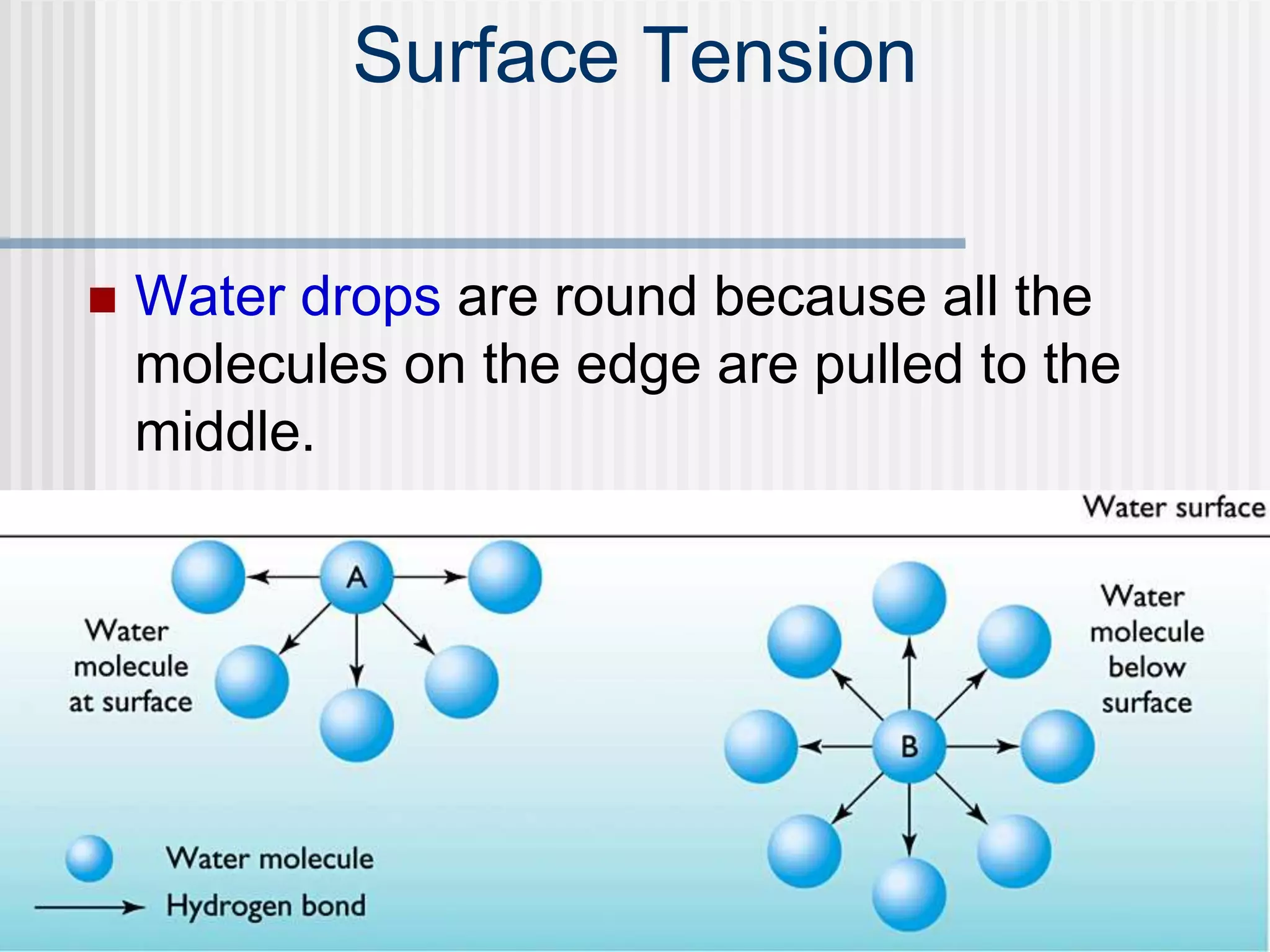
Surface Tension
 Water drops are round because all the
molecules on the edge are pulled to the
middle.
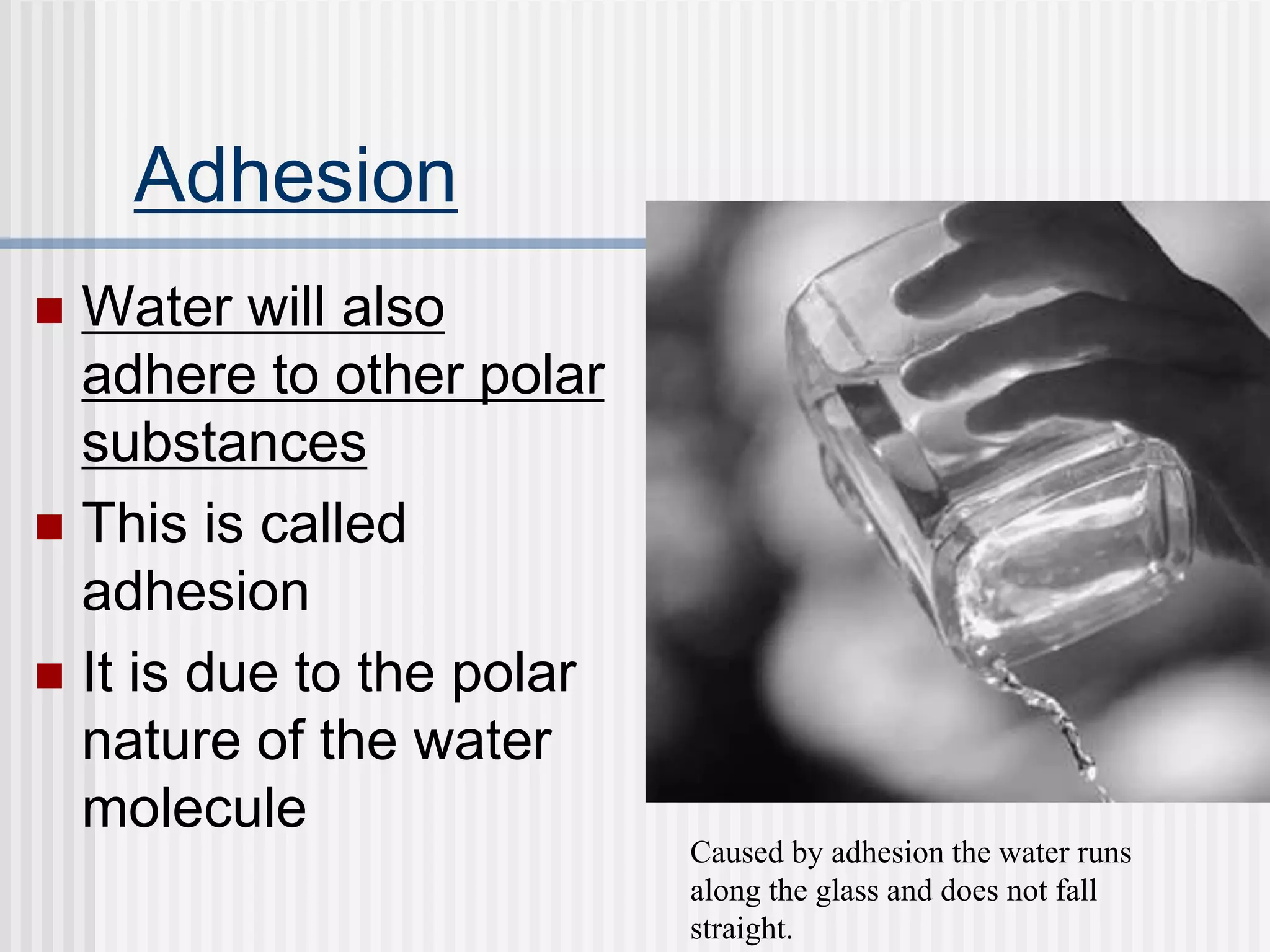
Adhesion
 Water will also
adhere to other polar
substances
 This is called
adhesion
 It is due to the polar
nature of the water
molecule
Caused by adhesion the water runs
along the glass and does not fall
straight.
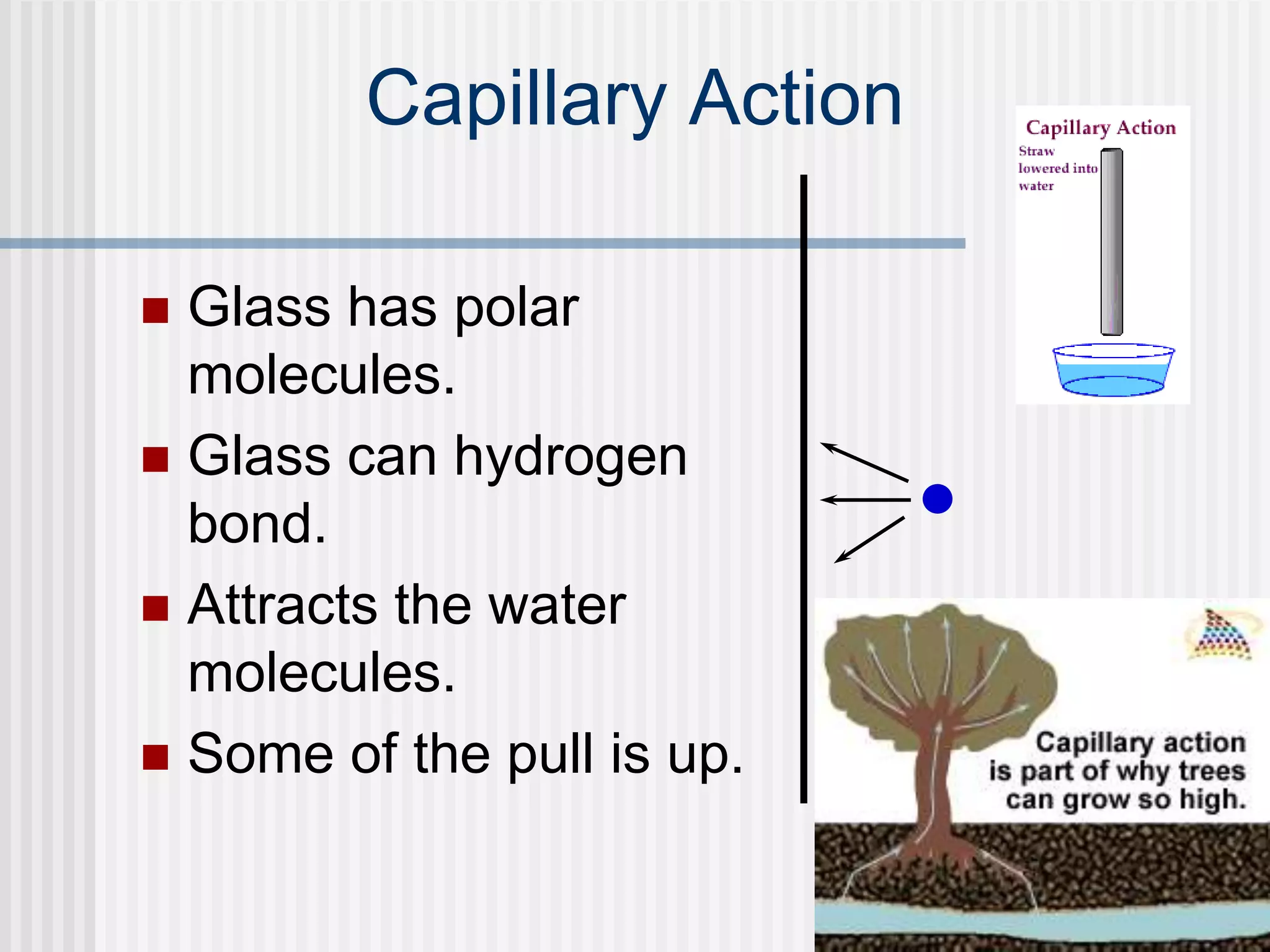
Capillary Action
 Glass has polar
molecules.
 Glass can hydrogen
bond.
 Attracts the water
molecules.
 Some of the pull is up.
Meniscus
 Water curves up
along the side.
 This makes the
meniscus.
Quick Think
 How are adhesion and
cohesion similar and
different?
 Give an example of how
these properties help
support life.
8-15-14 Warm up
 Use the clay and toothpicks to make a
model of a water molecule
 Working with someone near you, use your
models to demonstrate cohesion.
HW:
1.) Read section 3-1
and 3-2 in your
textbook
2.) Watch
CrashCourse
Biology – Water on
YouTube
3.) water worksheet
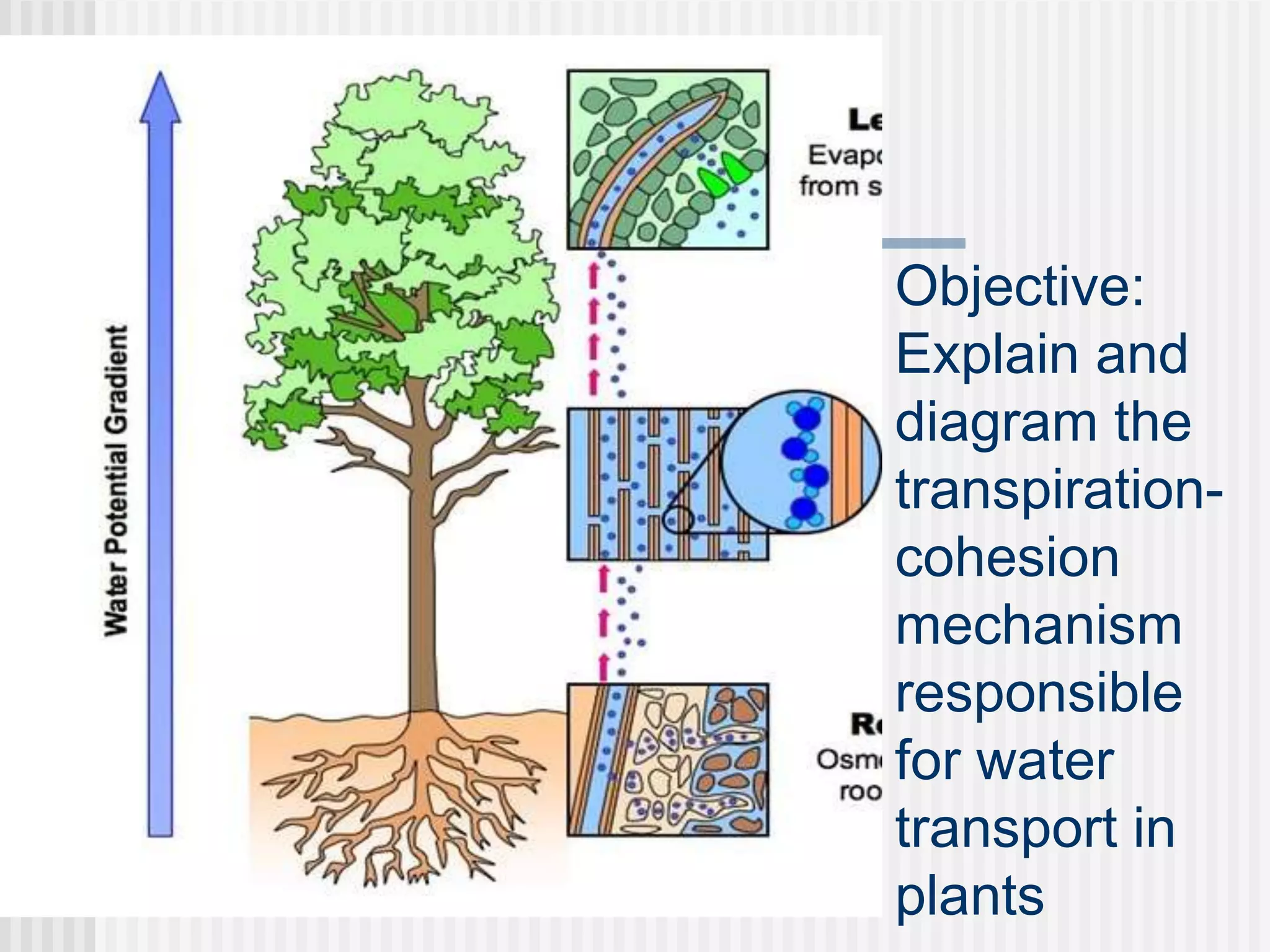
Objective:
Explain and
diagram the
transpiration-
cohesion
mechanism
responsible
for water
transport in
plants
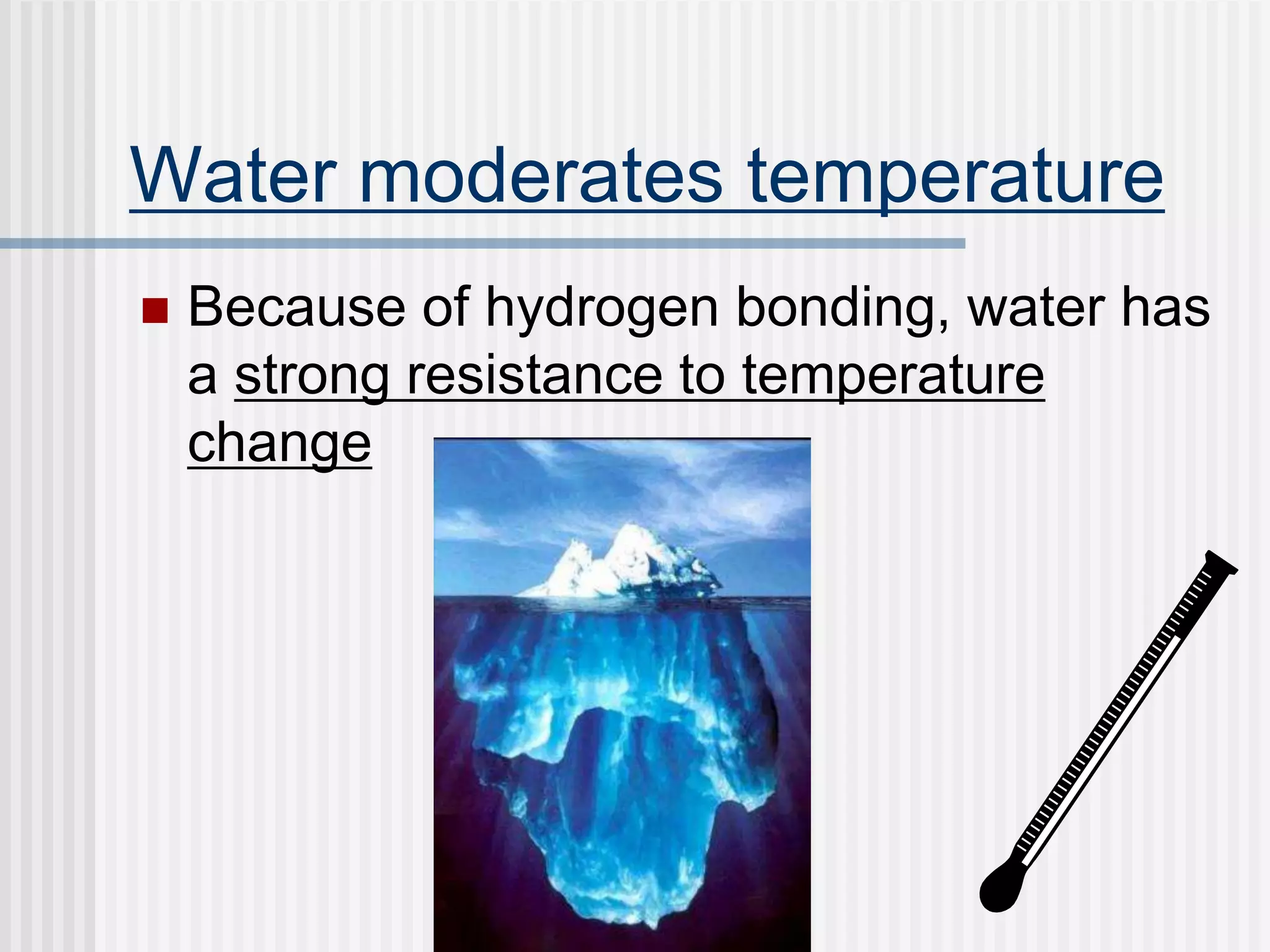
Water moderates temperature
 Because of hydrogen bonding, water has
a strong resistance to temperature
change
Water moderates temperature
 Heat and temperature are related, but
different
 Heat is a measure of the amount of kinetic
energy in the atoms and molecules in
something
 Temperature measures the intensity of the
heat
 Whenever 2 objects meet, the cooler object
absorbs heat from the warmer object until
they are the same temperature
Water moderates temperature
 Water has a high specific heat
 Specific heat = the amount of heat that must
be absorbed or lost to change the
temperature of 1g of the substance 1°C
Water moderates temperature
 much of the absorbed heat is used to
break hydrogen bonds, not increase the
kinetic energy of the molecules
Water moderates temperature
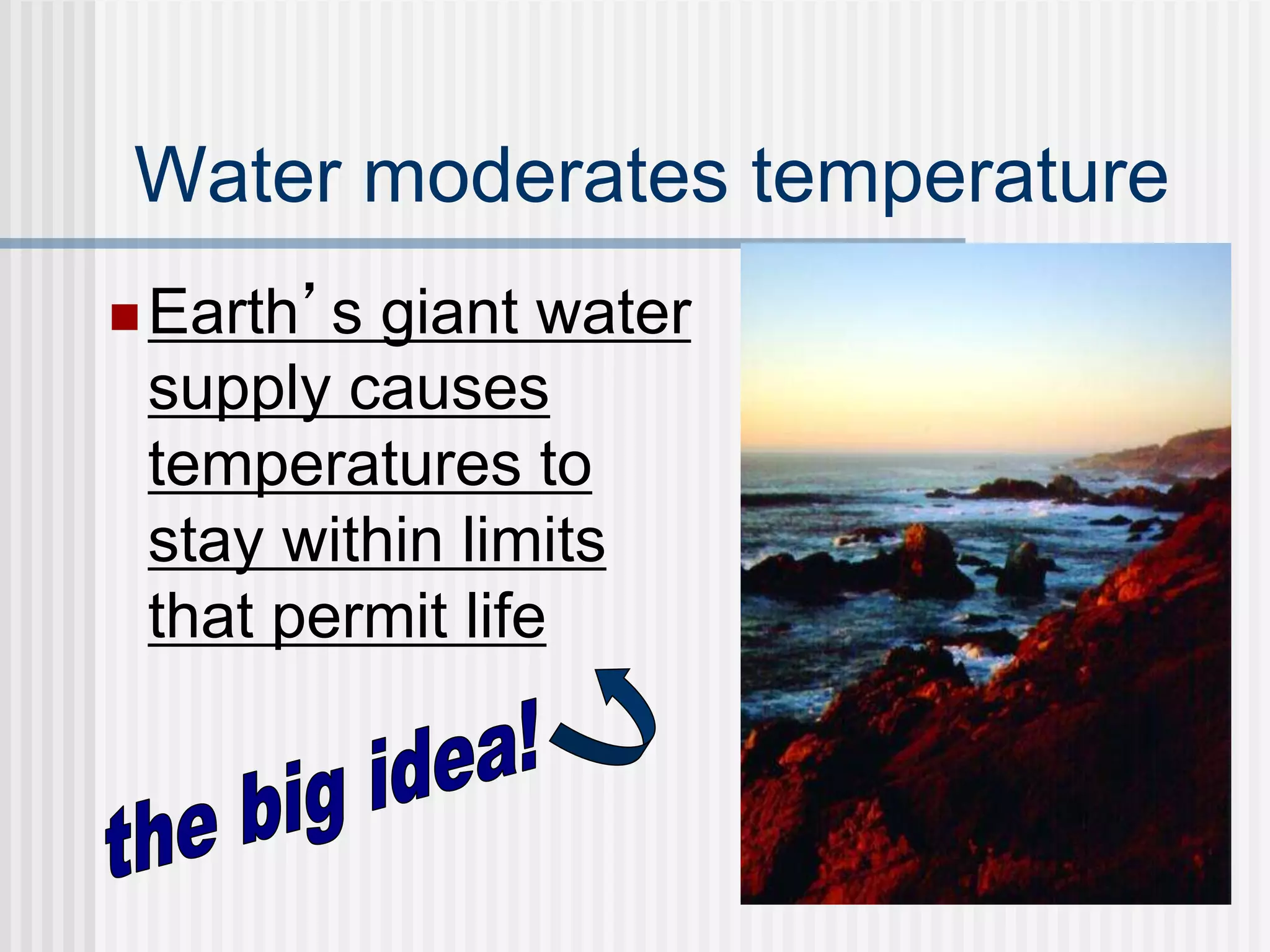
Earth’s giant water
supply causes
temperatures to
stay within limits
that permit life
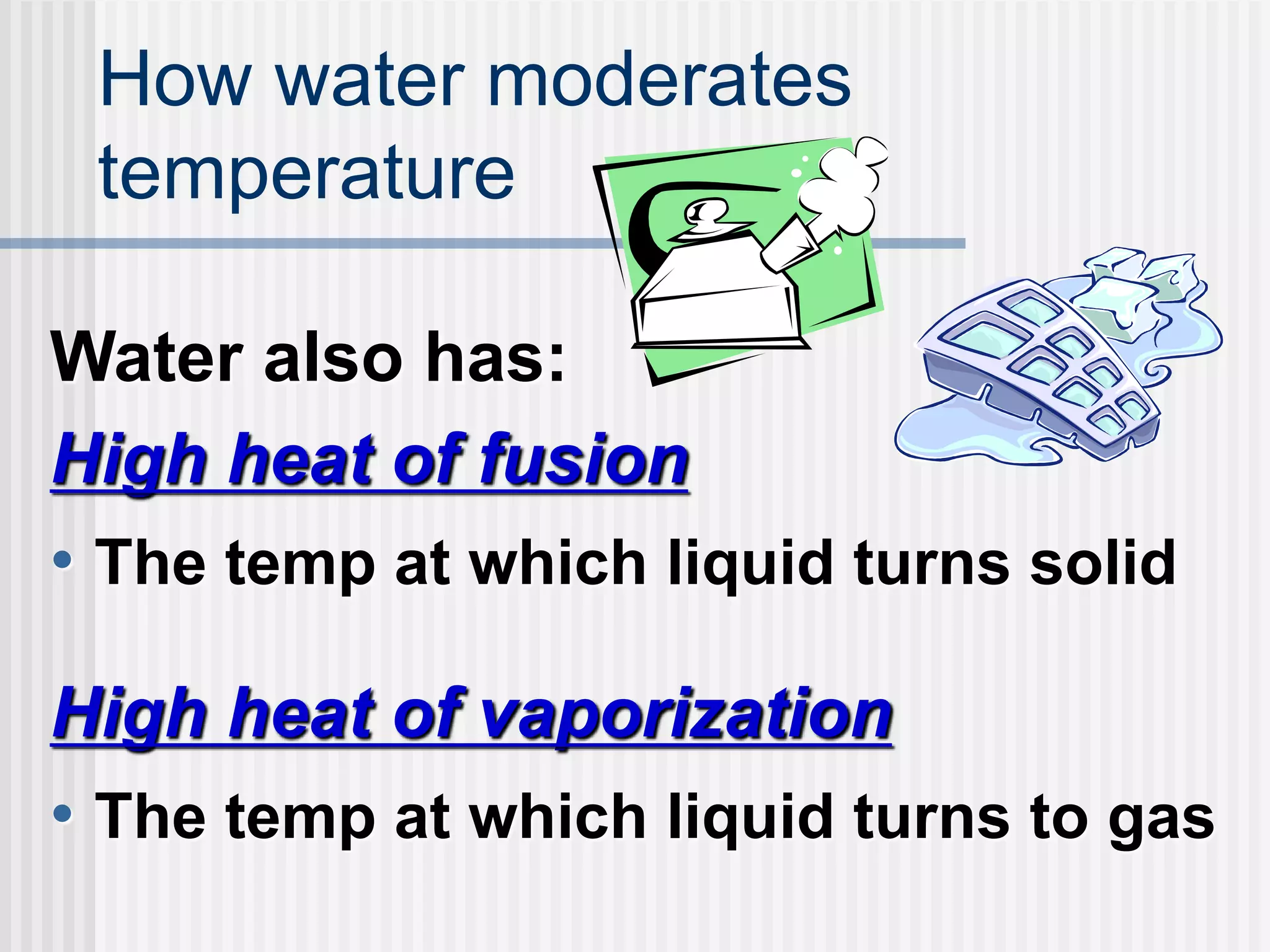
How water moderates
temperature
Water also has:
High heat of fusion
• The temp at which liquid turns solid
High heat of vaporization
• The temp at which liquid turns to gas
Quick Think
Why does it take so
much energy to
change the
temperature of water?
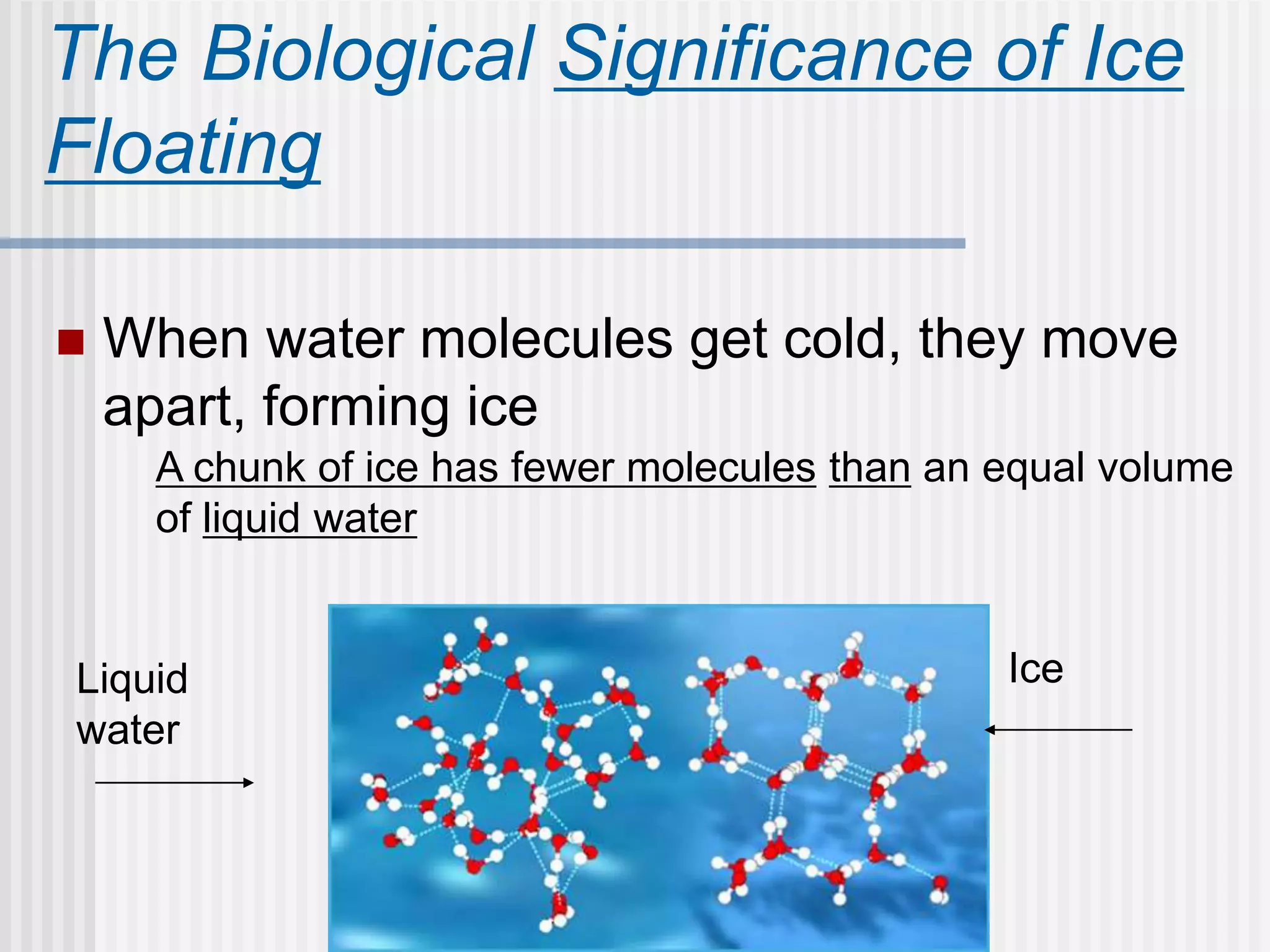
 When water molecules get cold, they move
apart, forming ice
The Biological Significance of Ice
Floating
A chunk of ice has fewer molecules than an equal volume
of liquid water
IceLiquid
water
 The density of ice is lower than liquid water
 This is why ice floats
Figure 2.15
Hydrogen bond
Liquid water
Hydrogen bonds
constantly break and re-form
Ice
Stable hydrogen bonds
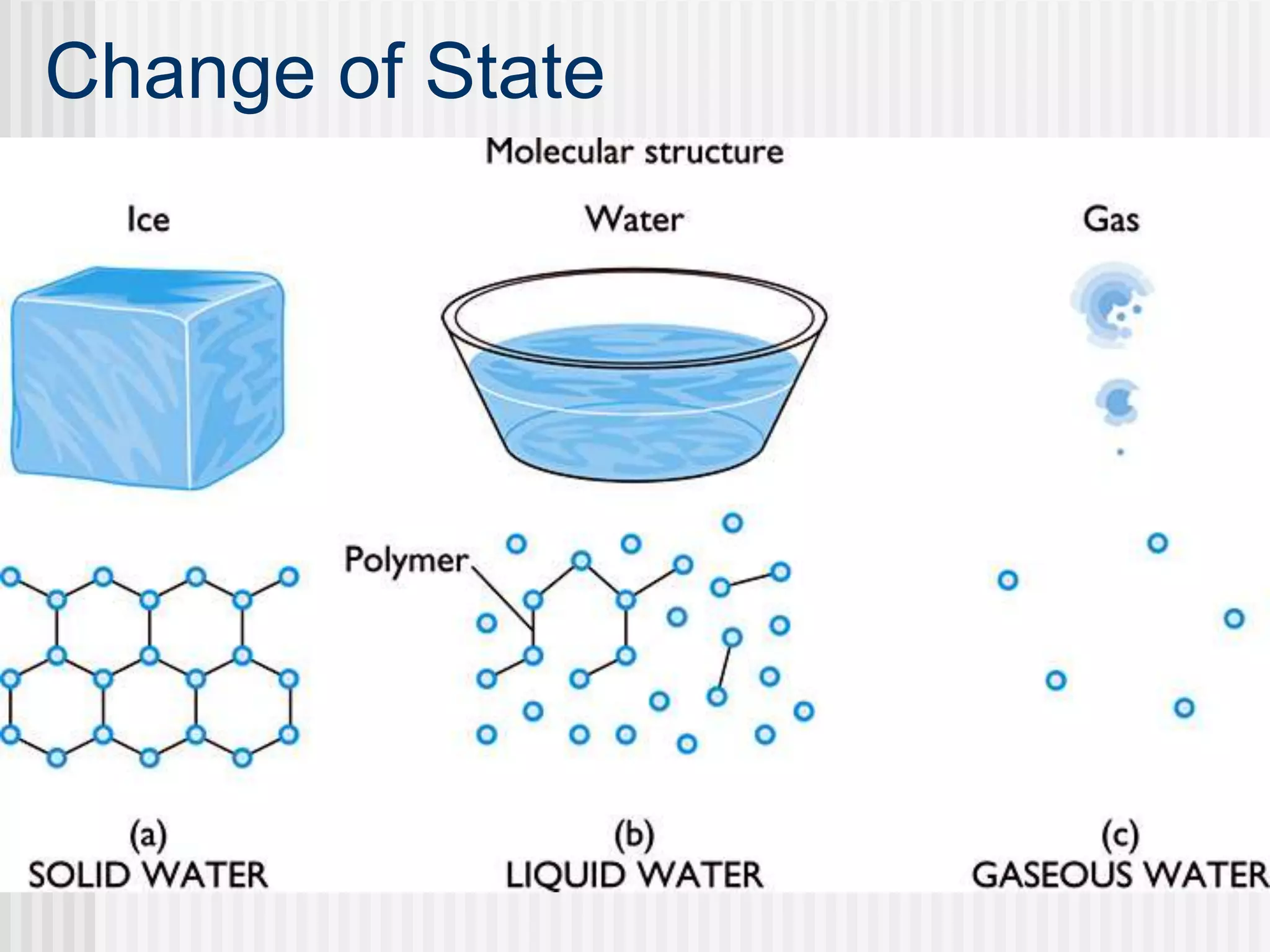
Change of State
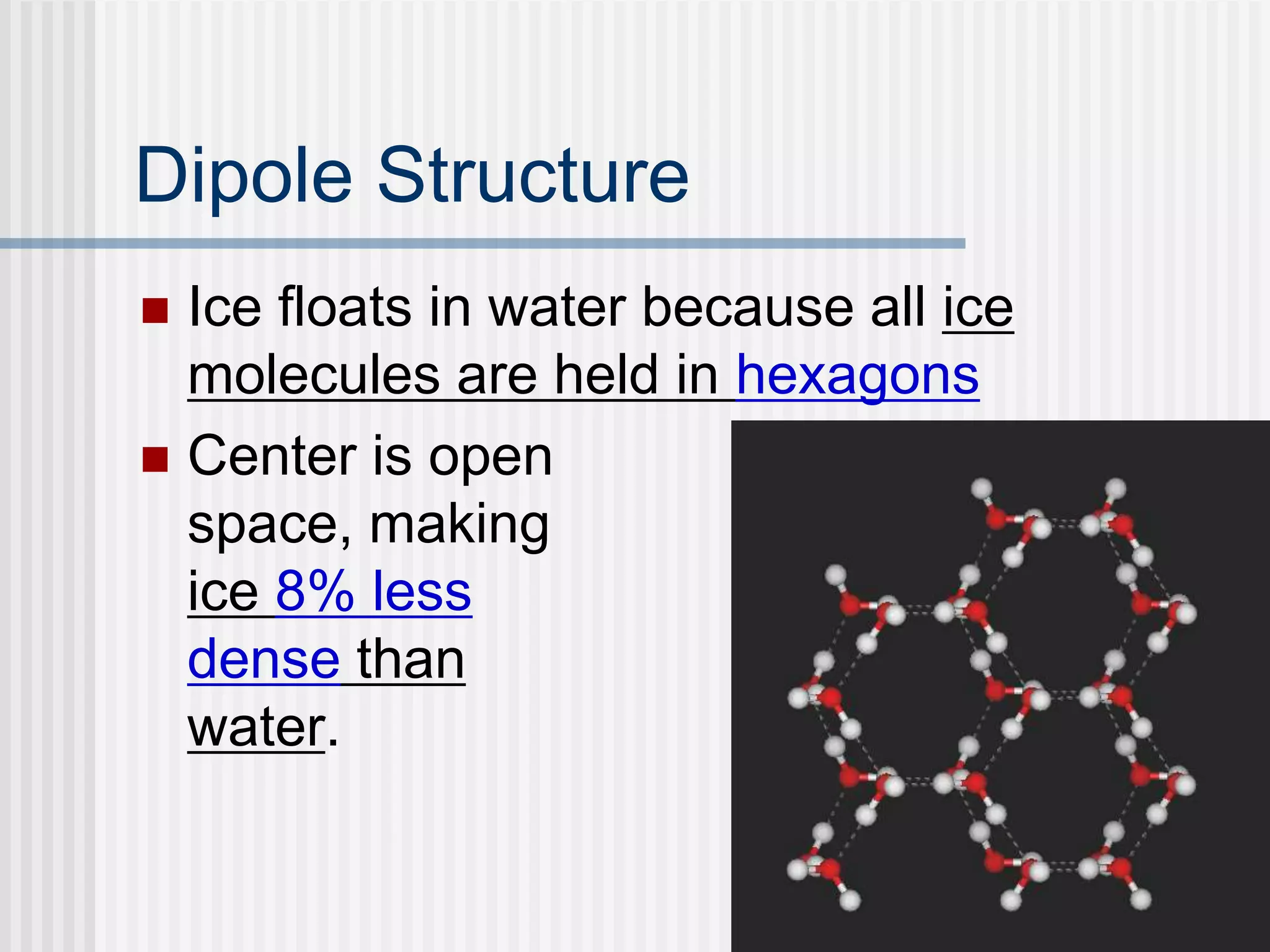
Dipole Structure
 Ice floats in water because all ice
molecules are held in hexagons
 Center is open
space, making
ice 8% less
dense than
water.
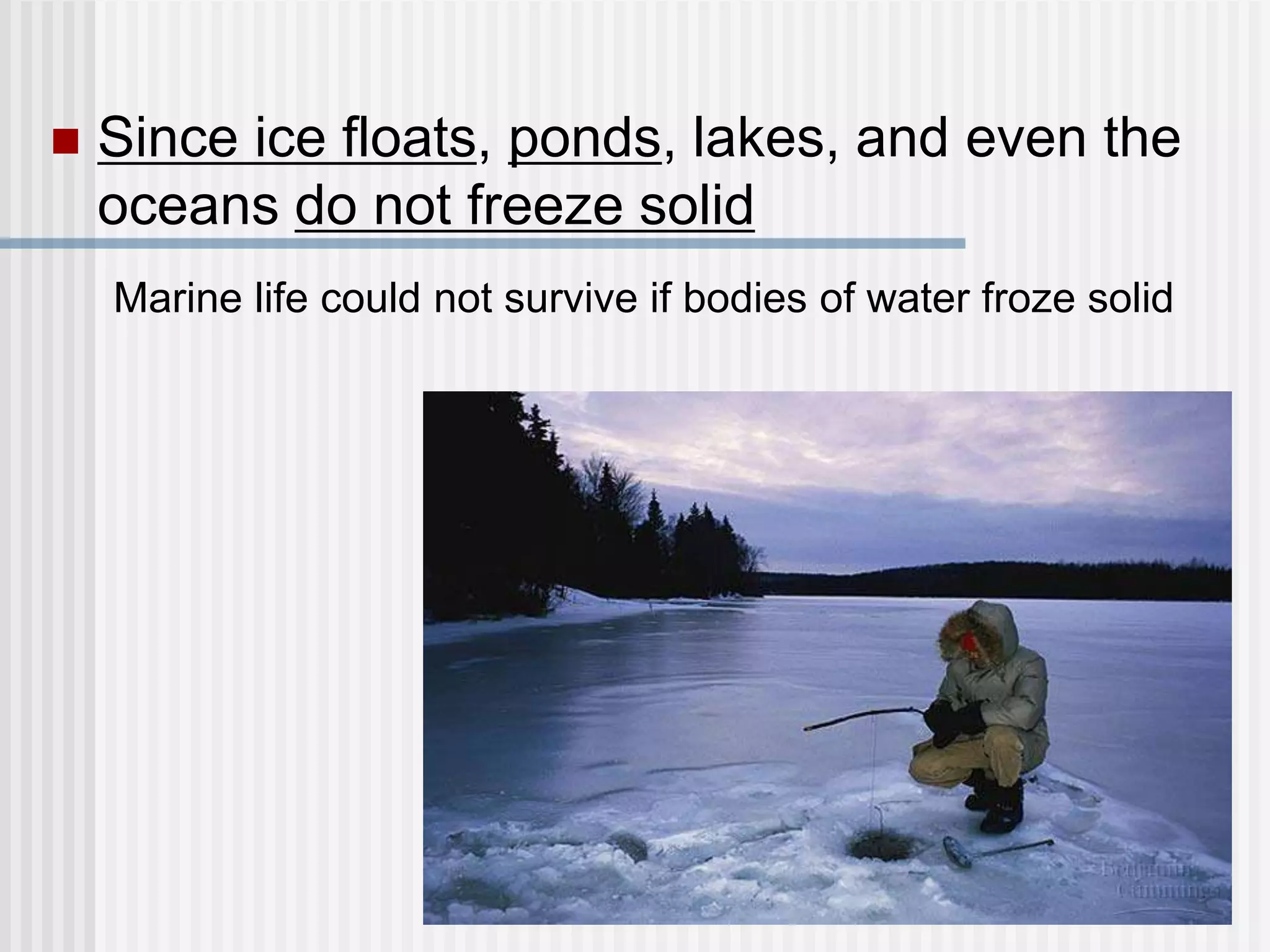
 Since ice floats, ponds, lakes, and even the
oceans do not freeze solid
Marine life could not survive if bodies of water froze solid
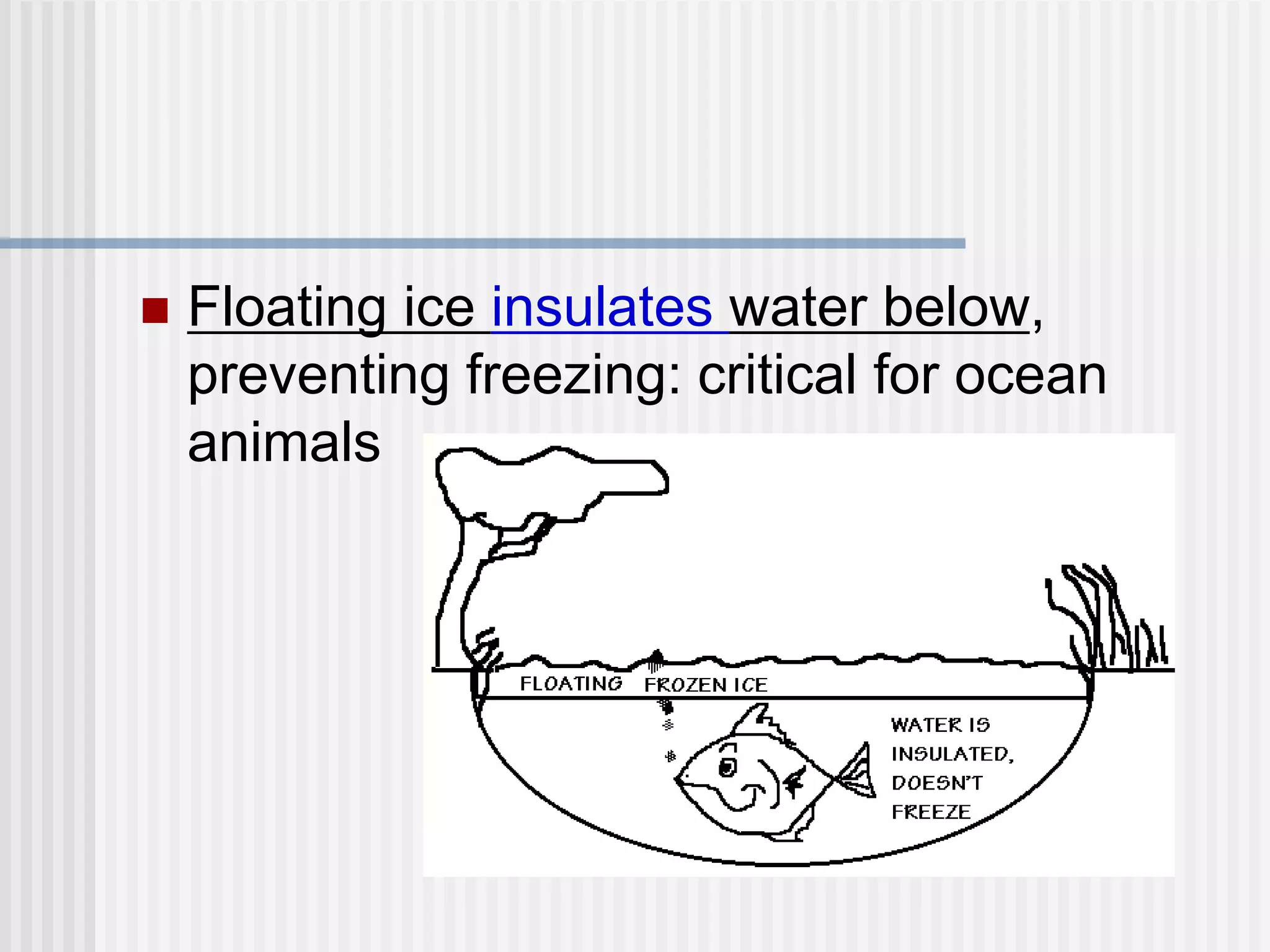
 Floating ice insulates water below,
preventing freezing: critical for ocean
animals
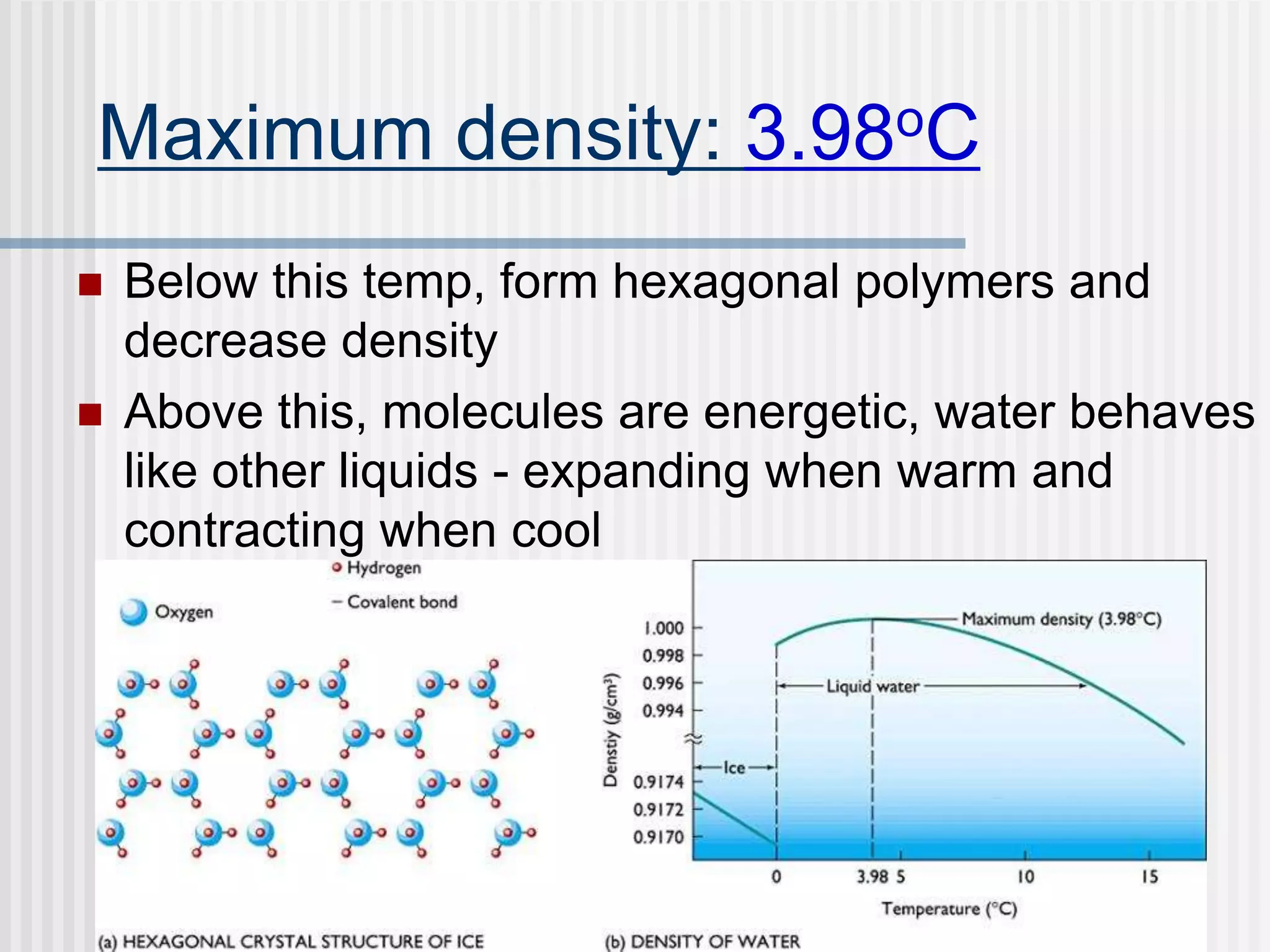
Maximum density: 3.98oC
 Below this temp, form hexagonal polymers and
decrease density
 Above this, molecules are energetic, water behaves
like other liquids - expanding when warm and
contracting when cool
Quick Think
 Of all the properties we’ve learned so far,
which ones could you competently write
about in your essay?
 A solution is a liquid consisting of two or
more substances evenly mixed
Water as the Solvent of Life
The dissolving agent is called the solvent
The dissolved substance is called the solute
Ion in solution
Salt crystal
 Water is a good solvent because it is polar
 Ionic (salts) and polar (sugars) compounds
dissolve readily in water
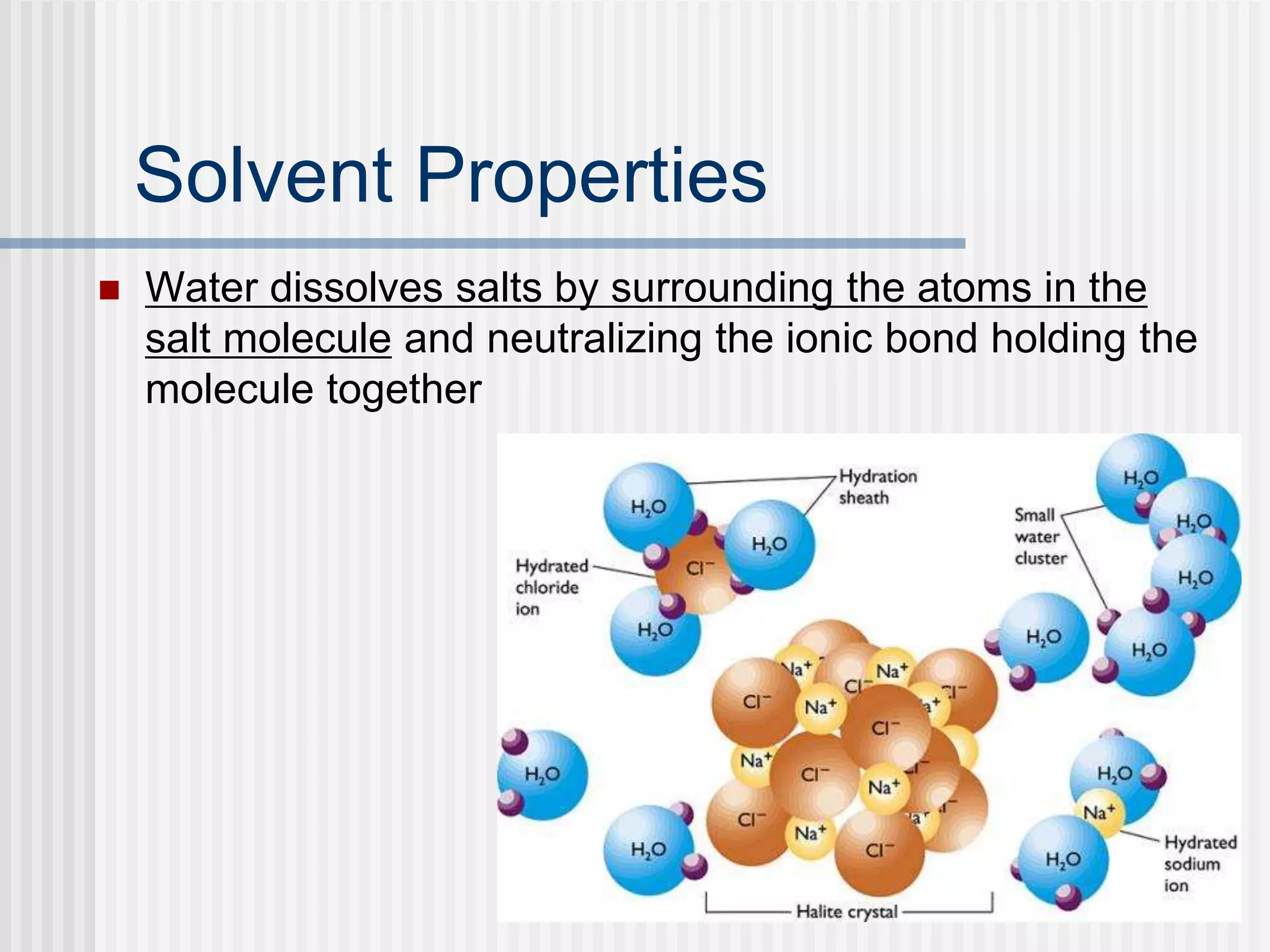
Solvent Properties
 Water dissolves salts by surrounding the atoms in the
salt molecule and neutralizing the ionic bond holding the
molecule together
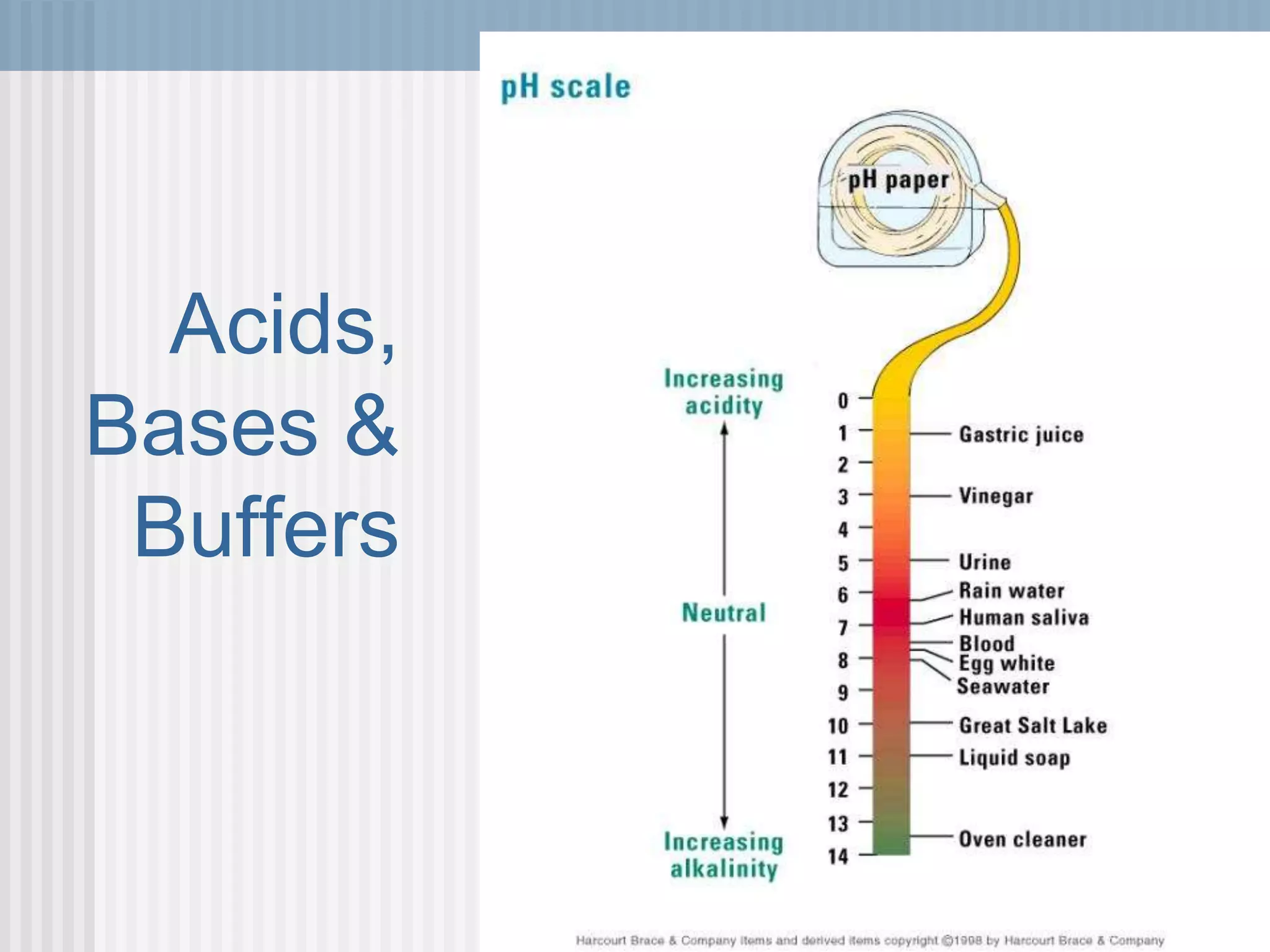
Acids,
Bases &
Buffers
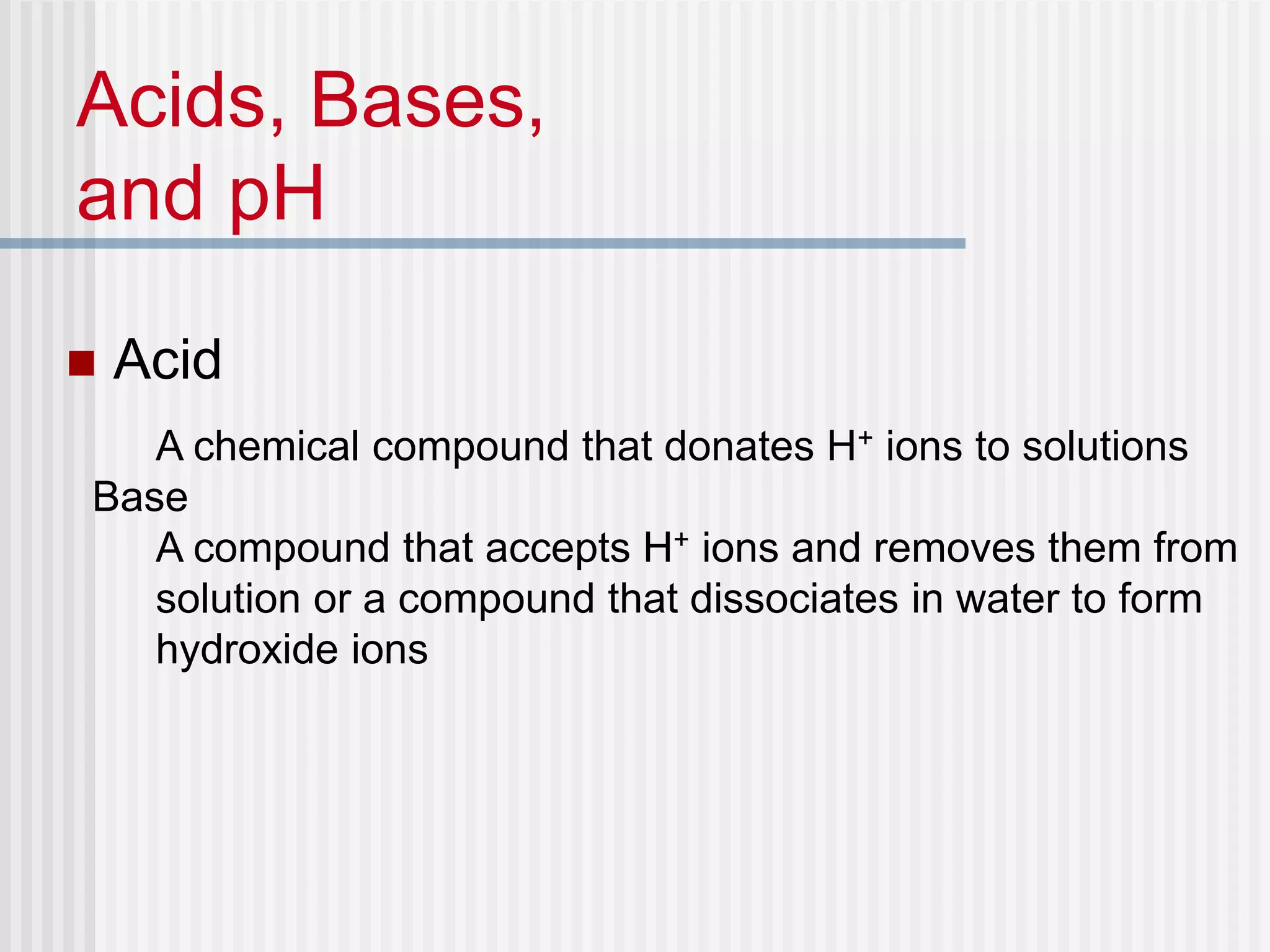
 Acid
Acids, Bases,
and pH
A chemical compound that donates H+ ions to solutions
Base
A compound that accepts H+ ions and removes them from
solution or a compound that dissociates in water to form
hydroxide ions
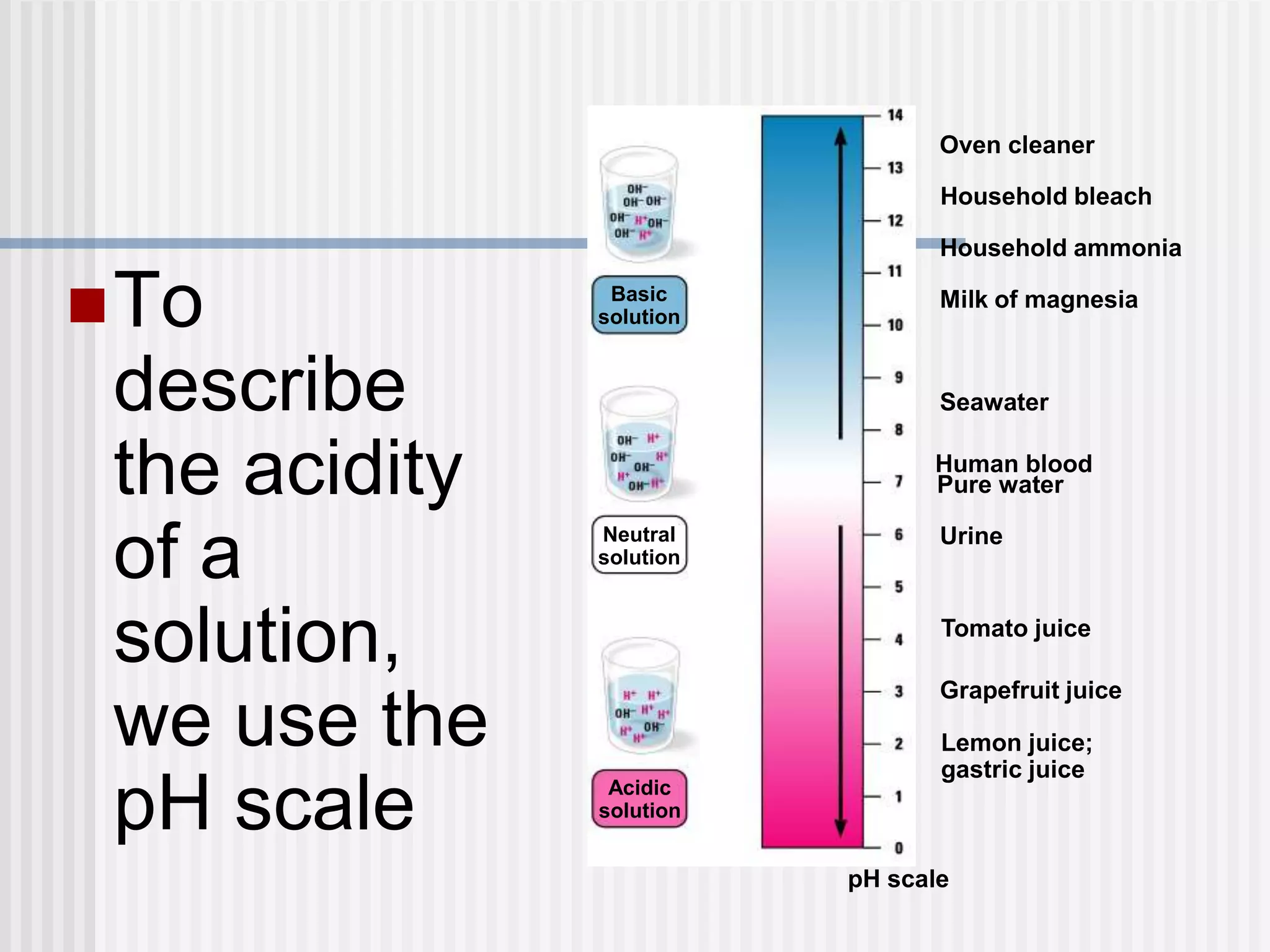
Basic
solution
Neutral
solution
Acidic
solution
Oven cleaner
Household bleach
Household ammonia
Milk of magnesia
Seawater
Human blood
Pure water
Urine
Tomato juice
Grapefruit juice
Lemon juice;
gastric juice
pH scale
To
describe
the acidity
of a
solution,
we use the
pH scale
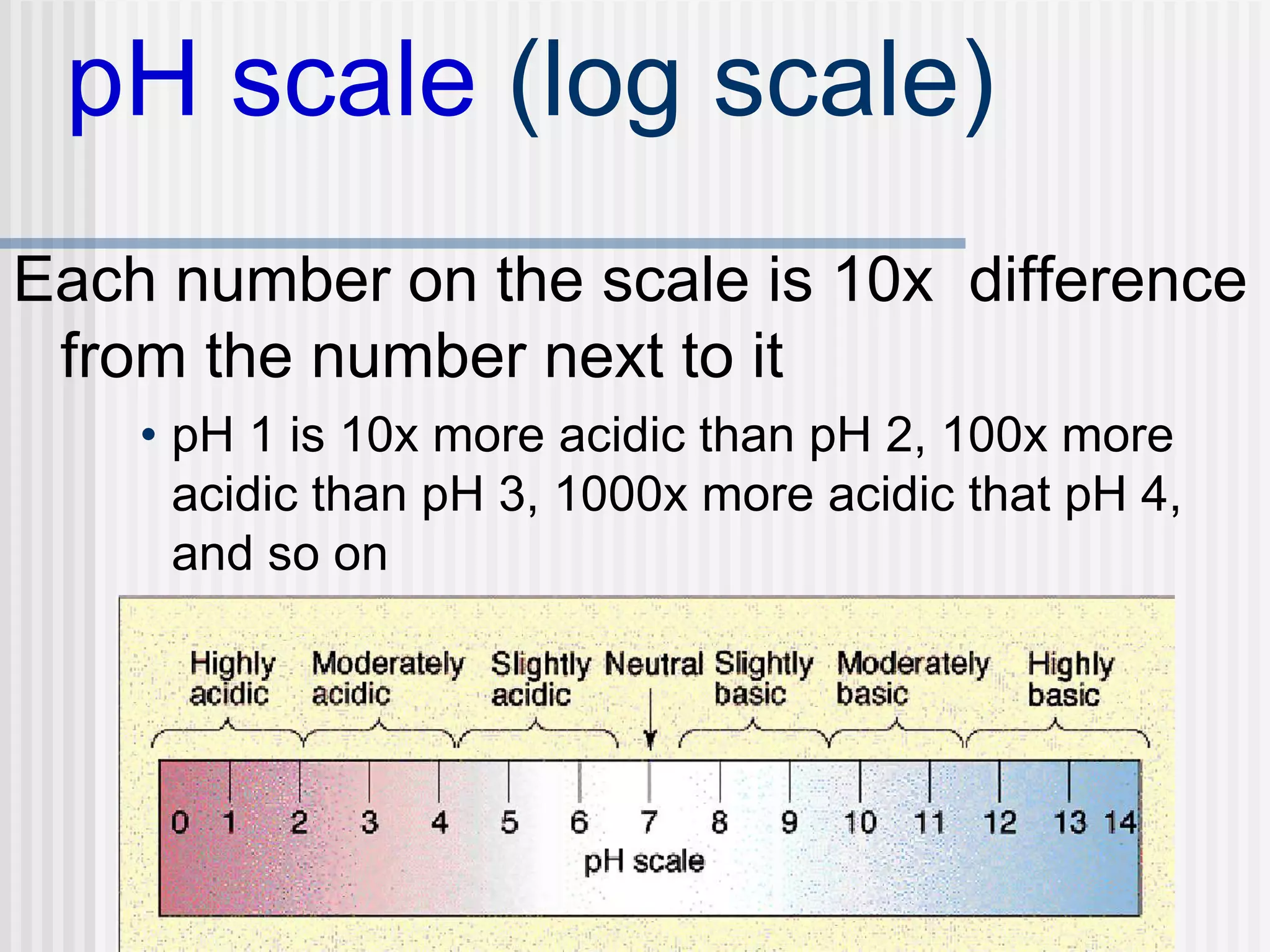
pH scale (log scale)
Each number on the scale is 10x difference
from the number next to it
• pH 1 is 10x more acidic than pH 2, 100x more
acidic than pH 3, 1000x more acidic that pH 4,
and so on
pH - Percent Hydronium
A measure of the percent of hydronium ions
in the solution
The greater the percent hydronium ions, the
more acidic the solution is
H2CO3 -------------> H+ + HCO3 -
CARBONIC ACID HYDRONIUM BICARBONATE
ION ION
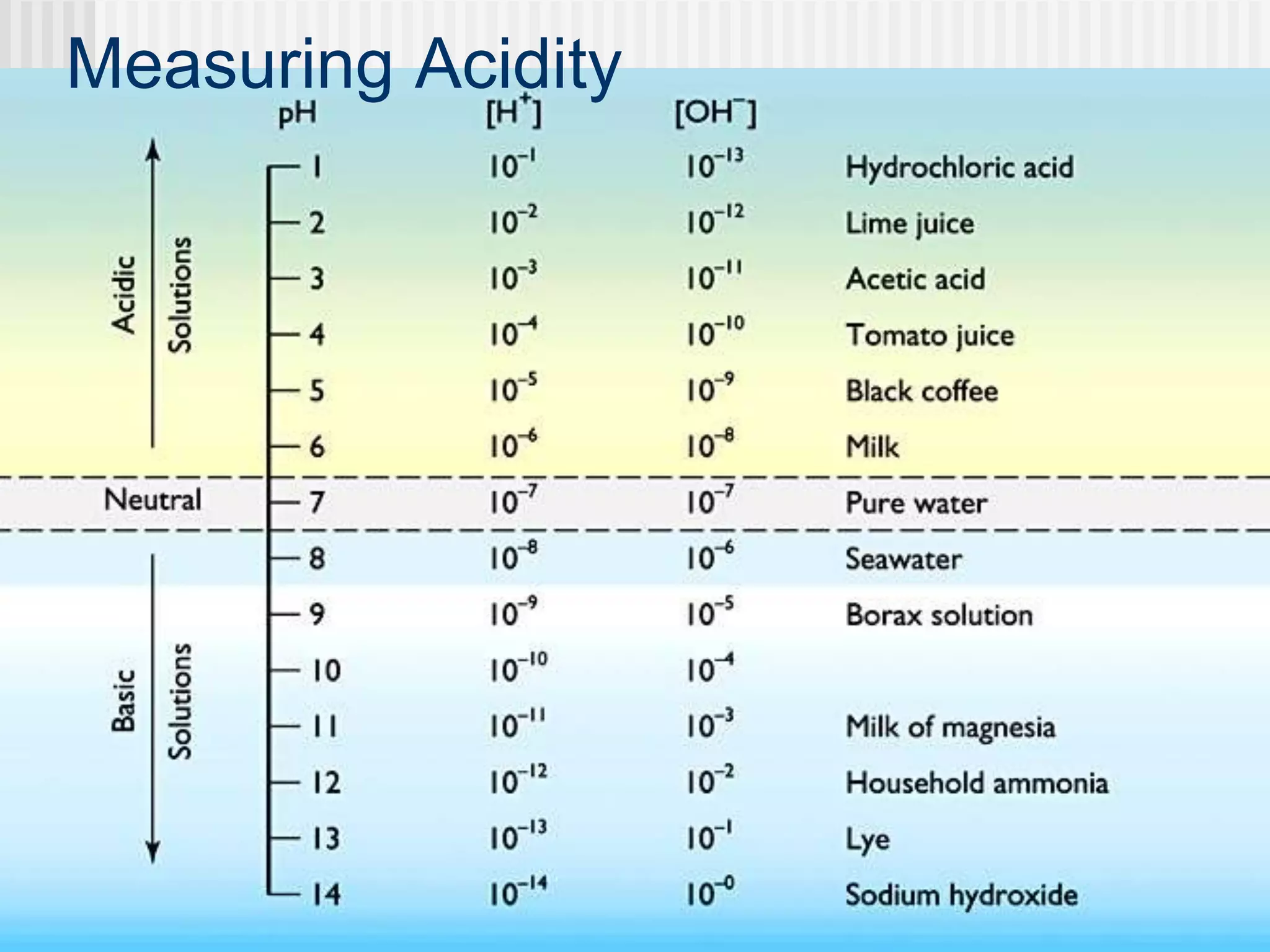
Measuring Acidity
 Buffers are substances that resist pH change
They accept H+ ions when they are in excess
They donate H+ ions when they are depleted
Buffering is not
foolproof
Example: acid
precipitation
normal rain water
(pH of 5-6)
pH of acid rain is
between 3-4
Buffers
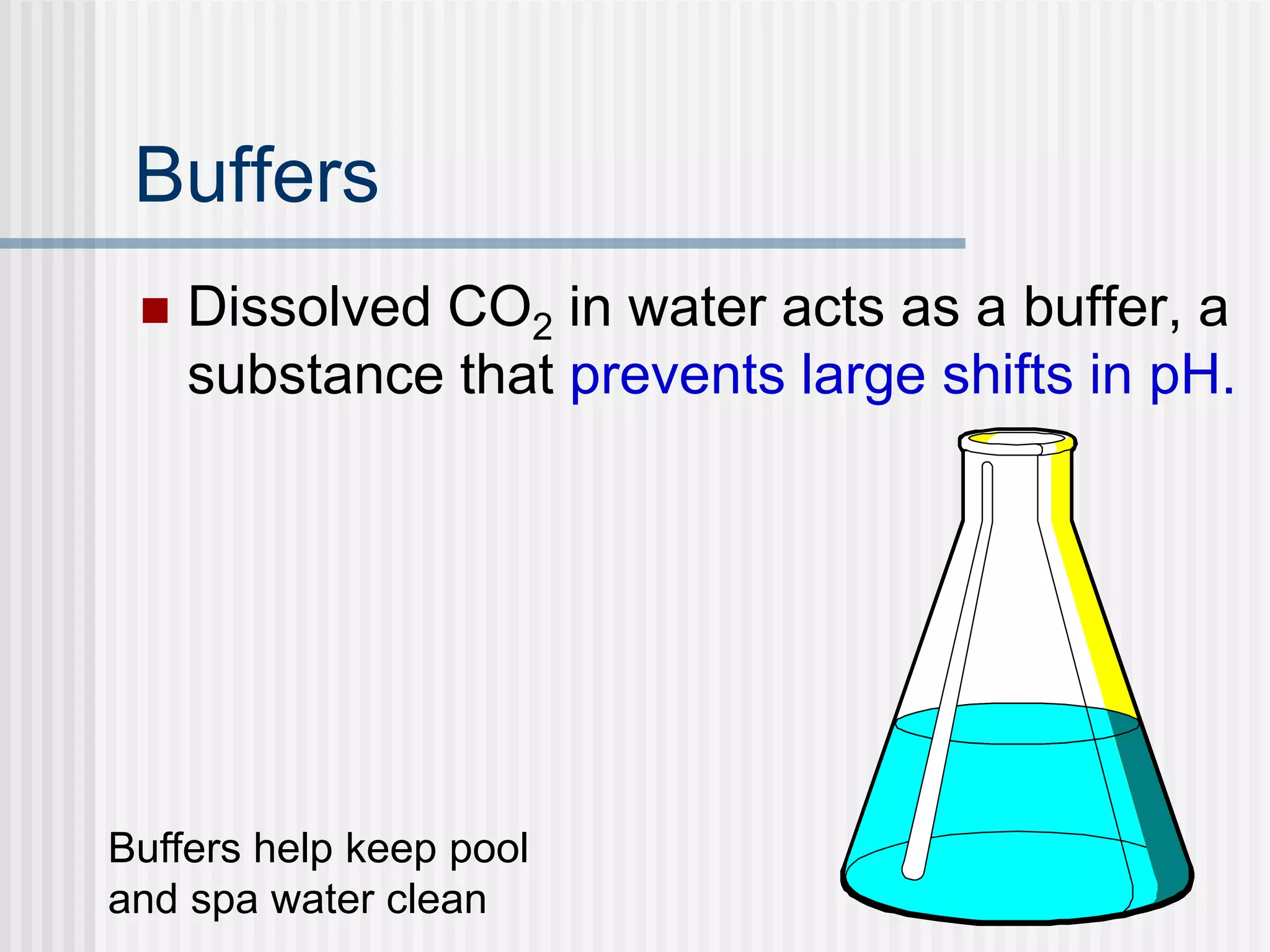
 Dissolved CO2 in water acts as a buffer, a
substance that prevents large shifts in pH.
Buffers help keep pool
and spa water clean
Buffer Systems
CO2 + H2O  H2CO3  H+ + HCO3
- H+ + CO3
-2
H2CO3 is carbonic acid,
H+ is the hydronium ion
HCO3
- is the bicarbonate ion
CO3
-2 is the carbonate ion
Buffer Systems
CO2 + H2O  H2CO3  H+ + HCO3
-H+ + CO3
-2
 Adding CO2 shifts the reaction to the right and
produces more H+ ions making the water more
acid.
Buffer Systems
CO2 + H2O  H2CO3  H+ + HCO3
- H+ + CO3
-2
 Removing CO2 shifts the reaction to the left,
combining H+ ions with carbonate and
bicarbonate ions reducing the acidity.
Ocean Buffers

AP Biology Properties of Water

  • 1.
  • 2.
    Water and it’slife giving properties  How many drops of water can you fit on a penny?  How does water do to ink?  What does a drop of water look like?  Can you float a paperclip on water?
  • 3.
    Observations  What observationsdid you make about water?  What do you already know?
  • 4.
  • 5.
    Your Objective Be ableto state at least 2 properties of water that help support life AND Be able to explain how the chemical nature of water gives rise to that property
  • 6.
    Water and Life  Lifeon Earth began in water and evolved there for 3 billion years.  Modern life still remains tied to water  Cells are composed of 70%- 95% water
  • 7.
    •Water is found asa liquid over 71% of the earth •The abundance of water is a major reason Earth is habitable
  • 8.
     Studied inisolation, the water molecule is deceptively simple  Its two hydrogen atoms are joined to one oxygen atom by single covalent bonds The structure of water H O H
  • 9.
     But theelectrons of the covalent bonds are not shared equally between oxygen and hydrogen This unequal sharing makes water a polar molecule Oxygen is more electronegative than hydrogen, so it has a greater pull on the electrons () () () ()
  • 10.
     The polarityof water results in weak electrical attractions between neighboring water molecules These interactions are called hydrogen bonds (b) () Hydrogen bond () () () () () () ()
  • 11.
  • 12.
  • 13.
    Quick Think  Whyis a molecule of water said to have polar covalent bonds?  What kind of bonds hold individual water molecules together?
  • 14.
    Water’s Life Supporting Properties The polarity of water molecules and the hydrogen bonding that results explain most of water’s life-supporting properties  Water’s cohesive nature  Water’s ability to moderate temperature  Floating ice  Versatility of water as a solvent
  • 16.
     Water molecules sticktogether as a result of hydrogen bonding  This is called cohesion The Cohesion of Water Cohesion is vital for water transport in plants Microscopic tubes
  • 17.
     Which ofour mini-lab demos seems to illustrate cohesion?
  • 19.
    Surface tension isthe measure of how difficult it is to stretch or break the surface of a liquid Hydrogen bonds give water an unusually high surface tension Cohesion between water molecules form a skin-like surface Can support animals like “water striders” in ponds
  • 20.
    Surface Tension  Waterdrops are round because all the molecules on the edge are pulled to the middle.
  • 21.
    Adhesion  Water willalso adhere to other polar substances  This is called adhesion  It is due to the polar nature of the water molecule Caused by adhesion the water runs along the glass and does not fall straight.
  • 22.
    Capillary Action  Glasshas polar molecules.  Glass can hydrogen bond.  Attracts the water molecules.  Some of the pull is up.
  • 23.
    Meniscus  Water curvesup along the side.  This makes the meniscus.
  • 24.
    Quick Think  Howare adhesion and cohesion similar and different?  Give an example of how these properties help support life.
  • 25.
    8-15-14 Warm up Use the clay and toothpicks to make a model of a water molecule  Working with someone near you, use your models to demonstrate cohesion. HW: 1.) Read section 3-1 and 3-2 in your textbook 2.) Watch CrashCourse Biology – Water on YouTube 3.) water worksheet
  • 26.
  • 28.
    Water moderates temperature Because of hydrogen bonding, water has a strong resistance to temperature change
  • 29.
    Water moderates temperature Heat and temperature are related, but different  Heat is a measure of the amount of kinetic energy in the atoms and molecules in something  Temperature measures the intensity of the heat  Whenever 2 objects meet, the cooler object absorbs heat from the warmer object until they are the same temperature
  • 30.
    Water moderates temperature Water has a high specific heat  Specific heat = the amount of heat that must be absorbed or lost to change the temperature of 1g of the substance 1°C
  • 31.
    Water moderates temperature much of the absorbed heat is used to break hydrogen bonds, not increase the kinetic energy of the molecules
  • 32.
    Water moderates temperature Earth’sgiant water supply causes temperatures to stay within limits that permit life
  • 33.
    How water moderates temperature Wateralso has: High heat of fusion • The temp at which liquid turns solid High heat of vaporization • The temp at which liquid turns to gas
  • 34.
    Quick Think Why doesit take so much energy to change the temperature of water?
  • 35.
     When watermolecules get cold, they move apart, forming ice The Biological Significance of Ice Floating A chunk of ice has fewer molecules than an equal volume of liquid water IceLiquid water
  • 36.
     The densityof ice is lower than liquid water  This is why ice floats Figure 2.15 Hydrogen bond Liquid water Hydrogen bonds constantly break and re-form Ice Stable hydrogen bonds
  • 37.
  • 38.
    Dipole Structure  Icefloats in water because all ice molecules are held in hexagons  Center is open space, making ice 8% less dense than water.
  • 39.
     Since icefloats, ponds, lakes, and even the oceans do not freeze solid Marine life could not survive if bodies of water froze solid
  • 40.
     Floating iceinsulates water below, preventing freezing: critical for ocean animals
  • 41.
    Maximum density: 3.98oC Below this temp, form hexagonal polymers and decrease density  Above this, molecules are energetic, water behaves like other liquids - expanding when warm and contracting when cool
  • 42.
    Quick Think  Ofall the properties we’ve learned so far, which ones could you competently write about in your essay?
  • 43.
     A solutionis a liquid consisting of two or more substances evenly mixed Water as the Solvent of Life The dissolving agent is called the solvent The dissolved substance is called the solute Ion in solution Salt crystal
  • 44.
     Water isa good solvent because it is polar  Ionic (salts) and polar (sugars) compounds dissolve readily in water
  • 45.
    Solvent Properties  Waterdissolves salts by surrounding the atoms in the salt molecule and neutralizing the ionic bond holding the molecule together
  • 46.
  • 47.
     Acid Acids, Bases, andpH A chemical compound that donates H+ ions to solutions Base A compound that accepts H+ ions and removes them from solution or a compound that dissociates in water to form hydroxide ions
  • 48.
    Basic solution Neutral solution Acidic solution Oven cleaner Household bleach Householdammonia Milk of magnesia Seawater Human blood Pure water Urine Tomato juice Grapefruit juice Lemon juice; gastric juice pH scale To describe the acidity of a solution, we use the pH scale
  • 49.
    pH scale (logscale) Each number on the scale is 10x difference from the number next to it • pH 1 is 10x more acidic than pH 2, 100x more acidic than pH 3, 1000x more acidic that pH 4, and so on
  • 50.
    pH - PercentHydronium A measure of the percent of hydronium ions in the solution The greater the percent hydronium ions, the more acidic the solution is H2CO3 -------------> H+ + HCO3 - CARBONIC ACID HYDRONIUM BICARBONATE ION ION
  • 51.
  • 53.
     Buffers aresubstances that resist pH change They accept H+ ions when they are in excess They donate H+ ions when they are depleted Buffering is not foolproof Example: acid precipitation normal rain water (pH of 5-6) pH of acid rain is between 3-4
  • 54.
    Buffers  Dissolved CO2in water acts as a buffer, a substance that prevents large shifts in pH. Buffers help keep pool and spa water clean
  • 55.
    Buffer Systems CO2 +H2O  H2CO3  H+ + HCO3 - H+ + CO3 -2 H2CO3 is carbonic acid, H+ is the hydronium ion HCO3 - is the bicarbonate ion CO3 -2 is the carbonate ion
  • 56.
    Buffer Systems CO2 +H2O  H2CO3  H+ + HCO3 -H+ + CO3 -2  Adding CO2 shifts the reaction to the right and produces more H+ ions making the water more acid.
  • 57.
    Buffer Systems CO2 +H2O  H2CO3  H+ + HCO3 - H+ + CO3 -2  Removing CO2 shifts the reaction to the left, combining H+ ions with carbonate and bicarbonate ions reducing the acidity.
  • 58.