Doname Asuncion Reyes
WATER
The Nature of Water
 CHEMICAL BOND AND PROPERTIES OF
SEAWATER
1. ATOM
 An atom is the smallest unit of a substance that
retains all of its chemical properties.

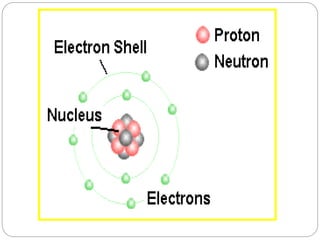
 Protons and neutrons form the nucleus (center) of
the atom.
 Protons have a positive charge.
 Electrons have a negative charge, little mass.
 Neutrons have no electrical charge.
 Electrons orbit around the nucleus in discrete levels,
called electron shells.
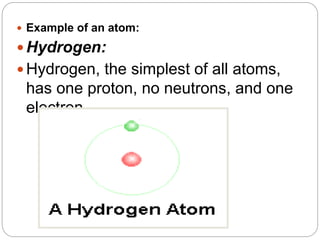
 Example of an atom:
 Hydrogen:
 Hydrogen, the simplest of all atoms,
has one proton, no neutrons, and one
electron.
Whenever an atom does not have
its outer orbital shell filled with
electrons, it is unstable and must
share electrons with another atom
to fill the void by combining to
form a molecule.
The hydrogen atom has an empty
space in its first orbital, so it must
always combine with another
atom to achieve a stable
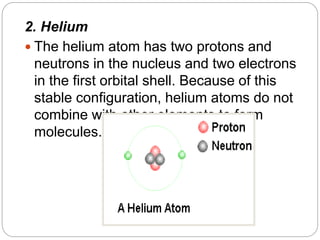
2. Helium
 The helium atom has two protons and
neutrons in the nucleus and two electrons
in the first orbital shell. Because of this
stable configuration, helium atoms do not
combine with other elements to form
molecules.
3. Oxygen
 Oxygen has a total of eight protons and
eight electrons, two in the first orbital shell
and six in the second.
 The second orbital shell has a capacity for
eight electrons, so the oxygen atom has
two empty spaces in its outer shell.
 Because of this unstable configuration,
atomic oxygen does not exist. Usually two
oxygen atoms share a pair of molecules to
form an oxygen molecule O2.
 CHEMICAL BOND
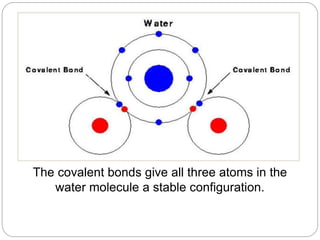
 1. Covalent Bonds
 A molecular bond formed by the
sharing of electrons is called a
covalent bond. In a molecule of
water (H2O) covalent bonding
contributes two hydrogen electrons
to fill the outer shell of the oxygen
atom, while each hydrogen atom
receives an oxygen electron to fill its
outer shell.
The covalent bonds give all three atoms in the
water molecule a stable configuration.
2. Hydrogen Bonding
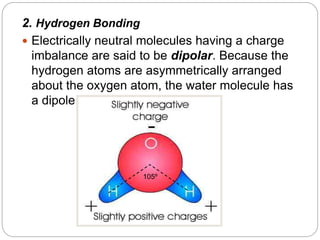
 Electrically neutral molecules having a charge
imbalance are said to be dipolar. Because the
hydrogen atoms are asymmetrically arranged
about the oxygen atom, the water molecule has
a dipole structure.
105º
 The oxygen (negative) end of one
water molecule is electrically
attracted to the hydrogen (positive)
end of another, forming a hydrogen
bond.
 Hydrogen bonds are only about 4%
as strong as covalent bonds, but the
cohesiveness of these bonds are
responsible for the many unique
properties of water.
3. Ionic Bonds
 In a compound like sodium chloride
(NaCl), common table salt, we find a
third type of bond.
 The force of the electrical attraction
between a cation (like Na+) and an
anion (like Cl–) produces an ionic
bond. In an ionic bond, the ions are
bonded like two magnets stuck
together.
 Unlike covalent bonds, electrons are
not shared.
 Substances formed by ionic bonds are
 Summary of Chemical Bonds:
 Covalent bonds: Two or more
atoms share electrons
 Ionic bonds: Two or more
oppositely-charged ions bonded by
electrical attraction. (Electrons are
not shared.)
 Hydrogen bonds: Weaker bonds
of attraction between electrically
neutral, but imbalanced, molecules
like water
3. CHEMICAL PROPERTIES OF
WATER
 It is one of very few substances that occurs as
all three states of matter within the normal
temperature range at Earth’s surface.
 The hydrogen bonds between water molecules
are only about 4% as strong as covalent bonds,
but they are responsible for the many unique
properties of water:
 High heat capacity
 High latent heat of melting/vaporization
 Temperature and Density
 High surface tension
 High solvent power
4. Heat Capacity of Water
 Water is very resistant to temperature
changes; it is slow to heat up or cool
down.
 It takes one calorie of heat energy to
change the temperature of 1 gram of
water by 1º C (i.e., the specific heat of
pure water is 1 cal/gºC).
 The high specific heat is a direct result of
the hydrogen bonding together of the
water molecules. For water to warm up,
the molecular motion must increase.
 Because of the hydrogen bonds,
liquid water arranged into loosely
structured, transient “bundles”, so
more heat is required to increase the
motion of water molecules.
2. Latent Heat of Melting
 It requires the input of heat energy to
change the state of a substance from a
solid to a liquid and from a liquid to a gas.
 It takes 80 calories of heat to convert one
gram of ice into one gram of water. This
energy is called the latent heat of melting
or fusion. (The term “latent” refers to the
fact that the heat energy transferred to the
water changes its state but not its
temperature.)
 The 80 calories are needed to break some
of the hydrogen bonds in order for the ice
3. Latent Heat of Vaporization
 To convert liquid water to water
vapor, all the hydrogen bonds must
be broken before individual water
molecules can evaporate into the
surrounding air.
 At a room temperature of 20º C, it
requires 585 calories of energy,
known as the latent heat of
vaporization, to convert one gram of
liquid water into one gram of water
4. Density of Pure Water and Ice
 Most liquids become more dense as they
cool, and if cooled until they become
solid, the solid phase is more dense than
the liquid phase. Water is different.
 We are all familiar with the fact that solid
water (ice) is less dense than the liquid
form, since ice floats.
 When water freezes, the angle of
separation between hydrogen atoms
expands to 109.5° in the ice crystal,
making ice less dense than the
surrounding water.
5. Surface Tension
 Hydrogen bonding also explains the high
surface tension of water.
 At the air-water interface, water molecules will
string together into a sheet, causing the
surface tension that allows water to form a
surface film.
 If you place a soda straw into water, a small
amount of water will remain in the straw, even
when you withdraw it from the water. This is
due to the surface tension of water.
 If added carefully, iron fillings can even be
“floated” on a glass of water due to the
6. Solvent Properties of Water
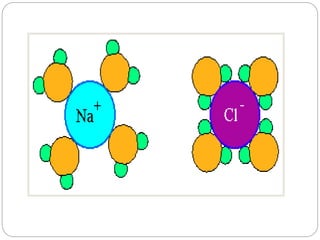
 When a salt is placed into water, the
negatively charged ends of the water
molecules dislodge the cations from the
salt crystal while the positive ends attract
the anions.
 The salt is dissolved until it disappears
entirely or until the water becomes
saturated and can no longer
accommodates more salt ions.
MAJOR CONSTITUENTS OF
SEAWATER
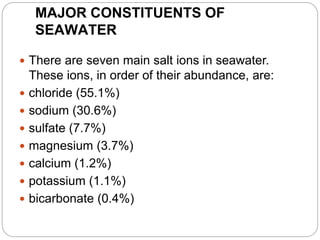
 There are seven main salt ions in seawater.
These ions, in order of their abundance, are:
 chloride (55.1%)
 sodium (30.6%)
 sulfate (7.7%)
 magnesium (3.7%)
 calcium (1.2%)
 potassium (1.1%)
 bicarbonate (0.4%)
WAVES
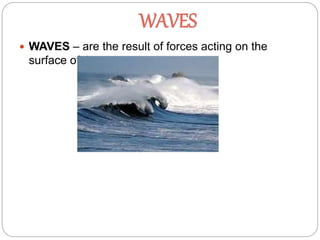
 WAVES – are the result of forces acting on the
surface of the water.
FORCE AND WAVES:
1. GENERATING FORCE – A force that disturbs the
water’s surface, such as a stone dropped into the
water or wind blowing across the water’s surface
 The disturbance produced by the generating force
moves outward, away from the point of the
disturbance.
2. RESTORING FORCE – The force that causes the
water to return to the undisturbed level. If the amount
of water that is displaced is small, the restoring force
is the surface tension of the water.
3. CAPILLARY WAVES – small waves
4. GRAVITY WAVES – When the amount of water
displaced is quite sizable, the restoring force is
gravity and the waves are referred to as gravity
waves.
5. PROGRESSIVE WAVE- progressive waves can
be formed by local storm centers or by the
prevailing winds of the wind belts such as the
tradewinds or westerlies. As wind waves are
formed by the storm, they are forced to increase
in size and speed by the input of energy from the
storm; for this reason they also known as forced
waves.
 A WAVE, then, results from the interactions between
generating forces and restoring forces. Generating
forces can be any event that adds energy to the
surface of the sea.
 Different factors of generating forces:
 Geological events such as earthquake and volcanic
eruptions
 Objects dropped into the water
 The movement of the ships
 Disturbances from beneath the surface such as
breeching whales
 Winds – most common factor in generating forces
 Most ocean waves are generated by wind and
restored by gravity, and they progress in a particular
direction.
Water

Water

  • 1.
  • 2.
    The Nature ofWater  CHEMICAL BOND AND PROPERTIES OF SEAWATER 1. ATOM  An atom is the smallest unit of a substance that retains all of its chemical properties.  Protons and neutrons form the nucleus (center) of the atom.  Protons have a positive charge.  Electrons have a negative charge, little mass.  Neutrons have no electrical charge.  Electrons orbit around the nucleus in discrete levels, called electron shells.
  • 4.
     Example ofan atom:  Hydrogen:  Hydrogen, the simplest of all atoms, has one proton, no neutrons, and one electron.
  • 5.
    Whenever an atomdoes not have its outer orbital shell filled with electrons, it is unstable and must share electrons with another atom to fill the void by combining to form a molecule. The hydrogen atom has an empty space in its first orbital, so it must always combine with another atom to achieve a stable
  • 6.
    2. Helium  Thehelium atom has two protons and neutrons in the nucleus and two electrons in the first orbital shell. Because of this stable configuration, helium atoms do not combine with other elements to form molecules.
  • 7.
    3. Oxygen  Oxygenhas a total of eight protons and eight electrons, two in the first orbital shell and six in the second.  The second orbital shell has a capacity for eight electrons, so the oxygen atom has two empty spaces in its outer shell.  Because of this unstable configuration, atomic oxygen does not exist. Usually two oxygen atoms share a pair of molecules to form an oxygen molecule O2.
  • 8.
     CHEMICAL BOND 1. Covalent Bonds  A molecular bond formed by the sharing of electrons is called a covalent bond. In a molecule of water (H2O) covalent bonding contributes two hydrogen electrons to fill the outer shell of the oxygen atom, while each hydrogen atom receives an oxygen electron to fill its outer shell.
  • 9.
    The covalent bondsgive all three atoms in the water molecule a stable configuration.
  • 10.
    2. Hydrogen Bonding Electrically neutral molecules having a charge imbalance are said to be dipolar. Because the hydrogen atoms are asymmetrically arranged about the oxygen atom, the water molecule has a dipole structure. 105º
  • 11.
     The oxygen(negative) end of one water molecule is electrically attracted to the hydrogen (positive) end of another, forming a hydrogen bond.  Hydrogen bonds are only about 4% as strong as covalent bonds, but the cohesiveness of these bonds are responsible for the many unique properties of water.
  • 12.
    3. Ionic Bonds In a compound like sodium chloride (NaCl), common table salt, we find a third type of bond.  The force of the electrical attraction between a cation (like Na+) and an anion (like Cl–) produces an ionic bond. In an ionic bond, the ions are bonded like two magnets stuck together.  Unlike covalent bonds, electrons are not shared.  Substances formed by ionic bonds are
  • 13.
     Summary ofChemical Bonds:  Covalent bonds: Two or more atoms share electrons  Ionic bonds: Two or more oppositely-charged ions bonded by electrical attraction. (Electrons are not shared.)  Hydrogen bonds: Weaker bonds of attraction between electrically neutral, but imbalanced, molecules like water
  • 14.
    3. CHEMICAL PROPERTIESOF WATER  It is one of very few substances that occurs as all three states of matter within the normal temperature range at Earth’s surface.  The hydrogen bonds between water molecules are only about 4% as strong as covalent bonds, but they are responsible for the many unique properties of water:  High heat capacity  High latent heat of melting/vaporization  Temperature and Density  High surface tension  High solvent power
  • 15.
    4. Heat Capacityof Water  Water is very resistant to temperature changes; it is slow to heat up or cool down.  It takes one calorie of heat energy to change the temperature of 1 gram of water by 1º C (i.e., the specific heat of pure water is 1 cal/gºC).  The high specific heat is a direct result of the hydrogen bonding together of the water molecules. For water to warm up, the molecular motion must increase.
  • 16.
     Because ofthe hydrogen bonds, liquid water arranged into loosely structured, transient “bundles”, so more heat is required to increase the motion of water molecules.
  • 17.
    2. Latent Heatof Melting  It requires the input of heat energy to change the state of a substance from a solid to a liquid and from a liquid to a gas.  It takes 80 calories of heat to convert one gram of ice into one gram of water. This energy is called the latent heat of melting or fusion. (The term “latent” refers to the fact that the heat energy transferred to the water changes its state but not its temperature.)  The 80 calories are needed to break some of the hydrogen bonds in order for the ice
  • 18.
    3. Latent Heatof Vaporization  To convert liquid water to water vapor, all the hydrogen bonds must be broken before individual water molecules can evaporate into the surrounding air.  At a room temperature of 20º C, it requires 585 calories of energy, known as the latent heat of vaporization, to convert one gram of liquid water into one gram of water
  • 19.
    4. Density ofPure Water and Ice  Most liquids become more dense as they cool, and if cooled until they become solid, the solid phase is more dense than the liquid phase. Water is different.  We are all familiar with the fact that solid water (ice) is less dense than the liquid form, since ice floats.  When water freezes, the angle of separation between hydrogen atoms expands to 109.5° in the ice crystal, making ice less dense than the surrounding water.
  • 20.
    5. Surface Tension Hydrogen bonding also explains the high surface tension of water.  At the air-water interface, water molecules will string together into a sheet, causing the surface tension that allows water to form a surface film.  If you place a soda straw into water, a small amount of water will remain in the straw, even when you withdraw it from the water. This is due to the surface tension of water.  If added carefully, iron fillings can even be “floated” on a glass of water due to the
  • 21.
    6. Solvent Propertiesof Water  When a salt is placed into water, the negatively charged ends of the water molecules dislodge the cations from the salt crystal while the positive ends attract the anions.  The salt is dissolved until it disappears entirely or until the water becomes saturated and can no longer accommodates more salt ions.
  • 23.
    MAJOR CONSTITUENTS OF SEAWATER There are seven main salt ions in seawater. These ions, in order of their abundance, are:  chloride (55.1%)  sodium (30.6%)  sulfate (7.7%)  magnesium (3.7%)  calcium (1.2%)  potassium (1.1%)  bicarbonate (0.4%)
  • 24.
    WAVES  WAVES –are the result of forces acting on the surface of the water.
  • 25.
    FORCE AND WAVES: 1.GENERATING FORCE – A force that disturbs the water’s surface, such as a stone dropped into the water or wind blowing across the water’s surface  The disturbance produced by the generating force moves outward, away from the point of the disturbance. 2. RESTORING FORCE – The force that causes the water to return to the undisturbed level. If the amount of water that is displaced is small, the restoring force is the surface tension of the water. 3. CAPILLARY WAVES – small waves
  • 26.
    4. GRAVITY WAVES– When the amount of water displaced is quite sizable, the restoring force is gravity and the waves are referred to as gravity waves. 5. PROGRESSIVE WAVE- progressive waves can be formed by local storm centers or by the prevailing winds of the wind belts such as the tradewinds or westerlies. As wind waves are formed by the storm, they are forced to increase in size and speed by the input of energy from the storm; for this reason they also known as forced waves.
  • 27.
     A WAVE,then, results from the interactions between generating forces and restoring forces. Generating forces can be any event that adds energy to the surface of the sea.  Different factors of generating forces:  Geological events such as earthquake and volcanic eruptions  Objects dropped into the water  The movement of the ships  Disturbances from beneath the surface such as breeching whales  Winds – most common factor in generating forces  Most ocean waves are generated by wind and restored by gravity, and they progress in a particular direction.