Predators and Prey
Target
To understand the terms predator
and prey.
Starter
• Discuss with the person next to you what
the words below mean
– Predator
– Prey
Predators
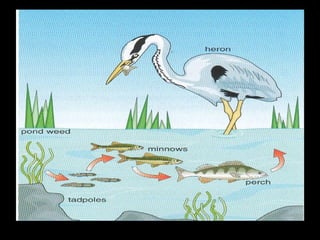
• A predator is…
• ….an animal that kills and eats other
animals
• Some examples of predators are…..
Prey
• A prey is…
• …...an animal that is killed and eaten (by a
predator)
• Some examples or prey are ……
Adaptations
• Predators and prey have different
adaptations
• Can you think of any?
Adaptations of predators and prey
Predators Reason Prey Reason
Forward facing eyes Eyes facing sideways
Sharp teeth Large ears
Good Eyesight Travel in herds
May hunt in packs Camouflage
Fast runner May hide in burrows
Sharp claws or beak Good sense of smell
Sees prey well
Grip prey
See prey
Better chance of catch
Catch prey
Hold prey
See predator
Hear predator
Less chance of
being caught
Hard to see
Difficult to find
Smells predator
Homework task
• Design a super predator and a super prey
– draw your own design.
QuestionsQuestions
Core Science - Page 88 and 89Core Science - Page 88 and 89
Feeding Types
We can group animals together in many ways.
One way that we can group them together is in
the way that they feed.
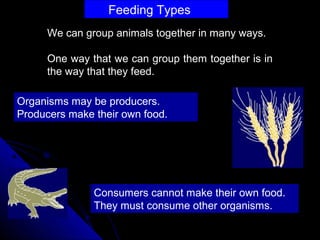
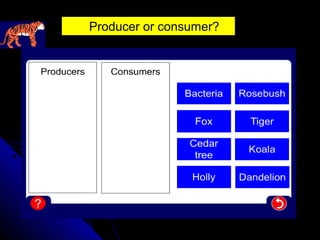
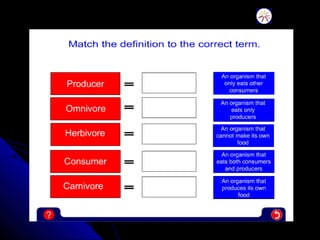
Consumers cannot make their own food.
They must consume other organisms.
Organisms may be producers.
Producers make their own food.
Producer or consumer?
Consumers
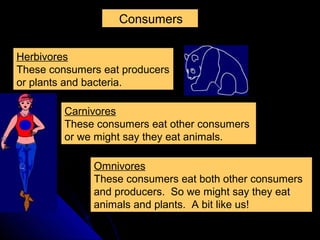
Consumers can be grouped into different types:
Carnivores
These consumers eat other consumers
or we might say they eat animals.
Herbivores
These consumers eat producers
or plants and bacteria.
Omnivores
These consumers eat both other consumers
and producers. So we might say they eat
animals and plants. A bit like us!
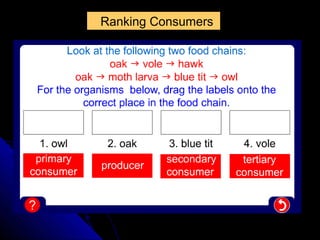
Ranking Consumers
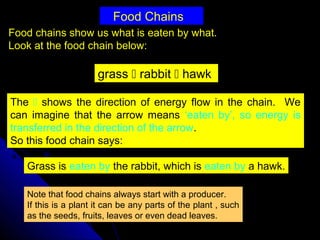
Food Chains
Food chains show us what is eaten by what.
Look at the food chain below:
grass  rabbit  hawk
The  shows the direction of energy flow in the chain. We
can imagine that the arrow means ‘eaten by’, so energy is
transferred in the direction of the arrow.
So this food chain says:
Note that food chains always start with a producer.
If this is a plant it can be any parts of the plant , such
as the seeds, fruits, leaves or even dead leaves.
Grass is eaten by the rabbit, which is eaten by a hawk.
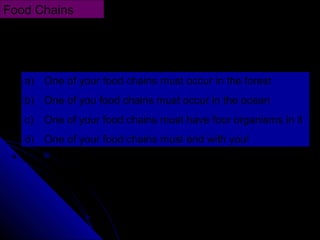
Draw four different food chains using the following as
guidelines:
Food Chains
a) One of your food chains must occur in the forest
b) One of you food chains must occur in the ocean
c) One of your food chains must have four organisms in it
d) One of your food chains must end with you!
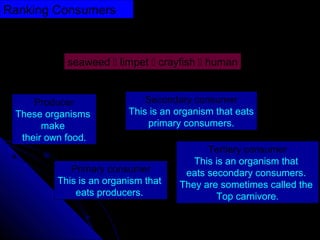
Ranking Consumers
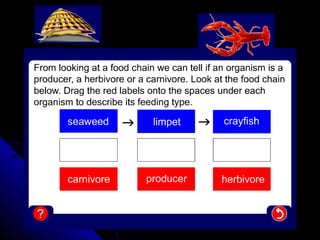
We can use a food chain to group organisms in another way:
seaweed  limpet  crayfish  human
Producer
These organisms
make
their own food.
Primary consumer
This is an organism that
eats producers.
Secondary consumer
This is an organism that eats
primary consumers.
Tertiary consumer
This is an organism that
eats secondary consumers.
They are sometimes called the
Top carnivore.
Numbers
• Numbers of predators are affected by the
number of prey and numbers of prey are
affected by the number of predators
• Why might this be?
Learning Objectives
By the end of the lesson you should:
• Know that predators and prey have
different features
• Understand that animals are adapted to
eat the food they do
• Be able to identify animals as predators or
prey from their characteristics