Indoor
Propagation
Models
Hello!
I am Wajid Ali.
Taimoor Hussain
Daniyal Jan
Content
 Indoor Propagation Models
 Propagation Influencement
 Similarity and Difference between Indoor and Outdoor Propagation
 Indoor Channels
 Indoor Propagation events and parameters
 Path Loss Factors
 Models for Indoor Propagation
 References
Giving connects two people, the giver and
the receiver, and this connection gives
birth to a new sense of belonging.
Deepak Chopra
Indoor Propagation
Indoor Propagation
✖ Outdoor Models are not accurate for Indoor scenarios
 Home, Shopping mall, office building, etc.
✖ Indoor radio channel differs from traditional mobile
radio channel in :
 Distances covered are much smaller.
 Variability of the environment is greater for a much
smaller range or T-R separation distances.
Propagation
Influencement
Propagation Influencement
✖ The propagation inside a building is influenced by:
 Layout of the building.
 Construction Materials.
 Building type:
 Traditional office building with fixed walls (Hard
Partitions)
 Open plan buildings with movable wall panels (Soft
Partitions)
 Sports Arena
 Residential Home
 Factory
Similarity and Difference
between Indoor and
Outdoor Propagation
Similarity in Mechanism
 Reflection
 Scattering
 Diffraction
Similarity and Difference between
Indoor and Outdoor Propagation
Difference in Conditions
 Doors/Windows open or not
 The mounting place of
antenna
 Desk
 Ceiling
 The level of floors
Indoor Channels
Indoor Channels
✖ Indoor Channels are classified as:
 Line-of-Sight (LOS).
 Obstructed (OBS) with varying degrees of clutter.
Indoor Propagation
Events &
Parameters
Indoor Propagation Events &
Parameters
✖ Temporal fading for fixed and moving terminals
 Motion of people inside building causes Ricean fading for
the stationary receivers.
 Portable receivers experience in general:
 Rayleigh fading for OBS propagation paths.
 Ricean fading for LOS paths.
Indoor Propagation Events &
Parameters
✖ Multipath Delay Spread
 Buildings with fewer metals and hard-partitions typically
have small rms delay spread 30-60ns.
 Can support data rates excess of several Mbps
without equalization.
 Larger buildings with great amount of metal may have
rms delay spreads as large as 300ns.
 Can not support data rates more than a few hundred
Kbps without equalization.
Path Loss Factors
Path Loss Factors
✖ Partition Losses (Same Floor)
✖ Partition Losses between floors
✖ Signal Penetration into Buildings
Partition Losses (Same Floor)
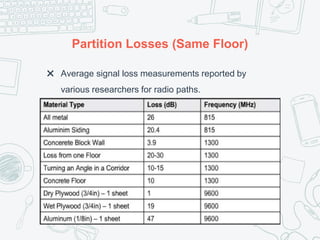
✖ Average signal loss measurements reported by
various researchers for radio paths.
Partition Losses between floors
✖ The losses between floors of a building are detemined
by:
 External dimensions and materials of the building.
 Type of construction used to create floors.
 External surroundings.
 Number of windows.
Signal Penetration into Buildings
✖ RF signals can penetrate from outside transmitter to
the inside of buildings:
 However the signals are attenuated?
✖ The path loss during penetration has been found to be
a function of:
 Frequency of the signal.
 The height of the building.
Models for Indoor
Propagation
Models for Indoor Propagation
✖ ITU Indoor Path Loss Model
✖ Log-Distance Path Loss Model
ITU Indoor Path Loss Model
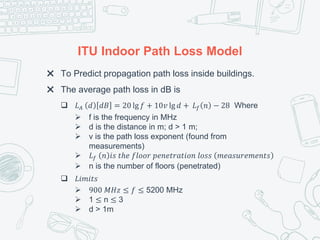
✖ To Predict propagation path loss inside buildings.
✖ The average path loss in dB is
 𝐿 𝐴 𝑑 𝑑𝐵 = 20 lg 𝑓 + 10𝑣 lg 𝑑 + 𝐿 𝑓 𝑛 − 28 Where
 f is the frequency in MHz
 d is the distance in m; d > 1 m;
 v is the path loss exponent (found from
measurements)
 𝐿 𝑓 𝑛 𝑖𝑠 𝑡ℎ𝑒 𝑓𝑙𝑜𝑜𝑟 𝑝𝑒𝑛𝑒𝑡𝑟𝑎𝑡𝑖𝑜𝑛 𝑙𝑜𝑠𝑠 𝑚𝑒𝑎𝑠𝑢𝑟𝑒𝑚𝑒𝑛𝑡𝑠
 n is the number of floors (penetrated)
 𝐿𝑖𝑚𝑖𝑡𝑠
 900 𝑀𝐻𝑧 ≤ 𝑓 ≤ 5200 MHz
 1 ≤ n ≤ 3
 d > 1m
Log-Distance Path Loss Model
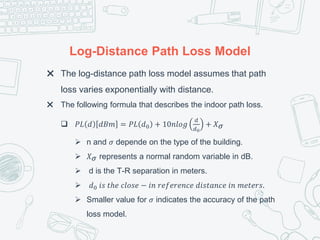
✖ The log-distance path loss model assumes that path
loss varies exponentially with distance.
✖ The following formula that describes the indoor path loss.
 𝑃𝐿 𝑑 𝑑𝐵𝑚 = 𝑃𝐿 𝑑0 + 10𝑛𝑙𝑜𝑔
𝑑
𝑑0
+ 𝑋 𝜎
 n and 𝜎 depende on the type of the building.
 𝑋 𝜎 represents a normal random variable in dB.
 d is the T-R separation in meters.
 𝑑0 𝑖𝑠 𝑡ℎ𝑒 𝑐𝑙𝑜𝑠𝑒 − 𝑖𝑛 𝑟𝑒𝑓𝑒𝑟𝑒𝑛𝑐𝑒 𝑑𝑖𝑠𝑡𝑎𝑛𝑐𝑒 𝑖𝑛 𝑚𝑒𝑡𝑒𝑟𝑠.
 Smaller value for 𝜎 indicates the accuracy of the path
loss model.
Thanks!
Any questions?
You can find us in
CS Depart
References
http://www.neednudge.com/10-powerful-networking-
quotes/
https://theses.lib.vt.edu/theses/available/etd-51997-
22830/.../Ch7.pdf
https://www.site.uottawa.ca/~sloyka/elg4179/Lec_4_ELG41
79.pdf
Wireless Communications Principles and Practice By
Theodore S Rapparport

Indoor propagation model (IPM)

  • 1.
  • 2.
    Hello! I am WajidAli. Taimoor Hussain Daniyal Jan
  • 3.
    Content  Indoor PropagationModels  Propagation Influencement  Similarity and Difference between Indoor and Outdoor Propagation  Indoor Channels  Indoor Propagation events and parameters  Path Loss Factors  Models for Indoor Propagation  References
  • 4.
    Giving connects twopeople, the giver and the receiver, and this connection gives birth to a new sense of belonging. Deepak Chopra
  • 5.
  • 6.
    Indoor Propagation ✖ OutdoorModels are not accurate for Indoor scenarios  Home, Shopping mall, office building, etc. ✖ Indoor radio channel differs from traditional mobile radio channel in :  Distances covered are much smaller.  Variability of the environment is greater for a much smaller range or T-R separation distances.
  • 7.
  • 8.
    Propagation Influencement ✖ Thepropagation inside a building is influenced by:  Layout of the building.  Construction Materials.  Building type:  Traditional office building with fixed walls (Hard Partitions)  Open plan buildings with movable wall panels (Soft Partitions)  Sports Arena  Residential Home  Factory
  • 9.
    Similarity and Difference betweenIndoor and Outdoor Propagation
  • 10.
    Similarity in Mechanism Reflection  Scattering  Diffraction Similarity and Difference between Indoor and Outdoor Propagation Difference in Conditions  Doors/Windows open or not  The mounting place of antenna  Desk  Ceiling  The level of floors
  • 11.
  • 12.
    Indoor Channels ✖ IndoorChannels are classified as:  Line-of-Sight (LOS).  Obstructed (OBS) with varying degrees of clutter.
  • 13.
  • 14.
    Indoor Propagation Events& Parameters ✖ Temporal fading for fixed and moving terminals  Motion of people inside building causes Ricean fading for the stationary receivers.  Portable receivers experience in general:  Rayleigh fading for OBS propagation paths.  Ricean fading for LOS paths.
  • 15.
    Indoor Propagation Events& Parameters ✖ Multipath Delay Spread  Buildings with fewer metals and hard-partitions typically have small rms delay spread 30-60ns.  Can support data rates excess of several Mbps without equalization.  Larger buildings with great amount of metal may have rms delay spreads as large as 300ns.  Can not support data rates more than a few hundred Kbps without equalization.
  • 16.
  • 17.
    Path Loss Factors ✖Partition Losses (Same Floor) ✖ Partition Losses between floors ✖ Signal Penetration into Buildings
  • 18.
    Partition Losses (SameFloor) ✖ Average signal loss measurements reported by various researchers for radio paths.
  • 19.
    Partition Losses betweenfloors ✖ The losses between floors of a building are detemined by:  External dimensions and materials of the building.  Type of construction used to create floors.  External surroundings.  Number of windows.
  • 20.
    Signal Penetration intoBuildings ✖ RF signals can penetrate from outside transmitter to the inside of buildings:  However the signals are attenuated? ✖ The path loss during penetration has been found to be a function of:  Frequency of the signal.  The height of the building.
  • 21.
  • 22.
    Models for IndoorPropagation ✖ ITU Indoor Path Loss Model ✖ Log-Distance Path Loss Model
  • 23.
    ITU Indoor PathLoss Model ✖ To Predict propagation path loss inside buildings. ✖ The average path loss in dB is  𝐿 𝐴 𝑑 𝑑𝐵 = 20 lg 𝑓 + 10𝑣 lg 𝑑 + 𝐿 𝑓 𝑛 − 28 Where  f is the frequency in MHz  d is the distance in m; d > 1 m;  v is the path loss exponent (found from measurements)  𝐿 𝑓 𝑛 𝑖𝑠 𝑡ℎ𝑒 𝑓𝑙𝑜𝑜𝑟 𝑝𝑒𝑛𝑒𝑡𝑟𝑎𝑡𝑖𝑜𝑛 𝑙𝑜𝑠𝑠 𝑚𝑒𝑎𝑠𝑢𝑟𝑒𝑚𝑒𝑛𝑡𝑠  n is the number of floors (penetrated)  𝐿𝑖𝑚𝑖𝑡𝑠  900 𝑀𝐻𝑧 ≤ 𝑓 ≤ 5200 MHz  1 ≤ n ≤ 3  d > 1m
  • 24.
    Log-Distance Path LossModel ✖ The log-distance path loss model assumes that path loss varies exponentially with distance. ✖ The following formula that describes the indoor path loss.  𝑃𝐿 𝑑 𝑑𝐵𝑚 = 𝑃𝐿 𝑑0 + 10𝑛𝑙𝑜𝑔 𝑑 𝑑0 + 𝑋 𝜎  n and 𝜎 depende on the type of the building.  𝑋 𝜎 represents a normal random variable in dB.  d is the T-R separation in meters.  𝑑0 𝑖𝑠 𝑡ℎ𝑒 𝑐𝑙𝑜𝑠𝑒 − 𝑖𝑛 𝑟𝑒𝑓𝑒𝑟𝑒𝑛𝑐𝑒 𝑑𝑖𝑠𝑡𝑎𝑛𝑐𝑒 𝑖𝑛 𝑚𝑒𝑡𝑒𝑟𝑠.  Smaller value for 𝜎 indicates the accuracy of the path loss model.
  • 25.
    Thanks! Any questions? You canfind us in CS Depart
  • 26.

Editor's Notes

  • #7 a channel is a separate path through which signals can flow.
  • #11 the distances covered are much smaller, and the variability of the environment is much greater for a much smaller range of T-R separation distances. Reflection involves a change in direction of waves when they bounce off a barrier; refraction of waves involves a change in the direction of waves as they pass from one medium to another; and diffraction involves a change in direction of waves as they pass through an opening or around a barrier in their path The main difference between indoor and outdoor propagation is that in an outdoor macro-cellular network propagation is fairly predictable. You can use a topographical database and really determine what will be the shape of a cell if you put a base station somewhere. For many reasons that's no longer feasible if you talk about indoor systems. First of all: the data bases of the propagation environment have to be very accurate. And the models that we have now for indoor propagation do not allow us to predict everything. Signals may propagate through an elevator shaft. They may or may not propagate through the corner inside a building. ....“
  • #13 a channel is a separate path through which signals can flow. Line-of-sight propagation is a characteristic of electromagnetic radiation or acoustic wave propagation. Electromagnetic transmission includes light emissions traveling in a straight line. The rays or waves may be diffracted, refracted, reflected, or absorbed by atmosphere and obstructions with material and generally cannot travel over the horizon or behind obstacles.
  • #15 Rician fading or Ricean fading is a stochastic model for radio propagation anomaly caused by partial cancellation of a radio signal by itself — the signal arrives at the receiver by several different paths (hence exhibiting multipath interference), and at least one of the paths is changing (lengthening or shortening). Rayleigh fading is a statistical model for the effect of a propagation environment on a radio signal, such as that used by wireless devices.
  • #16 RMS : the square of the function that defines the continuous waveform.
  • #21 The frequency of an RF signal is inversely proportional to the wavelength of the EM field to which it corresponds.
  • #24 The ITU indoor propagation model, also known as ITU model for indoor attenuation, is a radio propagation model that estimates the path loss inside a room or a closed area inside a building delimited by walls of any form. Suitable for appliances designed for indoor use, this model approximates the total path loss an indoor link may experience. This model is applicable to only the indoor environments. Typically, such appliances use the lower microwave bands around 2.4 GHz. However, the model applies to a much wider range. Coverage Frequency: 900 MHz to 5.2 GHz Floors: 1 to 3
  • #25 where n is the path loss exponent which indicates the rate at which path loss increases with distance d. where Xσ is a zero-mean Gaussian distributed (In particular, the standard normal distribution has zero mean) random variable with standard deviation σ.