Radio Propagation
CSCI 694
24 September 1999
Lewis Girod
17 March 1999 Radio Propagation 2
Outline
• Introduction and terminology
• Propagation mechanisms
• Propagation models
17 March 1999 Radio Propagation 3
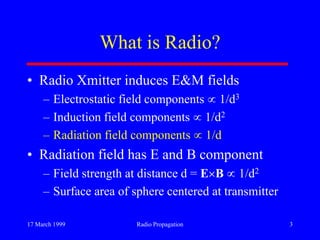
What is Radio?
• Radio Xmitter induces E&M fields
– Electrostatic field components 1/d3
– Induction field components 1/d2
– Radiation field components 1/d
• Radiation field has E and B component
– Field strength at distance d = E B 1/d2
– Surface area of sphere centered at transmitter
17 March 1999 Radio Propagation 4
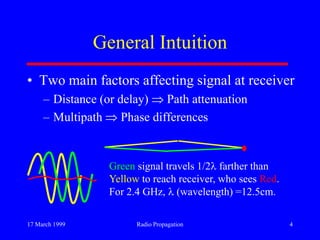
General Intuition
• Two main factors affecting signal at receiver
– Distance (or delay) Path attenuation
– Multipath Phase differences
Green signal travels 1/2 farther than
Yellow to reach receiver, who sees Red.
For 2.4 GHz, (wavelength) =12.5cm.
17 March 1999 Radio Propagation 5
Objective
• Invent models to predict what the field
looks like at the receiver.
– Attenuation, absorption, reflection, diffraction...
– Motion of receiver and environment…
– Natural and man-made radio interference...
– What does the field look like at the receiver?
17 March 1999 Radio Propagation 6
Models are Specialized
• Different scales
– Large scale (averaged over meters)
– Small scale (order of wavelength)
• Different environmental characteristics
– Outdoor, indoor, land, sea, space, etc.
• Different application areas
– macrocell (2km), microcell(500m), picocell
17 March 1999 Radio Propagation 7
Outline
• Introduction and some terminology
• Propagation Mechanisms
• Propagation models
17 March 1999 Radio Propagation 8
Radio Propagation Mechanisms
• Free Space propagation
• Refraction
– Conductors & Dielectric materials (refraction)
• Diffraction
– Fresnel zones
• Scattering
– “Clutter” is small relative to wavelength
17 March 1999 Radio Propagation 9
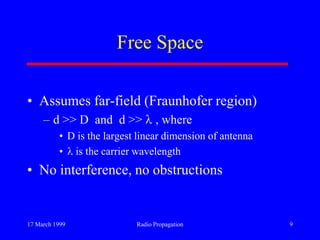
Free Space
• Assumes far-field (Fraunhofer region)
– d >> D and d >> , where
• D is the largest linear dimension of antenna
• is the carrier wavelength
• No interference, no obstructions
17 March 1999 Radio Propagation 10
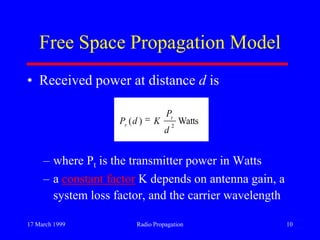
Free Space Propagation Model
• Received power at distance d is
– where Pt is the transmitter power in Watts
– a constant factor K depends on antenna gain, a
system loss factor, and the carrier wavelength
Watts)( 2
d
P
KdP t
r
17 March 1999 Radio Propagation 11
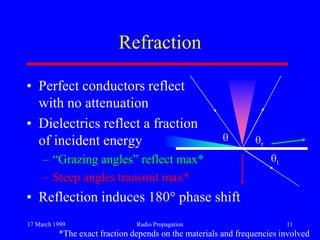
Refraction
• Perfect conductors reflect
with no attenuation
• Dielectrics reflect a fraction
of incident energy
– “Grazing angles” reflect max*
– Steep angles transmit max*
r
t
• Reflection induces 180 phase shift
*The exact fraction depends on the materials and frequencies involved
17 March 1999 Radio Propagation 12
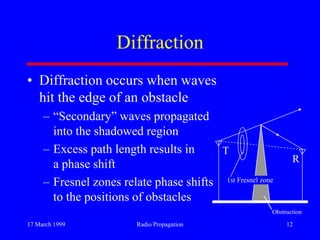
Diffraction
• Diffraction occurs when waves
hit the edge of an obstacle
– “Secondary” waves propagated
into the shadowed region
– Excess path length results in
a phase shift
– Fresnel zones relate phase shifts
to the positions of obstacles
T
R
1st Fresnel zone
Obstruction
17 March 1999 Radio Propagation 13
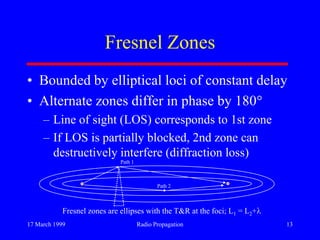
Fresnel Zones
• Bounded by elliptical loci of constant delay
• Alternate zones differ in phase by 180
– Line of sight (LOS) corresponds to 1st zone
– If LOS is partially blocked, 2nd zone can
destructively interfere (diffraction loss)
Fresnel zones are ellipses with the T&R at the foci; L1 = L2+
Path 1
Path 2
17 March 1999 Radio Propagation 14
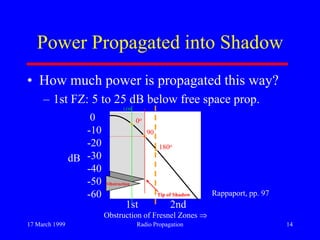
Power Propagated into Shadow
• How much power is propagated this way?
– 1st FZ: 5 to 25 dB below free space prop.
Obstruction of Fresnel Zones
1st 2nd
0
-10
-20
-30
-40
-50
-60
0o
90
180o
dB
Tip of Shadow
Obstruction
LOS
Rappaport, pp. 97
17 March 1999 Radio Propagation 15
Scattering
• Rough surfaces
– critical height for bumps is f( ,incident angle)
– scattering loss factor modeled with Gaussian
distribution.
• Nearby metal objects (street signs, etc.)
– Usually modelled statistically
• Large distant objects
– Analytical model: Radar Cross Section (RCS)
17 March 1999 Radio Propagation 16
Outline
• Introduction and some terminology
• Propagation Mechanisms
• Propagation models
– Large scale propagation models
– Small scale propagation (fading) models
17 March 1999 Radio Propagation 17
Propagation Models: Large
• Large scale models predict behavior averaged
over distances >>
– Function of distance & significant environmental
features, roughly frequency independent
– Breaks down as distance decreases
– Useful for modeling the range of a radio system
and rough capacity planning
17 March 1999 Radio Propagation 18
Propagation Models: Small
• Small scale (fading) models describe signal
variability on a scale of
– Multipath effects (phase cancellation)
dominate, path attenuation considered constant
– Frequency and bandwidth dependent
– Focus is on modeling “Fading”: rapid change in
signal over a short distance or length of time.
17 March 1999 Radio Propagation 19
Large Scale Models
• Path loss models
• Outdoor models
• Indoor models
17 March 1999 Radio Propagation 20
Free Space Path Loss
• Path Loss is a measure of attenuation based
only on the distance to the transmitter
• Free space model only valid in far-field;
– Path loss models typically define a “close-in”
point d0 and reference other points from there:
2
0
0
)()(
d
d
dPdP rr
dB
dBr
d
d
dPLdPdPL
0
0
2)()]([)(
What is dB?
17 March 1999 Radio Propagation 21
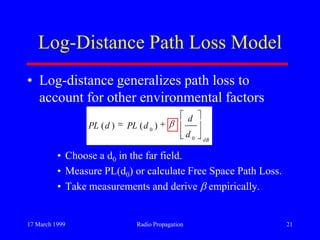
Log-Distance Path Loss Model
• Log-distance generalizes path loss to
account for other environmental factors
• Choose a d0 in the far field.
• Measure PL(d0) or calculate Free Space Path Loss.
• Take measurements and derive empirically.
dB
d
d
dPLdPL
0
0
)()(
17 March 1999 Radio Propagation 22
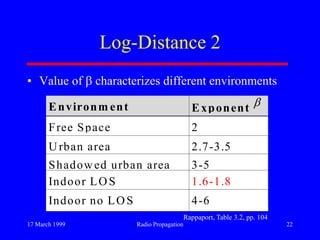
Log-Distance 2
• Value of characterizes different environments
Environm ent Exponent
Free Space 2
Urban area 2.7-3.5
Shadowed urban area 3-5
Indoor LOS 1.6-1.8
Indoor no LOS 4-6
Rappaport, Table 3.2, pp. 104
17 March 1999 Radio Propagation 23
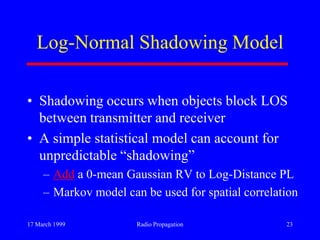
Log-Normal Shadowing Model
• Shadowing occurs when objects block LOS
between transmitter and receiver
• A simple statistical model can account for
unpredictable “shadowing”
– Add a 0-mean Gaussian RV to Log-Distance PL
– Markov model can be used for spatial correlation
17 March 1999 Radio Propagation 24
Outdoor Models
• “2-Ray” Ground Reflection model
• Diffraction model for hilly terrain
17 March 1999 Radio Propagation 25
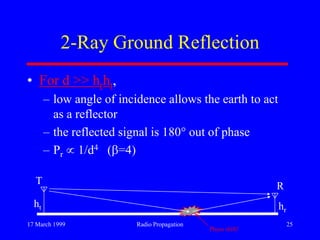
2-Ray Ground Reflection
• For d >> hrht,
– low angle of incidence allows the earth to act
as a reflector
– the reflected signal is 180 out of phase
– Pr 1/d4 ( =4)
RT
ht hr
Phase shift!
17 March 1999 Radio Propagation 26
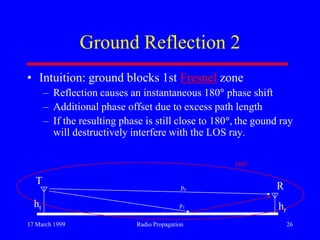
Ground Reflection 2
• Intuition: ground blocks 1st Fresnel zone
– Reflection causes an instantaneous 180 phase shift
– Additional phase offset due to excess path length
– If the resulting phase is still close to 180 , the gound ray
will destructively interfere with the LOS ray.
RT
ht hr
p1
p0
180
17 March 1999 Radio Propagation 27
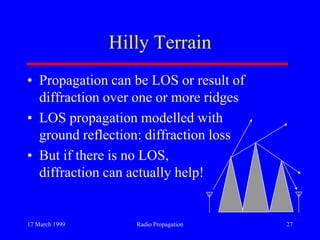
Hilly Terrain
• Propagation can be LOS or result of
diffraction over one or more ridges
• LOS propagation modelled with
ground reflection: diffraction loss
• But if there is no LOS,
diffraction can actually help!
17 March 1999 Radio Propagation 28
Indoor Path Loss Models
• Indoor models are less generalized
– Environment comparatively more dynamic
• Significant features are physically smaller
– Shorter distances are closer to near-field
– More clutter, scattering, less LOS
17 March 1999 Radio Propagation 29
Indoor Modeling Techniques
• Modeling techniques and approaches:
– Log-Normal, <2 for LOS down corridor
– Log-Normal shadowing model if no LOS
– Partition and floor attenuation factors
– Computationally intensive “ray-tracing” based
on 3-D model of building and attenuation
factors for materials
17 March 1999 Radio Propagation 30
Outline
• Introduction and some terminology
• Propagation Mechanisms
• Propagation models
– Large scale propagation models
– Small scale propagation (fading) models
17 March 1999 Radio Propagation 31
Recall: Fading Models
• Small scale (fading) models describe signal
variability on a scale of
– Multipath effects (phase cancellation)
dominate, path attenuation considered constant
– Frequency and bandwidth dependent
– Focus is on modeling “Fading”: rapid change in
signal over a short distance or length of time.
17 March 1999 Radio Propagation 32
Factors Influencing Fading
• Motion of the receiver: Doppler shift
• Transmission bandwidth of signal
– Compare to BW of channel
• Multipath propagation
– Receiver sees multiple instances of signal when
waves follow different paths
– Very sensitive to configuration of environment
17 March 1999 Radio Propagation 33
Effects of Multipath Signals
• Rapid change in signal strength due to
phase cancellation
• Frequency modulation due to Doppler shifts
from movement of receiver/environment
• Echoes caused by multipath propagation
delay
17 March 1999 Radio Propagation 34
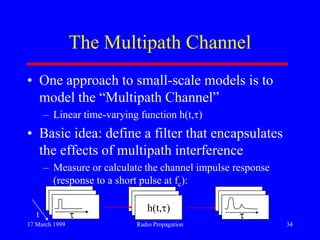
The Multipath Channel
• One approach to small-scale models is to
model the “Multipath Channel”
– Linear time-varying function h(t, )
• Basic idea: define a filter that encapsulates
the effects of multipath interference
– Measure or calculate the channel impulse response
(response to a short pulse at fc):
h(t, )
t
17 March 1999 Radio Propagation 35
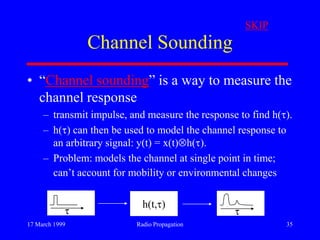
Channel Sounding
• “Channel sounding” is a way to measure the
channel response
– transmit impulse, and measure the response to find h( ).
– h( ) can then be used to model the channel response to
an arbitrary signal: y(t) = x(t) h( ).
– Problem: models the channel at single point in time;
can‟t account for mobility or environmental changes
h(t, )
SKIP
17 March 1999 Radio Propagation 36
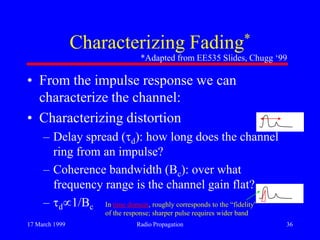
Characterizing Fading*
• From the impulse response we can
characterize the channel:
• Characterizing distortion
– Delay spread ( d): how long does the channel
ring from an impulse?
– Coherence bandwidth (Bc): over what
frequency range is the channel gain flat?
– d 1/Bc
*Adapted from EE535 Slides, Chugg „99
In time domain, roughly corresponds to the “fidelity”
of the response; sharper pulse requires wider band
17 March 1999 Radio Propagation 37
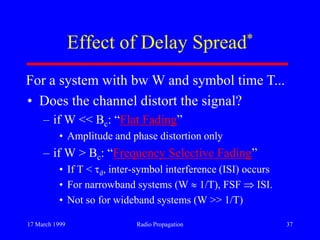
Effect of Delay Spread*
• Does the channel distort the signal?
– if W << Bc: “Flat Fading”
• Amplitude and phase distortion only
– if W > Bc: “Frequency Selective Fading”
• If T < d, inter-symbol interference (ISI) occurs
• For narrowband systems (W 1/T), FSF ISI.
• Not so for wideband systems (W >> 1/T)
For a system with bw W and symbol time T...
17 March 1999 Radio Propagation 38
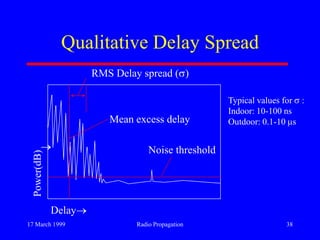
Qualitative Delay Spread
RMS Delay spread ( )
Mean excess delay
Noise threshold
Delay
Power(dB)
Typical values for :
Indoor: 10-100 ns
Outdoor: 0.1-10 s
17 March 1999 Radio Propagation 39
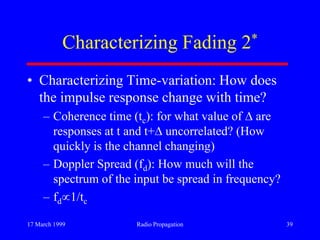
Characterizing Fading 2*
• Characterizing Time-variation: How does
the impulse response change with time?
– Coherence time (tc): for what value of are
responses at t and t+ uncorrelated? (How
quickly is the channel changing)
– Doppler Spread (fd): How much will the
spectrum of the input be spread in frequency?
– fd 1/tc
17 March 1999 Radio Propagation 40
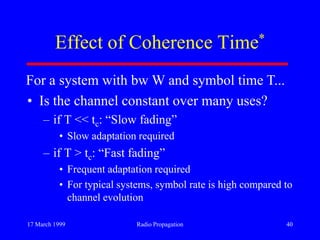
Effect of Coherence Time*
• Is the channel constant over many uses?
– if T << tc: “Slow fading”
• Slow adaptation required
– if T > tc: “Fast fading”
• Frequent adaptation required
• For typical systems, symbol rate is high compared to
channel evolution
For a system with bw W and symbol time T...
17 March 1999 Radio Propagation 41
Statistical Fading Models
• Fading models model the probability of a
fade occurring at a particular location
– Used to generate an impulse response
– In fixed receivers, channel is slowly time-varying; the
fading model is reevaluated at a rate related to motion
• Simplest models are based on the WSSUS
principle
17 March 1999 Radio Propagation 42
WSSUS*
• Wide Sense Stationary (WSS)
– Statistics are independent of small perturbations in time
and position
– I.e. fixed statistical parameters for stationary nodes
• Uncorrelated Scatter (US)
– Separate paths are not correlated in phase or attenuation
– I.e. multipath components can be independent RVs
• Statistics modeled as Gaussian RVs
17 March 1999 Radio Propagation 43
Common Distributions
• Rayleigh fading distribution
– Models a flat fading signal
– Used for individual multipath components
• Ricean fading distribution
– Used when there is a dominant signal
component, e.g. LOS + weaker multipaths
– parameter K (dB) defines strength of dominant
component; for K=- , equivalent to Rayleigh
17 March 1999 Radio Propagation 44
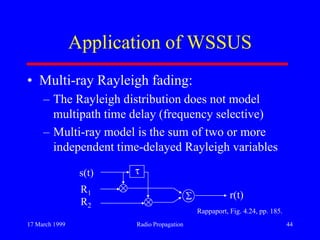
Application of WSSUS
• Multi-ray Rayleigh fading:
– The Rayleigh distribution does not model
multipath time delay (frequency selective)
– Multi-ray model is the sum of two or more
independent time-delayed Rayleigh variables
s(t)
R1
R2
r(t)
Rappaport, Fig. 4.24, pp. 185.
17 March 1999 Radio Propagation 45
Saleh & Valenzuela (1987)
• Measured same-floor indoor characteristics
– Found that, with a fixed receiver, indoor
channel is very slowly time-varying
– RMS delay spread: mean 25ns, max 50ns
– With no LOS, path loss varied over 60dB range
and obeyed log distance power law, 3 > n > 4
• Model assumes a structure and models
correlated multipath components.
Rappaport, pp. 188
17 March 1999 Radio Propagation 46
Saleh & Valenzuela 2
• Multipath model
– Multipath components arrive in clusters, follow Poisson
distribution. Clusters relate to building structures.
– Within cluster, individual components also follow
Poisson distribution. Cluster components relate to
reflecting objects near the TX or RX.
– Amplitudes of components are independent Rayleigh
variables, decay exponentially with cluster delay and
with intra-cluster delay
17 March 1999 Radio Propagation 47
References
• Wireless Communications: Principles and Practice, Chapters 3 and 4,
T. Rappaport, Prentice Hall, 1996.
• Principles of Mobile Communication, Chapter 2, G. Stüber, Kluwer
Academic Publishers, 1996.
• Slides for EE535, K. Chugg, 1999.
• Spread Spectrum Systems, Chapter 7, R. Dixon, Wiley, 1985 (there is a
newer edition).
• Wideband CDMA for Third Generation Mobile Communications,
Chapter 4, T. Ojanpera, R. Prasad, Artech, House 1998.
• Propagation Measurements and Models for Wireless Communications
Channels, Andersen, Rappaport, Yoshida, IEEE Communications,
January 1995.
17 March 1999 Radio Propagation 48
The End
17 March 1999 Radio Propagation 49
Scattering 2
• hc is the critical height of a protrusion to
result in scattering.
• RCS: ratio of power density scattered to receiver
to power density incident on the scattering object
– Wave radiated through free space to scatterer and reradiated:
)sin( θ8
λ
i
c
h
)log(20)log(20)π4log(30
]dB[)λlog(20)dBi()dBm()dBm(
2
RT
TTR
dd
mRCSGPP
17 March 1999 Radio Propagation 50
Free Space 2a
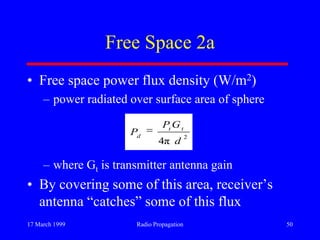
• Free space power flux density (W/m2)
– power radiated over surface area of sphere
– where Gt is transmitter antenna gain
• By covering some of this area, receiver‟s
antenna “catches” some of this flux
2
π4 d
GP
P tt
d
17 March 1999 Radio Propagation 51
Free Space 2b
• Fraunhofer distance: d > 2D2/
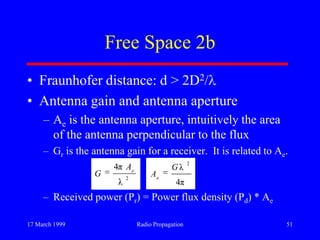
• Antenna gain and antenna aperture
– Ae is the antenna aperture, intuitively the area
of the antenna perpendicular to the flux
– Gr is the antenna gain for a receiver. It is related to Ae.
– Received power (Pr) = Power flux density (Pd) * Ae
2
λ
π4 e
A
G
π4
λ
2
G
Ae
17 March 1999 Radio Propagation 52
Free Space 2c
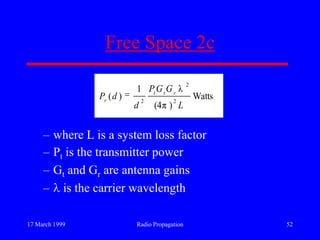
– where L is a system loss factor
– Pt is the transmitter power
– Gt and Gr are antenna gains
– is the carrier wavelength
Watts
)π(4
λ1
)( 2
2
2
L
GGP
d
dP rtt
r
17 March 1999 Radio Propagation 53
LNSM 2
• PL(d)[dB] = PL(d0) +10nlog(d/d0)+ X
– where X is a zero-mean Gaussian RV (dB)
• and n computed from measured data,
based on linear regression
17 March 1999 Radio Propagation 54
Ground Reflection 1.5
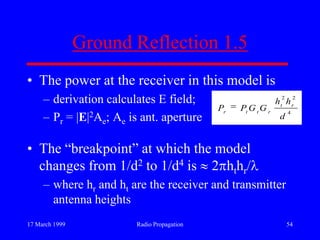
• The power at the receiver in this model is
– derivation calculates E field;
– Pr = |E|2Ae; Ae is ant. aperture
• The “breakpoint” at which the model
changes from 1/d2 to 1/d4 is 2 hthr/
– where hr and ht are the receiver and transmitter
antenna heights
4
22
d
hh
GGPP rt
rttr
17 March 1999 Radio Propagation 55
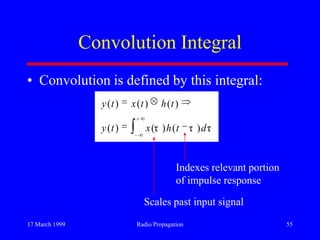
Convolution Integral
• Convolution is defined by this integral:
τ)τ()τ()(
)()()(
dthxty
thtxty
Indexes relevant portion
of impulse response
Scales past input signal
17 March 1999 Radio Propagation 56
Partition Losses
• Partition losses: same floor
– Walls, furniture, equipment
– Highly dependent on type of material, frequency
• Hard partitions vs soft partitions
– hard partitions are structural
– soft partitions do not reach ceiling
• “open plan” buildings
17 March 1999 Radio Propagation 57
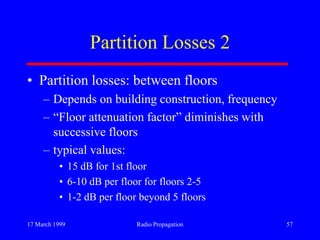
Partition Losses 2
• Partition losses: between floors
– Depends on building construction, frequency
– “Floor attenuation factor” diminishes with
successive floors
– typical values:
• 15 dB for 1st floor
• 6-10 dB per floor for floors 2-5
• 1-2 dB per floor beyond 5 floors
17 March 1999 Radio Propagation 58
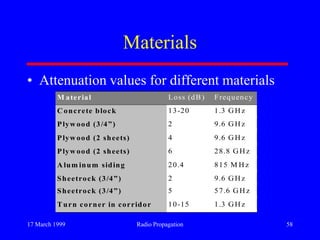
Materials
• Attenuation values for different materials
M aterial Loss (dB) Frequency
Concrete block 13-20 1.3 GHz
Plywood (3/4”) 2 9.6 GHz
Plywood (2 sheets) 4 9.6 GHz
Plywood (2 sheets) 6 28.8 GHz
Alum inum siding 20.4 815 M Hz
Sheetrock (3/4”) 2 9.6 GHz
Sheetrock (3/4”) 5 57.6 GHz
Turn corner in corridor 10-15 1.3 GHz
17 March 1999 Radio Propagation 59
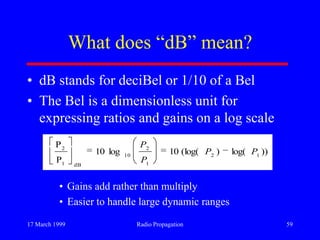
What does “dB” mean?
• dB stands for deciBel or 1/10 of a Bel
• The Bel is a dimensionless unit for
expressing ratios and gains on a log scale
• Gains add rather than multiply
• Easier to handle large dynamic ranges
))log()(log(10log10
P
P
12
1
2
10
dB1
2
PP
P
P
17 March 1999 Radio Propagation 60
dB 2
• Ex: Attenuation from transmitter to receiver.
– PT=100, PR=10
– attenuation is ratio of PT to PR
– [PT/PR]dB = 10 log(PT/PR) = 10 log(10) = 10 dB
• Useful numbers:
– [1/2]dB -3 dB
– [1/1000]dB = -30 dB
17 March 1999 Radio Propagation 61
dB 3
• dB can express ratios, but what about
absolute quantities?
• Similar units reference an absolute quantity
against a defined reference.
– [n mW]dBm = [n/mW]dB
– [n W]dBW = [n/W]dB
• Ex: [1 mW]dBW = -30 dBW
17 March 1999 Radio Propagation 62
Channel Sounding 2
• Several “Channel Sounding” techniques can
measure the channel response directly:
– Direct RF pulse (we hinted at this approach)
– Sliding correlator
– Frequency domain sounding
17 March 1999 Radio Propagation 63
Channel Sounding 3
• Direct RF Pulse
– Xmit pulse, scope displays response at receiver
– Can be done with off-the-shelf hardware
– Problems: hard to reject noise in the channel
– If no LOS
• must trigger scope on weaker multipath component
• may fail to trigger
• lose delay and phase information
17 March 1999 Radio Propagation 64
Channel Sounding 4
• Sliding correlator
– Xmit PseudoNoise sequence
– Rcvr correlates signal with its PN generator
– Rcvr clock slightly slower; PN sequences slide
– Delayed components cause delayed correlations
– Good resolution, good noise rejection
17 March 1999 Radio Propagation 65
Channel Sounding 5
• Frequency domain sounding
– Sweep frequency range
– Compute inverse Fourier transform of response
– Problems
• not instantaneous measurement
• Tradeoff between resolution (number of frequency
steps) and real-time measurement (i.e. duration as
short as possible)
17 March 1999 Radio Propagation 66
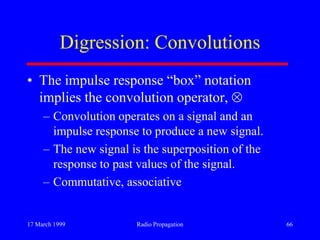
Digression: Convolutions
• The impulse response “box” notation
implies the convolution operator,
– Convolution operates on a signal and an
impulse response to produce a new signal.
– The new signal is the superposition of the
response to past values of the signal.
– Commutative, associative
17 March 1999 Radio Propagation 67
y(t)
y(t)
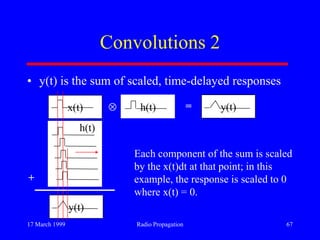
Convolutions 2
• y(t) is the sum of scaled, time-delayed responses
x(t) h(t) =
+
h(t)
Each component of the sum is scaled
by the x(t)dt at that point; in this
example, the response is scaled to 0
where x(t) = 0.
17 March 1999 Radio Propagation 68
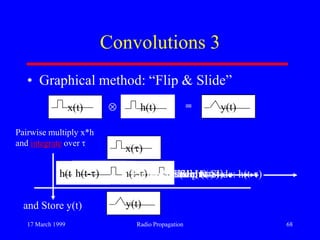
Flip & Slide: h(t- )h(t- ) Flip & Slide: h(t- )h(t- ) Flip & Slide: h(t- )h(t- )
Convolutions 3
• Graphical method: “Flip & Slide”
x(t)
x( )
h(t) =
Pairwise multiply x*h
and integrate over
and Store y(t)
y(t)
y(t)
Flip & Slide: h(t- )h(t- ) Flip & Slide: h(t- )h(t- )
17 March 1999 Radio Propagation 69
Frequency and Time Domains
• The channel impulse response is f(time)
– It describes the channel in the “time domain”
• Functions of frequency are often very useful;
– Space of such functions is “frequency domain”
• Often a particular characteristic is easier to
handle in one domain or the other.
17 March 1999 Radio Propagation 70
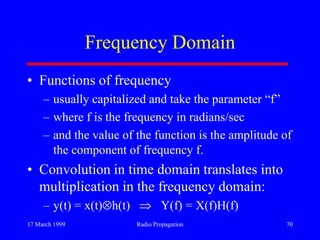
Frequency Domain
• Functions of frequency
– usually capitalized and take the parameter “f”
– where f is the frequency in radians/sec
– and the value of the function is the amplitude of
the component of frequency f.
• Convolution in time domain translates into
multiplication in the frequency domain:
– y(t) = x(t) h(t) Y(f) = X(f)H(f)
17 March 1999 Radio Propagation 71
Frequency Domain 2
• Based on Fourier theorem:
– any periodic signal can be decomposed into a
sum of (possibly infinite number of) cosines
• The Fourier Transform and inverse FT
– Convert between time and frequency domains.
– The frequency and time representations of the
same signal are “duals”
17 March 1999 Radio Propagation 72
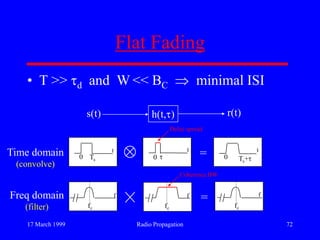
Flat Fading
• T >> d and W << BC minimal ISI
0 Ts 0 0 Ts+
fc fcfc
t t t
f f f
s(t) r(t)h(t, )
Time domain
(convolve)
Freq domain
(filter)
=
=
Delay spread
Coherence BW
17 March 1999 Radio Propagation 73
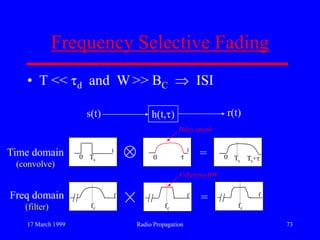
Frequency Selective Fading
• T << d and W >> BC ISI
0 Ts 0 0 Ts+
fc fcfc
t t
f f f
s(t) r(t)h(t, )
Time domain
(convolve)
Freq domain
(filter)
=
=
Delay spread
Coherence BW
Ts
17 March 1999 Radio Propagation 74
Review
• Object of radio propagation models:
– predict signal quality at receiver
• Radio propagation mechanisms
– Free space (1/d2)
– Diffraction
– Refraction
– Scattering
17 March 1999 Radio Propagation 75
Review 2
• Factors influencing received signal
– Path loss: distance, obstructions
– Multipath interference: phase cancellation due
to excess path length and other sources of phase
distortion
– Doppler shift
– Other radio interference
17 March 1999 Radio Propagation 76
Review 3
• Approaches to Modelling
– Models valid for far-field, apply to a range of
distances
– large scale models: concerned with gross
behavior as a function of distance
– small scale (fading) models: concerned with
behavior during perturbations around a
particular distance
17 March 1999 Radio Propagation 77
Relevance to Micronets
• Micronets may require different models
than most of the work featured here
– Smaller transmit range
– Likely to be near reflectors: on desk or floor.
• On the other hand, at smaller scales things are less
smooth: “ground reflection” may turn into scattering
– Outdoors, throwing sensors on ground may not
work. Deployable tripods?
17 March 1999 Radio Propagation 78
Relevance 2
• Consequences of “Fading”
– You can be in a place that has no signal, but
where a signal can be picked up a short distance
away in any direction
• Ability to move? Switch frequencies/antennas? Call
for help moving or for more nodes to be added?
• If stuck, may not be worth transmitting at all
– Reachability topology may be completely
irrelevant to location relationships
17 March 1999 Radio Propagation 79
Relevance 3
• Relevant modelling tools:
– Statistical models (Rice/Rayleigh/Log Normal)
• Statistical fading assumes particular dynamics, this
depends on mobility of receivers and environment
– CAD modelling of physical environment and
ray tracing approaches.
• For nodes in fixed positions this is only done once.
17 March 1999 Radio Propagation 80
Relevance 4
• An approach to modelling?
– Characterize wireless system interactions with
different materials, compare to published data
– Assess the effect of mobility in environment on fixed
topologies, relate to statistical models
– Try to determine what environmental structures and
parameters are most important:
• Scattering vs. ground reflection?
• can a simple CAD model help?

Radio propagation

  • 1.
    Radio Propagation CSCI 694 24September 1999 Lewis Girod
  • 2.
    17 March 1999Radio Propagation 2 Outline • Introduction and terminology • Propagation mechanisms • Propagation models
  • 3.
    17 March 1999Radio Propagation 3 What is Radio? • Radio Xmitter induces E&M fields – Electrostatic field components 1/d3 – Induction field components 1/d2 – Radiation field components 1/d • Radiation field has E and B component – Field strength at distance d = E B 1/d2 – Surface area of sphere centered at transmitter
  • 4.
    17 March 1999Radio Propagation 4 General Intuition • Two main factors affecting signal at receiver – Distance (or delay) Path attenuation – Multipath Phase differences Green signal travels 1/2 farther than Yellow to reach receiver, who sees Red. For 2.4 GHz, (wavelength) =12.5cm.
  • 5.
    17 March 1999Radio Propagation 5 Objective • Invent models to predict what the field looks like at the receiver. – Attenuation, absorption, reflection, diffraction... – Motion of receiver and environment… – Natural and man-made radio interference... – What does the field look like at the receiver?
  • 6.
    17 March 1999Radio Propagation 6 Models are Specialized • Different scales – Large scale (averaged over meters) – Small scale (order of wavelength) • Different environmental characteristics – Outdoor, indoor, land, sea, space, etc. • Different application areas – macrocell (2km), microcell(500m), picocell
  • 7.
    17 March 1999Radio Propagation 7 Outline • Introduction and some terminology • Propagation Mechanisms • Propagation models
  • 8.
    17 March 1999Radio Propagation 8 Radio Propagation Mechanisms • Free Space propagation • Refraction – Conductors & Dielectric materials (refraction) • Diffraction – Fresnel zones • Scattering – “Clutter” is small relative to wavelength
  • 9.
    17 March 1999Radio Propagation 9 Free Space • Assumes far-field (Fraunhofer region) – d >> D and d >> , where • D is the largest linear dimension of antenna • is the carrier wavelength • No interference, no obstructions
  • 10.
    17 March 1999Radio Propagation 10 Free Space Propagation Model • Received power at distance d is – where Pt is the transmitter power in Watts – a constant factor K depends on antenna gain, a system loss factor, and the carrier wavelength Watts)( 2 d P KdP t r
  • 11.
    17 March 1999Radio Propagation 11 Refraction • Perfect conductors reflect with no attenuation • Dielectrics reflect a fraction of incident energy – “Grazing angles” reflect max* – Steep angles transmit max* r t • Reflection induces 180 phase shift *The exact fraction depends on the materials and frequencies involved
  • 12.
    17 March 1999Radio Propagation 12 Diffraction • Diffraction occurs when waves hit the edge of an obstacle – “Secondary” waves propagated into the shadowed region – Excess path length results in a phase shift – Fresnel zones relate phase shifts to the positions of obstacles T R 1st Fresnel zone Obstruction
  • 13.
    17 March 1999Radio Propagation 13 Fresnel Zones • Bounded by elliptical loci of constant delay • Alternate zones differ in phase by 180 – Line of sight (LOS) corresponds to 1st zone – If LOS is partially blocked, 2nd zone can destructively interfere (diffraction loss) Fresnel zones are ellipses with the T&R at the foci; L1 = L2+ Path 1 Path 2
  • 14.
    17 March 1999Radio Propagation 14 Power Propagated into Shadow • How much power is propagated this way? – 1st FZ: 5 to 25 dB below free space prop. Obstruction of Fresnel Zones 1st 2nd 0 -10 -20 -30 -40 -50 -60 0o 90 180o dB Tip of Shadow Obstruction LOS Rappaport, pp. 97
  • 15.
    17 March 1999Radio Propagation 15 Scattering • Rough surfaces – critical height for bumps is f( ,incident angle) – scattering loss factor modeled with Gaussian distribution. • Nearby metal objects (street signs, etc.) – Usually modelled statistically • Large distant objects – Analytical model: Radar Cross Section (RCS)
  • 16.
    17 March 1999Radio Propagation 16 Outline • Introduction and some terminology • Propagation Mechanisms • Propagation models – Large scale propagation models – Small scale propagation (fading) models
  • 17.
    17 March 1999Radio Propagation 17 Propagation Models: Large • Large scale models predict behavior averaged over distances >> – Function of distance & significant environmental features, roughly frequency independent – Breaks down as distance decreases – Useful for modeling the range of a radio system and rough capacity planning
  • 18.
    17 March 1999Radio Propagation 18 Propagation Models: Small • Small scale (fading) models describe signal variability on a scale of – Multipath effects (phase cancellation) dominate, path attenuation considered constant – Frequency and bandwidth dependent – Focus is on modeling “Fading”: rapid change in signal over a short distance or length of time.
  • 19.
    17 March 1999Radio Propagation 19 Large Scale Models • Path loss models • Outdoor models • Indoor models
  • 20.
    17 March 1999Radio Propagation 20 Free Space Path Loss • Path Loss is a measure of attenuation based only on the distance to the transmitter • Free space model only valid in far-field; – Path loss models typically define a “close-in” point d0 and reference other points from there: 2 0 0 )()( d d dPdP rr dB dBr d d dPLdPdPL 0 0 2)()]([)( What is dB?
  • 21.
    17 March 1999Radio Propagation 21 Log-Distance Path Loss Model • Log-distance generalizes path loss to account for other environmental factors • Choose a d0 in the far field. • Measure PL(d0) or calculate Free Space Path Loss. • Take measurements and derive empirically. dB d d dPLdPL 0 0 )()(
  • 22.
    17 March 1999Radio Propagation 22 Log-Distance 2 • Value of characterizes different environments Environm ent Exponent Free Space 2 Urban area 2.7-3.5 Shadowed urban area 3-5 Indoor LOS 1.6-1.8 Indoor no LOS 4-6 Rappaport, Table 3.2, pp. 104
  • 23.
    17 March 1999Radio Propagation 23 Log-Normal Shadowing Model • Shadowing occurs when objects block LOS between transmitter and receiver • A simple statistical model can account for unpredictable “shadowing” – Add a 0-mean Gaussian RV to Log-Distance PL – Markov model can be used for spatial correlation
  • 24.
    17 March 1999Radio Propagation 24 Outdoor Models • “2-Ray” Ground Reflection model • Diffraction model for hilly terrain
  • 25.
    17 March 1999Radio Propagation 25 2-Ray Ground Reflection • For d >> hrht, – low angle of incidence allows the earth to act as a reflector – the reflected signal is 180 out of phase – Pr 1/d4 ( =4) RT ht hr Phase shift!
  • 26.
    17 March 1999Radio Propagation 26 Ground Reflection 2 • Intuition: ground blocks 1st Fresnel zone – Reflection causes an instantaneous 180 phase shift – Additional phase offset due to excess path length – If the resulting phase is still close to 180 , the gound ray will destructively interfere with the LOS ray. RT ht hr p1 p0 180
  • 27.
    17 March 1999Radio Propagation 27 Hilly Terrain • Propagation can be LOS or result of diffraction over one or more ridges • LOS propagation modelled with ground reflection: diffraction loss • But if there is no LOS, diffraction can actually help!
  • 28.
    17 March 1999Radio Propagation 28 Indoor Path Loss Models • Indoor models are less generalized – Environment comparatively more dynamic • Significant features are physically smaller – Shorter distances are closer to near-field – More clutter, scattering, less LOS
  • 29.
    17 March 1999Radio Propagation 29 Indoor Modeling Techniques • Modeling techniques and approaches: – Log-Normal, <2 for LOS down corridor – Log-Normal shadowing model if no LOS – Partition and floor attenuation factors – Computationally intensive “ray-tracing” based on 3-D model of building and attenuation factors for materials
  • 30.
    17 March 1999Radio Propagation 30 Outline • Introduction and some terminology • Propagation Mechanisms • Propagation models – Large scale propagation models – Small scale propagation (fading) models
  • 31.
    17 March 1999Radio Propagation 31 Recall: Fading Models • Small scale (fading) models describe signal variability on a scale of – Multipath effects (phase cancellation) dominate, path attenuation considered constant – Frequency and bandwidth dependent – Focus is on modeling “Fading”: rapid change in signal over a short distance or length of time.
  • 32.
    17 March 1999Radio Propagation 32 Factors Influencing Fading • Motion of the receiver: Doppler shift • Transmission bandwidth of signal – Compare to BW of channel • Multipath propagation – Receiver sees multiple instances of signal when waves follow different paths – Very sensitive to configuration of environment
  • 33.
    17 March 1999Radio Propagation 33 Effects of Multipath Signals • Rapid change in signal strength due to phase cancellation • Frequency modulation due to Doppler shifts from movement of receiver/environment • Echoes caused by multipath propagation delay
  • 34.
    17 March 1999Radio Propagation 34 The Multipath Channel • One approach to small-scale models is to model the “Multipath Channel” – Linear time-varying function h(t, ) • Basic idea: define a filter that encapsulates the effects of multipath interference – Measure or calculate the channel impulse response (response to a short pulse at fc): h(t, ) t
  • 35.
    17 March 1999Radio Propagation 35 Channel Sounding • “Channel sounding” is a way to measure the channel response – transmit impulse, and measure the response to find h( ). – h( ) can then be used to model the channel response to an arbitrary signal: y(t) = x(t) h( ). – Problem: models the channel at single point in time; can‟t account for mobility or environmental changes h(t, ) SKIP
  • 36.
    17 March 1999Radio Propagation 36 Characterizing Fading* • From the impulse response we can characterize the channel: • Characterizing distortion – Delay spread ( d): how long does the channel ring from an impulse? – Coherence bandwidth (Bc): over what frequency range is the channel gain flat? – d 1/Bc *Adapted from EE535 Slides, Chugg „99 In time domain, roughly corresponds to the “fidelity” of the response; sharper pulse requires wider band
  • 37.
    17 March 1999Radio Propagation 37 Effect of Delay Spread* • Does the channel distort the signal? – if W << Bc: “Flat Fading” • Amplitude and phase distortion only – if W > Bc: “Frequency Selective Fading” • If T < d, inter-symbol interference (ISI) occurs • For narrowband systems (W 1/T), FSF ISI. • Not so for wideband systems (W >> 1/T) For a system with bw W and symbol time T...
  • 38.
    17 March 1999Radio Propagation 38 Qualitative Delay Spread RMS Delay spread ( ) Mean excess delay Noise threshold Delay Power(dB) Typical values for : Indoor: 10-100 ns Outdoor: 0.1-10 s
  • 39.
    17 March 1999Radio Propagation 39 Characterizing Fading 2* • Characterizing Time-variation: How does the impulse response change with time? – Coherence time (tc): for what value of are responses at t and t+ uncorrelated? (How quickly is the channel changing) – Doppler Spread (fd): How much will the spectrum of the input be spread in frequency? – fd 1/tc
  • 40.
    17 March 1999Radio Propagation 40 Effect of Coherence Time* • Is the channel constant over many uses? – if T << tc: “Slow fading” • Slow adaptation required – if T > tc: “Fast fading” • Frequent adaptation required • For typical systems, symbol rate is high compared to channel evolution For a system with bw W and symbol time T...
  • 41.
    17 March 1999Radio Propagation 41 Statistical Fading Models • Fading models model the probability of a fade occurring at a particular location – Used to generate an impulse response – In fixed receivers, channel is slowly time-varying; the fading model is reevaluated at a rate related to motion • Simplest models are based on the WSSUS principle
  • 42.
    17 March 1999Radio Propagation 42 WSSUS* • Wide Sense Stationary (WSS) – Statistics are independent of small perturbations in time and position – I.e. fixed statistical parameters for stationary nodes • Uncorrelated Scatter (US) – Separate paths are not correlated in phase or attenuation – I.e. multipath components can be independent RVs • Statistics modeled as Gaussian RVs
  • 43.
    17 March 1999Radio Propagation 43 Common Distributions • Rayleigh fading distribution – Models a flat fading signal – Used for individual multipath components • Ricean fading distribution – Used when there is a dominant signal component, e.g. LOS + weaker multipaths – parameter K (dB) defines strength of dominant component; for K=- , equivalent to Rayleigh
  • 44.
    17 March 1999Radio Propagation 44 Application of WSSUS • Multi-ray Rayleigh fading: – The Rayleigh distribution does not model multipath time delay (frequency selective) – Multi-ray model is the sum of two or more independent time-delayed Rayleigh variables s(t) R1 R2 r(t) Rappaport, Fig. 4.24, pp. 185.
  • 45.
    17 March 1999Radio Propagation 45 Saleh & Valenzuela (1987) • Measured same-floor indoor characteristics – Found that, with a fixed receiver, indoor channel is very slowly time-varying – RMS delay spread: mean 25ns, max 50ns – With no LOS, path loss varied over 60dB range and obeyed log distance power law, 3 > n > 4 • Model assumes a structure and models correlated multipath components. Rappaport, pp. 188
  • 46.
    17 March 1999Radio Propagation 46 Saleh & Valenzuela 2 • Multipath model – Multipath components arrive in clusters, follow Poisson distribution. Clusters relate to building structures. – Within cluster, individual components also follow Poisson distribution. Cluster components relate to reflecting objects near the TX or RX. – Amplitudes of components are independent Rayleigh variables, decay exponentially with cluster delay and with intra-cluster delay
  • 47.
    17 March 1999Radio Propagation 47 References • Wireless Communications: Principles and Practice, Chapters 3 and 4, T. Rappaport, Prentice Hall, 1996. • Principles of Mobile Communication, Chapter 2, G. Stüber, Kluwer Academic Publishers, 1996. • Slides for EE535, K. Chugg, 1999. • Spread Spectrum Systems, Chapter 7, R. Dixon, Wiley, 1985 (there is a newer edition). • Wideband CDMA for Third Generation Mobile Communications, Chapter 4, T. Ojanpera, R. Prasad, Artech, House 1998. • Propagation Measurements and Models for Wireless Communications Channels, Andersen, Rappaport, Yoshida, IEEE Communications, January 1995.
  • 48.
    17 March 1999Radio Propagation 48 The End
  • 49.
    17 March 1999Radio Propagation 49 Scattering 2 • hc is the critical height of a protrusion to result in scattering. • RCS: ratio of power density scattered to receiver to power density incident on the scattering object – Wave radiated through free space to scatterer and reradiated: )sin( θ8 λ i c h )log(20)log(20)π4log(30 ]dB[)λlog(20)dBi()dBm()dBm( 2 RT TTR dd mRCSGPP
  • 50.
    17 March 1999Radio Propagation 50 Free Space 2a • Free space power flux density (W/m2) – power radiated over surface area of sphere – where Gt is transmitter antenna gain • By covering some of this area, receiver‟s antenna “catches” some of this flux 2 π4 d GP P tt d
  • 51.
    17 March 1999Radio Propagation 51 Free Space 2b • Fraunhofer distance: d > 2D2/ • Antenna gain and antenna aperture – Ae is the antenna aperture, intuitively the area of the antenna perpendicular to the flux – Gr is the antenna gain for a receiver. It is related to Ae. – Received power (Pr) = Power flux density (Pd) * Ae 2 λ π4 e A G π4 λ 2 G Ae
  • 52.
    17 March 1999Radio Propagation 52 Free Space 2c – where L is a system loss factor – Pt is the transmitter power – Gt and Gr are antenna gains – is the carrier wavelength Watts )π(4 λ1 )( 2 2 2 L GGP d dP rtt r
  • 53.
    17 March 1999Radio Propagation 53 LNSM 2 • PL(d)[dB] = PL(d0) +10nlog(d/d0)+ X – where X is a zero-mean Gaussian RV (dB) • and n computed from measured data, based on linear regression
  • 54.
    17 March 1999Radio Propagation 54 Ground Reflection 1.5 • The power at the receiver in this model is – derivation calculates E field; – Pr = |E|2Ae; Ae is ant. aperture • The “breakpoint” at which the model changes from 1/d2 to 1/d4 is 2 hthr/ – where hr and ht are the receiver and transmitter antenna heights 4 22 d hh GGPP rt rttr
  • 55.
    17 March 1999Radio Propagation 55 Convolution Integral • Convolution is defined by this integral: τ)τ()τ()( )()()( dthxty thtxty Indexes relevant portion of impulse response Scales past input signal
  • 56.
    17 March 1999Radio Propagation 56 Partition Losses • Partition losses: same floor – Walls, furniture, equipment – Highly dependent on type of material, frequency • Hard partitions vs soft partitions – hard partitions are structural – soft partitions do not reach ceiling • “open plan” buildings
  • 57.
    17 March 1999Radio Propagation 57 Partition Losses 2 • Partition losses: between floors – Depends on building construction, frequency – “Floor attenuation factor” diminishes with successive floors – typical values: • 15 dB for 1st floor • 6-10 dB per floor for floors 2-5 • 1-2 dB per floor beyond 5 floors
  • 58.
    17 March 1999Radio Propagation 58 Materials • Attenuation values for different materials M aterial Loss (dB) Frequency Concrete block 13-20 1.3 GHz Plywood (3/4”) 2 9.6 GHz Plywood (2 sheets) 4 9.6 GHz Plywood (2 sheets) 6 28.8 GHz Alum inum siding 20.4 815 M Hz Sheetrock (3/4”) 2 9.6 GHz Sheetrock (3/4”) 5 57.6 GHz Turn corner in corridor 10-15 1.3 GHz
  • 59.
    17 March 1999Radio Propagation 59 What does “dB” mean? • dB stands for deciBel or 1/10 of a Bel • The Bel is a dimensionless unit for expressing ratios and gains on a log scale • Gains add rather than multiply • Easier to handle large dynamic ranges ))log()(log(10log10 P P 12 1 2 10 dB1 2 PP P P
  • 60.
    17 March 1999Radio Propagation 60 dB 2 • Ex: Attenuation from transmitter to receiver. – PT=100, PR=10 – attenuation is ratio of PT to PR – [PT/PR]dB = 10 log(PT/PR) = 10 log(10) = 10 dB • Useful numbers: – [1/2]dB -3 dB – [1/1000]dB = -30 dB
  • 61.
    17 March 1999Radio Propagation 61 dB 3 • dB can express ratios, but what about absolute quantities? • Similar units reference an absolute quantity against a defined reference. – [n mW]dBm = [n/mW]dB – [n W]dBW = [n/W]dB • Ex: [1 mW]dBW = -30 dBW
  • 62.
    17 March 1999Radio Propagation 62 Channel Sounding 2 • Several “Channel Sounding” techniques can measure the channel response directly: – Direct RF pulse (we hinted at this approach) – Sliding correlator – Frequency domain sounding
  • 63.
    17 March 1999Radio Propagation 63 Channel Sounding 3 • Direct RF Pulse – Xmit pulse, scope displays response at receiver – Can be done with off-the-shelf hardware – Problems: hard to reject noise in the channel – If no LOS • must trigger scope on weaker multipath component • may fail to trigger • lose delay and phase information
  • 64.
    17 March 1999Radio Propagation 64 Channel Sounding 4 • Sliding correlator – Xmit PseudoNoise sequence – Rcvr correlates signal with its PN generator – Rcvr clock slightly slower; PN sequences slide – Delayed components cause delayed correlations – Good resolution, good noise rejection
  • 65.
    17 March 1999Radio Propagation 65 Channel Sounding 5 • Frequency domain sounding – Sweep frequency range – Compute inverse Fourier transform of response – Problems • not instantaneous measurement • Tradeoff between resolution (number of frequency steps) and real-time measurement (i.e. duration as short as possible)
  • 66.
    17 March 1999Radio Propagation 66 Digression: Convolutions • The impulse response “box” notation implies the convolution operator, – Convolution operates on a signal and an impulse response to produce a new signal. – The new signal is the superposition of the response to past values of the signal. – Commutative, associative
  • 67.
    17 March 1999Radio Propagation 67 y(t) y(t) Convolutions 2 • y(t) is the sum of scaled, time-delayed responses x(t) h(t) = + h(t) Each component of the sum is scaled by the x(t)dt at that point; in this example, the response is scaled to 0 where x(t) = 0.
  • 68.
    17 March 1999Radio Propagation 68 Flip & Slide: h(t- )h(t- ) Flip & Slide: h(t- )h(t- ) Flip & Slide: h(t- )h(t- ) Convolutions 3 • Graphical method: “Flip & Slide” x(t) x( ) h(t) = Pairwise multiply x*h and integrate over and Store y(t) y(t) y(t) Flip & Slide: h(t- )h(t- ) Flip & Slide: h(t- )h(t- )
  • 69.
    17 March 1999Radio Propagation 69 Frequency and Time Domains • The channel impulse response is f(time) – It describes the channel in the “time domain” • Functions of frequency are often very useful; – Space of such functions is “frequency domain” • Often a particular characteristic is easier to handle in one domain or the other.
  • 70.
    17 March 1999Radio Propagation 70 Frequency Domain • Functions of frequency – usually capitalized and take the parameter “f” – where f is the frequency in radians/sec – and the value of the function is the amplitude of the component of frequency f. • Convolution in time domain translates into multiplication in the frequency domain: – y(t) = x(t) h(t) Y(f) = X(f)H(f)
  • 71.
    17 March 1999Radio Propagation 71 Frequency Domain 2 • Based on Fourier theorem: – any periodic signal can be decomposed into a sum of (possibly infinite number of) cosines • The Fourier Transform and inverse FT – Convert between time and frequency domains. – The frequency and time representations of the same signal are “duals”
  • 72.
    17 March 1999Radio Propagation 72 Flat Fading • T >> d and W << BC minimal ISI 0 Ts 0 0 Ts+ fc fcfc t t t f f f s(t) r(t)h(t, ) Time domain (convolve) Freq domain (filter) = = Delay spread Coherence BW
  • 73.
    17 March 1999Radio Propagation 73 Frequency Selective Fading • T << d and W >> BC ISI 0 Ts 0 0 Ts+ fc fcfc t t f f f s(t) r(t)h(t, ) Time domain (convolve) Freq domain (filter) = = Delay spread Coherence BW Ts
  • 74.
    17 March 1999Radio Propagation 74 Review • Object of radio propagation models: – predict signal quality at receiver • Radio propagation mechanisms – Free space (1/d2) – Diffraction – Refraction – Scattering
  • 75.
    17 March 1999Radio Propagation 75 Review 2 • Factors influencing received signal – Path loss: distance, obstructions – Multipath interference: phase cancellation due to excess path length and other sources of phase distortion – Doppler shift – Other radio interference
  • 76.
    17 March 1999Radio Propagation 76 Review 3 • Approaches to Modelling – Models valid for far-field, apply to a range of distances – large scale models: concerned with gross behavior as a function of distance – small scale (fading) models: concerned with behavior during perturbations around a particular distance
  • 77.
    17 March 1999Radio Propagation 77 Relevance to Micronets • Micronets may require different models than most of the work featured here – Smaller transmit range – Likely to be near reflectors: on desk or floor. • On the other hand, at smaller scales things are less smooth: “ground reflection” may turn into scattering – Outdoors, throwing sensors on ground may not work. Deployable tripods?
  • 78.
    17 March 1999Radio Propagation 78 Relevance 2 • Consequences of “Fading” – You can be in a place that has no signal, but where a signal can be picked up a short distance away in any direction • Ability to move? Switch frequencies/antennas? Call for help moving or for more nodes to be added? • If stuck, may not be worth transmitting at all – Reachability topology may be completely irrelevant to location relationships
  • 79.
    17 March 1999Radio Propagation 79 Relevance 3 • Relevant modelling tools: – Statistical models (Rice/Rayleigh/Log Normal) • Statistical fading assumes particular dynamics, this depends on mobility of receivers and environment – CAD modelling of physical environment and ray tracing approaches. • For nodes in fixed positions this is only done once.
  • 80.
    17 March 1999Radio Propagation 80 Relevance 4 • An approach to modelling? – Characterize wireless system interactions with different materials, compare to published data – Assess the effect of mobility in environment on fixed topologies, relate to statistical models – Try to determine what environmental structures and parameters are most important: • Scattering vs. ground reflection? • can a simple CAD model help?