The UMTS Network and Radio Access Technology: Air Interface Techniques for Future Mobile Systems
                                                                               Jonathan P. Castro
                                                        Copyright © 2001 John Wiley & Sons Ltd
                                          Print ISBN 0-471-81375-3 Online ISBN 0-470-84172-9


                The UMTS Network and
                Radio Access Technology
The UMTS Network and
  Radio Access Technology
          Air Interface Techniques for
            Future Mobile Systems

           Dr. Jonathan P. Castro
         Orange Communications SA/AG, Switzerland


                   John Wiley & Sons, Ltd
Chichester New York Weinheim Brisbane Singapore Toronto
Copyright ¸ 2001 by John Wiley & Sons, Ltd
                    Baffins Lane, Chichester,
                    West Sussex, PO19 1UD, England
                      National 01243 779777
                      International (+44) 1243 779777
                      e-mail (for orders and customer service enquiries): cs-books@wiley.co.uk
                      Visit our Home Page on http://www.wiley.co.uk
All Rights Reserved. No part of this publication may be reproduced, stored in a retrieval system,
or transmitted, in any form or by any means, electronic, mechanical, photocopying, recording,
scanning or otherwise, except under the terms of the Copyright Designs and Patents Act 1988 or
under the terms of a licence issued by the Copyright Licensing Agency, 90 Tottenham Court Road,
London, W1P 9HE, UK, without the permission in writing of the Publisher, with the exception of
any material supplied specifically for the purpose of being entered and executed on a computer
system, for exclusive use by the purchaser of the publication.
Neither the author(s) nor John Wiley & Sons Ltd accept any responsibility or liability for loss or
damage occasioned to any person or property through using the material, instructions, methods or
ideas contained herein, or acting or refraining from acting as a result of such use. The author(s)
and Publisher expressly disclaim all implied warranties, including merchantability of fitness for
any particular purpose. There will be no duty on the author(s) or Publisher to correct any errors or
defects in the software.

Designations used by companies to distinguish their products are often claimed as trademarks. In
all instances where John Wiley & Sons is aware of a claim, the product names appear in initial
capital or capital letters. Readers, however, should contact the appropriate companies for more
complete information regarding trademarks and registration.
Other Wiley Editorial Offices
John Wiley & Sons, Inc., 605 Third Avenue,
New York, NY 10158-0012, USA
WILEY-VCH Verlag GmbH, Pappelallee 3,
D-69469 Weinheim, Germany
John Wiley & Sons (Asia) Pte Ltd, 2 Clementi Loop #02-01,
Jin Xing Distripark, Singapore 129809
John Wiley & Sons (Canada) Ltd, 22 Worcester Road,
Rexdale, Ontario, M9W 1L1, Canada
John Wiley & Sons Australia, Ltd, 33 Park Road, Milton,
Queensland 4064, Australia
Library of Congress Cataloging-in-Publication Data
A catalogue record from the Library of Congress has been applied for
British Library Cataloguing in Publication Data

A catalogue record for this book is available from the British Library
ISBN 0 471 81375 3
Produced in 10/12pt Times from the author’s files by Deerpark Publishing Services, Ltd, Shannon.
Printed and bound in Great Britain by Biddles Ltd, Guildford and King’s Lynn.
This book is printed on acid-free paper responsibly manufactured from sustainable forestry, in
which at least two trees are planted for each one used for paper production.
The UMTS Network and Radio Access Technology: Air Interface Techniques for Future Mobile Systems
                                                                                  Jonathan P. Castro
                                                           Copyright © 2001 John Wiley & Sons Ltd
                                             Print ISBN 0-471-81375-3 Online ISBN 0-470-84172-9


To:
My family for they endurance, and to my friends and colleagues for their understanding;
because while putting together this book I stole too many precious moments from them.

And

To all the 3GPP contributors for their dedication to make the UMTS specifications a
reality, without whom some of the contents of this book would not have been possible.
The UMTS Network and Radio Access Technology: Air Interface Techniques for Future Mobile Systems
                                                                                  Jonathan P. Castro
                                                           Copyright © 2001 John Wiley & Sons Ltd
                                             Print ISBN 0-471-81375-3 Online ISBN 0-470-84172-9


Acknowledgements
It is impossible to acknowledge every one who had contributed in some way to the con-
ception and realization of this book. Nonetheless, to the best of my ability I shall at-
tempt to do so. I would thus thank Mark Hammond from John Wiley, who encouraged
me to go ahead and undertake the idea of writing this book; and who also patiently mo-
tivated me to go forward when time was not on my side to complete the manuscript. I
would also like to thank Mark’s team, Sarah Hinton and Kirsten Evans for making all
the practical arrangements to produce the book. Special thanks also to Lorna O’Brien
who took the files to the finish.

My gratitude goes also to Orange Communications SA for providing a practical and
stimulating environment to deploy 2G and prepare for 3G mobile networks. In particu-
lar I would like to thank the Orange UMTS Engineering team, who devoted extra time
from their demanding tasks to join me in the 3G project to conceive a complete UMTS
network. I am especially would like to be grateful to those in NSS and BSS Engineering
for supporting my technical activities while I was writing this book and to those in Ra-
dio Planning for being there, to consolidate ideas and test assumptions. I would like also
to thank my colleagues in Procurement who tirelessly joined the team to look at the
investment side of the UMTS network elements and motivate and cheer the writing of
this book. In addition, I am also grateful to Ericsson’s, Nokia’s, Alcatel’s and other 3G
suppliers’ teams in Switzerland who joined the Orange UMTS team to consider the di-
mensioning, deployment (new and co-located sites) and configuration of forthcoming
UMTS networks.

Last, but not least, I would also like to thank all those in the standardization bodies, e.g.
(formerly SMG in ETSI), 3GPP, who despite all controversies or delays kept the speci-
fication work of UMTS on target to reach the milestones like R99 and go forward with
future releases.
The UMTS Network and Radio Access Technology: Air Interface Techniques for Future Mobile Systems
                                                                                    Jonathan P. Castro
                                                             Copyright © 2001 John Wiley & Sons Ltd
                                               Print ISBN 0-471-81375-3 Online ISBN 0-470-84172-9


CONTENTS
Preface  ............................................................................................................................... xix
Acronyms ............................................................................................................................... xxiii


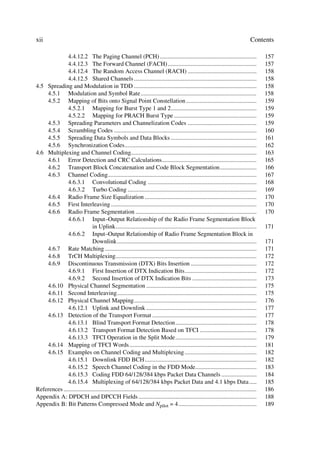
1 (92/9,1* 02%,/( 1(7:25.6                                                                               
1.1 The Growth of Mobile Communications.........................................................................                              1
    1.1.1 Convergence of Fixed and Mobile Networks.....................................................                                       3
1.2 Third Generation Mobile System Requirements .............................................................                                 4
    1.2.1 UMTS Services Aspects ....................................................................................                          5
    1.2.2 UMTS Terrestrial Radio Access Aspects...........................................................                                    6
1.3 Enhancing Technologies .................................................................................................                  8
    1.3.1 Capacity Increasing Antennas............................................................................                            8
    1.3.2 Multi-user Detection Techniques .......................................................................                             9
    1.3.3 Software Radio Applications .............................................................................                           9
    1.3.4 Implementation and Integration Aspects............................................................                                 10
1.4 Conclusions.....................................................................................................................         11
References ...............................................................................................................................   11


2 667(0 $1$/6,6 )81'$0(17$/6                                                                                 
2.1 Fundamentals of System Analysis...................................................................................                       13
    2.1.1 Multiple Access Options ....................................................................................                       13
           2.1.1.1 Narrow-band Digital Channel Systems ..............................................                                        13
           2.1.1.2 Wide-band Digital Channel Systems..................................................                                       14
           2.1.1.3 The UTRA FDD Mode: WCDMA.....................................................                                             14
           2.1.1.4 The UTRA TDD Mode: TD/CDMA ..................................................                                             15
    2.1.2 Signal Processing Aspects..................................................................................                        16
           2.1.2.1 The Spread Spectrum Concept ...........................................................                                   16
           2.1.2.2 Modulation and Spreading Principles.................................................                                      17
           2.1.2.3 CDMA System Performance..............................................................                                     21
           2.1.2.4 Pseudorandom Sequences ..................................................................                                 23
           2.1.2.5 Power Control Characteristics............................................................                                 24
           2.1.2.6 Soft Handovers Characteristics ..........................................................                                 24
2.2 The 3G Communications Environment...........................................................................                             25
    2.2.1 Mapping High Level Requirements onto Test Environments ............................                                                25
           2.2.1.1 Reference Services .............................................................................                          25
    2.2.2 Channel Types ...................................................................................................                  26
    2.2.3 Indoor Office......................................................................................................                26
    2.2.4 Outdoor to Indoor and Pedestrian ......................................................................                            28
viii                                                                                                                                 Contents

       2.2.5  Vehicular ...........................................................................................................         31
       2.2.6  Mixed ................................................................................................................        33
              2.2.6.1 Long-term Fading Decorrelation Length ...........................................                                     34
    2.2.7 Channel Impulse Response ...............................................................................                          34
     7UDIILF 7SHV DQG 3URSDJDWLRQ 0RGHOV .............................................................                                37
              2.2.8.1 Packet or Non-real Time Services .....................................................                                37
2.3 Concluding Remarks ......................................................................................................               39
References ..............................................................................................................................   39


3      7+( 8076 '(9(/230(17 3/$7)250  
3.1 Architecture and Deployment Scenarios ........................................................................                          41
    3.1.1 The UMTS High Level System Architecture ....................................................                                      41
            3.1.1.1 The UMTS Domains .........................................................................                              41
            3.1.1.2 The IMT 2000 Family .......................................................................                             42
    3.1.2 Coexistence of Present and Future Networks ....................................................                                   43
3.2 The Core Network Domain ............................................................................................                    44
    3.2.1 Network Evolution Towards UMTS .................................................................                                  44
            3.2.1.1 Main Packet Switched Network Elements.........................................                                          46
            3.2.1.2 Open Interfaces..................................................................................                       47
    3.2.2 Key Release 99 Architectural Requirements .....................................................                                   49
    3.2.3 The R99 Core Network Synthesis .....................................................................                              49
    3.2.4 Circuit Switched (CS) Network Elements (NE) ................................................                                      50
            3.2.4.1 The 3G Mobile Switching Centre (3GMSC) .....................................                                            50
            3.2.4.2 The 3G Home Location Register .......................................................                                   51
            3.2.4.3 New Services .....................................................................................                      51
    3.2.5 Packet Switched (PS) Network Elements (NE) .................................................                                      52
            3.2.5.1 3G Serving GPRS Support Node (3G SGSN) ...................................                                              52
            3.2.5.2 The Gateway GPRS Support Node (GGSN) .....................................                                              53
            3.2.5.3 Charging, Border and Lawful Interception Gateways .......................                                               54
            3.2.5.4 DNS, DHCP and the IP Backbone.....................................................                                      54
            3.2.5.5 Network Connectivity in the 3G Packet Core....................................                                          54
            3.2.5.6 Implementing Quality of Service (QoS) ............................................                                      55
            3.2.5.7 Implementing Ipv6 ............................................................................                          56
    3.2.6 Coexistence Interoperability Issues ...................................................................                           56
            3.2.6.1 Iu Interface Inter-Working Characteristics ........................................                                     57
3.3 The Access Network Domain.........................................................................................                      58
    3.3.1 UTRAN Architecture ........................................................................................                       58
3.4 UTRAN Identifiers and Functions..................................................................................                       59
    3.4.1 Identifiers ..........................................................................................................            59
    3.4.2 System Access Control......................................................................................                       60
            3.4.2.1 Admission and Congestion Control...................................................                                     60
            3.4.2.2 System Information Broadcasting .....................................................                                   61
    3.4.3 Radio Channel Ciphering and Deciphering .......................................................                                   61
    3.4.4 Mobility Functions ............................................................................................                   61
            3.4.4.1 Handover ...........................................................................................                    61
            3.4.4.2 SRNS Relocation...............................................................................                          61
    3.4.5 Radio Resource Management and Control Functions .......................................                                           62
Contents                                                                                                                                     ix

              3.4.5.1 Radio Resource Configuration ...........................................................                               62
              3.4.5.2 Radio Environment Survey ................................................................                              62
              3.4.5.3 Macro-diversity Control – FDD .........................................................                                62
              3.4.5.4 TDD – Dynamic Channel Allocation (DCA) .....................................                                           62
              3.4.5.5 Allocation/De-allocation and Control of Radio Bearers.....................                                             63
              3.4.5.6 Radio Protocols Function ...................................................................                           63
              3.4.5.7 RF Power Control ..............................................................................                        63
              3.4.5.8 Radio Channel Coding and Control....................................................                                   64
              3.4.5.9 Radio Channel Decoding....................................................................                             64
              3.4.5.10 Initial Random Access .......................................................................                         64
              3.4.5.11 NAS Core Network Distribution Functions .......................................                                       65
              3.4.5.12 Timing Advance in TDD....................................................................                             65
              3.4.5.13 NAS Service Specific Function..........................................................                               65
3.5 Mobility Management .....................................................................................................                65
    3.5.1 Signalling Connection........................................................................................                      65
    3.5.2 Impacts of Mobility Handling ............................................................................                          66
3.6 UTRAN Synchronization and OM Requirements ........................................................                                      66
    3.6.1 Synchronization Model ......................................................................................                       66
    3.6.2 Node B OM.....................................................................................................                    67
              3.6.2.1 Implementation Specific OM ..........................................................                                 67
              3.6.2.2 Logical OM .....................................................................................                      67
3.7 UTRAN Interfaces ..........................................................................................................              68
    3.7.1 General Protocol Model for UTRAN Interfaces ................................................                                       68
    3.7.2 Horizontal Layers...............................................................................................                   68
    3.7.3 Vertical Planes ...................................................................................................                68
              3.7.3.1 Control Plane......................................................................................                    68
              3.7.3.2 User Plane ..........................................................................................                  69
              3.7.3.3 Transport Network Control Plane ......................................................                                 69
              3.7.3.4 Transport Network User Plane ...........................................................                               69
3.8 Radio Interface Protocol Architecture.............................................................................                       70
    3.8.1 Protocol Structure ..............................................................................................                  70
              3.8.1.1 Service Access Points and Service Primitives....................................                                       71
    3.8.2 Services and Functions in Layer 1 .....................................................................                            72
              3.8.2.1 Services ..............................................................................................                72
              3.8.2.2 L1 Functions ......................................................................................                    73
    3.8.3 Services and Functions in Layer 2 .....................................................................                            73
              3.8.3.1 Services and Functions in The MAC Sub-layer .................................                                          73
              3.8.3.2 MAC Functions..................................................................................                        75
              3.8.3.3 RLC Services and Functions ..............................................................                              76
              3.8.3.4 RLC Functions ...................................................................................                      77
    3.8.4 PDCP Services and Function .............................................................................                           78
    3.8.5 Broadcast/Multicast Control – Services and Functions......................................                                         78
    3.8.6 Uu Stratum Services and Functions in Layer 3 ..................................................                                    79
    3.8.7 The Radio Resource Control (RRC) Functions..................................................                                       79
References ...............................................................................................................................   80
Appendix A: UMTS Functional Domains...............................................................................                           82
x                                                                                                                      Contents

4     7+( 875$ 3+6,$/ /$(5 '(6,*1  
4.1 Summary of Features......................................................................................................    85
4.2 Dedicated and Common Transport Channels .................................................................                    88
    4.2.1 Dedicated Transport Channels ..........................................................................                88
    4.2.2 Common Transport Channels............................................................................                  88
4.3 Configuration of FDD Physical Channels ......................................................................                89
    4.3.1 Uplink and Downlink Modulation.....................................................................                    89
    4.3.2 Dedicated Uplink Physical Channels ................................................................                    90
            4.3.2.1 Spreading DPCCH/DPDCH ..............................................................                         93
    4.3.3 Common Uplink Physical Channels..................................................................                      94
            4.3.3.1 Physical Random Access Channel - PRACH ....................................                                  94
            4.3.3.2 Physical Common Packet Channel (PCPCH)....................................                                   97
            4.3.3.3 Spreading Common Uplink Physical Channels .................................                                  98
    4.3.4 Uplink Channelization Codes............................................................................               100
            4.3.4.1 DPCCH/DPDCH Code Allocation ....................................................                            101
            4.3.4.2 PRACH Message Part Code Allocation ............................................                             101
            4.3.4.3 PCPCH Message Part Code Allocation .............................................                            101
    4.3.5 Uplink Scrambling Codes .................................................................................             101
            4.3.5.1 Long Scrambling Sequence ...............................................................                    101
            4.3.5.2 Short Scrambling Sequence...............................................................                    103
            4.3.5.3 Scrambling Codes in Uplink Dedicated Physical Channels...............                                       104
            4.3.5.4 PRACH and PCPCH Message Part Scrambling Code.......................                                         105
            4.3.5.5 Scrambling Code in the PCPCH Power Control Preamble................                                         106
            4.3.5.6 PRACH Preamble Codes...................................................................                     106
            4.3.5.7 PCPCH Preamble Codes ...................................................................                    107
    4.3.6 Uplink Power Control Procedure ......................................................................                 108
            4.3.6.1 PRACH and DPCCH/DPDCH Power Control ..................................                                      109
            4.3.6.2 Compressed Mode Power Control.....................................................                          111
            4.3.6.3 DPCCH Power Control Preamble......................................................                          112
            4.3.6.4 Power Control in the PCPCH Message Part and Preamble ...............                                        113
            4.3.6.5 Power Control in the Power Control Preamble Part ..........................                                 113
    4.3.7 Downlink Physical Channels.............................................................................               114
            4.3.7.1 Downlink Transmit Diversity ............................................................                    114
            4.3.7.2 Open Loop Transmit Diversity..........................................................                      114
            4.3.7.3 Closed Loop Transmit Diversity .......................................................                      115
    4.3.8 Dedicated Downlink Physical Channels............................................................                      115
            4.3.8.1 The Compressed Mode......................................................................                   116
            4.3.8.2 Multi-Code Transmission ..................................................................                  117
            4.3.8.3 STTD in the DPCH ...........................................................................                118
            4.3.8.4 Closed Loop Mode Transmit Diversity and Dedicated Channel Pilots                                            119
            4.3.8.5 The Downlink DPCCH for CPCH.....................................................                            119
    4.3.9 Common Downlink Physical Channels .............................................................                       120
            4.3.9.1 Common Pilot Channel (CPICH) ......................................................                         120
            4.3.9.2 Primary Common Control Physical Channel (P-CCPCH).................                                          121
            4.3.9.3 Secondary Common Control Physical Channel (S-CCPCH).............                                            122
            4.3.9.4 Synchronization Channel (SCH) .......................................................                       124
            4.3.9.5 Physical Downlink Shared Channel (PDSCH) ..................................                                 126
            4.3.9.6 Acquisition Indicator Channel (AICH)..............................................                          127
Contents                                                                                                                          xi

           4.3.9.7 CPCH Access Preamble Acquisition Indicator Channel (AP-AICH).                                                 127
           4.3.9.8 CPCH Collision Detection/Channel Assignment Indicator Channel..                                               128
           4.3.9.9 Paging Indicator Channel (PICH) ......................................................                        129
           4.3.9.10 CPCH Status Indicator Channel (CSICH)..........................................                              130
    4.3.10 Mapping Transport Channels onto Physical Channels .......................................                             130
    4.3.11 Timing Relationship Between Physical Channels..............................................                           131
           4.3.11.1 PICH/S-CCPCH Timing Relation......................................................                           132
           4.3.11.2 PRACH/AICH Timing Relation.........................................................                          133
           4.3.11.3 PCPCH/AICH Timing Relation .........................................................                         134
           4.3.11.4 DPCH/PDSCH Timing ......................................................................                     135
           4.3.11.5 DPCCH/DPDCH Timing Relations ...................................................                             135
           4.3.11.6 UE Uplink/Downlink Timing.............................................................                       135
    4.3.12 Downlink Spreading ..........................................................................................         136
           4.3.12.1 Downlink Channelization Codes ........................................................                       136
           4.3.12.2 Downlink Scrambling Codes..............................................................                      137
           4.3.12.3 Synchronization Codes.......................................................................                 139
    4.3.13 Downlink Power Control Procedure ..................................................................                   140
           4.3.13.1 DPCCH/DPDCH Downlink Power Control .......................................                                   140
           4.3.13.2 Power Control in the Downlink Compressed Mode ...........................                                    141
           4.3.13.3 Power Control in Site Selection Diversity Transmit (SSTD) .............                                      141
           4.3.13.4 Power Control in The PDSCH, AICH, PICH, and S-CCPCH............                                              142
    4.3.14 The Compressed Mode Procedure .....................................................................                   142
           4.3.14.1 Uplink Frame Structure ......................................................................                143
           4.3.14.2 Downlink Frame Structure .................................................................                   143
           4.3.14.3 Transmission Time Reduction Method ..............................................                            143
           4.3.14.4 Transmission Gap Position.................................................................                   144
    4.3.15 Handover Procedures .........................................................................................         145
           4.3.15.1 Cell Selection/Reselection Requirements...........................................                           146
           4.3.15.2 Handover Requirements .....................................................................                  146
    4.3.16 Other FDD Mode Physical Layer Procedures ....................................................                         148
4.4 Configuration of TDD Physical Channels.......................................................................                149
    4.4.1 Frame Structure..................................................................................................      150
    4.4.2 Dedicated Physical Channel (DPCH).................................................................                     150
           4.4.2.1 Downlink and Uplink Physical Channel Spreading ...........................                                    150
    4.4.3 Burst Types ........................................................................................................   151
           4.4.3.1 Transmission of TFCI ........................................................................                 152
           4.4.3.2 Midamble Transmit Power and Beam-forming/Transmit Diversity ...                                               153
    4.4.4 Common Physical Channels ..............................................................................                153
           4.4.4.1 Primary and Secondary Common Control Physical Channels............                                            153
    4.4.5 The Physical Random Access Channel (PRACH) .............................................                               154
    4.4.6 The Synchronization Channel (SCH).................................................................                     154
    4.4.7 Physical Uplink/Downlink Shared Channels .....................................................                         155
    4.4.8 The Page Indicator Channel (PICH) ..................................................................                   155
    4.4.9 Beacon Function in Physical Channels ..............................................................                    156
    4.4.10 Allocating Midamble to Physical Channels .......................................................                      156
    4.4.11 Mapping Transport Channels onto Physical Channels .......................................                             156
           4.4.11.1 Dedicated Transport Channels ...........................................................                     157
    4.4.12 Mapping Common Transport Channels .............................................................                       157
           4.4.12.1 The Broadcast Channel (BCH)...........................................................                       157
xii                                                                                                                                  Contents

              4.4.12.2 The Paging Channel (PCH) ...............................................................                             157
              4.4.12.3 The Forward Channel (FACH) ..........................................................                                157
              4.4.12.4 The Random Access Channel (RACH) .............................................                                       158
              4.4.12.5 Shared Channels ................................................................................                     158
4.5 Spreading and Modulation in TDD ................................................................................                        158
    4.5.1 Modulation and Symbol Rate............................................................................                            158
    4.5.2 Mapping of Bits onto Signal Point Constellation ..............................................                                    159
              4.5.2.1 Mapping for Burst Type 1 and 2........................................................                                159
              4.5.2.2 Mapping for PRACH Burst Type ......................................................                                   159
    4.5.3 Spreading Parameters and Channelization Codes .............................................                                       159
    4.5.4 Scrambling Codes .............................................................................................                    160
    4.5.5 Spreading Data Symbols and Data Blocks ........................................................                                   161
    4.5.6 Synchronization Codes......................................................................................                       162
4.6 Multiplexing and Channel Coding..................................................................................                       163
    4.6.1 Error Detection and CRC Calculations..............................................................                                165
    4.6.2 Transport Block Concatenation and Code Block Segmentation........................                                                 166
    4.6.3 Channel Coding.................................................................................................                   167
              4.6.3.1 Convolutional Coding .......................................................................                          168
              4.6.3.2 Turbo Coding ....................................................................................                     169
    4.6.4 Radio Frame Size Equalization .........................................................................                           170
    4.6.5 First Interleaving ...............................................................................................                170
    4.6.6 Radio Frame Segmentation ...............................................................................                          170
              4.6.6.1 Input–Output Relationship of the Radio Frame Segmentation Block
                              in Uplink............................................................................................         171
              4.6.6.2 Input–Output Relationship of Radio Frame Segmentation Block in
                              Downlink...........................................................................................           171
    4.6.7 Rate Matching ...................................................................................................                 171
    4.6.8 TrCH Multiplexing............................................................................................                     172
    4.6.9 Discontinuous Transmission (DTX) Bits Insertion ...........................................                                       172
              4.6.9.1 First Insertion of DTX Indication Bits...............................................                                 172
              4.6.9.2 Second Insertion of DTX Indication Bits ..........................................                                    173
    4.6.10 Physical Channel Segmentation ........................................................................                           175
    4.6.11 Second Interleaving...........................................................................................                   175
    4.6.12 Physical Channel Mapping................................................................................                         176
              4.6.12.1 Uplink and Downlink ........................................................................                         177
    4.6.13 Detection of the Transport Format ....................................................................                           177
              4.6.13.1 Blind Transport Format Detection.....................................................                                178
              4.6.13.2 Transport Format Detection Based on TFCI .....................................                                       178
              4.6.13.3 TFCI Operation in the Split Mode.....................................................                                179
    4.6.14 Mapping of TFCI Words ...................................................................................                        181
    4.6.15 Examples on Channel Coding and Multiplexing ...............................................                                      182
              4.6.15.1 Downlink FDD BCH .........................................................................                           182
              4.6.15.2 Speech Channel Coding in the FDD Mode........................................                                        183
              4.6.15.3 Coding FDD 64/128/384 kbps Packet Data Channels .......................                                              184
              4.6.15.4 Multiplexing of 64/128/384 kbps Packet Data and 4.1 kbps Data .....                                                  185
References ..............................................................................................................................   186
Appendix A: DPDCH and DPCCH Fields .............................................................................                            188
Appendix B: Bit Patterns Compressed Mode and Npilot = 4...................................................                                  189
Contents                                                                                                                          xiii

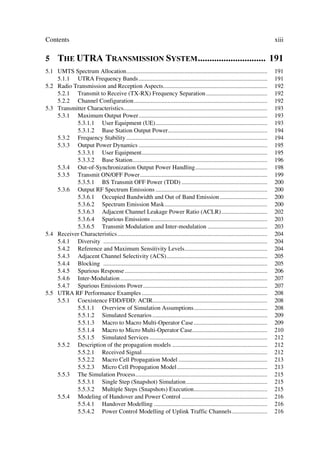
5 7+( 875$ 75$160,66,21 667(0  
5.1 UMTS Spectrum Allocation............................................................................................          191
    5.1.1 UTRA Frequency Bands ....................................................................................               191
5.2 Radio Transmission and Reception Aspects....................................................................                  192
    5.2.1 Transmit to Receive (TX-RX) Frequency Separation ........................................                               192
    5.2.2 Channel Configuration .......................................................................................           192
5.3 Transmitter Characteristics..............................................................................................     193
    5.3.1 Maximum Output Power....................................................................................                193
           5.3.1.1 User Equipment (UE).........................................................................                   193
           5.3.1.2 Base Station Output Power.................................................................                     194
    5.3.2 Frequency Stability ............................................................................................        194
    5.3.3 Output Power Dynamics ....................................................................................              195
           5.3.3.1 User Equipment..................................................................................               195
           5.3.3.2 Base Station........................................................................................           196
    5.3.4 Out-of-Synchronization Output Power Handling...............................................                             198
    5.3.5 Transmit ON/OFF Power...................................................................................                199
           5.3.5.1 BS Transmit OFF Power (TDD) ........................................................                           200
    5.3.6 Output RF Spectrum Emissions .........................................................................                  200
           5.3.6.1 Occupied Bandwidth and Out of Band Emission ...............................                                    200
           5.3.6.2 Spectrum Emission Mask...................................................................                      200
           5.3.6.3 Adjacent Channel Leakage Power Ratio (ACLR)..............................                                      202
           5.3.6.4 Spurious Emissions ............................................................................                203
           5.3.6.5 Transmit Modulation and Inter-modulation .......................................                               203
5.4 Receiver Characteristics ..................................................................................................   204
    5.4.1 Diversity ...........................................................................................................   204
    5.4.2 Reference and Maximum Sensitivity Levels......................................................                          204
    5.4.3 Adjacent Channel Selectivity (ACS)..................................................................                    205
    5.4.4 Blocking ...........................................................................................................    205
    5.4.5 Spurious Response .............................................................................................         206
    5.4.6 Inter-Modulation ................................................................................................       207
    5.4.7 Spurious Emissions Power .................................................................................              207
5.5 UTRA RF Performance Examples ..................................................................................               208
    5.5.1 Coexistence FDD/FDD: ACIR...........................................................................                    208
           5.5.1.1 Overview of Simulation Assumptions................................................                             208
           5.5.1.2 Simulated Scenarios ...........................................................................                209
           5.5.1.3 Macro to Macro Multi-Operator Case ................................................                            209
           5.5.1.4 Macro to Micro Multi-Operator Case.................................................                            210
           5.5.1.5 Simulated Services .............................................................................               212
    5.5.2 Description of the propagation models ..............................................................                    212
           5.5.2.1 Received Signal..................................................................................              212
           5.5.2.2 Macro Cell Propagation Model ..........................................................                        213
           5.5.2.3 Micro Cell Propagation Model...........................................................                        213
    5.5.3 The Simulation Process......................................................................................            215
           5.5.3.1 Single Step (Snapshot) Simulation.....................................................                         215
           5.5.3.2 Multiple Steps (Snapshots) Execution................................................                           215
    5.5.4 Modeling of Handover and Power Control ........................................................                         216
           5.5.4.1 Handover Modelling ..........................................................................                  216
           5.5.4.2 Power Control Modelling of Uplink Traffic Channels .......................                                     216
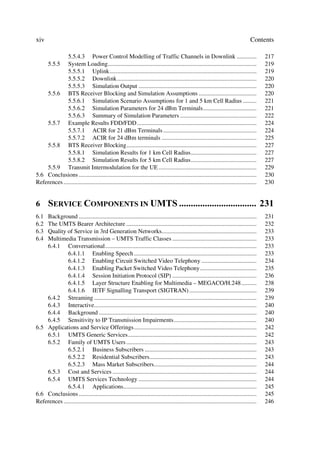
xiv                                                                                                                                  Contents

              5.5.4.3 Power Control Modelling of Traffic Channels in Downlink .............                                                 217
       5.5.5  System Loading.................................................................................................               219
              5.5.5.1 Uplink................................................................................................                219
              5.5.5.2 Downlink...........................................................................................                   220
              5.5.5.3 Simulation Output .............................................................................                       220
    5.5.6 BTS Receiver Blocking and Simulation Assumptions ......................................                                           220
              5.5.6.1 Simulation Scenario Assumptions for 1 and 5 km Cell Radius .........                                                  221
              5.5.6.2 Simulation Parameters for 24 dBm Terminals...................................                                         221
              5.5.6.3 Summary of Simulation Parameters ..................................................                                   222
    5.5.7 Example Results FDD/FDD ..............................................................................                            224
              5.5.7.1 ACIR for 21 dBm Terminals .............................................................                               224
              5.5.7.2 ACIR for 24 dBm terminals ..............................................................                              225
    5.5.8 BTS Receiver Blocking.....................................................................................                        227
              5.5.8.1 Simulation Results for 1 km Cell Radius...........................................                                    227
              5.5.8.2 Simulation Results for 5 km Cell Radius...........................................                                    227
    5.5.9 Transmit Intermodulation for the UE ................................................................                              229
5.6 Conclusions ....................................................................................................................        230
References ..............................................................................................................................   230


6      6(59,( 20321(176 ,1 8076  
6.1 Background ....................................................................................................................         231
6.2 The UMTS Bearer Architecture .....................................................................................                      232
6.3 Quality of Service in 3rd Generation Networks..............................................................                             233
6.4 Multimedia Transmission – UMTS Traffic Classes .......................................................                                  233
    6.4.1 Conversational...................................................................................................                 233
              6.4.1.1 Enabling Speech ................................................................................                      233
              6.4.1.2 Enabling Circuit Switched Video Telephony ....................................                                        234
              6.4.1.3 Enabling Packet Switched Video Telephony.....................................                                         235
              6.4.1.4 Session Initiation Protocol (SIP) .......................................................                             236
              6.4.1.5 Layer Structure Enabling for Multimedia – MEGACO/H.248..........                                                      238
              6.4.1.6 IETF Signalling Transport (SIGTRAN) ............................................                                      239
    6.4.2 Streaming ..........................................................................................................              239
    6.4.3 Interactive..........................................................................................................             240
    6.4.4 Background .......................................................................................................                240
    6.4.5 Sensitivity to IP Transmission Impairments......................................................                                  240
6.5 Applications and Service Offerings................................................................................                      242
    6.5.1 UMTS Generic Services....................................................................................                         242
    6.5.2 Family of UMTS Users .....................................................................................                        243
              6.5.2.1 Business Subscribers .........................................................................                        243
              6.5.2.2 Residential Subscribers......................................................................                         243
              6.5.2.3 Mass Market Subscribers...................................................................                            244
    6.5.3 Cost and Services ..............................................................................................                  244
    6.5.4 UMTS Services Technology .............................................................................                            244
              6.5.4.1 Applications.......................................................................................                   245
6.6 Conclusions ....................................................................................................................        245
References ..............................................................................................................................   246
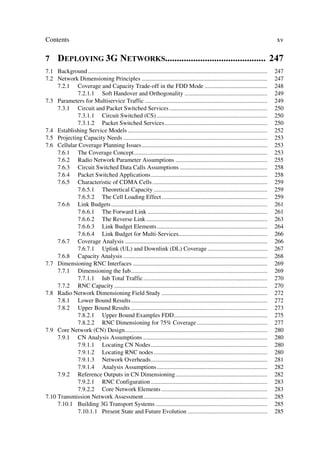
Contents                                                                                                                               xv

7 '(3/2,1* * 1(7:25.6 
7.1 Background .....................................................................................................................   247
7.2 Network Dimensioning Principles ..................................................................................                 247
     7.2.1 Coverage and Capacity Trade-off in the FDD Mode .........................................                                   248
            7.2.1.1 Soft Handover and Orthogonality ......................................................                             249
7.3 Parameters for Multiservice Traffic ................................................................................               249
     7.3.1 Circuit and Packet Switched Services ................................................................                       250
            7.3.1.1 Circuit Switched (CS) ........................................................................                     250
            7.3.1.2 Packet Switched Services...................................................................                        250
7.4 Establishing Service Models ...........................................................................................            252
7.5 Projecting Capacity Needs ..............................................................................................           253
7.6 Cellular Coverage Planning Issues..................................................................................                253
     7.6.1 The Coverage Concept.......................................................................................                 253
     7.6.2 Radio Network Parameter Assumptions ............................................................                            255
     7.6.3 Circuit Switched Data Calls Assumptions .........................................................                           258
     7.6.4 Packet Switched Applications............................................................................                    258
     7.6.5 Characteristic of CDMA Cells ...........................................................................                    259
            7.6.5.1 Theoretical Capacity ..........................................................................                    259
            7.6.5.2 The Cell Loading Effect .....................................................................                      259
     7.6.6 Link Budgets......................................................................................................          261
            7.6.6.1 The Forward Link ..............................................................................                    261
            7.6.6.2 The Reverse Link ...............................................................................                   263
            7.6.6.3 Link Budget Elements ........................................................................                      264
            7.6.6.4 Link Budget for Multi-Services..........................................................                           266
     7.6.7 Coverage Analysis .............................................................................................             266
            7.6.7.1 Uplink (UL) and Downlink (DL) Coverage .......................................                                     267
     7.6.8 Capacity Analysis ..............................................................................................            268
7.7 Dimensioning RNC Interfaces ........................................................................................               269
     7.7.1 Dimensioning the Iub.........................................................................................               269
            7.7.1.1 Iub Total Traffic .................................................................................                270
     7.7.2 RNC Capacity ....................................................................................................           270
7.8 Radio Network Dimensioning Field Study .....................................................................                       272
     7.8.1 Lower Bound Results.........................................................................................                272
     7.8.2 Upper Bound Results .........................................................................................               273
            7.8.2.1 Upper Bound Examples FDD.............................................................                              275
            7.8.2.2 RNC Dimensioning for 75% Coverage ..............................................                                   277
7.9 Core Network (CN) Design.............................................................................................              280
     7.9.1 CN Analysis Assumptions .................................................................................                   280
            7.9.1.1 Locating CN Nodes............................................................................                      280
            7.9.1.2 Locating RNC nodes ..........................................................................                      280
            7.9.1.3 Network Overheads............................................................................                      281
            7.9.1.4 Analysis Assumptions ........................................................................                      282
     7.9.2 Reference Outputs in CN Dimensioning............................................................                            282
            7.9.2.1 RNC Configuration ............................................................................                     283
            7.9.2.2 Core Network Elements .....................................................................                        283
7.10 Transmission Network Assessment.................................................................................                  285
     7.10.1 Building 3G Transport Systems .........................................................................                    285
            7.10.1.1 Present State and Future Evolution ....................................................                           285
xvi                                                                                                                                  Contents

     7.10.2 Transmission Reference Network .....................................................................                            287
              7.10.2.1 Co-siting Transmission Sites .............................................................                           288
              7.10.2.2 The Backhaul Network......................................................................                           289
              7.10.2.3 The National Backbone Network ......................................................                                 289
     7.10.3 Transmission Dimensioning Results .................................................................                             290
              7.10.3.1 Traffic per Site...................................................................................                  290
              7.10.3.2 Microwave Network..........................................................................                          290
              7.10.3.3 Leased Line Network ........................................................................                         291
              7.10.3.4 SDH Backbone Network ...................................................................                             292
              7.10.3.5 Local Switch Site Traffic...................................................................                         292
7.11 Co-locating and Sharing Sites ........................................................................................                 292
     7.11.1 Interference Levels and De-coupling ................................................................                            293
              7.11.1.1 GSM/UMTS Interference ..................................................................                             294
              7.11.1.2 Power Level Limitations ...................................................................                          295
7.12 Co-locating Antenna Systems ........................................................................................                   296
     7.12.1 Co-siting GSM1800 and UMTS........................................................................                              296
              7.12.1.1 Single Band .......................................................................................                  296
              7.12.1.2 Wideband Antenna ............................................................................                        297
              7.12.1.3 GSM 1800/UMTS Dual Band Antenna with Double Diplexers ........                                                       297
              7.12.1.4 Feeder Cables ....................................................................................                   297
7.13 Conclusions ....................................................................................................................       298
References ..............................................................................................................................   299


8      5(6285( $1' 1(7:25. 0$1$*(0(17  
8.1 Introduction ....................................................................................................................       301
8.2 Radio Resource Management and Signalling .................................................................                              301
    8.2.1 Managing Power ...............................................................................................                    301
              8.2.1.1 Fast Power Control (FPC) .................................................................                            302
              8.2.1.2 Power Control in Handover (HO)......................................................                                  302
              8.2.1.3 Outer Loop Power Control ................................................................                             304
              8.2.1.4 Conclusions .......................................................................................                   305
8.3 Network Management ....................................................................................................                 305
    8.3.1 Introduction .......................................................................................................              305
    8.3.2 Network Management Characteristics...............................................................                                 305
    8.3.3 A Generic Functional View of a 3G NMS System............................................                                          305
    8.3.4 Main 3G Network Elements for Management...................................................                                        307
              8.3.4.1 The UTRAN Building Blocks ...........................................................                                 307
              8.3.4.2 The Core Network (CN) Building Blocks .........................................                                       308
              8.3.4.3 Conclusions .......................................................................................                   309
8.4 UMTS Network Optimization ........................................................................................                      309
    8.4.1 ACIR Impacts in a Multi-Operator Environment ..............................................                                       310
    8.4.2 Enhancing and Managing Capacity...................................................................                                311
              8.4.2.1 Load Control Analysis.......................................................................                          312
              8.4.2.2 Conclusions .......................................................................................                   314
References ..............................................................................................................................   314
Contents                                                                                                                               xvii

9 72:$5'6 ,3 %$6(' 1(7:25.6 
9.1 Background .....................................................................................................................   317
    9.1.1 The UMTS Release 99 and Medium Term Architecture....................................                                         317
            9.1.1.1 Release 99 ..........................................................................................              317
            9.1.1.2 Release R4 and R5 .............................................................................                    317
    9.1.2 The Long Term UMTS Architecture Vision ......................................................                                318
    9.1.3 The All IP and Service Evolution ......................................................................                      318
            9.1.3.1 Transition to All IP Services ..............................................................                       318
    9.1.4 Classifying Releases 4 and 5 Services ...............................................................                        320
9.2 Release 00 Reference Architecture .................................................................................                321
    9.2.1 Overview of Release 00 Architecture ................................................................                         321
9.3 Functional Elements........................................................................................................        322
    9.3.1 Call State Control Function (CSCF) ..................................................................                        322
    9.3.2 Home Subscriber Server (HSS)..........................................................................                       324
    9.3.3 Transport Signalling Gateway Function (T-SGW) ............................................                                   325
    9.3.4 Roaming Signalling Gateway Function (R-SGW) .............................................                                    326
    9.3.5 Media Gateway Control Function (MGCF) .......................................................                                326
    9.3.6 Media Gateway Function (MGW) .....................................................................                           326
    9.3.7 Multimedia Resource Function (MRF) ..............................................................                            327
    9.3.8 MSC and Gateway MSC Server.........................................................................                          327
9.4 Reference Points..............................................................................................................     327
    9.4.1 Cx Reference Point (HSS–CSCF)......................................................................                          327
    9.4.2 Gf Reference Point (SGSN–EIR).......................................................................                         328
    9.4.3 Gi (GGSN–Multimedia IP Network) .................................................................                            328
    9.4.4 Gn Reference Point (GGSN–SGSN)..................................................................                             328
    9.4.5 Gm Reference Point (CSCF–UE) ......................................................................                          328
    9.4.6 Mc Reference Point (MGCF–MGW).................................................................                               328
    9.4.7 Mg Reference Point (MGCF–CSCF) .................................................................                             329
    9.4.8 Mh Reference Point (HSS–R-SGW)..................................................................                             329
    9.4.9 Mm Reference Point (CSCF–Multimedia IP networks).....................................                                        329
    9.4.10 Mr Reference Point (CSCF–MRF) ....................................................................                          329
    9.4.11 Ms Reference Point (CSCF–R-SGW)................................................................                             329
    9.4.12 Mw Reference Point (CSCF–CSCF)..................................................................                            330
    9.4.13 Nc Reference Point (MSC Server–GMSC Server).............................................                                    330
    9.4.14 Nb Reference Point (MGW-MGW) ...................................................................                            330
    9.4.15 CAP Based Interfaces ........................................................................................               330
    9.4.16 Iu Reference Point..............................................................................................            331
9.5 Mobility Management .....................................................................................................          331
    9.5.1 Address Management.........................................................................................                  331
    9.5.2 Addressing and Routing to Access IM-Subsystem Services ..............................                                        332
    9.5.3 Context Activation and Registration ..................................................................                       333
    9.5.4 Location Management........................................................................................                  334
    9.5.5 Handover (HO) ..................................................................................................             336
9.6 Registration Aspects........................................................................................................       336
    9.6.1 Registration Flows .............................................................................................             336
            9.6.1.1 Requirements and Assumptions .........................................................                             336
            9.6.1.2 Registration Procedures......................................................................                      337
9.7 Multimedia Signalling.....................................................................................................         339
xviii                                                                                                                                     Contents

     9.7.1 Support of Roaming Subscribers.......................................................................                                  340
     9.7.2 Assignment of Serving CSCF ...........................................................................                                 341
9.8 Service Platforms ...........................................................................................................                 341
     9.8.1 VHE/OSA .........................................................................................................                      341
              9.8.1.1 Implementation Options of the VHE/OSA ........................................                                              342
     9.8.2 The SIM Application Toolkit (SAT) .................................................................                                    343
              9.8.2.1 SAT Service Capability Server..........................................................                                     344
9.9 QoS Aspects ...................................................................................................................               344
     9.9.1 End-to-End QoS Negotiation and Policy Requirements....................................                                                 344
     9.9.2 QoS End-to-End Functional Architecture .........................................................                                       345
              9.9.2.1 IP BS Manager ..................................................................................                            345
              9.9.2.2 IP Policy Control ...............................................................................                           346
              9.9.2.3 Resource Manager .............................................................................                              346
              9.9.2.4 Implementing QoS.............................................................................                               347
9.10 Transport Issues..............................................................................................................               348
     9.10.1 Principles of Mobile Ipv4..................................................................................                           348
     9.10.2 Differences between IPv4 and IPv6 ..................................................................                                  348
              9.10.2.1 Reverse Tunnels ................................................................................                           349
              9.10.2.2 Use of Route Optimization ................................................................                                 350
9.11 Conclusions ....................................................................................................................             350
References ..............................................................................................................................         350

Index            ..............................................................................................................................   351
The UMTS Network and Radio Access Technology: Air Interface Techniques for Future Mobile Systems
                                                                                  Jonathan P. Castro
                                                           Copyright © 2001 John Wiley  Sons Ltd
                                             Print ISBN 0-471-81375-3 Online ISBN 0-470-84172-9


PREFACE

The rapid growth in traffic volume and increase in new services has begun to change
the configuration and structure of wireless networks. Thus, future mobile communica-
tions systems will be distinguished by high integration of services, flexibility and higher
throughput.
To support such features, the efficient use of spectrum and optimum management of
radio resources will be essential.
To meet these challenges standardization bodies like ETSI (now expanded to 3GPP),
have selected the Wideband Code Division Multiple Access (WCDMA) and the hybrid
Time Division – CDMA as the radio techniques for the Universal Mobile Telecommu-
nication Systems (UMTS). Hence, UMTS conceived at the eve of this new millennium
will without doubt have a large impact on future wideband mobile networks and serve
as the leading platform for wireless multimedia communications.
The specification extracts in this book are intended to provide a concise reference for
the many documents related to UMTS systems. After all, the whole UMTS specification
set would probably exceed 4000 pages. Thus, it is hoped that the synthesis presented in
this book will be useful in some way. In this context, in order to offer a complete source
on the UMTS air interface and network issues, this book aims to present a description of
the principles, methods and technology used in the standard specification. Different
aspects of the UMTS multiple access and network configuration are presented; how-
ever, this concise and integrated volume, which embodies the main design elements,
goes further. Thus, the content of this book follows structurally the specifications of the
3GPP recommendations to comply entirely with the concept, terminology, approach and
style, and not just the technical essence.
In drafting the standards or UMTS technical specifications, the experts have tried to
reduce the risk of ambivalent interpretation, and not necessarily ease the understanding
for the common reader. The logic, constructive discussions and consensus behind the
choices or equivalent solutions have not always been retained in the final specifications.
Therefore, in some ways this book tries to present an objective unified view of the key
aspects of UMTS. On the other hand, the area of UMTS is vast in content and detail,
and not all within the scope of these writings. As a result, the book will allow us to un-
derstand the UMTS specifications and get a good grasp of its design, but the technical
documents of formerly SMG, and now 3GPP, remain the official specifications with all
their appropriate ownership and origin of contribution.
Since this book has been introduced in good faith as a useful reference for UMTS tech-
nology, the author does not take responsibility for any misuse or error while dealing
xx                                                                                  Preface

with the information provided. If for some reason some representations have been omit-
ted due to time constraints or the dynamic changing process of the specifications, they
will be revised and corrected for later reprints. Thus, the author welcomes any com-
ments and suggestions for improvements or changes that could enhance further this
contribution to UMTS.
The chapters in this book cover specific design details of the building blocks in the
UMTS air interface, in particular the physical layer. It addresses the technical part of the
specification for both the FDD and TDD modes. On the other hand, it also introduces
the key criteria for network dimensioning and deployment of 3G systems assuming an
evolution from 2G mobile networks from the providers’ point of view. To illustrate the
progressive steps of UMTS standards such as the evolution towards predominant packet
switching oriented communications, this book also introduces the ‘All IP Core Net-
work’ architecture concept for mobile multimedia.
Chapter 1 deals with concrete requirements for 3G mobile systems after summarizing
the rapid growth of wireless communications and the Internet. It also outlines briefly
enhancing technologies such as capacity increasing antennas, multi-user detection tech-
niques, and software radio applications.
Chapter 2 presents the fundamentals of system analysis, e.g. multiple access options,
which considers narrow-band and wide-band digital channels, as well as the background
for the UTRA FDD and TDD modes. It covers signal processing aspects describing the
principles of spread spectrum, modulation and spreading, the CDMA performance, PN
sequences, power control and handovers. It presents the communications environments
envisaged for UMTS operation and deployment. It also describes the channel models
used to verify and justify the performance for the selected operating scenarios. It pro-
vides a summary of the mathematical formulation for the performance analysis results
seen in the forthcoming chapters (e.g. Chapter 7).
Chapter 3 describes the UMTS development platform. It introduces its architecture top
down, identifying the core and access network domains. It defines the UTRA identifiers
and functions, e.g. system access control, radio channel ciphering and deciphering, mo-
bility functions, and radio resource management and control functions. It also presents
mobility management with its signaling connections and impact of mobility handling.
Chapter 3 presents the UTRAN sychronization and UTRAN interfaces besides pointing
out co-existing 2G/3G network issues. It also introduces the radio interface protocol
architecture with its structure in terms of services and function layers. This chapter thus
outlines the most relevant elements, which require technical description for design and
implementation.
Chapter 4 describes the UTRA physical layer design and configuration, where we intro-
duce all the building blocks in detail with their respective technical description and re-
quirements. It covers dedicated common transport channels, configuration of FDD and
TDD physical channels in the uplink and downlink with their spreading and coding
characteristics. Spreading and modulation, including scrambling, multiplexing and
channel coding are also discussed. The chapter presents the aforementioned characteris-
Preface                                                                                  xxi

tics for the FDD and TDD separately for each mode or unified when the case applies to
both.
Chapter 5 introduces the UTRA transmission system starting from the spectrum alloca-
tion, i.e. the UTRA frequency bands. It presents the radio transmission and reception
aspects, describing transmitter and receiver characteristics for the User Equipment (UE)
and the Base Station (BS). It describes the maximum output power and output power
dynamics, out of synchronization output power handling, transmit on/off power. Details
on the output RF spectrum emissions, such as occupied bandwidth and out band emis-
sion, spectrum emissions, adjacent channel leakage power ratio, spurious emissions, and
transmit modulation and inter-modulation are given. The summary of examples in-
cludes a review of simulation scenarios for the co-existence of FDD/FDD when analyz-
ing ACIR with macro-to-macro and macro-to-micro cases. Before presenting results the
chapter also reviews propagation models.
Chapter 6 describes the UMTS service components. It covers the UMTS bearer archi-
tecture, concepts in quality of service for 3G systems, multimedia transmission and traf-
fic classes in UMTS. The classes include conversational, streaming, interactive, and
background types. Sensitivity to IP transmission impairments are also covered here. To
provide an overview of potential applications in UMTS this chapter also summarizes
service offerings and selected areas of service technology.
Chapter 7 introduces the factors that influence 3G network dimensioning. It discusses
coverage and capacity trade-off in the FDD mode pointing out impacts from soft hand-
over, power control and orthogonality deviations. It covers the analysis of parameters
for multi-service traffic in PS and CS. It establishes service models starting from capac-
ity projections, and service strategy. Cellular coverage planning issues, i.e. the coverage
concept, radio network parameter assumptions for CS and PS, characteristics of CDMA
cells (with its theoretical capacity and cell loading effects) constitute the essential parts
of this chapter. Link budget principles for the forward and reverse links and their re-
spective formulation are covered. In the latter part, these principles are applied to a field
study. For completeness the chapter also describes briefly the dimensioning of the RNC
in the UTRAN side. Chapter 7 also presents the dimensioning of the core network and
transmission systems. In the last part, results of a field study are provided using hypo-
thetical parameters to illustrate the concepts end-to-end. The illustrations correspond to
dimensioning exercises carried out while optimizing 3G networks. However, the input
and output values in this chapter do not necessarily reflect actual values that may be
used directly while dimensioning a future UMTS network. Finally, to complete the as-
sessment of UMTS network deployment within 2G networks like GSM, this chapter
discusses briefly co-location and site sharing, as well as co-location of antenna systems.
Chapter 8 presents issues on resource and network management. It covers radio re-
source management and signalling, i.e. managing power (fast and low). The conceptual
aspects of network management are covered from the network management system
point of view. Initial considerations for network optimization are also covered.
Chapter 9 as a prelude to future predominantly PS domain networks, covers the concep-
tual architecture of UMTS Release 2000 or more specifically Release 4 and 5. It starts
xxii                                                                             Preface

with the evolution of R99 and discusses briefly the long term view and vision of the
UMTS architecture. Then it describes the components of R00 with their corresponding
interfaces or reference points. This chapter also presents an introduction to and consid-
erations of mobility management, registration aspects, multimedia signalling, service
platforms, QoS aspects, and transport issues such as the basic differences of Ipv4 and
Ipv6.
The UMTS Network and Radio Access Technology: Air Interface Techniques for Future Mobile Systems
                                                                                    Jonathan P. Castro
                                                             Copyright © 2001 John Wiley  Sons Ltd
                                               Print ISBN 0-471-81375-3 Online ISBN 0-470-84172-9


ACRONYMS

AAL2             ATM Adaptation Layer Type 2
AAL5             ATM Adaptation Layer Type 5
ATM              Asynchronous Transfer Mode
BHCA             Busy Hour Call Attempt
CAMEL            A version of IN standardised for the mobile environment
CCB              Customer Care and Billing
CDR              Call Detail Record
CPS              Call Processing Server
CSE              CAMEL Service Environment
ACIR             Adjacent Channel Interference Ratio
ACLR             Adjacent Channel Leakage power Ratio
ACS              Adjacent Channel Selectivity
AH               Address Handling
AI               Acquisition Indicator
AICH             Acquisition Indicator Channel
ALCAP            Access Link Control Application Part
AMR              Adaptive MultiRate (speech codec)
AP               Access Preamble
AP-AICH          Access Preamble Acquisition Indicator Channel
API              Access Preamble Indicator
ARQ              Automatic Repeat Request
ASC              Access Service Class
BCCH             Broadcast Control Channel
BCH              Broadcast Channel
BER              Bit Error Rate
BLER             Block Error Ratio
BMC              Broadcast/Multicast Control
BM-IWF           Broadcast Multicast Interworking Function
BS               Base Station
BSS              Base Station Subsystem
C-               Control-
CA               Channel Assignment
xxiv                                                                          Acronyms


CAI         Channel Assignment Indicator
CBC         Cell Broadcast Centre
CBR         Constant Bit Rate
CBS         Cell Broadcast Service
CC          Call Control
CCC         CPCH Control Command
CCCH        Common Control Channel
CCF         Call Control Function
CCH         Control Channel
CCPCH       Common Control Physical Channel
CCTrCH      Coded Composite Transport Channel
CD          Collision Detection
CD/CA-ICH   Collision Detection/Channel Assignment Indicator Channel
CDI         Collision Detection Indicator
CDMA        Code Division Multiple Access
CFN         Connection Frame Number
Chip Rate   Chip rate of W CDMA system, equals to 3,84 M chips per second
CN          Core Network
CPCH        Common Packet channel
CPICH       Common Pilot Channel
CRC         Cyclic Redundancy Check
CS          Circuit Switched
CSCF        Call State Control Function
CSICH       CPCH Status Indicator Channel
CTCH        Common Traffic Channel
CW          Continuous Wave (un-modulated signal)
DC          Dedicated Control (SAP)
DCA         Dynamic channel allocation
DCCH        Dedicated Control Channel
DCH         Dedicated Channel, which is mapped into Dedicated Physical Channel.
DL          Downlink
DPCCH       Dedicated Physical Control Channel
DPCH        Dedicated Physical Channel
DPCH_Ec     Average energy per PN chip for DPCH
DPDCH       Dedicated Physical Data Channel
DRNC        Drift Radio Network Controller
DRNS        Drift RNS
DRX         Discontinuous Reception
Acronyms                                                                                xxv


DS-CDMA    Direct-Sequence Code Division Multiple Access
DSCH       Downlink Shared Channel
DSMA-CD    Digital Sense Multiple Access - Collison Detection
DTCH       Dedicated Traffic Channel
DTX        Discontinuous Transmission
EDGE       Enhanced Data Rates for GSM Evolution
EFR        Enhanced Full Rate speech codec
Ec/No      Received energy per chip divided by the power density in the band
FACH       Forward Link Access Channel
FAUSCH     Fast Upink Signalling Channel
FBI        Feedback Information
FCS        Frame Check Sequence
FDD        Frequency Division Duplex
FDMA       Frequency Division Multiple Access
FDR        False transmit format Detection Ratio
FEC        Forward Error Control
FER        Frame Error Rate
FTP        File Transfer Protocol
FSW        Frame Synchronization Word
Fuw        Frequency of unwanted signal.
GC         General Control (SAP)
GF         Galois Field
GGSN       Gateway GPRS support node
GMSC       Gateway MSC
GP         Guard Period
GPRS       General Packet Radio System
GSM        Global System for Mobile Communication
GTP        GPRS Tunnelling Protocol
HLR        Home Location register
HO         Handover
HSS        Home Subscriber Server
IC         Interference Cancellation
ICGW       Incoming call gateway
IETF       Internet engineering task force
IMSI       International Mobile Subscriber identity
IN         Intelligent network
Ioc        The power spectral density of a band limited white noise source.
Ior        The total transmit power spectral density of the DL at the BS antenna connector
xxvi                                                  Acronyms


IP     Internet Protocol
ISDN   Integrated services digital network
ISI    Inter-symbol interference
ITU    International Telecommunication Union
JD     Joint Detection
kbps   kilo-bits per second
L1     Layer 1 (physical layer)
L2     Layer 2 (data link layer)
L3     Layer 3 (network layer)
LAC    Link Access Control
LAI    Location Area Identity
LCS    Location Services
LLC    Logical Link Control
LAN    Local Area Network
MA     Multiple Access
MAC    Medium Access Control
Mbps   Mega bit per second
Mcps   Mega Chip Per Second
ME     Mobile Equipment
MER    Message Error Ratio
MF     Matched filter
MGCF   Media Gateway Control Function
MGW    Media Gateway Function
MM     Mobility Management
MPEG   Motion picture expert group
MRF    Multimedia Resource Function
MS     Mobile Station
MT     Mobile Terminated
MUD    Multiuser detection
MUI    Mobile User Identifier
NAS    Non Access Stratum
NBAP   Node B Application Protocol
NRT    Non-Real Time
Nt     Notification (SAP)
OVSF   Orthogonal Variable Spreading Factor (codes)
PAD    Padding
PC     Power Control
PCCC   Parallel Concatenated Convolutional Code
Acronyms                                              xxvii


PCCH       Paging Control Channel
PCCPCH     Primary Common Control Physical Channel
PCH        Paging Channel
PCPCH      Physical Common Packet Channel
PCS        Personal Communications System
PDCP       Packet Data Convergence Protocol
PDSCH      Physical Downlink Shared Channel
PDSCH      Physical Dedicated Shared Channel
PDP        Packet Data Control
PDU        Protocol Data Unit
PhCH       Physical Channel
PHY        Physical layer
PhyCH      Physical Channels
PI         Paging Indicator
PICH       Paging Indicator Channel
PICH       Page Indicator Channel
PN         Pseudo Noise
PPM        Parts Per Million
PRACH      Physical Random Access Channel
PSC        Primary Synchronisation Code
PSCH       Physical channel
PSTN       Public Switched Telephone Network
PU         Payload Unit
PUSCH      Physical Uplink Shared Channel
QoS        Quality of Service
QPSK       Quadrature Phase Shift Keying
RAB        Radio Access Bearer
RACH       Random Access Channel
RAI        Routing Area identity
RANAP      Radio Access Network Application Part
RB         Radio Bearer
RF         Radio Frequency
RL         Radio Link
RLC        Radio Link Control
RNC        Radio Network Controller
RNS        Radio Network Subsystem
RNSAP      Radio Network Subsystem Application Part
xxviii                                                                      Acronyms


RNTI      Radio Network Temporary Identity
RRC       Radio Resource Control
RRM       Radio Resource Management
RSC       Recursive Systematic Convolutional Coder
RSCP      Received Signal Code Power
RSSI      Received Signal Strength Indicator
RT        Real Time
RTP       Real Time Protocol
RU        Resource Unit
RX        Receive
SAB       Service Area Broadcast
SAP       Service Access Point
SCCC      Serial Concatenated Convolutional Code
SCCP      Signalling Connection Control Part
S-CCPCH   Secondary Common Control Physical Channel
SCH       Synchronisation Channel: Primary + Secondary synchronisation channels
SDP       Session Description Protocol
SDU       Service Data Unit
SF        Spreading Factor
SFN       System Frame Number
SHCCH     Shared Channel Control Channel
SI        Status Indicator
SIR       Signal to Interference Ratio
SMS       Short Message Service
SN        Sequence Number
SNR       Signal to Noise Ratio
SPD       Serving Profile Database
SRNC      Serving Radio Network Controller
SRNS      Serving Radio Network Subsystem
SSC       Secondary Synchronisation Code
SSCH      Secondary Synchronisation Channel
SSDT      Site Selection Diversity Transmission
SSDT      Site Selection Diversity TPC
STD       Selective Transmit Diversity
STTD      Space Time Transmit Diversity
TA        Timing Advance
TCH       Traffic Channel
TDD       Time Division Duplex
Acronyms                                                xxix


TDD        Time Division Duplex
TDMA       Time Division Multiple Access
TF         Transport Format
TFC        Transport Format Combination
TFCI       Transport Format Combination Indicator
TFI        Transport Format Indicator
TMSI       Temporary Mobile Subscriber Identity
TPC        Transmit Power Control
TrBk       Transport Block
TrCH       Transport Channel
T-SGW      Transport Signalling Gateway Function
TSTD       Time Switched Transmit Diversity
TTI        Transmission Time Interval
TX         Transmit
TxAA       Transmit Adaptive Antennas
U-         User-
UE         User Equipment
UL         Uplink (Reverse link)
UMTS       Universal Mobile Telecommunications System
URA        UTRAN Registration Area
USCH       Uplink Shared Channel
USIM       UMTS Subscriber Identity Module
UTRA       UMTS Terrestrial Radio Access
UTRAN      UMTS Terrestrial Radio Access Network
VBR        Variable Bit Rate
WCDMA      Wide-band Code Division Multiple Access
The UMTS Network and Radio Access Technology: Air Interface Techniques for Future Mobile Systems
                                                                                  Jonathan P. Castro
                                                           Copyright © 2001 John Wiley  Sons Ltd
                                             Print ISBN 0-471-81375-3 Online ISBN 0-470-84172-9


               EVOLVING MOBILE NETWORKS

While the history of mobile communications is long [1–3], and the background of mo
bile networks therebyx is also long, in this chapter we focus on the historic evolution in
terms of network architecture and services starting with 2nd generation (2G) mobile
systems. In particular we consider the development of the architecture of Global Sys-
tems for Mobile Communications (GSM), since it is by far the most widespread mobile
system in the world today. This will provide the basis to cover the introduction of Uni-
versal Mobile Telecommunication Services (UMTS) in relation to its Core Network
(CN) and radio architectures. The latter will in turn serve as the platform to present
UMTS Radio Access Technology, which is one the aims of this book.

1.1             THE GROWTH OF MOBILE COMMUNICATIONS
Today wireless voice service is one of the most convenient and flexible means of mod-
ern communications. GSM technology has been at the leading edge of this wireless
revolution. It is the technology of choice in over 120 countries and for more than 200
operators worldwide. Current estimates are that by the year 2001 there will be around
600 million wireless subscribers (e.g. mobile telephone users), out of which more than
50% will depend on GSM technology.
As the wireless revolution has been unfolding, the Internet has also shown a phenome-
nal growth simultaneously. The advent of the World Wide Web and web browsers has
propelled TCP/IP protocols into the main stream, and the Internet is widespread not


      †
      
      ‚
      v
          
      y
      y
      v
      €
      
      Ã
                                                                                   0 RELOH
      †
      …
      r
      i                                                                            ,QWHUQHW
      v
      …
      p
      †
      i   
      ˆ
      T


                        Figure 1.1 The growth of mobile and internet services.
2                                         The UMTS Network and Radio Access Technology

only in the corporate environment but also in households. Large number of consumers
have embraced the Internet and use it today to access information online, for interactive
business transactions, and e-commerce as well as electronic mail. Figure 1.1 illustrates
the growth in mobile and Internet subscribers.
The success of mobile communications, i.e. the ubiquitous presence it has established
and the emergence of the Internet point towards a tremendous opportunity to offer inte-
grated services through a wireless network.
One of the main market segments for wireless services besides corporate intra-
net/internet access is the consumer sector. The availability of intelligent terminals1 or
multipurpose wireless telephones is already ushering a new era of the information age,
where subscribers can receive directly through GSM-SMS: news, sport updates, stock
quotes, etc. However, the progress of audiovisual techniques and the support for a Web-
like interface in a new generation of terminals, will push consumers to a new era of
multimedia communications with a focus on services rather than technology.
To support the growth of Internet type services2 and future demands for wireless ser-
vices, ETSI SMG and other standards bodies3 have completed or are now completing
specifications to provide a transition platform or evolution path for wireless networks
like GSM. Figure 1.2 illustrates the wireless data technology options.
The technology options in Figure 1.2 can be summarized as follows:
œ    14.4 kbits/s allows GSM data calls with a rate of 14.4 kbits/s per time slot, resulting
     in a 50% higher data throughput compared to the current maximum speed of 9.6
     kbits/s.
œ    High Speed Circuit Switched Data (HSCSD) aggregates symmetrically or asym-
     metrically several circuit channels, e.g. 28.8 kbits/s for two time slots (2 + 2) or
     43.2 kbits/s for three time slots (3 + 1).
œ    General Packet Radio Service (GPRS) enables GSM with Internet access at high
     spectrum efficiency by sharing time slots between different users. It affords data
     rates of over 100 kbits/s to a single user while offering direct IP connectivity.
œ    Enhanced Data Rate for GSM Evolution (EDGE) modifies the radio link modula-
     tion scheme from GMSK to 8QPSK. Thereby increasing by three times the GSM
     throughput using the same bandwidth. EDGE in combination with GPRS (E-
     GPRS) will deliver single user data rates of over 300 kbits/s.
œ    UMTS as 3rd generation wireless technology utilizes a Wideband CDMA or
     TD/CDMA transceiver. Starting with channel bandwidths of 5 MHz it will offer
     data rates up to 2 Mbits/s. UMTS will use new spectrum and new radio network
     configurations while using the GSM core infrastructure.

_______
1
  For example WAP terminals.
2
  Including voice or IP as a new trend.
3
  In the USA – T1P1, in Japan – ARIB, in Korea – TTA, and in China – CWTS.
Evolving Mobile Networks                                                                                             3


                            !ÃxÃ


                             ÃxÃ
                                                                           3DFNHW
                                                                                             8076

                               ÃxÃ
         7URXJKSXW NESV
%#ÃxÃ


                                         LUFXLW      +66'               ('*(
                                                     
                               ÃxÃ
                                                         *356


                                ÃxÃ
                                       606
                                                   (('Ã      (((Ã     !Ã      ! Ã      !!Ã
                                                                                                    @‰‚yˆ‡v‚Ã`rh…


                                         Figure 1.2 Evolution for wireless networks4, e.g. GSM.

Although the circuit switched enhancements such as HSCSD will increase transmission
rates, it is packet switched enhancements, which will meet the challenges or demands
posed on current wireless networks. Thus, GPRS and UMTS with EDGE as an interme-
diate solution will provide the platform to support integrated services of voice and data
including multimedia.
While GPRS and UMTS meet the demands for Internet (IP) features and higher band-
widths in mobile networks, another evolution step is taking place in the network infra-
structure. This is the convergence of single networks into a multi-purpose backbone
network. The next section covers this step, which will have also impact on the imple-
mentation of UMTS radio access technology.

1.1.1                        Convergence of Fixed and Mobile Networks
RQYHUJHQFH LH WKH FORVHU LQWHUZRUNLQJ EHWZHHQ IL[HG DQG PRELOH WHOHFRPPXQLFD
WLRQV DOWKRXJK LW KDV ORQJ EHHQ D EX]]ZRUG LQ WKH WHOHFRP PDUNHW LV QRZ FRPLQJ LQWR
UHDOLW $V (ULFVVRQ SXWV LW @ IL[HG DQG PRELOH FRQYHUJHQFH LQFOXGHV HYHUWKLQJ IURP
QHZ VHUYLFHV WR WKH LQWHJUDWLRQ RI QRGHV QHWZRUNV DQG RSHUDWLQJ VVWHPV 7KH XVHU PD
KDYH HJ WKH VDPH YRLFH PDLOER[ IRU IL[HG DQG PRELOH WHOHSKRQ ZKLOH WKH RSHUDWRU
FDQ DOVR XVH WKH ODUJH VHFWLRQV RI WKH QHWZRUN LQ D FRRUGLQDWHG PDQQHU IRU GLIIHUHQW
WSHV RI DFFHVV 7KXV FRQYHUJHQFH LV QRZ D QHZ IURQWLHU LQ FRPPXQLFDWLRQV ZKHUH
8076 ZLOO HYROYH
)LJXUH  LOOXVWUDWH KRZ VLQJOH VHUYLFH QHWZRUNV ZLOO HYROYH LQWR PXOWLSXUSRVH QHW
ZRUNV ZLWK PXOWLOHYHO DFFHVV SRLQWV :LWK ,3 EHFRPLQJ PRUH SHUYDVLYH LQ WKH EDFN
ERQH WKH FKDOOHQJH RI LQWHJUDWLQJ YRLFH DQG GDWD VHUYLFHV LQ WKH IL[HG DQG PRELOH HQYL
URQPHQW EHFRPH PRUH IRUPLGDEOH

_______
4
    IS-136 has adopted EDGE as its air-interface expansion.
4                                                   The UMTS Network and Radio Access Technology

                                                                              Aˆ‡ˆ…r

                                                                   Hˆy‡vTr…‰vprÃIr‡‚…x†
                  Q…r†r‡
                                                                   UurHˆy‡v†r…‰r…Ã8yvr‡Ã8‚prƒ‡
        TvtyrTr…‰vprÃIr‡‚…x†


                                                RQWHQW
                                                ,QSXWV
                                                                          ,QIRUPDWLRQ                       RQWHQW
                                                                                                            ,QSXWV
                           9h‡hDQ
                           1HWZRUNV
                                                                            6HUYHUV
          QTUI

           DT9I
                                                               ÃD‡ryyvtr‡Ã8‚€€ˆvph‡v‚†Ã8‚‡…‚y


                                                                        Hˆy‡vGr‰ryÃTr…‰vpr

                                                                            7hpxi‚r


          QGHI


                            DEOH
                             79
                                                     Hˆy‡vÃGr‰ry                                    Hˆy‡vÃGr‰ry

                                                          6ppr††                                      6ppr††
                                                                             Hˆy‡vÃGr‰ry
                                                          Q‚v‡†                                      Q‚v‡†
                                                                               6ppr††

                                                                               Q‚v‡†


          6ppr††ÃU…h†ƒ‚…‡Ãhq

           Tv‡puvtÃIr‡‚…x†


                                                          OLHQWV WRZDUGV ,QWHJUDWHG
                                                                   6HUYLFHV
                                            Figure 1.3 Multi-service network.


               Table 1.1 The Converging Industry in Telecommunications, Computers and Media

    Telecom       Wire-line                                        Wireless Mobility
    Industry
                  PSTN          PTN            ISDN                2G         2.5 G        3G          3G             New
                                                                                           mobile      Internet       Telecoms

    Computer      Main          Desk top       PC-LAN PC-          PC-        Internet / Intranet WWW                 Converged
    Industry      Frames        Computing      Servers             WAN        Electronic Commerce                     Industry

    Media                                                                     Electronic Publication                  New battle
    Industry                                                                  Interactive Entertainment               ground


It boils downs to the transformation of the Telecom, Computer and Media Industry,
resulting into the Converged Industry as illustrated in Table 1.1.
Clearly then, UMTS will be part of the convergent Industry with a trend towards multi-
services within integrated infrastructures.

1.2            THIRD GENERATION MOBILE SYSTEM REQUIREMENTS
Although third generation (3G) systems involve primarily infrastructure change in the
Air-Interface (AI), it also has impact in the service configuration options and the access
Evolving Mobile Networks                                                                       5

to the Core Network (CN). Hence, the 3G, or more specifically UMTS requirements in
this section cover three main areas, i.e. services, air-interface, and core network access.

1.2.1      UMTS Services Aspects
The scope of services can be largely focused on different issues like service manage-
ment, charging and billing, terminals, network management, quality of service, and se-
curity. Here, however, we will be looking at services from the principle side in other to
establish a framework to present the UMTS air-interface. An extract of the service prin-
ciples outlined in the ETSI specifications UMTS Services aspects – Service Principles
and UMTS Services [4] and Services capabilities [16], can be summarized as follows:
   UMTS is the realization of a new generation of mobile communications technology for a
   world in which personal communications services should allow person-to-person calling,
   independent of location, the terminal used, the means of transmission (wired or wireless)
   and the choice of technology.
UMTS shall therefore be in compliance with the following objectives:
(a) to provide a single integrated system in which the user can access services in an easy
    to use and uniform way in all environments;
(b) to allow differentiation between service offerings of various serving networks and
    home environments;
(c) to provide a wide range of telecommunications services including those provided by
    fixed networks and requiring user bit rates of up to 2 Mbits/s as well as services spe-
    cial to mobile communications. These services should be supported in residential,
    public and office environments and in areas of diverse population densities. These
    services are provided with a quality comparable with that provided by fixed net-
    works such as ISDN;
(d) to provide services via hand held, portable, vehicular mounted, movable and fixed
    terminals (including those which normally operate connected to fixed networks), in
    all environments (in different service environments – residential, private domestic
    and different radio environments) provided that the terminal has the necessary capa-
    bilities;
(e) to provide support of roaming users by enabling users to access services provided by
    their home environment in the same way even when roaming.
(f) to provide audio, data, video and particularly multimedia services;
(g) to provide for the flexible introduction of telecommunication services;
(h) to provide the capability to support Universal Personal Telecommunications (UPT);
(i) to provide within the residential environment the capability to enable a pedestrian
    user to access all services normally provided by fixed networks;
(j) to provide within the office environment the capability to enable a pedestrian user to
    access all services normally provided by PBXs and LANs;
(k) to provide a substitute for fixed networks in areas of diverse population densities, un-
    der conditions approved by the appropriate national or regional regulatory authority.
6                                                 The UMTS Network and Radio Access Technology

(l) to provide support for interfaces which allow the use of terminals normally con-
    nected to fixed networks.
In addition UMTS aims:
– to enable users to access a wide range of telecommunications services, including
    many that are today undefined as well as multi-media and high data rates.
– to facilitate the provision of small, easy to use, low cost terminals with long talk
    time and long standby operation;
– to provide an efficient means of using network resources (particularly radio spec-
    trum).
Based on the above objectives, specific requirements related to services are outlined in
the ETSI Specifications [15–17]. These requirements are primarily concerned with
items such as Quality of Service, Security and Charging, Service Management, etc.

1.2.2         UMTS Terrestrial Radio Access Aspects
The UMTS Terrestrial Radio Access (UTRA) system requirements are based on the
service requirements. The latter sets the demands, which UTRA specification aims to
meet. Table 1.2 summarizes key (selected) requirements identified for the UTRA con-
cept from [18]:
                                    Table 1.2 UTRA High Level Requirements
Key requirements                 Description
                                 Bearer capabilities
Maximum user bit rates           œ   Rural Outdoor5: at least 144 kbit/s (goal to achieve 384 kbit/s),
                                     maximum speed: 500 km/h
                                 œ   Suburban Outdoor6: at least 384 kbps (goal to achieve 512
                                     kbit/s), maximum speed: 120 km/h
                                 œ   Indoor/Low range outdoor7: at least 2 Mbps, maximum speed: 10
                                     km/h
                                 œ   The UTRA definition should allow evolution towards higher bit
                                     rates
Flexibility                      œ   Negotiation of bearer service attributes (bearer type, bit rate, de-
                                     lay, BER, etc.)
                                 œ   Parallel bearer services (service mix), real-/non-real-time
                                     communication modes, etc.
                                 œ   Circuit and packet oriented bearers
                                 œ   Supports scheduling (and pre-emption) of bearers (including
                                     control bearers) within priority
                                 œ   Adaptability of link to quality, traffic and network load, as well
                                     as radio conditions.
                                 œ   Wide range of bit rates should be supported with sufficient granu-
                                     larity

_______
5
  The specified bit rate will be available throughout the operator’s service area, with the possibility of large cells.
6
  The specified bit rate will be available with complete coverage of a suburban or urban area, using microcells or smaller
   macrocells.
7
  The specified bit rate will be available indoors and localised coverage outdoors.
Evolving Mobile Networks                                                                            7

                                      œ
                               Variable bit rate real time capabilities should be provided
                                      œ
                               Bearer services appropriate for speech shall be provided
Handover                              œ
                               Provide seamless (to user) handover between cells of one opera-
                               tor
                          œ    The UTRA should not prevent seamless HO between different
                               operators or access networks
                          œ    Efficient handover between UMTS and 2nd generation systems,
                               e.g. GSM, should be possible
                          Operational requirements
Compatibility with ser- œ      ATM bearer services
vices provided by pre-    œ    GSM services
sent core transport net- œ     IP (internet protocol) based services
works
                          œ    B/N-ISDN services
Radio access network      œ    If radio resource planning is required, automatic planning shall be
planning                       supported
Public network operators œ     It shall be possible to guarantee pre-determined levels of QoS and
                               quality to public UMTS ops
Private and residential   œ    The radio access scheme should be suitable for low cost applica-
operators                      tions where range, mobility and user speed may be limited
                          œ    Multiple unsynchronized systems should be able to successfully
                               co-exist in the same environment
                          œ    It should be possible to install base stations without co-ordination
                          œ    Frequency planning should not be needed
                          Efficient spectrum usage
Spectrum efficiency       œ    High spectrum efficiency for typical mixtures of different bearer
                               services
                          œ    Spectrum efficiency at least as good as GSM for low bit rate
                               speech
Variable asymmetry of œ        Variable division of radio resource between up-link and down-
total band usage               link resources from a common pool (NB: this division could be in
                               either frequency, time, or code domains)
Spectrum utilization      œ    Allow multiple operators to use the band allocated to UMTS
                               without co-ordination8
                          œ    It should be possible to operate the UTRA in any suitable fre-
                               quency band that becomes available such as first and second gen-
                               eration system’s bands
Coverage/capacity         œ    The system should be flexible to support a variety of initial
                               coverage/capacity configurations and facilitate coverage/capacity
                               evolution
                          œ    Flexible use of various cell types and relations between cells (e.g.
                               indoor cells, hierarchical cells) within a geographical area without
                               undue waste of radio resources
                          œ    Ability to support cost effective coverage in rural areas
Mobile terminal viability œ    Hand-portable and PCM-CIA card sized UMTS terminals should
                               be viable in terms of size, weight, operating time, range, effective
                               radiated power and cost
Network complexity and œ       The development and equipment cost should be kept at a reason-
cost                           able level, taking into account cell site cost, cross-connect, signal-
                               ling load and traffic overhead (e.g. due to handovers)

_______
8
    The feasibility of spectrum sharing requires further study.
8                                       The UMTS Network and Radio Access Technology

Mobile station types      œ   It should be possible to provide a variety of mobile station types
                              of varying complexity, cost and capabilities in order to satisfy the
                              needs of different types of users
                          Requirements from bodies outside SMG
Alignment with IMT        œ   UTRA shall meet at least the technical requirements for submis-
2000                          sion as a candidate technology for IMT 2000 (FPLMTS)
Minimum bandwidth         œ   It should be possible to deploy and operate a network in a limited
allocation                    bandwidth (e.g. 5 MHz)
Electro-magnetic com-     œ   The peak and average power and envelope variations have to be
patibility (EMC)              such that the degree of interference caused to other equipment is
                              not higher than in today’s systems
RF radiation effects      œ   UMTS shall be operative at RF emission power levels, which are
                              in line with the recommendations related to electromagnetic ra-
                              diation
Security                  œ   The UMTS radio interface should be able to accommodate at
                              least the same level of protection as the GSM radio interface does
Co-existence with other   œ   The UMTS Terrestrial Radio Access should be capable of co-
systems                       existing with other systems within the same or neighbouring band
                              depending on systems and regulations
                          œ   Multi-mode implementation capabilities
                          œ   It should be possible to implement dual mode UMTS/GSM ter-
                              minals cost effectively


By looking at the bearer capabilities in Table 1.2, we can see that evolution towards
higher rates will initially apply mainly to indoor rates. In this environment convergence
will also have higher impact. In addition, UTRA will not only prevent seamless HO
between different operators or access networks, but also support HO between 2G and
3G systems, e.g. GSM and UMTS.
UTRA will support key technologies, like ATM, IP, BISDN, as well as GSM, when it
comes down to core network (CN) transports. This will consolidate the trend of 2G CN
towards integrated circuit switched and packet switched services.

1.3        ENHANCING TECHNOLOGIES
1.3.1      Capacity Increasing Antennas
By increasing the number of BS antennas we can resolve the uplink limitation of
WCDMA. However, this approach does not allow a single step solution because many
factors intervene before completing the process. These factors include: propagation en-
vironment, BS configuration, environmental issues as a result of power levels, and net-
work integration in terms of the RNC. However, here we consider first the BS configu-
ration by looking at the antenna design. We need low correlation between the antennas
achievable by adequate separation between the antennas. The beam forming technique
may exploit a uniform linear array, where the inter-antenna spacing falls near 1/2 of a
carrier wavelength. Then sectors using narrow beams will have an increased antenna
gain when compared to typical sector antenna.
Evolving Mobile Networks                                                                 9

While pico and micro environments have higher angular diversity, the macro environ-
ment has lower angular diversity, but higher multi-path diversity. Thus, the macro envi-
ronment can benefit from beam forming techniques, because the latter applies more to
lower angular diversity conditions. The optimum number of branches will depend on
the accuracy of the channel estimation, Godara [19,20] presents more beam forming
options related to mobile applications.

1.3.2          Multi-user Detection Techniques
Multi-user Detection (MUD) techniques may apply to both the UL and DL. However,
initially due to processing power constraints in the MS, MUD may be exploited first in
the BS. Thus, here we look at performance enhancement primarily in the UL while im-
plementing MUD in the BS. The two UTRA modes, i.e. FDD and TDD can benefit
from MUD techniques. In fact, the joint detection algorithm is already an inherent part
of the TDD mode.
Capacity within interference-limited WCDMA can improve through the use of efficient
receivers. This implies that the structured multiple access interference can be dealt with
at the receiver through multi-user detectors [21]. MUD techniques have been covered at
length in Refs. [22,23]. Here we aim to point out some of the promising techniques,
which can apply to future releases of the WCDMA mode.
Studies in MUD techniques for WCDMA BS receivers [24–26], indicate that a multi-
stage parallel interference cancellation (PIC) may suite well WCDMA systems with a
single spreading factor (SF). The parallel interference cancellation implies that interfer-
ence gets cancelled from all users concurrently. MUD techniques for multi-service
WCDMA with a variable spreading factor has been studied in Ref. [27], where a group-
wise serial interference cancellation (GSIC) receiver [28–30] appears to be the most
promising of the present receiver designs. In this technique, users with a given SF are
also detected concurrently, after which the MAI9 originated by them gets suppressed by
the users having different SF.

1.3.3          Software Radio Applications
Although 3G wireless communications concepts, e.g. IMT-2000 family of networks,
aim towards global standardization to break away with multiple standards deployed in
particular geographical areas, there is a need for multi-frequency transceivers operating
in common hardware platforms for practical solutions in the medium and long-term.
This solution appears more realistic today through Software Radio (SR), the application
of flexible and programmable transceivers. Thus, SR sets itself as a key technology to
drive the realization of global standards in 3G systems. The evolution of GSM to
UMTS alone will benefit multi-band multi-mode (GSM 900, 1800, 1900, GPRS, UMTS
(FDD and TDD) terminals. On the other hand, SR not only applies to terminals or Mo-

_______
9
    Multiple Access Interference.
10                                              The UMTS Network and Radio Access Technology

bile Stations (MS) but also the to the Base Stations (BS). In the sequel we cover SR as
part of the enabling techniques in the MS and BS.
The main limitation of the feasibility of MUD in real commercial systems has been the
disproportionate processing speeds afforded by current DSP10 technology and the re-
quirement of the detection and estimation algorithms. Although overall performance of
DSPs has increased and keeps increasing, 3G systems also are pushing the signal proc-
essing capabilities higher and higher. Tasks such as high-data-rate signal acquisition,
more accurate channel estimation for highly selective fading environments, fast signal
quality estimation algorithms involved in power control, and optimum combining of
signals for diversity gains in space and time, demand all the power a processor can pro-
duce. These demands can be realized more rapidly through Software Defined Radio
(SDR).
Thus, while compatibility between standards remains attractive, SDRs will shape into
software and hardware reconfigurable radios in the RF, intermediate frequency (IF), as
well as base-band processing stages [31–34].

1.3.4          Implementation and Integration Aspects
Research studies aiming to improve the overall performance of multiple access tech-
niques such as WCDMA or TDCDMA have provided interesting and applicable meth-
ods. However, these results may not necessarily be part of the first UTRA commercial
systems in the next 2 years. Thus, it will be some time before techniques such as Soft-
ware Radio, Adaptive Antennas, and Multi-user Detection enhance capacity, coverage
and increase system stability.
Implementation and integration appear as key limitations to bring these advanced tech-
niques into operating systems or near future11 exploitable networks. Processing power
demands for example, do not allow rapid implementation of the above methods. Fur-
thermore, integrating such techniques into smaller components is a great challenge. This
means, that while less optimum supporting techniques like system on a chip, maximiz-
ing power consumption, or operating at very low power come into place; the aforemen-
tioned improvements will remain academic.
At present, while UMTS frequency licensing becomes big business for governments,
operators seem to have fall into the spin of supremacy and consolidation for market
share and have somehow forgotten the timeliness of technology. Manufacturers are
finding themselves in a race to supply plain vanilla solutions and are incapable of im-
plementing true breakthroughs in multiple access or radio-access techniques.
Thus, it seems reasonable to think that it may be to the benefit of industry as a whole
and governments themselves to concentrate on putting more resources into the realiza-
tion of new communications technologies than just coping with spectrum allocation and
acquisition to offer services with higher transmission rates. Such an approach will make
_______
10
     Digital Signal Processor.
11
     Recent evaluation on end-to-end industrial solutions do not yet show these techniques as part of a product.
Evolving Mobile Networks                                                                11

UMTS a clear platform for advanced technology from the start and not just one more
alternative to provide new mobile applications.

1.4            CONCLUSIONS
Chapter 1 has presented a window to perceive the environment into which UMTS12 will
develop. It has set the background to introduce UMTS Radio Access Technology, the
aim of this book. From the impressive growth of GSM and the Internet, as well as the
UMTS air-interface specification requirements, UMTS Terrestrial Radio Access
(UTRA) is well positioned to play the key role in the convergence of telecommunica-
tions towards integrated services. Therefore, the contents of future chapters describe in
more detail some of key elements shown generically in this chapter.


References
[1]      Mehrotra, A. “Cellular Radio – Analog and Digital Systems”, Ch1 Artech House, Nor-
         wood, MA, 1994.
[2]      Young, W.R. “Advanced Mobile Phone Service: Introduction, Background, and Objec-
         tives”, Bell System Tech. J., 58(1), 1979, 1–14.
[3]      Macdonald, V.H. “Advanced Mobile Phone Service: The Cellular Concept”, Bell System
         Tech. J., 58(1), 1979, 15–41.
[4]      UMTS 22.01 Service Aspects – Service Principles.
[5]      UMTS 22.25 Quality of Service and Network Performance.
[6]      UMTS 22.05 Service Capabilities.
[7]      UMTS 33.20 Security Principles for UMTS.
[8]      UMTS 22.15 Security and Charging.
[9]      UMTS 22.24 New charging and Accounting Mechanisms.
[10] UMTS 22.70 Virtual Home Environment.
[11] UMTS 22.71 Automatic Establishment of Roaming Agreements.
[12] UMTS 23.05 Network Principles.
[13] TG24 Requirements for Charging, Billing, Accounting, Tariffing.
[14] UMTS 22.20 Service Management.
[15] UMTS 22.25 Quality of Service and Network Performance.
[16] Ericsson, Connection No. 2 June 1999.
[17] TG32 UMTS - Radio Requirements.


_______
12
     In particular UTRA.
12                                    The UMTS Network and Radio Access Technology

[18] High Level Requirements Relevant for the Definition of the UTRA concept, v3.0.1, 1998-
     10.
[19] Godara, L.C. “Application of Antenna Arrays to Mobile Communications”, Part I: Per-
     formance Improvement, Feasibility, And System Considerations”, Proc. IEEE, 85(7), 1997,
     1031–1060.
[20] Godara, L.C. “Application of Antenna Arrays to Mobile Communications, Part II: Beam-
     forming And Direction-of-Arrival Considerations”, Proc. IEEE, 85(8), 1997, 1195–1245.
[21] Verdú, S. “Minimum probability of error for asynchronous Gaussian multiple-access chan-
     nels”, IEEE Trans. Inform. Theory, 32(1), 1986, 85–96.
[22] Verdú, S. Multiuser Detection, Cambridge University Press, Cambridge, UK, 1998.
[23] Juntti, M. and Glisic, S. “Advanced CDMA For Wireless Communications”, in Wireless
     Communications: TDMA Versus CDMA (eds. S. G. Glisic and P. A. Leppänen), Kluwer,
     Dordrecht, Chapter 4, 1997, 447–490.
[24] Ojanperä, T., Prasad, R. and Harada, H. Qualitative Comparison of Some Multiuser De-
     tector Algorithms for Wideband CDMA, Proc. IEEE Vehic. Tech. Conf., 1, 1998, 46–50.
[25] Correal, N.S., Swanchara, S.F. and Woerner, B.D. “Implementation Issues For Multiuser
     DS-CDMA Receivers, Int. J. Wireless Inform. Networks, 5(3), 1998, 257–279.
[26] Juntti, M. and Latva-aho, M. “Multiuser Receivers For CDMA Systems in Rayleigh Fading
     Channels”, IEEE Trans. Vehic. Tech., 2000, in press.
[27] Wijting, C.S., Ojanperä, T., Juntti, M.J., Kansanen, K. and Prasad, R. Groupwise Serial
     Multiuser Detectors for Multirate DS-CDMA, Proc. IEEE Vehic. Tech. Conf., 1999, in
     press.
[28] Juntti, M. “Performance of Multiuser Detection in Multirate CDMA Systems”, Wireless
     Pers. Commun., 11(3), 1999, 293–311.
[29] Juntti, M. “Performance of Multiuser Detection in Multirate CDMA Systems”, Wireless
     Pers. Commun., 11(3), 1999, 293–311.
[30] Juntti, M. “Multiuser Detector Performance Comparisons in Multirate CDMA Systems”,
     Proc. VTC’98, Ottawa, Canada, 1998, 36–40.
[31] Seskar, I. and Mandayam, N., “Software-Defined Radio Architectures for Interference
     Cancellation in DS-CDMA Systems”, IEEE Pers. Commun., 6(4), 1999, 26–34.
[32] Tsurumi, H. and Suzuki, Y. “Broadband RF Stage Architecture for Software Defined Radio
     in Handheld Terminal Applications”, IEEE Commun. Mag., 37(2), 1999, 90–95.
[33] Walden, R.H. “Performance Trends of Analog-to-Digital Converters”, IEEE Commun.
     Mag., 37(2), 1999, 96–101.
[34] Chester, D.B. “Digital IF Filter Technology for 3G Systems: An Introduction”, IEEE
     Commun. Mag., 37(2), 1999, 102–107.
The UMTS Network and Radio Access Technology: Air Interface Techniques for Future Mobile Systems
                                                                                   Jonathan P. Castro
                                                            Copyright © 2001 John Wiley  Sons Ltd
                                              Print ISBN 0-471-81375-3 Online ISBN 0-470-84172-9


           SYSTEM ANALYSIS FUNDAMENTALS

2.1         FUNDAMENTALS OF SYSTEM ANALYSIS
Third generation systems focus on providing a universal platform to afford multifarious
communications options at all levels, i.e. the radio as well as the core network sides.
This implies the application of optimum techniques in multiple access and inter-
working protocols for the physical and upper layers, respectively. This chapter dis-
cusses the background of the multiple access or radio part of the UMTS specification.
Several sources [5–9] have already covered all types of fundamentals related to the air-
interface. Thus, we focus only on the communications environment to access the radio
link performance for coverage analysis and network dimensioning in forthcoming chap-
ters.

2.1.1       Multiple Access Options
The access technologies utilized in UTRA are unique because of the type of implemen-
tation and not because they are new. The combination of CDMA and TDMA techniques
in one fully compatible platform, make UTRA special. The WCDMA and hybrid
TDMA/CDMA form the FDD and TDD modes to co-exist seamlessly to meet the
UMTS services and performance requirements. In the sequel we cover the fundamental
characteristics for each access technique which serves as a building block for the UTRA
modes.

2.1.1.1     Narrow-band Digital Channel Systems
The two basic narrow-band techniques include FDMA (using frequencies) and TDMA
(using time slots). In the first case, frequencies are assigned to users while guard bands
maintain between adjacent signal spectra to minimize interference between channels. In
the second case, data from each user takes place in time intervals called slots. The ad-
vantages of FDMA lie on efficient use of codes and simple technology requirements.
But the drawbacks of operating at a reduced signal/interference ratio and the inhibiting
flexibility1 of bit rate capabilities outweigh the benefits. TDMA allows flexible rates in
multiples of basic single channels and sub-multiples for low-bit rate broadcast transmis-
sion. It offers frame-by-frame signal management with efficient guard band arrange-
ments to control signal events. However, it requires substantial amounts of signal proc-
essing resources to cope with matched filtering and synchronization needs.


_______
1 The maximum bit per channel remains fixed and low.
14                                                 The UMTS Network and Radio Access Technology

2.1.1.2     Wide-band Digital Channel Systems
Some of the drawbacks and limitations in the narrow-band channel systems made room
for wide-band channel system designs. In wide-band systems the entire bandwidth re-
mains available to each user, even if it is many times larger than the bandwidth required
to convey the information. These systems include primarily Spread Spectrum (SS) sys-
tems, e.g. Direct Sequence Spread Spectrum (DSSS) and Frequency Hopping Spread
Spectrum (FHSS). In DSSS, emphasized in this book, the transmission bandwidth ex-
ceeds the coherent bandwidth, i.e. the received signal after de-spreading resolves into
multiple time-varying delay signals that a RAKE receiver can exploit to provide an in-
herent time diversity receiver in a fading environment. In addition, DSSS has greater
resistance to interference effects when compared to FDMA and TDMA. The latter
greatly simplifies frequency band assignment and adjacent cell interference. In addition,
capacity improvements with DSSS or more commonly referred to as DS-CDMA2, re-
sulting from the voice activity factor, which we cannot apply effectively to FDMA or
TDMA. With DS-CDMA, e.g. adjacent micro-cells share the same frequencies, whereas
interference in FDMA and TDMA does not allow this. Other benefits and features can
be found in [10–12]. Here we focus on the WCDMA or FDD mode and TDMA/
CDMA or TDD mode of the UTRA solution.

2.1.1.3     The UTRA FDD Mode: WCDMA
Figure 2.1 illustrates some of the UTRA Frequency Division Duplexing (FDD) charac-
teristics. This mode uses Wide-band Direct-Sequence Code Division Multiple Access
(DS-CDMA), denoted WCDMA. To support bit rates up to 2 Mbps, it utilizes a variable
spreading factor and multi-code links. It supports highly variable user data rates through
the allocation of 10 ms frames, during which the user data rate remains constant, al-
though the latter may change from frame to frame depending on the network control. It
realizes a chip rate of 3.84 Mcps within 5 MHz carrier bandwidth, although the actual
carrier spacing can be selected on a 200 kHz grid between approximately 4.4 and
5 MHz, depending on the interference situation between the carriers.
                                                                      ÃA…r„ˆrp’Ã


               Ã


                       Wh…vhiyrÃiv‡Ã…h‡rÃ

                           †r…‰vpr†Ã


                         Q‚r…Ã


                   CvtuÃiv‡Ã…h‡rÃ
                                                                           ##$ÃHC“Ã
                     †r…‰vpr†Ã


                                                                   Uv€rÃ

                         9vssr…r‡Ã†ƒ…rhqvtÃshp‡‚…†Ã
                                                          À†Ã

                         rtÃhyy‚vtÃ'±'#Ãxƒi†Ã


                        Figure 2.1 The UTRA WCDMA or FDD mode characteristics.
_______
2 Direct Sequence Code Division Multiple Access.
System Analysis Fundamentals                                                                   15

The FDD has a self timing point of reference through the operation of asynchronous
BSs, and it uses coherent detection in the up- and downlink based on the use of pilot
reference symbols. Its architecture allows the introduction of advanced capacity and
coverage enhancing CDMA receiver techniques, e.g. multi-user detection and smart
adaptive antennas. In addition, it will seamlessly co-exist with GSM networks through
its inter-system handover functions of WCDMA.

2.1.1.4     The UTRA TDD Mode: TD/CDMA
The 2nd UTRA mode results from the combination of TDMA–FDMA and exploits
spreading as part of its CDMA component. It operates in Time Division Duplexing
using the same frequency channel.
                                                               ÃA…r„ˆrp’


          Q‚r…


                                                                                 ##$ÃHC“


                                                                              Hˆy‡vp‚qr


                                                                       Uv€r
   Hˆy‡v†y‚‡

                                     PV IUDPH
                  Hˆy‡vp‚qrÃÃHˆy‡v†y‚‡            Wh…vhiyrÃTƒ…rhqvt


                           Figure 2.2 UTRA TDD mode characteristics.

In this mode, the MSs can only access a Frequency Division Multiplexing (FDM) chan-
nel at specific times and only for a specific period of time. Thus, if a mobile gets one or
more Time Slots (TS) allocated, it can periodically access this set of TSs throughout the
duration of the frame. Spreading codes described in Chapter 4 separate user signals
within one or more slots. Hence, in the TDD mode we define a physical channel by a
code, one TS, and one frequency, where each TS can be assigned to either the uplink or
the downlink depending on the demand. Users may obtain flexible transmission rates by
occupying several TSs of a frame as illustrated in Figure 2.2, without additional proc-
essing resources from the transceiver hardware. On the other hand, when more than one
frequency channel gets occupied, utilization of transceiver resources will increase if the
wide-band transmission cannot prevent it. We achieve variable data rates through either
multi-code transmission with fixed spreading or through single code with variable
spreading. In the 1st case, a single user or users may get multiple spreading codes
within the same TS; while in the 2nd case, the physical channel spreading factor may
vary according to the data rate.
16                                         The UMTS Network and Radio Access Technology

2.1.2            Signal Processing Aspects
In the following, we review Signal Processing characteristics for the WCDMA as well
as TD/CDMA as a base to describe key functions of the UTRA FDD and TDD modes.
These include spreading aspects and modulation and coding.

2.1.2.1          The Spread Spectrum Concept
Digital designs of communications systems aim to maximise capacity utilization. We
can for example increase channel capacity by increasing channel bandwidth, and/or
transmitted power. In this context, CDMA operates at much lower S/N ratios as a result
of the extra channel bandwidth used to achieve good performance at low signal-to-noise
ratio. From Shannon’s channel capacity principle [22] expressed as:
                       6Þ
 = % ORJ Î +
           Ï
Ð         1ß
                        à
where B is the bandwidth (Hz), C is the channel capacity (bits/s), S is the signal power,
and N is the noise power; we can find a simple definition of the bandwidth as:
                1
%=           ™
6
Thus, for a particular S/N ratio, we can achieve a low information error rate by increas-
ing the bandwidth used to transfer information. To expand the bandwidth here, we add
the information to the spreading spectrum code before modulation. This approach ap-
plies for example to the FDD mode, which uses a code sequence to determine RF
bandwidth. The FDD mode has robustness to interference due to higher system process-
ing gain3 Gp. The latter quantifies the degree of interference rejection and can be de-
fined as the ratio of RF bandwidth to the information rate:
       %
*S =
5
From Ref. [23] in a spread-spectrum system, thermal noise and interference determine
the noise level. Hence, for a given user, the interference is processed as noise. Then, the
input and output S/N ratios can relate as:
Ë6Û      Ë6Û
Ì Ü = *S Ì Ü
Í 1 ÝR   Í 1 ÝL
Relating the S/N ratio to the Eb/No ratio4, where Eb is the energy per bit and No is the
noise power spectral density, we get:
Ë6Û    (E ™ 5 (E 
Ì Ü =         =   ™
Í 1 ÝL 1 R ™ % 1 R *S
From the preceding equations we can express Eb/No in terms of the S/N input and output
ratios as follows:
_______
3 Reference processing gains for spread spectrum systems have been established between 20 and 50 dBs.
4 Unless otherwise specified, here we assume that N includes thermal and interference noise.
                                                   o
System Analysis Fundamentals                                                             17

(E        Ë6Û Ë6Û
   = *S ™ Ì Ü = Ì Ü
1R        Í 1 ÝL Í 1 Ý R

2.1.2.2           Modulation and Spreading Principles
In wide-band spread-spectrum systems like the FDD mode, the entire bandwidth of the
system remains available to each user. To such systems, the following principles apply:
first, the spreading signal has a bandwidth much larger than the minimum bandwidth
required to transfer desired information or base-band data. Second, data spreading oc-
curs by means of a code spreading signal, where the code signal is independent of the
data and is of a much higher rate than the data signal. Lastly, at the receiver, de-
spreading takes place by the cross-correlation of the received spread signal with a syn-
chronized replica of the same signal used to spread the data [23].

2.1.2.2.1           Modulation
If we view Quadrature Phase-Shift Keying (QPSK) as two independent Binary Phase-
Shift Keying (BPSK) modulations, then we can assume the net data rate doubles. We
now provide the background for QPSK to serve as background to the applications in
UTRA presented in Chapter 4.
For all practical purposes we start with M-PSK, where M = 2b, and b = 1, 2 or 3 (i.e. 2-
PSK or BPSK, 4-PSK or QPSK and 8-PSK). In the case of QPSK modulation the phase
of the carrier can take on one of four values 45°, 135°, 225°, or 315° as we shall see
later. The QPSK power spectral density (V2/Hz) could be then defined as
                                        
               Ñ VLQ Î p7V ( I - I F ) Þ á
               Ô                       àÔ 
6  I
= $ 7V Ò Ð
              
                                         â
Ô Ð
               Ó   Î p7V ( I - I F ) Þ Ô
                                     à ã
where fc is the unmodulated carrier frequency, A is the carrier amplitude, and Ts is the
symbol interval. When Tb is the input binary bit interval, Ts may be expressed as
7V = 7E ORJ  0
The power spectral density of an unfiltered M-PSK signal occupies a bandwidth which
is a function of the symbol rate rs = (1/Ts). Thus, for a given transmitter symbol, the
power spectrum for any M-PSK signal remains the same regardless of the number M of
symbol levels used. This implies that BPSK, QPSK and 8-PSK signals each have the
same spectral shape if Ts remains the same in each case.
Spectral Efficiency
For a M-ary PSK scheme each transmitted symbol represents log2M bits. Hence, at a
fixed input bit rate, as the value of M increases, the transmitter symbol rate decreases;
which means that there is in increase in spectral efficiency for larger M.
Thus, if for any digital modulation the spectral efficiency hs, (i.e. the ratio of the input
data rate rb and the allocated channel bandwidth B) is given by:
       UE
hV =             ELWV +]
%
18                                     The UMTS Network and Radio Access Technology

the 8-PSK spectral efficiency will be three times as great as that for BPSK. However,
this will be achieved at the expense of the error probability.
Now allocating the RF bandwidth of a M-PSK signal we should remember that its spec-
trum rolls off relatively slowly. Therefore, it is necessary to filter the M-PSK signal so
that its spectrum is limited to a finite bandpass channel region avoiding adjacent chan-
nel interference. Using Nyquist filtering or raised cosine filtering prevents the adjacent
channel interference, as well as the intersymbol interference (ISI) due to filtering. The
raised-cosine spectra are characterized by a factor aB, known as the excess bandwidth
factor. This factor lies in the range 0–1, and specifies the excess bandwidth of the spec-
trum compared to that of an ideal bandpass spectrum (aB = 0) for which the bandwidth
would be B = rs. Typical values of aB used in practice are 0.3–0.5 [3].
Thus, for M-PSK transmission using the Nyquist filtering with roll-off aB the required
bandwidth will be given by
% = UV ( + a % )
Then the maximum bit rate in terms of the transmission bandwidth B, and the roll-off
factor aB can be defined as
       % ORJ  0
UE =
+ a%

However, if we assume an M-PSK with an ideal Nyquist filtering (i.e. aB = 0) the signal
spectrum is centred on fc, it is constant over the bandwidth B = 1/Ts, and it is zero out-
side that band. Then the transmitted bandwidth for the M-PSK signal, and the respective
spectral efficiency are given by
                            U
%=                 DQG hV = E = ORJ  0 
       7E ORJ  0            %

Bit Error Rate (BER) Performance
In M-PSK modulation, the input binary information stream is first divided into b bit
blocks, and then each block is transmitted as one of M possible symbols; where each
symbol is a carrier frequency sinusoid having one of M possible phase values [3].
Among the M-PSK schemes, BPSK and QPSK are the most widely used. Nevertheless,
here we review only the QPSK scheme. In QPSK each transmitted symbol (Figure 2.3)
represents two input bits as follows:
                 Input bits                  Transmitted symbols
                 00                          A cos(wct + 45°)
                 01                          A cos(wct + 135°)
                 11                          A cos(wct + 235°)
                 10                          A cos(wct + 315°)
System Analysis Fundamentals                                                                                   19

The conversion from binary symbol to phase angles is done using Gray coding. This
coding permits only one binary number to change in the assignment of binary symbols
to adjacent phase angles, thereby minimizing the demodulation errors, which in a digital
receiver result from incorrectly selecting a symbol adjacent to a correct one.
Figure 2.3 illustrates a block diagram frequently used for any form of M-PSK modula-
tion. For QPSK, the multiplexer basically converts the binary input stream into two par-
allel, half rate signal vI(t) and vQ(t) (i.e. the in-phase and quadrature signals). These sig-
nals taking values +A/¥ or –A/¥ in any symbol interval, are fed to two balanced
modulators with input carriers or relative phase 0° and 90°, respectively. Then the
QPSK signal could be given by
V ( W ) = Y ( W ) FRV Z W + Y ( W ) VLQ Z W 
           ,             F    4          F
If we assume Ts is the time interval and vI = +A/¥ and vQ = –A/¥, it can be shown that
the output s(t) is
                Ë     pÛ
V ( W ) = $ FRV Ì ZF - Ü
Í     Ý


                                                                                  X
                                                                       vI(t)
                                                                                      cos(wct)
                     Q
                                                                                          70 MHz
                                          Binary NRZ                                      oscillator
      01                 00               Input DATA                                                   +
                                          rb = bit/s   Demultiplexer
                                  I                                                                        Output
                                                                                90 deg.
      11                 10                                                                            +   QPSK
                                                                                                           Signal

                                                                                    sin(wct)
 QPSK signal vector diagram
                                                                       vQ(t)
                                                                                  X
               (a)
                                                                           (b) QPSK Modulation

                                      Figure 2.3 QPSK configuration, after [3].

Assuming a coherent demodulator, the latter includes a quadrature detector consisting
of two balanced multipliers with carrier inputs in phase quadrature, followed by root-
Nyquist filter in the output I and Q arms. Then, the resultant I and Q signals are sam-
pled at the centre of each symbol to produce the demodulator output I and Q signals,
which in turn are delivered to the decoder [3].
Generally, an M-PSK modulator produces symbols with one of M phase values spaced
 0 apart. Then each signal is demodulated correctly at the receiver when the phase is
within 0 radians of the correct phase at the demodulator sampling instant. If noise is
present, evaluation of the probability of error requires a calculation of the probability
20                                                The UMTS Network and Radio Access Technology

that the received phase lies outside the angular segment within 0 radians of the trans-
mitted symbol at the sampling instant.
Therefore, the probability that a demodulator error occurs can be referred to as the sym-
bol error probability Ps. In the context of the M-ary modulation scheme with M = 2b
bits, each symbol represents b bits. The most probable symbol errors are then those that
choose an incorrect symbol adjacent to the correct one. When using Gray coding, only
one bit error results from a symbol error. Thereupon, the bit error probability Pb is re-
lated to the symbol error probability by
       3V
3E =
P

In the case of QPSK, symbol errors occur when the noise pushes the received phasor
into the wrong quadrant as illustrated in Figure 2.4. In this figure it is assumed that the
WUDQVPLWWHG VPERO KDV D SKDVH RI  UDG FRUUHVSRQGLQJ WR WKH GHPRGXODWRU , DQG 4
values of vI = V and vQ = V volts (i.e. noise-free case). Thus, if we consider that the
noise phasors (n1 and n2) are pointing in directions that are most likely to cause errors,
then a symbol error will occur if either n1 or n2 exceeds V.
                                         Q axis
                                                                        Transmitted
                                                          n1               signal
                                             noise
                                                                   n2
                                         Received
                                          signal
                                                               noise


                                                                        I Axis


                              Figure 2.4 Transmitted and received signal vectors [3].

Now, if for simplicity we also assume that a QPSK signal is transmitted without
Nyquist filtering and demodulated with hard-decisions, the probability of a correctly
demodulate symbol value is equal to the product of the probabilities that each demodu-
lator low-pass filter output lies in the correct quadrant. Then the probability that the
demodulated symbol value is correct is given by
3 = ( - 3  )( - 3  ) 
 F            H      H
where Pe1 and Pe2 are the probabilities that the two filter output sample values are in the
wrong quadrant. When showing that the low-pass filters are equivalent to integrators,
which is the optimum choice if Nyquist filtering is not used, Pe1 and Pe2 can be ex-
pressed as
              Ë (V       Û
3H = 3H = 4 Ì
              Ì 1        Ü
                         Ü
Í   R      Ý
System Analysis Fundamentals                                                           21

where Es = A2Ts/2 is the energy per symbol, No/2 is the two-sided noise power noise
spectral density (in V2/Hz) at the demodulator input, and the function Q(x) is the com-
plementary integral Gaussian function. The error function erf(x) given by
                [
HUI ( [ ) =          H[S ( -   ) G 
                p ×
and complementary error function erfc(x) expressed as
HUIF ( [ ) =  - HUI ( [ )
are not fully identical to the integral Gaussian function G(x), and the complementary
integral Gc(x) or Q(x) in our case. Now if we assume Gc(x) = Q(x), we can use the fol-
lowing
              Ë [ Û
4 ( [ ) = HUIF Ì   Ü
Í Ý

function to evaluate our error probabilities. Then since Pe1 = Pe2, the symbol error prob-
ability could be written as
                        
3V =  - 3F =  3H - 3H
which at Pe1 ”  EHFRPHV
3V    3H
Substituting Pe1 from equation (2.17) into equation (2.22), the QPSK symbol error
probability can be given by
        Ë (V Û
3V   4 Ì
        Ì 1 ÜÜ
Í  R Ý


Now, for QPSK Es = 2Eb, where Eb is the energy per bit; then making use of equation
(2.C.3) we get the bit error rate probability PBER for the QPSK system as follows:
         Ë (E Û
3%(5 = 4 Ì
         Ì 1 Ü Ü
Í   R Ý


Here we found the PBER assuming that no Nyquist filtering was present. However ac-
cording to Ref. [3], this PBER also holds when root-Nyquist filters are used at the trans-
mitter and receiver under the assumption that the demodulator input energy Eb and the
noise power density No are the same for both cases.

2.1.2.3        CDMA System Performance
As noted earlier, CDMA systems tolerate more interference than typical TDMA or
FDMA systems. This implies that each additional active radio user coming into the
22                                         The UMTS Network and Radio Access Technology

network increases the overall level of interference to the cell site receivers receiving
CDMA signals from mobile station transmitters. This depends on its received power
level at the cell site, its timing synchronization relative to other signals at the cell site,
and its specific cross-correlation with other CDMA signals. Consequently, the number
of CDMA channels in the network will depend on the level of total interference that the
system can tolerate. As a result, the FDD mode behaves as an interference limited sys-
tem, where technical design will play a key role in the overall quality and capacity per-
formance. Thus, despite advanced techniques such as multi-user detection and adaptive
antennas, a robust system will still need a good bit error probability with a higher level
of interference.
When we consider that at the cell site all users receive the same signal level assuming
Gaussian noise as interference, the modulation method has a relationship that defines
the bit error rate as a function of the Eb/No ratio. Therefore, if we know the performance
of the signal processing methods and tolerance of the digitized information to errors, we
can define the minimum Eb/No ratio for a balanced system operation. Then, if we main-
tain operation at this minimum Eb/No, we can obtain the optimum performance of the
system. From Ref. [23] we can define the relationship between the number of mobile
users M, the processing gain Gp, and the Eb/No ratio as follows:
          *S
0 
( (E   1R )

On the other hand, the Eb/No performance can be seen better in relation with Shannon’s
limit in AWGN5, which simplified can be presented as:
    Ë6Û                          Ë (E Û Ë  Û
         Ì Ü            DQG            Ì     ÜÌ Ü
% ORJ H  Í 1 Ý                % ORJ H  Í 1 R Ý Í % Ý

then
(E
   ˜ ORJ H  =  = - G%
%
provides error-free communications. Then for Shannon’s limit the number of users can
be projected from:
       *S
0=            = *S
Shannon’s theoretical limit implies that a WCDMA system can support more users per
cell than classical narrow-band systems limited by the number of dimensions. On the
other hand, this limit in practice has Eb/No = 6 dB as a typical value. However, due to
practical limitations, accommodating as many users in a single cell as indicated by
Shannon’s limit is not possible in a CDMA system, and this applies also to the UTRA
FDD. Thus, cell capacity depends upon many factors, (e.g. receiver-modulation per-
_______
5 Additive White Gaussian Noise.
System Analysis Fundamentals                                                              23

formance, power control accuracy, intersystem interference), and the upper-bound theo-
retical capacity of an ideal noise-free CDMA channel has also limitations by the proc-
essing gain Gp [23].
Multiple transmissions in neighbouring CDMA cells using the same carrier frequency
cause interference, denoted by IDFWRU 7KLV HYHQW ZLOO FDXVH UHGXFWLRQ RI WKH QXPEHU
of users in a cell, because the interference from users in other cells has to be added to
WKH LQWHUIHUHQFH JHQHUDWHG E WKH RWKHU PRELOHV LQ WKH XVHU¶V FHOO PD UDQJH IURP 
to 0.55. In addition to the interference factor, we also introduce the imperfect power
conWURO RU SRZHU FRQWURO DFFXUDF IDFWRU  ZKLFK UDQJHV IURP  WR  ,QWHUIHUHQFH
FDQ EH UHGXFHG E WKH YRLFH DFWLYLW IDFWRU UDQJLQJ IURP  WR  ,I ZH XVH GLUHc-
tional antennas at the base station, the sectorized cell will have a sectors, the antennas
used at the cell each will radiate into a sector of 360/a degrees, resulting in an interfer-
ence imSURYHPHQW IDFWRU  $YHUDJH YDOXHV IRU   DQG  VHFWRU FHOO
DUH  
0.6 and 2.55, respectively [23]. Then incorporating all the preceding factors the user
capacity equation becomes:
       *S                
0             ™        ™a™ ™l
(E 1 R       + b    n
In the forthcoming section we also review pseudorandom sequences as part of the signal
processing aspects relevant for the operation of the UTRA modes.

2.1.2.4     Pseudorandom Sequences
Pseudorandom noise (PN), i.e. deterministic periodic sequences in WCDMA perform
the following tasks: bandwidth spreading of the modulated signal to wider transfer
bandwidths, signal discrimination among users transmitting in the same bandwidth of
multiple access methods.
The characteristics of these sequences are: 1/2 relative frequencies of zero and one; for
zeros or ones half of all run lengths are of length 1; one-quarter are of length 2, one-
eighth are of length 3; etc. When a PN sequence shifts by any non-zero number of ele-
ments, the resulting sequence will have an equal number of agreements and disagree-
ments with respect to the original sequence.
We generate PN sequences by combining feedback shift register outputs. This register
consists of consecutive two-state memory or storage stages and feedback logic. Binary
sequences shift through the shift register in response to clock pulses. We logically com-
bine the contents of the stages to produce the input to the first stage. The initial contents
of the stages and feedback logic determine the successive contents of the stages. We
call a feedback shift register and its output linear when the feedback logic consists en-
tirely of modulo-2 adders.
The output sequences get classified as either maximal length or non-maximal length.
The first ones are the longest sequences that can be generated by a given shift register of
a given length, while all other sequences besides maximal length sequences are non-
maximal length sequences. In the binary shift register sequence generators, the maximal
length sequence has 2n –1 chips, where n is the number of stages in the shift registers. A
24                                    The UMTS Network and Radio Access Technology

property of the maximal length sequences implies that for an n – stage linear feedback
shift register, the sequence repetition period in clock pulses is To = 2n – 1. When a linear
feedback shift register generates a maximal sequence, then all its non-zero output se-
quences result in maximal sequences, regardless of the initial stage. A maximal se-
quence contains 2n ––1 – 1 zeros and 2n – 1 ones per period.
Other characteristics of PN sequences, e.g. properties of maximal length PN sequences,
auto-correlation, cross-correlation, and orthogonal functions are described in Ref. [23].
In the following we review additional WCDMA characteristics, such as power control
and soft handover.

2.1.2.5    Power Control Characteristics
Accurate and fast power control becomes imperative in WCDMA. It increases network
stability and prevents near-far effect (UL) or cell blocking by overpowered MSs. Open
loop or slow power control would not cope with the highly non-correlated fast fading be-
tween UL and DL as a consequence of the large frequency separation. Chapter 4 describes
the technical details of fast power control. The latter applies to both the UL and DL. In the
1st case, the BS balances the MS’s power after comparing the received Signal-to-
Interference Ratio (SIR) to a SIRtarget. In the 2nd case, we aim to provide sufficient addi-
tional power to MSs at the cell edges in order to minimise other-cell interference.
The outer loop or slow power control adjusts the BS’s reference SIRtarget based on the
needs of a single or independent radio link. It aims to maintain constant quality estab-
lished by the network through a target BER or FER for example. The RNC handles the
command steps to lower or increase the reference SIRtarget.

2.1.2.6    Soft Handovers Characteristics
While there is hard handover for carrier change or hierarchical cell transition, and inter-
system hand over to pass from FDD to TDD or GSM, in WCDMA two types of soft
handovers characterise the cell transition process. These include Softer and Soft hand-
overs. In the 1st case, a MS finds itself in the overlapped cell coverage area of two adja-
cent sectors of a BS. The MS communicates simultaneously with BS through two chan-
nels (2 DL codes) corresponding one to each sector. The MS’s rake receives and proc-
esses the two signals, where its fingers generate the necessary de-spreading codes for
each sector. The UL process occurs in the BS, where the BS receives the MS’s channel
in each sector and routes them to the same rake receiver for the typical maximal ratio
combining process under one active power control loop per connection.
In the 2nd case, i.e. soft handover, a MS finds itself in the overlapping cell coverage
area of two sectors corresponding to different BSs. Communications between MS and
BS occur simultaneously through two channels, one from each BS. In the DL, the MS
receives both signals for maximal ratio combining. In the UL, the MS code channel
arrives from both BS, and is routed to the RNC for combining, in order to allow the
same frame reliability indicator provided for outer loop power control when selecting
the best frame. Two active power control loops participate in soft handover, i.e. one for
each BS.
System Analysis Fundamentals                                                                25

While softer handover may occur only in about 10 % of links, soft handover may occur
in about 30 % of the links. Thus, for the latter provision in terms of extra power, Rake
processing, RNC transmission lines will be essential.

2.2       THE 3G COMMUNICATIONS ENVIRONMENT
This section provides dedicated reference models for the test environments cited in the
forthcoming chapters, in particular the deployment contents presented in Chapter 7.
These test environments aim to cover the range of UMTS operating environments.
Thus, the necessary parameters to identify the reference models include the test propa-
gation environments, traffic conditions and user information rate for reference voice and
data services. It also presents some performance objectives and criteria for each operat-
ing environment.
The test operating environments are direct extracts from the recommendations consid-
ered for the evaluation process of the Radio Transmission Technologies (RTTs) submit-
ted to ETSI and ITU as UTRA candidate solutions. Thus, the contents bring together or
are based entirely on the specifications outlined in Refs. [1–4].

2.2.1     Mapping High Level Requirements onto Test Environments
This section maps high level service requirements summarized in Chapter 1 onto test en-
vironments described in the next sections. The mapping identifies the maximum user bit
rate in each test environment, together with the maximum speed, expected range and as-
sociated wide-band channel model. Table 2.1 illustrates the suggested reference values.
                      Table 2.1 Radio Transmission Test Environments [2]
High level         Maximal bit rate   Maximal        Test environment           Cell cover-
description                           speed          channel models             age
Rural outdoor      144 kbit/s         500 km/h       Vehicular channel A  B    Macrocell
Suburban outdoor   384 kbit/s         120 km/h       Outdoor to indoor and      Microcell
                                                     pedestrian channel A  B
                                                     Vehicular channel A        Macrocell
Indoor/            2048 kbit/s        10 km/h        Indoor channel A  B       Picocell
Low range out-                                       Outdoor to indoor and      Microcell
door                                                 pedestrian channel A


2.2.1.1   Reference Services
The UMTS minimum set of services to appropriately characterize bearers include:
ranges of supported data rates, BER requirements, one way delay requirements, activity
factor and traffic models. The forthcoming section covers traffic models and Table 2.2
provides example values for access reference services, such as: Speech, Low Delay
Data (LDD), Long delay Circuit Switched Data (LCD), Unrestricted Delay Data
(UDD). The latter corresponds to connectionless data for packet services; 12.2 kbps
corresponds to AMR rates not necessarily part of the early test recommendations [2].
26                                       The UMTS Network and Radio Access Technology

                                   Table 2.2 Reference Data Rates
 Test environments     Indoor office       Outdoor to indoor        Vehicular      Vehicular
                                           and pedestrian           120 km/h       500 km/h
 Speech (kbps)         8, 12.2             8, 12.2                  8, 12.2        8, 12.2
 BER                   ˆ10–3               ˆ10–3                    ˆ10–3          ˆ10–3
 Delay (ms             20                  20 ms                    20             20
 Activity (%)          50                  50%                      50             50
 LDD data (kbps)       144, 384, 2048      64, 144, 384             32, 144, 384   32, 144
 BER                   ˆ10–6               ˆ10–6                    ˆ10–6          ˆ10–6
 Delay (ms)            50                  50                       50             50
 Activity (%)          100                 100                      100            100
 UDD data (packet)     See Section         See Section              See Section    See Section
 connection-less       2.2.8.1 and         2.2.8.1 and Table        2.2.8.1 and    2.2.8.1 and
 information types     Table 2.7           2.7                      Table 2.7      Table 2.7
 LCD data (kbps)       144, 384, 2048      64, 144, 384             32, 144, 384   32, 144
 BER                   ˆ10–6               ˆ10–6                    ˆ10–6          ˆ10–6
 Delay (ms)            300                 300                      300            300
 Activity (%)          100                 100                      100            100

2.2.2       Channel Types
As a global standard, UMTS aims for a broad range of environment characteristics, e.g.
large and small cities, tropical, rural, and desert areas. Reference parameters describing
the propagation models for these areas include:
1.   time delay-spread with its structure and its statistical variability (e.g. probability
     distribution of time delay spread);
2.   geometrical path loss rule (e.g. R–4) and excess path loss;
3.   shadow fading and multi-path fading characteristics (e.g. Doppler spectrum, Rician
     vs. Rayleigh) for the envelope of channels; and
4.   operating radio frequency.
Characterization of rapid fading variation occurs by the channel impulse response,
where response modelling takes place using a tapped delay line implementation. The
Doppler spectrum characterizes the tap variability. These environments are represented
in terms of propagation from [2] by: indoor office, outdoor to indoor and pedestrian,
vehicular, and mixed.

2.2.3       Indoor Office
This environment has small cells and low transmit powers, where both BSs and pedes-
trian users remain indoors, with path loss rule varying due to scatter and attenuation by
walls, floors, and metallic structures, e.g. partitions and filing cabinets, all producing
some type of shadowing effects. These effects include: log-normal shadow fading with
standard deviation of 12 dB, and fading ranges from Rician to Rayleigh, with Doppler
frequency offsets set by walking speeds.
The indoor office path loss is based on the COST6 231 model; this low increase of path loss
versus distance is a worst case from the interference point of view and is defined as follows:
_______
6 COST 231 Final Report (e.g. propagation environments) , Commission of the European Communities.
System Analysis Fundamentals                                                               27

/ = / + / + ÊN / + Q
     )6     F          ZL   ZL
                                  Q   +
Q +
- E
*/    I Ã
where LFS is the free space between transmitter and receiver, Lc is the constant loss, kwi
is the number of penetrated walls of type i, n is the number of penetrated floors, Lwi is
the loss of wall type i, Lf is the loss between adjacent floors, and b is the empirical pa-
rameter. Lc normally is set to 37 dB. n = 4 is the average for an indoor office environ-
ment. For capacity calculations in moderately pessimistic environments, the model can
be modified to n = 3.
                Table 2.3 Weighted Average for Loss Categories Indoor Environment [2]
          Loss cate-        Description                                        Factor
          gory                                                                 (dB)
          Lf                Typical floor structures (i.e. offices)
                            - hollow pot tiles                                 18.3
                            - reinforced concrete
                            - thickness typ.  30 cm
          Lw1                Light internal walls
                            - plasterboard                                     3.4
                            - walls with large numbers of holes (e.g. windows)
          Lw2                Internal walls
                            - concrete, brick                                  6.9
                            - minimum number of holes

Under the simplifying assumptions of the office environment the indoor path loss model
has the following form:
                                  Q   +
Q +
-
/ =  + ORJ  5
+ Q
Ã


where R is the transmitter-receiver separation given in metres and n is the number of
floors in the path. L shall in no circumstances be less than free space loss. A log-normal
shadow fading standard deviation of 12 dB can be expected.
Physical deployment
The specific assumptions about the indoor physical deployment environment can be
summarized from [2] as: area per floor = 5000 m2, number of floors = 3, room = 20 ™
10 ™ 3 (m), corridor = 100 ™ 5 ™ 3 (m), log-normal standard deviation = 12 (dB), MS
velocity = 3 (km/h). Figure 2.5 illustrates a default deployment scheme, where base
stations use omnidirectional antennas. For spectrum efficiency evaluation, quality statis-
tics should only be collected in the middle floor. See the mobility model in [2].
28                                          The UMTS Network and Radio Access Technology

                              6

                                        '


                                                      '

                                                                       6


                          Figure 2.5 Indoor office model and deployment scheme.


2.2.4       Outdoor to Indoor and Pedestrian
We also characterize this environment by small cells and low transmit power, where BS
with low antenna heights stay outdoors while pedestrian users may remain in the streets
and/or inside buildings and residences. A geometrical path loss rule of R–4 may satisfy;
however, a wider range would serve better. When the path has a line of sight on a
canyon-like street, the path loss follows a R–2 rule with Fresnel zone clearance. In the
absence of Fresnel zone clearance, a path loss rule of R–4 will apply, but a range up to
R–6 may occur due to trees and other obstructions along the path. Log-normal shadow
fading with a standard deviation of 10 dB applies to outdoors and 12 dB to indoors.
Building penetration loss averages 12 dB with a standard deviation of 8 dB. Walking
speeds set Rayleigh and/or Rician fading rates, but not faster fading due to reflections
from moving vehicles.
Generally, the total transmission loss L (dB) between isotropic antennas for outdoor
transmission loss equals the sum of:
œ    free space loss, Lfs,
œ    the diffraction loss from rooftop to the street, Lrts, and
œ    the reduction due to multiple screen diffraction past rows of buildings, Lmsd

where Lfs and Lrts are independent of the BS antenna height, while Lmsd depends on
whether the base station antenna is at, below or above building heights. Then L is given
as:
/G
= /IV + /UWV + /PVG
Given a MS-to-BS separation R, the free space loss Lfs between them is given by:
                         
               Ë l Û
/IV = -ORJ Ì     Ü
Í pG Ý
The diffraction from the rooftop down to the street level gives the excess loss to the
mobile station:
System Analysis Fundamentals                                                           29

                Î l        Þ
/UWV = -ORJ Ï   -
ß
Ð p U q p + q à

where
           Ë DK Û
                                      ( DKP )
                                                
q = WDQ - Ì P Ü        DQG    U=                   + [
Í [ Ý

Dhm is the difference between the mean building height and the mobile antenna height;
x is the horizontal distance between the mobile and the diffracting edges [2].
For the general model, the multiple screen diffraction loss from the base antennas due to
propagation past rows of buildings is:
                  
/PVG = -ORJ 40
where Qm is a factor dependent on the relative height of the base station antenna as be-
ing either at, below or above the mean building heights [13,14].
In this case the base-station antenna height is near mean rooftop level, then:
        G
40 =
5

The total transmission loss for the near rooftop case then becomes:
             Ë l Û
                       
                                 Î l Ë           Û Þ
                                                       
                                                                    ËGÛ
                                                                         

/ = -ORJ Ì       Ü - ORJ Ï p U Ì q - p + q Ü ß - ORJ Ì 5 Ü
Í  p5 Ý           Ï
                                 Ð       Í            Ý ßà          Í Ý

When Dhb = –5 m, Dhm = 10.5 m, x = 15 m, and b = 80 m, as typical in an urban and
suburban environment, the above path loss expression reduces to a simple function of
the transmitter to receiver distance R (km) and frequency f (MHz),
/ = ORJ  5
+ ORJ  I
+
where R is the base station–mobile station separation in kilometres; f is the carrier fre-
quency of 2000 in MHz for UMTS band application. L shall in no circumstances be less
than free space loss. This model applies to the non-line-of-sight (NLOS) case only and
describes worse case propagation assuming log-normal shadow fading with a standard
deviation of 10 dB for outdoor users and 12 dB for indoor users. The average building
penetration loss is 12 dB with a standard deviation of 8 dB [2].
A more detailed model uses a recursive approach [15] that calculates the path loss as a
sum of LOS and NLOS segments. The shortest path along streets between the BS and
the MS has to be found within the Manhattan environment and the path loss (dB) is
given by:
              pG Q
/ = ORJ
l
30                                               The UMTS Network and Radio Access Technology

where dn is the illusory distance, l is the wavelength, n is the number of straight street
segments between BS and MS (along the shortest path).
The illusory distance = sum of the street segments obtained recursively using the ex-
pressions NQ = NQ - + G Q -F and G Q = NQ VQ - + G Q - where c is a function of the street cross-
ing, e.g. for a 90º street crossing c = 0.5. Furthermore, VQ - = length in meters of the last
(straight path) segment. We set the initial values as: k0 = 1 and d0 = 0, and we get the
illusory distance as the final dn when the last segment has been added. When extending
the model to cover the micro cell dual slope behaviour, we express L as:
            Ë pG Q Ë       Q
                                      ÛÛ                   Ñ [  [  [  [EU
/ = ORJ Ì      'Ì Ê V           - Ü Ü   ZKHUH ' [
= Ò EU
Ì l                 M
                                         Ü                 Ó [ ˆ [EU
            Í       Í =M             ÝÝ

Before the break point xbr the slope is 2, after the break point it increases to 4. The break
point xbr is set to 300 m; x is the distance from the transmitter to the receiver.
When taking into account propagation effects going above roof-tops, path loss calcula-
tion occurs according to the shortest geographical distance using the COST Walfish–
Ikegami Model and with antennas below roof-tops, i.e.:
/ =  + ORJ G +
where d is the shortest physical geographical distance from the transmitter to the re-
ceiver in metres. The final path loss results from the minimum between the street path
loss value and the path loss based on the shortest geographical distance, i.e.
3DWKORVV    PLQPDQKDWWDQ SDWKORVV PDFUR SDWK ORVV
This path loss model applies only to microcell coverage with antenna located below the
roof-top. When the urban structure has macrocell coverage, the first path loss case ap-
plies [2].


Physical Deployment
The same test service requirements of the preceding section (indoor) apply for the out-
door-to-indoor pedestrian environment. The specific assumptions about the physical
deployment environment include:
œ    Indoor: building penetration loss = 12 dB, standard deviation = 8, log-normal stan-
     dard deviation = 10 and MS velocity = 3 km.
œ    Outdoor: building penetration loss = NA, log-normal standard deviation = 10, MS
     velocity = 3 km.
A Manhattan-like structure defined for the outdoor to indoor and pedestrian environ-
ment can be applied with following assumptions: 6.5 km2, 200 ™ 200 m block, 30 m
street width, and 10 m BS height. Figure 2.6 illustrates the default deployment scheme
with BS using omni-directional antennas, where expected quality statistics would only
arise from among cells marked with a T. See the mobility model in Ref. [2].
System Analysis Fundamentals                                                                                                      31
                         Ã


                                                           7
                                                           Ã


                                                                       7
                                                                       Ã


                                                               7
                                                               Ã

                                                       7
                                                       Ã
                                                                           7
                                                                           Ã


                                                                   7
                                                                   Ã


                                     Figure 2.6 Manhattan-like urban model example.


2.2.5     Vehicular
We characterize the vehicular environment by larger cells and higher transmit power.
The recommendations imply a geometrical path loss rule of R–4 and log-normal shadow
fading with 10 dB standard deviation in urban and suburban areas. Rural areas with flat
terrain will have lower path loss than that of urban and suburban areas. In mountainous
areas we can apply a path loss rule closer to R–2 assuming that BS locations do not suf-
fer from blocking. Vehicle speeds set Rayleigh fading rates.
The vehicular environment applies to scenarios in urban and suburban areas outside the
high rise core where the buildings have nearly uniform height. In this model, the BS has
antenna height above rooftop level with QM as the factor depending on the relative
height of the BS antenna
                         

         Ë DK       EÛ
4 =  Ì
         Ì G
                E
                     Ü
lÜ
 0

         Í           Ý

where Dhb is the height difference between BS antenna and the mean building rooftop
height, and b is the average separation between rows of buildings. Then the total trans-
mission loss for the above rooftop case becomes:

           ÎË l Û            
                                 Þ              Î l Ë        Û
                                                                               
                                                                                   Þ            Î               Ë DK   GÛ Þ


/ = -ORJ ÏÌ     Ü              ß - ORJ      Ï      Ì -        Ü                ß - ORJ    Ï(  )   

                                                                                                                Ì
                                                                                                                   E
                                                                                                                        Ü ß
                                                                                                                Ì       Ü
           ÏÍ p5 Ý                             Ï p U Í q p + q Ý                             Ï               Í 5    lÝ ß
                                                                                      

           Ð                     ß
                                 à              Ð                                  ß
                                                                                   à            Ð                         à
32                                            The UMTS Network and Radio Access Technology

In the building environment, measurements [16] showed that the path loss slope be-
haves as a linear function of the base station antenna height relative to the average roof-
top Dhb. Then, the above path loss equation can be defined as:
                                                            Î
                                                                                      (              )        Þ
                                                                                                     

           ÎË l Û Þ     
                              Î l Ë        Û Þ
                                                           
                                                                      DKE G  l
                                                    - ORJ Ï(  )                                         ß
                                                                                 
/ = -ORJ ÏÌ     Ü ß - ORJ Ï      Ì  -       Ü ß
           ÏÍ p5 Ý ß
            
                              Ï p U Í q p + q Ý ß
                                                         Ï             -
                                                                      5 - ™ DKE
ß
           Ð        à         Ð                   à         Ï                                                 ß
                                                            Ð                                                 à
Ë DK Û
ZKHUH q = WDQ - Ì P Ü         U = DKP
+ [
Í [ Ý
Dhm is the difference between the mean building height and the mobile antenna height;
and x is the horizontal distance between the mobile and the diffracting edges.
If Dhm = 10.5 m, x = 15 m, and b = 80 m, typical urban and suburban environment val-
ues with average four story building heights, then the above path loss expression L re-
duces to a simple function of the transmitter to receiver distance R (km). We measure
the BS antenna height from the average rooftop Dhb in metres, and frequency f in MHz.
/ =  -  ™ - DKE
@ORJ  5
- ORJ DKE
+ ORJ  I
+  G%
When we assume a fixed BS antenna height of 15 m above the average rooftop, i.e. Dhb
= 15 m, and a carrier frequency of 2000 MHz, the vehicular path loss L becomes:
/ =  + ORJ  5
L shall in no circumstances be less than the free space loss. This model applies to the
Non-Line of Sight (NLOS) case only and describes the worse case propagation. Log-
normal shadow fading with 10 dB standard deviation are assumed in both urban and
suburban areas [2]. The path loss model is valid for a range of Dhb from 0 to 50 m.
Physical Deployment
When assuming a cell radius of 2000 m, services up to 144 kbit/s apply; and with a cell
radius of 500, services above 144 kbps (e.g. 384 kbps) apply. If the BS antenna height
remains above the average roof top height of 15 m, a hexagonal cell lay out with dis-
tances between base stations equal to 6 km can serve as reference. Figure 2.7 illustrates
this type of tri-sectored cells using the GSM based antenna pattern shown in Figure 2.8.
Mobility Model
The vehicular reference mobility model uses a pseudorandom mobility model with
semi-directed trajectories, the mobile’s position gets updated according to the de-
correlation length and direction can change at each position update following a given
probability within a sector. For a reference example, we can assume constant mobile
speeds of 120 km/h, with a direction probability change at position update of 0.2, and a
maximal angle for direction update of 45°. Mobiles get uniformly distributed on the
map and their direction randomly chosen at initialization [2].
System Analysis Fundamentals                                                                       33

                            †v‡rÆrƒÃ2Ã%Ãx€ÃÃ


                                       Figure 2.7 Vehicular deployment model.


        Gain (dB)


                                                     Angle (degrees)

                                                0DLQ VHFWRU  GHJ

          Figure 2.8 Horizontal antenna pattern example based on GSM three sectored antenna [2].


2.2.6               Mixed
Here we illustrate a mix environment by a vehicular (macrocells) and an outdoor to
indoor (microcells) environment taking place in the same geographical area. In this
area, fast moving terminals (e.g. vehicles, trains) will most likely connect to the macro-
cells to reduce the hand-off rate (number of hand-offs per minute) and slow moving
terminals (pedestrians, boats on a shore) will probably connect to the microcells to
achieve high capacity. The reference assumptions [2] about combined outdoor and ve-
hicular physical deployment environments can be as follows: the log-normal standard
deviations = 10 dB for both outdoor and vehicular environments, mobile speeds are 3
34                                         The UMTS Network and Radio Access Technology

km/h and 80–120 km/h for outdoor and vehicular, respectively. The proportions of users
are 60% and 40% for outdoor and vehicular, respectively.
Mobility Model
The mobility model will follow outdoor and vehicular patterns allowing appropriate
handover between macrocells and microcells for all users.


                  Figure 2.9 Mixed physical environment and proposed deployment model.

2.2.6.1      Long-term Fading Decorrelation Length
We characterize the log-normal fading in the logarithmic scale around the mean path
loss L (dB) by a Gaussian distribution with zero mean and standard deviation. In this
context, due to the slow fading process versus distance Dx, adjacent fading values corre-
late. Then, the normalized auto-correlation function R(Dx) can be described with suffi-
cient accuracy by an exponential function [17].
              Ë D[           Û
5 D[
= H[S Ì -       OQ  Ü
Í   G FRU      Ý

where the decorrelation length dcor, depends on the environment. From this principle,
we may assume 20 m for the decorrelation in the vehicular, and 5 m for the outdoor to
indoor pedestrian environment. For the latter the evaluation of decorrelation length may
not be fully valid.

2.2.7        Channel Impulse Response
The environments described in the preceding sections have a channel impulse response
based on a tapped-delay line model. The number of taps, the time delay relative to the
System Analysis Fundamentals                                                          35

first tap, the average power relative to the strongest tap, and the Doppler spectrum of
each tap characterize the model. Most of the time delay spreads are relatively small, but
occasionally, there are worst case multi-path characteristics that lead to larger delay
spreads. Here we consider the worst case. Two multi-path channels capture this delay
spread better than a single tapped delay line. The reference simulation channel model
can use a discrete wide sense stationary uncorrelated scattering (WSSUS) channel
model, where the sum of delay replicas represents the received signal of the input signal
weighted by independent zero-mean complex Gaussian time variant processes. Hence,
if z(t) and w(t) denote the complex low pass representations of the channel input and
output, respectively, then [2]
         1
ZW
= Ê SQ J Q W
] W - tQ
Q =

where pn is the strength of the nth weight, and gn(t) is the complex Gaussian process
weighting the nth replica.
The Doppler spectrum of the nth path or the power spectrum of gn(t) controls the fading
rate due to the nth path. Therefore, to define this channel model we can specify only the
Doppler spectra of the tap weights {Pn(u); n = 1,¡,N}, the tap delays {tn; n=1,¡,N},
and the tap weight strengths {pn(u); n = 1,¡,N}. Interpreting the process gn(t) as the
superposition of unresolved multi-path components arriving from different angles and
in the vicinity of the delay interval, we have:
Ë                          Û
Ì tQ -     t  tQ +         Ü
Í      :            :      Ý

where W is the bandwidth of the transmitted signal.
Generally, each ray has a different Doppler shift corresponding to a different value of
the cosine of the angle between the ray direction and the velocity vector. Which means
that we can assume: first, very large number of receive-rays arrive uniformly distributed
in azimuth at the MS and at zero elevation for each delay interval for outdoor channels7.
At the BS in general the received rays arrive in a limited range in azimuth. Second, for
indoor channels8 a very large number of receive-rays arrive uniformly distributed in
elevation and azimuth for each delay interval at the BS.
The first assumption matches the ones made in by Clarke [18] and Jakes [19] in narrow
band channel modelling. Thus the same Doppler spectrum will result, i.e.
                                                      9
3Q u
= 3 u
=                                  u
p   (9  l )
                                  
                                      -u               l


_______
7 Also, the antenna pattern is assumed to be uniform in the azimuthal direction.
8 Assuming the antenna is either a short or half-wave vertical dipole.
36                                           The UMTS Network and Radio Access Technology

where V is the velocity of the mobile and l is the wavelength at the carrier frequency.
The term CLASSIC is used to identify this Doppler spectrum [2].
The second assumption results in a Doppler spectrum that is nearly flat, and the choice
of a flat spectrum has been made, i.e.
                     l            9
3Q u
= 3 u
=           u
9            l

Hence, this Doppler spectrum is referred to as FLAT [2].
Table 2.4, Table 2.5 and 2.6 describe the tapped-delay-line parameters for each of the
environments introduced in the preceding sections. Three parameters characterize each
tap of the channels, i.e. the time delay relative to the first tap, the average power relative
to the strongest tap, and the Doppler spectrum of each tap. A –3% variation in the rela-
tive time delay allows channel sampling rate matching some in simulations [2].


               Table 2.4 Indoor Office Reference Environment Tapped-Delay-Line Parameters [2]
     Tap       Channel A                            Channel B                           Doppler
               Relative delay     Average           Relative        Average power       spectrum
               (ns)               power (dB)        delay (ns)      (dB)
     1           0                 0                  0               0                 FLAT
     2          50                –3.0              100              –3.6               FLAT
     3         110                –10.0             200              –7.2               FLAT
     4         170                –18.0             300             –10.8               FLAT
     5         290                –26.0             500             –18.0               FLAT
     6         310                –32.0             700             –25.2               FLAT


  Table 2.5 Outdoor to Indoor and Pedestrian Reference Environment Tapped-Delay-Line Parameters [2]
         Tap      Channel A                       Channel B                           Doppler
                  Relative        Average         Relative        Average power       spectrum
                  delay (ns)      power (dB)      delay (ns)      (dB)
         1          0               0                 0             0                 CLASSIC
         2        110             –9.7             200             –0.9               CLASSIC
         3        190             –19.2            800             –4.9               CLASSIC
         4        410             –22.8           1200             –8.0               CLASSIC
         5        –               –               2300             –7.8               CLASSIC
         6        –               –               3700            –23.9               CLASSIC
System Analysis Fundamentals                                                                                  37

        Table 2.6 Vehicular Reference Environment, High Antenna, Tapped-Delay-Line Parameters [2]
    Tap         Channel A                             Channel B                                    Doppler
                Relative         Average              Relative delay              Average          spectrum
                delay (ns)       power (dB)           (ns)                        power (dB)
    1               0              0.0                     0                       –2.5            CLASSIC
    2            310              –1.0                  300                         0              CLASSIC
    3            710              –9.0                 8900                       –12.8            CLASSIC
    4           1090             –10.0                12900                       –10.0            CLASSIC
    5           1730             –15.0                17100                       –25.2            CLASSIC
    6           2510             –20.0                20000                       –16.0            CLASSIC

2.2.8         7UDIILF 7SHV DQG 3URSDJDWLRQ 0RGHOV
We can represent real time services (e.g. speech and CS data services) by generating
calls according to a Poisson process assuming a mean call duration of 120 s. The speech
would an on-off model, with activity and silent periods being generated by an exponen-
tial distribution. The mean value for active and silence periods is 3 s and independent of
the up and downlink, and both are exponentially distributed. For circuit switched data
services, we can assume a traffic model with constant bit rate model and 100% activity.

2.2.8.1       Packet or Non-real Time Services
We can represent non-real time services by a WWW browsing session consisting of a
sequence of packet calls. We only consider the packets from a source, which may be at
either end of the link but not simultaneously. A subscriber may initiate a packet call
when requesting an information entity. During this call several packets may be gener-
ated, which means that the packet call constitutes a sequence of packets bursts [20,21].
Figure 2.10 illustrates the bursts during the packet call typically seen in fixed network
packet transmissions.

                            D†‡hpr†Ã‚sÃhpxr‡              Gh†‡Ãƒhpxr‡Ãh……v‰hyÇ‚

                            h……v‰hy†Ã‡‚Ã7TÃiˆssr…            7TÃiˆssr…


                                                                      6Ãhpxr‡Ãphyy

                                                                                               ‡


                                                    6Ãhpxr‡Ã†r…‰vprÆr††v‚
                        Av…†‡Ãƒhpxr‡Ãh……v‰hy

                        ‡‚Ã7TÃiˆssr…


                              Figure 2.10 Packet service session characteristics.

The behaviour of Figure 2.10 can be modelled through the following parameters:
-   Session arrival process “ Poisson process
-   Number of packet calls per session “ 1 SF ³ *HRPm 1SF
-   Reading time between packet calls “ 'SF ³ *HRPm 'SF
-   Number of datagrams within a packet call “ 1 G ³ *HRPm 1G
38                                                    The UMTS Network and Radio Access Technology

- Inter arrival time between datagrams (within a packet call) “ 'G ³ *HRPm 'G
- Size of a datagram, Sd “ Pareto distribution with cut-off:
Ñ             aN a
Ô I [  [
= a +  [ ˜ N
Ô             [
                      a
Ô                ËNÛ
Ô )[ ( [ ) =  - Ì Ü  [ ˜ N
Ô                Í[Ý
Ò
Ôm = N a  a  
Ô        a -
Ô
Ôs  =          N a
                              a
Ô         ( a - )( a - )
                           
Ó


Packet_Size is defined by the following formula:
3DFNHWB6L]H = PLQ 3 P
where P is the normal Pareto distributed random variable (a = 1.1, k = 81.5 bytes) and
m is the maximum allowed packet size, m = 66666 bytes. The PDF of the Packet_Size
becomes:
            Ñ aN a
            Ô         Nˆ[P
I Q ( [ ) = Ò [ a +
Ôb        [=P
            Ó

where b is the probability that x  m. It can easily be calculated as:
     Š                           a
                   ËNÛ
b = × I [  [
G[ = Ì Ü  a
P              ÍPÝ

Then it can be calculated as:
                                                                                                 a
                                                                             aN - P ( N  P )
         Š                  P-                         a
                                     aNa           ËNÛ
mQ =     ×
         -Š
              [ I Q  [
G[ = × [
                             N
                                     [ a +
                                            G[ + P Ì Ü = FDOFXODWLQJ =
                                                   ÍPÝ                            a -
with the parameters above the average size: mn = 480 bytes [2,20,21] indicates that ac-
cording to the values for a and k in the Pareto distribution, the average packet size µ is
480 bytes. Average requested file size is mNd ™ µ = 25 ™ 480 bytes   12 kbytes. The
inter-arrival time is adjusted in order to get different average bit rates at the source
level. Table 2.7 illustrates characteristics of connectionless information rates for WWW
from [20].
System Analysis Fundamentals                                                                                   39

                      Table 2.7 Characteristics of Connection-Less Information Types [20]
     Packet based infor-   Avg. no. of Avg. reading Avg. amount of Avg. inter-arrival Parameters
     mation rates, e.g.    packet calls time between packets within a time between for packet size
     Internet services     in a session packet calls (s) packet call    pakets (s)9   distribution
     WWW surfing                 5             412                25                 0.5            k = 81.5
     UDD 8 kbit/s                                                                                    (= 1.1
     WWW surfing                 5             412                25               0.125            k = 81.5
     UDD 32 kbit/s                                                                                   (= 1.1
     WWW surfing                 5             412                25              0.0625            k = 81.5
     UDD 64 kbit/s                                                                                   (= 1.1
     WWW surfing                 5             412                25              0.0277            k = 81.5
     UDD 144 kbit/s                                                                                  (= 1.1
     WWW surfing                 5             412                25              0.0104            k = 81.5
     UDD 384 kbit/s                                                                                  (= 1.1
     WWW surfing                 5             412                25              0.00195           k = 81.5
     UDD 2048 kbit/s                                                                                a = 1.1

2.3             CONCLUDING REMARKS
This chapter summarizes the essential background to investigate the UTRA physical
layer and its impact on its architecture. It has provided the reference models to represent
the communication environments and the signal processing issues. It was not the aim of
the author to cover the different topics in depth but to set them as review points for fur-
ther study when required.


References
[1]      TG32 UMTS – Radio Requirements.
[2]      High Level Requirements Relevant for the Definition of the UTRA Concept, v3.0.1, 1998-
         10.
[3]      TS 101 111 (UMTS 21.01) Universal Mobile Telecommunication System (UMTS); Overall
         Requirements on the Radio Interface(s) of the UMTS.
[4]      Draft New Recommendation ITU-R M.[FPLMTS.REVAL] Guidelines for Evaluation of
         Radio Transmission Technologies for IMT-200/FPLMTS.
[5]      Haykin, S., Communications Systems, Wiley, New York, 1983.
[6]      Shanmugam, K.S., Digital and Analog Communication Systems, Wiley, New York, 1979.
[7]      Schwartz, M., Information Transmission, Modulation, and Noise, McGraw-Hill, New
         York, 1970.
[8]      Steele, R. Mobile Radio Communications, IEEE Press, Piscataway, NJ, 1994.
[9]      Yang, S.C. CDMA RF System Engineering, Artech House, Norwood, MA, 1998.

_______
9
    The different interarrival times correspond to average bit rates of 8, 32, 64, 144, 384 and 2048 kbit/s.
40                                     The UMTS Network and Radio Access Technology

[10] Viterbi, A. Principles of Spread Spectrum Communication, Addison-Wesley, 1997.
[11] Cooper, G. and McGillem, C. Modern Communications and Spread Spectrum, McGraw-
     Hill, New York, 1998.
[12] Dixon, R. Spread Spectrum Systems with Commercial Applications, Wiley, New York,
     1994.
[13] Xia, H.H. and Bertoni, H.L., “Diffraction of Cylindrical and Plane Waves By an Array of
     Absorbing Half Screens”, IEEE Trans. Antennas Propagation, 40(2), 1992, 170–177.
[14] Maciel, L.R., Bertoni, H.L. and Xia, H.H., “Unified Approach to Prediction of Propagation
     Over Buildings for All Ranges of Base Station Antenna Height”, IEEE Trans. Vehicular
     Technol., 42(1), 1993, 41–45.
[15] J.E. Berg , “A Recursive Method For Street Microcell Path Loss Calculations”, PIMRC
     ‘95, Vol. 1, 1995, 140–143.
[16] Xia, H.H. et al., “Microcellular Propagation Characteristics for Personal Communications
     in Urban and Suburban environments”, IEEE Trans. Vehicular Technol., 43(3), 1994, 743–
     752.
[17] Gudmundson, M., “Correlation Model for Shadow Fading in Mobile Radio Systems”, Elec-
     tron. Lett., 27(23), 1991, 2145–2146.
[18] Clark, R.H. “A Statistical Theory of Mobile Reception,” Bell System Tech. J., 47, 1968,
     957–1000.
[19] Jakes, W.C. (Editor), Microwave Mobile Communications, Wiley, New York, 1974.
[20] Anderlind, E. and Zander, J. “A Traffic Model for Non-Real-Time Data Users in a Wireless
     Radio Network”, IEEE Commun. Lett., 1(2), 1997.
[21] Miltiades E et al. “A Multiuser Descriptive Traffic Source Model”, IEEE Trans. Commun.,
     44(10), 1996.
[22] Shannon, C.E., “Communications in the Presence of Noise,” Proc. IRE, 37, 1949, 10–21.
[23] Garg, V.K., Smolik, K. and Wilkes, J.E. Applications of CDMA in Wireless/Personal
     Communications, Prentice Hall, New Jersey, 1997.
The UMTS Network and Radio Access Technology: Air Interface Techniques for Future Mobile Systems
                                                                                  Jonathan P. Castro
                                                           Copyright © 2001 John Wiley  Sons Ltd
                                             Print ISBN 0-471-81375-3 Online ISBN 0-470-84172-9


           THE UMTS DEVELOPMENT
            PLATFORM

3.1         ARCHITECTURE AND DEPLOYMENT SCENARIOS
The architecture at the domain and functional levels, as well as the deployment scenar-
ios are presented based on the 3GPP (ETSI) specifications noted in [1,2]. The terminol-
ogy and basic principles are kept for consistency with a simplified approach in some
cases, and for a pragmatic representation of the subject in others.

3.1.1       The UMTS High Level System Architecture
3.1.1.1     The UMTS Domains
Figure 3.1 illustrates the different UMTS domains. The identified domains imply the
evolution of current or existing network infrastructures, but do not exclude new ones.
The Core Network (CN) domain can evolve for example from the GSM, N-ISDN, B-
ISDN, and PDN infrastructures.

                                                                      C‚€r

                                                                      Ir‡‚…x

                                                                      9‚€hv


                                                                    baˆd


  86,0      8ˆ      H‚ivyr        Vˆ       6ppr††          Dˆ         Tr…‰vt       b`ˆd     U…h†v‡


 'RPDLQ           @„ˆvƒ€r‡                Ir‡‚…x                    Ir‡‚…x               Ir‡‚…x

                   9‚€hv                  9‚€hv                     9‚€hv                 9‚€hv


                                                                           8‚…rÃIr‡‚…xÃ9‚€hv


    V†r…Ã@„ˆvƒ€r‡Ã9‚€hv                                Ds…h†‡…ˆp‡ˆ…rÃ9‚€hv


    8ˆ    2ÃSrsr…rprÂv‡Ãir‡rrÃVTDHÃhqÃH@

    Dˆ    2ÃSrsr…rprÂv‡Ãir‡rrÃ6ppr††ÃhqÃTr…‰vtÃIr‡‚…xÃq‚€hv†

    Vˆ    2ÃSrsr…rprÂv‡Ãir‡rrÃV†r…Ã@„ˆvƒ€r‡ÃhqÃDs…h†‡…ˆp‡ˆ…rÃq‚€hv†ÃVHUTÃ…hqv‚Ãv‡r…shpr

    b`ˆd 2ÃSrsr…rprÂv‡Ãir‡rrÃTr…‰vtÃhqÃU…h†v‡ÃIr‡‚…xÃq‚€hv†

    baˆd 2ÃSrsr…rprÂv‡Ãir‡rrÃTr…‰vtÃhqÃC‚€rÃIr‡‚…xÃq‚€hv†


                       Figure 3.1 UMTS architecture domains and reference points.
42                                      The UMTS Network and Radio Access Technology

The generic architecture incorporates two main domains, i.e. the user equipment domain
and the infrastructure domain. The first concerns the equipment used by the user to
access UMTS services having a radio interface to the infrastructure. The second con-
sists of the physical nodes, which perform the various functions required to terminate
the radio interface and to support the telecommunication services requirements of the
users. The rest of the sub-domains are defined in Table 3.1.
Figure 3.16 in Appendix A illustrates the four (Application, Home, Serving, and Trans-
port) strata. It also shows the integrated UMTS functional flow, i.e. the interactions be-
tween the USIM, MT/ME, Access Network, Serving Network and Home Network do-
mains, including interactions between TE, MT, Access Network, Serving Network,
Transit Network domains and the Remote Party.
                            Table 3.1 The UMTS Architecture Domains
 USER EQUIPMENT DOMAINS: dual mode and multi-mode handsets, removable smart cards, etc.
 Mobile Equipment Consists of:
 (ME) domain       œ     The Mobile Termination (MT) entity performing the radio trans-
                         mission and related functions, and
                   œ     the Terminal Equipment (TE) entity containing the end-to-end ap-
                         plication, (e.g. a laptop connected to a handset).
 USIM domain       The User Services Identity Modulo (USIM) domain contains data and
                   procedures to unambiguously and securely identify itself, (e.g. smart
                   card)
 INFRASTRUCTURE DOMAINS
 Access Network    Consists of the physical entities managing the access network resources
 (AN) domain       and provides the users with mechanisms to access the core network
 Core Network      Consists of the physical entities providing support for the network fea-
 (CN) domain       tures and telecommunication services; e.g. management of user location
                   information, control of network features and services, switching and
                   transmission mechanisms for signalling and for user generated informa-
                   tion.
                   It includes:
                   1. Serving Network (SN) domain representing the core network func-
                         tions local to the user’s access point and thus their location changes
                         when the user moves.
                   2. Home Network (HN) domain representing the core functions con-
                         ducted at a permanent location regardless of the user’s access point.
                         The USIM is related by subscription to the HN.
                   3. Transit Network (TN) domain, which is the CN part between the
                         SN and the remote party.


3.1.1.2    The IMT 2000 Family
The UMTS high level architecture integrates the physical aspects through the domain
concept and functional aspects through the strata concept. The separation according to
[1] allows a UMTS network to fit within the context of the IMT 2000 family of net-
works as illustrated in Figure 3.2.
Basically there are two CN options for the air interface of the IMT 2000 family of net-
works, i.e. GSM and IS-41 networks. The first one, which also includes the IP packet
The UMTS Development Platform                                                             43

network, will serve the UTRA modes and the UWC-136 (packet) evolving based on
EDGE. While GPRS may become an IP core network on its own, where UMTS and
other air interfaces will directly connect to it, today it is part of the GSM infrastructure.
IS-41 will serve primarily USA regions in the evolution of IS-136 in TDMA and IS-95
in CDMA.
                   * $LU ,QWHUIDFHV                      RUH 1HWZRUNV
                                                              *60
                        875$                               6 36
                   )'' :'0$                            (YROYLQJ FRUHV
                   7'' 7''0$

                                                            *356
                                                          ,325(
                                                                        0$3
                 8: ('*(
                                                                        ,:)

                                                                        ,6

                     '0$
                     0XOWLFDUULHU                        ,6 25(


                          Figure 3.2 The IMT 2000 family of networks.


3.1.2      Coexistence of Present and Future Networks
While UMTS will bring new services and allow new access options, its deployment and
introduction will be in several phases. The first no doubt will evolve within a mixed
environment where coexistence with 2nd generation systems like GSM (including
GPRS) will be predominant. Figure 3.3 illustrates the main network elements of a typi-
cal GSM network incorporating the Circuit Switched (CS) segment and the GPRS enti-
ties as part of the Packet Switched (PS) segment. It also includes the future UMTS ele-
ments on the radio interface side. Hence while some operators or service providers will
deploy completely new network infrastructures, others will use GSM architecture as the
basis for UMTS or 3G systems. This means that UMTS will complement the existing
GSM system in some cases, not replace it.
Clearly for all the elements to coexist as illustrated in Figure 3.3 they must all contain
the necessary HW/SW (including protocols) enabling features for inter-working. Today,
for example, the SMG (ETSI) and 3GPP organization have the task of making 2nd and
3rd generation elements inter-work seamlessly through specification and recommenda-
tions. The technical specifications for practical reasons are issued in releases, e.g. the
contents of the 1st edition of this book will be based on Release 1999 covering the evo-
lution of GSM and the introduction of UMTS.
44                                          The UMTS Network and Radio Access Technology


              ([LVWLQJ LUFXLW                      3671                   Tu‚…‡ÃHr††htr            166
                                                   1HWZRUN
           6ZLWFKHG 6
1HWZRUN                                           Tr…‰vprÃ8r‡…r


                                                                          606              C‚€rÃG‚ph‡v‚
     BTHÃhqÃVHUT

        Chq†r‡†                                                         *G                 Srtv†‡r…


                                    %76                             *V        66
                                                      06                                     +/5
                                                                              1:
                               %66                    9/5                                *U
                                                                                                    D‡rt…h‡rq
                                                                         %LOOLQJ
                                    %6                        *G        6VWHP
                                                                                                       PÃÉÃH


                                                              *U
                                    Q8V


                                                             *V
                                       *E
                                                                               8uh…tvt


        ('*(
                       ,X6                       6*61
                                                                               Bh‡rh’


         %76
                                   Tr…‰vtÃBQST
                                                   *Q                         *
                           ,X36
                                    Tˆƒƒ‚…‡ÃI‚qr


         VHUTÃÃVUS6I                             *356                                Av…rhyy


                                                %DFNERQH            *Q                         *L
        %76                                     ,3 1HWZRUN                 **61
                   5                                                                                   D‡r…r‡


                   1                  *356                                 Bh‡rh’ÃBQST


        %76                                         %*                       Tˆƒƒ‚…‡ÃI‚qr


                                                                                                    *L
                                                   7‚…qr…          9IT           Grthy

                                                   Bh‡rh’                      ,QWHUFHSW


                                                *S
                                                                                                 D‡…hr‡

     )XWXUH $LU,QWHUIDFH                                    9‚€hvÃIh€r

                                                               T’†‡r€

       (QKDQFHPHQWV                             D‡r…QGHI

                                                Ir‡‚…x


                                                               3DFNHW 6ZLWFKHG 36
1HWZRUN

               Figure 3.3 Coexistence of 2nd and 3rd generation mobile network elements.


3.2         THE CORE NETWORK DOMAIN
3.2.1       Network Evolution Towards UMTS
Evolution here implies seamless and dynamic interoperability of 2G (2.5G) and 3G
technologies in the Core Network (CN) and Radio Network (RN) sides. We will thus
cover these evolution implications next taking into account the integrated network ele-
ments illustrated in Figure 3.3, i.e. the PS and CS building blocks in the CN side and
UTRAN and EDGE in the RN side.
To structure the presentation following the domain concept, we first cover the core net-
work domain. Forthcoming chapters address the access network and mobile equipment
The UMTS Development Platform                                                                     45

domains. Furthermore, for completeness we also define the basic functions of the CN
building blocks.
The UMTS platform as illustrated in Figure 3.3, will incorporate a number of 2G/3G1
functional elements joined by standard interfaces. Together these network elements will
route multifarious information traffic and provide:
œ      resource allocation;
œ      mobility management;
œ      radio link management;
œ      call processing;
œ      billing record generation;
œ      operational and maintenance functions; and
œ      collection of performance statistics.

The CN comprises of circuit and packet switching systems, trunk transmission, signal-
ling systems, the access network and service platforms.
Figure 3.4 highlights the 3G side represented in layers to point out some of the new
elements incorporated to the legacy GSM network. Each layer contains a distinct net-
work element based on the CN infrastructure evolution. However, it is not restricted to
the CN layers, it includes, e.g. the radio layer and others as follows:
œ      the radio network layer illustrating new WCDMA base stations (BSs) and the RNC
       to be described in Chapter 4;
œ      the mobile switching layer, which regroups the 3G SGSN, 3G MSCs with their
       upgraded associated components, such as HLR, VLR, AuC, EIR, and their new
       CPS unit enabling IP telephony;
œ      the transit–IP layer, which not only serves as the backbone layer for transiting traf-
       fic between nodes, but also incorporates the IP bypass mediation device for signal-
       ling and user data between CS and PS. The GGSN may is also part of this layer.
œ      the signalling layer, comprising mainly of STPs connected to the other elements;
œ      the management layer composed of the integrated network management systems
       and network mediation systems as illustrated in Figure 3.3;
œ      the service layer will comprise all value-added service platforms, such as SMC,
       VMS, intelligent network platform and customer care centres, ISP, billing platform,
       etc;


_______
1
    GSM 1800 MHz evolving elements and new UMTS or 3G specific elements co-existing seamlessly.
46                                         The UMTS Network and Radio Access Technology

     Shqv‚ÃIr‡‚…xÃGh’r…           H‚ivyrÃTv‡puÃGh’r…          U…h†v‡ÃÃDQÃGh’r…


                                                 63                                     0
                                  +/5                                                6       6
                                                                                     L   D   H
                                                                     3671*60
                                                                     1HWZRUN         J   Q   U
                                                       8

                                                       6                             Q   D   Y
    B7UT                       H
                                        H6Q
                                                       Q                             D   J   L
                                 6                          DTVQ
                                                                                     O   H   F
                                 Q                                        *:             P
                                        86Q                                          O   H   H
                                                 * 06                              L   Q
                                                                                     Q   W   /
                  51            Dˆ
                                                                                     J       D
     VUS6Ã7T†
                                                                                         /   
                                                                  DQÃAˆp‡v‚
                                                                                     /   D   H
                         Dˆ                                              L,3

                                                                         1:
                                                                                     D      U
                                           B                                           H
                                                                         Bv
                                                                                     H   U
                                TBTI                                                 U
                                                                BBTI


                      Figure 3.4 Representation of the CN and radio access layers.

For background completeness on the CN side, the main GPRS elements and terminal
connections to a GPRS network are described next from the functional level.

3.2.1.1 Main Packet Switched Network Elements
The Serving GPRS Support Node (SGSN) performs the following key tasks:
œ     authentication and mobility management;
œ     protocol conversion between the IP backbone and the protocols used in the BSS
      and MS;
œ     collection of charging data and traffic statistics;
œ     routing data to the relevant GGSN when connection to an external network is re-
      quired (all intra-network MS to MS connections must also be made via a GGSN).

The Gateway GPRS Support Node (GGSN) acts as the interface between the GPRS
network and external networks; it is simply a router to a sub-network. When the GGSN
receives data addressed to a specific user, it checks if the address is active. If it is, the
GGSN forwards the data to the SGSN serving the mobile: if the address is inactive the
data is discarded. The GGSN also routes mobile originated packets to the correct exter-
nal network.

3.2.1.1.1   Terminal Attachment to the GPRS Network
The connection between a GPRS terminal and the network has two parts:
The UMTS Development Platform                                                            47

1. Connection to the GSM network (GPRS Attach) – When the GPRS terminal is
switched on, it sends an ‘attach’ message to the network. The SGSN collects the user
data from the HLR and authenticates the user before attaching the terminal.
2. Connection to the IP network (PDP context) – Once the GPRS terminal is attached, it
can request an IP address (e.g. 172.19.52.91) from the network. This address is used to
route data to the terminal. It can be static (the user always has the same IP address), or
dynamic (the network allocates the user a different IP address for each connection).
Dedicated standard (ETSI specified) interfaces assuring the interconnection between the
key network elements and enabling multi-vendor configurations include:
œ    Gb-interface (SGSN-BSS);
œ    Gn-interface (GSN-GSN);
œ    Gp-interface (inter-PLMN interface);
œ    Gi (GGSN-external IP networks);
œ    Gr (SGSN-HLR);
œ    Gs (SGSN-MSC/VLR);
œ    Gd (SGSN to SMS-GMSC/SMS-IWMSC).

Other GPRS elements illustrated in Figure 3.3 are:
1.   Domain Name Servers – These are standard IP devices that convert IP names into
     IP addresses e.g. vms.orange.ch “ 172.19.52.92
2.   Firewalls – These protect the IP network against external attack (e.g. from hack-
     ers). The firewall might reject all packets that are not part of a GPRS subscriber ini-
     tiated connection.
3.   Border Gateway – This is a router providing, e.g. a direct GPRS tunnel between
     different operators’ GPRS networks via an inter-PLMN data network, instead via
     the public Internet.
4.   Charging Gateway – GPRS charging data are collected by all the SGSNs and
     GGSNs in the network. The charging gateway collects all this data together, proc-
     esses it and passes it to the billing system.

3.2.1.2    Open Interfaces
To practically visualize the inter-operating environment we will take as reference a
GSM Network in transition towards a 3G system.
Evolving CN elements, e.g. will concurrently support interfaces (thereby signalling) for
both 2G and 3G radio networks, i.e. existing elements will be enable through field up-
grades with Iu interface towards high-capacity 3G.
48                                   The UMTS Network and Radio Access Technology

The 3G RAN, e.g. will connect to a GSM CN via the Iu interface. This interface pro-
vides a logical separation between CS and PS signalling giving the possibility to physi-
cally separate the interfaces, i.e.
œ    Iu–CS interface for circuit-switched traffic, based on the ATM transport protocol,
     and
œ    Iu–PS interface for packet-switched traffic, based most likely on IP over ATM.
The Iu interfaces above assume that: the MSC can also multiplex the Iu–PS interface to
the SGSN with only one physical interface from RNC to the core network, and that the
MSC will get an ATM module to interact with the ATM based RAN.
A second new interface besides the Iu in the CN concerns IP links. It is foreseen that by
the time UMTS is deployed, MCSs will support IP connections. Thus the solution can
be envisaged as follows:
œ    a new feature in the MSC, will be the integrated IP function protocol between two
     MSCs signalling and user data between CS and PS;
œ    the integrated IP function will introduce a new type of trunk signalling to the MSC
     switching system, i.e. SS7 over the IP network;
œ    the transmission over the IP network will be done using the User Datagram Proto-
     col (UDP) from the TCP/IP stack; both signalling transmission and media transmis-
     sion will use the protocol;
œ    data, fax and compressed speech will be packetized to IP packets and transmitted to
     the other switch using the Real-Time Transport Protocol (RTP) on the UDP.
Other key interfaces in the evolution to 3G include:
œ    A-Interface MSC to GSM BSS will continue as needed for applications like Radio
     Resource Management (RRM), Mobility Management (MM), and Link Manage-
     ment (LM);
œ    MAP performing signalling between the MSC and other NSS elements and per-
     forming critical operations between switching and database elements to support
     roaming;
œ    CCS7 – Common Channel Signalling system (7) links the MSC to a PSTN or to an
     ISDN using a single channel to carry the signalling of multiple speech circuits; the
     digital Channel Associated Signalling (CAS) used between exchanges will also
     continue as needed;
œ    in the short term, the File Transfer Access and Management (X.25 FTAM) inter-
     face will continue to communicate with billing systems as IP links to new billing
     centres develop;
œ    standard V.24 interfaces connecting OM terminals to the MSC will probably con-
     tinue, while more sophisticated WWW type interfaces will be implemented with
     evolving MSC operating systems.
The UMTS Development Platform                                                         49

In conclusion, we can say that the two critical interfaces that UMTS introduces to the
CN are primarily the Iu and IP. These interfaces add new dimension to the existing
GSM infrastructures besides enriching the type of links a CN may have.
In the following we cover the essential transition steps in terms of the 3G architecture
requirements.

3.2.2     Key Release 99 Architectural Requirements
The general working assumptions for Release 99 (R99), which cover the phase 1
UMTS/Release ’99 GSM standards and reflecting in part the elements illustrated in
Figure 3.3, can be summarized from [3] as follows:
œ   a Core Network based on an evolved 2G MSC and an evolved SGSN
œ   an optionally evolved Gs interface
œ   Mobile IPv4 with Foreign Agent (FA) care-of addresses to end-users over the
    UMTS/GPRS network, where the FA is located in the GGSN.
œ   class A GSM mobiles.
œ   Transcoder location shall be according to the “Evolution of the GSM platform to-
    wards UMTS” outlined in 3G TS 23.930
œ   UMTS/IMT 2000 Phase1 (R99) network architecture and standards shall allow the
    operator to choose between Integrated and Separated CNs for transmission (includ-
    ing L2)
œ   The UMTS standard shall allow for both separated and combined MSC/VLR and
    SGSN configurations.
œ   The UE shall be able to handle separated or combined MSCs and SGSNs.
œ   There can be several user planes to these CN nodes.
The following general concepts should be followed:
œ   Separate the layer 3 control signalling from the layer 2 transport discussion (do not
    optimize layer 3 for one layer 2 technology).
œ   MSC-MSC layer 3 call control is out of scope of standardization in SMG.
œ   As future evolution may lead to the migration of some services from the CS do-
    main to the PS domain without changes to the associated higher-layer protocols or
    functions. UMTS release 99 shall provide the flexibility to do this in a way that is
    backwards compatible with release 99 UEs, provided this does not introduce sig-
    nificant new complexity or requirements in the system.

3.2.3     The R99 Core Network Synthesis
In the preceding section we have already covered the evolution of the CN. However,
here we are summarizing them again in the light of the R99 to provide a concise back-
ground for R00 introduced in Chapter 9. The synthesis here considers the classical 2G
(GSM) type CN architecture evolving to 3G CN. However, some suppliers may already
50                                         The UMTS Network and Radio Access Technology

use the layered architecture as illustrated in Chapter 7, to introduce R99 and directly
evolve into R00 with minimum or no structural changes.
The UMTS R99 CN will start with a hybrid GSM network. Thus real-time services such
as voice and video will continue the usage of CS paths through the Mobile Switching
Centre (MSC). Non real-time services, e.g. Internet type (email, ftp, information ser-
vices, etc.), will also continue passing through the GPRS network.
While IP services may appeal to both, public and private, the latter may exploit more IP
services such as IP telephony, person-to-person multimedia conferencing, mobile Inter-
net, etc; CS voice telephony may initially remain the best solution for the mass market.
On the other hand, if end-to-end mobile IP telephony consolidates its flexibility with
minimized cost and high quality and IP native terminals are widespread, the mass mar-
ket may embrace IP services very rapidly.

                                        @‰‚y‰vtÃI@†


               IrÃI@                       TBTI
                                                       BBTI


            SI8           ,X36                                          D‡r…r‡ÃÉ
                                                                         p‚…ƒ‚…h‡r ÃDQ


                                  *E
                                            CGS


                                ,X6


            7T8
                                           BÃHT8
                            $                                            QTUIDT9I


                        Figure 3.4b 2G Elements evolving for UMTS R99.

Figure 3.4b illustrates the evolving CN elements to meet the R99 specificationss. Notice
that the evolution affects primarily the SGSN, MSC, and HLR. These elements will
either have new architecture platforms or follow SW upgrade with selected HW addi-
tions. The process will vary from supplier to supplier. The new element, i.e. RNC, cor-
responds to the radio network. For completeness we next review the main functions and
transition steps of the CS and PS network elements. The Value Added Services (VAS)
platforms (e.g. voice mail, SMSC, IN, pre-paid, etc.), which also reside in the CN, will
evolve at their own pace.

3.2.4     Circuit Switched (CS) Network Elements (NE)
3.2.4.1   The 3G Mobile Switching Centre (3GMSC)
The 3G MSC will become the main element of the R99 CS network just as it is in GSM.
In general depending on the manufacturers, a 3G MSC will include a VLR and a SSP to
serve both GSM BSS and 3G RAN concurrently by incorporating both A and Iu inter-
The UMTS Development Platform                                                          51

faces. The Iu interface will be realized through a HW upgrade, e.g. a plug-in board to
the MSC in some cases, or an ATM module using a new HW platform connecting to the
MSC in other cases. Thus, the same 3GMSC will control services and charging for CS
2G/3G services in seamless co-existence. Furthermore, some 3GMSCs will interconnect
through IP interfaces and multiplex Iu traffic from the RNC.

3.2.4.1.1      ATM Functionality
For all practical purposes we assume here that the ATM functionality takes place in a
dedicated element, which we will call the ATM unit. This unit will have as a primary
function to provide inter-working of the 3GMSC with the UMTS Radio Access Net-
work (UTRAN) In most cases this unit will also provide transcoding functions for 3G
CS services. The ATM unit will then support:
œ   Iu interface for ATM transmission in the UTRAN side and TDM transmission in
    the MSC side
œ   speech transcoding and user plane adaptation for CS data services
œ   3G to 2G protocol conversion (e.g. WCDMA RANAP and GSM BSSAP).

3.2.4.2      The 3G Home Location Register
In most cases the 3GHLR will evolve from the 2GHLR through SW upgrade, i.e. the
same HLR (including e.g. AuC and EIR) will serve 2G/3G dual-mode users with cen-
tralized subscriber information. Thus, service providers will use only one centre to acti-
vate 2G subscribers (e.g. GSM voice or GPRS) and UMTS subscribers with all their
different traffic profiles. The 3GHLR then stores:
œ   subscriber profile data for 2G and 3G services
    œ       subscriber identity
    œ       semi-dynamic information, e.g. current subscriber profile with activated ser-
            vices, etc.
    œ       dynamic data, e.g. mobility management data.
œ   authentication information
œ   equipment identity info specifying listed mobile equipment identities.

3.2.4.3      New Services
While expected CS services may have rates up to 384 kbps, initial new services may
start first with 64 and 144 kbps. Among these services sets we will have, e.g.:
œ   Virtual Home Environment (VHE): comprehensive set of services, features and
    tools, which have the same look and feel at home or abroad
œ   new bearer service defined by QoS parameters and a toolbox for implementing
    operator specific services
52                                         The UMTS Network and Radio Access Technology

œ      roaming between 2G/3G network, i.e. UMTS and GSM will be supported as well
       as handovers from one network to another
œ      enhanced location services, i.e. new multimedia applications will be possible with
       the higher rate transmissions (e.g. real time video displays, dynamic broadcasting
       and easy banking).
When comparing to GSM, e.g. in practice the new evolved NEs will then be capable of:
œ      providing multiple service components in one stream to a single user terminal si-
       multaneously for multimedia, thus offering transparency for video communications
œ      offering high bit rates for both circuit- and packet-switched bearer services
œ      offering multiple connections concurrently to single user MS to serve speech +
       packet data for example.
In addition, during the transition to full IP CN e.g. only the CS part will be able to sup-
port services requiring constant bit rate with small delay variations through the proto-
col/rate adaptation conversion carried out by the ATM unit. Thus, the 3G NEs will sup-
port 642 to 384 kbps transparent or real-time CS data services easily.

3.2.5         Packet Switched (PS) Network Elements (NE)
3.2.5.1       3G Serving GPRS Support Node (3G SGSN)
As illustrated in Figure 3.4b, for UMTS R99 the SGSN will require an evolution to 3G
SGSN to successfully support 3G PS services. This evolution becomes imperative to
acts as a link between the 3G Radio Access Network (RAN) and the packet core, in
order to perform both control and traffic handling (gateway) functions for the PS do-
main part of the 3G system. An evolved SGSN or a 3G SGSN will then provide:
œ      an interface between the Radio Network Controller (Iu) and the 3G Core Network
       (Gn, Gp). The physical Iu interface will generally use an ATM STM-1 optical in-
       terface, while the Gn and Gp physical interfaces can use Ethernet or ATM technol-
       ogy.
œ      SS7 network interface to communicate with the HLR (Gr), EIR (Gf) and the SMSC
       (Gd). Some may use X.25 or IP to connect the SMSC. The physical SS7 interfaces
       for Gf, Gr and Gd will generally use E1-PCM or T1-PCM connections.
œ      interface with the charging gateway through the Ga interface.
2WKHU IXQFWLRQV RI WKH *6*61 VRPH PD GHSHQG RQ WKH PDQXIDFWXUHUV URDG PDS
LQFOXGH ,3Y PRELOLW PDQDJHPHQW VHVVLRQ PDQDJHPHQW 4R6 PXOWLSOH 3'3 FRQWH[W
SHU ,3 DGGUHVV WXQQHOOLQJ FKDUJLQJ ,36HF ODZIXO LQWHUFHSWLRQ 606 SUHSDLG


_______
2
    With UDI ISDN H.324 inter-working for example.
The UMTS Development Platform                                                             53

3.2.5.1.1     Functional Characteristics GPRS and the 3G SGSN
As noted above, the 3G SGSN and the 2G SGSN do have some capital differences
when it comes to functionality. If we pair them with the RNC and BSC, respectively,
we can see the different functions in Table 3.1b.
                     Table 3.1b The 2G- and 3G-SGSN functional characteristics
                                         3G SGSN        RNC               2G SGSN   BSC
    Mobility management                  X              X                 X
    Interaction with HLR, MSC/HLR        X              3G MSC only       X
    Charging and statistics              X                                X
    High capacity routing                X
    IP telephony                         X              X
    Real time multimedia                 X              X
    Authentication                       X                                X
    Radio protocol to IP conversion                     X                 X
    GTP tunnelling to GGSN               X                                X
    Ciphering                                           X                 X
    Compression                                         X                 X


While there remains similarities between the 2G/3G SGSNs, major differences also
exist, e.g. ciphering and compression no longer takes place at the 3G SGSN but at the
RNC. Mobility management takes place in the 3G SGSN and the RNC. Before, the
BSC did not perform any of these functions. 3G SGSN will support delay sensitive ap-
plications, e.g. IP telephony and real time multimedia requiring high capacity routing;
these functions did not take place at the 2G SGSN. Thus, migration to the 3G SGSN has
added some functions with demand for higher processing capacity.

3.2.5.2     The Gateway GPRS Support Node (GGSN)
A 2G GGSN in most cases will not need structural changes besides probably a SW up-
grade to support 3G. In any case, it acts as an interface between the GPRS/3G network
and external networks. It connects the GPRS and 3G core to the Internet world, ISPs
and private or corporate Intranets, thereby allowing 2G (GPRS) and 3G mobile users to
have data services. On the other hand, because we see the GGSN as a router from exter-
nal networks, major changes will occur only with additional unique functions. Other
common functions, depending also on the manufacturer’s road map as in the SGSN, can
be listed as follows:
œ     integrated support for GPRS and 3G
œ     support for multiple access points per GGSN and multiple PDP contexts per IP
      address
œ     Ipv6 and QoS
œ     support standard routing protocols, e.g. RIPv1-v2, OSPF, IGRP, BGP4, DVMPR,
      including static routing
54                                              The UMTS Network and Radio Access Technology

œ       IPSec and lawful interception
œ       prepaid, hot billing, fixed rate charges, CDR consolidation3 and duplicate CDR
        removal.

3.2.5.3        Charging, Border and Lawful Interception Gateways
No changes in the intrinsic functions of the CG, BG, and LIG occurred for 3G. Thus,
charging, e.g. takes place as in GPRS, i.e. charging data gets collected by all the SGSNs
and GGSNs in the network.
For the Border Gateway (BG) we will continue using the Public Land Mobile Network
(PLMN) solutions based on roaming agreements between operators. Hence, main tasks
such as providing a secure connection between PLMNs over the Inter-PLMN backbone
network will continue.
The Lawful Interception Gateway (LIG) will also remain essential for network func-
tionality in the 3G infrastructure, allowing authorities to monitor and intercept 3G mo-
bile data calls. Therefore, providers around the globe will be able to meet their local
authority requirements before starting commercial 3G services.

3.2.5.4        DNS, DHCP and the IP Backbone
As in the preceding elements, the DNS, DHCP and IP backbone does not need unique
functions for 3G.
For example, with 3G, DNS will continue allowing the SGSNs to translate logical
names into physical addresses of the GSNs. The 3G SGSN will thus use the DNS server
to determine the IP address of the GGSN when activating a PDP context and to find the
address of the SGSN when doing an inter-SGSN routing area update. The principle of
two DNS servers, one primary and one secondary (backup DNS server) will also con-
tinue.
The Dynamic Host Control Protocol (DHCP) in GPRS and 3G also has the same func-
tion; i.e. it automates IP address management. In GPRS as well as 3G static IP address
allocation will take place in the HLR and dynamic IP address allocation will come ei-
ther from RADIUS/DHCP servers within the private/corporate network or from the
GGSN’s internal addresses pool.
Finally, the IP backbone will continue, as in GPRS, with the only difference that higher
capacity LAN switches may be required.

3.2.5.5        Network Connectivity in the 3G Packet Core
We do not expect major change in network connectivity for 3G PS either. For example,
an access point (configured in the GGSN) will continue to be the logical connection
point that the GGSN will provide to allow MS to attach to external networks4. Sub-
_______
3
    Putting together CDRs from various services.
4
    A single access point always refers to a certain external network, e.g. a company Intranet or an ISP.
The UMTS Development Platform                                                           55

scribers, e.g., will continue to use one access point in order to access their own ISP pro-
vider’s services, and a 2nd access point to connect to the private/corporate Intranet. In
general, the configuration parameters for an access point will include:
œ   static IP address range or dynamic IP address pool for subscribers
œ   set number of PDP contexts for the access point
œ   dedicated RADIUS server addresses and passwords (e.g. authentication and ac-
    counting)
œ   DHCP server address and IP address allocation method (e.g. DHCP, GGSN,
    RADIUS)
œ   user authentication method (e.g. RADIUS) and default router.
To select the desired network access, the subscriber uses the Access Point Name (APN).
The SGSN uses the APN to resolve the IP address of the correct GGSN.
One GGSN can provide more than one access point on the same physical interface (e.g.
Ethernet port) when using tunnelling to separate data traffic routed to different net-
works. Likewise, we can link one access point to several GGSNs for redundancy or
resilient using a round robin approach.

3.2.5.6   Implementing Quality of Service (QoS)
QoS managed on a link by link basis, is also an inherent feature in 3G. Once the traffic
has been classified dedicated and integrated for example, where the first would require a
certain level of quality and the 2nd a certain bandwidth guaranteed, the process of im-
plementation will follow typical steps. The MS and the network negotiate and agree
QoS level during the PDP-context activation. However, based on the availability of
radio resources, it may also be re-negotiated later during the session. We can illustrate
these steps as follows:
œ   The MS sends an active PDP context message to the SGSN containing, e.g. the
    access point name and a number of other parameters including a QoS profile.
œ   The SGSN verifies the request with the HLR based on the user’s subscription pro-
    file. If there is contradiction, the QoS request may be rejected. Otherwise, the
    SGSN will issue a DNS query to identify the IP address of the GGSN associated
    with the requested access point.
œ   The SGSN then issues a create PDP context request to the GGSN with the re-
    negotiated QoS profile. The GGSN may accept or decline this request.
œ   The GGSN replies with its acceptance of the PDP context request to the SGSN and
    the SGSN in turn to the MS.
In the IP backbone, dedicated traffic for example, will make use of the Type of Service
(ToS) field in the IPv4 or Ipv6 header to classify traffic. Then the GGSN and SGSN
map the QoS profile requested in the PDP context activation message to dedicated code
points.
56                                     The UMTS Network and Radio Access Technology

We can also map dedicated classes to ATM Permanent Virtual Circuits (PVCs) to pro-
vide guaranteed QoS. However, this is still undergoing consolidation in the standardiza-
tion bodies, e.g. IETF.
We may also map dedicated classes to MPLS labels, where the latter defines a protocol
for encapsulating IP packets. MPLS, which has awareness of routing devices, uses a
four-byte label added to the original packets. Thus, MPLS aims to simplify routing de-
cisions by allowing packets to go along specific routes based on QoS parameters among
others.

3.2.5.7    Implementing Ipv6
The introduction of IP terminals in 3G will dramatically increase the need for new IP
addresses. Thus, we turn to IPv6 to enable new services and solve the problems inherent
with IPv4 networks. IPv6 offers an enlarged address space, e.g. in IPv4 the address
length is only 32 bits whereas IPv6 addresses have a length of 128 bits. These longer
addresses enable IPv6 to offer a total of 2128 IP addresses.
The IPv6 protocol offers the following to 3G mobile networks, besides the enhanced
address range:
œ    same IP address wherever you roam, i.e. global reachability
œ    multifarious 3G services to the mass market
œ    enhanced security through standardized and mandated security features
œ    availability of IP addresses for billions of terminals
œ    built-in QoS enhancing performance.
On the other hand, supporting IPv6 in 3G mobiles implies changes in various elements
of the 3G network, and this may not come from all equipment manufacturers at the
same time, or may not happen inR99. These changes include:
œ    the HLR and SGSN will need SW upgrades to support IPv6 parameters
œ    the GGSN will need to support IPv6 protocol stack in its external interfaces (i.e.
     Gi)
œ    the MSs will need the IPv6 protocol stack.
Since the subscriber’s IPv6 traffic would be carried over the 3G backbone within the
GTP tunnels, it is not expedient that all the backbone routers, or even the SGSN proto-
col stacks, migrate from the start to IPv6. On the other hand, even if IPv6 capable MSs
could still use IPv4 backbones because of the GTP Tunneling Protocol that separates
the backbone IP layer from the subscriber IP packet payload; IPv6 will still benefit the
backbone layer, e.g. from the build in security features.

3.2.6      Coexistence Interoperability Issues
Although it seems that only one new interface, i.e. Iu, appears when incorporating the
UMTS radio network to the 2G or 2.5G CN, inter-networking impacts spread to all the
The UMTS Development Platform                                                       57

integrated network elements as shown in Figure 3.3. In particular, mobility management
and call control bring in new interoperability requirements. These requirements are
summarized next before we concentrate on describing the different UMTS building
blocks of the radio network in forthcoming chapters.

3.2.6.1     Iu Interface Inter-Working Characteristics
The Iu principles presented in [5] apply to PS and CS networks. In this context,
UTRAN supports two logically independent signalling flows via the Iu interface to
combined or separated network nodes of different types like MSC and SGSN [3].
Thus, UTRAN contains domain distribution function routing application independent
UE control signalling to a corresponding CN domain. The UE indicates the addressed
application type through a protocol discriminator for example. Then UTRAN maps this
onto a correct Iu instance to forward signalling. UTRAN services, including radio ac-
cess bearers, are CN domain independent, e.g. we can get speech bearer either through
the PS or CS core network. The Iu includes control and user planes.
Because only a RNC can identify the actual packet volume successfully transferred to a
UE, it indicates the volume of all not transferred downlink data to the 3G-SGSN so this
latter can correct its counter.

3.2.6.1.1    Iu Control Plane
Both PS and circuit CS domains use the Signalling Connection Control Part (SCCP)
protocol to transport Radio Access Network Application Part (RANAP) messages over
the Iu interface. Likewise, both SCCP and RANAP protocols comply with ITU-T rec-
ommendations. In R99, SCCP messages in CS domain use a broadband SS7 stack com-
prising MTP3b on top of SAAL-NNI. In the PS domain UMTS specs allow operators to
chose one out of two standardized protocol suites, i.e. broadband SS7 stack comprising
MTP3b on top of SAAL-NNI or IETF/Sigtran CTP protocol suite for MTP3 users with
adaptation to SCCP. Figure 3.5 illustrates the different RANAP stack options.

                                          5$1$3

                                          63

                             073E          D@UATvt‡…hÃ8UQÃQ…‚‡‚p‚y

                                            T88QHUQȆr…†Ã€‚qˆyr

                         6$$/11,                         ,3

                        Figure 3.5 Stack options in the RANAP protocol.


3.2.6.1.2    Iu User Plane
The user plane towards the IP domain works based on an evolved Gn interface, where
we achieve tunnelling of user data packets over the Iu interface through the user plane
part of GTP over UDP/IP. The tunnelling protocol corresponds to an evolution of the
user plane part of the GTP protocol used in GPRS stacked on top of UDP/IP. When
58                                            The UMTS Network and Radio Access Technology

transport data uses ATM PVCs, the Iu IP layer provides Iu network layer services such
as routing, addressing, load sharing and redundancy. This leads to an IP network con-
figured to transfer Iu data units between RNSs and 3G-SGSNs.
We can access common layer 2 resources between UTRAN and the IP domain of a CN
through one or several AAL5/ATM permanent VCs. More than one permanent AAL5/
ATM VCs, for example allows load sharing and redundancy.
The UMTS user data plane in the network consists of two tunnels, i.e. a first
IP/UDP/GTP tunnel between RNC and 3G SGSN on the Iu interface and a second
IP/UDP/GTP tunnel between GGSN and 3G SGSN on the Gn interface.
The double tunnel architecture provides hierarchical mobility, allows direct RNC con-
nection to the IP domain backbone, ensures traffic routing through 3G-SGSN to per-
form appropriate charging and legal interface functions, and it also makes room for fu-
ture exploitation of Iu and Gn interfaces. The protocol stack is shown in Figure 3.6.

                                                   ,X36


      5/                    5/      *738                  *738
                                                                       *738               *738


                                     8'3,3                 8'3,3    8'3,3               8'3,3

      0$                   0$                                                              /
                                      $$/                   $$/
                                                             $$/        /


       /                     /      $70                    $70         /                  /

                   8X                               ,X                              *Q                 *L
      8(                           516                        *6*61                     ***61

                         Figure 3.6 Protocol architecture for the IP domain user plane.

Specifications in [3] outline user data retrieval principles in UMTS and at GSM-UTMS
handover for the PS domain. In the following we cover the Radio Access Domain,
which in part will cover UTMS Mobility Management (UMM) and UMTS call control
to complete the context of interoperability between 2G and 3G systems, i.e. GSM and
UMTS.

3.3            THE ACCESS NETWORK DOMAIN
While the access network domain incorporates elements starting the physical layer and
radio protocols, here we concentrate on the UTRAN as part of the radio access network.

3.3.1          UTRAN Architecture
The UTRAN as illustrated in Figure 3.7, contains Radio Network Subsystems (RNSs)
communicating with the Core Network (CN) through the Iu interface. In turn a RNS
contains a Radio Network Controller (RNC) and one or more Node B5. A Node B con-
_______
5
    Throughout this book we use ‘Node B’ as noted by the 3GPP specifications. However, we should know that
     a Node B is just a 3G-BTS performing more functions than a 2G BTS in GSM for example.
The UMTS Development Platform                                                                                     59

nects to the RNC through the Iub interface, and it can support either a FDD or TDD or
combined dual mode operation.
The RNC takes care of handover decisions requiring signalling to the UE; it comprises a
combining/splitting function to support macro diversity between different Node Bs.
RNCs can interconnect each other through the Iur logical interface. The latter can be
conveyed over a direct physical connection between RNCs or through any appropriate
transport network.


                          *069/5                                                          *6*61
                                                  8‚…rÃIr‡‚…x


                                Dˆ8T                                                            DˆQT


        SIT                                                                 SIT


                                                            Dˆ…

                             SI8                                                              SI8


                                        Dˆi                                             Dˆi              Dˆi
                    Dˆi


              I‚qrÃ7                I‚qrÃ7                                           I‚qrÃ7              I‚qrÃ7


                                   Figure 3.7 UTRAN architecture example.

All UE connections between UTRAN have a serving RNS. When service relocation
demands it, a drift RNSs support the serving RNS by providing new radio resources.
Figure 3.8 illustrates the role of a RNS (serving or drift) on a per connection basis be-
tween a UE and UTRAN.

                                                   8 ‚ … r ÃI r ‡  ‚ … x à 8 I 


                                                                                                    Dˆ


          9 S I T                                                                    TSI T
                                                             Dˆ…


                                              8 r yy†


                                                         V @


                                        Figure 3.8 Serving and drift RNS.


3.4       UTRAN IDENTIFIERS AND FUNCTIONS
3.4.1     Identifiers
The unique RNC-Ids are defined by the operator, and set in the RNC via OM.
60                                    The UMTS Network and Radio Access Technology

 Element                 Identifiers
 PLMN                    The PLMN-Id is made of Mobile Country Code (MCC) and Mobile
                         Network Code (MNC): PLMN-Id = MCC + MNC
 CN Domain               Identifies a CN domain edge node for relocation tasks.
                         It is made up of the PLMN-Id and of the LAC or RAC of the first
                         accessed cell in the target RNS. The two CN domain identifiers are:
                         – CN CS Domain-Id = PLMN-Id + LAC
                         – CN PS Domain-Id = PLMN-Id + LAC+ RAC
 RNC                     RNC-Id together with the PLMN identifier is used to globally iden-
                         tify the RNC.
                         RNC-Id or the RNC-Id together with the PLMN-Id is used as RNC
                         identifier in UTRAN Iub, Iur and Iu interfaces.
                         SRNC-Id is the RNC-Id of the Serving RNC.
                         C-RNC-Id is the RNC-Id of the controlling RNC.
                         D-RNC-Id is the RNC Id of the Drift RNC.
                         Global RNC-Id = PLMN-Id + RNC-Id
 Service area            Used to uniquely identify an area consisting of one or more cells
                         belonging to the same location area
                         Such an area is called a service area and can be used for indicating
                         the location of a UE to the CN.
                         The Service Area Code (SAC) together with the PLMN-Id and the
                         LAC will constitute the service area identifier.
                         SAI = PLMN-Id + LAC + SAC
 Cell                    Used to uniquely identify a cell within an RNS
                         The Cell-Id together with the identifier of the controlling RNC
                         (CRNC-Id) constitutes the UTRAN Cell Identity (UC-Id)
                         UC-Id or C-Id is used to identify a cell in UTRAN Iub, Iur and Iu
                         interfaces. UC-Id = RNC-Id + C-Id
 Local Cell              Used to uniquely identify the set of resources within a Node B re-
                         quired to support a cell (as identified by a C-Id).
                         Also used for the initial configuration of a Node B when no C-Id is
                         defined.
 UE (Radio Network       Used as in UTRAN and in signalling messages between UE and
 Temporary Identities    UTRAN. They include: Serving RNC RNTI (s-RNTI), Drift RNC
 (RNTI) as UE identi-    RNTI (d-RNTI), Cell RNTI (c-RNTI), UTRAN RNTI (u-RNTI) See
 fiers                   their use in [6]
 Resource identifiers    Radio network control plane identifiers,
 (see [6])               Transport network control plane identifiers and binding identifier.

3.4.2      System Access Control
Through the system access 3G subscribers connect to the UMTS network to use ser-
vices and/or facilities. Subscriber system access may be initiated from either the mobile
side, e.g. a mobile originated call, or the network side, e.g. a mobile terminated call. In
the following we summarize key system access control functions; specifications in [6]
describe additional details.

3.4.2.1    Admission and Congestion Control
Admission control admits or denies new users, new radio access bearers or new radio
links resulting from network tasks, e.g. handover events. It aims to avoid overload situa-
The UMTS Development Platform                                                                                              61

tions and bases its decisions on interference and resource measurements. It also serves
during initial UE access, RAB assignment/reconfiguration and handover depending on
the required events. Finally, it functions depends on UL interference and DL power
information located in the controlling RNC. The serving RNC performs admission con-
trol towards the Iu interface.
Congestion control monitors, detects and handles situations when the system reaches
near overload or an overload situation while users remain connected. Thus, when
somewhere in the network, limited resources degrade service quality, congestion control
brings the system back and restores stability seamlessly.

3.4.2.2       System Information Broadcasting
This function provides the mobile station with the access stratum and non-access stra-
tum information used by the UE for its operation within the network.

3.4.3         Radio Channel Ciphering and Deciphering
This computation function protects radio-transmitted data against unauthorized third
parties. Ciphering and deciphering usage may depend on a session key, derived through
signalling and/or session dependent information.

3.4.4         Mobility Functions
3.4.4.1       Handover
Handover manages radio interface mobility based on radio measurements in order to
maintain CN quality of service. It may be directed to/from another system (e.g. UMTS
to GSM handover). Control for this function may originate in the network, or may come
independently from the UE. Hence, it may be located in the SRNC, the UE, or both.

3.4.4.2       SRNS Relocation
This function coordinates events when a SRNS role passes to another RNS. It manages
the Iu interface connection mobility from one RNS to another. The SRNC initiates the
SRNS relocation, which finds a home in the RNC and CN as illustrated in Figure 3.9.

                        8 ‚ …r ÃI r ‡ ‚ …x                                                   8 ‚ …r ÃI r ‡ ‚ …x


                                                             Dˆ                       Dˆ


        9 S I T                               TS I T                        TSI T                                   SI T

                              Dˆ…


                                                       8 r yy†


    7 r s‚ …r ÃT S I T                                                   6 s‡r …ÃT S I T

     S r y‚ p h ‡v‚                V @                                   S r y‚ p h ‡v ‚               V @


                                          Figure 3.9 A serving RNS relocation example.
62                                     The UMTS Network and Radio Access Technology

3.4.5      Radio Resource Management and Control Functions
Radio resource management concerns the allocation and maintenance of radio commu-
nication resources. In UMTS CS and PS services share these resources.
Not all functions apply to both FDD and TDD modes. For example, macro-diversity
applies only to FDD while dynamic channel allocations applies only to TDD.

3.4.5.1    Radio Resource Configuration
This function configures the radio network resources, i.e. cells and common transport
channels (e.g. BCH, RACH, FACH, PCH), and takes the resources into or out of opera-
tion.

3.4.5.2    Radio Environment Survey
The radio environment survey performs quality estimates and measurements on radio
channels from current and surrounding cells; as in [6] these functions, located in the UE
and UTRANS, include:
œ    received signal strengths (current and surrounding cells);
œ    estimated bit error ratios, (current and surrounding cells);
œ    estimation of propagation environments (e.g. high-speed, low-speed, satellite, etc.);
œ    transmission range (e.g. through timing information);
œ    Doppler shift;
œ    synchronization status;
œ    received interference level;
œ    total DL transmission power per cell.

3.4.5.3    Macro-diversity Control – FDD
In FDD, macro-diversity control manages duplication/replication of information
streams to receive/transmit the same information through multiple physical channels (or
different cells) from/towards a single mobile terminal.
This function also controls combining of information streams generated by a single
source (diversity link), but conveyed via several parallel physical channels (diversity
sub-links). Macro-diversity control interacts with channel coding control to reduce bit
error ratio when combining different information streams. Depending on the physical
network configuration, combining/splitting may occur at the SRNC, DRNC or Node B
level.

3.4.5.4    TDD – Dynamic Channel Allocation (DCA)
The TDD mode uses fast or slow DCA. Fast DCA implies assigning resources to the
radio bearers in relation to the admission control. Slow DCA implies assigning radio
The UMTS Development Platform                                                              63

resources, including time slots, to different TDD cells depending on the varying cell
load.

3.4.5.5      Allocation/De-allocation and Control of Radio Bearers
The allocation/de-allocation function located in the CRNC and SRNC, translates the
connection element set up requests into physical radio channel allocation according to
the QoS of the radio access bearer. It gets activated, e.g. during a call when user service
request varies or during macro-diversity.
Radio bearer control located both in the UE and in the RNC, manages connection ele-
ment set up and release in the radio access sub-network. It participates in the processing
of the end-to-end connection set up and release, as well as the managing and mainte-
nance of the end-to-end connection, which is located in the radio access sub network.

3.4.5.6      Radio Protocols Function
This function provides user data and signalling transfer capability across the UMTS
radio interface by adapting the services (according to the QoS of the radio access
bearer) to the radio transmission. This function includes:
œ      multiplexing of services and multiplexing of UEs on radio bearers;
œ      segmentation and reassembly;
œ      acknowledged/unacknowledged delivery according to the radio access bearer QoS.

3.4.5.7      RF Power Control
Power control manages the transmitted power level in order to minimize interference
and keep connection quality. Table 3.2 illustrates the different functions.
                             Table 3.2 RF Power Control Functions
    Power control     Link    Function description
    Outer loop        UL      Located in the SRNC sets the target quality value for the UL
                              inner loop power control, which is located in Node B for FDD
                              and is located in the UE for TDD.
                              It receives input from quality estimates of the transport chan-
                              nel. The UL outer loop power control is mainly used for long-
                              term quality control of the radio channel.
                              In FDD, if the connection involves both a SRNS and a DRNS
                              the function UL outer loop power control (located in the
                              SRNC) sets the target quality for the UL inner loop power
                              control function (located in Node B).
                      DL      Sets the target quality value for the DL inner loop power con-
                              trol. It receives input from quality estimates of the transport
                              channel measured in the UE. It is used for a long-term quality
                              control of the radio channel.
                              Located mainly in the UE with some control parameters are set
                              by the UTRAN, where the SRNC under an algorithms control
                              sends the target down link power range based on the measure-
                              ment report from UE.
64                                   The UMTS Network and Radio Access Technology

 Inner Loop         UL        Sets the power of the uplink dedicated physical channels.
                              In FDD, it is a closed loop process receiving quality target
                              from UL outer loop power control and quality estimates of the
                              uplink dedicated physical control channel. The UE gets power
                              control commands on the downlink dedicated physical control
                              channel. Resides in both the UTRAN and the UE.
                              In TDD located in the UE, it is a open loop process receiving
                              quality target from the UL outer loop power control and uses
                              the quality target and quality estimates of downlink channels to
                              set the transmit power.
                    DL        This function located in both UTRAN and UE, sets the power
                              of the downlink dedicated physical channels while receiving
                              the quality target from DL outer loop power control and quality
                              estimates of the downlink dedicated physical control channel.
                              Power control commands are sent on the uplink dedicated
                              physical control channel to the UTRAN.
 Open Loop          UL        This function located in both UTRAN and UE sets the initial
                              power of the UE at random access. It uses UE measurements
                              and broadcasted cell/system parameters as input
                    DL        Function located in both UTRAN and UE, sets the initial
                              power of downlink channels. It receives downlink measure-
                              ment reports from the UE


3.4.5.8   Radio Channel Coding and Control
This function located in both UE and UTRAN brings redundancy into the data source
flow, thereby increasing its rate by adding information calculated from the data source.
This allows detection or correction of signal errors introduced by the transmission me-
dium. Channel coding algorithm(s) and redundancy level may vary in the different
types of logical channels and different types of data.
Channel coding control residing in both UE and UTRAN, generates control information
required by the channel coding/ decoding execution functions, e.g. channel coding type,
code rate, etc.

3.4.5.9   Radio Channel Decoding
Channel decoding aims to reconstruct the information source using the added redun-
dancy by the channel coding function to detect or correct possible errors in the received
data flow. This function may also employ a priori error likelihood information gener-
ated by the demodulation function to increase the efficiency of the decoding operation.
The channel decoding function, located in both the UE and UTRAN, complements the
channel coding function.

3.4.5.10 Initial Random Access
This function, located in the UTRAN, detects initial MS access attempts and responds
accordingly. Handling this initial access may incorporate procedures to resolve collid-
ing events. Successful attempts will obtain the right to resource allocation request.
The UMTS Development Platform                                                          65

3.4.5.11 NAS Core Network Distribution Functions
Non-Access Stratum Messages (NAS) messages in the RRC protocol have transparent
transfer within the access stratum through a direct transfer procedure. A UE/SRNC dis-
tribution function handles a CN domain indicator, service descriptor, and flow ID being
part of the AS message to direct messages to the corresponding NAS entity, i.e. the ap-
propriate mobility management instance in the UE domain and the corresponding CN
domain.
In the downlink the SRNC provides the UE with the necessary information on the origi-
nating CN domain for the individual NAS message.
In the uplink, the UE distribution function inserts the appropriate CN domain values,
domain indicator, service descriptor, and flow ID IEs in the AS message. The SRNC
evaluates the CN domain indicator, service descriptor, and flow ID contained in the AS
message and distributes the NAS message to the corresponding RANAP instance for
transfer over the Iu interface.

3.4.5.12 Timing Advance in TDD
This function aligns uplink radio signals from the UE to the UTRAN. It is based on
uplink burst timing measurements performed by the Node B L1, and on timing advance
commands sent downlink to the UE.

3.4.5.13 NAS Service Specific Function
A UE or SRNC service specific function provides a SAP for particular services (e.g.
priority levels). In the downlink direction, the SRNC may base the routing on this SAP.

3.5       MOBILITY MANAGEMENT
3.5.1     Signalling Connection
The UE may or may not have a signalling connection, and in the radio interface dedi-
cated or common channels can be used [7].
When an established signalling connection exists over the Dedicated Control Service
Access Point (DC-SAP) from the access stratum, the CN reaches the UE by a dedicated
connection SAP on the CN side with a context between UTRAN and UE for the given
connection. This context disappears when the connection is released and a dedicated
connection can be initiated only from the UE.
When a dedicated connection does not exist, the CN reaches the UE through the notifi-
cation SAP, where the CN message may request the UE to establish a dedicated connec-
tion. The UE is addressed with a user/terminal identity and a geographical area.
The location of the UE is known either at cell level (higher activity) or in a larger area
consisting of several cells (lower activity). Knowing the location minimizes the number
of location update messages for moving UEs with low activity and removes paging
needs for UEs with high activity.
66                                        The UMTS Network and Radio Access Technology

3.5.2        Impacts of Mobility Handling
In the presence of a dedicated connection to the UE, the UTRAN handles the UE radio
interface mobility, such as soft handover, and procedures for handling mobility in the
RACH/PCH substrate. The radio network cell structure should not necessarily be
known outside the UTRAN.
In the absence of a dedicated connection to the UE, mobility handling occurs directly
between the UE and CN outside the access stratum, e.g. through registration procedures.
While paging the UE, the CN indicates a geographical area which becomes the actual
paged cell in UTRAN. Within a cell structure we may use location area identities or
other means to identify a geographical area independently.
While a dedicated connection lasts, the UE suppresses its registrations to the CN and re-
registers if required. Thus, the UTRAN does not contain any permanent location regis-
ters for the UE, but only temporary contexts for the duration of the dedicated connec-
tion. This context may typically contain location information (e.g. current cell(s) of the
UE) and information about allocated radio resources and related connection references
[6].

3.6          UTRAN SYNCHRONIZATION AND OM REQUIREMENTS
3.6.1        Synchronization Model
The main synchronization issues in UTRAN include: network, node, transport channel,
radio interface, and time alignment synchronization. Figure 3.10 illustrates the nodes
involved in these issues (with exception of network and node synchronization).

                                   9RFRGHU
        Uv€rÃ6yvt€r‡
                                                                                                 1
           Chqyvt


                                                           516
                                    51                                         51
      U…h†ƒ‚…‡Ã8uhry

        T’pu…‚v“h‡v‚


                          I‚qrÃ7     1RGH %             1RGH %         1RGH %          1RGH %

                                                                                           875$1
        Shqv‚ÃD‡r…shpr

        T’pu…‚v“h‡v‚

                                             bU99dÃShqv‚

                                              D‡r…shpr

                                   8(                           8(
                                                                                Pƒ‡v‚hyÃU99y’Ãvƒˆ‡
                                                T’p
                                                                                Ɉ‡ƒˆ‡Ã†’pÂ…‡†


                             Figure 3.10 Synchronization issues model.
The UMTS Development Platform                                                                                       67

3.6.2             Node B OM
Figure 3.11 illustrates the two Node B OM types, i.e. the implementation specific
OM linked to the actual implementation of Node B, and the logical OM having im-
pacts on the traffic carrying resources in Node B controlled from the RNC.

3.6.2.1           Implementation Specific OM
Implementation specific OM functions depend on both HW and SW management
components of Node B, and their transport from Node B to the management system
occurs via the RNC. The implementation specific OM interface shares the same
physical bearer with the Iub interface, where [8] specifies the routing function and the
transport bearer.
Routing across the RNC in the UTRAN is optional, but signalling between co-located
equipment and its management system is required, this may be carried over the same
bearer as the implementation specific OM.

3.6.2.2           Logical OM
The logical OM represents the signalling associated with the control of logical re-
sources owned by the RNC but physically implemented in Node B (e.g. channels, cells,
etc.). The RNC controls these logical resources. A number of OM procedures physi-
cally implemented in Node B impact on the logical resources requiring an information
exchange between RNC and Node B. All messages needed to support this information
exchange are classified as logical OM forming an integral part of NBAP [6].

                                           0DQDJHPHQW 3ODWIRUPV
I‚qrÃ7         SI8                   I‚qrÃ7     8‚y‚ph‡rq
                            Hhhtr€r‡        Hhhtr€r‡             Hhhtr€r‡   r„ˆvƒ€r‡
                                  H‚qry         H‚qry                  H‚qry      Hhhtr€r‡

                                                                                    H‚qry


                                                                                                   8‚y‚ph‡rq

                                                                                                   r„ˆvƒ€r‡


 I‚qrÃ7                                                                                                I‚qrÃ7


   D€ƒyr€r‡h‡v‚                                                                                  PÉHƃrpvsvp
    †ƒrpvsvpÃPÉH                                        SI8ÃPÉH                                    D€ƒyr€r‡h‡v‚


                                                           I‚qrÃ7
      G‚tvphy                                                                                         G‚tvphy
                                                           G‚tvphy
        PÉH                                                                                            PÉH
                                                            PÉH
                            DXE                                                             DXE
                         v‡r…shpr                                                     v‡r…shpr
        U…hssvp
                                                           U…hssvp                                    U…hssvp
      Aˆp‡v‚†
                                                        Aˆp‡v‚†                                   Aˆp‡v‚†


                                                            SI8


                           Figure 3.11 RNS architecture with OM interfaces [6].
68                                       The UMTS Network and Radio Access Technology

Figure 3.11, with representative logical connections, shows the concept of an interface
from the RNC to the management system and OM functions within the management
system for clarity only. The specifications of these functional connections do not corre-
spond to the scope of the radio network specification.

3.7       UTRAN INTERFACES
3.7.1     General Protocol Model for UTRAN Interfaces
Figure 3.12 presents the general UTRAN interfaces protocol model. The structure as-
sumes that layers and planes are logically independent of each other, and if needed, the
whole structure may evolve later with standardization work.
                                      Shqv‚ÃIr‡‚…xÃGh’r…
            RQWURO 3ODQH                                             8VHU 3ODQH

             $SSOLFDWLRQ                                                  'DWD
              3URWRFRO                                                 6WUHDPV
U…h†ƒ‚…‡   Ir‡‚…x          U…h†ƒ‚…‡ÃIr‡‚…x          U…h†ƒ‚…‡      Ir‡‚…x
               V†r…   Qyhr               8‚‡…‚yÃQyhr                V†r…      Qyhr


                                          $/$3V
6LJQDOOLQJ                   6LJQDOOLQJ                    'DWD
              %HDUHUV
%HDUHUV
%HDUHUV
Qu’†vphyÃGh’r…


                                   U…h†ƒ‚…‡ÃIr‡‚…xÃGh’r…


                      Figure 3.12 General protocol model for UTRAN Interfaces.


3.7.2     Horizontal Layers
The radio network and transport network layers constitute the main components of the
protocol structure. The first layer contains all visible UTRAN related issues, and the
second layer represents standard UTRAN transport technology for selection without any
specific requirements.

3.7.3     Vertical Planes
3.7.3.1   Control Plane
The control plane includes the application protocol, i.e. RANAP, RNSAP or NBAP,
and the signalling bearer for transporting the application protocol messages.
The UMTS Development Platform                                                           69

Among other things, the application protocol is used for setting up bearers for (i.e. radio
access bearer or radio link) in the radio network layer. In the three plane structure the
bearer parameters in the application protocol are not directly tied to the user plane tech-
nology, but are rather general bearer parameters.
The signalling bearer for the application protocol may or may not be of the same type as
the signalling protocol for the ALCAP. The signalling bearer is always set up by OM
actions.

3.7.3.2   User Plane
The user plane includes the data stream(s) and the data bearer(s) for the data stream(s).
The data stream(s) is/are characterized by one or more frame protocols specified for that
interface.

3.7.3.3   Transport Network Control Plane
The transport network control plane does not include any radio network layer informa-
tion, and is completely in the transport layer. It includes the ALCAP protocol(s) that
is/are needed to set up the transport bearers (data bearer) for the user plane. It also in-
cludes the appropriate signalling bearer(s) needed for the ALCAP protocol(s).
The transport network control plane is a plane that acts between the control plane and
the user plane. The introduction of transport network control plane makes it possible for
the application protocol in the radio network control plane to be completely independent
of the technology selected for data bearer in the user plane.
When the transport network control plane is used, the transport bearers for the data
bearer in the user plane are set up in the following fashion. First there is a signalling
transaction by the application protocol in the control plane, which triggers the set up of
the data bearer by the ALCAP protocol that is specific for the user plane technology.
The independence of control plane and user plane assumes that ALCAP signalling
transaction takes place. It should be noted that ALCAP might not be used for all types
data bearers. If there is no ALCAP signalling transaction, the transport network control
plane is not needed at all. This is the case when pre-configured data bearers are used.
It should also be noted that the ALCAP protocol(s) in the transport network control
plane is/are not used for setting up the signalling bearer for the application protocol or
for the ALCAP during real time operation.
The signalling bearer for the ALCAP may or may not be of the same type as the signal-
ling bearer for the application protocol. The signalling bearer for ALCAP is always set
up by OM actions.

3.7.3.4   Transport Network User Plane
The data bearer(s) in the user plane, and the signalling bearer(s) for application proto-
col, belong also to the transport network user plane. As described in the previous sec-
tion, the data bearers in the transport network user plane are directly controlled by the
70                                            The UMTS Network and Radio Access Technology

transport network control plane during real time operation, but the control actions re-
quired for setting up the signalling bearer(s) for application protocol are considered
OM actions.
The following section is an informative section which aims to provide an overall picture
of how the MAC layer is distributed over Uu, Iub and Iur for the RACH, FACH and
DCH [7].

3.8           RADIO INTERFACE PROTOCOL ARCHITECTURE
This section covers essential aspects on the radio interface protocols based on [9]. For
completeness and to remain close to the technical specifications we use the same termi-
nology and keep the approach of the proposed architecture.

3.8.1         Protocol Structure
Radio interface protocols establish, adapt, and free radio bearer services in the UTRA
platform. They have functions in Layers 1–3, i.e. physical (L1), link (L2) and network
(L3) layers in the OSI terminology. L2 has in turn the following sub-layers: Medium
Access Control (MAC), Radio Link Control (RLC), Packet Data Convergence Protocol
(PDCP) and Broadcast/Multicast Control (BMC). L3 and RLC consist of Control (C)
and User (U) planes. The PCDP and BMC sub-layers exist only in the U plane.
Layer 3 has sub-layers in the C-plane. The lowest one, the Radio Resource Control
(RRC), interfaces with L2 and terminates in the UTRAN. The next sub-layer provides
duplication avoidance functionality [10] and terminates in the CN. It remains part of the
access stratum to provide access stratum services to higher layers. However, we assume
that higher layer signalling such as Mobility Management (MM) and Call Control (CC)
does not belong to the non-access stratum6.
In the architecture representation shown by Figure 3.13, each block indicates an in-
stance of the respective protocol. At the interface between sub-layers, we mark with
ovals Service Access Points (SAP) for peer-to-peer communication. The SAP between
MAC and the physical layer provides the transport channels, and SAPs between RLC
and the MAC sub-layer provide the logical channels. In the C-plane, the General Con-
trol (GC) defines through Notification (Nt) and Dedicated Control (DC) SAPs the inter-
face between duplication avoidance and higher L3 sub-layers (CC, MM).
Figure 3.13 also illustrates connections between RRC and MAC as well as RRC and L1
affording local inter-layer control services. We have as well, an equivalent interface
control between RRC and the RLC sub-layer, between RRC and the PDCP sub-layers
and between RRC and the BMC sub-layer. These interfaces enable the RRC to control
the configuration of the lower layers. Thus, separate control SAPs defined between
RRC and each lower layer (PDCP, RLC, MAC, and L1) exist.

_______
6
    Higher level signalling is not in the scope of 3GPP TSG RAN. On the other hand, the UTRA radio interface
    protocol architecture has similarities to the current ITU-R protocol architecture, ITU-R M.1035.
The UMTS Development Platform                                                                                         71

The RLC sub-layer provides ARQ functionality in conjunction with the applied radio
transmission technique. In this case, we do not see a difference between RLC instances
in C and U planes. When the Iu connection-point remains unchanged, the CN may re-
quest the UTRAN full data protection. However, when the Iu connection point changes
(e.g. SRNS relocation, streamlining, etc.), the UTRAN may not guarantee full data pro-
tection, but rely on duplication avoidance functions in the CN.
                                 8‚‡…‚yÃyhrÆvthyyvt                    V†r…ÃyhrÃvs‚…€h‡v‚


                                                              I‡      98
                                                       B8


                                                        9ˆƒyvph‡v‚Ãh‰‚vqhpr


                                                              I‡     98
                                                       B8


                                                                                                       VˆTÃi‚ˆqh…’
                                                                             /
                                                                   p‚‡…‚y

                                        SS8


                                                                                    Q98Q
                                                                                              /3'3
                                                                             Q98Q
          O    O        O   O
          R
          U    R
               U        R
                        U   R
                            U
          W    W        W   W
          Q    Q        Q   Q
          R
          F    R
               F        R
                        F   R
                            F
                                                                                                      7H8
                                                                                                            /%0


                       /5/
                                                        SG8                                           SG8

                                                SG8
                                                                                             SG8
                                         SG8
                                                                                      SG8
                                  SG8                                          SG8


                       G‚tvphy

                       8uhry†


                                                               ÃÃÃH68
                        /0$

                       U…h†ƒ‚…‡

                       8uhry†


                                                                   QC`
                        /


          Figure 3.13 Radio interface protocol architecture (ovals are service access points) (after [9]).


3.8.1.1        Service Access Points and Service Primitives
At SAPs each layer provides services where a set of primitives or operations defines
every service that a layer provides to the upper layer(s). There exists control services at
Control SAPs (C-SAP) enabling the RRC layer to control lower layers locally (i.e. not
requiring peer-to-peer communication)7. See primitives in [9].


_______
7
    C-SAP primitives can bypass one or more sub-layers.
72                                              The UMTS Network and Radio Access Technology

3.8.2          Services and Functions in Layer 1
L1 or the physical layer provides information transfer services to MAC and upper lay-
ers. We characterize these services by how and with what features information gets
transferred over the air interface, and we denote them transport channels8’.

3.8.2.1        Services
3.8.2.1.1         Transport channels
In principle we classify transport channels in two groups, i.e. common and dedicated
channels. The 1st group has in-band identification of UEs when addressing particular
UEs. The 2nd group has identification of UEs through the physical channel, i.e. code
and frequency for FDD and code, time slot and frequency for TDD.
                                    Table 3.3 Transport Channel Summary [8]
    Transport channels                   description
    Common
    Random Access Channel                A contention based uplink channel used for transmission of
    (RACH)                               relatively small amounts of data, e.g. for initial access or non-
                                         real-time dedicated control or traffic data.
    Common Packet Channel                A contention based channel used for transmission of bursty
    (CPCH)                               data traffic. This channel only exists in FDD mode and only
                                         in the uplink direction. The common packet channel is shared
                                         by the UEs in a cell and therefore, it is a common resource.
                                         The CPCH is fast power controlled.
    Forward Access Channel               Common downlink channel without closed-loop power con-
    (FACH)                               trol used for transmission of relatively small amount of data.
    Downlink Shared Channel              A downlink channel shared by several UEs carrying dedi-
    (DSCH)                               cated control or traffic data.
    Uplink Shared Channel                An uplink channel shared by several UEs carrying dedicated
    (USCH)                               control or traffic data, used in TDD mode only.
    Broadcast Channel (BCH)              A downlink channel used for broadcast of system information
                                         into an entire cell.
    Paging Channel (PCH)                 A downlink channel used for broadcast of control informa-
                                         tion into an entire cell allowing efficient UE sleep mode pro-
                                         cedures. Currently identified information types are paging
                                         and notification. Another use could be UTRAN notification
                                         of change of BCCH information.
    Dedicated
    Dedicated Channel (DCH)              A channel dedicated to one UE used in uplink or downlink
    Fast Uplink Signalling Chan-         An uplink channel used to allocate dedicated channels in
    nel (FAUSCH)                         conjunction with FACH


Each transport channel, excluding the FAUSCH9, gets an associated transport format
when having a fixed or slow changing rate, or an associated transport format set when
having a fast changing rate. We define the transport format as a combination of encod-
ing, interleaving, bit rate and mapping onto physical channels [11]. We define the trans-
_______
8
    They transport signal and traffic information.
9
    It only conveys a reservation request.
The UMTS Development Platform                                                            73

port format set as a group of transport formats. In the context of the latter, e.g. variable
rate DCH has a transport format set, i.e. one transport format for each rate, whereas a
fixed rate DCH has a single transport format [9].

3.8.2.2     L1 Functions
Chapter 4 describes the main functions of L1; here we list a summary from [9] to com-
plete the services and functions introduction.
œ   error detection on transport channels and indication to higher layers;
œ   FEC encoding/decoding and interleaving/de-interleaving of transport channels;
œ   multiplexing of transport channels and de-multiplexing of coded composite trans-
    port channels;
œ   rate matching;
œ   modulation and spreading/demodulation and de-spreading of physical channels;
œ   macro-diversity distribution/combining and soft handover execution;
œ   mapping of coded composite transport channels on physical channels;
œ   power weighting and combining of physical channels;
œ   frequency and time (chip, bit, slot, frame) synchronization;
œ   measurements and indication to higher layers (e.g. FER, SIR, interference power,
    transmit power, etc.);
œ   closed-loop or fast power control;
œ   RF processing;
œ   support of uplink synchronization (TDD only);
œ   support of timing advance on uplink channels (TDD only).

3.8.3       Services and Functions in Layer 2
3.8.3.1     Services and Functions in The MAC Sub-layer
Specification in [12] provide the details of the MAC protocol; here we simply summa-
rize the main services and functions.

3.8.3.1.1    Services to upper layers
œ   Data transfer Å provides unacknowledged transfer of MAC SDUs between peer
    MAC entities without segmentation.
œ   Reallocation of radio resources and MAC parameters Å performs on request of
    RRC execution of radio resource reallocation and change of MAC parameters. In
    TDD mode, in addition, the MAC handles resource allocation autonomously.
œ   Reporting of measurements Å reports local measurements, e.g. traffic volume and
    quality indication to the RRC.
74                                      The UMTS Network and Radio Access Technology

3.8.3.1.2      Logical channels
The MAC layer provides data transfer services on logical channels. We classify these
channels in two groups, i.e. control channels for control-plane information transfer, and
traffic channels for user-plane information transfer (see Table 3.4).
                              Table 3.4 Summary of Logical Channels
 Logical channels             Description
 Control Channels (CCH)       Broadcast Control Channel (BCCH)
 Transfer of control plane    A downlink channel for broadcasting system control information
 information only             Paging Control Channel (PCCH)
                              A downlink channel transferring paging information.
                              Dedicated Control Channel (DCCH)
                              A point-to-point bi-directional channel that transmits dedicated
                              control information between a UE and the network
                              Common Control Channel (CCCH)
                              Bi-directional channel for transmitting control information be-
                              tween network and UEs
                              Shared Channel Control Channel (SHCCH)
                              Bi-directional channel that transmits control information for
                              uplink and downlink shared channels between network and UEs

 Traffic Channel (TCH)        Dedicated Traffic Channel (DTCH)
                              A DTCH is a point-to-point channel, dedicated to one UE, for
                              the transfer of user information. A DTCH can exist in both up-
                              link and downlink.
                              Common Traffic Channel (CTCH)
                              A point-to-multipoint unidirectional channel for transfer of dedi-
                              cated user information for all or a group of specified UEs.


3.8.3.1.3    Mapping between logical channels and transport channels
Table 3.5 illustrates connections between logical and transport channels:
                   Table 3.5 Connections Between Logical and Transport Channels
     Channel             Connected to
     BCCh                BCH, may also FACH
     CCCH                PCH
     CCCH                RACH and FACH
     SHCCH               RACH, USCH/FACH and DSCH
     DTCH                Either RACH and FACH; RACH and DSCH to DCH and DCSCH,
                         DCH AND DSCH, DCH, CPCH (FDD only) or USCH (TDD only9
     CTCH                FACH
     DCCH                Either RACH and FACH, RACH and DSCH, DCH and DSCH,
                         DCH, CPCH (FDD only), FAUSCH, USCH (TDD only)


Figures 3.14 and 3.15 illustrate the mappings as seen from the UE and UTRAN sides
including both the FDD and TDD modes.
The UMTS Development Platform                                                                                 75

                 788CÃ Q88CÃ         988CÃ      888CÃ        TC88CÃ 8U8CÃ                  9U8CÃ

                 T6QÃ                  T6QÃ        T6QÃ          T6QÃÃ      T6QÃ                 T6QÃ
                         T6QÃ

H68ÃT6Q†Ã                                                        U99y’Ã


    U…h†ƒ‚…‡Ã

    8uhry†Ã
                 %+ 3+ 3+ )$86+ 5$+ )$+ 86+                                       '6+ '+
                                  A99y’à                                U99y’


            Figure 3.14 Logical channels mapped onto transport channels, seen from the UE side [9].


    ÃÃ           788CÃ Q88CÃ           988CÃ   888CÃ TC88CÃ     8U8CÃ          9U8CÃ

                        T6QÃ             T6QÃ     T6QÃ    T6QÃ       T6QÃ            T6QÃ
                 T6QÃ
                                                          U99y’Ã
                                                                                                 H68ÃT6Q†Ã


                                                                                                  U…h†ƒ‚…‡Ã
                 78CÃ   Q8CÃ 8Q8CÃ A6VT8CÃ S68CÃ           A68CÃ VT8CÃ         9T8CÃ      98CÃ
                                                                                                  8uhry†Ã
                               A99y’à                           U99y’Ã


          Figure 3.15 Logical channels mapped onto transport channels, seen from the UTRAN side [9].


3.8.3.2 MAC Functions
The functions of MAC include:
œ        Mapping between logical channels and transport channels.
œ        Selection of appropriate transport format for each transport channel depending on
         instantaneous source rate.
œ        Priority handling between data flows of one UE. “Priorities are e.g. given by attrib-
         utes of Radio Bearer services and RLC buffer status. The priority handling is
         achieved by selecting a Transport Format Combination for which high priority data
         is mapped onto L1 with a ‘high bit rate’ Transport Format, at the same time letting
         lower priority data be mapped with a ‘low bit rate’ (could be zero bit rate) Trans-
         port Format. Transport format selection may also take into account transmit power
         indication from Layer 1” [9].
76                                              The UMTS Network and Radio Access Technology

œ       Priority handling between UEs by means of dynamic scheduling Å aiming for a
        dynamic scheduling for efficient spectrum utilization10. The MAC realizes priority
        handling on common and shared transport channels.
œ       Identification of UEs on common transport channels. When addressing a particular
        UE on a common downlink channel, or when a UE uses the RACH, we need in-
        band identification of the UE.
œ       Multiplexing/de-multiplexing of higher layer PDUs into/from transport blocks de-
        livered to/from the physical layer on common transport channels. The MAC sup-
        ports multiplexing for common transport channels as complement to the physical
        layer.
œ       Multiplexing/demultiplexing of higher layer PDUs into/from transport block sets
        delivered to/from the physical layer on dedicated transport channels. The MAC al-
        lows service multiplexing for dedicated transport channels.
œ       Traffic volume monitoring. Based on the MAC’s measurement of traffic volume on
        logical channels and reported to RRC, the latter performs transport channel switch-
        ing decisions.
œ       Dynamic Transport Channel type switching Å switching execution between com-
        mon and dedicated transport channels takes place based on a switching decision de-
        rived by the RRC.
œ       Ciphering. This function prevents unauthorized acquisition of data. Ciphering oc-
        curs in the MAC layer for transparent RLC mode.
œ       Access Service Class selection for RACH transmission. The RACH resources (i.e.
        access slots and preamble signatures for FDD, timeslot and channelization code for
        TDD) may be divided between different Access Service Classes (ASC) in order to
        provide different priorities of RACH usage. More than one ASC or all ASCs can get
        assigned to the same access slot/signature space. Each ASC will also have a set of
        back-off parameters associated with it, some or all of which may be broadcasted by
        the network. The MAC function applies the appropriate back-off and indicates to the
        PHY layer the RACH partition associated with a given MAC PDU transfer [9].

3.8.3.3         RLC Services and Functions
3.8.3.3.1 Services
œ RLC connection establishment/release.
œ       Transparent data transfer Å transmits higher layer PDUs without adding any pro-
        tocol information, but may include segmentation/re-assembly functionality.
œ       Unacknowledged data transfer Å transmits higher layer PDUs without guarantee-
        ing delivery to the peer entity. The unacknowledged data transfer mode has the fol-
        lowing characteristics:
_______
10
     In the TDD we represent transportable data in terms resource units sets.
The UMTS Development Platform                                                             77

        œ    Detection of erroneous data: delivering only correct SDUs to the receiving
             higher layer by using the sequence-number check function.
        œ    Unique delivery: delivering SDUs only once to the receiving upper layer using
             the duplication detection function.
        œ    Immediate delivery: delivering SDUs to the higher layer receiving entity as
             soon as it arrives at the receiver.
œ       Acknowledged data transfer. Transmits higher layer PDUs and guarantees delivery
        to the peer entity. It has the following characteristics:
        œ    Error-free delivery: ensured by means of retransmission.
        œ    Unique delivery: delivering each SDU only once to the receiving upper layer
             using duplication detection function.
        œ    In-sequence delivery: supports for in-order delivery of SDUs, i.e. delivering
             SDUs to the receiving higher layer entity in the same order as the transmitting
             higher layer entity submits them to the RLC sub-layer.
        œ    Out-of-sequence delivery: it shall also be possible to allow the receiving RLC
             entity to deliver SDUs to a higher layer in a different order than submitted to
             RLC sub-layer at the transmitting side.
œ       QoS setting. Configurable by Layer 3 to provide different levels of QoS.
œ       Notification of unrecoverable errors. Notifying the upper layer of errors that cannot
        be resolved by RLC11 itself by normal exception handling procedures, e.g. by ad-
        justing the maximum number of retransmissions according to delay requirements.

3.8.3.4        RLC Functions
œ       Segmentation and reassembly. This function performs segmentation/reassembly of
        variable-length higher layer PDUs into/from smaller RLC Payload Units (PUs).
        The RLC PDU size is adjustable to the actual set of transport formats.
œ       Concatenation
œ       Padding. In the absence of concatenation and non-filled RLC PDUs of given size,
        the remainder of the data field gets filled with padding bits.
œ       Transfer of user data. Conveyance of data between users of RLC services.
œ       Error correction. Error correction by retransmission (e.g. Selective Repeat, Go
        Back N, or a Stop-and-Wait ARQ) in acknowledged data transfer mode.
œ       In-sequence delivery of higher layer PDUs. Preserves the order of higher layer
        PDUs when submitted for transfer by RLC using the acknowledged data transfer
        service.


_______
11
     There is a single RLC connection per radio bearer.
78                                    The UMTS Network and Radio Access Technology

œ    Duplicate detection. Detects duplicated received RLC PDUs and ensures that the
     resultant higher layer PDU get delivered only once to the upper layer.
œ    Flow control. Allows an RLC receiver to control the rate at which the peer RLC
     transmitting entity may send information.
œ    Sequence number check (unacknowledged data transfer mode). Guarantees the
     integrity of reassembled PDUs and provides a mechanism for the detection of cor-
     rupted RLC SDUs through checking the sequence number in RLC PDUs when they
     are reassembled into a RLC SDU.
œ    Protocol error detection and recovery. Detects and recovers from errors in the
     operation of the RLC protocol.
œ    Ciphering. Prevents unauthorized acquisition of data. Ciphering occurs in the RLC
     layer for non-transparent RLC mode.
œ    Suspend/resume function. Suspension and resumption of data transfer as in e.g.
     LAPDm.

3.8.4      PDCP Services and Function
The Packet Data Convergence Protocol (PDCP) service provides transmission and re-
ception of network PDUs in acknowledged/unacknowledged and transparent RLC
mode. As part of its function, first it maps network PDUs from one network protocol to
one RLC entity. Second it compresses in the transmitting entity and decompresses in the
receiving entity redundant network PDU control information (header compression/
decompression), including TCP/IP header compression and decompression when neces-
sary. See more service and function details in [19].

3.8.5      Broadcast/Multicast Control – Services and Functions
The BMC provides broadcast/multicast transmission service in the user plane on the
radio interface for common user data in transparent or unacknowledged mode. Its essen-
tial functions include from [19]:
œ    Storage of cell broadcast messages Å stores messages received over the CBC-
     RNC interface for scheduled transmission.
œ    Traffic volume monitoring and radio resource request for CBS Å at the UTRAN
     side, it calculates the required transmission rate for cell broadcast service based on
     the messages received over the CBC-RNC interface, and requests appropriate
     CTCH/FACH resources from RRC.
œ    Scheduling of BMC messages Å The BMC receives scheduling information along
     with each cell broadcast message over the CBC-RNC-interface. Based on this
     UTRAN scheduling information, it generates schedule messages and schedules
     BMC message sequences correspondingly. At the UE side, it evaluates the sched-
     uled messages and indicates scheduling parameters to RRC, which are used by the
     RRC to configure lower layers for CBS discontinuous reception.
The UMTS Development Platform                                                         79

œ   Transmission of BMC messages to UE Å transmits BMC messages (scheduling
    and cell broadcast messages) based on a schedule.
œ   Delivery of cell broadcast messages to upper layer (NAS) Å delivers correctly re-
    ceived cell broadcast messages to upper layer (NAS) in the UE, neglecting cor-
    rupted ones.
Specifications are given in [19], “Data flows through Layer 2”.

3.8.6     Uu Stratum Services and Functions in Layer 3
Here we provide an overview on Layer 3 services and functions based on the Uu Stra-
tum. Further detailed description of the RRC protocol and structured procedures involv-
ing RRC can be found in [20–22].
The main Uu stratum services include: general control, notification and dedicated con-
trol. The first provides a common information broadcast service to all Ues in a certain
geographical area. The second provides paging and notification broadcast services to a
specific UE(s) in a certain geographical area. The third provides services for establish-
ment/release of a connection and transfer of messages using this connection. It should
also be possible to transfer a message during the establishment phase.

3.8.7     The Radio Resource Control (RRC) Functions
The RRC layer handles the control plane signalling of Layer 3 between the UEs and
UTRAN. It main functions include:
œ   Broadcast of information provided by the access and non-access stratum (core
    network). It performs information broadcasting from the network to all UEs. The
    system information is normally repeated on a regular basis.
œ   Establishment, re-establishment, maintenance and release of an RRC connection
    between the UE and UTRAN. Higher layers request the UE side to establish the first
    signalling connection for the UE. The establishment of an RRC connection in-
    cludes an optional cell re-selection, an admission control, and a Layer 2 signalling
    link establishment.
œ   Establishment, reconfiguration and release of radio bearers. Can, on request from
    higher layers, perform the establishment, reconfiguration and release of radio bear-
    ers in the user plane.
œ   Assignment, reconfiguration and release of radio resources for the RRC connec-
    tion. It handles the assignment of radio resources (e.g. codes, CPCH channels)
    needed for the RRC connection including needs from both the control and user
    plane.
œ   RRC connection mobility functions. Performs evaluation, decision and execution
    related to RRC connection mobility during an established RRC connection, e.g.
    handover, inter-system handover preparation, cell re-selection and cell/paging area
    update procedures, based on e.g. measurements done by the UE.
80                                     The UMTS Network and Radio Access Technology

œ     Paging/notification. May broadcast paging information from the network to se-
      lected Ues, upon request from higher layers on the network side when necessary, or
      can also initiate paging during an established RRC connection.
œ     Routing of higher layer PDUs. Performs at the UE side routing of higher layer
      PDUs to the correct higher layer entity, at the UTRAN side to the correct RANAP
      entity.
œ     Control of requested QoS. It ensures that the QoS requested for the radio bearers
      can be met, e.g. allocation of a sufficient number of radio resources.
œ     UE measurement reporting and control of the reporting. The RRC layer controls
      the measurements performed by the UE in terms of what to measure, when to
      measure and how to report, including both UMTS air interface and other systems. It
      also performs the reporting of the measurements from the UE to the network.
œ     Outer loop power control. The RRC layer controls setting of the target of the
      closed loop power control.
œ     Control of ciphering. Provides procedures for setting of ciphering (on/off) between
      the UE and UTRAN.
œ     Slow DCA. It applies only to the TDD mode and involves allocating preferred radio
      resources dynamically based on long-term decision criteria.
œ     Arbitration of radio resources on uplink DCH. Controls rapid radio resource
      allocations on uplink DCH using a broadcast channel to send control information to
      all involved users.
œ     Initial cell selection and re-selection in idle mode. Selection of the appropriate cell
      based on idle mode measurements and cell selection criteria.
œ     Integrity protection. Adds a Message Authentication Code (MAC-I) to sensitive
      and/or containing sensitive information RRC messages.
œ     Initial configuration for CBS. Performs the initial configuration of the BMC sub-
      layer.
œ     Allocation of radio resources for CBS. Allocates radio resources for CBS based on
      traffic volume requirements indicated by BMC.
œ     Configuration for CBS discontinuous reception. Configures the lower layers (L1,
      L2) of the UE when the latter listen to the resources allocated for CBS.
œ     Timing advance control. Controls the operation of timing advance, which is appli-
      cable only to the TDD mode.


References
[1]    3GPP, Technical Specification Group Services and System Aspects, General UMTS
       Architecture (3G TS 23.101. version 3.01, 1999-04).
The UMTS Development Platform                                                           81

[2]   3GPP, Technical Specification Group Services and System Aspects, Evolution of the GSM
      platform towards UMTS (3G TS 23.920. version 3.1, 1999-04).
[3]   3GPP, Architectural Requirements for Release 1999 (3G TS 23.121. version 3.1.0, 1999-
      10).
[4]   Hentschel, T. and Fettweis, G., “Software Radio Receivers”, in CDMA Techniques for
      Third Generation Mobile Systems, Kluwer, Dordrecht, pp. 257–283, 1999.
[5]   3GPP, Technical Specification Group Services and System Aspects, Iu Principles (3G TS
      23.930. version 3.0.0, 1999-07).
[6]   3GPP, Technical Specification Radio Access Network Group, UTRAN Overall Description
      (3G TS 25.401 version 3.1.0, 2000-01).
[7]   UMTS 23.10 UMTS Access Stratum Services and Functions.
[8]   TS 25.442: Implementation Specific OM Transport.
[9]   3GPP, Technical Specification Radio Access Network Group, Radio Interface Protocol
      Architecture (3G TS 25.301 version 3.4.0, 2000-03).
[10] 3G TS 24.007: Mobile Radio Interface Signalling Layer 3; General Aspects.
[11] 3GPP, Technical Specification Radio Access Network Groupà Services Provided by the
     Physical LayerÃ(3G TS 25.302 version 3.4.0, 2000-03).
[12] 3GPP, Technical Specification Radio Access Network Groupà MAC Protocol Specifica-
     tionsÃ(3G TS 25.321 version 3.3.0, 2000-03).
[13] 3GPP, Technical Specification Radio Access Network Group, RLC Protocol Specifications
     (3G TS 25.322 version 3.2.0, 2000-03).
[14] 3GPP, Technical Specification Radio Access Network Group, PDCP Protocol Specifica-
     tions (3G TS 25.323 version 3.1.0, 2000-03).
[15] 3GPP, Technical Specification Radio Access Network Group, BMC Protocol Specification
     (3G TS 25.324 version 3.1.0, 2000-03).
[16] 3GPP, Technical Specification Radio Access Network Group, RRC Protocol Specification
     (3G TS 25.331 version 3.2.0, 2000-03).
[17] 3GPP, Technical Specification Radio Access Network Group, Physical Layer Procedures
     (TDD) (3G TS 25.224 version 3.4.0, 2000-03).
[18] 3G TS 24.007: Mobile Radio Interface Signalling Layer 3; General Aspects.
[19] 3G TS 25.324: BMC Protocol Specification.
[20] 3G TS 25.303: Interlayer Procedures in Connected Mode.
[21] 3G TS 25.304: UE Procedures in Idle Mode and Procedures for Cell Reselection in Con-
     nected Mode.
[22] 3G TS 25.331: RRC Protocol Specification.
82                                             The UMTS Network and Radio Access Technology

APPENDIX A: UMTS FUNCTIONAL DOMAINS
Figure 3.16 illustrates the four (application, home, serving, and transport) strata. It also
shows the integrated UMTS functional flow, i.e. the interactions between the USIM,
MT/ME, access network, serving network and home network domains, including inter-
actions between TE, MT, access network, serving network, transit network domains and
the remote party.
The direct flows between non-contiguous domains (i.e. non-directly interconnected do-
mains) are transparently transported across all the domains and interfaces located on the
communication path between these end domains. The protocols may or may not be
UMTS specific, as long as they can inter-work seamlessly to facilitate roaming.
When looking at the lower part of Figure 3.16, the home network domain becomes the
transit network domain in the upper part. Thus, the integrated UMTS functional flow
illustrated Figure 3.16, includes the representation or notation of the remote party indi-
cating the remote-end entity (e.g. user or machine). It shows the end-to-end character of
the communication. However, the specification of the remote party is outside the scope
of the UMTS specification [1].
                      H‚ivyr                                                       U…h†v‡
                                                                                              Sr€‚‡r
                     @„ˆvƒ€r‡                                                     Ir‡ ‚…x
               U@                 HU
                                                                                              Qh…‡’
                      9‚€hv                      D …h†‡…ˆp‡ˆ…rÃ9
                                                   s            ‚€hv             9‚€hv


                                              6ƒƒyvph‡v‚ÃT‡…h‡ˆ€


                                       C‚€rÃT‡…h‡ˆ€

                                             VTDHÃÃCI


                          VTDHHU             HUÃÃTI                    TIÃÃCI


                                 Tr…‰vtÃT‡…h‡ˆ€


                     VTDHÃÃHU             HUÃÃTI


                                        U…h†ƒ‚…‡ÃT‡…h‡ˆ€


                                          6ppr† ÃT‡…h‡ˆ€
                                               †


                                        HUÃÃ6I       6IÃÃTI


               V H
                TD               H H
                                  U @         6ppr††              Tr…‰vt            C‚€r

                                              Ir‡ ‚…x            Ir‡ ‚…x         Ir‡ ‚…x

                                               9‚€hv             9‚€hv            9‚€hv


                               Figure 3.16 UMTS Architecture functional flow.

Because of the incorporation of the remote party in Figure 3.16, the home (through the
application stratum, the serving and transport strata are extended all the way to the re-
mote party line in the representation. Hence, two GLYHUVLRQ SDWKV UHIOHFW WKH IORZV H[
FKDQJHG EHWZHHQ VHUYLQJ DQG KRPH GRPDLQV RQ RQH VLGH DQG EHWZHHQ VHUYLQJ DQG WUDQ
VLW RQ WKH RWKHU VLGH Starting the first layer the stratum levels are defined in Table 3.6.
The UMTS Development Platform                                                                83

                            Table 3.6 Definition of the Strata Layers
 Stratum levels
 Transport stratum   Supports the transport of user data and network control signalling from
                     other strata through UMTS. It includes:
                     œ    considerations of the physical transmission formats used for trans-
                          mission;
                     œ    mechanisms for error correction and recovery;
                     œ    mechanisms to encrypt data over the radio interface and in the
                          infrastructure part if required;
                     œ    mechanisms for adaptation of data to use the supported physical
                          format (if required); and
                     œ    mechanisms to transcode data to make efficient use of, e.g. the
                          radio interface (if required);
                     œ    may include resource allocation and routing local to the different
                          interfaces (if required);
                     œ    the access stratum, which is specific to UMTS, as the part of the
                          transport stratum.
 Access stratum      œ    Consists of User Equipment (UE) and infrastructure parts, as well
                          as access-technique specific protocols between these parts (i.e. spe-
                          cific physical media formats between the UE and the infrastructure
                          used to carry information).
                     œ    It provides services related to the transmission of data over the
                          radio interface and the management of the radio interface to the
                          other parts of UMTS.
                     The access stratum includes the following protocols:
                     œ    Mobile Termination – Access Network (MT–AN) protocol support-
                          ing transfer of detailed radio-related information to coordinate the
                          use of radio resources between the MT and AN.
                     œ    Access Network – Serving Network (AN–SN) protocol supporting
                          the access from the SN to the resources provided by the AN. It is
                          independent of the specific radio structure of the AN.
 Serving stratum     Consists of protocols and functions to route and transmit user or network
                     generated data/information from source to destination. The source and
                     destination may be within the same or different networks. It contains
                     functions related to telecommunication services, and includes:
                     œ    USIM – Mobile Termination (USIM–MT) protocol supporting ac-
                          cess to subscriber-specific information to allow functions in the
                          user equipment domain.
                     œ    Mobile Termination – Serving Network (MT–SN) protocol support-
                          ing access from the MT to the services provided by the serving
                          network domain.
                     œ    Terminal Equipment – Mobile Termination (TE–MT) protocol sup-
                          porting exchange of control information between the TE and the
                          MT.
 Home stratum        œ    Consists of protocols and functions related to the handling and stor-
                          age of subscription data and possibly home network specific ser-
                          vices.
                     œ    It also includes functions to allow domains other than the home
                          network domain to act on behalf of the home network.
                     œ    It contains functions related to subscription data management and
                          customer care, as well as billing and charging, mobility manage-
                          ment and authentication.
                     The home stratum includes the following protocols:
84                             The UMTS Network and Radio Access Technology

               œ   USIM – Home Network (USIM–HN) protocol supporting co-
                   ordination of subscriber-specific information between USIM  HN.
               œ   USIM – Mobile Termination (USIM–MT) protocol providing the
                   MT with access to user specific data and resources necessary to
                   perform actions on behalf of the home network.
               œ   Mobile Termination – Serving Network (MT–SN) protocol support-
                   ing user specific data exchanges between the MT and the SN.
               œ   Serving Network – Home Network (SN–HN) protocol providing the
                   SN with access to HN data and resources necessary to perform its
                   actions on behalf of the HN, e.g. to support the users communica-
                   tions, services and features (including VHE).
 Application   œ   It represents the application process itself, provided to the end-user.
 stratum       œ   It includes end-to-end protocols and functions making use of ser-
                   vices provided by the home, serving and transport strata and neces-
                   sary infrastructure supporting services and/or value added services.
               œ   The functions and protocols within the application stratum may
                   adhere to GSM/UMTS standards or may be outside the scope of the
                   UMTS standards.
               œ   End-to-end functions are applications consumed by users at the
                   edge of/outside the overall network.
               œ   Authenticated and authorised users may access the applications by
                   using any variety of available user equipment.
The UMTS Network and Radio Access Technology: Air Interface Techniques for Future Mobile Systems
                                                                                  Jonathan P. Castro
                                                           Copyright © 2001 John Wiley  Sons Ltd
                                             Print ISBN 0-471-81375-3 Online ISBN 0-470-84172-9


          THE UTRA PHYSICAL LAYER DESIGN

The UTRA design is comprised basically of three parts, i.e. radio aspects corresponding
primarily to the physical layer, radio interface aspects incorporating layers two and three,
and network aspects inter-working directly with the core network. This chapter describes
the UTRA physical layer including both FDD and TDD modes, as well as spreading and
modulation, multiplexing and channel coding, and physical layer procedures.

4.1        SUMMARY OF FEATURES
Figure 4.1 illustrates the relationship of the physical layer (L1) and the upper layers
(L2–L3). L1 interfaces the Medium Access Control (MAC) sub-layer of L2 and the
Radio Resource Control (RRC) portion of L3. L1 offers different transport channels to
the MAC and the MAC offers different logical channels to the Radio Link Control
(RLC) sub-layer of L2. Thus, there are Service Access Points (SAPs) between the dif-
ferent layer/sub-layers. A transport channel is characterized by the way information is
transferred over the radio interface. The type of information transferred characterizes a
logical channel.
Two types of physical channels are defined in L1, i.e. Frequency Division Duplex (FDD)
and Time Division Duplex (TDD). The first (FDD) mode is characterized by code, fre-
quency and in the uplink by the relative phase (I/Q); the 2nd (TDD) mode has in addition
a time slot characterization. The Radio Resource Control (RRC) manages L1.

                                      5DGLR 5HVRXUFH RQWURO 55
/
                                                                                    RQWURO


                 G‚tvphyÃpuhry†                      Tr…‰vprÃ6ppr††ÃQ‚v‡†
                                                                                    0HDVXUHPHQWV


                                    0HGLXP $FFHVV RQWURO  0$
/
                                    0$
U…h†ƒ‚…‡Ãpuhry†          Tr…‰vprÃ6ppr††ÃQ‚v‡†


                                             3KVLFDO ODHU                    /


                     Figure 4.1 A radio interface protocol architecture around L1.

The data transport services offered to higher layers by L1 occurs through the use of
transport channels via the MAC sub-layer. Table 4.1 illustrates some of the L1 or physi-
cal layer services. Through inter-working (e.g. a UE) provision of compatible bearers is
assured.
86                                                The UMTS Network and Radio Access Technology

Based on the types of physical channels L1 has two multiple access techniques:
œ        a Direct-Sequence Code Division Multiple Access (DS-CDMA) with the informa-
         tion spread within 5 MHz bandwidth, also referred to as Wide-band CDMA
         (WCDMA; and
œ        a Time Division Multiple Access (TDMA) + CDMA often denoted as TDMA/
         CDMA or TD/CDMA resulting from the extra slotted feature.
                           Table 4.1 Main Functions of the UTRA Physical Layer
    1.    Macro-diversity distribution/combining        2.  Power weighting and combining of
          and soft handover execution                       physical channels
    3.    Error detection on transport channels and     4. Modulation and spreading/
          indication to higher layers                       demodulation and de-spreading of
                                                            physical channels
    5.    FEC encoding/decoding of transport chan-      6. Frequency and time (chip, bit, slot,
          nels                                              frame) synchronization
    7.    Multiplexing of transport channels and de-    8. Radio characteristics measurements
          multiplexing of coded composite transport         including FER, SIR, interference
          channels                                          power, etc., and indication to higher
                                                            layers
    9. Rate matching (data multiplexed on DCH)          10. Inner-loop power control
    11. Mapping of coded composite transport            12. RF processing
        channels on physical channels
The two access schemes afford UTRA two transmission modes, i.e. Frequency Division
Duplex (FDD) corresponding to WCDMA operating with pair bands, and Time Divi-
sion Duplex (TDD) corresponding to TD/CDMA operating with unpaired bands. The
flexibility to operate in either FDD or TDD mode allows efficient spectrum utilization
within the frequency allocation in different regions, e.g. Europe, Asia, etc.
The FDD mode or WCDMA is thus a duplex method where uplink and downlink
transmissions use two different radio frequencies separated, e.g. by 190 MHz. The TDD
mode is a duplex method where uplink and downlink transmissions occur over the same
radio frequency by using synchronized time intervals. In the TDD, time slots in a physi-
cal channel are divided into transmission and reception parts. Information on uplink and
downlink are transmitted reciprocally. The UTRA has QPSK as modulation scheme. In
the WCDMA or FDD mode the spreading (and scrambling) process is closely associ-
ated with modulation. The different UTRA families of codes are:
œ channelization codes derived with a code tree structure to separate channels from
     same the source, and codes to separate different cells;
Table 4.2 illustrates the harmonized parameters of the two UTRA modes.
A 10 ms radio frame divided into 15 slots (2560 chip/slot at the chip rate 3.84 Mcps)
applies to two modes. A physical channel is therefore defined as a code (or number of
codes) and additionally in TDD mode the sequence of time slots completes the defini-
tion of a physical channel. The information rate of the channel varies with the symbol
rate being derived from the 3.84 Mcps chip rate and the spreading factor.
We derive the symbol rate from the 3.84 Mcps chip rate and the spreading factor to ob-
tain a variable rate in the channel. The information rate of the channel, e.g. varies with
The UTRA Physical Layer Design                                                                     87

spreading factors from 256 to 4 for FDD uplink, from 512 to 4 for FDD downlink; and
from 16 to 1 for TDD uplink and downlink. Consequently, modulation symbol rates
vary from 960 k symbols/s to 15 k symbols/s (7.5 k symbols/s) for FDD uplink (down-
link) respectively, and for TDD the momentary modulation symbol rates varies from
3.84 M symbols/s to 240 k symbols/s.
The UTRA has QPSK as modulation scheme. In the WCDMA or FDD mode the
spreading (and scrambling) process is closely associated with modulation. The different
UTRA families of codes are:
œ
                           Table 4.2 UTRA FDD and TDD Harmonized Parameters
    Parameters                     UTRA TDD                          UTRA FDD
    Multiple access                TDMA, CDMA (inherent FDMA)        CDMA (inherent FDMA)
    Duplex method                  TDD                               FDD
    Channel spacing and carrier    5 MHz (nominal) and 3.84 Mcps
    chip rate
    Time slot and frame length     15 slots/frame and 10 ms
    Spreading factor               1,2,4,8,16                          4…512
    Channel allocation             Slow and fast DCA supported         No DCA required
    Types of burst                 Traffic bursts, random access       DTX time mask defined,
                                   and synchronization burst           burst not applicable
    Multi-rate concept             Multi-code, multi-slot and or-      Multi-code and orthogonal
                                   thogonal variable spreading         variable spreading
    Forward error correction       Convolutional coding R=1/2 or 1/3 constraint length K=9,
    (FEC) codes                    turbo coding (8-state PCCC R=1/3) or service specific coding
    Interleaving                   Inter-frame interleaving (10, 20, 40 and 80 ms)
    Modulation                     QPSK
    Detection                      Coherent, based on midamble         Coherent, based on pilot
                                                                       symbols
    Dedicated channel power        UL: open loop; 100 or 200 Hz        Fast closed loop;
    control                        DL: closed loop; rate ˆ 800 Hz      rate = 1500 Hz
    Intra-frequency handover       Hard handover                       Soft and softer handovers
    Inter-frequency handover       Hard handover
    Intra-cell interference can-   Support for joint detection         Support for advanced re-
    cellation                                                          ceivers at base station
œ      gold codes with 10 ms period (38400 chips at 3.84 Mcps) used in the FDD mode,
       with the actual code itself length 218–1 chips, and scrambling codes of length 16
       used in the TDD mode;
œ      User Equipment (UE) separating codes: gold codes with 10 ms period, or alternatively
       S(2) codes 256 chip period for FDD mode, and codes with period of 16 chips and mid-
       amble sequences of different length depending on the environment for the TDD mode.
The key physical layer procedures involved with UTRA operation are:
œ      power control, with both inner loop and slow quality loop for FDD mode, and for
       TDD mode open loop in uplink and inner loop in downlink;
œ      cell search operation.
88                                             The UMTS Network and Radio Access Technology

Measurements reported to higher layers and network containing radio characteristics
like FER, SIR, interference power, etc. are:
œ handover measurements within UTRA, e.g. determination of relative strength of a
     cell. In the FDD mode, identification of timing relation between cells to support
     asynchronous soft handover;
œ other measurement procedures are: preparation for HO to GSM900/1800/1900; UE
     procedures before random access process; and procedures for Dynamic Channel
     Allocation (DCA) in the TDD mode.

4.2        DEDICATED AND COMMON TRANSPORT CHANNELS
Transport channels are defined by how and with what features data is transferred over
the air interface. The generic classification of transport channels includes two groups,
i.e. dedicated and common channels. The first group uses inherent UE addressing, while
the second uses explicit UE addressing when addressing is required.

4.2.1      Dedicated Transport Channels
There is primarily one transport Dedicated Channel (DCH) for up- or downlink in the
FDD and TDD modes, which is used to carry user or control information between the
UTRAN and a UE. The DCH is transmitted over the entire cell or over only a part of
the cell using, e.g. beam-forming antennas.

4.2.2      Common Transport Channels
While the intrinsic function of each common transport channel may not necessarily be
identical in the FDD and TDD modes, both sets have basically the same function and
acronym. Table 4.3 summarizes the essential definitions for the two modes.


                         Table 4.3 Summary of Common Transport Channels
 FDD mode                                                 TDD mode
 BCH – Broadcast Channel                                  BCH – Broadcast Channel
 Downlink transport channel that is used to broadcast system- and cell-specific information.
 The BCH is always transmitted over the entire cell and has a single transport format.
 FACH – Forward Access Channel                            FACH – Forward Access Channel(s)
 Downlink transport channel used to carry control information to a mobile station when the
 system knows the cell location of the mobile station. In the FDD, it can be transmitted over the
 entire cell or over only a part of the cell using, e.g. beam-forming antennas, and it can also be
 transmitted using slow power control. In the TDD may carry short user packets.
 PCH – Paging Channel                                     PCH – Paging Channel
 Downlink transport channel transmitted always over the entire cell, used to carry control in-
 formation to a mobile station when the system does not know the location cell of the mobile
 station. In the FDD mode transmission of the PCH is associated with the transmission of
 physical-layer generated paging indicators, to support efficient sleep-mode procedures.
 RACH – Random Access Channel                             RACH – Random Access Channel
 Uplink transport channel, always received from the entire cell, used to carry control informa-
 tion from the mobile station. In FDD, the RACH is characterized by a collision risk and by
 using open loop power control for transmission. In TDD it may also carry short user packets.
The UTRA Physical Layer Design                                                                   89

 CPCH – Common Packet Channel                            USCH – Uplink Shared Channel
 Uplink transport channel associated with a dedi- Uplink transport channel shared by several
 cated channel on the downlink, which provides           UEs carrying dedicated control or traffic
 power control and CPCH control commands                 data.
 (e.g. emergency stop). It is characterized by
 initial collision risk and by using inner loop
 power control for transmission.
 DSCH – Downlink Shared Channel                          DSCH - Downlink Shared Channel
 Downlink transport channel shared by several UEs carrying dedicated control or traffic data. In
 FDD it is associated with one or several downlink DCH(s). It may be transmitted over the
 entire cell or over only a part of the cell using e.g. beam-forming antennas.

Both FDD and TDD have a similar number of transport channels; however, the FDD
mode does not have an Uplink Shared Channel (USCH) and the TDD mode does not
have a Common Packet Channel (CPCH).
The CPCH transport channel in FDD performs essential power control commands,
which may not be required in TDD. Likewise, the USCH transport channel performs
essential commands in TDD, which may not be required in FDD.

4.3        CONFIGURATION OF FDD PHYSICAL CHANNELS
Physical channels in FDD inherit primarily a layered structure of radio frames and time
slots. A radio frame is a processing unit consisting of 15 slots with a length of 38 400
chips, and slot is a unit consisting of fields containing bits with a length of 2560 chips.
The slot configuration varies depending on the channel bit rate of the physical channel;
thus, the number of bits per slot may be different for different physical channels and
may, in some cases, vary with time. The basic physical resource is the code/frequency
plane, and on the uplink, different information streams may be transmitted on the I and
Q branches. Thus, a physical channel corresponds to a specific carrier frequency, code,
and on the uplink there is in addition a relative phase (0 or p/2) element.

4.3.1      Uplink and Downlink Modulation
The uplink modulation uses a chip rate of 3.84 Mcps, where the complex-valued chip
sequence generated by the spreading process has QPSK modulation as seen in
Figure 4.2. The pulse-shaping characteristics are described in [3].
                                                                       p‚†w‡

                                            Sr”TXS–
                                                          Qˆy†r
                                  Tƒyv‡
                                            Sr”U    '/–   †uhƒvt
        8‚€ƒyr‘‰hyˆrq
                            TXS   …rhyÃÉ
        puvƒÃ†r„ˆrpr
                                  v€ht
        s…‚€Ã†ƒ…rhqvt     U '/
                                             D€”TXS–      Qˆy†r
        ‚ƒr…h‡v‚†                ƒh…‡†
                                             D€”U'/–      †uhƒvt


                                                                        †v   w‡
                          Figure 4.2 Uplink/downlink modulation process.
90                                                   The UMTS Network and Radio Access Technology

The downlink modulation also has a chip rate of 3.84 Mcps, with a QPSK modulated
complex-valued chip sequence generated by the spreading process. Figure 4.2 does also
represent the downlink modulation process. However, the DL pulse-shaping
characteristics are described in [4].

4.3.2     Dedicated Uplink Physical Channels
The two types of uplink dedicated physical channels, i.e. Dedicated Physical Data
Channel (DPDCH) and Dedicated Physical Control Channel (DPCCH) are I/Q code
multiplexed within each radio frame. The uplink DPDCH carries the DCH transport
channel, while the uplink DPCCH carries L1 control information such as: known pilot
bits to support channel estimation for coherent detection, Transmit Power Control
(TPC) commands, Feedback Information (FBI), and an optional Transport Format
Combination Indicator (TFCI).
The TFCI informs the receiver about the instantaneous transport format combination of
the transport channels mapped to the uplink DPDCH transmitted simultaneously. There
is one and only one uplink DPCCH on each radio link; however, there may be zero,
one, or several uplink DPDCHs on each radio link. Figure 4.3 illustrates the frame
structure of the uplink dedicated physical channels, where each frame has 10 ms length
split into 15 slots (Tslot) of 2560 chips length, corresponding to one power control
period.
Parameter k in Figure 4.3 determines the number of bits per uplink DPDCH slot. It is
related to the spreading factor defined as SF = 256/2k, which may range from 256 down
to 4. The SF in the uplink DPCCH is always equal to 256 corresponding to 10 bits per
uplink DPCCH slot. Table 4.4 illustrates the exact number of bits in the uplink DPDCH,
while Table 4.5 shows the different uplink DPCCH fields (i.e. Npilot, NTFCI, NFBI, and
NTPC). The pilot patterns are given Table 4.6 and the TPC bit pattern is given in Table
4.8. Upper layers configure the slot format. The channel symbol rate and SF for all
cases in Table 4.5 are 15 and 256, respectively. Channel bit and symbol rates illustrated
in Tables 4.4 and Table 4.5 reflect rates before spreading.
                                                                  N
                                UVORWÃ2Ã!$%Ãpuvƒ†ÃIGDWDÃ2à ! Ãiv‡†Ãx2%
                                                                                                   GDWDÃiv‡†
         '3'+
                                                                                             9h‡h)ÃI


                                             UVORWÃ2Ã!$%Ãpuvƒ†Ã Ãiv‡†


         '3+       Qvy‚‡)ÃISLORWÃiv‡†    UA8D)ÃI    7),Ãiv‡†       A7D)ÃI      )%,Ãiv‡†     UQ8)ÃI   73Ãiv‡†


         Ty‚‡Ã   Ty‚‡Ã                            Ty‚‡Ã$                                              Ty‚‡Ã   #


                                             Ã…hqv‚Ãs…h€r)ÃUIÃ2à À†


                          Figure 4.3 Uplink frame structure DPDCH/DPCCH.
The UTRA Physical Layer Design                                                                 91

The FBI bits (S field and D field) support the techniques requiring feedback from the
UE to the UTRAN access point, including closed loop mode transmit diversity and Site
Selection Diversity Transmission’ (SSDT). The open SSDT signalling uses the S field
and the closed loop mode transmit diversity signalling uses the D field. The S field con-
sists of 0, 1 or 2 bits while the D field consists of 0 or 1 bit. Table 4.5 shows the total
FBI field size, i.e. the NFBI. Simultaneous use of SSDT power control and closed loop
mode transmit diversity requires that the S field consists of 1 bit. The use of the FBI
fields is described in detail in [5].
                                    Table 4.4 DPDCH Fields
 Slot         Channel bit   Channel symbol         SF    Bits/frame     Bits/slot      Ndata
 format #i    rate (kbps)   rate (ksps)
 0             15            15                    256    150            10             10
 1             30            30                    128    300            20             20
 2             60            60                     64    600            40             40
 3            120           120                     32   1200            80             80
 4            240           240                     16   2400           160            160
 5            480           480                     8    4800           320            320
 6            960           960                     4    9600           640            640

There are two types of uplink dedicated physical channels; those that include TFCI (e.g.
for several simultaneous services) and those that do not include TFCI (e.g. for fixed-rate
services). These types are reflected by the duplicated rows of Table 4.5. It is the UT-
RAN that determines if a TFCI should be transmitted and it is mandatory for all UEs to
support the use of TFCI in the uplink. The mapping of TFCI bits onto slots is described
in [3]. In compressed mode, DPCCH slot formats with TFCI fields are changed. There
are two possible compressed slot formats for each normal slot format. They are labelled
A and B and the selection between them is dependent on the number of slots that are
transmitted in each frame in compressed mode.
                                    Table 4.5 DPCCH Fields
Slot         Channel bit    Bits/     Bits/s   Npilot    NTP    NTFCI   NFBI        Slots/
format #i    rate (kbps)    frame     lot                C                          frame
0            15             150       10       6         2      2       0           15
0A           15             150       10       5         2      3       0           10–14
0B           15             150       10       4         2      4       0           8–9
1            15             150       10       8         2      0       0           8–15
2            15             150       10       5         2      2       1           15
2A           15             150       10       4         2      3       1           10–14
2B           15             150       10       3         2      4       1           8–9
3            15             150       10       7         2      0       1           8–15
4            15             150       10       6         2      0       2           8–15
5            15             150       10       5         1      2       2           15
5A           15             150       10       4         1      3       2           10–14
5B           15             150       10       3         1      4       2           8–9
92                                                       The UMTS Network and Radio Access Technology

The pilot bit patterns are described in Tables 4.6 and 4.8. The shadowed column part of
pilot bit pattern is defined as FSW, which can be used to confirm frame synchroniza-
tion. (The value of the pilot bit pattern other than FSWs shall be ‘1’.)
                Table 4.6 Pilot Bit Patterns for Uplink DPCCH with Npilot = 3, 4, 5 and 6

 Slot     Npilot = 3           Npilot = 4              Npilot = 5                 Npilot = 6
 %LW                                                                                              
  0       1     1      1       1     1      1     1    1     1      1   1    0    1     1      1       1       1   0
  1       0     0      1       1     0      0     1    0     0      1   1    0    1     0      0       1       1   0
  2       0     1      1       1     0      1     1    0     1      1   0    1    1     0      1       1       0   1
  3       0     0      1       1     0      0     1    0     0      1   0    0    1     0      0       1       0   0
  4       1     0      1       1     1      0     1    1     0      1   0    1    1     1      0       1       0   1
  5       1     1      1       1     1      1     1    1     1      1   1    0    1     1      1       1       1   0
  6       1     1      1       1     1      1     1    1     1      1   0    0    1     1      1       1       0   0
  7       1     0      1       1     1      0     1    1     0      1   0    0    1     1      0       1       0   0
  8       0     1      1       1     0      1     1    0     1      1   1    0    1     0      1       1       1   0
  9       1     1      1       1     1      1     1    1     1      1   1    1    1     1      1       1       1   1
 10       0     1      1       1     0      1     1    0     1      1   0    1    1     0      1       1       0   1
 11       1     0      1       1     1      0     1    1     0      1   1    1    1     1      0       1       1   1
 12       1     0      1       1     1      0     1    1     0      1   0    0    1     1      0       1       0   0
 13       0     0      1       1     0      0     1    0     0      1   1    1    1     0      0       1       1   1
 14       0     0      1       1     0      0     1    0     0      1   1    1    1     0      0       1       1   1

Table 4.7 presents the relationship between the TPC bit pattern and transmitter power
control command.
                                                Table 4.7 TPC Bit Pattern
                       TPC bit pattern                              Transmitter power
                       NTPC = 1        NTPC = 2                     control command
                       1               11                           1
                       0               00                           0

While there is only DPCCH per radio link, several parallel DPDCHs using different
channelization codes [4] can be transmitted for the multi-code operation in the uplink
dedicated physical channels.
                   Table 4.8 Pilot Bit Patterns for Uplink DPCCH with Npilot = 7 and 8

 Slot #    Npilot = 7                                           Npilot = 8
 %LW                                                                                                 
  0        1      1        1       1        1      0      1     1      1     1    1      1         1       1       0
  1        1      0        0       1        1      0      1     1      0     1    0      1         1       1       0
  2        1      0        1       1        0      1      1     1      0     1    1      1         0       1       1
  3        1      0        0       1        0      0      1     1      0     1    0      1         0       1       0
  4        1      1        0       1        0      1      1     1      1     1    0      1         0       1       1
  5        1      1        1       1        1      0      1     1      1     1    1      1         1       1       0
  6        1      1        1       1        0      0      1     1      1     1    1      1         0       1       0
  7        1      1        0       1        0      0      1     1      1     1    0      1         0       1       0
The UTRA Physical Layer Design                                                                              93

  8       1      0        1         1           1   0   1   1       0       1   1       1       1   1   0
  9       1      1        1         1           1   1   1   1       1       1   1       1       1   1   1
 10       1      0        1         1           0   1   1   1       0       1   1       1       0   1   1
 11       1      1        0         1           1   1   1   1       1       1   0       1       1   1   1
 12       1      1        0         1           0   0   1   1       1       1   0       1       0   1   0
 13       1      0        0         1           1   1   1   1       0       1   0       1       1   1   1
 14       1      0        0         1           1   1   1   1       0       1   0       1       1   1   1

4.3.2.1    Spreading DPCCH/DPDCH
In the uplink spreading principle of DPCCH and DPDCHs real-valued sequences of +1
and –1 represent the binary values ‘0’ and ‘1’, respectively. We spread the DPCCH to
the chip rate by the channelization code cc, and the nth DPDCH (or DPDCHn) to the
chip rate by the channelization code cd,n. As illustrated in Figure 4.4, we can transmit
one DPCCH and up to six parallel DPDCHs simultaneously, i.e. 1 ˆ n ˆ 6 [8].
                          F             b
              '3'+
                              G
                                            G


                          F             b
              '3'+
                                                        S       ,
                              G           G


                          F             b
              '3'+
                              G           G


                                                                                    6  '3+Q


                                                                                ,M4
                                                                                            6
                          F   G       b
              '3'+   
                                            G


                          F             b
              '3'+  
                              G           G


                                                                4

              '3'+   
                          F   G       b   G
                                                        S
                                                                        M
                          F             b
              '3+
                              F             F


                          Figure 4.4 Spreading for uplink DPCCH and DPDCHs.

After channelization, gain factors bc for DPCCH and bd for all DPDCHs weight the
real-valued spread signals, where at every instant in time, at least one of the values bc
and bd have the amplitude 1.0. Likewise after the weighting, we sum the stream of real-
valued chips on the I- and Q-branches and then treat them as a complex-valued stream
of chips. After we scramble these streams by the complex-valued scrambling code
Sdpch.n, the scrambling code application aligns with the radio frames, i.e. the first scram-
bling chip corresponds to the beginning of a radio frame.
94                                                   The UMTS Network and Radio Access Technology

Table 4.9 illustrates quantization steps of the b-values quantized into 4 bit words. After
the weighting, we sum the stream of real-valued chips on the I- and Q-branches and
then treat them as a complex-valued stream of chips. After we scramble these streams
by the complex-valued scrambling code Sdpch,n. The scrambling code application aligns
with the radio frames, i.e. the first scrambling chip corresponds to the beginning of a
radio frame.
                             Table 4.9 The Quantization of the Gain Parameters
                   Signalling values for bc and          Quantized amplitude ratios
                   bd                                    bc and bd
                   15                                    1.0
                   14                                    0.9333
                   13                                    0.8666
                   12                                    0.8000
                   11                                    0.7333
                   10                                    0.6667
                    9                                    0.6000
                    8                                    0.5333
                    7                                    0.4667
                    6                                    0.4000
                    5                                    0.3333
                    4                                    0.2667
                    3                                    0.2000
                    2                                    0.1333
                    1                                    0.0667
                    0                                    Switch off

4.3.3     Common Uplink Physical Channels
4.3.3.1 Physical Random Access Channel - PRACH
The PRACH carries the Random Access Channel (RACH).
                        …hqv‚Ãs…h€r)à À†                         …hqv‚Ãs…h€r)à À†


                  $ !Ãpuvƒ†                                                        6ppr††Ã†y‚‡†


                 Shq‚€Ã6ppr††ÃU…h†€v††v‚


                       Shq‚€Ã6ppr††ÃU…h†€v††v‚


                                                         Shq‚€Ã6ppr††ÃU…h†€v††v‚


                                                             Shq‚€Ã6ppr††ÃU…h†€v††v‚


                             Figure 4.5 RACH access slot numbers and spacing.
The UTRA Physical Layer Design                                                                       95

4.3.3.1.1     The Random-access Transmission Structure
The random-access transmission uses a slotted ALOHA technique with fast acquisition
indication. The UE can start the random-access transmission at the beginning of a num-
ber of well-defined time intervals, denoted access slots as illustrated in Figure 4.5.
There are 15 access slots per two frames and they are spaced 5120 chips apart. The in-
formation about the type of access slots available for random-access transmission
comes from the upper layers.
Figure 4.6 illustrates the random-access transmission structure, where the transmission
consists of one or several preambles of length 4096 chips and a message of length
10 ms or 20 ms. Each preamble has 256 repetitions of 16 chips signature. Thus, there is
a maximum of 16 available signatures, see [4] for more details.
                                                                À†Ã Ã…hqv‚Ãs…h€r


     3UHDPEOH        3UHDPEOH             3UHDPEOH              0HVVDJH SDUW

      FKLSV                                                            0HVVDJH SDUW
                                                                  !À†Ã‡‚Ã…hqv‚Ãs…h€r†


                         Figure 4.6 Structure of the random-access transmission.


4.3.3.1.2     The RACH Message Part
Figure 4.7 illustrates the random-access message part radio frame structure, where the
10 ms message part radio frame is split into 15 slots, each having a length Tslot = 2560
chips. Furthermore, each slot consists of two parts, i.e. a data part to which the RACH
transport channel is mapped and a control part that carries Layer 1 control information;
they are transmitted in parallel.

                                                   'DWD
                  'DWD                            1GDWD ELWV

                                     3LORW                                              7),
                                    1SLORW ELWV                                        17), ELWV
               RQWURO      7VORW    FKLSV 
N ELWV N
6ORW      6ORW                         6ORW L                                       6ORW 

                          0HVVDJH SDUW UDGLR IUDPH 75$+         PV
                    Figure 4.7 Random-access message part radio frame structure.
96                                               The UMTS Network and Radio Access Technology

A 10 ms message part consists of one message part radio frame, while a 20 ms message
part consists of two consecutive 10 ms message part radio frames. The message part
length can be determined from the used signature and/or access slot, as configured by
higher layers. Table 4.10 illustrates data and control fields of the random access mes-
sage.
                      Table 4.10 Random Access Message Data and Control Fields
 Slot         Channel bit       Channel symbol       SF         Bits/       Bits/       Npilot   Ndata
 format #i rate (kbps)          rate (ksps)                     frame       slot
 0             15                15                  256         150        10                   10
 1             30                30                  128         300        20                   20
 2             60                60                   64         600        40                   40
 3            120               120                   32        1200        80                   80
 Control fields                                                                                  NTFCI
 0             15               15                   256        150         10          8        2


The data part consists of 10 × 2k bits, where k = 0,1,2,3. This corresponds to a spreading
factor of 256, 128, 64, and 32 for the message data part, respectively.
The control part consists of 8 known pilot bits to support channel estimation for coher-
ent detection and 2 TFCI bits. This corresponds to a spreading factor of 256 for the
message control part. The pilot bit pattern is described in Table 4.11. The total number
of TFCI bits in the random-access message is 15 × 2 = 30.
The TFCI of a radio frame indicates the transport format of the RACH transport channel
mapped to the simultaneously transmitted message part radio frame. In the case of a
20 ms PRACH message part, the TFCI is repeated in the second radio frame.
                  Table 4.11 Pilot Bit Patterns for RACH Message Part with Npilot = 8

 Slot #        Npilot = 8
       Bit #   0            1        2           3          4           5           6            7
  0            1            1        1           1          1           1           1            0
  1            1            0        1           0          1           1           1            0
  2            1            0        1           1          1           0           1            1
  3            1            0        1           0          1           0           1            0
  4            1            1        1           0          1           0           1            1
  5            1            1        1           1          1           1           1            0
  6            1            1        1           1          1           0           1            0
  7            1            1        1           0          1           0           1            0
  8            1            0        1           1          1           1           1            0
  9            1            1        1           1          1           1           1            1
 10            1            0        1           1          1           0           1            1
 11            1            1        1           0          1           1           1            1
 12            1            1        1           0          1           0           1            0
 13            1            0        1           0          1           1           1            1
 14            1            0        1           0          1           1           1            1
The UTRA Physical Layer Design                                                                                      97

4.3.3.2        Physical Common Packet Channel (PCPCH)
The Physical Common Packet Channel (PCPCH) carries the CPCH. The CPCH trans-
mission is based on the Digital Sense Multiple Access – Collision Detection (DSMA-
CD) technique with fast acquisition indication. The UE can start transmission at the
beginning of a number of well-defined time-intervals, relative to the frame boundary of
the received BCH of the current cell. The access slot timing and structure are identical
to those defined for the RACH. Figure 4.8 illustrates the structure of the CPCH access
transmission. The PCPCH access transmission consists of one or several Access Pream-
bles [A-P] of length 4096 chips, one Collision Detection Preamble (CD-P) of length
4096 chips, a DPCCH Power Control Preamble (PC-P) which is either 0 slots or 8 slots
in length, and a message of variable length Nx10 ms.
                                   3M      3M
                      3                                                         Hr††htrÃQh…‡
          3


             #(%Ãpuvƒ†
                                                       Â…Ã'Æy‚‡†               I À†rp


                                                           6ppr††ÃQ…rh€iyr                      Ã8‚‡…‚yÃQh…‡


                                                           8‚yyv†v‚Ã9r‡rp‡v‚                  9h‡hÃh…‡

                                                           Q…rh€iyr


                                Figure 4.8 Structure of the CPCH access transmission.


4.3.3.2.1       CPCH Access –Power Control and Detection Preamble Parts
œ   Like in the RACH, the access CPCH preamble uses signature sequences, but the
    number of sequences can be lower. The scrambling codes may differ from the gold
    codes segment used in the RACH or could be the same scrambling code.
œ   Table 4.12 defines the DPCCH fields form the CPCH PC-P part. The power control
    preamble length parameter takes the values 0 or 8 slots, as set by the higher layers.
    When the power control preamble length is set to 8 slots, pilot bit patterns from slot
    #0 to slot #7 defined in Table 4.8 shall be used for CPCH PC-P.
                      Table 4.12 DPCCH Fields for CPCH Power Control Preamble Segment
Slot        Chan-          Channel          SF       Bits/       Bits/     Npilot       NTPC       NTFCI        NFBI
format      nel bit        symb. rate                Fram        Slot
#i          rate           (ksps)                    e
            (kbps)
0           15             15               256      150         10        6            2          2            0
1           15             15               256      150         10        8            2          0            0
2           15             15               256      150         10        5            2          2            1
3           15             15               256      150         10        7            2          0            1
4           15             15               256      150         10        6            2          0            2
5           15             15               256      150         10        5            1          2            2
98                                                             The UMTS Network and Radio Access Technology

œ    Also like in the RACH, the detection CPCH preamble uses signature sequences.
     However, the scrambling code set differs from the gold code segment used to form
     the RACH scrambling code.

4.3.3.2.2      CPCH Message Part
With similar message part structure of the RASH, each CPCH message part consists of
up to N_Max_frames1 10 ms frames, with a 10 ms frame split into 15 slots, each having
Tslot = 2560 chips length. In addition, every slot consists of a data part that carries higher
layer information and a control part that carries Layer 1 control information. The data
and control parts are transmitted in parallel.
The DPDCH field entries defined in Table 4.4 apply also to the data part of the CPCH
message part. The control part of the CPCH message part has a spreading factor of 256,
and it uses the same slot format as the control part of the CPCH PC-P. The pilot bit pat-
terns defined in Tables 4.6 and 4.8 apply also to the pilot bit patterns of the CPCH mes-
sage part.
Figure 4.9 illustrates the uplink common packet physical channel frame structure. Each
frame of length 10 ms is split into 15 slots having Tslot = 2560 chips length correspond-
ing to one power-control period.

                        'DWD
                                                                9h‡h

                                                            I   GDWDÃiv‡†

                               Qvy‚‡                           U A 8D                   A 7D            U Q8

                           I   SLORWÃiv‡†                  I   7),Ãiv‡†           ÃI   )%,Ãiv‡†   ÃI   73Ãiv‡†
                       RQWURO              U   VORWÃ2Ã!$%Ãpuvƒ†Ã
                                                                             N
                                                                        ! Ãiv‡†Ãx2%


             Ty‚‡ÃÆ     Ty‚‡ÃÆ                         Ty‚‡ÃÆv                                          Ty‚‡ÃÆ    #


                                                                   I
                                                Ã…hqv‚Ãs…h€r) ÃU Ã2à        À†


            Figure 4.9 Frame structure for uplink data and control parts associated with PCPCH.

The data part consists of 10 × 2k bits, where k = 0, 1, 2, 3, 4, 5, 6, corresponding to
spreading factors of 256, 128, 64, 32, 16, 8, 4, respectively.

4.3.3.3      Spreading Common Uplink Physical Channels
4.3.3.3.1      PRACH
The PRACH preamble part consists of a complex-valued code and the message part
includes the data and control parts, Figure 4.10 illustrates its spreading principle. In the
message part, real-value sequences represent the binary control and data parts i.e. the
binary value ‘0’ maps to the real value +1, while the binary value ‘1’ maps to the real
_______
1 N_Max_frames is a higher layer parameter.
The UTRA Physical Layer Design                                                               99

value –1. The channelization code cc spreads the control part, while channelization code
cd spreads the data part.
After channelization, gain factor bc for the control part and bd for the data part weight
the real-valued spread signals, where at least every instant in time one of the value bc
and bd have the amplitude 1.0. Table 4.9 illustrates quantization steps of the b-values
quantized into 4 bit words.
Once the weighting takes place, we treat the stream of real-valued chips on the I- and
Q-branches as a complex-valued stream of chips. Then the complex-valued scrambling
code Sr-msg,n scrambles this complex-valued signal. The 10 ms scrambling code applica-
tion aligns with the 10 ms message part radio frames, i.e. the first scrambling chip cor-
responds to the beginning of a message part radio frame [8].

                                 pG        b  G


            QS68CÀr††htr
                                                                              TUPVJQ
            qh‡hÃh…‡
                                                      D

                                                                      DwR


                                                      R
                                                                                         6
            QS68CÀr††htr

            p‚‡…‚yÃh…‡
                                 pF       b F
                                                              w


                            Figure 4.10 Spreading of PRACH message part.


4.3.3.3.2     PCPCH
As in the PRACH, the PCPCH preamble part consists of a complex-valued code, and
the PCPCH message part includes data and control parts, Figure 4.11 illustrates its
spreading principle.

                                  pG        b     G


            Q8Q8CÀr††htr
                                                                              TFPVJQ
            qh‡hÃh…‡
                                                          D


                                                                       DwR


                                                      R
                                                                                         6
            Q8Q8CÀr††htr

            p‚‡…‚yÃh…‡

                                  pF       b    F
                                                                  w


                            Figure 4.11 Spreading of PCPCH message part.

In the message part, real-value sequences represent the binary control and data parts, i.e.
the binary value ‘0’ maps to the real value +1, while the binary value ‘1’ maps to the
100                                                                                                                  The UMTS Network and Radio Access Technology

real value –1. The channelization code cc spreads the control part, while channelization
code cd spreads the data part. Channelization and weighting follows the same pattern as
in the PRACH.

4.3.4                                 Uplink Channelization Codes
The Orthogonal Variable Spreading Factor (OVSF) channelization codes preserve or-
thogonality between a user’s different physical channels. A tree illustrated in Figure
4.12 defines these codes.

                                            6)                                           6)                                         6)           

                                                                                         p u !   Ã
p u #   Ã
p u #    Ã
pu    Ã
««


                                                                                p u !           Ã
p u  # ! Ã
p u #   Ã
Figure 4.12 Orthogonal Variable Spreading Factor (OVSF) code-tree generation.

The channelization codes in the OVSF tree have a unique description as Cch,SF,k, where
SF is the spreading factor of the code and k is the code number, 0 ˆ k ˆ SF – 1. Each
level in the code tree defines channelization codes of length SF, corresponding to a
spreading factor of SF. From [8] the generation method for the channelization code is
defined as:
   FK
                     =
Î                    Þ Î                                                 Þ Î  Þ
                      ß=Ï                                                   ß=Ï    ß
FK                                 FK            FK 

Ï
Ï
Ð    FK           ß Ð
                      à                     FK 
                                                      -          FK    à Ð -à

Î  +                (Q    )               Þ Î                  Q                     Q         Þ
Ï                                           ß Ï
            FK             


                                                                                                       ß
                                                           FK                    FK  


Ï  +                (Q        )           ß Ï                  Q        -              Q       ß
Ï                                           ß Ï
            FK                                         FK                      FK  


                                                                                                       ß
Ï  +                (Q    )               ß Ï                   Q                     Q        ß
Ï                                           ß Ï
            FK                                         FK                    FK 


                                                                                                       ß
Ï  +                (Q        )           ß=Ï           FK  Q 
                                                                             -      FK 
                                                                                              Q      ß
Ï                                           ß Ï
            FK                 


                                                                                                       ß
Ï                                          ß Ï                                                      ß
Ï  +  FK   (
                 Q   )
                          
                               (Q   +)-
                                            ß Ï               Q  Q -
                                                         FK                    FK 
                                                                                         Q  Q -
                                                                                                       ß
Ï                                          ß Ï                            -                         ß
Ï
Ð                                           à Ï
                                            ß Ð                                                        ß
                                                                                                       à
   +             Q             (Q   +)-                     Q  Q -                   Q Q -
      FK  (
                     )                                  FK                     FK
The UTRA Physical Layer Design                                                         101

The leftmost value in each channelization code word corresponds to the chip transmit-
ted first in time.

4.3.4.1   DPCCH/DPDCH Code Allocation
According to [8] for the DPCCH and DPDCHs the following applies: the DPCCH is
always a code cc = Cch,256,0 as spread; and when we transmit only one DPDCH, the
DPDCH1 has code cd,1 = Cch,SF,k as spread, where SF is the spreading factor of DPDCH1
and k = SF/4. However, when we transmit more than one DPDCH, all DPDCHs have
spreading factors equal to 4. The DPDCHn is spread by the code cd,n = Cch,4,k , where
k = 1 if n ³ {1, 2}, k = 3 if n ³ {3, 4}, and k = 2 if n ³ {5, 6}.

4.3.4.2   PRACH Message Part Code Allocation
The preamble signature s, 0 ˆ s ˆ 15, points to one of the 16 nodes in the code tree that
corresponds to channelization codes of length 16. To spread the message part we use
the sub-tree below a specified node, while to spread the control part we use the chan-
nelization code cc with SF = 256 in the lowest branch of the sub-tree, i.e. cc = Cch,256,m
where m = 16 ™ s + 15. The data part uses any of the channelization codes from spread-
ing factor 32 to 256 in the upper-most branch of the sub-tree. More exactly, we spread
the data part by channelization code cd = Cch,SF,m, SF is the data part spreading factor
and m = SF ™ s/16 [8].

4.3.4.3   PCPCH Message Part Code Allocation
For the control part and data part the following applies: the control part has always code
cc=Cch,256,0 as spread; and the data part has code cd = Cch,SF,k as spread, where SF is the
spreading factor of the data part and k = SF/4. The data part may use the code from
spreading factor 4 to 256, and a UE can increase SF during a message transmission on
frame by frame basis [8].
Finally, the same channelization code of the message control part applies to the PCPCH
power control preamble.

4.3.5     Uplink Scrambling Codes
All uplink physical channels use a complex-valued scrambling code. While either long
or short scrambling codes apply to the DPCCH/DPDCH, to the PRACH and PCPCH
message parts only long scrambling codes apply. Higher layers assign the 224 long and
224 short uplink scrambling codes.

4.3.5.1   Long Scrambling Sequence
The long scrambling sequences clong,1,n and clong,2,n result from the position wise modulo
2 sum of 38 400 chip segments and two binary m sequences generated by means of two
generator polynomials of degree 25. The 1st m sequences, i.e. x comes from the primi-
tive (over GF (2)) polynomial X25 + X3 + 1; while the 2nd m sequences, i.e. y comes
from the polynomial X25 + X3 + X2 + X + 1. The resulting sequences constitute a seg-
102                                                                           The UMTS Network and Radio Access Technology

ment set of gold sequences, where the sequence clong,2,n is a 16 777 232 chip shifted
version of the sequence clong,1,n [8]. Figure 4.13 illustrates a configuration of long uplink
scrambling sequence generator.
For completeness in the following we include an extract of the long scrambling se-
quence definition from [8]. Where n23…n0 = 24 bit binary representation of the scram-
bling sequence number n with n0 as the least significant bit, x sequence which depends
on the chosen scrambling sequence number n is denoted xn, xn(i) and y(i) denote the ith
symbol of the sequence xn and y, respectively. Then m sequences xn and y can be de-
fined as:
[Q
= Q              [Q
= Q  K  [Q
= Q                [Q
= Q    [Q
=
Ã
=
= L =
=
=
where xn(0) and y(0) are the initial conditions.
The recursive definition of subsequent symbols include:

[Q L +
= [Q L +
+ [Q L
PRG  L = K -
L +
=  L +
+  L +
+  L +
+  L
PRG  L = K  -
The binary gold sequence zn can be defined as:

]Q L
= [Q L
+  L
PRG  L = K  -
then the real valued gold sequence Zn is defined by:

           Ñ+ LI ]Q L
= 
= Q L
= Ò                   IRU L = K -
Ó - LI ]Q L
= 

Now, the real-valued long scrambling sequences clong,1,n and clong,2,n are defined as:

FORQJ    Q   L
= = Q L
L = K -
and

FORQJ     Q   L
= = Q L +
PRG  -
L = K -
Finally, we define the complex-valued long scrambling sequence Clong,n, as

   ORQJ  Q
               L
= F
                      ORQJ  Q      (
                                   L
+ M ( -) F
                                                  L

                                                      ORQJ   Q   (  ÏL  ß ) ) 
                                                                        Ð à
where i = 0,1,…,225 – 2 and Ð à denotes rounding to the nearest lower integer.
The UTRA Physical Layer Design                                                                  103


                                                                  /6%
                                                                                        FORQJQ
  06%


                                                                                       FORQJQ

               Figure 4.13 Configuration of the uplink long scrambling sequence generator.


4.3.5.2       Short Scrambling Sequence
The short scrambling sequences cshort,1,n(i) and cshort,2,n(i) originate from a family se-
quence of periodically extended S(2) codes, where n23n22…n0 = 24 bit binary represen-
tation of the code number n. We obtain the nth quaternary S(2) sequence zn(i), 0 ˆ n ˆ
1677721 by modulo 4 addition of three sequences, a quaternary sequence a(i) and two
binary sequences b(i) and d(i), where the initial loading of the three sequences comes
from the code number n. The sequence zn(i) of length 255 results from the following
relation:
]Q L
= D L
+ EL
+ G L
PRG  L = K
where we obtain the quaternary sequence a(i) recursively through the polynomial g0(x)=
x8 + x5 + 3x3 + x2 + 2x + 1 as
D
= Q +  PRG
DL
= Q PRG  L = K 
          L
DL
= DL -
+ DL -
+ D L -
+ D L -
+ D L -
PRG  L = K
and the binary sequence b(i) comes also recursively from the polynomial g1(x)=
x8 + x7 + x5 + x + 1 as
EL
= Q + PRG  L = K 
          L
EL
= EL -
+ EL -
+ EL -
+ EL -
PRG  L = K
and the binary sequence d(i) is again generated recursively by the polynomial g2(x)=
x8 + x7 + x5 + x4 + 1 as
104                                                                                     The UMTS Network and Radio Access Technology

G L
= Q + PRG  L = K 
                  L
G L
= G L -
+ G L -
+ G L -
+ G L -
PRG  L = K
We extend the sequence zn(i) to length 256 chips by setting zn(255) = zn(0).
Table 4.13 defines the mapping from zn(i) to the real-valued binary sequences cshort,1,n(i)
and cshort,2,n(i), i = 0,1,…,255.
                             Table 4.13 Mapping from zn(i) to cshort,1,n(i) and cshort,2,n(i), i = 0,1,…,255

                                                  zn(i)                           cshort,1,n(i)               cshort,2,n(i)
                                                  0                               +1                          +1
                                                  1                               –1                          +1
                                                  2                               –1                          –1
                                                  3                               +1                          –1

Finally, we define the complex-valued short scrambling sequence Cshort,n, as:

 VKRUW  Q
              L
= F     VKRUW  Q                 (
                                        L PRG
+ M ( -) F
                                                                          L

                                                                                  VKRUW   Q   (  Ï( L PRG )  ß )) 
                                                                                                     Ð                à
Figure 4.14 illustrates an implementation of the short scrambling sequence generator for
the 255 chip sequence extension by one chip.
                                                                                                         !


                               %         $   #              !                     
                                                                                           qv


                                                    €‚qÃ!


                                                                                                      !


                                                                                                                                               pVKRUWQv
                                                                                                                         “ v


                                                                                                                          Q


                               %         $   #              !                                                                  0DSSHU       pVKRUWQv
                                                                                           iv
                                                                                                             €‚qÃ#

                                                         €‚qÃ!


                              %         $    #              !                     
                                                                                                  hv


                                                                                                                                          Q
                                                                                                                                   €‚qà Ãhqqv‡v‚


                                                                                                                                 €ˆy‡vƒyvph‡v‚
                 €‚qÃ#


                             Figure 4.14 255 chip sequence uplink short scrambling sequence generator.


4.3.5.3               Scrambling Codes in Uplink Dedicated Physical Channels
The uplink DPCCH/DPDCH may use either long or short scrambling codes with differ-
ent constituent codes in each case.
The UTRA Physical Layer Design                                                     105

From [8], when using long scrambling codes we define the nth uplink DPCCH/DPDCH
scrambling code denoted Sdpch,n, as
6   GSFK    Q   L
=    ORQJ    Q   L
L = K
where the lowest index corresponds to the chip transmitted first in time and Section
4.3.5.1 defines Clong,n. Likewise, when using short scrambling codes we define the nth
uplink DPCCH/DPDCH scrambling code denoted Sdpch,n, as
6   GSFK    Q   L
= VKRUW      Q    L
L = K
where the lowest index corresponds to the chip transmitted first in time and Section
4.3.5.2 defines Cshort,n.

4.3.5.4                PRACH and PCPCH Message Part Scrambling Code
The PRACH message part uses 10 ms long scrambling code, and there are 8192 possi-
ble PRACH scrambling codes. From [8] we define the nth PRACH message part
scrambling code, denoted Sr-msg,n, where n = 0,1,…,8191, based on the long scrambling
sequence as
6   UPVJ    Q   L
=    ORQJ    Q   L +
L = K
where the lowest index corresponds to the chip transmitted first in time and Section
4.3.5.1 defines Clong,n.
The message part scrambling code has a one-to-one correspondence to the scrambling
code utilized in the preamble part. For one PRACH, we use the same code number in
both scrambling codes, i.e. if the PRACH preamble scrambling code uses Sr-pre,m then
the PRACH message part scrambling code uses Sr-msg,m, where the number m is the
same for both codes [8].
As in PRACH, PCPCH uses 10 ms long scrambling codes in the message part. They are
cell-specific and each scrambling code has a one-to-one correspondence to the signature
sequence and the access sub-channel utilized by the access preamble part. Both long
and short scrambling codes may scramble the PCPCH message part. We define up to 64
uplink-scrambling codes per cell and up to 32768 different PCPCH scrambling codes in
the system. For the long scrambling sequence we define the nth PCPCH message part
scrambling code (Sc-msg,,n, n = 8192,8193,…,40959) as:
6   FPVJ    Q   L
=    ORQJ    Q   L
L = K
where the lowest index corresponds to the chip transmitted first in time and Section
4.3.5.1 defines Clong,n. For the short scrambling codes we have
6   FPVJ    Q   L
=     VKRUW      Q   L
L = K
A total of 512 groups each containing 64 codes comprise the 32768 PCPCH scrambling
codes. The group of PCPCH preamble scrambling codes in a cell and the primary
106                                                                             The UMTS Network and Radio Access Technology

scrambling code used in the downlink of the cell match one-to-one. Sc-msg,n as defined in
the preceding paragraphs with n = 64 ™ m + k + 8176, is the kth PCPCH scrambling
code within the cell with downlink primary scrambling code m, where k =16,17,…,79
and m = 0,1,2,…,511 [8].

4.3.5.5                 Scrambling Code in the PCPCH Power Control Preamble
The PCPCH power control preamble uses the same scrambling code as the PCPCH
message part (Section 4.3.2.1), where the phase of the scrambling code is such that the
end of the code aligns with the frame boundary at the end of the power control pream-
ble.

4.3.5.6                 PRACH Preamble Codes
Complex valued sequence constitutes the random access preamble code Cpre,n,. It origi-
nates from a preamble scrambling code Sr-pre,n and a preamble signature Csig,s as:

                                                                           Î Ë p p ÛÞ
           Q V   N
= 6             Q   N
™        V    N
™ H[S Ï M Ì + N Ü ß  N = K
Ð Í   Ýà
    SUH                      USUH               VLJ 


where k = 0 corresponds to the chip transmitted first in time and we define Sr-pre,n and
Csig,s next. A total of 8192 PRACH preamble part scrambling codes result from the long
scrambling sequences. We define the nth preamble scrambling code, n = 0,1,…,8191,
as:
6   USUH    Q   L
= F
                         ORQJ    Q   L
L = K             Ã
Ã


where Section 4.3.5.1 defines the sequence clong,1,n.
As for the PCPCH, we divide the 8192 PRACH preamble scrambling codes in 512
groups with 16 codes in each. And again as in the earlier scrambling codes, we have
one-to-one correspondence between the group of PRACH preamble scrambling codes in
a cell and the primary scrambling code used in the downlink of the cell. Sr-pre,n(i) as de-
fined in equation (4.28) with n = 16 ™ m + k, represents the kth PRACH preamble
scrambling code within the cell with downlink primary scrambling code m, k = 0,1,2,…,
15 and m = 0,1,2,…,511.
The preamble signature s has 256 repetitions of the signature Ps(n) from the set of 16
Hadamard codes of length 16 (Table 4.14), where n = 0,…,15. The specifications in [8]
define it as:
   VLJ  V
              L
= 3V L PRG
L = K
The UTRA Physical Layer Design                                                                                                                  107

                                                                     Table 4.14 Preamble Signatures
 Preamble                 Value of n
 signature                0              1       2          3        4       5       6       7       8       9       10   11   12   13   14     15
 P0(n)                    1                  1       1          1        1       1       1       1       1       1    1    1    1    1    1       1
 P1(n)                    1              –1          1          –1       1   –1          1   –1          1   –1       1   –1    1   –1    1      –1
 P2(n)                    1                  1    –1            –1       1       1   –1      –1          1       1   –1   –1    1    1   –1      –1
 P3(n)                    1              –1       –1             1       1   –1      –1          1       1   –1      –1    1    1   –1   –1       1
 P4(n)                    1                  1       1          1    –1      –1      –1      –1          1       1    1    1   –1   –1   –1      –1
 P5(n)                    1              –1          1          –1   –1          1   –1          1       1   –1       1   –1   –1    1   –1       1
 P6(n)                    1                  1    –1            –1   –1      –1          1       1       1       1   –1   –1   –1   –1    1       1
 P7(n)                    1              –1       –1             1   –1          1       1   –1          1   –1      –1    1   –1    1    1      –1
 P8(n)                    1                  1       1          1        1       1       1       1   –1      –1      –1   –1   –1   –1   –1      –1
 P9(n)                    1              –1          1          –1       1   –1          1   –1      –1          1   –1    1   –1    1   –1       1
 P10(n)                   1                  1    –1            –1       1       1   –1      –1      –1      –1       1    1   –1   –1    1       1
 P11(n)                   1              –1       –1             1       1   –1      –1          1   –1          1    1   –1   –1    1    1      –1
 P12(n)                   1                  1       1           1   –1      –1      –1      –1      –1      –1      –1   –1    1    1    1       1
 P13(n)                   1              –1          1          –1   –1          1   –1          1   –1          1   –1    1    1   –1    1      –1
 P14(n)                   1                  1    –1            –1   –1      –1          1       1   –1      –1       1    1    1    1   –1      –1
 P15(n)                   1              –1       –1             1   –1          1       1   –1      –1          1    1   –1    1   –1   –1       1


4.3.5.7                  PCPCH Preamble Codes
Like in PRACH, PCPCH access preamble codes Cc-acc,n,s, have complex value se-
quences. We define them from the preamble scrambling codes Sc-acc,n and a preamble
signature Csig,s as:

                                                                           Î Ë p p ÛÞ
             Q V   N
= 6             Q   N
™       V   N
™ H[S Ï M Ì + N Ü ß  N = K
Ð Í   Ýà
    FDFF                      FDFF                   VLJ


where Sc-acc,n and Csig,s are defined in the sequel.
Code generation takes place as in PRACH, resulting in 32768 PCPCH scrambling codes
in total. We define nth PCPCH access preamble scrambling code, where n = 8192,
8193,…,40959, as:
6   FDFF   Q   L
= F  ORQJ    Q   L
L = K
where the sequence Section 4.3.5.1 defines clong,1,n.
When PRACH and PCPCH share access resources, the scrambling codes applied in
PRACH preamble apply also to PCPCH preamble; and as in the PRACH part we divide
the 32768 PCPCH preamble scrambling codes into 512 groups with 64 codes in each
group. There exists a one-to-one correspondence between the group of PCPCH access
preamble scrambling codes in a cell and the primary scrambling code used in the down-
link of the cell. The kth PCPCH scrambling code within the cell with downlink primary
scrambling code m, k = 16,17,…,79 and m = 0,1,2,…,511, corresponds to Sc-acc,n as de-
fined in Section 4.3.5.7 with n = 64 ™ m + k + 8176.
108                                                                           The UMTS Network and Radio Access Technology

When PCPCH and PRACH share scrambling code resources and the index k is less than
16, the corresponding PRACH formulae apply. Otherwise, if the index k is greater than
or equal to 16, the formula in this section applies. The CPCH-access burst preamble part
carries one of the 16 different orthogonal complex signatures identical to the ones used
by the preamble part of the random-access burst [8].

4.3.5.7.1                 Collision Detection(CD) Preamble
As in PRACH, the PCPCH CD preamble codes Cc-cd,n,s have complex valued sequences.
We define these preamble codes from the preamble scrambling codes Sc-cd,n and a pre-
amble signature Csig,s as:

                                                                          Î Ë p p ÛÞ
            QV   N
= 6            Q   N
™        V    N
™ H[S Ï M Ì + N Ü ß  N =  K
Ð Í   Ýà
    FFG                     FFG               VLJ 


where we define Sc-cd,n in the sequel and Csig,s in Section 4.3.5.6.
The 32768 PCPCH CD preamble-scrambling code originates from the same scrambling
code utilized in the CPCH access preamble. We define the nth PCPCH CD access pre-
amble scrambling code, where n = 8192,8193,…,40959, as:
6F FG Q L
= F
                      ORQJ    Q   L
L = K             Ã
Ã


where Section 4.3.5.1 defines the sequence clong,1,n.
When RACH and CPCH share scrambling code resources, RACH preamble scrambling
codes will also apply to the CPCH CD preamble. As in the cases above, we divide the
32768 PCPCH scrambling codes into 512 groups with 64 codes each. There exists also
a one-to-one correspondence between the group of PCPCH CD preamble scrambling
codes in a cell and the primary scrambling code used in the downlink of the cell. The
kth PCPCH scrambling code within the cell with downlink primary scrambling code m,
k = 16,17,…,79 and m = 0,1,2,…,511, corresponds to Sc-cd, n as defined in equation
(4.33) with n = 64 ™ m + k + 8176.
When PCPCH and PRACH share scrambling code resources, and the index k is less
than 16 the corresponding PRACH formula applies. Otherwise, when the index k is
greater than or equal to 16, the preceding formulae apply. The CD preamble part of the
CPCH access burst carries one of 16 different orthogonal complex signatures identical
to the ones utilized by the preamble part of the random access burst [8].

4.3.6                  Uplink Power Control Procedure
The FDD mode has unique procedures compared to the TDD. These include fast power
control and soft handover procedures. Other procedures are synchronization and ran-
dom access.
The UTRA Physical Layer Design                                                                          109

4.3.6.1      PRACH and DPCCH/DPDCH Power Control
The uplink PRACH message part applies gain factors to manage the control/data part
relative power similar to the uplink dedicated physical channels. Thus, power control
steps in the dedicated physical channels apply also to the RACH message part, with the
differences that [11]:
œ    bc is the gain factor for the control part (similar to DPCCH);
œ    bd is the gain factor for the data part (similar to DPDCH);
œ    no inner or fast loop power control is performed, but open loop power control.
Before the uplink power control procedure simultaneously controls the power of a
DPCCH and its corresponding DPDCHs when present, high layers set the initial uplink
DPCCH transmit power. The network determines this relative transmit power offset
between DPCCH and DPDCHs using the gain factors signalled to the UE. The inner or
fast power control loop operation adjusts the power of the DPCCH and DPDCHs in
steps of 1 dB or multiples of one and smaller steps through emulation at 1500 Hz com-
mand rate. The DPCCH uplink transmit power takes place immediately before the start
of its pilot field. This change occurs with respect to its previous value derived by the
UE, i.e. DDPCCH (in dB). The previous DPCCH power value corresponds to the one used
in the previous slot, except in the event of an interruption in transmission due to the use
of compressed mode. In the latter case, the previous value corresponds to the one used
in the last slot before the transmission gap. While in power control, the UE transmit
power will not exceed a maximum allowed value, i.e. the lowest out of the terminal
maximum output power and the one set by higher layer signalling. If the UE transmit
power falls below the required minimum output power and the derived value of DDPCCH
 0, the UE may reduce the DDPCCH magnitude [11].

4.3.6.1.1      The transmit power control function
The uplink inner-loop power control adjusts the UE transmit power to keep the received
uplink signal-to-interference ratio (SIR) at a given target, i.e. SIRtarget. The serving cells
in the active set estimate signal-to-interference ratio (SIRest) of the received uplink
DPCH. Then they generate TPC commands and transmit them once per slot according
to the following rules: if SIRest  SIRtarget then the TPC command enables transmission
of ‘0’, otherwise if SIRest  SIRtarget then the TPC command enables transmission of ‘1’.
Upon receipt of one or more TPC commands in a slot, the UE derives a single TPC
command, TPC_cmd, for each slot, i.e. it combines multiple TPC commands if more
than one is received in a slot. The UTRAN uses two algorithms supported by the UE2 to
realize a TPC_cmd.
Algorithm 1
1.   UE not in soft handover, “ each slots receives only one TPC command, then:
     œ If the received TPC_cmd = 0 then TPC_cmd for that slot = –1.
_______
2 The step size D
                    TPC is a UE specific parameter, under UTRAN control , which can have values 1 dB or 2 dB.
110                                              The UMTS Network and Radio Access Technology

         œ      If the received TPC_cmd = 1, then TPC_cmd for that slot = 1.
2.     UE is in soft handover, “ each slot may receive multiple TPC commands from
       different cells in the active set. In receiver diversity (i.e. softer handover), the
       UTRAN transmits the same command in all the serving cells the UE is in softer
       handover with, and the TPC commands known to be the same get combined into
       one TPC command (see more details in [11]).
Algorithm 23
1.     UE is not in soft handover, “ each slot receives only one TPC command and the
       UE processes received TPC commands on a 5-slot cycle. The non-overlapping sets
       of 5 slots align to the frame boundaries. The TPC_cmd logic is a follows:
                œ   The first 4 slots of a set have TPC_cmd = 0.
                œ   In the fifth slot of a set, the UE uses hard decisions on each of the 5 re-
                    ceived TPC commands as follows [11]:
                    œ   If all 5 hard decisions within a set are 1 then TPC_cmd = 1 in the
                        5th slot.
                    œ   If all 5 hard decisions within a set are 0 then TPC_cmd = -1 in the
                        5th slot.
                    œ   Otherwise, TPC_cmd = 0 in the 5th slot.
2.     UE is in soft handover, “ each slot receives multiple TPC commands from differ-
       ent cells in the active set. UE is in soft handover, “ each slot may receive multiple
       TPC commands from different cells in the active set. In receiver diversity (i.e.
       softer handover), the UTRAN transmits the same command in all the serving cells
       the UE is in softer handover with, and the TPC commands known to be the same
       get combined into one TPC command (see more details in [11]).
After deriving the combined TPC command TPC_cmd using one of the two supported
algorithms, the UE adjusts the transmit power of the uplink DPCCH with a step of
DDPCCH (in dB), which is given by DDPCCH = DTPC ™ TPC_cmd.
Out of sync handling
The UE shuts its transmitter off when the UE estimates the DPCCH quality over the last
200 ms period to be worse than a threshold Qout. This criterion never occurs during the
first 200 ms of the dedicated channel’s existence. The UE can turn its transmitter on
when the UE estimates the DPCCH quality over the last 200 ms period to be better than
a threshold Qin. This criterion always occurs during the first 200 ms of the dedicated
channel’s existence. At the transmission resumption the power of the DPCCH shall re-
main the same as when the UE transmitter went off [12].


_______
3 Allows emulation of smaller step sizes than the minimum power control step or to turn off uplink power
     control.
The UTRA Physical Layer Design                                                           111

4.3.6.2           Compressed Mode Power Control
The compressed mode, which has compressed frames containing transmission gaps,
uses the same transmit power control function outlined in the preceding section, but
with additional features aiming for fastest recovery of the signal-to-interference ratio
(SIR) close to the target SIR after each transmission gap. In this mode, compressed
frames may exist either in the uplink or the downlink or both. In the first case, the
DPDCH(s) and DPCCH uplink transmissions stop during the gaps. In the 2nd case, if
the gaps cause the absence of downlink TPC commands, the corresponding TPC_cmd
derived by the UE goes to zero.
A transmit power change of the uplink DPCCH compensates the variation in the total
pilot energy in both compressed and non-compressed frames in the uplink DPCCH due
the different number of pilot bits per slot. Thus, at the start of each slot the UE derives a
power offset DPILOT value. The compensation uses the value in the most recently trans-
mitted slot; DPILOT (in dB) follows:
D    3,/27
             =  ORJ  1      SLORW  SUHY
                                                1      SLORWFXUU
where Npilot,prev is the number of pilot bits in the most recently transmitted slot, and
Npilot,curr is the number of pilot bits in the current slot. If no compensation takes place
during transmission gaps in the downlink, DPILOT = zero. Furthermore, during com-
pressed mode the UE will adjust the transmit power of the uplink DPCCH with a step of
DDPCCH (in dB) as follows:
D    9Q8CC
                 =D   UQ8
                            ™ 73BFPG + D                   ÃQDGPU
                                                                             Ã
The latter may not occur if otherwise specified. After an uplink transmission gap, the
UE applies a change in the transmit power of the uplink DPCCH by an amount DDPCCH
(in dB) at the beginning the 1st slot, with respect to the uplink DPCCH power in the
most recently transmitted uplink slot, where:
D    '3+
             =D   5(680(
                                 +D   3,/27
                                                   Ã
The UE determines the DRESUME value (in dB) according to the Initial Transmit Power
(ITP) mode, which is a UE specific parameter signalled by the network with other com-
pressed mode parameters. Table 4.15 summarizes the ITP mode. If a downlink TPC
command is transmitted in the first slot of a downlink transmission gap, then dlast = di
computed in the first slot of the downlink transmission gap. Otherwise dlast = di com-
puted in the last slot before the downlink transmission gap. di will be updated according
to the following recursive relation:
d = d - - 73BFPG D 73 
 L                     L                                                  L
d - = d 
 L           L


di–1 is the value of di computed for the previous slot. di–1 = 0 when we activate the up-
link DPCCH, and also at the end of the first slot after each downlink transmission gap.
This relation gets executed in all slots with simultaneous uplink and downlink DPCCH
112                                                   The UMTS Network and Radio Access Technology

transmission, and in the first slot of a downlink transmission gap if a downlink TPC
command is transmitted in that slot. TPC_cmdi is the most recent power control com-
mand derived by the UE [11].
After a transmission gap in either the uplink or the downlink, there exists a recovery
period following resumption of simultaneous uplink and downlink DPCCH transmis-
sion. This period has a Recovery Period Length (RPL) and is expressed as a number of
slots. The RPL is equal to the minimum value out of the transmission gap length and 7
slots. Table 4.15 illustrates the two recovery period modes for the power control algo-
rithm, where the Recovery Period Power (RPP) control mode is signalled with the other
compressed mode parameters [13]. For RPP mode 0, the step size does not change dur-
ing the recovery period and ordinary transmit power control applies, i.e. the algorithm
for processing TPC commands determined by the value of PCA. For RPP mode 1, dur-
ing RPL slots after each transmission gap, power control algorithm 1 applies with a step
size DRP-TPC instead of DTPC, regardless of the value of PCA. We define the uplink
DPCCH transmit power change, which does not apply to the first slot after the transmis-
sion gap, as:
D   '3+
            =D   5373
                          ™ 73BFPG + D   3,/27
where DRP-TPC denotes the recovery power control step size and is expressed in dB.
When the PCA has the value 1,¡,DRP-TPC, it is equal to the minimum value of 3 dB and
2DTPC, and when the PCA has the value 2, DRP-TPC, it is equal to 1 dB. After the recov-
ery period, normal transmit power control function resumes using the algorithm speci-
fied by the value of PCA and with step size DTPC. When the PCA has 2 as value, slot
sets over which the TPC commands are processed remain aligned to the frame bounda-
ries in the compressed frame. For both RPP mode 0 and RPP mode 1, if the transmis-
sion gap or the recovery period results in any incomplete sets of TPC commands,
TPC_cmd = zero for those incomplete slots sets [11].
            Table 4.15 Initial Transmit Power (ITP) and Recovery Period Power (RPP) Control Modes
                   ITP        DESCRIPTION
                   0          DRESUME = DTPC ™ TPC_cmdgap
                   1          DRESUME = dlast
                   RPP
                   0          Transmit power control applies using the algorithm deter-
                              mined by the value of PCA with step size DTPC
                   1          Transmit power control applies using algorithm 1 with step
                              size DRP-TPC during RPL slots after each transmission gap


4.3.6.3        DPCCH Power Control Preamble
DCHs can use power control preamble for initialization, and both UL and DL DPCCHs
get transmitted during the uplink power control preamble. However, the UL DPDCH
does not start before the end of the power control preamble. The network signals the
power control preamble length as a UE-specific parameter, where values can take
0 slots or 8 slots. When the preamble length  zero, power control details used during
The UTRA Physical Layer Design                                                       113

the power control preamble differ from the ordinary power control used afterwards. The
uplink DPCCH change transmit power after the first slot of the power control preamble
can be defined as:
D   '3+
            =D   73LQLW
                            ™ 73BFPG
When PCA = 1, then DTPC-init is equal to the minimum value out of 3 dB and 2DTPC; and
when PCA = 2, then DTPC-init = 2dB. TPC_cmd is derived according to algorithm 1 re-
gardless of the value of PCA. Normal transmit power control with the power control
algorithm determined by the value of PCA and step size DTPC, applies as soon as the
sign of TPC_cmd reverses for the first time, or at the end of the power control preamble
if the power control preamble ends first. The specifications in [11] describe the setting
of the uplink DPCCH/DPDCH power difference.

4.3.6.4      Power Control in the PCPCH Message Part and Preamble
Message part. The uplink inner or fast loop power control adjusts the UE transmit
power to keep the received uplink signal-to-interference ratio (SIR) at a given
SIRTARGET set by upper layer outer loop.
The network estimates the SIREST of the received PCPCH, then it generates TPC com-
mands and transmits the commands once per slot according to the following rule:
œ     if SIREST  SIRTARGET then the TPC command to transmit = ‘0’, or
œ     if SIRest  SIRtarget then the TPC command to transmit = ‘1’.
The UE derives a TPC_cmd for each slot. The UE will support the UTRAN controlled
algorithms 1 and 2 to derive a TPC_cmd. These come in step size DTPC and can have
values of 1 dB or 2 dB. After deriving the TPC command TPC_cmd using one of the
two supported algorithms, the UE adjusts the transmit power of the uplink PCPCH in
steps of DTPC dB according to the TPC command. If TPC_cmd = 1, then the transmit
power of the uplink PCPCH increases by DTPC dB. If TPC_cmd = –1, then the transmit
power of the uplink PCPCH decreases by DTPC dB. If TPC_cmd = 0, then the transmit
power of the uplink PCPCH remains unchanged. Any power increase or decrease takes
place immediately before the start of the pilot field on the PCPCH control channel [11].

4.3.6.5      Power Control in the Power Control Preamble Part
The UE begins the power control preamble using the same power level applied for the
CD preamble. The initial power control step size utilized in the power control preamble
differs from the one applied in the message part as follows:
œ     When inner loop power control algorithm 1 applies to the message part, then the
      initial step size in the power control preamble = DTPC-init, where DTPC-init is the
      minimum value out of 3 dB and 2DTPC, where DTPC is the power control step size
      used for the message part.
114                                            The UMTS Network and Radio Access Technology

œ     When inner loop power control algorithm 2 applies to the message part, then we
      use initially the inner loop power control algorithm 1 in the power control pream-
      ble, with a step size of 2dB.
œ     In either one of the cases, the power control algorithm and step size revert to ones
      used for the message part as soon as the sign of the TPC commands reverses for the
      first time [11].

4.3.7       Downlink Physical Channels

4.3.7.1     Downlink Transmit Diversity
Table 4.16 outlines possible applications of open and closed loop transmit diversity
modes on different types of downlink physical channel. Simultaneous use of STTD and
closed loop modes on the same physical channel is not possible. Furthermore, when Tx
diversity applies to any of the downlink physical channels, it also apply to the
P-CCPCH and SCH.
In addition, the PDSCH and the DPCH associated with this PDSCH shall use the same
transmit diversity mode. A transmit diversity mode (open loop or closed loop) on the
associated DPCH may not change while the duration of the PDSCH frame, and within
the slot prior to the PDSCH frame. Nevertheless, changing from closed loop mode 1 to
mode 2 or vice versa, is possible.
           Table 4.16 Application of Tx Diversity Modes on Downlink Physical Channel Types
           Physical channel type     Open loop mode                  Closed loop
                                     TSTD         STTD               Mode
           P-CCPCH                   ™            »                  ™
           SCH                       »            ™                  ™
           S-CCPCH                   ™            »                  ™
           DPCH                      ™            »                  »
           PICH                      ™            »                  ™
           PDSCH                     ™            »                  »
           AICH                      ™            »                  ™
           CSICH                     ™            »                  ™
          », may apply; ™, does not apply.


4.3.7.2     Open Loop Transmit Diversity
œ     Space Time Block Coding Based Transmit Antenna Diversity (STTD) employs a
      space time block coding based transmit diversity. It is optional in UTRAN but
      mandatory at the UE. STTD encoding works on blocks of four consecutive channel
      bits. Figure 4.15 illustrates a block diagram of a generic STTD encoder for channel
      bits b0, b1, b2, b3. Channel coding, rate matching and interleaving occurs as in the
      non-diversity mode. The bit bi has real valued {0} for DTX bits and {1, -1} for all
      other channel bits.

Wiley The.Umts.Network.And.Radio.Access.Technology.Air.Interface.Techniques.For.Future.Mobile

  • 1.
    The UMTS Networkand Radio Access Technology: Air Interface Techniques for Future Mobile Systems Jonathan P. Castro Copyright © 2001 John Wiley & Sons Ltd Print ISBN 0-471-81375-3 Online ISBN 0-470-84172-9 The UMTS Network and Radio Access Technology
  • 2.
    The UMTS Networkand Radio Access Technology Air Interface Techniques for Future Mobile Systems Dr. Jonathan P. Castro Orange Communications SA/AG, Switzerland John Wiley & Sons, Ltd Chichester New York Weinheim Brisbane Singapore Toronto
  • 3.
    Copyright ¸ 2001by John Wiley & Sons, Ltd Baffins Lane, Chichester, West Sussex, PO19 1UD, England National 01243 779777 International (+44) 1243 779777 e-mail (for orders and customer service enquiries): cs-books@wiley.co.uk Visit our Home Page on http://www.wiley.co.uk All Rights Reserved. No part of this publication may be reproduced, stored in a retrieval system, or transmitted, in any form or by any means, electronic, mechanical, photocopying, recording, scanning or otherwise, except under the terms of the Copyright Designs and Patents Act 1988 or under the terms of a licence issued by the Copyright Licensing Agency, 90 Tottenham Court Road, London, W1P 9HE, UK, without the permission in writing of the Publisher, with the exception of any material supplied specifically for the purpose of being entered and executed on a computer system, for exclusive use by the purchaser of the publication. Neither the author(s) nor John Wiley & Sons Ltd accept any responsibility or liability for loss or damage occasioned to any person or property through using the material, instructions, methods or ideas contained herein, or acting or refraining from acting as a result of such use. The author(s) and Publisher expressly disclaim all implied warranties, including merchantability of fitness for any particular purpose. There will be no duty on the author(s) or Publisher to correct any errors or defects in the software. Designations used by companies to distinguish their products are often claimed as trademarks. In all instances where John Wiley & Sons is aware of a claim, the product names appear in initial capital or capital letters. Readers, however, should contact the appropriate companies for more complete information regarding trademarks and registration. Other Wiley Editorial Offices John Wiley & Sons, Inc., 605 Third Avenue, New York, NY 10158-0012, USA WILEY-VCH Verlag GmbH, Pappelallee 3, D-69469 Weinheim, Germany John Wiley & Sons (Asia) Pte Ltd, 2 Clementi Loop #02-01, Jin Xing Distripark, Singapore 129809 John Wiley & Sons (Canada) Ltd, 22 Worcester Road, Rexdale, Ontario, M9W 1L1, Canada John Wiley & Sons Australia, Ltd, 33 Park Road, Milton, Queensland 4064, Australia Library of Congress Cataloging-in-Publication Data A catalogue record from the Library of Congress has been applied for British Library Cataloguing in Publication Data A catalogue record for this book is available from the British Library ISBN 0 471 81375 3 Produced in 10/12pt Times from the author’s files by Deerpark Publishing Services, Ltd, Shannon. Printed and bound in Great Britain by Biddles Ltd, Guildford and King’s Lynn. This book is printed on acid-free paper responsibly manufactured from sustainable forestry, in which at least two trees are planted for each one used for paper production.
  • 4.
    The UMTS Networkand Radio Access Technology: Air Interface Techniques for Future Mobile Systems Jonathan P. Castro Copyright © 2001 John Wiley & Sons Ltd Print ISBN 0-471-81375-3 Online ISBN 0-470-84172-9 To: My family for they endurance, and to my friends and colleagues for their understanding; because while putting together this book I stole too many precious moments from them. And To all the 3GPP contributors for their dedication to make the UMTS specifications a reality, without whom some of the contents of this book would not have been possible.
  • 5.
    The UMTS Networkand Radio Access Technology: Air Interface Techniques for Future Mobile Systems Jonathan P. Castro Copyright © 2001 John Wiley & Sons Ltd Print ISBN 0-471-81375-3 Online ISBN 0-470-84172-9 Acknowledgements It is impossible to acknowledge every one who had contributed in some way to the con- ception and realization of this book. Nonetheless, to the best of my ability I shall at- tempt to do so. I would thus thank Mark Hammond from John Wiley, who encouraged me to go ahead and undertake the idea of writing this book; and who also patiently mo- tivated me to go forward when time was not on my side to complete the manuscript. I would also like to thank Mark’s team, Sarah Hinton and Kirsten Evans for making all the practical arrangements to produce the book. Special thanks also to Lorna O’Brien who took the files to the finish. My gratitude goes also to Orange Communications SA for providing a practical and stimulating environment to deploy 2G and prepare for 3G mobile networks. In particu- lar I would like to thank the Orange UMTS Engineering team, who devoted extra time from their demanding tasks to join me in the 3G project to conceive a complete UMTS network. I am especially would like to be grateful to those in NSS and BSS Engineering for supporting my technical activities while I was writing this book and to those in Ra- dio Planning for being there, to consolidate ideas and test assumptions. I would like also to thank my colleagues in Procurement who tirelessly joined the team to look at the investment side of the UMTS network elements and motivate and cheer the writing of this book. In addition, I am also grateful to Ericsson’s, Nokia’s, Alcatel’s and other 3G suppliers’ teams in Switzerland who joined the Orange UMTS team to consider the di- mensioning, deployment (new and co-located sites) and configuration of forthcoming UMTS networks. Last, but not least, I would also like to thank all those in the standardization bodies, e.g. (formerly SMG in ETSI), 3GPP, who despite all controversies or delays kept the speci- fication work of UMTS on target to reach the milestones like R99 and go forward with future releases.
  • 6.
    The UMTS Networkand Radio Access Technology: Air Interface Techniques for Future Mobile Systems Jonathan P. Castro Copyright © 2001 John Wiley & Sons Ltd Print ISBN 0-471-81375-3 Online ISBN 0-470-84172-9 CONTENTS Preface ............................................................................................................................... xix Acronyms ............................................................................................................................... xxiii 1 (92/9,1* 02%,/( 1(7:25.6 1.1 The Growth of Mobile Communications......................................................................... 1 1.1.1 Convergence of Fixed and Mobile Networks..................................................... 3 1.2 Third Generation Mobile System Requirements ............................................................. 4 1.2.1 UMTS Services Aspects .................................................................................... 5 1.2.2 UMTS Terrestrial Radio Access Aspects........................................................... 6 1.3 Enhancing Technologies ................................................................................................. 8 1.3.1 Capacity Increasing Antennas............................................................................ 8 1.3.2 Multi-user Detection Techniques ....................................................................... 9 1.3.3 Software Radio Applications ............................................................................. 9 1.3.4 Implementation and Integration Aspects............................................................ 10 1.4 Conclusions..................................................................................................................... 11 References ............................................................................................................................... 11 2 667(0 $1$/6,6 )81'$0(17$/6 2.1 Fundamentals of System Analysis................................................................................... 13 2.1.1 Multiple Access Options .................................................................................... 13 2.1.1.1 Narrow-band Digital Channel Systems .............................................. 13 2.1.1.2 Wide-band Digital Channel Systems.................................................. 14 2.1.1.3 The UTRA FDD Mode: WCDMA..................................................... 14 2.1.1.4 The UTRA TDD Mode: TD/CDMA .................................................. 15 2.1.2 Signal Processing Aspects.................................................................................. 16 2.1.2.1 The Spread Spectrum Concept ........................................................... 16 2.1.2.2 Modulation and Spreading Principles................................................. 17 2.1.2.3 CDMA System Performance.............................................................. 21 2.1.2.4 Pseudorandom Sequences .................................................................. 23 2.1.2.5 Power Control Characteristics............................................................ 24 2.1.2.6 Soft Handovers Characteristics .......................................................... 24 2.2 The 3G Communications Environment........................................................................... 25 2.2.1 Mapping High Level Requirements onto Test Environments ............................ 25 2.2.1.1 Reference Services ............................................................................. 25 2.2.2 Channel Types ................................................................................................... 26 2.2.3 Indoor Office...................................................................................................... 26 2.2.4 Outdoor to Indoor and Pedestrian ...................................................................... 28
  • 7.
    viii Contents 2.2.5 Vehicular ........................................................................................................... 31 2.2.6 Mixed ................................................................................................................ 33 2.2.6.1 Long-term Fading Decorrelation Length ........................................... 34 2.2.7 Channel Impulse Response ............................................................................... 34 7UDIILF 7SHV DQG 3URSDJDWLRQ 0RGHOV ............................................................. 37 2.2.8.1 Packet or Non-real Time Services ..................................................... 37 2.3 Concluding Remarks ...................................................................................................... 39 References .............................................................................................................................. 39 3 7+( 8076 '(9(/230(17 3/$7)250 3.1 Architecture and Deployment Scenarios ........................................................................ 41 3.1.1 The UMTS High Level System Architecture .................................................... 41 3.1.1.1 The UMTS Domains ......................................................................... 41 3.1.1.2 The IMT 2000 Family ....................................................................... 42 3.1.2 Coexistence of Present and Future Networks .................................................... 43 3.2 The Core Network Domain ............................................................................................ 44 3.2.1 Network Evolution Towards UMTS ................................................................. 44 3.2.1.1 Main Packet Switched Network Elements......................................... 46 3.2.1.2 Open Interfaces.................................................................................. 47 3.2.2 Key Release 99 Architectural Requirements ..................................................... 49 3.2.3 The R99 Core Network Synthesis ..................................................................... 49 3.2.4 Circuit Switched (CS) Network Elements (NE) ................................................ 50 3.2.4.1 The 3G Mobile Switching Centre (3GMSC) ..................................... 50 3.2.4.2 The 3G Home Location Register ....................................................... 51 3.2.4.3 New Services ..................................................................................... 51 3.2.5 Packet Switched (PS) Network Elements (NE) ................................................. 52 3.2.5.1 3G Serving GPRS Support Node (3G SGSN) ................................... 52 3.2.5.2 The Gateway GPRS Support Node (GGSN) ..................................... 53 3.2.5.3 Charging, Border and Lawful Interception Gateways ....................... 54 3.2.5.4 DNS, DHCP and the IP Backbone..................................................... 54 3.2.5.5 Network Connectivity in the 3G Packet Core.................................... 54 3.2.5.6 Implementing Quality of Service (QoS) ............................................ 55 3.2.5.7 Implementing Ipv6 ............................................................................ 56 3.2.6 Coexistence Interoperability Issues ................................................................... 56 3.2.6.1 Iu Interface Inter-Working Characteristics ........................................ 57 3.3 The Access Network Domain......................................................................................... 58 3.3.1 UTRAN Architecture ........................................................................................ 58 3.4 UTRAN Identifiers and Functions.................................................................................. 59 3.4.1 Identifiers .......................................................................................................... 59 3.4.2 System Access Control...................................................................................... 60 3.4.2.1 Admission and Congestion Control................................................... 60 3.4.2.2 System Information Broadcasting ..................................................... 61 3.4.3 Radio Channel Ciphering and Deciphering ....................................................... 61 3.4.4 Mobility Functions ............................................................................................ 61 3.4.4.1 Handover ........................................................................................... 61 3.4.4.2 SRNS Relocation............................................................................... 61 3.4.5 Radio Resource Management and Control Functions ....................................... 62
  • 8.
    Contents ix 3.4.5.1 Radio Resource Configuration ........................................................... 62 3.4.5.2 Radio Environment Survey ................................................................ 62 3.4.5.3 Macro-diversity Control – FDD ......................................................... 62 3.4.5.4 TDD – Dynamic Channel Allocation (DCA) ..................................... 62 3.4.5.5 Allocation/De-allocation and Control of Radio Bearers..................... 63 3.4.5.6 Radio Protocols Function ................................................................... 63 3.4.5.7 RF Power Control .............................................................................. 63 3.4.5.8 Radio Channel Coding and Control.................................................... 64 3.4.5.9 Radio Channel Decoding.................................................................... 64 3.4.5.10 Initial Random Access ....................................................................... 64 3.4.5.11 NAS Core Network Distribution Functions ....................................... 65 3.4.5.12 Timing Advance in TDD.................................................................... 65 3.4.5.13 NAS Service Specific Function.......................................................... 65 3.5 Mobility Management ..................................................................................................... 65 3.5.1 Signalling Connection........................................................................................ 65 3.5.2 Impacts of Mobility Handling ............................................................................ 66 3.6 UTRAN Synchronization and OM Requirements ........................................................ 66 3.6.1 Synchronization Model ...................................................................................... 66 3.6.2 Node B OM..................................................................................................... 67 3.6.2.1 Implementation Specific OM .......................................................... 67 3.6.2.2 Logical OM ..................................................................................... 67 3.7 UTRAN Interfaces .......................................................................................................... 68 3.7.1 General Protocol Model for UTRAN Interfaces ................................................ 68 3.7.2 Horizontal Layers............................................................................................... 68 3.7.3 Vertical Planes ................................................................................................... 68 3.7.3.1 Control Plane...................................................................................... 68 3.7.3.2 User Plane .......................................................................................... 69 3.7.3.3 Transport Network Control Plane ...................................................... 69 3.7.3.4 Transport Network User Plane ........................................................... 69 3.8 Radio Interface Protocol Architecture............................................................................. 70 3.8.1 Protocol Structure .............................................................................................. 70 3.8.1.1 Service Access Points and Service Primitives.................................... 71 3.8.2 Services and Functions in Layer 1 ..................................................................... 72 3.8.2.1 Services .............................................................................................. 72 3.8.2.2 L1 Functions ...................................................................................... 73 3.8.3 Services and Functions in Layer 2 ..................................................................... 73 3.8.3.1 Services and Functions in The MAC Sub-layer ................................. 73 3.8.3.2 MAC Functions.................................................................................. 75 3.8.3.3 RLC Services and Functions .............................................................. 76 3.8.3.4 RLC Functions ................................................................................... 77 3.8.4 PDCP Services and Function ............................................................................. 78 3.8.5 Broadcast/Multicast Control – Services and Functions...................................... 78 3.8.6 Uu Stratum Services and Functions in Layer 3 .................................................. 79 3.8.7 The Radio Resource Control (RRC) Functions.................................................. 79 References ............................................................................................................................... 80 Appendix A: UMTS Functional Domains............................................................................... 82
  • 9.
    x Contents 4 7+( 875$ 3+6,$/ /$(5 '(6,*1 4.1 Summary of Features...................................................................................................... 85 4.2 Dedicated and Common Transport Channels ................................................................. 88 4.2.1 Dedicated Transport Channels .......................................................................... 88 4.2.2 Common Transport Channels............................................................................ 88 4.3 Configuration of FDD Physical Channels ...................................................................... 89 4.3.1 Uplink and Downlink Modulation..................................................................... 89 4.3.2 Dedicated Uplink Physical Channels ................................................................ 90 4.3.2.1 Spreading DPCCH/DPDCH .............................................................. 93 4.3.3 Common Uplink Physical Channels.................................................................. 94 4.3.3.1 Physical Random Access Channel - PRACH .................................... 94 4.3.3.2 Physical Common Packet Channel (PCPCH).................................... 97 4.3.3.3 Spreading Common Uplink Physical Channels ................................. 98 4.3.4 Uplink Channelization Codes............................................................................ 100 4.3.4.1 DPCCH/DPDCH Code Allocation .................................................... 101 4.3.4.2 PRACH Message Part Code Allocation ............................................ 101 4.3.4.3 PCPCH Message Part Code Allocation ............................................. 101 4.3.5 Uplink Scrambling Codes ................................................................................. 101 4.3.5.1 Long Scrambling Sequence ............................................................... 101 4.3.5.2 Short Scrambling Sequence............................................................... 103 4.3.5.3 Scrambling Codes in Uplink Dedicated Physical Channels............... 104 4.3.5.4 PRACH and PCPCH Message Part Scrambling Code....................... 105 4.3.5.5 Scrambling Code in the PCPCH Power Control Preamble................ 106 4.3.5.6 PRACH Preamble Codes................................................................... 106 4.3.5.7 PCPCH Preamble Codes ................................................................... 107 4.3.6 Uplink Power Control Procedure ...................................................................... 108 4.3.6.1 PRACH and DPCCH/DPDCH Power Control .................................. 109 4.3.6.2 Compressed Mode Power Control..................................................... 111 4.3.6.3 DPCCH Power Control Preamble...................................................... 112 4.3.6.4 Power Control in the PCPCH Message Part and Preamble ............... 113 4.3.6.5 Power Control in the Power Control Preamble Part .......................... 113 4.3.7 Downlink Physical Channels............................................................................. 114 4.3.7.1 Downlink Transmit Diversity ............................................................ 114 4.3.7.2 Open Loop Transmit Diversity.......................................................... 114 4.3.7.3 Closed Loop Transmit Diversity ....................................................... 115 4.3.8 Dedicated Downlink Physical Channels............................................................ 115 4.3.8.1 The Compressed Mode...................................................................... 116 4.3.8.2 Multi-Code Transmission .................................................................. 117 4.3.8.3 STTD in the DPCH ........................................................................... 118 4.3.8.4 Closed Loop Mode Transmit Diversity and Dedicated Channel Pilots 119 4.3.8.5 The Downlink DPCCH for CPCH..................................................... 119 4.3.9 Common Downlink Physical Channels ............................................................. 120 4.3.9.1 Common Pilot Channel (CPICH) ...................................................... 120 4.3.9.2 Primary Common Control Physical Channel (P-CCPCH)................. 121 4.3.9.3 Secondary Common Control Physical Channel (S-CCPCH)............. 122 4.3.9.4 Synchronization Channel (SCH) ....................................................... 124 4.3.9.5 Physical Downlink Shared Channel (PDSCH) .................................. 126 4.3.9.6 Acquisition Indicator Channel (AICH).............................................. 127
  • 10.
    Contents xi 4.3.9.7 CPCH Access Preamble Acquisition Indicator Channel (AP-AICH). 127 4.3.9.8 CPCH Collision Detection/Channel Assignment Indicator Channel.. 128 4.3.9.9 Paging Indicator Channel (PICH) ...................................................... 129 4.3.9.10 CPCH Status Indicator Channel (CSICH).......................................... 130 4.3.10 Mapping Transport Channels onto Physical Channels ....................................... 130 4.3.11 Timing Relationship Between Physical Channels.............................................. 131 4.3.11.1 PICH/S-CCPCH Timing Relation...................................................... 132 4.3.11.2 PRACH/AICH Timing Relation......................................................... 133 4.3.11.3 PCPCH/AICH Timing Relation ......................................................... 134 4.3.11.4 DPCH/PDSCH Timing ...................................................................... 135 4.3.11.5 DPCCH/DPDCH Timing Relations ................................................... 135 4.3.11.6 UE Uplink/Downlink Timing............................................................. 135 4.3.12 Downlink Spreading .......................................................................................... 136 4.3.12.1 Downlink Channelization Codes ........................................................ 136 4.3.12.2 Downlink Scrambling Codes.............................................................. 137 4.3.12.3 Synchronization Codes....................................................................... 139 4.3.13 Downlink Power Control Procedure .................................................................. 140 4.3.13.1 DPCCH/DPDCH Downlink Power Control ....................................... 140 4.3.13.2 Power Control in the Downlink Compressed Mode ........................... 141 4.3.13.3 Power Control in Site Selection Diversity Transmit (SSTD) ............. 141 4.3.13.4 Power Control in The PDSCH, AICH, PICH, and S-CCPCH............ 142 4.3.14 The Compressed Mode Procedure ..................................................................... 142 4.3.14.1 Uplink Frame Structure ...................................................................... 143 4.3.14.2 Downlink Frame Structure ................................................................. 143 4.3.14.3 Transmission Time Reduction Method .............................................. 143 4.3.14.4 Transmission Gap Position................................................................. 144 4.3.15 Handover Procedures ......................................................................................... 145 4.3.15.1 Cell Selection/Reselection Requirements........................................... 146 4.3.15.2 Handover Requirements ..................................................................... 146 4.3.16 Other FDD Mode Physical Layer Procedures .................................................... 148 4.4 Configuration of TDD Physical Channels....................................................................... 149 4.4.1 Frame Structure.................................................................................................. 150 4.4.2 Dedicated Physical Channel (DPCH)................................................................. 150 4.4.2.1 Downlink and Uplink Physical Channel Spreading ........................... 150 4.4.3 Burst Types ........................................................................................................ 151 4.4.3.1 Transmission of TFCI ........................................................................ 152 4.4.3.2 Midamble Transmit Power and Beam-forming/Transmit Diversity ... 153 4.4.4 Common Physical Channels .............................................................................. 153 4.4.4.1 Primary and Secondary Common Control Physical Channels............ 153 4.4.5 The Physical Random Access Channel (PRACH) ............................................. 154 4.4.6 The Synchronization Channel (SCH)................................................................. 154 4.4.7 Physical Uplink/Downlink Shared Channels ..................................................... 155 4.4.8 The Page Indicator Channel (PICH) .................................................................. 155 4.4.9 Beacon Function in Physical Channels .............................................................. 156 4.4.10 Allocating Midamble to Physical Channels ....................................................... 156 4.4.11 Mapping Transport Channels onto Physical Channels ....................................... 156 4.4.11.1 Dedicated Transport Channels ........................................................... 157 4.4.12 Mapping Common Transport Channels ............................................................. 157 4.4.12.1 The Broadcast Channel (BCH)........................................................... 157
  • 11.
    xii Contents 4.4.12.2 The Paging Channel (PCH) ............................................................... 157 4.4.12.3 The Forward Channel (FACH) .......................................................... 157 4.4.12.4 The Random Access Channel (RACH) ............................................. 158 4.4.12.5 Shared Channels ................................................................................ 158 4.5 Spreading and Modulation in TDD ................................................................................ 158 4.5.1 Modulation and Symbol Rate............................................................................ 158 4.5.2 Mapping of Bits onto Signal Point Constellation .............................................. 159 4.5.2.1 Mapping for Burst Type 1 and 2........................................................ 159 4.5.2.2 Mapping for PRACH Burst Type ...................................................... 159 4.5.3 Spreading Parameters and Channelization Codes ............................................. 159 4.5.4 Scrambling Codes ............................................................................................. 160 4.5.5 Spreading Data Symbols and Data Blocks ........................................................ 161 4.5.6 Synchronization Codes...................................................................................... 162 4.6 Multiplexing and Channel Coding.................................................................................. 163 4.6.1 Error Detection and CRC Calculations.............................................................. 165 4.6.2 Transport Block Concatenation and Code Block Segmentation........................ 166 4.6.3 Channel Coding................................................................................................. 167 4.6.3.1 Convolutional Coding ....................................................................... 168 4.6.3.2 Turbo Coding .................................................................................... 169 4.6.4 Radio Frame Size Equalization ......................................................................... 170 4.6.5 First Interleaving ............................................................................................... 170 4.6.6 Radio Frame Segmentation ............................................................................... 170 4.6.6.1 Input–Output Relationship of the Radio Frame Segmentation Block in Uplink............................................................................................ 171 4.6.6.2 Input–Output Relationship of Radio Frame Segmentation Block in Downlink........................................................................................... 171 4.6.7 Rate Matching ................................................................................................... 171 4.6.8 TrCH Multiplexing............................................................................................ 172 4.6.9 Discontinuous Transmission (DTX) Bits Insertion ........................................... 172 4.6.9.1 First Insertion of DTX Indication Bits............................................... 172 4.6.9.2 Second Insertion of DTX Indication Bits .......................................... 173 4.6.10 Physical Channel Segmentation ........................................................................ 175 4.6.11 Second Interleaving........................................................................................... 175 4.6.12 Physical Channel Mapping................................................................................ 176 4.6.12.1 Uplink and Downlink ........................................................................ 177 4.6.13 Detection of the Transport Format .................................................................... 177 4.6.13.1 Blind Transport Format Detection..................................................... 178 4.6.13.2 Transport Format Detection Based on TFCI ..................................... 178 4.6.13.3 TFCI Operation in the Split Mode..................................................... 179 4.6.14 Mapping of TFCI Words ................................................................................... 181 4.6.15 Examples on Channel Coding and Multiplexing ............................................... 182 4.6.15.1 Downlink FDD BCH ......................................................................... 182 4.6.15.2 Speech Channel Coding in the FDD Mode........................................ 183 4.6.15.3 Coding FDD 64/128/384 kbps Packet Data Channels ....................... 184 4.6.15.4 Multiplexing of 64/128/384 kbps Packet Data and 4.1 kbps Data ..... 185 References .............................................................................................................................. 186 Appendix A: DPDCH and DPCCH Fields ............................................................................. 188 Appendix B: Bit Patterns Compressed Mode and Npilot = 4................................................... 189
  • 12.
    Contents xiii 5 7+( 875$ 75$160,66,21 667(0 5.1 UMTS Spectrum Allocation............................................................................................ 191 5.1.1 UTRA Frequency Bands .................................................................................... 191 5.2 Radio Transmission and Reception Aspects.................................................................... 192 5.2.1 Transmit to Receive (TX-RX) Frequency Separation ........................................ 192 5.2.2 Channel Configuration ....................................................................................... 192 5.3 Transmitter Characteristics.............................................................................................. 193 5.3.1 Maximum Output Power.................................................................................... 193 5.3.1.1 User Equipment (UE)......................................................................... 193 5.3.1.2 Base Station Output Power................................................................. 194 5.3.2 Frequency Stability ............................................................................................ 194 5.3.3 Output Power Dynamics .................................................................................... 195 5.3.3.1 User Equipment.................................................................................. 195 5.3.3.2 Base Station........................................................................................ 196 5.3.4 Out-of-Synchronization Output Power Handling............................................... 198 5.3.5 Transmit ON/OFF Power................................................................................... 199 5.3.5.1 BS Transmit OFF Power (TDD) ........................................................ 200 5.3.6 Output RF Spectrum Emissions ......................................................................... 200 5.3.6.1 Occupied Bandwidth and Out of Band Emission ............................... 200 5.3.6.2 Spectrum Emission Mask................................................................... 200 5.3.6.3 Adjacent Channel Leakage Power Ratio (ACLR).............................. 202 5.3.6.4 Spurious Emissions ............................................................................ 203 5.3.6.5 Transmit Modulation and Inter-modulation ....................................... 203 5.4 Receiver Characteristics .................................................................................................. 204 5.4.1 Diversity ........................................................................................................... 204 5.4.2 Reference and Maximum Sensitivity Levels...................................................... 204 5.4.3 Adjacent Channel Selectivity (ACS).................................................................. 205 5.4.4 Blocking ........................................................................................................... 205 5.4.5 Spurious Response ............................................................................................. 206 5.4.6 Inter-Modulation ................................................................................................ 207 5.4.7 Spurious Emissions Power ................................................................................. 207 5.5 UTRA RF Performance Examples .................................................................................. 208 5.5.1 Coexistence FDD/FDD: ACIR........................................................................... 208 5.5.1.1 Overview of Simulation Assumptions................................................ 208 5.5.1.2 Simulated Scenarios ........................................................................... 209 5.5.1.3 Macro to Macro Multi-Operator Case ................................................ 209 5.5.1.4 Macro to Micro Multi-Operator Case................................................. 210 5.5.1.5 Simulated Services ............................................................................. 212 5.5.2 Description of the propagation models .............................................................. 212 5.5.2.1 Received Signal.................................................................................. 212 5.5.2.2 Macro Cell Propagation Model .......................................................... 213 5.5.2.3 Micro Cell Propagation Model........................................................... 213 5.5.3 The Simulation Process...................................................................................... 215 5.5.3.1 Single Step (Snapshot) Simulation..................................................... 215 5.5.3.2 Multiple Steps (Snapshots) Execution................................................ 215 5.5.4 Modeling of Handover and Power Control ........................................................ 216 5.5.4.1 Handover Modelling .......................................................................... 216 5.5.4.2 Power Control Modelling of Uplink Traffic Channels ....................... 216
  • 13.
    xiv Contents 5.5.4.3 Power Control Modelling of Traffic Channels in Downlink ............. 217 5.5.5 System Loading................................................................................................. 219 5.5.5.1 Uplink................................................................................................ 219 5.5.5.2 Downlink........................................................................................... 220 5.5.5.3 Simulation Output ............................................................................. 220 5.5.6 BTS Receiver Blocking and Simulation Assumptions ...................................... 220 5.5.6.1 Simulation Scenario Assumptions for 1 and 5 km Cell Radius ......... 221 5.5.6.2 Simulation Parameters for 24 dBm Terminals................................... 221 5.5.6.3 Summary of Simulation Parameters .................................................. 222 5.5.7 Example Results FDD/FDD .............................................................................. 224 5.5.7.1 ACIR for 21 dBm Terminals ............................................................. 224 5.5.7.2 ACIR for 24 dBm terminals .............................................................. 225 5.5.8 BTS Receiver Blocking..................................................................................... 227 5.5.8.1 Simulation Results for 1 km Cell Radius........................................... 227 5.5.8.2 Simulation Results for 5 km Cell Radius........................................... 227 5.5.9 Transmit Intermodulation for the UE ................................................................ 229 5.6 Conclusions .................................................................................................................... 230 References .............................................................................................................................. 230 6 6(59,( 20321(176 ,1 8076 6.1 Background .................................................................................................................... 231 6.2 The UMTS Bearer Architecture ..................................................................................... 232 6.3 Quality of Service in 3rd Generation Networks.............................................................. 233 6.4 Multimedia Transmission – UMTS Traffic Classes ....................................................... 233 6.4.1 Conversational................................................................................................... 233 6.4.1.1 Enabling Speech ................................................................................ 233 6.4.1.2 Enabling Circuit Switched Video Telephony .................................... 234 6.4.1.3 Enabling Packet Switched Video Telephony..................................... 235 6.4.1.4 Session Initiation Protocol (SIP) ....................................................... 236 6.4.1.5 Layer Structure Enabling for Multimedia – MEGACO/H.248.......... 238 6.4.1.6 IETF Signalling Transport (SIGTRAN) ............................................ 239 6.4.2 Streaming .......................................................................................................... 239 6.4.3 Interactive.......................................................................................................... 240 6.4.4 Background ....................................................................................................... 240 6.4.5 Sensitivity to IP Transmission Impairments...................................................... 240 6.5 Applications and Service Offerings................................................................................ 242 6.5.1 UMTS Generic Services.................................................................................... 242 6.5.2 Family of UMTS Users ..................................................................................... 243 6.5.2.1 Business Subscribers ......................................................................... 243 6.5.2.2 Residential Subscribers...................................................................... 243 6.5.2.3 Mass Market Subscribers................................................................... 244 6.5.3 Cost and Services .............................................................................................. 244 6.5.4 UMTS Services Technology ............................................................................. 244 6.5.4.1 Applications....................................................................................... 245 6.6 Conclusions .................................................................................................................... 245 References .............................................................................................................................. 246
  • 14.
    Contents xv 7 '(3/2,1* * 1(7:25.6 7.1 Background ..................................................................................................................... 247 7.2 Network Dimensioning Principles .................................................................................. 247 7.2.1 Coverage and Capacity Trade-off in the FDD Mode ......................................... 248 7.2.1.1 Soft Handover and Orthogonality ...................................................... 249 7.3 Parameters for Multiservice Traffic ................................................................................ 249 7.3.1 Circuit and Packet Switched Services ................................................................ 250 7.3.1.1 Circuit Switched (CS) ........................................................................ 250 7.3.1.2 Packet Switched Services................................................................... 250 7.4 Establishing Service Models ........................................................................................... 252 7.5 Projecting Capacity Needs .............................................................................................. 253 7.6 Cellular Coverage Planning Issues.................................................................................. 253 7.6.1 The Coverage Concept....................................................................................... 253 7.6.2 Radio Network Parameter Assumptions ............................................................ 255 7.6.3 Circuit Switched Data Calls Assumptions ......................................................... 258 7.6.4 Packet Switched Applications............................................................................ 258 7.6.5 Characteristic of CDMA Cells ........................................................................... 259 7.6.5.1 Theoretical Capacity .......................................................................... 259 7.6.5.2 The Cell Loading Effect ..................................................................... 259 7.6.6 Link Budgets...................................................................................................... 261 7.6.6.1 The Forward Link .............................................................................. 261 7.6.6.2 The Reverse Link ............................................................................... 263 7.6.6.3 Link Budget Elements ........................................................................ 264 7.6.6.4 Link Budget for Multi-Services.......................................................... 266 7.6.7 Coverage Analysis ............................................................................................. 266 7.6.7.1 Uplink (UL) and Downlink (DL) Coverage ....................................... 267 7.6.8 Capacity Analysis .............................................................................................. 268 7.7 Dimensioning RNC Interfaces ........................................................................................ 269 7.7.1 Dimensioning the Iub......................................................................................... 269 7.7.1.1 Iub Total Traffic ................................................................................. 270 7.7.2 RNC Capacity .................................................................................................... 270 7.8 Radio Network Dimensioning Field Study ..................................................................... 272 7.8.1 Lower Bound Results......................................................................................... 272 7.8.2 Upper Bound Results ......................................................................................... 273 7.8.2.1 Upper Bound Examples FDD............................................................. 275 7.8.2.2 RNC Dimensioning for 75% Coverage .............................................. 277 7.9 Core Network (CN) Design............................................................................................. 280 7.9.1 CN Analysis Assumptions ................................................................................. 280 7.9.1.1 Locating CN Nodes............................................................................ 280 7.9.1.2 Locating RNC nodes .......................................................................... 280 7.9.1.3 Network Overheads............................................................................ 281 7.9.1.4 Analysis Assumptions ........................................................................ 282 7.9.2 Reference Outputs in CN Dimensioning............................................................ 282 7.9.2.1 RNC Configuration ............................................................................ 283 7.9.2.2 Core Network Elements ..................................................................... 283 7.10 Transmission Network Assessment................................................................................. 285 7.10.1 Building 3G Transport Systems ......................................................................... 285 7.10.1.1 Present State and Future Evolution .................................................... 285
  • 15.
    xvi Contents 7.10.2 Transmission Reference Network ..................................................................... 287 7.10.2.1 Co-siting Transmission Sites ............................................................. 288 7.10.2.2 The Backhaul Network...................................................................... 289 7.10.2.3 The National Backbone Network ...................................................... 289 7.10.3 Transmission Dimensioning Results ................................................................. 290 7.10.3.1 Traffic per Site................................................................................... 290 7.10.3.2 Microwave Network.......................................................................... 290 7.10.3.3 Leased Line Network ........................................................................ 291 7.10.3.4 SDH Backbone Network ................................................................... 292 7.10.3.5 Local Switch Site Traffic................................................................... 292 7.11 Co-locating and Sharing Sites ........................................................................................ 292 7.11.1 Interference Levels and De-coupling ................................................................ 293 7.11.1.1 GSM/UMTS Interference .................................................................. 294 7.11.1.2 Power Level Limitations ................................................................... 295 7.12 Co-locating Antenna Systems ........................................................................................ 296 7.12.1 Co-siting GSM1800 and UMTS........................................................................ 296 7.12.1.1 Single Band ....................................................................................... 296 7.12.1.2 Wideband Antenna ............................................................................ 297 7.12.1.3 GSM 1800/UMTS Dual Band Antenna with Double Diplexers ........ 297 7.12.1.4 Feeder Cables .................................................................................... 297 7.13 Conclusions .................................................................................................................... 298 References .............................................................................................................................. 299 8 5(6285( $1' 1(7:25. 0$1$*(0(17 8.1 Introduction .................................................................................................................... 301 8.2 Radio Resource Management and Signalling ................................................................. 301 8.2.1 Managing Power ............................................................................................... 301 8.2.1.1 Fast Power Control (FPC) ................................................................. 302 8.2.1.2 Power Control in Handover (HO)...................................................... 302 8.2.1.3 Outer Loop Power Control ................................................................ 304 8.2.1.4 Conclusions ....................................................................................... 305 8.3 Network Management .................................................................................................... 305 8.3.1 Introduction ....................................................................................................... 305 8.3.2 Network Management Characteristics............................................................... 305 8.3.3 A Generic Functional View of a 3G NMS System............................................ 305 8.3.4 Main 3G Network Elements for Management................................................... 307 8.3.4.1 The UTRAN Building Blocks ........................................................... 307 8.3.4.2 The Core Network (CN) Building Blocks ......................................... 308 8.3.4.3 Conclusions ....................................................................................... 309 8.4 UMTS Network Optimization ........................................................................................ 309 8.4.1 ACIR Impacts in a Multi-Operator Environment .............................................. 310 8.4.2 Enhancing and Managing Capacity................................................................... 311 8.4.2.1 Load Control Analysis....................................................................... 312 8.4.2.2 Conclusions ....................................................................................... 314 References .............................................................................................................................. 314
  • 16.
    Contents xvii 9 72:$5'6 ,3 %$6(' 1(7:25.6 9.1 Background ..................................................................................................................... 317 9.1.1 The UMTS Release 99 and Medium Term Architecture.................................... 317 9.1.1.1 Release 99 .......................................................................................... 317 9.1.1.2 Release R4 and R5 ............................................................................. 317 9.1.2 The Long Term UMTS Architecture Vision ...................................................... 318 9.1.3 The All IP and Service Evolution ...................................................................... 318 9.1.3.1 Transition to All IP Services .............................................................. 318 9.1.4 Classifying Releases 4 and 5 Services ............................................................... 320 9.2 Release 00 Reference Architecture ................................................................................. 321 9.2.1 Overview of Release 00 Architecture ................................................................ 321 9.3 Functional Elements........................................................................................................ 322 9.3.1 Call State Control Function (CSCF) .................................................................. 322 9.3.2 Home Subscriber Server (HSS).......................................................................... 324 9.3.3 Transport Signalling Gateway Function (T-SGW) ............................................ 325 9.3.4 Roaming Signalling Gateway Function (R-SGW) ............................................. 326 9.3.5 Media Gateway Control Function (MGCF) ....................................................... 326 9.3.6 Media Gateway Function (MGW) ..................................................................... 326 9.3.7 Multimedia Resource Function (MRF) .............................................................. 327 9.3.8 MSC and Gateway MSC Server......................................................................... 327 9.4 Reference Points.............................................................................................................. 327 9.4.1 Cx Reference Point (HSS–CSCF)...................................................................... 327 9.4.2 Gf Reference Point (SGSN–EIR)....................................................................... 328 9.4.3 Gi (GGSN–Multimedia IP Network) ................................................................. 328 9.4.4 Gn Reference Point (GGSN–SGSN).................................................................. 328 9.4.5 Gm Reference Point (CSCF–UE) ...................................................................... 328 9.4.6 Mc Reference Point (MGCF–MGW)................................................................. 328 9.4.7 Mg Reference Point (MGCF–CSCF) ................................................................. 329 9.4.8 Mh Reference Point (HSS–R-SGW).................................................................. 329 9.4.9 Mm Reference Point (CSCF–Multimedia IP networks)..................................... 329 9.4.10 Mr Reference Point (CSCF–MRF) .................................................................... 329 9.4.11 Ms Reference Point (CSCF–R-SGW)................................................................ 329 9.4.12 Mw Reference Point (CSCF–CSCF).................................................................. 330 9.4.13 Nc Reference Point (MSC Server–GMSC Server)............................................. 330 9.4.14 Nb Reference Point (MGW-MGW) ................................................................... 330 9.4.15 CAP Based Interfaces ........................................................................................ 330 9.4.16 Iu Reference Point.............................................................................................. 331 9.5 Mobility Management ..................................................................................................... 331 9.5.1 Address Management......................................................................................... 331 9.5.2 Addressing and Routing to Access IM-Subsystem Services .............................. 332 9.5.3 Context Activation and Registration .................................................................. 333 9.5.4 Location Management........................................................................................ 334 9.5.5 Handover (HO) .................................................................................................. 336 9.6 Registration Aspects........................................................................................................ 336 9.6.1 Registration Flows ............................................................................................. 336 9.6.1.1 Requirements and Assumptions ......................................................... 336 9.6.1.2 Registration Procedures...................................................................... 337 9.7 Multimedia Signalling..................................................................................................... 339
  • 17.
    xviii Contents 9.7.1 Support of Roaming Subscribers....................................................................... 340 9.7.2 Assignment of Serving CSCF ........................................................................... 341 9.8 Service Platforms ........................................................................................................... 341 9.8.1 VHE/OSA ......................................................................................................... 341 9.8.1.1 Implementation Options of the VHE/OSA ........................................ 342 9.8.2 The SIM Application Toolkit (SAT) ................................................................. 343 9.8.2.1 SAT Service Capability Server.......................................................... 344 9.9 QoS Aspects ................................................................................................................... 344 9.9.1 End-to-End QoS Negotiation and Policy Requirements.................................... 344 9.9.2 QoS End-to-End Functional Architecture ......................................................... 345 9.9.2.1 IP BS Manager .................................................................................. 345 9.9.2.2 IP Policy Control ............................................................................... 346 9.9.2.3 Resource Manager ............................................................................. 346 9.9.2.4 Implementing QoS............................................................................. 347 9.10 Transport Issues.............................................................................................................. 348 9.10.1 Principles of Mobile Ipv4.................................................................................. 348 9.10.2 Differences between IPv4 and IPv6 .................................................................. 348 9.10.2.1 Reverse Tunnels ................................................................................ 349 9.10.2.2 Use of Route Optimization ................................................................ 350 9.11 Conclusions .................................................................................................................... 350 References .............................................................................................................................. 350 Index .............................................................................................................................. 351
  • 18.
    The UMTS Networkand Radio Access Technology: Air Interface Techniques for Future Mobile Systems Jonathan P. Castro Copyright © 2001 John Wiley Sons Ltd Print ISBN 0-471-81375-3 Online ISBN 0-470-84172-9 PREFACE The rapid growth in traffic volume and increase in new services has begun to change the configuration and structure of wireless networks. Thus, future mobile communica- tions systems will be distinguished by high integration of services, flexibility and higher throughput. To support such features, the efficient use of spectrum and optimum management of radio resources will be essential. To meet these challenges standardization bodies like ETSI (now expanded to 3GPP), have selected the Wideband Code Division Multiple Access (WCDMA) and the hybrid Time Division – CDMA as the radio techniques for the Universal Mobile Telecommu- nication Systems (UMTS). Hence, UMTS conceived at the eve of this new millennium will without doubt have a large impact on future wideband mobile networks and serve as the leading platform for wireless multimedia communications. The specification extracts in this book are intended to provide a concise reference for the many documents related to UMTS systems. After all, the whole UMTS specification set would probably exceed 4000 pages. Thus, it is hoped that the synthesis presented in this book will be useful in some way. In this context, in order to offer a complete source on the UMTS air interface and network issues, this book aims to present a description of the principles, methods and technology used in the standard specification. Different aspects of the UMTS multiple access and network configuration are presented; how- ever, this concise and integrated volume, which embodies the main design elements, goes further. Thus, the content of this book follows structurally the specifications of the 3GPP recommendations to comply entirely with the concept, terminology, approach and style, and not just the technical essence. In drafting the standards or UMTS technical specifications, the experts have tried to reduce the risk of ambivalent interpretation, and not necessarily ease the understanding for the common reader. The logic, constructive discussions and consensus behind the choices or equivalent solutions have not always been retained in the final specifications. Therefore, in some ways this book tries to present an objective unified view of the key aspects of UMTS. On the other hand, the area of UMTS is vast in content and detail, and not all within the scope of these writings. As a result, the book will allow us to un- derstand the UMTS specifications and get a good grasp of its design, but the technical documents of formerly SMG, and now 3GPP, remain the official specifications with all their appropriate ownership and origin of contribution. Since this book has been introduced in good faith as a useful reference for UMTS tech- nology, the author does not take responsibility for any misuse or error while dealing
  • 19.
    xx Preface with the information provided. If for some reason some representations have been omit- ted due to time constraints or the dynamic changing process of the specifications, they will be revised and corrected for later reprints. Thus, the author welcomes any com- ments and suggestions for improvements or changes that could enhance further this contribution to UMTS. The chapters in this book cover specific design details of the building blocks in the UMTS air interface, in particular the physical layer. It addresses the technical part of the specification for both the FDD and TDD modes. On the other hand, it also introduces the key criteria for network dimensioning and deployment of 3G systems assuming an evolution from 2G mobile networks from the providers’ point of view. To illustrate the progressive steps of UMTS standards such as the evolution towards predominant packet switching oriented communications, this book also introduces the ‘All IP Core Net- work’ architecture concept for mobile multimedia. Chapter 1 deals with concrete requirements for 3G mobile systems after summarizing the rapid growth of wireless communications and the Internet. It also outlines briefly enhancing technologies such as capacity increasing antennas, multi-user detection tech- niques, and software radio applications. Chapter 2 presents the fundamentals of system analysis, e.g. multiple access options, which considers narrow-band and wide-band digital channels, as well as the background for the UTRA FDD and TDD modes. It covers signal processing aspects describing the principles of spread spectrum, modulation and spreading, the CDMA performance, PN sequences, power control and handovers. It presents the communications environments envisaged for UMTS operation and deployment. It also describes the channel models used to verify and justify the performance for the selected operating scenarios. It pro- vides a summary of the mathematical formulation for the performance analysis results seen in the forthcoming chapters (e.g. Chapter 7). Chapter 3 describes the UMTS development platform. It introduces its architecture top down, identifying the core and access network domains. It defines the UTRA identifiers and functions, e.g. system access control, radio channel ciphering and deciphering, mo- bility functions, and radio resource management and control functions. It also presents mobility management with its signaling connections and impact of mobility handling. Chapter 3 presents the UTRAN sychronization and UTRAN interfaces besides pointing out co-existing 2G/3G network issues. It also introduces the radio interface protocol architecture with its structure in terms of services and function layers. This chapter thus outlines the most relevant elements, which require technical description for design and implementation. Chapter 4 describes the UTRA physical layer design and configuration, where we intro- duce all the building blocks in detail with their respective technical description and re- quirements. It covers dedicated common transport channels, configuration of FDD and TDD physical channels in the uplink and downlink with their spreading and coding characteristics. Spreading and modulation, including scrambling, multiplexing and channel coding are also discussed. The chapter presents the aforementioned characteris-
  • 20.
    Preface xxi tics for the FDD and TDD separately for each mode or unified when the case applies to both. Chapter 5 introduces the UTRA transmission system starting from the spectrum alloca- tion, i.e. the UTRA frequency bands. It presents the radio transmission and reception aspects, describing transmitter and receiver characteristics for the User Equipment (UE) and the Base Station (BS). It describes the maximum output power and output power dynamics, out of synchronization output power handling, transmit on/off power. Details on the output RF spectrum emissions, such as occupied bandwidth and out band emis- sion, spectrum emissions, adjacent channel leakage power ratio, spurious emissions, and transmit modulation and inter-modulation are given. The summary of examples in- cludes a review of simulation scenarios for the co-existence of FDD/FDD when analyz- ing ACIR with macro-to-macro and macro-to-micro cases. Before presenting results the chapter also reviews propagation models. Chapter 6 describes the UMTS service components. It covers the UMTS bearer archi- tecture, concepts in quality of service for 3G systems, multimedia transmission and traf- fic classes in UMTS. The classes include conversational, streaming, interactive, and background types. Sensitivity to IP transmission impairments are also covered here. To provide an overview of potential applications in UMTS this chapter also summarizes service offerings and selected areas of service technology. Chapter 7 introduces the factors that influence 3G network dimensioning. It discusses coverage and capacity trade-off in the FDD mode pointing out impacts from soft hand- over, power control and orthogonality deviations. It covers the analysis of parameters for multi-service traffic in PS and CS. It establishes service models starting from capac- ity projections, and service strategy. Cellular coverage planning issues, i.e. the coverage concept, radio network parameter assumptions for CS and PS, characteristics of CDMA cells (with its theoretical capacity and cell loading effects) constitute the essential parts of this chapter. Link budget principles for the forward and reverse links and their re- spective formulation are covered. In the latter part, these principles are applied to a field study. For completeness the chapter also describes briefly the dimensioning of the RNC in the UTRAN side. Chapter 7 also presents the dimensioning of the core network and transmission systems. In the last part, results of a field study are provided using hypo- thetical parameters to illustrate the concepts end-to-end. The illustrations correspond to dimensioning exercises carried out while optimizing 3G networks. However, the input and output values in this chapter do not necessarily reflect actual values that may be used directly while dimensioning a future UMTS network. Finally, to complete the as- sessment of UMTS network deployment within 2G networks like GSM, this chapter discusses briefly co-location and site sharing, as well as co-location of antenna systems. Chapter 8 presents issues on resource and network management. It covers radio re- source management and signalling, i.e. managing power (fast and low). The conceptual aspects of network management are covered from the network management system point of view. Initial considerations for network optimization are also covered. Chapter 9 as a prelude to future predominantly PS domain networks, covers the concep- tual architecture of UMTS Release 2000 or more specifically Release 4 and 5. It starts
  • 21.
    xxii Preface with the evolution of R99 and discusses briefly the long term view and vision of the UMTS architecture. Then it describes the components of R00 with their corresponding interfaces or reference points. This chapter also presents an introduction to and consid- erations of mobility management, registration aspects, multimedia signalling, service platforms, QoS aspects, and transport issues such as the basic differences of Ipv4 and Ipv6.
  • 22.
    The UMTS Networkand Radio Access Technology: Air Interface Techniques for Future Mobile Systems Jonathan P. Castro Copyright © 2001 John Wiley Sons Ltd Print ISBN 0-471-81375-3 Online ISBN 0-470-84172-9 ACRONYMS AAL2 ATM Adaptation Layer Type 2 AAL5 ATM Adaptation Layer Type 5 ATM Asynchronous Transfer Mode BHCA Busy Hour Call Attempt CAMEL A version of IN standardised for the mobile environment CCB Customer Care and Billing CDR Call Detail Record CPS Call Processing Server CSE CAMEL Service Environment ACIR Adjacent Channel Interference Ratio ACLR Adjacent Channel Leakage power Ratio ACS Adjacent Channel Selectivity AH Address Handling AI Acquisition Indicator AICH Acquisition Indicator Channel ALCAP Access Link Control Application Part AMR Adaptive MultiRate (speech codec) AP Access Preamble AP-AICH Access Preamble Acquisition Indicator Channel API Access Preamble Indicator ARQ Automatic Repeat Request ASC Access Service Class BCCH Broadcast Control Channel BCH Broadcast Channel BER Bit Error Rate BLER Block Error Ratio BMC Broadcast/Multicast Control BM-IWF Broadcast Multicast Interworking Function BS Base Station BSS Base Station Subsystem C- Control- CA Channel Assignment
  • 23.
    xxiv Acronyms CAI Channel Assignment Indicator CBC Cell Broadcast Centre CBR Constant Bit Rate CBS Cell Broadcast Service CC Call Control CCC CPCH Control Command CCCH Common Control Channel CCF Call Control Function CCH Control Channel CCPCH Common Control Physical Channel CCTrCH Coded Composite Transport Channel CD Collision Detection CD/CA-ICH Collision Detection/Channel Assignment Indicator Channel CDI Collision Detection Indicator CDMA Code Division Multiple Access CFN Connection Frame Number Chip Rate Chip rate of W CDMA system, equals to 3,84 M chips per second CN Core Network CPCH Common Packet channel CPICH Common Pilot Channel CRC Cyclic Redundancy Check CS Circuit Switched CSCF Call State Control Function CSICH CPCH Status Indicator Channel CTCH Common Traffic Channel CW Continuous Wave (un-modulated signal) DC Dedicated Control (SAP) DCA Dynamic channel allocation DCCH Dedicated Control Channel DCH Dedicated Channel, which is mapped into Dedicated Physical Channel. DL Downlink DPCCH Dedicated Physical Control Channel DPCH Dedicated Physical Channel DPCH_Ec Average energy per PN chip for DPCH DPDCH Dedicated Physical Data Channel DRNC Drift Radio Network Controller DRNS Drift RNS DRX Discontinuous Reception
  • 24.
    Acronyms xxv DS-CDMA Direct-Sequence Code Division Multiple Access DSCH Downlink Shared Channel DSMA-CD Digital Sense Multiple Access - Collison Detection DTCH Dedicated Traffic Channel DTX Discontinuous Transmission EDGE Enhanced Data Rates for GSM Evolution EFR Enhanced Full Rate speech codec Ec/No Received energy per chip divided by the power density in the band FACH Forward Link Access Channel FAUSCH Fast Upink Signalling Channel FBI Feedback Information FCS Frame Check Sequence FDD Frequency Division Duplex FDMA Frequency Division Multiple Access FDR False transmit format Detection Ratio FEC Forward Error Control FER Frame Error Rate FTP File Transfer Protocol FSW Frame Synchronization Word Fuw Frequency of unwanted signal. GC General Control (SAP) GF Galois Field GGSN Gateway GPRS support node GMSC Gateway MSC GP Guard Period GPRS General Packet Radio System GSM Global System for Mobile Communication GTP GPRS Tunnelling Protocol HLR Home Location register HO Handover HSS Home Subscriber Server IC Interference Cancellation ICGW Incoming call gateway IETF Internet engineering task force IMSI International Mobile Subscriber identity IN Intelligent network Ioc The power spectral density of a band limited white noise source. Ior The total transmit power spectral density of the DL at the BS antenna connector
  • 25.
    xxvi Acronyms IP Internet Protocol ISDN Integrated services digital network ISI Inter-symbol interference ITU International Telecommunication Union JD Joint Detection kbps kilo-bits per second L1 Layer 1 (physical layer) L2 Layer 2 (data link layer) L3 Layer 3 (network layer) LAC Link Access Control LAI Location Area Identity LCS Location Services LLC Logical Link Control LAN Local Area Network MA Multiple Access MAC Medium Access Control Mbps Mega bit per second Mcps Mega Chip Per Second ME Mobile Equipment MER Message Error Ratio MF Matched filter MGCF Media Gateway Control Function MGW Media Gateway Function MM Mobility Management MPEG Motion picture expert group MRF Multimedia Resource Function MS Mobile Station MT Mobile Terminated MUD Multiuser detection MUI Mobile User Identifier NAS Non Access Stratum NBAP Node B Application Protocol NRT Non-Real Time Nt Notification (SAP) OVSF Orthogonal Variable Spreading Factor (codes) PAD Padding PC Power Control PCCC Parallel Concatenated Convolutional Code
  • 26.
    Acronyms xxvii PCCH Paging Control Channel PCCPCH Primary Common Control Physical Channel PCH Paging Channel PCPCH Physical Common Packet Channel PCS Personal Communications System PDCP Packet Data Convergence Protocol PDSCH Physical Downlink Shared Channel PDSCH Physical Dedicated Shared Channel PDP Packet Data Control PDU Protocol Data Unit PhCH Physical Channel PHY Physical layer PhyCH Physical Channels PI Paging Indicator PICH Paging Indicator Channel PICH Page Indicator Channel PN Pseudo Noise PPM Parts Per Million PRACH Physical Random Access Channel PSC Primary Synchronisation Code PSCH Physical channel PSTN Public Switched Telephone Network PU Payload Unit PUSCH Physical Uplink Shared Channel QoS Quality of Service QPSK Quadrature Phase Shift Keying RAB Radio Access Bearer RACH Random Access Channel RAI Routing Area identity RANAP Radio Access Network Application Part RB Radio Bearer RF Radio Frequency RL Radio Link RLC Radio Link Control RNC Radio Network Controller RNS Radio Network Subsystem RNS Radio Network Subsystem RNSAP Radio Network Subsystem Application Part
  • 27.
    xxviii Acronyms RNTI Radio Network Temporary Identity RRC Radio Resource Control RRM Radio Resource Management RSC Recursive Systematic Convolutional Coder RSCP Received Signal Code Power RSSI Received Signal Strength Indicator RT Real Time RTP Real Time Protocol RU Resource Unit RX Receive SAB Service Area Broadcast SAP Service Access Point SCCC Serial Concatenated Convolutional Code SCCP Signalling Connection Control Part S-CCPCH Secondary Common Control Physical Channel SCH Synchronisation Channel: Primary + Secondary synchronisation channels SDP Session Description Protocol SDU Service Data Unit SF Spreading Factor SFN System Frame Number SHCCH Shared Channel Control Channel SI Status Indicator SIR Signal to Interference Ratio SMS Short Message Service SN Sequence Number SNR Signal to Noise Ratio SPD Serving Profile Database SRNC Serving Radio Network Controller SRNS Serving Radio Network Subsystem SSC Secondary Synchronisation Code SSCH Secondary Synchronisation Channel SSDT Site Selection Diversity Transmission SSDT Site Selection Diversity TPC STD Selective Transmit Diversity STTD Space Time Transmit Diversity TA Timing Advance TCH Traffic Channel TDD Time Division Duplex
  • 28.
    Acronyms xxix TDD Time Division Duplex TDMA Time Division Multiple Access TF Transport Format TFC Transport Format Combination TFCI Transport Format Combination Indicator TFI Transport Format Indicator TMSI Temporary Mobile Subscriber Identity TPC Transmit Power Control TrBk Transport Block TrCH Transport Channel T-SGW Transport Signalling Gateway Function TSTD Time Switched Transmit Diversity TTI Transmission Time Interval TX Transmit TxAA Transmit Adaptive Antennas U- User- UE User Equipment UL Uplink (Reverse link) UMTS Universal Mobile Telecommunications System URA UTRAN Registration Area USCH Uplink Shared Channel USIM UMTS Subscriber Identity Module UTRA UMTS Terrestrial Radio Access UTRAN UMTS Terrestrial Radio Access Network VBR Variable Bit Rate WCDMA Wide-band Code Division Multiple Access
  • 29.
    The UMTS Networkand Radio Access Technology: Air Interface Techniques for Future Mobile Systems Jonathan P. Castro Copyright © 2001 John Wiley Sons Ltd Print ISBN 0-471-81375-3 Online ISBN 0-470-84172-9 EVOLVING MOBILE NETWORKS While the history of mobile communications is long [1–3], and the background of mo bile networks therebyx is also long, in this chapter we focus on the historic evolution in terms of network architecture and services starting with 2nd generation (2G) mobile systems. In particular we consider the development of the architecture of Global Sys- tems for Mobile Communications (GSM), since it is by far the most widespread mobile system in the world today. This will provide the basis to cover the introduction of Uni- versal Mobile Telecommunication Services (UMTS) in relation to its Core Network (CN) and radio architectures. The latter will in turn serve as the platform to present UMTS Radio Access Technology, which is one the aims of this book. 1.1 THE GROWTH OF MOBILE COMMUNICATIONS Today wireless voice service is one of the most convenient and flexible means of mod- ern communications. GSM technology has been at the leading edge of this wireless revolution. It is the technology of choice in over 120 countries and for more than 200 operators worldwide. Current estimates are that by the year 2001 there will be around 600 million wireless subscribers (e.g. mobile telephone users), out of which more than 50% will depend on GSM technology. As the wireless revolution has been unfolding, the Internet has also shown a phenome- nal growth simultaneously. The advent of the World Wide Web and web browsers has propelled TCP/IP protocols into the main stream, and the Internet is widespread not †  ‚ v y y v € à 0 RELOH † … r i ,QWHUQHW v … p † i ˆ T Figure 1.1 The growth of mobile and internet services.
  • 30.
    2 The UMTS Network and Radio Access Technology only in the corporate environment but also in households. Large number of consumers have embraced the Internet and use it today to access information online, for interactive business transactions, and e-commerce as well as electronic mail. Figure 1.1 illustrates the growth in mobile and Internet subscribers. The success of mobile communications, i.e. the ubiquitous presence it has established and the emergence of the Internet point towards a tremendous opportunity to offer inte- grated services through a wireless network. One of the main market segments for wireless services besides corporate intra- net/internet access is the consumer sector. The availability of intelligent terminals1 or multipurpose wireless telephones is already ushering a new era of the information age, where subscribers can receive directly through GSM-SMS: news, sport updates, stock quotes, etc. However, the progress of audiovisual techniques and the support for a Web- like interface in a new generation of terminals, will push consumers to a new era of multimedia communications with a focus on services rather than technology. To support the growth of Internet type services2 and future demands for wireless ser- vices, ETSI SMG and other standards bodies3 have completed or are now completing specifications to provide a transition platform or evolution path for wireless networks like GSM. Figure 1.2 illustrates the wireless data technology options. The technology options in Figure 1.2 can be summarized as follows: œ 14.4 kbits/s allows GSM data calls with a rate of 14.4 kbits/s per time slot, resulting in a 50% higher data throughput compared to the current maximum speed of 9.6 kbits/s. œ High Speed Circuit Switched Data (HSCSD) aggregates symmetrically or asym- metrically several circuit channels, e.g. 28.8 kbits/s for two time slots (2 + 2) or 43.2 kbits/s for three time slots (3 + 1). œ General Packet Radio Service (GPRS) enables GSM with Internet access at high spectrum efficiency by sharing time slots between different users. It affords data rates of over 100 kbits/s to a single user while offering direct IP connectivity. œ Enhanced Data Rate for GSM Evolution (EDGE) modifies the radio link modula- tion scheme from GMSK to 8QPSK. Thereby increasing by three times the GSM throughput using the same bandwidth. EDGE in combination with GPRS (E- GPRS) will deliver single user data rates of over 300 kbits/s. œ UMTS as 3rd generation wireless technology utilizes a Wideband CDMA or TD/CDMA transceiver. Starting with channel bandwidths of 5 MHz it will offer data rates up to 2 Mbits/s. UMTS will use new spectrum and new radio network configurations while using the GSM core infrastructure. _______ 1 For example WAP terminals. 2 Including voice or IP as a new trend. 3 In the USA – T1P1, in Japan – ARIB, in Korea – TTA, and in China – CWTS.
  • 31.
    Evolving Mobile Networks 3 !Ãxà Ãxà 3DFNHW 8076 Ãxà 7URXJKSXW NESV
  • 32.
    %#Ãxà LUFXLW +66' ('*( Ãxà *356 Ãxà 606 (('à (((à !à ! à !!à @‰‚yˆ‡v‚Ã`rh… Figure 1.2 Evolution for wireless networks4, e.g. GSM. Although the circuit switched enhancements such as HSCSD will increase transmission rates, it is packet switched enhancements, which will meet the challenges or demands posed on current wireless networks. Thus, GPRS and UMTS with EDGE as an interme- diate solution will provide the platform to support integrated services of voice and data including multimedia. While GPRS and UMTS meet the demands for Internet (IP) features and higher band- widths in mobile networks, another evolution step is taking place in the network infra- structure. This is the convergence of single networks into a multi-purpose backbone network. The next section covers this step, which will have also impact on the imple- mentation of UMTS radio access technology. 1.1.1 Convergence of Fixed and Mobile Networks RQYHUJHQFH LH WKH FORVHU LQWHUZRUNLQJ EHWZHHQ IL[HG DQG PRELOH WHOHFRPPXQLFD WLRQV DOWKRXJK LW KDV ORQJ EHHQ D EX]]ZRUG LQ WKH WHOHFRP PDUNHW LV QRZ FRPLQJ LQWR UHDOLW $V (ULFVVRQ SXWV LW @ IL[HG DQG PRELOH FRQYHUJHQFH LQFOXGHV HYHUWKLQJ IURP QHZ VHUYLFHV WR WKH LQWHJUDWLRQ RI QRGHV QHWZRUNV DQG RSHUDWLQJ VVWHPV 7KH XVHU PD KDYH HJ WKH VDPH YRLFH PDLOER[ IRU IL[HG DQG PRELOH WHOHSKRQ ZKLOH WKH RSHUDWRU FDQ DOVR XVH WKH ODUJH VHFWLRQV RI WKH QHWZRUN LQ D FRRUGLQDWHG PDQQHU IRU GLIIHUHQW WSHV RI DFFHVV 7KXV FRQYHUJHQFH LV QRZ D QHZ IURQWLHU LQ FRPPXQLFDWLRQV ZKHUH 8076 ZLOO HYROYH )LJXUH LOOXVWUDWH KRZ VLQJOH VHUYLFH QHWZRUNV ZLOO HYROYH LQWR PXOWLSXUSRVH QHW ZRUNV ZLWK PXOWLOHYHO DFFHVV SRLQWV :LWK ,3 EHFRPLQJ PRUH SHUYDVLYH LQ WKH EDFN ERQH WKH FKDOOHQJH RI LQWHJUDWLQJ YRLFH DQG GDWD VHUYLFHV LQ WKH IL[HG DQG PRELOH HQYL URQPHQW EHFRPH PRUH IRUPLGDEOH _______ 4 IS-136 has adopted EDGE as its air-interface expansion.
  • 33.
    4 The UMTS Network and Radio Access Technology Aˆ‡ˆ…r Hˆy‡vTr…‰vprÃIr‡‚…x† Q…r†r‡ UurHˆy‡v†r…‰r…Ã8yvr‡Ã8‚prƒ‡ TvtyrTr…‰vprÃIr‡‚…x† RQWHQW ,QSXWV ,QIRUPDWLRQ RQWHQW ,QSXWV 9h‡hDQ 1HWZRUNV 6HUYHUV QTUI DT9I ÃD‡ryyvtr‡Ã8‚€€ˆvph‡v‚†Ã8‚‡…‚y Hˆy‡vGr‰ryÃTr…‰vpr 7hpxi‚r QGHI DEOH 79 Hˆy‡vÃGr‰ry Hˆy‡vÃGr‰ry 6ppr†† 6ppr†† Hˆy‡vÃGr‰ry Q‚v‡† Q‚v‡† 6ppr†† Q‚v‡† 6ppr††ÃU…h†ƒ‚…‡Ãhq Tv‡puvtÃIr‡‚…x† OLHQWV WRZDUGV ,QWHJUDWHG 6HUYLFHV Figure 1.3 Multi-service network. Table 1.1 The Converging Industry in Telecommunications, Computers and Media Telecom Wire-line Wireless Mobility Industry PSTN PTN ISDN 2G 2.5 G 3G 3G New mobile Internet Telecoms Computer Main Desk top PC-LAN PC- PC- Internet / Intranet WWW Converged Industry Frames Computing Servers WAN Electronic Commerce Industry Media Electronic Publication New battle Industry Interactive Entertainment ground It boils downs to the transformation of the Telecom, Computer and Media Industry, resulting into the Converged Industry as illustrated in Table 1.1. Clearly then, UMTS will be part of the convergent Industry with a trend towards multi- services within integrated infrastructures. 1.2 THIRD GENERATION MOBILE SYSTEM REQUIREMENTS Although third generation (3G) systems involve primarily infrastructure change in the Air-Interface (AI), it also has impact in the service configuration options and the access
  • 34.
    Evolving Mobile Networks 5 to the Core Network (CN). Hence, the 3G, or more specifically UMTS requirements in this section cover three main areas, i.e. services, air-interface, and core network access. 1.2.1 UMTS Services Aspects The scope of services can be largely focused on different issues like service manage- ment, charging and billing, terminals, network management, quality of service, and se- curity. Here, however, we will be looking at services from the principle side in other to establish a framework to present the UMTS air-interface. An extract of the service prin- ciples outlined in the ETSI specifications UMTS Services aspects – Service Principles and UMTS Services [4] and Services capabilities [16], can be summarized as follows: UMTS is the realization of a new generation of mobile communications technology for a world in which personal communications services should allow person-to-person calling, independent of location, the terminal used, the means of transmission (wired or wireless) and the choice of technology. UMTS shall therefore be in compliance with the following objectives: (a) to provide a single integrated system in which the user can access services in an easy to use and uniform way in all environments; (b) to allow differentiation between service offerings of various serving networks and home environments; (c) to provide a wide range of telecommunications services including those provided by fixed networks and requiring user bit rates of up to 2 Mbits/s as well as services spe- cial to mobile communications. These services should be supported in residential, public and office environments and in areas of diverse population densities. These services are provided with a quality comparable with that provided by fixed net- works such as ISDN; (d) to provide services via hand held, portable, vehicular mounted, movable and fixed terminals (including those which normally operate connected to fixed networks), in all environments (in different service environments – residential, private domestic and different radio environments) provided that the terminal has the necessary capa- bilities; (e) to provide support of roaming users by enabling users to access services provided by their home environment in the same way even when roaming. (f) to provide audio, data, video and particularly multimedia services; (g) to provide for the flexible introduction of telecommunication services; (h) to provide the capability to support Universal Personal Telecommunications (UPT); (i) to provide within the residential environment the capability to enable a pedestrian user to access all services normally provided by fixed networks; (j) to provide within the office environment the capability to enable a pedestrian user to access all services normally provided by PBXs and LANs; (k) to provide a substitute for fixed networks in areas of diverse population densities, un- der conditions approved by the appropriate national or regional regulatory authority.
  • 35.
    6 The UMTS Network and Radio Access Technology (l) to provide support for interfaces which allow the use of terminals normally con- nected to fixed networks. In addition UMTS aims: – to enable users to access a wide range of telecommunications services, including many that are today undefined as well as multi-media and high data rates. – to facilitate the provision of small, easy to use, low cost terminals with long talk time and long standby operation; – to provide an efficient means of using network resources (particularly radio spec- trum). Based on the above objectives, specific requirements related to services are outlined in the ETSI Specifications [15–17]. These requirements are primarily concerned with items such as Quality of Service, Security and Charging, Service Management, etc. 1.2.2 UMTS Terrestrial Radio Access Aspects The UMTS Terrestrial Radio Access (UTRA) system requirements are based on the service requirements. The latter sets the demands, which UTRA specification aims to meet. Table 1.2 summarizes key (selected) requirements identified for the UTRA con- cept from [18]: Table 1.2 UTRA High Level Requirements Key requirements Description Bearer capabilities Maximum user bit rates œ Rural Outdoor5: at least 144 kbit/s (goal to achieve 384 kbit/s), maximum speed: 500 km/h œ Suburban Outdoor6: at least 384 kbps (goal to achieve 512 kbit/s), maximum speed: 120 km/h œ Indoor/Low range outdoor7: at least 2 Mbps, maximum speed: 10 km/h œ The UTRA definition should allow evolution towards higher bit rates Flexibility œ Negotiation of bearer service attributes (bearer type, bit rate, de- lay, BER, etc.) œ Parallel bearer services (service mix), real-/non-real-time communication modes, etc. œ Circuit and packet oriented bearers œ Supports scheduling (and pre-emption) of bearers (including control bearers) within priority œ Adaptability of link to quality, traffic and network load, as well as radio conditions. œ Wide range of bit rates should be supported with sufficient granu- larity _______ 5 The specified bit rate will be available throughout the operator’s service area, with the possibility of large cells. 6 The specified bit rate will be available with complete coverage of a suburban or urban area, using microcells or smaller macrocells. 7 The specified bit rate will be available indoors and localised coverage outdoors.
  • 36.
    Evolving Mobile Networks 7 œ Variable bit rate real time capabilities should be provided œ Bearer services appropriate for speech shall be provided Handover œ Provide seamless (to user) handover between cells of one opera- tor œ The UTRA should not prevent seamless HO between different operators or access networks œ Efficient handover between UMTS and 2nd generation systems, e.g. GSM, should be possible Operational requirements Compatibility with ser- œ ATM bearer services vices provided by pre- œ GSM services sent core transport net- œ IP (internet protocol) based services works œ B/N-ISDN services Radio access network œ If radio resource planning is required, automatic planning shall be planning supported Public network operators œ It shall be possible to guarantee pre-determined levels of QoS and quality to public UMTS ops Private and residential œ The radio access scheme should be suitable for low cost applica- operators tions where range, mobility and user speed may be limited œ Multiple unsynchronized systems should be able to successfully co-exist in the same environment œ It should be possible to install base stations without co-ordination œ Frequency planning should not be needed Efficient spectrum usage Spectrum efficiency œ High spectrum efficiency for typical mixtures of different bearer services œ Spectrum efficiency at least as good as GSM for low bit rate speech Variable asymmetry of œ Variable division of radio resource between up-link and down- total band usage link resources from a common pool (NB: this division could be in either frequency, time, or code domains) Spectrum utilization œ Allow multiple operators to use the band allocated to UMTS without co-ordination8 œ It should be possible to operate the UTRA in any suitable fre- quency band that becomes available such as first and second gen- eration system’s bands Coverage/capacity œ The system should be flexible to support a variety of initial coverage/capacity configurations and facilitate coverage/capacity evolution œ Flexible use of various cell types and relations between cells (e.g. indoor cells, hierarchical cells) within a geographical area without undue waste of radio resources œ Ability to support cost effective coverage in rural areas Mobile terminal viability œ Hand-portable and PCM-CIA card sized UMTS terminals should be viable in terms of size, weight, operating time, range, effective radiated power and cost Network complexity and œ The development and equipment cost should be kept at a reason- cost able level, taking into account cell site cost, cross-connect, signal- ling load and traffic overhead (e.g. due to handovers) _______ 8 The feasibility of spectrum sharing requires further study.
  • 37.
    8 The UMTS Network and Radio Access Technology Mobile station types œ It should be possible to provide a variety of mobile station types of varying complexity, cost and capabilities in order to satisfy the needs of different types of users Requirements from bodies outside SMG Alignment with IMT œ UTRA shall meet at least the technical requirements for submis- 2000 sion as a candidate technology for IMT 2000 (FPLMTS) Minimum bandwidth œ It should be possible to deploy and operate a network in a limited allocation bandwidth (e.g. 5 MHz) Electro-magnetic com- œ The peak and average power and envelope variations have to be patibility (EMC) such that the degree of interference caused to other equipment is not higher than in today’s systems RF radiation effects œ UMTS shall be operative at RF emission power levels, which are in line with the recommendations related to electromagnetic ra- diation Security œ The UMTS radio interface should be able to accommodate at least the same level of protection as the GSM radio interface does Co-existence with other œ The UMTS Terrestrial Radio Access should be capable of co- systems existing with other systems within the same or neighbouring band depending on systems and regulations œ Multi-mode implementation capabilities œ It should be possible to implement dual mode UMTS/GSM ter- minals cost effectively By looking at the bearer capabilities in Table 1.2, we can see that evolution towards higher rates will initially apply mainly to indoor rates. In this environment convergence will also have higher impact. In addition, UTRA will not only prevent seamless HO between different operators or access networks, but also support HO between 2G and 3G systems, e.g. GSM and UMTS. UTRA will support key technologies, like ATM, IP, BISDN, as well as GSM, when it comes down to core network (CN) transports. This will consolidate the trend of 2G CN towards integrated circuit switched and packet switched services. 1.3 ENHANCING TECHNOLOGIES 1.3.1 Capacity Increasing Antennas By increasing the number of BS antennas we can resolve the uplink limitation of WCDMA. However, this approach does not allow a single step solution because many factors intervene before completing the process. These factors include: propagation en- vironment, BS configuration, environmental issues as a result of power levels, and net- work integration in terms of the RNC. However, here we consider first the BS configu- ration by looking at the antenna design. We need low correlation between the antennas achievable by adequate separation between the antennas. The beam forming technique may exploit a uniform linear array, where the inter-antenna spacing falls near 1/2 of a carrier wavelength. Then sectors using narrow beams will have an increased antenna gain when compared to typical sector antenna.
  • 38.
    Evolving Mobile Networks 9 While pico and micro environments have higher angular diversity, the macro environ- ment has lower angular diversity, but higher multi-path diversity. Thus, the macro envi- ronment can benefit from beam forming techniques, because the latter applies more to lower angular diversity conditions. The optimum number of branches will depend on the accuracy of the channel estimation, Godara [19,20] presents more beam forming options related to mobile applications. 1.3.2 Multi-user Detection Techniques Multi-user Detection (MUD) techniques may apply to both the UL and DL. However, initially due to processing power constraints in the MS, MUD may be exploited first in the BS. Thus, here we look at performance enhancement primarily in the UL while im- plementing MUD in the BS. The two UTRA modes, i.e. FDD and TDD can benefit from MUD techniques. In fact, the joint detection algorithm is already an inherent part of the TDD mode. Capacity within interference-limited WCDMA can improve through the use of efficient receivers. This implies that the structured multiple access interference can be dealt with at the receiver through multi-user detectors [21]. MUD techniques have been covered at length in Refs. [22,23]. Here we aim to point out some of the promising techniques, which can apply to future releases of the WCDMA mode. Studies in MUD techniques for WCDMA BS receivers [24–26], indicate that a multi- stage parallel interference cancellation (PIC) may suite well WCDMA systems with a single spreading factor (SF). The parallel interference cancellation implies that interfer- ence gets cancelled from all users concurrently. MUD techniques for multi-service WCDMA with a variable spreading factor has been studied in Ref. [27], where a group- wise serial interference cancellation (GSIC) receiver [28–30] appears to be the most promising of the present receiver designs. In this technique, users with a given SF are also detected concurrently, after which the MAI9 originated by them gets suppressed by the users having different SF. 1.3.3 Software Radio Applications Although 3G wireless communications concepts, e.g. IMT-2000 family of networks, aim towards global standardization to break away with multiple standards deployed in particular geographical areas, there is a need for multi-frequency transceivers operating in common hardware platforms for practical solutions in the medium and long-term. This solution appears more realistic today through Software Radio (SR), the application of flexible and programmable transceivers. Thus, SR sets itself as a key technology to drive the realization of global standards in 3G systems. The evolution of GSM to UMTS alone will benefit multi-band multi-mode (GSM 900, 1800, 1900, GPRS, UMTS (FDD and TDD) terminals. On the other hand, SR not only applies to terminals or Mo- _______ 9 Multiple Access Interference.
  • 39.
    10 The UMTS Network and Radio Access Technology bile Stations (MS) but also the to the Base Stations (BS). In the sequel we cover SR as part of the enabling techniques in the MS and BS. The main limitation of the feasibility of MUD in real commercial systems has been the disproportionate processing speeds afforded by current DSP10 technology and the re- quirement of the detection and estimation algorithms. Although overall performance of DSPs has increased and keeps increasing, 3G systems also are pushing the signal proc- essing capabilities higher and higher. Tasks such as high-data-rate signal acquisition, more accurate channel estimation for highly selective fading environments, fast signal quality estimation algorithms involved in power control, and optimum combining of signals for diversity gains in space and time, demand all the power a processor can pro- duce. These demands can be realized more rapidly through Software Defined Radio (SDR). Thus, while compatibility between standards remains attractive, SDRs will shape into software and hardware reconfigurable radios in the RF, intermediate frequency (IF), as well as base-band processing stages [31–34]. 1.3.4 Implementation and Integration Aspects Research studies aiming to improve the overall performance of multiple access tech- niques such as WCDMA or TDCDMA have provided interesting and applicable meth- ods. However, these results may not necessarily be part of the first UTRA commercial systems in the next 2 years. Thus, it will be some time before techniques such as Soft- ware Radio, Adaptive Antennas, and Multi-user Detection enhance capacity, coverage and increase system stability. Implementation and integration appear as key limitations to bring these advanced tech- niques into operating systems or near future11 exploitable networks. Processing power demands for example, do not allow rapid implementation of the above methods. Fur- thermore, integrating such techniques into smaller components is a great challenge. This means, that while less optimum supporting techniques like system on a chip, maximiz- ing power consumption, or operating at very low power come into place; the aforemen- tioned improvements will remain academic. At present, while UMTS frequency licensing becomes big business for governments, operators seem to have fall into the spin of supremacy and consolidation for market share and have somehow forgotten the timeliness of technology. Manufacturers are finding themselves in a race to supply plain vanilla solutions and are incapable of im- plementing true breakthroughs in multiple access or radio-access techniques. Thus, it seems reasonable to think that it may be to the benefit of industry as a whole and governments themselves to concentrate on putting more resources into the realiza- tion of new communications technologies than just coping with spectrum allocation and acquisition to offer services with higher transmission rates. Such an approach will make _______ 10 Digital Signal Processor. 11 Recent evaluation on end-to-end industrial solutions do not yet show these techniques as part of a product.
  • 40.
    Evolving Mobile Networks 11 UMTS a clear platform for advanced technology from the start and not just one more alternative to provide new mobile applications. 1.4 CONCLUSIONS Chapter 1 has presented a window to perceive the environment into which UMTS12 will develop. It has set the background to introduce UMTS Radio Access Technology, the aim of this book. From the impressive growth of GSM and the Internet, as well as the UMTS air-interface specification requirements, UMTS Terrestrial Radio Access (UTRA) is well positioned to play the key role in the convergence of telecommunica- tions towards integrated services. Therefore, the contents of future chapters describe in more detail some of key elements shown generically in this chapter. References [1] Mehrotra, A. “Cellular Radio – Analog and Digital Systems”, Ch1 Artech House, Nor- wood, MA, 1994. [2] Young, W.R. “Advanced Mobile Phone Service: Introduction, Background, and Objec- tives”, Bell System Tech. J., 58(1), 1979, 1–14. [3] Macdonald, V.H. “Advanced Mobile Phone Service: The Cellular Concept”, Bell System Tech. J., 58(1), 1979, 15–41. [4] UMTS 22.01 Service Aspects – Service Principles. [5] UMTS 22.25 Quality of Service and Network Performance. [6] UMTS 22.05 Service Capabilities. [7] UMTS 33.20 Security Principles for UMTS. [8] UMTS 22.15 Security and Charging. [9] UMTS 22.24 New charging and Accounting Mechanisms. [10] UMTS 22.70 Virtual Home Environment. [11] UMTS 22.71 Automatic Establishment of Roaming Agreements. [12] UMTS 23.05 Network Principles. [13] TG24 Requirements for Charging, Billing, Accounting, Tariffing. [14] UMTS 22.20 Service Management. [15] UMTS 22.25 Quality of Service and Network Performance. [16] Ericsson, Connection No. 2 June 1999. [17] TG32 UMTS - Radio Requirements. _______ 12 In particular UTRA.
  • 41.
    12 The UMTS Network and Radio Access Technology [18] High Level Requirements Relevant for the Definition of the UTRA concept, v3.0.1, 1998- 10. [19] Godara, L.C. “Application of Antenna Arrays to Mobile Communications”, Part I: Per- formance Improvement, Feasibility, And System Considerations”, Proc. IEEE, 85(7), 1997, 1031–1060. [20] Godara, L.C. “Application of Antenna Arrays to Mobile Communications, Part II: Beam- forming And Direction-of-Arrival Considerations”, Proc. IEEE, 85(8), 1997, 1195–1245. [21] Verdú, S. “Minimum probability of error for asynchronous Gaussian multiple-access chan- nels”, IEEE Trans. Inform. Theory, 32(1), 1986, 85–96. [22] Verdú, S. Multiuser Detection, Cambridge University Press, Cambridge, UK, 1998. [23] Juntti, M. and Glisic, S. “Advanced CDMA For Wireless Communications”, in Wireless Communications: TDMA Versus CDMA (eds. S. G. Glisic and P. A. Leppänen), Kluwer, Dordrecht, Chapter 4, 1997, 447–490. [24] Ojanperä, T., Prasad, R. and Harada, H. Qualitative Comparison of Some Multiuser De- tector Algorithms for Wideband CDMA, Proc. IEEE Vehic. Tech. Conf., 1, 1998, 46–50. [25] Correal, N.S., Swanchara, S.F. and Woerner, B.D. “Implementation Issues For Multiuser DS-CDMA Receivers, Int. J. Wireless Inform. Networks, 5(3), 1998, 257–279. [26] Juntti, M. and Latva-aho, M. “Multiuser Receivers For CDMA Systems in Rayleigh Fading Channels”, IEEE Trans. Vehic. Tech., 2000, in press. [27] Wijting, C.S., Ojanperä, T., Juntti, M.J., Kansanen, K. and Prasad, R. Groupwise Serial Multiuser Detectors for Multirate DS-CDMA, Proc. IEEE Vehic. Tech. Conf., 1999, in press. [28] Juntti, M. “Performance of Multiuser Detection in Multirate CDMA Systems”, Wireless Pers. Commun., 11(3), 1999, 293–311. [29] Juntti, M. “Performance of Multiuser Detection in Multirate CDMA Systems”, Wireless Pers. Commun., 11(3), 1999, 293–311. [30] Juntti, M. “Multiuser Detector Performance Comparisons in Multirate CDMA Systems”, Proc. VTC’98, Ottawa, Canada, 1998, 36–40. [31] Seskar, I. and Mandayam, N., “Software-Defined Radio Architectures for Interference Cancellation in DS-CDMA Systems”, IEEE Pers. Commun., 6(4), 1999, 26–34. [32] Tsurumi, H. and Suzuki, Y. “Broadband RF Stage Architecture for Software Defined Radio in Handheld Terminal Applications”, IEEE Commun. Mag., 37(2), 1999, 90–95. [33] Walden, R.H. “Performance Trends of Analog-to-Digital Converters”, IEEE Commun. Mag., 37(2), 1999, 96–101. [34] Chester, D.B. “Digital IF Filter Technology for 3G Systems: An Introduction”, IEEE Commun. Mag., 37(2), 1999, 102–107.
  • 42.
    The UMTS Networkand Radio Access Technology: Air Interface Techniques for Future Mobile Systems Jonathan P. Castro Copyright © 2001 John Wiley Sons Ltd Print ISBN 0-471-81375-3 Online ISBN 0-470-84172-9 SYSTEM ANALYSIS FUNDAMENTALS 2.1 FUNDAMENTALS OF SYSTEM ANALYSIS Third generation systems focus on providing a universal platform to afford multifarious communications options at all levels, i.e. the radio as well as the core network sides. This implies the application of optimum techniques in multiple access and inter- working protocols for the physical and upper layers, respectively. This chapter dis- cusses the background of the multiple access or radio part of the UMTS specification. Several sources [5–9] have already covered all types of fundamentals related to the air- interface. Thus, we focus only on the communications environment to access the radio link performance for coverage analysis and network dimensioning in forthcoming chap- ters. 2.1.1 Multiple Access Options The access technologies utilized in UTRA are unique because of the type of implemen- tation and not because they are new. The combination of CDMA and TDMA techniques in one fully compatible platform, make UTRA special. The WCDMA and hybrid TDMA/CDMA form the FDD and TDD modes to co-exist seamlessly to meet the UMTS services and performance requirements. In the sequel we cover the fundamental characteristics for each access technique which serves as a building block for the UTRA modes. 2.1.1.1 Narrow-band Digital Channel Systems The two basic narrow-band techniques include FDMA (using frequencies) and TDMA (using time slots). In the first case, frequencies are assigned to users while guard bands maintain between adjacent signal spectra to minimize interference between channels. In the second case, data from each user takes place in time intervals called slots. The ad- vantages of FDMA lie on efficient use of codes and simple technology requirements. But the drawbacks of operating at a reduced signal/interference ratio and the inhibiting flexibility1 of bit rate capabilities outweigh the benefits. TDMA allows flexible rates in multiples of basic single channels and sub-multiples for low-bit rate broadcast transmis- sion. It offers frame-by-frame signal management with efficient guard band arrange- ments to control signal events. However, it requires substantial amounts of signal proc- essing resources to cope with matched filtering and synchronization needs. _______ 1 The maximum bit per channel remains fixed and low.
  • 43.
    14 The UMTS Network and Radio Access Technology 2.1.1.2 Wide-band Digital Channel Systems Some of the drawbacks and limitations in the narrow-band channel systems made room for wide-band channel system designs. In wide-band systems the entire bandwidth re- mains available to each user, even if it is many times larger than the bandwidth required to convey the information. These systems include primarily Spread Spectrum (SS) sys- tems, e.g. Direct Sequence Spread Spectrum (DSSS) and Frequency Hopping Spread Spectrum (FHSS). In DSSS, emphasized in this book, the transmission bandwidth ex- ceeds the coherent bandwidth, i.e. the received signal after de-spreading resolves into multiple time-varying delay signals that a RAKE receiver can exploit to provide an in- herent time diversity receiver in a fading environment. In addition, DSSS has greater resistance to interference effects when compared to FDMA and TDMA. The latter greatly simplifies frequency band assignment and adjacent cell interference. In addition, capacity improvements with DSSS or more commonly referred to as DS-CDMA2, re- sulting from the voice activity factor, which we cannot apply effectively to FDMA or TDMA. With DS-CDMA, e.g. adjacent micro-cells share the same frequencies, whereas interference in FDMA and TDMA does not allow this. Other benefits and features can be found in [10–12]. Here we focus on the WCDMA or FDD mode and TDMA/ CDMA or TDD mode of the UTRA solution. 2.1.1.3 The UTRA FDD Mode: WCDMA Figure 2.1 illustrates some of the UTRA Frequency Division Duplexing (FDD) charac- teristics. This mode uses Wide-band Direct-Sequence Code Division Multiple Access (DS-CDMA), denoted WCDMA. To support bit rates up to 2 Mbps, it utilizes a variable spreading factor and multi-code links. It supports highly variable user data rates through the allocation of 10 ms frames, during which the user data rate remains constant, al- though the latter may change from frame to frame depending on the network control. It realizes a chip rate of 3.84 Mcps within 5 MHz carrier bandwidth, although the actual carrier spacing can be selected on a 200 kHz grid between approximately 4.4 and 5 MHz, depending on the interference situation between the carriers. ÃA…r„ˆrp’à à Wh…vhiyrÃiv‡Ã…h‡rà †r…‰vpr†Ã Q‚r…à CvtuÃiv‡Ã…h‡rà ##$ÃHC“à †r…‰vpr†Ã Uv€rà 9vssr…r‡Ã†ƒ…rhqvtÃshp‡‚…†Ã À†Ã rtÃhyy‚vtÃ'±'#Ãxƒi†Ã Figure 2.1 The UTRA WCDMA or FDD mode characteristics. _______ 2 Direct Sequence Code Division Multiple Access.
  • 44.
    System Analysis Fundamentals 15 The FDD has a self timing point of reference through the operation of asynchronous BSs, and it uses coherent detection in the up- and downlink based on the use of pilot reference symbols. Its architecture allows the introduction of advanced capacity and coverage enhancing CDMA receiver techniques, e.g. multi-user detection and smart adaptive antennas. In addition, it will seamlessly co-exist with GSM networks through its inter-system handover functions of WCDMA. 2.1.1.4 The UTRA TDD Mode: TD/CDMA The 2nd UTRA mode results from the combination of TDMA–FDMA and exploits spreading as part of its CDMA component. It operates in Time Division Duplexing using the same frequency channel. ÃA…r„ˆrp’ Q‚r… ##$ÃHC“ Hˆy‡vp‚qr Uv€r Hˆy‡v†y‚‡ PV IUDPH Hˆy‡vp‚qrÃÃHˆy‡v†y‚‡ Wh…vhiyrÃTƒ…rhqvt Figure 2.2 UTRA TDD mode characteristics. In this mode, the MSs can only access a Frequency Division Multiplexing (FDM) chan- nel at specific times and only for a specific period of time. Thus, if a mobile gets one or more Time Slots (TS) allocated, it can periodically access this set of TSs throughout the duration of the frame. Spreading codes described in Chapter 4 separate user signals within one or more slots. Hence, in the TDD mode we define a physical channel by a code, one TS, and one frequency, where each TS can be assigned to either the uplink or the downlink depending on the demand. Users may obtain flexible transmission rates by occupying several TSs of a frame as illustrated in Figure 2.2, without additional proc- essing resources from the transceiver hardware. On the other hand, when more than one frequency channel gets occupied, utilization of transceiver resources will increase if the wide-band transmission cannot prevent it. We achieve variable data rates through either multi-code transmission with fixed spreading or through single code with variable spreading. In the 1st case, a single user or users may get multiple spreading codes within the same TS; while in the 2nd case, the physical channel spreading factor may vary according to the data rate.
  • 45.
    16 The UMTS Network and Radio Access Technology 2.1.2 Signal Processing Aspects In the following, we review Signal Processing characteristics for the WCDMA as well as TD/CDMA as a base to describe key functions of the UTRA FDD and TDD modes. These include spreading aspects and modulation and coding. 2.1.2.1 The Spread Spectrum Concept Digital designs of communications systems aim to maximise capacity utilization. We can for example increase channel capacity by increasing channel bandwidth, and/or transmitted power. In this context, CDMA operates at much lower S/N ratios as a result of the extra channel bandwidth used to achieve good performance at low signal-to-noise ratio. From Shannon’s channel capacity principle [22] expressed as: 6Þ = % ORJ Î + Ï
  • 46.
    Ð 1ß à where B is the bandwidth (Hz), C is the channel capacity (bits/s), S is the signal power, and N is the noise power; we can find a simple definition of the bandwidth as: 1 %= ™
  • 47.
    6 Thus, for aparticular S/N ratio, we can achieve a low information error rate by increas- ing the bandwidth used to transfer information. To expand the bandwidth here, we add the information to the spreading spectrum code before modulation. This approach ap- plies for example to the FDD mode, which uses a code sequence to determine RF bandwidth. The FDD mode has robustness to interference due to higher system process- ing gain3 Gp. The latter quantifies the degree of interference rejection and can be de- fined as the ratio of RF bandwidth to the information rate: % *S =
  • 48.
    5 From Ref. [23]in a spread-spectrum system, thermal noise and interference determine the noise level. Hence, for a given user, the interference is processed as noise. Then, the input and output S/N ratios can relate as: Ë6Û Ë6Û Ì Ü = *S Ì Ü
  • 49.
    Í 1 ÝR Í 1 ÝL Relating the S/N ratio to the Eb/No ratio4, where Eb is the energy per bit and No is the noise power spectral density, we get: Ë6Û (E ™ 5 (E Ì Ü = = ™
  • 50.
    Í 1 ÝL1 R ™ % 1 R *S From the preceding equations we can express Eb/No in terms of the S/N input and output ratios as follows: _______ 3 Reference processing gains for spread spectrum systems have been established between 20 and 50 dBs. 4 Unless otherwise specified, here we assume that N includes thermal and interference noise. o
  • 51.
    System Analysis Fundamentals 17 (E Ë6Û Ë6Û = *S ™ Ì Ü = Ì Ü
  • 52.
    1R Í 1 ÝL Í 1 Ý R 2.1.2.2 Modulation and Spreading Principles In wide-band spread-spectrum systems like the FDD mode, the entire bandwidth of the system remains available to each user. To such systems, the following principles apply: first, the spreading signal has a bandwidth much larger than the minimum bandwidth required to transfer desired information or base-band data. Second, data spreading oc- curs by means of a code spreading signal, where the code signal is independent of the data and is of a much higher rate than the data signal. Lastly, at the receiver, de- spreading takes place by the cross-correlation of the received spread signal with a syn- chronized replica of the same signal used to spread the data [23]. 2.1.2.2.1 Modulation If we view Quadrature Phase-Shift Keying (QPSK) as two independent Binary Phase- Shift Keying (BPSK) modulations, then we can assume the net data rate doubles. We now provide the background for QPSK to serve as background to the applications in UTRA presented in Chapter 4. For all practical purposes we start with M-PSK, where M = 2b, and b = 1, 2 or 3 (i.e. 2- PSK or BPSK, 4-PSK or QPSK and 8-PSK). In the case of QPSK modulation the phase of the carrier can take on one of four values 45°, 135°, 225°, or 315° as we shall see later. The QPSK power spectral density (V2/Hz) could be then defined as Ñ VLQ Î p7V ( I - I F ) Þ á Ô àÔ 6 I
  • 53.
    = $ 7VÒ Ð â
  • 54.
    Ô Ð Ó Î p7V ( I - I F ) Þ Ô à ã where fc is the unmodulated carrier frequency, A is the carrier amplitude, and Ts is the symbol interval. When Tb is the input binary bit interval, Ts may be expressed as 7V = 7E ORJ 0
  • 55.
    The power spectraldensity of an unfiltered M-PSK signal occupies a bandwidth which is a function of the symbol rate rs = (1/Ts). Thus, for a given transmitter symbol, the power spectrum for any M-PSK signal remains the same regardless of the number M of symbol levels used. This implies that BPSK, QPSK and 8-PSK signals each have the same spectral shape if Ts remains the same in each case. Spectral Efficiency For a M-ary PSK scheme each transmitted symbol represents log2M bits. Hence, at a fixed input bit rate, as the value of M increases, the transmitter symbol rate decreases; which means that there is in increase in spectral efficiency for larger M. Thus, if for any digital modulation the spectral efficiency hs, (i.e. the ratio of the input data rate rb and the allocated channel bandwidth B) is given by: UE hV = ELWV +]
  • 56.
  • 57.
    18 The UMTS Network and Radio Access Technology the 8-PSK spectral efficiency will be three times as great as that for BPSK. However, this will be achieved at the expense of the error probability. Now allocating the RF bandwidth of a M-PSK signal we should remember that its spec- trum rolls off relatively slowly. Therefore, it is necessary to filter the M-PSK signal so that its spectrum is limited to a finite bandpass channel region avoiding adjacent chan- nel interference. Using Nyquist filtering or raised cosine filtering prevents the adjacent channel interference, as well as the intersymbol interference (ISI) due to filtering. The raised-cosine spectra are characterized by a factor aB, known as the excess bandwidth factor. This factor lies in the range 0–1, and specifies the excess bandwidth of the spec- trum compared to that of an ideal bandpass spectrum (aB = 0) for which the bandwidth would be B = rs. Typical values of aB used in practice are 0.3–0.5 [3]. Thus, for M-PSK transmission using the Nyquist filtering with roll-off aB the required bandwidth will be given by % = UV ( + a % )
  • 58.
    Then the maximumbit rate in terms of the transmission bandwidth B, and the roll-off factor aB can be defined as % ORJ 0 UE =
  • 59.
    + a% However, ifwe assume an M-PSK with an ideal Nyquist filtering (i.e. aB = 0) the signal spectrum is centred on fc, it is constant over the bandwidth B = 1/Ts, and it is zero out- side that band. Then the transmitted bandwidth for the M-PSK signal, and the respective spectral efficiency are given by U
  • 60.
    %= DQG hV = E = ORJ 0 7E ORJ 0 % Bit Error Rate (BER) Performance In M-PSK modulation, the input binary information stream is first divided into b bit blocks, and then each block is transmitted as one of M possible symbols; where each symbol is a carrier frequency sinusoid having one of M possible phase values [3]. Among the M-PSK schemes, BPSK and QPSK are the most widely used. Nevertheless, here we review only the QPSK scheme. In QPSK each transmitted symbol (Figure 2.3) represents two input bits as follows: Input bits Transmitted symbols 00 A cos(wct + 45°) 01 A cos(wct + 135°) 11 A cos(wct + 235°) 10 A cos(wct + 315°)
  • 61.
    System Analysis Fundamentals 19 The conversion from binary symbol to phase angles is done using Gray coding. This coding permits only one binary number to change in the assignment of binary symbols to adjacent phase angles, thereby minimizing the demodulation errors, which in a digital receiver result from incorrectly selecting a symbol adjacent to a correct one. Figure 2.3 illustrates a block diagram frequently used for any form of M-PSK modula- tion. For QPSK, the multiplexer basically converts the binary input stream into two par- allel, half rate signal vI(t) and vQ(t) (i.e. the in-phase and quadrature signals). These sig- nals taking values +A/¥ or –A/¥ in any symbol interval, are fed to two balanced modulators with input carriers or relative phase 0° and 90°, respectively. Then the QPSK signal could be given by V ( W ) = Y ( W ) FRV Z W + Y ( W ) VLQ Z W , F 4 F
  • 62.
    If we assumeTs is the time interval and vI = +A/¥ and vQ = –A/¥, it can be shown that the output s(t) is Ë pÛ V ( W ) = $ FRV Ì ZF - Ü
  • 63.
    Í Ý X vI(t) cos(wct) Q 70 MHz Binary NRZ oscillator 01 00 Input DATA + rb = bit/s Demultiplexer I Output 90 deg. 11 10 + QPSK Signal sin(wct) QPSK signal vector diagram vQ(t) X (a) (b) QPSK Modulation Figure 2.3 QPSK configuration, after [3]. Assuming a coherent demodulator, the latter includes a quadrature detector consisting of two balanced multipliers with carrier inputs in phase quadrature, followed by root- Nyquist filter in the output I and Q arms. Then, the resultant I and Q signals are sam- pled at the centre of each symbol to produce the demodulator output I and Q signals, which in turn are delivered to the decoder [3]. Generally, an M-PSK modulator produces symbols with one of M phase values spaced 0 apart. Then each signal is demodulated correctly at the receiver when the phase is within 0 radians of the correct phase at the demodulator sampling instant. If noise is present, evaluation of the probability of error requires a calculation of the probability
  • 64.
    20 The UMTS Network and Radio Access Technology that the received phase lies outside the angular segment within 0 radians of the trans- mitted symbol at the sampling instant. Therefore, the probability that a demodulator error occurs can be referred to as the sym- bol error probability Ps. In the context of the M-ary modulation scheme with M = 2b bits, each symbol represents b bits. The most probable symbol errors are then those that choose an incorrect symbol adjacent to the correct one. When using Gray coding, only one bit error results from a symbol error. Thereupon, the bit error probability Pb is re- lated to the symbol error probability by 3V 3E =
  • 65.
    P In the caseof QPSK, symbol errors occur when the noise pushes the received phasor into the wrong quadrant as illustrated in Figure 2.4. In this figure it is assumed that the WUDQVPLWWHG VPERO KDV D SKDVH RI UDG FRUUHVSRQGLQJ WR WKH GHPRGXODWRU , DQG 4 values of vI = V and vQ = V volts (i.e. noise-free case). Thus, if we consider that the noise phasors (n1 and n2) are pointing in directions that are most likely to cause errors, then a symbol error will occur if either n1 or n2 exceeds V. Q axis Transmitted n1 signal noise n2 Received signal noise I Axis Figure 2.4 Transmitted and received signal vectors [3]. Now, if for simplicity we also assume that a QPSK signal is transmitted without Nyquist filtering and demodulated with hard-decisions, the probability of a correctly demodulate symbol value is equal to the product of the probabilities that each demodu- lator low-pass filter output lies in the correct quadrant. Then the probability that the demodulated symbol value is correct is given by 3 = ( - 3 )( - 3 ) F H H
  • 66.
    where Pe1 andPe2 are the probabilities that the two filter output sample values are in the wrong quadrant. When showing that the low-pass filters are equivalent to integrators, which is the optimum choice if Nyquist filtering is not used, Pe1 and Pe2 can be ex- pressed as Ë (V Û 3H = 3H = 4 Ì Ì 1 Ü Ü
  • 67.
    Í R Ý
  • 68.
    System Analysis Fundamentals 21 where Es = A2Ts/2 is the energy per symbol, No/2 is the two-sided noise power noise spectral density (in V2/Hz) at the demodulator input, and the function Q(x) is the com- plementary integral Gaussian function. The error function erf(x) given by [ HUI ( [ ) = H[S ( - ) G p ×
  • 69.
    and complementary errorfunction erfc(x) expressed as HUIF ( [ ) = - HUI ( [ )
  • 70.
    are not fullyidentical to the integral Gaussian function G(x), and the complementary integral Gc(x) or Q(x) in our case. Now if we assume Gc(x) = Q(x), we can use the fol- lowing Ë [ Û 4 ( [ ) = HUIF Ì Ü
  • 71.
    Í Ý function toevaluate our error probabilities. Then since Pe1 = Pe2, the symbol error prob- ability could be written as 3V = - 3F = 3H - 3H
  • 72.
    which at Pe1” EHFRPHV 3V   3H
  • 73.
    Substituting Pe1 fromequation (2.17) into equation (2.22), the QPSK symbol error probability can be given by Ë (V Û 3V   4 Ì Ì 1 ÜÜ
  • 74.
    Í RÝ Now, for QPSK Es = 2Eb, where Eb is the energy per bit; then making use of equation (2.C.3) we get the bit error rate probability PBER for the QPSK system as follows: Ë (E Û 3%(5 = 4 Ì Ì 1 Ü Ü
  • 75.
    Í R Ý Here we found the PBER assuming that no Nyquist filtering was present. However ac- cording to Ref. [3], this PBER also holds when root-Nyquist filters are used at the trans- mitter and receiver under the assumption that the demodulator input energy Eb and the noise power density No are the same for both cases. 2.1.2.3 CDMA System Performance As noted earlier, CDMA systems tolerate more interference than typical TDMA or FDMA systems. This implies that each additional active radio user coming into the
  • 76.
    22 The UMTS Network and Radio Access Technology network increases the overall level of interference to the cell site receivers receiving CDMA signals from mobile station transmitters. This depends on its received power level at the cell site, its timing synchronization relative to other signals at the cell site, and its specific cross-correlation with other CDMA signals. Consequently, the number of CDMA channels in the network will depend on the level of total interference that the system can tolerate. As a result, the FDD mode behaves as an interference limited sys- tem, where technical design will play a key role in the overall quality and capacity per- formance. Thus, despite advanced techniques such as multi-user detection and adaptive antennas, a robust system will still need a good bit error probability with a higher level of interference. When we consider that at the cell site all users receive the same signal level assuming Gaussian noise as interference, the modulation method has a relationship that defines the bit error rate as a function of the Eb/No ratio. Therefore, if we know the performance of the signal processing methods and tolerance of the digitized information to errors, we can define the minimum Eb/No ratio for a balanced system operation. Then, if we main- tain operation at this minimum Eb/No, we can obtain the optimum performance of the system. From Ref. [23] we can define the relationship between the number of mobile users M, the processing gain Gp, and the Eb/No ratio as follows: *S 0 
  • 77.
    ( (E 1R ) On the other hand, the Eb/No performance can be seen better in relation with Shannon’s limit in AWGN5, which simplified can be presented as: Ë6Û Ë (E Û Ë Û Ì Ü DQG Ì ÜÌ Ü
  • 78.
    % ORJ H Í 1 Ý % ORJ H Í 1 R Ý Í % Ý then (E ˜ ORJ H = = - G%
  • 79.
    % provides error-free communications.Then for Shannon’s limit the number of users can be projected from: *S 0= = *S
  • 80.
    Shannon’s theoretical limitimplies that a WCDMA system can support more users per cell than classical narrow-band systems limited by the number of dimensions. On the other hand, this limit in practice has Eb/No = 6 dB as a typical value. However, due to practical limitations, accommodating as many users in a single cell as indicated by Shannon’s limit is not possible in a CDMA system, and this applies also to the UTRA FDD. Thus, cell capacity depends upon many factors, (e.g. receiver-modulation per- _______ 5 Additive White Gaussian Noise.
  • 81.
    System Analysis Fundamentals 23 formance, power control accuracy, intersystem interference), and the upper-bound theo- retical capacity of an ideal noise-free CDMA channel has also limitations by the proc- essing gain Gp [23]. Multiple transmissions in neighbouring CDMA cells using the same carrier frequency cause interference, denoted by IDFWRU 7KLV HYHQW ZLOO FDXVH UHGXFWLRQ RI WKH QXPEHU of users in a cell, because the interference from users in other cells has to be added to WKH LQWHUIHUHQFH JHQHUDWHG E WKH RWKHU PRELOHV LQ WKH XVHU¶V FHOO PD UDQJH IURP to 0.55. In addition to the interference factor, we also introduce the imperfect power conWURO RU SRZHU FRQWURO DFFXUDF IDFWRU ZKLFK UDQJHV IURP WR ,QWHUIHUHQFH FDQ EH UHGXFHG E WKH YRLFH DFWLYLW IDFWRU UDQJLQJ IURP WR ,I ZH XVH GLUHc- tional antennas at the base station, the sectorized cell will have a sectors, the antennas used at the cell each will radiate into a sector of 360/a degrees, resulting in an interfer- ence imSURYHPHQW IDFWRU $YHUDJH YDOXHV IRU DQG VHFWRU FHOO
  • 82.
    DUH 0.6and 2.55, respectively [23]. Then incorporating all the preceding factors the user capacity equation becomes: *S 0  ™ ™a™ ™l
  • 83.
    (E 1 R + b n In the forthcoming section we also review pseudorandom sequences as part of the signal processing aspects relevant for the operation of the UTRA modes. 2.1.2.4 Pseudorandom Sequences Pseudorandom noise (PN), i.e. deterministic periodic sequences in WCDMA perform the following tasks: bandwidth spreading of the modulated signal to wider transfer bandwidths, signal discrimination among users transmitting in the same bandwidth of multiple access methods. The characteristics of these sequences are: 1/2 relative frequencies of zero and one; for zeros or ones half of all run lengths are of length 1; one-quarter are of length 2, one- eighth are of length 3; etc. When a PN sequence shifts by any non-zero number of ele- ments, the resulting sequence will have an equal number of agreements and disagree- ments with respect to the original sequence. We generate PN sequences by combining feedback shift register outputs. This register consists of consecutive two-state memory or storage stages and feedback logic. Binary sequences shift through the shift register in response to clock pulses. We logically com- bine the contents of the stages to produce the input to the first stage. The initial contents of the stages and feedback logic determine the successive contents of the stages. We call a feedback shift register and its output linear when the feedback logic consists en- tirely of modulo-2 adders. The output sequences get classified as either maximal length or non-maximal length. The first ones are the longest sequences that can be generated by a given shift register of a given length, while all other sequences besides maximal length sequences are non- maximal length sequences. In the binary shift register sequence generators, the maximal length sequence has 2n –1 chips, where n is the number of stages in the shift registers. A
  • 84.
    24 The UMTS Network and Radio Access Technology property of the maximal length sequences implies that for an n – stage linear feedback shift register, the sequence repetition period in clock pulses is To = 2n – 1. When a linear feedback shift register generates a maximal sequence, then all its non-zero output se- quences result in maximal sequences, regardless of the initial stage. A maximal se- quence contains 2n ––1 – 1 zeros and 2n – 1 ones per period. Other characteristics of PN sequences, e.g. properties of maximal length PN sequences, auto-correlation, cross-correlation, and orthogonal functions are described in Ref. [23]. In the following we review additional WCDMA characteristics, such as power control and soft handover. 2.1.2.5 Power Control Characteristics Accurate and fast power control becomes imperative in WCDMA. It increases network stability and prevents near-far effect (UL) or cell blocking by overpowered MSs. Open loop or slow power control would not cope with the highly non-correlated fast fading be- tween UL and DL as a consequence of the large frequency separation. Chapter 4 describes the technical details of fast power control. The latter applies to both the UL and DL. In the 1st case, the BS balances the MS’s power after comparing the received Signal-to- Interference Ratio (SIR) to a SIRtarget. In the 2nd case, we aim to provide sufficient addi- tional power to MSs at the cell edges in order to minimise other-cell interference. The outer loop or slow power control adjusts the BS’s reference SIRtarget based on the needs of a single or independent radio link. It aims to maintain constant quality estab- lished by the network through a target BER or FER for example. The RNC handles the command steps to lower or increase the reference SIRtarget. 2.1.2.6 Soft Handovers Characteristics While there is hard handover for carrier change or hierarchical cell transition, and inter- system hand over to pass from FDD to TDD or GSM, in WCDMA two types of soft handovers characterise the cell transition process. These include Softer and Soft hand- overs. In the 1st case, a MS finds itself in the overlapped cell coverage area of two adja- cent sectors of a BS. The MS communicates simultaneously with BS through two chan- nels (2 DL codes) corresponding one to each sector. The MS’s rake receives and proc- esses the two signals, where its fingers generate the necessary de-spreading codes for each sector. The UL process occurs in the BS, where the BS receives the MS’s channel in each sector and routes them to the same rake receiver for the typical maximal ratio combining process under one active power control loop per connection. In the 2nd case, i.e. soft handover, a MS finds itself in the overlapping cell coverage area of two sectors corresponding to different BSs. Communications between MS and BS occur simultaneously through two channels, one from each BS. In the DL, the MS receives both signals for maximal ratio combining. In the UL, the MS code channel arrives from both BS, and is routed to the RNC for combining, in order to allow the same frame reliability indicator provided for outer loop power control when selecting the best frame. Two active power control loops participate in soft handover, i.e. one for each BS.
  • 85.
    System Analysis Fundamentals 25 While softer handover may occur only in about 10 % of links, soft handover may occur in about 30 % of the links. Thus, for the latter provision in terms of extra power, Rake processing, RNC transmission lines will be essential. 2.2 THE 3G COMMUNICATIONS ENVIRONMENT This section provides dedicated reference models for the test environments cited in the forthcoming chapters, in particular the deployment contents presented in Chapter 7. These test environments aim to cover the range of UMTS operating environments. Thus, the necessary parameters to identify the reference models include the test propa- gation environments, traffic conditions and user information rate for reference voice and data services. It also presents some performance objectives and criteria for each operat- ing environment. The test operating environments are direct extracts from the recommendations consid- ered for the evaluation process of the Radio Transmission Technologies (RTTs) submit- ted to ETSI and ITU as UTRA candidate solutions. Thus, the contents bring together or are based entirely on the specifications outlined in Refs. [1–4]. 2.2.1 Mapping High Level Requirements onto Test Environments This section maps high level service requirements summarized in Chapter 1 onto test en- vironments described in the next sections. The mapping identifies the maximum user bit rate in each test environment, together with the maximum speed, expected range and as- sociated wide-band channel model. Table 2.1 illustrates the suggested reference values. Table 2.1 Radio Transmission Test Environments [2] High level Maximal bit rate Maximal Test environment Cell cover- description speed channel models age Rural outdoor 144 kbit/s 500 km/h Vehicular channel A B Macrocell Suburban outdoor 384 kbit/s 120 km/h Outdoor to indoor and Microcell pedestrian channel A B Vehicular channel A Macrocell Indoor/ 2048 kbit/s 10 km/h Indoor channel A B Picocell Low range out- Outdoor to indoor and Microcell door pedestrian channel A 2.2.1.1 Reference Services The UMTS minimum set of services to appropriately characterize bearers include: ranges of supported data rates, BER requirements, one way delay requirements, activity factor and traffic models. The forthcoming section covers traffic models and Table 2.2 provides example values for access reference services, such as: Speech, Low Delay Data (LDD), Long delay Circuit Switched Data (LCD), Unrestricted Delay Data (UDD). The latter corresponds to connectionless data for packet services; 12.2 kbps corresponds to AMR rates not necessarily part of the early test recommendations [2].
  • 86.
    26 The UMTS Network and Radio Access Technology Table 2.2 Reference Data Rates Test environments Indoor office Outdoor to indoor Vehicular Vehicular and pedestrian 120 km/h 500 km/h Speech (kbps) 8, 12.2 8, 12.2 8, 12.2 8, 12.2 BER ˆ10–3 ˆ10–3 ˆ10–3 ˆ10–3 Delay (ms 20 20 ms 20 20 Activity (%) 50 50% 50 50 LDD data (kbps) 144, 384, 2048 64, 144, 384 32, 144, 384 32, 144 BER ˆ10–6 ˆ10–6 ˆ10–6 ˆ10–6 Delay (ms) 50 50 50 50 Activity (%) 100 100 100 100 UDD data (packet) See Section See Section See Section See Section connection-less 2.2.8.1 and 2.2.8.1 and Table 2.2.8.1 and 2.2.8.1 and information types Table 2.7 2.7 Table 2.7 Table 2.7 LCD data (kbps) 144, 384, 2048 64, 144, 384 32, 144, 384 32, 144 BER ˆ10–6 ˆ10–6 ˆ10–6 ˆ10–6 Delay (ms) 300 300 300 300 Activity (%) 100 100 100 100 2.2.2 Channel Types As a global standard, UMTS aims for a broad range of environment characteristics, e.g. large and small cities, tropical, rural, and desert areas. Reference parameters describing the propagation models for these areas include: 1. time delay-spread with its structure and its statistical variability (e.g. probability distribution of time delay spread); 2. geometrical path loss rule (e.g. R–4) and excess path loss; 3. shadow fading and multi-path fading characteristics (e.g. Doppler spectrum, Rician vs. Rayleigh) for the envelope of channels; and 4. operating radio frequency. Characterization of rapid fading variation occurs by the channel impulse response, where response modelling takes place using a tapped delay line implementation. The Doppler spectrum characterizes the tap variability. These environments are represented in terms of propagation from [2] by: indoor office, outdoor to indoor and pedestrian, vehicular, and mixed. 2.2.3 Indoor Office This environment has small cells and low transmit powers, where both BSs and pedes- trian users remain indoors, with path loss rule varying due to scatter and attenuation by walls, floors, and metallic structures, e.g. partitions and filing cabinets, all producing some type of shadowing effects. These effects include: log-normal shadow fading with standard deviation of 12 dB, and fading ranges from Rician to Rayleigh, with Doppler frequency offsets set by walking speeds. The indoor office path loss is based on the COST6 231 model; this low increase of path loss versus distance is a worst case from the interference point of view and is defined as follows: _______ 6 COST 231 Final Report (e.g. propagation environments) , Commission of the European Communities.
  • 87.
    System Analysis Fundamentals 27 / = / + / + ÊN / + Q )6 F ZL ZL Q +
  • 88.
  • 89.
  • 90.
    */ I Ã
  • 91.
    where LFS isthe free space between transmitter and receiver, Lc is the constant loss, kwi is the number of penetrated walls of type i, n is the number of penetrated floors, Lwi is the loss of wall type i, Lf is the loss between adjacent floors, and b is the empirical pa- rameter. Lc normally is set to 37 dB. n = 4 is the average for an indoor office environ- ment. For capacity calculations in moderately pessimistic environments, the model can be modified to n = 3. Table 2.3 Weighted Average for Loss Categories Indoor Environment [2] Loss cate- Description Factor gory (dB) Lf Typical floor structures (i.e. offices) - hollow pot tiles 18.3 - reinforced concrete - thickness typ. 30 cm Lw1 Light internal walls - plasterboard 3.4 - walls with large numbers of holes (e.g. windows) Lw2 Internal walls - concrete, brick 6.9 - minimum number of holes Under the simplifying assumptions of the office environment the indoor path loss model has the following form: Q +
  • 92.
  • 93.
  • 94.
    / = + ORJ 5
  • 95.
  • 96.
    Ã where R isthe transmitter-receiver separation given in metres and n is the number of floors in the path. L shall in no circumstances be less than free space loss. A log-normal shadow fading standard deviation of 12 dB can be expected. Physical deployment The specific assumptions about the indoor physical deployment environment can be summarized from [2] as: area per floor = 5000 m2, number of floors = 3, room = 20 ™ 10 ™ 3 (m), corridor = 100 ™ 5 ™ 3 (m), log-normal standard deviation = 12 (dB), MS velocity = 3 (km/h). Figure 2.5 illustrates a default deployment scheme, where base stations use omnidirectional antennas. For spectrum efficiency evaluation, quality statis- tics should only be collected in the middle floor. See the mobility model in [2].
  • 97.
    28 The UMTS Network and Radio Access Technology 6 ' ' 6 Figure 2.5 Indoor office model and deployment scheme. 2.2.4 Outdoor to Indoor and Pedestrian We also characterize this environment by small cells and low transmit power, where BS with low antenna heights stay outdoors while pedestrian users may remain in the streets and/or inside buildings and residences. A geometrical path loss rule of R–4 may satisfy; however, a wider range would serve better. When the path has a line of sight on a canyon-like street, the path loss follows a R–2 rule with Fresnel zone clearance. In the absence of Fresnel zone clearance, a path loss rule of R–4 will apply, but a range up to R–6 may occur due to trees and other obstructions along the path. Log-normal shadow fading with a standard deviation of 10 dB applies to outdoors and 12 dB to indoors. Building penetration loss averages 12 dB with a standard deviation of 8 dB. Walking speeds set Rayleigh and/or Rician fading rates, but not faster fading due to reflections from moving vehicles. Generally, the total transmission loss L (dB) between isotropic antennas for outdoor transmission loss equals the sum of: œ free space loss, Lfs, œ the diffraction loss from rooftop to the street, Lrts, and œ the reduction due to multiple screen diffraction past rows of buildings, Lmsd where Lfs and Lrts are independent of the BS antenna height, while Lmsd depends on whether the base station antenna is at, below or above building heights. Then L is given as: /G
  • 98.
    = /IV +/UWV + /PVG
  • 99.
    Given a MS-to-BSseparation R, the free space loss Lfs between them is given by: Ë l Û /IV = -ORJ Ì Ü
  • 100.
    Í pG Ý Thediffraction from the rooftop down to the street level gives the excess loss to the mobile station:
  • 101.
    System Analysis Fundamentals 29 Î l Þ /UWV = -ORJ Ï -
  • 102.
  • 103.
    Ð p Uq p + q à where Ë DK Û ( DKP ) q = WDQ - Ì P Ü DQG U= + [
  • 104.
    Í [ Ý Dhmis the difference between the mean building height and the mobile antenna height; x is the horizontal distance between the mobile and the diffracting edges [2]. For the general model, the multiple screen diffraction loss from the base antennas due to propagation past rows of buildings is: /PVG = -ORJ 40
  • 105.
    where Qm isa factor dependent on the relative height of the base station antenna as be- ing either at, below or above the mean building heights [13,14]. In this case the base-station antenna height is near mean rooftop level, then: G 40 =
  • 106.
    5 The total transmissionloss for the near rooftop case then becomes: Ë l Û Î l Ë Û Þ ËGÛ / = -ORJ Ì Ü - ORJ Ï p U Ì q - p + q Ü ß - ORJ Ì 5 Ü
  • 107.
    Í p5Ý Ï Ð Í Ý ßà Í Ý When Dhb = –5 m, Dhm = 10.5 m, x = 15 m, and b = 80 m, as typical in an urban and suburban environment, the above path loss expression reduces to a simple function of the transmitter to receiver distance R (km) and frequency f (MHz), / = ORJ 5
  • 108.
  • 109.
  • 110.
    where R isthe base station–mobile station separation in kilometres; f is the carrier fre- quency of 2000 in MHz for UMTS band application. L shall in no circumstances be less than free space loss. This model applies to the non-line-of-sight (NLOS) case only and describes worse case propagation assuming log-normal shadow fading with a standard deviation of 10 dB for outdoor users and 12 dB for indoor users. The average building penetration loss is 12 dB with a standard deviation of 8 dB [2]. A more detailed model uses a recursive approach [15] that calculates the path loss as a sum of LOS and NLOS segments. The shortest path along streets between the BS and the MS has to be found within the Manhattan environment and the path loss (dB) is given by: pG Q / = ORJ
  • 111.
  • 112.
    30 The UMTS Network and Radio Access Technology where dn is the illusory distance, l is the wavelength, n is the number of straight street segments between BS and MS (along the shortest path). The illusory distance = sum of the street segments obtained recursively using the ex- pressions NQ = NQ - + G Q -F and G Q = NQ VQ - + G Q - where c is a function of the street cross- ing, e.g. for a 90º street crossing c = 0.5. Furthermore, VQ - = length in meters of the last (straight path) segment. We set the initial values as: k0 = 1 and d0 = 0, and we get the illusory distance as the final dn when the last segment has been added. When extending the model to cover the micro cell dual slope behaviour, we express L as: Ë pG Q Ë Q ÛÛ Ñ [ [ [ [EU / = ORJ Ì 'Ì Ê V - Ü Ü ZKHUH ' [
  • 113.
  • 114.
    Ì l M Ü Ó [ ˆ [EU Í Í =M ÝÝ Before the break point xbr the slope is 2, after the break point it increases to 4. The break point xbr is set to 300 m; x is the distance from the transmitter to the receiver. When taking into account propagation effects going above roof-tops, path loss calcula- tion occurs according to the shortest geographical distance using the COST Walfish– Ikegami Model and with antennas below roof-tops, i.e.: / = + ORJ G +
  • 115.
    where d isthe shortest physical geographical distance from the transmitter to the re- ceiver in metres. The final path loss results from the minimum between the street path loss value and the path loss based on the shortest geographical distance, i.e. 3DWKORVV PLQPDQKDWWDQ SDWKORVV PDFUR SDWK ORVV
  • 116.
    This path lossmodel applies only to microcell coverage with antenna located below the roof-top. When the urban structure has macrocell coverage, the first path loss case ap- plies [2]. Physical Deployment The same test service requirements of the preceding section (indoor) apply for the out- door-to-indoor pedestrian environment. The specific assumptions about the physical deployment environment include: œ Indoor: building penetration loss = 12 dB, standard deviation = 8, log-normal stan- dard deviation = 10 and MS velocity = 3 km. œ Outdoor: building penetration loss = NA, log-normal standard deviation = 10, MS velocity = 3 km. A Manhattan-like structure defined for the outdoor to indoor and pedestrian environ- ment can be applied with following assumptions: 6.5 km2, 200 ™ 200 m block, 30 m street width, and 10 m BS height. Figure 2.6 illustrates the default deployment scheme with BS using omni-directional antennas, where expected quality statistics would only arise from among cells marked with a T. See the mobility model in Ref. [2].
  • 117.
    System Analysis Fundamentals 31 Ã 7 Ã 7 Ã 7 Ã 7 Ã 7 Ã 7 Ã Figure 2.6 Manhattan-like urban model example. 2.2.5 Vehicular We characterize the vehicular environment by larger cells and higher transmit power. The recommendations imply a geometrical path loss rule of R–4 and log-normal shadow fading with 10 dB standard deviation in urban and suburban areas. Rural areas with flat terrain will have lower path loss than that of urban and suburban areas. In mountainous areas we can apply a path loss rule closer to R–2 assuming that BS locations do not suf- fer from blocking. Vehicle speeds set Rayleigh fading rates. The vehicular environment applies to scenarios in urban and suburban areas outside the high rise core where the buildings have nearly uniform height. In this model, the BS has antenna height above rooftop level with QM as the factor depending on the relative height of the BS antenna Ë DK EÛ 4 = Ì Ì G E Ü
  • 118.
    lÜ 0 Í Ý where Dhb is the height difference between BS antenna and the mean building rooftop height, and b is the average separation between rows of buildings. Then the total trans- mission loss for the above rooftop case becomes: ÎË l Û Þ Î l Ë Û Þ Î Ë DK GÛ Þ / = -ORJ ÏÌ Ü ß - ORJ Ï Ì - Ü ß - ORJ Ï( ) Ì E Ü ß Ì Ü ÏÍ p5 Ý Ï p U Í q p + q Ý Ï Í 5 lÝ ß Ð ß à Ð ß à Ð à
  • 120.
    32 The UMTS Network and Radio Access Technology In the building environment, measurements [16] showed that the path loss slope be- haves as a linear function of the base station antenna height relative to the average roof- top Dhb. Then, the above path loss equation can be defined as: Î ( ) Þ ÎË l Û Þ Î l Ë Û Þ DKE G l - ORJ Ï( ) ß / = -ORJ ÏÌ Ü ß - ORJ Ï Ì - Ü ß ÏÍ p5 Ý ß Ï p U Í q p + q Ý ß Ï - 5 - ™ DKE
  • 121.
    ß Ð à Ð à Ï ß Ð à
  • 122.
    Ë DK Û ZKHUHq = WDQ - Ì P Ü U = DKP
  • 123.
  • 124.
    Í [ Ý Dhmis the difference between the mean building height and the mobile antenna height; and x is the horizontal distance between the mobile and the diffracting edges. If Dhm = 10.5 m, x = 15 m, and b = 80 m, typical urban and suburban environment val- ues with average four story building heights, then the above path loss expression L re- duces to a simple function of the transmitter to receiver distance R (km). We measure the BS antenna height from the average rooftop Dhb in metres, and frequency f in MHz. / = - ™ - DKE
  • 125.
  • 126.
  • 127.
  • 128.
  • 129.
    When we assumea fixed BS antenna height of 15 m above the average rooftop, i.e. Dhb = 15 m, and a carrier frequency of 2000 MHz, the vehicular path loss L becomes: / = + ORJ 5
  • 130.
    L shall inno circumstances be less than the free space loss. This model applies to the Non-Line of Sight (NLOS) case only and describes the worse case propagation. Log- normal shadow fading with 10 dB standard deviation are assumed in both urban and suburban areas [2]. The path loss model is valid for a range of Dhb from 0 to 50 m. Physical Deployment When assuming a cell radius of 2000 m, services up to 144 kbit/s apply; and with a cell radius of 500, services above 144 kbps (e.g. 384 kbps) apply. If the BS antenna height remains above the average roof top height of 15 m, a hexagonal cell lay out with dis- tances between base stations equal to 6 km can serve as reference. Figure 2.7 illustrates this type of tri-sectored cells using the GSM based antenna pattern shown in Figure 2.8. Mobility Model The vehicular reference mobility model uses a pseudorandom mobility model with semi-directed trajectories, the mobile’s position gets updated according to the de- correlation length and direction can change at each position update following a given probability within a sector. For a reference example, we can assume constant mobile speeds of 120 km/h, with a direction probability change at position update of 0.2, and a maximal angle for direction update of 45°. Mobiles get uniformly distributed on the map and their direction randomly chosen at initialization [2].
  • 131.
    System Analysis Fundamentals 33 †v‡rÆrƒÃ2Ã%Ãx€Ãà Figure 2.7 Vehicular deployment model. Gain (dB) Angle (degrees) 0DLQ VHFWRU GHJ Figure 2.8 Horizontal antenna pattern example based on GSM three sectored antenna [2]. 2.2.6 Mixed Here we illustrate a mix environment by a vehicular (macrocells) and an outdoor to indoor (microcells) environment taking place in the same geographical area. In this area, fast moving terminals (e.g. vehicles, trains) will most likely connect to the macro- cells to reduce the hand-off rate (number of hand-offs per minute) and slow moving terminals (pedestrians, boats on a shore) will probably connect to the microcells to achieve high capacity. The reference assumptions [2] about combined outdoor and ve- hicular physical deployment environments can be as follows: the log-normal standard deviations = 10 dB for both outdoor and vehicular environments, mobile speeds are 3
  • 132.
    34 The UMTS Network and Radio Access Technology km/h and 80–120 km/h for outdoor and vehicular, respectively. The proportions of users are 60% and 40% for outdoor and vehicular, respectively. Mobility Model The mobility model will follow outdoor and vehicular patterns allowing appropriate handover between macrocells and microcells for all users. Figure 2.9 Mixed physical environment and proposed deployment model. 2.2.6.1 Long-term Fading Decorrelation Length We characterize the log-normal fading in the logarithmic scale around the mean path loss L (dB) by a Gaussian distribution with zero mean and standard deviation. In this context, due to the slow fading process versus distance Dx, adjacent fading values corre- late. Then, the normalized auto-correlation function R(Dx) can be described with suffi- cient accuracy by an exponential function [17]. Ë D[ Û 5 D[
  • 133.
    = H[S Ì- OQ Ü
  • 134.
    Í G FRU Ý where the decorrelation length dcor, depends on the environment. From this principle, we may assume 20 m for the decorrelation in the vehicular, and 5 m for the outdoor to indoor pedestrian environment. For the latter the evaluation of decorrelation length may not be fully valid. 2.2.7 Channel Impulse Response The environments described in the preceding sections have a channel impulse response based on a tapped-delay line model. The number of taps, the time delay relative to the
  • 135.
    System Analysis Fundamentals 35 first tap, the average power relative to the strongest tap, and the Doppler spectrum of each tap characterize the model. Most of the time delay spreads are relatively small, but occasionally, there are worst case multi-path characteristics that lead to larger delay spreads. Here we consider the worst case. Two multi-path channels capture this delay spread better than a single tapped delay line. The reference simulation channel model can use a discrete wide sense stationary uncorrelated scattering (WSSUS) channel model, where the sum of delay replicas represents the received signal of the input signal weighted by independent zero-mean complex Gaussian time variant processes. Hence, if z(t) and w(t) denote the complex low pass representations of the channel input and output, respectively, then [2] 1 ZW
  • 136.
    = Ê SQJ Q W
  • 137.
  • 138.
    Q = where pnis the strength of the nth weight, and gn(t) is the complex Gaussian process weighting the nth replica. The Doppler spectrum of the nth path or the power spectrum of gn(t) controls the fading rate due to the nth path. Therefore, to define this channel model we can specify only the Doppler spectra of the tap weights {Pn(u); n = 1,¡,N}, the tap delays {tn; n=1,¡,N}, and the tap weight strengths {pn(u); n = 1,¡,N}. Interpreting the process gn(t) as the superposition of unresolved multi-path components arriving from different angles and in the vicinity of the delay interval, we have: Ë Û Ì tQ - t tQ + Ü
  • 139.
    Í : : Ý where W is the bandwidth of the transmitted signal. Generally, each ray has a different Doppler shift corresponding to a different value of the cosine of the angle between the ray direction and the velocity vector. Which means that we can assume: first, very large number of receive-rays arrive uniformly distributed in azimuth at the MS and at zero elevation for each delay interval for outdoor channels7. At the BS in general the received rays arrive in a limited range in azimuth. Second, for indoor channels8 a very large number of receive-rays arrive uniformly distributed in elevation and azimuth for each delay interval at the BS. The first assumption matches the ones made in by Clarke [18] and Jakes [19] in narrow band channel modelling. Thus the same Doppler spectrum will result, i.e. 9 3Q u
  • 140.
  • 141.
    = u
  • 142.
    p (9 l ) -u l _______ 7 Also, the antenna pattern is assumed to be uniform in the azimuthal direction. 8 Assuming the antenna is either a short or half-wave vertical dipole.
  • 143.
    36 The UMTS Network and Radio Access Technology where V is the velocity of the mobile and l is the wavelength at the carrier frequency. The term CLASSIC is used to identify this Doppler spectrum [2]. The second assumption results in a Doppler spectrum that is nearly flat, and the choice of a flat spectrum has been made, i.e. l 9 3Q u
  • 144.
  • 145.
    = u
  • 146.
    9 l Hence, this Doppler spectrum is referred to as FLAT [2]. Table 2.4, Table 2.5 and 2.6 describe the tapped-delay-line parameters for each of the environments introduced in the preceding sections. Three parameters characterize each tap of the channels, i.e. the time delay relative to the first tap, the average power relative to the strongest tap, and the Doppler spectrum of each tap. A –3% variation in the rela- tive time delay allows channel sampling rate matching some in simulations [2]. Table 2.4 Indoor Office Reference Environment Tapped-Delay-Line Parameters [2] Tap Channel A Channel B Doppler Relative delay Average Relative Average power spectrum (ns) power (dB) delay (ns) (dB) 1 0 0 0 0 FLAT 2 50 –3.0 100 –3.6 FLAT 3 110 –10.0 200 –7.2 FLAT 4 170 –18.0 300 –10.8 FLAT 5 290 –26.0 500 –18.0 FLAT 6 310 –32.0 700 –25.2 FLAT Table 2.5 Outdoor to Indoor and Pedestrian Reference Environment Tapped-Delay-Line Parameters [2] Tap Channel A Channel B Doppler Relative Average Relative Average power spectrum delay (ns) power (dB) delay (ns) (dB) 1 0 0 0 0 CLASSIC 2 110 –9.7 200 –0.9 CLASSIC 3 190 –19.2 800 –4.9 CLASSIC 4 410 –22.8 1200 –8.0 CLASSIC 5 – – 2300 –7.8 CLASSIC 6 – – 3700 –23.9 CLASSIC
  • 147.
    System Analysis Fundamentals 37 Table 2.6 Vehicular Reference Environment, High Antenna, Tapped-Delay-Line Parameters [2] Tap Channel A Channel B Doppler Relative Average Relative delay Average spectrum delay (ns) power (dB) (ns) power (dB) 1 0 0.0 0 –2.5 CLASSIC 2 310 –1.0 300 0 CLASSIC 3 710 –9.0 8900 –12.8 CLASSIC 4 1090 –10.0 12900 –10.0 CLASSIC 5 1730 –15.0 17100 –25.2 CLASSIC 6 2510 –20.0 20000 –16.0 CLASSIC 2.2.8 7UDIILF 7SHV DQG 3URSDJDWLRQ 0RGHOV We can represent real time services (e.g. speech and CS data services) by generating calls according to a Poisson process assuming a mean call duration of 120 s. The speech would an on-off model, with activity and silent periods being generated by an exponen- tial distribution. The mean value for active and silence periods is 3 s and independent of the up and downlink, and both are exponentially distributed. For circuit switched data services, we can assume a traffic model with constant bit rate model and 100% activity. 2.2.8.1 Packet or Non-real Time Services We can represent non-real time services by a WWW browsing session consisting of a sequence of packet calls. We only consider the packets from a source, which may be at either end of the link but not simultaneously. A subscriber may initiate a packet call when requesting an information entity. During this call several packets may be gener- ated, which means that the packet call constitutes a sequence of packets bursts [20,21]. Figure 2.10 illustrates the bursts during the packet call typically seen in fixed network packet transmissions. D†‡hpr†Ã‚sÃhpxr‡ Gh†‡Ãƒhpxr‡Ãh……v‰hyÇ‚ h……v‰hy†Ã‡‚Ã7TÃiˆssr… 7TÃiˆssr… 6Ãhpxr‡Ãphyy ‡ 6Ãhpxr‡Ã†r…‰vprÆr††v‚ Av…†‡Ãƒhpxr‡Ãh……v‰hy ‡‚Ã7TÃiˆssr… Figure 2.10 Packet service session characteristics. The behaviour of Figure 2.10 can be modelled through the following parameters: - Session arrival process “ Poisson process - Number of packet calls per session “ 1 SF ³ *HRPm 1SF
  • 148.
    - Reading time between packet calls “ 'SF ³ *HRPm 'SF
  • 149.
    - Number of datagrams within a packet call “ 1 G ³ *HRPm 1G
  • 151.
    38 The UMTS Network and Radio Access Technology - Inter arrival time between datagrams (within a packet call) “ 'G ³ *HRPm 'G
  • 152.
    - Size ofa datagram, Sd “ Pareto distribution with cut-off: Ñ aN a Ô I [ [
  • 153.
    = a + [ ˜ N Ô [ a Ô ËNÛ Ô )[ ( [ ) = - Ì Ü [ ˜ N Ô Í[Ý Ò
  • 154.
    Ôm = Na a Ô a - Ô Ôs = N a a Ô ( a - )( a - ) Ó Packet_Size is defined by the following formula: 3DFNHWB6L]H = PLQ 3 P
  • 155.
    where P isthe normal Pareto distributed random variable (a = 1.1, k = 81.5 bytes) and m is the maximum allowed packet size, m = 66666 bytes. The PDF of the Packet_Size becomes: Ñ aN a Ô Nˆ[P I Q ( [ ) = Ò [ a +
  • 156.
    Ôb [=P Ó where b is the probability that x m. It can easily be calculated as: Š a ËNÛ b = × I [ [
  • 157.
    G[ = ÌÜ a
  • 158.
    P ÍPÝ Then it can be calculated as: a aN - P ( N P ) Š P- a aNa ËNÛ mQ = × -Š [ I Q [
  • 159.
    G[ = ×[ N [ a + G[ + P Ì Ü = FDOFXODWLQJ = ÍPÝ a -
  • 160.
    with the parametersabove the average size: mn = 480 bytes [2,20,21] indicates that ac- cording to the values for a and k in the Pareto distribution, the average packet size µ is 480 bytes. Average requested file size is mNd ™ µ = 25 ™ 480 bytes   12 kbytes. The inter-arrival time is adjusted in order to get different average bit rates at the source level. Table 2.7 illustrates characteristics of connectionless information rates for WWW from [20].
  • 161.
    System Analysis Fundamentals 39 Table 2.7 Characteristics of Connection-Less Information Types [20] Packet based infor- Avg. no. of Avg. reading Avg. amount of Avg. inter-arrival Parameters mation rates, e.g. packet calls time between packets within a time between for packet size Internet services in a session packet calls (s) packet call pakets (s)9 distribution WWW surfing 5 412 25 0.5 k = 81.5 UDD 8 kbit/s (= 1.1 WWW surfing 5 412 25 0.125 k = 81.5 UDD 32 kbit/s (= 1.1 WWW surfing 5 412 25 0.0625 k = 81.5 UDD 64 kbit/s (= 1.1 WWW surfing 5 412 25 0.0277 k = 81.5 UDD 144 kbit/s (= 1.1 WWW surfing 5 412 25 0.0104 k = 81.5 UDD 384 kbit/s (= 1.1 WWW surfing 5 412 25 0.00195 k = 81.5 UDD 2048 kbit/s a = 1.1 2.3 CONCLUDING REMARKS This chapter summarizes the essential background to investigate the UTRA physical layer and its impact on its architecture. It has provided the reference models to represent the communication environments and the signal processing issues. It was not the aim of the author to cover the different topics in depth but to set them as review points for fur- ther study when required. References [1] TG32 UMTS – Radio Requirements. [2] High Level Requirements Relevant for the Definition of the UTRA Concept, v3.0.1, 1998- 10. [3] TS 101 111 (UMTS 21.01) Universal Mobile Telecommunication System (UMTS); Overall Requirements on the Radio Interface(s) of the UMTS. [4] Draft New Recommendation ITU-R M.[FPLMTS.REVAL] Guidelines for Evaluation of Radio Transmission Technologies for IMT-200/FPLMTS. [5] Haykin, S., Communications Systems, Wiley, New York, 1983. [6] Shanmugam, K.S., Digital and Analog Communication Systems, Wiley, New York, 1979. [7] Schwartz, M., Information Transmission, Modulation, and Noise, McGraw-Hill, New York, 1970. [8] Steele, R. Mobile Radio Communications, IEEE Press, Piscataway, NJ, 1994. [9] Yang, S.C. CDMA RF System Engineering, Artech House, Norwood, MA, 1998. _______ 9 The different interarrival times correspond to average bit rates of 8, 32, 64, 144, 384 and 2048 kbit/s.
  • 162.
    40 The UMTS Network and Radio Access Technology [10] Viterbi, A. Principles of Spread Spectrum Communication, Addison-Wesley, 1997. [11] Cooper, G. and McGillem, C. Modern Communications and Spread Spectrum, McGraw- Hill, New York, 1998. [12] Dixon, R. Spread Spectrum Systems with Commercial Applications, Wiley, New York, 1994. [13] Xia, H.H. and Bertoni, H.L., “Diffraction of Cylindrical and Plane Waves By an Array of Absorbing Half Screens”, IEEE Trans. Antennas Propagation, 40(2), 1992, 170–177. [14] Maciel, L.R., Bertoni, H.L. and Xia, H.H., “Unified Approach to Prediction of Propagation Over Buildings for All Ranges of Base Station Antenna Height”, IEEE Trans. Vehicular Technol., 42(1), 1993, 41–45. [15] J.E. Berg , “A Recursive Method For Street Microcell Path Loss Calculations”, PIMRC ‘95, Vol. 1, 1995, 140–143. [16] Xia, H.H. et al., “Microcellular Propagation Characteristics for Personal Communications in Urban and Suburban environments”, IEEE Trans. Vehicular Technol., 43(3), 1994, 743– 752. [17] Gudmundson, M., “Correlation Model for Shadow Fading in Mobile Radio Systems”, Elec- tron. Lett., 27(23), 1991, 2145–2146. [18] Clark, R.H. “A Statistical Theory of Mobile Reception,” Bell System Tech. J., 47, 1968, 957–1000. [19] Jakes, W.C. (Editor), Microwave Mobile Communications, Wiley, New York, 1974. [20] Anderlind, E. and Zander, J. “A Traffic Model for Non-Real-Time Data Users in a Wireless Radio Network”, IEEE Commun. Lett., 1(2), 1997. [21] Miltiades E et al. “A Multiuser Descriptive Traffic Source Model”, IEEE Trans. Commun., 44(10), 1996. [22] Shannon, C.E., “Communications in the Presence of Noise,” Proc. IRE, 37, 1949, 10–21. [23] Garg, V.K., Smolik, K. and Wilkes, J.E. Applications of CDMA in Wireless/Personal Communications, Prentice Hall, New Jersey, 1997.
  • 163.
    The UMTS Networkand Radio Access Technology: Air Interface Techniques for Future Mobile Systems Jonathan P. Castro Copyright © 2001 John Wiley Sons Ltd Print ISBN 0-471-81375-3 Online ISBN 0-470-84172-9 THE UMTS DEVELOPMENT PLATFORM 3.1 ARCHITECTURE AND DEPLOYMENT SCENARIOS The architecture at the domain and functional levels, as well as the deployment scenar- ios are presented based on the 3GPP (ETSI) specifications noted in [1,2]. The terminol- ogy and basic principles are kept for consistency with a simplified approach in some cases, and for a pragmatic representation of the subject in others. 3.1.1 The UMTS High Level System Architecture 3.1.1.1 The UMTS Domains Figure 3.1 illustrates the different UMTS domains. The identified domains imply the evolution of current or existing network infrastructures, but do not exclude new ones. The Core Network (CN) domain can evolve for example from the GSM, N-ISDN, B- ISDN, and PDN infrastructures. C‚€r Ir‡‚…x 9‚€hv baˆd 86,0 8ˆ H‚ivyr Vˆ 6ppr†† Dˆ Tr…‰vt b`ˆd U…h†v‡ 'RPDLQ @„ˆvƒ€r‡ Ir‡‚…x Ir‡‚…x Ir‡‚…x 9‚€hv 9‚€hv 9‚€hv 9‚€hv 8‚…rÃIr‡‚…xÃ9‚€hv V†r…Ã@„ˆvƒ€r‡Ã9‚€hv Ds…h†‡…ˆp‡ˆ…rÃ9‚€hv 8ˆ 2ÃSrsr…rprÂv‡Ãir‡rrÃVTDHÃhqÃH@ Dˆ 2ÃSrsr…rprÂv‡Ãir‡rrÃ6ppr††ÃhqÃTr…‰vtÃIr‡‚…xÃq‚€hv† Vˆ 2ÃSrsr…rprÂv‡Ãir‡rrÃV†r…Ã@„ˆvƒ€r‡ÃhqÃDs…h†‡…ˆp‡ˆ…rÃq‚€hv†ÃVHUTÃ…hqv‚Ãv‡r…shpr b`ˆd 2ÃSrsr…rprÂv‡Ãir‡rrÃTr…‰vtÃhqÃU…h†v‡ÃIr‡‚…xÃq‚€hv† baˆd 2ÃSrsr…rprÂv‡Ãir‡rrÃTr…‰vtÃhqÃC‚€rÃIr‡‚…xÃq‚€hv† Figure 3.1 UMTS architecture domains and reference points.
  • 164.
    42 The UMTS Network and Radio Access Technology The generic architecture incorporates two main domains, i.e. the user equipment domain and the infrastructure domain. The first concerns the equipment used by the user to access UMTS services having a radio interface to the infrastructure. The second con- sists of the physical nodes, which perform the various functions required to terminate the radio interface and to support the telecommunication services requirements of the users. The rest of the sub-domains are defined in Table 3.1. Figure 3.16 in Appendix A illustrates the four (Application, Home, Serving, and Trans- port) strata. It also shows the integrated UMTS functional flow, i.e. the interactions be- tween the USIM, MT/ME, Access Network, Serving Network and Home Network do- mains, including interactions between TE, MT, Access Network, Serving Network, Transit Network domains and the Remote Party. Table 3.1 The UMTS Architecture Domains USER EQUIPMENT DOMAINS: dual mode and multi-mode handsets, removable smart cards, etc. Mobile Equipment Consists of: (ME) domain œ The Mobile Termination (MT) entity performing the radio trans- mission and related functions, and œ the Terminal Equipment (TE) entity containing the end-to-end ap- plication, (e.g. a laptop connected to a handset). USIM domain The User Services Identity Modulo (USIM) domain contains data and procedures to unambiguously and securely identify itself, (e.g. smart card) INFRASTRUCTURE DOMAINS Access Network Consists of the physical entities managing the access network resources (AN) domain and provides the users with mechanisms to access the core network Core Network Consists of the physical entities providing support for the network fea- (CN) domain tures and telecommunication services; e.g. management of user location information, control of network features and services, switching and transmission mechanisms for signalling and for user generated informa- tion. It includes: 1. Serving Network (SN) domain representing the core network func- tions local to the user’s access point and thus their location changes when the user moves. 2. Home Network (HN) domain representing the core functions con- ducted at a permanent location regardless of the user’s access point. The USIM is related by subscription to the HN. 3. Transit Network (TN) domain, which is the CN part between the SN and the remote party. 3.1.1.2 The IMT 2000 Family The UMTS high level architecture integrates the physical aspects through the domain concept and functional aspects through the strata concept. The separation according to [1] allows a UMTS network to fit within the context of the IMT 2000 family of net- works as illustrated in Figure 3.2. Basically there are two CN options for the air interface of the IMT 2000 family of net- works, i.e. GSM and IS-41 networks. The first one, which also includes the IP packet
  • 165.
    The UMTS DevelopmentPlatform 43 network, will serve the UTRA modes and the UWC-136 (packet) evolving based on EDGE. While GPRS may become an IP core network on its own, where UMTS and other air interfaces will directly connect to it, today it is part of the GSM infrastructure. IS-41 will serve primarily USA regions in the evolution of IS-136 in TDMA and IS-95 in CDMA. * $LU ,QWHUIDFHV RUH 1HWZRUNV *60 875$ 6 36 )'' :'0$ (YROYLQJ FRUHV 7'' 7''0$ *356 ,325( 0$3 8: ('*( ,:) ,6 '0$ 0XOWLFDUULHU ,6 25( Figure 3.2 The IMT 2000 family of networks. 3.1.2 Coexistence of Present and Future Networks While UMTS will bring new services and allow new access options, its deployment and introduction will be in several phases. The first no doubt will evolve within a mixed environment where coexistence with 2nd generation systems like GSM (including GPRS) will be predominant. Figure 3.3 illustrates the main network elements of a typi- cal GSM network incorporating the Circuit Switched (CS) segment and the GPRS enti- ties as part of the Packet Switched (PS) segment. It also includes the future UMTS ele- ments on the radio interface side. Hence while some operators or service providers will deploy completely new network infrastructures, others will use GSM architecture as the basis for UMTS or 3G systems. This means that UMTS will complement the existing GSM system in some cases, not replace it. Clearly for all the elements to coexist as illustrated in Figure 3.3 they must all contain the necessary HW/SW (including protocols) enabling features for inter-working. Today, for example, the SMG (ETSI) and 3GPP organization have the task of making 2nd and 3rd generation elements inter-work seamlessly through specification and recommenda- tions. The technical specifications for practical reasons are issued in releases, e.g. the contents of the 1st edition of this book will be based on Release 1999 covering the evo- lution of GSM and the introduction of UMTS.
  • 166.
    44 The UMTS Network and Radio Access Technology ([LVWLQJ LUFXLW 3671 Tu‚…‡ÃHr††htr 166 1HWZRUN 6ZLWFKHG 6
  • 167.
    1HWZRUN Tr…‰vprÃ8r‡…r 606 C‚€rÃG‚ph‡v‚ BTHÃhqÃVHUT Chq†r‡† *G Srtv†‡r… %76 *V 66 06 +/5 1: %66 9/5 *U D‡rt…h‡rq %LOOLQJ %6 *G 6VWHP PÃÉÃH *U Q8V *V *E 8uh…tvt ('*( ,X6 6*61 Bh‡rh’ %76 Tr…‰vtÃBQST *Q * ,X36 Tˆƒƒ‚…‡ÃI‚qr VHUTÃÃVUS6I *356 Av…rhyy %DFNERQH *Q *L %76 ,3 1HWZRUN **61 5 D‡r…r‡ 1 *356 Bh‡rh’ÃBQST %76 %* Tˆƒƒ‚…‡ÃI‚qr *L 7‚…qr… 9IT Grthy Bh‡rh’ ,QWHUFHSW *S D‡…hr‡ )XWXUH $LU,QWHUIDFH 9‚€hvÃIh€r T’†‡r€ (QKDQFHPHQWV D‡r…QGHI Ir‡‚…x 3DFNHW 6ZLWFKHG 36
  • 168.
    1HWZRUN Figure 3.3 Coexistence of 2nd and 3rd generation mobile network elements. 3.2 THE CORE NETWORK DOMAIN 3.2.1 Network Evolution Towards UMTS Evolution here implies seamless and dynamic interoperability of 2G (2.5G) and 3G technologies in the Core Network (CN) and Radio Network (RN) sides. We will thus cover these evolution implications next taking into account the integrated network ele- ments illustrated in Figure 3.3, i.e. the PS and CS building blocks in the CN side and UTRAN and EDGE in the RN side. To structure the presentation following the domain concept, we first cover the core net- work domain. Forthcoming chapters address the access network and mobile equipment
  • 169.
    The UMTS DevelopmentPlatform 45 domains. Furthermore, for completeness we also define the basic functions of the CN building blocks. The UMTS platform as illustrated in Figure 3.3, will incorporate a number of 2G/3G1 functional elements joined by standard interfaces. Together these network elements will route multifarious information traffic and provide: œ resource allocation; œ mobility management; œ radio link management; œ call processing; œ billing record generation; œ operational and maintenance functions; and œ collection of performance statistics. The CN comprises of circuit and packet switching systems, trunk transmission, signal- ling systems, the access network and service platforms. Figure 3.4 highlights the 3G side represented in layers to point out some of the new elements incorporated to the legacy GSM network. Each layer contains a distinct net- work element based on the CN infrastructure evolution. However, it is not restricted to the CN layers, it includes, e.g. the radio layer and others as follows: œ the radio network layer illustrating new WCDMA base stations (BSs) and the RNC to be described in Chapter 4; œ the mobile switching layer, which regroups the 3G SGSN, 3G MSCs with their upgraded associated components, such as HLR, VLR, AuC, EIR, and their new CPS unit enabling IP telephony; œ the transit–IP layer, which not only serves as the backbone layer for transiting traf- fic between nodes, but also incorporates the IP bypass mediation device for signal- ling and user data between CS and PS. The GGSN may is also part of this layer. œ the signalling layer, comprising mainly of STPs connected to the other elements; œ the management layer composed of the integrated network management systems and network mediation systems as illustrated in Figure 3.3; œ the service layer will comprise all value-added service platforms, such as SMC, VMS, intelligent network platform and customer care centres, ISP, billing platform, etc; _______ 1 GSM 1800 MHz evolving elements and new UMTS or 3G specific elements co-existing seamlessly.
  • 170.
    46 The UMTS Network and Radio Access Technology Shqv‚ÃIr‡‚…xÃGh’r… H‚ivyrÃTv‡puÃGh’r… U…h†v‡ÃÃDQÃGh’r… 63 0 +/5 6 6 L D H 3671*60 1HWZRUN J Q U 8 6 Q D Y B7UT H H6Q Q D J L 6 DTVQ O H F Q *: P 86Q O H H * 06 L Q Q W / 51 Dˆ J D VUS6Ã7T† / DQÃAˆp‡v‚ / D H Dˆ L,3 1: D U B H Bv H U TBTI U BBTI Figure 3.4 Representation of the CN and radio access layers. For background completeness on the CN side, the main GPRS elements and terminal connections to a GPRS network are described next from the functional level. 3.2.1.1 Main Packet Switched Network Elements The Serving GPRS Support Node (SGSN) performs the following key tasks: œ authentication and mobility management; œ protocol conversion between the IP backbone and the protocols used in the BSS and MS; œ collection of charging data and traffic statistics; œ routing data to the relevant GGSN when connection to an external network is re- quired (all intra-network MS to MS connections must also be made via a GGSN). The Gateway GPRS Support Node (GGSN) acts as the interface between the GPRS network and external networks; it is simply a router to a sub-network. When the GGSN receives data addressed to a specific user, it checks if the address is active. If it is, the GGSN forwards the data to the SGSN serving the mobile: if the address is inactive the data is discarded. The GGSN also routes mobile originated packets to the correct exter- nal network. 3.2.1.1.1 Terminal Attachment to the GPRS Network The connection between a GPRS terminal and the network has two parts:
  • 171.
    The UMTS DevelopmentPlatform 47 1. Connection to the GSM network (GPRS Attach) – When the GPRS terminal is switched on, it sends an ‘attach’ message to the network. The SGSN collects the user data from the HLR and authenticates the user before attaching the terminal. 2. Connection to the IP network (PDP context) – Once the GPRS terminal is attached, it can request an IP address (e.g. 172.19.52.91) from the network. This address is used to route data to the terminal. It can be static (the user always has the same IP address), or dynamic (the network allocates the user a different IP address for each connection). Dedicated standard (ETSI specified) interfaces assuring the interconnection between the key network elements and enabling multi-vendor configurations include: œ Gb-interface (SGSN-BSS); œ Gn-interface (GSN-GSN); œ Gp-interface (inter-PLMN interface); œ Gi (GGSN-external IP networks); œ Gr (SGSN-HLR); œ Gs (SGSN-MSC/VLR); œ Gd (SGSN to SMS-GMSC/SMS-IWMSC). Other GPRS elements illustrated in Figure 3.3 are: 1. Domain Name Servers – These are standard IP devices that convert IP names into IP addresses e.g. vms.orange.ch “ 172.19.52.92 2. Firewalls – These protect the IP network against external attack (e.g. from hack- ers). The firewall might reject all packets that are not part of a GPRS subscriber ini- tiated connection. 3. Border Gateway – This is a router providing, e.g. a direct GPRS tunnel between different operators’ GPRS networks via an inter-PLMN data network, instead via the public Internet. 4. Charging Gateway – GPRS charging data are collected by all the SGSNs and GGSNs in the network. The charging gateway collects all this data together, proc- esses it and passes it to the billing system. 3.2.1.2 Open Interfaces To practically visualize the inter-operating environment we will take as reference a GSM Network in transition towards a 3G system. Evolving CN elements, e.g. will concurrently support interfaces (thereby signalling) for both 2G and 3G radio networks, i.e. existing elements will be enable through field up- grades with Iu interface towards high-capacity 3G.
  • 172.
    48 The UMTS Network and Radio Access Technology The 3G RAN, e.g. will connect to a GSM CN via the Iu interface. This interface pro- vides a logical separation between CS and PS signalling giving the possibility to physi- cally separate the interfaces, i.e. œ Iu–CS interface for circuit-switched traffic, based on the ATM transport protocol, and œ Iu–PS interface for packet-switched traffic, based most likely on IP over ATM. The Iu interfaces above assume that: the MSC can also multiplex the Iu–PS interface to the SGSN with only one physical interface from RNC to the core network, and that the MSC will get an ATM module to interact with the ATM based RAN. A second new interface besides the Iu in the CN concerns IP links. It is foreseen that by the time UMTS is deployed, MCSs will support IP connections. Thus the solution can be envisaged as follows: œ a new feature in the MSC, will be the integrated IP function protocol between two MSCs signalling and user data between CS and PS; œ the integrated IP function will introduce a new type of trunk signalling to the MSC switching system, i.e. SS7 over the IP network; œ the transmission over the IP network will be done using the User Datagram Proto- col (UDP) from the TCP/IP stack; both signalling transmission and media transmis- sion will use the protocol; œ data, fax and compressed speech will be packetized to IP packets and transmitted to the other switch using the Real-Time Transport Protocol (RTP) on the UDP. Other key interfaces in the evolution to 3G include: œ A-Interface MSC to GSM BSS will continue as needed for applications like Radio Resource Management (RRM), Mobility Management (MM), and Link Manage- ment (LM); œ MAP performing signalling between the MSC and other NSS elements and per- forming critical operations between switching and database elements to support roaming; œ CCS7 – Common Channel Signalling system (7) links the MSC to a PSTN or to an ISDN using a single channel to carry the signalling of multiple speech circuits; the digital Channel Associated Signalling (CAS) used between exchanges will also continue as needed; œ in the short term, the File Transfer Access and Management (X.25 FTAM) inter- face will continue to communicate with billing systems as IP links to new billing centres develop; œ standard V.24 interfaces connecting OM terminals to the MSC will probably con- tinue, while more sophisticated WWW type interfaces will be implemented with evolving MSC operating systems.
  • 173.
    The UMTS DevelopmentPlatform 49 In conclusion, we can say that the two critical interfaces that UMTS introduces to the CN are primarily the Iu and IP. These interfaces add new dimension to the existing GSM infrastructures besides enriching the type of links a CN may have. In the following we cover the essential transition steps in terms of the 3G architecture requirements. 3.2.2 Key Release 99 Architectural Requirements The general working assumptions for Release 99 (R99), which cover the phase 1 UMTS/Release ’99 GSM standards and reflecting in part the elements illustrated in Figure 3.3, can be summarized from [3] as follows: œ a Core Network based on an evolved 2G MSC and an evolved SGSN œ an optionally evolved Gs interface œ Mobile IPv4 with Foreign Agent (FA) care-of addresses to end-users over the UMTS/GPRS network, where the FA is located in the GGSN. œ class A GSM mobiles. œ Transcoder location shall be according to the “Evolution of the GSM platform to- wards UMTS” outlined in 3G TS 23.930 œ UMTS/IMT 2000 Phase1 (R99) network architecture and standards shall allow the operator to choose between Integrated and Separated CNs for transmission (includ- ing L2) œ The UMTS standard shall allow for both separated and combined MSC/VLR and SGSN configurations. œ The UE shall be able to handle separated or combined MSCs and SGSNs. œ There can be several user planes to these CN nodes. The following general concepts should be followed: œ Separate the layer 3 control signalling from the layer 2 transport discussion (do not optimize layer 3 for one layer 2 technology). œ MSC-MSC layer 3 call control is out of scope of standardization in SMG. œ As future evolution may lead to the migration of some services from the CS do- main to the PS domain without changes to the associated higher-layer protocols or functions. UMTS release 99 shall provide the flexibility to do this in a way that is backwards compatible with release 99 UEs, provided this does not introduce sig- nificant new complexity or requirements in the system. 3.2.3 The R99 Core Network Synthesis In the preceding section we have already covered the evolution of the CN. However, here we are summarizing them again in the light of the R99 to provide a concise back- ground for R00 introduced in Chapter 9. The synthesis here considers the classical 2G (GSM) type CN architecture evolving to 3G CN. However, some suppliers may already
  • 174.
    50 The UMTS Network and Radio Access Technology use the layered architecture as illustrated in Chapter 7, to introduce R99 and directly evolve into R00 with minimum or no structural changes. The UMTS R99 CN will start with a hybrid GSM network. Thus real-time services such as voice and video will continue the usage of CS paths through the Mobile Switching Centre (MSC). Non real-time services, e.g. Internet type (email, ftp, information ser- vices, etc.), will also continue passing through the GPRS network. While IP services may appeal to both, public and private, the latter may exploit more IP services such as IP telephony, person-to-person multimedia conferencing, mobile Inter- net, etc; CS voice telephony may initially remain the best solution for the mass market. On the other hand, if end-to-end mobile IP telephony consolidates its flexibility with minimized cost and high quality and IP native terminals are widespread, the mass mar- ket may embrace IP services very rapidly. @‰‚y‰vtÃI@† IrÃI@ TBTI BBTI SI8 ,X36 D‡r…r‡ÃÉ p‚…ƒ‚…h‡r ÃDQ *E CGS ,X6 7T8 BÃHT8 $ QTUIDT9I Figure 3.4b 2G Elements evolving for UMTS R99. Figure 3.4b illustrates the evolving CN elements to meet the R99 specificationss. Notice that the evolution affects primarily the SGSN, MSC, and HLR. These elements will either have new architecture platforms or follow SW upgrade with selected HW addi- tions. The process will vary from supplier to supplier. The new element, i.e. RNC, cor- responds to the radio network. For completeness we next review the main functions and transition steps of the CS and PS network elements. The Value Added Services (VAS) platforms (e.g. voice mail, SMSC, IN, pre-paid, etc.), which also reside in the CN, will evolve at their own pace. 3.2.4 Circuit Switched (CS) Network Elements (NE) 3.2.4.1 The 3G Mobile Switching Centre (3GMSC) The 3G MSC will become the main element of the R99 CS network just as it is in GSM. In general depending on the manufacturers, a 3G MSC will include a VLR and a SSP to serve both GSM BSS and 3G RAN concurrently by incorporating both A and Iu inter-
  • 175.
    The UMTS DevelopmentPlatform 51 faces. The Iu interface will be realized through a HW upgrade, e.g. a plug-in board to the MSC in some cases, or an ATM module using a new HW platform connecting to the MSC in other cases. Thus, the same 3GMSC will control services and charging for CS 2G/3G services in seamless co-existence. Furthermore, some 3GMSCs will interconnect through IP interfaces and multiplex Iu traffic from the RNC. 3.2.4.1.1 ATM Functionality For all practical purposes we assume here that the ATM functionality takes place in a dedicated element, which we will call the ATM unit. This unit will have as a primary function to provide inter-working of the 3GMSC with the UMTS Radio Access Net- work (UTRAN) In most cases this unit will also provide transcoding functions for 3G CS services. The ATM unit will then support: œ Iu interface for ATM transmission in the UTRAN side and TDM transmission in the MSC side œ speech transcoding and user plane adaptation for CS data services œ 3G to 2G protocol conversion (e.g. WCDMA RANAP and GSM BSSAP). 3.2.4.2 The 3G Home Location Register In most cases the 3GHLR will evolve from the 2GHLR through SW upgrade, i.e. the same HLR (including e.g. AuC and EIR) will serve 2G/3G dual-mode users with cen- tralized subscriber information. Thus, service providers will use only one centre to acti- vate 2G subscribers (e.g. GSM voice or GPRS) and UMTS subscribers with all their different traffic profiles. The 3GHLR then stores: œ subscriber profile data for 2G and 3G services œ subscriber identity œ semi-dynamic information, e.g. current subscriber profile with activated ser- vices, etc. œ dynamic data, e.g. mobility management data. œ authentication information œ equipment identity info specifying listed mobile equipment identities. 3.2.4.3 New Services While expected CS services may have rates up to 384 kbps, initial new services may start first with 64 and 144 kbps. Among these services sets we will have, e.g.: œ Virtual Home Environment (VHE): comprehensive set of services, features and tools, which have the same look and feel at home or abroad œ new bearer service defined by QoS parameters and a toolbox for implementing operator specific services
  • 176.
    52 The UMTS Network and Radio Access Technology œ roaming between 2G/3G network, i.e. UMTS and GSM will be supported as well as handovers from one network to another œ enhanced location services, i.e. new multimedia applications will be possible with the higher rate transmissions (e.g. real time video displays, dynamic broadcasting and easy banking). When comparing to GSM, e.g. in practice the new evolved NEs will then be capable of: œ providing multiple service components in one stream to a single user terminal si- multaneously for multimedia, thus offering transparency for video communications œ offering high bit rates for both circuit- and packet-switched bearer services œ offering multiple connections concurrently to single user MS to serve speech + packet data for example. In addition, during the transition to full IP CN e.g. only the CS part will be able to sup- port services requiring constant bit rate with small delay variations through the proto- col/rate adaptation conversion carried out by the ATM unit. Thus, the 3G NEs will sup- port 642 to 384 kbps transparent or real-time CS data services easily. 3.2.5 Packet Switched (PS) Network Elements (NE) 3.2.5.1 3G Serving GPRS Support Node (3G SGSN) As illustrated in Figure 3.4b, for UMTS R99 the SGSN will require an evolution to 3G SGSN to successfully support 3G PS services. This evolution becomes imperative to acts as a link between the 3G Radio Access Network (RAN) and the packet core, in order to perform both control and traffic handling (gateway) functions for the PS do- main part of the 3G system. An evolved SGSN or a 3G SGSN will then provide: œ an interface between the Radio Network Controller (Iu) and the 3G Core Network (Gn, Gp). The physical Iu interface will generally use an ATM STM-1 optical in- terface, while the Gn and Gp physical interfaces can use Ethernet or ATM technol- ogy. œ SS7 network interface to communicate with the HLR (Gr), EIR (Gf) and the SMSC (Gd). Some may use X.25 or IP to connect the SMSC. The physical SS7 interfaces for Gf, Gr and Gd will generally use E1-PCM or T1-PCM connections. œ interface with the charging gateway through the Ga interface. 2WKHU IXQFWLRQV RI WKH *6*61 VRPH PD GHSHQG RQ WKH PDQXIDFWXUHUV URDG PDS
  • 177.
    LQFOXGH ,3Y PRELOLWPDQDJHPHQW VHVVLRQ PDQDJHPHQW 4R6 PXOWLSOH 3'3 FRQWH[W SHU ,3 DGGUHVV WXQQHOOLQJ FKDUJLQJ ,36HF ODZIXO LQWHUFHSWLRQ 606 SUHSDLG _______ 2 With UDI ISDN H.324 inter-working for example.
  • 178.
    The UMTS DevelopmentPlatform 53 3.2.5.1.1 Functional Characteristics GPRS and the 3G SGSN As noted above, the 3G SGSN and the 2G SGSN do have some capital differences when it comes to functionality. If we pair them with the RNC and BSC, respectively, we can see the different functions in Table 3.1b. Table 3.1b The 2G- and 3G-SGSN functional characteristics 3G SGSN RNC 2G SGSN BSC Mobility management X X X Interaction with HLR, MSC/HLR X 3G MSC only X Charging and statistics X X High capacity routing X IP telephony X X Real time multimedia X X Authentication X X Radio protocol to IP conversion X X GTP tunnelling to GGSN X X Ciphering X X Compression X X While there remains similarities between the 2G/3G SGSNs, major differences also exist, e.g. ciphering and compression no longer takes place at the 3G SGSN but at the RNC. Mobility management takes place in the 3G SGSN and the RNC. Before, the BSC did not perform any of these functions. 3G SGSN will support delay sensitive ap- plications, e.g. IP telephony and real time multimedia requiring high capacity routing; these functions did not take place at the 2G SGSN. Thus, migration to the 3G SGSN has added some functions with demand for higher processing capacity. 3.2.5.2 The Gateway GPRS Support Node (GGSN) A 2G GGSN in most cases will not need structural changes besides probably a SW up- grade to support 3G. In any case, it acts as an interface between the GPRS/3G network and external networks. It connects the GPRS and 3G core to the Internet world, ISPs and private or corporate Intranets, thereby allowing 2G (GPRS) and 3G mobile users to have data services. On the other hand, because we see the GGSN as a router from exter- nal networks, major changes will occur only with additional unique functions. Other common functions, depending also on the manufacturer’s road map as in the SGSN, can be listed as follows: œ integrated support for GPRS and 3G œ support for multiple access points per GGSN and multiple PDP contexts per IP address œ Ipv6 and QoS œ support standard routing protocols, e.g. RIPv1-v2, OSPF, IGRP, BGP4, DVMPR, including static routing
  • 179.
    54 The UMTS Network and Radio Access Technology œ IPSec and lawful interception œ prepaid, hot billing, fixed rate charges, CDR consolidation3 and duplicate CDR removal. 3.2.5.3 Charging, Border and Lawful Interception Gateways No changes in the intrinsic functions of the CG, BG, and LIG occurred for 3G. Thus, charging, e.g. takes place as in GPRS, i.e. charging data gets collected by all the SGSNs and GGSNs in the network. For the Border Gateway (BG) we will continue using the Public Land Mobile Network (PLMN) solutions based on roaming agreements between operators. Hence, main tasks such as providing a secure connection between PLMNs over the Inter-PLMN backbone network will continue. The Lawful Interception Gateway (LIG) will also remain essential for network func- tionality in the 3G infrastructure, allowing authorities to monitor and intercept 3G mo- bile data calls. Therefore, providers around the globe will be able to meet their local authority requirements before starting commercial 3G services. 3.2.5.4 DNS, DHCP and the IP Backbone As in the preceding elements, the DNS, DHCP and IP backbone does not need unique functions for 3G. For example, with 3G, DNS will continue allowing the SGSNs to translate logical names into physical addresses of the GSNs. The 3G SGSN will thus use the DNS server to determine the IP address of the GGSN when activating a PDP context and to find the address of the SGSN when doing an inter-SGSN routing area update. The principle of two DNS servers, one primary and one secondary (backup DNS server) will also con- tinue. The Dynamic Host Control Protocol (DHCP) in GPRS and 3G also has the same func- tion; i.e. it automates IP address management. In GPRS as well as 3G static IP address allocation will take place in the HLR and dynamic IP address allocation will come ei- ther from RADIUS/DHCP servers within the private/corporate network or from the GGSN’s internal addresses pool. Finally, the IP backbone will continue, as in GPRS, with the only difference that higher capacity LAN switches may be required. 3.2.5.5 Network Connectivity in the 3G Packet Core We do not expect major change in network connectivity for 3G PS either. For example, an access point (configured in the GGSN) will continue to be the logical connection point that the GGSN will provide to allow MS to attach to external networks4. Sub- _______ 3 Putting together CDRs from various services. 4 A single access point always refers to a certain external network, e.g. a company Intranet or an ISP.
  • 180.
    The UMTS DevelopmentPlatform 55 scribers, e.g., will continue to use one access point in order to access their own ISP pro- vider’s services, and a 2nd access point to connect to the private/corporate Intranet. In general, the configuration parameters for an access point will include: œ static IP address range or dynamic IP address pool for subscribers œ set number of PDP contexts for the access point œ dedicated RADIUS server addresses and passwords (e.g. authentication and ac- counting) œ DHCP server address and IP address allocation method (e.g. DHCP, GGSN, RADIUS) œ user authentication method (e.g. RADIUS) and default router. To select the desired network access, the subscriber uses the Access Point Name (APN). The SGSN uses the APN to resolve the IP address of the correct GGSN. One GGSN can provide more than one access point on the same physical interface (e.g. Ethernet port) when using tunnelling to separate data traffic routed to different net- works. Likewise, we can link one access point to several GGSNs for redundancy or resilient using a round robin approach. 3.2.5.6 Implementing Quality of Service (QoS) QoS managed on a link by link basis, is also an inherent feature in 3G. Once the traffic has been classified dedicated and integrated for example, where the first would require a certain level of quality and the 2nd a certain bandwidth guaranteed, the process of im- plementation will follow typical steps. The MS and the network negotiate and agree QoS level during the PDP-context activation. However, based on the availability of radio resources, it may also be re-negotiated later during the session. We can illustrate these steps as follows: œ The MS sends an active PDP context message to the SGSN containing, e.g. the access point name and a number of other parameters including a QoS profile. œ The SGSN verifies the request with the HLR based on the user’s subscription pro- file. If there is contradiction, the QoS request may be rejected. Otherwise, the SGSN will issue a DNS query to identify the IP address of the GGSN associated with the requested access point. œ The SGSN then issues a create PDP context request to the GGSN with the re- negotiated QoS profile. The GGSN may accept or decline this request. œ The GGSN replies with its acceptance of the PDP context request to the SGSN and the SGSN in turn to the MS. In the IP backbone, dedicated traffic for example, will make use of the Type of Service (ToS) field in the IPv4 or Ipv6 header to classify traffic. Then the GGSN and SGSN map the QoS profile requested in the PDP context activation message to dedicated code points.
  • 181.
    56 The UMTS Network and Radio Access Technology We can also map dedicated classes to ATM Permanent Virtual Circuits (PVCs) to pro- vide guaranteed QoS. However, this is still undergoing consolidation in the standardiza- tion bodies, e.g. IETF. We may also map dedicated classes to MPLS labels, where the latter defines a protocol for encapsulating IP packets. MPLS, which has awareness of routing devices, uses a four-byte label added to the original packets. Thus, MPLS aims to simplify routing de- cisions by allowing packets to go along specific routes based on QoS parameters among others. 3.2.5.7 Implementing Ipv6 The introduction of IP terminals in 3G will dramatically increase the need for new IP addresses. Thus, we turn to IPv6 to enable new services and solve the problems inherent with IPv4 networks. IPv6 offers an enlarged address space, e.g. in IPv4 the address length is only 32 bits whereas IPv6 addresses have a length of 128 bits. These longer addresses enable IPv6 to offer a total of 2128 IP addresses. The IPv6 protocol offers the following to 3G mobile networks, besides the enhanced address range: œ same IP address wherever you roam, i.e. global reachability œ multifarious 3G services to the mass market œ enhanced security through standardized and mandated security features œ availability of IP addresses for billions of terminals œ built-in QoS enhancing performance. On the other hand, supporting IPv6 in 3G mobiles implies changes in various elements of the 3G network, and this may not come from all equipment manufacturers at the same time, or may not happen inR99. These changes include: œ the HLR and SGSN will need SW upgrades to support IPv6 parameters œ the GGSN will need to support IPv6 protocol stack in its external interfaces (i.e. Gi) œ the MSs will need the IPv6 protocol stack. Since the subscriber’s IPv6 traffic would be carried over the 3G backbone within the GTP tunnels, it is not expedient that all the backbone routers, or even the SGSN proto- col stacks, migrate from the start to IPv6. On the other hand, even if IPv6 capable MSs could still use IPv4 backbones because of the GTP Tunneling Protocol that separates the backbone IP layer from the subscriber IP packet payload; IPv6 will still benefit the backbone layer, e.g. from the build in security features. 3.2.6 Coexistence Interoperability Issues Although it seems that only one new interface, i.e. Iu, appears when incorporating the UMTS radio network to the 2G or 2.5G CN, inter-networking impacts spread to all the
  • 182.
    The UMTS DevelopmentPlatform 57 integrated network elements as shown in Figure 3.3. In particular, mobility management and call control bring in new interoperability requirements. These requirements are summarized next before we concentrate on describing the different UMTS building blocks of the radio network in forthcoming chapters. 3.2.6.1 Iu Interface Inter-Working Characteristics The Iu principles presented in [5] apply to PS and CS networks. In this context, UTRAN supports two logically independent signalling flows via the Iu interface to combined or separated network nodes of different types like MSC and SGSN [3]. Thus, UTRAN contains domain distribution function routing application independent UE control signalling to a corresponding CN domain. The UE indicates the addressed application type through a protocol discriminator for example. Then UTRAN maps this onto a correct Iu instance to forward signalling. UTRAN services, including radio ac- cess bearers, are CN domain independent, e.g. we can get speech bearer either through the PS or CS core network. The Iu includes control and user planes. Because only a RNC can identify the actual packet volume successfully transferred to a UE, it indicates the volume of all not transferred downlink data to the 3G-SGSN so this latter can correct its counter. 3.2.6.1.1 Iu Control Plane Both PS and circuit CS domains use the Signalling Connection Control Part (SCCP) protocol to transport Radio Access Network Application Part (RANAP) messages over the Iu interface. Likewise, both SCCP and RANAP protocols comply with ITU-T rec- ommendations. In R99, SCCP messages in CS domain use a broadband SS7 stack com- prising MTP3b on top of SAAL-NNI. In the PS domain UMTS specs allow operators to chose one out of two standardized protocol suites, i.e. broadband SS7 stack comprising MTP3b on top of SAAL-NNI or IETF/Sigtran CTP protocol suite for MTP3 users with adaptation to SCCP. Figure 3.5 illustrates the different RANAP stack options. 5$1$3 63 073E D@UATvt‡…hÃ8UQÃQ…‚‡‚p‚y T88QHUQȆr…†Ã€‚qˆyr 6$$/11, ,3 Figure 3.5 Stack options in the RANAP protocol. 3.2.6.1.2 Iu User Plane The user plane towards the IP domain works based on an evolved Gn interface, where we achieve tunnelling of user data packets over the Iu interface through the user plane part of GTP over UDP/IP. The tunnelling protocol corresponds to an evolution of the user plane part of the GTP protocol used in GPRS stacked on top of UDP/IP. When
  • 183.
    58 The UMTS Network and Radio Access Technology transport data uses ATM PVCs, the Iu IP layer provides Iu network layer services such as routing, addressing, load sharing and redundancy. This leads to an IP network con- figured to transfer Iu data units between RNSs and 3G-SGSNs. We can access common layer 2 resources between UTRAN and the IP domain of a CN through one or several AAL5/ATM permanent VCs. More than one permanent AAL5/ ATM VCs, for example allows load sharing and redundancy. The UMTS user data plane in the network consists of two tunnels, i.e. a first IP/UDP/GTP tunnel between RNC and 3G SGSN on the Iu interface and a second IP/UDP/GTP tunnel between GGSN and 3G SGSN on the Gn interface. The double tunnel architecture provides hierarchical mobility, allows direct RNC con- nection to the IP domain backbone, ensures traffic routing through 3G-SGSN to per- form appropriate charging and legal interface functions, and it also makes room for fu- ture exploitation of Iu and Gn interfaces. The protocol stack is shown in Figure 3.6. ,X36 5/ 5/ *738 *738 *738 *738 8'3,3 8'3,3 8'3,3 8'3,3 0$ 0$ / $$/ $$/ $$/ / / / $70 $70 / / 8X ,X *Q *L 8( 516 *6*61 ***61 Figure 3.6 Protocol architecture for the IP domain user plane. Specifications in [3] outline user data retrieval principles in UMTS and at GSM-UTMS handover for the PS domain. In the following we cover the Radio Access Domain, which in part will cover UTMS Mobility Management (UMM) and UMTS call control to complete the context of interoperability between 2G and 3G systems, i.e. GSM and UMTS. 3.3 THE ACCESS NETWORK DOMAIN While the access network domain incorporates elements starting the physical layer and radio protocols, here we concentrate on the UTRAN as part of the radio access network. 3.3.1 UTRAN Architecture The UTRAN as illustrated in Figure 3.7, contains Radio Network Subsystems (RNSs) communicating with the Core Network (CN) through the Iu interface. In turn a RNS contains a Radio Network Controller (RNC) and one or more Node B5. A Node B con- _______ 5 Throughout this book we use ‘Node B’ as noted by the 3GPP specifications. However, we should know that a Node B is just a 3G-BTS performing more functions than a 2G BTS in GSM for example.
  • 184.
    The UMTS DevelopmentPlatform 59 nects to the RNC through the Iub interface, and it can support either a FDD or TDD or combined dual mode operation. The RNC takes care of handover decisions requiring signalling to the UE; it comprises a combining/splitting function to support macro diversity between different Node Bs. RNCs can interconnect each other through the Iur logical interface. The latter can be conveyed over a direct physical connection between RNCs or through any appropriate transport network. *069/5 *6*61 8‚…rÃIr‡‚…x Dˆ8T DˆQT SIT SIT Dˆ… SI8 SI8 Dˆi Dˆi Dˆi Dˆi I‚qrÃ7 I‚qrÃ7 I‚qrÃ7 I‚qrÃ7 Figure 3.7 UTRAN architecture example. All UE connections between UTRAN have a serving RNS. When service relocation demands it, a drift RNSs support the serving RNS by providing new radio resources. Figure 3.8 illustrates the role of a RNS (serving or drift) on a per connection basis be- tween a UE and UTRAN. 8 ‚ … r ÃI r ‡  ‚ … x à 8 I Dˆ 9 S I T TSI T Dˆ… 8 r yy† V @ Figure 3.8 Serving and drift RNS. 3.4 UTRAN IDENTIFIERS AND FUNCTIONS 3.4.1 Identifiers The unique RNC-Ids are defined by the operator, and set in the RNC via OM.
  • 185.
    60 The UMTS Network and Radio Access Technology Element Identifiers PLMN The PLMN-Id is made of Mobile Country Code (MCC) and Mobile Network Code (MNC): PLMN-Id = MCC + MNC CN Domain Identifies a CN domain edge node for relocation tasks. It is made up of the PLMN-Id and of the LAC or RAC of the first accessed cell in the target RNS. The two CN domain identifiers are: – CN CS Domain-Id = PLMN-Id + LAC – CN PS Domain-Id = PLMN-Id + LAC+ RAC RNC RNC-Id together with the PLMN identifier is used to globally iden- tify the RNC. RNC-Id or the RNC-Id together with the PLMN-Id is used as RNC identifier in UTRAN Iub, Iur and Iu interfaces. SRNC-Id is the RNC-Id of the Serving RNC. C-RNC-Id is the RNC-Id of the controlling RNC. D-RNC-Id is the RNC Id of the Drift RNC. Global RNC-Id = PLMN-Id + RNC-Id Service area Used to uniquely identify an area consisting of one or more cells belonging to the same location area Such an area is called a service area and can be used for indicating the location of a UE to the CN. The Service Area Code (SAC) together with the PLMN-Id and the LAC will constitute the service area identifier. SAI = PLMN-Id + LAC + SAC Cell Used to uniquely identify a cell within an RNS The Cell-Id together with the identifier of the controlling RNC (CRNC-Id) constitutes the UTRAN Cell Identity (UC-Id) UC-Id or C-Id is used to identify a cell in UTRAN Iub, Iur and Iu interfaces. UC-Id = RNC-Id + C-Id Local Cell Used to uniquely identify the set of resources within a Node B re- quired to support a cell (as identified by a C-Id). Also used for the initial configuration of a Node B when no C-Id is defined. UE (Radio Network Used as in UTRAN and in signalling messages between UE and Temporary Identities UTRAN. They include: Serving RNC RNTI (s-RNTI), Drift RNC (RNTI) as UE identi- RNTI (d-RNTI), Cell RNTI (c-RNTI), UTRAN RNTI (u-RNTI) See fiers their use in [6] Resource identifiers Radio network control plane identifiers, (see [6]) Transport network control plane identifiers and binding identifier. 3.4.2 System Access Control Through the system access 3G subscribers connect to the UMTS network to use ser- vices and/or facilities. Subscriber system access may be initiated from either the mobile side, e.g. a mobile originated call, or the network side, e.g. a mobile terminated call. In the following we summarize key system access control functions; specifications in [6] describe additional details. 3.4.2.1 Admission and Congestion Control Admission control admits or denies new users, new radio access bearers or new radio links resulting from network tasks, e.g. handover events. It aims to avoid overload situa-
  • 186.
    The UMTS DevelopmentPlatform 61 tions and bases its decisions on interference and resource measurements. It also serves during initial UE access, RAB assignment/reconfiguration and handover depending on the required events. Finally, it functions depends on UL interference and DL power information located in the controlling RNC. The serving RNC performs admission con- trol towards the Iu interface. Congestion control monitors, detects and handles situations when the system reaches near overload or an overload situation while users remain connected. Thus, when somewhere in the network, limited resources degrade service quality, congestion control brings the system back and restores stability seamlessly. 3.4.2.2 System Information Broadcasting This function provides the mobile station with the access stratum and non-access stra- tum information used by the UE for its operation within the network. 3.4.3 Radio Channel Ciphering and Deciphering This computation function protects radio-transmitted data against unauthorized third parties. Ciphering and deciphering usage may depend on a session key, derived through signalling and/or session dependent information. 3.4.4 Mobility Functions 3.4.4.1 Handover Handover manages radio interface mobility based on radio measurements in order to maintain CN quality of service. It may be directed to/from another system (e.g. UMTS to GSM handover). Control for this function may originate in the network, or may come independently from the UE. Hence, it may be located in the SRNC, the UE, or both. 3.4.4.2 SRNS Relocation This function coordinates events when a SRNS role passes to another RNS. It manages the Iu interface connection mobility from one RNS to another. The SRNC initiates the SRNS relocation, which finds a home in the RNC and CN as illustrated in Figure 3.9. 8 ‚ …r ÃI r ‡ ‚ …x 8 ‚ …r ÃI r ‡ ‚ …x Dˆ Dˆ 9 S I T TS I T TSI T SI T Dˆ… 8 r yy† 7 r s‚ …r ÃT S I T 6 s‡r …ÃT S I T S r y‚ p h ‡v‚  V @ S r y‚ p h ‡v ‚  V @ Figure 3.9 A serving RNS relocation example.
  • 187.
    62 The UMTS Network and Radio Access Technology 3.4.5 Radio Resource Management and Control Functions Radio resource management concerns the allocation and maintenance of radio commu- nication resources. In UMTS CS and PS services share these resources. Not all functions apply to both FDD and TDD modes. For example, macro-diversity applies only to FDD while dynamic channel allocations applies only to TDD. 3.4.5.1 Radio Resource Configuration This function configures the radio network resources, i.e. cells and common transport channels (e.g. BCH, RACH, FACH, PCH), and takes the resources into or out of opera- tion. 3.4.5.2 Radio Environment Survey The radio environment survey performs quality estimates and measurements on radio channels from current and surrounding cells; as in [6] these functions, located in the UE and UTRANS, include: œ received signal strengths (current and surrounding cells); œ estimated bit error ratios, (current and surrounding cells); œ estimation of propagation environments (e.g. high-speed, low-speed, satellite, etc.); œ transmission range (e.g. through timing information); œ Doppler shift; œ synchronization status; œ received interference level; œ total DL transmission power per cell. 3.4.5.3 Macro-diversity Control – FDD In FDD, macro-diversity control manages duplication/replication of information streams to receive/transmit the same information through multiple physical channels (or different cells) from/towards a single mobile terminal. This function also controls combining of information streams generated by a single source (diversity link), but conveyed via several parallel physical channels (diversity sub-links). Macro-diversity control interacts with channel coding control to reduce bit error ratio when combining different information streams. Depending on the physical network configuration, combining/splitting may occur at the SRNC, DRNC or Node B level. 3.4.5.4 TDD – Dynamic Channel Allocation (DCA) The TDD mode uses fast or slow DCA. Fast DCA implies assigning resources to the radio bearers in relation to the admission control. Slow DCA implies assigning radio
  • 188.
    The UMTS DevelopmentPlatform 63 resources, including time slots, to different TDD cells depending on the varying cell load. 3.4.5.5 Allocation/De-allocation and Control of Radio Bearers The allocation/de-allocation function located in the CRNC and SRNC, translates the connection element set up requests into physical radio channel allocation according to the QoS of the radio access bearer. It gets activated, e.g. during a call when user service request varies or during macro-diversity. Radio bearer control located both in the UE and in the RNC, manages connection ele- ment set up and release in the radio access sub-network. It participates in the processing of the end-to-end connection set up and release, as well as the managing and mainte- nance of the end-to-end connection, which is located in the radio access sub network. 3.4.5.6 Radio Protocols Function This function provides user data and signalling transfer capability across the UMTS radio interface by adapting the services (according to the QoS of the radio access bearer) to the radio transmission. This function includes: œ multiplexing of services and multiplexing of UEs on radio bearers; œ segmentation and reassembly; œ acknowledged/unacknowledged delivery according to the radio access bearer QoS. 3.4.5.7 RF Power Control Power control manages the transmitted power level in order to minimize interference and keep connection quality. Table 3.2 illustrates the different functions. Table 3.2 RF Power Control Functions Power control Link Function description Outer loop UL Located in the SRNC sets the target quality value for the UL inner loop power control, which is located in Node B for FDD and is located in the UE for TDD. It receives input from quality estimates of the transport chan- nel. The UL outer loop power control is mainly used for long- term quality control of the radio channel. In FDD, if the connection involves both a SRNS and a DRNS the function UL outer loop power control (located in the SRNC) sets the target quality for the UL inner loop power control function (located in Node B). DL Sets the target quality value for the DL inner loop power con- trol. It receives input from quality estimates of the transport channel measured in the UE. It is used for a long-term quality control of the radio channel. Located mainly in the UE with some control parameters are set by the UTRAN, where the SRNC under an algorithms control sends the target down link power range based on the measure- ment report from UE.
  • 189.
    64 The UMTS Network and Radio Access Technology Inner Loop UL Sets the power of the uplink dedicated physical channels. In FDD, it is a closed loop process receiving quality target from UL outer loop power control and quality estimates of the uplink dedicated physical control channel. The UE gets power control commands on the downlink dedicated physical control channel. Resides in both the UTRAN and the UE. In TDD located in the UE, it is a open loop process receiving quality target from the UL outer loop power control and uses the quality target and quality estimates of downlink channels to set the transmit power. DL This function located in both UTRAN and UE, sets the power of the downlink dedicated physical channels while receiving the quality target from DL outer loop power control and quality estimates of the downlink dedicated physical control channel. Power control commands are sent on the uplink dedicated physical control channel to the UTRAN. Open Loop UL This function located in both UTRAN and UE sets the initial power of the UE at random access. It uses UE measurements and broadcasted cell/system parameters as input DL Function located in both UTRAN and UE, sets the initial power of downlink channels. It receives downlink measure- ment reports from the UE 3.4.5.8 Radio Channel Coding and Control This function located in both UE and UTRAN brings redundancy into the data source flow, thereby increasing its rate by adding information calculated from the data source. This allows detection or correction of signal errors introduced by the transmission me- dium. Channel coding algorithm(s) and redundancy level may vary in the different types of logical channels and different types of data. Channel coding control residing in both UE and UTRAN, generates control information required by the channel coding/ decoding execution functions, e.g. channel coding type, code rate, etc. 3.4.5.9 Radio Channel Decoding Channel decoding aims to reconstruct the information source using the added redun- dancy by the channel coding function to detect or correct possible errors in the received data flow. This function may also employ a priori error likelihood information gener- ated by the demodulation function to increase the efficiency of the decoding operation. The channel decoding function, located in both the UE and UTRAN, complements the channel coding function. 3.4.5.10 Initial Random Access This function, located in the UTRAN, detects initial MS access attempts and responds accordingly. Handling this initial access may incorporate procedures to resolve collid- ing events. Successful attempts will obtain the right to resource allocation request.
  • 190.
    The UMTS DevelopmentPlatform 65 3.4.5.11 NAS Core Network Distribution Functions Non-Access Stratum Messages (NAS) messages in the RRC protocol have transparent transfer within the access stratum through a direct transfer procedure. A UE/SRNC dis- tribution function handles a CN domain indicator, service descriptor, and flow ID being part of the AS message to direct messages to the corresponding NAS entity, i.e. the ap- propriate mobility management instance in the UE domain and the corresponding CN domain. In the downlink the SRNC provides the UE with the necessary information on the origi- nating CN domain for the individual NAS message. In the uplink, the UE distribution function inserts the appropriate CN domain values, domain indicator, service descriptor, and flow ID IEs in the AS message. The SRNC evaluates the CN domain indicator, service descriptor, and flow ID contained in the AS message and distributes the NAS message to the corresponding RANAP instance for transfer over the Iu interface. 3.4.5.12 Timing Advance in TDD This function aligns uplink radio signals from the UE to the UTRAN. It is based on uplink burst timing measurements performed by the Node B L1, and on timing advance commands sent downlink to the UE. 3.4.5.13 NAS Service Specific Function A UE or SRNC service specific function provides a SAP for particular services (e.g. priority levels). In the downlink direction, the SRNC may base the routing on this SAP. 3.5 MOBILITY MANAGEMENT 3.5.1 Signalling Connection The UE may or may not have a signalling connection, and in the radio interface dedi- cated or common channels can be used [7]. When an established signalling connection exists over the Dedicated Control Service Access Point (DC-SAP) from the access stratum, the CN reaches the UE by a dedicated connection SAP on the CN side with a context between UTRAN and UE for the given connection. This context disappears when the connection is released and a dedicated connection can be initiated only from the UE. When a dedicated connection does not exist, the CN reaches the UE through the notifi- cation SAP, where the CN message may request the UE to establish a dedicated connec- tion. The UE is addressed with a user/terminal identity and a geographical area. The location of the UE is known either at cell level (higher activity) or in a larger area consisting of several cells (lower activity). Knowing the location minimizes the number of location update messages for moving UEs with low activity and removes paging needs for UEs with high activity.
  • 191.
    66 The UMTS Network and Radio Access Technology 3.5.2 Impacts of Mobility Handling In the presence of a dedicated connection to the UE, the UTRAN handles the UE radio interface mobility, such as soft handover, and procedures for handling mobility in the RACH/PCH substrate. The radio network cell structure should not necessarily be known outside the UTRAN. In the absence of a dedicated connection to the UE, mobility handling occurs directly between the UE and CN outside the access stratum, e.g. through registration procedures. While paging the UE, the CN indicates a geographical area which becomes the actual paged cell in UTRAN. Within a cell structure we may use location area identities or other means to identify a geographical area independently. While a dedicated connection lasts, the UE suppresses its registrations to the CN and re- registers if required. Thus, the UTRAN does not contain any permanent location regis- ters for the UE, but only temporary contexts for the duration of the dedicated connec- tion. This context may typically contain location information (e.g. current cell(s) of the UE) and information about allocated radio resources and related connection references [6]. 3.6 UTRAN SYNCHRONIZATION AND OM REQUIREMENTS 3.6.1 Synchronization Model The main synchronization issues in UTRAN include: network, node, transport channel, radio interface, and time alignment synchronization. Figure 3.10 illustrates the nodes involved in these issues (with exception of network and node synchronization). 9RFRGHU Uv€rÃ6yvt€r‡ 1 Chqyvt 516 51 51 U…h†ƒ‚…‡Ã8uhry T’pu…‚v“h‡v‚ I‚qrÃ7 1RGH % 1RGH % 1RGH % 1RGH % 875$1 Shqv‚ÃD‡r…shpr T’pu…‚v“h‡v‚ bU99dÃShqv‚ D‡r…shpr 8( 8( Pƒ‡v‚hyÃU99y’Ãvƒˆ‡ T’p Ɉ‡ƒˆ‡Ã†’pÂ…‡† Figure 3.10 Synchronization issues model.
  • 192.
    The UMTS DevelopmentPlatform 67 3.6.2 Node B OM Figure 3.11 illustrates the two Node B OM types, i.e. the implementation specific OM linked to the actual implementation of Node B, and the logical OM having im- pacts on the traffic carrying resources in Node B controlled from the RNC. 3.6.2.1 Implementation Specific OM Implementation specific OM functions depend on both HW and SW management components of Node B, and their transport from Node B to the management system occurs via the RNC. The implementation specific OM interface shares the same physical bearer with the Iub interface, where [8] specifies the routing function and the transport bearer. Routing across the RNC in the UTRAN is optional, but signalling between co-located equipment and its management system is required, this may be carried over the same bearer as the implementation specific OM. 3.6.2.2 Logical OM The logical OM represents the signalling associated with the control of logical re- sources owned by the RNC but physically implemented in Node B (e.g. channels, cells, etc.). The RNC controls these logical resources. A number of OM procedures physi- cally implemented in Node B impact on the logical resources requiring an information exchange between RNC and Node B. All messages needed to support this information exchange are classified as logical OM forming an integral part of NBAP [6]. 0DQDJHPHQW 3ODWIRUPV
  • 193.
    I‚qrÃ7 SI8 I‚qrÃ7 8‚y‚ph‡rq Hhhtr€r‡ Hhhtr€r‡ Hhhtr€r‡ r„ˆvƒ€r‡ H‚qry H‚qry H‚qry Hhhtr€r‡ H‚qry 8‚y‚ph‡rq r„ˆvƒ€r‡ I‚qrÃ7 I‚qrÃ7 D€ƒyr€r‡h‡v‚ PÉHƃrpvsvp †ƒrpvsvpÃPÉH SI8ÃPÉH D€ƒyr€r‡h‡v‚ I‚qrÃ7 G‚tvphy G‚tvphy G‚tvphy PÉH PÉH PÉH DXE DXE v‡r…shpr v‡r…shpr U…hssvp U…hssvp U…hssvp Aˆp‡v‚† Aˆp‡v‚† Aˆp‡v‚† SI8 Figure 3.11 RNS architecture with OM interfaces [6].
  • 194.
    68 The UMTS Network and Radio Access Technology Figure 3.11, with representative logical connections, shows the concept of an interface from the RNC to the management system and OM functions within the management system for clarity only. The specifications of these functional connections do not corre- spond to the scope of the radio network specification. 3.7 UTRAN INTERFACES 3.7.1 General Protocol Model for UTRAN Interfaces Figure 3.12 presents the general UTRAN interfaces protocol model. The structure as- sumes that layers and planes are logically independent of each other, and if needed, the whole structure may evolve later with standardization work. Shqv‚ÃIr‡‚…xÃGh’r… RQWURO 3ODQH 8VHU 3ODQH $SSOLFDWLRQ 'DWD 3URWRFRO 6WUHDPV
  • 195.
    U…h†ƒ‚…‡ Ir‡‚…x U…h†ƒ‚…‡ÃIr‡‚…x U…h†ƒ‚…‡ Ir‡‚…x V†r… Qyhr 8‚‡…‚yÃQyhr V†r… Qyhr $/$3V
  • 196.
    6LJQDOOLQJ 6LJQDOOLQJ 'DWD %HDUHUV
  • 197.
  • 198.
  • 199.
    Qu’†vphyÃGh’r… U…h†ƒ‚…‡ÃIr‡‚…xÃGh’r… Figure 3.12 General protocol model for UTRAN Interfaces. 3.7.2 Horizontal Layers The radio network and transport network layers constitute the main components of the protocol structure. The first layer contains all visible UTRAN related issues, and the second layer represents standard UTRAN transport technology for selection without any specific requirements. 3.7.3 Vertical Planes 3.7.3.1 Control Plane The control plane includes the application protocol, i.e. RANAP, RNSAP or NBAP, and the signalling bearer for transporting the application protocol messages.
  • 200.
    The UMTS DevelopmentPlatform 69 Among other things, the application protocol is used for setting up bearers for (i.e. radio access bearer or radio link) in the radio network layer. In the three plane structure the bearer parameters in the application protocol are not directly tied to the user plane tech- nology, but are rather general bearer parameters. The signalling bearer for the application protocol may or may not be of the same type as the signalling protocol for the ALCAP. The signalling bearer is always set up by OM actions. 3.7.3.2 User Plane The user plane includes the data stream(s) and the data bearer(s) for the data stream(s). The data stream(s) is/are characterized by one or more frame protocols specified for that interface. 3.7.3.3 Transport Network Control Plane The transport network control plane does not include any radio network layer informa- tion, and is completely in the transport layer. It includes the ALCAP protocol(s) that is/are needed to set up the transport bearers (data bearer) for the user plane. It also in- cludes the appropriate signalling bearer(s) needed for the ALCAP protocol(s). The transport network control plane is a plane that acts between the control plane and the user plane. The introduction of transport network control plane makes it possible for the application protocol in the radio network control plane to be completely independent of the technology selected for data bearer in the user plane. When the transport network control plane is used, the transport bearers for the data bearer in the user plane are set up in the following fashion. First there is a signalling transaction by the application protocol in the control plane, which triggers the set up of the data bearer by the ALCAP protocol that is specific for the user plane technology. The independence of control plane and user plane assumes that ALCAP signalling transaction takes place. It should be noted that ALCAP might not be used for all types data bearers. If there is no ALCAP signalling transaction, the transport network control plane is not needed at all. This is the case when pre-configured data bearers are used. It should also be noted that the ALCAP protocol(s) in the transport network control plane is/are not used for setting up the signalling bearer for the application protocol or for the ALCAP during real time operation. The signalling bearer for the ALCAP may or may not be of the same type as the signal- ling bearer for the application protocol. The signalling bearer for ALCAP is always set up by OM actions. 3.7.3.4 Transport Network User Plane The data bearer(s) in the user plane, and the signalling bearer(s) for application proto- col, belong also to the transport network user plane. As described in the previous sec- tion, the data bearers in the transport network user plane are directly controlled by the
  • 201.
    70 The UMTS Network and Radio Access Technology transport network control plane during real time operation, but the control actions re- quired for setting up the signalling bearer(s) for application protocol are considered OM actions. The following section is an informative section which aims to provide an overall picture of how the MAC layer is distributed over Uu, Iub and Iur for the RACH, FACH and DCH [7]. 3.8 RADIO INTERFACE PROTOCOL ARCHITECTURE This section covers essential aspects on the radio interface protocols based on [9]. For completeness and to remain close to the technical specifications we use the same termi- nology and keep the approach of the proposed architecture. 3.8.1 Protocol Structure Radio interface protocols establish, adapt, and free radio bearer services in the UTRA platform. They have functions in Layers 1–3, i.e. physical (L1), link (L2) and network (L3) layers in the OSI terminology. L2 has in turn the following sub-layers: Medium Access Control (MAC), Radio Link Control (RLC), Packet Data Convergence Protocol (PDCP) and Broadcast/Multicast Control (BMC). L3 and RLC consist of Control (C) and User (U) planes. The PCDP and BMC sub-layers exist only in the U plane. Layer 3 has sub-layers in the C-plane. The lowest one, the Radio Resource Control (RRC), interfaces with L2 and terminates in the UTRAN. The next sub-layer provides duplication avoidance functionality [10] and terminates in the CN. It remains part of the access stratum to provide access stratum services to higher layers. However, we assume that higher layer signalling such as Mobility Management (MM) and Call Control (CC) does not belong to the non-access stratum6. In the architecture representation shown by Figure 3.13, each block indicates an in- stance of the respective protocol. At the interface between sub-layers, we mark with ovals Service Access Points (SAP) for peer-to-peer communication. The SAP between MAC and the physical layer provides the transport channels, and SAPs between RLC and the MAC sub-layer provide the logical channels. In the C-plane, the General Con- trol (GC) defines through Notification (Nt) and Dedicated Control (DC) SAPs the inter- face between duplication avoidance and higher L3 sub-layers (CC, MM). Figure 3.13 also illustrates connections between RRC and MAC as well as RRC and L1 affording local inter-layer control services. We have as well, an equivalent interface control between RRC and the RLC sub-layer, between RRC and the PDCP sub-layers and between RRC and the BMC sub-layer. These interfaces enable the RRC to control the configuration of the lower layers. Thus, separate control SAPs defined between RRC and each lower layer (PDCP, RLC, MAC, and L1) exist. _______ 6 Higher level signalling is not in the scope of 3GPP TSG RAN. On the other hand, the UTRA radio interface protocol architecture has similarities to the current ITU-R protocol architecture, ITU-R M.1035.
  • 202.
    The UMTS DevelopmentPlatform 71 The RLC sub-layer provides ARQ functionality in conjunction with the applied radio transmission technique. In this case, we do not see a difference between RLC instances in C and U planes. When the Iu connection-point remains unchanged, the CN may re- quest the UTRAN full data protection. However, when the Iu connection point changes (e.g. SRNS relocation, streamlining, etc.), the UTRAN may not guarantee full data pro- tection, but rely on duplication avoidance functions in the CN. 8‚‡…‚yÃyhrÆvthyyvt V†r…ÃyhrÃvs‚…€h‡v‚ I‡ 98 B8 9ˆƒyvph‡v‚Ãh‰‚vqhpr I‡ 98 B8 VˆTÃi‚ˆqh…’ / p‚‡…‚y SS8 Q98Q /3'3 Q98Q O O O O R U R U R U R U W W W W Q Q Q Q R F R F R F R F 7H8 /%0 /5/ SG8 SG8 SG8 SG8 SG8 SG8 SG8 SG8 G‚tvphy 8uhry† ÃÃÃH68 /0$ U…h†ƒ‚…‡ 8uhry† QC` / Figure 3.13 Radio interface protocol architecture (ovals are service access points) (after [9]). 3.8.1.1 Service Access Points and Service Primitives At SAPs each layer provides services where a set of primitives or operations defines every service that a layer provides to the upper layer(s). There exists control services at Control SAPs (C-SAP) enabling the RRC layer to control lower layers locally (i.e. not requiring peer-to-peer communication)7. See primitives in [9]. _______ 7 C-SAP primitives can bypass one or more sub-layers.
  • 203.
    72 The UMTS Network and Radio Access Technology 3.8.2 Services and Functions in Layer 1 L1 or the physical layer provides information transfer services to MAC and upper lay- ers. We characterize these services by how and with what features information gets transferred over the air interface, and we denote them transport channels8’. 3.8.2.1 Services 3.8.2.1.1 Transport channels In principle we classify transport channels in two groups, i.e. common and dedicated channels. The 1st group has in-band identification of UEs when addressing particular UEs. The 2nd group has identification of UEs through the physical channel, i.e. code and frequency for FDD and code, time slot and frequency for TDD. Table 3.3 Transport Channel Summary [8] Transport channels description Common Random Access Channel A contention based uplink channel used for transmission of (RACH) relatively small amounts of data, e.g. for initial access or non- real-time dedicated control or traffic data. Common Packet Channel A contention based channel used for transmission of bursty (CPCH) data traffic. This channel only exists in FDD mode and only in the uplink direction. The common packet channel is shared by the UEs in a cell and therefore, it is a common resource. The CPCH is fast power controlled. Forward Access Channel Common downlink channel without closed-loop power con- (FACH) trol used for transmission of relatively small amount of data. Downlink Shared Channel A downlink channel shared by several UEs carrying dedi- (DSCH) cated control or traffic data. Uplink Shared Channel An uplink channel shared by several UEs carrying dedicated (USCH) control or traffic data, used in TDD mode only. Broadcast Channel (BCH) A downlink channel used for broadcast of system information into an entire cell. Paging Channel (PCH) A downlink channel used for broadcast of control informa- tion into an entire cell allowing efficient UE sleep mode pro- cedures. Currently identified information types are paging and notification. Another use could be UTRAN notification of change of BCCH information. Dedicated Dedicated Channel (DCH) A channel dedicated to one UE used in uplink or downlink Fast Uplink Signalling Chan- An uplink channel used to allocate dedicated channels in nel (FAUSCH) conjunction with FACH Each transport channel, excluding the FAUSCH9, gets an associated transport format when having a fixed or slow changing rate, or an associated transport format set when having a fast changing rate. We define the transport format as a combination of encod- ing, interleaving, bit rate and mapping onto physical channels [11]. We define the trans- _______ 8 They transport signal and traffic information. 9 It only conveys a reservation request.
  • 204.
    The UMTS DevelopmentPlatform 73 port format set as a group of transport formats. In the context of the latter, e.g. variable rate DCH has a transport format set, i.e. one transport format for each rate, whereas a fixed rate DCH has a single transport format [9]. 3.8.2.2 L1 Functions Chapter 4 describes the main functions of L1; here we list a summary from [9] to com- plete the services and functions introduction. œ error detection on transport channels and indication to higher layers; œ FEC encoding/decoding and interleaving/de-interleaving of transport channels; œ multiplexing of transport channels and de-multiplexing of coded composite trans- port channels; œ rate matching; œ modulation and spreading/demodulation and de-spreading of physical channels; œ macro-diversity distribution/combining and soft handover execution; œ mapping of coded composite transport channels on physical channels; œ power weighting and combining of physical channels; œ frequency and time (chip, bit, slot, frame) synchronization; œ measurements and indication to higher layers (e.g. FER, SIR, interference power, transmit power, etc.); œ closed-loop or fast power control; œ RF processing; œ support of uplink synchronization (TDD only); œ support of timing advance on uplink channels (TDD only). 3.8.3 Services and Functions in Layer 2 3.8.3.1 Services and Functions in The MAC Sub-layer Specification in [12] provide the details of the MAC protocol; here we simply summa- rize the main services and functions. 3.8.3.1.1 Services to upper layers œ Data transfer Å provides unacknowledged transfer of MAC SDUs between peer MAC entities without segmentation. œ Reallocation of radio resources and MAC parameters Å performs on request of RRC execution of radio resource reallocation and change of MAC parameters. In TDD mode, in addition, the MAC handles resource allocation autonomously. œ Reporting of measurements Å reports local measurements, e.g. traffic volume and quality indication to the RRC.
  • 205.
    74 The UMTS Network and Radio Access Technology 3.8.3.1.2 Logical channels The MAC layer provides data transfer services on logical channels. We classify these channels in two groups, i.e. control channels for control-plane information transfer, and traffic channels for user-plane information transfer (see Table 3.4). Table 3.4 Summary of Logical Channels Logical channels Description Control Channels (CCH) Broadcast Control Channel (BCCH) Transfer of control plane A downlink channel for broadcasting system control information information only Paging Control Channel (PCCH) A downlink channel transferring paging information. Dedicated Control Channel (DCCH) A point-to-point bi-directional channel that transmits dedicated control information between a UE and the network Common Control Channel (CCCH) Bi-directional channel for transmitting control information be- tween network and UEs Shared Channel Control Channel (SHCCH) Bi-directional channel that transmits control information for uplink and downlink shared channels between network and UEs Traffic Channel (TCH) Dedicated Traffic Channel (DTCH) A DTCH is a point-to-point channel, dedicated to one UE, for the transfer of user information. A DTCH can exist in both up- link and downlink. Common Traffic Channel (CTCH) A point-to-multipoint unidirectional channel for transfer of dedi- cated user information for all or a group of specified UEs. 3.8.3.1.3 Mapping between logical channels and transport channels Table 3.5 illustrates connections between logical and transport channels: Table 3.5 Connections Between Logical and Transport Channels Channel Connected to BCCh BCH, may also FACH CCCH PCH CCCH RACH and FACH SHCCH RACH, USCH/FACH and DSCH DTCH Either RACH and FACH; RACH and DSCH to DCH and DCSCH, DCH AND DSCH, DCH, CPCH (FDD only) or USCH (TDD only9 CTCH FACH DCCH Either RACH and FACH, RACH and DSCH, DCH and DSCH, DCH, CPCH (FDD only), FAUSCH, USCH (TDD only) Figures 3.14 and 3.15 illustrate the mappings as seen from the UE and UTRAN sides including both the FDD and TDD modes.
  • 206.
    The UMTS DevelopmentPlatform 75 788Cà Q88Cà 988Cà 888Cà TC88Cà 8U8Cà 9U8Cà T6Qà T6Qà T6Qà T6QÃà T6Qà T6Qà T6Qà H68ÃT6Q†Ã U99y’à U…h†ƒ‚…‡Ã 8uhry†Ã %+ 3+ 3+ )$86+ 5$+ )$+ 86+ '6+ '+ A99y’à U99y’ Figure 3.14 Logical channels mapped onto transport channels, seen from the UE side [9]. Ãà 788Cà Q88Cà 988Cà 888Cà TC88Cà 8U8Cà 9U8Cà T6Qà T6Qà T6Qà T6Qà T6Qà T6Qà T6Qà U99y’à H68ÃT6Q†Ã U…h†ƒ‚…‡Ã 78Cà Q8Cà 8Q8Cà A6VT8Cà S68Cà A68Cà VT8Cà 9T8Cà 98Cà 8uhry†Ã A99y’à U99y’à Figure 3.15 Logical channels mapped onto transport channels, seen from the UTRAN side [9]. 3.8.3.2 MAC Functions The functions of MAC include: œ Mapping between logical channels and transport channels. œ Selection of appropriate transport format for each transport channel depending on instantaneous source rate. œ Priority handling between data flows of one UE. “Priorities are e.g. given by attrib- utes of Radio Bearer services and RLC buffer status. The priority handling is achieved by selecting a Transport Format Combination for which high priority data is mapped onto L1 with a ‘high bit rate’ Transport Format, at the same time letting lower priority data be mapped with a ‘low bit rate’ (could be zero bit rate) Trans- port Format. Transport format selection may also take into account transmit power indication from Layer 1” [9].
  • 207.
    76 The UMTS Network and Radio Access Technology œ Priority handling between UEs by means of dynamic scheduling Å aiming for a dynamic scheduling for efficient spectrum utilization10. The MAC realizes priority handling on common and shared transport channels. œ Identification of UEs on common transport channels. When addressing a particular UE on a common downlink channel, or when a UE uses the RACH, we need in- band identification of the UE. œ Multiplexing/de-multiplexing of higher layer PDUs into/from transport blocks de- livered to/from the physical layer on common transport channels. The MAC sup- ports multiplexing for common transport channels as complement to the physical layer. œ Multiplexing/demultiplexing of higher layer PDUs into/from transport block sets delivered to/from the physical layer on dedicated transport channels. The MAC al- lows service multiplexing for dedicated transport channels. œ Traffic volume monitoring. Based on the MAC’s measurement of traffic volume on logical channels and reported to RRC, the latter performs transport channel switch- ing decisions. œ Dynamic Transport Channel type switching Å switching execution between com- mon and dedicated transport channels takes place based on a switching decision de- rived by the RRC. œ Ciphering. This function prevents unauthorized acquisition of data. Ciphering oc- curs in the MAC layer for transparent RLC mode. œ Access Service Class selection for RACH transmission. The RACH resources (i.e. access slots and preamble signatures for FDD, timeslot and channelization code for TDD) may be divided between different Access Service Classes (ASC) in order to provide different priorities of RACH usage. More than one ASC or all ASCs can get assigned to the same access slot/signature space. Each ASC will also have a set of back-off parameters associated with it, some or all of which may be broadcasted by the network. The MAC function applies the appropriate back-off and indicates to the PHY layer the RACH partition associated with a given MAC PDU transfer [9]. 3.8.3.3 RLC Services and Functions 3.8.3.3.1 Services œ RLC connection establishment/release. œ Transparent data transfer Å transmits higher layer PDUs without adding any pro- tocol information, but may include segmentation/re-assembly functionality. œ Unacknowledged data transfer Å transmits higher layer PDUs without guarantee- ing delivery to the peer entity. The unacknowledged data transfer mode has the fol- lowing characteristics: _______ 10 In the TDD we represent transportable data in terms resource units sets.
  • 208.
    The UMTS DevelopmentPlatform 77 œ Detection of erroneous data: delivering only correct SDUs to the receiving higher layer by using the sequence-number check function. œ Unique delivery: delivering SDUs only once to the receiving upper layer using the duplication detection function. œ Immediate delivery: delivering SDUs to the higher layer receiving entity as soon as it arrives at the receiver. œ Acknowledged data transfer. Transmits higher layer PDUs and guarantees delivery to the peer entity. It has the following characteristics: œ Error-free delivery: ensured by means of retransmission. œ Unique delivery: delivering each SDU only once to the receiving upper layer using duplication detection function. œ In-sequence delivery: supports for in-order delivery of SDUs, i.e. delivering SDUs to the receiving higher layer entity in the same order as the transmitting higher layer entity submits them to the RLC sub-layer. œ Out-of-sequence delivery: it shall also be possible to allow the receiving RLC entity to deliver SDUs to a higher layer in a different order than submitted to RLC sub-layer at the transmitting side. œ QoS setting. Configurable by Layer 3 to provide different levels of QoS. œ Notification of unrecoverable errors. Notifying the upper layer of errors that cannot be resolved by RLC11 itself by normal exception handling procedures, e.g. by ad- justing the maximum number of retransmissions according to delay requirements. 3.8.3.4 RLC Functions œ Segmentation and reassembly. This function performs segmentation/reassembly of variable-length higher layer PDUs into/from smaller RLC Payload Units (PUs). The RLC PDU size is adjustable to the actual set of transport formats. œ Concatenation œ Padding. In the absence of concatenation and non-filled RLC PDUs of given size, the remainder of the data field gets filled with padding bits. œ Transfer of user data. Conveyance of data between users of RLC services. œ Error correction. Error correction by retransmission (e.g. Selective Repeat, Go Back N, or a Stop-and-Wait ARQ) in acknowledged data transfer mode. œ In-sequence delivery of higher layer PDUs. Preserves the order of higher layer PDUs when submitted for transfer by RLC using the acknowledged data transfer service. _______ 11 There is a single RLC connection per radio bearer.
  • 209.
    78 The UMTS Network and Radio Access Technology œ Duplicate detection. Detects duplicated received RLC PDUs and ensures that the resultant higher layer PDU get delivered only once to the upper layer. œ Flow control. Allows an RLC receiver to control the rate at which the peer RLC transmitting entity may send information. œ Sequence number check (unacknowledged data transfer mode). Guarantees the integrity of reassembled PDUs and provides a mechanism for the detection of cor- rupted RLC SDUs through checking the sequence number in RLC PDUs when they are reassembled into a RLC SDU. œ Protocol error detection and recovery. Detects and recovers from errors in the operation of the RLC protocol. œ Ciphering. Prevents unauthorized acquisition of data. Ciphering occurs in the RLC layer for non-transparent RLC mode. œ Suspend/resume function. Suspension and resumption of data transfer as in e.g. LAPDm. 3.8.4 PDCP Services and Function The Packet Data Convergence Protocol (PDCP) service provides transmission and re- ception of network PDUs in acknowledged/unacknowledged and transparent RLC mode. As part of its function, first it maps network PDUs from one network protocol to one RLC entity. Second it compresses in the transmitting entity and decompresses in the receiving entity redundant network PDU control information (header compression/ decompression), including TCP/IP header compression and decompression when neces- sary. See more service and function details in [19]. 3.8.5 Broadcast/Multicast Control – Services and Functions The BMC provides broadcast/multicast transmission service in the user plane on the radio interface for common user data in transparent or unacknowledged mode. Its essen- tial functions include from [19]: œ Storage of cell broadcast messages Å stores messages received over the CBC- RNC interface for scheduled transmission. œ Traffic volume monitoring and radio resource request for CBS Å at the UTRAN side, it calculates the required transmission rate for cell broadcast service based on the messages received over the CBC-RNC interface, and requests appropriate CTCH/FACH resources from RRC. œ Scheduling of BMC messages Å The BMC receives scheduling information along with each cell broadcast message over the CBC-RNC-interface. Based on this UTRAN scheduling information, it generates schedule messages and schedules BMC message sequences correspondingly. At the UE side, it evaluates the sched- uled messages and indicates scheduling parameters to RRC, which are used by the RRC to configure lower layers for CBS discontinuous reception.
  • 210.
    The UMTS DevelopmentPlatform 79 œ Transmission of BMC messages to UE Å transmits BMC messages (scheduling and cell broadcast messages) based on a schedule. œ Delivery of cell broadcast messages to upper layer (NAS) Å delivers correctly re- ceived cell broadcast messages to upper layer (NAS) in the UE, neglecting cor- rupted ones. Specifications are given in [19], “Data flows through Layer 2”. 3.8.6 Uu Stratum Services and Functions in Layer 3 Here we provide an overview on Layer 3 services and functions based on the Uu Stra- tum. Further detailed description of the RRC protocol and structured procedures involv- ing RRC can be found in [20–22]. The main Uu stratum services include: general control, notification and dedicated con- trol. The first provides a common information broadcast service to all Ues in a certain geographical area. The second provides paging and notification broadcast services to a specific UE(s) in a certain geographical area. The third provides services for establish- ment/release of a connection and transfer of messages using this connection. It should also be possible to transfer a message during the establishment phase. 3.8.7 The Radio Resource Control (RRC) Functions The RRC layer handles the control plane signalling of Layer 3 between the UEs and UTRAN. It main functions include: œ Broadcast of information provided by the access and non-access stratum (core network). It performs information broadcasting from the network to all UEs. The system information is normally repeated on a regular basis. œ Establishment, re-establishment, maintenance and release of an RRC connection between the UE and UTRAN. Higher layers request the UE side to establish the first signalling connection for the UE. The establishment of an RRC connection in- cludes an optional cell re-selection, an admission control, and a Layer 2 signalling link establishment. œ Establishment, reconfiguration and release of radio bearers. Can, on request from higher layers, perform the establishment, reconfiguration and release of radio bear- ers in the user plane. œ Assignment, reconfiguration and release of radio resources for the RRC connec- tion. It handles the assignment of radio resources (e.g. codes, CPCH channels) needed for the RRC connection including needs from both the control and user plane. œ RRC connection mobility functions. Performs evaluation, decision and execution related to RRC connection mobility during an established RRC connection, e.g. handover, inter-system handover preparation, cell re-selection and cell/paging area update procedures, based on e.g. measurements done by the UE.
  • 211.
    80 The UMTS Network and Radio Access Technology œ Paging/notification. May broadcast paging information from the network to se- lected Ues, upon request from higher layers on the network side when necessary, or can also initiate paging during an established RRC connection. œ Routing of higher layer PDUs. Performs at the UE side routing of higher layer PDUs to the correct higher layer entity, at the UTRAN side to the correct RANAP entity. œ Control of requested QoS. It ensures that the QoS requested for the radio bearers can be met, e.g. allocation of a sufficient number of radio resources. œ UE measurement reporting and control of the reporting. The RRC layer controls the measurements performed by the UE in terms of what to measure, when to measure and how to report, including both UMTS air interface and other systems. It also performs the reporting of the measurements from the UE to the network. œ Outer loop power control. The RRC layer controls setting of the target of the closed loop power control. œ Control of ciphering. Provides procedures for setting of ciphering (on/off) between the UE and UTRAN. œ Slow DCA. It applies only to the TDD mode and involves allocating preferred radio resources dynamically based on long-term decision criteria. œ Arbitration of radio resources on uplink DCH. Controls rapid radio resource allocations on uplink DCH using a broadcast channel to send control information to all involved users. œ Initial cell selection and re-selection in idle mode. Selection of the appropriate cell based on idle mode measurements and cell selection criteria. œ Integrity protection. Adds a Message Authentication Code (MAC-I) to sensitive and/or containing sensitive information RRC messages. œ Initial configuration for CBS. Performs the initial configuration of the BMC sub- layer. œ Allocation of radio resources for CBS. Allocates radio resources for CBS based on traffic volume requirements indicated by BMC. œ Configuration for CBS discontinuous reception. Configures the lower layers (L1, L2) of the UE when the latter listen to the resources allocated for CBS. œ Timing advance control. Controls the operation of timing advance, which is appli- cable only to the TDD mode. References [1] 3GPP, Technical Specification Group Services and System Aspects, General UMTS Architecture (3G TS 23.101. version 3.01, 1999-04).
  • 212.
    The UMTS DevelopmentPlatform 81 [2] 3GPP, Technical Specification Group Services and System Aspects, Evolution of the GSM platform towards UMTS (3G TS 23.920. version 3.1, 1999-04). [3] 3GPP, Architectural Requirements for Release 1999 (3G TS 23.121. version 3.1.0, 1999- 10). [4] Hentschel, T. and Fettweis, G., “Software Radio Receivers”, in CDMA Techniques for Third Generation Mobile Systems, Kluwer, Dordrecht, pp. 257–283, 1999. [5] 3GPP, Technical Specification Group Services and System Aspects, Iu Principles (3G TS 23.930. version 3.0.0, 1999-07). [6] 3GPP, Technical Specification Radio Access Network Group, UTRAN Overall Description (3G TS 25.401 version 3.1.0, 2000-01). [7] UMTS 23.10 UMTS Access Stratum Services and Functions. [8] TS 25.442: Implementation Specific OM Transport. [9] 3GPP, Technical Specification Radio Access Network Group, Radio Interface Protocol Architecture (3G TS 25.301 version 3.4.0, 2000-03). [10] 3G TS 24.007: Mobile Radio Interface Signalling Layer 3; General Aspects. [11] 3GPP, Technical Specification Radio Access Network Groupà Services Provided by the Physical LayerÃ(3G TS 25.302 version 3.4.0, 2000-03). [12] 3GPP, Technical Specification Radio Access Network Groupà MAC Protocol Specifica- tionsÃ(3G TS 25.321 version 3.3.0, 2000-03). [13] 3GPP, Technical Specification Radio Access Network Group, RLC Protocol Specifications (3G TS 25.322 version 3.2.0, 2000-03). [14] 3GPP, Technical Specification Radio Access Network Group, PDCP Protocol Specifica- tions (3G TS 25.323 version 3.1.0, 2000-03). [15] 3GPP, Technical Specification Radio Access Network Group, BMC Protocol Specification (3G TS 25.324 version 3.1.0, 2000-03). [16] 3GPP, Technical Specification Radio Access Network Group, RRC Protocol Specification (3G TS 25.331 version 3.2.0, 2000-03). [17] 3GPP, Technical Specification Radio Access Network Group, Physical Layer Procedures (TDD) (3G TS 25.224 version 3.4.0, 2000-03). [18] 3G TS 24.007: Mobile Radio Interface Signalling Layer 3; General Aspects. [19] 3G TS 25.324: BMC Protocol Specification. [20] 3G TS 25.303: Interlayer Procedures in Connected Mode. [21] 3G TS 25.304: UE Procedures in Idle Mode and Procedures for Cell Reselection in Con- nected Mode. [22] 3G TS 25.331: RRC Protocol Specification.
  • 213.
    82 The UMTS Network and Radio Access Technology APPENDIX A: UMTS FUNCTIONAL DOMAINS Figure 3.16 illustrates the four (application, home, serving, and transport) strata. It also shows the integrated UMTS functional flow, i.e. the interactions between the USIM, MT/ME, access network, serving network and home network domains, including inter- actions between TE, MT, access network, serving network, transit network domains and the remote party. The direct flows between non-contiguous domains (i.e. non-directly interconnected do- mains) are transparently transported across all the domains and interfaces located on the communication path between these end domains. The protocols may or may not be UMTS specific, as long as they can inter-work seamlessly to facilitate roaming. When looking at the lower part of Figure 3.16, the home network domain becomes the transit network domain in the upper part. Thus, the integrated UMTS functional flow illustrated Figure 3.16, includes the representation or notation of the remote party indi- cating the remote-end entity (e.g. user or machine). It shows the end-to-end character of the communication. However, the specification of the remote party is outside the scope of the UMTS specification [1]. H‚ivyr U…h†v‡ Sr€‚‡r @„ˆvƒ€r‡ Ir‡ ‚…x U@ HU Qh…‡’ 9‚€hv D …h†‡…ˆp‡ˆ…rÃ9 s ‚€hv 9‚€hv 6ƒƒyvph‡v‚ÃT‡…h‡ˆ€ C‚€rÃT‡…h‡ˆ€ VTDHÃÃCI VTDHHU HUÃÃTI TIÃÃCI Tr…‰vtÃT‡…h‡ˆ€ VTDHÃÃHU HUÃÃTI U…h†ƒ‚…‡ÃT‡…h‡ˆ€ 6ppr† ÃT‡…h‡ˆ€ † HUÃÃ6I 6IÃÃTI V H TD H H U @ 6ppr†† Tr…‰vt C‚€r Ir‡ ‚…x Ir‡ ‚…x Ir‡ ‚…x 9‚€hv 9‚€hv 9‚€hv Figure 3.16 UMTS Architecture functional flow. Because of the incorporation of the remote party in Figure 3.16, the home (through the application stratum, the serving and transport strata are extended all the way to the re- mote party line in the representation. Hence, two GLYHUVLRQ SDWKV UHIOHFW WKH IORZV H[ FKDQJHG EHWZHHQ VHUYLQJ DQG KRPH GRPDLQV RQ RQH VLGH DQG EHWZHHQ VHUYLQJ DQG WUDQ VLW RQ WKH RWKHU VLGH Starting the first layer the stratum levels are defined in Table 3.6.
  • 214.
    The UMTS DevelopmentPlatform 83 Table 3.6 Definition of the Strata Layers Stratum levels Transport stratum Supports the transport of user data and network control signalling from other strata through UMTS. It includes: œ considerations of the physical transmission formats used for trans- mission; œ mechanisms for error correction and recovery; œ mechanisms to encrypt data over the radio interface and in the infrastructure part if required; œ mechanisms for adaptation of data to use the supported physical format (if required); and œ mechanisms to transcode data to make efficient use of, e.g. the radio interface (if required); œ may include resource allocation and routing local to the different interfaces (if required); œ the access stratum, which is specific to UMTS, as the part of the transport stratum. Access stratum œ Consists of User Equipment (UE) and infrastructure parts, as well as access-technique specific protocols between these parts (i.e. spe- cific physical media formats between the UE and the infrastructure used to carry information). œ It provides services related to the transmission of data over the radio interface and the management of the radio interface to the other parts of UMTS. The access stratum includes the following protocols: œ Mobile Termination – Access Network (MT–AN) protocol support- ing transfer of detailed radio-related information to coordinate the use of radio resources between the MT and AN. œ Access Network – Serving Network (AN–SN) protocol supporting the access from the SN to the resources provided by the AN. It is independent of the specific radio structure of the AN. Serving stratum Consists of protocols and functions to route and transmit user or network generated data/information from source to destination. The source and destination may be within the same or different networks. It contains functions related to telecommunication services, and includes: œ USIM – Mobile Termination (USIM–MT) protocol supporting ac- cess to subscriber-specific information to allow functions in the user equipment domain. œ Mobile Termination – Serving Network (MT–SN) protocol support- ing access from the MT to the services provided by the serving network domain. œ Terminal Equipment – Mobile Termination (TE–MT) protocol sup- porting exchange of control information between the TE and the MT. Home stratum œ Consists of protocols and functions related to the handling and stor- age of subscription data and possibly home network specific ser- vices. œ It also includes functions to allow domains other than the home network domain to act on behalf of the home network. œ It contains functions related to subscription data management and customer care, as well as billing and charging, mobility manage- ment and authentication. The home stratum includes the following protocols:
  • 215.
    84 The UMTS Network and Radio Access Technology œ USIM – Home Network (USIM–HN) protocol supporting co- ordination of subscriber-specific information between USIM HN. œ USIM – Mobile Termination (USIM–MT) protocol providing the MT with access to user specific data and resources necessary to perform actions on behalf of the home network. œ Mobile Termination – Serving Network (MT–SN) protocol support- ing user specific data exchanges between the MT and the SN. œ Serving Network – Home Network (SN–HN) protocol providing the SN with access to HN data and resources necessary to perform its actions on behalf of the HN, e.g. to support the users communica- tions, services and features (including VHE). Application œ It represents the application process itself, provided to the end-user. stratum œ It includes end-to-end protocols and functions making use of ser- vices provided by the home, serving and transport strata and neces- sary infrastructure supporting services and/or value added services. œ The functions and protocols within the application stratum may adhere to GSM/UMTS standards or may be outside the scope of the UMTS standards. œ End-to-end functions are applications consumed by users at the edge of/outside the overall network. œ Authenticated and authorised users may access the applications by using any variety of available user equipment.
  • 216.
    The UMTS Networkand Radio Access Technology: Air Interface Techniques for Future Mobile Systems Jonathan P. Castro Copyright © 2001 John Wiley Sons Ltd Print ISBN 0-471-81375-3 Online ISBN 0-470-84172-9 THE UTRA PHYSICAL LAYER DESIGN The UTRA design is comprised basically of three parts, i.e. radio aspects corresponding primarily to the physical layer, radio interface aspects incorporating layers two and three, and network aspects inter-working directly with the core network. This chapter describes the UTRA physical layer including both FDD and TDD modes, as well as spreading and modulation, multiplexing and channel coding, and physical layer procedures. 4.1 SUMMARY OF FEATURES Figure 4.1 illustrates the relationship of the physical layer (L1) and the upper layers (L2–L3). L1 interfaces the Medium Access Control (MAC) sub-layer of L2 and the Radio Resource Control (RRC) portion of L3. L1 offers different transport channels to the MAC and the MAC offers different logical channels to the Radio Link Control (RLC) sub-layer of L2. Thus, there are Service Access Points (SAPs) between the dif- ferent layer/sub-layers. A transport channel is characterized by the way information is transferred over the radio interface. The type of information transferred characterizes a logical channel. Two types of physical channels are defined in L1, i.e. Frequency Division Duplex (FDD) and Time Division Duplex (TDD). The first (FDD) mode is characterized by code, fre- quency and in the uplink by the relative phase (I/Q); the 2nd (TDD) mode has in addition a time slot characterization. The Radio Resource Control (RRC) manages L1. 5DGLR 5HVRXUFH RQWURO 55
  • 217.
    / RQWURO G‚tvphyÃpuhry† Tr…‰vprÃ6ppr††ÃQ‚v‡† 0HDVXUHPHQWV 0HGLXP $FFHVV RQWURO 0$
  • 218.
    / 0$
  • 219.
    U…h†ƒ‚…‡Ãpuhry† Tr…‰vprÃ6ppr††ÃQ‚v‡† 3KVLFDO ODHU / Figure 4.1 A radio interface protocol architecture around L1. The data transport services offered to higher layers by L1 occurs through the use of transport channels via the MAC sub-layer. Table 4.1 illustrates some of the L1 or physi- cal layer services. Through inter-working (e.g. a UE) provision of compatible bearers is assured.
  • 220.
    86 The UMTS Network and Radio Access Technology Based on the types of physical channels L1 has two multiple access techniques: œ a Direct-Sequence Code Division Multiple Access (DS-CDMA) with the informa- tion spread within 5 MHz bandwidth, also referred to as Wide-band CDMA (WCDMA; and œ a Time Division Multiple Access (TDMA) + CDMA often denoted as TDMA/ CDMA or TD/CDMA resulting from the extra slotted feature. Table 4.1 Main Functions of the UTRA Physical Layer 1. Macro-diversity distribution/combining 2. Power weighting and combining of and soft handover execution physical channels 3. Error detection on transport channels and 4. Modulation and spreading/ indication to higher layers demodulation and de-spreading of physical channels 5. FEC encoding/decoding of transport chan- 6. Frequency and time (chip, bit, slot, nels frame) synchronization 7. Multiplexing of transport channels and de- 8. Radio characteristics measurements multiplexing of coded composite transport including FER, SIR, interference channels power, etc., and indication to higher layers 9. Rate matching (data multiplexed on DCH) 10. Inner-loop power control 11. Mapping of coded composite transport 12. RF processing channels on physical channels The two access schemes afford UTRA two transmission modes, i.e. Frequency Division Duplex (FDD) corresponding to WCDMA operating with pair bands, and Time Divi- sion Duplex (TDD) corresponding to TD/CDMA operating with unpaired bands. The flexibility to operate in either FDD or TDD mode allows efficient spectrum utilization within the frequency allocation in different regions, e.g. Europe, Asia, etc. The FDD mode or WCDMA is thus a duplex method where uplink and downlink transmissions use two different radio frequencies separated, e.g. by 190 MHz. The TDD mode is a duplex method where uplink and downlink transmissions occur over the same radio frequency by using synchronized time intervals. In the TDD, time slots in a physi- cal channel are divided into transmission and reception parts. Information on uplink and downlink are transmitted reciprocally. The UTRA has QPSK as modulation scheme. In the WCDMA or FDD mode the spreading (and scrambling) process is closely associ- ated with modulation. The different UTRA families of codes are: œ channelization codes derived with a code tree structure to separate channels from same the source, and codes to separate different cells; Table 4.2 illustrates the harmonized parameters of the two UTRA modes. A 10 ms radio frame divided into 15 slots (2560 chip/slot at the chip rate 3.84 Mcps) applies to two modes. A physical channel is therefore defined as a code (or number of codes) and additionally in TDD mode the sequence of time slots completes the defini- tion of a physical channel. The information rate of the channel varies with the symbol rate being derived from the 3.84 Mcps chip rate and the spreading factor. We derive the symbol rate from the 3.84 Mcps chip rate and the spreading factor to ob- tain a variable rate in the channel. The information rate of the channel, e.g. varies with
  • 221.
    The UTRA PhysicalLayer Design 87 spreading factors from 256 to 4 for FDD uplink, from 512 to 4 for FDD downlink; and from 16 to 1 for TDD uplink and downlink. Consequently, modulation symbol rates vary from 960 k symbols/s to 15 k symbols/s (7.5 k symbols/s) for FDD uplink (down- link) respectively, and for TDD the momentary modulation symbol rates varies from 3.84 M symbols/s to 240 k symbols/s. The UTRA has QPSK as modulation scheme. In the WCDMA or FDD mode the spreading (and scrambling) process is closely associated with modulation. The different UTRA families of codes are: œ Table 4.2 UTRA FDD and TDD Harmonized Parameters Parameters UTRA TDD UTRA FDD Multiple access TDMA, CDMA (inherent FDMA) CDMA (inherent FDMA) Duplex method TDD FDD Channel spacing and carrier 5 MHz (nominal) and 3.84 Mcps chip rate Time slot and frame length 15 slots/frame and 10 ms Spreading factor 1,2,4,8,16 4…512 Channel allocation Slow and fast DCA supported No DCA required Types of burst Traffic bursts, random access DTX time mask defined, and synchronization burst burst not applicable Multi-rate concept Multi-code, multi-slot and or- Multi-code and orthogonal thogonal variable spreading variable spreading Forward error correction Convolutional coding R=1/2 or 1/3 constraint length K=9, (FEC) codes turbo coding (8-state PCCC R=1/3) or service specific coding Interleaving Inter-frame interleaving (10, 20, 40 and 80 ms) Modulation QPSK Detection Coherent, based on midamble Coherent, based on pilot symbols Dedicated channel power UL: open loop; 100 or 200 Hz Fast closed loop; control DL: closed loop; rate ˆ 800 Hz rate = 1500 Hz Intra-frequency handover Hard handover Soft and softer handovers Inter-frequency handover Hard handover Intra-cell interference can- Support for joint detection Support for advanced re- cellation ceivers at base station œ gold codes with 10 ms period (38400 chips at 3.84 Mcps) used in the FDD mode, with the actual code itself length 218–1 chips, and scrambling codes of length 16 used in the TDD mode; œ User Equipment (UE) separating codes: gold codes with 10 ms period, or alternatively S(2) codes 256 chip period for FDD mode, and codes with period of 16 chips and mid- amble sequences of different length depending on the environment for the TDD mode. The key physical layer procedures involved with UTRA operation are: œ power control, with both inner loop and slow quality loop for FDD mode, and for TDD mode open loop in uplink and inner loop in downlink; œ cell search operation.
  • 222.
    88 The UMTS Network and Radio Access Technology Measurements reported to higher layers and network containing radio characteristics like FER, SIR, interference power, etc. are: œ handover measurements within UTRA, e.g. determination of relative strength of a cell. In the FDD mode, identification of timing relation between cells to support asynchronous soft handover; œ other measurement procedures are: preparation for HO to GSM900/1800/1900; UE procedures before random access process; and procedures for Dynamic Channel Allocation (DCA) in the TDD mode. 4.2 DEDICATED AND COMMON TRANSPORT CHANNELS Transport channels are defined by how and with what features data is transferred over the air interface. The generic classification of transport channels includes two groups, i.e. dedicated and common channels. The first group uses inherent UE addressing, while the second uses explicit UE addressing when addressing is required. 4.2.1 Dedicated Transport Channels There is primarily one transport Dedicated Channel (DCH) for up- or downlink in the FDD and TDD modes, which is used to carry user or control information between the UTRAN and a UE. The DCH is transmitted over the entire cell or over only a part of the cell using, e.g. beam-forming antennas. 4.2.2 Common Transport Channels While the intrinsic function of each common transport channel may not necessarily be identical in the FDD and TDD modes, both sets have basically the same function and acronym. Table 4.3 summarizes the essential definitions for the two modes. Table 4.3 Summary of Common Transport Channels FDD mode TDD mode BCH – Broadcast Channel BCH – Broadcast Channel Downlink transport channel that is used to broadcast system- and cell-specific information. The BCH is always transmitted over the entire cell and has a single transport format. FACH – Forward Access Channel FACH – Forward Access Channel(s) Downlink transport channel used to carry control information to a mobile station when the system knows the cell location of the mobile station. In the FDD, it can be transmitted over the entire cell or over only a part of the cell using, e.g. beam-forming antennas, and it can also be transmitted using slow power control. In the TDD may carry short user packets. PCH – Paging Channel PCH – Paging Channel Downlink transport channel transmitted always over the entire cell, used to carry control in- formation to a mobile station when the system does not know the location cell of the mobile station. In the FDD mode transmission of the PCH is associated with the transmission of physical-layer generated paging indicators, to support efficient sleep-mode procedures. RACH – Random Access Channel RACH – Random Access Channel Uplink transport channel, always received from the entire cell, used to carry control informa- tion from the mobile station. In FDD, the RACH is characterized by a collision risk and by using open loop power control for transmission. In TDD it may also carry short user packets.
  • 223.
    The UTRA PhysicalLayer Design 89 CPCH – Common Packet Channel USCH – Uplink Shared Channel Uplink transport channel associated with a dedi- Uplink transport channel shared by several cated channel on the downlink, which provides UEs carrying dedicated control or traffic power control and CPCH control commands data. (e.g. emergency stop). It is characterized by initial collision risk and by using inner loop power control for transmission. DSCH – Downlink Shared Channel DSCH - Downlink Shared Channel Downlink transport channel shared by several UEs carrying dedicated control or traffic data. In FDD it is associated with one or several downlink DCH(s). It may be transmitted over the entire cell or over only a part of the cell using e.g. beam-forming antennas. Both FDD and TDD have a similar number of transport channels; however, the FDD mode does not have an Uplink Shared Channel (USCH) and the TDD mode does not have a Common Packet Channel (CPCH). The CPCH transport channel in FDD performs essential power control commands, which may not be required in TDD. Likewise, the USCH transport channel performs essential commands in TDD, which may not be required in FDD. 4.3 CONFIGURATION OF FDD PHYSICAL CHANNELS Physical channels in FDD inherit primarily a layered structure of radio frames and time slots. A radio frame is a processing unit consisting of 15 slots with a length of 38 400 chips, and slot is a unit consisting of fields containing bits with a length of 2560 chips. The slot configuration varies depending on the channel bit rate of the physical channel; thus, the number of bits per slot may be different for different physical channels and may, in some cases, vary with time. The basic physical resource is the code/frequency plane, and on the uplink, different information streams may be transmitted on the I and Q branches. Thus, a physical channel corresponds to a specific carrier frequency, code, and on the uplink there is in addition a relative phase (0 or p/2) element. 4.3.1 Uplink and Downlink Modulation The uplink modulation uses a chip rate of 3.84 Mcps, where the complex-valued chip sequence generated by the spreading process has QPSK modulation as seen in Figure 4.2. The pulse-shaping characteristics are described in [3]. p‚†w‡ Sr”TXS– Qˆy†r Tƒyv‡ Sr”U '/– †uhƒvt 8‚€ƒyr‘‰hyˆrq TXS …rhyÃÉ puvƒÃ†r„ˆrpr v€ht s…‚€Ã†ƒ…rhqvt U '/ D€”TXS– Qˆy†r ‚ƒr…h‡v‚† ƒh…‡† D€”U'/– †uhƒvt †v w‡ Figure 4.2 Uplink/downlink modulation process.
  • 224.
    90 The UMTS Network and Radio Access Technology The downlink modulation also has a chip rate of 3.84 Mcps, with a QPSK modulated complex-valued chip sequence generated by the spreading process. Figure 4.2 does also represent the downlink modulation process. However, the DL pulse-shaping characteristics are described in [4]. 4.3.2 Dedicated Uplink Physical Channels The two types of uplink dedicated physical channels, i.e. Dedicated Physical Data Channel (DPDCH) and Dedicated Physical Control Channel (DPCCH) are I/Q code multiplexed within each radio frame. The uplink DPDCH carries the DCH transport channel, while the uplink DPCCH carries L1 control information such as: known pilot bits to support channel estimation for coherent detection, Transmit Power Control (TPC) commands, Feedback Information (FBI), and an optional Transport Format Combination Indicator (TFCI). The TFCI informs the receiver about the instantaneous transport format combination of the transport channels mapped to the uplink DPDCH transmitted simultaneously. There is one and only one uplink DPCCH on each radio link; however, there may be zero, one, or several uplink DPDCHs on each radio link. Figure 4.3 illustrates the frame structure of the uplink dedicated physical channels, where each frame has 10 ms length split into 15 slots (Tslot) of 2560 chips length, corresponding to one power control period. Parameter k in Figure 4.3 determines the number of bits per uplink DPDCH slot. It is related to the spreading factor defined as SF = 256/2k, which may range from 256 down to 4. The SF in the uplink DPCCH is always equal to 256 corresponding to 10 bits per uplink DPCCH slot. Table 4.4 illustrates the exact number of bits in the uplink DPDCH, while Table 4.5 shows the different uplink DPCCH fields (i.e. Npilot, NTFCI, NFBI, and NTPC). The pilot patterns are given Table 4.6 and the TPC bit pattern is given in Table 4.8. Upper layers configure the slot format. The channel symbol rate and SF for all cases in Table 4.5 are 15 and 256, respectively. Channel bit and symbol rates illustrated in Tables 4.4 and Table 4.5 reflect rates before spreading. N UVORWÃ2Ã!$%Ãpuvƒ†ÃIGDWDÃ2à ! Ãiv‡†Ãx2% GDWDÃiv‡† '3'+ 9h‡h)ÃI UVORWÃ2Ã!$%Ãpuvƒ†Ã Ãiv‡† '3+ Qvy‚‡)ÃISLORWÃiv‡† UA8D)ÃI 7),Ãiv‡† A7D)ÃI )%,Ãiv‡† UQ8)ÃI 73Ãiv‡† Ty‚‡Ã Ty‚‡Ã Ty‚‡Ã$ Ty‚‡Ã # Ã…hqv‚Ãs…h€r)ÃUIÃ2à À† Figure 4.3 Uplink frame structure DPDCH/DPCCH.
  • 225.
    The UTRA PhysicalLayer Design 91 The FBI bits (S field and D field) support the techniques requiring feedback from the UE to the UTRAN access point, including closed loop mode transmit diversity and Site Selection Diversity Transmission’ (SSDT). The open SSDT signalling uses the S field and the closed loop mode transmit diversity signalling uses the D field. The S field con- sists of 0, 1 or 2 bits while the D field consists of 0 or 1 bit. Table 4.5 shows the total FBI field size, i.e. the NFBI. Simultaneous use of SSDT power control and closed loop mode transmit diversity requires that the S field consists of 1 bit. The use of the FBI fields is described in detail in [5]. Table 4.4 DPDCH Fields Slot Channel bit Channel symbol SF Bits/frame Bits/slot Ndata format #i rate (kbps) rate (ksps) 0 15 15 256 150 10 10 1 30 30 128 300 20 20 2 60 60 64 600 40 40 3 120 120 32 1200 80 80 4 240 240 16 2400 160 160 5 480 480 8 4800 320 320 6 960 960 4 9600 640 640 There are two types of uplink dedicated physical channels; those that include TFCI (e.g. for several simultaneous services) and those that do not include TFCI (e.g. for fixed-rate services). These types are reflected by the duplicated rows of Table 4.5. It is the UT- RAN that determines if a TFCI should be transmitted and it is mandatory for all UEs to support the use of TFCI in the uplink. The mapping of TFCI bits onto slots is described in [3]. In compressed mode, DPCCH slot formats with TFCI fields are changed. There are two possible compressed slot formats for each normal slot format. They are labelled A and B and the selection between them is dependent on the number of slots that are transmitted in each frame in compressed mode. Table 4.5 DPCCH Fields Slot Channel bit Bits/ Bits/s Npilot NTP NTFCI NFBI Slots/ format #i rate (kbps) frame lot C frame 0 15 150 10 6 2 2 0 15 0A 15 150 10 5 2 3 0 10–14 0B 15 150 10 4 2 4 0 8–9 1 15 150 10 8 2 0 0 8–15 2 15 150 10 5 2 2 1 15 2A 15 150 10 4 2 3 1 10–14 2B 15 150 10 3 2 4 1 8–9 3 15 150 10 7 2 0 1 8–15 4 15 150 10 6 2 0 2 8–15 5 15 150 10 5 1 2 2 15 5A 15 150 10 4 1 3 2 10–14 5B 15 150 10 3 1 4 2 8–9
  • 226.
    92 The UMTS Network and Radio Access Technology The pilot bit patterns are described in Tables 4.6 and 4.8. The shadowed column part of pilot bit pattern is defined as FSW, which can be used to confirm frame synchroniza- tion. (The value of the pilot bit pattern other than FSWs shall be ‘1’.) Table 4.6 Pilot Bit Patterns for Uplink DPCCH with Npilot = 3, 4, 5 and 6 Slot Npilot = 3 Npilot = 4 Npilot = 5 Npilot = 6 %LW 0 1 1 1 1 1 1 1 1 1 1 1 0 1 1 1 1 1 0 1 0 0 1 1 0 0 1 0 0 1 1 0 1 0 0 1 1 0 2 0 1 1 1 0 1 1 0 1 1 0 1 1 0 1 1 0 1 3 0 0 1 1 0 0 1 0 0 1 0 0 1 0 0 1 0 0 4 1 0 1 1 1 0 1 1 0 1 0 1 1 1 0 1 0 1 5 1 1 1 1 1 1 1 1 1 1 1 0 1 1 1 1 1 0 6 1 1 1 1 1 1 1 1 1 1 0 0 1 1 1 1 0 0 7 1 0 1 1 1 0 1 1 0 1 0 0 1 1 0 1 0 0 8 0 1 1 1 0 1 1 0 1 1 1 0 1 0 1 1 1 0 9 1 1 1 1 1 1 1 1 1 1 1 1 1 1 1 1 1 1 10 0 1 1 1 0 1 1 0 1 1 0 1 1 0 1 1 0 1 11 1 0 1 1 1 0 1 1 0 1 1 1 1 1 0 1 1 1 12 1 0 1 1 1 0 1 1 0 1 0 0 1 1 0 1 0 0 13 0 0 1 1 0 0 1 0 0 1 1 1 1 0 0 1 1 1 14 0 0 1 1 0 0 1 0 0 1 1 1 1 0 0 1 1 1 Table 4.7 presents the relationship between the TPC bit pattern and transmitter power control command. Table 4.7 TPC Bit Pattern TPC bit pattern Transmitter power NTPC = 1 NTPC = 2 control command 1 11 1 0 00 0 While there is only DPCCH per radio link, several parallel DPDCHs using different channelization codes [4] can be transmitted for the multi-code operation in the uplink dedicated physical channels. Table 4.8 Pilot Bit Patterns for Uplink DPCCH with Npilot = 7 and 8 Slot # Npilot = 7 Npilot = 8 %LW 0 1 1 1 1 1 0 1 1 1 1 1 1 1 1 0 1 1 0 0 1 1 0 1 1 0 1 0 1 1 1 0 2 1 0 1 1 0 1 1 1 0 1 1 1 0 1 1 3 1 0 0 1 0 0 1 1 0 1 0 1 0 1 0 4 1 1 0 1 0 1 1 1 1 1 0 1 0 1 1 5 1 1 1 1 1 0 1 1 1 1 1 1 1 1 0 6 1 1 1 1 0 0 1 1 1 1 1 1 0 1 0 7 1 1 0 1 0 0 1 1 1 1 0 1 0 1 0
  • 227.
    The UTRA PhysicalLayer Design 93 8 1 0 1 1 1 0 1 1 0 1 1 1 1 1 0 9 1 1 1 1 1 1 1 1 1 1 1 1 1 1 1 10 1 0 1 1 0 1 1 1 0 1 1 1 0 1 1 11 1 1 0 1 1 1 1 1 1 1 0 1 1 1 1 12 1 1 0 1 0 0 1 1 1 1 0 1 0 1 0 13 1 0 0 1 1 1 1 1 0 1 0 1 1 1 1 14 1 0 0 1 1 1 1 1 0 1 0 1 1 1 1 4.3.2.1 Spreading DPCCH/DPDCH In the uplink spreading principle of DPCCH and DPDCHs real-valued sequences of +1 and –1 represent the binary values ‘0’ and ‘1’, respectively. We spread the DPCCH to the chip rate by the channelization code cc, and the nth DPDCH (or DPDCHn) to the chip rate by the channelization code cd,n. As illustrated in Figure 4.4, we can transmit one DPCCH and up to six parallel DPDCHs simultaneously, i.e. 1 ˆ n ˆ 6 [8]. F b '3'+ G G F b '3'+ S , G G F b '3'+ G G 6 '3+Q ,M4 6 F G b '3'+ G F b '3'+ G G 4 '3'+ F G b G S M F b '3+ F F Figure 4.4 Spreading for uplink DPCCH and DPDCHs. After channelization, gain factors bc for DPCCH and bd for all DPDCHs weight the real-valued spread signals, where at every instant in time, at least one of the values bc and bd have the amplitude 1.0. Likewise after the weighting, we sum the stream of real- valued chips on the I- and Q-branches and then treat them as a complex-valued stream of chips. After we scramble these streams by the complex-valued scrambling code Sdpch.n, the scrambling code application aligns with the radio frames, i.e. the first scram- bling chip corresponds to the beginning of a radio frame.
  • 228.
    94 The UMTS Network and Radio Access Technology Table 4.9 illustrates quantization steps of the b-values quantized into 4 bit words. After the weighting, we sum the stream of real-valued chips on the I- and Q-branches and then treat them as a complex-valued stream of chips. After we scramble these streams by the complex-valued scrambling code Sdpch,n. The scrambling code application aligns with the radio frames, i.e. the first scrambling chip corresponds to the beginning of a radio frame. Table 4.9 The Quantization of the Gain Parameters Signalling values for bc and Quantized amplitude ratios bd bc and bd 15 1.0 14 0.9333 13 0.8666 12 0.8000 11 0.7333 10 0.6667 9 0.6000 8 0.5333 7 0.4667 6 0.4000 5 0.3333 4 0.2667 3 0.2000 2 0.1333 1 0.0667 0 Switch off 4.3.3 Common Uplink Physical Channels 4.3.3.1 Physical Random Access Channel - PRACH The PRACH carries the Random Access Channel (RACH). …hqv‚Ãs…h€r)à À† …hqv‚Ãs…h€r)à À† $ !Ãpuvƒ† 6ppr††Ã†y‚‡† Shq‚€Ã6ppr††ÃU…h†€v††v‚ Shq‚€Ã6ppr††ÃU…h†€v††v‚ Shq‚€Ã6ppr††ÃU…h†€v††v‚ Shq‚€Ã6ppr††ÃU…h†€v††v‚ Figure 4.5 RACH access slot numbers and spacing.
  • 229.
    The UTRA PhysicalLayer Design 95 4.3.3.1.1 The Random-access Transmission Structure The random-access transmission uses a slotted ALOHA technique with fast acquisition indication. The UE can start the random-access transmission at the beginning of a num- ber of well-defined time intervals, denoted access slots as illustrated in Figure 4.5. There are 15 access slots per two frames and they are spaced 5120 chips apart. The in- formation about the type of access slots available for random-access transmission comes from the upper layers. Figure 4.6 illustrates the random-access transmission structure, where the transmission consists of one or several preambles of length 4096 chips and a message of length 10 ms or 20 ms. Each preamble has 256 repetitions of 16 chips signature. Thus, there is a maximum of 16 available signatures, see [4] for more details. À†Ã Ã…hqv‚Ãs…h€r 3UHDPEOH 3UHDPEOH 3UHDPEOH 0HVVDJH SDUW FKLSV 0HVVDJH SDUW !À†Ã‡‚Ã…hqv‚Ãs…h€r† Figure 4.6 Structure of the random-access transmission. 4.3.3.1.2 The RACH Message Part Figure 4.7 illustrates the random-access message part radio frame structure, where the 10 ms message part radio frame is split into 15 slots, each having a length Tslot = 2560 chips. Furthermore, each slot consists of two parts, i.e. a data part to which the RACH transport channel is mapped and a control part that carries Layer 1 control information; they are transmitted in parallel. 'DWD 'DWD 1GDWD ELWV 3LORW 7), 1SLORW ELWV 17), ELWV RQWURO 7VORW FKLSV N ELWV N
  • 230.
    6ORW 6ORW 6ORW L 6ORW 0HVVDJH SDUW UDGLR IUDPH 75$+ PV Figure 4.7 Random-access message part radio frame structure.
  • 231.
    96 The UMTS Network and Radio Access Technology A 10 ms message part consists of one message part radio frame, while a 20 ms message part consists of two consecutive 10 ms message part radio frames. The message part length can be determined from the used signature and/or access slot, as configured by higher layers. Table 4.10 illustrates data and control fields of the random access mes- sage. Table 4.10 Random Access Message Data and Control Fields Slot Channel bit Channel symbol SF Bits/ Bits/ Npilot Ndata format #i rate (kbps) rate (ksps) frame slot 0 15 15 256 150 10 10 1 30 30 128 300 20 20 2 60 60 64 600 40 40 3 120 120 32 1200 80 80 Control fields NTFCI 0 15 15 256 150 10 8 2 The data part consists of 10 × 2k bits, where k = 0,1,2,3. This corresponds to a spreading factor of 256, 128, 64, and 32 for the message data part, respectively. The control part consists of 8 known pilot bits to support channel estimation for coher- ent detection and 2 TFCI bits. This corresponds to a spreading factor of 256 for the message control part. The pilot bit pattern is described in Table 4.11. The total number of TFCI bits in the random-access message is 15 × 2 = 30. The TFCI of a radio frame indicates the transport format of the RACH transport channel mapped to the simultaneously transmitted message part radio frame. In the case of a 20 ms PRACH message part, the TFCI is repeated in the second radio frame. Table 4.11 Pilot Bit Patterns for RACH Message Part with Npilot = 8 Slot # Npilot = 8 Bit # 0 1 2 3 4 5 6 7 0 1 1 1 1 1 1 1 0 1 1 0 1 0 1 1 1 0 2 1 0 1 1 1 0 1 1 3 1 0 1 0 1 0 1 0 4 1 1 1 0 1 0 1 1 5 1 1 1 1 1 1 1 0 6 1 1 1 1 1 0 1 0 7 1 1 1 0 1 0 1 0 8 1 0 1 1 1 1 1 0 9 1 1 1 1 1 1 1 1 10 1 0 1 1 1 0 1 1 11 1 1 1 0 1 1 1 1 12 1 1 1 0 1 0 1 0 13 1 0 1 0 1 1 1 1 14 1 0 1 0 1 1 1 1
  • 232.
    The UTRA PhysicalLayer Design 97 4.3.3.2 Physical Common Packet Channel (PCPCH) The Physical Common Packet Channel (PCPCH) carries the CPCH. The CPCH trans- mission is based on the Digital Sense Multiple Access – Collision Detection (DSMA- CD) technique with fast acquisition indication. The UE can start transmission at the beginning of a number of well-defined time-intervals, relative to the frame boundary of the received BCH of the current cell. The access slot timing and structure are identical to those defined for the RACH. Figure 4.8 illustrates the structure of the CPCH access transmission. The PCPCH access transmission consists of one or several Access Pream- bles [A-P] of length 4096 chips, one Collision Detection Preamble (CD-P) of length 4096 chips, a DPCCH Power Control Preamble (PC-P) which is either 0 slots or 8 slots in length, and a message of variable length Nx10 ms. 3M 3M 3 Hr††htrÃQh…‡ 3 #(%Ãpuvƒ† Â…Ã'Æy‚‡† I À†rp 6ppr††ÃQ…rh€iyr Ã8‚‡…‚yÃQh…‡ 8‚yyv†v‚Ã9r‡rp‡v‚ 9h‡hÃh…‡ Q…rh€iyr Figure 4.8 Structure of the CPCH access transmission. 4.3.3.2.1 CPCH Access –Power Control and Detection Preamble Parts œ Like in the RACH, the access CPCH preamble uses signature sequences, but the number of sequences can be lower. The scrambling codes may differ from the gold codes segment used in the RACH or could be the same scrambling code. œ Table 4.12 defines the DPCCH fields form the CPCH PC-P part. The power control preamble length parameter takes the values 0 or 8 slots, as set by the higher layers. When the power control preamble length is set to 8 slots, pilot bit patterns from slot #0 to slot #7 defined in Table 4.8 shall be used for CPCH PC-P. Table 4.12 DPCCH Fields for CPCH Power Control Preamble Segment Slot Chan- Channel SF Bits/ Bits/ Npilot NTPC NTFCI NFBI format nel bit symb. rate Fram Slot #i rate (ksps) e (kbps) 0 15 15 256 150 10 6 2 2 0 1 15 15 256 150 10 8 2 0 0 2 15 15 256 150 10 5 2 2 1 3 15 15 256 150 10 7 2 0 1 4 15 15 256 150 10 6 2 0 2 5 15 15 256 150 10 5 1 2 2
  • 233.
    98 The UMTS Network and Radio Access Technology œ Also like in the RACH, the detection CPCH preamble uses signature sequences. However, the scrambling code set differs from the gold code segment used to form the RACH scrambling code. 4.3.3.2.2 CPCH Message Part With similar message part structure of the RASH, each CPCH message part consists of up to N_Max_frames1 10 ms frames, with a 10 ms frame split into 15 slots, each having Tslot = 2560 chips length. In addition, every slot consists of a data part that carries higher layer information and a control part that carries Layer 1 control information. The data and control parts are transmitted in parallel. The DPDCH field entries defined in Table 4.4 apply also to the data part of the CPCH message part. The control part of the CPCH message part has a spreading factor of 256, and it uses the same slot format as the control part of the CPCH PC-P. The pilot bit pat- terns defined in Tables 4.6 and 4.8 apply also to the pilot bit patterns of the CPCH mes- sage part. Figure 4.9 illustrates the uplink common packet physical channel frame structure. Each frame of length 10 ms is split into 15 slots having Tslot = 2560 chips length correspond- ing to one power-control period. 'DWD 9h‡h I GDWDÃiv‡† Qvy‚‡ U A 8D A 7D U Q8 I SLORWÃiv‡† I 7),Ãiv‡† ÃI )%,Ãiv‡† ÃI 73Ãiv‡† RQWURO U VORWÃ2Ã!$%Ãpuvƒ†Ã N ! Ãiv‡†Ãx2% Ty‚‡ÃÆ Ty‚‡ÃÆ Ty‚‡ÃÆv Ty‚‡ÃÆ # I Ã…hqv‚Ãs…h€r) ÃU Ã2à À† Figure 4.9 Frame structure for uplink data and control parts associated with PCPCH. The data part consists of 10 × 2k bits, where k = 0, 1, 2, 3, 4, 5, 6, corresponding to spreading factors of 256, 128, 64, 32, 16, 8, 4, respectively. 4.3.3.3 Spreading Common Uplink Physical Channels 4.3.3.3.1 PRACH The PRACH preamble part consists of a complex-valued code and the message part includes the data and control parts, Figure 4.10 illustrates its spreading principle. In the message part, real-value sequences represent the binary control and data parts i.e. the binary value ‘0’ maps to the real value +1, while the binary value ‘1’ maps to the real _______ 1 N_Max_frames is a higher layer parameter.
  • 234.
    The UTRA PhysicalLayer Design 99 value –1. The channelization code cc spreads the control part, while channelization code cd spreads the data part. After channelization, gain factor bc for the control part and bd for the data part weight the real-valued spread signals, where at least every instant in time one of the value bc and bd have the amplitude 1.0. Table 4.9 illustrates quantization steps of the b-values quantized into 4 bit words. Once the weighting takes place, we treat the stream of real-valued chips on the I- and Q-branches as a complex-valued stream of chips. Then the complex-valued scrambling code Sr-msg,n scrambles this complex-valued signal. The 10 ms scrambling code applica- tion aligns with the 10 ms message part radio frames, i.e. the first scrambling chip cor- responds to the beginning of a message part radio frame [8]. pG b G QS68CÀr††htr TUPVJQ qh‡hÃh…‡ D DwR R 6 QS68CÀr††htr p‚‡…‚yÃh…‡ pF b F w Figure 4.10 Spreading of PRACH message part. 4.3.3.3.2 PCPCH As in the PRACH, the PCPCH preamble part consists of a complex-valued code, and the PCPCH message part includes data and control parts, Figure 4.11 illustrates its spreading principle. pG b G Q8Q8CÀr††htr TFPVJQ qh‡hÃh…‡ D DwR R 6 Q8Q8CÀr††htr p‚‡…‚yÃh…‡ pF b F w Figure 4.11 Spreading of PCPCH message part. In the message part, real-value sequences represent the binary control and data parts, i.e. the binary value ‘0’ maps to the real value +1, while the binary value ‘1’ maps to the
  • 235.
    100 The UMTS Network and Radio Access Technology real value –1. The channelization code cc spreads the control part, while channelization code cd spreads the data part. Channelization and weighting follows the same pattern as in the PRACH. 4.3.4 Uplink Channelization Codes The Orthogonal Variable Spreading Factor (OVSF) channelization codes preserve or- thogonality between a user’s different physical channels. A tree illustrated in Figure 4.12 defines these codes. 6) 6) 6) p u ! Ã
  • 236.
    p u # Ã
  • 237.
    p u # Ã
  • 238.
    pu Ã
  • 239.
    «« p u ! Ã
  • 240.
    p u # ! Ã
  • 241.
    p u # Ã
  • 242.
    Figure 4.12 OrthogonalVariable Spreading Factor (OVSF) code-tree generation. The channelization codes in the OVSF tree have a unique description as Cch,SF,k, where SF is the spreading factor of the code and k is the code number, 0 ˆ k ˆ SF – 1. Each level in the code tree defines channelization codes of length SF, corresponding to a spreading factor of SF. From [8] the generation method for the channelization code is defined as: FK =
  • 243.
    Î Þ Î Þ Î Þ ß=Ï ß=Ï ß
  • 244.
    FK FK FK Ï Ï Ð FK ß Ð à FK - FK à Ð -à Î + (Q ) Þ Î Q Q Þ Ï ß Ï FK ß FK FK Ï + (Q ) ß Ï Q - Q ß Ï ß Ï FK FK FK ß Ï + (Q ) ß Ï Q Q ß Ï ß Ï FK FK FK ß Ï + (Q ) ß=Ï FK Q - FK Q ß
  • 245.
    Ï ß Ï FK ß Ï ß Ï ß Ï ß Ï ß Ï + FK ( Q ) (Q +)- ß Ï Q Q - FK FK Q Q - ß Ï ß Ï - ß Ï Ð à Ï ß Ð ß à + Q (Q +)- Q Q - Q Q - FK ( ) FK FK
  • 246.
    The UTRA PhysicalLayer Design 101 The leftmost value in each channelization code word corresponds to the chip transmit- ted first in time. 4.3.4.1 DPCCH/DPDCH Code Allocation According to [8] for the DPCCH and DPDCHs the following applies: the DPCCH is always a code cc = Cch,256,0 as spread; and when we transmit only one DPDCH, the DPDCH1 has code cd,1 = Cch,SF,k as spread, where SF is the spreading factor of DPDCH1 and k = SF/4. However, when we transmit more than one DPDCH, all DPDCHs have spreading factors equal to 4. The DPDCHn is spread by the code cd,n = Cch,4,k , where k = 1 if n ³ {1, 2}, k = 3 if n ³ {3, 4}, and k = 2 if n ³ {5, 6}. 4.3.4.2 PRACH Message Part Code Allocation The preamble signature s, 0 ˆ s ˆ 15, points to one of the 16 nodes in the code tree that corresponds to channelization codes of length 16. To spread the message part we use the sub-tree below a specified node, while to spread the control part we use the chan- nelization code cc with SF = 256 in the lowest branch of the sub-tree, i.e. cc = Cch,256,m where m = 16 ™ s + 15. The data part uses any of the channelization codes from spread- ing factor 32 to 256 in the upper-most branch of the sub-tree. More exactly, we spread the data part by channelization code cd = Cch,SF,m, SF is the data part spreading factor and m = SF ™ s/16 [8]. 4.3.4.3 PCPCH Message Part Code Allocation For the control part and data part the following applies: the control part has always code cc=Cch,256,0 as spread; and the data part has code cd = Cch,SF,k as spread, where SF is the spreading factor of the data part and k = SF/4. The data part may use the code from spreading factor 4 to 256, and a UE can increase SF during a message transmission on frame by frame basis [8]. Finally, the same channelization code of the message control part applies to the PCPCH power control preamble. 4.3.5 Uplink Scrambling Codes All uplink physical channels use a complex-valued scrambling code. While either long or short scrambling codes apply to the DPCCH/DPDCH, to the PRACH and PCPCH message parts only long scrambling codes apply. Higher layers assign the 224 long and 224 short uplink scrambling codes. 4.3.5.1 Long Scrambling Sequence The long scrambling sequences clong,1,n and clong,2,n result from the position wise modulo 2 sum of 38 400 chip segments and two binary m sequences generated by means of two generator polynomials of degree 25. The 1st m sequences, i.e. x comes from the primi- tive (over GF (2)) polynomial X25 + X3 + 1; while the 2nd m sequences, i.e. y comes from the polynomial X25 + X3 + X2 + X + 1. The resulting sequences constitute a seg-
  • 247.
    102 The UMTS Network and Radio Access Technology ment set of gold sequences, where the sequence clong,2,n is a 16 777 232 chip shifted version of the sequence clong,1,n [8]. Figure 4.13 illustrates a configuration of long uplink scrambling sequence generator. For completeness in the following we include an extract of the long scrambling se- quence definition from [8]. Where n23…n0 = 24 bit binary representation of the scram- bling sequence number n with n0 as the least significant bit, x sequence which depends on the chosen scrambling sequence number n is denoted xn, xn(i) and y(i) denote the ith symbol of the sequence xn and y, respectively. Then m sequences xn and y can be de- fined as: [Q
  • 248.
    = Q [Q
  • 249.
    = Q K [Q
  • 250.
    = Q [Q
  • 251.
    = Q [Q
  • 252.
  • 253.
  • 254.
  • 255.
  • 256.
  • 257.
  • 258.
    where xn(0) andy(0) are the initial conditions. The recursive definition of subsequent symbols include: [Q L +
  • 259.
  • 260.
  • 261.
    PRG L= K -
  • 262.
  • 263.
    = L+
  • 264.
    + L+
  • 265.
    + L+
  • 266.
  • 267.
    PRG L= K -
  • 268.
    The binary goldsequence zn can be defined as: ]Q L
  • 269.
  • 270.
  • 271.
    PRG L= K -
  • 272.
    then the realvalued gold sequence Zn is defined by: Ñ+ LI ]Q L
  • 273.
  • 274.
    = Ò IRU L = K -
  • 275.
    Ó - LI]Q L
  • 276.
    = Now, thereal-valued long scrambling sequences clong,1,n and clong,2,n are defined as: FORQJ Q L
  • 277.
  • 278.
  • 279.
  • 280.
    = = QL +
  • 281.
  • 283.
  • 284.
    Finally, we definethe complex-valued long scrambling sequence Clong,n, as ORQJ Q L
  • 285.
    = F ORQJ Q ( L
  • 286.
    + M (-) F L ORQJ Q ( ÏL ß ) ) Ð à
  • 287.
    where i =0,1,…,225 – 2 and Ð à denotes rounding to the nearest lower integer.
  • 288.
    The UTRA PhysicalLayer Design 103 /6% FORQJQ 06% FORQJQ Figure 4.13 Configuration of the uplink long scrambling sequence generator. 4.3.5.2 Short Scrambling Sequence The short scrambling sequences cshort,1,n(i) and cshort,2,n(i) originate from a family se- quence of periodically extended S(2) codes, where n23n22…n0 = 24 bit binary represen- tation of the code number n. We obtain the nth quaternary S(2) sequence zn(i), 0 ˆ n ˆ 1677721 by modulo 4 addition of three sequences, a quaternary sequence a(i) and two binary sequences b(i) and d(i), where the initial loading of the three sequences comes from the code number n. The sequence zn(i) of length 255 results from the following relation: ]Q L
  • 289.
  • 290.
  • 291.
  • 292.
    PRG L= K
  • 293.
    where we obtainthe quaternary sequence a(i) recursively through the polynomial g0(x)= x8 + x5 + 3x3 + x2 + 2x + 1 as D
  • 294.
    = Q + PRG
  • 295.
  • 296.
    = Q PRG L = K L
  • 297.
  • 298.
  • 299.
  • 300.
  • 301.
  • 302.
  • 303.
    PRG L= K
  • 304.
    and the binarysequence b(i) comes also recursively from the polynomial g1(x)= x8 + x7 + x5 + x + 1 as EL
  • 305.
    = Q +PRG L = K L
  • 306.
  • 307.
  • 308.
  • 309.
  • 310.
  • 311.
    PRG L= K
  • 312.
    and the binarysequence d(i) is again generated recursively by the polynomial g2(x)= x8 + x7 + x5 + x4 + 1 as
  • 313.
    104 The UMTS Network and Radio Access Technology G L
  • 314.
    = Q +PRG L = K L
  • 315.
  • 316.
  • 317.
  • 318.
  • 319.
  • 320.
    PRG L= K
  • 321.
    We extend thesequence zn(i) to length 256 chips by setting zn(255) = zn(0). Table 4.13 defines the mapping from zn(i) to the real-valued binary sequences cshort,1,n(i) and cshort,2,n(i), i = 0,1,…,255. Table 4.13 Mapping from zn(i) to cshort,1,n(i) and cshort,2,n(i), i = 0,1,…,255 zn(i) cshort,1,n(i) cshort,2,n(i) 0 +1 +1 1 –1 +1 2 –1 –1 3 +1 –1 Finally, we define the complex-valued short scrambling sequence Cshort,n, as: VKRUW Q L
  • 322.
    = F VKRUW Q ( L PRG
  • 323.
    + M (-) F L VKRUW Q ( Ï( L PRG ) ß )) Ð à
  • 324.
    Figure 4.14 illustratesan implementation of the short scrambling sequence generator for the 255 chip sequence extension by one chip. ! % $ # ! qv €‚qÃ! ! pVKRUWQv “ v Q % $ # ! 0DSSHU pVKRUWQv iv €‚qÃ# €‚qÃ! % $ # ! hv Q €‚qà Ãhqqv‡v‚ €ˆy‡vƒyvph‡v‚ €‚qÃ# Figure 4.14 255 chip sequence uplink short scrambling sequence generator. 4.3.5.3 Scrambling Codes in Uplink Dedicated Physical Channels The uplink DPCCH/DPDCH may use either long or short scrambling codes with differ- ent constituent codes in each case.
  • 325.
    The UTRA PhysicalLayer Design 105 From [8], when using long scrambling codes we define the nth uplink DPCCH/DPDCH scrambling code denoted Sdpch,n, as 6 GSFK Q L
  • 326.
    = ORQJ Q L
  • 327.
  • 328.
    where the lowestindex corresponds to the chip transmitted first in time and Section 4.3.5.1 defines Clong,n. Likewise, when using short scrambling codes we define the nth uplink DPCCH/DPDCH scrambling code denoted Sdpch,n, as 6 GSFK Q L
  • 329.
  • 330.
  • 331.
    where the lowestindex corresponds to the chip transmitted first in time and Section 4.3.5.2 defines Cshort,n. 4.3.5.4 PRACH and PCPCH Message Part Scrambling Code The PRACH message part uses 10 ms long scrambling code, and there are 8192 possi- ble PRACH scrambling codes. From [8] we define the nth PRACH message part scrambling code, denoted Sr-msg,n, where n = 0,1,…,8191, based on the long scrambling sequence as 6 UPVJ Q L
  • 332.
    = ORQJ Q L +
  • 333.
  • 334.
    where the lowestindex corresponds to the chip transmitted first in time and Section 4.3.5.1 defines Clong,n. The message part scrambling code has a one-to-one correspondence to the scrambling code utilized in the preamble part. For one PRACH, we use the same code number in both scrambling codes, i.e. if the PRACH preamble scrambling code uses Sr-pre,m then the PRACH message part scrambling code uses Sr-msg,m, where the number m is the same for both codes [8]. As in PRACH, PCPCH uses 10 ms long scrambling codes in the message part. They are cell-specific and each scrambling code has a one-to-one correspondence to the signature sequence and the access sub-channel utilized by the access preamble part. Both long and short scrambling codes may scramble the PCPCH message part. We define up to 64 uplink-scrambling codes per cell and up to 32768 different PCPCH scrambling codes in the system. For the long scrambling sequence we define the nth PCPCH message part scrambling code (Sc-msg,,n, n = 8192,8193,…,40959) as: 6 FPVJ Q L
  • 335.
    = ORQJ Q L
  • 336.
  • 337.
    where the lowestindex corresponds to the chip transmitted first in time and Section 4.3.5.1 defines Clong,n. For the short scrambling codes we have 6 FPVJ Q L
  • 338.
    = VKRUW Q L
  • 339.
  • 340.
    A total of512 groups each containing 64 codes comprise the 32768 PCPCH scrambling codes. The group of PCPCH preamble scrambling codes in a cell and the primary
  • 341.
    106 The UMTS Network and Radio Access Technology scrambling code used in the downlink of the cell match one-to-one. Sc-msg,n as defined in the preceding paragraphs with n = 64 ™ m + k + 8176, is the kth PCPCH scrambling code within the cell with downlink primary scrambling code m, where k =16,17,…,79 and m = 0,1,2,…,511 [8]. 4.3.5.5 Scrambling Code in the PCPCH Power Control Preamble The PCPCH power control preamble uses the same scrambling code as the PCPCH message part (Section 4.3.2.1), where the phase of the scrambling code is such that the end of the code aligns with the frame boundary at the end of the power control pream- ble. 4.3.5.6 PRACH Preamble Codes Complex valued sequence constitutes the random access preamble code Cpre,n,. It origi- nates from a preamble scrambling code Sr-pre,n and a preamble signature Csig,s as: Î Ë p p ÛÞ Q V N
  • 342.
    = 6 Q N
  • 343.
    V N
  • 344.
    ™ H[S ÏM Ì + N Ü ß N = K
  • 345.
    Ð Í Ýà SUH USUH VLJ where k = 0 corresponds to the chip transmitted first in time and we define Sr-pre,n and Csig,s next. A total of 8192 PRACH preamble part scrambling codes result from the long scrambling sequences. We define the nth preamble scrambling code, n = 0,1,…,8191, as: 6 USUH Q L
  • 346.
    = F ORQJ Q L
  • 347.
    L = K Ã
  • 348.
    Ã where Section 4.3.5.1defines the sequence clong,1,n. As for the PCPCH, we divide the 8192 PRACH preamble scrambling codes in 512 groups with 16 codes in each. And again as in the earlier scrambling codes, we have one-to-one correspondence between the group of PRACH preamble scrambling codes in a cell and the primary scrambling code used in the downlink of the cell. Sr-pre,n(i) as de- fined in equation (4.28) with n = 16 ™ m + k, represents the kth PRACH preamble scrambling code within the cell with downlink primary scrambling code m, k = 0,1,2,…, 15 and m = 0,1,2,…,511. The preamble signature s has 256 repetitions of the signature Ps(n) from the set of 16 Hadamard codes of length 16 (Table 4.14), where n = 0,…,15. The specifications in [8] define it as: VLJ V L
  • 349.
    = 3V LPRG
  • 350.
  • 352.
    The UTRA PhysicalLayer Design 107 Table 4.14 Preamble Signatures Preamble Value of n signature 0 1 2 3 4 5 6 7 8 9 10 11 12 13 14 15 P0(n) 1 1 1 1 1 1 1 1 1 1 1 1 1 1 1 1 P1(n) 1 –1 1 –1 1 –1 1 –1 1 –1 1 –1 1 –1 1 –1 P2(n) 1 1 –1 –1 1 1 –1 –1 1 1 –1 –1 1 1 –1 –1 P3(n) 1 –1 –1 1 1 –1 –1 1 1 –1 –1 1 1 –1 –1 1 P4(n) 1 1 1 1 –1 –1 –1 –1 1 1 1 1 –1 –1 –1 –1 P5(n) 1 –1 1 –1 –1 1 –1 1 1 –1 1 –1 –1 1 –1 1 P6(n) 1 1 –1 –1 –1 –1 1 1 1 1 –1 –1 –1 –1 1 1 P7(n) 1 –1 –1 1 –1 1 1 –1 1 –1 –1 1 –1 1 1 –1 P8(n) 1 1 1 1 1 1 1 1 –1 –1 –1 –1 –1 –1 –1 –1 P9(n) 1 –1 1 –1 1 –1 1 –1 –1 1 –1 1 –1 1 –1 1 P10(n) 1 1 –1 –1 1 1 –1 –1 –1 –1 1 1 –1 –1 1 1 P11(n) 1 –1 –1 1 1 –1 –1 1 –1 1 1 –1 –1 1 1 –1 P12(n) 1 1 1 1 –1 –1 –1 –1 –1 –1 –1 –1 1 1 1 1 P13(n) 1 –1 1 –1 –1 1 –1 1 –1 1 –1 1 1 –1 1 –1 P14(n) 1 1 –1 –1 –1 –1 1 1 –1 –1 1 1 1 1 –1 –1 P15(n) 1 –1 –1 1 –1 1 1 –1 –1 1 1 –1 1 –1 –1 1 4.3.5.7 PCPCH Preamble Codes Like in PRACH, PCPCH access preamble codes Cc-acc,n,s, have complex value se- quences. We define them from the preamble scrambling codes Sc-acc,n and a preamble signature Csig,s as: Î Ë p p ÛÞ Q V N
  • 353.
    = 6 Q N
  • 354.
    V N
  • 355.
    ™ H[S ÏM Ì + N Ü ß N = K
  • 356.
    Ð Í Ýà FDFF FDFF VLJ where Sc-acc,n and Csig,s are defined in the sequel. Code generation takes place as in PRACH, resulting in 32768 PCPCH scrambling codes in total. We define nth PCPCH access preamble scrambling code, where n = 8192, 8193,…,40959, as: 6 FDFF Q L
  • 357.
    = F ORQJ Q L
  • 358.
  • 359.
    where the sequenceSection 4.3.5.1 defines clong,1,n. When PRACH and PCPCH share access resources, the scrambling codes applied in PRACH preamble apply also to PCPCH preamble; and as in the PRACH part we divide the 32768 PCPCH preamble scrambling codes into 512 groups with 64 codes in each group. There exists a one-to-one correspondence between the group of PCPCH access preamble scrambling codes in a cell and the primary scrambling code used in the down- link of the cell. The kth PCPCH scrambling code within the cell with downlink primary scrambling code m, k = 16,17,…,79 and m = 0,1,2,…,511, corresponds to Sc-acc,n as de- fined in Section 4.3.5.7 with n = 64 ™ m + k + 8176.
  • 360.
    108 The UMTS Network and Radio Access Technology When PCPCH and PRACH share scrambling code resources and the index k is less than 16, the corresponding PRACH formulae apply. Otherwise, if the index k is greater than or equal to 16, the formula in this section applies. The CPCH-access burst preamble part carries one of the 16 different orthogonal complex signatures identical to the ones used by the preamble part of the random-access burst [8]. 4.3.5.7.1 Collision Detection(CD) Preamble As in PRACH, the PCPCH CD preamble codes Cc-cd,n,s have complex valued sequences. We define these preamble codes from the preamble scrambling codes Sc-cd,n and a pre- amble signature Csig,s as: Î Ë p p ÛÞ QV N
  • 361.
    = 6 Q N
  • 362.
    V N
  • 363.
    ™ H[S ÏM Ì + N Ü ß N = K
  • 364.
    Ð Í Ýà FFG FFG VLJ where we define Sc-cd,n in the sequel and Csig,s in Section 4.3.5.6. The 32768 PCPCH CD preamble-scrambling code originates from the same scrambling code utilized in the CPCH access preamble. We define the nth PCPCH CD access pre- amble scrambling code, where n = 8192,8193,…,40959, as: 6F FG Q L
  • 365.
    = F ORQJ Q L
  • 366.
    L = K Ã
  • 367.
    Ã where Section 4.3.5.1defines the sequence clong,1,n. When RACH and CPCH share scrambling code resources, RACH preamble scrambling codes will also apply to the CPCH CD preamble. As in the cases above, we divide the 32768 PCPCH scrambling codes into 512 groups with 64 codes each. There exists also a one-to-one correspondence between the group of PCPCH CD preamble scrambling codes in a cell and the primary scrambling code used in the downlink of the cell. The kth PCPCH scrambling code within the cell with downlink primary scrambling code m, k = 16,17,…,79 and m = 0,1,2,…,511, corresponds to Sc-cd, n as defined in equation (4.33) with n = 64 ™ m + k + 8176. When PCPCH and PRACH share scrambling code resources, and the index k is less than 16 the corresponding PRACH formula applies. Otherwise, when the index k is greater than or equal to 16, the preceding formulae apply. The CD preamble part of the CPCH access burst carries one of 16 different orthogonal complex signatures identical to the ones utilized by the preamble part of the random access burst [8]. 4.3.6 Uplink Power Control Procedure The FDD mode has unique procedures compared to the TDD. These include fast power control and soft handover procedures. Other procedures are synchronization and ran- dom access.
  • 368.
    The UTRA PhysicalLayer Design 109 4.3.6.1 PRACH and DPCCH/DPDCH Power Control The uplink PRACH message part applies gain factors to manage the control/data part relative power similar to the uplink dedicated physical channels. Thus, power control steps in the dedicated physical channels apply also to the RACH message part, with the differences that [11]: œ bc is the gain factor for the control part (similar to DPCCH); œ bd is the gain factor for the data part (similar to DPDCH); œ no inner or fast loop power control is performed, but open loop power control. Before the uplink power control procedure simultaneously controls the power of a DPCCH and its corresponding DPDCHs when present, high layers set the initial uplink DPCCH transmit power. The network determines this relative transmit power offset between DPCCH and DPDCHs using the gain factors signalled to the UE. The inner or fast power control loop operation adjusts the power of the DPCCH and DPDCHs in steps of 1 dB or multiples of one and smaller steps through emulation at 1500 Hz com- mand rate. The DPCCH uplink transmit power takes place immediately before the start of its pilot field. This change occurs with respect to its previous value derived by the UE, i.e. DDPCCH (in dB). The previous DPCCH power value corresponds to the one used in the previous slot, except in the event of an interruption in transmission due to the use of compressed mode. In the latter case, the previous value corresponds to the one used in the last slot before the transmission gap. While in power control, the UE transmit power will not exceed a maximum allowed value, i.e. the lowest out of the terminal maximum output power and the one set by higher layer signalling. If the UE transmit power falls below the required minimum output power and the derived value of DDPCCH 0, the UE may reduce the DDPCCH magnitude [11]. 4.3.6.1.1 The transmit power control function The uplink inner-loop power control adjusts the UE transmit power to keep the received uplink signal-to-interference ratio (SIR) at a given target, i.e. SIRtarget. The serving cells in the active set estimate signal-to-interference ratio (SIRest) of the received uplink DPCH. Then they generate TPC commands and transmit them once per slot according to the following rules: if SIRest SIRtarget then the TPC command enables transmission of ‘0’, otherwise if SIRest SIRtarget then the TPC command enables transmission of ‘1’. Upon receipt of one or more TPC commands in a slot, the UE derives a single TPC command, TPC_cmd, for each slot, i.e. it combines multiple TPC commands if more than one is received in a slot. The UTRAN uses two algorithms supported by the UE2 to realize a TPC_cmd. Algorithm 1 1. UE not in soft handover, “ each slots receives only one TPC command, then: œ If the received TPC_cmd = 0 then TPC_cmd for that slot = –1. _______ 2 The step size D TPC is a UE specific parameter, under UTRAN control , which can have values 1 dB or 2 dB.
  • 369.
    110 The UMTS Network and Radio Access Technology œ If the received TPC_cmd = 1, then TPC_cmd for that slot = 1. 2. UE is in soft handover, “ each slot may receive multiple TPC commands from different cells in the active set. In receiver diversity (i.e. softer handover), the UTRAN transmits the same command in all the serving cells the UE is in softer handover with, and the TPC commands known to be the same get combined into one TPC command (see more details in [11]). Algorithm 23 1. UE is not in soft handover, “ each slot receives only one TPC command and the UE processes received TPC commands on a 5-slot cycle. The non-overlapping sets of 5 slots align to the frame boundaries. The TPC_cmd logic is a follows: œ The first 4 slots of a set have TPC_cmd = 0. œ In the fifth slot of a set, the UE uses hard decisions on each of the 5 re- ceived TPC commands as follows [11]: œ If all 5 hard decisions within a set are 1 then TPC_cmd = 1 in the 5th slot. œ If all 5 hard decisions within a set are 0 then TPC_cmd = -1 in the 5th slot. œ Otherwise, TPC_cmd = 0 in the 5th slot. 2. UE is in soft handover, “ each slot receives multiple TPC commands from differ- ent cells in the active set. UE is in soft handover, “ each slot may receive multiple TPC commands from different cells in the active set. In receiver diversity (i.e. softer handover), the UTRAN transmits the same command in all the serving cells the UE is in softer handover with, and the TPC commands known to be the same get combined into one TPC command (see more details in [11]). After deriving the combined TPC command TPC_cmd using one of the two supported algorithms, the UE adjusts the transmit power of the uplink DPCCH with a step of DDPCCH (in dB), which is given by DDPCCH = DTPC ™ TPC_cmd. Out of sync handling The UE shuts its transmitter off when the UE estimates the DPCCH quality over the last 200 ms period to be worse than a threshold Qout. This criterion never occurs during the first 200 ms of the dedicated channel’s existence. The UE can turn its transmitter on when the UE estimates the DPCCH quality over the last 200 ms period to be better than a threshold Qin. This criterion always occurs during the first 200 ms of the dedicated channel’s existence. At the transmission resumption the power of the DPCCH shall re- main the same as when the UE transmitter went off [12]. _______ 3 Allows emulation of smaller step sizes than the minimum power control step or to turn off uplink power control.
  • 370.
    The UTRA PhysicalLayer Design 111 4.3.6.2 Compressed Mode Power Control The compressed mode, which has compressed frames containing transmission gaps, uses the same transmit power control function outlined in the preceding section, but with additional features aiming for fastest recovery of the signal-to-interference ratio (SIR) close to the target SIR after each transmission gap. In this mode, compressed frames may exist either in the uplink or the downlink or both. In the first case, the DPDCH(s) and DPCCH uplink transmissions stop during the gaps. In the 2nd case, if the gaps cause the absence of downlink TPC commands, the corresponding TPC_cmd derived by the UE goes to zero. A transmit power change of the uplink DPCCH compensates the variation in the total pilot energy in both compressed and non-compressed frames in the uplink DPCCH due the different number of pilot bits per slot. Thus, at the start of each slot the UE derives a power offset DPILOT value. The compensation uses the value in the most recently trans- mitted slot; DPILOT (in dB) follows: D 3,/27 = ORJ 1 SLORW SUHY 1 SLORWFXUU
  • 371.
    where Npilot,prev isthe number of pilot bits in the most recently transmitted slot, and Npilot,curr is the number of pilot bits in the current slot. If no compensation takes place during transmission gaps in the downlink, DPILOT = zero. Furthermore, during com- pressed mode the UE will adjust the transmit power of the uplink DPCCH with a step of DDPCCH (in dB) as follows: D 9Q8CC =D UQ8 ™ 73BFPG + D ÃQDGPU Ã
  • 372.
    The latter maynot occur if otherwise specified. After an uplink transmission gap, the UE applies a change in the transmit power of the uplink DPCCH by an amount DDPCCH (in dB) at the beginning the 1st slot, with respect to the uplink DPCCH power in the most recently transmitted uplink slot, where: D '3+ =D 5(680( +D 3,/27 Ã
  • 373.
    The UE determinesthe DRESUME value (in dB) according to the Initial Transmit Power (ITP) mode, which is a UE specific parameter signalled by the network with other com- pressed mode parameters. Table 4.15 summarizes the ITP mode. If a downlink TPC command is transmitted in the first slot of a downlink transmission gap, then dlast = di computed in the first slot of the downlink transmission gap. Otherwise dlast = di com- puted in the last slot before the downlink transmission gap. di will be updated according to the following recursive relation: d = d - - 73BFPG D 73 L L L
  • 374.
    d - =d L L di–1 is the value of di computed for the previous slot. di–1 = 0 when we activate the up- link DPCCH, and also at the end of the first slot after each downlink transmission gap. This relation gets executed in all slots with simultaneous uplink and downlink DPCCH
  • 375.
    112 The UMTS Network and Radio Access Technology transmission, and in the first slot of a downlink transmission gap if a downlink TPC command is transmitted in that slot. TPC_cmdi is the most recent power control com- mand derived by the UE [11]. After a transmission gap in either the uplink or the downlink, there exists a recovery period following resumption of simultaneous uplink and downlink DPCCH transmis- sion. This period has a Recovery Period Length (RPL) and is expressed as a number of slots. The RPL is equal to the minimum value out of the transmission gap length and 7 slots. Table 4.15 illustrates the two recovery period modes for the power control algo- rithm, where the Recovery Period Power (RPP) control mode is signalled with the other compressed mode parameters [13]. For RPP mode 0, the step size does not change dur- ing the recovery period and ordinary transmit power control applies, i.e. the algorithm for processing TPC commands determined by the value of PCA. For RPP mode 1, dur- ing RPL slots after each transmission gap, power control algorithm 1 applies with a step size DRP-TPC instead of DTPC, regardless of the value of PCA. We define the uplink DPCCH transmit power change, which does not apply to the first slot after the transmis- sion gap, as: D '3+ =D 5373 ™ 73BFPG + D 3,/27
  • 376.
    where DRP-TPC denotesthe recovery power control step size and is expressed in dB. When the PCA has the value 1,¡,DRP-TPC, it is equal to the minimum value of 3 dB and 2DTPC, and when the PCA has the value 2, DRP-TPC, it is equal to 1 dB. After the recov- ery period, normal transmit power control function resumes using the algorithm speci- fied by the value of PCA and with step size DTPC. When the PCA has 2 as value, slot sets over which the TPC commands are processed remain aligned to the frame bounda- ries in the compressed frame. For both RPP mode 0 and RPP mode 1, if the transmis- sion gap or the recovery period results in any incomplete sets of TPC commands, TPC_cmd = zero for those incomplete slots sets [11]. Table 4.15 Initial Transmit Power (ITP) and Recovery Period Power (RPP) Control Modes ITP DESCRIPTION 0 DRESUME = DTPC ™ TPC_cmdgap 1 DRESUME = dlast RPP 0 Transmit power control applies using the algorithm deter- mined by the value of PCA with step size DTPC 1 Transmit power control applies using algorithm 1 with step size DRP-TPC during RPL slots after each transmission gap 4.3.6.3 DPCCH Power Control Preamble DCHs can use power control preamble for initialization, and both UL and DL DPCCHs get transmitted during the uplink power control preamble. However, the UL DPDCH does not start before the end of the power control preamble. The network signals the power control preamble length as a UE-specific parameter, where values can take 0 slots or 8 slots. When the preamble length zero, power control details used during
  • 377.
    The UTRA PhysicalLayer Design 113 the power control preamble differ from the ordinary power control used afterwards. The uplink DPCCH change transmit power after the first slot of the power control preamble can be defined as: D '3+ =D 73LQLW ™ 73BFPG
  • 378.
    When PCA =1, then DTPC-init is equal to the minimum value out of 3 dB and 2DTPC; and when PCA = 2, then DTPC-init = 2dB. TPC_cmd is derived according to algorithm 1 re- gardless of the value of PCA. Normal transmit power control with the power control algorithm determined by the value of PCA and step size DTPC, applies as soon as the sign of TPC_cmd reverses for the first time, or at the end of the power control preamble if the power control preamble ends first. The specifications in [11] describe the setting of the uplink DPCCH/DPDCH power difference. 4.3.6.4 Power Control in the PCPCH Message Part and Preamble Message part. The uplink inner or fast loop power control adjusts the UE transmit power to keep the received uplink signal-to-interference ratio (SIR) at a given SIRTARGET set by upper layer outer loop. The network estimates the SIREST of the received PCPCH, then it generates TPC com- mands and transmits the commands once per slot according to the following rule: œ if SIREST SIRTARGET then the TPC command to transmit = ‘0’, or œ if SIRest SIRtarget then the TPC command to transmit = ‘1’. The UE derives a TPC_cmd for each slot. The UE will support the UTRAN controlled algorithms 1 and 2 to derive a TPC_cmd. These come in step size DTPC and can have values of 1 dB or 2 dB. After deriving the TPC command TPC_cmd using one of the two supported algorithms, the UE adjusts the transmit power of the uplink PCPCH in steps of DTPC dB according to the TPC command. If TPC_cmd = 1, then the transmit power of the uplink PCPCH increases by DTPC dB. If TPC_cmd = –1, then the transmit power of the uplink PCPCH decreases by DTPC dB. If TPC_cmd = 0, then the transmit power of the uplink PCPCH remains unchanged. Any power increase or decrease takes place immediately before the start of the pilot field on the PCPCH control channel [11]. 4.3.6.5 Power Control in the Power Control Preamble Part The UE begins the power control preamble using the same power level applied for the CD preamble. The initial power control step size utilized in the power control preamble differs from the one applied in the message part as follows: œ When inner loop power control algorithm 1 applies to the message part, then the initial step size in the power control preamble = DTPC-init, where DTPC-init is the minimum value out of 3 dB and 2DTPC, where DTPC is the power control step size used for the message part.
  • 379.
    114 The UMTS Network and Radio Access Technology œ When inner loop power control algorithm 2 applies to the message part, then we use initially the inner loop power control algorithm 1 in the power control pream- ble, with a step size of 2dB. œ In either one of the cases, the power control algorithm and step size revert to ones used for the message part as soon as the sign of the TPC commands reverses for the first time [11]. 4.3.7 Downlink Physical Channels 4.3.7.1 Downlink Transmit Diversity Table 4.16 outlines possible applications of open and closed loop transmit diversity modes on different types of downlink physical channel. Simultaneous use of STTD and closed loop modes on the same physical channel is not possible. Furthermore, when Tx diversity applies to any of the downlink physical channels, it also apply to the P-CCPCH and SCH. In addition, the PDSCH and the DPCH associated with this PDSCH shall use the same transmit diversity mode. A transmit diversity mode (open loop or closed loop) on the associated DPCH may not change while the duration of the PDSCH frame, and within the slot prior to the PDSCH frame. Nevertheless, changing from closed loop mode 1 to mode 2 or vice versa, is possible. Table 4.16 Application of Tx Diversity Modes on Downlink Physical Channel Types Physical channel type Open loop mode Closed loop TSTD STTD Mode P-CCPCH ™ » ™ SCH » ™ ™ S-CCPCH ™ » ™ DPCH ™ » » PICH ™ » ™ PDSCH ™ » » AICH ™ » ™ CSICH ™ » ™ », may apply; ™, does not apply. 4.3.7.2 Open Loop Transmit Diversity œ Space Time Block Coding Based Transmit Antenna Diversity (STTD) employs a space time block coding based transmit diversity. It is optional in UTRAN but mandatory at the UE. STTD encoding works on blocks of four consecutive channel bits. Figure 4.15 illustrates a block diagram of a generic STTD encoder for channel bits b0, b1, b2, b3. Channel coding, rate matching and interleaving occurs as in the non-diversity mode. The bit bi has real valued {0} for DTX bits and {1, -1} for all other channel bits.