SUB MI T T ED TO: MR .TAI MOOR
INDOOR PROPAGATION
GROUP MEMBERS
• Hafiz Muneeb Ahmad
• Syed Irtaza Haider
• Ejaz Tabassum
• Hamza
CONTENTS
• Introduction
• Path loss factor
• Propagation models
• Types
• Difference Between Indoor and Outdoor
• Partition Losses
• Indoor models
INTRODUCTION
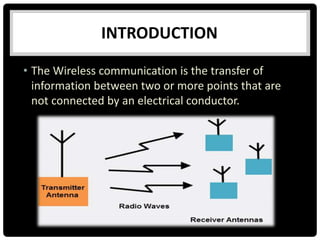
• The Wireless communication is the transfer of
information between two or more points that are
not connected by an electrical conductor.
• A message is transmitted through open space by EM
waves called radio waves.
• Radio waves are radiated from transmitter in open
space through a device called Antenna.
• A receiving antenna intercepted the radio waves at
receiver
INTRODUCTION
• During this transmission, some losses occur between
the transmitter and receiver is known as propagation
path loss.
• Path loss is the unwanted reduction in power of the
signal which is transmitted.
• This path loss may be arising by various effects such
as reflection, diffraction, scattering.
INTRODUCTION
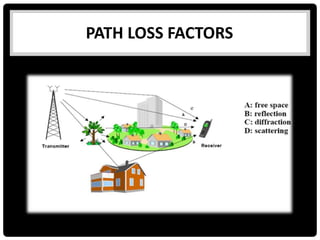
PATH LOSS FACTORS
• Reflection: occurs when waves encounters a surface
of earth, building and walls.
• Diffraction: occurs when propagating
electromagnetic waves encounters at edges of an
impenetrable body.
• Scattering: occurs when waves encounters by rough
surfaces, small obstacles.
PATH LOSS FACTORS
• Service area network: Geographical area in which
wireless service providers offer their service or coverage.
• Path loss: The path loss is the difference (in dB) between
the transmitted power and the received power.
• Propagation model: It is an empirical mathematical
formulation to characterize the behavior of the radio
waves as a function of frequency, surrounding
environment and distance.
PROPAGATION MODELS
A propagation model describes the average signal
propagation and it provides the maximum cell range
with respect to the maximum propagation loss. It
depends on the following:
• Environments (urban, sea, rural, forest, dense)
• Distance
• Frequency
• Atmospheric conditions
• Indoor/Outdoor
PROPAGATION MODELS
These path loss models can be categorized into two
types:
• Outdoor propagation models
• Indoor propagation path loss models.
TYPES
OUTDOOR PROPAGATION MODELS
Outdoor radio transmission takes place over an
irregular terrain e.g. trees buildings and hills must be
taken into consideration.
The outdoor propagation models are:
• Longley-RIce Model
• Durkin's Model
• Okumura Model
• Hata Model
WHY INDOOR MODELS
 Outdoor Models are not accurate for Indoor scenarios
 Home, Shopping mall, office building, etc.
 Indoor radio channel differs from traditional mobile radio
channel in :
 Distances covered are much smaller.
 Variability of the environment is greater for a much smaller range
or T-R separation distances.
INDOOR PROPAGATION MODELS
Indoor propagation models are a radio propagation
model that estimates the path loss inside a room or a
closed area inside a building delimited by walls of any
form.
The indoor propagation models are:
• ITU Indoor Path Loss Model
• Log-Distance Path Loss Model
• Ericsson Multiple Breakpoint Model
The propagation inside a building is influenced by:
 Layout of the building.
 Construction Materials.
 Building type:
 Traditional office building with fixed walls (Hard Partitions)
 Open plan buildings with movable wall panels (Soft Partitions)
 Sports Arena
 Residential Home
 Factory
INDOOR PROPAGATION MODELS
OUTDOOR & INDOOR
Similarity
Reflection
Diffraction
Scattering
Difference
Doors/Windows open or not
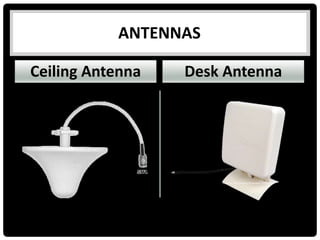
The mounting place of
antenna
 Desk
 Ceiling
The level of floors
ANTENNAS
Ceiling Antenna Desk Antenna
PARTITION LOSSES
• Partition Losses (Same Floor)
• Partition Losses between floors
• Signal Penetration into Buildings
PARTITION LOSSES (SAME FLOOR)
• Buildings have a wide variety of partitions and
obstacles which form the internal and external
structure.
• Partitions that are formed as part of the building
structure are called hard partitions, and partitions
that may be moved and which do not span to the
ceiling are called soft partitions.
PARTITION LOSSES (SAME FLOOR)
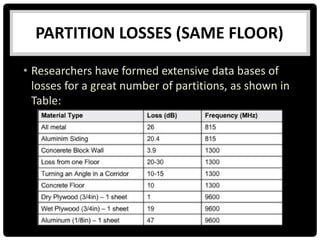
• Researchers have formed extensive data bases of
losses for a great number of partitions, as shown in
Table:
PARTITION LOSSES BETWEEN FLOORS
The losses between floors of a building are detemined
by:
 External dimensions and materials of the building.
 Type of construction used to create floors.
 External surroundings.
 Number of windows.
PARTITION LOSSES BETWEEN FLOORS
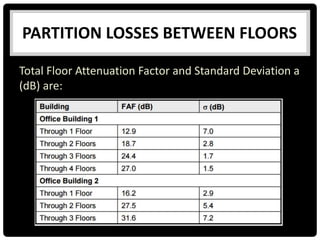
Total Floor Attenuation Factor and Standard Deviation a
(dB) are:
SIGNAL PENETRATION INTO
BUILDINGS
• RF signals can penetrate from outside transmitter to
the inside of buildings however the signals are
attenuated.
• The path loss during penetration has been found to
be a function of:
1. Frequency of the signal
2. The height of the building
• ITU Indoor Path Loss Model
• Log-Distance Path Loss Model
• Ericsson Multiple Breakpoint Model
INDOOR PATH LOSS MODEL
ITU INDOOR PATH LOSS MODEL
• This estimates the path loss inside a room or a closed
area inside a building delimited by walls of any form.
• This model is applicable to only the indoor
environments.
• Appliances use the lower microwave bands around
2.4 GHz.
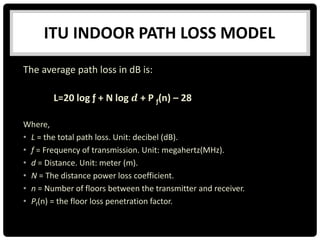
ITU INDOOR PATH LOSS MODEL
The average path loss in dB is:
L=20 log ƒ + N log 𝒅 + P ƒ(n) – 28
Where,
• L = the total path loss. Unit: decibel (dB).
• f = Frequency of transmission. Unit: megahertz(MHz).
• d = Distance. Unit: meter (m).
• N = The distance power loss coefficient.
• n = Number of floors between the transmitter and receiver.
• Pf(n) = the floor loss penetration factor.
ITU INDOOR PATH LOSS MODEL
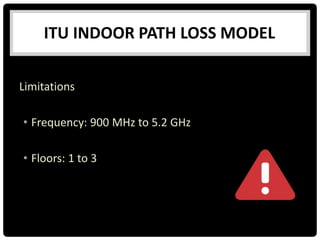
Limitations
• Frequency: 900 MHz to 5.2 GHz
• Floors: 1 to 3
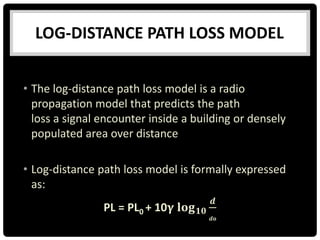
LOG-DISTANCE PATH LOSS MODEL
• The log-distance path loss model is a radio
propagation model that predicts the path
loss a signal encounter inside a building or densely
populated area over distance
• Log-distance path loss model is formally expressed
as:
PL = PL0 + 10𝛄 𝐥𝐨𝐠 𝟏𝟎
𝒅
𝒅𝐨
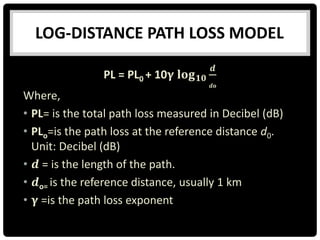
LOG-DISTANCE PATH LOSS MODEL
PL = PL0 + 10𝛄 𝐥𝐨𝐠 𝟏𝟎
𝒅
𝒅𝐨
Where,
• PL= is the total path loss measured in Decibel (dB)
• PLo=is the path loss at the reference distance d0.
Unit: Decibel (dB)
• 𝒅 = is the length of the path.
• 𝒅o= is the reference distance, usually 1 km
• 𝛄 =is the path loss exponent
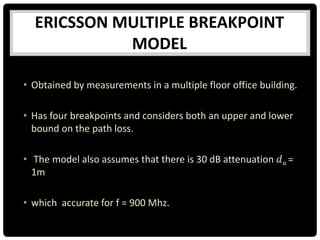
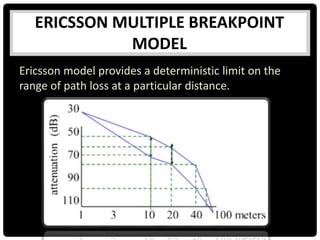
ERICSSON MULTIPLE BREAKPOINT
MODEL
• Obtained by measurements in a multiple floor office building.
• Has four breakpoints and considers both an upper and lower
bound on the path loss.
• The model also assumes that there is 30 dB attenuation 𝑑o =
1m
• which accurate for f = 900 Mhz.
ERICSSON MULTIPLE BREAKPOINT
MODEL
Ericsson model provides a deterministic limit on the
range of path loss at a particular distance.
Indoor propogation

Indoor propogation

  • 1.
    SUB MI TT ED TO: MR .TAI MOOR INDOOR PROPAGATION
  • 2.
    GROUP MEMBERS • HafizMuneeb Ahmad • Syed Irtaza Haider • Ejaz Tabassum • Hamza
  • 3.
    CONTENTS • Introduction • Pathloss factor • Propagation models • Types • Difference Between Indoor and Outdoor • Partition Losses • Indoor models
  • 4.
    INTRODUCTION • The Wirelesscommunication is the transfer of information between two or more points that are not connected by an electrical conductor.
  • 5.
    • A messageis transmitted through open space by EM waves called radio waves. • Radio waves are radiated from transmitter in open space through a device called Antenna. • A receiving antenna intercepted the radio waves at receiver INTRODUCTION
  • 6.
    • During thistransmission, some losses occur between the transmitter and receiver is known as propagation path loss. • Path loss is the unwanted reduction in power of the signal which is transmitted. • This path loss may be arising by various effects such as reflection, diffraction, scattering. INTRODUCTION
  • 7.
    PATH LOSS FACTORS •Reflection: occurs when waves encounters a surface of earth, building and walls. • Diffraction: occurs when propagating electromagnetic waves encounters at edges of an impenetrable body. • Scattering: occurs when waves encounters by rough surfaces, small obstacles.
  • 8.
  • 9.
    • Service areanetwork: Geographical area in which wireless service providers offer their service or coverage. • Path loss: The path loss is the difference (in dB) between the transmitted power and the received power. • Propagation model: It is an empirical mathematical formulation to characterize the behavior of the radio waves as a function of frequency, surrounding environment and distance. PROPAGATION MODELS
  • 10.
    A propagation modeldescribes the average signal propagation and it provides the maximum cell range with respect to the maximum propagation loss. It depends on the following: • Environments (urban, sea, rural, forest, dense) • Distance • Frequency • Atmospheric conditions • Indoor/Outdoor PROPAGATION MODELS
  • 11.
    These path lossmodels can be categorized into two types: • Outdoor propagation models • Indoor propagation path loss models. TYPES
  • 12.
    OUTDOOR PROPAGATION MODELS Outdoorradio transmission takes place over an irregular terrain e.g. trees buildings and hills must be taken into consideration. The outdoor propagation models are: • Longley-RIce Model • Durkin's Model • Okumura Model • Hata Model
  • 13.
    WHY INDOOR MODELS Outdoor Models are not accurate for Indoor scenarios  Home, Shopping mall, office building, etc.  Indoor radio channel differs from traditional mobile radio channel in :  Distances covered are much smaller.  Variability of the environment is greater for a much smaller range or T-R separation distances.
  • 14.
    INDOOR PROPAGATION MODELS Indoorpropagation models are a radio propagation model that estimates the path loss inside a room or a closed area inside a building delimited by walls of any form. The indoor propagation models are: • ITU Indoor Path Loss Model • Log-Distance Path Loss Model • Ericsson Multiple Breakpoint Model
  • 15.
    The propagation insidea building is influenced by:  Layout of the building.  Construction Materials.  Building type:  Traditional office building with fixed walls (Hard Partitions)  Open plan buildings with movable wall panels (Soft Partitions)  Sports Arena  Residential Home  Factory INDOOR PROPAGATION MODELS
  • 16.
    OUTDOOR & INDOOR Similarity Reflection Diffraction Scattering Difference Doors/Windowsopen or not The mounting place of antenna  Desk  Ceiling The level of floors
  • 17.
  • 18.
    PARTITION LOSSES • PartitionLosses (Same Floor) • Partition Losses between floors • Signal Penetration into Buildings
  • 19.
    PARTITION LOSSES (SAMEFLOOR) • Buildings have a wide variety of partitions and obstacles which form the internal and external structure. • Partitions that are formed as part of the building structure are called hard partitions, and partitions that may be moved and which do not span to the ceiling are called soft partitions.
  • 20.
    PARTITION LOSSES (SAMEFLOOR) • Researchers have formed extensive data bases of losses for a great number of partitions, as shown in Table:
  • 21.
    PARTITION LOSSES BETWEENFLOORS The losses between floors of a building are detemined by:  External dimensions and materials of the building.  Type of construction used to create floors.  External surroundings.  Number of windows.
  • 22.
    PARTITION LOSSES BETWEENFLOORS Total Floor Attenuation Factor and Standard Deviation a (dB) are:
  • 23.
    SIGNAL PENETRATION INTO BUILDINGS •RF signals can penetrate from outside transmitter to the inside of buildings however the signals are attenuated. • The path loss during penetration has been found to be a function of: 1. Frequency of the signal 2. The height of the building
  • 24.
    • ITU IndoorPath Loss Model • Log-Distance Path Loss Model • Ericsson Multiple Breakpoint Model INDOOR PATH LOSS MODEL
  • 25.
    ITU INDOOR PATHLOSS MODEL • This estimates the path loss inside a room or a closed area inside a building delimited by walls of any form. • This model is applicable to only the indoor environments. • Appliances use the lower microwave bands around 2.4 GHz.
  • 26.
    ITU INDOOR PATHLOSS MODEL The average path loss in dB is: L=20 log ƒ + N log 𝒅 + P ƒ(n) – 28 Where, • L = the total path loss. Unit: decibel (dB). • f = Frequency of transmission. Unit: megahertz(MHz). • d = Distance. Unit: meter (m). • N = The distance power loss coefficient. • n = Number of floors between the transmitter and receiver. • Pf(n) = the floor loss penetration factor.
  • 27.
    ITU INDOOR PATHLOSS MODEL Limitations • Frequency: 900 MHz to 5.2 GHz • Floors: 1 to 3
  • 28.
    LOG-DISTANCE PATH LOSSMODEL • The log-distance path loss model is a radio propagation model that predicts the path loss a signal encounter inside a building or densely populated area over distance • Log-distance path loss model is formally expressed as: PL = PL0 + 10𝛄 𝐥𝐨𝐠 𝟏𝟎 𝒅 𝒅𝐨
  • 29.
    LOG-DISTANCE PATH LOSSMODEL PL = PL0 + 10𝛄 𝐥𝐨𝐠 𝟏𝟎 𝒅 𝒅𝐨 Where, • PL= is the total path loss measured in Decibel (dB) • PLo=is the path loss at the reference distance d0. Unit: Decibel (dB) • 𝒅 = is the length of the path. • 𝒅o= is the reference distance, usually 1 km • 𝛄 =is the path loss exponent
  • 30.
    ERICSSON MULTIPLE BREAKPOINT MODEL •Obtained by measurements in a multiple floor office building. • Has four breakpoints and considers both an upper and lower bound on the path loss. • The model also assumes that there is 30 dB attenuation 𝑑o = 1m • which accurate for f = 900 Mhz.
  • 31.
    ERICSSON MULTIPLE BREAKPOINT MODEL Ericssonmodel provides a deterministic limit on the range of path loss at a particular distance.