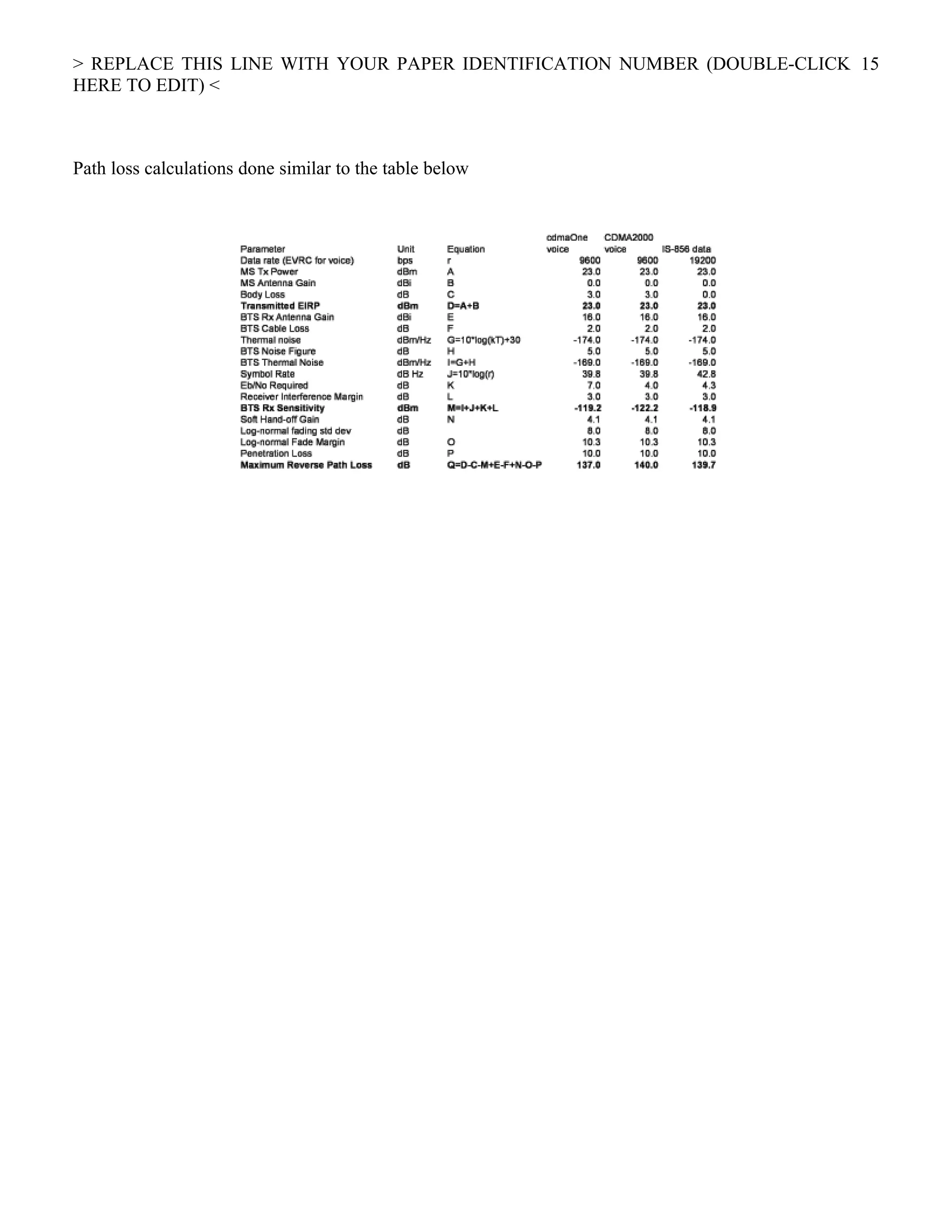
This paper discusses propagation modeling for urban environments. It describes the various effects that impact signal propagation in cities, such as multipath fading caused by signals reflecting off buildings. Empirical propagation models like COST 231 are developed based on extensive measurements to characterize path loss in urban areas. The paper also examines diffraction effects caused by obstructions blocking the first Fresnel zone and the impact of weather on radio wave propagation. Modeling is done of signal propagation around the University of Colorado campus to validate the COST 231 model for suburban environments.
![> REPLACE THIS LINE WITH YOUR PAPER IDENTIFICATION NUMBER (DOUBLE-CLICK
HERE TO EDIT) <
1. INTRODUCTION
n the tropospheric region which extends upto12 km above the earths surface the radio waves are
transmitted and received through microwave links and between these microwave links we have a
constantly changing environment which influences the propagation characteristics of these waves. The
electromagnetic radiation in this region is called as the ground waves and sky waves and similar to light
these electromagnetic radiations experience various effects such as reflection, scattering, attenuation and
diffraction. As to which of these effects occur, it is dependent on the surface which the electromagnetic
wave encounters. If the wave impinges on an object which is comparable to its wavelength it experiences
reflection. When it encounters a sharp irregular edge it undergoes diffraction and scattering is caused by
objects way smaller than the wavelength of the propagating wave.
I
When electromagnetic waves are propagated over extended distances they experience fading. This occurs
because of the changing distance between the receiver and transmitter and the changes in the atmospheric
conditions. Fading can be split into three types, fading in free space, large-scale fading or shadowing and
small scale fading. It is important to measure the path loss in all the cases as it provides us with useful
information to what happens to these electromagnetic radiations in a statistical sense. For each of these
fading types different models have been proposed and implemented. All these models try to define the path
loss component for different environments. The simplest way of defining path loss is that it’s the ratio
between the received power to the transmitted power. For free space propagation the power ratio of a
microwave system can be given by the Friss formulae.
, (1)
Where, Pt and Pr are the transmitted and received power and Gt and Gr are the gains of the transmitting and
receiving antennas respectively. As most Rf comparison and measurements are performed in decibles and it
is a consistent method to determine the signal level at any given point, we manipulate the equation to a
logarithmic format to obtain the equation below [1].
L(dB) = 32.45+20log(f/fo)+20log(d/d0) (2)
The path loss is highly dependent on the environment; a dense region such as an urban city will have higher
path loss compared to a suburban region. It is important to develop empirical models as they are less site
specific and provide a first order modeling for a wide range of similar locations. Developing all these
models consume a lot of time and cost. Hence, these models are always developed around PCS frequencies
(800 MHz to 1900 Mhz) which are commercially used by cellular companies and extended over other
frequencies. These empirical models are mostly applicable to outdoor environments but when we model for
indoor propagation the modeling is mostly site specific with features specific to a particular building: wall
thickness, construction material used, floor and ceiling material etc. Since most of the buildings have sharp
edges, diffraction is a very common phenomenon in indoor propagation or in a region comprising lots of
building. The diffraction losses are often calculated as a function of obstruction with respect to the first
Fresnel zone. Fresnel zones are zones delimited by prolate ellipsoids of revolution with transmitter and
receiver as the two foci [2]; the nth
Fresnel zone is the loci of points with an excess path between (n-1)λ/2
and (n)λ/2 over the direct path. The odd Fresnel zones especially the first carry most of the propagation
energy; therefore it is highly essential the designed microwave link clears this region so as to have an
effective communication link.
2](https://image.slidesharecdn.com/81265bfa-d49d-45f1-8d2e-e5f5639d09d5-161104135713/75/ECEN-5264-TERM-PAPER_Mithul-Thanu-2-2048.jpg)
![> REPLACE THIS LINE WITH YOUR PAPER IDENTIFICATION NUMBER (DOUBLE-CLICK
HERE TO EDIT) <
The equation for the power received is given below
(3)
Where l1 and l’
1 are defined below
(4)
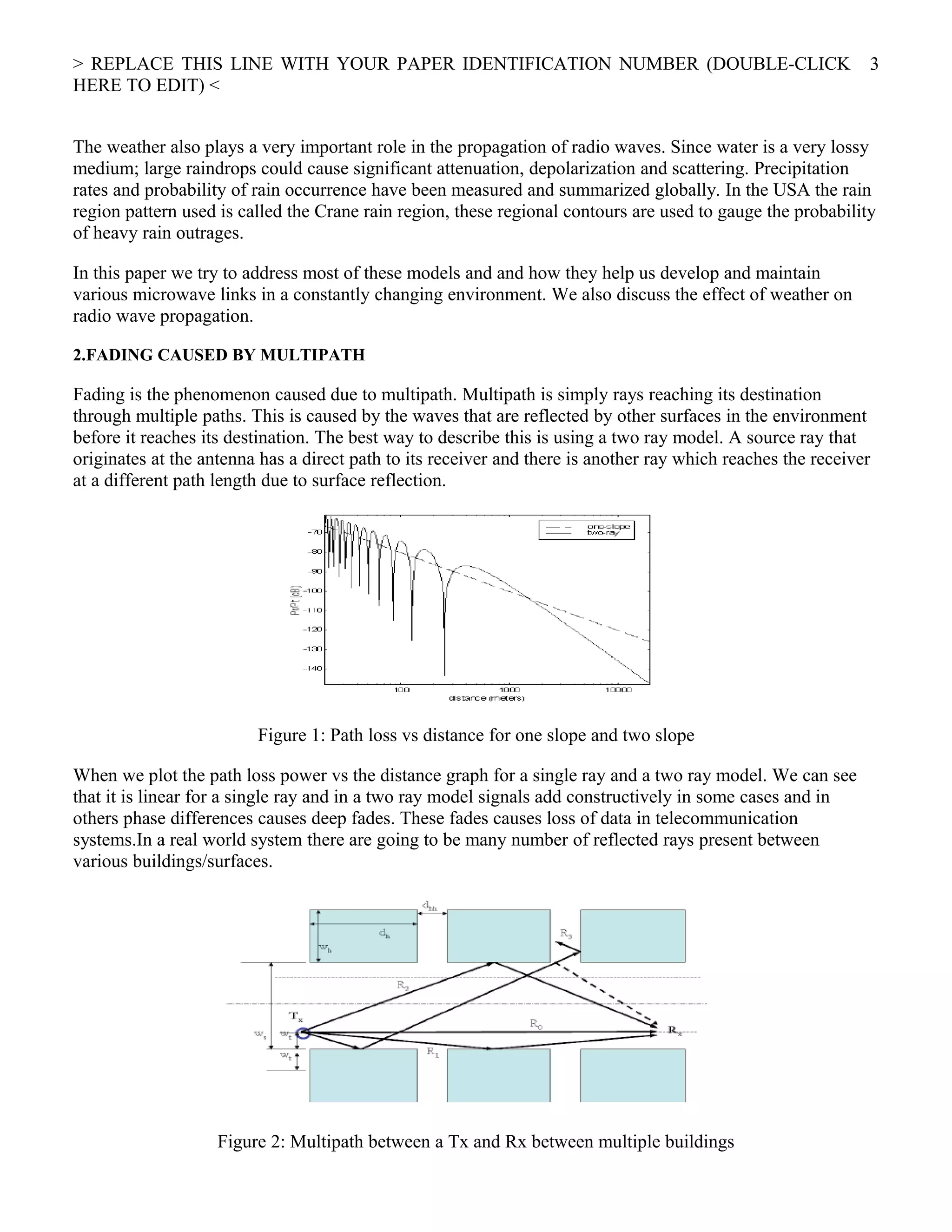
We assume a value of 10 feet for Wt and 40 feet for Ws and obtain the plot below.
Figure 3: Plot of fades caused my multipaths
We observe as we increase the number of rays the number of fades also increases this is due to the
destructive interference between multiple rays.
3. PROPAGATION MODEL IN URBAN AND SUB-URBAN CHANNELS
To overcome these fades and to provide an efficient microwave link; empirical models were designed.
Extensive measurements were performed in different urban and suburban environments and were modeled
into a general equation, of these the most significant empirical model was the COST 231-Hata model. This
model was derived by Okumura by performing extensive measurements and was later put into equation by
Hata and this model provides effective path loss estimates for large urban cells, suburban as well as rural
regions[3]. The derived equation is given below
LHata = c0 + cf log(f/1MHz) – b(hB/1m) – a(hM/1m) + (44.9-6.55 log(hB/1m)) log(d/1km) + CM (5)
The co cf and b(hB) almost remain constant between different regions. The values of a(hM) and CM vary
extensively and are modeled according to the city size and height. The data book of the COST project gives
the values for different cities. Using the above model we try to design the propagation characteristics in
Boulder at the University of Colorado campus. A signal generator was set up to transmit at 785 MHz
frequency form the engineering center through a directional panel antenna. Various data points of receiver
4](https://image.slidesharecdn.com/81265bfa-d49d-45f1-8d2e-e5f5639d09d5-161104135713/75/ECEN-5264-TERM-PAPER_Mithul-Thanu-4-2048.jpg)
![> REPLACE THIS LINE WITH YOUR PAPER IDENTIFICATION NUMBER (DOUBLE-CLICK
HERE TO EDIT) <
power were measured using a spectrum analyzer outside the engineering center and the readings are
tabulated as below. Antenna parameters are provided in the Appendix [A1].
Table 1: Measurements of received power at various distances
These data points were fed into EDX propagation design software and the actual propagation model was
designed.
Figure 4: Free space Propagation model
From the above design we can see that only 4 data points matches the actual measured values. This is
because the free space propagation model only considers the decay in power with respect do distance and
does not account for the fades from multipath. Now we calculate the various parameters of the COST 231
model for a suburban environment and input it in the EDX design software and run the simulation. We
import the antenna lobe pattern [A2] into the simulation tool and we obtain the COST 231 propagation
model and this model has managed to match 14 of the 21 different data points proving that it is an efficient
sub urban propagation model. The modeling equation for the sub-urban environment in boulder is given
below along with the propagation pattern.
5](https://image.slidesharecdn.com/81265bfa-d49d-45f1-8d2e-e5f5639d09d5-161104135713/75/ECEN-5264-TERM-PAPER_Mithul-Thanu-5-2048.jpg)
![> REPLACE THIS LINE WITH YOUR PAPER IDENTIFICATION NUMBER (DOUBLE-CLICK
HERE TO EDIT) <
Lhata = 69.55 dB + 26.16 log(f/1MHz) – 13.82 (hB/1m) – 1.1 log( f/1Mhz) - 0.7)hM/1m – 1.56 log ( f/1Mhz)
+ 0.8 + (44.9 – 6.55 log(hb/1m)) log (d/1km) – 2(log ( f/28mhz))2
- 5.4 (6)
Where hB defines the height of the base station or the Rx antenna whick can vary from 10m to 100m, hM
height of the mobile terminal which ranges from 0 m to10 m and hb gives the average height of the building
around the datapoints. For our case we assumed this to be 15-30 meters. We could only match 14 points
because of approximation of height values. Model is more accurate for accurate values of assumed height.
In the equation we have substituted values of c0, cf, b(hB),a(hM) and CM from the data book for a suburban
terrain operation between frequency range of 500-1500 MHz for a COST 231Hata model [A3]. The
software computes the Lhata and modifies the propagation model as given below and proves its validity for
suburban environments by managing to obtain a closer propagation model to the actual readings.
Figure 5: COST 231 propagation model
There is another model derived from the COST 231 model called the COST 231-Walfish Ikegami Model.
This model is based on the considerations of reflection and scattering above and between buildings in urban
environments. It considers the LOS and the NLOS situations hence it has an additional term compared to
the previous equation
LNLOS = L0 + Max{0, Lrts + Lmsd} (7)
The Lrts and the Lmsd are the factors representing the diffraction and scatters from rooftop to streets and Lmsd
is the Multi-diffraction between buildings. This model enables us to obtain a better model for dense urban
environments by tweaking the Loss equation by including additional parameters.
3. SMALL SCALE AND LARGE SCALE FADING
Small scale fading is explained by the fact that, the instantaneous received signal is a sum of many
contributions coming from different directions due to the many reflections of the transmitted signal
reaching the receiver [5]. In the time domain, multipath parameters can be seen as the spread of the arriving
waves but in the frequency domain, the concept becomes less intuitive and relates to a coherence
bandwidth, which refers to the width of the spectrum attenuated by the fade. Depending on the coherence
bandwidth the wave experiences flat fading or frequency selective fading. The amplitude of the signal
follows a Rayleigh fading distribution.Rayleigh fading channels are used in empirical urban studies and are
6](https://image.slidesharecdn.com/81265bfa-d49d-45f1-8d2e-e5f5639d09d5-161104135713/75/ECEN-5264-TERM-PAPER_Mithul-Thanu-6-2048.jpg)
![> REPLACE THIS LINE WITH YOUR PAPER IDENTIFICATION NUMBER (DOUBLE-CLICK
HERE TO EDIT) <
accepted to model multipath environments with no direct line of sight. The channel amplitude follows the
Rayleigh distribution:
P(α) = (2α /Ω) exp ( - α2
/Ω) (8)
Where, Ω is the mean square value of α
Now moving over to large scale fading which corresponds to losses caused due to blockage such as a
receiver turning into a corner or entering a building. This large-scale fading is referred to as shadowing.
Large scale variations caused by shadowing follow log normal distribution, which means when they are
converted to dB values they follow a Gaussian distribution.
P0(R) =1/2 erfc (-F/σ ) (9)
This is useful for calculating the edge reliability in wireless communications.
4. DIFFRACTION AND CLUTTER
Diffraction loss is a very significant component of microwave design. It depends on the path clearance, for
a given path clearance the diffraction loss will vary from a minimum value for a single knife-edge
obstruction to a maximum for smooth spherical obstructions [6]. Most of the microwave energy is
concentrated within the first Fresnel zone and the diffraction loss is always calculated as a function of
obstruction with respect to the first Fresnel zone. The dotted lines in the figure below represent the 1st
2nd
and 3rd
Fresnel zones. The obstruction height must always clear the first Fresnel zone or the microwave link
is going to suffer clutter or diffraction loss.
Figure 6: Fresnel zone geometry
F1 the radius of the first Fresnel ellipsoid can be approximated by the following formulae.
F1 = 17.3 (d1d2/f*d)1/2
(10)
There are infinite Fresnel zone in an real world environment. The even Fresnel are generally ignored
because they are totally in out of phase with the original signal and hence out the original signal and hence
it is not required in the design of a radio path. The diffraction loss is small when at least 55% of the first
Fresnel zone is cleared. There by using the formulae we can design systems so that it clears the 1st
Fresnel
zone.
7](https://image.slidesharecdn.com/81265bfa-d49d-45f1-8d2e-e5f5639d09d5-161104135713/75/ECEN-5264-TERM-PAPER_Mithul-Thanu-7-2048.jpg)
![> REPLACE THIS LINE WITH YOUR PAPER IDENTIFICATION NUMBER (DOUBLE-CLICK
HERE TO EDIT) <
To prove this we setup an antenna to radiate at 785 Mhz frequency using an antenna at a window in the
basement so there is NLOS measurement and various data points are noted on the map and measurements
of received power are taken at these points. We plot the radiation characteristics using the EDX software
without accounting for any of the environmental factors and considering it as a free space propagation
model.
Point RcvdPowerdBm Antangle Antgain dBi EIRP(dBm) pathloss dist(m) Receivedpower #VALUE!
1 -40.1 0 0 10 43 -93.1 100 -37.6 2
165N -66.7 20 -2 8 41 -115.7 165 -80 2.217484
181S -60.34 -30 -5 5 38 -103.34 181 -140 2.257679
2 -45.1 0 0 10 43 -98.1 200 -43.1 2.30103
254N -62.74 10 -1 9 42 -113.74 254 -73 2.404834
268N -87.8 30 -5 5 38 -130.8 268 -80.1 2.428135
270S -77.27 -20 -2 8 41 -126.27 270 -140 2.431364
3 -49.55 0 0 10 43 -102.55 300 -46.9 2.477121
320S -73.78 -10 -1 9 42 -124.78 320 -140 2.50515
325S -79.5 -30 -5 5 38 -122.5 325 -140 2.511883
4 -50.8 0 0 10 43 -103.8 400 -49.7 2.60206
400N -80 20 -2 8 41 -129 400 -93.2 2.60206
454S -51.3 -20 -2 8 41 -100.3 454 -90.9 2.657056
5 -68.5 0 0 10 43 -121.5 500 -91.7 2.69897
510N -84 30 -5 5 38 -127 510 -96.5 2.70757
510S -39.2 -30 -5 5 38 -82.2 510 -140 2.70757
550N -83 10 -1 9 42 -134 550 -82.8 2.740363
550S -85.3 -10 -1 9 42 -136.3 550 -140 2.740363
580S -81.8 -20 -2 8 41 -130.8 580 -140 2.763428
581N -86 20 -2 8 41 -135 581 -140 2.764176
582 -140 0 0 10 43 NA 582 -87.4 2.764923
Table 2 : Received power for 785 Hz at various data points
Figure 6: Free space propagation model
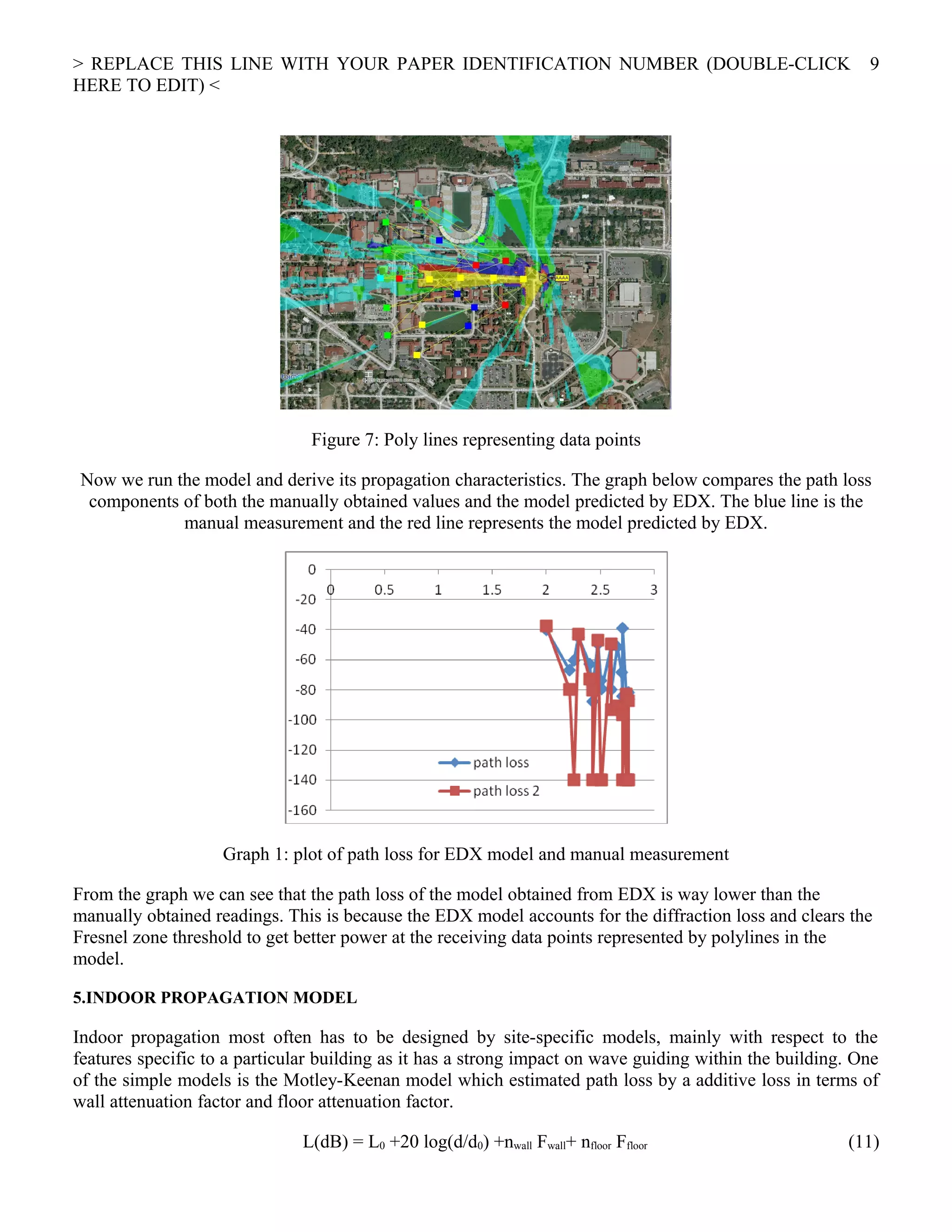
Now we zoom in to the model and draw the poly lines to tweak the model and account for the region data
and the average height of objects around the data points for clutter and diffraction losses [A4].
8](https://image.slidesharecdn.com/81265bfa-d49d-45f1-8d2e-e5f5639d09d5-161104135713/75/ECEN-5264-TERM-PAPER_Mithul-Thanu-8-2048.jpg)
![> REPLACE THIS LINE WITH YOUR PAPER IDENTIFICATION NUMBER (DOUBLE-CLICK
HERE TO EDIT) <
The model simply approximates the number of walls and floors with an average loss for each. The COST
project also proposed a model for indoor penetration. This model considers the angle through which the
radiation enters a building and the material used to construct the walls of the building.
6. ATMOSPHERIC ABSORBPTION AND ITS EFFECTS
Due to temperature variations in the atmosphere the water vapor content will vary thereby creating different
refractive layers in the atmosphere, which will affect long range microwave links. This effect is dominant
in costal regions as the humidity is high in these regions. They create a refractive gradient in the
atmosphere which leads to multipath and hence fading. When we talk about humidity it directly implies to
the water vapor content in the atmosphere. The atmospheric absorption is dominated by the water vapor
and the oxygen content in the atmosphere. The absorption of microwave energy by oxygen is a result of
magnetic dipole interactions with the incident radiation due to the oxygen molecule’s permanent magnetic
dipole moment [7]. This creates transistors between the fine molecular structure levels of the allowed
rotational states. The general absorption rate for oxygen molecule in terms of dB/Km is given below.
AO2 = 7.19x10⁻³
+6.09/(f2
+0.27)+4.81/{(f-57)2
+1.5}) x f2
x10-3
(12)
The absorption of microwave energy by water vapor results from electric dipole interactions and its
theoretical treatment is similar to the case discussed above. The absorption rate can be given by the
following equation.
[13]
7. IMPACT OF RAIN ON RADIO CHANNELS
As we have seen in the earlier case water is a very lossy medium and as the size of the rain drop increases it
tends to leave its spherical shape and transforms to more of an oblate ellipsoid. Due to this change in shape
of the rain drop, its effect is more dominant in the horizontally polarized wave compared to that of the
vertically polarized wave. Hence, most design engineers prefer to use the vertically polarized wave. Also,
rain fades have more dominant effects on higher frequencies. Since, rain storms are a more localized
phenomena it only affects a portion of the microwave link. Hence various measurements are done
geographically to determine the precipitation rates and probability of rain occurrences. The commonly used
rain region data is the Crain rain region map. With the help of this model it is possible to estimate the
occurrence of rain over a huge geographical region and design systems accordingly. The effective path
length attenuated due to rain can be defined by the equation below:
Deff = d / 1 + (d/d0) [14]
Where do = 35e-0.015R0
.
01
R0.01= 100mm/h.
The rain attenuation is estimated by
A0.01= deff*k*(R0.01)α
[15]
10](https://image.slidesharecdn.com/81265bfa-d49d-45f1-8d2e-e5f5639d09d5-161104135713/75/ECEN-5264-TERM-PAPER_Mithul-Thanu-10-2048.jpg)
![> REPLACE THIS LINE WITH YOUR PAPER IDENTIFICATION NUMBER (DOUBLE-CLICK
HERE TO EDIT) <
Where k and α are the constants defined by the Crain region table.
Thus, it is possible compute rain attenuations for a specific region and design an efficient microwave link.
8. CONCLUSION
In this paper we have discussed how surfaces in urban environments affects the propagation of radio waves.
We managed to design empirical models to contain these propagation effects and how to establish an
effective microwave link in an urban/sub-urban channel also proving their validity by using simulation tool
EDX. Finally, we discuss on the propagation effects caused due to the atmosphere and rain. All these
empirical models and equations do not give a 100% efficient system by they manage to address the most of
the losses and provide us with a sufficiently effective radio link modeling strategy for Urban/Sub-urban
propagation channels.
References
[1] http://www.radio-electronics.com/info/propagation/radio-propagation/radio-propagation-overview-tutorial.php
[2] “Identification of Scattering objects in microcell in Urban Propagation channels” , Mir Ghoraishi, Member, IEEE, Junichi
Takada, Member, IEEE.IEEE TRANSACTIONS ON ANTENNAS AND PROPAGATION, VOL. 54, NO. 11, NOVEMBER
2006.
[3] “Modification of Universal okumura and Hata model for radio wave propagation” ,Lida Akhoondzadeh-Asl and Narges
Noori,IEEE,propagationProceedings of Asia-Pacific Microwave Conference 2007
[4] “Microcell Urban Propagation Channel Analysis Using Measurement Data”, Mir Ghoraishi, Jun-ichi Takada(Tokyo Institute
of Technology),IEEE Proceedings 2005.
[5] ”Morse.colorado.edu”,Notes Thomas Schwengler.
[6]” Full-Wave Computation of Clutter for VHF Ground RADAR over Irregular Terrain”,Le pauld,Ieee,
Radar, 2001 CIE International Conference on, Proceedings,p314-318.
[7] “The absorbption of radio waves by oxygen and watervapor in the atmosphere”,Straiton.a,IEEE TRANSACTIONS ON
ANTENNAS AND PROPAGATION, JULY 1975.
11](https://image.slidesharecdn.com/81265bfa-d49d-45f1-8d2e-e5f5639d09d5-161104135713/75/ECEN-5264-TERM-PAPER_Mithul-Thanu-11-2048.jpg)
![> REPLACE THIS LINE WITH YOUR PAPER IDENTIFICATION NUMBER (DOUBLE-CLICK
HERE TO EDIT) <
APPENDIX
[A1] Antenna parameters
RX antenna:
Dipole Antenna (0.8 to 1 GHz) for 2650A / 2652A / 2658A.
Frequency Range: 0.8 to 1 GHz
Antenna Gain: >1 dBi
VSWR: <1.5
Connector: Type N(m)
Weight: approx. 20 g
Dipole Antenna (0.8 to 1 GHz)
TX antenna:
No ITEM TYPICAL
1 Frequency Range 740 - 785 MHz
2 Impedance 50 ohms
3 VSWR (or Return Loss) < 1.5:1 ( or > 14dB)
4 Gain >9.5dBi
5 Polarization Vertical, Linear
6 3dB Horizontal Beamwidth 66 Degrees
7 3dB Vertical Beamwidth 66 Degrees
8 Front to Back Ratio >20dB
A[2]
Antenna Pattern of 785 MHz.- Pat file - CSI-AP-698-2.2K-7-10 PS700_1.pat
12](https://image.slidesharecdn.com/81265bfa-d49d-45f1-8d2e-e5f5639d09d5-161104135713/75/ECEN-5264-TERM-PAPER_Mithul-Thanu-12-2048.jpg)
![> REPLACE THIS LINE WITH YOUR PAPER IDENTIFICATION NUMBER (DOUBLE-CLICK
HERE TO EDIT) <
A[3]
13](https://image.slidesharecdn.com/81265bfa-d49d-45f1-8d2e-e5f5639d09d5-161104135713/75/ECEN-5264-TERM-PAPER_Mithul-Thanu-13-2048.jpg)
![> REPLACE THIS LINE WITH YOUR PAPER IDENTIFICATION NUMBER (DOUBLE-CLICK
HERE TO EDIT) <
A[4]
Accounting for clutter height and vegetation losses.
Colour codes for the Propagation Figure 6 and 7
Accounting for clutter height values
14](https://image.slidesharecdn.com/81265bfa-d49d-45f1-8d2e-e5f5639d09d5-161104135713/75/ECEN-5264-TERM-PAPER_Mithul-Thanu-14-2048.jpg)