1. Waves propagate or spread outward from their origin through a medium such as air.
2. Electromagnetic waves are created by local disturbances in electric and magnetic fields and propagate uniformly in all directions through a uniform medium.
3. Radio waves can propagate from transmitting to receiving antennas through either ground waves, which travel near the Earth's surface, or sky waves, which are reflected back by the ionosphere.
In this document
Powered by AI
Overview of wave propagation and its significance in transmitting energy via sound and light.
Definition of wave propagation, vibrations, and categorization of sound and light as wave energy.
Details the communication process, electromagnetic wave creation, and its outward propagation.
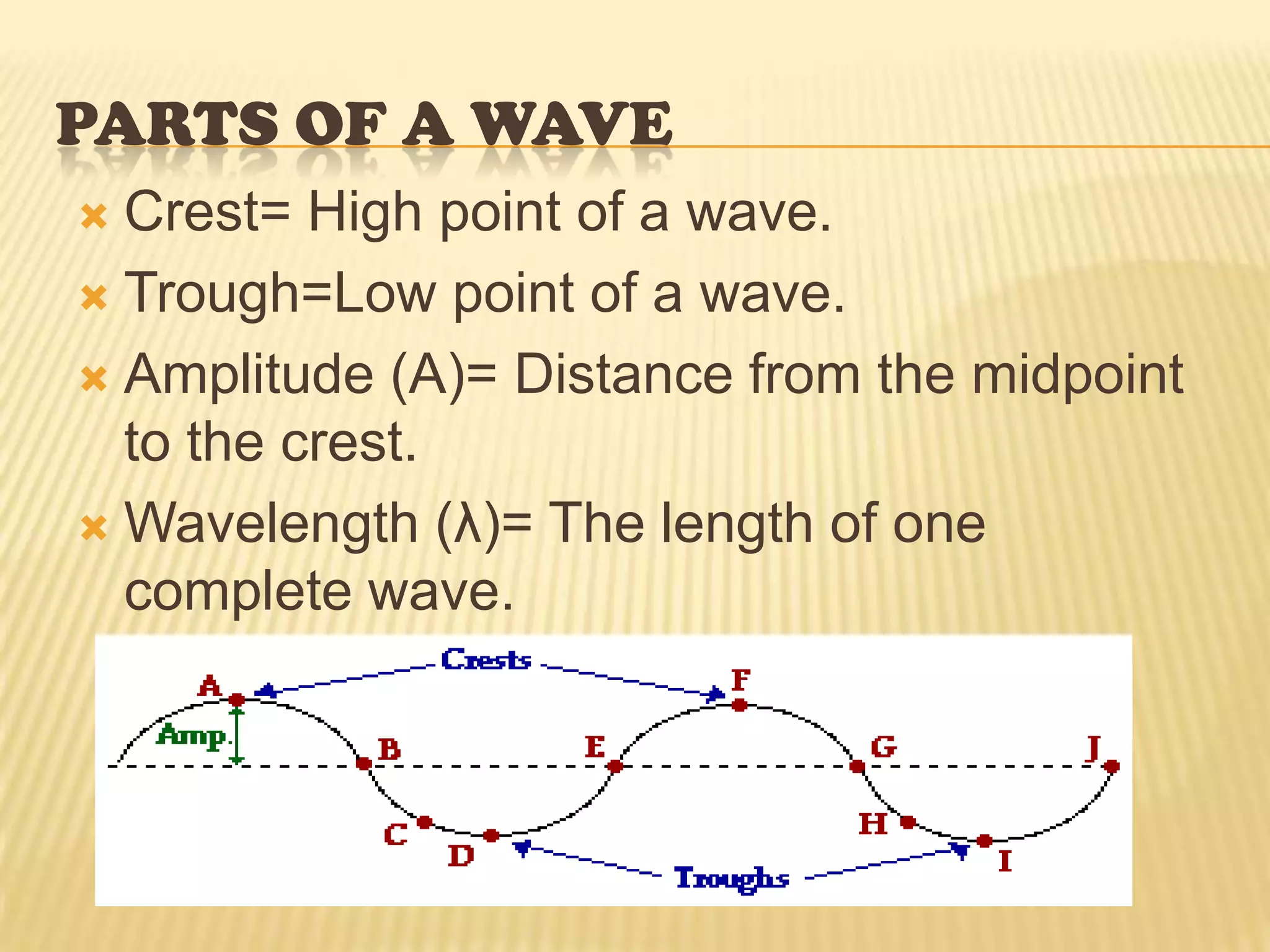
Explains parts of a wave: crest, trough, amplitude, and wavelength.
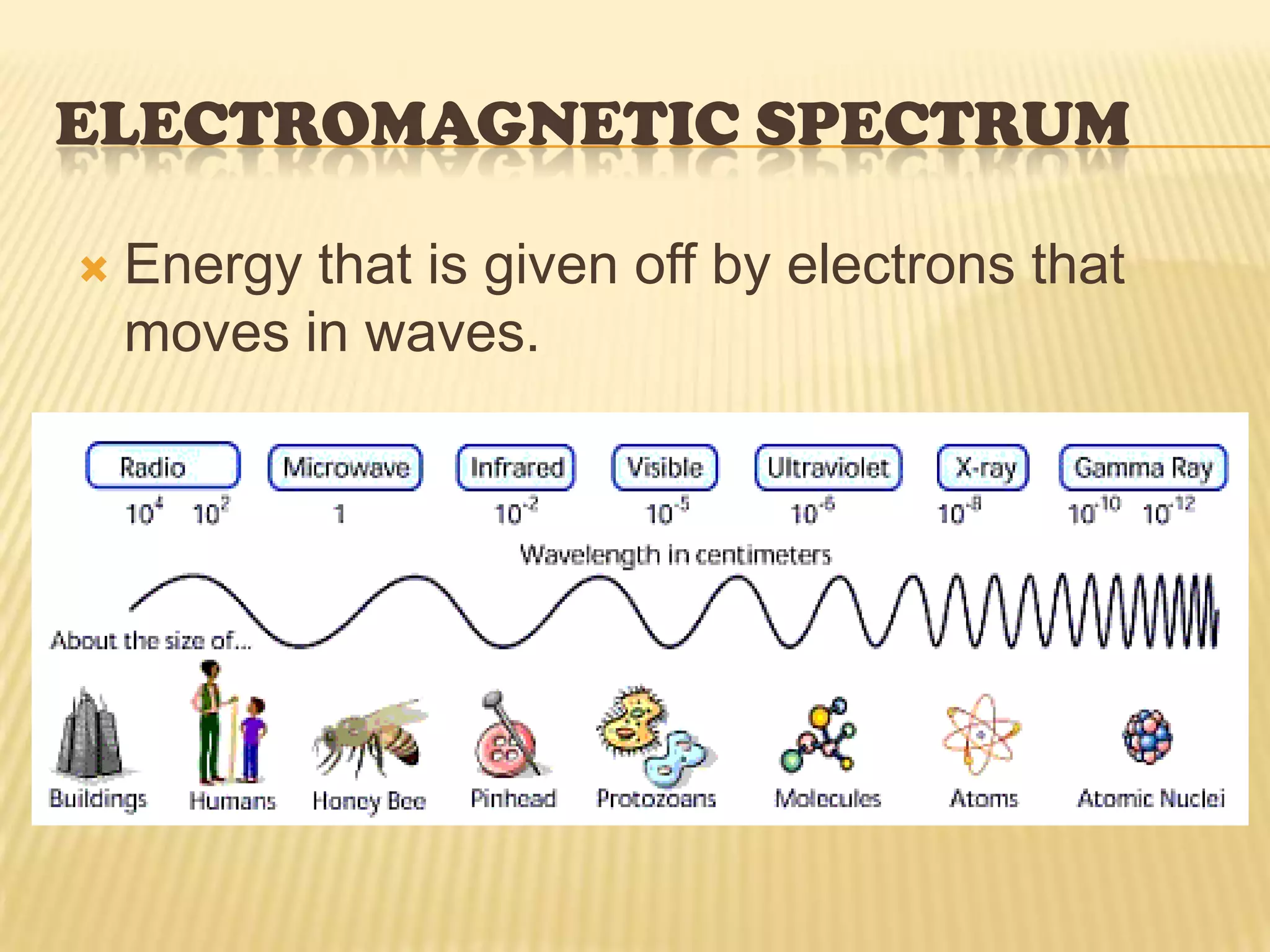
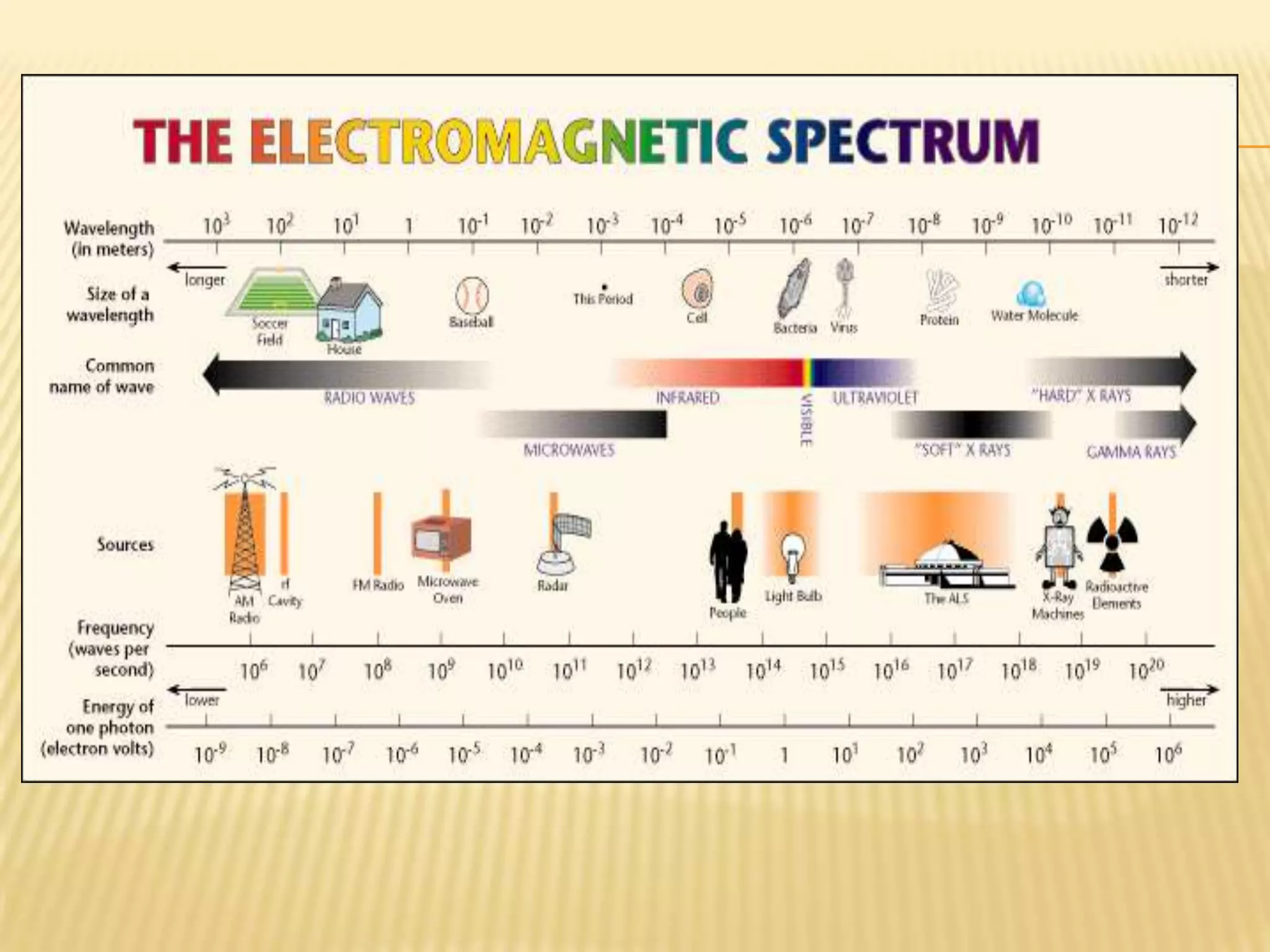
Describes the energy emitted by electrons which travels in waves within the electromagnetic spectrum.
Explains how different mediums affect wave speed, emphasizing faster travel in liquids and solids.
Two methods of electromagnetic wave travel: ground waves and sky waves, with an overview of the ionosphere.
Details the composition of ground waves and their behavior, including diffraction and polarization effects.
Discusses how terrain conductivity affects surface wave attenuation during propagation.
Interactive exercise questions related to electromagnetic waves, energy, and frequency concepts.
Ending slide acknowledging the completion of the presentation.
What does propagationmeans?To reproduce To cause to spread.What is a wave?A vibration or disturbance.SOUND & LIGHT are forms of energy that travel in waves.
3.
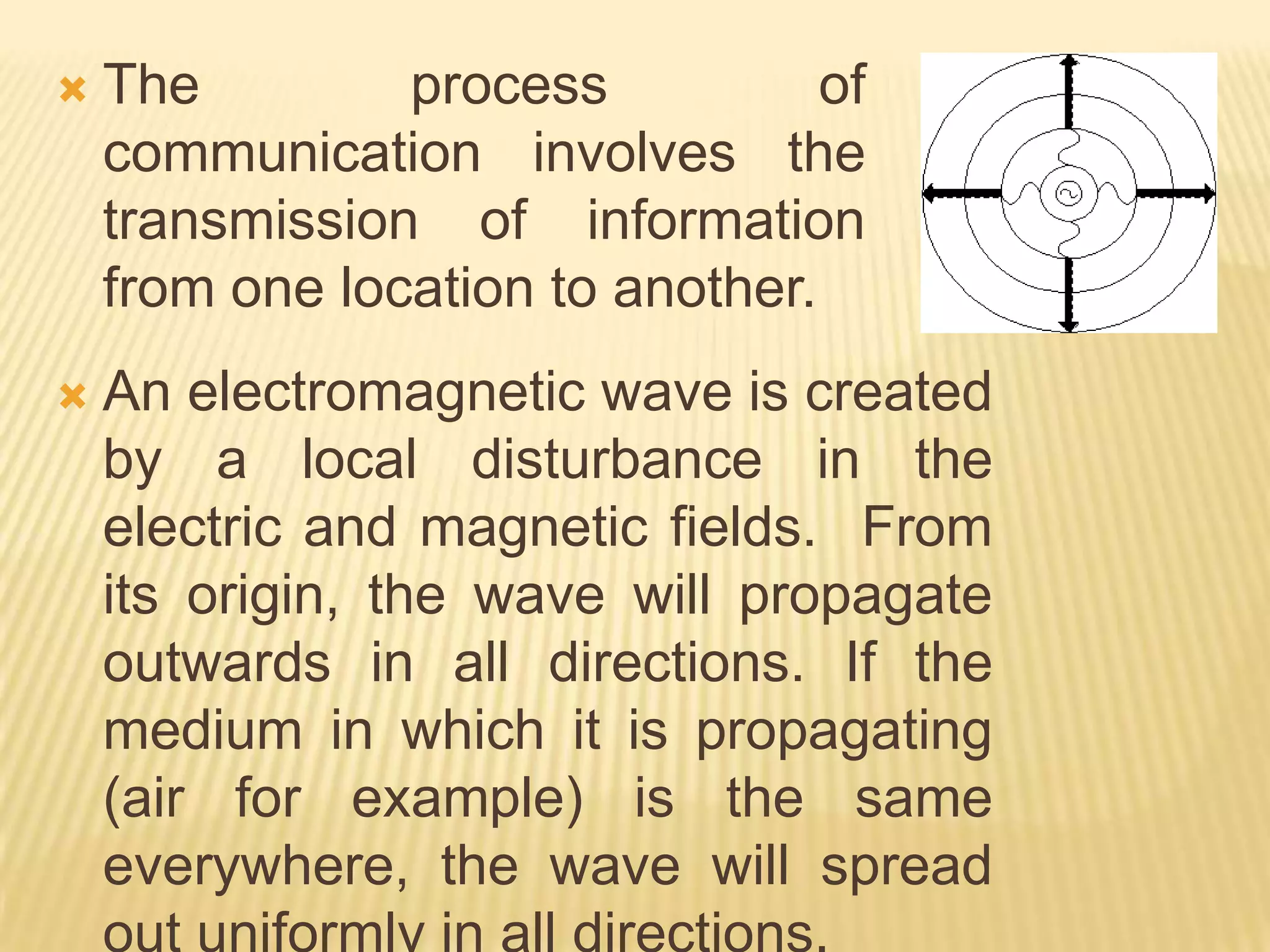
The process ofcommunication involves the transmission of information from one location to another.An electromagnetic wave is created by a local disturbance in the electric and magnetic fields. From its origin, the wave will propagate outwards in all directions. If the medium in which it is propagating (air for example) is the same everywhere, the wave will spread out uniformly in all directions. Parts of a Wave
4.
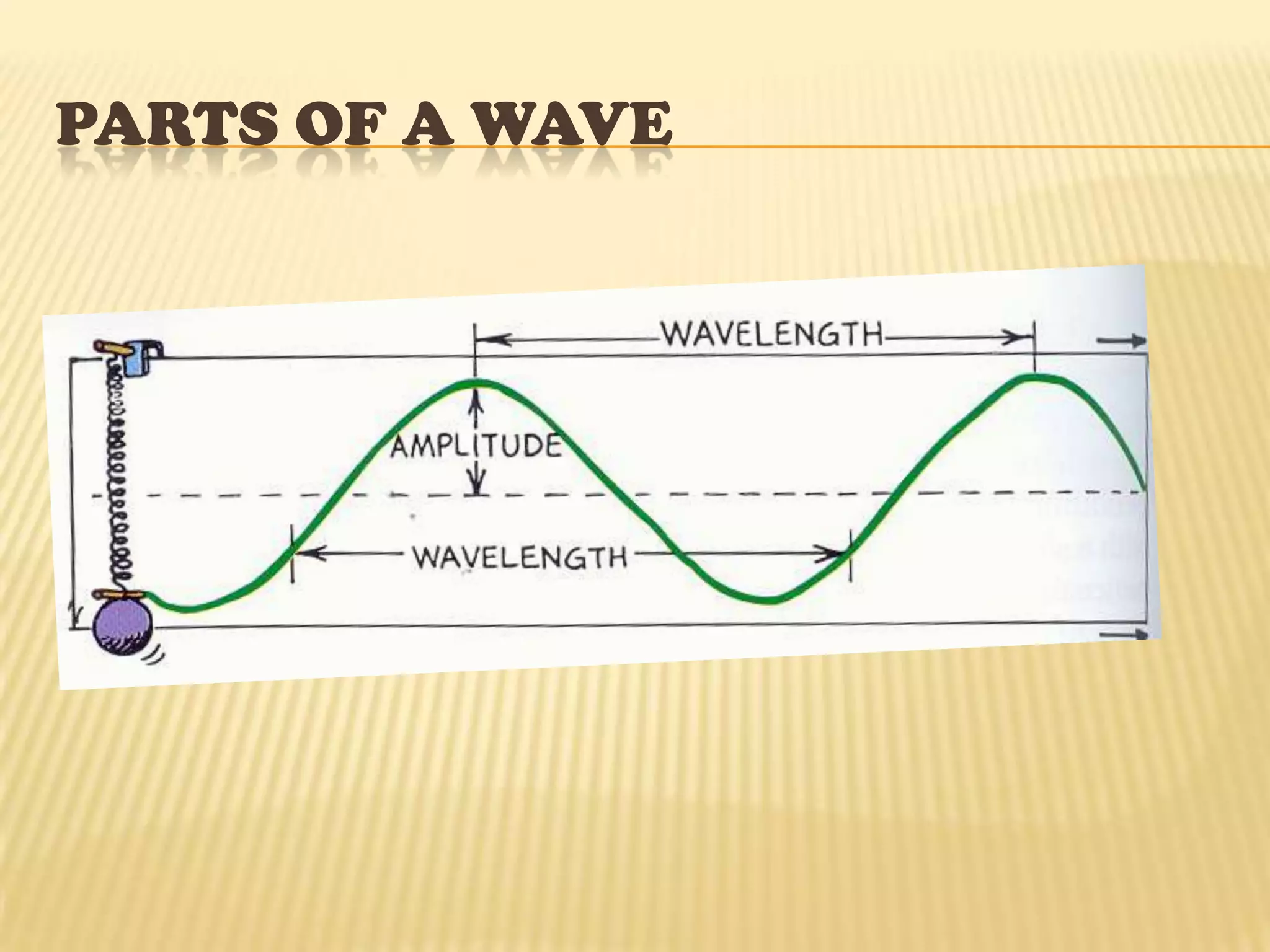
Parts of aWaveCrest= High point of a wave.Trough=Low point of a wave.Amplitude (A)= Distance from the midpoint to the crest.Wavelength (λ)= The length of one complete wave.
Type of mediumThetype of medium changes the way a wave moves.Mediums with close molecules travel quickly.This is why waves travel better in liquids and solids than in gases.
8.
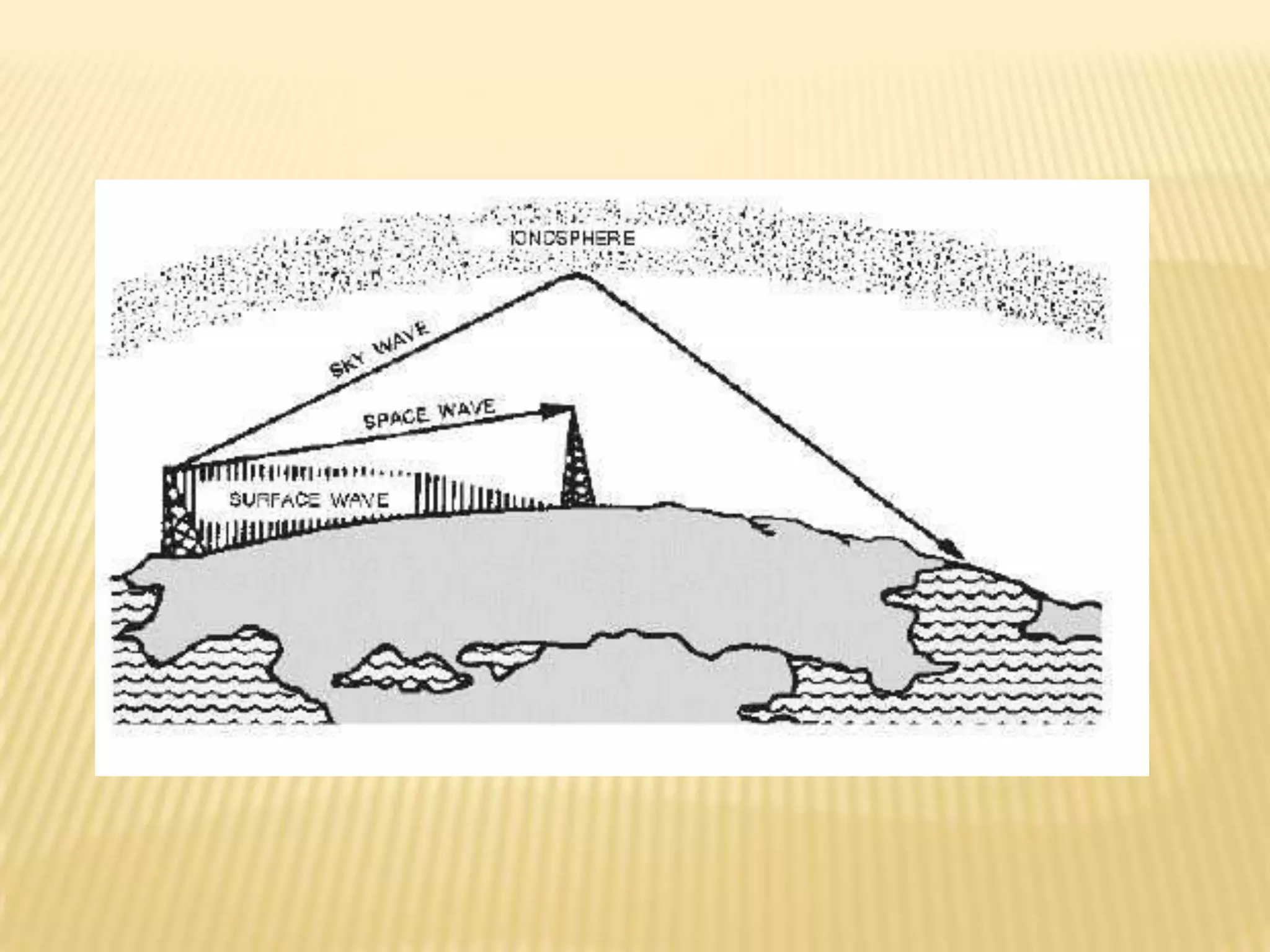
Radio wave TransmissionThereare two principal ways in which electromagnetic (radio) energy travels from a transmitting antenna to a receiving antenna. One way is by GROUND WAVES and the other is by SKY WAVES.Ground waves - are radio waves that travel near the surface of the Earth (surface and space waves).Sky waves - are radio waves that are reflected back to Earth from the ionosphere.
9.
Ionosphere - extendsupward from about 31.1 miles (50 km) to a height of about 250 miles (402 km). It contains four cloud-like layers of electrically charged ions, which enable radio waves to be propagated to great distances around the Earth. This is the most important region of the atmosphere for long distance point-to-point communications.
11.
Ground (Surface) WaveThe ground wave is actually composed of two separate component waves. These are known as the SURFACE WAVE and the SPACE WAVE.A surface wave travels along the surface of the Earth. A space wave travels over the surface.
12.
Ground (Surface) WaveSURFACE WAVE—The surface wave reaches the receiving site by travelling along the surface of the ground. A surface wave can follow the contours of the Earth because of the process of diffraction. When a surface wave meets an object and the dimensions of the object do not exceed its wavelength, the wave tends to curve or bend around the object. The smaller the object, the more pronounced the diffractive action will be.
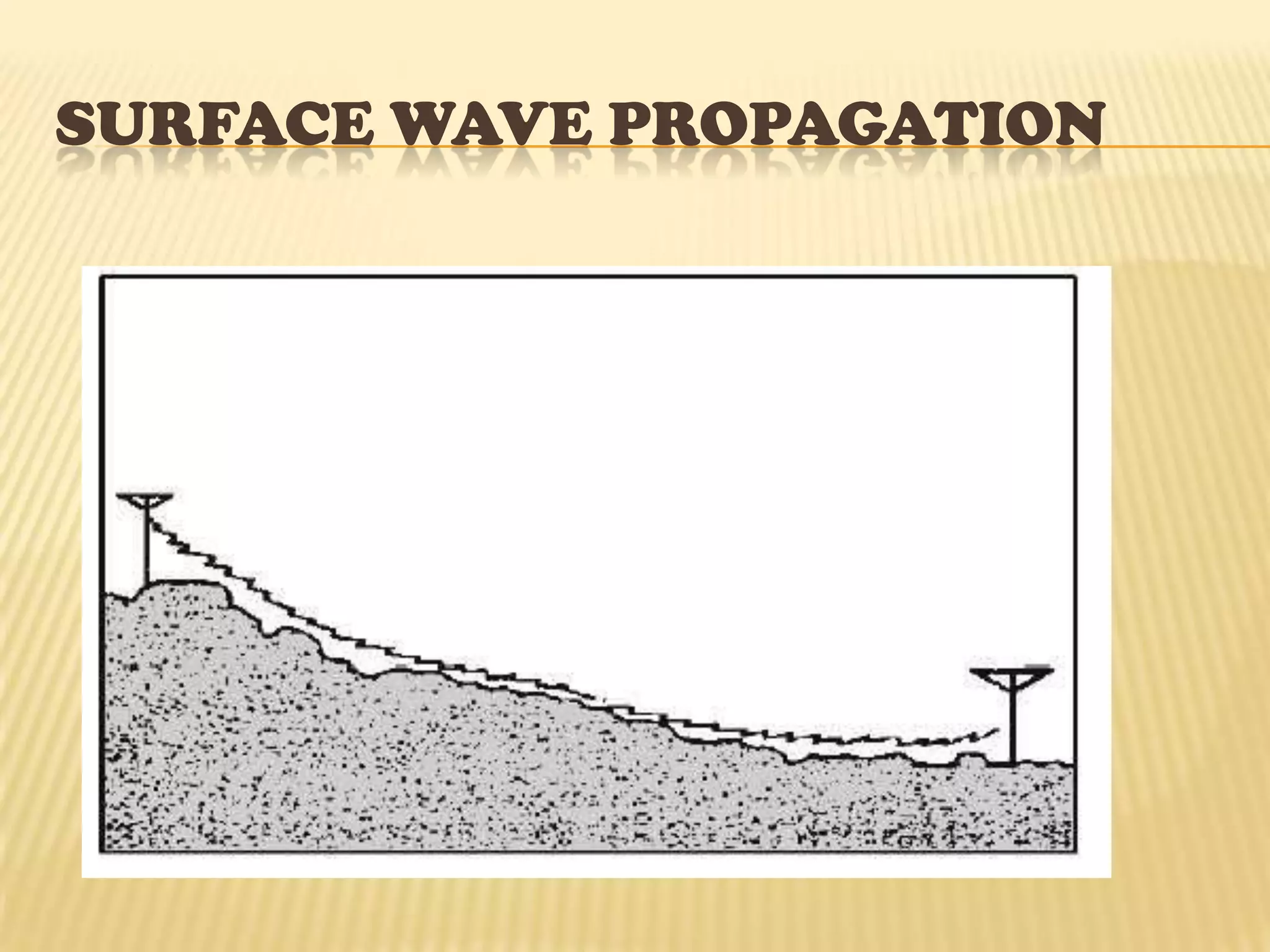
Surface Wave PROPAGATIONAsa surface wave passes over the ground, the wave induces a voltage in the Earth. The induced voltage takes energy away from the surface wave, thereby weakening, or attenuating, the wave as it moves away from the transmitting antenna. To reduce the attenuation, the amount of induced voltage must be reduced. This is done by using vertically polarized waves that minimize the extent to which the electric field of the wave
15.
is in contactwith the Earth. When a surface wave is horizontally polarized, the electric field of the wave is parallel with the surface of the Earth and, therefore, is constantly in contact with it. The wave is then completely attenuated within a short distance from the transmitting site. On the other hand, when the surface wave is vertically polarized, the electric field is vertical to the Earth and merely dips into and out of the Earth's surface. For this reason, vertical polarization is vastly superior to horizontal polarization for surface wave propagation
16.
Surface Wave PROPAGATIONTheattenuation that a surface wave undergoes because of induced voltage also depends on the electrical properties of the terrain over which the wave travels. The best type of surface is one that has good electrical conductivity. The better the conductivity, the less the attenuation.
17.
Exercises:Which ELECTROMAGNETIC WAVEhas the most energy? The least?(4 pts.)Which ELECTROMAGNETIC WAVE has the longest wavelength? The shortest?(4 pts.)As frequency increases, what happens to energy?(2 pts.)As frequency increases, what happens to wavelength?(2 pts.)As the wavelength increases, what happens to the frequency of the waves?(2 pts.)Give at least 5 common names of waves.(5 pts.)What is a wave that travels along the surface of the Earth?(1 pt.)