Improving Capacity in Cellular
Systems
Improving Capacity in Cellular Systems
• Methods for improving capacity in cellular systems
– Cell Splitting: subdividing a congested cell into smaller cells.
– Sectoring: directional antennas to control the interference and frequency reuse.
– Coverage zone : Distributing the coverage of a cell and extends the cell
boundary to hard-to-reach place.
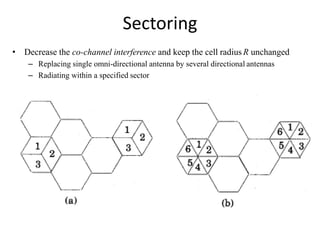
Sectoring
• Decrease the co-channel interference and keep the cell radius R unchanged
– Replacing single omni-directional antenna by several directional antennas
– Radiating within a specified sector
4
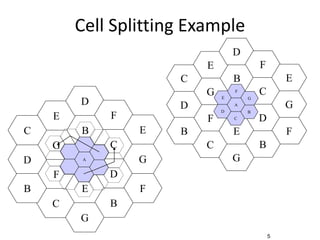
Cell splitting
• If higher capacity is needed in a spot, we need to go, locally, to smaller cluster
size N
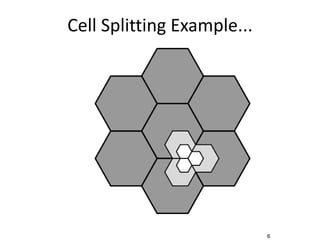
• Each cell can be split into multiple “microcells” with own BS
• Rescaling system to smaller cell size
• Transmit power of BS reduced to obtain smaller coverage area than original BS
• Enables more spatial reuse → greater system capacity
• Cell splitting preserves original frequency reuse plan
• Cell splitting causes increased handoff
• Can use “umbrella” cells where fast-moving mobiles covered by original cell
and slower mobiles covered by microcells
5
Cell Splitting Example
F D
B
G C
F
E
D
G
C
F
E
D
B E
B
G
C
D
E
F
G
B
C
A
F D
B
G C
F
E
D
G
C
F
E
D
B E
B
G
C
A
6
Cell Splitting Example...
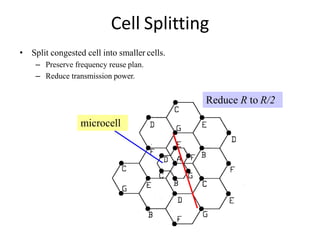
Cell Splitting
• Split congested cell into smaller cells.
– Preserve frequency reuse plan.
– Reduce transmission power.
microcell
Reduce R to R/2
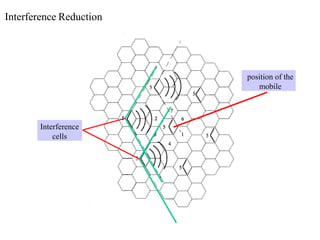
Interference Reduction
position of the
mobile
Interference
cells

Improving coverage and capacity in cellular systems

  • 1.
    Improving Capacity inCellular Systems
  • 2.
    Improving Capacity inCellular Systems • Methods for improving capacity in cellular systems – Cell Splitting: subdividing a congested cell into smaller cells. – Sectoring: directional antennas to control the interference and frequency reuse. – Coverage zone : Distributing the coverage of a cell and extends the cell boundary to hard-to-reach place.
  • 3.
    Sectoring • Decrease theco-channel interference and keep the cell radius R unchanged – Replacing single omni-directional antenna by several directional antennas – Radiating within a specified sector
  • 4.
    4 Cell splitting • Ifhigher capacity is needed in a spot, we need to go, locally, to smaller cluster size N • Each cell can be split into multiple “microcells” with own BS • Rescaling system to smaller cell size • Transmit power of BS reduced to obtain smaller coverage area than original BS • Enables more spatial reuse → greater system capacity • Cell splitting preserves original frequency reuse plan • Cell splitting causes increased handoff • Can use “umbrella” cells where fast-moving mobiles covered by original cell and slower mobiles covered by microcells
  • 5.
    5 Cell Splitting Example FD B G C F E D G C F E D B E B G C D E F G B C A F D B G C F E D G C F E D B E B G C A
  • 6.
  • 7.
    Cell Splitting • Splitcongested cell into smaller cells. – Preserve frequency reuse plan. – Reduce transmission power. microcell Reduce R to R/2
  • 8.
    Interference Reduction position ofthe mobile Interference cells