International Research Journal of Engineering and Technology (IRJET) e-ISSN: 2395 -0056
Volume: 04 Issue: 06 | June -2017 www.irjet.net p-ISSN: 2395-0072
© 2017, IRJET | Impact Factor value: 5.181 | ISO 9001:2008 Certified Journal | Page 2696
Field strength predicting outdoor models
Meenu Chinwan1, Arun Uniyal2
1,2 Assistant professor,Department of ECE Engineering,I.T.gopeshwar,Uttarakhand,India
---------------------------------------------------------------------***---------------------------------------------------------------------
Abstract—The main objective of this paper is a
comprehensive review of outdoor propagation model in
different geographical areas. A wide variety of radio
propagation models for different wireless services that
specifically address varying propagation environments and
operating frequency bands are generally known. A large
number of propagation prediction models have been
developed for various terrains Irregularities, tunnels, urban
streets and buildings, earth curvature, etc
Keywords— outdoor, propagation model, path loss
I. INTRODUCTION
Radio Propagation is essential to understand the upcoming
any wireless network with its deployment, design and
management strategies. Wireless network are more
complicated than its wired countered part .due tothenature
of the radio channels. Some factors effected radio
propagation as it is heavily site specific and varies due to
frequency of operation, depends on terrain, mobile terminal
velocity, interference due to sources etc. Radio channels
characteristics must be accurate by controlling some key
parameters. Also by mathematical model some parameters
can be predicted such signal as coverage, data which can be
achievable, performanceparametersofalternativesignalling
and also its reception schemes.
Signal strength and transmission power are the two
important concepts of mathematical modelling. Radio
propagation is the term related to the transfer of the energy
which is measured in power or watts. The power which is
measured at transmitter is the transmission power and this
power is measured at the transmitteraswell asreceiver.The
total amount of the power measured as the receiver is also
known as the strength of the signal (signal strength). The
letter measurement is less than the former; it is due to the
nature of the radio wave propagation because when the
signal moves through the air in the form of radio waves it
loses its power.
Path Loss
The primary factor which is considered in wireless
communication system is the free space propagation. As
there are no obstacles or obstruction due earth’s surface in
the case of LOS propagation. A term known as friss free
space propagation is used to determine the received power
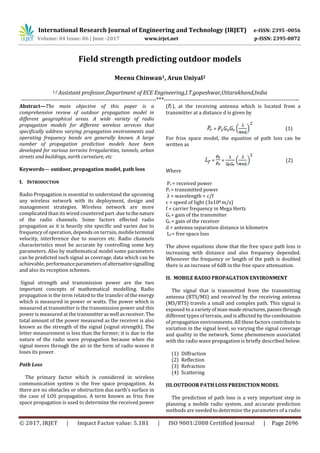
( ), at the receiving antenna which is located from a
transmitter at a distance d is given by
= (1)
For friss space model, the equation of path loss can be
written as
= = (2)
Where
Pr = received power
Pt = transmitted power
λ = wavelength = c/f
c = speed of light (3x10⁸ m/s)
f = carrier frequency in Mega Hertz
Gt = gain of the transmitter
Gr = gain of the receiver
d = antenna separation distance in kilometre
Lf = free space loss
The above equations show that the free space path loss is
increasing with distance and also frequency depended.
Whenever the frequency or length of the path is doubled
there is an increase of 6dB in the free space attenuation.
II. MOBILE RADIO PROPAGATION ENVIRONMENT
The signal that is transmitted from the transmitting
antenna (BTS/MS) and received by the receiving antenna
(MS/BTS) travels a small and complex path. This signal is
exposed to a variety of man-madestructures,passesthrough
different types of terrain, and is affected by the combination
of propagation environments. All these factors contributeto
variation in the signal level, so varying the signal coverage
and quality in the network. Some phenomenon associated
with the radio wave propagation is briefly described below.
(1) Diffraction
(2) Reflection
(3) Refraction
(4) Scattering
III.OUTDOOR PATH LOSS PREDICTION MODEL
The prediction of path loss is a very important step in
planning a mobile radio system, and accurate prediction
methods are needed to determine the parameters of a radio
International Research Journal of Engineering and Technology (IRJET) e-ISSN: 2395 -0056
Volume: 04 Issue: 06 | June -2017 www.irjet.net p-ISSN: 2395-0072
© 2017, IRJET | Impact Factor value: 5.181 | ISO 9001:2008 Certified Journal | Page 2697
system which will provide efficientandreliablecoverage ofa
specified service area. A path loss prediction or propagation
model is the fundamental tool for designing any wireless
communication system. Since it become verycostlyifwe use
site measurements to design a system, so as an alternative
propagation model has been developed which are more
suitable, convenient and low cost. These models typically
focus on path loss realization and predict what will happen
to the transmitted signal as it travel from transmitter to the
receiver.
The outdoor propagation model can be classified as:
(1) Empirical model
(2) Physical model
(3) Theoretical model
A. Empirical Model
The Experimental measurement data is used byempirical
model to produce a relationship between propagation
circumstances and expectedfieldstrengthortimedispersion
result. Development of empirical model candobylaboratory
measurement or with scale models of propagation
environment. This type of approach can achieve by using
fitting curve or analytical expression that recreate set of
measured data. When we talking aboutpropagationfactor,it
include both known and unknown, through actual field
measurement. However, establishment of validity of
empirical model at transmission frequency or other than
model driven environment can be done by adding data
which is measured at new environment at the required
transmission frequency.
Mathematical model failstoexplain everysituation;inthis
situation approximation is done to protect same data. To
overcome this problem empirical model was introduced,
which is totally base on the observation and measurements.
Data was predicted but it has limitationthatthismodel isnot
able to explain.
It has two subcategories time dispersive and non-time
dispersive.
The time dispersive model detail itdata istheformoftime
– dispersive characteristics such as delay spread of channel
during multipath. Examples are SUI model. Whereas COST
231 Hata model. Hata and ITU –R model are falls under the
example of non time dispersive empirical model.
B. Theoretical Model
Theoretical model are based on assumption that taken
about environment of propagation. These are also known as
statical model. These models are used for analyze the
behavior of communication system having various channel
response circumstances. Through, they are not able to deal
with specific propagation information. They are not
employed to plane a communication system use to serve a
particular area. Hence they are used to relay an assumption
for mathematical formulation.
Example of these models are..
(1) The geometrically based signal bomer macrocell
(GBSBM) channel model by perturs.
(2) Quassi wide sense stationary uncorrelated scalling
(quassi-wssus) channel model by bellow.
C. Physical Model
Physical model are based on basics of physics and deals
with propagation environment. This model can either site
specific or not site specific. A not site specific physical model
based on the propagation principle of electromagneticwave
that predict signal level in generic environment to take
account of development of relation shift between
characteristics of environment and propagation.
Example of these model by W.I Kegami and H.L Beritoni
for mobile radio system in urban area, where series of
diffraction screen considered by roof edge with including
diffraction from building roof to the select level.
In other way, a physical and site specific model uses
physical low of electromagnetic wave propagationaswell as
have technique from which mapping of real propagation as
well have techniquefromwhichmappingof real propagation
environment can be done into model propagation
environment. Prediction of presence of attenuation in a
signal is achieved by Epstein-Peterson method, Deygent
method, Longely rice method and Anderson 2-dimensional
model. Example of physical and site specific model is ray
tracing model which proves dispersion information and
angle of arrival information.
D. Okumura Model
Okumura model is generated by empirical method in
which various test are conducted to collect the data in
different situation like irregular terrain and other
environmental obstacles. This collected data was analyzed
and checked in form of Diagrams. In the urban areas the
quasi smooth terrain gives the information about median
field strength. Along with urban area, an open area or
suburban are requires the correction factors. Like rolling
hilly terrain an isolated mountain mixed land sea paths,
direction of streets, slope of terrain and it predictstheactual
field strengths.
In the area of urban environment many studies havebeen
done up to 1935 about the losses arises in the radio wave
propagation, but the study of Yoshihisa okumura waswidely
focused on the above. In 1968 Tokoyo, Japan Yoshihisa
okumura tested the propagation between the mobilestation
& base station. With a variation in the urban geometrymany
International Research Journal of Engineering and Technology (IRJET) e-ISSN: 2395 -0056
Volume: 04 Issue: 06 | June -2017 www.irjet.net p-ISSN: 2395-0072
© 2017, IRJET | Impact Factor value: 5.181 | ISO 9001:2008 Certified Journal | Page 2698
tests were conducted for the transmissionofsignal.Different
frequencies were used in the measurement like 200, 453,
922, 1310, 1430 & 1929 Mhz. graph is plotted between path
distances & varying condition in terms of measured field
value curve for each frequency. For the representationof the
median attenuation which is extended along the
transmission path as a function of frequency which fits this
plotted data for a series of curves was developed by
Okumura & his colleagues.
A propagation model was developed byokumura whichis
based on the calculations &the collection of data by him,this
model incorporates the correctionfactorsforthelocationsof
transmit & receive antenna, type of environment, city size,
terrain type. The model proposed by okumura has
disadvantage as it was complex & time consuming as the
user has to refer to the okumura mathematical curvesfor the
calculations of losses & correction factors.
(i) Generally Okumura illustrate correction factors for
open area & suburban area.
(ii) Its model can predict the path loss up to 3 GHz in
urban, suburban & Rural Area.
PL(dB)= Lf + Amn (f,d) – G(hte) – Ghre -GAREA (4)
Where
PL=Media path loss [dB]
Lf= Free space path loss [dB]
Amn (f,d)= Media attenuation relative to free space [dB]
G(hte)= Base station antenna height gain factor [dB]
Ghre = Mobile station antenna height gain factor [dB]
GAREA=Gain due to the type of environment [dB]
F= Frequency [MHz]
hte=Transmitter antenna height [m]
khre=Receiver antenna height [m]
d=Distance between transmitter and receiver [km]
E.Hata Model
The limitations of okumura model was corrected in 1980 by
Masaharu Hata who simplified it & reduces theuserinput to
only four parameters by developing a set of equations. A
fairly accurate prediction of propagation loss is obtained
with only frequency, transmitted distance height of the base
station antenna, height of mobile antenna in the earlier
Okumura model. Hata model has limiting factors that it
predicts only a short range of transmitted distance &
frequencies. The limitations are overcome by the
modification of Hata model into many models to extend the
output over greater transmission distance & frequencies
more accurately. The combination of a scaling term
independent of distances, correctionfactorslogarithmiclike,
open air, suburban urban is given by Hata model. Up to the
transmission distances of 30 km.Otherstudiesshowthatthe
curves match for Hata & Okumura model within the
acceptable parameters. Beyond 30km both the curves
approximately separated by 15db difference near about
100km. Today the most widely used loss model for urban
propagation is Hata model in comparison withtheotherloss
model.
A. ECC-33 Path Loss Model
The model is a systematic arrangement of Okumura Hata
model as this was formed in Tokyo City so urban area is
subdivided into large and medium city. This model is
generally beneficial for macro cellular system.
Few specification of this model is:-
i. 30-200m, Antenna height of the base station
ii. 1-10m antenna height of the mobile station
iii. 1-20 km distance between Base station & mobile
station
The path loss model presented in is referredtohereasthe
ECC-33 model. The path loss is defined as,
PL(dB)= Afs+ Abm − Gb − Gr
where, Afs, Abm, Gband Grare the free spaceattenuation,the
basic median path loss, the BS height gain factor and the
terminal (CPE) height gain factor. They are
individuallydefined as,
Afs= 92.4 + 20 log10(d) + 20 log10(f)
Abm= 20.41 + 9.83 log10(d) + 7.894 log10(f) + 9.56[log10(f)]2
Gb= log10(hb/200){13.958 + 5.8[log10(d)]2}
and for medium city environments,
Gr = [42.57 + 13.7 log10(f)][log10(hr) − 0.585]
where, f is the frequency in GHz, d is the distance between
base station and CPE in km, hbis the BS antenna height in
meters and hris the CPE antenna height in meters. The
medium city model is more appropriate for European cities
whereas the large city environment should only be used for
cities having tall buildings. It is interesting to note that the
predictions produced by the ECC-33 model do not lie on
straight lines when plotted against distance having a log
scale.
B. COST -231-Hata Model
COST-231 Hata model generally follows empirical model
due to this the frequency range of Hata model is increased to
1500-2000MHz. it is applicable for suburban an urban area
so called as outdoor propagation model. This model is used
for flat terrain and base on huge measurement. Limitationof
this model is that it fails to situation where node’s antenna
height is above top level adjacent to the node. This model
gives accurate prediction within 1 dB for distance ranging 1
to 20Km.
International Research Journal of Engineering and Technology (IRJET) e-ISSN: 2395 -0056
Volume: 04 Issue: 06 | June -2017 www.irjet.net p-ISSN: 2395-0072
© 2017, IRJET | Impact Factor value: 5.181 | ISO 9001:2008 Certified Journal | Page 2699
The basic equation for path loss in dB is
PL(dB)= 46.3 + 33.9 log10(f) − 13.82 log10(hte) – a(hm)
+ (44.9 − 6.55 log10(hte)) log10d + cm
where, f is the frequency in MHz, disthedistance between
base station and mobile antennas in km, and hteis the base
station antenna height above ground level in meters. The
parameter cmis defined as 0 dB for suburban or open
environments and 3 dB for urban environments. The
parameter a(hm)is defined for large area as
a(hm) [dB] = 8.29 (log 1.54 hre)2 - 1.1 for f 300 MHz
a(hm ) [dB] = 3.2 (log 11.75 hre)2 - 4.97 for f 300 MHz
and for medium or small city area,
a(hm) [dB]= (1.1 log10f − 0.7)hre− (1.56 log10f − 0.8)
where, hreis the mobile antenna heightabovegroundlevel
in meters.
C. Egli Model
Egli model is not a universal model but ease of
implementation and agreement with the empirical data
makes it a popular choice for a first analysis. Egli model for
path loss over irregular terrain is
PL(dB) = GB GM
where
GB: is gain of base station antenna
GM: is gain of mobile station antenna
hB: is height of base station antenna in meters
hM: is height of mobile station antenna in meters
d:is distance from base station antenna in km and
f: is frequency of transmission in MHz
Egli model provides the entire path loss, whereas the
Okumura model discussed below provides the path loss in
addition to free space loss. This model is empirical in nature
and applicable to scenarios where the transmission has to
pass an irregular terrain. Egli model is not applicable to
scenarios where some vegetative obstruction is in the
middle of the link.
D. Lee Model
In 1982 a model was given by W.C.R Lee. This model
becomes very popular due to its parameterswhichareeasily
adjustable among researches and system engineers. This
model has faster prediction rate and has greater accuracy.
The Lee model is a modified power law model, with
parameters taken from measurements in a number of
locations, together with a procedure for calculating an
effective base station antenna height which takes account of
the variations in the terrain. Lee model can be expressed in
the simplified form as
PL (dB) = 10n log d - 20 log hb(eff) - P0 - 10 log hm + 29
where n and P0are given by measurements as shown in
table 3.1,hb(eff) is the effectivebasestationantenna heightin
meter,hmis the mobile antenna height in meter and d is the
distance between base station and mobile station in km.
E. Cost 231 Walfisch-Ikegami Model
The most accurate propagation loss prediction model
recognized was the Walfisch-Ikegami model but other than
previous model. The range of parameters is for accurate
calculation was very small. It has two different cases. A
simple equation with transmission distance and frequency
as two input parameter is called Line Of Sight. This case
produces slightly greater losses in comparison with free
space losses. But if an unobstructed signal would encounter
a qualitative check validate that it has a similar loss as those
in free space.
Other cases are much more complex in nature and called
as non-line of sight, the equation is complicated and various
factor affect like a multi-screen diffraction, average root top
height, building separation, street width, roof top to street
orientation and street angle of orientation. 800-2000MHz is
the acceptable input frequency range and 0.02 to 5 km is the
transmission distance range for this model.
F. Stanford University Interim (SUI) Model
SUI prediction model is developed under the Institute of
Electrical and Electronic Engineers (IEEE) 802.16
Broadband Wireless Access Working Group.This prediction
model comes from the extension of Hata model with
frequency larger than 1900 MHz. The correctionparameters
are allowed to extend this model up to 3.5 GHz band. In the
USA, this model is defined for the Multipoint Microwave
Distribution System(MMDS) forthefrequencybandfrom 2.5
GHz to 2.7 GHz. The base station antenna heightofSUImodel
can be used from 10 m to 80 m. Receiver antenna height is
from 2 m to 10 m. The cell radius is from 0.1 km to 8 km. The
SUI model describes three types of terrain, they are terrain
A, terrain B and terrain C. There is no declaration about any
particular environment. Terrain A can be usedforhillyareas
with moderate or very dense vegetation. This terrain
presents the highest path loss. Terrain B is characterized for
the hilly terrains with rare vegetation, or flat terrains with
moderate or heavy tree densities. This is the intermediate
path loss scheme. This terrain can be considered for
suburban environment. Terrain C is suitable for flat terrains
or rural with light vegetation, here path loss is minimum.
The basic path loss expression of The SUI model with
correction factors is presented as
International Research Journal of Engineering and Technology (IRJET) e-ISSN: 2395 -0056
Volume: 04 Issue: 06 | June -2017 www.irjet.net p-ISSN: 2395-0072
© 2017, IRJET | Impact Factor value: 5.181 | ISO 9001:2008 Certified Journal | Page 2700
PL(dB) = A + 10γ log10(d / do) + Xf + Xh+ sford> do
where the parameters are
d: distance between BS and receiving antenna in meter
d0: 100 m
λ: Wavelength in meter
Xf: Correction for frequency above 2 GHz
Xh: Correction for receiving antenna heights
s: Correction for shadowing in dB
γ: Path loss exponent
IV.CONCLUSIONS
Due to the recent interestin propagatedsignals,modelshave
been developed and currently exist that predict path losses
associated with the urban environment, but the accuracy of
each model generally exists only in a small window of
specific parameters that are involved. An accurate radio
propagation model is essential for coming up with
appropriate design,deployment,andmanagementstrategies
for any wireless network. It is also important for predicting
signal coverage, achievable data, specific performance
attributes of alternative signaling, reception schemes,
analysis of interference from different systems and
determining the optimum location for installingbasestation
antennas.
REFERENCES
[1] Yih-GuangJan,Yang-HanLee,Hsien-WeiTseng,Ming Hsueh
Chuan, Jheng Yao Lin, Chih-Weisu, “comparison of
propagation path loss models” IEEE-C802.16m-07/121, call
forcomments,2007.
[2] V.S Abhaywardhana, I.J Wassell, D. Crosby, M.P Sellars, M.G
Brown, ‘Comparison of empirical propagation path loss
models for fixed wireless access systems’ IEEE Conference,
2005.
[3] Theodore S. Rappaport, Susumu Yoshida, ‘propagation
measurement & models for wireless communication
channels’IEEE,CommunicationMagazine1995.
[4] Magdy F. Iskander, Zhengquing Yun, ‘ Propagation
predication models for wireless communication systems’,
IEEETransactionsonmicrowavetheory&techniques,March
2012.
[5] V.S Abhaywardhana, I.J Wassell, D. Crosby, M.P Sellars, M.G
Brown, ‘time variability of the foliated fixed wireless access
channel at305GHz’,IEEEConference,2005.
[6] JhonS.Seybold,‘introductiontorfpropagation’,JohnWiley&
Sons.,2005
[7] F.MLandstorfer,‘wavepropagationmodelsfortheplanningof
mobilecommunicationnetworks’,GAASMunich,1999.
[8] V.Erceg,K.V.S.Hari,etal.,‘Channel modelsoffixedwireless
applications’ tech. rep. IEEE 802.16 Broadband Wireless
AccessWorkingGroup,January2001.
[9] M Hata, ‘Empirical formula for propagation loss in land
mobile radio services’ IEEE Transactions on vehicular
technology,Vol 29,No3,August1980,P317
[10] T.K.Sarkar,Z.Ji,K.Kim,A.Medouri,M.Salazar–Palma.‘A
Survey of Various Propagations Models for Mobile
communication’. IEEE Antennas and Propagation Magazine,
45, 3(2003), pp.51-82N.W.-K. Chen, Linear Networks and
Systems. Belmont, Calif.: Wadsworth, pp.123-135,1993.

Field Strength Predicting Outdoor Models

  • 1.
    International Research Journalof Engineering and Technology (IRJET) e-ISSN: 2395 -0056 Volume: 04 Issue: 06 | June -2017 www.irjet.net p-ISSN: 2395-0072 © 2017, IRJET | Impact Factor value: 5.181 | ISO 9001:2008 Certified Journal | Page 2696 Field strength predicting outdoor models Meenu Chinwan1, Arun Uniyal2 1,2 Assistant professor,Department of ECE Engineering,I.T.gopeshwar,Uttarakhand,India ---------------------------------------------------------------------***--------------------------------------------------------------------- Abstract—The main objective of this paper is a comprehensive review of outdoor propagation model in different geographical areas. A wide variety of radio propagation models for different wireless services that specifically address varying propagation environments and operating frequency bands are generally known. A large number of propagation prediction models have been developed for various terrains Irregularities, tunnels, urban streets and buildings, earth curvature, etc Keywords— outdoor, propagation model, path loss I. INTRODUCTION Radio Propagation is essential to understand the upcoming any wireless network with its deployment, design and management strategies. Wireless network are more complicated than its wired countered part .due tothenature of the radio channels. Some factors effected radio propagation as it is heavily site specific and varies due to frequency of operation, depends on terrain, mobile terminal velocity, interference due to sources etc. Radio channels characteristics must be accurate by controlling some key parameters. Also by mathematical model some parameters can be predicted such signal as coverage, data which can be achievable, performanceparametersofalternativesignalling and also its reception schemes. Signal strength and transmission power are the two important concepts of mathematical modelling. Radio propagation is the term related to the transfer of the energy which is measured in power or watts. The power which is measured at transmitter is the transmission power and this power is measured at the transmitteraswell asreceiver.The total amount of the power measured as the receiver is also known as the strength of the signal (signal strength). The letter measurement is less than the former; it is due to the nature of the radio wave propagation because when the signal moves through the air in the form of radio waves it loses its power. Path Loss The primary factor which is considered in wireless communication system is the free space propagation. As there are no obstacles or obstruction due earth’s surface in the case of LOS propagation. A term known as friss free space propagation is used to determine the received power ( ), at the receiving antenna which is located from a transmitter at a distance d is given by = (1) For friss space model, the equation of path loss can be written as = = (2) Where Pr = received power Pt = transmitted power λ = wavelength = c/f c = speed of light (3x10⁸ m/s) f = carrier frequency in Mega Hertz Gt = gain of the transmitter Gr = gain of the receiver d = antenna separation distance in kilometre Lf = free space loss The above equations show that the free space path loss is increasing with distance and also frequency depended. Whenever the frequency or length of the path is doubled there is an increase of 6dB in the free space attenuation. II. MOBILE RADIO PROPAGATION ENVIRONMENT The signal that is transmitted from the transmitting antenna (BTS/MS) and received by the receiving antenna (MS/BTS) travels a small and complex path. This signal is exposed to a variety of man-madestructures,passesthrough different types of terrain, and is affected by the combination of propagation environments. All these factors contributeto variation in the signal level, so varying the signal coverage and quality in the network. Some phenomenon associated with the radio wave propagation is briefly described below. (1) Diffraction (2) Reflection (3) Refraction (4) Scattering III.OUTDOOR PATH LOSS PREDICTION MODEL The prediction of path loss is a very important step in planning a mobile radio system, and accurate prediction methods are needed to determine the parameters of a radio
  • 2.
    International Research Journalof Engineering and Technology (IRJET) e-ISSN: 2395 -0056 Volume: 04 Issue: 06 | June -2017 www.irjet.net p-ISSN: 2395-0072 © 2017, IRJET | Impact Factor value: 5.181 | ISO 9001:2008 Certified Journal | Page 2697 system which will provide efficientandreliablecoverage ofa specified service area. A path loss prediction or propagation model is the fundamental tool for designing any wireless communication system. Since it become verycostlyifwe use site measurements to design a system, so as an alternative propagation model has been developed which are more suitable, convenient and low cost. These models typically focus on path loss realization and predict what will happen to the transmitted signal as it travel from transmitter to the receiver. The outdoor propagation model can be classified as: (1) Empirical model (2) Physical model (3) Theoretical model A. Empirical Model The Experimental measurement data is used byempirical model to produce a relationship between propagation circumstances and expectedfieldstrengthortimedispersion result. Development of empirical model candobylaboratory measurement or with scale models of propagation environment. This type of approach can achieve by using fitting curve or analytical expression that recreate set of measured data. When we talking aboutpropagationfactor,it include both known and unknown, through actual field measurement. However, establishment of validity of empirical model at transmission frequency or other than model driven environment can be done by adding data which is measured at new environment at the required transmission frequency. Mathematical model failstoexplain everysituation;inthis situation approximation is done to protect same data. To overcome this problem empirical model was introduced, which is totally base on the observation and measurements. Data was predicted but it has limitationthatthismodel isnot able to explain. It has two subcategories time dispersive and non-time dispersive. The time dispersive model detail itdata istheformoftime – dispersive characteristics such as delay spread of channel during multipath. Examples are SUI model. Whereas COST 231 Hata model. Hata and ITU –R model are falls under the example of non time dispersive empirical model. B. Theoretical Model Theoretical model are based on assumption that taken about environment of propagation. These are also known as statical model. These models are used for analyze the behavior of communication system having various channel response circumstances. Through, they are not able to deal with specific propagation information. They are not employed to plane a communication system use to serve a particular area. Hence they are used to relay an assumption for mathematical formulation. Example of these models are.. (1) The geometrically based signal bomer macrocell (GBSBM) channel model by perturs. (2) Quassi wide sense stationary uncorrelated scalling (quassi-wssus) channel model by bellow. C. Physical Model Physical model are based on basics of physics and deals with propagation environment. This model can either site specific or not site specific. A not site specific physical model based on the propagation principle of electromagneticwave that predict signal level in generic environment to take account of development of relation shift between characteristics of environment and propagation. Example of these model by W.I Kegami and H.L Beritoni for mobile radio system in urban area, where series of diffraction screen considered by roof edge with including diffraction from building roof to the select level. In other way, a physical and site specific model uses physical low of electromagnetic wave propagationaswell as have technique from which mapping of real propagation as well have techniquefromwhichmappingof real propagation environment can be done into model propagation environment. Prediction of presence of attenuation in a signal is achieved by Epstein-Peterson method, Deygent method, Longely rice method and Anderson 2-dimensional model. Example of physical and site specific model is ray tracing model which proves dispersion information and angle of arrival information. D. Okumura Model Okumura model is generated by empirical method in which various test are conducted to collect the data in different situation like irregular terrain and other environmental obstacles. This collected data was analyzed and checked in form of Diagrams. In the urban areas the quasi smooth terrain gives the information about median field strength. Along with urban area, an open area or suburban are requires the correction factors. Like rolling hilly terrain an isolated mountain mixed land sea paths, direction of streets, slope of terrain and it predictstheactual field strengths. In the area of urban environment many studies havebeen done up to 1935 about the losses arises in the radio wave propagation, but the study of Yoshihisa okumura waswidely focused on the above. In 1968 Tokoyo, Japan Yoshihisa okumura tested the propagation between the mobilestation & base station. With a variation in the urban geometrymany
  • 3.
    International Research Journalof Engineering and Technology (IRJET) e-ISSN: 2395 -0056 Volume: 04 Issue: 06 | June -2017 www.irjet.net p-ISSN: 2395-0072 © 2017, IRJET | Impact Factor value: 5.181 | ISO 9001:2008 Certified Journal | Page 2698 tests were conducted for the transmissionofsignal.Different frequencies were used in the measurement like 200, 453, 922, 1310, 1430 & 1929 Mhz. graph is plotted between path distances & varying condition in terms of measured field value curve for each frequency. For the representationof the median attenuation which is extended along the transmission path as a function of frequency which fits this plotted data for a series of curves was developed by Okumura & his colleagues. A propagation model was developed byokumura whichis based on the calculations &the collection of data by him,this model incorporates the correctionfactorsforthelocationsof transmit & receive antenna, type of environment, city size, terrain type. The model proposed by okumura has disadvantage as it was complex & time consuming as the user has to refer to the okumura mathematical curvesfor the calculations of losses & correction factors. (i) Generally Okumura illustrate correction factors for open area & suburban area. (ii) Its model can predict the path loss up to 3 GHz in urban, suburban & Rural Area. PL(dB)= Lf + Amn (f,d) – G(hte) – Ghre -GAREA (4) Where PL=Media path loss [dB] Lf= Free space path loss [dB] Amn (f,d)= Media attenuation relative to free space [dB] G(hte)= Base station antenna height gain factor [dB] Ghre = Mobile station antenna height gain factor [dB] GAREA=Gain due to the type of environment [dB] F= Frequency [MHz] hte=Transmitter antenna height [m] khre=Receiver antenna height [m] d=Distance between transmitter and receiver [km] E.Hata Model The limitations of okumura model was corrected in 1980 by Masaharu Hata who simplified it & reduces theuserinput to only four parameters by developing a set of equations. A fairly accurate prediction of propagation loss is obtained with only frequency, transmitted distance height of the base station antenna, height of mobile antenna in the earlier Okumura model. Hata model has limiting factors that it predicts only a short range of transmitted distance & frequencies. The limitations are overcome by the modification of Hata model into many models to extend the output over greater transmission distance & frequencies more accurately. The combination of a scaling term independent of distances, correctionfactorslogarithmiclike, open air, suburban urban is given by Hata model. Up to the transmission distances of 30 km.Otherstudiesshowthatthe curves match for Hata & Okumura model within the acceptable parameters. Beyond 30km both the curves approximately separated by 15db difference near about 100km. Today the most widely used loss model for urban propagation is Hata model in comparison withtheotherloss model. A. ECC-33 Path Loss Model The model is a systematic arrangement of Okumura Hata model as this was formed in Tokyo City so urban area is subdivided into large and medium city. This model is generally beneficial for macro cellular system. Few specification of this model is:- i. 30-200m, Antenna height of the base station ii. 1-10m antenna height of the mobile station iii. 1-20 km distance between Base station & mobile station The path loss model presented in is referredtohereasthe ECC-33 model. The path loss is defined as, PL(dB)= Afs+ Abm − Gb − Gr where, Afs, Abm, Gband Grare the free spaceattenuation,the basic median path loss, the BS height gain factor and the terminal (CPE) height gain factor. They are individuallydefined as, Afs= 92.4 + 20 log10(d) + 20 log10(f) Abm= 20.41 + 9.83 log10(d) + 7.894 log10(f) + 9.56[log10(f)]2 Gb= log10(hb/200){13.958 + 5.8[log10(d)]2} and for medium city environments, Gr = [42.57 + 13.7 log10(f)][log10(hr) − 0.585] where, f is the frequency in GHz, d is the distance between base station and CPE in km, hbis the BS antenna height in meters and hris the CPE antenna height in meters. The medium city model is more appropriate for European cities whereas the large city environment should only be used for cities having tall buildings. It is interesting to note that the predictions produced by the ECC-33 model do not lie on straight lines when plotted against distance having a log scale. B. COST -231-Hata Model COST-231 Hata model generally follows empirical model due to this the frequency range of Hata model is increased to 1500-2000MHz. it is applicable for suburban an urban area so called as outdoor propagation model. This model is used for flat terrain and base on huge measurement. Limitationof this model is that it fails to situation where node’s antenna height is above top level adjacent to the node. This model gives accurate prediction within 1 dB for distance ranging 1 to 20Km.
  • 4.
    International Research Journalof Engineering and Technology (IRJET) e-ISSN: 2395 -0056 Volume: 04 Issue: 06 | June -2017 www.irjet.net p-ISSN: 2395-0072 © 2017, IRJET | Impact Factor value: 5.181 | ISO 9001:2008 Certified Journal | Page 2699 The basic equation for path loss in dB is PL(dB)= 46.3 + 33.9 log10(f) − 13.82 log10(hte) – a(hm) + (44.9 − 6.55 log10(hte)) log10d + cm where, f is the frequency in MHz, disthedistance between base station and mobile antennas in km, and hteis the base station antenna height above ground level in meters. The parameter cmis defined as 0 dB for suburban or open environments and 3 dB for urban environments. The parameter a(hm)is defined for large area as a(hm) [dB] = 8.29 (log 1.54 hre)2 - 1.1 for f 300 MHz a(hm ) [dB] = 3.2 (log 11.75 hre)2 - 4.97 for f 300 MHz and for medium or small city area, a(hm) [dB]= (1.1 log10f − 0.7)hre− (1.56 log10f − 0.8) where, hreis the mobile antenna heightabovegroundlevel in meters. C. Egli Model Egli model is not a universal model but ease of implementation and agreement with the empirical data makes it a popular choice for a first analysis. Egli model for path loss over irregular terrain is PL(dB) = GB GM where GB: is gain of base station antenna GM: is gain of mobile station antenna hB: is height of base station antenna in meters hM: is height of mobile station antenna in meters d:is distance from base station antenna in km and f: is frequency of transmission in MHz Egli model provides the entire path loss, whereas the Okumura model discussed below provides the path loss in addition to free space loss. This model is empirical in nature and applicable to scenarios where the transmission has to pass an irregular terrain. Egli model is not applicable to scenarios where some vegetative obstruction is in the middle of the link. D. Lee Model In 1982 a model was given by W.C.R Lee. This model becomes very popular due to its parameterswhichareeasily adjustable among researches and system engineers. This model has faster prediction rate and has greater accuracy. The Lee model is a modified power law model, with parameters taken from measurements in a number of locations, together with a procedure for calculating an effective base station antenna height which takes account of the variations in the terrain. Lee model can be expressed in the simplified form as PL (dB) = 10n log d - 20 log hb(eff) - P0 - 10 log hm + 29 where n and P0are given by measurements as shown in table 3.1,hb(eff) is the effectivebasestationantenna heightin meter,hmis the mobile antenna height in meter and d is the distance between base station and mobile station in km. E. Cost 231 Walfisch-Ikegami Model The most accurate propagation loss prediction model recognized was the Walfisch-Ikegami model but other than previous model. The range of parameters is for accurate calculation was very small. It has two different cases. A simple equation with transmission distance and frequency as two input parameter is called Line Of Sight. This case produces slightly greater losses in comparison with free space losses. But if an unobstructed signal would encounter a qualitative check validate that it has a similar loss as those in free space. Other cases are much more complex in nature and called as non-line of sight, the equation is complicated and various factor affect like a multi-screen diffraction, average root top height, building separation, street width, roof top to street orientation and street angle of orientation. 800-2000MHz is the acceptable input frequency range and 0.02 to 5 km is the transmission distance range for this model. F. Stanford University Interim (SUI) Model SUI prediction model is developed under the Institute of Electrical and Electronic Engineers (IEEE) 802.16 Broadband Wireless Access Working Group.This prediction model comes from the extension of Hata model with frequency larger than 1900 MHz. The correctionparameters are allowed to extend this model up to 3.5 GHz band. In the USA, this model is defined for the Multipoint Microwave Distribution System(MMDS) forthefrequencybandfrom 2.5 GHz to 2.7 GHz. The base station antenna heightofSUImodel can be used from 10 m to 80 m. Receiver antenna height is from 2 m to 10 m. The cell radius is from 0.1 km to 8 km. The SUI model describes three types of terrain, they are terrain A, terrain B and terrain C. There is no declaration about any particular environment. Terrain A can be usedforhillyareas with moderate or very dense vegetation. This terrain presents the highest path loss. Terrain B is characterized for the hilly terrains with rare vegetation, or flat terrains with moderate or heavy tree densities. This is the intermediate path loss scheme. This terrain can be considered for suburban environment. Terrain C is suitable for flat terrains or rural with light vegetation, here path loss is minimum. The basic path loss expression of The SUI model with correction factors is presented as
  • 5.
    International Research Journalof Engineering and Technology (IRJET) e-ISSN: 2395 -0056 Volume: 04 Issue: 06 | June -2017 www.irjet.net p-ISSN: 2395-0072 © 2017, IRJET | Impact Factor value: 5.181 | ISO 9001:2008 Certified Journal | Page 2700 PL(dB) = A + 10γ log10(d / do) + Xf + Xh+ sford> do where the parameters are d: distance between BS and receiving antenna in meter d0: 100 m λ: Wavelength in meter Xf: Correction for frequency above 2 GHz Xh: Correction for receiving antenna heights s: Correction for shadowing in dB γ: Path loss exponent IV.CONCLUSIONS Due to the recent interestin propagatedsignals,modelshave been developed and currently exist that predict path losses associated with the urban environment, but the accuracy of each model generally exists only in a small window of specific parameters that are involved. An accurate radio propagation model is essential for coming up with appropriate design,deployment,andmanagementstrategies for any wireless network. It is also important for predicting signal coverage, achievable data, specific performance attributes of alternative signaling, reception schemes, analysis of interference from different systems and determining the optimum location for installingbasestation antennas. REFERENCES [1] Yih-GuangJan,Yang-HanLee,Hsien-WeiTseng,Ming Hsueh Chuan, Jheng Yao Lin, Chih-Weisu, “comparison of propagation path loss models” IEEE-C802.16m-07/121, call forcomments,2007. [2] V.S Abhaywardhana, I.J Wassell, D. Crosby, M.P Sellars, M.G Brown, ‘Comparison of empirical propagation path loss models for fixed wireless access systems’ IEEE Conference, 2005. [3] Theodore S. Rappaport, Susumu Yoshida, ‘propagation measurement & models for wireless communication channels’IEEE,CommunicationMagazine1995. [4] Magdy F. Iskander, Zhengquing Yun, ‘ Propagation predication models for wireless communication systems’, IEEETransactionsonmicrowavetheory&techniques,March 2012. [5] V.S Abhaywardhana, I.J Wassell, D. Crosby, M.P Sellars, M.G Brown, ‘time variability of the foliated fixed wireless access channel at305GHz’,IEEEConference,2005. [6] JhonS.Seybold,‘introductiontorfpropagation’,JohnWiley& Sons.,2005 [7] F.MLandstorfer,‘wavepropagationmodelsfortheplanningof mobilecommunicationnetworks’,GAASMunich,1999. [8] V.Erceg,K.V.S.Hari,etal.,‘Channel modelsoffixedwireless applications’ tech. rep. IEEE 802.16 Broadband Wireless AccessWorkingGroup,January2001. [9] M Hata, ‘Empirical formula for propagation loss in land mobile radio services’ IEEE Transactions on vehicular technology,Vol 29,No3,August1980,P317 [10] T.K.Sarkar,Z.Ji,K.Kim,A.Medouri,M.Salazar–Palma.‘A Survey of Various Propagations Models for Mobile communication’. IEEE Antennas and Propagation Magazine, 45, 3(2003), pp.51-82N.W.-K. Chen, Linear Networks and Systems. Belmont, Calif.: Wadsworth, pp.123-135,1993.