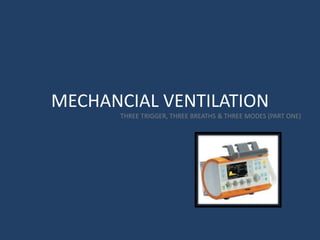
MECHANCIAL VENTILATION
THREE TRIGGER, THREE BREATHS & THREE MODES (PART ONE)
MECHANCIAL VENTILATION
Objectives:
• To provide the building blocks for a deeper
understanding of mechanical ventilation
• ③ Trigger
• ③ Types of Breaths
• ③ Modes
THREE TRIGGERS
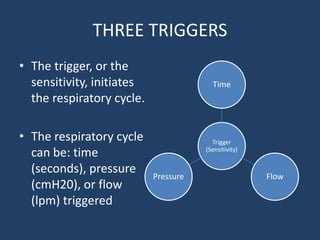
• The trigger, or the
sensitivity, initiates
the respiratory cycle.
• The respiratory cycle
can be: time
(seconds), pressure
(cmH20), or flow
(lpm) triggered
Trigger
(Sensitivity)
Time
FlowPressure
THREE TRIGGERS
• Time Trigger:
The respiratory cycle will be initiated after a set period of time . For
example, if the rate is 15 a time cycled breath will be delivered every 4
seconds. No effort is require by the patient.
• Flow:
The respiratory cycle will begin when the patient inspiratory effort
generates a negative flow.
• Pressure:
The respiratory cycle will begin when the patient inspiratory effort
generates a negative pressure drop.
THREE TRIGGERS
• For sedated patients most ventilator allow a
combination of time / flow or time / pressure
triggered breaths.
• For awake patients, most ventilators allow only flow
or pressure triggered breaths.
• The pressure (or flow) trigger is manipulated by the
RT based on the clinical situation.
• Most modern ventilators are flow / time triggered.
• This concept will become clearer when we discuss the
three types of breaths.
③
THREE TYPES OF BREATHS
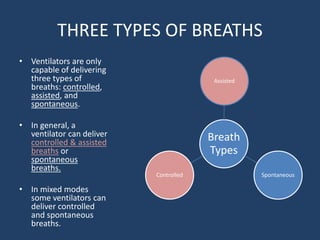
• Ventilators are only
capable of delivering
three types of
breaths: controlled,
assisted, and
spontaneous.
• In general, a
ventilator can deliver
controlled & assisted
breaths or
spontaneous
breaths.
• In mixed modes
some ventilators can
deliver controlled
and spontaneous
breaths.
Breath
Types
Assisted
SpontaneousControlled
CONTROL BREATHS
• Controlled breaths require no effort from the patient
(no work of breathing).
• Therefore, a controlled breath must be time triggered.
5 seconds 5 seconds 5 seconds
For example, a paralyzed
and deeply sedated patient
(RASS-5) is being ventilated
12 times per minute, or once
every 5 seconds.
ASSISTED BREATHS
• Patient are not locked out from the ventilator.
• They can initiate their own respiratory cycle (flow or pressure
trigger).
• The ventilator coordinates with the patient’s respiratory effort.
5 seconds ∆ in pressure
5 seconds ∆ in flow 5 seconds
5 seconds
Patient is more awake a
breaths above the ventilator
SPONTANOUS BREATHS
• Spontaneous breaths are not time triggered.
• They require an inspiratory effort from the patient. They
are flow or pressure triggered.
• The inspiratory effort must be sufficient enough to trigger a
respiratory cycle.
∆ in flow ∆ in flow
∆ in pressure ∆ in pressure
THREE TYPES OF BREATHS
• In review:
• Controlled breaths are only time triggered.
• Assisted breaths are flow (lpm) or pressure
(cmH20) triggered. This allows the ventilator to
coordinate ventilation with the patient.
• Spontaneous breaths are flow (lpm) or pressure
triggered (cmH20). No time cycle controlled
breaths are allowed.
• Most ventilators on 5.2 and 3A are time & flow
triggered and deliver controlled/assisted breaths
(i.e. AC or PCV) or spontaneous breaths (i.e. PSV).
③
THREE TYPES OF BREATHS
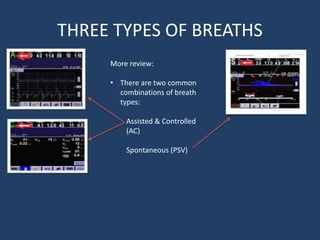
More review:
• There are two common
combinations of breath
types:
Assisted & Controlled
(AC)
Spontaneous (PSV)
MODES OF MECHANICAL VENTILATION
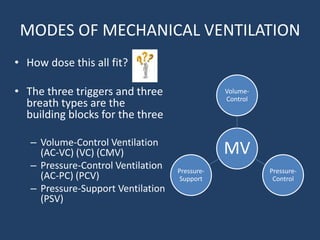
• How dose this all fit?
• The three triggers and three
breath types are the
building blocks for the three
– Volume-Control Ventilation
(AC-VC) (VC) (CMV)
– Pressure-Control Ventilation
(AC-PC) (PCV)
– Pressure-Support Ventilation
(PSV)
MV
Volume-
Control
Pressure-
Control
Pressure-
Support
VOLUME-CONTROLLED VENTILATION
• Volume control (AC-VC) will deliver a set
number of controlled (or mandatory)
breath to a pre-set volume.
• Patients can trigger assisted breaths.
• Airway pressure (PIP/PLT) can vary
(therefore, may not be acceptable in
patient with poor lung compliance).
• The RT will set the rate, VT, FiO2, PEEP, I:E
and the trigger based on the patient’s
clinical condition.
PRESSURE-CONTROLLED VENTILATION
• Pressure-Control (AC-PC/ PCV) will deliver a set number of controlled (or
mandatory) breath to set pressure.
• Patients can trigger an assisted breaths.
• Airway pressure is fixed but the VT may vary.
• The RT will set the rate, peak inspiratory pressure, FiO2, PEEP, inspiratory
time, and the trigger based on the patient’s clinical condition.
• Pressure cycled (or limited) breaths are safer in patients with poor lung
compliance.
PRESSURE-SUPPORT VENTILATION
• Pressure-Support Ventilation (PSV / PS) will only deliver patient
triggered spontaneous breaths.
• The respiratory rate and VT will vary depending upon the patient.
• The inspiratory cycle will end (cycle) when the maximum airway
pressure is reached (PSV+PEEP) or the flow has fallen (< 25%).
• PSV is used in stable patients with an intact respiratory drive.
• The pressure support, Fio2, and PEEP are set by the RT.
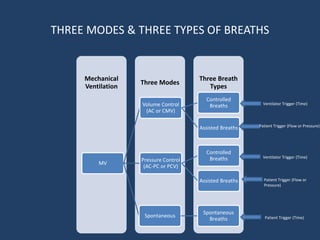
THREE MODES & THREE TYPES OF BREATHS
Three Breath
Types
Three Modes
Mechanical
Ventilation
MV
Volume Control
(AC or CMV)
Controlled
Breaths
Assisted Breaths
Pressure Control
(AC-PC or PCV)
Controlled
Breaths
Assisted Breaths
Spontaneous
Spontaneous
Breaths
Ventilator Trigger (Time)
Patient Trigger (Flow or Pressure)
Patient Trigger (Flow or
Pressure)
Patient Trigger (Time)
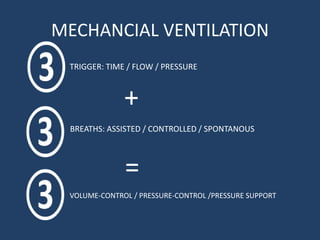
MECHANCIAL VENTILATION
TRIGGER: TIME / FLOW / PRESSURE
BREATHS: ASSISTED / CONTROLLED / SPONTANOUS
+
=
VOLUME-CONTROL / PRESSURE-CONTROL /PRESSURE SUPPORT
MECHANCIAL VENTILATION
• That is a lot of information!
• Your doing great!
• Let us move on to part two: respiratory cycle

Mechancial Ventilation Part One

  • 1.
    MECHANCIAL VENTILATION THREE TRIGGER,THREE BREATHS & THREE MODES (PART ONE)
  • 2.
    MECHANCIAL VENTILATION Objectives: • Toprovide the building blocks for a deeper understanding of mechanical ventilation • ③ Trigger • ③ Types of Breaths • ③ Modes
  • 3.
    THREE TRIGGERS • Thetrigger, or the sensitivity, initiates the respiratory cycle. • The respiratory cycle can be: time (seconds), pressure (cmH20), or flow (lpm) triggered Trigger (Sensitivity) Time FlowPressure
  • 4.
    THREE TRIGGERS • TimeTrigger: The respiratory cycle will be initiated after a set period of time . For example, if the rate is 15 a time cycled breath will be delivered every 4 seconds. No effort is require by the patient. • Flow: The respiratory cycle will begin when the patient inspiratory effort generates a negative flow. • Pressure: The respiratory cycle will begin when the patient inspiratory effort generates a negative pressure drop.
  • 5.
    THREE TRIGGERS • Forsedated patients most ventilator allow a combination of time / flow or time / pressure triggered breaths. • For awake patients, most ventilators allow only flow or pressure triggered breaths. • The pressure (or flow) trigger is manipulated by the RT based on the clinical situation. • Most modern ventilators are flow / time triggered. • This concept will become clearer when we discuss the three types of breaths. ③
  • 6.
    THREE TYPES OFBREATHS • Ventilators are only capable of delivering three types of breaths: controlled, assisted, and spontaneous. • In general, a ventilator can deliver controlled & assisted breaths or spontaneous breaths. • In mixed modes some ventilators can deliver controlled and spontaneous breaths. Breath Types Assisted SpontaneousControlled
  • 7.
    CONTROL BREATHS • Controlledbreaths require no effort from the patient (no work of breathing). • Therefore, a controlled breath must be time triggered. 5 seconds 5 seconds 5 seconds For example, a paralyzed and deeply sedated patient (RASS-5) is being ventilated 12 times per minute, or once every 5 seconds.
  • 8.
    ASSISTED BREATHS • Patientare not locked out from the ventilator. • They can initiate their own respiratory cycle (flow or pressure trigger). • The ventilator coordinates with the patient’s respiratory effort. 5 seconds ∆ in pressure 5 seconds ∆ in flow 5 seconds 5 seconds Patient is more awake a breaths above the ventilator
  • 9.
    SPONTANOUS BREATHS • Spontaneousbreaths are not time triggered. • They require an inspiratory effort from the patient. They are flow or pressure triggered. • The inspiratory effort must be sufficient enough to trigger a respiratory cycle. ∆ in flow ∆ in flow ∆ in pressure ∆ in pressure
  • 10.
    THREE TYPES OFBREATHS • In review: • Controlled breaths are only time triggered. • Assisted breaths are flow (lpm) or pressure (cmH20) triggered. This allows the ventilator to coordinate ventilation with the patient. • Spontaneous breaths are flow (lpm) or pressure triggered (cmH20). No time cycle controlled breaths are allowed. • Most ventilators on 5.2 and 3A are time & flow triggered and deliver controlled/assisted breaths (i.e. AC or PCV) or spontaneous breaths (i.e. PSV). ③
  • 11.
    THREE TYPES OFBREATHS More review: • There are two common combinations of breath types: Assisted & Controlled (AC) Spontaneous (PSV)
  • 12.
    MODES OF MECHANICALVENTILATION • How dose this all fit? • The three triggers and three breath types are the building blocks for the three – Volume-Control Ventilation (AC-VC) (VC) (CMV) – Pressure-Control Ventilation (AC-PC) (PCV) – Pressure-Support Ventilation (PSV) MV Volume- Control Pressure- Control Pressure- Support
  • 13.
    VOLUME-CONTROLLED VENTILATION • Volumecontrol (AC-VC) will deliver a set number of controlled (or mandatory) breath to a pre-set volume. • Patients can trigger assisted breaths. • Airway pressure (PIP/PLT) can vary (therefore, may not be acceptable in patient with poor lung compliance). • The RT will set the rate, VT, FiO2, PEEP, I:E and the trigger based on the patient’s clinical condition.
  • 14.
    PRESSURE-CONTROLLED VENTILATION • Pressure-Control(AC-PC/ PCV) will deliver a set number of controlled (or mandatory) breath to set pressure. • Patients can trigger an assisted breaths. • Airway pressure is fixed but the VT may vary. • The RT will set the rate, peak inspiratory pressure, FiO2, PEEP, inspiratory time, and the trigger based on the patient’s clinical condition. • Pressure cycled (or limited) breaths are safer in patients with poor lung compliance.
  • 15.
    PRESSURE-SUPPORT VENTILATION • Pressure-SupportVentilation (PSV / PS) will only deliver patient triggered spontaneous breaths. • The respiratory rate and VT will vary depending upon the patient. • The inspiratory cycle will end (cycle) when the maximum airway pressure is reached (PSV+PEEP) or the flow has fallen (< 25%). • PSV is used in stable patients with an intact respiratory drive. • The pressure support, Fio2, and PEEP are set by the RT.
  • 16.
    THREE MODES &THREE TYPES OF BREATHS Three Breath Types Three Modes Mechanical Ventilation MV Volume Control (AC or CMV) Controlled Breaths Assisted Breaths Pressure Control (AC-PC or PCV) Controlled Breaths Assisted Breaths Spontaneous Spontaneous Breaths Ventilator Trigger (Time) Ventilator Trigger (Time) Patient Trigger (Flow or Pressure) Patient Trigger (Flow or Pressure) Patient Trigger (Time)
  • 17.
    MECHANCIAL VENTILATION TRIGGER: TIME/ FLOW / PRESSURE BREATHS: ASSISTED / CONTROLLED / SPONTANOUS + = VOLUME-CONTROL / PRESSURE-CONTROL /PRESSURE SUPPORT
  • 18.
    MECHANCIAL VENTILATION • Thatis a lot of information! • Your doing great! • Let us move on to part two: respiratory cycle