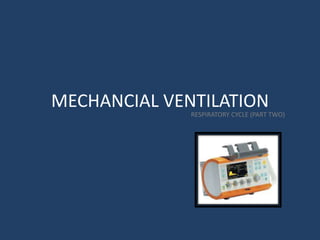
MECHANCIAL VENTILATION
RESPIRATORY CYCLE (PART TWO)
RESPIRATORY CYCLE
Objectives:
• Examine the phases of the respiratory cycle:
– Trigger
– Inspiratory Phase
– Cycling Mechanism
– Expiratory Phase
TRIGGER
Time Trigger: no patient
effort (no dip: no change
in flow or pressure)
followed by a controlled
breath
Flow Trigger: patient effort
(dip: a change in flow or
pressure) followed by an
assisted or spontaneous
breath (depending on mode
– see below)
The trigger allows the inspiratory phase to begin:
INSPIRATORY PHASE
• During the inspiratory phase positive
pressure is delivered to the lungs.
• The inspiratory phase lasts between
.8 seconds to 2 seconds.
• The inspiratory phase is adjusted by
the RT depending upon the clinical
situation.
CYCLING MECHANISM
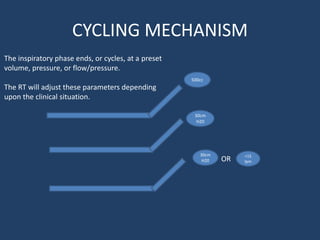
• Volume cycled (or limited) will end the inspiratory
phase at a set volume (i.e. 500cc).
• Pressure cycled (or limited) will end the
inspiratory phase at a set pressure (i.e. 30
cmH20).
• Flow/Pressure cycled (or limited) will end the
inspiratory phase at a preset set pressure (i.e. 30
cmH20) or flow (i.e. <15 lmp). Which ever one
come first.
CYCLING MECHANISM
500cc
30cm
H20
30cm
H20 OR <15
lpm
The inspiratory phase ends, or cycles, at a preset
volume, pressure, or flow/pressure.
The RT will adjust these parameters depending
upon the clinical situation.
EXPIRATORY PHASE
• The expiratory phase begins when the inspiratory phase ends.
• The RT can manipulate various setting to increase or decrease
the expiratory phase.
RESPIRATORY CYCLE
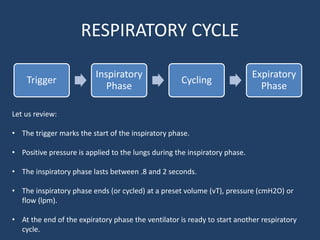
Let us review:
• The trigger marks the start of the inspiratory phase.
• Positive pressure is applied to the lungs during the inspiratory phase.
• The inspiratory phase lasts between .8 and 2 seconds.
• The inspiratory phase ends (or cycled) at a preset volume (vT), pressure (cmH2O) or
flow (lpm).
• At the end of the expiratory phase the ventilator is ready to start another respiratory
cycle.
Trigger
Inspiratory
Phase
Cycling
Expiratory
Phase
MECHANCIAL VENTILATION
• How dose all this fit?
• AC-VC indicates that the ventilator will deliver a combination of assisted and
controlled breaths (AC).
• The inspiratory phase will end or be cycled at pre-set volume (VC)
• Assist Control – Volume Cycled (AC-VC) is also know as CMV and VC.
• AC-PC indicates that the ventilator will deliver a combination of assisted and
controlled breaths (AC).
• The inspiratory phase will end or be cycled at a pre-set pressure (PC).
• Assist Control – Pressure Cycled (AC-PC) is also know as PCV or PC.
MECHANICAL VENTILATION
• PSV indicates the ventilator will deliver only
patient triggered spontaneous breaths.
• The inspiratory phase will end when the flow
decreases or the maximum pressure is
achieved.
MECHANICAL VENTILATION
• You are doing great!
• We understand how the trigger, inspiratory
phase and the three breath types are used to
build AC-VC, AC-PC and PSV.
• Next, we will cover how mechanical
ventilation can improve oxygenation!

Mechanical Ventilation Part Two

  • 1.
  • 2.
    RESPIRATORY CYCLE Objectives: • Examinethe phases of the respiratory cycle: – Trigger – Inspiratory Phase – Cycling Mechanism – Expiratory Phase
  • 3.
    TRIGGER Time Trigger: nopatient effort (no dip: no change in flow or pressure) followed by a controlled breath Flow Trigger: patient effort (dip: a change in flow or pressure) followed by an assisted or spontaneous breath (depending on mode – see below) The trigger allows the inspiratory phase to begin:
  • 4.
    INSPIRATORY PHASE • Duringthe inspiratory phase positive pressure is delivered to the lungs. • The inspiratory phase lasts between .8 seconds to 2 seconds. • The inspiratory phase is adjusted by the RT depending upon the clinical situation.
  • 5.
    CYCLING MECHANISM • Volumecycled (or limited) will end the inspiratory phase at a set volume (i.e. 500cc). • Pressure cycled (or limited) will end the inspiratory phase at a set pressure (i.e. 30 cmH20). • Flow/Pressure cycled (or limited) will end the inspiratory phase at a preset set pressure (i.e. 30 cmH20) or flow (i.e. <15 lmp). Which ever one come first.
  • 6.
    CYCLING MECHANISM 500cc 30cm H20 30cm H20 OR<15 lpm The inspiratory phase ends, or cycles, at a preset volume, pressure, or flow/pressure. The RT will adjust these parameters depending upon the clinical situation.
  • 7.
    EXPIRATORY PHASE • Theexpiratory phase begins when the inspiratory phase ends. • The RT can manipulate various setting to increase or decrease the expiratory phase.
  • 8.
    RESPIRATORY CYCLE Let usreview: • The trigger marks the start of the inspiratory phase. • Positive pressure is applied to the lungs during the inspiratory phase. • The inspiratory phase lasts between .8 and 2 seconds. • The inspiratory phase ends (or cycled) at a preset volume (vT), pressure (cmH2O) or flow (lpm). • At the end of the expiratory phase the ventilator is ready to start another respiratory cycle. Trigger Inspiratory Phase Cycling Expiratory Phase
  • 9.
    MECHANCIAL VENTILATION • Howdose all this fit? • AC-VC indicates that the ventilator will deliver a combination of assisted and controlled breaths (AC). • The inspiratory phase will end or be cycled at pre-set volume (VC) • Assist Control – Volume Cycled (AC-VC) is also know as CMV and VC. • AC-PC indicates that the ventilator will deliver a combination of assisted and controlled breaths (AC). • The inspiratory phase will end or be cycled at a pre-set pressure (PC). • Assist Control – Pressure Cycled (AC-PC) is also know as PCV or PC.
  • 10.
    MECHANICAL VENTILATION • PSVindicates the ventilator will deliver only patient triggered spontaneous breaths. • The inspiratory phase will end when the flow decreases or the maximum pressure is achieved.
  • 11.
    MECHANICAL VENTILATION • Youare doing great! • We understand how the trigger, inspiratory phase and the three breath types are used to build AC-VC, AC-PC and PSV. • Next, we will cover how mechanical ventilation can improve oxygenation!