Subarachnoid Hemorrhages
Subarachnoid Hemorrhage
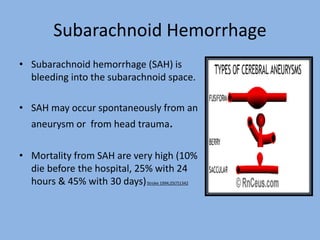
• Subarachnoid hemorrhage (SAH) is
bleeding into the subarachnoid space.
• SAH may occur spontaneously from an
aneurysm or from head trauma.
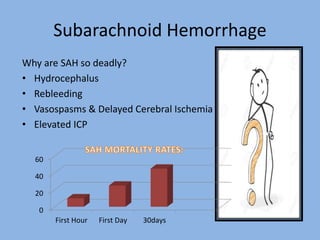
• Mortality from SAH are very high (10%
die before the hospital, 25% with 24
hours & 45% with 30 days)Stroke 1994;25(7)1342
Subarachnoid Hemorrhage
• Signs and Symptoms of a SAH:
• Headaches
• Photophobia
• Nausea & Vomiting
• Seizures
• Decreased LOC
• Neurological Deficits
• Stiff Neck
• Seizures
Subarachnoid Hemorrhage
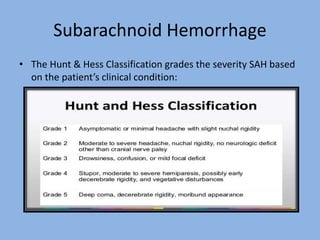
• The Hunt & Hess Classification grades the severity SAH based
on the patient’s clinical condition:
Subarachnoid Hemorrhage
Why are SAH so deadly?
• Hydrocephalus
• Rebleeding
• Vasospasms & Delayed Cerebral Ischemia
• Elevated ICP
0
20
40
60
First Hour First Day 30days
Subarachnoid Hemorrhages
• Hydrocephalus develops in 20 to 30% of
SAH patients. Stroke 2009;40(3)994
• Communicating hydrocephalus, the
type seen after SAH, occurs when CSF
cannot be absorbed normally through
the arachnoid villi.
Subarachnoid Hemorrhages
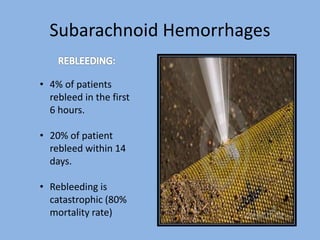
• 4% of patients
rebleed in the first
6 hours.
• 20% of patient
rebleed within 14
days.
• Rebleeding is
catastrophic (80%
mortality rate)
Subarachnoid Hemorrhages
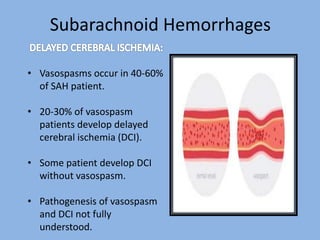
• Vasospasms occur in 40-60%
of SAH patient.
• 20-30% of vasospasm
patients develop delayed
cerebral ischemia (DCI).
• Some patient develop DCI
without vasospasm.
• Pathogenesis of vasospasm
and DCI not fully
understood.
Subarachnoid Hemorrhages
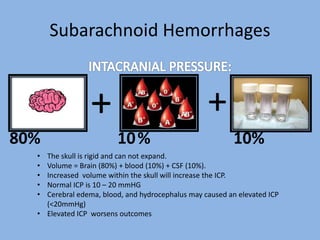
+ +
80% 10% 10%
• The skull is rigid and can not expand.
• Volume = Brain (80%) + blood (10%) + CSF (10%).
• Increased volume within the skull will increase the ICP.
• Normal ICP is 10 – 20 mmHG
• Cerebral edema, blood, and hydrocephalus may caused an elevated ICP
(<20mmHg)
• Elevated ICP worsens outcomes
Subarachnoid Hemorrhage
• SAH is bleeding into the subarachnoid space
• The Hunt & Hess Classification grades the
degree of neurological deficits
• Grade I (mild deficits + mortality) → Grade V
(severe deficits + mortality)
• SAH patients have a substantial mortality
rate from hydrocephalus, rebleeding,
increased ICP & delayed cerebral ischemia
(vasospasms)
• Early, the risk of bleeding is higher. Later,
the risk of vasospasms increases (see next
slide).
Subarachnoid Hemorrhage
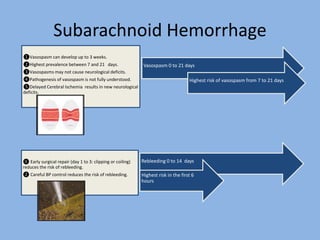
Vasospasm 0 to 21 days
❶Vasospasm can develop up to 3 weeks.
❷Highest prevalence between 7 and 21 days.
❸Vasospasms may not cause neurological deficits.
❹Pathogenesis of vasospasm is not fully understood.
❺Delayed Cerebral Ischemia results in new neurological
deficits.
Rebleeding 0 to 14 days
Highest risk in the first 6
hours
❶ Early surgical repair (day 1 to 3: clipping or coiling)
reduces the risk of rebleeding.
❷ Careful BP control reduces the risk of rebleeding.
Highest risk of vasospasm from 7 to 21 days
Subarachnoid Hemorrhage
• VS Q1H
• NVS as ordered
• Temperature Q4H + PRN
• Zero ICP Monitor Qshift + PRN
• ICP + CPP Q1H + PRN
• CSF Drainage Q1H
• ABG Qshift + PRN
• HOB 30degrees
Next, lets get more
specific:
Subarachnoid Hemorrhage
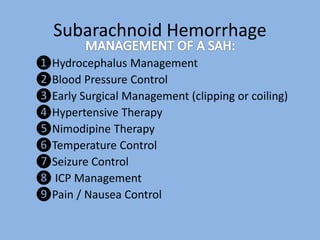
❶Hydrocephalus Management
❷Blood Pressure Control
❸Early Surgical Management (clipping or coiling)
❹Hypertensive Therapy
❺Nimodipine Therapy
❻Temperature Control
❼Seizure Control
❽ ICP Management
❾Pain / Nausea Control
Subarachnoid Hemorrhage
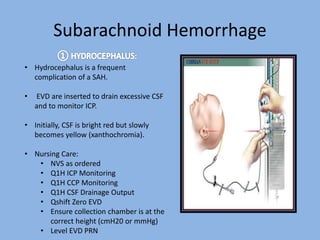
• Hydrocephalus is a frequent
complication of a SAH.
• EVD are inserted to drain excessive CSF
and to monitor ICP.
• Initially, CSF is bright red but slowly
becomes yellow (xanthochromia).
• Nursing Care:
• NVS as ordered
• Q1H ICP Monitoring
• Q1H CCP Monitoring
• Q1H CSF Drainage Output
• Qshift Zero EVD
• Ensure collection chamber is at the
correct height (cmH20 or mmHg)
• Level EVD PRN
Subarachnoid Hemorrhage
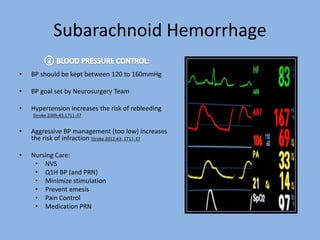
• BP should be kept between 120 to 160mmHg
• BP goal set by Neurosurgery Team
• Hypertension increases the risk of rebleeding
Stroke 2009;43:1711-37
• Aggressive BP management (too low) increases
the risk of infraction Stroke 2012;43: 1711-37
• Nursing Care:
• NVS
• Q1H BP (and PRN)
• Minimize stimulation
• Prevent emesis
• Pain Control
• Medication PRN
Subarachnoid Hemorrhage
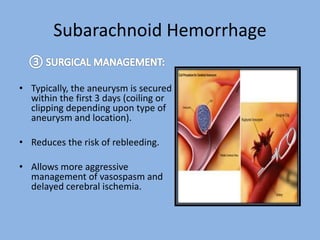
• Typically, the aneurysm is secured
within the first 3 days (coiling or
clipping depending upon type of
aneurysm and location).
• Reduces the risk of rebleeding.
• Allows more aggressive
management of vasospasm and
delayed cerebral ischemia.
Subarachnoid Hemorrhage
• Hypertensive therapy is utilized to combat
vasospasms.
• Vasospasm can cause cerebral ischemia and
neurological deficits.
• Levophed (as well as Milrinone) is used to
increase BP which preserve cerebral blood flow
and prevent ischemia.
• In extreme cases, endovascular rescue
therapies (balloon dilation and intra-arterial
medications) may be attempted.
• Nursing Care:
• NVS as ordered
• Ensure BP parameters are achieved
Subarachnoid Hemorrhage
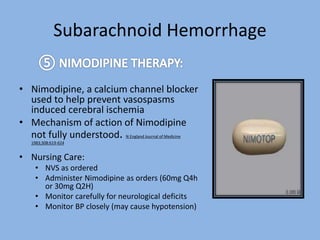
• Nimodipine, a calcium channel blocker
used to help prevent vasospasms
induced cerebral ischemia
• Mechanism of action of Nimodipine
not fully understood. N England Journal of Medicine
1983;308:619-624
• Nursing Care:
• NVS as ordered
• Administer Nimodipine as orders (60mg Q4h
or 30mg Q2H)
• Monitor carefully for neurological deficits
• Monitor BP closely (may cause hypotension)
Subarachnoid Hemorrhage
• Neurogenic Hyperthermia is
common in SAH (41-71%) Neurosurgery 2010;
66:696-700
• Normothermia improved
outcomes.
• Nursing Care:
• Temperature Q4H & PRN
• Cooling as ordered
• Tylenol as ordered
Subarachnoid Hemorrhage
• During hospitalization, 5% of
SAH patients, will have
seizures.
• Anticonvulsant therapy may be
indicted in these patients.
• Nursing Care:
• NVS
• Monitor for seizure activity
• Administer anticonvulsants and
benzodiazepines as ordered.
Subarachnoid Hemorrhage
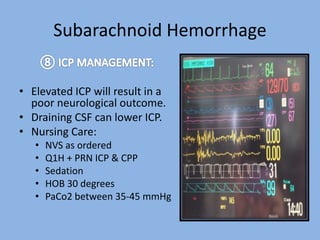
• Elevated ICP will result in a
poor neurological outcome.
• Draining CSF can lower ICP.
• Nursing Care:
• NVS as ordered
• Q1H + PRN ICP & CPP
• Sedation
• HOB 30 degrees
• PaCo2 between 35-45 mmHg
Subarachnoid Hemorrhage
• Severe headaches are common in
SAH.
• Pain control is essential for patient
comfort.
• Excessive pain may cause
unwanted hypertension.
• Nausea and emesis is common
with SAH patients
• Administer antiemetic
medications, as ordered, to
prevent vomiting.
• Vomiting increases the risk of
rebleeding, and increases ICP.
Subarachnoid Hemorrhage
• Rebleeding is an early and catastrophic
complication of SAH.
• Early aneurysm repair reduces the risk of
rebleeding.
• EVD are inserted to drain excessive CSF and to
monitor ICP.
• Nimodipine Therapy is used to mitigate
vasospasm, and to prevent cerebral ischemia.
• Once the aneurysm is secured Hypertensive
Therapy is used to prevent cerebral ischemia.
• Careful neurological assessment is essential.
Subarachnoid Hemorrhage
Thank you….
References:
https://www.youtube.com/watch?v=
WNcGiM5kH5s
Stroke 1994; 25(7) 1342
Stroke 2009; 40(3) 994
Stroke 2012; 43:1711-37
NEJM 1983; 308:619-624

Subarachnoid hemorrhage

  • 1.
  • 2.
    Subarachnoid Hemorrhage • Subarachnoidhemorrhage (SAH) is bleeding into the subarachnoid space. • SAH may occur spontaneously from an aneurysm or from head trauma. • Mortality from SAH are very high (10% die before the hospital, 25% with 24 hours & 45% with 30 days)Stroke 1994;25(7)1342
  • 3.
    Subarachnoid Hemorrhage • Signsand Symptoms of a SAH: • Headaches • Photophobia • Nausea & Vomiting • Seizures • Decreased LOC • Neurological Deficits • Stiff Neck • Seizures
  • 4.
    Subarachnoid Hemorrhage • TheHunt & Hess Classification grades the severity SAH based on the patient’s clinical condition:
  • 5.
    Subarachnoid Hemorrhage Why areSAH so deadly? • Hydrocephalus • Rebleeding • Vasospasms & Delayed Cerebral Ischemia • Elevated ICP 0 20 40 60 First Hour First Day 30days
  • 6.
    Subarachnoid Hemorrhages • Hydrocephalusdevelops in 20 to 30% of SAH patients. Stroke 2009;40(3)994 • Communicating hydrocephalus, the type seen after SAH, occurs when CSF cannot be absorbed normally through the arachnoid villi.
  • 7.
    Subarachnoid Hemorrhages • 4%of patients rebleed in the first 6 hours. • 20% of patient rebleed within 14 days. • Rebleeding is catastrophic (80% mortality rate)
  • 8.
    Subarachnoid Hemorrhages • Vasospasmsoccur in 40-60% of SAH patient. • 20-30% of vasospasm patients develop delayed cerebral ischemia (DCI). • Some patient develop DCI without vasospasm. • Pathogenesis of vasospasm and DCI not fully understood.
  • 9.
    Subarachnoid Hemorrhages + + 80%10% 10% • The skull is rigid and can not expand. • Volume = Brain (80%) + blood (10%) + CSF (10%). • Increased volume within the skull will increase the ICP. • Normal ICP is 10 – 20 mmHG • Cerebral edema, blood, and hydrocephalus may caused an elevated ICP (<20mmHg) • Elevated ICP worsens outcomes
  • 10.
    Subarachnoid Hemorrhage • SAHis bleeding into the subarachnoid space • The Hunt & Hess Classification grades the degree of neurological deficits • Grade I (mild deficits + mortality) → Grade V (severe deficits + mortality) • SAH patients have a substantial mortality rate from hydrocephalus, rebleeding, increased ICP & delayed cerebral ischemia (vasospasms) • Early, the risk of bleeding is higher. Later, the risk of vasospasms increases (see next slide).
  • 11.
    Subarachnoid Hemorrhage Vasospasm 0to 21 days ❶Vasospasm can develop up to 3 weeks. ❷Highest prevalence between 7 and 21 days. ❸Vasospasms may not cause neurological deficits. ❹Pathogenesis of vasospasm is not fully understood. ❺Delayed Cerebral Ischemia results in new neurological deficits. Rebleeding 0 to 14 days Highest risk in the first 6 hours ❶ Early surgical repair (day 1 to 3: clipping or coiling) reduces the risk of rebleeding. ❷ Careful BP control reduces the risk of rebleeding. Highest risk of vasospasm from 7 to 21 days
  • 12.
    Subarachnoid Hemorrhage • VSQ1H • NVS as ordered • Temperature Q4H + PRN • Zero ICP Monitor Qshift + PRN • ICP + CPP Q1H + PRN • CSF Drainage Q1H • ABG Qshift + PRN • HOB 30degrees Next, lets get more specific:
  • 13.
    Subarachnoid Hemorrhage ❶Hydrocephalus Management ❷BloodPressure Control ❸Early Surgical Management (clipping or coiling) ❹Hypertensive Therapy ❺Nimodipine Therapy ❻Temperature Control ❼Seizure Control ❽ ICP Management ❾Pain / Nausea Control
  • 14.
    Subarachnoid Hemorrhage • Hydrocephalusis a frequent complication of a SAH. • EVD are inserted to drain excessive CSF and to monitor ICP. • Initially, CSF is bright red but slowly becomes yellow (xanthochromia). • Nursing Care: • NVS as ordered • Q1H ICP Monitoring • Q1H CCP Monitoring • Q1H CSF Drainage Output • Qshift Zero EVD • Ensure collection chamber is at the correct height (cmH20 or mmHg) • Level EVD PRN
  • 15.
    Subarachnoid Hemorrhage • BPshould be kept between 120 to 160mmHg • BP goal set by Neurosurgery Team • Hypertension increases the risk of rebleeding Stroke 2009;43:1711-37 • Aggressive BP management (too low) increases the risk of infraction Stroke 2012;43: 1711-37 • Nursing Care: • NVS • Q1H BP (and PRN) • Minimize stimulation • Prevent emesis • Pain Control • Medication PRN
  • 16.
    Subarachnoid Hemorrhage • Typically,the aneurysm is secured within the first 3 days (coiling or clipping depending upon type of aneurysm and location). • Reduces the risk of rebleeding. • Allows more aggressive management of vasospasm and delayed cerebral ischemia.
  • 17.
    Subarachnoid Hemorrhage • Hypertensivetherapy is utilized to combat vasospasms. • Vasospasm can cause cerebral ischemia and neurological deficits. • Levophed (as well as Milrinone) is used to increase BP which preserve cerebral blood flow and prevent ischemia. • In extreme cases, endovascular rescue therapies (balloon dilation and intra-arterial medications) may be attempted. • Nursing Care: • NVS as ordered • Ensure BP parameters are achieved
  • 18.
    Subarachnoid Hemorrhage • Nimodipine,a calcium channel blocker used to help prevent vasospasms induced cerebral ischemia • Mechanism of action of Nimodipine not fully understood. N England Journal of Medicine 1983;308:619-624 • Nursing Care: • NVS as ordered • Administer Nimodipine as orders (60mg Q4h or 30mg Q2H) • Monitor carefully for neurological deficits • Monitor BP closely (may cause hypotension)
  • 19.
    Subarachnoid Hemorrhage • NeurogenicHyperthermia is common in SAH (41-71%) Neurosurgery 2010; 66:696-700 • Normothermia improved outcomes. • Nursing Care: • Temperature Q4H & PRN • Cooling as ordered • Tylenol as ordered
  • 20.
    Subarachnoid Hemorrhage • Duringhospitalization, 5% of SAH patients, will have seizures. • Anticonvulsant therapy may be indicted in these patients. • Nursing Care: • NVS • Monitor for seizure activity • Administer anticonvulsants and benzodiazepines as ordered.
  • 21.
    Subarachnoid Hemorrhage • ElevatedICP will result in a poor neurological outcome. • Draining CSF can lower ICP. • Nursing Care: • NVS as ordered • Q1H + PRN ICP & CPP • Sedation • HOB 30 degrees • PaCo2 between 35-45 mmHg
  • 22.
    Subarachnoid Hemorrhage • Severeheadaches are common in SAH. • Pain control is essential for patient comfort. • Excessive pain may cause unwanted hypertension. • Nausea and emesis is common with SAH patients • Administer antiemetic medications, as ordered, to prevent vomiting. • Vomiting increases the risk of rebleeding, and increases ICP.
  • 23.
    Subarachnoid Hemorrhage • Rebleedingis an early and catastrophic complication of SAH. • Early aneurysm repair reduces the risk of rebleeding. • EVD are inserted to drain excessive CSF and to monitor ICP. • Nimodipine Therapy is used to mitigate vasospasm, and to prevent cerebral ischemia. • Once the aneurysm is secured Hypertensive Therapy is used to prevent cerebral ischemia. • Careful neurological assessment is essential.
  • 24.
    Subarachnoid Hemorrhage Thank you…. References: https://www.youtube.com/watch?v= WNcGiM5kH5s Stroke1994; 25(7) 1342 Stroke 2009; 40(3) 994 Stroke 2012; 43:1711-37 NEJM 1983; 308:619-624