CODE MANAGEMENT
Ventricular Tachycardia & Ventricular Fibrillation
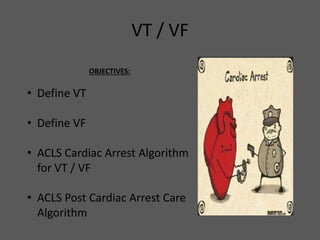
VT / VF
OBJECTIVES:
• Define VT
• Define VF
• ACLS Cardiac Arrest Algorithm
for VT / VF
• ACLS Post Cardiac Arrest Care
Algorithm
VT / VF
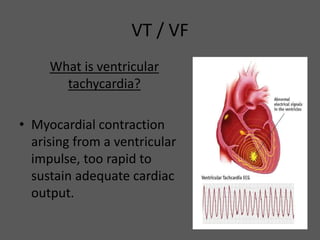
What is ventricular
tachycardia?
• Myocardial contraction
arising from a ventricular
impulse, too rapid to
sustain adequate cardiac
output.
VT / VF
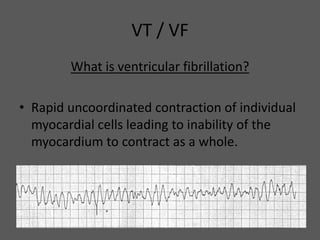
What is ventricular fibrillation?
• Rapid uncoordinated contraction of individual
myocardial cells leading to inability of the
myocardium to contract as a whole.
VT / VF
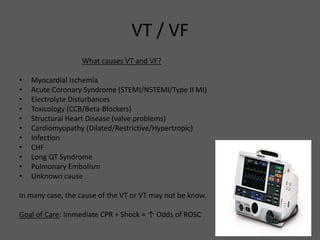
What causes VT and VF?
• Myocardial Ischemia
• Acute Coronary Syndrome (STEMI/NSTEMI/Type II MI)
• Electrolyte Disturbances
• Toxicology (CCB/Beta-Blockers)
• Structural Heart Disease (valve problems)
• Cardiomyopathy (Dilated/Restrictive/Hypertropic)
• Infection
• CHF
• Long QT Syndrome
• Pulmonary Embolism
• Unknown cause
In many case, the cause of the VT or VT may not be know.
Goal of Care: Immediate CPR + Shock = ↑ Odds of ROSC
VT / VF
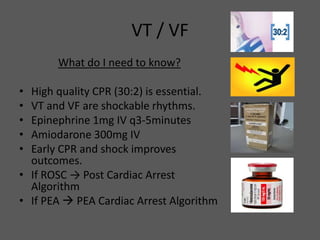
What do I need to know?
• High quality CPR (30:2) is essential.
• VT and VF are shockable rhythms.
• Epinephrine 1mg IV q3-5minutes
• Amiodarone 300mg IV
• Early CPR and shock improves
outcomes.
• If ROSC → Post Cardiac Arrest
Algorithm
• If PEA  PEA Cardiac Arrest Algorithm
VT / VF
VT / VF
What happens if we achieve ROSC?
• Prepare to manage Post Cardiac Arrest
Syndrome.
• Occurs with the return of spontaneous
circulation.
• Ischemia and reperfusion injury can cause
vasodilation (low BP).
• Cardiac dysfunction and pump failure (dilated
cardiomyopathy).
• Post cardiac arrest brain injury.
• Severity depended on duration of code and
patient history.
VT / VF
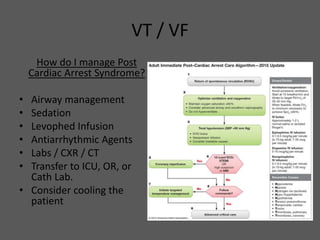
How do I manage Post
Cardiac Arrest Syndrome?
• Airway management
• Sedation
• Levophed Infusion
• Antiarrhythmic Agents
• Labs / CXR / CT
• Transfer to ICU, OR, or
Cath Lab.
• Consider cooling the
patient
VT / VF
References:
• ACLS 2015 PEA and Post Cardiac Arrest guidelines
• CC 90-015 – D
http://policy.nshealth.ca/Site_Published/DHA9/document_render.aspx?document
Render.IdType=6&documentRender.GenericField=&documentRender.Id=53045
• Pulseless Electrical Activity, Circulations, 2013;128;2532-2541
http://circ.ahajournals.org/content/128/23/2532.short
• A Simplified and Structured Teaching Tool for the Evaluation and Management of
Pulseless Electrical Activity, Medical Principals & Practice, 2014;23:1-6
https://www.karger.com/Article/FullText/354195
• Post Cardiac Arrest Syndrome A Review of Therapeutic Strategies, Circulation,
2011;123:1428-1435. http://circ.ahajournals.org/content/123/13/1428

Code Management: VT & VF

  • 1.
    CODE MANAGEMENT Ventricular Tachycardia& Ventricular Fibrillation
  • 2.
    VT / VF OBJECTIVES: •Define VT • Define VF • ACLS Cardiac Arrest Algorithm for VT / VF • ACLS Post Cardiac Arrest Care Algorithm
  • 3.
    VT / VF Whatis ventricular tachycardia? • Myocardial contraction arising from a ventricular impulse, too rapid to sustain adequate cardiac output.
  • 4.
    VT / VF Whatis ventricular fibrillation? • Rapid uncoordinated contraction of individual myocardial cells leading to inability of the myocardium to contract as a whole.
  • 5.
    VT / VF Whatcauses VT and VF? • Myocardial Ischemia • Acute Coronary Syndrome (STEMI/NSTEMI/Type II MI) • Electrolyte Disturbances • Toxicology (CCB/Beta-Blockers) • Structural Heart Disease (valve problems) • Cardiomyopathy (Dilated/Restrictive/Hypertropic) • Infection • CHF • Long QT Syndrome • Pulmonary Embolism • Unknown cause In many case, the cause of the VT or VT may not be know. Goal of Care: Immediate CPR + Shock = ↑ Odds of ROSC
  • 6.
    VT / VF Whatdo I need to know? • High quality CPR (30:2) is essential. • VT and VF are shockable rhythms. • Epinephrine 1mg IV q3-5minutes • Amiodarone 300mg IV • Early CPR and shock improves outcomes. • If ROSC → Post Cardiac Arrest Algorithm • If PEA  PEA Cardiac Arrest Algorithm
  • 7.
  • 8.
    VT / VF Whathappens if we achieve ROSC? • Prepare to manage Post Cardiac Arrest Syndrome. • Occurs with the return of spontaneous circulation. • Ischemia and reperfusion injury can cause vasodilation (low BP). • Cardiac dysfunction and pump failure (dilated cardiomyopathy). • Post cardiac arrest brain injury. • Severity depended on duration of code and patient history.
  • 9.
    VT / VF Howdo I manage Post Cardiac Arrest Syndrome? • Airway management • Sedation • Levophed Infusion • Antiarrhythmic Agents • Labs / CXR / CT • Transfer to ICU, OR, or Cath Lab. • Consider cooling the patient
  • 10.
    VT / VF References: •ACLS 2015 PEA and Post Cardiac Arrest guidelines • CC 90-015 – D http://policy.nshealth.ca/Site_Published/DHA9/document_render.aspx?document Render.IdType=6&documentRender.GenericField=&documentRender.Id=53045 • Pulseless Electrical Activity, Circulations, 2013;128;2532-2541 http://circ.ahajournals.org/content/128/23/2532.short • A Simplified and Structured Teaching Tool for the Evaluation and Management of Pulseless Electrical Activity, Medical Principals & Practice, 2014;23:1-6 https://www.karger.com/Article/FullText/354195 • Post Cardiac Arrest Syndrome A Review of Therapeutic Strategies, Circulation, 2011;123:1428-1435. http://circ.ahajournals.org/content/123/13/1428