PRONE POSITIONING:
ICU&OT
• INTRODUCTION.
• PHYSIOLOGIC EFFECTS ON OXYGENATION.
• INDICATIONS.
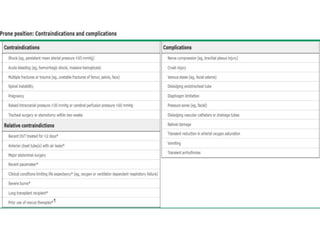
• CONTRADICATIONS.
• TYPES OF PRONING.
• PRONE PROCEDURE.
• ASSESSING THE RESPONSE.
• COMPLICATIONS.
• LITERATURE.
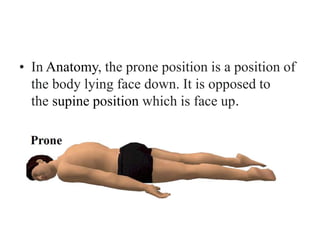
• In Anatomy, the prone position is a position of
the body lying face down. It is opposed to
the supine position which is face up.
• Prone position is used during surgical procedures
that provide surgical access to the dorsal aspects of
the patient’s body.
• Prone position ventilation, first proposed in
1974 and first applied in patients with ARDS
in 1976,results in improved arterial
oxygenation in most patients.
• Prone ventilation refers to the delivery of
mechanical ventilation with the patient
lying in the prone position.
• Awake proning.
• Sedated-Paralysed patients.
• Tracheostomised patients.
• ECMO patients.
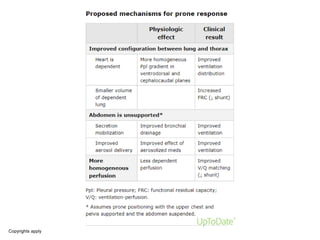
PHYSIOLOGIC EFFECTS ON OXYGENATION:
• The prone position alters the mechanics and physiology
of gas exchange to result consistently in improved
oxygenation. The improvement of oxygenation during
prone ventilation is multifactorial.
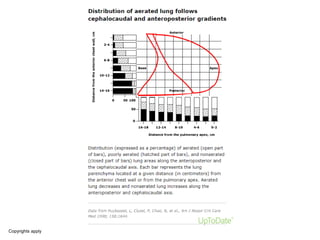
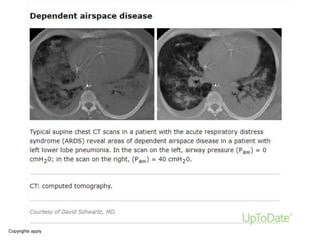
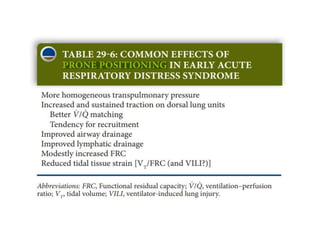
• Prone positioning improves gas exchange by
ameliorating the ventral-dorsal transpulmonary pressure
difference, reducing dorsal lung compression, and
improving lung perfusion.
Copyrights apply
Copyrights apply
Copyrights apply
Copyrights apply
indications
• Severe ARDS – PROSEVA defined severe ARDS as those having a partial
pressure of arterial oxygen:fraction of inspired oxygen (PaO2:FiO2) ratio <150
mmHg with a FiO2 ≥0.6 and PEEP ≥5 cm H2O; at study entry, the median
PaO2 was 80 mmHg (range 62 to 98 mmHg; 8.3 to 13 kPa), fraction of inspired
oxygen was 0.8 (range 0.75 to 0.95), and PaO2:FiO2 ratio was 100 mmHg. This
definition deviates from the Berlin definition where severe ARDS is defined as
a PaO2:FiO2 ratio <100 mmHg
• Refractory hypoxemia due to ARDS – An alternative reasonable definition is a
PaO2:FiO2 of ≤100 mmHg with a PaO2 ≤60 mmHg despite optimization of the
ventilator settings on FiO2 of 1 (ie refractory hypoxemia)
• For patients with ARDS who have hypoxemia that is immediately life-
threatening in whom an increase in oxygenation is urgently required or who are
rapidly progressive despite optimizing ventilator settings, strategies other than
proning such as ECMO or pulmonary vasodilators may be more appropriate, if
available
• prone ventilation has been used as a bridge to ECMO.
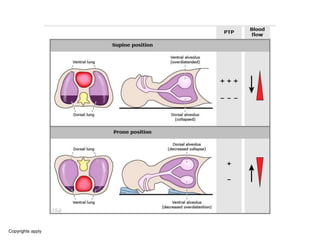
Reduced lung compression — Lung compression by both the heart and the diaphragm
can be favorably affected by prone positioning.
• The effects of supine positioning – When an individual with ARDS is supine, the
heart compresses the medial posterior lung parenchyma and the diaphragm
compresses the posterior-caudal lung parenchyma.
• The latter is caused by the abdominal contents displacing the diaphragm cranially,
which can be exacerbated by a loss of diaphragmatic tone due to sedation and/or
paralysis or increased abdominal pressure.
• Compression by either the heart and/or the diaphragm may exaggerate dependent
lung collapse in the supine position, increasing hypoxemia (ie, worsening shunt)
and ventilator-associated lung injury [11].
• The effects of prone positioning – During prone ventilation, the heart becomes
dependent, lying on the sternum, potentially decreasing medial posterior lung
compression.
• In addition, the diaphragm is displaced caudally (especially in obese patients and
when the abdomen is left unsupported), decreasing compression of the posterior-
caudal lung parenchyma [12]. These effects improve ventilation and oxygenation
[13].
BENEFITS
• This position may be more physiologic for
most mammals and results in improved
secretion removal, better ventilation-perfusion
matching, and enhanced aeration of the dorsal
lung units.
• Prone positioning may also unload the right
ventricle in the setting of severe ARDS.
Techniques
• Manual method…“sandwich and flip” technique,
and awake prone positioning.
• Automated proning by Rotaprone bed.
Timing of initiation —
• After a 12 to 24 hour stabilization period of supine ventilation,
we maintain a low threshold for initiating prone ventilation
early (up to 36 hours) in the course of mechanical ventilation
for severe acute respiratory distress syndrome (ARDS). This is
based on the observation from PROSEVA and additional trials
that early initiation of prone ventilation was most effective, as
well as the physiologic rationale that collapsed lung units are
likely to be opened (ie, recruited) most easily during the acute
exudative phase of ARDS.
Monitoring:
• Standard monitoring ..invasive arterial
lines,ET CO2 monitoring..
• Endotracheal suctioning should be assessed
with increased frequency after the patient is
placed prone because large quantities of
pulmonary secretions may drain into the
endotracheal tube.
Feeding —
• Once prone, enteral tube feeds and usual mouth and skin care can
be resumed.
• However, enteral feeding during prone ventilation can be
complicated by emesis and/or increased residual gastric volumes
.
• In order to minimize such complications, we prefer a cautious
approach to enteral feeding in the prone position, with proper
positioning (head of the patient slightly elevated), monitoring,
and judicious use of prokinetic agents.
• Tube feeds should be temporarily switched off and the stomach
emptied before repositioning back to the supine position.
Sedation —
• All patients in whom prone ventilation is
performed require increased sedation and
neuromuscular blockade. (PROSEVA).
Duration —
• The optimal duration of prone positioning is unknown. Most
studies have used either repeated sessions of prone ventilation
lasting six to eight hours per day or prolonged prone ventilation
lasting 17 to 20 hours per day , with similar results.
• In the one randomized study that showed a mortality benefit for
prone positioning in severe ARDS (PROSEVA), the mean
duration of time in the prone position was 17 hours per day with
an average of four sessions in total per patient .
• Prone ventilation was continued for the study period for up to 28
days. It was stopped for continued improvement in oxygenation
(PaO2:FiO2 ≥150 mmHg, FiO2 ≤0.6, PEEP ≤10 cm H2O)
maintained for at least four hours after the end of the last prone
session.
ASSESSING THE RESPONSE
• A sustained improvement in gas exchange (eg, >10 mmHg PaO2 on
stable ventilator settings) or evidence of alveolar recruitment (eg,
increase in lung compliance based on a fall in plateau pressure for a
given tidal volume) that does not increase the risk of ventilator
induced lung injury.
• Usually a response is noted during the first hour of the initial trial
but longer periods (eg, 12 to 18 hours) are appropriate to ensure a
response, provided no life-threatening hypoxemia is present.
• Importantly, if prone ventilation fails (eg, no change in the patient's
gas exchange or lung mechanics, a worsening of gas exchange or
cardiovascular status), the patient should be returned to the supine
position and alternate strategies for improving oxygenation (eg,
extracorporeal membrane oxygenation) should be pursued.
EFFECT OF PRONE POSITIONING ON CLINICAL
OUTCOME OF PATIENTS WITH ACUTE RESPIRATORY
FAILURE
• Three different responses have been observed
in patients who exhibited improved
oxygenation in the prone position: (a) most of
the patients display better oxygenation than in
the original supine position, although the
values are lower than in the prone position; (b)
some patients return to basal supine
oxygenation values when returned to the
supine position (these patients are then
considered “prone dependent”); and (c) some
Potential Sources of Injury in
Prone Position
• Patient must be first examined for his/her ability to bear
the prone position.
• The staff must ensure not to apply too much pressure,
especially on the delicate and small parts of the body
such eyes, ears, nose, etc. Excess pressure may lead to
damage of the body part. This pressure may not only be
applied through the hands, it may also be a result of the
obstruction caused by the arterial supply or venous
drainage.
• The dependent areas such as nose, forehead, breast,
arms, chest, genitalia, and pelvis must be properly noted
and addressed. In case of joint replacement, any
negligence may lead to tissue injuries or dislocation.
• Direct pressure may lead to damage of the nerves. It
should be taken care that nerves are applied with
appropriate pressure only.
• Ocular damage might be a result of two factors. The first
one might be excess pressure on the eyes, while the
second one being poor perfusion. This may lead to severe
damages, hence, it should be well taken care of.
• Too much pressure can be transferred
from the lower and upper limbs to the
head, neck, chest, abdomen, and vessels.
This may cause the corresponding areas to
swell, thus, producing obstructions to the
air flow.
Prone Positioning Checklist
• A checklist ensures that the complications associated with prone positioning
can be avoided. It includes following steps (4):
• Identify the team members and make sure that everyone has been assigned
their task in order to avoid confusion during the process.
• Identify the connections to the patient’s body and make sure they do not
face any blockage.
• Make sure you provide cushions wherever necessary. It not only ensures the
patient’s comfort, but also reduces the chances of extra pressure on the
smaller parts of the body.
• All the test that should have be conducted prior to the commencement of
prone positioning should be performed by the nursing staff, and same
should be checked by the higher authorities involved.
• The team must ensure coordination between the team members.
•
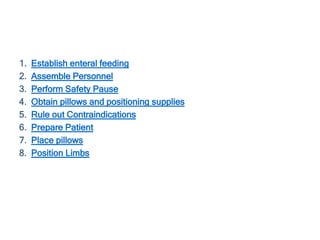
1. Establish enteral feeding
2. Assemble Personnel
3. Perform Safety Pause
4. Obtain pillows and positioning supplies
5. Rule out Contraindications
6. Prepare Patient
7. Place pillows
8. Position Limbs
• Tracheostomised patient
• Ecmo patient
unproning
Copyrights apply

PRONE.pptx

  • 1.
  • 2.
    • INTRODUCTION. • PHYSIOLOGICEFFECTS ON OXYGENATION. • INDICATIONS. • CONTRADICATIONS. • TYPES OF PRONING. • PRONE PROCEDURE. • ASSESSING THE RESPONSE. • COMPLICATIONS. • LITERATURE.
  • 3.
    • In Anatomy,the prone position is a position of the body lying face down. It is opposed to the supine position which is face up.
  • 4.
    • Prone positionis used during surgical procedures that provide surgical access to the dorsal aspects of the patient’s body. • Prone position ventilation, first proposed in 1974 and first applied in patients with ARDS in 1976,results in improved arterial oxygenation in most patients.
  • 5.
    • Prone ventilationrefers to the delivery of mechanical ventilation with the patient lying in the prone position. • Awake proning. • Sedated-Paralysed patients. • Tracheostomised patients. • ECMO patients.
  • 6.
    PHYSIOLOGIC EFFECTS ONOXYGENATION: • The prone position alters the mechanics and physiology of gas exchange to result consistently in improved oxygenation. The improvement of oxygenation during prone ventilation is multifactorial. • Prone positioning improves gas exchange by ameliorating the ventral-dorsal transpulmonary pressure difference, reducing dorsal lung compression, and improving lung perfusion.
  • 7.
  • 8.
  • 9.
  • 10.
  • 11.
    indications • Severe ARDS– PROSEVA defined severe ARDS as those having a partial pressure of arterial oxygen:fraction of inspired oxygen (PaO2:FiO2) ratio <150 mmHg with a FiO2 ≥0.6 and PEEP ≥5 cm H2O; at study entry, the median PaO2 was 80 mmHg (range 62 to 98 mmHg; 8.3 to 13 kPa), fraction of inspired oxygen was 0.8 (range 0.75 to 0.95), and PaO2:FiO2 ratio was 100 mmHg. This definition deviates from the Berlin definition where severe ARDS is defined as a PaO2:FiO2 ratio <100 mmHg • Refractory hypoxemia due to ARDS – An alternative reasonable definition is a PaO2:FiO2 of ≤100 mmHg with a PaO2 ≤60 mmHg despite optimization of the ventilator settings on FiO2 of 1 (ie refractory hypoxemia) • For patients with ARDS who have hypoxemia that is immediately life- threatening in whom an increase in oxygenation is urgently required or who are rapidly progressive despite optimizing ventilator settings, strategies other than proning such as ECMO or pulmonary vasodilators may be more appropriate, if available • prone ventilation has been used as a bridge to ECMO.
  • 12.
    Reduced lung compression— Lung compression by both the heart and the diaphragm can be favorably affected by prone positioning. • The effects of supine positioning – When an individual with ARDS is supine, the heart compresses the medial posterior lung parenchyma and the diaphragm compresses the posterior-caudal lung parenchyma. • The latter is caused by the abdominal contents displacing the diaphragm cranially, which can be exacerbated by a loss of diaphragmatic tone due to sedation and/or paralysis or increased abdominal pressure. • Compression by either the heart and/or the diaphragm may exaggerate dependent lung collapse in the supine position, increasing hypoxemia (ie, worsening shunt) and ventilator-associated lung injury [11]. • The effects of prone positioning – During prone ventilation, the heart becomes dependent, lying on the sternum, potentially decreasing medial posterior lung compression. • In addition, the diaphragm is displaced caudally (especially in obese patients and when the abdomen is left unsupported), decreasing compression of the posterior- caudal lung parenchyma [12]. These effects improve ventilation and oxygenation [13].
  • 13.
    BENEFITS • This positionmay be more physiologic for most mammals and results in improved secretion removal, better ventilation-perfusion matching, and enhanced aeration of the dorsal lung units. • Prone positioning may also unload the right ventricle in the setting of severe ARDS.
  • 15.
    Techniques • Manual method…“sandwichand flip” technique, and awake prone positioning. • Automated proning by Rotaprone bed.
  • 16.
    Timing of initiation— • After a 12 to 24 hour stabilization period of supine ventilation, we maintain a low threshold for initiating prone ventilation early (up to 36 hours) in the course of mechanical ventilation for severe acute respiratory distress syndrome (ARDS). This is based on the observation from PROSEVA and additional trials that early initiation of prone ventilation was most effective, as well as the physiologic rationale that collapsed lung units are likely to be opened (ie, recruited) most easily during the acute exudative phase of ARDS.
  • 17.
    Monitoring: • Standard monitoring..invasive arterial lines,ET CO2 monitoring.. • Endotracheal suctioning should be assessed with increased frequency after the patient is placed prone because large quantities of pulmonary secretions may drain into the endotracheal tube.
  • 18.
    Feeding — • Onceprone, enteral tube feeds and usual mouth and skin care can be resumed. • However, enteral feeding during prone ventilation can be complicated by emesis and/or increased residual gastric volumes . • In order to minimize such complications, we prefer a cautious approach to enteral feeding in the prone position, with proper positioning (head of the patient slightly elevated), monitoring, and judicious use of prokinetic agents. • Tube feeds should be temporarily switched off and the stomach emptied before repositioning back to the supine position.
  • 19.
    Sedation — • Allpatients in whom prone ventilation is performed require increased sedation and neuromuscular blockade. (PROSEVA).
  • 20.
    Duration — • Theoptimal duration of prone positioning is unknown. Most studies have used either repeated sessions of prone ventilation lasting six to eight hours per day or prolonged prone ventilation lasting 17 to 20 hours per day , with similar results. • In the one randomized study that showed a mortality benefit for prone positioning in severe ARDS (PROSEVA), the mean duration of time in the prone position was 17 hours per day with an average of four sessions in total per patient . • Prone ventilation was continued for the study period for up to 28 days. It was stopped for continued improvement in oxygenation (PaO2:FiO2 ≥150 mmHg, FiO2 ≤0.6, PEEP ≤10 cm H2O) maintained for at least four hours after the end of the last prone session.
  • 21.
    ASSESSING THE RESPONSE •A sustained improvement in gas exchange (eg, >10 mmHg PaO2 on stable ventilator settings) or evidence of alveolar recruitment (eg, increase in lung compliance based on a fall in plateau pressure for a given tidal volume) that does not increase the risk of ventilator induced lung injury. • Usually a response is noted during the first hour of the initial trial but longer periods (eg, 12 to 18 hours) are appropriate to ensure a response, provided no life-threatening hypoxemia is present. • Importantly, if prone ventilation fails (eg, no change in the patient's gas exchange or lung mechanics, a worsening of gas exchange or cardiovascular status), the patient should be returned to the supine position and alternate strategies for improving oxygenation (eg, extracorporeal membrane oxygenation) should be pursued.
  • 22.
    EFFECT OF PRONEPOSITIONING ON CLINICAL OUTCOME OF PATIENTS WITH ACUTE RESPIRATORY FAILURE • Three different responses have been observed in patients who exhibited improved oxygenation in the prone position: (a) most of the patients display better oxygenation than in the original supine position, although the values are lower than in the prone position; (b) some patients return to basal supine oxygenation values when returned to the supine position (these patients are then considered “prone dependent”); and (c) some
  • 24.
    Potential Sources ofInjury in Prone Position • Patient must be first examined for his/her ability to bear the prone position. • The staff must ensure not to apply too much pressure, especially on the delicate and small parts of the body such eyes, ears, nose, etc. Excess pressure may lead to damage of the body part. This pressure may not only be applied through the hands, it may also be a result of the obstruction caused by the arterial supply or venous drainage.
  • 25.
    • The dependentareas such as nose, forehead, breast, arms, chest, genitalia, and pelvis must be properly noted and addressed. In case of joint replacement, any negligence may lead to tissue injuries or dislocation. • Direct pressure may lead to damage of the nerves. It should be taken care that nerves are applied with appropriate pressure only. • Ocular damage might be a result of two factors. The first one might be excess pressure on the eyes, while the second one being poor perfusion. This may lead to severe damages, hence, it should be well taken care of.
  • 26.
    • Too muchpressure can be transferred from the lower and upper limbs to the head, neck, chest, abdomen, and vessels. This may cause the corresponding areas to swell, thus, producing obstructions to the air flow.
  • 27.
    Prone Positioning Checklist •A checklist ensures that the complications associated with prone positioning can be avoided. It includes following steps (4): • Identify the team members and make sure that everyone has been assigned their task in order to avoid confusion during the process. • Identify the connections to the patient’s body and make sure they do not face any blockage. • Make sure you provide cushions wherever necessary. It not only ensures the patient’s comfort, but also reduces the chances of extra pressure on the smaller parts of the body. • All the test that should have be conducted prior to the commencement of prone positioning should be performed by the nursing staff, and same should be checked by the higher authorities involved. • The team must ensure coordination between the team members. •
  • 28.
    1. Establish enteralfeeding 2. Assemble Personnel 3. Perform Safety Pause 4. Obtain pillows and positioning supplies 5. Rule out Contraindications 6. Prepare Patient 7. Place pillows 8. Position Limbs
  • 29.
  • 30.
  • 31.
  • 32.