Project Management Body of
Knowledge® Guide (Scope)5th Edition
Image retrieved from https://quotefancy.com/quote/267711/Steve-Jobs-Deciding-what-not-to-do-is-as-important-as-deciding-what-to-do
3
PMBOK Guide® (Scope)
Project Scope Management is a process where all work tasks and requirements are
properly defined, documented, maintained, monitored and managed to complete the project
successfully. Project work boundaries are set on what should be included and what should not.
Scope can refer to 2 things: Product Scope, features and functions that characterizes a product,
service or result; and Project Scope, work performed to deliver a project, service or result.
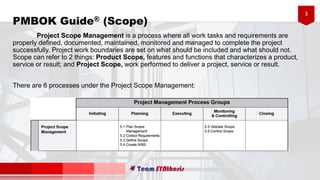
There are 6 processes under the Project Scope Management:
4
5.1 Plan Scope Management
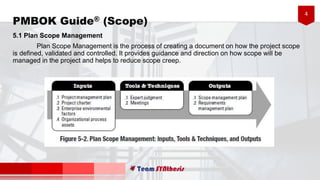
Plan Scope Management is the process of creating a document on how the project scope
is defined, validated and controlled. It provides guidance and direction on how scope will be
managed in the project and helps to reduce scope creep.
PMBOK Guide® (Scope)
5
Input
(1) Project Management Plan
Approved subsidiary plans of the project management plan are used to create the scope
management plan and influence the approach taken for planning and managing project scope.
(2) Project Charter
Document used to plan the project scope management processes. It provides high-level project
description and product characteristics from the project statement of work.
(3) Enterprise Environmental Factors (EEF)
Factors like organizational culture, infrastructure, personnel information and marketplace
conditions could influence the development of the Scope Management Plan.
(4) Organizational Process Assets (OPA)
Scope Management Plan would need to comply to the organizational processes, procedures
and policies, historical information and lessons learned knowledge base.
PMBOK Guide® (Scope)
6
Tools and Techniques
(1) Expert Judgement
Knowledgeable parties with specialized education, knowledge, skill or experience would be
required to receive the input for developing the project scope management plan.
(2) Meetings
Project managers, stakeholders, project sponsor and team members are the common
attendees to develop the project scope management plan.
Output
(1) Scope Management Plan
A document describing how the scope is defined, developed, monitored, controlled and verified.
(2) Requirements Management Plan
A management plan of how requirements are analyzed, documented, tracked and managed.
PMBOK Guide® (Scope)
7
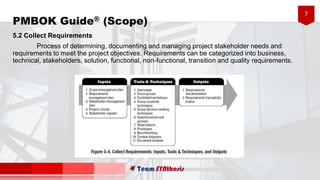
5.2 Collect Requirements
Process of determining, documenting and managing project stakeholder needs and
requirements to meet the project objectives. Requirements can be categorized into business,
technical, stakeholders, solution, functional, non-functional, transition and quality requirements.
PMBOK Guide® (Scope)
8
Input
(1) Scope Management Plan
Document that provides clarity on which types of requirements needed to be collected.
(2) Requirements Management Plan
Definition of project processes and stakeholders’ needs are recorded into the document.
(3) Stakeholder Management Plan
Stakeholders communication requirements, engagement and participation level are
documented.
(4) Project Charter
High-level description of product, service or result to develop detailed project requirements.
(5) Stakeholder Register
Database of stakeholders that gives requirements information and stores them in the register.
PMBOK Guide® (Scope)
9
Tools and Techniques
(1) Interviews
Formal or informal approach to extract information from stakeholders.
(2) Focus Groups
Interactive discussion that brings stakeholders together to understand their expectations and
thoughts on proposed product, service or result.
(3) Facilitated Workshops
Workshop is conducted to define cross-functional requirements and reconciling stakeholder
differences. It also builds stakeholders’ communication, relationship and consensus.
(4) Group Creativity Techniques
Several group activities that perform brainstorming, nominal group technique, idea mapping,
affinity diagram or muticriteria decision analysis.
PMBOK Guide® (Scope)
10
(5) Group Decision-making Techniques
Assessment process with conclusive actions to achieve future expected outcomes. Various
methods can be used such as unanimity, majority, plurality or dictatorship.
(6) Questionnaires and Surveys
Set of enquiries to accumulate information and statistical analysis from a large amount of
respondents. Useful for varied audiences and respondents that are geographically dispersed.
(7) Observations
External viewing of individuals or groups in their environment by understanding how they
perform their tasks and carry out processes. Also known as “job shadowing”.
(8) Prototypes
Tangible experimental model to showcase and receive feedbacks from the stakeholders.
Prototypes uses the concept of progressive elaboration in iterative cycles.
PMBOK Guide® (Scope)
11
(9) Benchmarking
Comparison of actual and planned practices to generate ideas for improvement, identify best
practices and provide a basis for measuring performances.
(10) Context Diagrams
A model that shows the business system and how people or other systems interact with it.
(11) Document Analysis
Technique used to elicit requirements by identifying information from existing documents.
PMBOK Guide® (Scope)
12
Output
(1) Requirements Documentation
Document describing how the requirements meet the business needs. Requirements need to
be measurable, testable, traceable, complete, consistent and acceptable to stakeholders.
(2) Requirements Traceability Matrix
A grid that links requirements from their origin to the deliverables. The matrix helps to add
business value and tracks requirements throughout the project cycle. This helps in ensuring
that the requirements are approved and delivered in the final stage of project closing.
PMBOK Guide® (Scope)
13
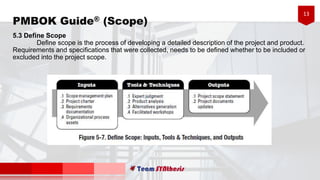
5.3 Define Scope
Define scope is the process of developing a detailed description of the project and product.
Requirements and specifications that were collected, needs to be defined whether to be included or
excluded into the project scope.
PMBOK Guide® (Scope)
14
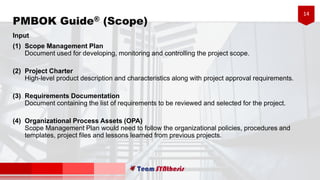
Input
(1) Scope Management Plan
Document used for developing, monitoring and controlling the project scope.
(2) Project Charter
High-level product description and characteristics along with project approval requirements.
(3) Requirements Documentation
Document containing the list of requirements to be reviewed and selected for the project.
(4) Organizational Process Assets (OPA)
Scope Management Plan would need to follow the organizational policies, procedures and
templates, project files and lessons learned from previous projects.
PMBOK Guide® (Scope)
15
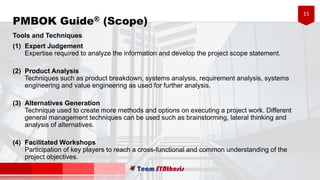
Tools and Techniques
(1) Expert Judgement
Expertise required to analyze the information and develop the project scope statement.
(2) Product Analysis
Techniques such as product breakdown, systems analysis, requirement analysis, systems
engineering and value engineering as used for further analysis.
(3) Alternatives Generation
Technique used to create more methods and options on executing a project work. Different
general management techniques can be used such as brainstorming, lateral thinking and
analysis of alternatives.
(4) Facilitated Workshops
Participation of key players to reach a cross-functional and common understanding of the
project objectives.
PMBOK Guide® (Scope)
16
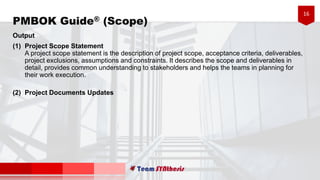
Output
(1) Project Scope Statement
A project scope statement is the description of project scope, acceptance criteria, deliverables,
project exclusions, assumptions and constraints. It describes the scope and deliverables in
detail, provides common understanding to stakeholders and helps the teams in planning for
their work execution.
(2) Project Documents Updates
PMBOK Guide® (Scope)
17
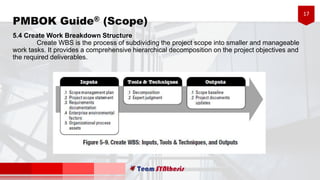
5.4 Create Work Breakdown Structure
Create WBS is the process of subdividing the project scope into smaller and manageable
work tasks. It provides a comprehensive hierarchical decomposition on the project objectives and
the required deliverables.
PMBOK Guide® (Scope)
18
Input
(1) Scope Management Plan
Document specifying how to create WBS and how would it be maintained and approved.
(2) Project Scope Statement
A document that describes the constraints or limitations of project work to be performed.
(3) Requirements Documentation
List of expectations to be completed and delivered as the final products, services or results.
(4) Enterprise Environmental Factor (EEF)
Industry-specific WBS standards may serve as a reference for creation of the WBS.
(5) Organizational Process Assets (OPA)
WBS would need to follow the organizational policies, procedures and templates, project files
and lessons learned from previous projects.
PMBOK Guide® (Scope)
19
Tools and Techniques
(1) Decomposition
Technique used for breaking down the project scope and deliverables into smaller manageable
parts which would be easier to estimate and manage the cost and duration. Decomposition
involves in activities such as analyzing the deliverables, structuring the WBS, breaking down of
high level deliverables to smaller chunks, assigning identification codes to the WBS
components and verifying if the components are appropriate.
(2) Expert Judgement
Expert opinions are needed to help breakdown and consolidate the project scope. Knowledge
in technical and management areas are appreciated to gain input on the different areas of
work.
PMBOK Guide® (Scope)
20
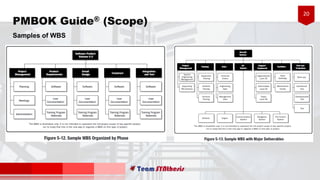
Samples of WBS
PMBOK Guide® (Scope)
21
Output
(1) Scope Baseline
Scope baseline is the approved version of project scope statement, work breakdown structure
and work breakdown dictionary. It is used for work comparison and can only be changed
through the change control procedures.
(2) Project Documents Updates
PMBOK Guide® (Scope)
22
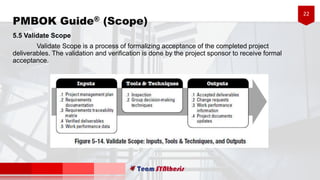
5.5 Validate Scope
Validate Scope is a process of formalizing acceptance of the completed project
deliverables. The validation and verification is done by the project sponsor to receive formal
acceptance.
PMBOK Guide® (Scope)
23
Input
(1) Project Management Plan
Document containing scope management plan and the scope baseline. Scope management
plan specifies on methods to obtain formal acceptance of the completed project deliverables.
The scope baseline includes the approved version of a scope management, work breakdown
structure and the work breakdown structure directory.
(2) Requirements Documentation
List of requirements of the project along with the acceptance criteria.
(3) Requirements Traceability Matrix
Requirements Traceability Matrix links the requirements to the origin and tracks them
throughout the project cycle.
PMBOK Guide® (Scope)
24
(4) Verified Deliverables
Completed and checked deliverables for correctness through the Control Quality process
(5) Work Performance Data
Data that includes the degree of compliance with requirements, number of nonconformities,
severity of nonconformities or the number of validation cycle performed in a period of time.
PMBOK Guide® (Scope)
25
Tools and Techniques
(1) Inspection
Investigation activities such as measuring, examining and validating to determine whether
deliverables meet requirements and product acceptance criteria. Inspection can be in the form
of reviews, product reviews, audits and walkthroughs.
(2) Group Decision-making Techniques
Technique used to reach a unanimous conclusion when the validation is performed by the
project team and other stakeholders.
PMBOK Guide® (Scope)
26
Output
(1) Accepted Deliverables
Formal documentation containing the deliverables that meet the criteria are then signed off by
the sponsor.
(2) Change Requests
Deliverables that did not met the acceptance criteria might require change requests for defect
repair and will go through the Integrated Change Control process.
(3) Work Performance Information
Information about the project’s progress and is updated and communicated to the key
stakeholders.
(4) Project Documents Updates
PMBOK Guide® (Scope)
27
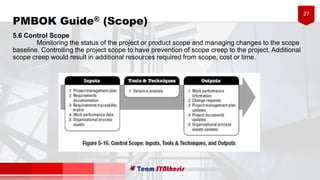
5.6 Control Scope
Monitoring the status of the project or product scope and managing changes to the scope
baseline. Controlling the project scope to have prevention of scope creep to the project. Additional
scope creep would result in additional resources required from scope, cost or time.
PMBOK Guide® (Scope)
28
Input
(1) Project Management Plan
Scope baseline, scope management plan, change management plan, configuration
management plan and requirements management plan are used to control the project scope.
(2) Requirements Documentation
Documented requirements that are measurable, testable, traceable, complete and consistent.
This makes it easier to detect any deviation from the project scope.
(3) Requirements Traceability Matrix
Matrix used to detect the impact of any change or deviation from the scope baseline on the
project objectives.
PMBOK Guide® (Scope)
29
(4) Work Performance Data
Raw information of the change request received, number of change requests and number of
deliverables completed
(5) Organizational Process Assets (OPA)
Existing formal or informal scope, control-related policies, procedures, processes, monitoring
and reporting methods or templates influences the Control Scope process.
Tools and Techniques
(1) Variance Analysis
Technique used to calculate the degree of differences between the scope baseline and actual
performances. Project performances measurements are used to measure the magnitude of the
variation from the project’s original scope.
PMBOK Guide® (Scope)
30
Output
(1) Work Performance Information
Produced information regarding the project scope in comparison with the scope baseline.
Contains the information of changes received, the identified scope variances and their causes,
the impact to the schedule or cost along with the forecast of future scope performances. This
document provides the foundation of making scope decisions.
(2) Change Requests
Preventive, corrective actions or defect repairs that are raised to ensure the project work is
following as planned in the project scope.
(3) Project Management Plan Updates
(4) Project Documents Updates
(5) Organizational Process Assets (OPA) Updates
PMBOK Guide® (Scope)
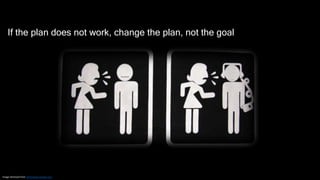
Image retrieved from tshirts4sale.weebly.com
If the plan does not work, change the plan, not the goal
32References
01 Project Management Institute (2013), A Guide to the Project Management
Body of Knowledge (PMBOK ® Guide) - 5th Edition

Project Management Body of Knowledge (Scope)

  • 1.
    Project Management Bodyof Knowledge® Guide (Scope)5th Edition
  • 2.
    Image retrieved fromhttps://quotefancy.com/quote/267711/Steve-Jobs-Deciding-what-not-to-do-is-as-important-as-deciding-what-to-do
  • 3.
    3 PMBOK Guide® (Scope) ProjectScope Management is a process where all work tasks and requirements are properly defined, documented, maintained, monitored and managed to complete the project successfully. Project work boundaries are set on what should be included and what should not. Scope can refer to 2 things: Product Scope, features and functions that characterizes a product, service or result; and Project Scope, work performed to deliver a project, service or result. There are 6 processes under the Project Scope Management:
  • 4.
    4 5.1 Plan ScopeManagement Plan Scope Management is the process of creating a document on how the project scope is defined, validated and controlled. It provides guidance and direction on how scope will be managed in the project and helps to reduce scope creep. PMBOK Guide® (Scope)
  • 5.
    5 Input (1) Project ManagementPlan Approved subsidiary plans of the project management plan are used to create the scope management plan and influence the approach taken for planning and managing project scope. (2) Project Charter Document used to plan the project scope management processes. It provides high-level project description and product characteristics from the project statement of work. (3) Enterprise Environmental Factors (EEF) Factors like organizational culture, infrastructure, personnel information and marketplace conditions could influence the development of the Scope Management Plan. (4) Organizational Process Assets (OPA) Scope Management Plan would need to comply to the organizational processes, procedures and policies, historical information and lessons learned knowledge base. PMBOK Guide® (Scope)
  • 6.
    6 Tools and Techniques (1)Expert Judgement Knowledgeable parties with specialized education, knowledge, skill or experience would be required to receive the input for developing the project scope management plan. (2) Meetings Project managers, stakeholders, project sponsor and team members are the common attendees to develop the project scope management plan. Output (1) Scope Management Plan A document describing how the scope is defined, developed, monitored, controlled and verified. (2) Requirements Management Plan A management plan of how requirements are analyzed, documented, tracked and managed. PMBOK Guide® (Scope)
  • 7.
    7 5.2 Collect Requirements Processof determining, documenting and managing project stakeholder needs and requirements to meet the project objectives. Requirements can be categorized into business, technical, stakeholders, solution, functional, non-functional, transition and quality requirements. PMBOK Guide® (Scope)
  • 8.
    8 Input (1) Scope ManagementPlan Document that provides clarity on which types of requirements needed to be collected. (2) Requirements Management Plan Definition of project processes and stakeholders’ needs are recorded into the document. (3) Stakeholder Management Plan Stakeholders communication requirements, engagement and participation level are documented. (4) Project Charter High-level description of product, service or result to develop detailed project requirements. (5) Stakeholder Register Database of stakeholders that gives requirements information and stores them in the register. PMBOK Guide® (Scope)
  • 9.
    9 Tools and Techniques (1)Interviews Formal or informal approach to extract information from stakeholders. (2) Focus Groups Interactive discussion that brings stakeholders together to understand their expectations and thoughts on proposed product, service or result. (3) Facilitated Workshops Workshop is conducted to define cross-functional requirements and reconciling stakeholder differences. It also builds stakeholders’ communication, relationship and consensus. (4) Group Creativity Techniques Several group activities that perform brainstorming, nominal group technique, idea mapping, affinity diagram or muticriteria decision analysis. PMBOK Guide® (Scope)
  • 10.
    10 (5) Group Decision-makingTechniques Assessment process with conclusive actions to achieve future expected outcomes. Various methods can be used such as unanimity, majority, plurality or dictatorship. (6) Questionnaires and Surveys Set of enquiries to accumulate information and statistical analysis from a large amount of respondents. Useful for varied audiences and respondents that are geographically dispersed. (7) Observations External viewing of individuals or groups in their environment by understanding how they perform their tasks and carry out processes. Also known as “job shadowing”. (8) Prototypes Tangible experimental model to showcase and receive feedbacks from the stakeholders. Prototypes uses the concept of progressive elaboration in iterative cycles. PMBOK Guide® (Scope)
  • 11.
    11 (9) Benchmarking Comparison ofactual and planned practices to generate ideas for improvement, identify best practices and provide a basis for measuring performances. (10) Context Diagrams A model that shows the business system and how people or other systems interact with it. (11) Document Analysis Technique used to elicit requirements by identifying information from existing documents. PMBOK Guide® (Scope)
  • 12.
    12 Output (1) Requirements Documentation Documentdescribing how the requirements meet the business needs. Requirements need to be measurable, testable, traceable, complete, consistent and acceptable to stakeholders. (2) Requirements Traceability Matrix A grid that links requirements from their origin to the deliverables. The matrix helps to add business value and tracks requirements throughout the project cycle. This helps in ensuring that the requirements are approved and delivered in the final stage of project closing. PMBOK Guide® (Scope)
  • 13.
    13 5.3 Define Scope Definescope is the process of developing a detailed description of the project and product. Requirements and specifications that were collected, needs to be defined whether to be included or excluded into the project scope. PMBOK Guide® (Scope)
  • 14.
    14 Input (1) Scope ManagementPlan Document used for developing, monitoring and controlling the project scope. (2) Project Charter High-level product description and characteristics along with project approval requirements. (3) Requirements Documentation Document containing the list of requirements to be reviewed and selected for the project. (4) Organizational Process Assets (OPA) Scope Management Plan would need to follow the organizational policies, procedures and templates, project files and lessons learned from previous projects. PMBOK Guide® (Scope)
  • 15.
    15 Tools and Techniques (1)Expert Judgement Expertise required to analyze the information and develop the project scope statement. (2) Product Analysis Techniques such as product breakdown, systems analysis, requirement analysis, systems engineering and value engineering as used for further analysis. (3) Alternatives Generation Technique used to create more methods and options on executing a project work. Different general management techniques can be used such as brainstorming, lateral thinking and analysis of alternatives. (4) Facilitated Workshops Participation of key players to reach a cross-functional and common understanding of the project objectives. PMBOK Guide® (Scope)
  • 16.
    16 Output (1) Project ScopeStatement A project scope statement is the description of project scope, acceptance criteria, deliverables, project exclusions, assumptions and constraints. It describes the scope and deliverables in detail, provides common understanding to stakeholders and helps the teams in planning for their work execution. (2) Project Documents Updates PMBOK Guide® (Scope)
  • 17.
    17 5.4 Create WorkBreakdown Structure Create WBS is the process of subdividing the project scope into smaller and manageable work tasks. It provides a comprehensive hierarchical decomposition on the project objectives and the required deliverables. PMBOK Guide® (Scope)
  • 18.
    18 Input (1) Scope ManagementPlan Document specifying how to create WBS and how would it be maintained and approved. (2) Project Scope Statement A document that describes the constraints or limitations of project work to be performed. (3) Requirements Documentation List of expectations to be completed and delivered as the final products, services or results. (4) Enterprise Environmental Factor (EEF) Industry-specific WBS standards may serve as a reference for creation of the WBS. (5) Organizational Process Assets (OPA) WBS would need to follow the organizational policies, procedures and templates, project files and lessons learned from previous projects. PMBOK Guide® (Scope)
  • 19.
    19 Tools and Techniques (1)Decomposition Technique used for breaking down the project scope and deliverables into smaller manageable parts which would be easier to estimate and manage the cost and duration. Decomposition involves in activities such as analyzing the deliverables, structuring the WBS, breaking down of high level deliverables to smaller chunks, assigning identification codes to the WBS components and verifying if the components are appropriate. (2) Expert Judgement Expert opinions are needed to help breakdown and consolidate the project scope. Knowledge in technical and management areas are appreciated to gain input on the different areas of work. PMBOK Guide® (Scope)
  • 20.
    20 Samples of WBS PMBOKGuide® (Scope)
  • 21.
    21 Output (1) Scope Baseline Scopebaseline is the approved version of project scope statement, work breakdown structure and work breakdown dictionary. It is used for work comparison and can only be changed through the change control procedures. (2) Project Documents Updates PMBOK Guide® (Scope)
  • 22.
    22 5.5 Validate Scope ValidateScope is a process of formalizing acceptance of the completed project deliverables. The validation and verification is done by the project sponsor to receive formal acceptance. PMBOK Guide® (Scope)
  • 23.
    23 Input (1) Project ManagementPlan Document containing scope management plan and the scope baseline. Scope management plan specifies on methods to obtain formal acceptance of the completed project deliverables. The scope baseline includes the approved version of a scope management, work breakdown structure and the work breakdown structure directory. (2) Requirements Documentation List of requirements of the project along with the acceptance criteria. (3) Requirements Traceability Matrix Requirements Traceability Matrix links the requirements to the origin and tracks them throughout the project cycle. PMBOK Guide® (Scope)
  • 24.
    24 (4) Verified Deliverables Completedand checked deliverables for correctness through the Control Quality process (5) Work Performance Data Data that includes the degree of compliance with requirements, number of nonconformities, severity of nonconformities or the number of validation cycle performed in a period of time. PMBOK Guide® (Scope)
  • 25.
    25 Tools and Techniques (1)Inspection Investigation activities such as measuring, examining and validating to determine whether deliverables meet requirements and product acceptance criteria. Inspection can be in the form of reviews, product reviews, audits and walkthroughs. (2) Group Decision-making Techniques Technique used to reach a unanimous conclusion when the validation is performed by the project team and other stakeholders. PMBOK Guide® (Scope)
  • 26.
    26 Output (1) Accepted Deliverables Formaldocumentation containing the deliverables that meet the criteria are then signed off by the sponsor. (2) Change Requests Deliverables that did not met the acceptance criteria might require change requests for defect repair and will go through the Integrated Change Control process. (3) Work Performance Information Information about the project’s progress and is updated and communicated to the key stakeholders. (4) Project Documents Updates PMBOK Guide® (Scope)
  • 27.
    27 5.6 Control Scope Monitoringthe status of the project or product scope and managing changes to the scope baseline. Controlling the project scope to have prevention of scope creep to the project. Additional scope creep would result in additional resources required from scope, cost or time. PMBOK Guide® (Scope)
  • 28.
    28 Input (1) Project ManagementPlan Scope baseline, scope management plan, change management plan, configuration management plan and requirements management plan are used to control the project scope. (2) Requirements Documentation Documented requirements that are measurable, testable, traceable, complete and consistent. This makes it easier to detect any deviation from the project scope. (3) Requirements Traceability Matrix Matrix used to detect the impact of any change or deviation from the scope baseline on the project objectives. PMBOK Guide® (Scope)
  • 29.
    29 (4) Work PerformanceData Raw information of the change request received, number of change requests and number of deliverables completed (5) Organizational Process Assets (OPA) Existing formal or informal scope, control-related policies, procedures, processes, monitoring and reporting methods or templates influences the Control Scope process. Tools and Techniques (1) Variance Analysis Technique used to calculate the degree of differences between the scope baseline and actual performances. Project performances measurements are used to measure the magnitude of the variation from the project’s original scope. PMBOK Guide® (Scope)
  • 30.
    30 Output (1) Work PerformanceInformation Produced information regarding the project scope in comparison with the scope baseline. Contains the information of changes received, the identified scope variances and their causes, the impact to the schedule or cost along with the forecast of future scope performances. This document provides the foundation of making scope decisions. (2) Change Requests Preventive, corrective actions or defect repairs that are raised to ensure the project work is following as planned in the project scope. (3) Project Management Plan Updates (4) Project Documents Updates (5) Organizational Process Assets (OPA) Updates PMBOK Guide® (Scope)
  • 31.
    Image retrieved fromtshirts4sale.weebly.com If the plan does not work, change the plan, not the goal
  • 32.
    32References 01 Project ManagementInstitute (2013), A Guide to the Project Management Body of Knowledge (PMBOK ® Guide) - 5th Edition